

AS THE EUROPEAN CAPTIVES WERE BEING WARMLY WELCOMED BY some of Wolseley’s junior officers, the king was desperately attempting to muster enough troops to confront the British force. While urging his men to mobilize, he tried to buy time and perhaps to forestall an invasion altogether by sending Wolseley another appeal to halt and negotiate. Wolseley had already planned to halt on January 24 for four days at a town named Fomena because he wanted to build up a ten-day supply of food and ammunition before attacking, but he deceitfully wrote to the king that he would agree to make a peace gesture by halting. Thirty years later Wolseley confessed his lie, writing “may God forgive me that fib—the halts were absolutely necessary.”1 However, before he would agree to negotiate, he demanded that he be sent six of the highest-ranking men and women of the Asante royal family, including the queen mother, as hostages, be paid a huge down payment on the fifty thousand ounces of gold indemnity, and be promised safe passage to Kumase for his staff and five hundred troops, where he would sign a peace treaty. Once again he declared that it was his intention to march to Kumase and it was for the king to decide whether he did so peacefully or not. He also specified the routes that he, Glover, and Butler would follow in their advance, hoping to force the Asante to divide their forces. In reality, he had little confidence that either Glover or Butler would advance at all, as both forces were stalemated to the east and southeast of Kumase.
King Kofi Kakari and his councillors were appalled by Wolseley’s harsh conditions. For one thing 50,000 ounces of gold was worth £1.5 million (or over $6 million), substantially more than the cost of the entire British military campaign and far more gold dust than could possibly be delivered on short notice. Furthermore, such high-ranking members of the royal family could not possibly be surrendered. To do so would mean handing over the core of the royal family to British custody, an unimaginable betrayal. Without any reasonable hope of negotiating peace, the king ordered Asante commanders to redouble their efforts to block all the British routes of advance and be prepared to fight if the British attacked.Nevertheless, he sent two more letters again asking Wolseley not to advance and to allow more time for negotiation. He knew that the rains were due soon, and if he could delay until they began, he might be safe. This time Joseph Dawson, who as usual did the translation, included a note of his own, acknowledging some money sent to him by General Wolseley. The note concluded, “Please see 2d Corinthians, chap, ii, ver.II.” Grabbing a Bible from a nearby soldier, one of Wolseley’s staff officers deciphered Dawson’s warning: “Lest Satan should get advantage of us, for we are not ignorant of his devices.”2 Wolseley’s reply was curt: “I halted four days at Fomena to please your Majesty. I cannot halt again until you have complied with my terms.” Then, as if to test the king’s grasp on reality, he concluded, “I am, King, your true friend.”3
Initially, the Asante military commanders had planned to set up a defensive position at the crest of the one thousand six hundred-foot Adansi Hills, forcing Wolseley to attack up the steep escarpment, something that would have been difficult, especially for the men who would have to haul his artillery. This would have been a very strong position. In fact, it was so formidable that the king’s advisers, including some of his Muslim councillors, feared that the British would find this defensive line so impregnable that they would retreat before the Asante could surround them and capture all their weapons and supplies, something that at least some Asante leaders regarded as perfectly feasible. Persuaded by this argument, the king, who planned to go to batde with his commanders, agreed to leave the Adansi Hills unguarded, surprising the British to such an extent that many officers took it as a sign that the Asante would not fight at all. Henry Stanley agreed with them and cursed the Asante for their cowardice. Wolseley’s intelligence officer, the indomitable Redvers Buller, who would become a great hero in the British war against the Zulus five years later, knew better. His spies told him that the Asante army would fight at a place called Amoafo. Wolseley was pleased by the intelligence and wrote in his memoirs that the Adansi Hills were “delightful.”4
The Asante army was willing to fight, but there was great controversy about what strategy to follow. In an attempt to vindicate himself, Amankwatia proposed that the entire Asante army mass near Amoafo and, instead of following their usual enveloping tactics, launch a surprise frontal attack against the British. The powerful king of Dwabin with his army of ten thousand men agreed to this plan, but King Kakari insisted on the traditional battle plan proposed by the charismatic Asamoa Nkwanta, Asante’s greatest and highest-ranking general, and perhaps the only man who could inspire the troops to fight. Neither the king nor the Asante troops had confidence in Amankwatia. He was the son of a famous general and the darling of many of the older war hawks, but he had insisted on the invasion of the coast that had not only failed to reap dividends but cost him half his army and, what was worse, brought Wolseley’s army into the Asante kingdom on his heels. Amankwatia also ordered the cosdy frontal attacks on Elmina and Abrakrampa, decisions Kofi Kakari insisted were against his orders.
The king of Dwaben was so enraged by this decision not to make a frontal attack that he held his men out of the battle. (These men later served the Asante cause by holding back Captain Glover’s force advancing from the east, but their absence at Amoafo was crucial.) Another ten thousand disciplined troops attacking the thinly manned British front could have made a decisive difference.5 Instead, their seventy-year-old, gray-haired, and long-bearded commander, General Nkwanta, chose to fight a defensive battle at a position just south of Amoafo. To attack the Asante line, the British would have to advance through marshy land, drop down into a ravine, and then climb a ridge. The brush was so thick that the Asante troops would be nearly invisible to them. The main Asante force would lie flat on a broad front across Wolseley’s line of march. Two flanking armies would circle the British and attack their rear. One of these would be commanded by Amankwatia. At least ten thousand men assembled at Amoafo, and as the British would soon learn, their failure to fight in the Adansi Hills had nothing to do with cowardice.
Although their will to resist had miraculously been rekindled since their humiliating withdrawal from the British protectorate only a few weeks earlier, the Asante were so short of powder and shot that many men would have to load their Dane guns with pebbles or even snail shells.6 A handful of Asante had modern breech-loading British Enfield rifles that fired deadly bullets, but the only other additions to the antiquated Asante weaponry were one thousand well-worn French smooth-bore muskets originally used in 1814 at Waterloo! Ironically, the brunt of the Asante fire at Amoafo would be taken by the Black Watch, a regiment that had lost 330 men at Waterloo, perhaps to fire from the same muskets.7
Hoping to surprise the British, the Asante assigned highway police to prevent anyone from approaching Amoafo by road, but a spy hired for £20 was able to slip through, and he reported to Wolseley exacdy how the Asante troops were deployed.8 In an attempt to gain more information, Wolseley offered large rewards to anyone who could bring in an Asante prisoner, but there was little success, partly because the African advance troops of Wood’s and Russell’s brigades preferred killing Asante prisoners to handing them over for questioning.9 For example, on one occasion Colonel Wood’s aide, Lieutenant Arthur Eyre, ran to the colonel, asking him to hurry along with his pistol so that he could shoot some of his Mende troops who were practicing their sword strokes by seeing if they could cut an Asante prisoner in half with a single blow. When Wood arrived, he found that the man was dead but cut only three quarters of the way in half. Wood could not find the culprits because the African sentry who witnessed the act said he could not tell one Mende from another.10
Wolseley never failed to send African scouts under British officers in advance of his main body, and far in advance of these men was Lord Gifford with forty picked men from various tribes, including some Mende. They wore short pants, had no shirts, and were barefooted; but some sported monkey-skin or buffalo-horn caps, others had long feather headdresses that stood straight up, and others had their own hair braided into long spikes that stood out in all directions.11Gifford and his men had survived many harrowing encounters with Asante scouts, including one particularly frustrating episode in which Gifford challenged an advance party of armed Asante to fight, only to be indignantly told that they could not because they had no orders to fight white men. He did not realize that these men were highway police, not soldiers, and thus quite properly refused to fight without orders.12
Early in the morning of January 30, Gifford cautiously led his men through the gloomy, shadowless forest so dark that a man could not read written orders, toward the small village of Egginassie, a mile south of Amoafo. Throughout the advance Gifford’s men had come upon magical and religious paraphernalia intended to deflect the British from their purpose or send them away. One was a long white thread, apparently mimicking the telegraph wire that was thought to be British magic. Earlier that morning the scouts found an emasculated slave impaled on a bamboo stake. Disgusted, but lacking any tools to dig a grave, Gifford threw the man’s body down a deep ravine. As Gifford’s scouts moved closer to Egginassie, a sudden roar of Asante musketry dropped three of Gifford’s men; he quickly withdrew, sending word back to Wolseley that the enemy were in strength and had opened fire. Later that day another British patrol stormed an Asante village, capturing fifty-three muskets, twelve kegs of powder, and the umbrella of Essaman Quantah, a venerable Asante general who had taught Amankwatia the art of war. The old general barely escaped capture.13 It was an impressive little victory but not without loss. Captain Nicol, a brave officer whom Wolseley characterized as elderly, was shot dead as he led his men into the village. Some of Wolseley’s young officers blamed Nicol’s death on the general’s order to his men not to fire first. One went so far as to refer to it as murder.14 Later that day General Wolseley ordered that a general advance against Amoafo would take place on the following morning, January 31.
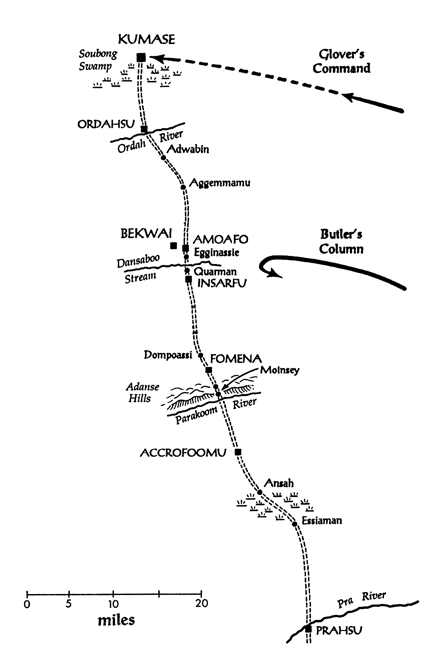
WOLSELEY’S CAMPAIGN ROUTE of 1874
As far as the jungle would permit, a traditional British square would advance along a six hundred-yard-wide front. Royal Engineers and African laborers would do their best to open up the brush enough for the men to move forward. The 42nd Highlanders, bearded veteran troops led by clean-shaven officers who seemed to Henry Stanley to be mere boys, would be in front, closely followed by Rait’s Hausa artillerymen with their cannon and rockets. The front line would be commanded by Brigadier General Sir Archibald Alison, a veteran who had lost an arm in the Crimean War twenty years earlier. The left flank, which would extend very loosely for over two miles to the rear, would be manned by half of the Naval Brigade followed by Russell’s African troops. The right flank, equally long and vulnerable, would be led by the other half of the Naval Brigade followed by Wood’s African brigade. The Rifle Brigade would be the rear guard. Wolseley and his staff would direct the battle from the middle of the square, which would also hold the supply carriers and the 23rd Royal Welch Fusiliers led by their aggressive colonel, the aptly named Honorable Savage Mostyn. Because the serious thigh wound he had suffered years earlier in Burma had been causing him great pain, Wolseley had ridden all the way to the battleground in a rickety American-made buggy pulled by four Africans, but once the battle started, he would be on foot like the other officers.
Lord Gifford’s advance guard once again came under Asante fire at the village of Egginassie, but reinforced by two companies of the Black Watch, he pressed forward until he ran into the main Asante line. By 8:15 A.M. the entire front was engulfed in pungent sulfurous smoke from thousands of Asante muskets. There was no wind, and the smoke hugged the ground, obscuring everyone’s vision. Under the command of Colonel Cluny MacPherson, whose name left no doubt about his Scottish ancestry, the Highlanders did everything men could to press forward against the Asante fire. The sound of the weapons was so intense—the Dane guns booming, the Sniders much sharper—that the Scots could not hear the skirl of the bagpipes that always accompanied them into battle. The Highlanders came under tremendous fire before they could see anyone to fire at, and they began to take heavy casualties. Lying down, they returned fire in the general direction of the Asante smoke, but they could not advance. Sir Archibald Alison, who had campaigned in India and the Crimea, wrote, “The Ashantis stood admirably, and kept up one of the heaviest fires I ever was under.”15 Wolseley’s written assurance that the Asante would never dare to stand against white men must have caused a few dark thoughts among the troops.
After an hour the battlefield resembled a scene from the Western front in World War I. All the bark and leaves had been stripped off the trees, but as usual the Asante fired high, sparing most of the men who were lying down.16 The Asante also launched a series of attacks against the Highlanders’ flanks, forcing Alison to move up his reserve companies. Others climbed trees to fire down on the British, most of whom, except for officers, were now returning fire while lying down.At 9:30 A.M., after an hour and fifteen minutes of intense fighting, Alison sent a messenger to Wolseley, reporting that his reserves had been committed and he was heavily engaged: “The enemy is holding his ground stoutly in the front and left flank; some relief to my men would be advantageous, if possible, from the Rifle Brigade, as they are getting tired from this continuous fighting. Our loss in wounded is pretty severe.”17 If the king of Dwaben had allowed his ten thousand Asante troops to add their fire at this point, it might well have changed the course of the battle. The British infantry had been stopped cold, and they were beginning to waver.
The Royal Engineers were also under heavy fire, and unlike the soldiers, they had to remain standing to cut brush and command the African laborers, most of whom had either thrown themselves down or left the front altogether. Captain Buckle was killed while trying to rouse these men. At the same time the advancing left flank of the Naval Brigade came under such heavy fire that it was forced to lie down and return fire. Wolseley sent a company of the Royal Welch Fusiliers to aid Alison at the front just as Alison’s dispatch arrived asking for surgeons to treat wounded Highlanders. The Asante now opened fire up and down both flanks. At 10:30 A.M. General Alison again reported that he could not advance and asked for half a battalion of the rifles. At the same time Colonel MacPherson was carried back to Wolseley’s headquarters with three wounds, the one in his ankle being incapacitating. He confirmed Alison’s report that the infantry could not advance.
Hard pressed on all sides and with virtually no reserves remaining, General Wolseley was faced with a difficult choice. His men had been stopped in their tracks, casualties were mounting, and Asante fire showed no sign of slackening. He could have fallen back on a nearby village and formed a strong defensive position, but he refused even to consider such an action for fear that it would encourage the Asante to fight even harder. The sound of Asante musketry continued to be deafening, as Wolseley later wrote, but he calmly ordered Major Rait, his favorite artillery officer, to have his Hausa gunners manhandle their cannon across the swamp and fire at point-blank range into the Asante front line. With great effort and many casualties they managed to bring their guns to bear at close range, and their fire of rockets exploded against tree trunks with deafening crashes while their canister and explosive shells caused such appalling casualties that Asante fire began to slacken.
Seizing the opportunity, Alison ordered the Highlanders to charge with fixed bayonets. Unable to defend themselves against bayonets because it took them so long to reload, a portion of the Asante line retreated, drawing other Asante on their flanks back with them to a nearby ridge where they took up another strong position. Rait’s artillery pursued, and once again the Asante front was driven back with great losses. As the Highlanders and Royal Welch moved forward, they passed by hundreds of Asante dead, all so terribly mutilated by the cannon fire that the correspondents who saw them were moved to comment on their horrible wounds. The huge .57-caliber Snider bullets had torn fist-sized holes through the dead, while the rockets and shells had left arms, heads, torsos, legs, and entrails in piles on the ground with blood and chunks of flesh scattered through the brush and trees.
By midday, after four hours of fierce combat, General Alison had pushed his men into the town of Amoafo. Hearing heavy fire on both flanks and knowing that his men were done in, General Alison halted his advance and took a defensive position while he awaited orders from Wolseley. The Asante strategy had always called for allowing the head of Wolseley’s column to advance, although obviously not without stiff resistance, while the crucial attacks would be made on the flanks and the rear of the British army. The Asante flanking armies, especially the one led by Amankwatia, who was desperate to salvage his reputation, continued these attacks without letup, probing for weak spots that they could exploit. At one point earlier in the day, Colonel Wood, on the right flank, had been so annoyed by the inability of his men to advance or even to see the enemy that he rushed ahead and began to push the brush away with his hands. Fortunately for Wood, Lieutenant Eyre, his adjutant, almost tackled him to hold him back because an Asante soldier was in the brush only a few yards away. The man fired and somehow missed as Wood was pulled down. Later, as the Asante fire increased, Wood was hit above the heart with a nail head and fell heavily. The surgeons could do nothing and were so certain Wood would not live that they sent word to Wolseley that Wood was dying. Wolseley adamantly refused to believe them, but the doctor in charge, Surgeon Major Mackinnon insisted, “No, Sir, you never yet saw a man live with a shot in his pericardium.”18 Dosed with brandy, Wood lay on a stretcher guarded by his Sierra Leone servant, who sat beside him armed with a Snider. To the astonishment of the surgeons, Wood recovered and rejoined his command the next day.
At the peak of the fighting, Wolseley strolled about without apparent concern, smoking a cigar, appearing to be wholly fearless.19 Asante slugs were cutting the air all around him, but he shrugged them off, telling his staff that nearly everyone had been hit by a slug or a pebble, usually without harm. However, he later wrote that it was a strange sensation to realize that there were thousands of people trying to kill him and his men, yet none of them could be seen. He also added that if the Asante had been armed with Sniders, the British force would have been annihilated.20 The General was quite impressed by newsman Winwood Reade, who rushed to the front to join the Highlanders’ attack, and by the veteran African explorer Henry Stanley, who was cool under fire and shot back like a veteran, which for all practical purposes he was. But Wolseley called one unnamed newsman a craven coward.21 By 2 P.M. the firing in front stopped, but the Asante now enveloped the British rear and overwhelmed a supply column led by Colonel Colley. The unarmed carriers threw down their loads and stampeded, trampling Colley as they ran for their lives. Troops from the Rifle Brigade and the 2nd West India Regiment arrived just in time to save Colley, but many of the supplies were lost. The West Indians fought gallantly, but Wolseley never praised them, perhaps because his prejudice blinded him to their courage.22 There was no more heavy fighting that afternoon, but bursts of fire continued at various places along the British flanks until sunset.
British officers and newsmen generally agreed that between two and three thousand Asante must have been killed, but to everyone’s amazement, after twelve hours of fighting by over one thousand five hundred British troops and seven hundred Africans against endless Asante fire, they had suffered only four dead, three of them British. However, there were at least two hundred wounded, many of them in serious condition. Surgeons worked throughout the day and into the night extracting slugs, nails, and a few Snider bullets (usually the unintended result of British troops being unable to see one another’s positions) and bandaging wounds as best they could. The British doctors had morphine and used it liberally, but many of the wounded were nevertheless in great pain. Observers were struck by how well they endured their suffering. When one young lieutenant was carried in with a severe shoulder wound, a surgeon left a wounded Hausa soldier whom he had been treating to attend to the British officer. The officer refused to be treated until the doctor had done his best for the wounded African.23
Even before rations were handed out, rum was served to the troops and brandy to the officers. The general’s sense of victory overcame his insistence on a dry campaign, but class distinctions were, of course, maintained. Soon after, torrents of rain and tornadic winds struck, the first serious storm since the British force had invaded Asante land. The troops had no tents or cover of any kind, no fires could be made to burn, and the ground soon became a morass of mud. The wounded lay uncovered on their stretchers all night in misery that it would be difficult to exaggerate. The engineers were equally miserable as they worked throughout the night to bridge a rapidly rising stream that the army would have to cross the next day. Everyone in camp went without sleep, and few men even bothered to lie down in the mud. Wolseley called the rain the heaviest he had ever been under.24 He was greatly concerned about his exhausted men but still determined to march on Kumase in the morning.
The Asante army spent an equally miserable night, although not for quite the same reasons. Many were able to find shelter from the rain, and the old campaigners were accustomed to rain, mud, and the lack of cooking fires. They were dispirited more by the knowledge that British firepower was too destructive to stand against than they were by the elements. Their greatest concern about the rain was keeping their powder dry. If the rain continued into the next day and the British advanced as they were expected to do, their ancient flintlocks would be extremely difficult to fire. The Asante were also disturbed by the heavy losses they had suffered. Many were seriously wounded, including the king of Mampon, and General Amankwatia had been killed. To inspire his men to fight harder, the general had stood on his stool, an act that was intended to make his men fight more fiercely. As he exhorted his men, he was shot through the back and died on the battlefield.25 Their morale did not improve when it was rumored that King Kofi Kakari had left the battlefield early in the day.26 When the decision for war was made in 1873, King Kakari had ordered his retainers to recite praise songs for his martial valor. His favorite was, “Kakari the hero, the champion who will fight at the cannon’s mouth.” Although far in the rear during the fighting, actual cannon fire did not please him. He fled with a few slaves whom he then had executed in a vain attempt to prevent word of his cowardice from spreading. His actions were widely considered to bring disgrace to the Asante nation.27
In Kumase a fearful populace was making ready to flee, and they were not pleased when the severed head of a Highlander was triumphantly displayed. Many worried that this was a bad omen. This Scottish soldier, whose name is unknown, resisted his death so resolutely that the fingers on his hands were found to be almost entirely severed as he tried in vain to prevent the Asante from taking his head by fending off their knives.
After the terrible night of deluge, the British were not able to organize themselves to advance until one the next afternoon, giving the Asante time to fortify the next town along the road to Kumase and dry their powder. Houses were loopholed, and a huge tree trunk was dragged across the road. When the British advanced, fire from the houses and the tree wounded seventeen of Gifford’s scouts, and he was forced to withdraw. With the help of artillery fire, men of the Naval Brigade were able to drive the Asante back, but one sailor was killed and several wounded. At the same time, supply convoys in the rear of Wolseley’s army were harried by a series of attacks. Many of these carriers had been ordered to carry wounded back to Cape Coast, but when they were fired on by the Asante, they dropped their charges and fended for themselves, to the great suffering of the wounded men. One large group of African carriers refused to carry even their own wounded, insisting that it was customary for them to leave wounded men behind to die. Colonel Wood who had argued and pleaded with them to no avail, finally had their leader flogged “until I was nearly sick from the sight.”28It was not until he had given a second man twenty-five lashes, a terrible, back-scourging punishment, that the African carriers finally agreed to carry their own wounded away.
Wood was concerned by another problem common to his African militia: they insisted on carrying everything balanced on their heads—rifles, ammunition, cooking pots, blankets, food, and what all. Whenever a shot was fired from the bush, the men ducked, and everything fell down with a crash, leaving them defenseless until they could crawl around and recover their weapons. Wood solved the problem by ordering them to wear military crossbelts on which their equipment could be neatly hung. One man refused to comply and continued to carry everything on his head. Wood fined him, to no effect; so he called a doctor to witness punishment and ordered the man flogged. His comrades implored Wood not to carry out the punishment, but Wood explained that the man must obey orders. Frustrated and puzzled, he asked the man why he would not obey orders and was told that the belts were painful. Wood examined the man and to his horror found that he had a gaping slug wound in his chest into which he had shoved a wad of grass. Wood and the doctor were properly impressed. The doctor treated him and the man was not punished.
Wolseley’s army spent the night of February 1 in a large, comfortable town that impressed the officers with the beauty of the bas-relief ornamentation of its houses. It provided ample, clean, and comfortable housing for the exhausted men.Correspondent Henty of the Standard found the Asante houses so well made and their furniture so finely carved that he could not comprehend how these people could endure the rigors of campaigns in the unforgiving jungles near the coast.Perversely, that night, when the troops had cover, there was no rain. Much better rested, the troops moved out at daybreak on the second. After crossing a river on a bridge elegantly built by the always remarkable engineers, they encountered a series of ambushes, but the Asante opened fire at such long range that they did no damage. The British returned fire but made no serious effort to attack. Earlier in the day the Asante had made an attack on the main British supply depot, an attack so ferocious that the carriers now refused to leave the fortified camp. Short of supplies, Wolseley camped in the early afternoon, hoping that a convoy would reach him. When he learned that night about the disruption to his supply system, he made the audacious decision to attack Kumase with no more than his troops could carry. This meant that he would have to get to Kumase and back to his supply dump at Fomena in five to six days without expending too much ammunition. Colonel Wood concluded that no other British commander would have had the confidence and courage to make this decision.29 Wolseley had both, but he also knew that with the rains now upon him, he could not long afford to be on the wrong side of flooded rivers, nor could he safely expose his troops to malaria for much longer. He took the gamble.
Wolseley’s advance guard moved out early on the third and quickly encountered heavy Asante opposition. British artillery fire drove them back, but they re-formed again and again, and the firing continued while the British slowly advanced north on the road to Kumase. At mid-afternoon an Asante messenger arrived carrying a white flag of truce designed by Joseph Dawson. The gold-breastplated envoy presented Wolseley with yet another disjointed appeal to halt and negotiate but did nothing to comply with Wolseley’s demands. Dawson, in fear of his life, wrote a separate note appealing to the general. He insisted that the king now truly wanted peace, that the Asante were beaten, but that members of the royal family could not be handed over as hostages and the king needed time to raise the gold. All this was true, but Wolseley sent back a brusque note rejecting the king’s request, and he ordered his troops to press on. (This time he said nothing about being the king’s true friend.) That night they camped on the south bank of the formidable and rapidly rising Ordah River. Heavy rain fell all night, and as the Royal Engineers worked to bridge the river, the rest of the troops tried, without any semblance of success, to stay dry by crouching under large plantain leaves. It was another sleepless night.
At dawn the men tried to dry themselves around large fires, but few succeeded. Soon the scouts were across the new bridge, and the main body followed. Asante prisoners had said that an army of ten thousand men was ahead of them but that it was under orders not to fire unless fired on.30 As the British advance approached, however, the Asante opened a deadly fire that stopped the white troops in their tracks. The Rifle Brigade was sent forward, but it could not advance either. As the men lay down to exchange fire, the Asante launched a strong attack against the Highlanders on the British right flank. The attack was so persistent that Wolseley was worried, but once again, when artillery was brought into place, the Asante attack was held off. Wood’s adjutant, Lieutenant Arthur Eyre, was standing upright as most officers did, but the firing was so heavy that Wood told him to kneel down. He had no sooner done so than he was shot through the bladder. Despite morphine he was in such agony that a shaken Wood, who loved him like a son, was relieved when he died two hours later, his last wish being that his rings be given to his mother.31
While Eyre lay dying, the battle was not going well for Wolseley. Russell’s African regiment in the front wavered, firing aimlessly, and even a company of the Black Watch lost its discipline and fired wildly at nothing. Amid loud singing, cheering, and drumming, the Asante pressed attacks on both flanks with such determination that the usually staunch Rifle Brigade also began to lose its composure. The Asante charged so close to the British lines that officers shot them down with their revolvers.32 One officer who saw an Asante unit in the open was astonished to see that they marched in perfect order, their muskets all held at the same angle. He said that they were “disciplined, under command and well in hand.”33 As casualties mounted, Colonel John McLeod, or “Old Jack” as he was better known, rushed about giving a copy of the Book of Psalms to wounded officers. McLeod’s faith in the healing powers of the Scriptures was so well known that many officers found his actions hilarious. One seriously wounded officer had such a laughing fit when McLeod approached him that he claimed it stopped his bleeding and saved his life.34
Just as Wolseley had decided to send the Highlanders to the front to replace the shaken Rifle Brigade, a slug hit him in the head with enough force that it knocked him down, but the thick leather strap on his helmet deflected it enough that he was able to carry on. The bearded, sweat-soaked Scotsmen, their numbers now reduced by 25 percent, moved up the road toward yet another Asante roadblock, an immense tree that sheltered riflemen. This time they did not wait for Rait’s artillery. With their pipers playing as loudly as possible, their officers leapt up and led the cheering men on a bayonet charge that broke the Asante line. After two hours of valiant fighting, the Asante finally fled, leaving behind chiefs’ umbrellas and war chairs, drums, muskets, powder, and many dead and wounded. The Black Watch attack was so successful that the men trotted and walked forward for four miles, firing as they went, before sheer exhaustion forced them to a halt. As the Scots rested, they congratulated themselves on a fine fight, although one man insisted that if they had been able to wear their traditional green coats and their “kilts and bonnets,” they would have routed the Asante easily. They also discovered that all had been hit by Asante slugs and compared their cuts and bruises with good humor, except for one man whose beard had been partly sheared off by Asante fire. He complained that his girlfriend would be furious about the loss of his “manhood.”35
At 1:45 P.M. General Alison sent word to Wolseley that the road was open and that if he were supported from the rear, he would be in Kumase that night. When Wolseley shared this news with his men, they erupted in an enormous cheer, and those Africans among them who could speak Asante shouted the news as loudly as they could. The Asante gunfire on the flanks immediately halted. Knowing that the battle was lost, the Asante began to withdraw toward Kumase on parallel paths to the road that the now-triumphant British hurried along.36 The Black Watch, now led by Colonel John McLeod and followed as closely as possible by Sir Archibald Alison, reached the outskirts of Kumase at 5 P.M.
Many Asante greeted them by saying “thank you,” the only English they knew. They were also greeted by a high-ranking Asante officer in a leopard-skin uniform, who begged the scouts to stop and allow for a proper truce. Because his men needed a rest, Sir Archibald agreed. He needed one as well. Only a few minutes earlier as he was riding across the fetid swamp that lay before Kumase, his wretched mule slipped, pitching the general into the vile water before collapsing on top of him. The one-armed officer was vainly trying to extricate himself when his adjutant came to his rescue. Covered with fecal-smelling water, he tried to gather his wits and his dignity while his men restored their strength. All the while, Asante soldiers with loaded guns stood nearby, their faces contorted by anger. The British soldiers were nervous until Asante officers spoke to the men and they reluctantly moved away.
At 5:30 P.M., less than an hour before darkness would fall, Alison received Wolseley’s order to move into Kumase. His men were greeted by large crowds of credulous Asante eager to see the white men. A court buffoon danced and tried to amuse the British by kissing them, a courtesy that was not well received. It was a tense moment as the advance guard of Highlanders, who numbered only 340 men at best, moved along, surrounded by several thousand Asante soldiers whose numbers increased by the moment. The powder-stained men were all fully armed and clearly capable of further hostilities. As Alison and McLeod looked on, hundreds of men and women passed by them carrying food, powder, guns, and boxes on their heads. The British conquerors could do nothing to interfere.
Shortly after six Wolseley rode into Kumase on another less-than-splendid mule followed by his staff and very eager newsmen. For reasons that are still unclear, when British envoy and interpreter Joseph Dawson met Lieutenant Lord Gifford on the outskirts of Kumase, he did not lead him to the king’s palace as ordered but instead took him on a thirty-minute wild-goose chase that ended with Gifford threatening to shoot Dawson and Dawson claiming to be confused. It seems likely that the avaricious Dawson had been paid to delay the British as long as he could. As a result, much of great value could have been removed from the palace before the British could find it. When the British did locate the palace, they quite inexplicably did not place guards around it.37
As the remainder of Wolseley’s force of barely more that one thousand white troops made their way into Kumase, he ordered sentries posted on all avenues of approach to the central square, where he billeted his men. He sited cannon to command every street that hostile Asante soldiers might use in an attack, something the seemingly terrified Dawson had warned him was very likely to take place that night. Large supplies of gin were discovered, and when medical officers declared it to be fine Hollands gin, it was served out to the troops, a greatly appreciated reward for taking the city. At 8 P.M., well after dark, Wolseley sent a messenger, whom Dawson had provided, to the king, assuring him that if he returned to Kumase to make peace, his palace and the city itself would be left untouched. But he also warned the king that if any Asante were to shoot at the British troops, the city would be burned and everyone in it killed.
By Wolseley’s order the Fante prisoners were located and freed, often to touching scenes of kindness as Fante carriers tenderly ministered to the wounds of their long-fettered and mistreated countrymen. Wolseley also decreed that anyone found pillaging would be executed. The general’s orders notwithstanding, the city soon burst into flames as the newly-released Fante prisoners wreaked vengeance on their captors, whose powder-filled houses caught fire and exploded. As the fires spread, engineers and troops were called out to pull down neighboring houses in an attempt to contain the blazes, but parts of the city burned all night. Against orders, pillaging also took place. Several carriers caught looting were flogged, and when a seventeen-year-old Fante policeman was caught with a stolen cloth in his hand, he was promptly sentenced to death. The young man was hanged from a tree, but his hangmen neglected to tie his hands. His agonizing efforts to avoid strangulation were so loud that many people rushed to the scene. Let down, he was hanged again, but the rope was now tied across his mouth to silence him. It took another 15 minutes of appalling agony for him to die. Asante who witnessed this event were disgusted and later pointedly wondered why the British thought the Asante’s method of executing their criminals was so barbaric.38
The execution did little to prevent arson or looting that night because very few men were aware that the hanging had even taken place, but it served some small purpose the next morning. When Captain W T. Dooner marched his African soldiers from Russell’s brigade past the hanged man, he warned them that they would suffer the same fate if they were caught looting: “To my amazement they then emptied their haversacks on the road, and out came beautiful silks and cloths of all kinds, and there we left them.”39
Despite their exhaustion few among the British invaders, including General Wolseley, slept more than a couple of hours that night. The exciting strangeness of Kumase and the uncertainty about what tomorrow would bring preyed on their minds. Their sleep was also disturbed by the nauseating smell of putrefying human flesh that came from the nearby “place of the vultures” where the headless torsos of executed Asante were left to rot. The smell was so offensive to the British that they lit fires hoping to cleanse the air, but to no avail. In this predeodorant age these men had not bathed or changed their filthy, sweat-encrusted uniforms for many days; still, this new odor was too much for them.
Everyone was awake before daybreak, eager to see more of the exotic city. Though Wolseley still hoped that the king might return to Kumase and agree to peace terms, he feared that the fires set last night had made Kofi Kakari even less inclined to trust him than before, and he was right.40 Wolseley was only too aware that if the king did not return to Kumase soon, the heavy rains and the lack of food would compel him to march back to the coast the following day. It was not yet clear what the valor of his men had won for him.
Wolseley began the next day by issuing an order praising his troops for their courage and devotion, which, he said, had “been rewarded with complete success.”41 As his officers well knew, success was far from being complete. Wolseley had enough food for his men to remain in Kumase for at most two days; but as he looked at the leaden, drizzly sky, he could not avoid worrying about the swollen rivers in his rear. More heavy rain seemed to be on the way, and he feared that his army could be trapped.42 He was also greatly troubled by a shortage of hammocks for carrying his sick and wounded. If he had to fight another battle, he would not be able to carry them all. His only option was to find some way to lure King Kofi Kakari back to Kumase to sign a peace treaty in a day or two at most or withdraw without a fight and without a treaty.
While he waited for word of the king’s intentions, the general and some of his staff officers visited the still-unguarded palace. It was obvious at a glance that much of value, including the gold dust, had been removed during the night. They nevertheless noticed boxes and crates filled with silks, gold and silver treasures, leopard skins, and many curiosities of European manufacture, including a music box that played “O rest thee babe” and “Adeste Fideles.” They also found many enormous umbrellas, some of the king’s pet cats (a passion that Asante kings had maintained throughout the century), and his huge four-poster bed, covered in silk. Offended by some ritual objects and a number of executioner’s stools covered with clotted blood, Wolseley stayed only long enough to glance around. Belatedly he ordered that a guard be placed around the large building. It took one hundred men to guard all the entrances.43
As the clouds darkened ominously, some of the newspaper correspondents explored the deserted city, which was so large that one of them believed it would ordinarily have held forty thousand people.44 Yet anyone who had seen it in Bowdich’s time would have found it badly down at the heel. All of metropolitan Asante had suffered a population decline, and Kumase was no longer the imposing capital that had dazzled earlier European visitors. While these men were exploring the empty city, various Asante messengers arrived bringing word that the king was on his way. Wolseley was cautiously delighted, but time passed and the king was nowhere to be seen. However, two of these high-ranking messengers were later discovered gathering guns and ammunition to be carried out of the city. They were placed under arrest. Frederick Boyle, special correspondent of the Daily Telegraph, recorded the following anecdote about one of these messengers:
One of them is a prince, whom we call Bosomnogo, the most courteous and charming of savages. Tied to him is a captain, Cocoforo…. Both of them were captured in the act of removing guns and powder from the palace, after bringing to the General a message from the King. The prince has an excellent face, very good-looking and intelligent. There is something quite high-bred about his manner, but the Ashantees especially pride themselves upon their courtesy. When taken, he wore a bracelet of strung nuggets, sandals heavily plated with gold, and in his hand a bag of dust worth nearly £500; so, at least, he complained to Monsieur Bonnat. Both he and the captain were dressed in clothes of native manufacture, strikingly clean, and arranged like an ancient toga. They were white, handsomely marked with a blue pattern. The prince showed himself particularly indignant at the manner in which he was carried down. “Here am I,” said he to Monsieur Bonnat, “a prince of Ashantee, tied like a slave to one of my captains. That third man is only a warrior! It is infamous!” Monsieur Bonnat reminded him that the Ashantees had kept their prisoners, whites and one a woman, seven weeks in irons, without any cause at all. But an Ashantee prince could not see the parallel.45
More messengers arrived to declare the king to be on his way, but by then even the ever-hopeful Wolseley knew that the game was up. Shortly after noon the city had been inundated by thunderstorms that knocked over the troops’ newly arrived canvas tents like houses of cards and left everyone thoroughly intimidated by the fury of tropical rain and wind. By mid-afternoon the general made his decision. He sent so-called prize-agents to the palace to remove everything they could that was of value. Led by intelligence officer Captain Redvers Buller, these men spent all night removing valuables while nursing the only four candles they had. They found pure gold masks, one weighing forty-one ounces that represented a ram’s head and other smaller ones representing men and other animals. There were necklaces and bracelets of beads, gold and silver, silverplate, swords, gold- and silver-embossed cartridge belts, caps mounted in solid gold, stools mounted in silver, calabashes covered with silver and gold, silks, and all manner of European gifts from earlier times. The prize-agents worked throughout the night, and although it took thirty Africans to carry away the loot, they were still unable to remove everything of value.
While these exhausted officers robbed the palace, Royal Engineers obeyed Wolseley’s orders by mining the building so that it could be completely destroyed. While these destructive steps were being put in place, the rain continued to pour, and the British troops sought shelter without much success. As the day passed, it became obvious to everyone that the king had no intention of negotiating with General Wolseley, and it was not only those closest to the general who realized how much this refusal compromised the complete victory Wolseley had announced. Winwood Reade reported that every officer he spoke to expressed disappointment because the king had not capitulated or paid even an ounce of gold. They were also concerned that if the Asante army attacked them as they withdrew from Kumase, it would appear that they had been driven out.46 It was a cold, wet night spent in largely sleepless despondency by the British staff officers. They had won Kumase but not the peace. Unless there was a miracle, tomorrow the general would order the destruction of Kumase, and they would all march back to the coast, possessors of a Pyrrhic victory at best. If they were attacked, there might be no victory at all.
At daybreak Wolseley ordered the mines to be fired, and they went off in a spectacular eruption. Unfortunately, the walls of the palace were still standing, but engineers confidently said that they were too badly damaged to do so for long. At the same time troops were ordered to deploy throughout the city with firebrands, torching the tinder-dry undersides of the houses’ roofs. Within minutes the city was an inferno. Wolseley believed that destroying the palace and the city would demonstrate British might and Asante weakness. Brutal as these actions were, they would prove to have the desired effect. The Asante were appalled by the destruction of the city. While Kumase was being burned and the palace destroyed, many high-ranking British officers paid a visit to the place of the vultures. Holding their noses, they found an area at least an acre in size filled with bodies in various stages of decay. On top of uncountable numbers of skeletons and partially decomposed bodies, lay fourteen bloated bodies, including at least one woman and a child, all writhing with worms. Disgusted, the white men quickly left.
By 8 A.M. the troops began to move out of Kumase toward the coast, and by nine the rear guard of Highlanders had left the burning city. The first obstacle they came to was an expanse of water two hundred yards wide that had been a narrow stream only three feet deep when they crossed it three days earlier. With the help of a large tree used as a bridge, the troops managed to wade across. The river Ordah, which they came to next, was even more difficult to cross, as Wolseley had feared. Remarkably, the bridge the British engineers had built was still standing, even though the flood waters were two feet above it and still rising. Most men made it across the bridge, but it collapsed before the 42nd Highlanders reached it, and they had to strip naked and swim across, with their clothes and equipment being carried by Africans. It was nightfall before all the men were safely on the south bank of the river. With fires blazing, they spent the night in relative comfort in a large, well-fortified camp that had been constructed while they were in Kumase.
The troops that marched south the next day were happy to be headed home, but in addition to the hundreds of sick and wounded who had to be carried, many had minor but painful wounds, and others suffered from fever and dysentery.The rough joking that had earlier taken place around the subject of men suddenly plunging off the road to empty their bowels had long since ceased. Some men openly wondered what they had accomplished by their gallantry and suffering.They were a victorious army, but when they camped at the end of the day’s march, there was no singing. To the Asante, who could not understand why the British were retreating, the long column of tired, filthy, and increasingly glum men looked more like a vanquished army than a victorious one. Wolseley could not help worrying about the reception he would receive in England if many more of his exhausted men fell ill on the return march.
But on the nineth of February, Wolseley was blessed by an apparent miracle. To everyone’s surprise a messenger from King Kofi Kakari arrived in camp with an offer to accept Wolseley’s peace terms. He begged the general to halt Captain Glover’s forces, which he said were advancing toward Kumase from the east. Wolseley, who had all but forgotten the seemingly inert force that Glover was attempting to lead, was astonished but somehow managed to maintain his imperious poker face. He agreed to remain in camp at Fomena until the night of the twelfth, and if the king sent him a down payment on the indemnity of fifty thousand ounces of gold dust, he would sign a treaty of peace and order Captain Glover to halt. The messenger returned in haste while Wolseley and his staff were left to wonder what on earth was happening. To the best of Wolseley’s knowledge, none of the three British officers who had attempted to mount diversionary attacks had been able to achieve anything. A captain named Dalrymple had run into a stone wall of fear and indifference as he tried to raise an army and had long since been written off as a threat to Kumase. Glover’s dispatches had been promising great things, but so far his activities were largely unknown. And much more had been expected of an African force raised by Captain W P. Butler.
Butler was a physically powerful, adventurous man who had served with Wolseley in Canada and was one of the general’s most trusted officers. In 1873 he had crossed Canada from east to west by dogsled and foot, then hiked down the Pacific coast to San Francisco, where he learned of the impending Asante expedition and rushed by train to New York and by ship to London in order to join Wolseley again. Wolseley gave him the unenviable task of raising an African army from the people to the east of Cape Coast and marching this force northwest toward Kumase on a path parallel to the one taken by Wolseley. Despite his gifts of rum and gunpowder, his promises of plunder, and the force of his personality, it was only with the greatest difficulty that he was able to assemble some one thousand four hundred armed men like the one he described as follows:
He was a large powerful negro, armed with a flintgun; he was utterly destitute of clothing, unless a square black Dutch bottle could be construed into a garment…. The gun was balanced upon his head; the bottle was worn after the manner of the Old Hussar jacket, suspended from the left shoulder. His whole appearance fulfilled the requirements of what is termed “an Irregular.” He was, I think, the most irregular-looking soldier I had ever seen.47
By January 30, as the battle of Amoafo was about to begin, Butler managed to cajole his irregular army to a position only a few miles southeast of the town, when suddenly “a complete panic” took place and the entire force fled, leaving Butler alone and completely unable to support Wolseley.48
While the sick and wounded continued to be carried to the coast, Wolseley remained at Fomena, hoping that the king’s latest peace offer was not another delaying tactic to allow the Asante army to regroup and attack. The tenth was spent in growing anxiety as no word came from the king. The eleventh was equally silent and even more nerve-wracking. Though there was no messenger from the king, Wolseley could take some comfort from the reports of his scouts that they could find no sign of the Asante army; so perhaps the king’s message was not a ruse to hold the British in place until they could be attacked. The morning of the twelveth passed without event until noon when, as Wolseley’s staff sat down to lunch, an exhausted British officer on an emaciated horse staggered into camp at the head of twenty Hausa soldiers, who somehow had kept up with his pony on foot! The officer was Captain Reginald Sartorius of the 6th Bengal Lancers, whose previous reputation for great bravery would not be diminished by his amazing ride.
It seems that Captain Glover’s force had been thoroughly blocked by an Asante army of between five thousand and ten thousand men under the king of Dwaben. The loss of this powerful army against Wolseley’s advance was critical, but the men from Dwaben had nevertheless managed to play an important role in the war by preventing Glover’s advance. Several small battles took place without success for Glover, whose men took some serious losses. On February 2 Dwaben scouts discovered that the body of Glover’s army, which was only then ready to attack, consisted of men from the Akyem Abuakwa kingdom, with which Dwaben had a reciprocal peace treaty that forbade them to fight each other. The troops from Dwaben promptly withdrew, and so did Glover’s Akyem men despite Glover’s best efforts to restrain them. Left with his surviving Hausas and a couple of thousand Africans from other tribes, Glover cautiously moved ten miles closer to Kumase before camping on February 10 at a place he estimated to be seven miles east of Kumase. Deeply concerned about the condition of his nearly starving troops, he sent Sartorius to Wolseley with a message that he would remain where he was until he received further orders. He added that his men had been given only one ounce of salt meat a day since the eighteenth of January and that Captain Sartorius had done “excellent and hard service.” Leaving without provisions, Sartorius and his Hausa escort set out for Kumase, finding that it was not seven miles away but eighteen. He was fired on but pressed ahead and slept that night in the bush four miles from Kumase. The next day, the eleventh of February, he entered Kumase, finding it deserted except for a few apparent looters, who fled when he approached. Moving on, he met an Asante woman who told him that the king and his soldiers had entered Kumase and were anxious for revenge. He reached Amoafo that night to find that it too was deserted. The next day, having traveled fifty five miles without food and very little water, he found Wolseley.
Wolseley and his staff fed the famished Sartorius and his men, but after the excitement of his arrival wore off, they still waited impatiently for the king’s messenger. What they did not know was that at 1 P.M., as they were eating, Glover’s force had entered Kumase. Horrified by this new invasion, the distraught King Kofi Kakari and his councillors decided that further delay was impossible, and they sent messengers to Wolseley with some gold dust. It was dark before two gold-breastplated envoys accompanied by a suite of carriers arrived at Wolseley’s camp. There followed one of the least dignified treaty signings on record.
First, the envoys blithely declared that they had only one thousand ounces of gold with them and that no more was available. They then asked to see Joseph Dawson, who first pocketed some of the gold, then oversaw what followed. The Asante envoys had brought not only gold dust—which was carefully scrutinized and weighed by a gold tester from Cape Coast who somehow happened to be with the general—but many solid gold masks, ornaments, and nuggets as well. The British gold tester weighed and inspected everything while Dawson, the ever-present former hostage Bonnat, and various Fante assistants kept up a spirited dialogue worthy of the most raucous fish market in East London. What little dignity remained to either side was lost when the British inspected the folds of the Asante envoys’ garments in a search for more gold dust. In fact, they found an additional forty ounces.
Finally convinced that there was no more gold to be had, Wolseley called these demeaning proceedings to a halt and sent back a draft of his treaty to King Kakari for his signature. Amazingly, the signed treaty was quickly returned, and Wolseley was triumphant. The Asante king had made his submission and the general could not be happier. When Glover received Wolseley’s dispatch telling him that a peace treaty had been signed and to halt hostilities, he was only too happy to march south where food was waiting. Wolseley, wasting no time waiting for Glover or smoothing his way, marched off toward the coast as rapidly as possible, leaving Glover’s wretched men to their own devices. Glover’s eleventh hour actions had saved Wolseley’s campaign, but sharing the glory with Glover was not one of the general’s priorities. Not only did Wolseley do nothing to thank Glover at the time, his memoirs pointedly ignored Glover’s vital role in the peace process. As one of Wolseley’s biographers later observed, they were not the best of friends.49
Wolseley was convinced that by signing this treaty, the Asante would lose their ascendancy. That indeed appeared to be the result, as it soon became apparent that the coastal people were greatly encouraged. Of course, their confidence was likely to be fragile at best. As the British forces crossed the Pra River, they met a Russian prince, well known in London, who was hoping to participate in great events. He was, as he put it, “just in time to be too late.” The returning British troops, on the other hand, were just in time to receive a glorious welcome at Cape Coast, complete with a triumphal arch of flowers, townspeople singing hymns, and a salute from the ships offshore. While the troops were ferried out to waiting ships, the valuables taken from the king’s palace were sold at public auction. Wolseley personally bought the king’s crown and orb, which his daughter later used as a rattle, and a Georgian silver coffeepot. All told, the palace’s treasures sold for less than £5,000, a trifling amount compared to what could have been raised if the sale had been held in Britain or Europe and a tiny fraction of the cost of the campaign, about £900,000.
The cost to the British in men was regarded by the War Office and the public as quite low. Still, sixty-nine had been killed and some four hundred wounded, 135 of these from the Black Watch. Over one thousand men had to be invalided home due to wounds or disease. Seventy-one percent of the army units had suffered some form of severe illness, and 95 percent of the Naval Brigade had done so. Of the thirty officers who sailed to the Gold Coast with Wolseley, seven were dead and seven others wounded. The only one who had not been incapacitated by fever or diarrhea at least once was Lord Gifford, who had not been sick at all. For conspicuous bravery Wolseley recommended him, along with five others, for the Victoria Cross.50 One so decorated was Lance Sergeant Samuel McGaw of the Black Watch, who had led the charge at Amoafo, and Captain Sartorius (the son, incidentally, of a prominent admiral), whose brother had been awarded a Victoria Cross in an earlier battle.
The first troops to return home to a tumultuous welcome were the Royal Welch Fusiliers. Through no fault of their own, they had seen little combat but had suffered a greater percentage of casualties from disease than any other battalion.Next to return were the 42nd Highlanders, who were delighted to be wearing their bonnets, kilts, and green coats once again. They were received with even greater enthusiasm. 51 When the Rifle Brigade arrived, there were feasts, balls, and honors all over the country. Every officer was decorated and almost all were promoted.
One member of Parliament was not impressed by Wolseley’s campaign, saying that it reminded him of the famous rhyme,
The King of France with twenty thousand men
Marched up a hill and then marched down again.52
However, most in the government could not be happier that their faith in Wolseley had been vindicated. Disraeli and Gladstone competed with each other in search of ever more extravagant words of praise for their general, and the country joined in. Queen Victoria reviewed those troops able to leave the hospital in Windsor Park and bestowed the Grand Cross of the Order of St. Michael and St. George and a Knight Commander of the Bath on General Wolseley. He was also offered a baronetcy, which he contemptuously refused; he expected soon to be offered a peerage and become known as Lord Wolseley of Kumase.53 The lord mayor of London presented him with a sword of honor, both the universities of Oxford and Cambridge awarded him honorary degrees, and the House of Commons made him a personal grant of £25,000, a phenomenal sum at a time when a fine riding horse could be purchased for £20. When Captain Glover returned to England some weeks later, all he received was a word of thanks from Parliament.
“So ended,” Wolseley was later to write, “the most horrible war I ever took part in.” So ended, too, by far the luckiest of his many campaigns. If the disgruntled King of Dwabin had not withdrawn his ten thousand men from the battle of Amoafo, Wolseley could have been stopped cold or, at the very least, accumulated so many more casualties that he could not have carried them. If the Asante had attacked as he marched back to the coast, he would have had the same problem; and if the king and his inner council had not panicked at the forward movement of Glover’s almost starved force by unnecessarily sending gold dust to Wolseley and signing a treaty, it is likely that Wolseley’s campaign would have been reckoned a failure. As British correspondents and members of his own staff acknowledged, despite his many brilliant preparations for the campaign, Wolseley’s utter failure to anticipate the need for more African laborers delayed his march inland by a full month, putting him into the drenching start of the rainy season, when despite the great bravery of his officers and men and the luck of Glover’s advance, he was within an ace of defeat.54