
Chapter 3
After the massive losses on Crete the 7th Flieger Division made its way back to Germany for much needed rest, refitting and reinforcement. The Germans launched Operation Barbarossa in June 1941, but without the use of the Fallschirmjäger. However, their deployment to Russia was imminent. By the end of September 1941 parts of the division were already being sent east; this time to operate as conventional infantry.
The 1st Regiments 1st and 3rd Battalions, along with the 2nd Battalion of the Sturm Regiment, were sent for duty on the Leningrad front. It was a problematic part of the front for both the Germans and the Russians. The 2nd and 3rd Battalion of the 3rd Regiment arrived on 1 October and the division’s headquarters arrived in the mid-October. Other units began trickling into the region.
The Russians were desperate to break through to Leningrad to ra raise the siege. The fighting was extremely heavy and by December 1941 the casualties had been so high that the Fallschirmjäger in the Leningrad area was pulled out and returned to Germany.
The 2nd Regiment, of which Plieschen was attached, had been held back as a reserve. They were sent in November 1941 to join Army Group South, fighting in the Ukraine. The winter had put a stop to the German advances and they were now on the defensive. The Russians were launching attack after attack in the region. Army Group South found itself spread out across the whole of the Ukraine. The 2nd Regiment became part of an ad hoc battle group, or Kampfgruppe, along with the 4th Battalion of the assault regiment, a company from the anti-tank battalion and, of course, the machine gun companies. Sturm commanded the unit himself and they were ordered to defend a sector that ran along the River Mius, close to the town of Charzysk. They would defend this whole area throughout the winter off 1941 and into the early months of 1942.
In March 1942 the 2nd Regiment was moved from the south to the Volkhov area of the front. This was where the 1st Regiment had fought in the previous year. The regiment came under the command of the 21st Infantry Division. It was a very bad time for them to be moving to the area; the Russians were regrouping and about to launch a massive offensive aimed at breaking through to Leningrad.

What must have been a rude awakening for the Fallschirmjäger, having suffered a harsh environment in Crete only to be followed by the opposite in weather conditions in snow-covered Russia. This is probably around the Stalino area, which is now in the Ukraine. Field Marshal von Rundstedt was tasked with the capture of the Ukraine and the Crimea, as his part of Operation Barbarossa. The forty-six and a half divisions under his command attacked on a front of 800 miles, beginning at 0100 hours on 22 June 1941. By the time the Fallschirmjäger units began to arrive in the region Army Group South had already overrun Kiev, Odessa, and Kharkov. The Fallschirmjäger, operating as infantrymen, bore the brunt of the fighting. It was they that secured ground and then held it.
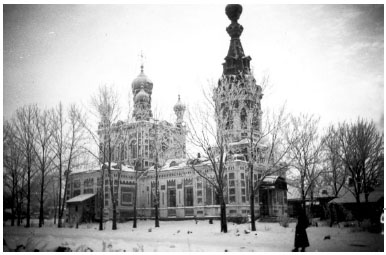
An unidentified Russian Orthodox Church is shown in this photograph. At Kiev alone the Germans had taken 665,000 prisoners. However, the fighting around this part of the Ukraine was extremely bitter. Under the command of Sturm the unit fought around Stalino (Donetsk). This city was virtually destroyed during the war. In 1941 it had had a population of over 500,000; only 175,000 remained after the war. We also know that the unit fought at Woroschilkovka (Woroschilowgrad), Ivanovka and Petropawlowsk. We also know that a second Kampfgruppe, under Meindl, was formed from the 1st Battalionon of the 2nd Regiment. It included the assault units, under Major Walter Koch. This force was sent to cover the town of Vyasma, some ninety-five miles to the east of Smolensk.

This is an intriguing photograph of the paratroopers, presumably in a period of thaw in Russia. This photograph may have been out of sequence in the photograph album, as it is certain that by the time the 2nd Regiment arrived in Russia there was already heavy snow. Kampfgruppe Meindl was joined by scattered groups of Wehrmacht and SS units that had suffered heavy casualties. It is not clear precisely where the machine gun company was deployed at this time; it either remained with the bulk of the 2nd Regiment, on the River Mius close to Yuknov, or was part of Kampfgruppe Meindl. A series of battles developed around this area, as the Russians launched a major counteroffensive. For several weeks the paratroopers held back the onslaught, being reinforced by Kampfgruppe Meindl. Ultimately the Soviet high command halted the attacks due to the enormous casualties.
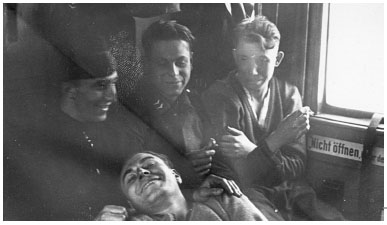
In all likelihood this is a photograph of the unit being transferred north to the Volkhov area in either March or April 1942. Here they would fight in the same area near Leningrad where the 1st Regiment had been in action in 1941. The 2nd Regiment was to be deployed around the small town of Lipovka. What is confusing about the deployment of the particular units is that there are references to the 2nd Company of the Fallschirmjäger machine gun battalion in action around the Volkhov front, near Leningrad in September and October 1941. It was on the River Neva that the Fallschirmjäger units saw their first action on the eastern front. The Russians had launched a series of attacks aiming to penetrate the weakly held German line around Leningrad. The plan wawas that the Russian armies would break through the German defences and link up with forces pushing from out of the city. It was here, on the River Neva, that elements of the 2nd Battalion of the assault regiment, backed up by the 2nd Company of the Fallschirmjäger machine gun battalion, held back huge attacks by Russian tanks and massed infantry. They took massive casualties and on 7 October they were pulled out of the line and redeployed on another sector of the River Neva where a new Russian attack was developing.

This photograph suggests that the unit is in transit in relatively good weather. Again, this might be a symptom of the fact that the photographs in the album are out of order. What is clear, however, is that the 2nd and 3rd Battalions of the 3rd Regiment, under Heidrich, had reached the Leningrad front at the beginning of October 1941. They were tasked with the job of covering the flanks of the asssault regiment, which was counter-attacking a number of Russian bridgeheads. We also know that two companies of the Fallschirmjäger Pioneer Battalion, under Major Liebach, arrived around mid-October and they were thrown straight into action on the western side of the River Neva. They operated in woodland near Sinyavino. This was some 58 km to the east of Leningrad and was a relatively new town that had only been established in 1930. Having said that, this was the place where the Russians had decided to concentrate the bulk of their reserves in their build up to another breakthrough towards Leningrad. The engineers took possession of the woods and destroyed a large number of tanks with grenades and mines. The Russians tried everything to dislodge them but ultimately, on 16 November, they were pulled out and sent back to Germany for rest and refitting.
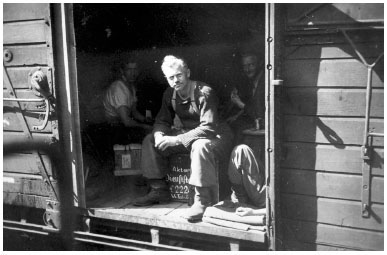
The majority of the men in this photograph are wearing the standard NCO and enlisted men’s side cap. On the side of the rollingng stock from which the German soldier is dispensing rations it says Deutsche Reichsbahn. This simply means German Reich Railway. It was reorganised in 1937 and since the 1920s had been 100 per cent owned by the German state.
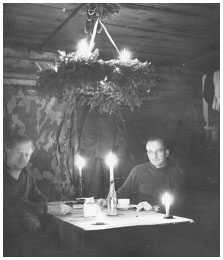
Christmas in a bombproof bunker is shown in this photograph. Note that the clothing of the Fallschirmjäger is pegged out along the rear wall to dry and that it is somewhat different from the clothing that was worn by the Fallschirmjäger back in Crete in May 1941. The camouflage equipment appears to be the reversible winter parka, which had a splinter pattern on one side and was grey on the other side. Fallschirmjäger in Russia would wear a mixture of Luftwaffe and Gebirgsjäger clothing. Some would wear white ski suits. In 1942 many of the Fallschirmjäger were issued with single-breasted combat jackets, known as kampfjacke, which were a mixture of rayon and cotton in splinter camouflage. These were the same as those issued to Luftwaffe field divisions. The only insignia that were worn on these smocks and combat jackets were the breast eagle of the Luftwaffe and the cloth rank badges on the sleeves. The combat trousers were relatively loose fitting; they aimed to be comfortable and to be easy to move around in. They were fastened at the ankle by tape and had two side and two hip pockets and a fob pocket under the waistband. They could be held up either with a belt or braces. On the outside of each of the knees was a vent where a rectangular canvas pad filled with kapok could be inserted to protect the knees. This did not work that well and for combat jumps external pads were strapped on.

This intriguing photograph shows two First World War vintage tanks outside a large Russian building. These tanks may well now be in the Kharkov Historical Museum in the Ukraine. These were tanks that were delivered by Britain to Russia after the First World War. They were sent in support of the anti-Communist forces during the Russian civil war and subsequently captured and used as monuments. At the time it is believed that these tanks were on display in Smolensk, which makes a great deal of sense since the machine gun company was in this area over the winter of 1941 to 1942. There are a number of these tanks in Russia, also at the Tank Museum at Kubinka. Here they have a British Mark V, which was captured by the Red Army in April 1920.
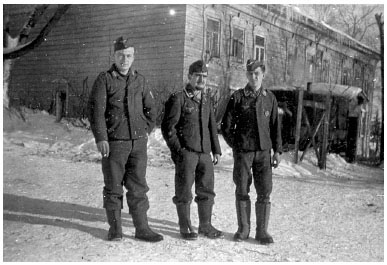
Three of the men from the unit are seen here in fatigue dress, with lined boots. Note that the man on the right has his Iron Cross on his chest. Despite contradictory information, the 2nd Fallschirmjäger MG Battalion 7, of which Plieschen was a member, appears to have been simultaneously deployed both around the River Neva sector of the Leningrad front and in the Ukraine. Elements of the unit are listed as having entrained for the Leningrad front, arriving there in October 1941. The units in this area suffered 1,000 dead or missing and 2,000 wounded. Likewise, elements of the same machine gun unit were operating in the Ukraine under Sturm and they held the line around Stalino throughout January 1942. This is further confused by the fact that additional parachute troops, under Meindl, were also operating in the same area. We can only assume that Plieschen was part of this Ukrainian operation, as his photographs seem to suggest that he was in the Smolensk area.
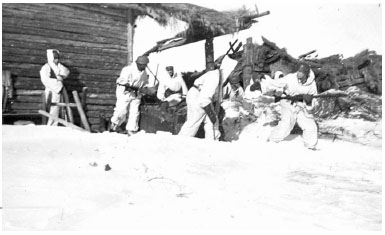
Fallschirmjäger in white coveralls are about to leave for a patrol on the Russian front. The personal weapons used by the Fallschirmjäger were fairly standard, except that they had the specially designed FG42 assault rifle. They would also tend to h have a higher ratio of automatic weapons, such as the MP40. The Fallschirmjäger operating around Lipovka, near Leningrad, faced stiff opposition on 9 May 1942, when they came under attack from Russian aircraft aiming to soften up their positions before determined mass attacks by Russian infantry. After withstanding the attacks for four days the paratrooper units were reinforced by tanks and self-propelled guns. The line was held and, in fact, the Russians were forced back to their start line. On 14 May the 2nd Regiment was ordered to counterattack Russian positions to the east of Lipovka. Sturm flew to Berlin when he received the order from the 21st Infantry Division. His protests were ignored and the attack went in under a cover of artillery fire. As the attack progressed the Russians began to envelop them and the paratroopers were forced to withdraw, taking as many of their wounded with them as possible. By the evening of 14 May they were back at their start line, having achieved nothing.

Paratroopers look over a collection of captured Russian tanks in this photograph. The tank in the foreground is a Russian BT7. Incredibly, one of these tanks was salvaged from the Neva River on 18 June 2007. This was a light tank that was designed in the 1930s. It had rubber-coated wheels and an engine based on American designs. It fired 45-mm ammunition and held 132 shells. The command version was known as the BT5 and this one had a radio. The BT7 weighed 13.8 tons, had a three-man crew, a range of 500 km and could reach speeds of up to 72 km/hour. A large number of Russian tanks have been found in the Neva River and many of them are now kept at the Nevskij Bridgehead Museum.

Undoubtedly, this is a posed shot but here we can clearly see a Fallschirmjäger antiaircraft crew in action, hunting the skies for approaching Russian aaircraft. During the rest of May 1942 the survivors of the 2nd Regiment tended to only be used on reconnaissance duties. The bulk of the regiment was sent home to Germany in June 1942, although some elements of the 2nd Regiment remained behind in Russia until the July. By the summer of 1942 they had exchanged the nightmare of the Russian front for the relative peace of Normandy in France. It was around this time that the 2nd Regiment was transferred to duties in North Africa. As for the rest of the division, now consisting of six battalions, they would be transferred back to the Russian front. There were plans for an air drop in southern Russia in order to capture oilfields, but this was cancelled in September 1942. Instead, the 7th Airborne, comprising the 1st, 3rd and 4th Regiments, plus support units, were in Smolensk. Here they would defend a fifty-six-mile sector to the north of the Smolensk to Vitebsk Highway.
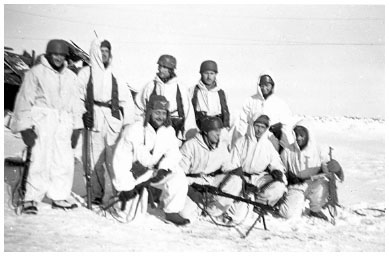
Another posed photograph of members of the unit in their full winter gear. Note that they are all heavily armed with ammunition bandoliers and a variety of rifles and automatic weapons. The division, now operating around Smolensk, was positioned on the part of the sector that was expected to receive the brunt of an upcoming Russian offensive. They were tasked with carrying out long-range probing missions to disrupt the Russian build up. This took place throughout October 1942; largely as a result of their aggressive action the Russians abandoned their attempt to launch an offensive against this stretch of the sector and chose a weaker one instead. The Fallschirmjäger of the 7th Airborne then had the rest of the year and the beginning of 1943 as a relatively inactive participant on the eastern front. This gave them an opportunity to reorganise, refit and reinforce.

This is a dramatic photograph, as a shell exploddes amongst buildings beside a snowbound road. By March 1943 the 7th Airborne was due to be relieved but this coincided with a major offensive launched by the Russians against their sector. At Lushki the Fallschirmjäger held a hill against determined Russian attacks. The men defending the hill were members of the 3rd Battalion of the 4th Regiment. They were reinforced by the 3rd Battalion of the 3rd Regiment and over a period between 20 and 27 March these two battalions held back two complete Soviet divisions. By the end of March the situation had stabilised. The division, now under the command of General Richard Heidrich, was transferred to the west and sent to southern France.

Here an NCO and officer stand beside a log-built shelter on the Russian front during the winter of 1941 to 1942. If we assume that the 2nd Fallschirmjäger Regiment was indeed withdrawn earlier than the events in late 1942 and d that Plieschen was one of these men, then he would ultimately become a part of the newly formed 2nd Fallschirmjäger Division, under Ramcke. In fact, the 2nd Fallschirmjäger Regiment became the nucleus of this new division. Ramcke had been on Crete and in 1942 his Fallschirmjäger Brigade Afrika had been sent to North Africa. By 1943 he had taken command of the 2nd Fallschirmjäger Division. It was deployed to Italy and was there to ensure that the Italians remained loyal to Germany. He took part in Operation Achse in September 1943 when Italy signed an armistice with the Allies. It was his division that secured Rome. Shortly after this Ramcke was wounded after his car was forced off the road after being attacked by an Allied aircraft.

Fallschirmjäger are resting in their dugout during the winter of 1941 to 1942 in this photograph. Note the wide variety of different rent clothes and variants of uniforms worn by the men. By early 1944 the 2nd Fallschirmjäger Regiment was back on the eastern front. Ultimately, the division was withdrawn and sent for refitting near Cologne. Once the Allies had landed in Normandy in June 1944 the 2nd Fallschirmjäger Division was despatched to Brittany and here it became responsible for the defence of Brest. Ramcke was one of only twenty-seven Germans to receive the Knight’s Cross with Swords, Oak Leaves and Diamonds.
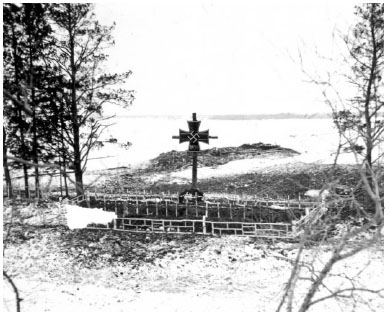
This photograph shows a mass grave of German troops. Underneath the swastika can be seen ‘1939’, which strongly suggests that this photograph may well have been taken in Poland rather than in Russia. This is somewhat surprising if indeed it has any link at all with the parachute troops. Certainly, the 2nd Fallschirmjäger Regiment played no part in the attack on Poland in 1939 and neither did any other paratroopetrooper unit. This may simply be a mass grave that Plieschen happened upon at some point, perhaps during a rest period from the front line two years later.
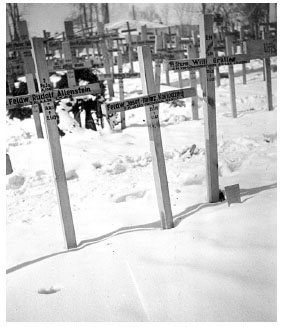
The centre grave at the front is one of a feldwebel of the Fallschirmjäger machine gun company to which Plieschen belonged. The date of death is given as 1 January 1942. Alongside are other men from different units, who died in and around the same time as this paratrooper. The grave to the left is that of a feldwebel that belonged to the 2nd Panzer Division and from the description he was in an antiaircraft unit and died a day after the paratrooper. It is also interesting to consider the relatively young age of the fallen Fallschirmjäger; he was just twenty-three.
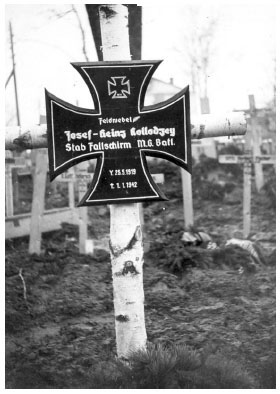
This is a more permanent tribute to the same man as in the previous photographph who was killed on 1 January 1942. He was Josef-Heinz Hollodzey. The inscription simply reads that he was a member of the machine gun battalion. This feldwebel was born on 25 May 1919 and he would have been twenty-one when he was air dropped onto Crete.
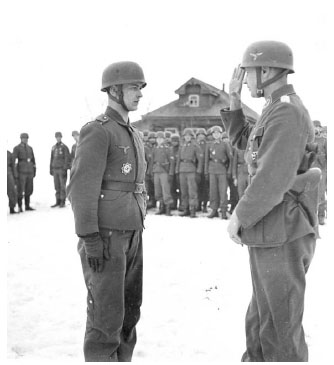
This is the first of a series of three photographs that were presumably taken around the same time as the burials of the men from the machine gun unit that were killed over the Christmas period 1941 to 1942. Despite the conditions the men are wearing their best uniforms and their decorations.
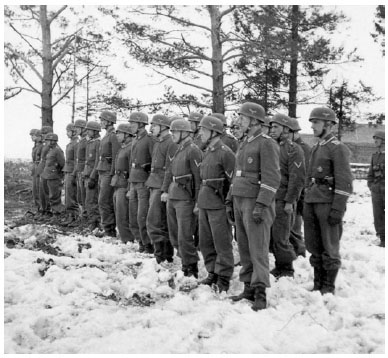
Members of the unit line up to salute their fallen comrades. Note that the majority of the men are wearing their sidearms and that prudently most have gloves. There is also a mix of footwear, although fur-lined boots predominate. Note also that there are several members of this group that are Iron Cross winners.
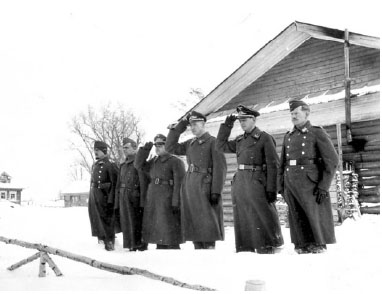
The senior officers of the unit are shown saluting the fallen members of the company in this photograph. It is difficult to be clear as to whether or not Plieschen survived the war since these photographs and the two at the end of the photograph album appear to show him later with a moustache. It is not clear precisely when these last photographs were taken. What we do know is that the 2nd Fallschirmjäger Division became trapped in Brest following Operation Cobra, which was launched in late July 1944. Ramckes men fell back on Brest, turning it into a strong point in an attempt to hold onto this vital port. With him were around 35,000 German troops. They stubbornly held onto Brest between 11 August and 19 September. On 19 September he finally surrendered and the men were taken into captivity.
This is an interesting photograph of a much older-looking Plieschen. He has clearly suffered from the rigours and dangers of the eastern front and this may well be a photograph of him heading west in the summer of 1942. The fighting was by no means over for Plieschen and his unit. Additional tours of duty on the eastern front around Kirovograd in January 1944 were yet to come, as indeed were operations on the eastern front until May of 1944. As for the division itself, the vast majority of them had surrendered in September 1944 to the Americans. A handful of the division managed to withdraw towards Germany. The 2nd Parachute Regiment itself was reconstituted the same month in Holland and, along with the 7th and 23rd Parachute Regiments, a new 2nd Parachute Division was created. It would fight on until it finally surrendered in the Ruhr pocket in April 1945.

Plieschen displays his accumulation of decorations for valour and service during the early stages of the Second World War here. His cuffs display a band that designates him as one of the men involved in the Crete operation and his Iron Cross can be clearly seen. Once the 2nd Fallschirmjäger Regiment became subsumed as part of the 2nd Fallschirmjäger Division, it is difficult to know precisely where Plieschen served. Elements of the 2nd Fallschirmjäger Regiment were on Leros in late 1943 and in November 1943 part of the division remained in Italy to form part of the 4th Fallschirmjäger Division. This means that it is incredibly difficult to trace the movements of the machine gun company, let alone those of Plieschen. There is no information to support whether or not he was transferred, having been promoted, or whether he remained with the machine gun unit. It would be incredible to believe that any of the men could have survived over four years of continuous combat action with only short periods of rest. In many respectpects the Fallschirmjäger had been transformed from a primary strike weapon in the armoury of the German war machine to become Hitlers fire brigade, as they were nicknamed.