

A line of Beaufighters approaching completion. The ducts above each machine were part of the air-conditioning equipment.
The Bristol Type 156 Beaufighter, often referred to as simply the Beau, was a British long-range heavy fighter modification of the Bristol Aeroplane Company’s earlier Beaufort torpedo bomber design. The name Beaufighter is a portmanteau of ‘Beaufort’ and ‘fighter’.
Unlike the Beaufort, the Beaufighter had a long career and served in almost all theatres of war, first as a night fighter, then as a fighter bomber and eventually replacing the Beaufort as a torpedo bomber. A variant was built in Australia by the Department of Aircraft Production (DAP) and was known in Australia as the DAP Beaufighter.
The idea of a fighter development of the Beaufort was suggested to the Air Ministry by Bristol. The suggestion coincided with the delays in the development and production of the Westland Whirlwind cannon-armed twin-engine fighter. Bristol proopsed a fixed four cannon version and a turret fighter with twin cannons; the former was preferred by the Assistant Chief of the Air Staff. For fighter-like performance Bristol suggested their new Hercules engines in place of the Beaufort’s Taurus.
Since the ‘Beaufort Cannon Fighter’ was a conversion of an existing design, development and production could be expected far more quickly than with a completely fresh design. Accordingly, the Air Ministry produced draft Specification F.11/37 written around Bristol’s suggestion for an ‘interim’ aircraft pending proper introduction of the Whirlwind. Bristol started building a prototype by taking a part-built Beaufort out of the production line. This conversion would speed the process - Bristol had promised series production in early 1940 on the basis of a order being placed in February 1939 - and the Ministry ordered two prototypes from the line and two built from scratch. Although it had been expected that maximum re-use of Beaufort components would speed the process, the fuselage needed more work than expected and had to be completely redesigned. As such the first prototype flew for the first time on 17 July 1939, a little more than eight months after the design had started, possibly due to the use of much of the Beaufort’s design and parts. A production contract for 300 machines ‘off the drawing board’ had already been placed two weeks before the prototype F.17/39 even flew.

Beaufighter rear fuselages as delivered to the factory were completely assembled. The small marks on the transparent cover over the observer’s station were press-studs for the attachment of either a blackout cover or a sun-blind.
The first Beaufighter achieved 335 mph at 16,800 ft, the second prototype when laden with operational equipment was slower at 309 mph at 15,000 ft. Large orders were placed, but this meant an expected shortage of Hercules engines. In February 1940, conversion of three aircraft to Merlins was ordered; success with the design was expected to lead to production aircraft in 1941. The first Merlin powered aircraft flew in June 1940.
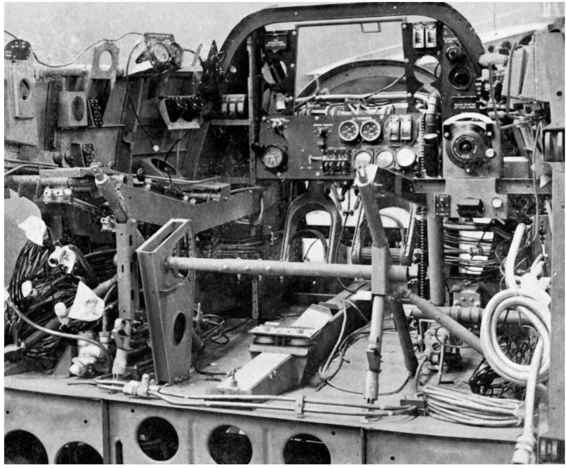
The interior of the Beaufighter fuselage showing the Z-section and box frames, the bulb-angle stringers and the floor built on two longitudinal keels. The legs of the rotating seat for the observer were mounted on the keels.

1941 saw the development of the Beaufighter Mk.IC long-range heavy fighter. This new variant entered service in May 1941 with a detachment from 252 Sqn operating from Malta. The aircraft proved so effective in the Mediterranean against shipping, aircraft and ground targets that Coastal Command became the major user of the Beaufighter.
The Beaufighter arrived at squadrons in Asia and the Pacific in mid-1942. It has been said - although it was originally a piece of RAF whimsy quickly taken up by a British journalist - that Japanese soldiers referred to the Beaufighter as the ‘whispering death’, because attacking aircraft often were not heard until too late. The Beaufighter’s Hercules engines used sleeve valves which lacked the noisy valve gear common to poppet valve engines.
Owing to its twin power plant, heavy armament and radio-location equipment, the cockpit of the Beaufighter had considerably more controls and instruments than most fighter aircraft.

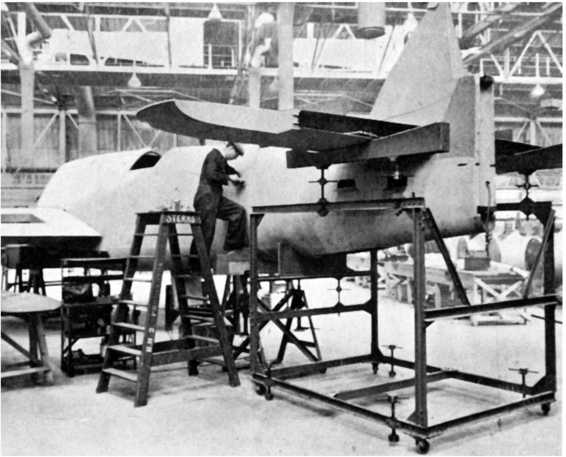
The rear fuselage of the Beaufighter is offered up to the centre section on an adjustable trolley specially designed for the purpose.
The Beaufighter found itself coming off the production line at almost exactly the same time as the first British Airborne Intercept (AI) radar sets. With the four 20 mm cannon mounted in the lower fuselage, the nose could accommodate the radar antennas, and the spaciousness of the fuselage enabled the AI equipment to be fitted easily. Even loaded to 20,000 lb the aircraft was fast enough to catch German bombers. By early 1941, it was an effective counter to Luftwaffe night raids. A night-fighter MkVIF was supplied to squadrons in March 1942, equipped with AI Mark VIII radar. As the faster De Havilland Mosquito took over in the night fighter role in mid to late 1942, the heavier Beaufighters made valuable contributions in other areas such as anti-shipping, ground attack and interdiction in every operational threatre.
In the Mediterranean, the USAAF received 100 Beaufighters during the summer of 1943, achieving their first victory in July. Through the summer the squadrons conducted both daytime convoy escort and ground-attack operations, but primarily flew defensive interception missions at night.
The stern section of this Beaufighter is offered up to the rear fuselage on its trolley and adjusted by checking the rudder post against a plumb line.
The North Coates Strike Wing of Coastal Command, based on the Lincolnshire coast, developed tactics which used large formations of Bristol Beaufighters using cannon and rockets. These tactics were put into practice in mid 1943, and in a 10-month period, 29,762 tons of shipping were sunk. Tactics were further adapted when shipping left port during the night. North Coates Strike Wing operated as the largest anti-shipping force of the Second World War, and accounted for over 150,000 tons of shipping and 117 vessels for a loss of 120 Beaufighters and 241 aircrew killed or missing.
Offering up the fore end of the fuselage to be attached by its pin joints to the centre-section.

In the South-East Asian Theatre, the Beaufighter Mk VIF operated from India on night missions against Japanese lines of communication in Burma and Thailand. The high-speed, low-level attacks were highly effective, despite often atrocious weather conditions, and makeshift repair and maintenance facilities.
As an aside, Bristol Aircraft seems to have used captial letters to denote their mark numbers - ie Mk.VIF -where all other manufactureres used lower case - ie Spitfire Mk. 5c.

The centre section was supported in two cast-iron fixtures by means of eight pin joints during assembly operations.
Before Department of Aircraft Production Beaufighters arrived at Royal Australian Air Force units in the South West Pacific theatre the Bristol Beaufighter Mk IC was employed in anti-shipping missions.
The most famous of these was the Battle of the Bismarck Sea, where they were used in the fire-suppression role in a mixed force with USAAF A-20 Boston and B-25 Mitchell bombers.
30 Sqn RAAF Beaufighters flew in at mast height to provide heavy suppressive fire for the waves of attacking bombers. The Japanese convoy, under the impression that they were under torpedo attack, made the fatal tactical error of turning their ships towards the Beaufighters, leaving them exposed to skip bombing attacks by the US medium bombers. The Beaufighters inflicted maximum damage on the ships’ anti-aircraft guns, bridges and crews during strafing runs with their four 20 mm nose cannons and six wing-mounted .303 in machine guns. Eight transports and four destroyers were sunk for the loss of five aircraft, including one Beaufighter.
A partially-completed Beaufighter sitting in its assembly fixture.

One little known fact about Beaufighter operations is that late 1944, RAF Beaufighter units were engaged in the Greek Civil War, finally withdrawing in 1946.
The Beaufighter was also used by the air forces of Portugal, Turkey and the Dominican Republic. It was used briefly by the Israeli Air Force when some ex RAF examples were clandestinely purchased in 1948.
Many aircraft were converted to the target tug role postwar as the TT.10 and served with several RAF support units until 1960. The last flight of a Beaufighter in RAF service was by TT.10 RD761 from RAF Seletar on 12 May 1960.
The outer wing of this Beaufighter is supported on padded trestles before being bolted into place. They were bolted to the centre section by four pin joints.


Lifting the partially-completed Beaufighter out of its assembly fixture.
By the time British production lines shut down in September 1945, supposedly some 5,564 Beaufighters had been built in Britain, by Bristol and also by Fairey Aviation Company at Stockport and RAF Ringway (498); Ministry of Aircraft Production (3336) and Rootes at Speke (260). When Australian production ceased in 1946, 365 Mk.21s had been built.
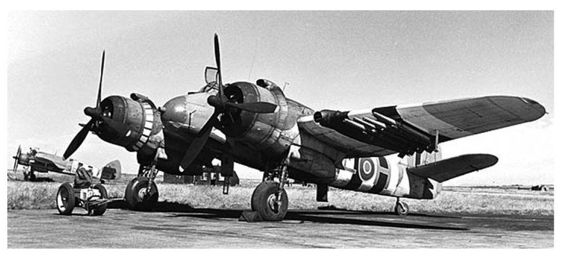
The Beaufighter Mk X with rockets. This machine is NE255/EE-H of No. 404 Squadron RCAF, of RAF Coastal Command at Davidstow Moor, 21 August 1944.
As Director of the Beaufort Division of the Department of Aircraft Production in Australia, John Storey was responsible for the production of Beaufighters there. Mr. Storey joined the Aircraft Production Commission at the request of the Commonwealth Government early in 1940, assuming full control of Beaufort production shortly afterwards, and became a member of the Aircraft Advisory Committee. Here he talks about how it happened.
‘Actually the first batch of engineering drawings and technical data for the Beaufighter did not arrive from Bristol until March, 1943, but we were able to put the first Beaufighter into the air on May 26, 1944, and deliver it to the Air Force five days later. This was a creditable achievement for a country like Australia, owing to our limited background of aircraft construction experience, and also because, before the first aircraft came off the assembly line, we were required to incorporate and develop most extensive modifications. By September we had achieved quantity production, although in the interim we had to convert our plants to Beaufighter production and at the same time finish off our Beaufort programme.
Front fuselages for Beaufighters were built in an annexe to the New South Wales Railways workshops.


Looking down the Beaufighter assembly line at a Beaufort-Division plant. At least one serial visible here is A8-222.
The Beaufighter being built in Australia was the Mark XXI. At the outset, we were required to build it as a torpedo-carrier, but before we had got properly into production the torpedo role was abandoned and we had to turn our attention to equipping the aircraft for other functions. This, with numerous modifications to adapt the Beaufighter to tropical conditions, made the task anything but an easy one. Amongst other changes, we substituted four 0.5 inch Browning guns for the previous six 0.303 guns in the wings, installed a rearward-firing gun and substituted pneumatic cannon-cocking control for manual selection, which permitted better harmonisation. We provided for rockets or bombs under the wings, completely redesigned the electrical and radio installations, repositioned and extensively modified the fuel system, fitted a tailwheel with anti-shimmy device, and made provision for the installation of the Sperry automatic pilot should it be required.
Before we were able to embark on Beaufighter production, we had to deal with some 70,000 negatives of engineering and tooling drawings and technical data, necessitating the establishment of a special photographic unit. Enlargements from these negatives made on semi-transparent linotone or mastertrace paper were used as tracings. Simultaneously, groups of technicians were sent to England to study manufacturing methods and processes at Bristol and elsewhere, and steps were taken to organize the manufacture of parts. In one respect we were in luck, for owing to the generosity of Great Britain we received the Hercules power eggs complete from England’.