
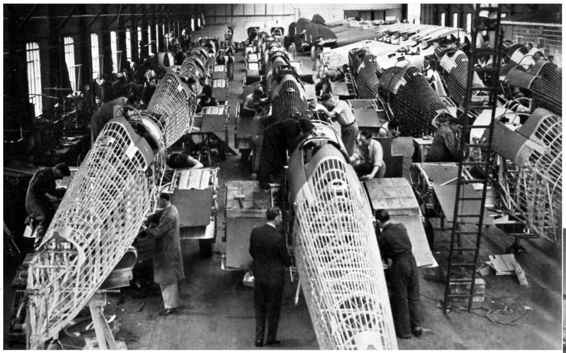
Original caption: Benefiting from the comparative simplicity of the fabric-covered girder structure which permits rapid installation of equipment. Hawker Aircraft are fast delivering Hurricane eight-gun fighters from their Kingston works. The Hurricane demonstrates how a well-tried structural principle can be adapted to modern military aircraft, making a fine showing against machines of advanced stressed-skin construction.
The Hawker Hurricane was a single-seat fighter aircraft that was designed and predominantly built by Hawker Aircraft for the RAF. Although largely overshadowed by the Supermarine Spitfire, the Hurricane became renowned during the Battle of Britain, accounting for 60% of the RAF’s air victories in the battle, and served in all the major theatres of the Second World War.
The 1930s design evolved through several versions and adaptations, resulting in a series of aircraft which acted as interceptor-fighters, fighter-bombers - also called ‘Hurribombers’- and ground support aircraft. Further versions known as the Sea Hurricane had modifications which enabled operation from ships. Some were converted as catapult-launched convoy escorts, known as ‘Hurricats’. More than 14,000 Hurricanes were built by the end of 1944, including about 1,200 converted to Sea Hurricanes and some 1,400 built in Canada by the Canada Car and Foundry.
Construction of the first prototype, K5083, began in August 1935 incorporating the PV-12 Merlin engine. Completed sections of the aircraft were taken to Brooklands, where Hawkers had an assembly shed, and re-assembled on 23 October 1935. Ground testing and taxi trials took place over the following two weeks, and on 6 November 1935, the prototype took to the air for the first time in the hands of Hawker’s chief test pilot, Flight Lieutenant (later Group Captain) P. W. S. Bulman. Flight Lieutenant Bulman was assisted by two other pilots in subsequent flight testing; Philip Lucas flew some of the experimental test flights, while John Hindmarsh conducted the firm’s production flight trials. Sammy Wroath, who was the founding Commandant of the Empire Test Pilot School, was the RAF test pilot for the Hurricane and his enthusiastic endorsement helped get it into production.
The maiden flight of the first production Hurricane, powered by a Merlin II engine, took place on 12 October 1937. The first four aircraft to enter service with the RAF joined 111 Sqn at RAF Northolt the following December. By the outbreak of the Second World War, nearly 500 Hurricanes had been produced, and had equipped eighteen squadrons.
Characteristic features of the Hurricane construction are well brought out in this view of the assembly. The centre-section is supported on adjustable trestles, the fuselage then being lowered into position; the alignment is checked by measuring the diagonals as seen here before the whole lot is bolted up.


Applying the fabric covering to the fuselage of a Hawker Hurricane. This extends forward from the sternpost to a point level with the pilot’s seat.
The Hurricane was ordered into production in June 1936, mainly due to its relatively simple construction and ease of manufacture. As war was looking increasingly likely, and time was of the essence in providing the RAF with an effective fighter aircraft, it was unclear if the more advanced Spitfire would enter production smoothly, while the Hurricane used well-understood manufacturing techniques. This was true for service squadrons as well, who were experienced in working on and repairing aircraft whose construction employed the same principles as the Hurricane, and the simplicity of its design enabled the improvisation of some remarkable repairs in squadron workshops. The Hurricane was also significantly cheaper than the Spitfire, requiring 10,300 man hours to produce rather than 15,200 for the Spitfire.
Initially, the wing structure consisted of two steel spars, and was also fabric-covered. Several fabric-wing Hurricanes were still in service during the Battle of Britain, although a good number had had their wings replaced during servicing or after repair. Changing the wings only required three hours‘ work per aircraft. An all-metal, stressed-skin wing of duraluminium was introduced in April 1939 and was used for all of the later marks. Metal skinned wings allowed a diving speed that was 80 mph higher than the fabric-covered ones. The great advantage of the metal-covered wings over the fabric ones was that the metal ones could carry far greater stress loads without needing so much structure beneath.
So said the original caption to this picture. One of Sydney Camm’s priorities was to provide the pilot with good all round visibility. To this end, the cockpit was mounted reasonably high in the fuselage, creating a distinctive ‘hump-backed’ silhouette. Pilot access to the cockpit was aided by a retractable ‘stirrup’ mounted below the trailing edge of the port wing. This was linked to a spring-loaded hinged flap which covered a handhold on the fuselage, just behind the cockpit. When the flap was shut, the footstep retracted into the fuselage. In addition, both wingroots were coated with strips of non-slip material.

The simplicity of its open-girder structure not only enables the Hawker Hurricane eight-gun single-seater fighter to be built rapidly in large numbers, but greatly facilitates the installation of its complex military equipment. In view of the speeds now being attained by fighters, and considering the limitations of fabric covering, it is to be doubted if any future single-seater fighter will be able to benefit likewise.

A flight of four Hawker Hurricanes.
During 1940, Lord Beaverbrook, who was the Minister of Aircraft Production, established an organisation in which a number of manufacturers were seconded to repair and overhaul battle-damaged Hurricanes. The Civilian Repair Organisation also overhauled battle-weary aircraft, which were later sent to training units or to other air forces.
In all, some 14,000 Hurricanes and Sea Hurricanes were produced. The majority of Hurricanes were built by Hawker, with Hawker’s sister company, the Gloster Aircraft Company, making 2,750. The Austin Aero Company built 300. Canada Car and Foundry in For William, Ontario, Canada, was responsible for production of 1,400 Hurricanes, known as the Mk X.
A general view of the Hurricane assembly shop. Machines are seen in the background coming up to the covering and doping shop, and, in the foreground, returning after these processes have been completed.

PZ865, the last Hurricane ever built during construction at Langley. The overhead banner proudly portrays the battle-honours won by the design.

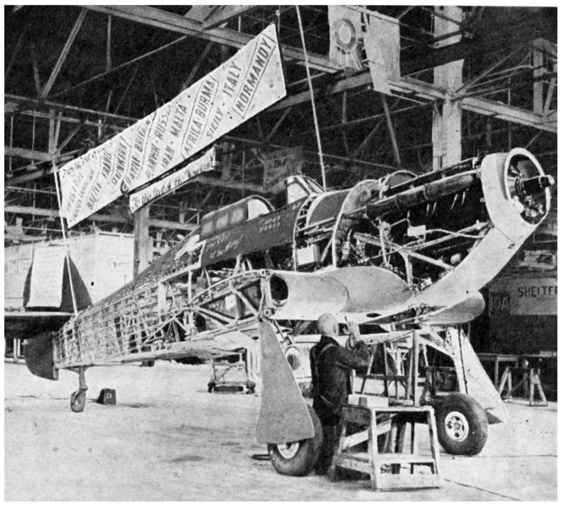
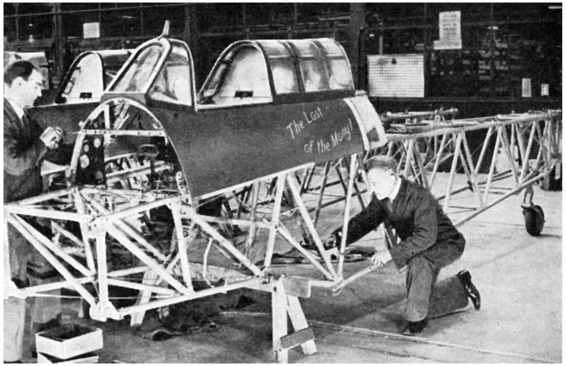
The last Hurricane ever built, PZ865, rolled off the production line at Langley, Buckinghamshire, in the summer of 1944 with the inscription ‘The Last of the Many’ on her port and starboard sides. The aircraft was almost immediately purchased back from the Air Ministry by Hawkers and initially mothballed, before being employed as a company communications and test aircraft. In 1950, wearing the civilian registration G-AMAU, it was entered in the King’s Cup Air Race by HRH Princess Margaret. Flown by Group Captain Peter Townsend, it achieved second place. During the 1960s, PZ865 was returned to its wartime camouflage scheme and was used as a company ‘hack’ and communications aircraft. It appeared in ‘The Battle of Britain’ film and also made numerous display appearances, often in the hands of the famous fighter pilot and test pilot Bill Bedford. After a complete overhaul, PZ865 was flown to Coltishall in March 1972 and given to the Memorial Flight by Hawker Siddeley. For many years the aircraft appeared as ‘The Last of the Many’ but eventually the inscription was removed and put on display in the BBMF headquarters.