
PART THREE
CHAPTER TEN
Of all the piston-engined fighters of the Second World War, the Brewster Buffalo has to be a candidate for being the most unloved. Although its handling characteristics were pleasant enough and it possessed no real vices, its relatively poor performance and inadequate hitting power meant that it would have been hopelessly outclassed had it been pitted against modern high performance fighters such as the Bf 109E.
The aircraft that would be known in the UK as the Buffalo, was designed by Dayton Brown of the Brewster Aeronautical Corporation in 1936 and proved to be of considerable interest to the US Navy, who applied the designation F2A. Its portly fuselage accommodated a 950 hp single-row, nine-cylinder Wright Cyclone radial engine. It featured a mid-set wing, with an inward retracting undercarriage (the wheels being housed in the lower fuselage), and a large glazed canopy, which provided excellent rearwards vision. Following comparative testing, the US Navy began to favour the rival Grumman F4F Wildcat and Brewster’s corpulent offering was eventually foisted onto the Marine Corps. With the rapidly worsening political situation in Europe, orders began to come in from overseas and forty-four of the original F2A-1 aircraft for the US Navy were de-navalised as the Brewster B-239 and delivered to Finland for the war against the Soviet Union. An order was also placed by Belgium for the up-rated (1100 hp Wright Cyclone GR-1820-G) B-339, but these aircraft had not been delivered by the time that the country capitulated after the German invasion of May 1940.
The Belgian order was taken over by the RAF and three Brewster Buffalos were delivered to Church Fenton in September 1940 to be taken over by the newly re-formed No. 71 Squadron, which was the first of the so-called ‘Eagle’ Squadrons manned by US volunteer pilots. The unit’s first CO was Squadron Leader Walter Churchill DSO DFC, who had become an ‘ace’ whilst flying Hurricanes of No. 3 Squadron during the air battles over France. His evaluation of the Buffalo was less than complimentary. Indeed, he went so far as to recommend that the aircraft should on no account be considered as a fighter until considerable modifications had been carried out to eradicate certain deficiencies as highlighted by recent operational experience.
Churchill considered that the armament of two 0.5-in and two 0.303-in machine guns was entirely inadequate, a situation that was exacerbated by the lack of a reflector gunsight. He also criticised the thickness of the armour protection to the rear and the fact that it did not protect the pilot’s head. The shoulder straps of the Sutton harness also passed over the top of the seat instead of through slots in the back, which meant that they tended to give way when the aircraft was inverted and could lead to the pilot hitting his head on the hood. The undercarriage actuating lever was too small and difficult to operate. This criticism also applied to the flap-operating lever and the seat adjustment. As the R/T controls were located on the right-hand side of the cockpit, this required the pilot to change hands to operate the radio. He was also liable to hit his elbow on the seat every time he had to change from send to receive. The oxygen system was regulated automatically, instead of being a manual operation, and it was felt that the latter would have been preferable as this system at least allowed the pilot the opportunity to turn up the amount of oxygen he was receiving if he was in a dogfight. Churchill also considered that the Buffalo’s stick-type control column, with the firing button located on the top, was not as good as the articulated spade grip as used on most RAF fighters.
Criticism was also levelled at some of the Buffalo’s structural aspects. The wings were not bolted to the fuselage centre section as was normal practice on British fighters, but had a straight through spar. It was felt that they would be difficult and time-consuming to repair following an accident or as a result of battle damage. As the fuel tanks were of the integral type, another lengthy maintenance job was in the offing should they take any hits. The elevators were activated by a push-pull tube instead of the more normal twin-cable arrangement, and although these provided an excellent level of control, it was felt that the tubes might succumb to enemy fire to a greater extent than a cable system. As there was no automatic boost control, the pilot had to continuously adjust the throttle during a climb, to avoid exceeding maximum permissible boost. As the flaps only extended through 60 degrees, the aircraft tended to glide in a fairly flat attitude, as a result of which its landing roll could be excessively long. After landing the tailwheel was also liable to wobble on its caster, which on occasion was severe enough to strip the rubber from the tyre. Churchill concluded that the Buffalo would make an excellent ‘trainer’ aircraft as it was relatively simple to fly and delightful for aerobatics.
At the same time as Walter Churchill was evaluating the Buffalo at Church Fenton, another example was being tested at RAE Farnborough. The best technique on take-off was to hold the stick fully forward for about thirty yards to bring the tail up, after which the aircraft ran smoothly and showed no tendency to bounce. As speed increased there was a slight tendency to swing to the left, but this was easily controlled by rudder, which was effective, but not so sensitive as to cause over-correction. The aircraft flew itself off without assistance after a take-off run shorter than both the Hurricane and Spitfire. When airborne, it accelerated quite rapidly and had a good initial rate of climb. The elevator control was excellent and not too sensitive, as on the Spitfire, or too sloppy, as on the Hurricane.
The best approach speed was around 90–95 mph IAS and the hydraulically operated split flaps took nine seconds to come down. Lowering the flaps caused a nose-down trim change of around 17 degrees, which required re-trimming, but even with the trimmer wheel fully aft (tab angle 17 degrees) there was still slight nose heaviness. There was also a marked sensation of sinking at speeds below 75 mph IAS. The approach glide was steep, which allowed an excellent view of the aerodrome and because of the slight sinking, pilots found that they tended to flatten out slightly higher than usual. The landing itself was easy and the aircraft settled down after a small float with no bounce or swing. The brakes could be used soon after touching down and they were smooth and effective in operation. Once on the ground, the Buffalo was very manoeuvrable and could readily be turned in its own space with the aid of a little braking.
With the engine set to 1850 rpm, the stall speeds were 76 mph IAS with the flaps and undercarriage up and 64 mph IAS with the flaps and undercarriage down. The stall was marked by the sudden drop of a wing, followed by the nose, but the aircraft tended to quickly un-stall itself when back pressure on the control column was relaxed. With the flaps and undercarriage down the wing dropped rather more quickly, however the stall was still quite mild. Longitudinal trim was maintained by the elevator trim tabs, which were controlled via a 1¾ in diameter wheel, which rotated about an axis parallel to the wing span and operated in the natural sense, i.e. winding back on the wheel brought the nose up. Full tab range (+17 to –8 degrees) required nine complete turns of the wheel. Directional trim was provided by a 3-in diameter wheel, nine turns of which rotated the rudder trim tab through its full travel of +/–5 degrees.
The ailerons were tested in the speed range 90–400 mph IAS. They were proved to be exceptionally effective, crisp and powerful; stick forces were neither too light at low speeds or too heavy at greater speeds. Pilots considered them to be a definite improvement over the fabric-covered ailerons of the Hurricane and Spitfire. A comparison of the Buffalo and Spitfire in terms of aileron response and stick force makes interesting reading.
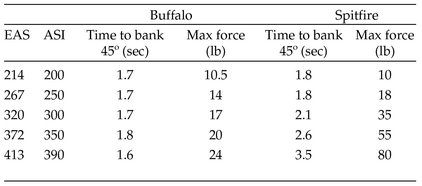
The elevator was tested at speeds between 80–400 mph IAS, with the response and feel being rated as excellent. At 80 mph IAS the response was exceptionally good, but at the same time the stick forces were not too light. With increase in speed the weight increased steadily, but even at 400 mph IAS, the stick force was not unduly heavy and the response remained good. At 80 mph IAS the rudder was effective, but the response was poor for the first quarter movement. This improved above 100 mph IAS and the response and feel were good until fairly high speed (over 300 mph IAS), when the rudder tended to become too light. Even a small displacement gave a large response, which caused a snaking tendency that had to be corrected. Apart from this, the control harmony was good. RAE pilots were highly complimentary about the handling characteristics of the Buffalo and all agreed that a definite advance had been made in fighter controls.
AFDU (then at Northolt) also produced a report on the Buffalo in November 1940. As the aircraft was not fitted with guns, the findings were somewhat complimentary, as its performance was rather better than an aircraft in operational trim. Pilots were particularly impressed by the aircraft’s roomy and comfortable cockpit and the excellent view afforded by the extensive glazing, particularly to the sides and rear, which was vastly superior to that offered in both the Hurricane and Spitfire. The hood could be opened easily at all speeds, but proved to be difficult to close at high speed. One item in the cockpit that was criticised, however, was the mechanism to raise and lower the pilot’s seat, as it was found to be almost impossible to raise the seat when in the air.
As Farnborough had already discovered, the take-off in a Buffalo was completely straightforward. It was rated as being superior to that in a Hurricane. For landing, it was recommended that a little engine be left on instead of employing a full glide approach, and despite the aircraft’s comparatively fast approach speed it pulled up very quickly after touchdown. The pedal-operated brakes were very efficient at shortening the landing run and as an aid to taxying. The Buffalo’s main asset in the air was its excellent manoeuvrability, brought about by its excellent aileron control and relatively stubby wings which, at a span of 35 ft, were 5 ft shorter than the Hurricane. The elevator control was also light and positive and although the rudder was heavier, this did not produce any real harmonisation problems and directional control was readily available. Trimmers were provided for all three controls and these were found to be quite sensitive and very effective, and materially aided the aircraft’s excellent controllability.
Brief comparative trials were flown against a Hurricane at the Buffalo’s rated altitudes and during level speed tests the Buffalo was found to be 15 mph faster at 6000 ft. At 14,700 ft the maximum speed of the two aircraft was virtually identical. However, it was later calculated that had the Buffalo been carrying its full war load, as was the Hurricane, the speeds would have been approximately the same at the lower height and the Buffalo would have been slower by around 12 mph at the higher altitude. Owing to the disparity in weight the Buffalo also out-performed the Hurricane in climbs to 15,000 ft and it could easily turn inside the British aircraft. Pilots were of the opinion that the Buffalo would be a good gun platform.
With a maximum speed of around 300 mph and a rapidly deteriorating performance above 15,000 ft, there was no possibility of the Buffalo being used in the European theatre and most aircraft were shipped to the Far East. The first unit to become operational was No. 67 Squadron at Kallang, Singapore in May 1941. The Buffalo was also flown by Nos 146, 243, 453, 488 and (RAAF) 21 Squadrons. Carrying full fuel and armament, the Buffalo’s performance was reduced still further. Following the Japanese invasion in December 1941, it was hopelessly outclassed by the nimble Mitsubishi Zero, which benefited from a vastly superior power-to-weight ratio. A story that did the rounds at the time told of Buffalo pilots having to suffer the ignominy of the Blenheim twin-engined bombers they were escorting being forced to slow down so that they could keep up. In an effort to improve performance, some aircraft had their all-up weight reduced by having two of their 0.5-in guns replaced by 0.303-in Brownings, together with a smaller ammunition load and less than full fuel. This accounted for around 900 lb, which reduced the performance gap with the Zero. However, general wear and tear on the airframes and down-on-power engines countered this and following the withdrawal of units to India, the Buffalo was quickly replaced by the Hurricane.
At the same time as the dispatch of the Buffalo to the Far East, a number of aircraft were delivered to the FAA, which was suffering from a desperate shortage of fighters, to the point that even obsolescent machines had to be considered. It served with No. 805 Squadron during the defence of Crete in March 1941, alongside the Fairey Fulmar, and also flew with No. 885 Squadron. Prior to its naval service, the Buffalo was flown by Eric Brown, who was to become a renowned test pilot and CO of the Aerodynamics Flight at Farnborough. Like many pilots before him, he found the view directly ahead to be extremely poor because of the high sit of the nose when on the ground, but despite this taxying was easy and the efficient brakes allowed the aircraft to be weaved gently to clear the path ahead. As there was no automatic boost control, the throttle had to be opened carefully on take-off and plenty of forward stick had to be applied to raise the tail to allow the aircraft to accelerate. The rudder control was deemed excellent and the gentle swing to the left during the take-off run could easily be controlled.
Once airborne, the Buffalo climbed steeply with an initial climb rate of around 2000 ft/min, but it was found that this figure soon diminished as altitude was gained. At a cruising speed of 160 mph IAS, the aircraft was unstable longitudinally, which caused problems if it had to be flown on instruments in cloud. Laterally, the Buffalo was neutrally stable and it had positive stability directionally. The maximum speed was noted as being 290 mph IAS at 16,500 ft and the service ceiling was 25,000 ft. Although Brown was not impressed with these levels of performance, he was delighted by the aircraft’s handling, particularly the ailerons, which were highly effective throughout the whole speed range. The elevators were nearly as good and the rudder, although the heaviest of the three controls, was entirely adequate.
The Buffalo’s low-speed characteristics were mild-mannered and the stall with the undercarriage and flaps up occurred at 76 mph IAS, together with a gentle wing drop and a lowering of the nose. With the gear and flaps down the stall came at a very low 67 mph IAS, although it was noticeable that the wing drop was slightly more pronounced. Prior to landing, the undercarriage was lowered at 95 mph IAS followed by the flaps, the operation of which was considered to be a little on the slow side. The best approach speed was around 80 mph IAS. This allowed a reasonable view ahead, but to achieve this almost full backward elevator trim was required. A distinct pull on the control column was needed to set the aircraft in the correct attitude for a three-point landing, which occurred at 75 mph IAS. The landing run could be controlled easily by gentle use of the brakes and there was little danger of a swing developing.
After his flight, Brown had mixed emotions as regards the Buffalo. On the one hand, the aircraft was a delight to fly. The handling characteristics and control responses were as good, if not better, than any other fighter he had flown, but as a weapon of war it was seriously flawed due to its laboured performance at altitudes above 10,000 ft. At a time when the RAF/FAA were looking towards the 20-mm Hispano cannon as the primary weapon in fighter combat, the Buffalo’s firepower also left something to be desired.
Of the Buffalos that were sent to the Far East, the vast majority were lost in action in Malaya and Singapore, or were destroyed in the face of the Japanese advance. A handful made it to serve with second-line units and the last few RAF machines were struck off charge in late 1943 to become instructional airframes. Although the aircraft was to achieve fame in the war in Finland, where it fought at low level (where it was at its best) and against mediocre opposition, elsewhere it was a different story. Sadly, Brewster’s gallant effort to compete with more established names in the world of fighter aircraft production was doomed to failure, and the Buffalo has unfortunately gone down in history as one of the world’s worst aircraft. This is all rather unfair, as there was nothing particularly wrong with the Buffalo as a flying machine, quite the opposite. However, the rapidly advancing technology of the day meant that many other types were soon able to surpass its relatively modest performance.