
The march from Warsaw to Rome was not a manoeuvre the Polish Army or any other nation had envisaged. Following the defeat of Poland in September 1939 the tens of thousands of soldiers incarcerated in Soviet prisoner-of-war camps were essentially written off as a lost cause. Hitler’s invasion of the USSR in June 1941 changed this; these men now represented a vital, potentially decisive addition to the Allied fight against Germany. The struggle to get these Polish soldiers back into action depended on close cooperation between the diplomatic and military missions of Britain, Poland and the USSR. It was to prove a most challenging endeavour.
These three countries, compelled to cooperate through the necessity of war were Allies, not friends. They had nothing in common, no shared ideology or post-war outlook; the relationship was characterized by antipathy, mistrust and open aggression. The only common ground was the objective of defeating Germany. The feat of getting these countries to work together was never realized, even the pacts between them were made individually and not as a tripartite agreement – together the three could agree on nothing.
In military circles things were different. The unprecedented effectiveness of Hitler’s war machine was obliterating all before it and no nation was able to even slow the onslaught. Something drastic had to be done. The result of the panicked process was a wildly ambitious and risky plan; to release Polish soldiers held in Soviet prisoner-of-war camps, recruit them into a brand new Polish Army to be raised in the Soviet Union, equip them from Britain and then send them to war on the Soviet or Mediterranean front! Amazingly, the scheme did work, not perfectly, but well enough to get tens of thousands of Polish soldiers back in the war and fighting the Germans. That any measure of success was achieved at all was purely down to the dogged determination of the Poles in the Soviet Union to strike back at Hitler, with their dying breath if need be, to wreak vengeance for the plight of their nation. And this they did in good measure.
The creation of the Polish Army in the East and subsequently the II Corps represents the largest non-UK or Dominion fighting force ever raised by Britain; it was a mammoth undertaking without parallel before or since. To grasp the scale of this feat it is helpful to make a brief comparison of troop numbers: the Polish II Corps on 30 April 1945 totalled 83,0231 personnel, on 1 January 2016 the British Army totalled 84,960.2 Their first parent British formation, Persia and Iraq Command, summed up the achievement and is clear about where the real credit is due: ‘The triumph belongs first of all to the greatness of the Poles themselves, and the glory of their subsequent fighting on the Italian front to them alone.’3
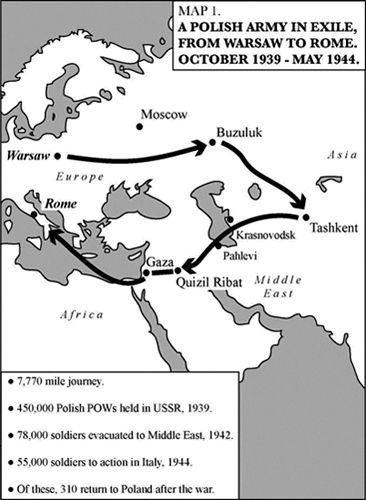
The exiled Polish soldier’s lot was a tough one characterized by disease, fatigue, hard choices, isolation and great emotional and political pressure. This cauldron could boil over and led to some scalding arguments and bitter rebukes, notably from Churchill who was perennially frustrated with political infighting amongst the Polish commanders. There was always hope in the story though, characterized by one constant of the Polish Army – they were an incredibly tough and ferocious bunch whose spirit to carry on fighting proved to be one of the most outstanding displays of human endurance ever seen. You would not want them as your enemy; as a fighting ally, there could be no better choice.
The following quote from the introduction to Stefan Kleczkowski’s 1942 information publication Poland’s First 100,000 sets a poignant opening for this book: ‘So it is right that British minds should be stirred and their ignorance dispelled by such an account as this of what has been and is being done to regain freedom for Poland . . . [and that for Poland’s ongoing fight against Hitler] we and the United Nations owe a historic debt of gratitude. Fully to repay it may be beyond our power. At least we can and should recognize and endeavour to understand it.’4
This book is an attempt to answer the call from 1942; the debt of gratitude was never repaid, the least we can do now is to appreciate the struggle of our wartime Ally and the role we played in their tragedy, one sadly characterized by ignorance and fear of the Stalinist USSR.
A fitting wartime phrase frequently used by the Poles when describing their struggle was: For our freedom, and yours. Here then, is their story, and ours.