
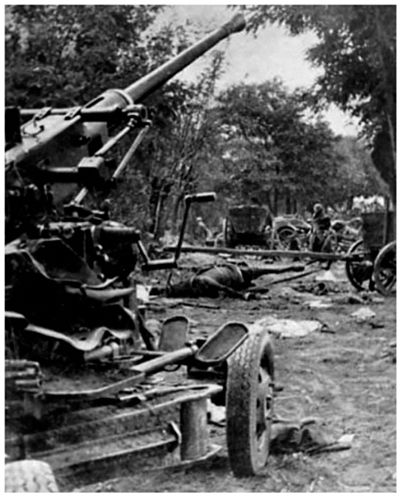
Polish anti-aircraft gun and equipment abandoned after attack by German aircraft, Battle of Bzura, Poland, September 1939. The German Blitzkrieg assault based on close cooperation between army and airforce proved a devastatingly effective new means of attack. (Source: ww2db.com, no picture credit available)

The partition of Poland, Brest, 21 September 1939. Red Army Commander Vladimir Yulianovich Borovitsky (in leather coat) leans over a map of central Poland to face German General Heinz Guderian, to finalize the demarcation of the German–Soviet border following their joint invasion of Poland. (Source: ww2db.com, from German Federal Archive, Bild 1011-121-0010-11)
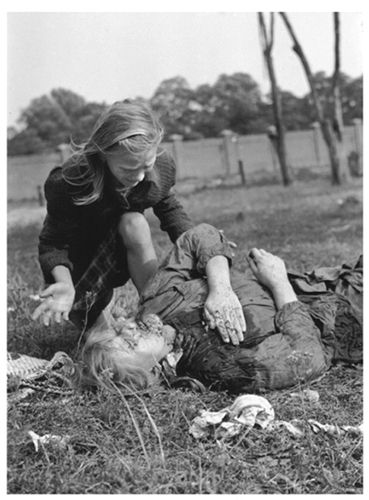
The German invasion of Poland was one of the most aggressive assaults ever launched and appalled the world through the deliberate targeting of civilians. Here, a 10-year-old Polish girl Kazimiera Mika mourns the death of her sister, gunned down by a strafing German aircraft, near Warsaw, 13 September 1939. (Source: ww2db.com, photo by Julien Bryan)

Polish prisoners of war captured by the invading Red Army being marched into captivity. (Source: Wikimedia Commons, uploaded from Soviet newsreel September 1939, also Czerwony Sztandar (Lviv newspaper) September 1940, by unknown TASS war correspondent.)
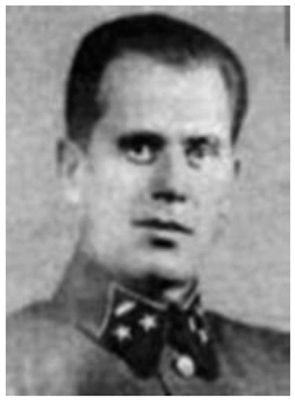
Major General Alexei Panfilov, Head of the Soviet Mission to the Polish Army. A victorious tank commander against the Japanese, Panfilov was assigned to the General Staff in Moscow and placed in charge of the Red Army reserves, including the Polish Army. (Source: Polish blog, http://postacie.ovh.org/panfilow.htm no picture credit available)

General Władysław Sikorski, the Polish Prime Minister and Commander-in-Chief, a statesman held in the highest regard by the Allies. His untimely death in 1943 deprived the exiled Poles of a leader highly experienced in the complexities of international politics. His successors never commanded the same respect or influence. (Source: United States Library of Congress LC-USW33-019087-C)
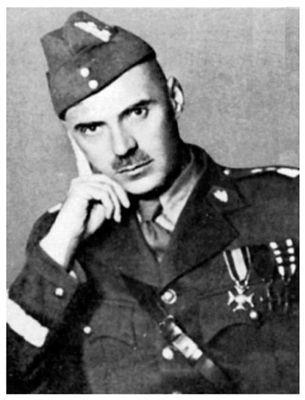
Lt. Gen. Władysław Anders shortly after his release from Soviet detention and appointment as commander of the Polish Army in the USSR. Having shared the same hardships as the rest of the army detained in the USSR, Anders commanded the near fanatical allegiance of his soldiers. (Source: ww2db.com, original from Anders, Władysław, Bez ostatniego rozdziału, Warsaw, 1990)

Polish policemen and civilians being forcibly marched out of Poland by Soviet Internal Security Troops, the NKVD, 1939. These, and hundreds of thousands of other Polish civilians were banished to the remotest regions of the USSR for use as hard labour and farm hands. The death toll was catastrophic. (Source: ww2db.com, no picture credit available)
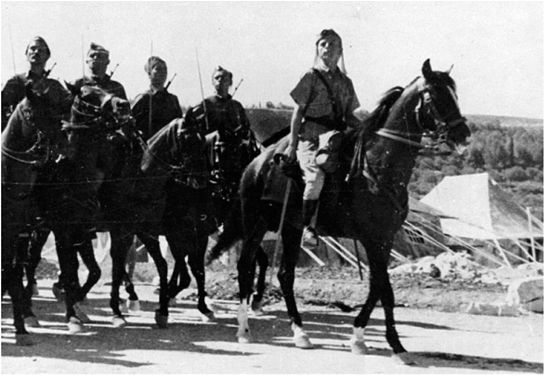
Cavalry of the Carpathian Lancers Regiment, Polish Independent Carpathian Rifle Brigade on parade in Palestine, 1940. These soldiers had escaped from Poland after 1939 and joined the French Army of the Levant in Syria. Following the defeat of France in 1940 the Brigade marched out of Vichy-controlled Syria and into Palestine to continue the fight alongside the British Army. (Source: Wikimedia commons)

General Georgi Zhukov of the NKVD, Political Commissar of the Soviet Mission to the Polish Army. Zhukov had the full confidence of Stalin and he subsequently commanded great executive authority within the Soviet system. (Source: Author collection, no picture credit available)
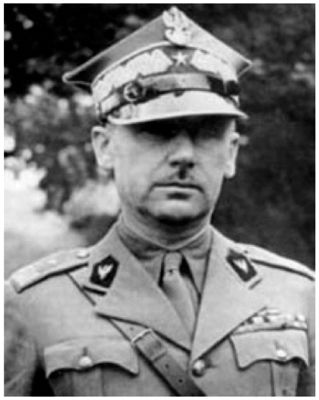
Major General Kopański, commander of the Independent Carpathian Rifle Brigade and subsequently the 3rd Carpathian Rifle Division. Following General Sosnkowski’s appointment as Commander-in-Chief, Kopański was recalled to London to serve as the Polish Army’s Chief of Staff. (Source: ww2incolor.com, no picture credit available)
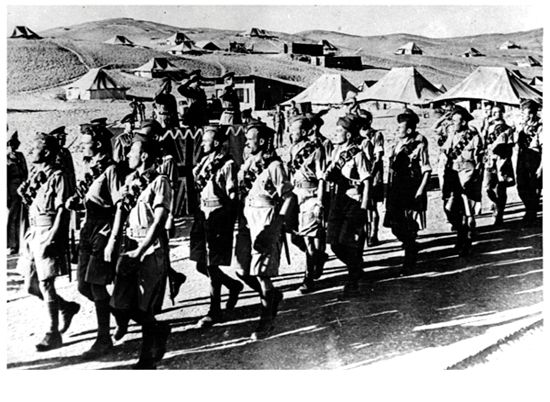
Soldiers of the Polish Independent Carpathian Rifle Brigade parade before British and Polish dignitaries in Palestine, 1940. (Source: Wikimedia commons)
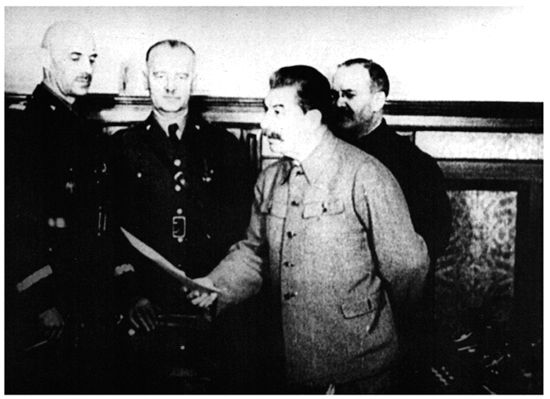
Signing of the Mutual Friendship Pact between Poland and the USSR, Moscow, 4 December 1941. From left: Lt. Gen. Anders, General Sikorski, Stalin, Molotov. (Source: Wikimedia commons)
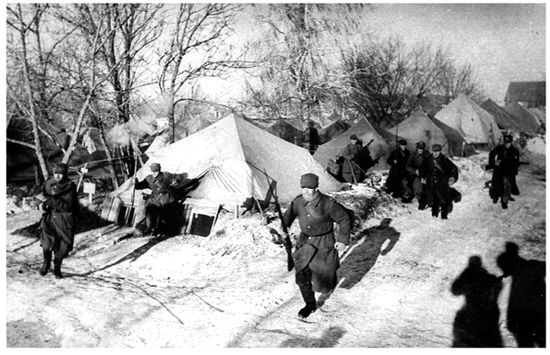
Men of the 6th Infantry Division run to muster at their camp near Tockoje, on the banks of the River Volga, winter 1941/42. This was one of the initial camps established after the release of many Polish soldiers from Soviet detention. The flimsy tents provided scant shelter from the rigours of the Russian winter. (Source: Wikimedia commons)
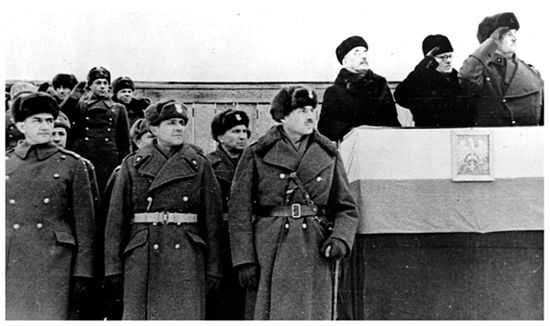
Inspection of the Polish Army in the USSR by General Sikorski (far right) in December 1941. To the left of the podium stands Lt. Gen. Anders, Col. Okulicki and a Soviet officer. (Source: Wikimedia commons)

The snow-clad steppes of the border with China and Afghanistan – a bleak and inhospitable environment that became the Polish Army’s second and final base in the USSR. General Anders sits in the snow during a training exercise as Soviet officers (in peaked caps) maintain a watchful presence, early 1942. Note the Polish soldiers are now wearing British Army uniforms and helmets. (Source: Wikimedia commons)
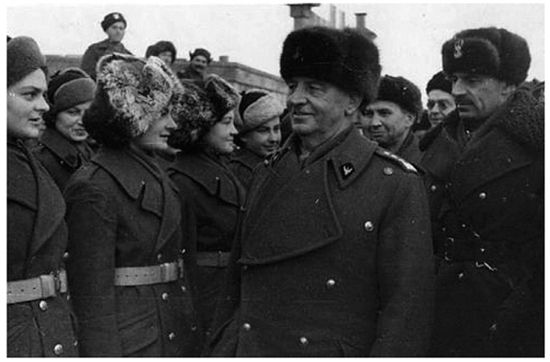
General Sikorski with Lt. Gen. Anders (behind) review women volunteers to the Polish Army in the USSR, December 1941. Creating military roles for women greatly facilitated their release from Soviet detention. (Source: ww2incolor.com, image 621349. No picture credit available)
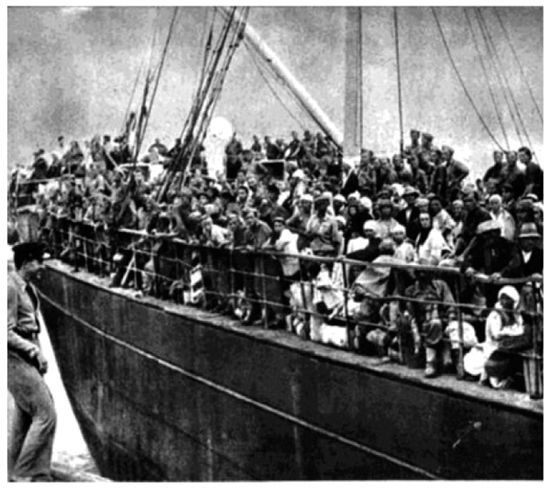
A cargo ship loaded with Polish evacuees arrives at Pahlevi, Iran, having sailed across the Caspian Sea from Krasnovodsk, USSR. The open deck is crammed with soldiers and civilians. (Source: ww2incolor.com, image 626158, no picture credit available)

The brutality of Stalin’s dictatorship; the decaying body of a major of the 1st Light Horse Regiment. Taken prisoner by the Soviets in 1939 he was shot through the head by the NKVD in 1940 near Katyn. The bodies of several thousand Polish Army officers were discovered by the retreating German Army in a mass grave, all were found with their hands tied behind their backs and all killed with a single pistol shot to the back of the head. By publicizing the discovery Goebbels delivered a propaganda coup that almost destroyed Allied unity. (Source: Wikimedia commons)
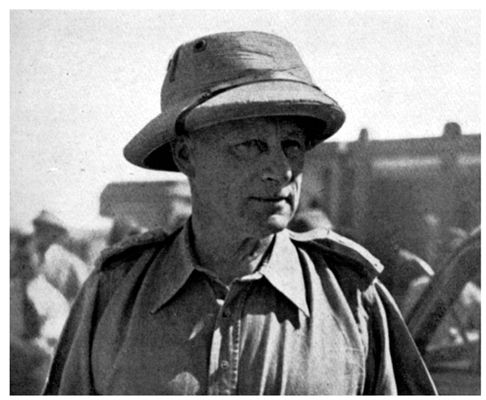
Lieutenant General Sir Edward Quinan, Commander-in-Chief of British Troops in Iraq until August 1942. (Source: PAIFORCE: The official story of the Persia and Iraq Command 1941–1946, prepared for the War Office, 1948, HMSO, Crown Copyright)

General Sir Henry Maitland Wilson, Commander-in-Chief of Persia and Iraq Command from August 1942 to February 1943 and subsequently Supreme Allied Commander Mediterranean. Wilson was a strong advocate for the Polish Army and greatly facilitated their development. His physical bulk led to the near-official nickname ‘Jumbo’, and even his command was assigned an elephant as its formation sign, which he took as a compliment, pointing out that elephants are renowned for their intellect. (Source: PAIFORCE: The official story of the Persia and Iraq Command 1941–1946, prepared for the War Office, 1948, HMSO, Crown Copyright)

Lieutenant General Sir Henry Pownall, Commander-in-Chief of Persia and Iraq Command, March to September 1943. Pownall oversaw the creation of II Corps out of the Polish Army in the East. A hard taskmaster, he moulded them into a modern fighting formation of British outline and ordered Anders to follow the Allied stance over the Katyn massacre and to rein in anti-Soviet agitation amongst the Polish soldiers. (Source: PAIFORCE: The official story of the Persia and Iraq Command 1941–1946, prepared for the War Office, 1948, HMSO, Crown Copyright)

Carpathian Lancers Regimental HQ at Mena Camp, Palestine 1942. Note the pennon flying in the foreground; the chequered square contains a block of colour for each of the four squadrons, whilst the trailing banner is in the red and blue colours of the Regiment. (Source: Author’s collection, photo by Lieutenant Henryk Siemiradzki)
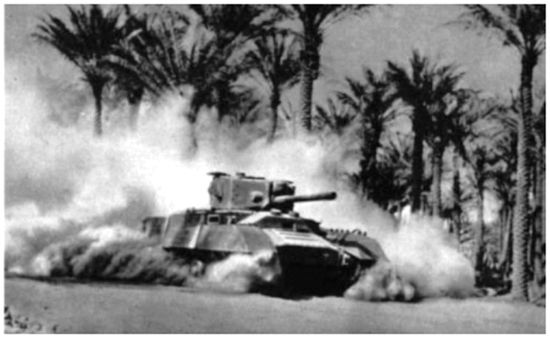
Valentine tank of 2 Tank Brigade during training exercises in the Middle East, 1943. Training of tank crews took place in Egypt and Iraq before moving to Palestine with the whole of II Corps in late 1943, where the Brigade was outfitted with modern Sherman tanks. (Source ww2incolor.com, image 477842, no picture credit available)
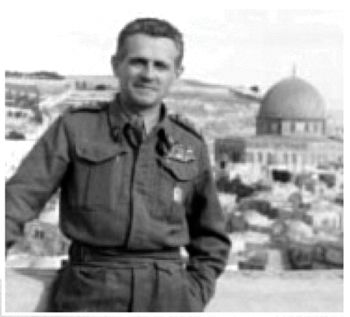
Lieutenant General Karaszewicz-Tokarzewski, commander of the 6th Infantry Division and subsequently Deputy Commander-in-Chief Polish Army in the East and following Sosnkowski’s organizational plan, commander of Polish Army Units in the Middle East, the JWŚW. Photographed in Jerusalem, 1942/43. (Source: United States Library of Congress, LC-M33-12965-C)
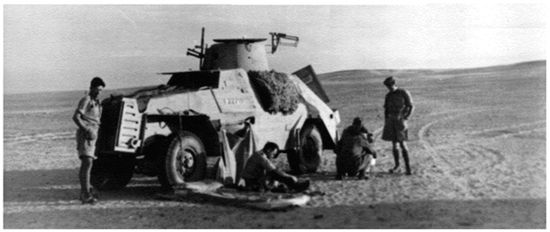
Marmon Herrington armoured car of the Carpathian Lancers Regiment on patrol in the Palestinian desert, a lonely activity. (Source: Author’s collection, photo Lieutenant Henryk Siemiradzki)

Lieutenant Boruta of the Carpathian Lancers Regiment reads a Polish Army newspaper in the shade of his tent at Mena Camp, Palestine. The Polish troops suffered the effects of isolation in an alien environment – the value of cultural activities was appreciated by the command and a wide range of social and welfare facilities were established throughout the Middle East. (Source: Author’s collection, photo by Lieutenant Henryk Siemiradzki)
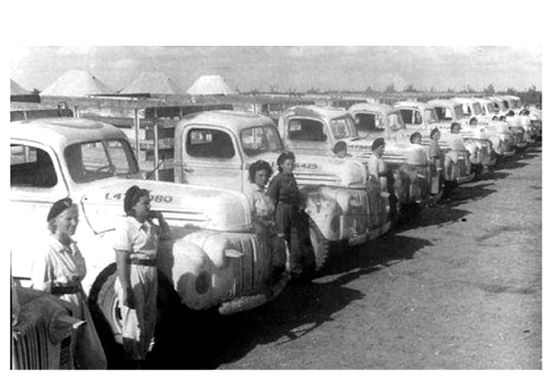
Two transport companies of II Corps were staffed entirely by women – 316 and 317. Photo taken in the Middle East, either Iraq or Palestine, note the RAF roundel painted on the cab roofs for recognition from the air. (Source: ww2incolor.com, image 62882081, no picture credit available)
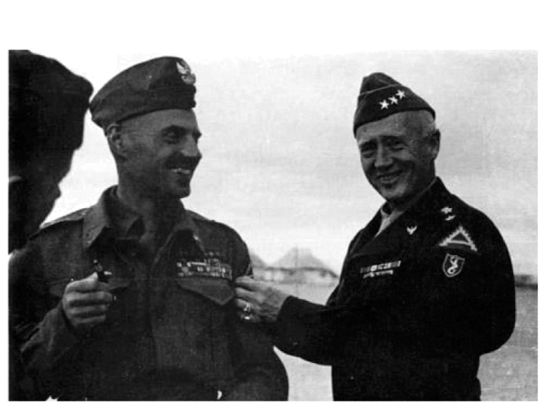
General Patton exchanges formation insignia with Lt. Gen. Anders during Patton’s inspection of Polish forces in the Middle East in late 1943. The American General was greatly impressed by the toughness and fighting zeal of Anders and his soldiers. (Source: ww2db.com, no picture credit available)

Lt. Gen. Anders and Master Zygmunt Deyczakowski on the deck of MS Batory during the sea passage from Egypt to Italy, 1944. Convoys of Polish merchant ships such as this liner, escorted by Polish naval vessels, ferried Polish troops across the Mediterranean for five months to establish II Corps in Taranto, Italy. (Source: Wikimedia commons)
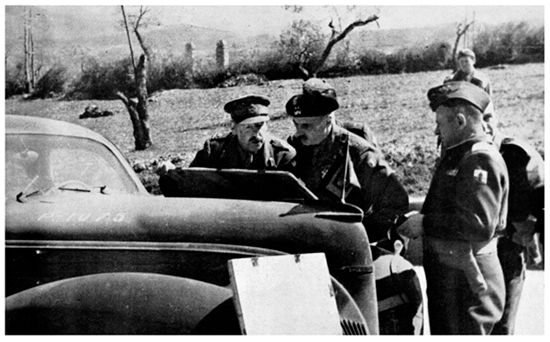
Allied generals deliberate their plans, from left: Lt. Gen. Leese, Eighth Army Commander, Lt. Gen. Anders, II Corps Commander and Maj. Gen. Duch, 3rd Carpathian Infantry Division Commander. River Sangro sector, March 1944. (Source: Divisional photo album of 3rd Carpathian Rifle Division in Italy, 3 Dywizja Strzelców Karpackich w Italii, Firenze, 1945, published by the division’s own press, all photos by Polish Army photographers. This photo by J. Fuks)
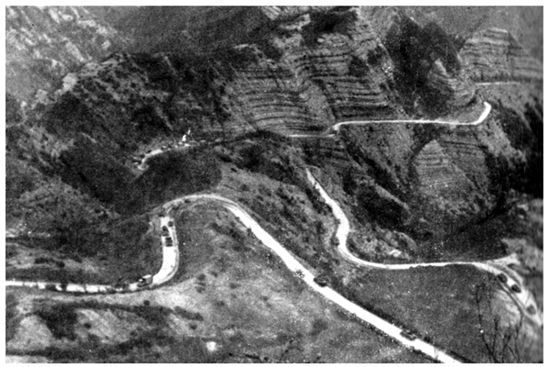
Supply and logistics was a vast undertaking, moving a large mechanized army and the provisions to keep it running through the Apennine Mountains was a tortuous and time-consuming endeavour. (Source: Łozrński, Marian, Przechodniu, Powiedz Polsce…, Kraków 1972, many editions before 1994)
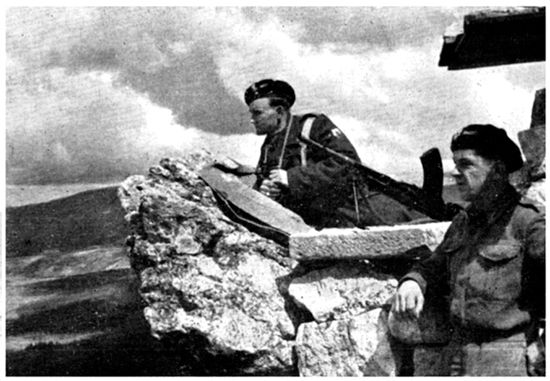
Observation post of the 12 Podolski Lancers on the Capracotta sector. Observation and harassment of the enemy were the mainstay of operations during the winter months on the Sangro River front. (Source: Divisional photo album of 3rd Carpathian Rifle Division in Italy, 3 Dywizja Strzelców Karpackich w Italii, Firenze, 1945, published by the division’s own press, all photos by Polish Army photographers. This photo by W. Domański)
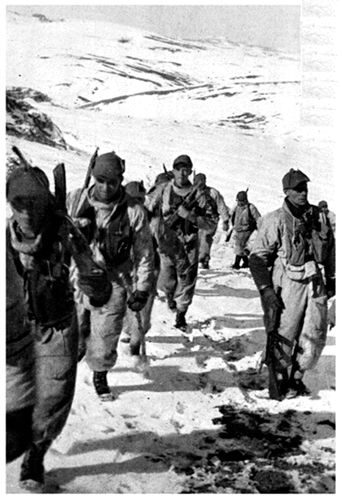
Infantry battalions sent out regular patrols, here soldiers of the 3rd Carpathian Rifle Division complete with winter camouflage move out across the snow-covered slopes of the Sangro valley. (Source: Divisional photo album of 3rd Carpathian Rifle Division in Italy, 3 Dywizja Strzelców Karpackich w Italii, Firenze, 1945, published by the division’s own press, all photos by Polish Army photographers. This photo by J. Siemek)
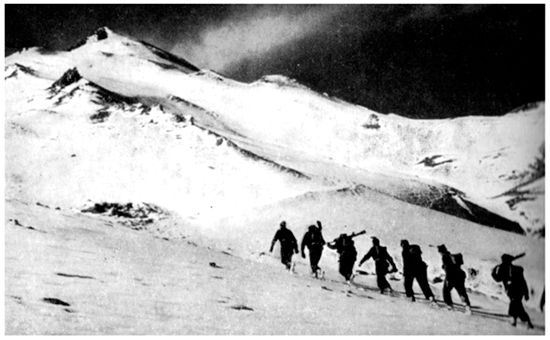
Patrol of the 3rd Carpathian Rifle Division begins the climb up one of the region’s many mountains. The terrain and climate were as much as a challenge as the Germans. Small patrols such as these were regularly sent out to set ambushes and probe enemy positions. (Source: Łoziński, Marian, Przechodniu, Powiedz Polsce…, Kraków 1972, many editions before 1994)
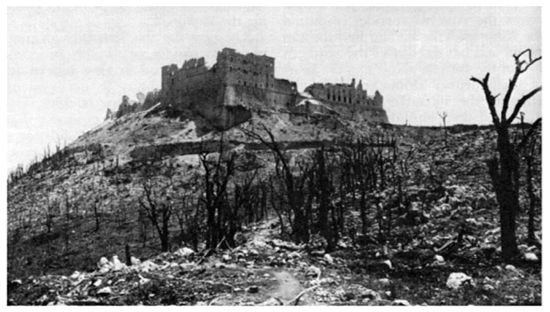
Monte Cassino monastery in ruins, Italy, February 1944. This desolate scene of destruction was to become the terrain on which the Polish II Corps would fight to secure mastery of the strategic hills, possession of which was pivotal to enable the charge to Rome to begin. (Source: ww2db.com)

40mm Bofors Anti-Aircraft Gun and crew from a divisional artillery regiment await H Hour and the commencement of battle. With little enemy airforce action anticipated such guns were used to fire tracer rounds over the battlefield to delineate lines of advance for the troops. Many anti-aircraft gunners were re-assigned to mortar batteries and as stretcher bearers for the battle. (Source: Anders, Władysław, Bez ostatniego rozdziału. Wspomnienia 1939–1946, Warsaw 1989, many editions before 1994)
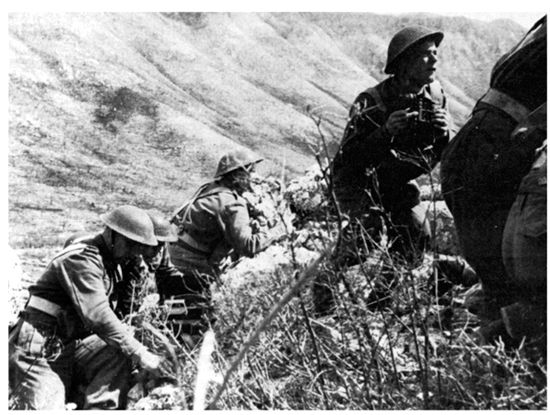
Artillery observation posts were established as far forward as possible to identify enemy gun positions and report on the accuracy and effect of the Polish artillery fire. The German guns proved to be too well dug in to be engaged and the 25pdr Field Gun equipping most Polish artillery regiments lacked the power to destroy fortifications of rock and concrete. (Source: Anders, Władysław, Bez ostatniego rozdziału.Wspomnienia 1939–1946, Warsaw 1989, many editions before 1994)
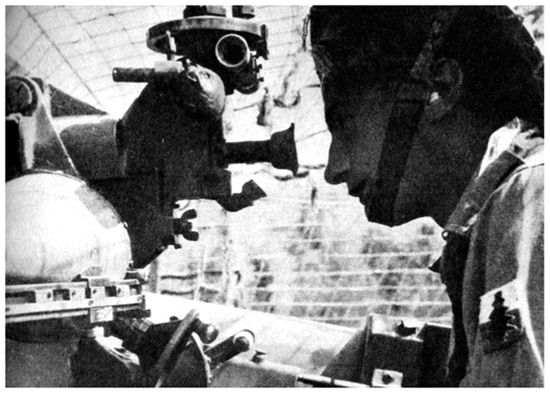
An artilleryman from the Carpathian Rifle Division checks the lay of his 25pdr Field Gun under cover of a camouflage net. The artillery regiments were positioned on the flat valley floor beneath the monastery, totally exposed to enemy observation and fire. Movement was restricted to a minimum, and only by night. The gun positions of the 6th Carpathian Artillery Regiment were suspected by the Germans and shelled relentlessly prior to the battle. The Poles did not return fire as that would have confirmed their presence. (Source: Wańkowicz, Melchior, Monte Cassino, Warsaw 1989, many editions before 1994)
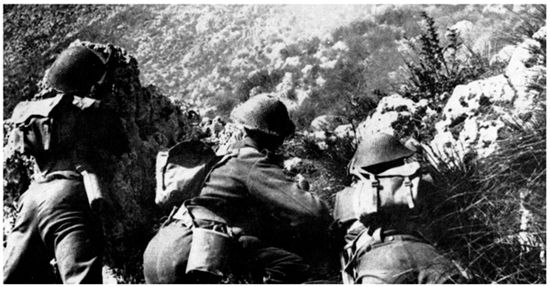
Polish infantry take cover behind a ridge as their artillery engage German positions ahead of them. (Source: Anders, Władysław, Bez ostatniego rozdziału.Wspomnienia 1939–1946, Warsaw 1989, many editions before 1994)
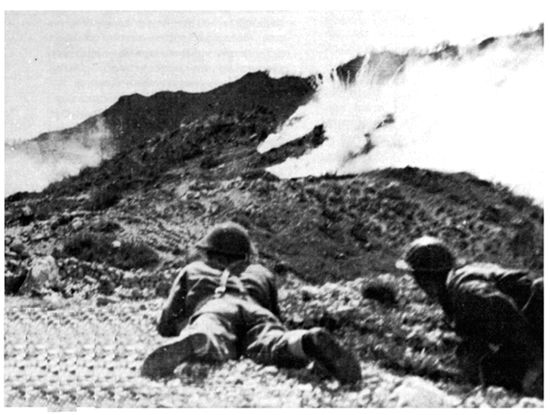
Polish soldiers hug the ground as phosphorus rounds hit German defences ahead of them. (Source: Anders, Władysław, Bez ostatniego rozdziału. Wspomnienia 1939–1946, Warsaw 1989, many editions before 1994)
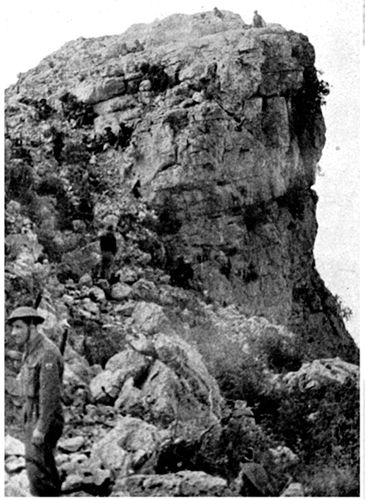
Hill 569, here raged one of the fiercest engagements during the Monte Cassino battle. (Source: Divisional photo album of 3rd Carpathian Rifle Division in Italy, 3 Dywizja Strzelców Karpackich w Italii, Firenze, 1945, published by the division’s own press, all photos by Polish Army photographers. This photo by W. Domański)
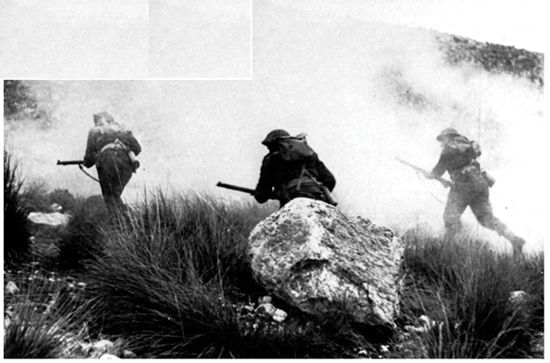
Polish infantry advance through the smoke of a preceding artillery barrage to engage German paratroopers dug in on the hillside above. It was an exceptionally difficult task and cost the Poles heavily in casualties. (Source: Anders, Władysław, Bez ostatniego rozdziału. Wspomnienia 1939–1946, Warsaw 1989, many editions before 1994)
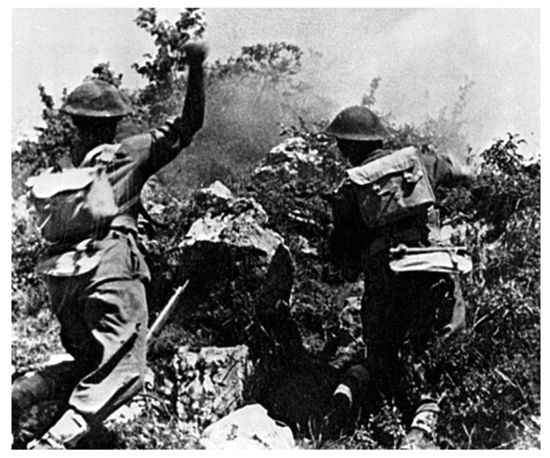
Polish infantry throw grenades at entrenched German positions on Hill 593. (Source: Wańkowicz, Melchior, Monte Cassino, Warsaw, 1989, many editions before 1994)

Polish troops scaling a rock face with ammunition crates, Monte Cassino, Italy, May 1944. (Source: ww2db.com, no picture credit available)
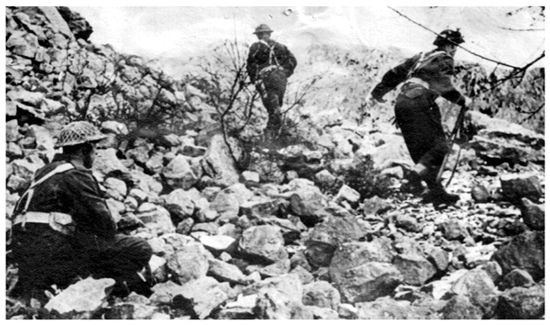
Hill 593. Much of the terrain at Cassino consisted of bare rock and scree slopes, with no cover, nowhere to dig in and no shelter from shrapnel – the only survival strategy was to kill the enemy and the fighting became fanatical and ferocious on both sides. (Source: ww2db.com, no picture credit available)

Dead soldiers of the 6th Battalion, 3rd Carpathian Rifle Division lie strewn at the foot of Hill 593. (Source: Łoziński, Marian, Przechodniu, Powiedz Polsce…, Kraków 1972, many editions before 1994)

Polish infantry cautiously approach a seemingly deserted German machine-gun post, the soldier in the foreground is manoeuvring a demolition charge on a length of stick to make sure the position is clear. (Source: Wańkowicz, Melchior, Monte Cassino, Warsaw, 1989, many editions before 1994)
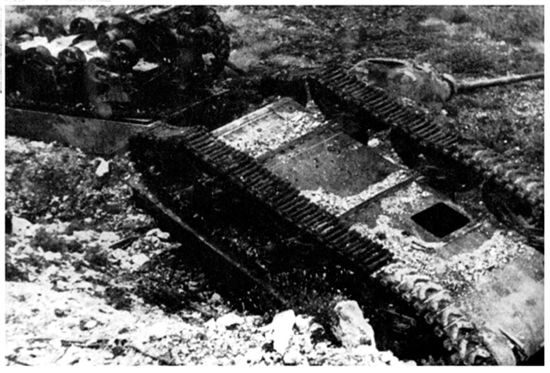
The remains of an upturned Polish Sherman tank along the Polish Sappers’ Road, a tortuously narrow and steep supply track to the front line. Numerous vehicles fell into the ravine below or in the case of breakdowns had to be pushed over the edge to clear the road. (Source: Wańkowicz, Melchior, Monte Cassino, Warsaw, 1989, many editions before 1994)
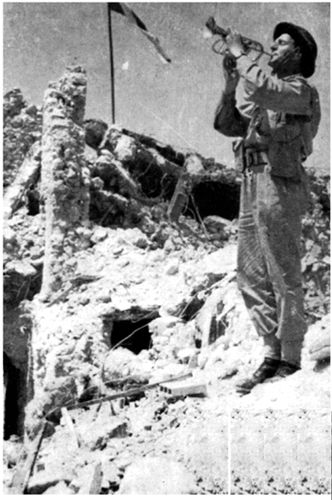
With the Polish flag flying above the ruins of Monte Cassino Abbey, Bugler Lance Sergeant Karol Czech sounds the Hejnal Mariacki, a traditional Polish piece played daily from the cathedral tower in Kraków. The Battle of Cassino won, the next Polish attack, on the neighbouring town of Piedimonte and the mountains to the east was about to get underway. (Source: Łoziński, Marian, Przechodniu, Powiedz Polsce…, Kraków, 1972, many editions before 1994)
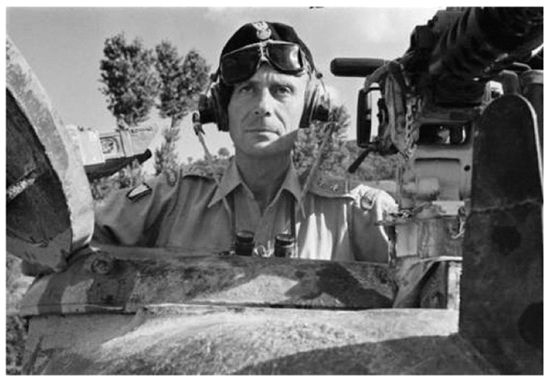
Lieutenant Colonel Bobiński, deputy commander of 2 Armoured Brigade and commander of ‘Group Bob’ that was tasked with the assault on Piedimonte. (Source: ww2incolor.com, no picture credit available)
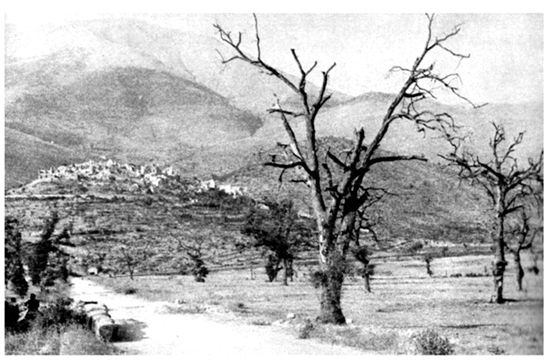
View from Highway 6, the hilltop town of Piedimonte just ahead, and behind the hills lead to Passo Corno and Monte Cairo in the distance. The Abbey of Monte Cassino is just out of shot to the right. (Source: Wańkowicz, Melchior, Monte Cassino, Warsaw, 1989, many editions before 1994)
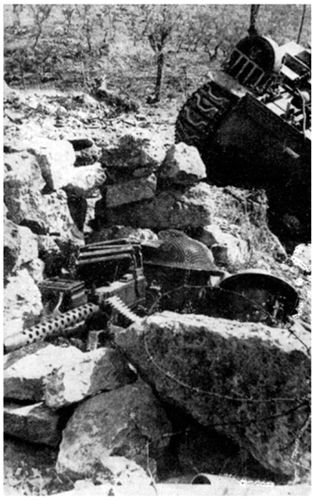
Polish soldiers man their machine gun amidst the rubble and disabled tanks that lay scattered around the town of Piedimonte. (Source: Wańkowicz, Melchior, Monte Cassino, Warsaw, 1989, many editions before 1994)
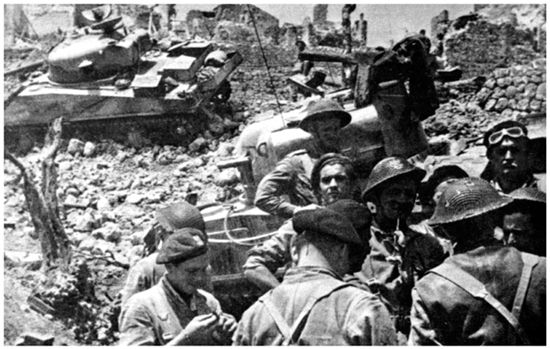
Tank crews of the 6 Armoured Regiment deliberate on the best course of action to take. Tanks were totally unsuited to the terrain and the regiment lost nearly all the vehicles it deployed – as a result the dismounted tankers assumed the role of infantry and attacked the Germans on foot. (Source: Wańkowicz, Melchior, Monte Cassino, Warsaw, 1989, many editions before 1994)

The upturned tank of Warrant Officer Średnicki that toppled from one of the steep escarpments leading to the town of Piedimonte. (Source: Wańkowicz, Melchior, Monte Cassino, Warsaw, 1989, many editions before 1994)
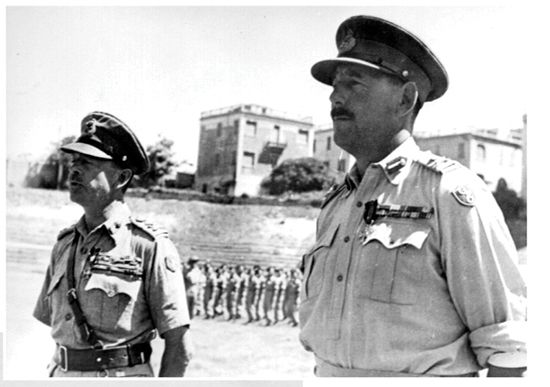
British Generals Alexander and Leese decorated with Polish Virtuti Militari Cross awards, Italy, July 1944. (Source: ww2db.com, no picture credit available)

Polish II Corps preparing to embark for the voyage from Italy to the UK and their subsequent processing into the Polish Resettlement Corps and onwards to civilian life. (Source: Wikimedia commons, photo by Benon Tuszyński)