
12
NOVEMBER 1942
AFTER THE DUCK returned to the Northland, the night on the ice cap was clear and the weather tame. It was tempting to imagine that Greenland had surrendered. The seven remaining PN9E crewmen bundled together in the bomber’s tail section, warmed by the thought that two of their friends were safe and their own imprisonment was nearly over. As darkness fell, they fired bright red flares into the starlit sky. The official purpose was to guide the motorsled drivers to the wreck, but the flares also seemed a fitting celebration of the anticipated end of their ordeal.
Seeing the red starbursts, Max Demorest and Don Tetley knew they were close. In fact, the lights on their sleds were already visible from the PN9E. They shot off a flare of their own to let the bomber crew know they were within range. But a mile or so from the plane, the motorsled drivers halted at a menacing sight: their intended route was across an active glacier beset by crevasses. Demorest, the Princeton PhD glacier expert, and Tetley, the Texas horseman turned Arctic explorer, climbed off their motorsleds to assess the danger. Agreeing that it was too perilous to proceed on their sleds at night, they strapped on skis and grabbed poles to test the way. They’d find a safe trail through the maze of crevasses on foot, and then return to the sleds to drive along that footpath.
Carrying a bundle of supplies and threading their way around the ice chasms, Demorest and Tetley reached the PN9E after midnight. They found Monteverde’s crew awake and in high spirits. After hearty greetings, the seven remaining survivors broke out a can of chicken that they’d saved for just such an occasion. Demorest dressed O’Hara’s gangrenous feet and treated him with antibacterial sulfa drugs and morphine for the pain. Tetley described O’Hara as suffering from “frozen feet and body poison.” The diagnosis reflected his belief that the navigator’s shriveled feet had become infected and that immediate evacuation was essential for any chance to avoid amputation.
After treating O’Hara, Demorest checked Spina’s arm to ensure that the bones were knitting properly, then applied fresh bandages. Then he went man to man, wrapping frostbitten fingers and toes. As the ministrations continued, the men of the PN9E told Demorest and Tetley about one further indignity: a steady diet of dry rations, a lack of fruit or vegetables, and little exercise had left most of them constipated.
When the medical work was complete, Demorest and Tetley shared news of the war. They regaled the PN9E crew with the triumph of Operation Torch, the joint British-American invasion of North Africa. They also reported the bad news that McDowell’s C-53 still hadn’t been found. Then they explained their plan to take everyone to Ice Cap Station and then on to Beach Head Station, on foot or motorsled, if the Duck didn’t return.
Even with Tucciarone and Puryear gone, the bomber’s tail section felt too cramped for Demorest and Tetley to spend the night. Also, they worried that a blizzard might cover their sleds while they slept, delaying them in the morning. They told the bomber crew that they’d sleep in tents by their motorsleds and return around 10:00 a.m. The PN9E crew urged them to stay, fearful of the motorsled men walking in the dark amid the crevasses. But Demorest and Tetley wouldn’t hear of it. As the party broke up, Monteverde made plans to greet Demorest and Tetley with a hot breakfast.
After the motorsled men left, the PN9E crewmen were too excited to sleep. They talked about getting back home and agreed how nice it would be to sleep on a cot again. Monteverde reminisced about the warmth of California, and anticipated a spaghetti feast that Tucciarone had promised everyone. Hearing that, Spencer cranked open a can of spaghetti that Tetley had left behind. He warmed it over the fire and gave his crewmates one forkful each. Spencer joked that he wanted all of them to taste spaghetti before Tucciarone did.
At O’Hara’s suggestion, they prayed together before turning in. Afterward everyone lay in silence, but Spina knew that no one was asleep.
THE FOLLOWING DAY, November 29, 1942, Winston Churchill delivered a worldwide radio address declaring a turning point in the war, the Allies’ first “bright gleam of victory.” He hailed the defeat of German field marshal Erwin Rommel in Egypt, and the American-led landings in Algeria and Morocco. Despite the good news, for the first time since Pearl Harbor the war was overshadowed in the United States by a homegrown tragedy: nearly five hundred dead, many of them servicemen, in the Cocoanut Grove nightclub fire in Boston.
Aboard the Coast Guard cutter Northland in Comanche Bay, neither Churchill’s speech nor the nightclub fire was the big news. Thoughts and hopes were focused on the PN9E crew, and on Pritchard, Bottoms, and the Duck.
When daylight broke, wispy fog and steely clouds replaced the clear sky of the previous night. Pritchard checked the weather reports and saw that snow was on the way and the overcast was thickening. At 8:00 a.m., visibility was approaching twenty miles. But it soon deteriorated, falling to perhaps half that distance an hour later. The fog was getting murkier, the snow heavier, the sky darker. By noon, visibility would be less than one mile. If they chanced it, Pritchard and Bottoms would be flying by the seat of their pants.
But Pritchard believed that he, his radioman, and the Duck could handle the weather, and it wasn’t likely to improve the next day or the day after. During the previous nine months, he’d become expert in the tricky flying that was required over and around the island. He knew how to hold steady through wild bursts of turbulence, loss of visibility, and dangerous haze that blurred the horizon. Pritchard took those risks seriously, but he’d also seen firsthand how the men of the PN9E were suffering. This was their twentieth day on the ice, and they’d waited long enough. Pollard, the Northland’s captain, trusted Pritchard’s judgment and allowed him to proceed.
The decision was sealed when Lolly Howarth awoke that morning and radioed the Northland that it was a beautiful day on the glacier, with good visibility.
As the ship’s crew again lined the rail, Pritchard and Bottoms gained speed along their water runway and took off at 9:29 a.m. The flight normally took no more than twenty minutes, so Pritchard and Bottoms could expect to join Demorest, Tetley, and the remaining seven PN9E men for their scheduled ten o’clock breakfast.
The flight over Koge Bay was uneventful. As Pritchard flew above the wreck, Bottoms tossed out the stretcher-sleds built by the Northland’s carpenters, so they’d be near the bomber to transport O’Hara and Spina to the Duck. At the sound of the plane, Harry Spencer emerged from the B-17’s tail to retrieve the sleds. Monteverde intended to have Demorest and Tetley use their motorsleds to carry O’Hara and Spina to the Duck, but Spencer decided to assemble the handmade stretcher-sleds nonetheless. Spencer also made a fire to cook breakfast for the rescuers and his fellow crewmen, but the PN9E survivors wanted only coffee. They were saving room for an expected banquet aboard the Northland.
As he worked, Spencer took several breaks to slip inside the tail and give updates to Spina and O’Hara, who remained in their sleeping bags. On one visit, he said, “It won’t be long now. The sleds are almost here and the plane is due any minute. I guess we can kiss the Ice Cap goodbye.” Several other men came inside to pat O’Hara and Spina on the back for good luck.
WHILE ASSEMBLING THE hand sleds, Spencer saw the motorsleds bearing Demorest and Tetley approaching from the east, each with a cargo sled in tow. They followed the path of ski tracks they’d made the night before, with Demorest out front and Tetley close behind.
Motorsleds are heavy and difficult to turn. Demorest wanted his to be facing in the opposite direction, away from the B-17, when the time came to leave. About one hundred yards from the bomber, Demorest turned off the trail and steered the motorsled in a wide arc. When he reached the end of the arc, Demorest expected, he’d be pointing away from the PN9E. Even after Spencer’s fall into the crevasse, Monteverde’s crew had walked around the crash area to gather airdropped supplies. Demorest must have thought the well-trod area was safe from danger.
But twenty-five yards into the turn, Demorest’s motorsled crossed a snow bridge over a hidden crevasse. The bridge might have supported a man alone on foot, but it was too weak to bear the weight of a man on a loaded motorsled. Without warning, the bridge gave way. Max Demorest and his motorsled plunged headfirst into the blue-white abyss, with the attached cargo sled pulled in behind.
Tetley jumped off his sled and sprinted to the crevasse, yelling for help as he ran. When he reached the eight-foot-wide opening, he looked down to see the motorsled’s tail and the cargo sled, wedged between the walls about one hundred feet down. But he saw no sign of Demorest. He shouted for his friend but heard no answer.
Grabbing ropes, Monteverde, Spencer, and Howarth ran to join Tetley at the hole. They called to Demorest, but received no reply. Howarth volunteered to trek as quickly as possible to the Duck’s landing site to tell Pritchard and Bottoms what had happened. He’d ask the Coast Guard pilot to return to the Northland to gather more men and equipment to attempt a rescue. Monteverde gave him the go-ahead and told Howarth that Pritchard should take off as soon as possible, without waiting for more crewmen from the PN9E. They needed help fast, and snow and fog were rolling in from Koge Bay.
Howarth stopped at the tail section for a fast good-bye to Bill O’Hara, Paul Spina, Clint Best, and Clarence Wedel. They wished him luck, told him to avoid the crevasses, and gave him eight rolls of film they’d taken of themselves. They told Howarth they wanted him to have sets of photos developed for each of them aboard the Northland when they arrived. Howarth tucked away the film and followed the trail Pritchard and Bottoms had made the day before to the Duck.
At the crevasse, Tetley frantically wove a rope ladder. Monteverde considered lowering a man, but this was much different from Spencer’s fall. With no sign of life from Demorest, Monteverde concluded that sending a man down would recklessly endanger another life. Tetley and Spencer agreed. Trying to reach Demorest would take every healthy man among them, and even then they might not have enough strength or equipment. They had no option but to keep watch and continue calling to the lieutenant. If he answered, they’d send a man down.
One PN9E crewman rushed to the radio to call for help, but without Howarth’s knowhow, all he could do was send SOS messages. The Northland heard them but misunderstood their purpose. The ship’s radio operator relayed a message to “Iceberg” Smith saying that the bomber was “apparently attempting to contact motor sledges in her vicinity or [at] Ice Cap Station.”
JOHN PRITCHARD AND Ben Bottoms landed the Duck at the same spot where they’d come down the previous day, some two miles from the PN9E. This time, Pritchard landed on the Duck’s pontoon, with the wheels up, as though the ice were water. Bottoms radioed the Northland that they were safely on the glacier.
When Howarth reached the landing area, he told the Coast Guardsmen about Demorest’s fall. Pritchard and Bottoms brought the young radioman aboard for the return trip to the Northland and prepared for an immediate departure. Pritchard and Bottoms climbed into the cockpit and Howarth crawled down into the empty compartment in the fuselage.
Pritchard took off in the same direction as he’d flown away the day before, heading toward Koge Bay. As he flew south and passed over the wreck, Pritchard waggled the Duck’s wings in salute.
Below, at the crevasse, Monteverde, Spencer, and Tetley were still calling to Demorest. He never answered. Soon the fog grew so thick that they had to abandon their vigil, lest they risk falling into a crevasse, too. They returned several times to the hole when the fog cleared, but heard nothing but the echo of their own voices.
Two years earlier, Max Demorest’s mentor had published a worried insight about his protégé’s fearlessness. Now the prophecy had come true for Max Harrison Demorest of Flint, Michigan, a thirty-two-year-old Ivy League professor and scholar, husband and father, army lieutenant and motorsled rescuer.
While trying to help a group of desperate men, one of the world’s leading authorities on glaciers had been lost forever at the bottom of one.
WITHIN MINUTES OF takeoff, the Duck and the three men aboard were in trouble, too. The storm had arrived faster than Pritchard expected, and the window for a safe return to the waiting Northland in Comanche Bay had closed.
Roughly nine minutes into the flight, when the Duck should have been about halfway back to the ship, Pritchard called the Northland for a weather report. From the little radio room a deck below the bridge, the ship’s communications officer began to reply. But before he could finish, Pritchard cut him off, yelling, “MOs, MOs—quick!”
The urgent call could mean only one thing: Pritchard was lost, disoriented in the fog and storm, flying at perhaps ninety knots, or about one hundred miles per hour. Pritchard was flying in milk. By calling for magnetic orientation, he was desperately seeking a course to the Northland. Without it, the Duck was in danger of slamming into the water or the ice cap. Pritchard was the airborne equivalent of a sailor searching for a beacon to guide him past a reef.
The Northland’s radio operator hammered his transmitter key, sending the signal for MOs—five dashes in succession, da-da-da-da-da—on a prearranged frequency. He repeated the signal again and again—da-da-da-da-da, da-da-da-da-da—but received no reply. The Northland was trying to tell Pritchard and Bottoms that the course was 115 degrees true, a heading over the ice-covered landscape to the waiting ship. But the radio calls to the Duck remained unanswered, and the little plane never emerged from the fog.
The crew of the Northland knew that Pritchard, Bottoms, and Howarth were in danger, or worse, but they refused to write them off. Maybe Pritchard had turned back toward the PN9E to land on the ice cap. Maybe, Northland crew members told themselves, he’d landed somewhere else safely but his radio had been damaged. Or maybe the Duck had set down on the water and was floating in Koge Bay. Perhaps the Duck’s radio signal was blocked by the storm, and that’s why no one could reach them.
AFTER STRUGGLING TO use Howarth’s patched-together radio, Don Tetley told the Northland the bad news at the crash site: “Demorest and one motor sledge in crevasse. Unable to get help to him. Please send help immediately. . . . No word from Northland plane.”
In reply, the ship told Tetley that the Duck hadn’t returned to the Northland, either.
News of the plane’s disappearance fell hard on the PN9E crew, most of all O’Hara and Spina. That morning, before the Duck left with Howarth, the other crewmen had helped to dress the two most seriously injured men, expecting that they’d be next to leave. With the Duck nowhere to be found, and with one motorsled gone, O’Hara and Spina seemed to be running out of ways to leave the glacier for medical care. Maybe running out of time altogether.
Still, the men on the ice and on the Northland retained hope that Pritchard, Bottoms, and Howarth were alive, and that they’d landed somewhere between the PN9E and the ship. Until there was proof one way or another, the Duck’s crew and the PN9E’s radioman were missing, not dead.
During the next few days, Greenland Patrol commander “Iceberg” Smith exchanged a series of messages with the Northland in which he expressed concern for the lost Duck and told the ship to leave Comanche Bay “if by remaining, ship and personnel are endangered.” The PN9E rescue was supposed to take about three days, and it had already stretched longer. Each day the Northland waited, the threat of ice capturing the ship in Comanche Bay increased. A follow-up message from Smith delivered the point more sharply: “Emphasize that remaining to continue rescue operations must be secondary to the safety of Northland.” The ship was his primary workhorse along the coast, and he couldn’t afford to lose it. And yet, despite his doubts, nowhere in the radio messages did Smith question the decisions by the ship’s top officers or by pilot John Pritchard.
A WEEK AFTER the Duck’s last flight, an American B-17 flew over the Koge Bay glacier. Its pilot, Captain Kenneth Turner, reported a sad but unsurprising discovery: “Grumman [Duck] located. No sign of life. Badly wrecked.”
The broken remains of the plane were about three miles from the water, Turner said, although later sightings claimed that he overestimated the actual distance. No one would question Turner’s heartbreaking description of what he saw. The Duck’s tail pointed skyward and its wings were broken off. Its fuselage was intact, but “front part of ship demolished.”
The evidence pointed to a nose-first dive. Still, investigators, Coast Guard officials, and armchair historians would speculate for decades about what happened. Above all, they’d argue whether Pritchard had tried to turn back to his takeoff area when he ran into the fog, or if he’d continued heading for home, toward the Northland. The latter seemed more likely to most, as the navigator for Turner’s B-17, Herbert Kurz, created a map that showed the downed Duck pointing in the direction of Comanche Bay.
However it happened, the sighting by Turner and his B-17 crew established that Pritchard, Bottoms, and Howarth were gone and the Duck was destroyed.
In the end, Tetley’s initial radio message—“Demorest and one motor sledge in crevasse. . . . No word from Northland plane”—disclosed the failure of two rescue methods, by air and by motorsled. More important, it reported the deaths of four American heroes, all of whom had died after volunteering to help fellow servicemen.
In the weeks that followed, a Coast Guard team from the Northland attempted to reach the little plane. Yet from the very first, there was no hope that the three men had survived. Still, one overly optimistic message from the Northland five days after the crash requested that the Duck be dropped a cache of supplies and tools, including a new battery, sixty gallons of fuel, eighteen spark plugs, and several wrenches that would be needed to prepare the engine for takeoff. The message also requested three sleeping bags, animal hides, coffee, food, and spirits.
In reality, after Turner spotted the Duck, all the efforts to reach the plane were motivated by a desire to recover the three men’s remains, to honor their sacrifices, and to grant peace to their families. But storms, billowing snow, and uncertainty about precisely where to look forced the searchers to abandon the effort. Pritchard, Bottoms, and Howarth were left where they fell.
In March 1943 Colonel Bernt Balchen also flew over the wrecked Duck, afterward drawing a rough map of its location, with an X marking the plane’s spot. The result was a sketch that looked like a pirate’s treasure map. Although the map was accurate in several important respects, Balchen invented several geographical features and omitted others. Complicating any future search for the Duck and its men, Balchen’s errors compounded flawed longitude and latitude data reported by Turner’s B-17 crew. Some of those errors were later corrected, but the combined effect was to create confusion and false leads about the Duck’s resting place. That problem would reverberate for decades, as a steady accumulation of snow and ice buried Pritchard, Bottoms, Howarth, and the Duck.
AFTER THREE MILITARY plane crashes in November 1942 in which all men aboard initially survived—McDowell’s C-53, Monteverde’s PN9E, and the Canadian A-20—Greenland had struck back. In less than two hours on the morning of November 29, 1942, a Coast Guard pilot, a Coast Guard radioman, an Army Air Corps radioman, and an army lieutenant motorsled driver were killed trying to save others.
That death toll soon rose, as the search for McDowell’s C-53 crew was abandoned a month after their crash. “Concentrated search was discontinued,” the official report declared, “because it was believed that the crew could not maintain life more than thirty days with the short rations they had on board, and during which time extremely cold weather prevailed. It is believed the crew perished. Aircraft is considered a total loss due to the inaccessibility of the Ice Cap, should it ever be located.” Official declaration of their deaths would come on November 5, 1943.
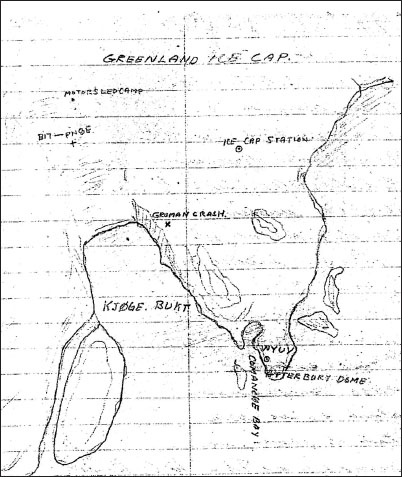
THE MAP COLONEL BERNT BALCHEN DREW IN HIS NOTEBOOK AFTER FLYING OVER THE WRECKED DUCK AND THE KOGE BAY AREA. (U.S. COAST GUARD IMAGE.)
Frozen in time in November 1942 were Lieutenant John A. Pritchard Jr., Sergeant Benjamin Bottoms, and Corporal Loren “Lolly” Howarth of the Duck; Captain Homer McDowell, Lieutenant William Springer, Staff Sergeant Eugene Manahan, Corporal William Everett, and Private Thurman Johannessen of the C-53; and motorsled rescuer Lieutenant Max Demorest.
As Greenland’s god-awful winter approached, seven men remained trapped on the ice: Armand Monteverde, Harry Spencer, William “Bill” O’Hara, Alfred “Clint” Best, Paul Spina, and Clarence Wedel from the PN9E, and their new companion, motorsled driver Don Tetley.
In a battle against nature, fought at the far edge of a war among men, Greenland had regained the upper hand.
POSTHUMOUSLY, JOHN PRITCHARD and Benjamin Bottoms each received the Distinguished Flying Cross. Both also were recommended for the Medal of Honor, the nation’s highest military decoration, but the award was never made.
Pritchard’s Distinguished Flying Cross citation honored him “for heroism and extraordinary achievement while participating in aerial flights as pilot of a plane which rescued Army fliers stranded on the Greenland Ice Cap, on 28 and 29 November 1942. . . . By his courage, skill and fearless devotion to duty, Lieutenant Pritchard upheld the highest traditions of the United States Naval Service.” The medal was presented to his parents in a ceremony at their Congregational church in Los Angeles, with music by Rudy Vallee and the Coast Guard Band. For the loss of her firstborn child in heroic circumstances, Virginia Pritchard was honored as the “California Mother of the Year” for 1944.
Ben Bottoms’s Distinguished Flying Cross citation read, “He rendered valuable assistance to the pilot on the two flights to the Ice Cap, maintained excellent contact by radio between his plane and their ship, and assisted the pilot in rendering aid to the injured and stranded fliers.”
For repairing the radio at the risk of his own life, and for trying to help Max Demorest when he fell into the crevasse, Loren Howarth received the Legion of Merit, the sixth-highest military award, for “exceptionally meritorious conduct in the performance of outstanding services and achievements.”
WORD OF THE Duck’s crash reached Al Tucciarone and Woody Puryear while they were recovering aboard the Northland. Several weeks after his rescue, Tucciarone gave military investigators a sworn account of the PN9E crash and its aftermath. At the end, he veered from formal chronology and wrote, “I want to stress that I owe my life to Howarth, Pritchard, and his radioman, Bottoms.” Thinking about the men still awaiting rescue on the ice, Tucciarone wrote, “I can only hope and pray that those other unfortunate fellows get away from that ‘Death Hole’ as lucky as Sergeant Puryear and myself. May God bless them.”
From his hospital bed, where he’d remain for more than two months, Puryear wrote to Pritchard’s and Bottoms’s families to offer thanks and condolences.
To Bottoms’s parents, he wrote, “I am one of the boys whose life was saved through the heroic efforts of your son, Benjamin A. Bottoms, and Lieutenant John A. Pritchard. Two braver men I have never seen. I knew your son for only a short while and had never seen him until the day of the rescue. He was more than willing to go to the limit to save our lives, even though endangering his own.”
After receiving a similar letter from Puryear, Virginia Pritchard wrote back, “I breathed a little prayer of thankfulness when I learned you were back in this country and able to wire. We know how very ill you were from hunger and exposure. We have no hope whatever that our son still lives, but until the final chapter is written, we have faith that somehow a miracle will bring him back.”
Virginia Pritchard died in 1976 with that prayer for a miracle unfulfilled.