
I CORPS, VIETNAM, 1968
PROLOGUE
This insanity really happened. It may sound like fiction—it does to me, and I lived it—but it’s true the way you’ll read it. I didn’t rely on memory alone. Recently declassified secret information from the United States Marine Corps History and Museums Division, Washington, D.C., helped me in documenting some of the stories. I also had the benefit of checking the facts as I remembered them with two of the men who lived through Vietnam with me.
I was seventeen when I joined the Marine Corps, extremely naive, and dangerously close to competence in several fields of endeavor that served absolutely no purpose: football, baseball, and basketball. Obviously I was in no danger of being classified a genius. I remember sincerely fearing that the war would be over before I got there. Like I said, in no danger of being a genius.
My first twelve years were spent in the West Virginia mountains and in poverty, one being synonymous with the other, I suppose. Don’t get me wrong. I don’t knock West Virginia. Poor or not, mountain people have character, guts, and down-home honesty.
My mom’s first husband was a census taker out in the mountains of Lincoln County, right up the holler from the famous Hatfields. He first found my mom plowing a field on the McClellan farm. She was a raving beauty in those days, and he grabbed her right up. Later he got killed in the Battle of the Bulge and left her with two kids, an eighth-grade education, and a job in a bomb factory. She married my dad, who promptly lost his job and everything else right after they had my sister. They gave the kids to the grandparents because the grandparents had food. I was the last one out of the shute. Mom couldn’t part with another kid, so she decided I’d starve with them before she gave me up.
Dad got in a car wreck and was blind and crippled for the last seven years of his life. After he died Mom and I took off for Florida on Mom’s guts and no money. She married a tough man from New York, a 1935 Golden Gloves boxer and a hard worker who helped me talk Mom into signing the papers that would get me into the Corps. I was inducted in Jacksonville. They put all the inductees up at the old Florida Hotel downtown. My first night there, some wide-eyed, shirtless lunatic ran into the lobby of the hotel waving a .45-caliber pistol. I stood on the stairway not believing my eyes until he scattered four shots around the lobby. One hit the stairway right under my foot. Then he turned and ran back into the street. A minute later two Navy Shore Patrol guys burst into the lobby with pistols drawn. The desk clerk started screaming and pointing. The SPs turned and ran out. I never did find out what happened or why, but I knew a bad omen when it shot at me.
It left me with that “Oh no, what have I done?” feeling. You know, the feeling you get deep in the pit of your stomach when you step in a pile of dog crap and don’t realize it until you’ve walked across the living room carpet. I didn’t smell anything, but my stomach said “check your boots” as the big green Braniff 727 touched down in Da Nang.
The one comforting thought was that I wasn’t alone. The plane bulged with young Marine Corps faces. Private First Class Richard Chan was the only one I knew very well. We had been together since Parris Island, the Marine Corps boot camp.
Chan had been born in Red China. His father and mother smuggled him out as an infant. He wasn’t your average Marine. Besides being Chinese-American, he had his pre-med degree from the University of Tennessee with a minor in ministry. He could have been playing doctor in New York, but he joined the Corps because he felt that he owed the country a debt for taking him in. Corny as it might sound, he also wanted to be the best, a Marine, a feeling we all shared.
We couldn’t get away from each other. Bunkies at Parris Island, bunkies at ITR (Infantry Training Regiment) School, bunkies at jungle warfare school in Camp Pendleton, California. Now we sat beside each other on a plane landing in Da Nang.
The blistering sun stung my eyes as I reached the first step of the drab gray departing ramp. I tried to be ready to duck. Scuttlebutt had it that one planeload of Marines had gotten hit on the runway, but I couldn’t hear any gunshots, just some moronic sergeant screaming, “Move it! Move it! Move it!” By the time I reached the bottom of the ramp, my eyes adjusted enough to see a hot blue sky without a single cloud. A sleek, impressive camouflaged Phantom jet whined to a stop nearby. Thundering artillery echoed across the airstrip. The Marine in front of me whistled. “Man! They mean business.” God, I thought, this is the real thing. I’m in a war. I mumbled a quick prayer, something I hadn’t done since I was fourteen.
A skinny-looking helicopter floated down one hundred meters to our right. Its camouflaged body bristled with rockets and machine guns. The roar of another camouflaged Phantom streaking down a runway snatched my eyes as it sprang off the ground and climbed sharply above the steep green mountains surrounding Da Nang.
We double-timed over to a processing area. It was a couple of hundred yards away, but by the time we stopped, I was dripping wet. The pilot of the Braniff had said it was 119 degrees. I’d thought he’d been joking.
The Tet Offensive was in full swing, and the battle for Hue City had covered the front page of every newspaper back home. On TV the house-to-house fighting looked like World War II films.
Chan stood in front of me in the alphabetical line of Marines filing past a loud dispersing officer. Each man handed him a set of orders which he grabbed quickly and stamped with a big rubber stamp as he screamed, “Fifth Marines!” I tapped Chan on the shoulder.
“Why’s everybody going to the Fifth Marines? They can’t need this many replacements.”
Chan looked over his shoulder with one of those “Boy have I got news for you” looks. “Oh, I think they might have accommodations for us. That’s the regiment that’s taking Hue City.”
“Thanks, buddy,” I said with a hard slap on his back. “I can always depend on you to find a bright spot in all this.”
“Move it! Move it! Move it!” shouted the sergeant.
A moment later the big rubber stamp came down on my orders like the authority of God. “Fifth Marines!”
We marched to a large dusty tent that was surrounded by a four-foot wall of sandbags. As a darkly tanned corporal called out names, each man stepped into the tent. Inside, a corporal with a huge black mustache handed me an M16 rifle, five magazines, and two bandoliers of ammunition. One of the men got a rifle with a bullet hole through the stock. When they gave the same guy a helmet with a bullet crease on the side, he nearly came unraveled.
Twenty minutes later we were herded into a waiting C-130 for a short flight north to a place called Phu Bai. The flight would have been more comfortable with seats or windows and without rifles sticking in my ear. One guy said we were flying over the South China Sea to avoid potshots. I wanted to be mentally ready for people shooting at me, but I could tell already there was a fine line between ready and panic.
Phu Bai was the base camp for the Fifth Marines. It didn’t look like a dangerous place. One part even looked fairly civilized, with groups of tin-roofed houses made of wood and screen. Sandbag bunkers dotted the camp, and everything was colored beige over green from the dust of tanks, trucks, and jeeps rolling through the dirt streets. I soon found out that the civilized part of Phu Bai belonged to the Army. The Marine area was all tents. As usual, the Army was equipped far better than the Corps—a constant source of irritation to Marines.
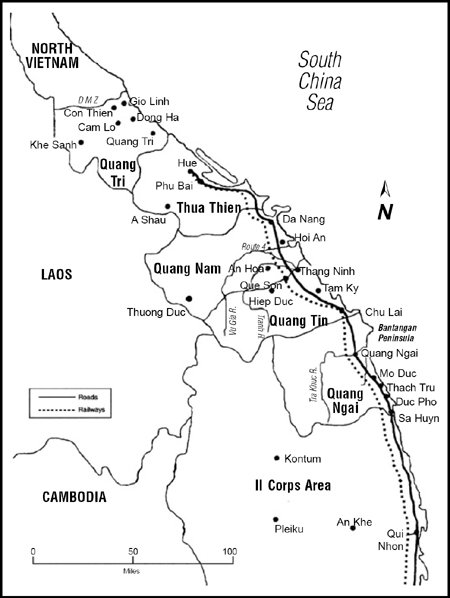
Phu Bai sat fifteen miles from Hue City. Just a quick truck ride north on Highway 1 would take me to Hue. Another little longer ride would take me to a place called Khe Sanh.
We were taken to a large tent where an old, crusty-looking master gunnery sergeant with a giant silver handlebar mustache screamed, “Attention!” The chattering tent went silent.
“I am Master Gunnery Sergeant O’Connel. I will help you in your indoctrination on the Fifth Marine Regiment.” The old sergeant gave his great mustache a slow proud twirl and turned to a large blackboard behind him. “This is the most decorated regiment in the United States Marine Corps.” He spoke as he wrote “French Forteget” at the top of the blackboard. “Some of you may remember hearing about the Belleau Woods in boot camp. The Fifth took the woods in twenty-four hours of hand-to-hand combat. You will wear on your dress uniform the French Forteget. We are the only Marines in the Corps allowed to wear any item other than Marine Corps issue. The Fifth Marines have taken Guadalcanal; New Guinea; New Britain; Peleiu; Okinawa; Tientsin, China; Pusan; Inchon, in Seoul, Korea; and the Chosin Reservoir. Now it’s Hue City.” He put his hands on his hips, standing with his boots more than shoulder-width apart. He beamed with pride as he stuck out his barrel-shaped chest. “We have the highest kill ratio in Vietnam. The colonel does not intend for that to change. Unless we are given permission to invade the North we shall continue fighting under the rules now in effect. You will not kill people who are not in uniform unless you are fired upon by them. You will kill anyone in a North Vietnamese Government …”
As the indoctrination continued I became more confused. I wasn’t sure if this guy was saying this crap because it was procedure or if we were really supposed to wait to be fired upon before returning fire.
Thoughts of all kinds scrambled through my mind like a blender. I felt scared and excited and lonely at the same instant, but mostly excited. I couldn’t wait to write the first letter home and tell everyone all about it. I didn’t know a bloody thing about it yet, but I knew I had to keep a few girls worried to make sure I got a lot of mail.
After the indoctrination, we were led to a small firing range where we got a chance to make sure our weapons worked, a small item I hadn’t given a thought to.
A sunburned sergeant began shouting. “The first ten in column spread out facing the targets at the ready position. Feet spread! Rifles at the ready! Move it! Count off!”
“Nine!” I shouted as my turn came to jog into a position facing ten large black-and-white bull’s-eyes staked to the side of a fifty-foot-long by ten-foot-tall mound of dirt. The targets looked about one hundred meters away, just inside the barbed-wire perimeter surrounding Phu Bai.
“Lock and load!” I checked my magazine and flicked my rifle off safety.
“Step two of the prone position! Drop to the knees holding rifle securely! Drop to your stomach breaking your fall with the butt of the rifle!” I dropped to my stomach and took aim at the bull’s-eye straight ahead.
“Aim and fire!” shouted the sergeant, and I did. Nothing! I squeezed the trigger again. My weapon sent out a harmless klick amidst the continuous firing from the other nine rifles. My stomach churned as I looked past the targets to the unfriendly mountains beyond.
The sergeant quickly found me a rifle that worked, but the broken firing pin left me with serious doubts. “Check your boots,” my stomach said.
Now that my confidence was thoroughly shaken we were led back to a row of large dusty tents. A voice shouted to get in a formation, so we did. A truckload of Marines drove by, covering us with a solid layer of dust. The men in the truck howled with laughter at us. Some shouted friendly insults about our stateside utilities. We stuck out like big green thumbs. Every person we’d seen so far was dressed in jungle utilities. The men in the truck looked hard. Their jungle clothes were tattered and torn. The men hadn’t shaved in a long time, their skin was dark from the jungle sun, and they looked lean and mean like Marines are supposed to look. We looked like fat, happy kids, clean-shaven, with side-walled haircuts and spit-shined stateside boots.
A small snappy corporal began shouting our names in alphabetical order. Once we were all accounted for, we filed into the first in the long row of tents. Once inside, a tough-looking supply sergeant shouted at me, “What’s your size, Marine?” Like everyone else, I received a flak jacket, cartridge belt, canteens, four grenades, one pack, jungle boots, and utilities. After that we were led to different tents according to the platoons and companies we had been assigned. Unbelievably, Chan and I were together again—same company, same platoon.
Inside our tent were two rows of cots. At the end of one row, dwarfing the small cot he slept on, rested a giant red-headed man. His arms looked as big as my legs, and he must have had on size fifteen boots, which, like his utilities, were bleached beige from the sun and rain. They looked molded to his feet as if they were moccasins he hadn’t taken off for years.
I wanted to talk about this adventure with him right now. Chan must have thought the same thing. We walked to the end of the tent and sat side by side on the cot next to him. I wasn’t sure what he might think, since the rest of the tent was empty. It reminded me of standing at the end of a row of twenty unoccupied urinals and having one guy walk in and take the one right next to me.
He looked like a giant Viking. A big red mustache matched his hair. He was the most handsome red-headed man I’d ever seen. A real billboard Marine. I leaned closer to tap him on the shoulder. As he rolled over, the cot creaked under the strain. I knew one thing for sure: I wanted this monster on my side when the fighting started. He opened one large blue eye, which focused in on Chan.
“What’s this gook doing in here?”
Chan jumped to his feet. He rambled off a series of insults, some of which included the biological background of the big redhead’s parents, his speech, his looks, his smell, and his intelligence.
The big redhead opened both eyes fully as if he couldn’t believe his ears. I wanted to calm things down but couldn’t find the words. A friendly smile appeared from behind the large red mustache. He laughed deep and strong, then stuck out his hand. Chan hesitated for an instant then shook it.
“My name is Red. They call me Big Red. You look like boots.”
“We are,” I said. “Just got in today.”
“What platoon are you in?” He rolled back to a comfortable position.
“Second Platoon,” Chan said. “First Battalion, Fifth Marines.”
“That means you’re with me. What’s your MOS?”
“My military occupational specialty is 0331,” Chan said dryly.
“We’re both 0331s,” I said.
A big smile stretched across Red’s face.
“Both gunners? Oh boy, they’re sure going to be glad to see you two.”
“Why is that?” asked Chan.
“I’m a gunner too,” he said. “I got hit on the first day of Operation Hue City, and when I left I was the last gunner with machine-gun MOS in the whole company. They were grabbing mortar men and sticking M60s in their hands, and believe me, they don’t like humpin’ through the bush with grunts. Do you remember that crap they told you in machine-gun school about the life expectancy of a gunner after a firefight begins?”
We nodded in unison.
“Well, they meant it. Seven to ten seconds. Don’t get too worried, though,” Red said. “I heard we might invade. If we do, this war will be over in a couple of weeks. Just don’t panic out there. Go at it gung-ho. If you’re too careful you’ll just make a better target.”
With those last encouraging remarks, Red rolled over and went back to sleep. I thought he meant well, but he had planted a seed of doubt in me that was quickly growing into a large tree. I tapped him on the shoulder. I felt like one of the little people waking up Gulliver. “You weren’t kidding just a little were you?” I asked quietly. “I mean, we can’t be the only three gunners in all of Alpha Company.”
“We are unless they got some more boots while I was in the hospital.” He opened his eyes again. “Look, you guys, don’t worry about it, ‘cause it won’t help. Find a salt when you get to the unit and stick with him like glue. If you don’t get killed the first couple of months you’ll be okay.”
“What should we do to get ready? I mean is there anything we should know?” I asked.
“You probably oughta take your dog tags off the chain. They make noise at night; it’ll get you killed. If your head gets blown off they probably won’t find the tags and you won’t be identified. String ’em into your boot laces. The boots usually hold together, and they won’t make noise. And color ’em up with something so they won’t shine with the sun- or moonlight. If you got anything you want to keep dry, put it in plastic and stick it between your helmet and helmet liner.” He pointed at our grenades lying on my cot. “Bend the pins on those frags right now. When you hump through the bush, sticks get caught in the ring and pull out the pin and you get blown away.”
Red’s advice made me realize for the first time all of the assorted ways I could get myself killed in this place. His information scared me, but I knew it was important, and I was thankful for it.
“Don’t ever take your boots off unless you’re in some area like Phu Bai. Put your crap-paper in plastic if you want any hope of keeping it dry—writing paper, too. If you don’t put Halazone tablets in each canteen of water you’ll get dysentery with the first drink. When it’s a hundred and twenty degrees you’ll drink a lot of water. Take your malaria pills every day or you’ll get malaria and it’ll stay with you even when you go home. The salt tabs, too. Forget your salt tab and you’ll pass out from heat exhaustion. And take your helmet off when you get the chance. I saw one boot get his brain fried ‘cause he left that pot on all day when it was about a hundred and twenty degrees. Ask whoever is writing you to send some care packages with Kool-Aid and stuff that won’t spoil in the heat.”
“Does the M16 rifle malfunction consistently under jungle conditions as projected?” Chan asked with his usual overdose of vocabulary.
Red looked at me quizzically. “Does he always talk like that?”
I nodded the affirmative.
Red chuckled, then answered, “No, not if you keep it clean. Clean it every single day or it’ll jam. The M60 too. Use lots of oil. During the monsoon season your weapon will start to rust every few hours. If you light a cigarette up at night, you can kiss your butt goodbye. If the gooks don’t kill you another Marine probably will. More important for you two than anything else is this: When you hear ‘Guns up!’ you got to get that gun to a firing position and open up.”
With the end of that list Red rolled back over to try sleeping again. Then he rolled back as if he had remembered one last thing. “I almost forgot. Don’t pull off the leeches. Burn ’em off with a match, or the head of the leech will stay in your skin. Tie the strings real tight at the bottom of your trousers and you can keep some of them out.”
After that Red went to sleep. I had a thousand more questions, but I didn’t dare wake him again. I couldn’t understand how he managed to sleep. The tent was full of flies, the heat was sweltering, and every time a truck went by, heavy clouds of dust poured into the tent like the receiving bag of a vacuum cleaner.
Chan leaned back on his cot, using his pack for a pillow. He pulled his writing paper out of his shirt pocket.
“Tell Valerie hi for me,” I said.
“I’m writing my parents.” I wasn’t surprised. Chan seemed very close to his parents.
“How’s it been going with you and Valerie?” I asked.
“She loves me, and I love her.” He paused, then shook his head dejectedly. “But her mother’s another story. Mrs. Gallina is doing everything she can to stop our relationship.”
“Because you’re Chinese?”
“That’s part of it. But the main reason is because I’m not Italian and I’m not Catholic.”
“But you know the Bible backwards.”
“That doesn’t matter to Valerie’s mother. She doesn’t know the Old Testament from the New. She worships a religious system and doesn’t really know the Lord at all.” Chan didn’t sound angry. He spoke as if he pitied her, as if he was honestly worried about her. Chan often said we were best friends because we were alike in many ways. Maybe, but I would have told this meddling Gallina broad to shove it up her diddy-bag. I leaned back on my cot and stared at the roof until it was too dark to see.
A heavy rain pelted the tent all night and didn’t stop until morning. I knew because I was too excited to sleep. The day started like all the other days in the Corps, with a formation. The mud was drying fast. It was 6 A.M., and I was already grimy with sweat. We marched to the chow hall, where I received my first clue to what the country of Vietnam was all about: dysentery.
My stomach felt like it was getting an oil change. I wanted to puke, but I was too busy putting it out the other end. Chan thought it was hilariously funny until he came down with the same thing. We spent the rest of the day and the majority of the next as close to a row of outhouses as possible.
On the third day the entire group of boots was herded into a large tent with sandbag walls. The atmosphere was serious. Fifty to seventy-five of us crowded in, and no one spoke. I felt nervous. Ten rows of benches made the tent look like a chapel. A large blackboard surrounded by two large maps stood at the front. Someone yelled, “Attention!” We jumped to our feet. I felt like I was in a movie, getting orders to bomb Germany.
A small man with prematurely gray hair and dark sunglasses strode into the tent. He hustled to a platform in front of the maps. He looked more like a stockbroker than a major in the Marine Corps. “At ease.” He picked up a pointer stick and began to talk.
“You are members of the Fifth Marines. The Fifth is now completing Operation Hue City. Hue has always been treated as an open city in recognition of its place as the ancient imperial capital and cultural seat of Vietnam. This is the only reason we have not bombed the NVA into dust. Hue has never been heavily fortified like Da Nang. The First ARVN Division has its headquarters in a corner of the Citadel. There is also the Black Panther Company, an elite unit of the Vietnamese Marines. That is the substance of the Vietnamese Army strength within the city. The Fifth Marines have been given the job of retaking Hue, which was occupied by the NVA on 31 January. By February 9 the enemy death count had reached 1,053. It is estimated that two enemy battalions had been destroyed by that point. All we have left can be considered mopping up. That does not mean people won’t be shooting at you. If an enemy soldier shouts ‘Chieu Hoi!’ he is surrendering and is not to be fired upon. The Chieu Hoi program must be respected. We have dropped hundreds of thousands of leaflets telling the NVA soldier that he can drop his weapon and shout ‘Chieu Hoi’ and that he will be treated well. These prisoners are changing sides. They will fight for the South Vietnamese Government. Now, I know you all have a lot of questions, but this is all you have to know: You are United States Marines, the finest fighting men in the history of the world. We have never lost a major battle. No other fighting unit on earth can make such a claim. Now, attention!”
The tent full of white sidewall haircuts snapped to attention. “Repeat after me: Yea, though I walk through the valley of the shadow of death”—the chorus of youthful voices stuttered out the words like they had never heard them before—”I shall fear no evil.” We repeated the second part more clearly: “For I am the meanest mother in the valley!” I loved it! I didn’t feel quite right about using the Lord’s word in vain, but I felt psyched enough to go all the way to Russia and stop this crap where it started.
“Saddle up!”
My stomach jumped up to my throat. This was it, not a daydream. I was really going into battle. Half of me wanted to get into this war and get it over with. The other half wanted my mommy to wake me up for school before this dream got carried away.
Ten minutes later I found myself in the back of a deuce-and-a-half truck bouncing up Highway 1 toward Hue. I didn’t even remember getting in the truck. “Are you all right?” The voice was coming out of a fog. “John, are you okay?” It was Chan.
“Yeah. I’m fine.”
Red was sleeping against the tailgate. It was good to see him. I’d only known the guy for a couple of days, and I was hard-pressed to squeeze more than a sentence at a time out of him, but he radiated self-confidence, and some special quality in him, possibly his honesty, made me trust him immediately.
The ride down Highway 1 was slow and bumpy. We passed another deuce-and-a-half that had been pushed to the side of the road. Its cab stuck into the air, and the front wheels lay mangled nearby.
The ride got slower. Two huge American tanks appeared from somewhere to lead the convoy. A strange-looking vehicle pulled out from a smaller dirt road and was now bringing up the rear.
“Chan, what’s that?” I pointed to the odd-looking vehicle. It had the bottom of a tank, but instead of a turret it had six big cannons, three on each side.
“That’s an Ontos. A tank killer. Those are six 106s.”
“That thing could knock out this whole convoy!”
Chan looked at me with a friendly look of disdain. “Brilliant, Sherlock.”
I did sound a bit “Gee-whiz,” but emotions I had never known were bouncing around from my brain to my stomach. My body tingled. I felt overwhelmed with expectation. I felt exhilaration like never before, then paranoia, then excited again. This is crazy, I had to keep telling myself. I have to control myself or I’m going to get killed for sure.
I thought I heard artillery. A flight of Phantom fighter planes roared over our truck just above treetop level. Now the sounds of war echoed more clearly. My hands were clammy. My mouth tasted like vinegar. A skinny Marine sitting close to Red knocked on his helmet. Red peered from underneath the helmet with one groggy eye. The other eye remained closed.
“Yeah?”
The skinny guy hesitated then blurted out, “What’s it like?”
“It’s a job.”
“How bad is Hue?” asked another Marine. “I heard we’re takin’ heavy casualties.”
Red pulled out a cigarette, then took his helmet off and removed a pack of matches from inside the liner straps. He looked like a Marlboro poster.
“If you want to keep anything dry you better put it in your helmet right now.” The men started fumbling for their wallets. Chan and I had already done that. “Don’t worry about Hue. Just don’t go playing John Wayne. The battle is just about over. I heard we’re getting bridge duty.”
“What’s that?” I asked.
“We guard the bridges on Highway 1.”
“Is it bad?” blurted the skinny guy.
“It’s skate duty. Slack city. You don’t have to hump through the bush except for a few patrols, and sometimes you get beer or Cokes off the trucks going by. Take advantage of it, man. It won’t last long. You’ll know what war is when you start humping thirty klicks a day in the bush with two hours’ sleep a night.”
“What’s a klick?” a Marine beside me asked, already squinting like he was afraid of the answer.
“One klick is a thousand meters. It’s for calling in artillery.”
The men moved in closer to Red, hoping for that one piece of advice that might keep them alive. Everyone started asking questions at once. He held up one hand to stop the onslaught.
“Now listen up. The smartest thing each of you can do is this: When you get to your squad, find a salt, somebody who’s been here awhile. Ask him what you have to know, stick with him, and do what he says. Keep that M16 clean or it’ll jam on ya. If you fall asleep on line, one of your own men might kill you and you’ll deserve it.”
Twenty questions later we pulled off the road on the outskirts of the city. Sporadic gunfire echoed from somewhere up ahead. An old gunnery sergeant ran by our truck shouting, “Get off those trucks and spread out! Move it! Move it!”
The trucks turned around and headed for Phu Bai as soon as we were out. The gunny shouted us into two columns, one on each side of the road, with a ten-yard interval between each man. Then he spotted Red. “Red, is that you? It’s good to see you. Boy, do we need a gunner.” He walked over to Red, turned his head, and spit out a shot of tobacco like a major leaguer. They shook hands. The gunny lowered his voice to say something only Red was supposed to hear. I heard two words too many: “… got killed.” The butt of a pump shotgun rested on the gunny’s hip. He wore special bandoliers full of shotgun shells, and small leather pouches full of more shells on his cartridge belt. He looked like my grandpa coming back from a hunting trip in West Virginia. He even spit like Grandpa. I didn’t know the Marine Corps allowed men to carry any weapon other than Marine Corps issue.
Red followed the gunny to the front of the column, then we started a slow nervous walk down the dirt road. Sweat poured down me like a sticky shower, but a cool breeze blew over my face. Twenty meters later the breeze blew a sickening, rotting odor into my nose. I had the uneasy feeling I had just smelled my first corpse.
Two hundred meters and a thousand horrible imaginings later we came to a small bamboo hootch. The hut turned out to be battalion headquarters. A quick roll call and we were sent to our respective platoons. I still couldn’t see the city, but the steady pounding of heavy machine guns rang closer. Black smoke billowed above the treetops and into the gray sky, then an explosion. A Phantom whisked by.
Chan and I followed Red down a well-trodden path with heavy brush on both sides. We came to a small clearing and another hootch. A group of tired, dirty men stood near the grass and plywood huts sipping coffee out of C-ration cans. A tall, lanky character spotted Red first. His pitted face opened into a wide, ugly smile as he ran up with his hand out. He smelled worse than he looked.
“You big mother!” He shook Red’s hand and slapped him on the back. “Man, you missed some real heavy crap. How was the hospital? Get any Red Cross girls?”
“It’s good to see ya, Sam.”
“I thought I heard you out here.” A young officer who looked as if he were just out of college stood grinning in the door of the hootch.
“How’ve you been, Lieutenant?” Red gave a casual salute.
“A lot better now.” The lieutenant came forward with his hand out. They exchanged a quick, firm handshake.
“Who do you have with you?” the lieutenant looked at me.
“Boots,” said Red. “0331s.”
“Outstanding! Sam, take Red and these two down to the chief’s squad.”
We turned to follow the ugly Sam. I noticed something pinned to his camouflaged helmet cover. Whatever it was, it was covered with flies. I moved closer to get a better look. It was an ear. A human ear. It looked brittle and baked grayish green from the sun. I wanted to ask him about it, but I hesitated, trying to remember his name.
“Sam,” I said. Before I got another word out, the lieutenant started speaking.
“And Red, send that stupid mortar man back to mortars before he kills himself with the gun. Break in the boots. They’re your new gun team.”
“Sam,” I said again. “Is that an ear pinned to your helmet?”
“Yeah, man. I used to have more, but they drew too many flies. I saved this one to suck on. Want a lick?”
I laughed. “No thanks.”
“Well, I do.” He took his helmet off and unpinned the ear, then stuck it in his mouth and sucked on it like a lollipop. I don’t know what my face looked like, but my mouth had no response. Even Chan was left speechless.
Sam led us down a narrow path for about two hundred meters when a driving rainstorm hit us with the monsoon fury we’d been told about. When we reached the squad, the men were relaxing in a muddy circle behind the remains of a cement wall and making no effort to stay dry. Faces seemed to light up as they recognized Red, and the most excited one belonged to a short, rather chunky Marine with “DON’T SHOOT I’M NOT A GRUNT” printed on his helmet and flak jacket.
When Red said he was taking over the gun, the fat little man actually jumped into the air and clicked his heels. “Take this bull’s-eye off my back. I’m going back to mortars, baby!” With that, he threw on his pack and disappeared without so much as a goodbye or good luck.
My stomach tightened. The situation looked worse every time somebody opened their mouth. Suddenly a machine gun opened up from the city. I hit the ground with a splash. When I opened my eyes I discovered Chan and I were the only ones ducking. The rest of the squad stood looking over the cement wall and laughing.
I stood up cautiously and peered over the wall. Running down the street directly to my front was a black Marine. He weaved back and forth, trying to present a difficult target, but that wasn’t what was funny. He was pushing a small Honda motorcycle while balancing a television set on the seat. The machine gun opened up again. It sounded bigger, slower, and more powerful than the M60.
“Chief!” Red shouted. “That’s a fifty! I thought the city was cleaned up?”
“You thought wrong,” a deep voice answered. It belonged to a tall, dark-skinned corporal with a nose like a Roman’s and a chin that looked like it had been cast from iron. Though the closest I’d ever been to a real Indian was Tonto, even I could tell that this guy was the real thing. He was the only one not laughing. “There’s still a couple of fifties left. They chained ’em to walls so they couldn’t run. They’re too doped up to surrender.” The big Indian looked bored.
The black Marine reached the cover of the cement wall, gasping for air and grinning an utterly happy grin. He hung on to the TV like it was a kid he had just rescued from a fire. He crumpled to the ground still smiling. No one noticed the lieutenant until he slid in like he was stealing third base. He looked at the black Marine as if he’d never seen him before. His mouth opened to speak, but the words weren’t forming very well.
“Jackson! Where do you think you are, Marine! This ain’t no riot in Watts!”
“Spoils of war, Lieutenant.” Jackson’s big smile was catching. Just looking at him made me grin too.
“The guy who owned the store was dead anyway, Lieutenant. Would you mind keeping this stuff for me till we go back to Phu Bai so I can mail it home?” The lieutenant looked horrified.
“And look at this!” Jackson lifted his chin, revealing a vicious-looking green rubber snake with bloody teeth that clamped onto Jackson’s shirt like a clothespin.
“Drop that garbage and saddle up. We’re moving out in ten minutes.”
“What?” the Indian corporal asked.
“That’s right, Chief.”
“Why?”
“To preserve the honor of the South Vietnamese we’re pulling out so they can mop up. Saddle up! We got choppers on the way.”
An hour later I jumped off a troop helicopter in Phu Bai. The base looked strangely different this time, no longer dangerous and foreign, but actually safe.
Early the next morning the whole company was bouncing down Highway 1 away from Hue City. We reached the first bridge in twenty-five minutes. The convoy stopped. The first platoon was shouted out of the last two trucks in the column.
The rest of the convoy started up again. A mile down the road we came to a stop at a large old steel bridge that was painted black. It looked like an old suspension bridge for trains, but it was strictly for road traffic. It stretched across a wide jungle river that was reddish black from decaying leaves that swirled near its surface and lay in piles on its bed. Rolls of barbed wire encircled the bridge, and thick, five-foot-high sandbag bunkers guarded each end. Another sandbag bunker sat on a huge cement piling that supported the center of the bridge.
The big Indian corporal jumped out of our truck and started shouting, “Truoi Bridge! Second Platoon, get out! Move it! Move it! Hurry up, you’re makin’ a great target!” We lined up in formation in front of a rusting old tank with a French emblem on the turret. Twenty yards to the right of the tank stood a three-story sandbag bunker with the barrel of a .30-caliber machine gun sticking out near the top.
Just to the left of the bridge and behind the three-story bunker sat five small white cement-block buildings with tin roofs. Directly in front of us on the other side of the road was a long cement-block building riddled with bullet holes. Vietnamese children ran around it, screaming like normal kids in a playground. Thirty meters to the right of that building was a huge camouflaged parachute spread fully open and tied to three trees. Under the parachute, sheltered from the murderous sun, sat twelve Marines. Some were playing cards; others were sleeping.
“Who are they?” I asked Red.
“That’s a Civil Action Patrol unit. CAP, they’re called. They work with the villagers. They try to keep ’em on our side, protect their rice, and give ’em medical aid.”
On the south end of the bridge was a long village that paralleled the river for as far as I could see. ARVNs (Army of the Republic of Vietnam) walked in and out of the white block buildings. Most of them didn’t carry weapons. The lieutenant stood at the door of the smallest block building talking to an ARVN major. The major first pointed to the largest of the buildings, then pointed at us. They exchanged salutes, and the lieutenant strode over to us.
“Listen up!”
Chan and I were the only two who did. The rest of the platoon kept chattering. Then the big Indian said the same thing, only different: “Shut up!” The chatter stopped. “Okay, Lieutenant.”
“We’re spending the night in the ARVN compound.” He pointed to the nearest and largest of the tin-roofed buildings. “The ARVNs are standing lines tonight so we can get some sleep. If we’re lucky, we will probably be here for a couple of weeks. Go ahead and stow your gear.” He turned to the Indian corporal. “Swift Eagle, I want a guard on the gear so our ARVNs don’t pick something up by mistake.”
“Yes, sir.”
“Dismissed!”
The building didn’t impress me much, but the rest of the men acted like it was the Hilton. Chan and I dumped our gear and quickly strolled toward the village to avoid getting picked for guard duty.
As we reached the south end of the bridge, a Vietnamese boy ran up to us with two eight-ounce Cokes in each hand.
“I sell Coke. One dollar MPC.”
“No thanks,” Chan said.
“What you need, Marine?” The boy looked at me. “You need boom-boom. I can get.”
“Chan, what’s boom-boom mean?”
“I assume it’s a reference to a prostitute.”
The kid looked at Chan.
“Why you look like Marine? You same-same me.”
Chan’s face tightened. He clenched his fists, and for an instant I thought he was going to belt the kid. I grabbed his arm and patted him on the shoulder.
“Hey! What’s wrong?”
Chan ignored me and glared at the kid like he still wanted to smack him.
“I’m not same-same Vietnamese.” Chan shook my hand loose and grabbed the kid by the throat. “I’m American. Chinese-American. Not Vietnamese.” When Chan let go, the kid ran back a few feet and turned back to us.
“You dink-ki-dow, Marine!” he sneered as he made circles with his index finger around his right ear, then ran away.
“The kid thinks you’re nuts,” I said.
“He’s probably right,” Chan mumbled angrily.
“What’s wrong?”
“I don’t know.” He looked me in the eyes. “It just hit me the wrong way. Sometimes I get fed up with explaining my nationality. I’m a good eight inches taller than your average Vietnamese, and they still assume that I’m one of them. You know that corporal that you think so highly of?” he said sarcastically.
“Corporal James? The stocky little jerk that acts like a general?”
“Yes. Him. He told me he didn’t trust Kit Carson Scouts, and for me to watch it.”
“You’re kidding! What did you say?”
“I told him I didn’t particularly trust Vietnamese scouts either, or corporals who weren’t aware of new replacements. That seemed to stump him. He walked off with this ignorant look on his face.”
I was caught off guard by Chan’s reaction. Usually he drove me crazy with his forgiving Christian attitude. He’d practically become my conscience. He didn’t wag fingers at me or anything like that, but if I ever made the mistake of arguing with him over something being right or wrong, sin or not sin, he would just open up his little Bible and shoot my view full of more holes than Swiss cheese. He sure wasn’t anyone’s angel. Sometimes he sounded arrogant, but that was usually because he knew what he was talking about. Overall he was disgustingly honest and disgustingly fair, and I was quite sure that I could depend upon him right to the end. I didn’t say anything. I knew he would feel badly about the kid soon enough. He finally shook his head and smiled. “That was pretty stupid, wasn’t it?” I nodded yes. “I’ll have to make it up to the kid when I see him. You ready to go see downtown Truoi?”
“Let’s go,” I said.
As we started through the village I noticed that every hootch had its own bunker. Actually they weren’t bunkers so much as small underground caves. Red had told us the people slept in these things, but I’d thought he was exaggerating. He hadn’t been. It was a village of human groundhogs. They only came up in the daylight. We peeked into one hole to see how it was furnished. Two pieces of rotting plywood lined the floor. Two filthy old Army blankets and a dozen spiders. One had a body as big as a fifty-cent piece.
The primitive existence of these people fascinated me. Civilization drove right by on Highway 1, but twenty feet away women squatted together beating their clothes on rocks. The villagers looked and sounded unhealthy. Everyone coughed and hacked as if they all had TB. We decided to keep curiosity from getting the better of us. We turned back.
The night started quietly. Having off from work was a big deal, because most of the men hadn’t slept a full eight hours straight in over two months. We cleaned our weapons, then Sam pulled out a deck of cards and started saying “Back-alley, bro. Back-alley,” grinning with a mouth full of rotten teeth.
So far it looked like Sam would receive the platoon’s vote for strangest person in the Fifth Marines. His sense of humor was as strange as the rest of his personality, and although I didn’t particularly like him, I didn’t particularly dislike him either. He seemed to have an almost unnatural love for his little blooper gun, officially known as an M79 grenade launcher. The blooper looked like a sawed-off shotgun with an extra-fat barrel. It even broke in half like a shotgun, but it fired midget artillery rounds—or so I called them—that exploded on contact. It made a bloop sound when fired. Red told me Sam could hit anything with it.
“Keep your eyes on your own cards, Sam,” Sudsy said as he leaned back on his PRC-25 radio. Sudsy, our freckle-faced radioman, reminded me of Beaver Cleaver. He usually stayed with the CP (Command Post), with the doc and lieutenant and gunny. He had a flare for talking on the radio.
“You treat that radio like a woman, Suds,” Rodgers said with a nervous laugh. Rodgers was the kind of Marine that girls would call cute. Sort of a pug-nose kind of cute. Red told me that Rodgers used to be a good Marine, but he’d heard that Rodgers was spooked now. He’d caught some shrapnel in Hue and just wasn’t the same guy anymore.
I watched the card game for a while and listened to loud-mouthed Sam complaining about his luck. The men looked tired but relaxed. I couldn’t have been less relaxed on a bed of nails. The place smelled like fish. In fact, the whole country reeked of fish.
My pack made a rocky pillow. I dumped out a couple of cans of C-rations, fluffed it up, and tried again. By the time the red, pink, and pastel flow of sunset had passed over our one-room, earth-floor Hilton, leaving us engulfed in darkness, most of the men were asleep.
The darkness was shattered by three violent explosions, one right after the other. Bullets of fluorescent red light rifled through cracks in the boarded-up windows. I was instantly awake. I scrambled for my rifle and got to my feet waiting for instructions. Another series of explosions shook the building. The door was yanked open, bringing in more red light filtering through clouds of dust. Confusion filled the room. Someone screamed, “Mortars!” Two men ran out the open door. The slow, fluctuating rhythm of an older machine gun opened up with a long burst. Shouting Vietnamese ran by the door. A loud voice screamed, “Guns up!” I thought I saw Red dart through the door and into the eerie red light. I followed him into a world of chaos.
Vietnamese were running in all directions. Panic had overwhelmed the compound. An ARVN ran into me, entangling the barrel of his rifle in my machine-gun ammo belts. As we struggled to free ourselves, our faces came together for one terrifying moment. He stared into my eyes and screamed, “VC!” He pulled his rifle away and sprinted in the opposite direction from the bridge. My instincts said to follow him, but just then another flare popped open above the bridge and I saw Red running into the back door of a cement machine-gun bunker twenty meters in front of me.
Behind me, on top of the three-story sandbag bunker, an old .30-caliber machine gun was going crazy, raking every inch of the surrounding barbed wire. Another machine gun opened up from the sandbag bunker on the cement piling under the center of the bridge.
ARVNs manning positions on the south side of the bridge stopped firing and ran wildly to the other side, dropping their weapons as they went. The only ARVN returning fire was the gunner on the three-story bunker. The rest were in retreat. A blast of M60 fire from the cement bunker blew one off the bridge.
I ran to the door of the bunker and screamed in at Red, “You’re shooting ARVNs!”
“Shut up and feed the gun!”
I dropped my M16 and linked up a belt of ammo as fast as my shaking hands would function. Two more red flares popped open over the bridge, revealing shadowy figures crawling through the wire directly to our front on the opposite side of the road. I could see more shadows turning into people on the south end of the bridge. Red started firing twenty-round bursts southward. I tried to fire at the men coming through the wire to our front, but my weapon wouldn’t work.
A ripping explosion behind us caused Red to cease firing. Another explosion to our right popped my right ear. My ears started ringing. My head felt like the inside of a bass drum. I felt warm blood trickle out of my ear and down my neck.
“Red!” I screamed. Red couldn’t hear me through the constant blasts around us. The bunker filled with dust and smoke.
“Red!” I screamed again and shook his arm. “My rifle won’t work!”
“Take the safety off, boot!”
I felt for the safety. It was on. God, what an idiot. Now the M60 on the cement piling opened up on the south end of the bridge. Hundreds of muzzle flashes erupted from the blackness. I put my rifle on full automatic and started firing.
“No, you idiot!” screamed Red. “Semi-automatic only. You’ll run out of ammo! Link up more ammo! Quick!”
Red started firing again as I linked up another belt of ammo. A series of explosions started pounding the north side of the bridge. Then explosions walked down the road in ten-yard intervals, slowly zeroing in on the three-story bunker. Red screamed, “Mortars!” and started firing at the south end of the bridge. Shrapnel slapped against the side of our bunker, then the red light died. Red stopped firing.
Enemy muzzle flashes illuminated the darkness like hundreds of deadly lightning bugs. Suddenly the explosions stopped. Then the night was silent. A green flare popped open above the bridge and swung down slowly under its tiny parachute. Five men sprinted onto the bridge from the south end. I couldn’t see any weapons. Another flare burst more light on the battle. Now I could see that each had satchel charges taped to his chest and back.
“Sappers!” Red screamed, and opened up on the five men now weaving toward the center of the bridge. The M60 on the cement piling and the .30 caliber opened up on the sappers at the same time Red did.
Orange tracers ricocheted in a thousand directions as bullets bounced around the five sappers, yet they kept coming. Then three dropped at the same time. One of them struggled back to his feet. His legs were cut from under him again. He began crawling toward the center of the bridge. The remaining two staggered like drunks, jerked spasmodically as the machine guns found their mark, then finally collapsed.
Suddenly our position came under murderous small-arms fire from directly across the road. Pieces of cement and dirt stung my face as bullets chipped away at our bunker. Whining lead tore through the gun slit. It looked like the flashes of another hundred rifles were firing straight at us.
Red ducked, bumping helmets with me. My stomach pressed against my spine. I mumbled a quick prayer. Lead smacked against the outside wall of the bunker. Bullets flattening with solid thuds ripped away precious inches of all that was keeping us alive. Then the firing stopped.
We peeked through the gun slits in time to see another group of five sappers jog onto the south end of the bridge.
I started firing, this time single-shot. I hit one; I knew I hit him, but he kept coming.
“I hit that sucker!”
“Go for the legs!” screamed Red as he opened up again. “They’re doped up. You gotta knock ’em off their feet!”
Now the flashes across the road to our front were firing at the maniac manning the .30 caliber at the top of the three-story sandbag bunker. He must have two thousand rounds linked up to that thing, I thought. I haven’t heard him stop yet.
I linked up another belt of ammo as Red blew one of the sappers off his feet. The M60 on the cement piling had a bad angle for hitting the sappers. That was supposed to be the job of the south-end gun bunker that the ARVNs had abandoned.
Bright white flares began popping open from above, lighting the battle like twenty little suns. When I realized where they were coming from, I cried out, “A plane, Red! Air support!”
The sappers on the bridge were being yanked and twirled like puppets with each direct hit. The lead man spun like a top, his arms flailing the air above his head, but still he came forward.
A giant sparkler moving in a small circle sizzled at us from the blackness of the jungle across the road. Red stopped firing and shoved me down, landing on top of me. Our bunker shuddered under the numbing explosion. Dirt, rocks, and dust poured through the firing slits. We lifted our heads in time to see another rocket sizzling toward the three-story sandbag bunker.
“They’re inside the wire!” Red pointed as he yelled over the clamor of the screaming NVAs. Silhouettes moved across the road to our right. “Shoot anything that moves!”
I knew the positions to our right were being overrun; self-torturing thoughts of hand-to-hand combat darted through my mind. I’d rather get shot than bayoneted, I thought. God, I hate knives!
A fleeing Vietnamese ran by our door. Red turned and fired a burst through the opening, dropping two ARVNs five feet from the bunker. I couldn’t believe what was happening. I stared at the dead ARVNs for a couple of seconds until Red started firing again. I watched the tracers of the M60 ripping into the sappers on the bridge. Only three still stood. Others tried to crawl forward.
At the center of the bridge, just over the piling where the M60 gun team was still firing, the three sappers put their arms around a steel support. Five seconds later a violent explosion lifted the huge steel superstructure into the air. It surged ten feet above the cement piling, twisted slightly, and crashed back down on the gun team.
For twenty seconds the firing ceased, as if the climactic destruction had ended the battle. Then an American began screaming in pain from the bridge. Until that moment I hadn’t been sure it was a Marine gun team out there. “Chan!”
Red slapped me across the face. “It’s not Chan! It’s a CAP unit. They work with the ARVNs.”
The voice of the dying Marine drifted through the damp night air. I felt more helpless with each piercing moan.
“Red, we gotta do something!”
The firing started again. Red opened up on muzzle flashes across the road. I linked up more ammo. With each lull in the shooting the torturous calls for help from the wounded Marine ripped at my sanity. Red slapped me hard on the back and then patted my helmet.
“Charlie will de-de mow before daybreak. It’d be suicide to go out there any sooner.”
“What’s ‘de-de mow’ mean?”
“He’ll run. Charlie has two chances against us in the daylight—slim and none.”
Suddenly a noise like a sick foghorn bellowed from the sky, accompanied by a magnificent golden streak that seemed to originate from the pitch-black sky.
“What’s that?” I asked.
“Puff the Magic Dragon—a C-130 with mini-guns and a whole plane full of ammo. It’s supposed to cover every inch of a football field in ten seconds.”
“It sure doesn’t sound like a machine gun.”
“No. It’s like a giant Gatling gun, and each barrel is a machine gun.”
I watched and listened to Puff in amazement. The enormous stream of orange and gold tracers looked two or three feet thick. It wavered slightly with each movement of the plane or the gun. It sounded more like an angry monster bellowing than a gun firing. But the enemy was too close to us for Puff to be effective. Ten minutes later the deadly golden stream disappeared.
During the next two hours sporadic exchanges of fire continued, but as daybreak neared, the shooting slackened to an occasional sniper round. The first shafts of sunlight brought a command from the Indian corporal.
“Listen up!”
I couldn’t see where the voice was coming from, but it was loud and clear.
“This is Swift Eagle! I’m going after him!”
The big Indian was on the bridge before I even spotted him. The wounded Marine had stopped calling for help an hour ago, but I still had hope. The Indian moved quickly and gracefully, like a cat. Then he jumped from the twisted bridge to the piling and out of sight. A few moments later he reappeared. I knew the man was dead.
I expected to see hundreds of dead NVA scattered about as the sun grew brighter, but this was my first lesson on just how good the enemy was at dragging away the dead and wounded.
Every inch of me itched. A layer of gritty sand mixed with sweat that felt more like glue had somehow covered my body. I wanted to see the dead men. I had to find Chan.
“Johnnie!” A voice that brought joy and relief to my heart resounded across the compound.
“Red! That’s Chan! Chan!” I screamed through the door of the arid bunker. I ran out of the bunker and into a bear hug that nearly crushed my ribs.
“Well, I’m sure glad you’re okay.” I escaped the bear hug to see who was talking. It was the big Indian.
“This guy bugged me all night worrying about you,” the chief said.
“We’ve been together since boot camp,” I said, feeling a bit embarrassed. “He’s like my brother.”
Chan removed the smile from his face and went back to looking too sophisticated for a show of emotion. “Well,” he said, as he took one step back and straightened his flak jacket. “I did promise your mother I’d keep you from doing anything foolish.”
“Let’s go,” Swift Eagle said.
“Where?” I asked.
“A body count.”
We followed the stone-faced Indian to the perimeter wire. There, and around the bridge and compound, we counted sixty-four dead NVA. We found one wounded in both legs by machine-gun fire. He was taken prisoner. Out of the fifteen Marines killed, twelve were from the Civil Action Patrol unit. I didn’t know any of them, and I was glad I didn’t. I never heard how many ARVNs died.
The official report says that the Truoi River Bridge was attacked and overrun by an estimated three hundred NVA regulars and one hundred sappers. The bridge was destroyed by suicide squads (sappers) carrying satchel charges. It says nothing about the ARVNs falling asleep on lines and then abandoning fortified positions.