
ONE million Allied soldiers had come ashore at Normandy by early July, yet the invasion increasingly resembled the deadlock at Anzio or, worse, the static trench warfare of World War I. Tentage vanished, replaced by labyrinthine burrows roofed with double layers of pine logs and sandbags. “They keep lobbing mortars at us,” Lieutenant Orval E. Faubus informed his diary. “It is a world no civilian can ever know.” Though Cherbourg had been taken, the beachhead on July 1 was only six miles deep in places. Caen and St.-Lô remained in German custody, and daily casualties in Normandy exceeded those of the 1917 British force in Flanders during the third battle of Ypres, which included the hellish struggle at Passchendaele. A German general who had fought in both world wars now described the Normandy struggle as “a monstrous blood-mill, the likes of which I have not seen in eleven years of war.” Omar Bradley lamented, “I can’t afford to stay here. I lose all my best boys. They’re the ones who stick their heads through hedges and then have them blown off.”
Eisenhower’s planners had given little thought to the Allied recourse if OVERLORD led to stalemate. A few options were considered, including another airborne and amphibious assault outside the Normandy lodgement. But the only credible solution, a SHAEF study concluded, was to bash on: to “concentrate all available air and land forces for a breakout from within the captured area.”
The supreme commander’s jitters grew with each new casualty list. He switched cigarette brands to Chesterfields, but still smoked several score a day, contributing to an ominous blood pressure reading of 176/110. An Army doctor prescribed “slow-up medicine”; his ears rang anyway. He ate poorly and slept badly, not least because V-1 attacks often forced him into a renovated shelter at Bushy Park where paint fumes gave him headaches. A flying bomb on July 1 detonated two hundred yards from Eisenhower’s office, sucking panes out of the windows and peeling off a swatch of WIDEWING’s roof. In a red leather journal, the supreme commander jotted brief, unhappy notes: “Bradley’s attack to south now postponed to July 3. How I suffer!… Tried to play bridge. Awful.” During a visit to the beachhead in early July, he stayed at Bradley’s command post, padding about at night in red pajamas and slippers; one afternoon he squeezed into the back of a P-51 Mustang from which the radio had been removed and for forty-five minutes flew west, then south, then east toward Paris for an aerial view of the battlefield. “Marshall would raise hell if he knew about this,” he admitted. Upon being told that a German officer captured at Cherbourg refused to disclose where mines had been laid, Eisenhower said, “Shoot the bastard”—an order neither intended nor enforced.
Montgomery had long envisioned an attritional battle, which he called “the Dogfight,” between the invasion assault and a breakout from the beachhead. Eisenhower chafed anyway. In a “dear Monty” note on July 7, he wrote:
I am familiar with your plan for generally holding firmly with your left, attracting thereto all of the enemy armor, while your right pushes down the peninsula and threatens the rear and flank of the forces facing the Second British Army.… We must use all possible energy in a determined effort to prevent a stalemate.… I will back you up to the limit in any effort you may decide upon to prevent a deadlock.
Montgomery’s reply a day later affected a bluff insouciance, despite 1,200 casualties that day in the Canadian 3rd Division alone, including 330 killed. “I am, myself, quite happy about the situation.… I now begin to see daylight,” he wrote, adding:
I think the battle is going very well. The enemy is being heavily attacked all along the line, and we are killing a lot of Germans. Of one thing you can be quite sure—there will be no stalemate.
So it had begun. This direct, professional exchange concealed an enmity that already infected the Allied high command and would grow more toxic. In his diary, Montgomery complained that Eisenhower “cannot stop ‘butting in’ and talking—always at the top of his voice!!… I like him very much but I could never live in the same house with him; he cannot talk calmly and quietly.” Montgomery professed to spend one-third of his day “making sure I’m not sacked” and another third inspiriting the troops, which “leaves one-third of my time to defeat the enemy.”
At SHAEF, the insistence by “Chief Big Wind”—as Montgomery was privately nicknamed—that the battle was unfolding as planned fed a seething disgruntlement, particularly among British air commanders. Montgomery had become “something of a dictator, something of a mystic,” wrote one. “It was difficult to track him down and to get an audience with him.” Eisenhower’s deputy, Air Chief Marshal Sir Arthur W. Tedder, told Churchill in late June that fewer than half of the planned eighty-one squadrons were flying from Normandy because only thirteen airstrips had been built. “The problem is Monty, who can be neither removed nor moved to action,” Tedder advised his diary. Persistent rain added to the gloom. A scowling Leigh-Mallory compulsively tapped his portable barometer, which always seemed to be falling. “Things are now egg-bound,” he complained, “and they may become glacial.”
Churchill too grew waspish. Fearful that Britain’s contribution was undervalued even as the American preponderance grew, the prime minister demanded that Canadian dead and wounded be “included in the British publication of casualties, otherwise they will be very readily assumed to be part of the American casualties. The point is of Imperial consequence.” The V-1s pummeling London made him bloody-minded, and he seemed to consider countering either with biological weapons—anthrax looked promising—or with a more conventional campaign that publicly listed one hundred small, lightly defended German towns, which would be obliterated “one by one by bombing attack.”
Neither idea found favor with the British high command, mostly for pragmatic reasons, but Churchill on July 6 insisted that “a cold-blooded calculation” be made about whether Allied poison gas would shorten the war while also retaliating againstCROSSBOWtargets. “It would be absurd to consider morality on this topic when everybody used it in the last war without a word of complaint from the moralists or the church,” Churchill argued. He also noted that bombing cities had been proscribed in the Great War but “now everybody does it.… It is simply a question of fashion changing as she does between long and short skirts for women.” Strategic planners in London replied that gas “would not be likely to have more than a harassing effect” on the Third Reich, while it would provoke widespread chemical warfare, including attacks on London. When Eisenhower learned of the discussion he ended it—for the moment—with a tart note to Beetle Smith, his chief of staff: “I will not be party to so-called retaliation or use of gas. Let’s for God’s sake keep our eye on the ball and use some sense.”
* * *
Montgomery’s battle plan required a great lunge by the U.S. First Army to deepen the bridgehead, and in this he was disappointed. With high hopes but little imagination, Bradley ordered three corps abreast to attack south down three macadam roads beginning July 3. On the western edge of the Allied line, VIII Corps—with three divisions on a fifteen-mile front—took ten thousand casualties in twelve days while advancing only seven miles through swamp and bocage. Bitten witless by mosquitoes, “everyone was more or less confused,” one unit reported.
Beyond Omaha Beach, on the left flank of the American sector, XIX Corps managed to cross the steep-banked Vire River and an adjacent canal in rubber boats. But a push for the high ground west of St.-Lô was thwarted by congestion, fratricide, and panzers counterattacking with sirens screaming. In the American center, VII Corps fared no better—“That is exactly what I don’t want,” Joe Collins said after one ill-fated action. Casualties included fourteen hundred men from the 83rd Division during its first day in combat. One regiment ripped through five colonels in a week, and more Norman fields were upholstered with what Hemingway called “the deads.” An officer describing war in Normandy wrote simply, “The sadness of it is always with me.” Combat skills proved suspect across First Army, from map reading to armor-infantry collaboration. Senior leadership seemed especially thin: in the space of two months, Bradley would relieve nine generals, including two division commanders from the 90th Division alone.
The hapless 90th was about to be assigned a new commander, although he did not know it yet. During the Sicilian campaign, Bradley had deemed Ted Roosevelt “too softhearted to take a division,” but now he reconsidered and so recommended to Eisenhower. Roosevelt had been frantically busy as the military governor of Cherbourg; he had also been helping the 4th Division manage the five thousand casualties it had suffered since D-Day. The rifle company with which he had landed on Utah Beach had lost more than 80 percent of its men, he wrote Eleanor, and five of the original six officers. “Our best young men are being killed,” he told her. “Let us hope the sacrifice will be to some purpose.” With his fifty-seventh birthday approaching, he confessed to “a desperate weariness,” and in a July 10 letter home complained that it had been “raining for God knows how long. It still is, for that matter.” But, he added, “now I’ve got a little home in a truck. It was captured from the Germans … and I’ve got a desk and a bed in it. The inside is painted white.” As always, he drew solace from The Pilgrim’s Progress: “Maybe my feet hurt and the way is hard, but I must go on.… My soul’s peace depends on it.”
After a conference with Collins on Wednesday afternoon, July 12, Roosevelt was delighted by the arrival at 7:30 P.M. of his son, Quentin, an officer in the 1st Division. For more than two hours in the spiffed-up German lorry “we talked about everything,” Quentin wrote, “home, the family, my plans, the war.” Hardly an hour after his son left, Roosevelt suffered a severe coronary thrombosis. The 4th Division commander, Tubby Barton, was summoned at 11:30 P.M. “He was breathing but unconscious when I entered his truck,” he wrote Eleanor a few hours later. “I sat helpless and saw the most gallant soldier and finest gentleman I have ever known expire.… The show goes on. He would have it so and we shall make it so.”
An Army half-track bore Roosevelt to his grave on Friday, Bastille Day, past homemade American flags hanging from cottage sills and a sign declaring, “Merci à Nos Libérateurs.” The division band played “The Son of God Goes Forth to War” before two buglers, one echoing the other, followed with “Taps.” Rough Rider was returned to the motor pool for reissue with the name painted over. The show went on.
Roosevelt never knew of the division command assignment sitting on Eisenhower’s desk, nor did he know of the Medal of Honor that would be awarded for his valor on Utah Beach. Eisenhower and Bradley favored reducing Barton’s recommendation to a Distinguished Service Cross, but George Marshall made certain that his old World War I comrade received the higher honor. “He had the Elizabethan quality,” a family friend wrote Eleanor. “A range of mountains, a fine line of poetry, a nobility of act all caught an answering fire in his spirit. I don’t believe there are many people in the world like that.” And now, one less.
* * *
The German travel writer Karl Baedeker had once described St.-Lô as “a very ancient place,” fortified by Charlemagne and “picturesquely situated on a slope on the right bank of the Vire.” Although sacked by Vikings, by Plantagenet kings, and, in 1574, by Catholic reactionaries who put Calvinist apostates to the sword, St.-Lô had always recovered its charm—until June 6, 1944, when Allied planes turned the town to powder. By dawn of D+1, eight hundred citizens were dead, and the bombers returned every day for a week, further pulverizing chokepoints to discomfit enemy convoys bound for the beachhead. Entire families lay buried beneath the rubble; others fled, and now no more than ten living inhabitants remained where there had been eleven thousand.
Eight roads and a rail line still radiated from St.-Lô, making it the most vital terrain in First Army’s zone and the most ardently defended segment on a fifty-mile front. Artillery and “big-stuff bombs,” in one reporter’s phrase, turned the encircling hills into a “moth-eaten white blanket.” Smoke draping the stone-ribbed fields reminded an Army observer of woodcut illustrations of Civil War battlefields. For more than a week GIs struggled to advance five hundred yards a day, through splintered apple orchards and across charred ridgelines defended by German paratroopers in baggy gray smocks. Bradley on July 11 had posited that enemy defenders were “on their last legs,” and a final killing blow was ordered across a ten-mile sector. The 29th Infantry Division, martyrs of Omaha Beach, would aim for St.-Lô itself under the command of a pugnacious, bullet-headed major general named Charles Hunter Gerhardt, Jr.
“Everything about him was explosive: speech, movements, temper,” one major wrote. “He was a detector and eradicator of lethargy.” A classmate of Collins and Ridgway’s at West Point, Gerhardt was known both as “Loose Reins,” for his riding style as a polo player, and as “General Chickenshit,” for his fussbudget ways. Even senior officers were required in training to answer five questions, including “describe the resuscitation of a man from drowning.” While commanding a division in the United States, Gerhardt had required a suntan for all soldiers through shirtless daily exposure (7.5 minutes each for chest and back), and he still offered a ten-shilling bounty to any deadeye who could outshoot him with pistol or carbine. One subordinate described him as “hard, exacting, aggressive, percolating in his own vitality,” while another considered him “completely off the beam. He would make a dashing Indian fighter.” He had coined the division motto—“Twenty-nine, let’s go!”—but even admirers would later joke that Charlie Gerhardt really commanded a corps of three divisions: one in the field, one in the hospital, and one in the cemetery.
By late afternoon on July 15, attacking from north and east, the 29th spearheads closed to within two miles of St.-Lô. Fire teams snaked through the bocage, one infantry squad in each field with a single Sherman tank creeping in first gear as a gesture toward stealth. Engineers then blew gaps in the hedgerows with slabs of TNT and ammonium nitrate as riflemen rushed forward. Sudden bursts of German fire knocked men “backward as though jerked with a rope,” an officer wrote, to be answered with artillery that chopped enemy paratroopers into pieces “difficult to reconcile” with a whole man. Tracers stabbed the woodlot thickets like hot needles, and the roar of gunfire built until it “seemed like the end of everything,” a private first class wrote. “There was no memory of any time before being here, under fire.” A trooper with three days in the line was now deemed a veteran.
Before dawn on Monday, July 17, Gerhardt ordered all nine rifle battalions to attack. The 3rd Battalion of the 116th Infantry—at less than half strength, with barely four hundred men, but still the strongest of the nine—slipped through the fog in a column of companies to the hamlet of La Madeleine, a mile east of St.-Lô. Just after eight A.M. the Germans lashed back with mortar fire, killing the new commander, Major Thomas D. Howie, and his two radiomen. Only artillery and dive-bombing P-47 Thunderbolts prevented panzers from overrunning the battalion; GIs marked the front line with undershirts and yellow smoke, then rummaged through hedges for plasma bags dropped from Piper Cubs. Replacement troops in new olive-drab uniforms hurried forward carrying rifles with quartermaster tags still fluttering from the trigger guards—“an unbearably sorry scene,” a young officer later recalled.
But German defenses were melting away. General Dutch Cota, that stalwart of Omaha Beach, led a task force into St.-Lô from the northeast at six P.M. on July 18, storming through a cemetery where the Famille Blanchet crypt became a command post, with eighteen-inch marble walls and a stone sarcophagus suitable for a map table. “Here among the dead,” wrote Don Whitehead, “was the safest place in all St. Lô.” After weeks in the bocage, troops capered into town up the Rue de Bayeux “with all the joy of a band of claustrophobes released from a maze,” A. J. Liebling added. German artillery still dropped from the southern heights—Cota’s fingertips dripped blood after a shell fragment slashed his arm—but GIs soon secured seventeen strongpoints. On Gerhardt’s order, Howie’s body arrived by jeep at dusk. Draped with a flag, the corpse was laid on a rubble bier that once had been the abbey church of Ste.-Croix.
Hardly a trace of sidewalk or street pavement remained in St.-Lô. “You couldn’t identify anything any more,” the poet Jean Follain wrote. “The persistence of durable objects had been solidly defeated.” Fragments of stone houses with painted shutters now dammed the Vire, the correspondent Iris Carpenter reported. “On this lake floated planks from floors, timber from roofs, furniture, mattresses … and an assortment of dead horses, cows, cats, and dogs. Everything was gray.” A GI added, “We sure liberated the hell out of this place.” The Irish writer Samuel Beckett, who would arrive as a Red Cross volunteer, estimated that 2,000 of 2,600 buildings had been “completely wiped out” in what he described as “the capital of ruins.” An Army list of booby-trapped items included “fence posts, teacups, doorbells, jackknives, purses, drawers, light switches, automobile starters, window curtains, inkwells.” Added to that were the first booby-trapped German bodies, often with a grenade pin tied to a souvenir Luger or a fountain pen. GIs were warned that “bodies being picked up on the battlefield should be jerked by a rope at least 200 feet long.”
The capture of St.-Lô ended Bradley’s mid-July offensive. All in all, it was a disappointment: at a cost of forty thousand casualties, a dozen divisions had advanced between three and seven miles. “If there was a world beyond this tangle of hedgerows,” a survivor wrote, “you never expected to live to see it.” Most discovered, as a battalion commander put it, “a sinking feeling that the German army would take much more destroying.”
But St.-Lô was no Pyrrhic victory. The offensive, in Montgomery’s phrase, had “eaten the guts out of the German defense” and deprived Rommel of a road network critical to maneuvering east and west. An unfinished letter found on a dead German from the 9th Parachute Regiment described comrades chewing cigarettes and gnawing the ground in terror. “We thought the world was coming to an end.”
In a green Norman meadow at La Cambe, Gerhardt would lead the living in singing “Nearer, My God, to Thee,” as nearly two thousand division dead were honored beneath whitewashed wooden crosses and stars of David. An adjutant called the roster of those killed, each name answered in turn by a surviving comrade: “Here!” Then as the division band played “Beer Barrel Polka,” the men gave a great roar—Twenty-nine, let’s go!—and turned back to the battle.
* * *
Rommel rose with the sun as usual on Monday, July 17. As a precaution against Allied bombers he now often slept with the rest of his staff in paneled rooms tunneled into the chalk cliffs behind La Roche–Guyon. A dachshund, Elbo, dozed under the luggage stand; a good dog, Rommel told Lucie, “can take your mind off your troubles.” After a quick breakfast in the château, he clattered down the fifteen stone steps to the courtyard and climbed into the front seat of the Horch. His aide, a sergeant, and another officer sat in back, peering up for enemy fighters as the big convertible pulled through the gate and swung west past Giverny, where, in a calmer age, Claude Monet had painted his water lilies. The field marshal planned to inspect two divisions at Falaise, then visit two of his corps command posts near Caen.
Troubles he had, and neither a dog nor the Brahms radio concert he had listened to the previous evening could take them away. For a field marshal who often drove two hundred miles or more each day to visit his battle commanders, simply venturing beyond La Roche–Guyon had become perilous. All German road convoys and most single vehicles now moved only during the brief midsummer nights; from Normandy to Holland, roadsides were excavated with “funk holes,” slit trenches every sixty yards into which drivers and their passengers could dive whenever strafing planes appeared.
“Militarily things aren’t at all good,” he had written Lucie. “We must be prepared for grave events.” Caen finally had fallen on July 9, after British planes gutted the city with six thousand half-ton bombs in forty minutes. “There was nothing more to see,” a witness reported, “only more dust.” Eight thousand French refugees now jammed a lycée and the reeking Abbaye-aux-Hommes, founded by William the Conqueror as penance for marrying his cousin Matilda. German troops still held Caen’s southern outskirts, but the infantry strength of the 12th SS Panzer Division equaled a single battalion. The Murder Division had been murdered, at least a bit.
On any given day now, Army Group B might suffer as many losses as Rommel’s Afrika Korps had in the entire summer of 1942. Only 10,000 replacements had arrived to compensate for 100,000 German casualties in Normandy over the past six weeks. A British cannonade of 80,000 artillery rounds at Caen on July 10 had been answered with 4,500 German shells, all that were available. Rommel had seen a battalion commander riding horseback for want of a car or of fuel. “The divisions are bleeding white,” his war diary recorded. Berlin anticipated 1.6 million German casualties on all fronts from June through October, far more than the Fatherland could sustain.
That bloodletting had intensified with a Soviet summer offensive, launched on June 22 with close to two million Red Army troops, 2,700 tanks, and 24,000 field guns. In less than two weeks, an enormous pincer attack had obliterated twenty-five German divisions, ripping a hole 250 miles wide in the front. On this very Monday, tens of thousands of German prisoners would shuffle through Moscow in a winding column led by captured Wehrmacht generals.
Rommel’s disaffection grew day by day. Hitler “will fight without the least regard for the German people until there isn’t a house left standing in Germany,” he told his confidant Admiral Ruge. The field marshal was aware of talk, dangerous talk, of a separate peace on the Western Front, and perhaps a coup; he opposed making Hitler a martyr but would consider taking command of the armed forces if necessary. In early July, Rundstedt had been removed as commander in the west, ostensibly after pleading age and infirmity, but in fact because he had advised Berlin to “make an end to the whole war.” Hitler gave him a medal and a 250,000-mark gratuity to go take the cure at Bad Tölz. “I will be next,” Rommel predicted.
Rundstedt’s successor, Field Marshal Günther von Kluge, known as Cunning Hans, had commanded an army group in the east for two years and brought to France a reputation as a fearless and tenacious innovator. In their first meeting at La Roche–Guyon, he accused Rommel of “obstinate self-will,” but within a week concurred that “the situation couldn’t be grimmer.” On July 15, Rommel composed a three-page report for the high command, in which he wrote: “The situation on the Normandy front is growing worse every day and is now approaching a grave crisis. The unequal struggle is approaching its end.” Kluge endorsed the assessment in a cover note to Berlin.
Fried eggs and brandy awaited Rommel at midafternoon on Monday when the Horch pulled beneath a camouflage net at the I SS Panzer Corps command post in St.-Pierre-sur-Dives, twenty miles southeast of Caen. Nothing he had seen during the day’s travels had lifted his gloom, including strafed Wehrmacht trucks smoldering on the road shoulders. When Kurt Meyer, commander of the 12th SS Panzer, pleaded for Luftwaffe support, Rommel snapped in frustration, “Who do you think you’re talking to? Do you think I drive with my eyes closed through the country?”
During a conference at St.-Pierre with General Sepp Dietrich, the onetime butcher’s apprentice and beer-hall brawler who commanded the panzer corps, Rommel warned that a “large-scale attack” might come as early as that night. British armor and bridging equipment had been seen and heard massing in the Orne valley despite efforts to conceal the noise with artillery barrages. Rommel suggested that layered antitank defenses ten miles deep could blunt the attack and prevent the Allied bridgehead from merging with a second invasion force, still expected in the Pas de Calais.
Dietrich agreed that an attack seemed imminent: limestone under the Caen plain acted as a sounding board, amplifying enemy tank sounds for any ear pressed to the ground. “You’re the boss, Herr Feldmarschall,” he said in his Bavarian twang. “I obey only you—whatever it is you’re planning.”
Just after four P.M., Rommel climbed back into the Horch, spreading a map over his knees. Bad news from St.-Lô required him back at La Roche–Guyon. “I’ve won Dietrich over,” he murmured to his aide.
The car raced east on Route D-4, past cap-doffing peasants and oxcarts flying white flags. Outside Livarot the driver detoured onto a farm track, then rejoined the main road three miles north of Vimoutiers. On the northern horizon, half a dozen enemy planes could be seen darting like dragonflies.
Abruptly the sergeant in the rear seat cried out: two Spitfires had spotted the Horch and were closing from behind, streaking just above the treetops. Flooring the accelerator, the driver had nearly reached a narrow lane behind a screen of poplar trees when the first gun burst flashed from the lead fighter’s wings at five hundred yards. Slugs stitched the left side of the Horch, mortally wounding the driver in the shoulder and arm. The car careered downhill, slamming against a tree stump before flipping into a ditch. Flung against the windshield and then from the car, Rommel lay in the roadbed twenty yards behind the wrecked Horch.
He was grievously hurt, bleeding from the ears with a fracture at the base of his skull, two more fractures at his left temple, a shattered cheekbone, a damaged left eye, and lacerations of face and scalp. Carried to a nearby gatekeeper’s lodge, he was driven to Livarot after a forty-five-minute search for another car. The local pharmacist, found sipping his evening calvados in a café on the town square, dressed the field marshal’s wounds, injected him with etherated camphor for shock, and pronounced him hopeless. Still unconscious, Rommel was loaded into another staff car and driven to the Luftwaffe hospital in Bernay, twenty-five miles distant.
There he would in fact survive, slowly recuperating in room 9 until stable enough to go home to Lucie in Herrlingen. Not for weeks would Reich propagandists announce that he had been injured in a car wreck, omitting the role of enemy fighters. For Erwin Rommel, the Führer’s marshal, the war was over.
* * *
Rommel was right about the Allied attack: at five A.M. on Tuesday, July 18, a morning fine and bright, 1,000 Lancaster bombers swept across the glistening Channel at three thousand feet, the first of 4,500 planes that were to smash a narrow corridor southeast of Caen that Tuesday. “Aircraft were spread out in a great fan in the red dawn, coming in over the sea,” Leigh-Mallory told his diary after watching from the cockpit of a small plane. “Soon there was nothing but a pall of dust and smoke.” A German panzer crewman “saw little dots detach themselves from the planes, so many of them that the crazy thought occurred to us: are those leaflets?… Then began the most terrifying hours of our lives.”
The first bombing wave alone dropped six thousand tons, with some targets calibrated to receive twenty-five pounds of high explosives per square yard in what one captain described as “a canopy of noise” that left German survivors stone deaf. The “little dots” fell and fell, and a few flaming aircraft fell too, but at length the formations made for home with what a Tommy called “a dreadful, unalterable dignity.” At 7:45 A.M. the shrill cry went out among the armored ranks massed along the Orne—“Move now!”—and the biggest tank battle fought by Britain in World War II had begun.
Operation GOODWOOD massed three British and Canadian corps—some 76,000 troops and 1,370 tanks—for a southward dagger thrust into five German divisions with 230 tanks plus 600 guns and heavy mortars. The iron-plated British VIII Corps would lead the attack with 700 tanks in three armored divisions. Montgomery, who had ample tanks but ever dwindling British infantry reserves, told subordinates that he intended “to draw the main enemy forces into the battle on our eastern flank … so that our affairs on the western flank may proceed the easier.”
That modest, credible battle plan—entangle Rommel with the British Second Army so the U.S. First Army could burst from the beachhead—was beset with tactical and conceptual complications. Flinging tanks insufficiently protected by infantrymen against entrenched antitank defenses had long proved perilous if not ruinous. Montgomery also told General Miles Dempsey, the Second Army commander, “to engage the German armor in battle and ‘write it down’ to such an extent that it is of no further value to the Germans as a basis of the battle”—that is, to attrit the enemy unto annihilation. British armored spearheads “should push far to the south towards Falaise,” some twenty miles from Caen, while spreading “alarm and despondency.” To Field Marshal Brooke in London, Montgomery predicted “a real ‘show down’ on the eastern flank.… With 700 tanks loosed to the S.E. of Caen, and armored cars operating far ahead, anything may happen.” War correspondents believed that a “Russian style” breakthrough could carry Second Army one hundred miles or more, nigh unto Paris.
Montgomery had overegged the pudding. Many subordinates and at least some of his superiors anticipated a titanic battle of exploitation and pursuit. Eisenhower, told by Montgomery that the “whole eastern flank will burst into flames,” promised in return that the Yanks would continue “fighting like the very devil, twenty-four hours a day, to provide the opportunity your armored corps will need.” The supreme commander added in a cable: “I am viewing the prospects with the most tremendous optimism and enthusiasm. I would not be at all surprised to see you gaining a victory that will make some of the ‘old classics’ look like a skirmish between patrols.… Forgive me if I grow a bit exuberant.”
To wheedle those four thousand warplanes out of skeptical air commanders, Montgomery felt compelled “to paint his canvas in rather glowing colors, and to magnify or even over-emphasize the result to be gained,” Dempsey said after the war. “In doing this he did not take Eisenhower into his confidence.” Brigadier Williams, the British intelligence chief, added that Montgomery “had to be overconfident all the time in order to get people willing to be killed.”
Move now! Willing or not, the tanks trundled forward “like a fleet raising anchor,” prow to stern, debouching from minefield gaps marked with white tape. The 11th Armored Division led, followed by the Guards and 7th Armored Divisions, crossing three Orne bridges at a rate of one vehicle every twenty seconds: a grinding choreography that soon frayed. Through burning, breast-high wheat they rolled, in a hole-and-corner terrain of fruit trees and stone villages, on ground that inclined south and allowed the hidden enemy perfect observation with long fields of fire. Some 760 Royal Artillery guns howled and stamped, and “shells roared through the air like angry women swishing out of a room,” as one captain wrote. The rolling barrage swept forward three hundred yards every two minutes in what a tank crewman described as “a solid grey wall of shellbursts.… It was hard to believe that anything could live in it.” But soon the barrage outran the tank squadrons, slowed by a rail embankment two miles from the start line, and the Germans, rattled but not unhinged by an air bombardment less apocalyptic than Montgomery had hoped, recovered their wits.
Torrid orange sheaves of flanking fire came from Cagny, a battered hamlet on the left edge of the attack corridor. Here, at ten A.M., Lieutenant Colonel Hans von Luck, a Rommel acolyte still wearing his dress uniform after three days’ leave in Paris, found an intact Luftwaffe battery of four 88mm antiaircraft guns. With drawn pistol, Luck forced the reluctant battery commander to shift his tubes into an apple orchard—“You are going to fight the tanks”—and rounds began zipping through the wheat stalks “like torpedoes.” The 11th Armored Division reported “great difficulty in locating where the fire came from,” and before long sixteen Shermans stood burning in the grain. Cagny would hold out until early evening, a wicked nuisance.
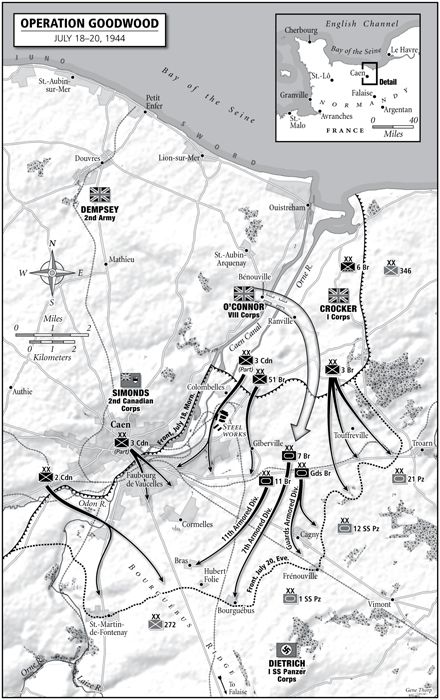
Many more tanks soon burned farther south, past a second rail embankment that gave onto the main enemy gun line along the Bourguébus Ridge, inevitably pronounced Buggersbus. Carpet bombing had left both the ridge and SS reinforcements mostly unscathed, and fighter-bomber pilots found that camouflaged gun pits using flashless, smokeless powder were almost invisible. German defenders lay low when British scouts nosed forward, and “as a result the reports of no opposition in the Bourguébus area sent by scout cars were erroneous,” the 11th Armored Division commander later explained. “Violent, impassable fire” subsequently swept the tank fleet, and soon “the horizon was blazing with Shermans,” a Coldstream Guards lieutenant recalled.
“Some tank crews are on fire and rolling about on the ground trying to put their clothes out,” the gunner John M. Thorpe informed his diary. “Now all the tanks in front of us are burning fiercely.… Huge smoke rings leave their turrets, rising high into the windless sky.” Another Tommy wrote that “burnt and injured men kept coming back through the corn. We gave them a drink of water, and told them to keep going.” A corporal described the scorched Bourguébus slope as “a horrible graveyard of burning tanks.”
* * *
Montgomery took a different view. “Operations this morning a complete success,” he cabled Field Marshal Brooke just after four P.M. “Situation very promising and it is difficult to see what the enemy can do at present.” To Eisenhower he added, “Am very well satisfied with today’s fighting on eastern flank. We definitely caught the enemy off balance.… Second Army has three armored divisions now operating in the open country.” He gave locations for those divisions that were pure fantasy: VIII Corps had scratched out six miles on a front hardly wider than a knife’s edge, at a cost of two hundred tanks. Perhaps misled by blithe early dispatches from the field, he also issued a public statement in time for the BBC news at nine P.M.: “Second Army attacked and broke through. General Montgomery is well satisfied.” The London Times’ banner headline on Wednesday morning, July 19—“Second Army Breaks Through”—was outdone only by the Daily Mail’s: “Armor Now Swarming into Open Country.”
Montgomery’s cheery assurance sparked jubilation at Bushy Park, but that turned to ashes in the mouth when the true battle map came clear. On Wednesday, Kay Summersby wrote in her desk diary: “E worried because Monty has stopped going. E does not feel well, high blood pressure.” The day’s events would only make E feel worse. Bourguébus Ridge was reported “groaning with enemy,” including antitank reinforcements that ignited more Sherman pyres on the Caen plain. Dempsey’s two flanking corps, the British I to the east and the Canadian II to the west, found hardly more success: repeated attacks by the former on Troarn failed, and the latter seized the southern skirts of Caen before fighting off a ferocious counterattack. In one trapped brigade, according to a Canadian account, “men who were still alive lay hiding in the wheat” until they could creep to safety. At first light on Thursday, Tommies finally occupied the village of Bourguébus but advanced no farther. At four P.M. a thunderstorm broke “with tropical violence,” the advent of a two-day downpour that put paid to Operation GOODWOOD. Sergeants passed around the rum rations as soldiers crept across the battlefield to collect the dead.
The offensive had liberated another thirty-four square miles of France, plus the rest of Caen; this enlarged the beachhead sufficiently to bring the Canadian First Army vanguard to Normandy but hardly constituted the breakthrough hoped for by SHAEF. More than two thousand Germans had been captured, and, as Montgomery envisioned, additional panzer forces were lured to the Allies’ eastern wing. Yet Sepp Dietrich lost only seventy-five tanks and assault guns, by no means the evisceration of German armor that Montgomery also desired. The so-called death ride of the armored divisions cost more than four thousand Second Army casualties and more than four hundred tanks, about a third of the British armored force on the Continent. Airmen grumbled about “seven thousand tons of bombs for seven miles.”
After nearly seven weeks, OVERLORD had inserted thirty-three Allied divisions along an eighty-mile front but penetrated no deeper into Normandy than thirty miles, at a cost of 122,000 casualties. “We are up against a tougher proposition than the worst pessimist had in mind during the planning stages,” Major General Everett S. Hughes, a close confidant of Eisenhower’s, wrote his wife on July 22. Wits invented mock headlines—“Montgomery Sitting on His Caen”—but the New York Herald Tribune captured the prevailing gloom: “Allies in France Bogged Down on Entire Front.” The Times of London corrected its GOODWOOD zeal: “The word ‘break-through’ used in early reports can only be said to have a limited meaning.” Leigh-Mallory told his diary, “The fault with us is, basically, generalship.”
Grumbling and backbiting intensified within the Allied high command. Would Montgomery be sacked? Rumors flew, agitators agitated. Informed that V-1 launch sites would not soon be overrun, Air Marshal Tedder informed Beetle Smith, “Then we must change our leaders for men who will get us there.” He, Eisenhower, and others “had been had for suckers,” Tedder complained. “I do not believe there was the slightest intention to make a clean breakthrough.” Worse yet, he told Eisenhower, was the failure to exploit an attempt by the German military to kill Hitler with a bomb on July 20; with the Norman battlefield still deadlocked, Hitler could attend to reprisals and to shoring up his regime. The failed assassin, Colonel Claus von Stauffenberg, and at least two hundred others would be executed—shot, hanged, beheaded, poisoned, or garroted, sometimes on film—and thousands more were jailed. Before the month ended, Wehrmacht officers would be required to demonstrate fealty by giving the stiff-armed Nazi Heilrather than the traditional military salute.
“E is not pleased at progress being made,” Summersby noted. If displeased, he was also determined not to panic or to act rashly. Instead he would pressure his field commanders, directly and indirectly. Awakened one night by a phone call from Churchill, Eisenhower asked, “What do your people think about the slowness of the situation over there?” Perhaps the prime minister could “persuade Monty to get on his bicycle and start moving.”
To Montgomery, the supreme commander sent a sober, fourteen-paragraph note. “Time is vital,” Eisenhower wrote. “We must hit with everything.”
I thought that at last we had him and were going to roll him up. That did not come about.… Eventually the American ground strength will necessarily be much greater than the British. But while we have equality in size we must go forward shoulder to shoulder, with honors and sacrifices equally shared.
He would keep faith—with the battle plan, with his commanders, and with their common cause. Perhaps only to his mother could he reveal how weary he was. “If I could get home,” he wrote Ida Eisenhower in Kansas on July 23, “I could lie down on the front lawn and stay there for a week without moving.”