
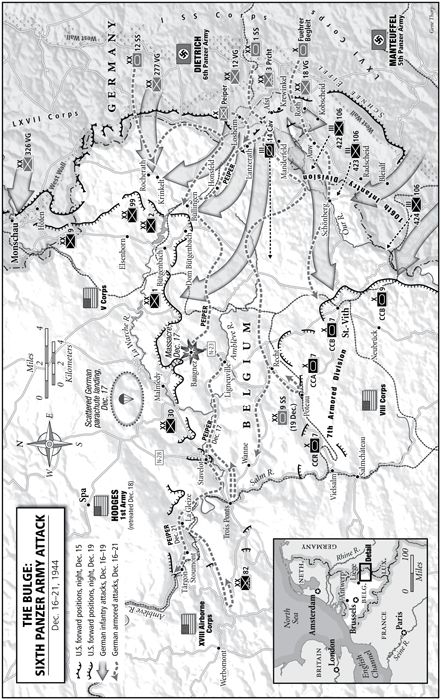
SHEETS of flame leaped from the German gun pits at precisely 5:30 A.M. on December 16. Drumfire fell in crimson splashes across the front with a stink of turned earth and burnt powder, and the green fireballs of 88mm shells bored through the darkness at half a mile per second as if hugging the nap of the Ardennes hillcrests. The Screaming Meemie shriek of Nebelwerfer rockets echoed in the hollows where wide-eyed GIs crouched in their sugar bowls. Then enemy machine guns added their sawmill racket to the din, and rounds with the heft of railroad spikes splintered fir boughs and soldiers’ bones alike. The thrum of panzer engines now carried from the east, along with a creak of bogey wheels, and as the artillery crashed and heaved, a rifleman in the 99th Division reflected, “You’d think the end of the world is coming.”
For some, yes, soon enough. A pearly dawn leaked down the slopes, hurried by hissing German flares that glazed the snow with metallic tints of red and silver. Through the trees the infantry emerged as bent shadows, some in snow suits or white capes, others in greatcoats of Feldgrau with flanged helmets or duck-bill caps, shouting and singing above the whip-crack of rifle fire. One GI, hiding in a barn among cows now excused from the Saturday-morning slaughter, whispered, “The whole German army’s here.” Along the thin American line, men dug in deeper, scratching furrows with helmets and mess tins. Others scuttled to the rear, past the first dead men, who wore the usual deadpan expressions. Only the living were surprised.
The battle was joined, this last great grapple of the Western Front, although hours would elapse before American commanders realized that the opening barrage was more than a feint, and days would pass before some generals acknowledged the truth of what Rundstedt had told his legions in an order captured early Saturday: Es geht um das Ganze. Everything is at stake. The struggle would last for a month, embroiling more than a million men drawn from across half a continent to this haunted upland. The first act of the drama, perhaps the most decisive, played out simultaneously across three sanguinary fields scattered over sixty miles—on the American left, on the American right, and in the calamitous center. “Your great hour has struck,” Rundstedt had also declared. “You bear in yourselves a divine duty to give everything and to achieve the superhuman for our Fatherland and our Führer.”
* * *
No man embraced the field marshal’s sentiments with greater fervor than the slender young SS lieutenant colonel barking at the jammed traffic northwest of Losheim on Saturday morning. Joachim Peiper’s great hour had indeed struck, yet he was already late. A highway bridge across a rail cut had been demolished in September by retreating German troops, but engineers assigned to repair the span could not get past the mule wagons, horse-drawn artillery carriages, and Tiger tanks clogging the narrow approach road. A stalled column of tanks and personnel carriers snaked for miles back into Germany.
As commander of the 1st SS Panzer Regiment, proudly wearing the death’s-head insignia above the visor of his peaked cap, Peiper had been given the specific divine duty of streaking across Belgium with a task force of almost six thousand men and seventy-two tanks to seize the Meuse crossings at Huy, between Liège and Namur. Although only twenty-nine, he was an obvious choice as the Spitze—the point—of Sixth Panzer Army’s attack and indeed all of HERBSTNEBEL. A Berliner born into a military family, fluent in English and French, and handsome in the approved Aryan mode, Peiper in 1938 had served as Heinrich Himmler’s personal adjutant, even marrying one of his secretaries shortly before the invasion of Poland. Much of his war had been spent in the east, burning villages and slaughtering civilians with such abandon that his unit was nicknamed the Blow Torch Battalion. Two brothers, also SS men, were now dead, but Peiper’s devotion to the Reich was undimmed. With Allied bombers terrorizing German cities, he did not question Hitler’s orders to wield fear and terror as weapons.
In early December, after a test run in a Panther near Bonn, Peiper reported that a tank regiment could cover eighty kilometers in a single night, “if I had a free road to myself.” But when assigned his route to the Meuse in December he had complained that “these roads were not for tanks but for bicycles.” The Saturday chaos proved his point, and although he urged his young troopers to “run down anything in the road ruthlessly,” most of Null Tag had slipped past before the column finally found a detour through Losheim at 7:30 P.M.
More troubles awaited. Both German and American mines cost Peiper five tanks before the task force reached Lanzerath at midnight; an hour later, he ordered two Panthers to take the point, guided through the tenebrous woods by troops waving white handkerchiefs. Shortly before 6 A.M. on Sunday the Spitze clattered into Honsfeld to find American vehicles parked in doorways and exhausted GIs slumbering inside. Here the atrocities commenced. Eight soldiers rousted outside in their underwear and bare feet, shouting “Kamerad”—comrade, I surrender—were lined up in the street and murdered with a machine gun. Five others emerged from a house with a white flag; four were shot, and the fifth, pleading for mercy, was crushed beneath a tank. Four more Americans, also carrying a large white banner, were shot, too. Peiper’s men stripped boots from the dead and pressed on to Büllingen, two miles northwest.
German intelligence had correctly identified Büllingen as a likely fuel dump, and SS crews, after raking a dozen parked spotter planes with gunfire on an airstrip outside town, seized fifty thousand gallons of gasoline by ten A.M. Several American soldiers hiding in a cellar strangled their pet dog to keep her from barking, but two hundred other men were rounded up. Before being marched to prison cages in the rear, GIs were forced to fuel the panzers with jerricans in the treeless square that in happier days had served as the town cattle market. Already many hours behind schedule and still sixty miles from Huy, with orders to ignore his exposed flanks and all diversions, Peiper now pivoted southwest—unwittingly giving the Americans a priceless tactical reprieve. Had he swung northwest a few miles to Bütgenbach and then Elsenborn, where the 12th SS Panzer Division was attacking from the east, he likely would have encircled as many as thirty thousand GIs in the beset 2nd and 99th Divisions, who were struggling to fall back to defensible ground.
This serendipity proved catastrophic for Battery B of the 285th Field Artillery Observation Battalion, which early that morning had hurriedly decamped from Germany with orders to move to Luxembourg. At 11:45 A.M., 140 men in thirty-three vehicles stopped for a Sunday lunch of hash, peas, and pineapple outside the Walloon town of Malmédy, ten miles west of Büllingen. An hour later the march south resumed, past Army engineers taping TNT to ash trees to be blown down as roadblocks if necessary. As the convoy sped through Malmédy on Highway N-23, Belgian civilians gestured ahead, yelling, “Boches! Boches!”
Boches there were, and in a particularly foul mood after clumping down a muddy farm trace barely passable even by tracked vehicles. Three miles below Malmédy, at the crossroads hamlet of Baugnez, Peiper’s SS column collided with Battery B shortly before one P.M. For two minutes German machine-gun and tank fire peppered the American convoy until Peiper, furious at the destruction of fifteen fine Detroit trucks, managed to call a cease-fire. A few GIs had been killed, a few others escaped through the woods or hid in a ditch, but more than one hundred surrendered, some with white rags tied to their rifle barrels. As Panthers shoved the burning chassis off the road, prisoners were herded with hands high into eight rows on a snowy field, where their captors stripped them of rings, cigarettes, watches, and gloves. Peiper watched for a few minutes from his personnel carrier, then pushed on down the N-23 toward Ligneuville behind his vanguard.
No one would ever be certain which German soldier fired the first shot, but at 2:15 P.M. an abrupt fusillade from two panzer machine guns chewed into the ranks of prisoners still standing with their hands raised. “At the first outburst of fire everyone fell to the ground, including myself,” recalled Private First Class Homer D. Ford, an MP who had been captured while directing traffic at the crossroads. For two minutes gunfire tore into the writhing, bleating ranks. Then SS men stalked through the bloody pile, kicking groins and—with the fatal verdict “Da kriegt noch einer Luft,” This one’s still breathing—firing pistol shots into the skulls or hearts of those yet alive. Ford lived to bear witness:
I was wounded in the left arm while the group was being sprayed on the ground.… I was laying in the snow … and I was afraid they would see me shivering but they didn’t.… I could hear them pull the trigger back and then the click.
For twenty minutes executioners prowled the field, bellowing in English, “You sons of bitches!” An American medic permitted to attend a wounded soldier was then shot along with his patient. A dozen GIs who had fled into a scruffy café at the crossroads were flushed when the building was set ablaze, and shot down as they scattered. For the next two hours, passing SS convoys fired into the mounded bodies until even the SS tired of the sport. The faces of the dead quickly assumed a deep claret color as the blood in their capillaries froze.
Unaware for the moment that his minions had just committed one of the most infamous battlefield crimes of the war, Peiper arrived at Ligneuville in midafternoon. He was disappointed to find that American officers had just fled, but he spent thirty minutes wolfing down the lunch they left behind in the dining room of the Hôtel du Moulin, a three-story hostel with a wrought-iron balcony. Here a German sergeant led eight U.S. prisoners out back to dig graves for three dead Germans; he then shot the Americans in the head, killing seven. The eighth fled bleeding through the forest only to be later captured again and sent to a camp.
The Spitze pushed westward that Sunday as winter’s blue shadows grew long. In empty Belgian schoolhouses, Christmas decorations covered walls now perforated with bullet holes; a French lesson chalked on a blackboard read, “God made me to know Him, to love Him, and to serve Him in this world, and to be happy with Him in the next.” Twilight had fallen when Peiper reached the wooded bluff above Stavelot on the Amblève River. A single squad of American combat engineers held the town, but when three panzers rushed the only bridge, a mine crippled the lead tank, giving Peiper pause. Perhaps the defenders were stronger than he realized. His march column, strung out for fifteen miles across Belgium, would have to close ranks for an assault into Stavelot, and after three nights of little sleep his men desperately needed rest. He gave the order: they would halt until dawn, still forty-two miles from the Meuse.
Behind him, near Malmédy, more than eighty corpses lay in the snow with their ruddy death masks. But at least a dozen GIs had feigned death for more than two hours and now they rose as if resurrected to pelt through the woods. Soon word of the massacre passed from foxhole to foxhole and up the chain of command, reaching First Army headquarters in Spa even before Peiper decided to stop for the night. Vows to give no quarter spread through the ranks; there were formal decrees in at least two regiments. “American troops are now refusing to take any more SS prisoners,” the Ninth Army war diary would note, “and it may well spread to include all German soldiers.” Es geht um das Ganze. Everything is at stake.
* * *
Peiper had bored a small, vicious hole through the American left flank, but that aperture would have to be widened considerably if the bulk of Sixth Panzer Army was to ram through. Much of the weight of General Dietrich’s attack fell on the 99th Division, another neophyte unit that had been wedged by V Corps into a twenty-mile swatch of the Ardennes front, between Monschau in the north and Lanzerath in the south. By Sunday morning, various battalions had been chopped to pieces in what Captain Charles P. Roland called “a red nightmare,” and much of the division reeled west in confusion. Soldiers siphoned gasoline from wrecked jeeps to ignite flame pits across forest trails, but the enemy came on, bayoneting GIs in their holes and firing point-blank through cellar windows.
“One of our young lieutenants danced a rubber-legged jig as he twisted slowly, making the blue bullet hole between his eyes visible,” Roland later wrote. Artillerymen spiked their guns with thermite grenades, and drivers opened radiator petcocks before abandoning their trucks to flee on foot through the woods. Signalmen smashed switchboards, adjutants burned secrets, and skittish soldiers shot one another by mistake, including one clutch of GIs who accidentally killed their own major, then wounded a captain trying to calm them down. In the Bütgenbach villa where he kept his command post, the division commander, Major General Walter E. Lauer, played a piano in the living room with studied insouciance even as one frightful dispatch arrived after another; his casualties would climb to two thousand and keep climbing. Lieutenant Richard H. Byers, a lanky gunner from Cleveland, watched tracers flicker overhead in neon sheets and recalled lines written by the poet Alan Seeger before he was killed in France in 1916: “I’ve a rendezvous with death / At midnight in some flaming town.”
Two towns, actually: three miles from the German border, the twin Belgian villages of Krinkelt and Rocherath stood in the path of the 12th SS Panzer Division. The Murder Division, responsible for liquidating so many Canadian prisoners in Normandy, had been rebuilt with more Hitler Youth teenagers and 130 tanks and assault guns. Two panzer grenadier battalions probed the villages on Sunday only to butt against veterans from the U.S. 2nd Infantry Division who had been hustled into the line so quickly that some had Christmas packages from home dangling on their belts and rifle barrels; one witness thought they looked “more like postmen than soldiers.”
A full-throated German assault at first light on Monday failed to win through, and fighting swept from house to house, room to room, alley to muddy alley, with grenades, knives, tank destroyers, and artillery salvos called by American officers onto their own heads. Smoke spiraled in thick braids above the mêlée as men from both sides were captured, freed, and recaptured. Antitank guns and skulking bazooka teams, along with almost thirty thousand artillery rounds, knocked out so many Panthers and other tracks that a German officer called the villages “a perfect panzer graveyard.” An enemy gambit to outflank the American line by attacking through Höfen, ten miles north, ended with a battalion of Volksgrenadiers littering the snow like gray stepping-stones. Burial details counted 554 German bodies, for only a dozen U.S. casualties.
At dusk on Tuesday, with the last remnants of the 99th Division bundled to the rear except for stouthearts fighting with the 2nd Division, the Americans slipped from Krinkelt and Rocherath in thick fog, abandoning those flaming towns for better ground a thousand yards west—a boomerang crest two thousand feet high, running from southwest to northeast and unmarked on Belgian military maps. American commanders named this high ground after a nearby village: Elsenborn Ridge. Here Major General Gerow, the V Corps commander, believed the German attack could impale itself.
Corps gunners muscled hundreds of tubes into the lee of the ridge, along with 90mm antiaircraft guns to be used as artillery. Troops shoveled dirt into empty wooden ammunition boxes for field fortifications and burrowed down in the shale slope, roofing the hollows with pine logs and doors ripped from their hinges in a nearby Belgian barracks. Riflemen from the 2nd Division filled the ridgeline on the right and those from the 99th held the left, braced by the veteran 9th Infantry Division taking positions below Monschau in the north. An officer described a command post near Elsenborn as “a Gilbert and Sullivan opera … a big crowd of officers, all with map cases, binoculars, gas masks, etc., milling about. Nobody knew anything useful, even where the enemy was.” Loony rumors flitted about, including reports of Tiger tanks being dropped by parachute. “I want to throw back my head and give voice to that empty feeling with a long animal howl,” Lieutenant Byers wrote his wife. Then a colonel walked in and proclaimed, “You need worry no longer. The 1st Division is here.”
Just so. At a moment when artillery prowess was most in demand, no better gunner was to be found in the U.S. Army than the owlish, bespectacled pipe-smoker known as Mr. Chips: Major General Clift Andrus, who a week earlier had taken command of the 1st Division when General Clarence Huebner became Gerow’s deputy at V Corps. Andrus soon would orchestrate time-on-target fire missions from as many as thirty-five battalions—more than four hundred guns shooting at a single target simultaneously. Also welcome was the arrival of the division’s 26th Infantry Regiment to straddle the trunk road from Büllingen to Malmédy.
Here for three days and nights German paratroopers and the 12th SS Panzer smashed against the defensive bulkhead again and again. One message to Andrus’s headquarters advised, “Attack repulsed. Send litters.” Then: “Much happening out there. We are killing lots of Germans.”
The heaviest blows fell on the 26th Infantry’s 2nd Battalion, commanded since the battle of El Guettar in Tunisia by Lieutenant Colonel Derrill M. Daniel, a Ph.D. entomologist wise in the ways of insect pests. A night attack from Büllingen by twenty truckloads of whooping, dismounted German infantry supported by panzers churning through deck-deep mud was repulsed with white phosphorus and antitank guns firing high-velocity British sabot ammunition at exhaust flames and engine noises. Hours later eight Panthers punched through the battalion line in a rampage of machine-gun and 75mm fire until bazooka teams and scorching antitank volleys threw them back. Thursday brought worse yet, with a three-hour cannonade before dawn by German howitzers and Nebelwerfers; then two battalions of paratroopers and SS panzer grenadiers spilled from a piney wood in the west, trailed by thirty panzers. The 2nd Battalion’s right flank crumbled, and SS tanks wheeled up and down the line, crushing GIs in their foxholes.
“Get me all the damned artillery you can get,” Daniel radioed. Ten thousand rounds in eight hours—among the fiercest concentrations in the European war—kept enemy infantry at bay, but panzers closed to within a hundred yards of the battalion command post in a farm compound called Dom Bütgenbach. For much of the day Daniel and his staff crouched in a cellar with the wounded, burning classified papers and massing fires as tank and machine-gun rounds blistered the four-foot stone walls. Sleeting counterfire from Shermans and new 90mm tank destroyers finally winkled out the last attackers from behind a barn by shooting right through it; only one panzer escaped. An eerie silence descended with the night.
Army patrols reported enemy dead “as common as grass,” and grave diggers would count nearly 800 bodies, along with the wrecked hulks of forty-seven panzers and self-propelled guns. Daniel took 250 casualties—this just three weeks after ruinous losses in the Hürtgen—and during the protracted fight at Elsenborn Ridge 5,000 others were killed or wounded or went missing in the 2nd and 99th Divisions alone.
But the American line held. Here Sixth Panzer Army reached its high-water mark, on what would become known as the north shoulder of the Bulge. Dietrich needed an eight- to twelve-mile cushion on his right flank to keep German assault columns unmolested by American artillery as they lumbered toward the Meuse. Instead, the juggernaut was forced to shear away from the main road through Bütgenbach to seek secondary avenues farther south; three routes allocated to the I SS Panzer Corps remained blocked, with others under fire. An attack farther north near Monschau failed abjectly when one German division arrived late to the battle and the other was knocked back. Only Peiper’s foray showed clear promise in this sector. The 12th SS Panzer Division had been mauled, again, and other SS units seemed muscle-bound and clumsy.
The Americans by contrast demonstrated agility and a knack for concentrating firepower. Sixty thousand fresh troops had been shuttled into the Ardennes on Sunday, December 17, among the quarter-million reinforcements who would arrive within a week. Four U.S. infantry divisions clotted the north shoulder so effectively that OB West’s war diary acknowledged “the Elsenborn attack is gaining only quite insignificant ground,” while Army Group B lamented “slower progress than anticipated.” The tactical fortunes of Dietrich and his lieutenants seemed increasingly doubtful, to the point that Rundstedt and Model, watching the offensive come unstitched, agreed to abruptly shift the German main effort from Sixth Panzer Army to Manteuffel’s Fifth Panzer Army in the south. With northern routes denied or constricted, a new urgency obtained on the German left, and the roads leading through Luxembourg toward Bastogne and thence to the Meuse were now more vital than ever.
* * *
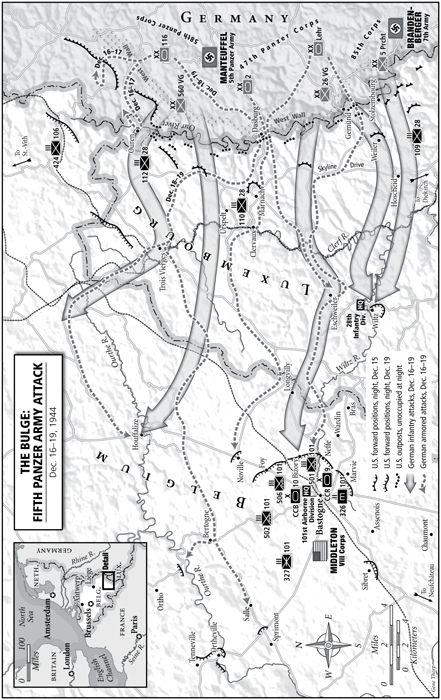
Two armored corps abreast had come down like wolves on the fold in Manteuffel’s Saturday-morning attack, each corps falling on little more than an American regiment at an unnerving ratio of ten wolves for each sheep. Cota’s 28th Division, still recuperating from six thousand Hürtgen casualties, held an impossibly wide twenty-five-mile front along the Our River, with all three infantry regiments on line. Instead of facing two German divisions across the river, as Army intelligence had surmised, Cota’s men found themselves fighting five, plus heavy enemy reinforcements.
As artillery and mortar barrages shredded field-phone wires and truck tires, German infiltrators forded the Our in swirling fog to creep up stream beds behind the American pickets. Forward outposts fell back, or perished, or surrendered. “While I was being searched they came across my teeth wrapped in a handkerchief in my pocket,” a captured engineer recorded. “These they kept.” German shock troops soon rushed American gun lines illuminated by flares and by searchlights ricocheting off the low clouds; howitzer crews fired over open sights before spiking their tubes. An American armored column rushing down a ridgetop road known as Skyline Drive blundered into a German ambush: eleven light tanks were destroyed in as many minutes, “like clay pipes in a shooting gallery.” From his command post in Wiltz, a brewing and tanning town ten miles west of the Our, Cota repeated orders from General Middleton at the VIII Corps headquarters in Bastogne, another ten miles farther west: “Hold at all costs.” A soldier scribbled in his diary, “This place is not healthy anymore.”
Yet as in the north, frictions and vexations soon bedeviled the German attack. A bridge for the 2nd Panzer Division collapsed into the Our after only ten tanks had crossed. Engineers eventually built two spans stout enough to hold a Panther, at Gemünd and Dasburg, but steep, hairpin approach roads, pocked by American artillery, reduced traffic to a crawl. Although Cota’s flank regiments yielded ground in the face of flamethrowers and panzer fire, they imposed a severe penalty on the German timetable.
Along the American right, where four infantry divisions from the enemy’s Seventh Army formed HERBSTNEBEL’s southern lip, the 109th Infantry over three days would fall back slowly for four miles to Diekirch before joining forces with part of the 9th Armored Division. Another Hürtgen convalescent, the 4th Infantry Division, helped parry an enemy sweep into the American rear. On Cota’s left, two battalion kitchens in the 112th Infantry were quickly overrun, but cooks fought with rifles and Manteuffel’s LVIII Panzer Corps bled badly in getting a foothold across the Our. By Sunday night, the weight of metal and numbers won through for the Germans, but the 112th withdrew in good order to the northwest, largely intact although now splintered away from the rest of the 28th Division. With Cota’s permission, the regiment continued sidling north to help defend the Belgian town of St.-Vith.
That left Cota a single regiment, the 110th Infantry, holding an eleven-mile front in the division center. Here Manteuffel swung his heaviest blow, with three divisions in XLVII Panzer Corps instructed to rip through to Bastogne, specifically targeted for quick capture under a Führer order. By midday Sunday the 110th was disintegrating, though not without a scrap. In the medieval town of Clervaux, various nobles for nine centuries—notably, John the Blind and the House of Burgundy—had occupied a feudal castle on a rocky spur overlooking the road to Bastogne. Now one hundred GIs, including clerks and bakers, barricaded themselves inside, firing from arrow slits in the Tower of the Witches at Germans in long leather coats scampering below. Wailing pleas for salvation rose from the dungeon, where dozens of women and children had taken refuge.
A mile up the road, in the three-story Hotel Claravallis, the flinty regimental commander, Colonel Hurley E. Fuller, advised Cota by radio of his peril: at least a dozen panzers on the high ground firing into Clervaux; the castle besieged; ammunition short; artillery overrun or retreating. “Hold at all costs,” Cota repeated. “No retreat. Nobody comes back.”
At 7:30 on Sunday evening, Fuller was again on the radio to division headquarters, likening his predicament to the Alamo, when a staff officer rushed in to report enemy tanks on the street outside. “No more time to talk,” Fuller told one of Cota’s lieutenants, and then slammed down the handset just before three shells demolished the hotel façade. He bounded to the third floor to grab his carbine and coat, only to find ten terrified soldiers crouched in Room 10. As the sound of German voices carried up the stairway, an explosion blew in the window. Glass, plaster, and steel sprayed the room, killing a lieutenant and wounding five other men. Hurriedly bandaging the eyes of a blinded soldier, Fuller led him by the hand to Room 12, where an iron ladder extended from the window across a fifteen-foot gap to crude steps cut into a shale cliff behind the hotel. Out and up they climbed, one by one, the blind man clutching Fuller’s belt from behind. Reaching the bluff above the ruby glow of burning Clervaux, Fuller set a course west for Bastogne, but to no avail: chaos and gunfire soon scattered the absconders. Within hours Fuller had been captured in a thicket near Wiltz, to be bundled off by boxcar to a prison camp near Leipzig.
The castle too was burning. Flames danced from the tower roof and black smoke stained the whitewashed inner walls. A final radio call went out Monday morning, December 18, before a panzer battered down the heavy wooden gates. At one P.M. the little garrison hoisted a white flag in surrender. Silence settled over Clervaux but for crackling fires and the shatter of glass from German looting. In a small inn that once housed the Red Cross club, a sign in the front window still proclaimed, “Of course we’re open.”
Not far from Clervaux, frightened civilians in another Luxembourg town wielded hammers and axes to demolish a huge sign erected in the fall to welcome the Americans. On the heels of the retreating 109th Infantry, three thousand men, women, and children fled Diekirch in bitter cold at midnight on Tuesday, abandoning four hundred others too old, infirm, or stubborn to leave. On Cota’s order, undelivered Christmas packages and letters were piled in a Wiltz courtyard, doused with gasoline, and burned; the division command post pulled out Tuesday, first to Bastogne, then to Sibret, and eventually to Neufchâteau. A gaggle of Army bandsmen, engineers, paymasters, and sawmill operators fought as a rear guard until overrun by whistle-blowing German paratroopers, who reduced Wiltz with machine pistols and forty panzers.
“This was the end,” the official Army history recorded. “Shots, blazing vehicles, and screaming wounded.” Some GIs escaped by night in groups of ten with map scraps and radium-dial compasses. Several hundred others were captured, including one young officer who described being propped on a German staff car as a hood ornament, legs dangling over the grille, and driven east through march columns of Wehrmacht reinforcements who were “laughing at me as the trophy.”
The 110th Infantry had been annihilated, with 2,500 battle casualties. Sixty American tanks were reduced to smoking wreckage. Yet once again space had been traded for time, a few miles for forty-eight hours, and once again that bargain favored the defenders. The southern shoulder was jammed almost as effectively as the northern. Fifth Panzer Army now marched on Bastogne, true enough, but the stumbling, tardy advance by three bloodied divisions hardly resembled the blitzkrieg of Hitler’s fever dream.
* * *
Only in the center of the German onslaught did HERBSTNEBEL find unalloyed success. Here many of the fourteen thousand green soldiers in the 106th Division sheltered in captured Siegfried Line pillboxes, as enemy spearheads to the left and right tried on Saturday to envelop them in a pincer movement around the Schnee Eifel hogback. General Manteuffel hoped to capture St.-Vith within a day; the five main roads and three rail lines converging on that Belgian market hub, sixteen miles to the west, were vital given the hazards of moving cross-country through the Ardennes. On no segment of the Western Front were GIs more outnumbered, yet sharp firefights that morning imperiled the German timetable here as elsewhere. After one enemy column was slapped around, a German soldier shouted, in English, “Take a ten-minute break. We’ll be back.” A GI answered, “Fuck you, we’ll still be here.”
Not for long, at least on the left flank. Here about half of the sixteen hundred troopers in the 14th Cavalry Group plugged the Losheim Gap with flimsy armored cars and a few tank destroyers in eight sugar-bowl strongpoints under the group commander, Colonel Mark A. Devine, Jr., a beetle-browed disciplinarian with a penchant for telling Belgian mayors, “Your damn town is dirty. Clean it up.” Facing paratroopers from the southern edge of Sixth Panzer Army and Volksgrenadiers from the northern edge of Fifth Panzer Army, the cavalry buckled. “Front lines still intact. Things well in hand,” Devine reported from Manderfeld, but German shock troops gobbled up the sugar bowls one by one: Krewinkel, Afst, Kobscheid. A final radio message from Roth—“Tanks seventy-five yards from command post. Firing direct fire. Out”—was followed by silence. At four o’clock on Saturday afternoon, after an enemy shell wounded a staff officer and knocked Devine to the floor of his command post, he received permission from the 106th Division headquarters in St.-Vith to pull back two miles. Troopers put Manderfeld to the torch and retreated to the next ridgeline, blowing up eight of a dozen tank destroyers to forestall capture.
Devine’s behavior now grew odd; perhaps he was suffering effects from the concussive blast. As his troopers dug in, he drove to St.-Vith, where for hours he loitered around the hectic 106th Division offices, eating bread, cheese, and then a breakfast of hot cakes and coffee. One officer thought his demeanor unremarkable, but the assistant division commander found him “almost incoherent.… He was nervous, could barely control his actions.” The chief of staff described him as “excited and anxious.” The division commander, Major General Alan W. Jones, anxious himself, offered scant advice other than to hold tight.
Instead, at daybreak on Sunday Devine returned to his men and, though there was little enemy pressure, ordered them to fall back farther, this time without authorization. He again drove to St.-Vith early in the afternoon, bursting into Jones’s office. “The Germans are right behind us!” he warned, his face flushed. “They’ve broken through in the north. My group is practically destroyed.” Sent back to his cavalrymen, the colonel ordered yet another retreat contrary to orders, now to Poteau, west of St.-Vith and seventeen miles from the original front.
At dusk on Sunday, Devine set out once more for St.-Vith, this time driving southeast with his executive officer and entire senior staff in a convoy of three jeeps and an armored car, each burning blackout lights. Thwarted by torrents of traffic crawling west, the little procession turned around in the dark only to hear a sharp command of “Halt!” a mile east of Recht. As an approaching German picket did a double take at the white star insignia on the armored car, an officer in the lead jeep pulled a pistol and shot the enemy soldier in the face. A sergeant then unleashed a cackling burst from a .50-caliber machine gun, and in the ensuing gunfight the Americans scattered through the woods. At midnight a disheveled, incoherent Devine appeared in the Poteau tavern serving as his command post, where he told a subordinate, “I want you to take over”; at four A.M. Monday, he was evacuated to Vielsalm by the unit dentist. A battalion surgeon later found Devine in La Roche with “a wild gleam in his eye,” directing traffic and urging passersby to counterattack immediately. Six grams of sodium amytal put him into a deep sleep and removed him from the front.
The damage had been done, but even a stalwart stand by the 14th Cavalry likely would not have long postponed the catastrophe that followed. With the American left flank abruptly unhinged, German paratroopers on Sunday had cantered through Manderfeld to Lanzerath, brushing sleeves with Colonel Peiper’s SS column and further pressuring the 99th Division to the north as well as imperiling the 106th Division in the south.
In St.-Vith, General Jones, a stocky native of Washington State with brilliantine hair and a Clark Gable mustache, sought counsel from the VIII Corps commander, General Middleton. Except for an engineer battalion, virtually all division reserves had been hustled into the fight. Should the 106th’s infantry regiments, entrenched along a twenty-eight-mile front, pull back?
“You know how things are up there better than I do,” Middleton said in a phone call from Bastogne. “But I agree it would be wise to withdraw them.” In one of those mischances so common in war, a brief disruption on the line apparently kept Jones from hearing the second sentence. He hung up, telling his staff in St.-Vith, “Middleton says we should leave them in,” even as Middleton told subordinates in Bastogne, “I just talked to Jones. I told him to pull his regiments off the Schnee Eifel.” The 106th would stand pat, despite howling barbarians on both flanks. “He felt that he could hold,” Middleton later observed. “He made a mistake.… He had a fighting heart.”
Jones also believed that help was on the way. VIII Corps promised that combat commands from both the 7th and 9th Armored Divisions would soon arrive, perhaps within hours. That optimism failed to account for the “indescribable confusion” of double- and triple-banked traffic “hurtling to the rear,” in one major’s description. “It was a case of every dog for himself … the most perfect traffic jam I have ever seen.” Another officer conceded, “It wasn’t orderly, it wasn’t military, it wasn’t a pretty sight.” A tanker plowing against the exodus at one mile per hour reported that “the fear-crazed occupants of the vehicles fleeing to the rear had lost all reason.”
By midday on Sunday, only the advance guard from Combat Command B of the 7th Armored Division had arrived in St. Vith. The commander, a newly promoted brigadier general named Bruce C. Clarke, had been preparing to leave for Paris to undergo gallstone surgery when word came that “Alan Jones is having some trouble at St. Vith.” Clarke, a craggy engineer from upstate New York, found that General Jones’s trouble included Germans on three sides, a disintegrating cavalry group, and fretful anxiety over his son, a lieutenant somewhere on the Schnee Eifel. Division staff officers stomped about, burning maps and flinging equipment into truck beds for evacuation. At one P.M., Jones phoned Middleton again, telling the corps commander, “Things are looking up.… We are going to be all right.” After ringing off he told an astonished Clarke that Middleton had “enough troubles already” without worrying about the 106th Division.
The crackle of small-arms fire sent both generals hurrying to the third floor of the division command post in steep-roofed St. Josef’s Kloster, where the devout had long cared for the sick, schooled the young, and bathed the bodies of the dead. Muzzle flashes twinkled along a bluff just east of town. “I’ve thrown in my last chips,” Jones said, turning to Clarke. “I’ve got nothing left. You take it now.” And with that General Jones soon joined the frantic exodus to the west.
* * *
Jones’s stand-fast decision had left two infantry regiments, the 422nd and 423rd, and five artillery battalions exposed to entrapment on the Schnee Eifel. On Sunday the trap snapped shut when German columns from north and south converged in Schönberg, just across the Belgian border east of St.-Vith. South of town a third regiment, the 424th Infantry, had earlier that day managed to beat back the enemy envelopment and thus escape entrapment, but by dusk nine thousand other GIs were surrounded on a bleak, snowy German moor. An icy west wind soughed through the fir stands, carrying the fateful whine of panzer engines from the American rear. GIs huddling for warmth in foxholes along the West Wall listened impassively, displaying, one officer recorded, “absolutely no expression.”
At 2:15 on Monday morning, a radio message from General Jones at last ordered the two regiments to retreat toward Schönberg, where an armored spearhead from St.-Vith would help them break out. Ammunition, food, and water were to be dropped by parachute. Colonel George L. Descheneaux, commander of the 422nd Infantry, bowed his head. “My poor men,” he said. “They’ll be cut to pieces.”
Cooks made towering stacks of pancakes, then destroyed their kitchens. In dense fog at dawn the anabasis began, a serpentine column of battalions trudging through the snow, vaguely following a compass azimuth of 270 degrees, while a parallel procession of trucks, jeeps, and towed artillery bumped along cow paths and game trails. Men listened for V-weapons overhead and sought to follow the sound westward. Even Descheneaux muttered, “Where the hell are we?” Huge orange panels were readied to mark a drop zone, but no drop came. Bad weather and “command incoordination,” as the AAF later termed the confusion, kept some planes grounded in England, while two dozen others shuttled emergency supplies between airfields in Belgium and France, futilely seeking information about the besieged regiments.
By midday the Germans had found them though Allied pilots could not. Artillery and mortar salvos fractured the columns, killing or wounding hundreds and scattering regiments, battalions, and companies across the tableland. Unsure where to shoot, given enemy fire falling from at least three directions, gunners began to spike their guns. With mortar ammunition gone and many riflemen reduced to just a few rounds, wet, cold, hungry troops crawled down ravines or sheltered among the firs and waited for dark. Another radio message from General Jones, now in Vielsalm, advised that no armored relief column was likely to appear. He added:
Attack Schönberg. Do maximum damage to enemy there. Then attack toward St. Vith. This mission is of greatest importance to the nation. Good luck.
At daybreak on Tuesday, three battalions from the 422nd Infantry, quite lost but still game, moved out abreast only to be lacerated by German tank and machine-gun fire. Mortars walked through the ranks with a heavy footfall. GIs again went to ground, although not before unleashing a five-minute fusillade against shadowy figures in a nearby stream bed who proved to be comrades from the 423rd Infantry. Their commander, Colonel Charles C. Cavender, leaned against a tree, a study in dejection. “Well, Colonel,” the regimental chaplain said, “this isn’t exactly as we planned, is it?” Cavender shook his head. “No, Chaplain, it isn’t.”
By one P.M., at least one battalion had been pared to just fifty men. Relentless cannonading flayed the pastures between Radscheid and Auw. An icy breeze stirred the hair of helmetless boys sprawled on their backs, pupils fixed and sightless, “their skin that yellow-white of the newly dead,” one lieutenant noted. Benny Goodman and Artie Shaw records blared from German loudspeakers, interspersed with promises of “showers, warm beds, and hotcakes.” A GI sobbing in a ditch shouted, “Go blow it out your ass, you German son of a bitch!” Spirits soared for a moment when a clanking Sherman appeared on the Schönberg road; then enemy crewmen inside the captured tank opened fire, and all hope perished.
At 2:30 P.M., with two thousand of his men now packed into a last-stand perimeter four hundred yards across, Colonel Descheneaux summoned his subordinates. “We’re still sitting like fish in a pond,” he told them. “I’m going to save as many men as I can, and I don’t give a damn if I’m court-martialed.” The order filtered through the ranks: “Destroy all weapons and equipment. We are about to surrender.” As soldiers smashed their rifles against tree trunks and tossed the last ammunition clips into a creek, a major knotted together two white handkerchiefs and set off in search of parley. Descheneaux sat on the lip of a slit trench, weeping. Half a mile away, Colonel Cavender had reached the same conclusion, giving his regiment thirty minutes to destroy all weapons and fling away any German souvenirs. An artillery officer stood on an ambulance waving a snow cape, bellowing, “We surrender.”
A few diehards lay low or scampered into the forest, but rank upon rank marched forward with hands raised. More than seven thousand would surrender, in the worst reverse for American arms in the European theater and the greatest U.S. mass capitulation of the war excepting Bataan. “I’ve lost a division quicker than any division commander in the U.S. Army,” General Jones lamented. Two days later, having been relieved of command, he collapsed from a heart attack and was assigned to the “Detachment of Patients” near Paris; “evacuation order no. 13” authorized his return to Washington with a government per diem of $7.
Long columns of prisoners plodded toward Germany, Jones’s son among them, past wounded men wailing for help from the snow meadows. Wehrmacht reinforcements tramped by, trundling machine guns in wheelbarrows and catcalling about how panzers had already crossed the Meuse. In that gray tide making for St.-Vith, a captured gunner observed “tanks towing other tanks; tanks towing buses without engines; buses and trucks with red crosses all over them loaded down with ammo and troops.”
“Do not flee,” the German guards called out. “If you flee, you will be machine weaponed.” Many GIs had lost their overcoats and blankets, and at night they lay back to belly for warmth. Some chewed wax candles to ward off hunger, or wolfed down potato skins found in hog troughs. Through Rhineland towns they marched, pelted with stones and maledictions. “The Germans made us take off our overshoes and give them to the civilians,” a squad leader from the 423rd Infantry told his diary; in Koblenz, he added, a man in a business suit “hit me in the head with his briefcase. Guard said he was upset over recent bombing.”
Among those transported by train into captivity was a twenty-two-year-old private first class named Kurt Vonnegut, Jr., bound for a Dresden work camp. “Bayonets aren’t much good against tanks,” the future novelist wrote his family in Indiana.
The supermen marched us, without food, water or sleep to Limburg … where we were loaded and locked up, sixty men to each small, unventilated, unheated box car.… The floors were covered with fresh cow dung.… Half slept while the other half stood.
More than a hundred miles east of the battle, at the Adlerhorst compound in the Taunus Hills, adjutants and headquarters clerks sorted through the latest reports on the Ardennes fighting. Given the disappointments on both flanks of his offensive, Herr Hitler took heart at field dispatches from the Schnee Eifel. The Meuse, Antwerp, victory—all remained in play. To his generals the Führer proclaimed, “Success—complete success—is now in our grasp.”