
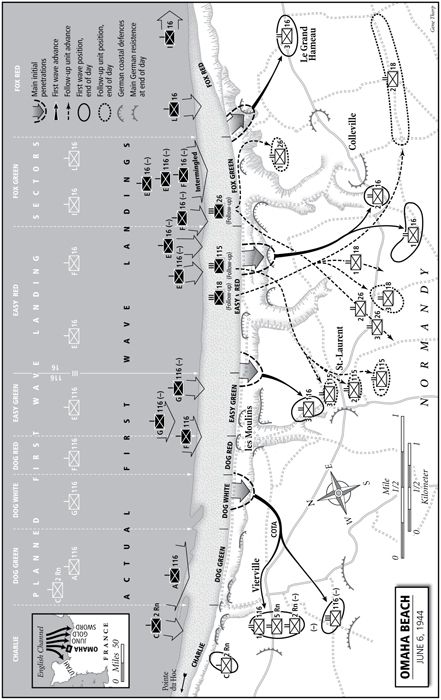
FIFTEEN miles southeast of Utah, the flat Norman littoral lifted briefly to form a sea-chewed plateau named La Côte du Calvados after a reef on which legend held the Spanish galleon Salvador came to grief in 1588 as part of the Armada’s larger mischance. In various Allied plans the crescent plage below the bluffs had been labeled Beach 46, Beach 313, and X Beach; now it was known, and would forever be known, as Omaha. Five miles long, composed of packed sand yielding to shingle sorted in size by a thousand storms, the beach offered but five exits up the hundred-foot escarpment, each following a narrow watercourse to four villages of thick-walled farmhouses a mile or so inland. June airs usually wafted out of the south, but on this fraught morning the wind whistled from the northwest at almost twenty knots, raising the offshore lop to six feet and accelerating the current from two knots to three, running easterly or westerly depending on the tide.
That Norman tide was a primordial force unseen in any previous amphibious landing. Rising twenty-three feet, twice daily it inundated the beach and everything on it at a rate of a vertical foot every eight minutes, then ebbed at almost an inch per second. Low tide typically revealed four hundred yards of open strand, but six hours later that low-tide mark would lie more than twenty feet deep. To finesse this phenomenon in landing the 30,000 assault troops of Task Force O, followed by 26,000 more in Force B, planners chose to attack on a rising tide the morning of June 6. This would permit landing craft to ferry the assault force as far up the exposed beach as possible, but without stranding the boats on falling water as the tide retreated. Ten thousand combat engineers would land with the infantry on June 6, as the historian Joseph Balkoski has written, yet the first sappers would have only half an hour to blow open lanes among the beach obstacles for landing craft before the rising sea swallowed them.
OVERLORD’s plan called for nine infantry companies to attack simultaneously on a beach divided into segments: Dog, Easy, Charlie, and Fox. But three mistakes had already given Omaha an ineluctable tragic cast—one error attributable mostly to the Navy, two to the Army. To minimize the risk of German shore fire, naval captains had anchored their transport ships eleven miles distant, guaranteeing derangement of the landing echelons by wind, current, and confusion. In a bid for tactical surprise, Army commanders had insisted on truncating the naval bombardment to barely thirty-five minutes—enough to scare the defenders but not enough, given the clean miss by Allied air forces, to subdue them. The Army also had chosen to storm the narrow beach exits where fortifications were sturdiest, rather than stressing infiltration up the bluffs to outflank enemy strong points.
The German defenses were fearsome. Eighty-five machine-gun nests, soon known to GIs as “murder holes,” covered Omaha, more than all three British beaches combined. Unlike the obstacles at Utah, many of the 3,700 wood pilings and iron barriers embedded in the tidal flat at Omaha were festooned with mines—“like huckleberries,” as a Navy officer described them. Unique among the five beaches, the escarpment allowed plunging as well as grazing fire. Thirty-five pillboxes and eight massive bunkers—some “as big as a New England town hall,” in one reporter’s description—defended the beach’s five exits, while eighteen antitank sites, six Nebelwerfer rocket-launcher pits, and four artillery positions covered the balance of the beach. Guns enfiladed nearly every grain of sand on Omaha, concealed from the sea by concrete and earthen blast shields that aerial photos had failed to find. Thanks to smokeless, flashless powder and a German ban on tracer bullets here, gun pits remained, as a Navy analysis conceded, “exceedingly difficult to detect.”
Also undetected and unexpected by the assault troops were German reinforcements. Rommel in mid-March had shifted the 352nd Infantry Division to the coast from St.-Lô, twenty miles inland, placing two regiments behind Omaha and Gold Beaches alongside two regiments from the feebler 716th Infantry Division, while a third 352nd regiment bivouacked in reserve at Bayeux. Neither Ultra nor conventional intelligence sniffed out the move; belated suspicions of reinforcement reached Omar Bradley’s First Army headquarters on June 4, too late to alert the scattered fleets under a radio blackout. The thirteen thousand troops from the 352nd—mobile, dangerous, and so young that Wehrmacht officers requisitioned milk from French farmers to build their bones—had spent much of their time in recent weeks hauling timber in dray carts from the Forêt de Cerisy to buttress the Atlantic Wall. Nearly half the division’s infantry strength, including two battalions on bicycles, had been dispatched before dawn to the southern Cotentin with orders to confront reported paratroopers. Some of those invaders proved to be “exploding puppets,” hundreds of airborne dummies with noisemakers, accompanied by a few British tricksters popping flares and playing gramophone recordings of gunfire.
If the Omaha defenses had been thinned to three weak battalions by such dupery, they remained far more lethal than the single immobile regiment scattered over a fifty-mile front that most GIs had expected to biff aside. Rather than the three-to-one ratio favored by attackers in storming an entrenched foe, some units now sweeping toward land would meet odds of three to five. The foreshore that had first warranted only a succession of code numbers, and then a homely code name, now would earn other enduring epithets, including Bloody Omaha and Hell’s Beach.
* * *
For those who outlived the day, who survived this high thing, this bright honor, this destiny, the memories would remain as shot-torn as the beach itself. They remembered waves slapping the steel hulls, and bilge pumps choked with vomit from seasick men making “utterly inhuman noises” into their gas capes. Green water curled over the gunwales as coxswains waited for a tidal surge to lift them past the bars before dropping the ramps with a heavy clank and a shouted benediction: “It’s yours, take it away!”
They remembered the red splash of shell bursts plumping the shallows, and machine-gun bullets puckering the sea “like wind-driven hail” before tearing through the grounded boats so that, as one sergeant recalled, “men were tumbling out just like corn cobs off a conveyor belt.” Mortar fragments said to be the size of shovel blades skimmed the shore, trimming away arms, legs, heads. The murder holes murdered. Steel-jacketed rounds kicked up sand “like wicked living things,” as a reporter wrote, or swarmed overhead in what the novelist-soldier Vernon Scannell called an “insectile whine.” Soldiers who had sung “Happy D-Day, dear Adolf” now cowered like frightened animals. They desperately gouged out shallow holes in the shingle with mess kit spoons and barked knuckles, mouths agape in a rictus of astonishment intended to prevent artillery concussions from rupturing their eardrums.
They remembered brave men advancing as if “walking in the face of a real strong wind,” in Forrest Pogue’s image, all affecting the same tight grimace until whipcrack bullets cut them down. Above the battle din they remembered the cries of comrades ripped open, merging at moments into a single ululation described by the BBC reporter David Howarth as “a long terrible dying scream which seemed to express not only fear and pain, but amazement, consternation, and disbelief.” And they remembered the shapeless dead, sprawled on the strand like smears of divine clay, or as flotsam on the making tide, weltering, with their life belts still cinched. All this they would remember, from the beaten zone called Omaha.
Army and Navy engineers, lugging twenty-eight tons of explosives, were supposed to land three minutes behind the infantry spearhead to blow sixteen gaps, each fifty yards wide, through tidal-zone obstacles emplaced in three belts. Little went right: some engineers landed early and alone, some landed late, nearly all drifted left—east—of their assigned beaches by up to a mile because of the current and navigation error. An 88mm shell hit Team 14’s landing craft, blowing the coxswain overboard and slaughtering the vessel’s entire Navy demolition squad; one man’s lower trunk and severed legs were described by a seaman as “sticking up in the water like a pitiful V for victory.” Seven died in Team 11 when shellfire hit their rubber boat; of forty men in Team 15, only four eluded death or injury. A mortar round caught Team 12, tripping the TNT primacord and explosive charges, and killing or wounding nineteen engineers in an explosion so violent that three-legged steel hedgehogs rained down “like fence posts falling,” a survivor reported.
Demolitionists shinnied up pilings or stood on one another’s shoulders to pluck off mines and place their charges, popping violet smoke grenades to signal an imminent detonation. Gunfire shot away fuses as fast as engineers could rig them, including one burst that also carried off the fuse man’s fingers. Terrified infantrymen sheltered behind the German obstacles “like a cluster of bees,” even as engineers screamed, kicked, and threatened to blow their charges anyway. By seven A.M., as the floodtide began to swallow the obstacles, only six of sixteen gaps had been cleared through all three belts, and at a fell cost: more than half of the engineers would be dead, wounded, or missing by midmorning.
The fiascos multiplied. Sherman amphibious tanks, ostensibly seagoing with their inflatable canvas skirts and twin propellers, began plopping into the waves from LCT ramps “like toads from the lip of an ornamental pond,” as the historian John Keegan later wrote. Yet the tanks had only nine inches of freeboard in a pond with six-foot seas; of thirty-two Shermans in one battalion, twenty-seven sank trying to cross six thousand yards of open water, with a loss of 9 officers and 137 men. “There was a certain gallantry,” the BBC’s Howarth noted. “Commanders of the second, third, and fourth tanks in each [LCT] could see the leaders founder; but the order had been given to launch, and they launched.” Farther west, a Navy lieutenant sensibly recognized the rough sea as unfit for a thirty-three-ton swimming tank, and LCTs carrying most of another armor battalion made for shore instead. Eight Shermans went under when their vessels took direct hits, but twenty-four others clanked ashore.
Artillerymen also struggled to land their guns. A dozen 105mm howitzers from the 111th Field Artillery Battalion had been loaded onto DUKW amphibious trucks, each of which also carried fourteen men, fifty shells, and a protective rampart of eighteen sandbags, enough to make the DUKW “altogether unseaworthy,” as the Army belatedly recognized. Eight quickly shipped water and capsized, and three others were lost to waves or shellfire before reaching shore. “I can still hear those men calling for help over the noise,” a master sergeant later recalled.
Two infantry regiments washed onto Hell’s Beach early that morning, from the two assault divisions that formed V Corps. To the west, the 116th Infantry—rural Virginians marinated in Confederate glory and descended from the Stonewall Brigade of 1861—had trained in Britain for twenty months as part of the 29th Infantry Division, long enough to earn a derisive nickname: “England’s Own.” Officers ordered men in landing craft approaching the shore to keep their heads down, as one lieutenant explained, “so they wouldn’t see it and lose heart.” They saw soon enough. On the right flank of the invasion zone, German gunners abruptly turned beach Dog Green into an abattoir. Without firing a shot, Company A was reportedly “inert and leaderless” in ten minutes; after half an hour, two-thirds of the company had been destroyed, including Sergeant Frank Draper, Jr., killed when an antitank round tore away his left shoulder to expose a heart that beat until he bled to death. Among twenty-two men from tiny Bedford, Virginia, who would die in Normandy, Draper “didn’t get to kill anybody,” his sister later lamented. A surviving officer reported that his men fell “like hay dropping before the scythe.”
German machine guns—with a sound one GI compared to “a venetian blind being lifted up rapidly”—perforated the beach, killing the wounded and rekilling the dead. All thirty-two soldiers in one boat, LCA-1015, were slaughtered, including their captain. A lieutenant shot in the brain continued to direct his troops until, a survivor recounted, “he sat down and held his head in the palm of his hand before falling over dead.” Wounded men jabbed themselves with morphine or shrieked for medics, one of whom used safety pins to close a gaping leg wound. “A guy in front of me got it through the throat. Another guy in front of me got it through the heart. I run on,” a survivor later recalled. An unhinged soldier sat in the sand, weeping softly and tossing stones into the water. “This,” an officer declared, “is a debacle.”
More than a mile to the east, the 16th Infantry Regiment—veterans of landings in Africa and Sicily with the 1st Infantry Division—had its own debacle. The entire first wave carried east of its intended beaches. Simply reaching the waterline reduced Company L from 187 men to 123. Medics found that “the greater portion of the dead had died of bullet wounds through the head”; officers and sergeants alike began slapping wet sand over the rank insignia on their helmets to confound snipers. “Fire was coming from everywhere, big and little stuff,” a soldier in Company E recalled. Moved to computation by the demented shooting, one sergeant calculated that the beach was swept with “at least twenty thousand bullets and shells per minute.” Robert Capa, who had removed his Contax camera from its waterproof oilskin to snap the most memorable photographs of the Second World War, crouched behind a burned-out Sherman on Easy Red and murmured a phrase he recalled from the Spanish Civil War: “Es una cosa muy seria.”This is a very serious business.
The four-hundred-ton LCI 85, grounding ashore on the seam between Easy Red and Fox Green, had begun dispensing men down the left ramp when enemy 47mm and 88mm shells blew through the front hold, killing fifteen and wounding forty-seven. The Coast Guard crew backed off and steamed west several hundred yards only to face scorching fire upon putting in again. More than two dozen shells ripped into the ship, igniting troop compartments and leaving the decks slick with blood. White bandages from a shot-up medical company fluttered down through the smoke. On the bridge, the skipper reported, “we could hear the screams of the men through the voice tube.” Listing, burning, bleeding, LCI 85 steamed for the horizon, where the wounded and the dead were extracted before she capsized and sank.
By 8:30 A.M. the Omaha assault had stalled. The rising tide quickly reclaimed the thin strip of liberated beach, drowning those immobilized by wounds or fear. With no room to land more vehicles, a Navy beachmaster halted further unloading on much of the shoreline. “Face downwards, as far as eyes could see in either direction,” a 16th Infantry surgeon later wrote, “were the huddled bodies of men living, wounded, and dead, as tightly packed together as layers of cigars in a box.”
Two large boats burned furiously in the shallows of Dog White. LCI 91, carrying two hundred soldiers, had caught a shell in her fuel tanks, engulfing the well deck in flames. At least two dozen men were incinerated as others leaped into the sea, including one bright torch who dove in with even the soles of his boots blazing. Moments later, LCI 92, seeking cover in her sister’s smoke, struck a mine on the port bow. The explosion blew two soldiers from a hatch like champagne corks and trapped more than forty others belowdecks. “A sheet of flame shot up thirty feet in the air through the number one hold directly forward of the conning tower,” a yeoman reported. “Terror seized me.” German gunners then found the range to finish off the boat. A survivor dog-paddled to the beach not as an infantry officer ready for combat, as he later acknowledged, but as the “helpless unarmed survivor of a shipwreck.”
Only where escarpment turned to cliff, four miles west of Omaha, did the early-morning assault show promise. Three companies from the 2nd Ranger Battalion scaled the headland at Pointe du Hoc, first climbing freehand despite a rain of grenades, then using grapnels and braided ropes fired from mortar tubes. Comrades gave covering fire from ladders loaned by the London fire department and carried in DUKWs. As windswept as Troy, the promontory had been reduced to what one officer called “ripped-open dirt” by 250 shells from Texas’s 14-inch barrels. Rangers hauled themselves over the lip of the cliff, then used thermite grenades to wreck five shore guns that had been removed from their casemates and secreted in an apple orchard. The triumph was short-lived: they soon found themselves trapped by rallying Germans who spent the next thirty-six hours trying to sweep them from the scarp to the rocks below.
Back on Hell’s Beach, several thousand shivering soldiers also found defilade where they could and waited for a counterattack from the bluffs to bowl them back into the sea. “They’ll come swarming down on us,” murmured Don Whitehead. A lieutenant, who watched sodden bodies advance on the creeping tide, later wrote, “After a couple of looks back, we decided we couldn’t look back anymore.” Among those huddled on the beach was Captain Joseph T. Dawson, a lanky, dark-eyed veteran of Company G in the 16th Infantry. An hour earlier, Dawson had leaped from his landing craft onto Easy Red just as an artillery shell struck the boat, exterminating the thirty-three men behind him. “The limitations of life come into sharp relief,” he would write his family in Texas. “No one is indispensable in this world.”
* * *
From the gray deck of the command ship U.S.S. Augusta none of this was clear. A brown miasma of dust and smoke draped the French coast to the south, mysterious and impenetrable except by the cherry-red battleship shells soaring toward inland targets. A cramped First Army war room had been built on the cruiser’s afterdeck, ten feet by twenty, with a tarpaulin door, a Michelin map of France fastened to a sheet-metal wall, and a clock whose glass face had been taped against concussion. Other maps displayed the suspected location of enemy units, marked in red, and the range of German shore guns, delineated with concentric circles. Signalmen wearing headphones listened for radio messages, which they pounded out on a bank of typewriters. From Omaha only incoherent fragments had been heard, of sinkings, swampings, heavy fire. One dispatch picked up by another ship nearby advised, “We are being butchered like a bunch of hogs.”
At a plotting table in the center of the war room sat a tall, bespectacled man in a helmet, Mae West, and three-star field jacket. Again he asked—“What’s going on?”—and again got little more than an apologetic shrug. On several occasions as a young officer, Omar Bradley had studied Gallipoli, the disastrous British effort to capture Constantinople in 1915, and more recently he had scrutinized reports from Anzio. The preeminent lesson from both amphibious attacks, he concluded, was “to get ground quickly.” Was that happening at Omaha? Another shrug. He had expected the two assault regiments to be a mile inland by 8:30 A.M., but now he was unsure whether they had even reached France. Bradley had begun contemplating his course if the troops failed to get off the strand. He felt not only alarmed but also a bit ridiculous: this morning the army commander sported an immense bandage on his nose to cover a boil that had been lanced in the ship’s dispensary. Photographers were forbidden to take his picture.
After successfully commanding a corps in Africa and Sicily, Bradley had benefitted from hagiographic press coverage, including a recent Time cover story that called him “Lincolnesque … a plain, homely, steady man with brains and character.” Ernie Pyle wrote that “he spoke so gently a person couldn’t hear him very far,” while Liebling described “the high cranium, bare on top except for a lattice of gray hairs; the heavy, almost undershot jaw; and the deeply emplaced presbytic eyes, peering out from under the dark brows with an expression of omnivorous but benevolent curiosity.” That he still wore a cap with “Lieut. Col. O. N. Bradley” inked in the lining was considered emblematic of his humility; in fact, lieutenant colonel was his permanent rank.
Few could resist the biography. Son of a schoolteaching Missouri farmer who made $40 a month, married one of his pupils, and died when Omar was thirteen, Bradley had played football on an undefeated Army team that earned unlikely headlines, such as “West Point Finds Notre Dame Easy.” He also befriended a classmate who was now his boss and greatest admirer: “Ice-in-hower,” as Bradley pronounced the name in his sodbuster twang. As a lieutenant, he had been sent to Montana to keep the copper mines open with fixed bayonets against labor agitators; later he taught mathematics at West Point while moonlighting as a construction worker, stringing cable for the Bear Mountain Bridge over the Hudson. He skipped the rank of colonel and was the first of fifty-nine men in the Military Academy class of 1915 to win a general’s stars. A teetotaler until the age of thirty-three, Bradley rarely drank; he had added the pint of whiskey and two flasks of brandy issued when he boarded Augusta to his unopened allotment from Sicily. Vain about his marksmanship—“If there’s a bird anywhere in shootin’ distance, I won’t miss it,” he once told a reporter—he had also nursed a sense of divine anointment ever since, in Tunisia, he drove his jeep over a mine that failed to explode. “I think I had some guidance from God,” he later said. “I felt that I must be destined to play an important part in the war.… I was saved by a miracle.”
Perhaps. But a few wondered if he was out of his depth, if he had been promoted beyond his natural level of competence, if some part of him remained “Lieut. Col. O. N. Bradley.” Patton, who had been his commander in the Mediterranean and would be his subordinate in France, had rated Bradley “superior” in all categories of generalship in September 1943, while privately calling him “a man of great mediocrity.” In his diary Patton added, with typical ambivalence: “Has a strong jaw, talks profoundly and says little. I consider him among our better generals.” The Omaha plan had been largely Bradley’s design, including the limited fire support from the Navy, and he had dismissed predictions of stiff losses as “tommyrot.”
Now he was not so sure. Messages from the beachhead remained fragmentary, including: “Obstacles mined, progress slow.” An aide dispatched by PT boat returned drenched and discouraged an hour later to report that troops were pinned down; a naval officer came back with a more vivid assessment: “My God, this is carnage!” Told that Admiral Moon was jittery over ship losses, Bradley advised Collins, his VII Corps commander, “We’ve got to get the buildup ashore even if it means paving the whole damned Channel bottom with ships.” Another 25,000 troops and 4,000 vehicles were scheduled to land at Omaha on the second tide. Should those waves be diverted to Utah or to the British beaches? Would that consign those now ashore to annihilation?
The man described in his high school yearbook as “calculative” pushed through the canvas war-room door and climbed to Augusta’s bridge, squinting at the opaque shore and mulling his odds.
* * *
Not for some hours would Bradley learn that by late morning his prospects on Omaha had brightened considerably, beginning at beach Dog White. There Brigadier General Norman Cota, known as Dutch and the son of a French-Canadian railroad telegrapher who emigrated to New England, had reached the five-foot timber seawall half a mile east of the beach exit leading to Vierville. Soldiers who could outcrawl the tide lay clustered like barnacles on the banked littoral, hugging wooden groins that jutted from the seawall.
We must improvise, carry on, not lose our heads, Cota had told officers from the 116th Infantry as they sailed for Normandy. Now he improvised. Chewing an unlit cigar, jut-jawed with pale eyes and a hooked nose, Cota scrabbled west along the groins. Pistol in hand, he sang tuneless, ad-libbed lyrics under his breath. Encountering a cluster of troops, he demanded, “What outfit is this? Goddamn it, if you’re Rangers get up and lead the way.… I know you won’t let me down.… We’ve got to get these men off this goddamned beach.” A bangalore torpedo threaded through a double apron of barbed wire blew a gap across the beach road beyond the seawall. Machine-gun fire cut down the first GI into the breach—“Medico, I’m hit,” he cried, then sobbed for his mother until he died—but others, including Cota, scampered across the blacktop and through the burning marsh grass beyond.
Up the bluff they climbed, single file, marking mines with white engineer tape, cigarettes, and scraps from a ration box. Smoke hid them from German marksmen but made them weep until they strapped on gas masks. Mortar rounds killed a trio of soldiers next to Cota and wounded his radioman; knocked flat but unscratched, the general regained his feet and followed the snaking column toward the hillcrest, past captured Germans spread-eagled on the ground. Then over the lip of the ridge they ran, past stunted pines and through uncut wheat as Cota yelled, “Now let’s see what you’re made of!” GIs hauling a captured MG-42 machine gun with ammunition belts draped around their necks poured fire into enemy trenches and at the broken ranks pelting inland.
By ten A.M. tiny Vierville had fallen but for snipers. Outside a cobbler’s shop dead horses lay in their traces, still harnessed to a Wehrmacht supply wagon. Terrified civilians peeked from their window casements onto a road clogged with rubble. Another rifle company scuffing into the village found Cota twirling his pistol on his finger. “Where the hell have you been, boys?” he asked.
Elsewhere along Omaha, in what one witness called “a final stubborn reserve of human courage,” more desperate men found additional seams up the escarpment. “I walked slowly,” a 29th Division soldier recalled, “dragging my unwilling soul with me.” Halfway up the slope, a soldier missing a lower leg sat smoking a cigarette and fiddling with the tourniquet tied at his knee. “Watch it,” he warned. “There are some personnel mines here.” Captain Joe Dawson’s G Company used GI corpses as stepping stones through a minefield. “Fire everywhere it seems,” a major scribbled on an envelope used as a diary. “Prayed several times.” When a German feigned surrender and threw a grenade from his raised hand, disemboweling a Ranger lieutenant, the dead officer’s enraged men not only killed the killer but each man reportedly “shot the corpse six or eight times” as they filed past.
A dozen destroyers—some so close to the beach that their keels scraped bottom—plied the inshore stations to fire onto targets marked by Army tracer and tank rounds. One soldier watching shells arc across the bluff reported that “a man standing there felt as if he could reach up and pick them out of the air.” When a German artillery observer was spotted in the eleventh-century Colleville church tower, U.S.S. Emmons took a dozen rounds to find the range, then with the thirteenth knocked the tower into the nave and adjacent graveyard below. A similar call for fire against the church of St.-Laurent shattered the steeple with the first shell. After one shuddering broadside from Texas, an RAF pilot spotting for the battleship cried from his Spitfire cockpit, “Oh, simply champion!”
By noon the enemy line had been broken by half a dozen penetrations “coagulating haphazardly,” as the official Army history later noted. Two fresh regiments, the 115th Infantry and the 18th Infantry, swarmed over Easy Red before the ebb tide despite the loss of many landing craft to mines and misadventure. Later the 26th Infantry also was ordered to shore, putting the entire infantry complement of the 1st Division back in France for the first time since 1918. By midafternoon, some five thousand infantrymen had scaled the bluff, finally free of plunging fire although still tormented by fires flanking and grazing, direct and indirect. Scraps of news reached the fleet, including a message dispatched from a colonel in a DUKW: “Men believed ours on skyline.… Things look better.” But only after one P.M. did Omar Bradley, pacing on Augusta’s flag bridge, learn in a message from V Corps that the day was saved, if not won: “Troops formerly pinned down on beaches Easy Red, Easy Green, Fox Red advancing up heights behind beaches.”
Cota continued his charmed day by hiking from Vierville down the narrow ravine toward Dog Green, forcing five prisoners yanked from foxholes to guide him through a minefield. “Come on down here, you sons of bitches,” he yelled at snipers plinking away from the hillside. In a great geyser of masonry, engineers on the beach flats used a thousand pounds of dynamite to demolish a long antitank wall nine feet high and six feet thick. Armored bulldozers scraped debris from the Vierville draw, thus opening another portal for tanks, trucks, and the mechanized juggernaut that would be needed to liberate first Normandy, then France, then the continent beyond.
* * *
That left the British and Canadians, beating for three beaches to the east. Several tactical modifications aided the trio of assault divisions in Second Army: landing craft were launched seven miles from shore rather than the eleven typical in the American sector; the Royal Navy’s bombardment lasted four times longer than that of the U.S. Navy; and half a dozen gadgets eschewed by the Yanks as either too newfangled or unsuited to the American beaches—such as an armored flamethrower and a mine flail bolted to the nose of a tank—proved useful at several points during the battle.
In other respects, “the bitches,” as Tommies called Gold, Juno, and Sword, were of a piece with Utah and Omaha, if less benign than the former and less harrowing than the latter. Some amphibious Shermans, another British brainstorm, foundered in the chop, and many LCT engine rooms flooded from leaks and the low freeboard. Landing craft ferrying Centaur tanks proved no more seaworthy than the DUKWs overloaded with American howitzers; scores capsized. OVERLORD’s eastern flank was considered especially vulnerable, so two battleships and a monitor pounded the landscape with 15-inch guns from twenty thousand yards, buttressed by five cruisers and fifteen destroyers. Thousands of rockets launched from modified landing craft soared inland “like large packs of grouse going for the next parish with a strong wind under their tails,” as one brigadier reported. This twenty-eight-mile stretch of coast was defended by ninety shore guns and eight German battalions whose ranks included many conscripted Poles, Czechs, and Ukrainians of doubtful fealty to the Reich. British naval and air bombardments later were found to have demolished one in ten enemy mortars, one in five machine guns, and one in three larger guns, in addition to those abandoned by their affrighted crews. Still, British assault infantrymen were said to be disappointed, having “expected to find the Germans dead and not just disorganized.”
During the run to shore, inevitable recitations from Henry V were bellowed above the roar of diesel engines and booming guns. More than a few men felt themselves accursed for swilling proffered tots of rum, “thick as syrup and as dark,” in a Royal Engineer’s description; thousands of expended “spew bags” bobbed on the boat wakes. Heartfelt snatches of “Jerusalem” could be heard in wallowing landing craft, and “The Beer Barrel Polka” blared from a motor launch loudspeaker.
On, on, you noble English! Closest to Omaha lay Gold, barricaded with 2,500 obstacles along its 3.5-mile length. Engineers managed to clear only two boat lanes on the rising tide, and stout fortifications at Le Hamel would hold out until reduced by petard bombs and grenades later in the day. “Perhaps we’re intruding,” one soldier mused. “This seems to be a private beach.” Royal Marines storming the fishing village of Port-en-Bessin, on the Omaha boundary, suffered over two hundred casualties during the forty-eight hours needed to finally rout enemy diehards there. But by early afternoon on June 6, all four brigades of the 50th Division made shore, scuttling inland and threatening to turn the German flank.
On the eastern lip of the Allied beachhead, the British 3rd Division hit Sword on a narrow front in hopes of quickly knifing through to Caen, nine miles inland. “Ramp down! All out!” the boat crews cried, echoed by sergeants barking, “Bash on! Bash on!” Enemy mortar and machine-gun fire bashed back, and Royal Engineers cleared no beach obstacles on the first tide. Tommies “with shoulders hunched like boxers ready for in-fighting” found themselves in the surf, as a Daily Mail reporter wrote, “treading on an invisible carpet of squirming men.” A Commando sergeant reported that the crimson-tinted seawater “made it look as though men were drowning in their own blood,” and a lieutenant in the King’s Liverpool Regiment told his diary: “Beach a shambles. Bodies everywhere.… Phil killed.” The northwest wind shoved the high-tide line to within thirty feet of the dunes, leaving the narrow beach utterly clogged and so disrupting landing schedules that a reserve brigade remained at sea until midafternoon. Even so a kilted piper with a dirk strapped to his leg, Sergeant Bill Millin, waded through the shallows playing “Highland Laddie” despite cries of “Get down, you mad bastard, you’re attracting attention to us!” Skirling “Blue Bonnets over the Border,” Millin then marched off with Commandos “in parade-ground style” to search for British glidermen holding the Orne bridges.
The wind-whipped tide and a bullying current also played hob with the Canadian 3rd Division on Juno, wedged between the two British beaches. Almost one-third of three hundred landing craft were lost or damaged, and only six of forty tanks made shore. Street fighting raged along the Courseulles harbor, and fortified houses behind the twelve-foot seawall at Bernières kept Canadian artillery and vehicles jammed on the beaches. Pigeons carrying Reuters dispatches from Juno flew south rather than across the Channel, provoking outraged cries of “Traitors! Damned traitors!”
Despite such setbacks and a thousand Canadian casualties—about half the number expected—the Royal Winnipeg Rifles and Regina Rifles by midmorning had pushed two miles inland. Across the Anglo-Canadian bridgehead, once troops punched through the coastal defenses few German units remained to block village crossroads. At two P.M., Piper Millin and the Commandos led by their brigadier, Lord Lovat—wearing a green beret and white sweater, and swinging his shillelagh—tramped across the Bénouville bridge held by Major John Howard and his glider force; now the seaborne and airborne forces were linked on both invasion flanks. Fifteen miles to the west, Allied fighter-bombers at noon pounced on a counterattacking regiment of 2,500 Germans with twenty-two assault guns near Villiers-le-Sec. British troops hieing from Gold finished the rout at three P.M., killing the German commander and shattering the enemy column.
Reporters were told to expect a briefing by British officers at four P.M. in Caen. No such briefing transpired: the 3rd Division spearhead, harassed by mines and heavy gunfire, stalled three miles north of the city. Troops from the Royal Warwickshire Regiment who were issued bicycles and told to “cycle like mad behind the Sherman tanks into Caen” found bikes “not at all the ideal accessory” for crawling under mortar fire. The city and the road linking it to Bayeux remained in German hands, an inconvenience both vexing and consequential.
Yet the day seemed undimmed. Canadian troops had pressed six miles or more into France, and British soldiers reported reaching Bayeux’s outskirts. Despite sniper fire nagging from a copse nearby, engineers by day’s end began building a refueling airstrip at Crépon with a twelve-hundred-foot packed-earth runway. Prisoners trudged to cages on the beach, holding up trousers from which the buttons had been snipped to discourage flight. French women who emerged from cellars to kiss their liberators found themselves happily smudged with camouflage kettle soot and linseed oil. Inquiries by officers in their public-school French—“Ou sont les Boches?”—often provoked wild pointing and an incomprehensible torrent of Norman dialect. But there was no misunderstanding the scratchy strains of “La Marseillaise” played over and over by a young girl outside her cottage on an antique gramophone with a tin horn. Allons enfants de la Patrie, / Le jour de gloire est arrivé!