
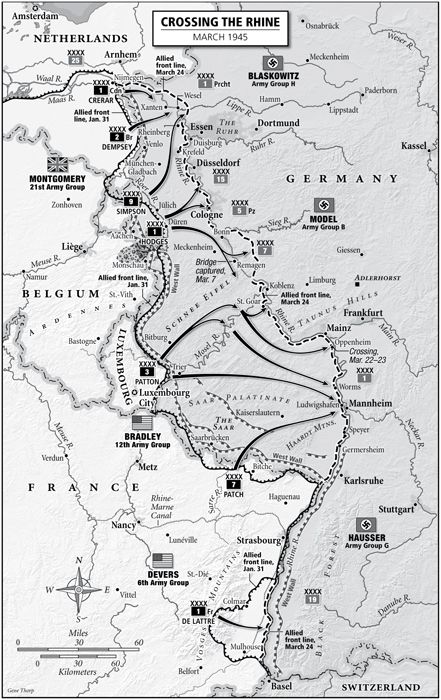
INTO the Rhineland they pounded, and across the Saar and down the Mosel, where violets and myrtle had begun to bloom and the first early buds stippled the fruit trees. Engineers corduroyed cart tracks through smitten glades, and filled roadside ditches with bricks and stone from granulated villages to fashion an extra lane for the endless convoys rolling east. “This is better than the other sort of war,” a British lieutenant reflected. “You feel you’re getting somewhere.”
German refugees trudged away from the beaten zone, lugging suitcases and favorite lamps and tablecloth peddler packs. Martial slogans could still be seen on the broken walls—“Führer befehl, wir folgen!” Führer, command us and we’ll follow!—but so could slatherings of despair, including “Hitler weg! Krieg weg!” Down with Hitler! Down with war! Churches posted “In Memoriam” notices for dead soldiers by the hundreds, the thousands, the tens of thousands. U.S. Army trucks trundled to the rear with coal-scuttle helmets as hood ornaments, each open bed packed with prisoners. “They stood facing the rear, their gray-green uniforms dirty,” wrote W. C. Heinz, “all of them rocking together with the motion of the trucks.” German women held up babies or tossed bread from their doorways as they studied the passing blur of faces in hopes of a recognition. “I am in the fodderland,” Audie Murphy would write to his family. “It is much different than the other countrys ive been in. The Houses are nicer and more modern but still arnt as good as ours.”
As two dozen British, Canadian, and American divisions in 21st Army Group closed on the Rhine in the north, Hodges’s First Army also made for the river between Cologne and Koblenz, with thirteen divisions in three corps abreast. “It is impossible not to be elated,” the headquarters diary noted on March 3. Farther south, twelve divisions in Patton’s Third Army overran the rubble that once was Bitburg, then pivoted through the Saar-Palatinate in tandem with fourteen divisions from Patch’s Seventh Army. Together, they would attack on a seventy-mile front along the flanks of the Haardt Mountains. Any town that spurned surrender demands from a “bullshit wagon”—a Sherman fitted with loudspeakers audible two miles away—was scourged with tank and howitzer shells until eventually a white flag or two popped up; the obstinate died. “On the road yesterday I could look ahead and see at least a dozen towns burning and fires sprouting out from various and sundry places all over the horizon,” Major General Alvan C. Gillem, Jr., commander of XIII Corps, wrote his wife in Georgia. Of 1,700 buildings in Jülich, 300 remained intact; of 9,322 in Düren, described by an engineer as “the most totally destroyed city I have ever seen,” 13 stood undamaged. Doors torn from their hinges were used to cover German bodies awaiting burial, and big paper sacks served as coffins for want of lumber.
“Everything smelled of death,” Iris Carpenter wrote after viewing another place reduced to slag. “Bulldozers scraped a road through the heart of the town which was little more than a smoldering rockery.” Allied fighter-bombers harried the fleeing enemy in what one pilot called a “rat hunt: You beat the ground. You flushed the vermin.” Artillery barrages ignited open-pit coal seams, Alan Moorehead noted, giving “a lovely play of light and gold flowing heat.” To his family in Virginia, a logistics officer wrote in early March, “The earth is certainly scorched.”
Nearer the Rhine, however, the swift bound of Allied armies captured intact a gemütlich land of bucolic farmsteads and bulging larders. “The cattle, so numerous, so well fed. Chickens and pigs and horses were running everywhere,” Moorehead wrote. “Every house seemed to have a good linen cupboard.” The reporter R. W. Thompson catalogued “fine stocks of ironmongery, metal goods, oil stoves, furniture, and mattresses. The paper in the deserted offices was of fine quality.” In a former candy factory, Martha Gellhorn found “vast stocks of sugar, chocolate, cocoa, butter, almonds,” as well as rooms chock-full of Dutch and French cheese, Portuguese sardines, Norwegian canned fish, and syrup by the barrel.
Here was a world of Dresden plates, pewter steins, and trophy antlers arranged just so on parlor walls, of Goethe and Schiller bound in calfskin, of boiled eggs in brine vats and the smell of roasting goose. Here was a world of damask tablecloths and silverware in handsome hutches, of Third Reich motherhood medals for stalwart childbearing, and French cosmetics looted from Paris or Lyon. Every house seemed to display a crucifix or Christian texts over the bedsteads; some flew Allied flags, or posted signs claiming that the occupants were Dutch or Belgian, and never mind that discolored patch of wallpaper where the Führer’s portrait had hung until the day before. “No one is a Nazi. No one ever was,” Gellhorn wrote. “It would sound better if it were set to music. Then the Germans could sing this refrain.”
Here too was a world to be looted. “We’re advancing as fast as the looting will permit,” a 29th Division unit in München-Gladbach reported. German towns were “processed,” houses “liberated” from attic to cellar, with everything from Leica cameras to accordions pilfered. A corps provost marshal complained of “gangsterism” by GIs who were “looting and bullying civilians”; some were caught exhuming a medieval grave in a hunt for jewels, while others ripped up floorboards or searched gardens with mine detectors. W. C. Heinz watched a soldier on a stolen bicycle with half a dozen women’s dresses draped over his arm carefully stow both bike and garments in a jeep trailer. Plundering MPs were known as the “Lootwaffe”: according to a soldier in the 45th Division, a “typical infantry squad involved two shooting and ten looting.” Moorehead described how “German cars by the hundred were dragged out of garages … painted khaki and driven away.” French troops hauled German motorcycles, typewriters, and Friesian cows back to Lorraine. British soldiers pillaged a hardware shop, carrying away screws, nails, and hinges simply from “a desire to do some unhindered shoplifting,” a Daily Telegraph reporter concluded.
That which escaped plunder often was vandalized in what one private called “the chaotic air of a drunken, end-of-the-world carnival.” A Canadian soldier recounted his own rampage through a Westphalian house:
First I took a hammer and smashed over 100 plates, and the cups along with them. Then I took an axe to the china cabinets and buffets. Next I smashed all the furniture.… I put a grenade in the big piano, and after I poured a jar of molasses into it. I broke all the French doors and all the doors with mirrors in them and threw the lamps into the street. I was so mad.
“I did not feel sorry for the Germans,” said Major Peter Carrington, a British officer. “After all they had proved enormously inconvenient.”
Allied commanders also found themselves struggling to enforce SHAEF’s “non-fraternization” edict, which forbid “mingling with Germans upon terms of friendliness, familiarity, or intimacy,” and specifically proscribed “the ogling of women and girls.” Violations incurred a $65 fine, so the pursuit of pretty German girls—dubbed “fraternazis” and “furleins”—was soon known as “the $65 question.” “Don’t play Samson to her Delilah,” an Armed Forces Network broadcast warned. “She’d like to cut your hair off—at the neck.” But “goin’ fratin’” became epidemic, often with cigarettes or chocolate as “frau bait.” “To frat” was a synonym for intercourse; non-fraternization was referred to as “non-fertilization.” GIs argued that “copulation without conversation is not fraternization,” and Patton advised, “Tell the men of Third Army that so long as they keep their helmets on they are not fraternizing.” Many a troop truck rolled through a Rhenish village with some leather-lunged soldier bellowing pathetically at young women on the sidewalk, “Bitte, schlafen mit.” Please sleep with me.
* * *
General Hodges ordered champagne served in his mess on Monday, March 5, to celebrate First Army’s imminent arrival on the Rhine. Toasts were raised “to an early crossing.” A day later VII Corps punched into Cologne, Germany’s fourth largest metropolis, that city of mystics and heretics, of Saint Ursula and eleven thousand virgins said to have been massacred by barbarians for their faith, the city where Karl Marx had edited the Rheinische Zeitung and where priests had once celebrated a thousand masses a day. Now, of 770,000 residents only 10,000 remained. Two dozen Bomber Command raids in the past three years left Cologne resembling “the open mouth of a charred corpse,” in the image of the poet Stephen Spender. Like other dead cities it had the same odd shapelessness that afflicted dead men, a loss of structure and contour as well as life.
Volkssturm pensioners fought from behind overturned trams, and enemy snipers darted through the rubble. Building by broken building, block by broken block, Sherman gunners systematically burned out upper floors with white phosphorus while GI infantrymen grenaded the cellars. A cavalry charge across Cologne’s airfield by 3rd Armored Division tanks smashed sixteen 88mm antiaircraft guns trying to form a skirmish line. The twin-spired thirteenth-century cathedral still stood, though wounded by bombs, shells, and incendiaries that had left the ceiling and stained glass in shards across the nave floor. Nazi flags could be found “dumped like scarlet garbage into the corners of alleys,” wrote the journalist Janet Flanner. “The destroyer of others is herself destroyed.”
Hodges on Wednesday, March 7, reported that Cologne had fallen. Yet so had the city’s link to the east bank of the Rhine: a twelve-hundred-foot segment of the Hohenzollern bridge had been blown into the river at noon the previous day. First Army’s hopes for an early crossing seemed ever more faint.
“The Rhine. I don’t know what I expected. Another Mississippi, I suppose,” an engineer sergeant told his diary. “The damn thing flows north.” Indeed it did. From Switzerland, where the river was fed by 150 glaciers, to the North Sea, the European father of waters formed an extraordinary moat against invasion from the west. Although it was only the world’s fifteenth-largest river in volume, ranking between the Euphrates and the Rhône, the Rhine was broad, deep, and fast enough that engineers compared any crossing to “a short sea voyage.” “At no place is the river fordable, even at low water,” the U.S. Army Corps of Engineers reported, and winter floods had been the highest in a quarter century, with currents in some stretches approaching eleven miles an hour. Most of the thirty-one Rhine bridges within Germany had been demolished by men with a rare aptitude for destruction. Thanks to the aerial bombardment of German factories, the river flowed relatively unpolluted for the first time in a generation, but so much wreckage clogged its bed that the Allies could not simply sail upstream from Nijmegen. A “top secret and private” note from Churchill’s office to Beetle Smith likened the difficulties faced by seven Allied armies in catapulting eighty divisions across the river to “another D-Day.”
Plans to jump the Rhine had been drafted even before the Normandy landings. Exhaustive studies examined bank, current, weather, and ice conditions, as well as Roman accounts of erecting a trestle bridge before the birth of Christ, and French records of nineteenth-century pile-driving near Strasbourg. Army engineers in Vicksburg, Mississippi, scrutinized historical hydrology data, aided by intelligence agents in Switzerland and daily gage readings intercepted in German radio broadcasts to river pilots. More than 170 models of the Rhine were built, and a hydraulics laboratory in Grenoble conducted elaborate experiments. A Rhine River Flood Prediction Service opened in January; mindful of the Roer debacle, diplomats pressed the Swiss to protect seven headwater dams with soldiers and artillery.
River-crossing schools on the Loire trained hundreds of outboard-motor operators, pile-driving specialists, and DUKW drivers. A steel mill in Luxembourg extruded 54,000 tons of massive I-beams for bridge building. Boatyards in Florida, Minnesota, and Michigan built hundreds of seventeen-foot plywood craft designed to carry a dozen riflemen and three engineers each; nested and crated in clusters of six, the vessels were whisked to Europe by cargo plane or fast ship. French boatwrights, shown a photograph of a storm boat in January, set to work using blueprints drawn by a naval architect. Trees were felled, plywood milled, and screws and nails fashioned from surplus wire; five weeks after placing the order, the U.S. Army picked up seven hundred boats. Seagoing landing craft, capable of carrying a Sherman tank or sixty men, sailed from England to Antwerp and up the Albert Canal before being hauled overland to the Rhineland on trailers so enormous that bulldozers led the convoys to knock down any building crimping the roadway. Other big craft for this “inland navy” were trucked three hundred miles from Le Havre; they arrived, a witness reported, “festooned with treetops, telephone wires, and bits of buildings from French villages.”
By early March, forward depots contained 1,100 assault boats, 124 landing craft, 2,500 outboard motors, 5 million board feet of lumber, 6,000 bridge floats, and enough steel and pilings to build more than 60 bridges. Everyone agreed, however, that it would be far simpler to capture one already built.
* * *
Just such a bridge still stood fifteen miles south of Bonn at Remagen, an ancient Roman town straddling a road built by Marcus Aurelius. Here the Rhine scoured a curving basalt gorge: to the north, Siegfried had slain his dragon at Drachenfels, bathing in the creature’s blood to become invulnerable; to the south, Julius Caesar built two spans over the river, in 55 and 53 B.C., during his Gallic campaigns. The current bridge had been completed in 1918 and named for General Erich Ludendorff, the progenitor of the final, fatal German offensives on the Western Front in the Great War. More than a thousand feet long and wide enough for two trains to pass abeam, the span featured symmetrical arches resting on four stone piers, with embrasured stone towers at either end. Wooden planks could be laid on the rail tracks to permit motor traffic. On the east bank, the tracks vanished into the Dwarf’s Hole, a tunnel bored through the steep six-hundred-foot hill called the Erpeler Ley. Local aesthetes complained that the bridge marred the dramatic riverscape; they complained more when it drew repeated Allied air attacks, including a January raid that killed three dozen civilians.
Retreating German soldiers had tramped across the Ludendorff in late 1918, and now retreating German soldiers were tramping over it once again, mingling with refugees, livestock, and an occasional hospital train carrying broken boys. A teenage antiaircraft gunner described a snaking procession making for the bridge through Remagen’s jammed streets on Wednesday morning, March 7, “with cannons being pulled by horses, by motor vehicles, and yes, even by soldiers.” Fewer than a thousand defenders remained in the area; most were Volkssturm militia of doubtful martial value, and all fell under a confused, fractured command architecture. Field Marshal Model had promised reinforcements, but none had arrived.
Sixty zinc-lined boxes for explosives had been fitted to the bridge in 1938, linked by cables through heavy conduits to an electrical firing switch inside the rail tunnel. The premature blowing of a bridge near Cologne—apparently triggered by an American bomb—had led to a Führer order that explosive charges would be emplaced only when the enemy was within five miles of a bridge, and igniters were to be withheld until “demolition seems to be unavoidable.” On Wednesday morning, sketchy reports put U.S. Army outriders near the western bluffs above Remagen. Explosives were laid, but Army Group B described the Americans as a thin screening force to mask an Allied thrust toward Bonn and Cologne. Little urgency obtained.
Their enemy was nearer than they knew. On the previous night, March 6, the U.S. III Corps commander, Major General John Millikin, had phoned Major General John W. Leonard, commander of the 9th Armored Division. “Do you see that little black strip of a bridge at Remagen?” Millikin asked as both men squinted at their maps. “If you happen to get that, your name will go down in glory.”
At 8:20 A.M. on this gray, misty Wednesday, a tank-and-infantry task force left Meckenheim, ten miles from the river. Leading the column in the advance guard was Lieutenant Karl H. Timmermann, who had commanded Company A of the 27th Armored Infantry Battalion for less than twenty-four hours. Timmermann had been born not far to the southeast, in Frankfurt; his doughboy father had taken a German war bride in 1919 before moving back to Nebraska. In a note scribbled in a Meckenheim cellar, the weary young officer told his wife:
There is no glory in war. Maybe those who have never been in battle find [a] certain glory and glamour that doesn’t exist.… Tell mom that we’ll be on the Rhine tomorrow.
Now Lieutenant Timmermann would prove himself wrong: for a brief, vivid moment glory would be his. Summoned by two waving scouts shortly before one P.M., he hurried forward in his jeep to find a hazy, panoramic view of the Rhine gorge below. “Jesus, look at that,” a sergeant muttered. “Do you know what the hell river that is?” Through field glasses Timmermann watched cows, horses, soldiers, trucks, and civilians cross beneath the bridge arches in a lumbering parade. Just below, white flags and bedsheets flapped from Remagen windowsills. Two locomotives with steam up stood on the far bank.
As three platoons descended through the town, leapfrogging from doorway to doorway, Timmermann bounded past the handsome St. Apollinaris Church and a sign that read, “Citizens and Friends: Preserve Our Parks.” A spatter of German musketry provoked booming return fire from a platoon of new M-26 Pershing tanks, each brandishing a 90mm gun. Tearful Germans pointed to cellars where Volkssturm stragglers crouched in terror. A captured enemy general in an elaborately braided uniform proved upon interrogation to be a railroad station agent.
Shortly before two P.M. a dark geyser of earth and paving stones abruptly blossomed above the western ramp; the blast left a smoking hole thirty feet wide, intended to keep American tanks from gaining the bridge. Heckling gunfire erupted from the Ludendorff towers. Bullets pinged and sparked among the girders. GIs fixed bayonets before darting past the last houses above the river. “I’ll see you on the other side,” the 27th Armored Infantry commander told Timmermann, “and we’ll all have a chicken dinner.… Move on.” Timmermann raked the far bank with his glasses. Tiny figures loped along the shoreline and into the tunnel. “They look like they want to get us on the bridge before they blow it up,” he said.
Barely half a mile away, pandemonium swept the eastern shore. Civilians and shrieking children cowered in the Dwarf’s Hole as billowing smoke from white-phosphorus shells drifted down the tunnel. German soldiers ran this way and that along the bridge ramp, including several engulfed in orange flame from American tank shells chewing up the riverbank and smacking the Erpeler Ley. Three junior officers argued over whether the demolition order should be put in writing. Shouts of “Blow the bridge!” carried across the water, and at length a captain shouted, “Everybody lie down! Open your mouths to protect your eardrums.” He turned the key on the firing switch.
Nothing happened. He turned it again, and again, without effect. A German sergeant sprinted ninety yards onto the bridge, lighted the primer cord by hand, and pelted back to the tunnel, chased by bullets.
With a doleful boom the timber planks rose from the railbed like jackstraws. Dust and black smoke boiled from the piers. The Ludendorff seemed to levitate momentarily as if expending a great sigh, then settled back onto its stone foundations, insulted but intact.
No one would ever be certain why fourteen hundred pounds of explosives failed to detonate properly: faulty charges, faulty blasting caps, perhaps a tank shell that severed the main demolition cable, perhaps, as some averred, a miracle.
Reprieved, Lieutenant Timmermann and his men raced onto the bridge, slashing wires and pitching charges into the water. Four Pershing tanks and a dozen Shermans arrayed on the west bank hammered the eastern tower until riflemen could clear out a German machine-gun nest. Sergeant Alex Drabik of Toledo reached the far bank first, in a zigzagging, stumbling sprint that cost him his helmet. Eight others followed on his heels, including Timmermann.
By late afternoon, Company A had 120 men across. A platoon began to scale the Erpeler Ley, dodging stones rolled down the slope by a flak battery holding the crest. After a single warning shot, five German engineers surrendered in the Dwarf’s Hole; GIs blew apart the master demolition switch with a carbine. A 90mm tank round from across the river smashed through a German locomotive tugging a long string of boxcars, and the train halted with a sharp lurch, a white plume of steam sighing from the firebox. GIs crouched in a ditch as a passenger train from the north pulled into the tiny Erpel station; middle-aged soldiers with rifles spilled onto the platform only to be greeted with mispronounced shouts of “Hände hoch.” A single German guard at the eastern exit of the rail tunnel also was seized, and twenty minutes later two hundred others emerged under a white flag to march in their long leather coats, hands high, across the bridge they had neither saved nor destroyed. Before surrendering, Captain Willi Bratge, the Remagen commandant, told a subordinate to deliver a message to the German high command. “Inform them that the demolition of the bridge was unsuccessful,” Bratge said, “and that the Americans have crossed.”
Night fell, a sodden, moonless night, “dark as a pocket,” as one officer recorded, so dark that engineers felt for the street curbs in Remagen with their feet. Bulldozers slowly filled the crater on the western ramp and three artillery battalions unlimbered. Soldiers ripped lumber from German houses to patch the rail planks. Exhausted drivers napped at their wheels as great knots of convoy traffic converged at the bridge, awaiting orders to cross. By ten P.M. three depleted rifle companies occupied the far shore, thwarting a counterattack by a hundred German engineers and antiaircraft crewmen who were repulsed near the Erpeler Ley while carrying half a ton of explosives.
At last nine Shermans—narrower than the Pershings—crept across at midnight, guided by foot soldiers wearing luminous buttons on their belts. German tracer fire searched the span, usually a few feet too high. “Ominous and nerve-wracking creaking” rose from the bridge, a captain reported, all the more ominous when the tenth vehicle to cross, a tank destroyer, skidded to the right near one of the eastern piers and plunged partway through a hole in the deck. For several hours—“the most harrowing minutes of my life,” one officer acknowledged—the vehicle remained stuck, blocking all traffic. Engineers debated pushing it over the side, or jacking it up, or winching it out, or blowing it to pieces. Just as dawn peeked above the Erpeler Ley, the damnable thing was muscled out and towed away. The desperate effort to deepen the bridgehead resumed apace, through what a Wehrmacht general now called “the inner door to Germany.”
* * *
Ancient, stately Reims, known by the undignified Allied code name BASSINET, had been home to SHAEF’s forward headquarters since mid-February. The city was renowned both for enthroning more than two dozen French kings, beginning with the fifth-century conversion to Christianity of Clovis the Frank, and for champagne, fermented in chalky warrens that ran for miles underground. Allied staff officers often held blind tastings at day’s end, sipping from one bottle after another to debate the merits of Krug and Taittinger and Moët & Chandon.
Eisenhower messed in the borrowed house of a Heidsieck Monopole champagne baron, not far from the Cathédrale Notre-Dame, and on March 7 he had invited several airborne commanders to supper, among them Ridgway, Gavin, and Maxwell Taylor. He had just complained about the soup when a whispering aide summoned him to the telephone for a call from Bradley. Harry Butcher could hear the supreme commander’s booming voice:
Brad, that’s wonderful. Sure, get right on across with everything you’ve got. It’s the best break we’ve had.… To hell with the planners. Sure, go on, Brad.… We’ll make good use of it even if the terrain isn’t too good.
Returning to the dining room with a jubilant grin on his face, Eisenhower ordered champagne for the table. “That was Brad,” he said. “He’s got a bridge across the Rhine. And he apologized for it, said it was badly located at Remagen.”
They drank to the bridge, and to the valiant lads who had seized it. Yet before long the supreme commander would realize that this remote site created almost as many problems as it solved. “Nobody ever would have selected that bridge,” General Millikin conceded. Poor roads and rugged terrain; a sclerotic bottleneck at Remagen; the shift of Allied legions to bolster Montgomery’s planned crossing ninety miles north—such exigencies made exploitation harder than simply flinging First Army over the Ludendorff, or the Ludy, as it was soon called.
For the moment, Eisenhower would commit five divisions across the Rhine, with orders to gain the autobahn seven miles beyond the river. By Thursday evening, March 8, eight thousand GIs occupied a bridgehead two miles wide and a mile deep. Mindful of the German frogmen who had destroyed the Nijmegen rail bridge, engineers strung three protective booms upstream, including one with a steel net dangling ten feet below the river surface. Searchlights swept the water from dusk until dawn, cavalrymen fired at suspicious flotsam, and boat crews dropped depth charges every five minutes, detonating seven tons of explosives each night.
As engineers toiled to strengthen the fragile Ludy, the first ferry crossed the Rhine at dawn on Friday, soon joined by two more hauling gasoline and ammunition. Construction crews also began work on a floating treadway bridge a few hundred yards downstream. Power boats bullied each new segment through the river, to be appended to the growing span with four-foot spikes hammered home by “suicide squads” braving German mortar and artillery barrages. A particularly vicious shelling demolished nineteen floats in ten minutes, killing or wounding seventeen engineers. Among them was Private First Class Marion Priester, age twenty, who tried to close a wicked chest wound with his hands before announcing, “Boys, I’ve had it.” As a comrade reported, “He died before he hit the ground.” Yet by five o’clock on Sunday afternoon, thirty-two hours after work had begun, the first jeep crossed the thousand-foot bridge. A second span was finished a few hours later. By Monday, three infantry divisions and part of an armored combat command held a bridgehead fourteen miles wide and four miles deep.
* * *
Loss of the Ludendorff was an unalloyed disaster for the German high command. In an order decrypted by Ultra, Rundstedt demanded that both bridge and bridgehead “be immediately destroyed with lasting effect.” Model directed the 11th Panzer Division to lead a counterattack from Düsseldorf, a fantasy given the profound shortages of fuel and munitions. Still, more than a hundred guns soon battered the bridgehead, a round every two minutes, among them three shells that hit the Ludy on March 9, punching another fifteen-foot hole in the deck and setting an ammunition truck on fire. Joining the cannonade was the “Karl” mortar, a 600mm behemoth that weighed 137 tons and fired a 2-ton projectile with little accuracy and less effect, although one enemy shell was said to have hit a Remagen bank, filling the street with fluttering Reichsmark notes.
Hermann Göring sought volunteers to fly suicide missions into the bridge, a proposal also intercepted by Allied eavesdroppers even before it was rejected as impractical by German commanders. Nearly four hundred Luftwaffe sorties were flown over Remagen, including missions by jet planes and antiquated Stuka dive-bombers; all could just as well have been deliberately suicidal. The marauders soon encountered twenty-five barrage balloons and nearly seven hundred antiaircraft guns—the Army’s densest concentration of World War II—under orders to shoot anything with wings. Each approaching enemy plane was said by one officer to “cost the American taxpayer a million dollars in antiaircraft ammunition,” and gunners would claim more than a hundred aircraft shot down. The intense fire inflicted two hundred friendly casualties on the ground, mostly welts and bruises from the spent .50-caliber slugs that fell like hard rain. On Hitler’s command, V-2 launch sites in Holland also fired eleven rockets at the bridge, the only tactical use of the weapon during the war. None struck home; the single near miss killed three GIs and a barnyard full of livestock several hundred yards from the river.
The debacle at Remagen clearly called for recrimination and reprisal, and the Führer wasted no time. Rundstedt, who had already infuriated Hitler by ridiculing the Westwall as a “mousetrap,” was relieved of command for the second time in nine months. Given another bauble to pin to his uniform and a curt “I thank you for your loyalty” from the Führer, Rundstedt once again repaired to Bad Tölz to take the cure for his rheumatism. “No one,” his chief of staff wrote, “can jump over his own shadow.” He was succeeded on March 10 as the OB West commander by Field Marshal Albert Kesselring, who for the past two and a half years had been the Allies’ arch-nemesis in North Africa, Sicily, and Italy.
Harsher fates befell four junior officers deemed to have bungled the Ludendorff demolition. A drumhead court-martial tried, convicted, and condemned them within thirty minutes. Denied clergy and stripped of rank insignia, each was shot in the back of the neck and buried in a shallow grave. The letters they had been permitted to write their families were then burned.
* * *
Such rough justice was said to create a “bridge psychosis” throughout the German ranks: officers devoted colossal tonnages of TNT to blowing bridges and culverts across the shrinking Reich. But neither Kesselring nor a kangaroo court could stem the American flood tide at Remagen.
Among those crossing the Rhine on March 12 was the 5th Platoon of Company K of the 394th Infantry Regiment. Singular only because they were black, these GI riflemen were among fifty-three platoons of “colored” infantry mustered from volunteers to help remedy manpower shortages after the Bulge. Many had surrendered sergeant’s stripes earned as cooks, drivers, and laborers in black service battalions for the privilege of fighting as privates. “Hitler was the one that got us out of the white folks’ kitchen,” one black observer later said.
“Get it moving,” yelled a first sergeant in the 394th. “You ain’t in the quartermaster no more. You’re in the Army now.” They of course had already been in the Army, among 900,000 African-Americans to serve in olive drab, but now they were partially integrated as black platoons under white officers within white companies, scattered through eleven divisions. Despite the creditable records of two black divisions in Italy and the Pacific, and of black artillery and tank battalions before and during the Bulge, resistance to integrating combat regiments ran deep. “A colored soldier cannot think fast enough to fight in armor,” Patton told his diary, and some argued that teaching black riflemen to shoot white Germans would lead to the shooting of white Americans at home. “We were going to make liars out of the whites,” a black soldier later said. Another wrote, “I am an American negro, doing my part for the American government to make the world safe for a democracy I have never known.” For many white combat soldiers in Germany, the simple truth was voiced by an artillery forward observer in the 394th Infantry: “We were short-handed and they were welcome.”
Repairs on the Ludendorff continued for nine days even as tactical bridges carried most of the traffic across the Rhine. Between air raids and enemy shellings, two hundred welders, riggers, ironworkers, and carpenters swarmed over the structure, patching chords, stringers, and holes in the deck. Measurements showed the Ludy settling a bit on the upstream side, to the south, but engineers believed the structure had been stabilized.
It had not. Just before three P.M. on Saturday, March 17, a rivet sheared away with a sharp pop! Others followed, as if musketry swept the girders. A vertical hanger snapped. Dust billowed from the quaking deck. Timbers splintered and the squeal of steel on steel echoed against the Erpeler Ley. “Men on the deck dropped their tools and started to run,” an engineer colonel later testified. Many found themselves sprinting uphill as the center span twisted counterclockwise and buckled. Then the entire bridge seemed to fold in on itself, “gracefully, like an old slow-motion movie,” before pitching into the Rhine with a white splash.
Of those who rode the Ludy down, twenty-eight died and another sixty-three were injured. A major’s body found atop the east pier was recognizable only by his oak-leaf rank insignia; others vanished into the Rhine forever. Scaffolding and deck timbers threatened to ram through the treadways downstream until engineers with axes and poles pushed the debris away while boatmen fished survivors from the river. Precisely why the bridge collapsed would remain uncertain. Weakened by earlier Allied bombing and the botched demolition, the span had since been assaulted by hard winds, heavy traffic, welding, incessant hammering, V-2s, artillery, and the vibration of a thousand shells fired from an Army 8-inch howitzer battery less than a mile away. “Most of us,” an engineer told his diary, “are glad the damned thing is gone.”
Late Saturday night, seven German frogmen who had trained in a Vienna swimming pool slipped into the Rhine with orders to destroy the tactical bridges using plastic explosives. None got close before being captured, killed, or forced to shore by exhaustion, gunfire, and blinding searchlights. Within a week, eight Army bridges would span the Rhine near Remagen, feeding a bridgehead now twenty-five miles wide and eight miles deep. The Frankfurt autobahn, finally severed on March 16, would serve as a trunk road into the Fatherland’s central precincts.
On Monday, March 19, Eisenhower approved shoving nine First Army divisions across the Rhine in anticipation of forming a common front with Third Army once Patton jumped the river below Koblenz. “The war is over, I tell you,” Hodges repeatedly proclaimed in Spa. “The war is over.” The war was not over, nor would giddy repetition make it so. But the inner door to Germany had swung wide, never to be shut again.