
1. General
In German doctrine the object of the defense (Verteidigung, or Abwehr) is to halt the hostile attack, or to gain time pending development of a more favorable situation for resumption of the offensive. Thus German and U.S. doctrine are essentially the same: only the offensive leads to decisive successes.
In the last two years German defensive operations have become increasingly passive in nature. The Germans formerly placed the greatest stress on immediate and violent counterattacks as effective means of destroying the attacking enemy. This required great mobility and large reserves. At present more emphasis is placed on the construction of defensive positions, and counterattacks are frequently local in character. It is most likely that this passive type of defense is only an expedient due to German shortages of mobile equipment and manpower.
2. Organization for Defense
a. GENERAL.
The Germans attempt to break a hostile attack in front of the main line of resistance (Hauptkampflinie), at the forward limit of the battle position (Hauptkampffeld), or to force the enemy to abandon his attack.
As in U.S. practice, the commander usually determines from the map the main battlefield and assigns a general line as guide for the location of the main line of resistance, to ensure continuity of the defensive position. Lower echelon commanders fix the main line of resistance on the ground, since only on the terrain, after thorough reconnaissance, can the details of the defense be decided. A recent official German directive states, however, that reconnaissance must not delay the construction of defensive positions.
Organization of the defensive position follows a conventional pattern and includes an advanced position (Vorgeschobene Stellung), and an outpost position (Gefechtsvorposten), both of which usually are under immediate command of the area commander. A reserve position may also be provided.
The width and depth of a German defense area depend upon the terrain and the proportional strength of friendly and hostile forces. In general, however, the width of a defensive sector assigned to a unit is Approximately twice the width of the sector when the same unit attacks. Normal sectors are: platoon, 220 to 550 yards; company, 440 to 1,100 yards; battalion, 880 to 2,200 yards; regiment, 2,200 to 3,300 yards; division, 6,600 to 11,000 yards.
b. ADVANCED POSITION.
The Germans organize the advanced position 5,000 to 7,000 yards in front of the main line of resistance, within the range of their medium artillery. A position is selected which will prevent seizure by the enemy of important terrain features, provide good observation points for friendly artillery, and, if possible, deceive the enemy as to the location of the main line of resistance. Troops manning these positions attempt to make the enemy deploy his forces prematurely and, if possible, in the wrong direction.
The forces in the advanced position are usually reconnaissance detachments, which include machine-gun, armored-car, and antitank-gun units, the fire power and mobility of which make them suitable for this type of employment. In general they occupy important features, such as railroads, river crossings, cross-roads, and commanding ground. Forces in advanced positions are not expected to hold at all cost; in the face of superior enemy fire they retire along predetermined routes under over of their medium artillery.
c. OUTPOST POSITIONS.
Outpost positions normally are established 2,000 to 5,000 yards in front of the main line of resistance. When the fronts are stabilized, the outpost position is the only position forward of the main line of resistance. The location, which depends upon the terrain, is always within range of friendly light artillery.
German outpost positions are occupied in strength varying from platoons to companies, depending upon the mission, terrain, width of the sector, and the number of troops available. Often they are only weakly occupied as long as the advanced positions are in front of them. Ordinarily outposts are established by infantry units drawn from the main battle position, supported by the fire of close-support weapons, such as mortars and infantry guns.
Antitank guns often are attached to these outpost units to repel hostile armored reconnaissance units. The main weapon, however, is the light machine gun which opens fire at ranges of about 1,300 yards, while riflemen commence fire at about 850 yards.
Firing positions are selected by the Germans to facilitate unobserved withdrawal of the outposts to the main battle position when hostile pressure becomes too strong. Several alternate positions are prepared for each weapon, and shifts are made by day and night to make it difficult for the opponent to detect and dislodge the outpost troops. Positions normally are selected at the edges of woods, villages, hedgerows, or hills. A good field of fire is considered mandatory, and the organization of firing positions is simple. Numerous dummy positions are constructed, including knee-deep trenches filled with leaves to simulate depth and occupancy. During the day, positions are manned by guards; at night, advanced listening posts, particularly alert at dusk and dawn, warn the troops of the enemy's approach. Small, prepared attacks with limited objectives under the protection of the outposts are utilized to interfere with the hostile preparations and secure information.
Withdrawal of the outposts is conducted so as not to hinder the fire of the main battle position. After the outposts are abandoned, they are likely to be covered by carefully registered fire of heavy weapons in order to prevent their occupation by the enemy.
d. MAIN LINE OF RESISTANCE.
The Germans organize their battle position in depth, with individual strongpoints connected to form an uninterrupted belt. The strongpoints, constructed for all-around defense, and surrounded by barbed-wire obstacles and mine belts, contain one or more heavy weapons supplemented by machine guns, mortars, and riflemen. The smallest strong-point is occupied by a reinforced squad. Squad strongpoints normally are incorporated into platoon strongpoints, and the latter into company strongpoints, etc.
The Germans make the maximum use of reverse slopes in their defensive positions. Forward-slope positions are usually avoided as they are detected too early by the enemy and are likely to be destroyed by massed fire. Since organization of a position in woods requires much time and labor, and strong occupation is requisite to compensate for poor observation, the Germans also avoid woods when time is short and labor scarce. Battle positions are laid out so that woods are neither in, nor directly in front or in rear of, defense installations. The Germans believe, however, that when it is possible to establish a well prepared position in a woods, a position so located offers the same advantages as a reverse slope.
When the Germans decide to construct defensive positions on terrain divided by a stream, they organize bridgeheads on the bank on the hostile side where the terrain facilitates crossings. Where the river forms a re-entrant bend into enemy-held terrain, a second position is constructed at the base of the bend. On narrow rivers and creeks, the entire German main line of resistance is on the hostile side of the river, and the stream becomes the tank obstacle of the position. (See antimechanized defense.) When the friendly side of the river consists of swampland, it is used as an obstacle, and the hostile bank is not included in the defense system.

Figure 11.—Typical layout of a reinforced battalion strongpoint.

Figure 12.—Typical layout of a reinforced squad strongpoint.
The Germans endeavor to provide all parts of their position with strong support from artillery and heavy infantry weapons. A detailed fire plan is prepared in advance by the infantry and coordinated with the artillery plan. Provision is made for fire in front of the forward limit of the battle position, which is partly protected by minefields and other obstacles. Alternate positions are dug so that support weapons may be shifted and fired rapidly. The mass of the artillery lays concentrated fire both close to and well in front of the main line of resistance, and is sited to cover the spaces between the effective fire zones of front-line units.
The Germans in general adhere to the principle of "effect before cover" in determining priorities for constructing the various installations in a defense position. first they build combat trenches; erect infantry obstacles such as barbed-wire fences; and construct machine-gun positions, dugouts, foxholes, and antitank positions. They clear fields of fire by careful cutting of underbrush but try to avoid cutting down trees in order to preserve concealment of the position. The underbrush is left in front of the position as far as 1 to 3 yards. They organize observation posts for artillery and heavy infantry weapons, increase the depth of the battle position, dig communication trenches and emplacements for the heavy infantry weapons, and build command posts. Finally, they construct emplacements for the artillery, dig antitank ditches within the battle position, and build dummy positions.
The Germans insist on thorough camouflage. Whenever practicable, trenches and wire obstacles are placed along natural terrain lines such as rows of brush or edges of fields. Trenches are dug zig-zag at obtuse angles, 330 to 660 yards long, depending on the terrain. Machine-guns are emplaced in trenches 1 to 3 yards in length. To avoid silhouettes, the Germans heap more earth behind the trenches than in front. Dugouts for riflemen and for machine-gun positions normally provide sufficient protection against enemy artillery and mortar fire. Whenever possible, three layers of logs and earth are used as cover.
e. RESERVE POSITION.
Occasionally a reserve position is organized and troops in the main battle position retire to it, but only under heavy pressure. This reserve position is constructed far enough to the rear to compel hostile artillery to displace forward in order to bring it under fire. Motorized reserve units normally are kept there for counterattacks which are planned in advance.
f. ANTIMECHANIZED DEFENSE.
In constructing a defensive position the Germans stress construction of obstacles and antitank defenses. If possible they select tank-proof terrain, and natural tank obstacles, such as steep slopes, are improved. Very steep forward slopes are made at least 8 yards deep, while uphill slopes are made 2 to 3 yards high. Originally the Germans constructed antitank ditches well forward of the main line of resistance, but experience taught them that such ditches offered favorable jumping-off positions for hostile infantry and also revealed the location of the main line of resistance. At the present time, therefore, antitank ditches normally are dug in the area between the main line of resistance and the artillery positions. They are built in an uninterrupted line to avoid leaving passages that can be exploited by the enemy.

Figure 13.—German company in a defensive position.
All crossings essential to assure the maneuverability of friendly troops are built so that they can be blown up on the shortest notice.
The Germans are aware that obstacles of any kind are effective only when covered by fire from various weapons. Consequently, there usually are trenches behind the antitank ditches from which machine-gun and antitank-gun fire can cover the entire length of the tank obstacle.
The Germans learned that dense minefields in front of their positions were an inadequate tank obstacle, because the enemy usually neutralized them by massed artillery fire or by concentrated air bombardment before launching a large-scale attack. Now German minefields normally are laid within the main battle position, and only single mines are dispersed in pattern at wide intervals in front of the main line of resistance. Particular stress is placed on the mining of roads. Routes of withdrawal which have to be left open are prepared for mining, and, if time does not permit placing of actual mines, dummy mines are installed.
The Germans employ many kinds of tank obstacles. They recently have used static flame throwers dug into the ground. Usually sited in pairs and in conjunction with other tank obstacles, they are fired by well concealed personnel as soon as hostile tanks come within range.
German antitank guns are disposed in depth, with some well forward. They often are dug in and carefully concealed to prevent the enemy from discovering the location and strength of the antitank defenses prior to attack. In emplacing antitank guns, the Germans prefer positions in enfilade or on reverse slopes. They normally employ two to three antitank guns in each position, protecting them from infantry attacks with light machine guns. Ranges at which the Germans open fire upon hostile tanks vary according to the caliber of the gun and its position. Although single antitank guns sometimes engage enemy tanks at ranges up to 1,000 yards, main antitank defenses usually hold their fire until the range is reduced to about 150 to 300 yards. The employment of close-combat antitank teams supplements the antitank defense. When the hostile tank attack is repulsed, the antitank guns move to alternate positions.
The Germans emphasize that the use of smoke can be of great assistance in defeating enemy tank attacks. Smoke shells are fired into the attacking formation about one-third the distance back from the leading echelon. Thus the Germans avoid blinding their own antitank gunners, and leading hostile tanks not only are left without adequate support but are silhouetted against the smoke. The Germans also rely on the smoke being sucked into the tanks and forcing the crews to dismount.
3. Conduct of the Defense
German defense of a position, whether hastily prepared or complete in all details, is conducted on the same principles. Unless they are compelled by manpower and materiel shortages to rely on the strength of their positions, the Germans prefer heavy concentrations of fire and powerful, coordinated counterattacks by mobile reserves of all arms. They apply the principle of selecting a point of main effort (Schwerpunkt) to the defense as well as to the attack. This principle necessarily is applied in reverse order in the defensive, the main effort being made opposite the point where the enemy is making his main attack.
German artillery attempts to disrupt a hostile attack before it reaches the defensive positions. The Germans state that it is invaluable to install observation posts simultaneously in the main line of resistance, in the advanced position, and in the immediate vicinity of the gun position. Thus they try to keep a hostile force constantly under observation and fire even when it achieves a penetration. The artillery regiment commander controls the fire as long as possible, although requests for artillery barrages may be made by unit commanders as low as platoon leaders. Capabilities of German heavy mortars, which like all other support weapons usually are sited on reverse slopes, are exploited, with a present trend toward mortar-fire concentration.
When a part of the battle position is lost, the area is taken under artillery fire to annihilate enemy forces which have penetrated it. The Germans normally organize reserve units, even when only relatively few troops are available. Immediate local counterthrusts by infantry elements and support weapons near the penetration endeavor to hurl back the enemy before he has an opportunity to establish himself. These small counterthrusts, which normally closely follow the artillery fire, preferably are directed at the flanks of the penetrations.
When the enemy succeeds in making a large penetration or breakthrough, the German higher echelon commander decides whether a general counterattack should be launched to restore the position or whether the main battle position should be reestablished farther to the rear. The counterattack is directed against the hostile flank, where possible, and is prepared thoroughly. Assembly area, time, objective, zone, artillery support, and employment of tanks, self-propelled artillery, assault guns, and air units are controlled by one commander.
German antiaircraft defense, which is unable to give adequate protection everywhere because of Allied air supremacy, is concentrated at important points. The main mission of the light and medium antiaircraft artillery is the protection of roads. Accuracy of Allied air reconnaissance compels the German antiaircraft artillery to change positions from day to day, the changeover being made during the night. The Germans also enforce a preliminary two-hour fire silence in the new position to try to trap enemy fighter-bombers. Searchlights often are placed parallel to a protected road to prevent enemy aircraft from illuminating the road by flares. This is particularly important since the Germans normally bring forward their relief troops, rations, and ammunition during the night.
4. Defense of Towns
The Germans regard towns and villages as excellent strongpoints, particularly if the buildings are of masonry. Towns also are regarded as excellent antitank positions because of the considerable infantry-artillery effort necessary to neutralize them.
In defending a town or village, the Germans locate their main line of resistance well within the built-up portion; the edges of the town, which provide easy targets for artillery fire, are believed to be too vulnerable. The main line of resistance is laid out irregularly in order to develop flanking fire, and every effort is made to conceal its location until the last possible moment. Minor strongpoints are maintained forward of the line in order to break up attacks and provide additional flanking fire. Cul-de-sacs are organized and attempts made to trap attacking forces in them for destruction by counterattacking mobile reserves. These reserves are kept in readiness within the town itself, but other reserve forces are held outside the town to prevent hostile flanking maneuvers.

Figure 14.—Strongpoint manned by an infantry battalion.
Both occupied and unoccupied buildings are booby-trapped in organizing the defended positions. Entrances to buildings are blocked, and all windows opened so as not to disclose those from which fire is maintained. Rooms are darkened, and passages are cut in the walls between buildings. To avoid detection, the Germans fire from the middle of the rooms, and frequently change their positions, while communication is maintained through cellars and over roofs. Machine guns are sited low, usually in basements, to provide better grazing fire. Chimneys and cornices are used as cover for men on roofs; tiles may be removed to provide loopholes. Searchlights are mounted to illuminate fields of fire; in their absence vehicle headlights may be used as substitutes. When houses collapse, the defense is carried on from cellars, and rubble heaps of destroyed areas are organized into strongpoints.
Tanks are considered to be ineffective within a defended town, although the Germans have used them in static, dug-in positions at crossroads and squares. As a result of their experiences on the Eastern Front, the Germans believe single tanks are too vulnerable to Molotov cocktails, magnetic mines, and explosive charges. When the Germans themselves use these antitank weapons, they employ them from foxholes dug outside the perimeter of the town. Efforts are made to destroy enemy tanks immobilized by antitank action, either within or outside the town, in order to prevent their recovery or use as artillery observation posts and machine-gun nests. Antipersonnel mines are interspersed in antitank minefields because the attacking infantry are considered the chief menace.
Assault guns may provide direct defensive support fire if attacking forces break through and disorganize the German position. To secure the added protection afforded by masonry walls, the Germans may locate assault guns or tanks within buildings and use them against hostile armored vehicles and infantry. Counterattacks, supported by assault guns or tanks, will not be withheld until the situation has become desperate; indeed, surprise counterattacks may be launched at any time.
For the defense of village strongpoints special battle commandants (Kampfkommandanten) are appointed. The battle commandant is usually the senior officer and the tactical commander of all military forces, emergency units, and civil organizations in his area. He has the disciplinary power of a regimental commander.
In the case of fairly small villages, consolidation of the place itself is usually deemed sufficient. For larger localities an outer defense system is constructed in addition to the inner defenses.
The inner defense system consists of a number of concentric positions which are broken down into perimeter positions, intermediate positions, and the inner ring position. The inner defense system is divided into sectors, each forming a strongpoint system in itself, with the strongpoints protected by all-around antitank and infantry obstacles and connected with each other by trenches.
The perimeter ring position is the most important part of the inner defenses and consists of one or more continuous trench systems, each with a deep main battle zone. The forward edge often is beyond the outskirts of the village, unless this creates unfavorable conditions for the antitank defense, in which case it is within the village itself. Artillery and heavy support weapons are employed as whole units in support of the perimeter ring position, although single guns may be detached for the defense of strongpoints and roads. The nearer the fighting approaches the inner ring, the more likely it will be that the Germans will split up the support weapons units for close cooperation with infantry assault groups.
The outer defense system likewise consists of a number of concentric positions, Approximately 4 to 6 miles apart, so as to force the enemy artillery to displace to engage each one. For defense of larger towns the Germans organize the outside ring about 12 1/2 to 18 1/2 miles beyond the outskirts whenever feasible. Beyond this outside defense ring, about 2,200 yards forward, are the advanced positions, with covering units still further forward on main roads and railways.
Patrols of all types, including motorized and cyclist patrols, give early warning of the enemy's approach and keep him under continuous observation. Non-military outposts, such as police sentries, party officials, and local farmers also are used for these duties.
Sector boundaries for companies and battalions are defined from the outside defense ring to the center of the town or village. Usually they do not coincide with vital main roads, which always are defended by entire companies or battalions. Every strongpoint, defense block (combined adjacent buildings), and sector has local reserves; mobile reserves, consisting of combat groups comprised of infantry, tanks, assault and self-propelled guns, are employed for counterattacks of a larger scale.
In addition to regular military units the Germans employ emergency units, organized from personnel of Army, Navy, and Air Force in town defense. Besides these regularly organized emergency units, improvised emergency units are formed from stragglers, remnants of formations, and units in process of reorganization. Utilization of emergency units is only temporary. Their main tasks, of local nature, are protection of headquarters, supply points, airfields, etc., and garrison service in fortifications.
5. Doctrine of Westwall System
The Germans consider economy of force the fundamental principle in planning zones of permanent fortifications. They originally built the Westwall as a protective barrier along the French frontier to permit commitment of maximum forces offensively in the East. Thus, in 1939, they were able to hold in the West with Approximately 20 divisions, while employing 40 to 50 divisions against Poland.
When Westwall construction ceased in 1940, German strategy in the West was offensive, envisioning an invasion of France by a wide envelopment, with the bulk of the German forces in the North, where the Westwall defenses were relatively weak. The pivot of maneuver was south of the Moselle River, where the Westwall defenses were strongest.
The Germans never have discarded the principle that offensive action is the best protection. When their armies were forced back to the Westwall in 1944, they used this defensive system as a base for offensive operations in selected areas, as in the Saar and the Eifel. Advantage also was taken of this protected zone for the free lateral movement of troops; shelters were utilized for the cover and concealment of reserve forces, weapons, and supplies.
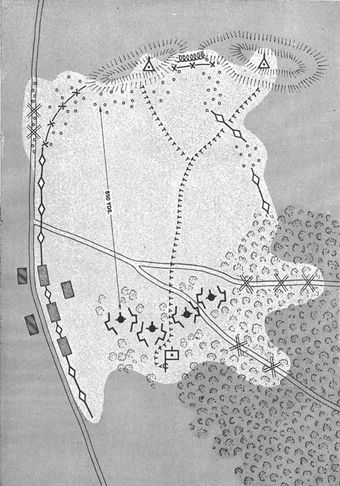
Figure 15.—Antitank defense of an artillery battery firing position.
German Westwall tactics are based on a stubborn defense of individual fortifications, local counterattacks against areas of penetration, and counterattack by general mobile reserves against areas of deep penetration. German troops are not permitted to develop a static-defense complex which might foster the idea that a position once surrounded is lost. Bunker garrisons are taught to continue resistance even though surrounded, because their perseverance impedes the attackers' advance and facilitates counterattacks. Troops are trained in the principle that the decision usually is achieved by the infantry in the open between bunkers. Organic heavy infantry weapons and artillery are the backbone of German defense in the Westwall, just as in mobile warfare. Reserves habitually are left under cover until the time for counterattack arrives.
Surprise is always attempted. For example, bunkers and heavy weapons frequently are sited on reverse slopes, not only for concealment and protection in defilade, but also to open fire suddenly upon the unwary attacker crossing the crest or moving around the nose of a hill. The attacker penetrating the Westwall defense system must be prepared to cope with unexpected resistance flaring up in his rear areas, surprise by accurate flanking and enfilade fire at short and medium ranges, sudden counterattacks by forces not known to be in the areas, and counterattacks in increasing strength as the penetration progresses.
German doctrine prescribes that the intact portion of the defenses must continue the battle, regardless of the situation at the penetrated area, until the appropriate command orders a readjustment of the line. Penetrations normally are dealt with as follows: by mobile reserves which seal them off frontally; by counterattack or counteroffensive from protected flanks to threaten the rear areas of the penetrating force; or by both, as in the Aachen area. At any rate, the Germans will attempt to destroy the penetration before the attacker has reorganized and consolidated his gains. Here again the principle of economy of force is generally followed. German troops may be taken from strongly protected and little threatened areas in order to concentrate on adequate counterattacking or counteroffensive force. Hence the attacker should have sufficient strength to ward off strong countermeasures and at the same time exploit the advantages gained by a penetration.
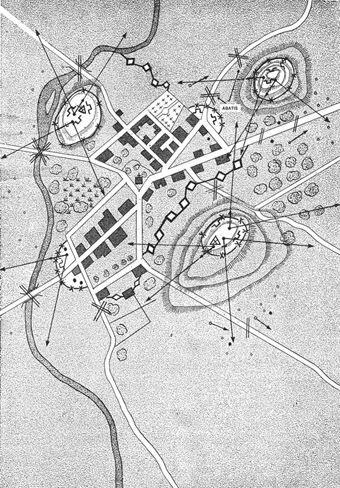
Figure 16.—Defense of a community.