Strike—til the last armed foe expires.
Fitz-greene Halleck
Marco Bozzaris
By late January 1945 the Fast Carrier Force had grown to 12 CVs and 6 CVLs. These 18 flattops embarked the staggering total of 1,365 aircraft, of which nearly three-quarters were fighters. The fleet defense problem, as far as the mere number of fighters, was solved.
The large carrier air groups averaged 102 aircraft, the light carriers 27. Hellcats still represented over 80 percent of the total fighter force with 820 in all, but 174 Corsairs were spread among the Essex, Wasp, Bennington, and Bunker Hill air groups. In fact, Air Group 84 aboard the latter embarked 71 F4U-lDs and only six Hellcats, all photo planes.
The reliable old F6F-3 was almost gone now. Only 63 remained with the force, scattered among eight squadrons where -5s were unavailable in sufficient number. Four of these were CVL units but the largest -3 contingent was VF (N) -90’s sixteen F6F-3Es.
The fighter emphasis on some ships was astonishing. The Wasp’s Air Group 81 boasted 127 fighters with 91 Hellcats and 36 Corsairs. As a result there was no dive bomber squadron, but 15 Avengers were retained. Five other CVs operated at least 70 Hellcats, and, combined with F4Us, eight of the ten CV day air groups each had 70-plus fighters. The two exceptions were the Hancock’s Air Group 7 with 64 Hellcats and the Bennington’s Air Group 82 with 33 Hellcats and 36 Marine Corsairs.
Sharply contrasting with this wealth of aircraft was the depleted Air Group 22 aboard the Cowpens. Fighting 22 had only nine F6Fs on hand at this time, and VF-29 aboard the Cabot retained 16. The other three CVL fighter outfits all had two dozen F6Fs.
An administrative change had occurred earlier in the month which bore directly upon CV fighter squadrons. With an average complement of 71 F6Fs and 105 to 110 pilots, it was decided to divide the enlarged fighter squadrons into two equal parts. Thus was created the fighterbomber squadron, designated VBF. On those ships that operated all F6Fs (or later, all F4Us), it was no problem for both squadrons to fly the same aircraft interchangeably since maintenance could be performed on a share-and-share-alike basis.
For air groups at sea, the decision whether or not to make the VF-VBF split was in some cases discretionary. Since the current executive officer would automatically take over the fighter-bomber outfit, that individual stood to gain from a professional viewpoint. But not all units split up. The Hornet’s VF-11, for instance, was very near the end of its tour and decided to stick together. The Wasp’s VF-81, with 91 Hellcats, had been in combat since November and also remained intact, making it the largest single squadron in the force.
But air groups on the West Coast or staging west from Hawaii divided their fighter squadrons as a matter of routine. One of the first such to reach the fleet was Air Group 12, destined for the brand-new Randolph (CV-15). The CAG was an old hand around the Pacific—Commander Charlie Crommelin, who had somehow flown his riddled Hellcat back to the Yorktown over a year before and had landed aboard literally half-blind. Fighting 12 had been reorganized under another veteran fighter pilot, Commander Noel A. M. Gayler, who would shortly depart for staff duty with Vice Admiral McCain. When Fighting 12 was split in half, VBF-12 came under the direction of dark, good-looking Lieutenant Commander Ed Pawka.
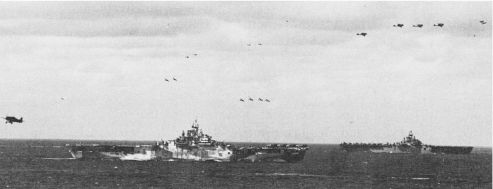
Hellcats break into four-plane divisions prior to landing aboard two Essex-class carriers before the first strikes against Tokyo in February 1945.
Air Group 12 was representative of a not entirely successful experiment conducted during late 1944. The old Air Group 9 had been divided, with about half the fighter pilots transferring to form the VF nucleus of Air Group 12. It was theorized that five-man fighter teams could be “grown” from the ground up, trained as a unit, and sent to the task force to fit into any squadron with a minimum degree of adjustment and indoctrination.
By itself, it was probably a valid concept. But in implementing the experiment, another factor became evident. There were numerous Naval Academy graduates with high flight time as instructors in the U.S. who rightfully considered themselves eligible for combat assignments. Therefore, many of the five-man divisions were organized around the Annapolis men, with a combat-experienced pilot assigned as the second section leader. Three young “nuggets” filled out the division, taking turns to put four planes in the air.
An unforeseen problem that occasionally occurred was one of morale. The setup tended to push all three factions into cliques. The Annapolis graduates gravitated towards one another, the pilots with previous combat towards each other, and the youngsters frequently kept to themselves. The team concept suffered accordingly. Furthermore, some section leaders with combat in their logbooks were disappointed at not having a division of their own, but the Academy men had seniority.
No one called this combat team organization a failure. It was merely argued that within some squadrons the structure added an unnecessary complication. For it came at a time when the fast carriers were experiencing undreamed-of expansion and technological advances.
For the fighter pilots, the most outstanding piece of new equipment was the gyro-stabilized, lead-computing gunsight. First available in the fall of 1944, it appeared in the task force in early 1945. The Mark 21 sight automatically showed a pilot the correct deflection when tracking a hostile aircraft and was deadly accurate. The problem was that some squadrons had too little time to practice with the new gadget before entering combat. Ed Pawka’s pilots in VBF-12 would choose to leave their lead-computing sights locked in “pegged range” through most of the forthcoming tour. This in effect made a standard reflector sight which was fully adequate for a fighter pilot used to shooting by “Kentucky windage.”
On the evening of 15 February, sixteen fast carriers ran northwest through heavy seas. Again under the command of Vice Admiral Mitscher, they were once more known as Task Force 58, deployed in four day task groups and one night group.
Seven of the air groups were embarking upon their first combat operation, and two others were beginning new tours. One of the latter was Lieutenant Commander D. A. Clark’s VF-30 on the light carrier Belleau Wood in TG-58.1. Operating off the Monterey from November 1943 to March 1944, Fighting 30 had claimed 50 victories. This new tour would more than double that figure.
In TG-58.2 another veteran air group was returning to combat. Fighting Nine aboard the Lexington was still led by Lieutenant Commander Herb Houck, and the former fighter skipper, Commander Phil Torrey, remained CAG. Though the VF-9 of 1943–44 had been split to help form VF-12, many of the original F6F pilots remained. One was Lieutenant Gene Valencia, who had bagged seven planes during his first tour. Now it was almost exactly a year to the day since his last combat and the frantic tail-chase near Truk. But Valencia had used the interim well.
While the air group re-formed at NAS Pasco, Washington, Valencia found three enthusiastic “jaygees” to round out his division: Joseph H. Roquemore, his wingman; James B. French, his second section leader, and Clinton L. Smith as number four. Intensely devoted to the art of flying fighters in combat, Valencia worked his pilots relentlessly. As French recalled, “We were at Pasco for about six months, and most pilots averaged 70 to 80 hours a month. But Gene flew us over 100 hours a month.” This was more than was authorized, so Valencia needed extra fuel. Legend has it that he and his pilots “misappropriated” extra fuel, but Jim French denies it. “That implies we stole the gas,” he says. “Actually, we sort of traded for it. We just slipped the service crews a few bottles of booze, and they filled up our airplanes for us.”1

The most successful fighter division in the U.S. Navy was led by Lieutenant E. A. Valencia (left) with Lieutenants (jg) C. L. Smith, H. E. Mitchell, and J. B. French. These four VF-9 pilots accounted for 50 Japanese aircraft without loss or damage to themselves.
En route to Hawaii, Valencia’s wingman Joe Roquemore died of pneumonia. After trying out several others, Valencia decided to make a young VBF-9 pilot his new number two. Lieutenant (jg) Harris E. Mitchell was a 21-year-old West Texas farmboy with a slow, deliberate drawl and a smile-when-you-say-that directness. He admitted to a certain degree of envy in watching the antics of Valencia’s team at Pasco, and quickly fitted in during training in Hawaii.
Valencia not only worked his pilots hard; he developed a strong esprit de corps. He wanted to paint purple lightning bolts on his Hellcats, but since regulations forbade such markings, his division adopted flamboyant decorations for their flying helmets. Jim French had the ace of spades on his helmet, for instance. Intense, mercurial, and often short-tempered, Valencia nevertheless had a certain flair.
Once the flight line was secured, his division sipped champagne or mint julips from frosted glasses while other pilots indulged in more regulation refreshment. Gene Valencia seldom endeared himself to his superiors, but his pilots knew they would be ready the day they entered combat.
That day was less than 24 hours away on the evening of 15 February. Mitscher informed his task force that the next morning’s target was Tokyo—the first carrier strike on the enemy home islands since Mitscher himself had sent the Doolittle Raiders on their way from the old Hornet three years before.
With so many new air groups in the task force, and the enlarged fighter and fighter-bomber squadrons, the first Japan strikes would be the initial combat exposure for a large portion of Mitscher’s aviators. But he confidently predicted the greatest air victory of the war for carrier aviation, and told his young pilots that the individual Japanese was “probably more afraid of you than you are of him.”2
Nevertheless, a good many pilots felt just as Harris Mitchell aboard the Lexington did, “The adrenalin, you might say, flowed very freely that night.”3
The first fighter sweep was launched before daylight into a 20-knot northeast wind under low clouds and limited visibility. It was 125 miles to the target airfields around Tokyo, but landfall was made halfway en route as the Hellcats and Corsairs groped their way along. The ceiling was low enough—4,000 feet—but broken clouds extended down to only 1,000 feet. Some of the Hellcat pilots wore long-John underwear, something they never imagined they would need in the Pacific, because numerous F6F-5s had been delivered without cockpit heaters.
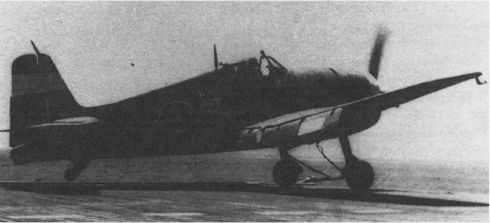
British Hellcat I of 804 Squadron aboard the HMS Ameer in the Indian Ocean early in 1945.
The Lexington’s sweep, led by the VF-9 skipper, Herb Houck, crossed the Honshu coast flying through rain and snow squalls. The TG-58.2 sweeps were the only ones to meet sizable opposition, operating over the Chiba Peninsula on the east side of Tokyo Bay. About 100 Japanese aircraft were sighted there, and in a series of dogfights Hellcats claimed over 40 kills.
Most of this combat was conducted by Hancock fighters from Lieutenant Commander Albert O. Vorse’s Air Group 80. Vorse was one of the genuine veterans of the Pacific war. He had flown F4Fs from the old Lexington, the Saratoga, and the Enterprise through nearly all of 1942. But VF-80’s first sweep was led by the fighter skipper, Lieutenant Commander Leroy W. Keith. Nearing the coast, the ceiling raised to 7,500 feet, and Keith sighted a lone Zeke five to six miles off. The CO bent his throttle to catch up, hauled into gun range, and dropped the Zeke burning into the choppy sea. The Hancock Hellcats then proceeded to their primary target, Katori airfield, where they strafed and rocketed parked airplanes and facilities. Hampered only by light to moderate flak, the F6Fs started fires in the hangars on the west side of the field, then pulled off the target just as antiaircraft fire increased.
As Keith pulled up, he met an Oscar head-on and shot it down. Japanese aircraft then dropped in “from all directions and all altitudes,” for the next hour and, noted the squadron diarist, “they were given a bad time.”4
Indeed they were. Leroy Keith shot down three more planes—a Nate, another Zeke, and a Val—for a total of five. His wingman, Ensign F. F. Ackerman, dropped a Nate which seemed to stop in midair to get on Keith’s tail, plus a Zeke and two Vals. Meanwhile, in the strung-out battle fought between 1,000 and 4,000 feet, Keith’s second division leader, Lieutenant William C. Edwards, Jr., knocked down two Nates, two Zekes, and an Oscar by exploiting a consistent altitude advantage. Making only fast, steep gunnery passes, the F6Fs nullified the superior maneuverability of the Japanese aircraft.
Keith’s disappointed third division accounted for only one of the 24 kills and 5 probables scored in this fracas. One pilot had engine trouble which prevented him from leaving the task force, and another’s guns jammed in the bitter cold.
Back aboard ship the pilots tallied their scores and told their friends of the lousy weather, the crowded airfields, and the excellent hunting. Herb Houck rushed through VF-9’s ready room en route to the bridge, shedding flight gear as he went. A pilot called after him, “How’d it go, skipper?” As Houck disappeared through a hatch he called over his shoulder, “There are Zeroes all over the place.”5

A broken arresting wire allowed this F6F-5 to collide with the island of the escort carrier Sangamon in early 1945. Despite spraying gasoline from a ruptured fuel cell, Lieutenant (jg) W. G. Bailey emerged from the wreck unharmed.
It remained that way for the rest of the day. The Lexington and Hancock F6Fs saw much of the subsequent action, and the second VF-9 sweep-strike included Gene Valencia’s division which followed Phil Torrey up into a 200-foot ceiling on the way to Emba airfield 40 miles north of Tokyo. Torrey’s 16 Hellcats climbed on instruments almost all the way to the coast, then broke out at nearly 20,000 feet.
The CAG took three divisions down towards Emba while Valencia remained above as top cover. Then Valencia’s keen eyes spotted something in his rearview mirror and he called out a bogey at six o’clock high. In a hard climbing turn, he left Harris Mitchell behind momentarily and pressed a head-on attack on a Tojo. Still out of effective gun range Gene fired four of his rockets, all of which fell short. Mitchell, back in position, did likewise. Then Valencia disappeared from view to starboard. Mitchell turned up his gunsight rheostat and continued head-on at the Tojo. His first tracers hit the bandit’s cowling, the engine caught fire, and as Mitch pulled up he saw the enemy pilot bail out.
The division re-formed and for the next hour hunted Japanese planes in the air and on the ground. Valencia shot down two more and French and Smith got three between them, in addition to burning several planes parked on various airfields. Valencia’s “flying circus” came away from its first combat with six confirmed kills and no damage to the four F6Fs.
But as Mitchell recalled, “Our return to the ship was with mixed emotions. Phil Torrey and two other pilots were missing.”6 Torrey, the wisecracking, popular leader, had been hit by a Tojo. His Hellcat climbed and dived out of control, then disappeared when his wingman stalled and lost contact. Fighting Nine claimed 25 victories against the day’s three losses.
Meanwhile, the Hancock fighters found more combat. Lieutenant Pat Fleming took nine planes of VBF-80 to Mobara airfield and bombed its five hangars, three hits being observed. Fleming then spotted several Zekes high over the field and climbed up beneath to take them by surprise. He burned two almost immediately and chased down another pair, exploding both at an altitude of 50 feet. Another Zeke was hit from astern, and though Fleming’s Navy Cross citation credited him with five kills in this engagement, in fact the fifth Zeke was claimed as a probable.
Fleming’s section leader, Ensign E. W. Parrish, low-sided a formation at 10,000 feet and exploded a Zeke and an Oscar with one burst each. He then dispatched two more Zekes in head-on passes. Lieutenant “Zeke” Cormier, a future Blue Angel leader, lived up to his nickname with three Zeros destroyed and a probable Oscar. Two other pilots were credited with three more Zekes and a Tojo. Thus, five VBF-80 pilots had accounted for 15 kills and two probables; the only damage suffered was a 7.7-mm bullet which shattered Parrish’s windscreen.
Lieutenant Commander Vorse led 14 VF-80 Hellcats on this same sweep and nearly matched the fighter-bombers’ bag. Some 25 to 30 bandits were found in disorganized small groups or singles and were picked off with relative ease; the Japanese displayed little aggressiveness. The 30-year-old Vorse was credited with five and one-half victories in 1942, from the early Rabaul raid through Coral Sea and Guadalcanal. But he nearly equalled his previous total when he shot two Oscars out of a formation of three, then added a Nate and a Dinah “which was fat and dumb but soon unhappy.”7 Lieutenant John W. Fair was next best, with an Oscar and a Tojo by himself, plus a Zeke and a Dinah shared with his wingmen.
Farther west, the fifth fighter sweep was the first to actually reach Tokyo. Task Group 58.2 launched Essex and Bunker Hill fighters, which found good weather. The Hellcats of VF-4 and Corsairs of VF-84 were the first carrier-based fighters over the Japanese capital, but they met little airborne opposition.
Nearly 250 kills were recorded during the 16th, of which the Hellcats claimed over three-quarters. But losses had been heavy. The Wasp’s VF-81 alone lost five planes and pilots in dogfights with Zekes. Fighting 82 had an equally rugged combat initiation. Four Bennington F6Fs were shot down near Atsugi Airfield by enemy aircraft. And one of the squadron’s most popular pilots, Ensign Paul K. Spradling of Buhl, Idaho, was killed by American AA fire. While attempting a water landing, he was fired upon by a destroyer of TG-58.1 which mistook his Hellcat for a hostile plane.
The weather remained a formidable enemy. On the 16th, the Randolph’s VBF-12 lost three pilots in mid-air collisions or weather-related accidents, including the exec, Lieutenant B. P. Seaman.
On the 17th, ceilings were down to 150 or 200 feet over the task force, and many scheduled CAPs were not even launched. Lieutenant Rube Denoff, a two-tour VF-9 veteran, was standing by with his VBF-12 division when bogeys were reported approaching the task group. Cloud tops were reported at 4,000 to 5,000 feet, so Denoff led his three pilots off “Randy’s” flight deck and climbed in close formation. But there was no clearing at 6,000 feet, and still none at 15,000. Denoff and his pilots had their hands full, fastening oxygen masks while flying their planes and watching their instruments, all the while staying tucked in close formation.

The Randolph aircraft prepare to launch under rainy skies in May 1945. Thirty-five F6Fs and eight TBMs are visible in this photo. Photo: R. M. Hill
They climbed for another 7,000 feet before breaking out on top, 20 miles from the ship. “How we stayed together I don’t know,” Denoff recalled.8 Vectored towards the unidentified aircraft, Denoff recognized them as a flight of Corsairs and asked if they required assistance. They had neglected to turn on their IFF gear, but once informed of the situation they declined the offer of help. So Denoff led his division back down into the murk, feeling his way towards the water. He regained visual contact at about 100 feet in greatly reduced visibility—only a half to three-quarters of a mile. All four Hellcats got back safely aboard, but to Rube Denoff this flight was “the only wartime experience that still gives me nightmares.”9
Similar conditions existed over the target area that morning. Fighting Nine launched four divisions which flew just off the whitecaps all the way to the coast. Approaching the beach, a pilot called “Tally ho. Land two o’clock at five miles.” Another responded, “Wonder what it is?” A third voice piped in, “It sure as hell ain’t Frisco.”10
The sweep leader was Herb Houck, who succeeded Phil Torrey as CAG-9, while Lieutenant John S. Kitchen assumed command of VF-9. Houck decided to try to climb up through the cloud layer as it was obvious that low-level navigation in reduced visibility was an unacceptable risk. It was snowing in the clouds, and visibility was reduced to zero. When the Hellcats reached 20,000 with no end in sight one pilot asked, “How high are we going, skipper?” Houck replied, “Looks like I can see the sun—we’ll probably top out at about 25,000.” Another squadron overheard this transmission and responded, “No you won’t. I’m at 35,000 and haven’t broken out yet.”11 Houck took his formation up to 25 grand just to be sure, but it was no use. He led his troops back to the task force.
Before Mitscher canceled further operations, a few sweep-strikes got through to their targets. Another 70 bandits fell to Hellcats and Corsairs, for a two-day total of nearly 320 fighter victories and 190 planes destroyed on the ground. Pat Fleming of VBF-80 repeated his previous day’s performance by downing four more enemy fighters, raising his final score to 18. It was the highest personal tally in the task force at the time.
Carrier plane losses for both days amounted to 60 in combat, but some pilots were saved. One was Ensign R. L. Buchanan of VF-29. While escorting a strike against the Tachikawa Engine Plant, the Cabot Hellcats fought “a pitched battle over an airfield”12 and claimed five kills and two probables. Buchanan, who had shot down five planes in one mission four months before, had to ditch near the mouth of Tokyo Bay.
Lieutenant A. J. Fecke and his wingman contacted the lifeguard submarine Pomfret 30 miles away, and established “a very lonesome air cover for both pilot and submarine for over an hour.”13 Despite the dangers of possible minefields, the extremely shallow water near shore, and a dozen Japanese airfields only 50 miles away, the Pomfret pressed on. Her gutsy skipper, Commander John Hess, scooped up Buchanan and a Hornet pilot of Air Group 17 in one of the most daring “zoomie” rescues of the war. Properly appreciative, VF-29 allowed as how the Pomfret’s rescue would make Hollywood blush with envy.
By noon the strike planes were back aboard and the fast carriers steamed south to support the invasion of Iwo Jima.
And thus began the final six months of hostilities.
The month of March was an eventful one for the fighters of Task Force 58; it led up to the invasion of Okinawa. The fireworks began on the evening of the 11th, three days before the task force was to depart Ulithi. Sixteen fast carriers riding at anchor made an inviting target, even blacked out, and 24 Japanese twin-engine aircraft were sent from Minami Jima, 800 miles to the north. Only two Frances bombers got to Ulithi, and one of them crashed on the atoll. But the other—perhaps accidentally—flew into the Randolph’s stern. Fire and explosions wracked the aft portion of her hangar deck, putting the ship out of action for almost a month, and nearly 30 men were killed. Air Group 12 would therefore miss the buildup to Operation Iceberg, the Okinawa invasion. But the CAG, Charlie Crommelin, ran true to form and got himself temporarily assigned to another carrier. He would perish in a mid-air collision on 28 March, three days before the invasion began.
Fighter sweeps were launched from 90 miles southeast of Kyushu early on 18 March, blanketing 45 enemy airfields. There were few planes on most fields, as they had been withdrawn north out of range, but Hornet’s VF-17 found considerable activity around Kanoya. The skipper was Lieutenant Commander Marshall U. Beebe, a 31-year-old Californian who had led the Wildcats of escort carrier Liscome Bay until she was sunk in the Gilberts. Now, 16 months later, Marsh Beebe still had seven of his original pilots with him.
Approaching Kanoya and Kanoya East, the 20 Hellcats tally-hoed single Zekes, which were handled by Lieutenant Thomas S. Harris and his wingman. Between them, they scored two kills, two probables, and three damaged. Beebe took six planes down on Kanoya, where enemy aircraft were moving, and kept his other two divisions high as top cover. In a series of quick passes Beebe’s Hellcats destroyed 15 planes on the ground, then were bounced by numerous Zekes, Franks, and Tonys. In the ensuing low-level hassle, Beebe dropped three Franks and two Zekes while one of his division leaders, Lieutenant Robert C. Coats, also made five kills, all Zekes. When airplanes quit falling, VF-17 had claimed 25 aerial victories and three probables without a loss.
Other Japanese aircraft were somewhat more successful. Conventional bombers and kamikazes made several attempts to hit the fast carriers, and TG-58.4 was the focal point. The Enterprise, Intrepid, and Yorktown all sustained minor damage.
Next day the Japanese came back. While carrier strikes were flown against enemy shipping, thereby reducing the number of CAP fighters over hostile airfields, Japanese bombers scored twice. About 0700 the Wasp, with Air Group 86 aboard, took a bomb which tore up her insides and left over 370 men dead or injured. Almost simultaneously another bomber hit the Franklin with two bombs, and the damage was appalling. “Big Ben” was turned into a ghastly floating oven as fires, explosions, and thick smoke almost obscured her from view. Though superhuman damage control eventually saved her, the Franklin and the re-formed Air Group Five were knocked out of the war. The ship’s company and air group lost a combined total of 1,100 killed and wounded.
On the afternoon of 21 March a brand-new suicide threat appeared. It was the rocket-powered Ohka, or “Cherry Blossom” aircraft. The Americans had known of these “baka bombs” since February, and though “baka” was the Japanese word for fool, the design was ingenuous. A small, lightweight single-seater with twin rudders, the Ohka Model 11 carried 2,600 pounds of TNT in its pointed nose and could do 400 mph. Its vulnerability lay in its mode of transport; it was fastened to the belly of a Mitsubishi G4M Betty which took it within range of its target.
Eighteen Ohka-carrying Bettys escorted by 30 Zekes were plotted by TG-58.1 that afternoon, distance 70 miles. Two Hornet divisions, one each from VF-17 and VBF-17, were scrambled, while VF-30 dispatched eight Hellcats from Belleau Wood. Fighting 30 took on the Zekes while the Hornet fighters went for the Bettys. It was over in 20 minutes.
The F6Fs made repeated runs—some as many as a dozen each—methodically picking off the lumbering, laden bombers. Lieutenant Henry E. Mitchell, Jr., of VBF-17 splashed four Bettys, then saw another scooting for home at zero feet. Mitchell buzzed over the top of the bomber, forcing the enemy pilot to nose down. The Betty skidded into the water. Lieutenant Murray Winfield claimed four Bettys, and the other Hornet pilots accounted for the remaining nine. One VBF-17 plane was shot down, the only Hellcat loss against 18 Bettys, their Ohkas, and a dozen Zekes.
Ten days later the invasion of Okinawa began.
Okinawa is only 350 miles from the southern tip of Kyushu, placing it well within range of Japan-based aircraft. With the fast carriers that were supporting the invasion tied to a 60-square-mile area off Okinawa, the Japanese had no trouble locating their prime targets. And Task Force 58 remained in this precarious situation for two months—from mid-March to mid-May.
It was probably the most trying period of the Pacific war. Under constant threat of massed suicide and conventional air attacks, the fliers and ships’ crews were worn down by the strain of operations—particularly the fighter pilots, whose responsibility was awesomely simple: shoot down the attackers before they could destroy the carrier decks.
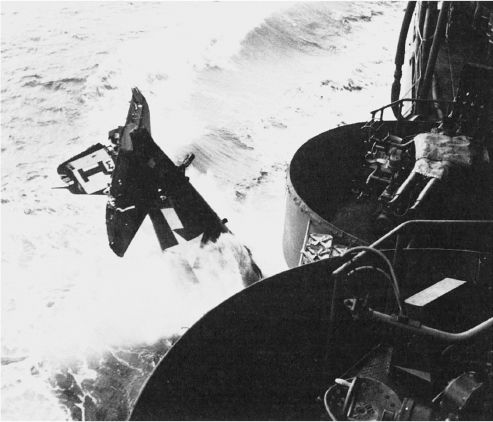
This shot-up Hellcat was jettisoned from the escort carrier Block Island in May 1945, being too heavily damaged to repair.
To provide better advance warning, 16 radar picket stations were established around Okinawa. They were plotted in reference to “Point Bolo,” the tip of land on Okinawa’s west coast known as Zampa Misaki. The picket stations averaged 52 nautical miles from Point Bolo, with RP-13 being the closest, only 18 miles offshore, and RP-8 the farthest, 95 miles southeast. Each station was usually patrolled by two destroyers, which had highly trained fighter-director teams on board, and was supported by utility vessels.
The Japanese flung their first massed attack at the invasion fleet on D-Plus-Five, April sixth. It involved nearly 700 aircraft, including 355 kamikazes. Three squadrons of TG-58.1 were credited with nearly 90 kills among them, as Hellcats met succeeding waves of attackers.
A series of large battles was fought over Okinawa and the invasion fleet that afternoon and evening. Sixteen Air Group 17 Hellcats met “a swarm of kamikaze-bent Japs”14 evidently headed for the landing beaches. The Hornet pilots barged in and gunned down 33 as other squadrons arrived on the scene. In this combat Lieutenant Willis E. Hardy was credited with a Zeke, two Judys, and a pair of Vals—the last with only one gun firing. Then later that afternoon, Marsh Beebe led two VF-17 divisions on CAP north of the force and bounced a formation of Val and Judy dive bombers, splashing eight. It brought the Hornet fighters’ one-day total to 41½.
Fighting 30 had things entirely its own way in what it called “Turkey Shoot Number Two.”15 Over the island, 14 F6F-5s under Lieutenant R. F. Gillespie almost immediately contacted several small enemy groups when taking station at 1530. In a two-hour running battle, formations and singles of Vals, Zekes, and a handful of Tojos and Oscars were met—about 60 bandits in all. The Hellcats found their opponents inexperienced, unaggressive, and poor marksmen. Every Belleau Wood pilot scored, and upon return to the ship, the only damage VF-30 had suffered was 16 holes in one plane, put there by a “friendly” F6F night fighter.
Belleau Wood’s 14 pilots accounted for 26½ Vals, 14 Zekes, 5 Tojos, and 2 Oscars. The top scorers were all ensigns, three of whom became “instant aces”; Carl C. Foster got six kills, Kenneth J. Dahms got five and one-half and Johnnie G. Miller bagged five. Michelle A. Mazzocco got three singles and three halves for a total of four and one-half, and three other ensigns each scored quadruples. The total of 47½ prompted Belleau Wood’s skipper, Captain W. G. Tomlinson, to query the task group commander, Rear Admiral Jocko Clark, “Does this exceed bag limit?” To which Clark replied, “Negative. . . . This is open season.”16
The hunters of VF-83 certainly thought so; the Essex Hellcats claimed 56 kills from dawn to late afternoon. Four night fighter sorties contributed nine of this record total for 6 April, but the daylight F6Fs dropped 47 in the course of two CAPs, an airfield strike, and a shipping search. The latter was a planned 300-mile mission to the northwest which included 15 Hellcats plus a dozen Corsairs of VBF-83, but few of the fighters got more than halfway outbound. The divisional search teams, flying ten-degree sectors, encountered widespread enemy planes and engaged 53 of them. Thirteen of the Hellcat pilots shot down 26 planes of six different varieties while losing one of their own and sustaining damage to eight more Grummans. The Corsairs added another half-dozen victories for a total of 32 on this mission.
An hour after the search-strike combats ended, a pair of Essex Hellcats on a special CAP near Yoro Shima sighted nine bomb-armed Zekes headed for the invasion force. The section leader, Lieutenant (jg) Hugh N. Batten, took advantage of the eight-tenth cloud cover and thick haze to approach undetected from astern. He and his wingman, Lieutenant (jg) Sam J. Brocato, dropped four Zekes between them before the others could take evasive action. In the brief dogfight that followed, the two F6Fs remained together even through violent aerobatics, splashing four more Zeros. Batten and Brocato had downed eight of the nine Zekes with barely 1,500 rounds of .50 caliber, all confirmed by gun-camera film or nearby witnesses.
In all, over 200 of the 350-odd victories claimed were credited to Mitscher’s Hellcats during this, by far the largest one-day air attack of the campaign. Though the Japanese lost half of their committed aircraft, they succeeded in hitting 19 ships. Thirteen were destroyers on radar picket patrol, a foretaste of the ordeal to come.
The tempo increased, even if the weight of air attacks did not. Nine more massed suicide attacks were mounted against the invasion fleet and the carriers: three more in April, four in May, and two in June, each numbering from 45 to 185 planes. But by and large, the Hellcat and Corsair CAP handled these “smaller” raids.
Besides protecting the fleet and supporting the troops ashore, the fast carriers also launched further strikes against Japan. The Hornet fighters had another big day on 16 April when they knocked down 45 hostiles in the course of three CAPs, three scrambles, and a sweep. Marsh Beebe’s pilots accounted for 31, including Lieutenant (jg) John Crosby, who got three Jacks, a Zeke, and a Val in an interception near the northern tip of Okinawa. The fighter-bombers dropped 14 more during the day, for a Hornet total of 45. Short, aggressive, Lieutenant John “Super Mouse” Johnston got four of the Zekes, doubling his previous score.
Next day Fighting Nine recorded another big success. Gene Valencia’s division was vectored by Yorktown’s FDO onto a bogey about 60 miles north of the task group. At first the radar plot looked small, and the other two VF-9 divisions were not assigned. But when Valencia’s sharp eyes detected the bandits, the situation changed rapidly. There were 38 bomb-carrying Zekes and Franks. While Lieutenant G. E. Phillips’s division was racing to the scene, Valencia took his “Circus” into the enemy formation at 15,000 feet.
Outnumbered 38 to 4, Harris Mitchell on Valencia’s wing recalled, “I discovered the true meaning of anxiety, but when I looked over at Gene his expression was that of a young child who had just spotted his favorite toy under the Christmas tree.”17 Valencia’s first burst exploded a Frank, and all the others jettisoned their bombs. Then the two Hellcat sections took turns attacking while one stayed high to provide cover. It was sound doctrine; Mitchell shot two Zekes off Valencia’s tail, and Gene got another Frank behind his number four, Clinton “Smitty” Smith.
The fight lasted 20 minutes, from 15,000 feet down to the deck, and ended as abruptly as it began. Valencia re-formed his division and circled the area, counting eight Japanese parachutes still in the air or on the water. The division accounted for 14 destroyed, three probables, and one damaged: six Franks for Valencia; three Zekes for Mitchell, four Zekes for Jim French, and a Frank for Clinton Smith. Phillips’s division arrived late and splashed a Frank, an Oscar, and a Zeke. The only damage sustained was a few 7.7-mm holes in the wing of one of Phillips’s Hellcats.
Though Japanese formations were flung at the invasion fleet in smaller numbers than before, they still came in infinite variety. On a “Barrier Cap” between Kyushu and Okinawa on 22 April, Lieutenant Rube Denoff, leading four VBF-12 divisions, saw about 50 mixed bandits at 16,000 to 18,000 feet. Before the hostiles pulled up into the overcast, Denoff caught a glimpse of an open-cockpit biplane among the fighters and dive bombers. Six or eight enemy planes then dropped out of the clouds and, though most were shot down, they gave the Randolph pilots a hard time. Denoff himself shot down a Jill, but Lieutenant (jg) Bob Drewelow’s four Hellcats were so badly shot up they had to land at Okinawa where three were declared unflyable.
Meanwhile, the battle of the radar pickets continued. On 4 May Valencia and company knocked down 11 more bandits in a two-hour low-level combat over the destroyers. But one “can” was hit during this battle when the Yorktown division was forced to disengage and land at Okinawa with fuel gauges reading empty. Three easy-meat Vals were passed up en route to Yontan airfield, such was the critical gas shortage, and Harris Mitchell had to be towed off the runway when his engine quit.
One week later the Circus fought its last battle. The divisions of Valencia, Lieutenant Marvin Franger, and Lieutenant Bert Eckard took on at least 55 enemy fighters over the northern Ryukyus. The three flights were vectored separately to orbit 20 to 30 miles apart. Valencia’s team fought 18 bandits in two groups, downing 9 without loss, although Valencia pressed his attacks so closely that his radio was jarred loose by an exploding Frank. It brought the Circus’s total to 43 kills during the deployment, one-third of the squadron total, including 34 in the last three combats. With Valencia’s previous tally of seven from the Essex cruise in 1943-44 it made a plump, comfortable 50 victories for no losses and only minor damage.
Bert Eckard and his wingman, Ensign J. Kaelin, tangled with 30 Zekes between 18,000 and 20,000 feet and harried them for 20 minutes. In that time the two VF-9 pilots hit 12 Zekes between them and definitely destroyed eight—five by Eckard and three by Kaelin. A Zeke and Frank splashed by the second section brought the division’s total to ten, and Eckard became the 42nd and last Hellcat pilot to score five victories in one day.
Marv Franger’s division saw only one hostile, a Tony which Franger quickly dispatched. It was his ninth and last victory of the war. And it had been a long war. Franger was undoubtedly the only fighter pilot to score on each of three successive tours with the same squadron. He had opened his string of victories by downing a Vichy French fighter while flying F4F-4s off the Ranger during the invasion of North Africa back in November of 1942. During the squadron’s Essex tour he bagged five Japanese planes, and in 1945 he added the last three.
A former VF-9 squadron mate had almost as good hunting. Lieutenant Harold E. Vita was one of those transferred to form VF-12 when Air Group Nine was divided in late 1944. Handsome enough to make the cover of Life, “Honest Hal” Vita had been credited with one victory over North Africa but failed to score during the 1943–44 tour. The third time out was his lucky charm, however; while flying from the Randolph with Fighting 12, he knocked down five Japanese planes.
During this same period, a small ceremony marked a big achievement. In May, VBF-87 received some new F6F-5s. One of them was the 10,000th Hellcat delivered since December of 1942. As the fighter had progressed down the assembly line at Bethpage, a bucket was hung on its tail. Grumman workers dropped spare change into the bucket as a contribution to the welfare fund of the squadron which would eventually receive the new fighter. A check for several hundred dollars was made out, marked for delivery to the appropriate unit.
When Commander Porter W. Maxwell landed the special F6F aboard the Ticonderoga, Grumman’s “tech rep” Ralph Clark was on hand to do the honors. Clark presented the check to Maxwell and VBF-87 on behalf of all Grumman employees. Hellcat production had peaked at 600 in March, but was holding steady at well over 400 per month. And the new fighter-bombers would soon be put to use, for Air Group 87 entered combat on 17 May.
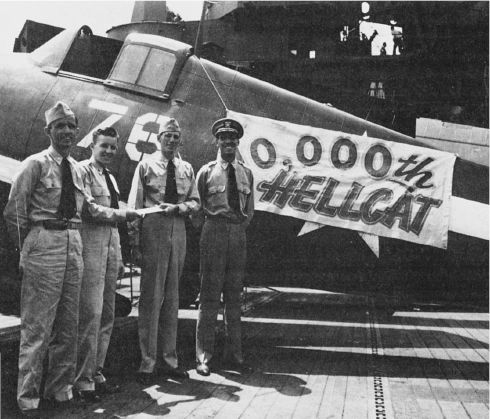
The 10,000th Hellcat, an F6F-5, was delivered to VBF-87 aboard the USS Ticonderoga in May of 1945. From left to right are: Lieutenant Commander Charles Ingalls; Grumman tech rep Ralph Clark; Commander Porter Maxwell, the CO of VBF-87; and Commander Everett L. Phadres, CAG-87. Photo: Grumman
The carrier phase of the Okinawa Campaign lasted almost till the end of June. By that time another CV had been knocked out—the veteran Bunker Hill took two kamikazes on 11 May—but McCain’s was “the fleet that came to stay.” Some 3,000 enemy aircraft had attacked the task force, and nearly 1,700 were believed shot down by F6Fs and F4Us. Despite the handicap of operating in a restricted area in the face of massed land-based air assault, the fighters provided sufficient defense. Nine CVs and a CVL had been hit by kamikazes or bombs, and though none was sunk, some, like the Franklin and Bunker Hill, would not fight again.
Pilot fatigue was such that the normal six-month tour was reduced to four months at this time. Some second- and third-tour pilots found themselves questioning the need to chase a lone Japanese plane inland, weighing the risk against the benefit. Many others shared the feelings confided by a double ace years later, “I wasn’t score happy, and I knew that one more kill wasn’t going to end the war any sooner.”
In defeating the kamikazes, three main factors were involved. One concerned the Japanese themselves. Lieutenant Commander Bill Leonard of McCain’s staff summed it up: “Instead of the classic formations making their brave approach, we would have singles coming in on us from all directions, from all altitudes. It would have been much more hairy save for the fact that many of the kamikaze boys were pitifully short on flight experience, and got lost or fouled up. The few that did get through were bad enough.”18
Secondly, there were the skilled, experienced fighter directors who were the key to handling suiciders, along with overlapping task group radar coverage. And finally, of course, there were the young men in Hellcat and Corsair cockpits. Their role in anti-kamikaze work was that of a high-priced CAP mission with a premium on good air and radio discipline, suspicion of every sighting, and reliance on sharp vision.
As the Okinawa Campaign began winding down, increasing attention was given to operations against the enemy home islands. Hellcats would finish the war over Japan itself.
Hellcat Squadrons in Combat: February to May 1945
|
VF-3 |
Yorktown |
Lieutenant Commander W. L. Lamberson |
|
VBF-3 |
Yorktown |
Lieutenant Commander F. E. Wolf |
|
VF-4 |
Essex |
Lieutenant L. M. Boykin |
|
VF-6 |
Hancock |
Lieutenant Commander R. L. Copeland |
|
VF-7 |
Hancock |
Lieutenant J. A. Duncan |
|
VF-9 |
Lexington, Yorktown |
Lieutenant Commander H. N. Houck, Lieutenant J. S. Kitchen |
|
VBF-9 |
Lexington, Yorktown |
Lieutenant Commander F. L. Lawlor |
|
VF-12 |
Randolph |
Commander N. A. M. Gayler |
|
VBF-12 |
Randolph |
Lieutenant Commander E. Pawka, Lieutenant R. H. Denoff |
|
VF-17 |
Hornet |
Lieutenant Commander M. U. Beebe |
|
VBF-17 |
Hornet |
Lieutenant Commander H. W. Nicholson (KIA), Lieutenant E. S. Conant |
|
VF-23 |
Langley |
Lieutenant Commander M. Paddock |
|
VF-29 |
Cabot |
Lieutenant Commander W. E. Eder |
|
VF-30 |
Belleau Wood |
Lieutenant Commander D. A. Clark |
|
VF-34 |
Monterey |
Lieutenant Commander R. W. Conrad |
|
VF-45 |
San Jacinto |
Commander G. E. Schechter |
|
VF-46 |
Cowpens, Independence |
Commander C. W. Rooney |
|
VF-47 |
Bataan |
Commander W. Etheridge |
|
VF-49 |
San Jacinto |
Lieutenant Commander G. M. Rouzee |
|
VF-53 |
Saratoga |
Lieutenant Commander R. W. Conrad |
|
VF-80 |
Hancock |
Lieutenant Commander L. R. Keith |
|
VBF-80 |
Hancock |
Lieutenant Commander F. G. Gooding |
|
VF-81 |
Wasp |
Commander F. K. Upham |
|
VF-82 |
Bennington |
Lieutenant Commander E. W. Hessel |
|
VF-83 |
Essex |
Commander J. J. Southerland |
|
VF-86 |
Wasp |
Lieutenant Commander C. J. Dobson |