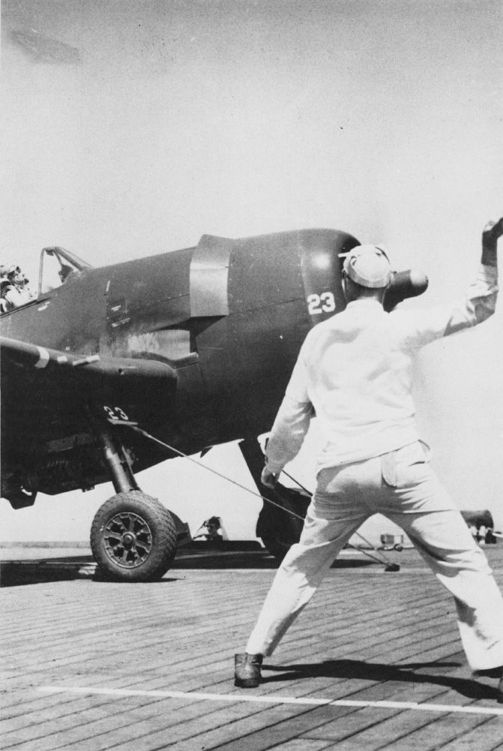
O suns and skies and clouds of June,
Helen Hunt Jackson
The 15 fast carriers of Task Force 58 brought some 475 Hellcats to the Marianas in the second week of June 1944. Another 66 F6Fs were aboard three of the five escort carriers assigned to support the invasion beachheads in Operation Forager. It was by far the largest Hellcat gathering to date; nearly 550 of them embarked in 18 CVs, CVLs, and CVEs. To naval historians the forthcoming confrontation would be the First Battle of the Philippine Sea. To Hellcat pilots and nearly everyone else, it would always be the “Great Marianas Turkey Shoot.”
D-Day in Normandy had come and gone by the time Admiral Mitscher’s seven CVs and eight CVLs were in position to open Forager. But D-Day for Saipan wasn’t until the 15th, allowing the Hellcats four days to gain air supremacy over the Marianas, the last of the major Central Pacific island groups to be captured before the Philippines. As it turned out, two days would be sufficient.
Mitscher’s staff was aware that by now the Japanese were accustomed to dawn fighter sweeps as the forerunner to amphibious invasion, and they devised a new schedule to throw the enemy off guard. Ordinarily the first sweep would have been launched on the morning of 12 June, but instead it was advanced to early afternoon of the 11th. And it was none too soon, for a Japanese snooper spotted the task force that morning. Four intruders were downed during the noon hour by the CAP.
Then at 1300 the fast carriers, steaming into a 14-knot wind, began launching 208 Hellcats. The large flattops each sent off four divisions; the Independence-class ships sent three divisions each, in a fairly complex plan. The Hornet, Yorktown, Belleau Wood, and Bataan of Rear Admiral Jocko Clark’s TG-58.1 were assigned targets at Guam. Rear Admiral Alfred Montgomery’s 58.2 and Rear Admiral J. W. Reeves’s 58.3 took Saipan and Tinian, while the smallest task group, Rear Admiral W. K. Harrill’s 58.4, with the Essex, Langley, and Cowpens, shared Tinian and had Pagan to themselves. The Marianas lie nearly north-south, and the distance from Saipan to Guam is almost 150 miles. Pagan to Guam is even farther. It meant the Hellcats were launched 180 to 240 miles from their targets.
In the widespread dogfights that resulted, claims were made for over 70 aerial victories. About half the day’s total was contributed by the Hornet’s VF-2, reunited with its air group since March. The skipper, Commander Bill Dean, led his troops over Guam and attacked airfields there, but his attention was diverted when Lieutenant (jg) Howard B. Duff was shot down by AA fire. Cruising at about 1,000 feet, attempting to guide SB2Cs to Duff so they could drop life rafts, Dean was alerted by Lieutenant (jg) J. T. Wolf’s “Heads up.”1
Nearly 30 bandits jumped VF-2 below the 2,000-foot overcast. A pair of Zekes came down behind the lead division, but Dean and his wingman Lieutenant (jg) Davy Park did simultaneous right and left chandelles into the attack and set both assailants on fire. Dean also chased a Tojo in a climb, catching up by using water injection, and burned it. He then bagged another Zeke for a total of five and one-half kills since November. Wolf claimed three Zekes, and the squadron tally for this battle was 21 Zekes and two Tojos.
But VF-2 wasn’t finished for the day. The Hornet’s CAP picked off three Bettys above a picket destroyer, and a second sweep-strike to Guam netted seven Zekes, two Tojos, and an Irving without a loss. Another Irving late that afternoon boosted Fighting Two’s total claims for the 11th to 37, the only loss being Duff’s Hellcat.
Three VF-31 divisions flew top cover under Lieutenant Doug Mulcahy, the only Cabot pilot on the sweep with a previous score. The 12 Hellcats claimed 13 and two probables destroyed in the air—with three pilots scoring doubles—and four wrecked on the ground. The only loss was Ensign R. G. Whitworth’s plane. The young flier was fished out of the ocean three days later.
The Belleau Wood’s VF-24 made only one kill near Guam, but it was encouraging anyway. A four-plane division sighted a lone Zeke north of the island and gave chase, spotting the bandit a three-mile head start. The F6 pilots poured on 55 inches of manifold pressure and 2,700 RPM, indicating 240 knots. After an eight-mile low-level tailchase, the Hellcats hauled into gun range, even though three kept their drop tanks and the Zeke jettisoned its own. The Zeke outmaneuvered individual Hellcats at 200 knots airspeed, but was boxed in and Lieutenant (jg) R. H. Thelen made the kill. It was further proof that the F6F was considerably faster than its primary opponent.
Another single victory during the day was notable, but for a different reason. Farther north, near Saipan, the CAG of the Essex’s new Air Group 15 saw a lone Zeke drop out of the cloud cover. Commander David McCampbell, a former intercollegiate diving champion from the Annapolis class of ’33, instantly turned towards the Mitsubishi and fired three bursts. The Zeke went down streaming smoke, the first in what would become a long, long string for the CAG.
McCampbell’s initial success in aerial combat was met with a professional’s cool detachment: “I knew I could shoot him down, and I did. That’s all there was to it.”2 It was something of an understatement, for like all squadron commanders and CAGs, Dave McCampbell had had extensive practice. A naval aviator since 1938, he had assumed command of VF-15 in September 1943 and moved up to air group commander while in training aboard the new Hornet in February. McCampbell had some 2,000 hours of total flight time, including 800 in F6Fs, when he led Air Group 15 on its first combat mission against Marcus Island on 19 May. During that strike his Hellcat was so badly shot up it was pushed overboard upon landing.
Eleven F6Fs were lost on 11 June, though three pilots were recovered. Lieutenant Commander Robert H. Price suffered two weeks of drifting, scorching tedium in a raft before he was finally rescued. His F6F had gone down while leading a Cowpens attack upon a Japanese convoy northwest of Saipan. But enemy air power in the Marianas was so depleted that Mitscher’s fighters claimed only a dozen victories the next day. By the 13th, D-Minus Two, the Hellcats owned the sky over the islands. The Japanese had no recourse but to attempt funneling aircraft into the Marianas via Iwo Jima to the north and the Carolines to the south.
The former possibility had been anticipated, as Iwo Jima and the Bonins were almost exactly halfway between the Marianas and Japan—an excellent staging area. Task Groups 58.1 and 58.4 were ordered northward to strike these bases on the 15th and 16th, despite the forecast of poor weather over the targets.
The meteorological pessimists proved accurate. When launch position was reached in the early afternoon of the 15th, low ceilings and limited visibility greeted the fliers, who also had to contend with a fairly rough sea. But launch commenced 135 miles east of Iwo Jima, and 44 Hellcats in three formations set out to bomb and strafe Iwo’s two fields before the SB2Cs and TBMs arrived.
About 100 Japanese aircraft were based on Iwo, but only 38 were scrambled in time to intercept the unexpected Hellcats, so the odds were nearly even. The combat wasn’t. Fighting One, newly arrived aboard the Yorktown, and Fighting Two from the Hornet had things almost entirely to themselves, destroying nearly all the airborne Zekes.
First over the target was VF-1, in its first large combat. The CO, “Smoke” Strean, led his division down from 10,000 feet in a 50° dive, dropping fragmentation bombs and strafing revetted fighters. Strean himself caught a Zeke taking off and dropped it from 300 feet, then two of his four divisions tangled with the late-reacting enemy fighters.
Lieutenant Paul M. Henderson’s three-plane division claimed half of VF-1’s total of 20 kills. Henderson and Lieutenant (jg) J. R. Meharg were both credited with four Zekes, but Henderson was lost from sight after shooting the last one off the tail of his number three, Ensign A. P. Morner. Morner claimed a double and returned to the Yorktown with Meharg but Pablo Henderson never showed up. Another Fighting One Hellcat was lost to antiaircraft fire.
Seven Hornet F6Fs were next on the scene, led by Lieutenant Lloyd G. Barnard. Commander Bill Dean had democratically sent only pilots without victories to Iwo for a chance to catch up. They made the most of the opportunity. In the next 25 minutes, Barnard exploded three Zekes and shot two more into the water. Lieutenant (jg) Myrvin E. Noble and Lieutenant (jg) Charles H. Carroll both claimed three apiece, and the other four pilots accounted for six more. Barnard remembered Zeros “blowing up all over the place,”3 but only two of his F6Fs received minor battle damage. The one loss was Noble’s Hellcat, irreparably damaged in landing aboard in heavy seas.
By the time Fighting 15 arrived, there were only three Zekes available and the Essex pilots got them all. Thus, the claims were 40 “confirmed” kills—an obvious exaggeration—but even so the Japanese recorded the loss of nearly all their airborne fighters. During the rest of the day Hellcats, Avengers, and Helldivers concentrated on destroying parked aircraft.
Poor weather prevented air operations all morning of the 16th. Shortly after noon, however, strikes were resumed on facilities at Iwo and Chichi Jima. Flak brought total U.S. aircraft losses to 12, but Japanese air strength in the Bonins-Jimas was annihilated. The bomb-cratered runways would be quickly repaired, but no aircraft from Iwo would get to the Marianas in time to contest the invasion. Rear Admirals Clark and Harrill took their task groups back south for the main event.
Things had been relatively quiet in their absence. One of the few squadrons to find combat over the Marianas on the 15th was VF-51 off the San Jacinto, “Flagship of the Texas Navy.” Commander Charles L. Moore’s pilots accounted for seven confirmed and a probable. Three were Tonys downed by the unit’s top scorer, Lieutenant W. R. Maxwell, whose division had splashed a pair of snoopers on the 11th. It was a welcome change of fortune for Bob Maxwell, whose first combat tour had been cut short on his fifth mission from Guadalcanal one year earlier. His VF-11 Wildcat lost its tail in a mid-air collision, and he spent two weeks making his way to safety from Japanese-controlled waters. The Marianas campaign was to be equally significant to the San Jacinto fighters, for during June VF-51 would gain 21 of its total 29 victories.
Aerial opposition remained skimpy even after D-Day, but that didn’t lessen the risk. The Enterprise CAG, W. R. “Killer” Kane, discovered that the hard way on the 16th. As the day’s first target coordinator, Kane arrived over the landing force west of Saipan with a wingman at 0540, before daylight. Suddenly Kane’s F6F was jarred violently by an AA shell which exploded just under his port wing. Gasoline and smoke spewed from the Hellcat as more shells burst all around. The two fighters were 25 miles offshore, under fire from American ships.
Kane’s first instinct was to bail out. But when he determined his engine was still running, he decided to dive out of range. Too late. Another AA barrage cut him off, and with zero oil pressure he plunked his riddled Hellcat down into the waves with a jarring deceleration which knocked his head forward into the gunsight.
Despite a nasty gash on the forehead, Kane scrambled into his rubber raft and watched his F6 sink as the sun rose. He was rescued 30 minutes later, unmollified by the knowledge that American gunners could knock down a plane with their first round. What was worse, Kane would be off flight status for three days, recovering from his injury. It had been a full three months since his first three kills as CO of VF-10 at Truk, and now with a fleet engagement in sight, he was grounded.
Admiral Spruance, in overall command of Forager, knew from submarine reports that a large Japanese task force was approaching the Marianas to contest the landings. There was little activity on Sunday the 18th, except that eight Belleau Wood Hellcats over Guam were bounced by about 15 Zekes, seven of which were downed by VF-24, including three to Lieutenant (jg) Bob Thelen. But it seemed fairly certain that the next day would see the war’s fifth carrier battle, and Mitscher’s people fumed at the orders which kept the task force tied down within 100 miles of the islands, guarding the beaches.
The Imperial Japanese Navy mustered nine flattops—five CVs and four CVLs—in three carrier divisions under Vice Admiral Jisaburo Ozawa. They embarked nearly 450 aircraft, of which half were Zekes: 145 fighters and 80 modified for dive-bombing. Thus, except for some Japanese Army Air Force planes which flew up to Guam from the Carolines, it would be a classic Zero-versus-Hellcat fighter battle. The Japanese 601st, 652nd, and 653rd Air Groups also included 99 Judy dive bombers, 87 Jill torpedo planes, and 39 of the familiar Vals and Kates.
No Hellcats or Helldivers had ever flown against enemy carriers, but almost 60 percent of the Japanese formations were composed of the same aircraft types which had begun the war at Pearl Harbor. Though large numbers of Japanese land-based aircraft brought the total air strength on both sides to about parity, Japanese coordination was poor; the Americans would deal with the seaborne and land-based threats separately. And at sea, the fast carriers stocked fully as many Hellcats as Ozawa’s total strength.
In addition to these advantages, the F6F pilots possessed a less tangible but even more crucial edge. Though six fighter squadrons (VF-1, VF-14, VF-15, VF-27, VF-28, and VF-51) were relatively new to combat, the Hellcat pilots had had extensive, thorough training. Not so their adversaries. Excluding a smattering of veteran fliers, the Japanese squadrons were composed of aviators who could take off and land aboard carriers and fly formation. The tactical aspects of their training had been necessarily brief, and this would show up in the results they obtained. In the Marianas the Imperial Navy would pay for its catastrophic personnel losses at Midway and the Solomons.
Still, the enemy air groups were to be reckoned with. Launched in sufficient strength, large formations stood a chance of penetrating the American CAP by sheer force of numbers. The full force of Hellcats could never be committed at any one time, nor even a majority of them. Ample reserves waiting on deck and those being refueled and rearmed would necessarily amount to at least two-thirds of the available F6Fs. As things developed, intercepting Hellcats would invariably be outnumbered. The equalizing factors were advance radar warning, superior pilot and aircraft performance, and carefully cultivated air discipline.
Daylight on the 19th brought beautiful flying weather. It was a bright, warm morning with a 10-knot easterly breeze. Ceiling and visibility were unlimited—perfect conditions for defending fighter pilots who, even with radar guidance, had to eyeball their targets as soon as possible. The few scattered low clouds would be no help to large formations seeking cover in them, and telltale contrails would form as low as 20,000 feet.
In so complex a military art as carrier warfare, the importance of communications was impossible to overestimate, and the upcoming battle had caught the U.S. carriers at an inopportune time. Only two fighter-direction channels were common to all four task groups, because radio equipment was being updated in the task force. The situation would demand that pilots suppress their radio chatter if tactical information were to be relayed.
Even more responsibility was borne by the four junior officers who were responsible for fighter direction of each task group. The force FDO was Lieutenant Joseph R. Eggert aboard the Lexington. A young reservist like the other FDOs, Eggert had been a New York stockbroker in civilian life. On this day his management skills would be fully tested. The experience, skill, and judgment of these young men was all-important, for they would actually be in tactical control of the largest carrier duel in history.
While Avenger search planes were out hunting the Japanese carriers, the day’s first contact occurred. At about 0530 the task force radar picked up a blip west of the southernmost group, Montgomery’s 58.2. A division of VF-28 from the light carrier Monterey was already airborne on Vector CAP and was sent out to have a look. The division leader, Lieutenant (jg) W. T. Fitzpatrick, sighted two Judys in tight step-down echelon only 30 miles west of the Monterey, probably land-based recon planes from Guam. Fitzpatrick and his wingman attacked from a 500-foot altitude advantage, diving from starboard in a 30° high side run.
Fitzpatrick fired and hit the lead Judy forward of the cockpit, continuing his dive below and to port. The second section of Hellcats saw the Judy pull up, roll inverted, and spin into the water. Immediately, the second Judy split-essed into some convenient clouds at 4,000 feet and was lost from sight, and after having drawn first blood the F6Fs were recalled to base.
Less than an hour later, a VF-24 division was dispatched to Orote airfield to investigate a suspicious radar contact. The four Hellcats encountered numerous airborne Zekes—evidence that the Japanese were sending aircraft north from Truk and Yap. The Belleau Wood pilots hollered for help and attacked, claiming ten shot down for one F6F damaged. This combat began a series of strung-out scraps which involved 33 more Hellcats until 0930. During the hour or so of on-again, off-again dogfights over and around Guam, these fighters claimed 30 Zekes and five bombers. But the F6 pilots reported more bandits taking off and many more still on the ground. Mitscher concluded that his force was “probably due for a working over by both land-based and carrier-based planes,”4 and shortly before 1000 the fighters over Guam were recalled to the task force by the radioed phrase, “Hey Rube,” first used by the old Lexington in early 1942.
At almost the same time, radar picked up enemy aircraft orbiting at 20,000 feet about 100 miles to the west. The general alarm was sounded at 1004, and 140 additional Hellcats were scrambled in 15 minutes to join the nearly 60 on CAP.
The battleship Alabama’s radar had estimated the strength of this first strike at about 50 aircraft, bearing 265° True. Actually, there were over 60: 14 Zeke fighters escorting 43 Zeke fighter-bombers and seven speedy Jill torpedo planes. Commander Charles W. Brewer, skipper of VF-15, was first on the spot, about 55 miles out. He called the tally-ho at 1035. The hostiles were flying at 18,000 feet, and from 6,000 feet above them Brewer maneuvered his two divisions for the attack. Three minutes after the tally-ho, Brewer rolled into a dive and in a few short minutes shot down three Zekes and a “Judy.” His wingman Ensign Richard E. Fowler got separated while meeting an attack from port but shifted for himself, claiming four Zekes. Five of VF-15’s other 12 kills were made by Lieutenant (jg) George R. Carr, who, like Brewer, identified the Jills as Judy dive bombers.
In the next 25 minutes, 54 more Hellcats from seven squadrons piled in. To say the affair was one-sided is to understate the matter considerably. Only three minutes after VF-15 struck, Commander Bill Dean and seven other VF-2 pilots dropped down from 27,000 feet. They picked off nine Zekes and three of the Jills which split away from the main formation. The surviving Jills poked their round noses down and outdistanced the F6F-3s, though eight Cowpens fighters chased after them.
The “Rippers” of VF-2 frankly considered this batch of Zekes “the best we’ve met.” Back aboard the Hornet, Dean told his air intelligence officer, “I was fighting for my life for almost an hour out there.”5
The larger formation was harried and chopped to pieces by F6Fs from VF-25, VF-27, VF-28, and VF-31 for about 20 miles. Aboard the Cabot, Lieutenant Commander Bob Winston won a footrace with two of his ensigns for the last available Hellcat and was nearly hit by two falling Japanese planes as he launched. He had not scored since the end of March and was nearly wild with frustration, intensified when he was only able to find a formation of SBDs circling clear of the fight.
The remnants were picked over by VF-8, VF-10, and VF-51. Only a few Japanese pressed on, and even then their efforts were wasted on the battleship task group. The South Dakota took a hit which did little harm. Twenty Zekes and two Jills survived.
In exchange for 42 enemy aircraft destroyed, three Hellcats and their pilots were lost, one from VF-25 and two from the Princeton’s VF-27. The latter formation was led by the CAG, Lieutenant Commander Ernest W. Wood, a gifted pianist fond of playing “Claire de Lune.” Wood went into a vertical dive on an enemy formation and began a rolling pullout when his horizontal stabilizers sheared off under the exceptional stress. His Annapolis classmate, Fred Bardshar, exec of VF-27, took over.
Raid Two got considerably closer before it was intercepted. But again it was VF-15, this time led by CAG Dave McCampbell, that made first contact. At 1140 McCampbell’s 11 Hellcats bounced 109 Zekes, Jills, and shark-mouthed Judys only 40 miles west of Task Group 58.7, the battle-wagons. The Essex fighters mauled the big formation for six minutes before 43 more Hellcats arrived.
McCampbell took the Judys which were stacked above the Jills, and his other eight planes handled the Zeke top cover. Actually, the CAG never did see the enemy fighters; he was too busy shooting down five Judys. The first one “exploded practically in my face,” he reported.6 The force of the Essex fighters’ attack was spectacular. When he had time to look around, McCampbell saw the unforgettable sight of a line of splashes in the water where Japanese airplanes had crashed, and varicolored parachutes floating on the surface.
Then the reinforcements arrived. The largest contingent was 23 of the Lexington’s VF-16, backed up by three divisions of VF-14 off the Wasp and two divisions of VF-27 from the Princeton. Lieutenant Commander Paul Buie led most of his Airdales in a high-power cruise which left five of his pilots in its wake with various mechanical difficulties. One was Alex Vraciu, who found his supercharger would not shift into high blower. He reported to the FDO and was vectored onto a strung-out line of Judy dive bombers. In a fast eight minutes the Indiana ace caught up with and shot down six, chasing the last two right into task force AA fire. Vraciu’s squadron mates splashed 16 more in the 25 minutes before noon.
Fred Bardshar had been sunbathing after an uneventful CAP when another scramble was ordered aboard the Princeton. He launched with two divisions in such a hurry that he was climbing through 10,000 feet before he got around to fastening his parachute pack to his harness. When a head-on interception occurred at 14,000 feet, the Princeton pilots noted that the top-cover Zekes were strangely inactive. Bardshar quickly shot down one bomber, then was drawn out of the fight by a diving bandit which he flamed at about 7,000 feet. By the time he regrouped, it was all over. The running battle had progressed farther east. Fighting 27’s current top scorer, Lieutenant Dick Stambook, had downed two Zekes and a pair of Judys.
Again the enemy’s remnants split their forces, attempting a forked attack on the battleships and two of the carrier groups. This phase of Raid Two was dominated by 21 Yorktown Hellcats in three formations. CAG-1, Commander J. M. Peters, took six F6Fs with him, while the fighter skipper, Smoke Strean, sailed in with ten more. A five-plane division rounded things out for VF-1. In an up-and-down combat, Peters’s and Strean’s pilots chased vectors from 30,000 feet down to 5,000 and back up again, claiming 32 of the 35 Zekes encountered. Lieutenant R. T. Eastmond splashed four Zekes and four other VF-1 pilots claimed three apiece. Strean got a double.
Though small attacks were made on four individual carriers, no significant damage was done. Again, barely 20 enemy aircraft returned to their ships in exchange for four Hellcats shot down and three pilots killed. Fighting 1, 14, and 15 all lost a plane and pilot while a VF-8 pilot bailed out. Additionally, VF-1 had to jettison a second Hellcat with extensive battle damage and another F6 ditched but the pilot was rescued. Ninety-four Japanese planes were claimed from Raid Two.
At 1230 the radarscopes were clear and most airborne fighters were instructed to land and refuel. But 12 minutes later a bogey showed up, and some VF-10 fighters were given a vector less than 40 miles out. First on the scene, however, was Lieutenant William B. Lamb, the new VF-27 exec, flying by himself after bagging two torpedo planes early in the raid. The Californian paced the 12 Jills, keeping out of gun range while reporting their position and asking for help. Then, often with only one gun firing, he made repeated runs on the formation and sent three spinning towards the ocean. To Fred Bardshar it was “a bit like Sergeant York’s shooting up the WW I German patrol—one at a time, like turkeys, from the rear!”7 The rest of the Judys, which had been behind and below the main enemy formation, were broken up by other Hellcats.
Raid Three actually failed to develop as such. The strike’s 27 bombers failed to find the U.S. carriers, but its 20 escorting Zekes were reported by Yorktown radar at about 1245. As the VF-1 CAP was now patrolling well to the west, the Hornet’s controller took over and vectored three divisions to intercept. The 17 Hellcats claimed 14 kills, and though Japanese records indicated the actual loss was half as many, the enemy were dispersed. The only harm suffered by the F6Fs was slight 20-mm damage to a VF-2 plane.
Admiral Ozawa’s fourth and last raid was deployed in three parts, and nearly all its 82 aircraft were destroyed. Eighteen enemy planes aborted after searching in vain 100 miles southwest of Guam. An erroneous contact report had led them astray. While returning to their carriers, the ten Zekes and eight Jills came across a Lexington search team of two TBMs and a Hellcat. The Air Group 16 pilots turned into the attack, calling for assistance from the team in the next sector. By the time help arrived, at least three Zekes had already gone down, and the fight ended with another three claimed destroyed.
The balance of the Japanese 652nd Air Group turned for Guam and Rota in two formations. Fifteen of them hove into sight of TG-58.2 and made ineffective glide-bombing runs on the Wasp and Bunker Hill. Both carriers were recovering aircraft—an unenviable time to be attacked—but the enemy pilots failed to score. Though this formation escaped the attention of any Hellcats, five planes fell to shipboard gunfire.
Forty-nine planes of the third portion of Raid Four arrived over Orote on Guam, but 30 were spared the trouble of landing. The 27 Vals, 20 Zekes, and two Kates were met by a delegation of 41 Hellcats representing four carriers. It was all over in a few minutes.
Eight Hornet Hellcats, including three night fighters of VFN-76, had the best of the shooting. Ensign Wilbur W. Webb of VF-2 was circling a downed flier in the water west of Orote when he looked up and saw a large formation inbound. He was low over the water, and “all I could do was to enter the traffic circle at Orote Field and slip in behind.”8 Quickly he shot down one flight of three Vals and then two of the next three. He picked off one of the following division in a head-on run at 1,500 feet. That made six kills, but Webb lost two others he had smoking when other Hellcats cut in, forcing him to break off.
Lieutenant Russell L. Reiserer, a Hornet night fighter pilot, had much the same experience. Joining the landing pattern, he dropped wheels and flaps to stay with the fixed-gear Vals and methodically shot down five. Two other Hornet pilots accounted for a Zeke, a Kate, and a Val.
Dave McCampbell was back in the air, leading seven other Essex fighters into the milling, confused enemy air group after detouring to Rota where nothing was doing. Back over Guam he found “all the action we could safely handle.”9 The two VF-15 divisions were jumped by several Zekes and McCampbell bagged one; then he went after another by himself, intentionally violating his own tactical doctrine in the interest of operational research, as it were. Ever curious and willing to experiment, the CAG wanted to find out if an F6F with its drop tank attached could catch a Zeke on the deck—he’d been told that it couldn’t.
As VF-24 could have attested from a few days before, the F6F-3 carrying a drop tank could in fact overhaul a Zeke down low. But as soon as McCampbell drew a bead on his quarry the Japanese pulled up, did a left wingover, and quickly reversed the situation. “I was unable to turn with him, so I dropped my belly tank, lowered my seat to get behind the armor plate and headed back for Orote, where hopefully I could find some friends,” McCampbell remembered. “I called out that I would be passing Orote in about four minutes at 1,000 feet and that anyone not occupied, please come down and knock the Jap off my tail! Three Hellcats did.”10
Heading for rendezvous, the CAG came across one of his planes with a Zeke on its tail. McCampbell shot the bandit out of its beautifully executed slow roll. At dawn he’d had two victories to his credit. Now he had nine.
The Cowpens, San Jacinto, and Enterprise fighters also got in some shooting before the air cleared. Of the 19 Japanese planes which succeeded in landing at Orote, nearly all were damaged beyond repair or were wrecked on the ground. Nine returned to their ships. Raid Four had been massacred at a cost of two Hellcats—one each from VF-10 and VF-51.
Fighter sweeps continued over the islands until dark. Fighting 15 was responsible for part of the island CAP, and on arriving back at the Essex McCampbell found Commander Brewer just launching with two divisions for Guam. The VF-15 CO called the ship, asking if that were all the fighters the task group could provide. The reply was affirmative. Hearing this, McCampbell contacted Brewer and advised him that the air over Guam was full of bandits, and that he “had better go in with plenty of altitude and be extra cautious.”11
Brewer was over Orote at 1825 and attacked some Judys trying to land. He got one, but in doing so he lost his altitude advantage and was bounced by several Zekes. Brewer and his wingman were both killed, two of the three VF-15 pilots lost during the 19th.
Earlier in the day, Paul Buie had been listening to Lexington intelligence officers debriefing some of his VF-16 pilots. One exultant youngster compared the lopsided air battle to “an old-time turkey shoot.”12 Buie repeated the remark to Mitscher, and the phrase immediately caught on.
Thirteen hours after it began, the Great Marianas Turkey Shoot was over.
What was the score?
The single best-known and possibly best-documented air battle in history remains difficult to pin down. Japanese aircraft losses on 19 June are known to have totaled about 325 from all causes. This includes 22 that sank with the carriers Taiho and Shokaku, torpedoed by U.S. submarines. Hellcat losses amounted to 16 in combat, of which 9 were downed over Guam. Another six were lost in operational accidents, including one shot down by U. S. antiaircraft fire. Thirteen F6F pilots were killed in action.
Unfortunately, no two sources agree on the total claims made by Hellcats. The squadron histories and action reports amount to 354 kills, which include a few by Avenger search planes. Fighting 15 off the Essex was heavily engaged in Raids One, Two, and Four and consequently led the task force with claims for 68½ destroyed in the air. Next came the Hornet’s Hellcats with 52 and the Lexington with 46. The Yorktown claimed 33 and the Princeton was tops among the CVLs, her VF-27 claiming 30. Two-thirds of the kills were claimed by the CV squadrons, which were more heavily engaged than the CVL units.
Preliminary action reports showed 365 air and 15 strafing credits. In his report, Mitscher credited the F6Fs with enemy losses of 210 fighters, 93 dive bombers, 43 torpedo planes, and ten assorted types—a total of 356. Another 19 were believed downed by ships’ gunfire and 13 destroyed on the ground, 388 in all. CinCPac figures showed 366 enemy aircraft shot down by Hellcats, 19 by AA fire, and 17 on the ground for a grand total of 402.
These figures were clearly overoptimistic. Ozawa’s ships launched 354 carrier sorties, including 24 on searches, and 19 floatplanes. From these 373 sorties, 243 failed to return. Nearly 60 land-based aircraft were also lost in combat, accidents, or strafing attacks.
Therefore, taking the known Japanese loss of some 325 aircraft and subtracting the 22 that went down with the two carriers, and granting maximum claims of 19 destroyed on the ground and 17 by AA fire, we arrive at a combat and operational loss of some 275. This does not include numerous aircraft damaged beyond repair, never to fly again. Thus, it appears the F6F squadrons overclaimed by about 90, a factor of one-third. Claiming three victories for two actual kills has been a fairly consistent factor of large-scale air combat.
But a wise air commander does not let himself become engrossed in a “numbers game” or in “keeping score.” The only thing that really mattered was whether or not air supremacy had been achieved, and most certainly it had. Admiral Ozawa’s carriers had barely 100 operational aircraft on board at the end of the day; Mitscher had four times that many Hellcats alone.
From just over 400 fighter sorties, some 290 Hellcats contacted the enemy formations and inflicted losses of nearly 70 percent. Fighting Squadrons 1, 2, 15, 16, and 27 all claimed more kills than sorties, and six F6F pilots were credited with five or more victories each. Three were from the Essex. McCampbell got seven in two sorties, Brewer claimed five in two sorties, and Lieutenant (jg) Carr downed his five in one flight. McCampbell’s tally of five Judys and two Zekes was the highest of the day. It was also a record matched by only four other American fighter pilots, and exceeded by none—except McCampbell himself.
“Spider” Webb and Russ Reiserer, the two Hornet pilots, may have had the easiest pickings of all. They dumped 11 Vals between them, the Japanese employing virtually no evasive action. Alex Vraciu’s bag of six Judys raised his tally to 18, tops not only among carrier pilots but for the entire Navy at the time.
Of the 33 planes credited to these six men, only five were Zekes. The proportion reflected the nature of the combats, as once the Hellcats were among the Vals, Jills, and Judys there was virtually no chance of escape. A Jill could be difficult to catch in an F6F-3, spotted much of a lead, but was incapable of an effective defense.
The Japanese airmen displayed considerable courage in pursuing their attacks despite dreadful losses. About 50 penetrated the CAP during the day, but target selection was poor—they often went for battleships instead of carriers—and their aim was worse. No flattop was hit by a bomb or torpedo. The First Battle of the Philippine Sea was already a strategic defeat for Japan. Her seven remaining carriers withdrew westward, and by nightfall the U.S. search planes still had not found them. If Ozawa could elude detection for another full day, he would escape with his surviving carriers intact.
At dawn on the 20th, the Essex, Langley, and Cowpens sweeps began over Guam but netted only 18 kills. Throughout the day air opposition was negligible, and the carrier pilots claimed 52 more planes destroyed on the bomb-pitted, wreckage-strewn airfields. By mid-morning it was clear the islands would pose no serious threat to the invasion fleet, but by noon there was still no further word of the retiring Japanese carriers. They were just beyond American air-search range.
As nothing had been sighted to the west, search efforts were shifted to the northwest. At 1220 the Lexington CAG, Commander Ernie Snowden, led a dozen VF-16 Hellcats out on what was the longest U.S. Navy carrier-launched search to date; 475 miles. Fanning out over a 20° sector based on 340° True, the 12 F6Fs were each armed with a 500-pound GP and orders to attack any carriers they might find. There were also eight San Jacinto fighters flying top cover.
By 1500 the 20 Hellcats had reached the limit of their very long hunt. The VF-16 pilots jettisoned their external stores and turned back. It was a six-hour mission well beyond the range of easy rescue in the event of a forced landing. No wonder Snowden called for volunteers only.
About this same time the Hornet had launched eight fighters and four dive bombers on a 325-mile search. They found no ships, but Fighting Two bagged a pair of Jake floatplanes and a Kate. These planes were clearly from Ozawa’s Mobile Fleet, hoping to find out how closely the Americans were pursuing.
While the search pilots were numbly boring their way home, things had perked up considerably. An Avenger had found Ozawa only about half an hour after Snowden’s formation turned back, and Mitscher was quickly preparing to empty his flight decks before the quarry slipped farther out of range. Even so, it was a dicey proposition. The original contact placed the Mobile Fleet 220 miles from the task force, bearing west-northwest.
At 1624 the first of 85 Hellcats began launch into the southeasterly wind—almost exactly the opposite direction from the target. They would escort 77 dive bombers and 54 Avengers. Twelve minutes later all 216 aircraft were flying 290° True, climbing slowly to conserve fuel. The contact was at near-maximum range for armed strike planes, but shortly the situation was seriously compounded. A TBF search pilot caught a one-degree error in his navigation, which placed the Mobile Fleet 60 miles farther west. Combined with the carriers’ easterly launch heading, it put the target very nearly 300 nautical miles away. Clearly, a night recovery would be necessary when the strike returned. Equally clearly, a lot of planes would go into the water. Mitscher canceled plans for a second strike. He wanted something left on deck next morning.
Task Groups 58.1, 58.2, and 58.3 launched the strike, each carrier but the Princeton putting up something. However, the Cabot, Monterey, and San Jacinto launched no fighters, so only 8 of the 12 flattops in these three groups contributed any Hellcats. Fighting Squadrons 1, 2, 8, 10, 14, 16, 24, and 50 sent off two to four divisions each, many armed with 500-pounders to gain more effect from the attack. A typical mix was Fighting Two’s 14 Hellcats—ten with 500-pound semi-armor-piercing and four with 500-pound GPs. Ensign W. H. Vaughn, Jr., noticed his artificial horizon was not working, but he launched from the Hornet anyway—risky business on a mission which would require instrument flight on the return leg.
The three Japanese carrier divisions were found shortly past 1800, heading northwest roughly in line abreast over a 40-mile front. Their oilers and auxiliaries trailed some 50 miles behind, but were passed up by all but Wasp’s Air Group 14. Commander Ralph L. Shifley, leading the Bunker Hill’s strike, orbited the southern carrier group in his photo Hellcat, watching Bombing Eight’s SB2Cs deploy for attack. Antiaircraft fire was intense but caused no serious damage, and as Shifley’s planes pulled off the target—probably the light carrier Chiyoda—the Cabot and Montereystrikes went in.
The only serious air opposition met by Air Group Eight was handled by the CAG and his wingman, who fought a half-dozen Zekes near the rendezvous. The two F6s fired at several Zeros; Shifley claimed two splashed, then firewalled everything to outrun three bandits on his tail.
Enemy aircraft intercepted every formation but the Hornet’s, though only in small groups of six or seven each. It was poor coordination by the 75 or so that Ozawa put in the air. The Grim Reapers of VF-10 got in the most air combat, claiming seven certain kills while losing one of their own. Leading the Enterprise strike against the middle Japanese group, Killer Kane made up for the heavy action he had missed the day before, though his head was still bandaged under his flying helmet from the knock he took on the 16th. During a five-hour search earlier in the day, he’d shot down a floatplane and a Jill. Now, over the Mobile Fleet, he and his wingman splashed one of Fighting Ten’s Zeke victims.
Air Group 16 also hit the center group. Nine Hellcats were deployed as top cover in twos and threes, and most climbed away to investigate reported bogeys at their seven o’clock. Alex Vraciu was leading two wingmen on the Lexington group’s starboard beam when several Zekes hit the formation from behind and below. They set a TBM afire, and then eight of them hemmed in Vraciu and Ensign H. W. Brockmeyer.
One Zeke got behind Brockmeyer and began firing. Vraciu dropped his nose to get the bandit in his sights and exploded it with two bursts. But Brockmeyer’s Hellcat fell towards the water streaming a plume of smoke. It went in without any visible attempt to pull out. With two Zekes on his own tail, Vraciu stomped the rudder pedal, jerked the stick into his belly, and snap-rolled his F6 in a speed-killing maneuver. He recovered with another Zeke coming head-on, and fired. His target smoked and rolled inverted, then was lost from sight. When Vraciu looked around he was completely alone.
The northern carrier group had only the Shokaku left, but air combat was fairly heavy. Two CVL fighter squadrons, VF-24 and VF-50, claimed three and four victories respectively in exchange for three F6Fs shot down. The eight Belleau Wood fighters would have had a rougher time, outnumbered as they were, if not for poor Japanese gunnery.
Both VF-1 and VF-2 went after carriers. Eight Rippers dived on a CVL but made no hits with their bombs. The four which attacked another carrier reported a “certain” hit, and the last two Hornet Hellcats went after a cruiser, with undetermined results. Lieutenant (jg) “Butch” Voris made VF-2’s only kill over the Mobile Fleet.
Smoke Strean led his 12 bomb-laden fighters on a short sweep of the area, hunting for airborne hostiles, then returned to the center group and initiated a dive-bombing attack on one of the three flattops. Fighting One claimed three direct hits on the target, with five more bombs laid close aboard. But in the thick flak and confusion, actual results were hard to discern. It is possible Strean’s pilots scored, however, as the Junyo and Hiyo both received damage during the 20 minutes the U. S. planes were over the enemy fleet.
Despite the efforts of 200 aircraft, the Hiyo was the only Japanese carrier sunk. Wasp’s planes dealt with the oiler group, sinking two AOs, but Fighting 14 found itself in a hassle with several Zekes immediately afterward. The result was five to one, as Lieutenant E. E. Cotton, one of the best photo pilots in the fleet, smashed head-on into a Zeke when neither would break off.
Twenty-six Japanese planes were claimed shot down, including 22 by Hellcats. Though the actual figure may have been closer to 40, the aspect of the dusk attack which stuck most in the fliers’ minds was the AA fire. It was intense, occasionally accurate, and wildly spectacular in its multi-hued colors. The Yorktown’s CAG, Commander James M. Peters, summed up most of the pilots’ feelings when he said the whole affair was like “watching a ten-ring circus with a sniper shooting at you from behind the lion’s cage.”13 No Hellcats were lost to flak, but six bombers were known shot down by AA fire.
Six Hellcats had been shot down over the Japanese force in dogfights. The remaining fighters, with their strung-out Helldivers, Avengers, and Dauntlesses, set course into the blackening eastern sky. The F6Fs had launched with a maximum capacity 400 gallons of fuel, so the fighters were in better shape than most bombers. Even so, the pilots leaned their fuel mixtures and trimmed their aircraft for best cruise configuration. Their bunks were over 250 salt-water miles away.
At 2030 the first returning aircraft were in sight of the task force, and were overhead about 15 minutes later. The carriers immediately made 22 knots into the easterly wind, with 15 miles between task groups. Admiral Mitscher pondered the risks involved in lighting up his ships to enable the anxious fliers to get on board, then gave his famous order to turn on the lights. Nearly every ship in the force did so—an heroically well-intentioned move which was to cause problems.
Numerous SB2Cs and TBMs had splashed down short of the task force, but nearly all the Hellcats arrived overhead with fuel enough to get on board if there weren’t too many delays. Some pilots couldn’t believe the brightly lit ships when they hove into view. Alex Vraciu called the Lexingtonto ask if she were burning her lights. “Affirmative,” came the reply. “Land on nearest base.”14 Vraciu was waved off his first approach on an Essex-class ship but got aboard the Enterprise on his next try.
Others weren’t so lucky. Killer Kane went straight back to the Enterprise, took a wave-off, and flew into the water. He’d flown ten hours during the day’s two sorties and was exhausted. He injured his head again and didn’t return to the “Big E” till the 22nd. According to custom, the destroyer which delivered him received several gallons of ice cream in exchange.
Even returning to one’s own flight deck could not ensure safety. Lieutenant M. M. Tomme of VF-1 landed on the Yorktown and was still in his cockpit when another plane hit hard, bounced, and crashed down on the F6, killing Tomme where he sat.
In all, at least 14 Hellcats were lost near the task force, either in deck crashes or ditchings. All eight fighter squadrons involved lost at least one airplane, but Bill Dean’s Rippers had the worst of it. Seven of the Hornet’s F6Fs—half those launched—were lost to operational causes unrelated to combat. Five VF-2 planes were wrecked in barrier crashes—three aboard the Yorktown—and two more went in the water. One of the latter was Ensign Vaughn, who had flown the mission without an artificial horizon. But all of Dean’s pilots returned unharmed to the Hornet.
The Bataan’s VF-50 suffered the next heaviest aircraft losses among the F6Fs, with two in combat and one operational. Even those squadrons with small losses were widely dispersed. Only five of VF-14’s pilots got aboard the Wasp; ten others were scattered among five other carriers.
Still, Hellcat casualties were the lightest of all except for the SBDs. One-fifth of the F6Fs on the dusk strike were lost, compared with over half the Avengers and nearly all the Helldivers. The Hellcat’s large fuel capacity was mainly responsible for the high survival rate, though the F6Fs which found a carrier deck that night had only about 40 gallons remaining. It wasn’t much—well under an hour in landing configuration and power setting—but was four times the average fuel found in returning Avengers.
In analyzing the catastrophe in which 100 airplanes were lost, staff officers determined that lack of experience was the main cause of ditchings. Valuable time and fuel were wasted when relatively inexperienced pilots made nocturnal landing approaches on cruisers or destroyers which had their truck lights burning. It took a practiced eye to distinguish ship types solely by their running lights, and in many cases only an old hand could tell the difference before he was almost on top of the vessel.
“Pete” Mitscher has received high praise for his decision to expose the task force by turning on the lights. His personal regard for his aviators was almost paternal in nature, and anyone who knew the man was aware he could not act otherwise. Perhaps the best example of what his decision meant to the fliers trying to get down from a crowded, dangerous sky came from one of the admiral’s favorite pilots. Years later, Al Vraciu would name his youngest son after Marc Mitscher.
Hellcats now had control of the air over the Marianas. Not until the 23rd did appreciable opposition arise once more, when VF-15 ran into 18 Zekes over Orote. The Essex fighters gunned down 14, claiming three probables, for the loss of two F6Fs and pilots. Ensign J. L. Bruce bailed out of his plane but could not be found again.
Later that day three of the task groups headed for Eniwetok to rest and resupply, but 58.1 took up a familiar northerly heading, returning to Iwo Jima. Rear Admiral Jocko Clark’s four carriers—the Hornet, Yorktown, Bataan, and Belleau Wood—were to beat up the island again and disrupt its use as a staging base to the Marianas, just as they had on the 15th and 16th.
The weather had been unfavorable on the first Iwo strike, but on the morning of the 24th it was just plain bad. The Belleau Wood’s fighters remained as ForceCap while 51 Hellcats of VF-1, 2, and 50 launched 230 miles out, each carrying a 500-pound bomb.
The formation penetrated a thick front on the way in, weaving around the very worst of the weather, following radar-equipped TBFs. Near the target, 60-plus Zekes and perhaps 20 Judys were met; a snooper had spotted the task group and flashed the word to Iwo. There were 122 Japanese aircraft on the island, over half of them from carriers, as the Yokosuka Air Group had arrived only four days before.
Most Hellcats jettisoned their bombs and immediately engaged. For the hot pilots of Fighting Two it was almost—but not quite—a cake walk. Lieutenant (jg) M. W. Vineyard spotted a large bogey near Iwo and another farther west. The Hornet’s 15 Hellcats climbed to 9,000 feet, turned into the hostiles and began scoring almost immediately. Vineyard gunned down four Zekes while Lieutenant (jg) Everett C. Hargreaves claimed four kills and a probable. Lieutenant (jg) Carroll Carlson put one Zeke in flames from five o’clock and did some snap-shooting at others before he latched onto still another’s tail. At that moment his guns jammed, and he was sure he’d have to let a certain kill off the hook. But the Zeke, attempting to evade its pursuer, dived into the water without firing a round. Fighting Two lost one plane and pilot, with another F6F badly damaged, but returned to the Hornet with claims of 25 Zekes and 8 Judys downed.
The Yorktown’s VF-1 put up four divisions which ran into about 35 enemy planes five miles south of Iwo beneath a solid 15,000-foot overcast. Commander Strean’s unit lost one plane and pilot for 18 kills and 5 probables. Top scorer was Lieutenant (jg) “Tank” Schroeder, a slim dark-haired pilot who splashed three Zekes in five minutes. He burned the first from astern and exploded another crossing his nose while it pursued a Hellcat. Schroeder noticed his third victim low on the water and made a side run. It went in without burning.
Four F6Fs got through to drop their bombs on the runways, but they were far too few to prevent two strike groups from taking off and heading for the carriers. The first was composed of some 20 Kate torpedo planes, and none of them returned to Iwo. The Hornet CAP got 17, including three by Lieutenant John Dear of VF(N)-76, and the ships’ guns splashed the rest.
The next group was composed of nine Judys, nine Jills, and 23 Zekes, none of which could find the American ships in the poor weather. But the Hellcat CAP found the Japanese formation, and 14 of Fighting Two waded in, backed up by some VF-50 Hellcats. Seven of the torpedo planes went down quickly, then ten Zekes.
Total Hellcat claims for the day amounted to over 100. By their own admission the Japanese lost at least 34 fighters, 27 torpedo planes, and five dive bombers. Nearly half the 80 Zekes on Iwo Jima had been destroyed, while Clark’s group lost six Hellcats. Fighting Two claimed 67 kills—the admitted total enemy loss—but if it was too high, it certainly demonstrated the squadron’s role in the day’s combats. The Rippers had claimed 117 victories in the two weeks since 11 June.
Jocko Clark wasn’t finished with battered little Iwo Jima. Not quite yet. He returned to the area on 3 and 4 July, bringing Rear Admiral Ralph Davison’s TG-58.2 with him. This raid would introduce the F6F-5 to combat, as Davison’s task group included the new Essex-class carrier Franklin.“Big Ben” operated Air Group 13, and Commander W. M. Coleman’s VF-13 was completely equipped with the new model Hellcat.
Some other squadrons received -5s as replacement aircraft while still at sea. This was made possible by the various service squadrons which ran fleet bases, conducted overhaul and repair or supply and logistics work. The seagoing service squadron was Servron 10, historically one of the most neglected organizations in the U.S. Navy. Though mostly composed of fleet oilers, supply ships, and other auxiliaries, Servron 10 also had a number of escort carriers attached. These CVEs did double duty: providing air protection for the auxiliaries, and supplying replacement aircraft to the CVs and CVLs while still at sea. In this manner the fast carriers could remain in action for longer periods without returning to a fleet base such as Majuro or Ulithi.
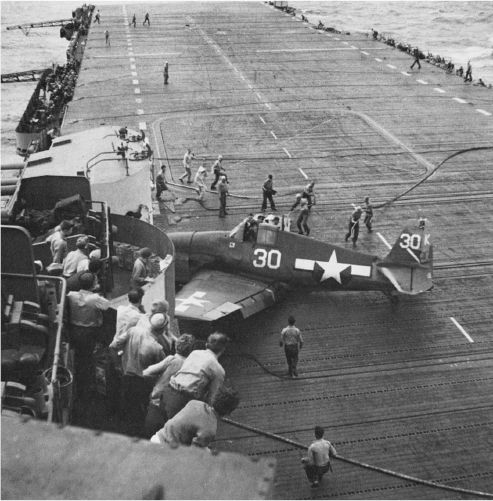
This VF-1 F6F returned to the Yorktown despite damage to oil and hydraulic systems and slight wounds to the pilot. Plane handlers rush to help the “Top Hat” flier from his aircraft.
The sailors of the service squadrons—both afloat and ashore—won few decorations and even fewer headlines. But the Japanese knew of their worth. After the war, former premier and warlord Hideki Tojo identified the ability of the United States to keep task forces at sea for long periods as one of the major factors in Japan’s defeat.
But to Clark and Davison’s fighter pilots, the big news was the F6F-5’s zero-length rocket rails. These allowed the use of 5-inch HVAR projectiles, and the Franklin Hellcats particularly would make effective use of them.
Raiding Iwo Jima was now a familiar routine to VF-1 and VF-2, and the pilots knew what to expect. “We got a hot reception every time we went to Iwo,” recalled Smoke Strean.15 This time was no different.
The fighter sweep of 3 July pitted 43 Hellcats from the Hornet and Yorktown against 40-odd Zekes which barely got off the ground in time. Seventeen VF-1 aircraft made contact under a 3,000-to 5,000-foot cloud layer as Strean’s outfit claimed 11 confirmed and 5 probables for the loss of a plane and pilot plus 3 F6Fs damaged. Eleven of VF-2’s 26 sweep Hellcats put their bombs on their airfield targets when the Zekes appeared overhead. Many of the Japanese were skillful and aggressive, maintaining their altitude advantage, but making poor use of it. Bill Dean and four other Rippers each scored triples as Fighting Two ran up a 33 to 3 claim.
Next morning the severely depleted Japanese air group could only put up eight torpedo planes and nine Zekes, all with orders to dive deliberately into the American carriers. This was four months prior to formation of the Kamikaze “special attack corps,” but the enemy fliers had no opportunity to commit suicide. Instead, Cabot Hellcats celebrated the Fourth of July by dropping onto the Japanese from 10,000 feet. Lieutenant (jg) Conny Nooy paced Fighting 31 with three kills and a probable as the enemy formation was annihilated. Of the 17 hostiles, only four Zekes returned to Iwo in the thick weather. During three, sharp, hard-fought raids the F6Fs had destroyed over 70 of the 80 Zeros on Iwo Jima.
Fighting 13 had notched its first four victories during the operation, but of far greater interest was the first fighter use of High Velocity Aerial Rockets in Pacific combat. The Franklin Hellcats sent their big, 60-pound rockets smoking into a variety of Japanese ships in the Bonins and returned exultant. They claimed the destruction by rocketing and strafing of an escort and four small merchantmen.
Air Group One had 16 planes probing for Japanese shipping, too. The Yorktown fliers went after three vessels identified as two destroyer escorts and a medium cargo ship. Smoke Strean’s Hellcats plunged through surprisingly thick AA fire, continuously strafing the two DEs, and began exploding depth charges which “went off like popcorn”16 on the stern of one ship. The first escort shuddered from a large explosion and the second was wracked by fire when the Yorktown planes pulled off. The cargo vessel was last seen smoking. But VF-l’s newest ace, Lieutenant Bill Moseley, never turned up. He had shot down his fifth and sixth planes the day before and was awarded a posthumous Air Medal to go with his two DFCs.
So ended the unrelenting pace of midsummer in the Pacific. The month of June had seen Hellcats prowling over most of Micronesia, and the early July aftermath found Japanese air power in the region virtually nonexistent. The Marianas Campaign, which officially lasted until 8 August with more strikes on the Palaus, Carolines, and the Bonins, netted claims of 917 enemy planes destroyed in air combat. Against this, 65 U.S. carrier planes—mostly Hellcats—had been shot down by Japanese aircraft. It was an exchange ratio of 14 to 1, and even if it suffered from honest exaggeration, it was still impressive. And it did not include 306 planes thought destroyed on the ground by U.S. carrier aircraft.
With the arrival of the F6F-5 in the Fast Carrier Task Force, the Hellcat was entering its most successful period—the last 12 months of the war. For though Japanese naval aviation was no longer in serious contention at sea, momentous events were set in motion once the U.S. Navy went to the Philippines and beyond.
Hellcat Squadrons in Combat: May to August 1944
|
VF-1 |
Yorktown |
Commander Bernard M. Strean |
|
VF-2 |
Hornet |
Commander William A. Dean, Jr. |
|
VF-8 |
Bunker Hill |
Commander William M. Collins, Jr. |
|
VF-10 |
Enterprise |
Lieutenant R.W. Schumann |
|
VF-13 |
Franklin |
Commander Wilson M. Coleman |
|
VF-14 |
Wasp |
Lieutenant Commander Edmund W. Biros (KIA), Lieutenant W. Q, Punnell (KIA) |
|
VF-15 |
Essex |
Commander Charles W. Brewer (KIA), Lieutenant Commander James F. Rigg |
|
VF-16 |
Lexington |
Commander Paul D. Buie |
|
VF-19 |
Lexington |
Lieutenant Commander Franklin E. Cook |
|
VF-20 |
Enterprise |
Commander Fred E. Bakutis |
|
VF-21 |
Belleau Wood |
Lieutenant Commander V. F. Casey |
|
VF-24 |
Belleau Wood |
Lieutenant Commander Edward M. Link |
|
VF-25 |
Cowpens |
Lieutenant Commander Robert H. Price |
|
VF-27 |
Princeton |
Lieutenant Commander Ernest W. Wood (KIA), Lieutenant Commander Fred A. Bardshar |
|
VF-28 |
Monterey |
Lieutenant Commander Roger W. Mehle |
|
VF-31 |
Cabot |
Lieutenant Commander Robert A. Winston |
|
VF-32 |
Langley |
Commander Edward C. Outlaw |
|
VF-50 |
Bataan |
Lieutenant Commander John C. Strange |
|
VF-51 |
San Jacinto |
Commander Charles L. Moore |