
‘It is the duty of every single person to attempt, in the spirit of the Führer, to work towards him.’
Werner Willikens, 21 February 1934
‘The Führer had for outward appearances to ban individual actions against the Jews in consideration of foreign policy, but in reality was wholly in agreement that each individual should continue on his own initiative the fight against Jewry in the most rigorous and radical form.’
Reported opinion in Hessen, March 1936
‘I go with the certainty of a sleepwalker along the path laid out for me by Providence.’
Hitler, 14 March 1936
Everyone with opportunity to observe it knows that the Führer can only with great difficulty order from above everything that he intends to carry out sooner or later. On the contrary, until now everyone has best worked in his place in the new Germany if, so to speak, he works towards the Führer.
This was the central idea of a speech made by Werner Willikens, State Secretary in the Prussian Agriculture Ministry, at a meeting of representatives from Länder agriculture ministries held in Berlin on 21 February 1934. Willikens continued:
Very often, and in many places, it has been the case that individuals, already in previous years, have waited for commands and orders. Unfortunately, that will probably also be so in future. Rather, however, it is the duty of every single person to attempt, in the spirit of the Führer, to work towards him. Anyone making mistakes will come to notice it soon enough. But the one who works correctly towards the Führer along his lines and towards his aim will in future as previously have the finest reward of one day suddenly attaining the legal confirmation of his work.1
These comments, made in a routine speech, hold a key to how the Third Reich operated. Between Hindenburg’s death at the beginning of August 1934 and the Blomberg-Fritsch crisis in late January and early February 1938, the Führer state took shape. These were the ‘normal’ years of the Third Reich that lived in the memories of many contemporaries as the ‘good’ years (though they were scarcely that for the already growing numbers of victims of Nazism).2 But they were also years in which the ‘cumulative radicalization’3 so characteristic of the Nazi regime began to gather pace. One feature of this process was the fragmentation of government as Hitler’s form of personalized rule distorted the machinery of administration and called into being a panoply of overlapping and competing agencies dependent in differing ways upon the ‘will of the Führer’. At the same time, the racial and expansionist goals at the heart of Hitler’s own Weltanschauung began in these years gradually to come more sharply into focus, though by no means always as a direct consequence of Hitler’s own actions. Not least, these were the years in which Hitler’s prestige and power, institutionally unchallengeable after the summer of 1934, expanded to the point where it was absolute. This point was reached when the once mighty army officer corps surrendered what was left of its authority and independent power-base following a scandal relating to the private lives of the two most senior military leaders in the country in early 1938.4
These three tendencies – erosion of collective government, emergence of clearer ideological goals, and Führer absolutism – were closely interrelated. Hitler’s personal actions, particularly in the realm of foreign policy, were certainly vital to the development. But the decisive component was that unwittingly singled out in his speech by Werner Willikens. Hitler’s personalized form of rule invited radical initiatives from below and offered such initiatives backing, so long as they were in line with his broadly defined goals. This promoted ferocious competition at all levels of the regime, among competing agencies, and among individuals within those agencies. In the Darwinist jungle of the Third Reich, the way to power and advancement was through anticipating the ‘Führer will’, and, without waiting for directives, taking initiatives to promote what were presumed to be Hitler’s aims and wishes. For party functionaries and ideologues and for SS ‘technocrats of power’, ‘working towards the Führer’ could have a literal meaning. But, metaphorically, ordinary citizens denouncing neighbours to the Gestapo, often turning personal animosity or resentment to their advantage through political slur, businessmen happy to exploit anti-Jewish legislation to rid themselves of competitors, and the many others whose daily forms of minor cooperation with the regime took place at the cost of others, were – whatever their motives – indirectly ‘working towards the Führer’. They were as a consequence helping drive on an unstoppable radicalization which saw the gradual emergence in concrete shape of policy objectives embodied in the ‘mission’ of the Führer.
Through ‘working towards the Führer’, initiatives were taken, pressures created, legislation instigated – all in ways which fell into line with what were taken to be Hitler’s aims, and without the dictator necessarily having to dictate. The result was continuing radicalization of policy in a direction which brought Hitler’s own ideological imperatives more plainly into view as practicable policy options. The disintegration of the formal machinery of government and the accompanying ideological radicalization resulted then directly and inexorably from the specific form of personalized rule under Hitler. Conversely, both decisively shaped the process by which Hitler’s personalized power was able to free itself from all institutional constraints and become absolute.
Within this process, Hitler’s growing self-confidence – swollen with each international ‘triumph’ attained, as it appeared, through boldness in the face of the timidity of others, in reality achieved by pushing against a European state system which was as stable as a house of cards – intensified his already immense ego, magnified his megalomaniac tendencies, and underlined his contempt for more cautious spirits in the military leadership and Foreign Office. At the same time, every success accredited to Hitler increased his popular standing, undermined the hopes of opposition, and enhanced the readiness of any remaining doubters among the political élite to accept his outright supremacy without demur. And as the Führer cult moved towards its apogee, it became ever more clear that Hitler, too, had succumbed to it. The tense developments in foreign affairs culminating in the reoccupation of the Rhine-land mark a crucial phase in this process. The successful outcome of the Rhine-land crisis was Hitler’s greatest triumph to date. By that point he had become more than ever a convinced believer in his own ‘myth’.
I
Those close to Hitler later claimed that they detected a change in him after Hindenburg’s death. According to Press Chief Otto Dietrich, the years 1935 and 1936, with Hitler ‘now as absolute ruler on the lookout for new deeds’, were ‘the most significant’ in his development ‘from domestic reformer and social leader of the people to the later foreign-policy desperado and gambler in international politics’. ‘In these years,’ Dietrich went on, ‘a certain change also made itself noticeable in Hitler’s personal conduct and behaviour. He became increasingly unwilling to receive visitors on political matters if they had not been ordered by him to attend. Equally, he knew how to distance himself inwardly from his entourage. While, before the takeover of power, they had the possibility of putting forward their differing political opinion, he now as head of state and person of standing (Respektsperson) kept strictly out of all unrequested political discussion… Hitler began to hate objections to his views and doubts on their infallibility… He wanted to speak, but not to listen. He wanted to be the hammer, not the anvil.’5
Hitler’s increasing withdrawal from domestic politics once the period of consolidation of power had come to an end in August 1934 was, as Dietrich’s remarks suggest, not simply a matter of character and choice. It also directly mirrored his position as Leader, whose prestige and image could not allow him to be politically embarrassed or sullied by association with unpopular policy choices. Hitler represented, and as the regime’s central integrating mechanism had to represent, the image of national unity. He could not be seen to be involved in internal, day-to-day political conflict. Beyond that, his growing aloofness reflected, too, the effective transformation of domestic politics into propaganda and indoctrination. Choice and debate about options – the essence of politics – had by now been removed from the public arena (even if, of course, bitter disputes and conflicts continued behind the scenes). ‘Politics’ within a ‘coordinated’ Germany now amounted to what Hitler had since the early 1920s regarded as its sole aim: the ‘nationalization of the masses’ in preparation for the great and inevitable struggle against external enemies. But this goal, the creation of a strong, united, and impregnable ‘national community’ (Volksgemeinschaft), was so all-embracing, so universal in its impact, that it amounted to little more than an extremely powerful emotional incitement to formulate policy initiatives in every sphere of the regime’s activity, affecting all walks of life. Hitler – and the same would have been true of even a more administratively competent and efficient head of state – could not possibly have overseen, let alone directed, all such initiatives. What his form of leadership, linked to the broad ‘directions for action’6 which he embodied – national revival, ‘removal’ of Jews, racial ‘improvement’, and restoration of Germany’s power and standing in the world – did, was to unleash an unending dynamic in all avenues of policy-making. As Willikens had remarked, the greatest chances of success (and best opportunities for personal aggrandizement) occurred where individuals could demonstrate how effectively they were ‘working towards the Führer’. But since this frenzy of activity was uncoordinated – and could not be coordinated – because of Hitler’s need to avoid being openly drawn into disputes, it inexorably led to endemic conflict (within the general understanding of following the ‘Führer’s will’). And this in turn merely reinforced the impossibility of Hitler’s personal involvement in resolving the conflict. Hitler was, therefore, at one and the same time the absolutely indispensable fulcrum of the entire regime, and yet largely detached from any formal machinery of government. The result, inevitably, was a high level of governmental and administrative disorder.
Hitler’s personal temperament, his unbureaucratic style of operating, his Darwinistic inclination to side with the stronger, and the aloofness necessitated by his role as Führer, all merged together to produce a most extraordinary phenomenon: a highly modern, advanced state without any central coordinating body and with a head of government largely disengaged from the machinery of government. However dominant, Benito Mussolini and Francisco Franco (dictator of Spain after 1939) continued to run affairs through their cabinets, even if these were largely consultative bodies. Josef Stalin retained his Politburo (despite having members of it shot on occasion). All three attempted to dominate and impose rigid control over the central machinery of government. But in Germany, cabinet meetings (which Hitler had never liked running) now lost significance. There were only twelve gatherings of ministers in 1935. By 1937, this had fallen to a mere six meetings. After 5 February 1938, the cabinet never met again. During the war, Hitler would even ban his ministers getting together occasionally over a glass of beer.7 In the absence of cabinet discussions which might have determined priorities, a flood of legislation emanating independently from each ministry had to be formulated by a cumbersome and grossly inefficient process whereby drafts were circulated and recirculated among ministers until some agreement was reached. Only at that stage would Hitler, if he approved after its contents were briefly summarized for him, sign the bill (usually scarcely bothering to read it) and turn it into law. Hans Heinrich Lammers, the head of the Reich Chancellery, and sole link between the ministers and the Führer, naturally attained considerable influence over the way legislation (or other business of ministers) was presented to Hitler. Where Lammers decided that the Führer was too busy with other pressing matters of state, legislation that had taken months to prepare could simply be ignored or postponed, sometimes indefinitely. Alternatively, Hitler intervened, sometimes in minutiae, on the basis of some one-sided piece of information he had been fed. The result was an increasing arbitrariness as Hitler’s highly personalized style of rule came into inevitable – and ultimately irreconcilable – conflict with bureaucracy’s need for regulated norms and clearly defined procedures. Hitler’s ingrained secretiveness, his preference for one-to-one meetings (which he could easily dominate) with his subordinates, and his strong favouritism among ministers and other leaders in party as well as state, were added ingredients that went to undermine formal patterns of government and administration.
Access to Hitler was naturally a key element in the continuing power-struggle within the regime. Ministers who had for some reason fallen out of favour could find it impossible to speak to Hitler. Agriculture Minister Walther Darre, for instance, was in the later 1930s to attempt in vain for over two years to gain an audience with the Führer to discuss the country’s seriously worsening agricultural problems. Though they could not hinder the access of ‘court favourites’ like Goebbels and the highly ambitious young architect Albert Speer – skilful in pandering to Hitler’s obsession with building plans and a rapidly rising star in the Nazi firmament – Hitler’s adjutants acquired a good deal of informal power through their control of the portals of the Führer.8
Fritz Wiedemann, during the First World War Hitler’s immediate superior and in the mid-1930s one of his adjutants, later recalled the extraordinary style of his arbitrary and haphazard form of personal rule. In 1935, commented Wiedemann, Hitler still maintained a relatively orderly routine. Mornings, between about 10a.m. and lunch at 1 or 2p.m., were normally taken up with meetings with Lammers, State Secretary Meissner, Funk (from the Propaganda Ministry) and ministers or other significant figures who had pressing business to discuss. In the afternoons, Hitler held discussions with military or foreign-policy advisers, though he preferred to talk to Speer about building plans. Gradually, however, any formal routine crumbled. Hitler reverted to the type of dilettante lifestyle which, in essence, he had enjoyed as a youth in Linz and Vienna, and for which, as party leader, he had earned Gottfried Feder’s reproof in the early 1920s. ‘Later on,’ recalled Wiedemann, ‘Hitler appeared as a rule only just before lunch, quickly read the press summaries provided by Reich Press Chief Dr Dietrich, then went to eat. It became, therefore, ever more difficult for Lammers and Meissner to acquire decisions from Hitler which he alone as head of state could take.’ When Hitler was at his residence on the Obersalzberg, it was even worse. ‘There he invariably left his room only approaching 2p.m. Then it was lunch. The afternoon was mainly taken up with a walk, and in the evenings, straight after the evening meal, films were shown.’9
The walks were always downhill, with a car stationed at the bottom to ferry Hitler and his accompaniment back up again. Hitler’s detestation of physical exercise and fear of embarrassment through lack of athleticism remained acute. The whole area was cordoned off during the afternoon walk, to keep away the crowds of sightseers eager for a glimpse of the Führer. Instead, the tradition set in of the visitors’ ‘march-past’. Up to 2,000 people of all ages and from all parts of Germany, whose devotion had persuaded them to follow the steep paths up to the Obersalzberg and often wait hours, marched, at a signal from one of the adjutants, in a silent column past Hitler. For Wiedemann, the adulation had quasi-religious overtones.10
Hitler rarely missed his evening film. The adjutants had to see to it that a fresh film was on offer each day – not always an easy task given the level of production of quality films. Hitler invariably preferred light entertainment to serious documentaries, and, according to Wiedemann, probably gleaned some of his strong prejudices about the culture of other nations from such films.11
In the Reich Chancellery, the company was almost exclusively male – the atmosphere part way between that of a men’s club and an officers’ mess (with a whiff of the gangsters’ den thrown in). On the Obersalzberg – ‘the mountain’, as it came to be called – the presence of women (Eva Braun and wives or lady-friends of members of Hitler’s entourage) helped to lighten the atmosphere, and political talk was banned as long as they were there. Hitler was courteous, even charming in a somewhat awkwardly stiff and formal fashion, to his guests, especially towards women. He was invariably correct and attentive in dealings with the secretaries, adjutants, and other attendants on his personal staff, who for the most part liked as well as respected him.12 He could be kind and thoughtful, as well as generous, in his choice of birthday and Christmas presents for his entourage. Even so, whether at the Reich Chancellery or on the Obersalzberg, the constrictions and tedium of living in close proximity to Hitler were considerable. Genuine informality and relaxation were difficult when he was present. Wherever he was, he dominated. In conversation, he would brook no contradiction. Guests at meals were often nervous or hesitant lest a false word incur his displeasure. His adjutants were more concerned late at night lest a guest unwittingly lead on to one of Hitler’s favourite topics – notably the First World War, or the navy – where he would launch into yet another endless monologue which they would be forced to sit through until the early hours.13
Hitler’s unmethodical, even casual, approach to the flood of often serious matters of government brought to his attention was a guarantee of administrative disorder. ‘He disliked reading files,’ recalled Wiedemann. ‘I got decisions out of him, even on very important matters, without him ever asking me for the relevant papers. He took the view that many things sorted themselves out if they were left alone.’14
Hitler’s lethargy regarding paperwork knew one major exception. When it came to preparing his speeches, which he composed himself, he would withdraw into his room and could work deep into the night several evenings running, occupying three secretaries taking dictation straight into the typewriter before carefully correcting the drafts.15 The public image was vital. He remained, above all, the propagandist par excellence.
Even had Hitler been far more conscientious and less idiosyncratic and haphazard in his style of leadership, he would have found the highly personalized direction of the complex and varied issues of a modern state beyond him. As it was, the doors were opened wide to mismanagement and corruption on a massive scale. Hitler coupled financial incompetence and disinterest with an entirely exploitative and cavalier usage of public funds. Posts were found for ‘old fighters’. Vast amounts of money were poured into the construction of imposing representative buildings. Architects and builders were lavishly rewarded. For favoured building or artistic projects, money was no object.16 Leading figures in the regime could draw upon enormous salaries, enjoy tax relief, and benefit further from gifts, donations and bribes to accommodate their extravagant tastes in palatial homes, fine trappings, works of art and other material luxuries – including, of course, the inevitable showy limousines. Labour Front boss Robert Ley, a former Rhineland Gauleiter with a doctorate in food chemistry, a notorious womanizer who acquired the well-earned nickname of ‘Reich Drunkard’ (Reichstrunkenbold), was one notable case – though he was merely part of the tip of a very large iceberg. His self-evident venality and luxury living were a blatant affront to many in the working class earning pitiful wages for backbreaking labour. But ordinary Germans knew nothing, for example, of his use of funds from the Bank of German Labour (Bank der deutschen Arbeit) to buy back at twice the purchase price the Berlin villa acquired by the commander of Hitler’s bodyguard, Sepp Dietrich (who had soon tired of his luxury home in the capital and wanted to replace it with one in Munich), nor of the Bank’s offer of what amounted to a handsome bribe to Hitler’s adjutant Fritz Wiedemann.17 Corruption was rife at all levels of the regime.18 Hitler was happy to indulge the infinite craving for the material trappings of power and success of his underlings, aware that corruption on a massive scale ensured loyalty as the Third Reich developed into a modern variant of a feudal system resting on personal allegiance rewarded by private fiefdoms.19 He himself, by now a millionaire on the proceeds of sales of Mein Kampf, led his publicly acclaimed spartan lifestyle (as regards his food and clothing) in a context of untold luxury. Alongside his magnificent apartments – his official one in Berlin and his private one in Munich – the initially somewhat modest alpine residence, Haus Wachenfeld on the Obersalzberg, was now converted at vast expense into the grandiose Berghof, suitable for state visits of foreign dignitaries.20 His restless energy demanded that he and his sizeable entourage were almost constantly on the move within Germany. For that, a special train with eleven coaches containing sleeping compartments, a fleet of limousines, and three aeroplanes stood at his disposal.21
Even more serious than the way corrupt party despots profited from the bonanza of a seemingly unlimited free-for-all with public funds was the corruption of the political system itself. In the increasing absence of any formal procedures for arriving at political decisions, favoured party bosses with access to Hitler were often able, over lunch or at coffee, to put forward some initiative and manipulate a comment of approval to their own advantage.22
Hitler’s impulsive verbal agreement to suggestions from subordinate leaders could prove embarrassing. When, in October 1934, Robert Ley obtained Hitler’s signature on a decree which would have strengthened the hand of the Labour Front at the expense of employers and the state authorities, the Trustees of Labour, it led to difficulties. Neither the Ministry of Labour nor the Ministry of Economics had been properly consulted. The party’s head, Rudolf Heß, personally at loggerheads with Ley (who in addition to being boss of the Labour Front had also been placed by Hitler in charge of the party’s organizational matters, bringing him directly and repeatedly into conflict with Heß), also strongly protested. Unable to antagonize economics supremo Schacht and the industrial leadership, Hitler had to comply with the pressure. To preserve his prestige, the decree was not revoked, but simply ignored and fell into desuetude however much Ley tried to have recourse to it.23
A few months later, in early 1935, the reverse happened when Hitler bowed to party pressure having initially agreed to a proposal from a Reich government minister. Labour Minister Seldte had won Hitler’s support for his plans to replace the regionally weighted wage structure for building workers by a unified structure across the Reich. This led to loud protests from the Gauleiter, the party’s regional chieftains – Gauleiter Kaufmann of Hamburg was especially vociferous – about the impact of wage reductions in some areas on worker morale.24 Hitler backed down. Again, for prestige purposes the earlier decision could not simply be rescinded as a mistake. Instead, Hitler ordered further deliberations over an indefinite period before the wage revision should be implemented. This meant the matter was shelved and forgotten.25
In the two examples just cited, specific policy initiatives which ran foul of the vested interests of powerful groups in the regime had to be jettisoned. Ley and Seldte found, on these occasions, that they ultimately turned out not to be ‘working towards the Führer’. However, Hitler’s sparse involvement in initiating domestic policy during the mid – and later 1930s and the disintegration of any centralized body for policy formulation meant that there was wide scope for those able to exert pressure for action in areas broadly echoing the aims of nationalization of the masses and exclusion of those deemed not to belong to the ‘national community’. The pressure came above all from two sources: the party (both its central office and its provincial bosses, the Gauleiter) and the élite organization the SS (now merging into the police to become an ideologically driven state security force of immense power). Using Hitler’s professed (and unlimited) goals of national rebirth and strength through racial purity to legitimate their demands and actions, they ensured that the dynamic unleashed by the takeover of power would not subside.
Once power had been attained in 1933, the NSDAP, its numbers now rapidly swelling through the intake of hundreds of thousands of opportunists, became in essence a loosely coordinated vehicle of propaganda and social control. Hitler had in any case, in destroying the organizational structure built up by Gregor Strasser, already determined in December 1932 that mobilization behind the ‘National Socialist idea’ embodied in his own person was the party’s task.26 After becoming Chancellor, he had taken little interest in the party as an institution. The weak and ineffectual, but devotedly loyal Rudolf Heß was in April made Hitler’s deputy in charge of the party. Since Robert Ley, as we have noted, was left running the party’s organizational matters, Heß’s authority was from the outset far from complete.27 Nor was Heß in a strong position in his dealings with the Gauleiter, most of whom could rely on their long-standing personal bonds with Hitler to uphold their power-base in the provinces. Neither a genuine hierarchical structure of command at the top of the party, nor a collective body for determining party policy, was ever instituted. The ‘Reich Leadership’ of the party remained a group of individuals who never met as a type of Politburo; Gauleiter conferences only took place at Hitler’s own behest, to hear a speech from the Führer, not to discuss policy; while a party senate was never called into existence.28 The party acquired, therefore, neither a coherent structure nor a systematic policy which it could enforce upon the state administration. Its essential nature – that of a ‘Führer party’ tied to emotively powerful but loosely defined general aims embodied in the person of the Führer and held together by the Führer cult – ruled out both. Even so, once Heß was given in 1934 what amounted to veto rights over draft legislation by government ministers and, the following year, over the appointment of higher civil servants, the party had indeed made significant inroads into the purely governmental arena.29 The possibilities of intervention, however unsystematic, did now increase the party’s influence, above all in what it saw as crucial ideological spheres. Race policy and the ‘Church struggle’ were among the most important of these.30 In both areas, the party had no difficulty in mobilizing its activists, whose radicalism in turn forced the government into legislative action. In fact, the party leadership often found itself compelled to respond to pressures from below, stirred up by Gauleiter playing their own game, or emanating sometimes from radical activists at local level. Whatever the derivation, in this way the continuum of radicalization in issues associated with the Führer’s aims was sustained.
By the mid-1930s, Hitler paid little attention to the workings of the party. ‘His personal participation in the life of the party was limited from now on in essence to his appearance at the major representative occasions in Munich, Nuremberg etc., and to the speeches which he regularly held in November and February before his “old guard”,’ commented Otto Dietrich.31 The dualism of party and state was never resolved – and was not resolvable. Hitler himself welcomed the overlaps in competence and lack of clarity. Sensitive as always to any organizational framework which might have constrained his own power, he undermined all attempts at ‘Reich reform’ by Frick, aimed at producing a more rational authoritarian state structure.32
Hitler’s approach to the state, as to all power-relations, was purely exploitative and opportunistic. It was for him, as he had expressly stated in Mein Kampf, purely a means to an end – the vague notion of ‘upholding and advancing a community of physically and mentally similar beings’, the ‘sustaining of those racial basic elements which, as bestowers of culture, create the beauty and dignity of a higher type of human being’.33 It followed that he gave no consideration to forms and structures, only to effect. His crude notion was that if a specific sphere of policy could not be best served by a government ministry, weighed down by bureaucracy, then another organization, run as unbureaucratically as possible, should manage it. The new bodies were usually set up as directly responsible to Hitler himself, and straddled party and state without belonging to either. The Organisation Todt, the Hitler Youth, and, from 1936, the Four Year Plan, were such institutions. In reality, of course, this process merely erected new, competing, sometimes overlapping bureaucracies and led to unending demarcation disputes. These did not trouble Hitler. But their effect was at one and the same time to undermine still further any coherence of government and administration, and to promote the growing autonomy within the regime of Hitler’s own position as Führer.
The most important, and ideologically radical, new plenipotentiary institution, directly dependent on Hitler, was the combined SS-police apparatus which had fully emerged by mid-1936. Already before the ‘Röhm-Putsch’, Himmler had extended his initial power-base in Bavaria to gain control over the police in one state after another, culminating in his nomination in April 1934 as ‘Inspector of the Gestapo’, accompanied by Reinhard Heydrich as head of the Office of the Prussian Secret State Police (Gestapa). After the SS had played such a key part in breaking the power of the SA leadership at the end of June, Himmler had been able to push home his advantage until Göring conceded full control over the security police in the largest of the states. Attempts by Reich Minister of the Interior Frick and Justice Minister Gürtner to curb autonomous police power, expanding through the unrestricted use of ‘protective custody’ (Schutzhaft) and control of the growing domain of the concentration camps, also ended in predictable failure. Where legal restrictions on the power of the police were mooted, Himmler could invariably reckon with Hitler’s backing. When, in 1935, Gürtner complained about the number of deaths occurring in concentration camps and demanded the presence of lawyers in cases of ‘protective custody’, Himmler went to Hitler and won his support for a ban on consultation of lawyers and a block on any ‘special measures’ owing to ‘the conscientious direction of the camps’.34 Frick had no greater success with his protests at abuses of ‘protective custody’.35 Indeed, Himmler gained Hitler’s authorization to expand the concentration camp system at a time, in summer 1935, when, with 3,500 internees, it was smaller than at any other period throughout the Third Reich and appeared to have exhausted its prime purpose. This was followed, in October 1935, by Hitler’s backing for the Gestapo as the decisive agent in the ‘struggle against the internal enemies of the nation’.36
Himmler’s concessions in the Prussian Gestapo Law of 10 February 1936 were purely nominal. While one clause of the Law subordinated the Gestapo to the Ministry of the Interior, another emphasized that it was ultimately responsible to the Gestapa.37 There was no doubt which would prevail in case of conflict. The next step was not long in coming. On 17 June, Hitler’s decree created a unified Reich police under Himmler’s command.38 The most powerful agency of repression thus merged with the most dynamic ideological force in the Nazi Movement. Himmler’s subordination to Frick through the office he had just taken up as Chief of the German Police existed only on paper. As head of the SS, Himmler was personally subordinate only to Hitler himself. With the politicization of conventional ‘criminal’ actions through the blending of the criminal and political police in the newly formed ‘security police’ a week later, the ideological power-house of the Third Reich and executive organ of the ‘Führer will’ had essentially taken shape.
The instrument had been forged which saw the realization of the Führer’s Weltanschauung as its central aim. Himmler saw the prime task of the merged police and SS as ‘the internal defence of the people’ in ‘one of the great struggles of human history’ against ‘the universally destructive force of Bolshevism’.39 For Werner Best, Heydrich’s deputy, the police were a ‘fighting formation’, existing to root out all symptoms of disease and germs of destruction that threatened the ‘political health’ of the nation.40 No directions from Hitler were needed to encourage a police force starting from such premisses to expand the target-groups of those dubbed ‘enemies of the state’ or ‘harmful to the people’. The list could be extended almost at will. Alongside the prime racial victims, the Jews, and the foremost ideological and political enemies, Communists and Socialists, or the freemasons (a secret society held in deep suspicion for its alleged international power network and links with Jews engaged in world conspiracy), assiduous police careerists and SS ideologues blended their efforts to find new internal ‘enemies’ to combat. Most were weak, unpopular and marginalized social groups such as gypsies, homosexuals, beggars, ‘antisocials’, ‘work-shy’, and ‘habitual criminals’.41 In addition, the drive to eliminate any ‘institutional space’ turned persecution not only against those unprepared to yield to the total claim of the Nazi state – Jehovah’s Witnesses or ‘politically active’ representatives of the main Christian denominations – but also against small Christian sects which bent over backwards to accommodate National Socialism (such as the Mormons, or the Seventh Day Adventists).42
Intensification of radicalism was built into the nature of such a police force which combined ruthlessness and efficiency of persecution with ideological purpose and dynamism. Directions and dictates from Hitler were not needed. The SS and police had individuals and departments more than capable of ensuring that the discrimination kept spiralling. The rise of Adolf Eichmann from an insignificant figure collecting information on Zionism, but located in what would rapidly emerge as a key department – the SD ‘s ‘Jewish Desk’ in Berlin – to ‘manager’ of the ‘Final Solution’ showed how initiative and readiness to grasp opportunities not only brought rewards in power and aggrandizement to the individual concerned, but also pushed on the process of radicalization precisely in those areas most closely connected with Hitler’s own ideological fixations.
In the mid-1930s this process was still in its early stages. But pressures for action from the party in ideological concerns regarded as central to National Socialism, and the instrumentalization of those concerns through the expanding repressive apparatus of the police, meant that there was no sagging ideological momentum once power had been consolidated, as was the case in Mussolini’s Italy or Franco’s Spain. And as initiatives formulated at different levels and by different agencies of the regime attempted to accommodate the ideological drive, the ‘idea’ of National Socialism, located in the person of the Führer, thus gradually became translated from Utopian ‘vision’ into realizable policy objectives.
II
The beginnings of this process were also visible in Germany’s foreign relations. Nothing did more to bolster Hitler’s self-confidence than his successful coups in Europe’s ‘diplomatic revolution’.43 Most spectacular were the reintroduction of conscription in March 1935 and the reoccupation of the Rhineland almost exactly a year later. The results abroad were to destroy the remnants of the post-war diplomatic settlement, upturn the European order, seal the fatal division and weakening of the western powers, and drastically loosen the constraints on the build-up of German military might. At home, Hitler’s immense popularity and acclaim attained untouched levels. The triumphs of boldness over caution, as it seemed, strengthened his hand over the more restrained and circumspect among the military and foreign-policy advisers. As Otto Dietrich detected, they also enhanced Hitler’s belief in his own infallibility. Hitler’s own greatest contribution to events with such momentous consequences lay in his gambling instinct, his use of bluff, and his sharp antennae for the weak spots of his opponents. He took the key decisions; he alone determined the timing. But little else was Hitler’s own work. The broad aims of rearmament and revision of Versailles – though each notion hid a variety of interpretations – united policy-makers and power-groups, whatever the differences in emphasis, in the military and the foreign office.
Apart from the drama surrounding Germany’s withdrawal from the League of Nations in October 1933, the first two years of Hitler’s Chancellorship had been largely dominated by internal affairs. Given German defensive weakness (on both eastern and western borders) and diplomatic isolation, there was no alternative to wariness in foreign affairs in these early years. The dangers of military intervention by either the Poles or the French were taken seriously. As Bernhard von Bülow, State Secretary in the Foreign Office, put it in his memorandum of 13 March 1933, Germany’s ‘dangerous weakness’ compelled a policy of ‘avoiding foreign-policy conflicts for as long as possible, until we are strong again’.44 Rearmament in secret had to go along with public readiness to appear conciliatory. Repeated emphasis on the unfair treatment of Germany in the post-war settlement would continue to probe the obvious divisions between the French and British, arising from their differing views on the harshness of Versailles, their divergent foreign-policy interests (more obviously global in Britain’s case), and the corresponding variation on the likely dangers of a resurgent Germany and the ways of containing rearmament and any revisionist claims.45 Meanwhile, once Germany’s diplomatic isolation was sealed by its withdrawal from the League of Nations, any opportunity of bilateral agreements in eastern Europe which would prevent German ambitions being contained by the multilateral pacts striven for by the French was to be seized.46
The first indicator of such a move was the non-aggression pact with Poland. Germany’s departure from the League of Nations had intensified the mutual interest in an improved relationship. The pact benefited Germany in undermining French influence in eastern Europe (thereby removing the possibility of any combined Franco-Polish military action against Germany). For the Poles, it provided at least the temporary security felt necessary in the light of diminished protection afforded through the League of Nations, weakened by the German withdrawal.47
The first moves had come from the Poles. Bülow had recorded traditional Foreign Office animosity towards Poland when, in his March tour d’horizon of foreign-policy options, he had remarked that an understanding with the Poles was ‘neither possible nor desired’.48 Pilsudski’s government had, however, put out feelers towards a better relationship the following month. It was, as Hitler realized, also in Germany’s interests, whatever the official Foreign Office view, to lessen tension on its eastern borders. Diplomatic activity over the summer of 1933 succeeded in improving relations between Danzig (where National Socialists now dominated the government) and Poland.49 Danzig had been a point of friction between Germany and Poland since the post-war peace settlement. Offering an outlet to the sea demanded by the new Polish state, and surrounded by territory taken from Germany and handed to Poland, Danzig’s overwhelming German population had meant that the Versailles principles of territorial integrity and national self-determination could not be reconciled. The result was the compromise to make Danzig a ‘free city’, autonomous under League of Nations supervision. The Poles had access to the sea, but no harbour of their own. The Germans had not ceded Danzig to Poland, but had not retained it for the Reich. No one was happy, least of all the people of Danzig. It was a solution unlikely to stand the test of time. But, for the moment, despite the almost inevitable upsurge of support in Danzig for a stridently nationalist government in the Reich, relations were improving between the Free City and the Polish government, prompted by the need for détente felt both in Berlin and in Warsaw.50 Steps were also taken towards ending the long-standing trade war between Germany and Poland.51 Hitler himself pressed for the trade agreement, which was being painstakingly worked out between the two countries, to be extended to a non-aggression treaty. From his point of view, treaties were matters of expediency. They were to be held to as long as they served their purpose.
He was prepared to appear generous in his dealings with the Poles. There was a new urgency in negotiations. Neurath and the Foreign Office, initially set for a different course, swiftly trimmed their sails to the new wind. ‘As if by orders from the top, a change of front toward us is taking place all along the line. In Hitlerite spheres they talk about the new Polish-German friendship,’ noted Józef Lipski, Polish minister to Berlin, on 3 December 1933.52 In conditions of great secrecy, a ten-year non-aggression treaty was prepared and sprung on an astonished Europe on 26 January 1934.53 This early shift in German foreign policy plainly bore Hitler’s imprint. ‘No parliamentary minister between 1920 and 1933 could have gone so far,’ noted Ernst von Weizsäcker, at that time German ambassador in Bern.54
The rapprochement with Poland meant, inevitably, a new course towards the Soviet Union. Initially, little or nothing had altered the modus vivendi based on mutual advantage, which, despite deteriorating relations during the last years of the Weimar Republic, and despite ideological antipathy, had existed since the treaties of Rapallo in 1922 and Berlin in 1926. Soviet worries about the Hitler regime were soothed by the German ambassador Herbert von Dirksen, whose own expressed anxieties met with the reassurance of State Secretary Bülow: ‘The National Socialists faced with responsibility are naturally different people and follow a policy other than that which they have previously proclaimed.’ ‘That’s always been so and is the same with all parties,’ he complacently added.55From summer onwards, however, contrary to the wishes of the Foreign Office and (despite mounting concern) of its Soviet equivalent though in line with the clamour of the Nazi Movement, diplomatic relations worsened significantly. In autumn 1933, Hitler himself ruled out any repair of relations.56 During 1934, despite the efforts of the German ambassador Rudolf Nadolny (who had replaced Dirksen in autumn the previous year) and Soviet overtures for better relations, the deterioration continued. Hitler himself blocked any improvement, leading to Nadolny’s resignation.57 The inevitable consequence was to push the Soviet Union closer to France, thus enlarging the spectre of encirclement on which Nazi propaganda so readily played.
In early 1935, the Soviet Union was still little more than a side issue in German foreign policy. Relations with the western powers were the chief concern. The divisions, weakness, and need to carry domestic opinion of the western democracies would soon play into Hitler’s hands. But before taking any steps in foreign policy, or in addressing the increasingly pressing issue of the expansion of the armed forces, it was becoming imperative for Hitler to calm the internal tensions which had developed between the army and the Nazi Movement, overshadowing the last months of 1934 and threatening his relations with the military leadership. Underlying the tension were the promises Hitler had made to the SS at the time of the Röhm affair for the military arming of SS units – the origins of the later Waffen-SS – thus immediately breaking the promise he had made to the army that it alone would be the bearer of arms in the Reich.58 The SS were then at the forefront of a wave of scarcely veiled attacks on the military leadership, also involving the SA and other sections of the Movement, which punctuated the autumn of 1934, doing little for the confidence of army leaders in Hitler or his party. Domestic unrest – continued criticism of local party leaders in the wake of intense disappointment at the failure to undertake a more drastic purge of the party following the murder of the SA leaders, and, not least, the damaging effects of the Church struggle on popular morale – also contributed. The military leadership plainly felt its position under threat by what it saw as the ‘total claim’ of the Nazi Movement.59 For their part, Nazi activists were resentful of the power of what they took to be a bastion of reaction with protected status.
Hitler could afford, finally, to stand back no longer. He was compelled to intervene. At extraordinarily short notice – only one day – he summoned for 3 January 1935 a uniquely entitled meeting of the ‘German Leadership’ (Deutsche Führerschaft) in Berlin’s State Opera House. Rudolf Heß took the chair. The Party Reichsleiter and Gauleiter were present. So were the top leaders of the armed forces. Hitler spoke for one and a half hours with the overriding object of restoring the faith of the military in the NationalSocialist leadership. He stressed his will to make Germany a great power again, its defences secured through a strong Wehrmacht. This could only be attained through total unity. He referred again to the two pillars of the Wehrmacht and the Party on which the National Socialist state rested. He demanded restoration of the mutual trust between the two. He assured the army that he was on their side. He would disbelieve any comments and tear up any reports from those in the Party claiming that army leaders were criticizing or opposing him, ‘for my faith in the Wehrmacht is unshakable,’ he declared. Weeping, he beseeched party leaders to see that only absolute loyalty and devotion to him in a united community would enable him to rebuild Germany. As in the Strasser crisis of 1932, the high-point of the theatricals was his threat to commit suicide if this unity were not forthcoming. The contrived drama of the speech did the trick. The applause was tumultuous. The army leaders were won over, impressed by what they saw as Hitler’s moving declaration of loyalty to the armed forces. Göring ended the meeting, representing the unity of party, state and military leadership in his own person, with a vote of thanks to Hitler.60Once more, Hitler had succeeded in presenting himself as the indispensable unifier, reconciling through his ‘mission’ the conflicting interests of the differing sections of the ‘power-cartel’.61
In the meantime, a rich propaganda gift was about to fall into Hitler’s lap with the return of the Saar territory to Germany through the plebiscite of 13 January 1935. The Versailles Treaty had removed the Saarland from Germany, placing it under League of Nations control for fifteen years, and affording France the right to its resources. After fifteen years it was foreseen that the Saar inhabitants – roughly half a million voters – should decide whether they would prefer to return to Germany, become part of France, or retain the status quo. It was always likely that the majority of the largely German-speaking population, where resentment at the treatment meted out in 1919 still smouldered fiercely, would want to return to Germany. A good deal of work by the German government prepared the ground, and as the plebiscite day approached Goebbels unleashed a massive barrage of propaganda directed at the Saar inhabitants and raising consciousness of the issue at home.62 Berlin could feel confident that the plebiscite would result in a vote to return the Saar to Germany. According to the French ambassador André François-Poncet, however, Hitler would not have been surprised if the French had attempted to forestall a German triumph by taking possession of the territory or by adjourning the date of the plebiscite.63 Moreover, the Saar territory was overwhelmingly Catholic, with a large industrial working-class segment of the population – the two social groups which had proved least enthusiastic about Nazism within Germany itself.64
In the light of the ferocious repression of the Left and the threatening, if still largely sporadic, persecution of the Catholic Church that had followed the Nazi takeover in Germany, opponents of the Hitler regime in the Saar could still harbour illusions of a substantial anti-Nazi vote.65 But the Catholic authorities put their weight behind a return to Germany. And many Saar Catholics already looked to Hitler as the leader who would rescue them from Bolshevism.66 On the Left, the massive erosion of party loyalties had set in long before the plebiscite. For all their propaganda efforts, the message of the dwindling number of Social Democrat and Communist functionaries fell largely on stony ground. Nazi propaganda had little difficulty in trumpeting the alternative to a return to Germany: continued massive unemployment, economic exploitation by France, and lack of any political voice.67 Some concerted intimidation, as in the Reich itself during the ‘time of struggle’, did the rest. For the vast majority – workers and Catholics, middle-class and better-off alike – there seemed no choice to speak of. The future lay with Hitler’s Germany. Nationalist emotion and material self-interest went hand in hand.
When the votes were counted, just under 91 per cent of the Saar’s electorate had freely chosen dictatorship.68 At least two-thirds of the former supporters of both left-wing parties had supported the return to Germany.69 Any lingering doubts about whether Hitler had the genuine backing of the German people were dispelled.
Hitler milked his triumph for all that it was worth. At the same time, he was careful to make dove-like noises for public consumption. ‘Following the completion of your return,’ he told the Saar people, the German Reich ‘had no further territorial demands to make of France’.70 And in an interview with the Daily Mail journalist Ward Price four days after the plebiscite, he intoned: ‘Germany will of its own accord (von sich aus) never break the peace.’71 On 1 March, the day of the formal incorporation of the Saar territory in the Reich, Hitler spoke in Saarbrücken. He was ‘supremely happy’ (überglücklich), he declared, to be able to take part ‘in this day of happiness for the entire nation’ and ‘for the whole of Europe’. He hoped that as a consequence of the settlement of the Saar issue, ‘relations between Germany and France had improved once and for all. Just as we want peace, so we must hope that our great neighbouring people is also willing and ready to seek this peace with us.’72
Hitler’s true thoughts were different. The Saar triumph had strengthened his hand. He had to exploit the advantage. Western diplomats awaited his next move. They would not wait long.
Anxious to do nothing to jeopardize the Saar campaign, especial caution had been deployed in rearmament, either on Hitler’s orders or those of the Foreign Office. It could, therefore, be expected that the demands of the armed forces leadership for accelerated rearmament, in which political and military considerations went hand in hand, would gain new impetus following the Saar triumph. The Saar was indirectly connected with the rearmament question in another way. The disarmament talks in Geneva – since Germany’s withdrawal deprived of their substance – had been adjourned in November 1934 to await the outcome of the Saar plebiscite before attempting once more to propose internationally agreed limits on rearmament. This was of no interest to Hitler, concerned only with bilateral agreements.73 But the prospect led to a memorandum from General Beck, written on 6 March, which gives clear insight into the army’s views at the time.
The memorandum revolved around the notion of guaranteeing the ‘security of our living-space’ – a phrase indicating the widespread but varied usage of the term ‘Lebensraum’. Beck envisaged the possibility of attack from the Reich’s neighbours – France, Czechoslovakia, Poland and Belgium – though he saw little danger of Soviet intervention. The likelihood in his view was of a limited central European war in which Britain would be merely a bystander. Germany’s defence strength had to be measured in the context of the worst possible scenario. Beck looked to full equality for Germany in all questions of rearmament, and the removal of all restrictions – including those on the western borders of the Reich. The ending of the demilitarized zone in the Rhineland was a minimal demand. The army leadership had planned since December 1933, as a memorandum from Beck’s office made clear, for a peacetime army of twenty-one divisions.74 Beck now contemplated expansion in peacetime to twenty-three divisions, which could be rapidly increased to sixty-three divisions by 1939 – almost the size of the 1914 army – in the event of war. In an exchange of memoranda with army chief (Chef der Heeresleitung) Fritsch a few days later, it was plain that Beck saw the twenty-three divisions as a temporary arrangement for three or four years before further expansion to a peacetime army of thirty-six divisions. Fritsch, more anxious about the prospect of a preventive attack on Germany, argued that twenty-three divisions was too small a basis for the intended sixty-three-division war army, and advocated moving more swiftly to a thirty-six-division army. Fritsch too, however, was concerned that over-hasty expansion could produce foreign-policy tension, and perhaps even military danger – a view shared by Defence Minister Blomberg.75
Army leaders were thus divided about the tempo of expansion, but not about its necessity or the aim of an eventual thirty-six-division peacetime army, the size eventually determined by Hitler in March 1935. General conscription had already been foreseen in the programme of December 1933, put forward by Beck. It was an essential component of military planning, intended for introduction on 1 October 1934.76 This date proved illusory. But military leaders still reckoned with the necessity of moving to a conscript army by summer 1935. Only the timing remained to be determined – on the basis of the foreign-policy situation.77
This had become strained again in early 1935. A joint British-French communiqué on 3 February had condemned unilateral rearmament, and advanced proposals for general restrictions of arms levels and an international defence-pact against aggression from the air.78 After some delay, the German response on 15 February expressed the wish for clarificatory talks with the British government.79 The British Foreign Secretary Sir John Simon and Lord Privy Seal Anthony Eden were accordingly invited for talks in Berlin on 7 March.80 Three days before the planned visit, the publication of a British Government White Book, announcing increases in military expenditure as a result of the growing insecurity in Europe caused by German rearmament and the bellicose atmosphere being cultivated in the Reich, led to a furious outcry in the German press.81 Hitler promptly developed a ‘diplomatic’ cold and sore throat, allegedly picked up during his trip to a rainy Saarbrücken at the start of the month, and postponed Simon’s visit.82 Rosenberg found him ‘on the day of the outbreak of his hoarseness’ in excellent mood, cheered by the cancellation. ‘Again some time had been won,’ Hitler commented. ‘Those ruling England must get used to dealing with us only on an equal footing.’ He would ‘recover Germany’s position centimetre for centimetre,’ he added. ‘After a year, nobody will dare any longer to attack us! These few years must do it. If we had begun rearmament only in 1936 it would have been too late.’83
Three days after the visit should have taken place, on 10 March, Göring announced the existence of a German air-force – an outright breach of the Versailles Treaty.84 For effect, in comments to diplomats, he almost doubled the numbers of aircraft actually at Germany’s disposal at the time.85Just prior to this, the French had renewed their military treaty of 1921 with Belgium.86 And on 15 March the French National Assembly approved the lengthening of the period of military service from one to two years.87 The moves of the arch-enemy, France, prompted Hitler’s reaction. They provided the pretext.88 Alert as ever to both the political and the propaganda advantages to be gained from the actions of his opponents, he decided to take the step now which in any case would soon have been forthcoming.
On 13 March, Lieutenant-Colonel Hoßbach, Hitler’s Wehrmacht adjutant, was ordered to present himself the next morning in the Hotel Vier Jahreszeiten in Munich. When he arrived, Hitler was still in bed. Only shortly before midday was the military adjutant summoned to be told that the Führer had decided to reintroduce conscription in the immediate future – a move which would in the eyes of the entire world graphically demonstrate Germany’s newly regained autonomy and cast aside the military restrictions of Versailles.89 Hitler expounded his reasons for two hours. The advantageous foreign-policy situation, in which other European states were adjusting their military strength, and especially the measures being taken in France, were decisive. Hoßbach was then asked what size the new army should be. Astonishingly, Hitler did not consider directly consulting Fritsch or Beck on this vital topic. It was expected that Hoßbach would be familiar with the thinking of the military leadership. Subject to approval from War Minister Blomberg and Commander-in-Chief of the Army Fritsch, Hoßbach stipulated thirty-six divisions. This matched the final size of the peacetime army that the military leadership had envisaged as a future goal. 90 It implied an army of 550,000 men, five and a half times the size of the post-Versailles army, and a third larger than that envisaged by Beck in his memorandum written only nine days earlier. Hitler accepted Hoßbach’s figures without demur. What had been meant by the army chiefs as a level to be attained only gradually was now determined as the immediate size.
The more spectacular the better, was always Hitler’s maxim in a propaganda coup. Secrecy both to achieve the greatest surprise and avoid damaging leaks that could provoke dangerous repercussions was another. Hitler had taken his decision without consulting either his military leaders or relevant ministers.91 It was the first time this had happened in a serious matter of foreign policy, and the first time that Hitler encountered opposition from the heads of the armed forces.92 Only Hoßbach’s pleading on 14 March had persuaded Hitler to inform Blomberg, Fritsch, and selected cabinet ministers of what he had in store two days later. He had initially been unwilling to disclose to them what he intended on the grounds that there might then be a risk to secrecy.93 The War Minister and armed forces leadership were astonished and appalled that Hitler was prepared to take the step at such a sensitive juncture in foreign policy. It was not that they disagreed with the expansion of the armed forces, or its scale; merely that the timing and way it was done struck them as irresponsible and unnecessarily risky.94 The Foreign Ministry was more sanguine about the risks involved, reckoning the danger of military intervention to be slight.95 Britain’s reaction would be decisive. And various indicators reaching Berlin pointed to the fact that the British were increasingly inclined to accept German rearmament.96 While the military leadership recoiled, therefore, civilian members of the cabinet welcomed Hitler’s move.97
The relative calm of the other members of the cabinet evidently helped to soothe Blomberg’s nerves. Alongside the worries of foreign-policy repercussions had also to be weighed the advantages and opportunities that the move would afford the army. By the following day, the very day of the announcement, he had overcome his initial disapproval.98 At the lunchtime cabinet meeting, the last before the announcement, he praised the Führer’s ‘great deed’, led the other ministers in a three-fold ‘Heil’ to Hitler, and pledged his further loyalty.99 Fritsch, too, had come round to giving his approval. His objections – remembered by Hitler years later – were by now confined to technical problems arising from the planned speed of rearmament.100
Later that afternoon, Saturday, 16 March, Hitler, with Neurath at his side, informed foreign ambassadors of his imminent action.101 According to Hitler, the Italian ambassador, Vittorio Cerruti (replaced in the summer, at Hitler’s request), went white with anger; the French, André François-Poncet, delivered an immediate verbal protest; the British ambassador, Sir Eric Phipps, merely inquired whether Germany’s offers to Britain on relative sizes of air-forces and fleets still stood.102 Then the dramatic news was announced. Hitler proclaimed the new Wehrmacht of thirty-six divisions, and the introduction of general military service. He justified the move through the steps taken by other states to rearm, spurning German offers for disarmament on an equal basis, and asserted that the government wished for nothing more than ‘the power, for the Reich and thereby also for the whole of Europe, to be able to uphold peace’.103
Special editions of newspapers were rushed out, eulogizing ‘the first great measure to liquidate Versailles’, the erasing of the shame of defeat, and the restoration of Germany’s military standing. Delirious crowds gathered outside the Reich Chancellery cheering Hitler.104 ‘Today’s creation of a conscript army in open defiance of Versailles will greatly enhance his domestic position,’ commented the American journalist William Shirer, who witnessed the scenes in Berlin, ‘for there are few Germans, regardless of how much they hate the Nazis, who will not support it wholeheartedly. The great majority will like the way he has thumbed his nose at Versailles, which they all resented.’105
The following day, from now on renamed ‘Heroes’ Memorial Day’, amid a sea of military uniforms and flags in the State Opera House in Berlin, the huge stage-curtain hung with an enormous silver and black iron cross, the sombre chords of Beethoven’s ‘Funeral March’ (the second movement of the great Eroica symphony) sounding out, General Blomberg gave the address. ‘The world has been made to realize that Germany did not die of its defeat in the World War,’ he intoned. ‘Germany will again take the place she deserves among the nations. We pledge ourselves to a Germany which will never surrender and never again sign a treaty which cannot be fulfilled.’ Hitler looked on approvingly from the royal box.106 A grandiose military display followed, the restored tradition of the German army as its centrepiece.107 Hitler stood flanked on his right by a symbol of the old army, the aged Field Marshal August von Mackensen, who had commanded the German troops in Rumania during the First World War, with Blomberg, representing the new army, on his left.108
The German people were completely unprepared for what Hitler had done. Many reacted initially with shock, worried about the consequences abroad and the possibility even of a new war.109 But the mood – at least of the vast majority – rapidly turned to euphoria when it was realized that the western powers would do nothing. It was felt that Germany had the right to rearm, since France had done nothing to disarm. Hitler’s prestige soared. People admired his nerve and boldness. He had put the French in their place, and achieved what ‘the others’ had failed to bring about in fourteen years.110 ‘Enthusiasm on 17 March enormous,’ ran one report from oppositional sources sent from Bavaria to Sopade headquarters in Prague. ‘The whole of Munich was on its feet. People can be compelled to sing, but not forced to sing with such enthusiasm. I witnessed the days of 1914 and can only say that the declaration of war did not make the same impact on me as Hitler’s reception on 17 March… The trust in the political talent and honest will of Hitler becomes greater all the time, as Hitler has again gained extraordinary ground among the people. He is loved by many.’111
Foreign governments were also taken by surprise by Hitler’s move. French and Czech diplomacy went into overdrive. In each case, sluggish negotiations for treaties with Moscow were speeded up. In Italy, Mussolini made sabre-rattling noises against Germany, provoking for a time an atmosphere resembling that of 1915, and looked for closer alliance with France.112 But Great Britain held the key. And Britain’s interests overseas in the Empire and in the troubled Far East, alongside a prevalent concern about the threat of Bolshevism, encouraged a more pro-German stance completely at odds with French diplomacy and to Hitler’s direct advantage. Without consulting the French, the British government put out on 18 March a flat, formal protest at the German unilateral action, then, in the same protest note and to the astonishment of German diplomats, asked whether the Reich government was still interested in a meeting between Simon and Hitler.113 The French ambassador, François-Poncet, had wanted the meeting abandoned, ambassadors to be recalled from Berlin, and the creation of a common defence-pact against Germany.114 Instead, Britain was going its own way. The formal French and Italian protests, more sharply worded than the British, indicated to Berlin that Germany’s isolation was breaking down.115
‘I think we’ll come through’, Hitler had told Rosenberg, as the army leaders commissioned panicky war-games about the likely consequences of military intervention.116 The response, at home and abroad, amounted, in Hitler’s own eyes, to a triumph for boldness over timidity and a further indicator that he was unerringly right in his judgement.
Hitler was confident and self-assured when the postponed visit of Simon and Eden eventually took place in the Reich Chancellery, on 25 March. Paul Schmidt, meeting Hitler for the first time and acting as his interpreter, noted the cordial atmosphere at the beginning of the talks. He had expected the ‘raging demagogue’ he had heard on the radio, but was instead impressed by the skill and intelligence with which Hitler conducted the negotiations.117 Anthony Eden noted a change in Hitler’s demeanour since the first time he had met him, back in February 1934. ‘Hitler was definitely more authoritative and less anxious to please than a year before,’ he recalled. ‘Another twelve months of a dictator’s power and growing military force to back it had had its consequence.’ He handled the talks ‘without hesitation and without notes, as befitted the man who knew where he wanted to go’.118 Hitler completely dominated the proceedings. In the first morning session of almost four hours, Simon and Eden could do no more than pose the occasional question during Hitler’s monologues – translated by Schmidt at twenty-minute intervals – on the menace of Bolshevism. Only when Eden mentioned Lithuania as a member of a proposed ‘Eastern Pact’, intended to include Germany as another partner, did Hitler suddenly fall into a rage, his eyes blazing, his Rs rolling, his fists clenched. ‘He suddenly seemed to have become another person,’ noted Schmidt. ‘We will under no circumstances take part in a pact with a state that is stamping on the German minority inMemel,’ he stormed, referring to the trial nearing its end of 128 Germans accused of treason.119 Then, suddenly, the storm subsided as quickly as it had blown up. Hitler was once more the skilled negotiator, effectively countering all attempts to draw Germany into multilateral agreements. When Simon criticized the unilateral renunciation of treaty agreements on Germany’s armaments level, Hitler asked ironically if Wellington had inquired of lawyers in the Foreign Office, as Blücher came to his assistance at Waterloo, whether Prussian army strength was in accord with treaty agreements. This struck Eden as a good parry – and the nearest Hitler came to humour.120
Alongside his repeated attacks on Soviet expansionist intentions, Hitler’s main theme was equality of treatment for Germany in armaments levels. He insisted to Simon on parity in air-forces with Britain and France. Asked about the current strength of the German air-force, Hitler hesitated, then declared: ‘We have already attained parity with Great Britain.’121 Simon and Eden were sceptical, but said nothing. Nor did they when Hitler named a ratio of 35 per cent of English naval strength as the German demand, but their lack of immediate objection gave a hint to their hosts that they were not opposed. As he observed the patience with which the British ministers listened to Hitler’s unyielding reassertions of German demands, Schmidt wondered whether his colleagues in the Foreign Office were not mistaken; perhaps Hitler was indeed able to achieve more with his method of the fait accompli than were conventional negotiating ploys. He reflected on his time as an interpreter at the disarmament talks: ‘Two years ago in Geneva the heavens would have fallen in if German representatives had posed such demands as Hitler here advanced as if it were the most self-evident thing in the world.’122
Both sides had been keen to make a good impression. Hitler was, according to Schmidt, ‘a charming host’ at a reception in the Reich Chancellery at the end of the talks. Earlier in the day, at Hitler’s first visit to a foreign embassy, the children of the British Ambassador, Sir Eric Phipps, had raised their arms in the ‘German Greeting’ when presented to the Chancellor.123 Behind the official posturing, reactions differed. Hitler rejoiced in what he saw, with justification, as a diplomatic triumph.124 The attitudes of the British ministers had darkened during the talks themselves as it became apparent that Hitler, despite his superficial cordiality, was in effect rejecting all their proposals. ‘Results bad… whole tone and temper very different to a year ago,’ noted Eden in his diary at the time, comparing the talks with his first discussion with Hitler in February 1934.125 He formed the impression that Hitler was shifty and devious, though skilful as well as tough in negotiations.126 But the position adopted by the British government was a weak one. The British had shown themselves as pliant, willing to negotiate, insistent on upholding peace, but ready to make concessions at the expense of solidarity with the French. The German stance, on the other hand, had been unyielding, inflexible on all points of substance. The courting of the British appeared to be making headway. The post-war European settlement was visibly crumbling. All Hitler needed to do was to stand firm; all the signs were that the British would move to accommodate him. The seeds of appeasement had been sown.
Though British avowals of international solidarity continued, the much-trumpeted Stresa Front – the outcome of the meeting in Stresa of the leaders of Britain, France, and Italy on II April 1935, at which they pledged to uphold the 1925 Pact of Locarno guaranteeing the western borders of the Reich and to support Austria’s integrity – existed on paper only.127 Hitler appears to have been little worried by Stresa. ‘Stresa wavers further. No danger,’ Goebbels noted in his diary on 15 April, after talking to Hitler.128 Two days later, the Propaganda Minister was a little less sanguine. The meeting of the League of Nations in Geneva leading to condemnation of the German introduction of conscription and French efforts to bring about a pact of mutual assistance with the Soviet Union (eventually concluded on 16 May) led Goebbels to remark that the military dangers ought not to be underrated. That meant, he added, that ‘our only solution lies in power’. There was nothing for it but to carry on arming and put on a brave face. ‘Let us get through this summer, O Lord,’ he wrote.129
The isolation arising from Stresa, the League of Nations condemnation of Germany, and the French pact with the Soviet Union had to be broken. This was the backcloth to Hitler’s second ‘peace speech’ – following that of 17 May 1933 – to the Reichstag on 21 May 1935. ‘What else could I wish for other than calm and peace?’ he rhetorically asked. ‘Germany needs peace, and wants peace.’130 He regretted the deterioration in relations with Italy, caused by conflict over Austria. ‘Germany had neither the intention nor the wish,’ he asserted, ‘to annex or incorporate Austria.’131 This was a clear response to the signal sent by Mussolini through Stresa for Germany to keep its hands off its eastern neighbour.132 Towards France, he was more hostile, if restrained. He attacked the treaty signed on 2 May between France and the Soviet Union, stated that Germany would only hold to the Locarno Pact as long as other signatories did the same, and hinted strongly that Germany’s toleration of the demilitarized Rhineland might last only a little longer. The speech was, however, directed chiefly at Britain.133 He was keen to appear reasonable and moderate while reiterating German demands for equal rights in armament. He dismissed any hint of a threat in the armaments programme. He wanted, he stated (as he had done privately to Simon and Eden), no more than parity in air weaponry and a limit of 35 per cent of British naval tonnage. He scorned press suggestions that this would lead to a demand for the possession of colonies. Nor had Germany any wish or capability for naval rivalry with Great Britain. ‘The German Reich government recognizes of itself the overwhelming importance for existence (Lebenswichtigkeit) and thereby the justification of dominance at sea to protect the British Empire, just as, on the other hand, we are determined to do everything necessary in protection of our own continental existence and freedom.’134 The framework of the desired alliance with Britain had been outlined.
The idea of a bilateral naval agreement between Britain and Germany, to regulate the relative size of the fleets, had first arisen in the British admiralty in early 1933.135 The notion found support in Germany among some national-conservative politicians and naval officers before Hitler took it up in December 1933.136 During the following year, he bowed to pressure from Admiral Raeder, head of the navy, for a rapid build-up of the fleet. Raeder’s views of the navy’s role went back to the traditions of Admiral Tirpitz’s time under the Kaiser. Its keystone now was parity with France. But an arrangement with Britain about relative fleet sizes was envisaged merely as a temporary arrangement. At some future date an enlarged battle-fleet, Raeder imagined, might be needed to take on Britain itself.137 Parity with France meant, in effect, a ratio of 1:3 with Britain (which was rounded up to 35 per cent). Ambitious expansionists on Raeder’s staff wanted to push the demand up to 50 per cent, but Hitler – with a better sense of realism – insisted on the lower level. The Foreign Offices of both countries were critical of schemes for a naval accord. But the British Admiralty found the 35 per cent limit acceptable, as long as there was no weakening of the British position vis à vis the Japanese navy – seen as the greater threat. The British cabinet conceded. Despite the fact that Germany had been condemned for its breach of Versailles as recently as mid-April by the League of Nations, the British, following Hitler’s ‘peace speech’ of 21 May, had taken up German feelers for the naval talks in London, first mooted on Simon’s visit to Berlin in March.138
Leading the German delegation, when the talks began on 4 June, was Joachim von Ribbentrop. The linguistically able but boundlessly vain, arrogant and pompous former champagne salesman had joined the party only in 1932. But with the passion of the late convert he had from the start showed fanatical commitment and devotion to Hitler – reminding the interpreter Schmidt, who saw him frequently at close quarters, of the dog on the label of the gramophone company His Master’s Voice.139 In 1934, as newly appointed ‘Commissioner for Disarmament Questions’, he had been sent by Hitler as a type of roving envoy to Rome, London, and Paris to try to improve relations, though at the time he had achieved little.140 Despite his lack of obvious success, Hitler, distrustful of the career diplomats at the Foreign Office, continued to favour him. On 1 June 1935 he was provided with the grand title of ‘Ambassador Extraordinary and Plenipotentiary on Special Mission’.141 His moment of triumph in London a waited.
The talks began in the imposing building of the Foreign Office in Whitehall.142 Ribbentrop imported a new style of diplomacy. Straight away, after the opening formalities led by Sir John Simon, he presented his ultimatum: acceptance of Germany’s terms – the 35 per cent ratio – as a binding and lasting settlement; otherwise, it was pointless to continue the talks. This ratio, he stated, was ‘not simply a demand to be put forward by the German side but a final decision by the German Chancellor’. Simon frostily remarked that ‘the German delegation’s demand was something which properly belonged not to the beginning but to the end of the negotiations’. He then left to attend another meeting.143 So cool was the atmosphere following Ribbentrop’s opening sally that the interpreter Schmidt was already contemplating what the weather would be like on the flight back to Berlin.144 Undeterred, Ribbentrop requested the following morning an early reply on whether the British Government ‘would clearly and formally recognize the Chancellor’s decision on the 100:35 ratio’. If not, there might well be a delay before negotiations could resume.145 Astonishingly, even to the German interpreter Schmidt, given Ribbentrop’s crude diplomacy and the evident offence taken by the British Foreign Secretary, Sir John Simon opened the meeting in the British Admiralty on the evening of 6 June with the formal announcement to the German Delegation that the British Government intended to accept Hitler’s proposal. The British delegates, meeting privately on the morning of the 5th, had told the cabinet that ‘we may have cause to regret it if we fail to take this chance’ and, after Hitler’s withdrawal of his offer, Germany then built to a higher level than 35 per cent.146
The blackmail tactic had worked again. Schmidt had once more to revise his views of Nazi negotiating tactics. He concluded that the British must desperately have wanted an agreement with Germany to cave in so completely so quickly.147 The Anglo-German Naval Agreement was finally concluded on 18 June. Germany could now construct a navy of 35 per cent of the British navy, and a submarine fleet the size of that of Britain. Ribbentrop had covered himself with glory. Hitler had gained a major diplomatic triumph – and experienced, he said, the happiest day of his life.148For the German people, Hitler seemed to be achieving the unimaginable. The world, meanwhile, looked on in astonishment. Great Britain, party to the condemnation of Germany for breach of treaties, had wholly undermined the Stresa Front, left its allies in the lurch, and assisted Hitler in tearing a further large strip off the Versailles Treaty.149 Whether peace would be more secure as a result already gave grave cause for doubt.
Within little over three months, European diplomacy was plunged still further into turmoil. Mussolini’s invasion of Abyssinia – an atavistic imperialist adventure designed to restore Italy’s status as a world power and satisfy national pride and a dictator’s ambitions – was launched on 3 October. It was no puny affair. Across wide tracts of eastern Africa, terror bombing of towns, destruction of villages, and poison gas attacks would all be put to use over the following months by a large army engaged in what Mussolini dubbed ‘the greatest colonial war in all history’.150 The invasion was unanimously condemned by the members of the League of Nations. But their slow and half-hearted application of economic sanctions – which left out the key commodity, oil – did little but show up once more the League’s ineffectiveness.151 Divisions were once more exposed between the two western democracies. France, through its foreign minister Pierre Laval, had, in fact, the previous January given the green light to Mussolini to invade Abyssinia.152 The French had hoped by their compliance to keep Mussolini out of Hitler’s orbit. Britain’s line was different, as explained to Lammers by the German ambassador in London, Leopold von Hoesch, a week after the Italian invasion had begun. ‘For England,’ reported Hoesch, ‘not imperialist aims but the establishment of “collective security” had priority at present. The view was generally adopted that some sort of adventure of Hitler would follow Mussolini’s adventure in Abyssinia. The first priority in this regard was to prevent Europe being faced with surprises.’153
Mussolini’s action had plunged the League into crisis once more. It had blasted apart the accord reached at Stresa. Europe was on the move. Hitler could await rich pickings.
III
While events on the diplomatic front were turning Hitler’s way in the spring and summer of 1935, the new wave of anti-Jewish violence – after a relative lull since the later months of 1933 – that swept across the land between May and September spurred further radicalization in the area of his chief ideological obsession. Heavily preoccupied with foreign policy at this time, Hitler was only sporadically involved in the months before the hastily improvised promulgation of the notorious Nuremberg Laws at the Party Rally in September. ‘With regard to the Jews, too,’ Hitler commented at a much later date, ‘I had for long to remain inactive.’ His inactivity was tactical, not temperamental. ‘There’s no point in artificially creating additional difficulties,’ he added. ‘The more cleverly you proceed, the better.’154 There was little need for him to be active. All he had to do was to provide backing for the party radicals – or, even less, do nothing to hinder their activism (until it eventually became counter-productive) – then to introduce the discriminatory legislation which the agitation had prompted. Knowing that actions to ‘remove’ the Jews were in line with Hitler’s aims and met with his approval largely provided its own momentum.
Chiefly on account of foreign-policy sensitivities and economic precariousness, the regime had during 1934 reined in the violence against Jews which had characterized the early months of Nazi rule. Barbarity had merely subsided – and far from totally. Ferocious discrimination continued unabated. Intimidation was unrelenting. In some areas, like Streicher’s Franconia, the economic boycott remained as fierce as ever and the poisonous atmosphere invited brutal actions. In one of the worst incidents encountered, in spring 1934, a local pogrom led by the SA and whipping up a mob of over 1,000 people had brought a vicious assault on thirty-five Jews. Two Jews were so terrified that they committed suicide.155 Such a horrific explosion of violence was unusual at this time, even for Franconia. But it was the clearest indicator that any decline in the general scale of persecution was relative, less than universal, and likely to be temporary. Even so, the exodus of Jews fleeing from Germany slowed down markedly; some even came back, thinking the worst over.156 Then, early in 1935 with the Saar plebiscite out of the way, the brakes on antisemitic action began to be loosened. Written and spoken propaganda stoked the fires of violence, inciting action from party formations – including units of the Hitler Youth, SA, SS, and the small traders’ organization, N S – Hago – that scarcely needed encouragement. The Franconian Gauleiter, Julius Streicher, the most rabid and primitive antisemite among the party leaders, was at the forefront. Other Gauleiter – Joseph Goebbels, Gauleiter of Berlin, Wilhelm Kube of the Kurmark, Jacob Sprenger of Hesse, and Josef Grohé of Cologne-Aachen – also distinguished themselves by their antisemitic tirades.157 Party organs – particularly the newly-founded Der Judenkenner (The Jewish Expert) and Goebbels’s Der Angriff (both of which aped much of Der Stürmer’s style) – stirred up heated feeling against Jews and pressed for immediate action to fulfil the party’s programme.158Streicher’s own quasi-pornographic newspaper, Der Stürmer, which had never ceased dispensing its poison despite frequent brushes even with Nazi authorities, now excelled itself in a new and intensified campaign of filth, centring upon endless stories of ‘racial defilement’. The newspaper was displayed in the notorious ‘StürmerCases’ in the streets and squares of cities, towns, and even villages in the backwaters. Posters advertising it could scarcely be missed. Sales quadrupled during 1935, chiefly on account of the support from local party organizations.159
The tone was changing at the very top. In March 1934, Heß had banned anti-Jewish propaganda by the NS-Hago, indicating that Hitler’s authorization was needed for any boycott.160 But at the end of April 1935, Wiedemann told Bormann that Hitler did not favour the prohibition, sought by some, of the anti-Jewish notice-boards – ‘Jews Not Wanted Here’ (or even more threatening versions) – on the roadside, at the entry to villages, and in public places.161 The notice-boards as a result now spread rapidly. Radicals at the grass-roots gleaned the obvious message from the barrage of propaganda and the speeches of party notables that they were being given the green light to attack the Jews in any way they saw fit.
The party leaders were, in fact, reacting to and channelling pressures emanating from radicals at the grass-roots of the Movement. The continuing serious disaffection within the ranks of the SA, scarcely abated since the ‘Röhm affair’, was the underlying impetus to the new wave of violence directed at the Jews. Feeling cheated of the brave new world they thought was theirs, alienated and demoralized, the young toughs in the SA needed a new sense of purpose.162 As internal SA reports indicated, they were also more than spoiling for a fight with their ideological enemies – Jews, Catholics, and capitalists. There was an expectation that, once the Saar plebiscite was out of the way, the true Nazi revolution – which the SA saw as derailed by conservatives – would regain its drive.163Against the bastions of economic power, the nihilistic fanaticism of S A and party radicals had little chance, and was kept closely in check. Against the Catholic Church, the most dominant remaining ideological barrier against Nazism in large tracts of the country, radicals could engage in a protracted war of attrition but faced the enormous resilience of a powerful establishment as well as widespread unpopularity at the grass-roots. But against the Jews, the prime ideological target, given a green light from above, they encountered no barrier and, in fact, every encouragement. The feeling among party activists, and especially stormtroopers, summarized in one Gestapo report in spring 1935, was that ‘the Jewish problem’ had to be ‘set in motion by us from below’, and ‘that the government would then have to follow’.164
The instrumental value of the new wave of agitation and violence was made plain in reports from the Rhineland from Gauleiter Grohé of Cologne-Aachen, who thought in March and April 1935 that a new boycott and intensified attack on the Jews would help ‘to raise the rather depressed mood among the lower-middle classes (Mittelstandy).165 Grohé, an ardent radical in the ‘Jewish Question’, went on to congratulate himself on the extent to which party activism had been revitalized and the morale of the lower-middle class reinvigorated by the new attacks on the Jews.166 The new anti-Jewish wave was in the first instance, as such comments indicate, a release-valve allowing activists, frustrated and alienated by the evaporation of the revolutionary drive and purpose of the Movement, to let off steam at the expense of a disliked, unprotected, and brutally exposed minority.
Despite the aims of the Nazi programme, in the eyes of the Movement’s radicals little had been done by early 1935 to eradicate the Jews from German society. There was a good deal of feeling among fanatical antisemites that the state bureaucracy had deflected the party’s drive and not produced much by way of legislation to eliminate Jewish influence. The new wave of violence now led, therefore, to vociferous demands for the introduction of discriminatory legislation against the Jews which would go some way towards fulfilling the party’s programme. The state bureaucracy also felt under pressure from actions of the Gestapo, demanding retrospective legal sanction for its own discriminatory measures, such as its ban, independently declared, in February 1935 on Jews raising the swastika flag.167
Attempts to mobilize the apathetic masses behind the violent antisemitic campaign of the party formations backfired. Beyond committed Nazis, the mood – to go from Gestapo and other internal reports as well as those from the exiled Social Democrats’ (Sopade) underground network – was poor. The euphoria following national triumphs such as the return of the Saar and the reintroduction of military service was short-lived. The greyness of daily life returned all too soon for most ordinary citizens. Economic worries affecting different parts of the population, resentment among both Protestant and Catholic church-goers about the intensified attacks on the Churches, and antagonism towards local representatives of the party all contributed to the wide-ranging disaffection.168 Instead of galvanizing the discontented, however, the antisemitic wave merely fuelled already prominent criticism of the party. There was little participation from those who did not belong to party formations. Many people ignored exhortations to boycott Jewish shops and stores. And the public displays of violence accompanying the ‘boycott movement’, as Jews were beaten up by Nazi thugs and their property vandalized, met with wide condemnation.169 Not much of the criticism was on humanitarian grounds. Economic self-interest played a large part. So did worries that the violence might be extended to attacks on the Churches. The methods rather than the aims were attacked. There were few principled objections to discrimination against Jews. What concerned people above all were the hooliganism, mob violence, distasteful scenes, and disturbances of order.170
Accordingly, across the summer the violence became counter-productive, and the authorities felt compelled to take steps to condemn it and restore order. So heated was the mood in Munich, following riotous anti-Jewish ‘demonstrations’ in the city centre in the middle of May, that Adolf Wagner, Gauleiter of Munich-Upper Bavaria and Bavarian Minister of the Interior, went on the radio to denounce the ‘terror groups’ responsible. Wagner had, in fact, himself secretly instigated the action.171 Unruly scenes on Berlin’s Kurfürstendamm on 15 July 1935, when Jewish shops had been vandalized and Nazi thugs had beaten up Jews, scandalized onlookers and led immediately to the dismissal – already long desired by Goebbels and the Berlin party – of the Berlin Police Chief Magnus von Levetzow. The last straw had been when a group of Jews had protested in the darkness of a Berlin cinema against an antisemitic film. Goebbels immediately persuaded Hitler, who had just returned from a few days’ holiday with the Propaganda Minister in Heiligendamm, a resort on the Baltic, to have Levetzow dismissed as police chief of the capital. He was replaced by Wolf Heinrich Graf von Helldorf, up to then police chief in Potsdam, of Saxon aristocratic descent, former head of the Berlin SA, with a reputation deeply sullied by scandal about his financial affairs and private life, but – compensating for everything – a radical antisemite who, the Propaganda Minister reckoned, would help him ‘make Berlin clean again’.172 Helldorf immediately had Jewish stores on the Kurfürstendamm closed. A week later, he banned ‘individual actions’ (Einzelaktionen) in the capital, blaming ‘provocateurs’ for the outrages.173 The terror on the streets had done its job for the time being. It had pushed the discrimination still further. The radicalization demanded action from above.
At last, Hitler, silent on the issue throughout the summer, was forced to take a stance. Schacht had warned him in a memorandum as early as 3 May of the economic damage being done by combating the Jews through illegal means.174 Hitler had reacted at the time only by commenting that everything would turn out all right as matters developed. But now, on 8 August, he ordered a halt to all ‘individual actions’, which Heß relayed to the party the following day.175 On 20 August, Minister of the Interior Frick took up Hitler’s ban in threatening those continuing to perpetrate such acts with stiff punishment.176 The stage had now been reached where the state authorities were engaged in the repression of party members seeking to implement what they knew Hitler wanted and what was a central tenet of party doctrine. It was little wonder that the police, increasingly compelled to intervene against party activists engaged in violent outrages against Jews, also wanted an end to the public disturbances.177 Hitler stood aloof from the fray but uneasily positioned between the radicals and the conservatives. His instincts, as ever, were with the radicals, whose bitter disappointment at what they saw as a betrayal of Nazi principles was evident.178 But political sense dictated that he should heed the conservatives. Led by Schacht, these wanted a regulation of antisemitic activity through legislation. This in any case fed into growing demands within the party for tough discriminatory measures, especially against ‘racial defilement’. Out of the need to reconcile these conflicting positions, the Nuremberg Laws emerged.
Shrill demands for harsh legislation against the Jews had mounted sharply in spring and summer 1935. Reich Minister of the Interior Frick had appeared in April to offer the prospect of a new, discriminatory law on rights of state citizenship, but nothing had emerged to satisfy those who saw a central feature of the Party Programme still not implemented after two years of Nazi rule.179 Party organs demanded in June that Jews be excluded from state citizenship and called for the death penalty for Jews renting property to ‘Aryans’, employing them as servants, serving them as doctors or lawyers, or engaging in ‘racial defilement’.180
The issue of banning intermarriage and outlawing sexual relations between Jews and ‘Aryans’ had by this time gone to the top of the agenda of the demands of the radicals. Racial purity, they claimed, could only be attained through total physical apartheid. Even a single instance of sexual intercourse between a Jew and an ‘Aryan’, announced Streicher, was sufficient to prevent the woman from ever giving birth to a ‘pure-blooded Aryan’ child.181 ‘Defilement’ of ‘German’ girls through predatory Jews, a constant allegation of the vicious Stürmer and its imitators, had by now become a central theme of the anti-Jewish agitation.
As early as 1930, Frick had introduced a draft bill ‘for the Protection of the German Nation’ in the Reichstag, threatening draconian punishment for engaging in sexual relations with Jews and ‘coloured races’. After 1933, the idea had been taken up by National Socialist lawyers, but Reich Justice Minister Gürtner had rejected as late as June 1934 the practicality of legislation for ‘racial protection’.182 Even so, the judicial authorities could advance only tactical, not principled, arguments.
The clamour for legislation in 1935 could have come as little surprise. Nazi doctors joined in – the Reich Doctors’ Leader Gerhard Wagner at their forefront. A meeting of physicians in Nuremberg had sent a telegram to Frick in December 1934 demanding ‘the heaviest punishment’ for any attempted sexual contact between a ‘German woman’ and a Jew. Only this way could German racial purity be maintained and ‘further Jewish-racial poisoning and pollution of German blood prevented’.183 Streicher spoke in May 1935 of a forthcoming ban on marriages between Jews and Germans. In early August, Goebbels proclaimed that such marriages would be prohibited. Meanwhile, activists were taking matters into their own hands. SA men demonstrated in front of the houses of newly-weds where one partner was Jewish.184 Even without a law, officials at some registry offices were refusing to perform ‘mixed marriages’.185 Since they were not legally banned, others carried out the ceremony. Still others informed the Gestapo of an intended marriage. The Gestapo itself pressed the Justice Ministry for a speedy regulation of the confused situation. A further impulse arose from the new Defence Law of 21 May 1935, banning marriage with ‘persons of non-Aryan origin’ for members of the newly formed Wehrmacht. By July, bowing to pressure from within the Movement, Frick had decided to introduce legislation to ban ‘mixed marriages’. Some form of draft bill had already been worked upon in the Justice Ministry. The delay in bringing forward legislation largely arose from the question of how to deal with the ‘Mischlinge’ – those of partial Jewish descent.186
Frick had told party members in early August that the ‘Jewish Question’ would be ‘slowly but surely solved by legal means’.187 On 18 August, in a speech in Königsberg, which, despite censorship in the official published version of those sections attacking the antisemitic violence, obtained wide circulation inside and outside Germany, Schacht had indicated that anti-Jewish legislation in accordance with the Party Programme was ‘in preparation’ and had to be regarded as a central aim of the government.188
Schacht summoned state and party leaders on 20 August to the Ministry of Economics to discuss the ‘Jewish Question’. At a packed meeting, lasting almost two hours, Frick gave an account of work being undertaken in his ministry to prepare legislation in line with the Party Programme. Adolf Wagner, representing Heß, spoke of popular pressure for legislation and said that he too disapproved of the ‘excesses’ (which, in Munich, he had been instrumental in stimulating).189 Nevertheless, the state had to take account of antisemitic public feeling by pursuing the exclusion of Jews from economic life through ‘legal, if gradual, measures’. He demanded preliminary legal measures to quell the unrest: the exclusion of Jews in the placing of public contracts, and the prohibition of establishment of new Jewish businesses. Schacht said he agreed in principle with such measures.190Gürtner spoke of the need to combat the impression that the leadership was happy to turn a blind eye to breaches of the law since political considerations prevented it from the action it wanted to take. Johannes Popitz, the Prussian Finance Minister, pleaded for the government to set a specific limit to the treatment of Jews – it did not matter where, he stated – but then hold to it. Schacht himself fiercely attacked the party’s violent methods as causing great harm to the economy and rearmament drive, concluding that it was vital to carry out the party’s programme, but only through legislation. He agreed with Wagner’s suggestion that such legislation should apply only to ‘full Jews’ (Volljuden)to avoid delay once more through the question of including Mischlinge. The meeting ended by agreeing that party and state should combine to bring suggestions to the Reich government ‘about desirable measures’.191
An account of the meeting prepared for the State Secretary in the Foreign Ministry commented:
It emerged from the discussion that the Party’s general programme in respect of the Jews was substantially adhered to but that the methods employed were subjected to criticism. The unbridled expansion of antisemitic activities in every conceivable sphere of life on the part of irresponsible organizations or private individuals should be stopped by legal measures. At the same time, the Jews should be subjected to special legislation in certain definite spheres, above all economic, but apart from this they should retain their freedom of movement.
An overall and uniform objective for Germany’s policy towards the Jews did not emerge from the discussion. The arguments put forward by the Ministers responsible for the various Departments merely went to show that the Jewish question represented an obstacle to the performance of their political duties… In the main, the departmental representatives drew attention to the practical disadvantages for their departmental work, whilst the Party justified the necessity for radical action against the Jews with politico-emotional and abstract ideological considerations… 192
For all the vehemence of his arguments, Schacht had not wanted to, or felt able to, challenge the principle of excluding the Jews. ‘Herr Schacht did not draw the logical conclusion,’ stated the Foreign Ministry’s report, ‘and demand a radical change in the Party’s Jewish programme, nor even in the methods of applying it, for instance a ban on Der Stürmer. On the contrary, he kept up the fiction of abiding a hundred per cent by the Jewish programme.’193 Schacht’s meeting had clearly highlighted the differences between party and state, between radicals and pragmatists, between fanatics and conservatives. There was no fundamental disagreement about aims; merely about methods. However, the matter could not be allowed to drag on indefinitely. A resolution had to be found in the near future.
The minutes of the meeting were sent to Hitler, who also discussed the matter with Schacht on 9 September.194 This was a day before Hitler left to join the hundreds of thousands of the party faithful assembled for the annual ritual in Nuremberg for the ‘Reich Party Rally of Freedom’ – ‘the High Mass of our party’, as Goebbels called it.195 Eleven days before the Party Rally, the London weekly Jewish Chronicle reported on planned legislation ‘to regulate the question of German citizenship, ban mixed marriages, and enact heavy penalties for “racial desecration” ‘. The new Citizenship Law, it went on, was to be officially proclaimed at the Nazi Congress in Nuremberg on 10 September.196 This was reasoned speculation, not firm insider-knowledge. The Schacht meeting (where economic legislation had been the main demand) had demonstrated that, for all the talk of preparatory work, in mid-August, ten days before the appearance of the article in the Jewish Chronicle, there was still nothing available. The rapid drafting which was necessary during the Nuremberg Rally itself further indicated that the legislation was far from ready. For all its apparent prescience, the Jewish Chronicle had picked up the many hints at forthcoming legislation which had been made by Nazi leaders, and guessed that discriminatory laws would be announced at Nuremberg. It turned out to be a shrewd guess. But when Hitler left for Nuremberg, it was not with the intention of proclaiming the anti-Jewish ‘citizenship’ and ‘blood’ laws during the Party Rally. Once again, propaganda considerations played a significant part. And so did the lobbying at Nuremberg of one of the most fanatical proponents of a ban on sexual relations between Germans and Jews, Dr Gerhard Wagner, the Reich Doctors’ Leader, who had been advocating a ban on marriages between ‘Aryans’ and Jews since 1933.197
Two days into the Party Rally, on 12 September, Wagner announced in a speech that within a short time a ‘Law to Protect German Blood’ would prevent the further ‘bastardization’ of the German people. A year later, Wagner claimed that he had no idea, when making his announcement, that the Führer would introduce the Nuremberg Laws within days. Probably Hitler had given Wagner no specific indication of when the ‘Blood Law’ would be promulgated. But since Wagner had unequivocally announced such a law as imminent, he must have been given an unambiguous sign by Hitler that action would follow in the immediate future.198 At any rate, late the very next evening, 13 September, Dr Bernhard Lösener, in charge of preparation of legislation on the ‘Jewish Question’ in the Reich Ministry of the Interior, was, to his surprise, ordered to Nuremberg. He and a colleague, Ministerialrat Franz Albrecht Medicus, arrived in the morning of 14 September to be told by their superiors in the Interior Ministry, State Secretaries Hans Pfundtner and Wilhelm Stuckart, that Hitler had instructed them the previous day to prepare a law to regulate the problems of marriage between ‘Aryans’ and ‘non-Aryans’. They had immediately begun work on a draft.199 It seems likely that the urging of Wagner, in Hitler’s company for hours at the crucial time and doubtless supported by other Nazi leaders, had been instrumental in the decision to bring in the long-desired law there and then. Wagner was the link between Hitler and those given the task of drafting the law, who were not altogether clear – since they had received no written instructions – on exactly what came from the Doctor’s Leader and what came from Hitler himself.200 But Hitler would not have acted on Wagner’s prompting had he not seen the political and propaganda advantages in doing so.
From Hitler’s point of view, such a move was most timely. To embellish the Party Rally – the first at which the new Wehrmacht was on show since the reintroduction of conscription – he had summoned the Reichstag to a symbolic meeting in the city where it had last met in 1543. It had been called to acclaim a law making the swastika banner the sole Reich Flag – a move, replacing the traditional black-white-red horizontal stripes of the national flag of the Kaiser’s era, of notable sensitivity in conservative and military circles.201 The Diplomatic Corps was also to be present, apparently because Hitler had planned to exploit the mounting Abyssinian crisis – how the divided League of Nations, with Italian threats unmistakable, should respond to the likely assault (which in fact took place little over a fortnight later) on one of its members, Abyssinia, by another, Italy – to pose German revisionist demands. In the event, on 13 September Neurath had dissuaded him from this idea.202 Hitler then needed something to ‘fill out somewhat’ the legislative programme for the Reichstag which, with only the Flag Law to promulgate, was looking rather thin.203 Meeting Wagner’s wishes – echoing those of many in the party – for a law against ‘mixed’ marriages of Germans and Jews, offered a satisfactory way round the problem.
The atmosphere was in any case ripe. The summer of intimidation and violence towards Jews had seen to that. The increasingly shrill demands for action in the ‘Jewish Question’ formed a menacing backcloth to the high-point of the party’s year as hundreds of thousands of the faithful arrived in Nuremberg, its walls, towers, and houses bedecked by swastika banners, the air full of expectancy at the great spectacle to follow in what had been labelled the ‘Reich Party Rally of Freedom’. As in the previous two years, the narrow streets of Nuremberg’s beautiful old town were thronged with ‘Party comrades’, boys from the Hitler Youth, stormtroopers, and the black-uniformed élite corps of the SS. Hitler’s reception had been, as always, that of a conquering hero when he arrived in the city. The Zeppelinfeld, to the south-east of the city, where Albert Speer’s stadium, congress-hall, and parade-grounds, begun the previous year, and set to accommodate over 300,000 persons, were still being built, was a sea of swastika flags, lit at night with soaring searchlights. The scene captured Nazi aesthetics at their height.204
The tone of the Rally had been set by Hitler’s opening proclamation, read out as usual by Adolf Wagner. Hitler threatened ‘that the fight against the inner enemies of the nation’ would ‘never fail because of the formal state bureaucracy or its inadequacy’. What the state could not solve, would be solved through the party. And at the head of the list of internal enemies he mentioned stood ‘Jewish Marxism’.205 Exploiting attacks on National Socialism made at the Moscow conference of the Comintern in the summer, the shrill assault on ‘Jewish Marxism’ ran as a leitmotiv throughout the Rally.206
Preparations for the notorious laws which would determine the fate of thousands were little short of chaotic. Lösener and Medicus had arrived in Nuremberg on Saturday, 14 September. The Reichstag meeting was scheduled for 8p.m. the following day.207 There was little time for the already weary civil servants to draft the required legislation. Whatever the prior work on anti-Jewish legislation in the Ministries of the Interior and Justice had been, it had plainly not passed the initial stages. No definition of a Jew had been agreed upon. The party were pressing for inclusion of Mischlinge (those of mixed descent). But the complexities of this were considerable. The work went on at a furious pace. During the course of the day, Lösener was sent more than once to battle his way through the huge crowds to Frick, staying at a villa on the other side of the city and showing little interest in the matter. Hitler, at Wagner’s insistence, rejected the first versions Frick brought to him as too mild.208 Around midnight, Frick returned from Hitler with the order to prepare for him four versions of the Blood Law – varying in the severity of the penalties for offences against the law – and, in addition, to complete the legislative programme, to draft a Reich Citizenship Law.209 Within half an hour, they had drawn up in the briefest of terms a law distinguishing state subjects from Reich citizens, which only those of German or related blood were eligible to become.210 Though almost devoid of content, the law provided the framework for the mass of subsidiary decrees that in the following years were to push German Jews to the outer fringes of society, prisoners in their own land. At 2.30a.m. Frick returned with Hitler’s approval.211 The civil servants learnt only when the Reichstag assembled which of the four drafts of the ‘Blood Law’ Hitler had chosen. Possibly following the intervention of either Neurath or, more likely, Gürtner, he had chosen the mildest. However, he struck out with his own hand the restriction to ‘full Jews’, adding further to the confusion by ordering this restriction to be included in the version published by the German News Agency (Deutsches Nachrichtenbüro).212 Marriage and extra-marital sexual relations between Jews and Germans were outlawed, and to be punished with stiff penalties. Jews were also barred from employing German women under the age of forty-five as servants.213
Hitler’s speech – for him a remarkably short one – to the Reichstag on 15 September, recommending acceptance of the three laws (the Flag Law, the Citizenship Law, and the Blood Law), was the first time he had concentrated on the ‘Jewish Question’ in a major address since becoming Chancellor. Jews abroad, he declared, had been responsible for agitation and renewed boycotts against Germany. He blamed the ‘Bolshevik revolutionary agitation’ following the Comintern Congress in Moscow and the ‘insulting of the German Flag’ in New York (when dock workers had torn down the swastika banner from the steamer Bremen, giving rise to an international incident) on ‘Jewish elements’.214 The ‘international unrest’ had stirred Jews within Germany to ‘provocative action’ of an organized kind. If this were not to lead to uncontrollable ‘defensive actions of the enraged population’, there remained ‘only the way of a legal regulation of the problem’. The German government was, therefore, Hitler went on, persuaded ‘by the idea of being able, through a once and for all secular solution, of perhaps creating a basis on which the German people might possibly be able to find a tolerable relationship with the Jewish people’. From one whose first written political statement, in 1919, had specified that the final aim of government policy must be ‘the removal of the Jews altogether’,215 and had made a political career out of his vitriolic hatred of the Jews, this was blatant deception, aimed at the outside world.216 The threat, always near at hand for Hitler, followed immediately. Should the hope not be fulfilled, and international agitation continue, the situation would have to be re-examined. He sharpened the threat in a menacing remark in recommending the ‘Blood Law’. This, he said, was ‘the attempt at a legal regulation of a problem, which in the event of further failure would then have through law to be transferred to the final solution of the National Socialist Party’.217
This was a hint of Hitler’s true feelings about radical measures on the ‘Jewish Question’. But the reason – alongside propaganda advantages – why Hitler had been prepared to bow to the pressure to introduce the anti-Jewish legislation so hastily was apparent in further comments he made that evening. After Göring, as Reichstag President, had formally introduced the laws,218 and they had received the unanimous vote of the delegates, Hitler returned to the podium. He appealed to the delegates to ‘see to it that the nation itself does not depart from the rule of law’, and ‘that this law is ennobled by the most unprecedented discipline of the entire German people’.219 In his fourth speech of the day, this time to party leaders, Hitler once more underlined the significance of the laws and renewed his command to the party to desist from ‘every individual action against Jews’.220 The Nuremberg Laws, it is plain, had been a compromise adopted by Hitler, counter to his instincts, to defuse the anti-Jewish agitation of the party, which over the summer had become unpopular not merely in wide sections of the population but, because of its harmful economic effects, among conservative sections of the leadership. The compromise did not please party radicals.221 It was a compromise, even so, which placated those in the party who had been pressing for legislation, especially on ‘racial defilement’. And in putting the brakes on agitation and open violence, it had nevertheless taken the discrimination on to new terrain. Disappointment among activists at the retreat from a direct assault on Jews was tempered by the recognition, as one report put it, ‘that the Führer had for outward appearances to ban individual actions against the Jews in consideration of foreign policy, but in reality was wholly in agreement that each individual should continue on his own initiative the fight against Jewry in the most rigorous and radical form’.222
The dialectic of radicalization in the ‘Jewish Question’ in 1935 had been along the following lines: pressure from below; green light from above; further violence from below; brakes from above assuaging the radicals through discriminatory legislation. The process had ratcheted up the persecution several notches.
The Nuremberg Laws served their purpose in dampening the wild attacks on the Jews which had punctuated the summer.223 Most ordinary Germans not among the ranks of the party fanatics had disapproved of the violence, but not of the aims of anti-Jewish policy – the exclusion of Jews from German society, and ultimately their removal from Germany itself. They mainly approved now of the legal framework to separate Jews and Germans as offering a permanent basis for discrimination without the unseemly violence.224 Hitler had associated himself with the search for a ‘legal’ solution. His popularity was little affected.225
The thorny question of defining a Jew had still to be tackled. Since Hitler had ruled out the restriction of the ‘Blood Law’ to ‘full Jews’, civil servants in the Ministry of the Interior were left to struggle for weeks with party representatives in an attempt to reach agreement about the extent of partial ‘Jewishness’ needed to qualify under the law.226 Drafts of the first implementation ordinances under the Reich Citizenship Law, legally defining a Jew, were formulated to try to comply with Hitler’s presumed views.227 But although Hitler intervened on occasion, even on points of minute detail, his sporadic involvement was insufficient to bring the tug-of-war between Heß’s office and the Ministry of the Interior to a speedy end. The Ministry wanted to classify as ‘Jews’ only those with more than two ‘non-Aryan’ grandparents. The party – with Reich Doctors’ Leader Wagner applying pressure – insisted on the inclusion of ‘quarter-Jews’. Numerous meetings brought no result. Meanwhile, without awaiting a definition, some ministries were already imposing a variety of discriminatory measures on those of ‘mixed’ background, using different criteria.228 A decision was urgently necessary. But Hitler would not come down on one side or the other. A decision was expected when he addressed a meeting of Gauleiter in Munich, to which Stuckart and Lösener were invited, on 24 September. However, Hitler contented himself with a discourse on the need to ensure the purity of German blood through the measures planned for implementation under the Citizenship Law, then deviated into what Goebbels called a ‘monumental foreign-policy preview’.229 The definition of a Jew would, he said, have to be worked out between the party and the Ministry of the Interior.230 The key question had been left unanswered. ‘Jewish Question still not decided,’ noted Goebbels on 1 October. ‘We debate for a long time about it, but the Führer is still wavering.’231
By early November, with still no final resolution in sight, Schacht and the Reichsbank Directorate, claiming the uncertainty was damaging the economy and the foreign-exchange rate, joined in the pressure on Hitler to end the dispute. Hitler had no intention of being pinned down to accepting security of rights for Jews under the legislation, as the Reichsbank wanted. The prospect of open confrontation between party representatives and state ministers of the Interior, Economics, and Foreign Affairs, and likely defeat for the party, at a meeting scheduled for 5 November to reach a final decision, made Hitler call off the meeting at short notice.232 He was looking for a compromise. ‘Führer now wants a decision,’ wrote Goebbels on 7 November. ‘Compromise is in any case necessary and absolutely satisfactory solution impossible.’233 A week later, the First Supplementary Decree to the Reich Citizenship Law finally ended the uncertainty. Wagner got his way on most points. But on the definition of a Jew, the Ministry of the Interior could point to some success. Three-quarter Jews were counted as Jewish. Half-Jews (with two Jewish and two ‘Aryan’ grandparents) were reckoned as Jewish only if practising the Jewish faith, married (since the promulgation of the Nuremberg Laws) to a Jew, the child of a marriage with a Jewish partner, or the illegitimate child of a Jew and ‘Aryan’.234 ‘A compromise, but the best possible one’, was how Goebbels described the outcome. His distaste was evident. ‘Quarter-Jews over to us. Half-Jews only in exceptional cases. In the name of God, so that we can have peace. Slickly and unobtrusively launch in the press. Not make too much noise about it.’235 Whatever Goebbels’s personal reservations, there was some sense in playing it down. For the definition of a Jew had ended with a contradiction, recognized by the Ministry of the Interior. For legislative purposes, it had been impossible to arrive at a biological definition of race dependent on blood types. So it had been necessary to resort to religious belief to determine who was racially a Jew. As a result, it was possible to imagine descendants of ‘pure Aryan’ parents converted to Judaism who would thereby be regarded as racial Jews.236 It was absurd, but merely highlighted the absurdity of the entire exercise.
The approach of the Winter Olympics in Garmisch-Partenkirchen, then the summer games in Berlin, along with the sensitive foreign-policy situation, meant that the regime was anxious to avoid any repetition of the violence of the summer of 1935. For the next two years, though the wheel of discrimination carried on turning, the ‘Jewish Question’ was kept away from the forefront of politics. When Wilhelm Gustloff, the leading NSDAP representative (Landesgruppenleiter) in Switzerland, was assassinated by a young Jew in February 1936, the circumstances did not lend themselves to wild retaliation.237 Frick, in collaboration with Heß, strictly banned ‘individual actions’.238 Hitler restrained his natural instinct, and confined himself to a relatively low-key generalized attack on Jewry at Gustloff’s funeral.239 Germany remained quiet. The absence of violence following Gustloff’s murder is as clear a guide as the outrages in the anti-Jewish wave of 1935 to the fact that the regime could control, when it wanted to, the pressures for action within the ranks of the party radicals. In 1935 it had been useful to encourage and respond to such pressures. In 1936 it was opportune to keep them in check.
For Hitler, whatever the tactical considerations, the aim of destroying the Jews – his central political idea since 1919 – remained unaltered. He revealed his approach to a meeting of party District Leaders at the end of April 1937, in immediate juxtaposition to comments on the Jews: ‘I don’t straight away want violently to demand an opponent to fight. I don’t say “fight” because I want to fight. Instead, I say: “I want to destroy you!” And now let skill help me to manoeuvre you so far into the corner that you can’t strike any blow. And then you get the stab into the heart.’240
In practice, however, as had been the position during the summer of 1935 before the Nuremberg Rally, Hitler needed do little to push forward the radicalization of the ‘Jewish Question’.241 By now, even though still not centrally coordinated, the ‘Jewish Question’ pervaded all key areas of government; party pressure at headquarters and in the localities for new forms of discrimination was unceasing; civil servants complied with ever tighter constraints under the provisions of the ‘Reich Citizenship Law’; the law-courts were engaged in the persecution of Jews under the provisions of the Nuremberg Laws; the police were looking for further ways to hasten the elimination of Jews and speed up their departure from Germany; and the general public, for the most part, passively accepted the discrimination where they did not directly encourage or participate in it. Antisemitism had come by now to suffuse all walks of life. ‘The Nazis have indeed brought off a deepening of the gap between the people and the Jews,’ ran a Sopade report from Berlin covering the month of January 1936. ‘The feeling that the Jews are another race is today a general one.’242
IV
In one of the seventeen speeches he made at the 1935 Party Rally in Nuremberg, Hitler attempted – he was speaking after all to the party faithful – to disclaim the evident wide disparity between his own massive popularity and the poor image of the party. ‘I must… take a stance here against the comment so often heard, especially among the bourgeoisie: “The Führer, yes, – but the Party, that’s a different matter!” To that, I give the answer: “No, gentlemen! The Führer is the Party, and the Party is the Führer”.’243 Since the mid-1920s the identity of Leader and Party had been a myth that had served both well. It had given the party a cohesion and discipline otherwise notably lacking. And it had established Hitler’s supreme power-base as the sole keeper of the party’s Grail. But, however necessary Hitler’s attempts to uphold the myth were, the reality was that once in power the popular images had inevitably diverged.
Hitler, by late 1935, was already well on the way to establishing – backed by the untiring efforts of the propaganda machine – his standing as a national leader, transcending purely party interest. He stood for the successes, the achievements of the regime. Within three years, his genius – so propaganda proclaimed, and so the majority of the population believed – had masterminded economic recovery, the removal of the scourge of unemployment, and (even by ordering the shooting of his own SA leaders) the re-establishment of law and order. He had, it seemed, also single-handedly broken the shackles of Versailles, restored military pride, and made Germany once more a force to be reckoned with in international affairs – and all the time skilfully avoiding conflict and upholding Germany’s peaceful aims. There was nothing specifically ‘Nazi’ about his ‘achievements’. Any patriotic German could find something to admire in them. His popularity soared accordingly also among those who were otherwise critical of National Socialism.
With the party, it was a different matter. Where Hitler seemed to represent national unity, the party functionaries were all too often seen as corrupt, high-handed, and self-serving – sowing discord rather than embodying the spirit of the ‘national community’. The party could be, and often was, blamed for all the continuing ills of daily life – for the gulf between expectations and reality that had brought widespread disillusionment in the wake of the initial exaggerated hopes of rapid material improvement in the Third Reich.
Not least, the party’s image had badly suffered through its attacks on the Christian Churches. As in the ‘Jewish Question’, much of the impetus came from the party’s grass-roots and local or provincial leadership. The long-standing antagonisms built up in the ‘time of struggle’ before 1933 were not easy to contain now that the party held power.
The attack on the autonomy of the provincial Protestant Churches in Bavaria and Württemberg provided one notable flashpoint. The deposition in autumn 1934 by Reich Bishop Ludwig Müller (implemented, with strong-arm tactics, by his henchmen) of the popular Bishops Meiser and Wurm, who headed the resistance to incorporation of these independent churches in the ‘coordinated’ new creation of a ‘Reich Church’, had led to mass unrest among some of National Socialism’s most loyal supporters.244 The pious peasantry of Franconia, one of the NSDAP’s bastions, bitterly blamed the party.245 Hitler escaped the opprobrium. Personal loyalty to him was untouched. When he intervened in late October to reinstate Meiser and Wurm, it seemed yet another indication that he had been kept in the dark by his subordinates, intervening to restore justice once he realized what was taking place without his approval. His intervention had in fact been a capitulation to popular pressure, a necessary step to end the unrest and limit the damage being done. His emollient assurances to Meiser and Wurm contrasted with his angry denunciation of them, a few months earlier, as ‘traitors to the people, enemies of the Fatherland, and the destroyers of Germany’.246
Among the Catholic population, too, the continued war of attrition against Church practices and institutions undermined the position – never as strong as in Protestant regions – of the NSDAP and its representatives in solidly Catholic areas. Hitler again escaped much of the blame. His popularity was certainly not left unscathed.247 But it was easier (and less dangerous) to criticize the local party functionaries or the ‘bogyman’ usually singled out by Church leaders as the most pernicious anti-Christian radical, Alfred Rosenberg.248 Concerned at the growth of unrest caused by the ‘Church struggle’, especially with vital issues in foreign policy still unsettled, Hitler told Goebbels in the summer of 1935 that he wanted ‘peace with the Churches’ – ‘at least for a certain period of time’.249 He took the ‘question of Catholicism’, noted Goebbels, ‘very seriously’.250 But, as with the ‘Jewish Question’, the radicals at the party’s grass-roots, and in its leadership, were not so easily controlled. The ‘Church struggle’ in Catholic areas intensified. And by the winter of 1935–6, morale in such regions plummeted.251
The dismal mood in those parts of the country worst affected by the assault on the Churches was only part of a wider drop in the popularity of the regime in the winter of 1935–6. Hitler’s personal standing was still largely untouched. But even the Führer was increasingly being drawn into the criticism. For a regime – and its Leader quite especially – which had built a doctrine on erasing the consequences of November 1918 and ensuring that no future people’s rising could take place, the manifestations of unrest could not be ignored.252
Hitler was aware of the deterioration in the political situation within Germany, and of the material conditions underlying the worsening mood of the population. ‘Führer gives an overview of the political situation. Sees a decline,’ registered Goebbels in mid-August.253 A summary of price and wage levels prepared for Hitler on 4 September 1935 showed almost half of the German work-force earning gross wages of 18 Reich Marks or less per week. This was substantially below the poverty line. The statistics went on to illustrate that a family of five – including three children of school age – existing on the low wage of even 25 Reich Marks a week earned by a typical urban worker and living on an exceedingly frugal diet could scarcely be expected to make ends meet. Wages, then, remained at the 1932 level – substantially lower than the last pre-Depression year of 1928 in the much-maligned Weimar Republic. Food-prices, on the other hand, had risen officially by 8 per cent since 1933. Overall living costs were higher by 5.4 per cent. Official rates did not, however, tell the whole tale. Increases of 33, 50, and even 150 per cent had been reported for some foodstuffs.254 By late summer, the terms ‘food crisis’ (Ernährungskrise) and ‘provisions crisis’ (Versorgungskrise) were in common use.
Dwindling currency reserves and a chronic shortage of foreign exchange had already led in 1934 to Schacht being given near-dictatorial control over the economy. His ‘New Plan’ of September that year had imposed strict controls on allocation of foreign exchange for imports and aimed to reorientate Germany’s foreign trade through bilateral agreements with countries in south-eastern Europe, essentially obtaining supplies of raw materials on credit set against subsequent exports of finished goods from Germany.255The problems, however, continued. The priority given to rearmament made them unavoidable. Noticeably rising armaments expenditure and expensive imports, given a refusal to entertain any consideration of currency devaluation, were creating inevitable difficulties. It was becoming impossible to provide both the imports of raw materials needed for the expanding armaments industry and the imports of foodstuffs required to keep down consumer prices. A bad harvest in 1934 and a combination of inefficiency,mismanagement and over-bureaucratization in Darré’s Reich Food Estate further exacerbated the structural economic problem. The ‘production battle’ (Erzeugungsschlacht) trumpeted by Darré in November 1934 had, despite reducing imports, begun with some misplaced bureaucratic intervention by the Reich Food Estate. The result was a serious shortage of domestic fodder, falling livestock herds, and a vicious circle of food shortages. By the autumn of 1935, reserves of fats and eggs had been almost entirely used up.256But foreign exchange for imports could only be at the expense of industry – and primarily armaments manufacture.
All at once, it seemed, the food shops were empty. Queuing for food became part of a dismal daily routine in the big cities. Fats, butter, eggs, then meat became scarce and expensive. Farmers, with their usual public-spirited support for the ‘national community’, held back their produce to maximize profits. Standards of living, already depressed in the big cities, fell sharply. The industrial working class – the section of society treated with most suspicion and caution by the regime and worst hit by the ‘food crisis’ – was especially disaffected.
The Berlin police reported a serious deterioration in the mood of the population in autumn 1935 as a result of the fats and meats shortage, rising food-prices, and renewed growth in unemployment. There was great anger among those queuing for food. Butter sales had to be watched over by the police. There was ill-feeling towards hoarders. But most ill-feeling was directed at the government, which had proved incapable of controlling prices.257 The situation was even worse in some other big cities. After all, the capital had been singled out for favourable treatment.258 By January 1936, a further deterioration had set in. The mood among a ‘shockingly high percentage of the population’ in Berlin was said to be ‘directly negative towards State and Movement’. Criticism was ‘now moving into uncontrollable territory’. Income and food-prices stood in crass disproportion to each other. Rises in food-prices – 70 per cent in the case of frozen meat – were the main source of unrest. Reality stood in contradiction to official declarations about the situation. Food stalls in the markets of Moabit and Charlottenburg were hotbeds of discontent. Communist sentiments could be heard and were apparently falling increasingly on ready ears.259 By March, the mood prompted ‘great worry’. There was ‘marked bitterness’ in wide sections of the population. The ‘Heil Hitler’ greeting had largely vanished. There was a lot of talk of a second ‘30 June’ (the Night of the Long Knives), bringing a military dictatorship and ‘a fundamentally new and clean state leadership and administration under the dominant influence of the armed forces’. The food shortages had highlighted the enormous gulf between the poverty of the masses and the ostentatious wealth and blatant corruption of party bosses. Hitler himself came under fire for tolerating such a situation. ‘Confidence of the population in the person of the Führer is also undergoing a crisis,’ claimed the report of the Berlin police.260
‘The mood in the people is not bad, but good. I know that better. It’s made bad through such reports. I forbid such things in future,’ raged Hitler, when his adjutant Fritz Wiedemann tried drawing the accounts of low morale to his attention.261 But such an irrational response itself hinted that Hitler had a good impression of how the material shortages had affected the popularity of his regime. He was, in fact, fully in the picture of the seriousness of the situation.
He had been made well aware, as early as September 1934, of complaints from the poorer sections of society about the price of fat products. Darré was asked whether the complaints were justified and had to supply information on the price trends for milk and fats.262 This was followed by a number of top-level discussions, involving the party’s Gauleiter, with Hitler himself present on one occasion.263 Two months later, Hitler ordered the appointment of Carl Goerdeler, Lord Mayor of Leipzig, as Reich Commissar for Price Surveillance. Hitler had, he told a meeting of ministers on 5 November 1934, ‘given the working class his word that he would allow no price increases. Wage-earners would accuse him of breaking his word if he did not act against the rising prices. Revolutionary conditions among the people would be the further consequence. He would not, therefore, allow the shocking driving up of prices.’264
Goerdeler’s position, however, had more to do with appearances than with any actual power to prevent the price-rises. By July 1935, Frick was sending copies of worrying reports from all parts of the country to the Reich Chancellery. He urgently requested that Hitler be made aware of the ‘serious danger’ they illustrated of the impact the rising prices was having on the working class.265 The Trustees of Labour, meeting in Berlin on 27 August, painted the same picture.266 Hitler demanded the statistical report on prices and income levels which we have already noted. The report, of 4 September, showed poor living-standards, falling real wages, and steep price increases in some necessities.267 This was the dismal reality behind the ‘fine façade of the Third Reich’.268
Hitler was told later in the month of the implications of the food shortage for the rearmament programme. The minimum from the critically depleted reserves of foreign exchange needed to import fats (especially cheap margarine) to overcome the shortages was estimated at 300,000 Reich Marks per day – and even this was well below what Darré was wanting. There was no doubt what this meant: ‘All foreign exchange [expended] for fats provisions has as a consequence a drop in raw material imports and therefore increased unemployment. But even this must be accepted, for the provisioning of the population with fatstuffs must take precedence over all other needs.’269 Rearmament had, for the time being, to take second place. By then, Schacht had already warned the Gauleiter, in Hitler’s presence, that only 5 milliard Reich Marks were available for armaments, and that he would have to introduce cuts, ‘otherwise the whole thing will collapse’.270
Price Commissar Goerdeler wanted more than a temporary reordering of the priority given to rearmament. In a devastating analysis of Germany’s economic position, sent to Hitler towards the end of October 1935, he regarded ‘the satisfactory provisioning of the population with fats, even in relation to armaments, as having political priority’. He favoured a return to a market economy, a renewed emphasis upon exports, and a corresponding reduction in the rearmament drive – in his view at the root of the economic problems. The only alternative, he apocalyptically proclaimed, was the return to a non-industrial economy with drastic reductions in the standard of living for every German. If things carried on as they were, only a hand-to-mouth existence would be possible after January 1936.271 The prognosis was anathema to Hitler.272 For Goerdeler, it marked the beginning of the path that led eventually into outright resistance.273 His more immediate response, however, was to recommend the winding-up of the Reich Commissariat for Price Surveillance since, in his view, it served no useful purpose. On both occasions the suggestion was made, in November 1935 and again in February 1936, Hitler refused – plainly to retain appearances – to entertain the dissolution of the Price Commissariat ‘until further notice’.274
Meanwhile, Hitler had intervened in October to ensure that Schacht made available an additional sum of 12.4 million Reich Marks in precious foreign exchange for the import of oil-seed for margarine production.275 Göring – his first sally into the economic domain up to now rigidly in Schacht’s hand – was deployed by Hitler to arbitrate between Schacht and Darré in the fight for foreign exchange.276 He came down on the side of Darré – a decision that took Schacht and some business leaders by surprise. But for Hitler, the immediate prime need was to avoid the damaging psychological effects of the only alternative: food rationing. The press agency was confidentially informed in November of the Führer’s decision ‘that the card for fats should not be introduced and that instead sufficient currency for the import of foodstuffs should be made available by the Economics Minister’. Rearmament was affected. The War Ministry was prepared to forgo until spring some of its allocation of foreign exchange so that foodstuffs could be imported.277Popular unrest was directly impinging on the regime’s absolute priority. Hitler had cause for concern.278
As the domestic problems deepened, however, the Abyssinian crisis, causing disarray in the League of Nations, presented Hitler with new opportunities to look to foreign-policy success. He was swiftly alert to the potential for breaking out of Germany’s international isolation, driving a further deep wedge between the Stresa signatories, and attaining, perhaps, a further revision of Versailles. Given the domestic situation, a foreign-policy triumph would, moreover, be most welcome. Already in August, he had expressed eager anticipation of what he saw as a certain war about to take place in Abyssinia. He outlined in Goebbels’s presence how he saw foreign-policy plans developing: ‘with England, eternal alliance. Good relationship with Poland… Expansion to the east. The Baltic belongs to us… Conflicts Italy-Abyssinia-England, then Japan-Russia imminent.’ Within a few years would arrive ‘Our great historic hour. We must be ready then.’ ‘Grandiose perspective,’ added Goebbels. ‘We’re all deeply moved.’279 Less than two months later, with the Italian war in Abyssinia now a reality, Goebbels recorded Hitler’s view, expressed to ministers and army leaders, that ‘everything is coming for us three years too soon’. He emphasized, however, the opportunity that Germany now faced: ‘Rearm and get ready. Europe is on the move again. If we’re clever, we’ll be the winners.’280
But the rearmament drive was now seriously threatened by the food crisis. In spring 1936 Hitler again personally intervened, in the face of Schacht’s bitter objections, to allocate Darré once more scarce foreign currency – 60 million Reich Marks on this occasion – for the import of seed-oil.281The armaments position was becoming desperate. Schacht had to explain to Blomberg in December that an increase in raw-material imports was out of the question. By early 1936, available supplies of raw materials for rearmament had shrunk to a precariously low level. Only one to two months’ supplies were left. Schacht demanded a slow-down in the pace of rearmament.282
As Hitler entered his fourth year as Chancellor, the economic situation posed a real threat to rearmament plans. At the very time that international developments encouraged the most rapid expansion possible, the food crisis – and the social unrest it had stirred – was sharply applying the brakes to it. Other indicators were also discouraging. Fears of a new rise in unemployment seemed likely to be borne out. In January 1936 the Reich Labour Ministry was gloomily reporting unemployment still running at around 2.5 million, with, it seemed, little prospect of a further lasting reduction.283 Any slow-down in rearmament, as Goerdeler and Schacht were advocating, would inevitably bring increased unemployment in its train. Politically, the problems of the winter had given new life to the underground KPD, while reports from within the NSDAP repeatedly emphasized the poor morale and low spirits of party members.284 It was little wonder that Hitler and other Nazi leaders had been seriously concerned about the possible consequences of a lasting period of food shortages, rising prices, and social tension, both for domestic stability and for foreign-policy ambitions. Almost two years later, he would remark that a renewed food crisis, without adequate foreign exchange to master it, would amount to a ‘waning point (Schwäcbungsmoment) of the regime’. He saw this as all the more reason to hasten expansion to gain ‘living-space’.285
In early 1936, too, domestic as well as foreign-policy considerations almost certainly played a part in the timing of Hitler’s next big gamble: to destroy what was left of the Versailles and Locarno treaties by reoccupying the demilitarized Rhineland.
Certainly, that was the view of Foreign Minister Neurath. Speaking to Ulrich von Hassell, German ambassador in Rome, who had been urgently summoned (for the second time within a few days) to Berlin on 18 February to discuss the Rhineland question, Neurath was of the opinion that ‘for Hitler in the first instance domestic motives were decisive (maßgebend)’. Hitler, he went on, ‘felt the deterioration of mood in favour of the regime and was looking for a new national slogan to fire the masses again’. The usual election, alongside a plebiscite, would be the way, the Foreign Minister presumed.286 Hitler himself spoke openly of his domestic motives at a meeting with Hassell that evening, describing how he wanted to couch his appeal ‘both abroad, as well as to his own nation’.287 Weeks later, Hassell remained sure that domestic considerations had been dominant in Hitler’s mind, and that the timing to coincide with ‘Heroes’ Memorial Day’ on 8 March had been determined in order to maximize the propaganda effect.288
Hitler needed no convincing of the domestic advantages and propaganda capital to be gained from a dramatic national triumph. It would certainly offer an opportunity to deflect from the problems of the previous winter – the ‘food crisis’, the escalating ‘Church struggle’. The sagging morale could be dispelled overnight, the regime’s position strengthened at home as well as abroad, Hitler’s own popularity still further enhanced. In the Rhineland itself, where reports had been painting a dismal picture of especially unfavourable economic conditions, and where clashes between the party and the Catholic Church were seriously undermining support for the regime – never specially strong in this area – the abolition of the demilitarized zone through unilateral German action was certain of a rapturous welcome.289 A step which could unquestionably – as the Foreign Ministry knew – have been accomplished through patient diplomacy within a year or two was, then, undertaken with all the risk and drama of a military coup at least in part because of the notable propaganda gains Hitler saw to be made from a sudden coup. As Neurath had foreseen, the elections and plebiscite immediately called for 29 March underlined the domestic considerations involved. The masses could be reinvigorated, sagging morale among the party membership dispelled, activists again given activity.290
As on other occasions, domestic and foreign-policy considerations were closely intertwined in Hitler’s thinking. The domestic advantages would not have weighed so heavily had not international circumstances, framed by the Abyssinian crisis, opened up an opportunity to strike which Hitler felt he could not miss.
V
Under the terms of the 1919 peace settlement, the German Reich had been prohibited from erecting fortifications, stationing troops, or undertaking any military preparations on the left bank of the Rhine and within a 50 kilometre strip on the right bank. The status of the demilitarized Rhineland had subsequently been endorsed by the Locarno Pact of 1925, which Germany had signed. Any unilateral alteration of that status by Germany would not only amount to a devastating breach of the post-war settlement and reneging on an international agreement; it would also threaten the very basis of western security which that settlement had endeavoured to establish. From a German nationalist perspective, however, the current status of the Rhineland was intolerable.
The remilitarization of the Rhineland would have been on the agenda of any German nationalist government. The army viewed it as essential for the rearmament plans it had established in December 1933, and for western defence.291 The Foreign Ministry presumed the demilitarized status would be ended by negotiation at some point. Diplomats were aware that it would have been done away with when Germany reintroduced military service, had not caution prevailed because of its anchorage in the Locarno Pact as well as the Versailles Treaty.292 Hitler had talked confidentially of the abolition of the demilitarized zone as early as 1934. He spoke of it again, in broad terms, in summer 1935. By the end of the year, the French were reckoning that they would soon face a fait accompli in the Rhineland. Hitler referred in a meeting with the British Ambassador on 13 December to the need to end the demilitarized zone, saying he regretted not having taken the step along with the introduction of conscription the previous March. Around that time, Hitler discussed with his military advisers the problems that might arise from reoccupying the zone.293 The opportunity was by then beginning to present itself. However likely the reoccupation would have been within the next year or two, the seizing of that opportunity, the timing and character of the coup, were Hitler’s. They bore his hallmark at all points.
The opportunity was provided by Mussolini. As we have noted, his Abyssinian adventure, provoking the League of Nations’ condemnation of an unprovoked attack on a member-state and the imposition of economic sanctions, broke the fragile Stresa Front. Italy, faced with a pessimistic military outlook, sanctions starting to bite, and looking for friends, turned away from France and Britain, towards Germany. The stumbling-block to good relations had since 1933 been the Austrian question. Since the Dollfuss assassination in mid-1934, the climate had been frosty. This now swiftly altered. Mussolini signalled in January 1936 that he had nothing against Austria in effect becoming a satellite of Germany.294 The path to the ‘Axis’ immediately opened up. Later the same month he publicly claimed the French and British talk of possible joint military action against Italy in the Mediterranean – not that this was in reality ever likely – had destroyed the balance of Locarno, and could only lead to the collapse of the Locarno system. Hitler took note. Then, in an interview with Ambassador Hassell, Mussolini indicated that, for Italy, Stresa was ‘finally dead’, and that in the event of sharper sanctions, Italy would leave the League of Nations, thereby effectively killing the Locarno agreement. He acknowledged to Hassell that Italy would offer no support for France and Britain should Hitler decide to take action in response to the ratification of the Franco-Soviet mutual assistance pact, currently before the French Chamber of Deputies, and viewed by Berlin as a breach of Locarno.295 The message was clear: from Italy’s point of view, Germany could re-enter the Rhineland with impunity.
The Abyssinian crisis had also damaged Anglo-French relations, and driven the two democracies further apart. This was particularly the case after the storm of protest once news had leaked out in December 1935 of the proposed Hoare-Laval Plan (named after Sir Samuel Hoare and Pierre Laval, the British and French Foreign Ministers) – rewarding Italy’s aggression (in a foretaste of what would happen in a different context at Munich in 1938) by offering it two-thirds of Abyssinian territory.296 The French government realized that a move to remilitarize the Rhineland was inevitable. Most observers tipped autumn 1936, once the Olympics were out of the way. Few thought Hitler would take great risks over the Rhineland when conventional diplomacy would ultimately succeed. Ministers rejected independent military action against flagrant German violation. In any case, the French military leadership – grossly exaggerating German armed strength – had made it plain that they opposed military retaliation, and that the reaction to any fait accompli should be purely political.297 The truth was: the French had no stomach for a fight over the Rhineland. And Hitler and the German Foreign Office sensed this.298 Soundings had also led Hitler and Neurath to a strong presumption that Britain, too, would refrain from any military action in the event of a coup. They saw Britain as for the time being weakened militarily, preoccupied politically with domestic affairs and with the Abyssinian crisis, unwilling to regard the preservation of the demilitarization of the Rhineland as a vital British interest, and possessing some sympathy for German demands.299 The chances of success in a swift move to remilitarize the Rhineland were, therefore, high; the likelihood of military retaliation by France or Britain relatively low. That was, of course, as long as the assessment in Berlin of the likely reactions of the European powers was correct. Nothing was certain. Not all Hitler’s advisers favoured the risk he was increasingly prepared to take without delay. But Hitler had been proved right in his boldness when leaving the League of Nations in 1933 and reintroducing conscription in 1935. He had gained confidence. His role in the Rhineland crisis was still more assertive, less than ever ready to bow to the caution recommended by the military and diplomats.300
Rumours were rife in Berlin at the beginning of February that Hitler was planning to march troops into the Rhineland in the near future.301 Nothing at that point had been decided. Hitler pondered the matter while he was in Garmisch-Partenkirchen for the opening of the Winter Olympics on 6 February.302 He invited objections, particularly from the Foreign Office. During February, he discussed the pros and cons with Neurath, Blomberg, Fritsch, Ribbentrop, Göring, then with Hassell, the ambassador in Rome. A wider circle within the Foreign Office and military leadership were aware of the pending decision. Fritsch and Beck were opposed; Blomberg as usual went along with Hitler. Foreign Minister Neurath also had grave doubts. He thought ‘speeding up’ the action was not worth the risk. Though it was not likely that Germany would face military retaliation, further international isolation would be the result. Hassell also argued that there was no hurry, since there would be future chances to abolish the demilitarized zone. Both were of the view that Hitler should at least await the ratification of the French-Soviet Pact by the Senate in Paris. This, as an alleged breach of Locarno, was to serve as the pretext. Hitler preferred to strike after ratification by the Chamber of Deputies, without waiting for the Senate.303 Whatever the caution of the career diplomats, Hitler was, as always, egged on in the most unctuous fashion by the sycophantic Ribbentrop.304
Hitler told Hassell that the reoccupation of the Rhineland was ‘from a military point of view an absolute necessity’. He had originally had 1937 in mind for such a step. But the favourable international constellation, the advantage of the French-Soviet Pact (given the anti-Soviet feeling in Britain and France) as the occasion, and the fact that the military strength of the other powers, especially of the Russians, was on the increase and would soon alter the military balance, were reasons for acting sooner, not later. He did not believe there would be military retaliation. At worst there might be economic sanctions.305 At discussions on 19 February, Hassell argued that the change for the better in Italy’s fortunes in Abyssinia and the dropping of oil sanctions had lessened the chances of Italian support. Hitler countered by stressing the disadvantages of delay. ‘Attack in this case, too,’ he characteristically argued – to ‘lively assent from Ribbentrop’ – ‘was the better strategy.’ He would use the Franco-Russian Pact as a pretext, and offer a seemingly generous package – continuation of the demilitarized zone on both sides, a three-power air pact, and non-aggression pact with France – to the western powers. There was little chance that it would prove acceptable. Hassell had even before this already formed the view that Hitler was ‘more than 50 per cent determined’ to act. The sceptical Fritsch also thought by the middle of the month that the decision had been taken. Neurath was by this time also resigned to the move, whatever his reservations.306
But Hitler continued to waver. His arguments had failed to convince the diplomats and military leaders. The sycophantic Ribbentrop was in favour, Blomberg nervously supportive. Otherwise, the advice he was receiving favoured caution, not boldness. This was the case as late as the end of February. However determined Hitler was on an early strike, the precise timing still had to be decided. On 27 February, remilitarizing the Rhineland was the topic at lunch. Göring and Goebbels had both joined Hitler. ‘Still somewhat too early,’ summed up Goebbels.307 The following day, Hitler remained undecided. Goebbels advised him to wait till ‘the Russian pact is perfect’, meaning until it had been ratified by the French Senate.308 Later that day, Goebbels accompanied Hitler to Munich, discussing the Rhineland question on the train. ‘The Führer still wavering(unschlüssig),’ noted Goebbels in his diary. He himself continued to argue for a delay until the Senate’s ratification. There would be further talks next day before Hitler would decide.309 At lunch on 29 February, he had yet to make up his mind.
But the following day, Sunday, 1 March, with Munich bathed in beautiful spring-like weather, Hitler turned up at the hotel where Goebbels was staying in a good mood. The decision had been taken. ‘It’s another critical moment, but now is the time for action,’ wrote Goebbels. ‘Fortune favours the brave! He who dares nothing wins nothing.’310
The next day, 2 March, Goebbels attended a meeting in the Reich Chancellery at 11a.m. The heads of the armed forces – Göring, Blomberg, Fritsch and Raeder – were there. So was Ribbentrop. Hitler told them he had made his decision. The Reichstag would be summoned for Saturday, 7 March. There the proclamation of the remilitarization of the Rhineland would be made. At the same time, he would offer Germany’s re-entry into the League of Nations, an air pact, and a non-aggression treaty with France. The acute danger would thereby be reduced, Germany’s isolation prevented, and sovereignty once and for all restored. The Reichstag would be dissolved and new elections announced, with foreign-policy slogans. Fritsch had to arrange for the troop transport during Friday night. ‘Everything has to happen as quick as lightning.’ Troop movements would be camouflaged by making them look like SA and Labour Front exercises. The military leaders had their doubts.311 Members of the cabinet were informed individually only on the afternoon of the following day, Frick and Heß as late as the evening. By then, invitations to the Reichstag had already gone out – but, to keep up the deception, only to a beer evening.312 By Wednesday Hitler was working on his Reichstag speech; Goebbels was already preparing the election campaign. Warning voices from the Foreign Ministry could still be registered on the Thursday. By Friday evening Hitler had completed his speech. The cabinet met to be informed for the first time collectively of what was planned. Goebbels announced that the Reichstag would meet at noon the next day.313 The only item on the agenda was a government declaration.314 To prevent any leaks, plans for the election campaign were finalized. Workers in the Propaganda Ministry were not permitted to leave the building overnight. ‘Success lies in surprise,’ noted Goebbels. ‘Berlin trembles with tension,’ he added next morning.315
The Reichstag, too, was tense as Hitler rose, amid enormous applause, to speak. The Kroll Opera, where the Reichstag still met, close to the ruins of the building that had burned down in 1933, was packed to the rafters. Hundreds of pressmen filled the galleries. Numerous diplomats were present – though the English and French ambassadors, guessing what was coming, had stayed away. On the platform, among the members of the cabinet, Blomberg was visibly white with nerves. None were visible in Göring, sitting behind Hitler and looking about to burst with pride. Goebbels read a typed copy of the speech as Hitler spoke. The deputies, all in Nazi uniform, still did not know what to expect.316
The speech was aimed not just at those present in the Kroll Opera, but at the millions of radio listeners. After a lengthy preamble denouncing Versailles, restating Germany’s demands for equality and security, and professing peaceful aims, a screaming onslaught on Bolshevism brought wild applause. This took Hitler into his argument that the Soviet-French Pact had invalidated Locarno. He read out the memorandum which Neurath had given to the ambassadors of the Locarno signatories that morning, stating that the Locarno Treaty had lost its meaning. He paused for a brief moment, then continued: ‘Germany regards itself, therefore, as for its part no longer bound by this dissolved pact… In the interest of the primitive rights of a people to the security of its borders and safeguarding of its defence capability, the German Reich government has therefore from today restored the full and unrestricted sovereignty of the Reich in the demilitarized zone of the Rhineland.’317 At this, wrote William Shirer, witnessing the scene, the 600 Reichstag deputies, ‘little men with big bodies and bulging necks and cropped hair and pouched bellies and brown uniforms and heavy boots, little men of clay in his fine hands, leap to their feet like automatons, their right arms upstretched in the Nazi salute, and scream “Heil’S’’’.318 When the tumult eventually subsided, Hitler advanced his ‘peace proposals’ for Europe: a non-aggression pact with Belgium and France; demilitarization of both sides of their joint borders; an air-pact; non-aggression treaties, similar to that with Poland, with other eastern neighbours; and Germany’s return to the League of Nations.319 Some thought Hitler was offering too much.320 They had no need to worry. As Hitler knew, there was not the slightest chance of his ‘offer’ proving acceptable. He moved to the climax. ‘Men, deputies of the German Reichstag! In this historic hour when in the western provinces of the Reich German troops are at this moment moving into their future peace-time garrisons, we all unite in two sacred inner vows.’ He was interrupted by a deafening tumult from the assembled deputies. ‘They spring, yelling and crying, to their feet,’ William Shirer recorded. ‘The audience in the galleries does the same, all except a few diplomats and about fifty of us correspondents. Their hands are raised in slavish salute, their faces now contorted with hysteria, their mouths wide open, shouting, shouting, their eyes, burning with fanaticism, glued on the new god, the Messiah. The Messiah plays his role superbly.’321 Patiently he waited for silence. Then he made the two vows: never to yield to force when the honour of the people was at stake; and to strive for better understanding with Germany’s European neighbours. He repeated his promise of the previous year, that Germany had no territorial demands to make in Europe.322 But outside Germany trust in Hitler’s word was beginning to wear thin.323
Around 1p.m., just as Hitler was reaching the high-point of his peroration, German troops approached the Hohenzollern Bridge in Cologne.324 Two plane-loads of journalists, hand-picked by Goebbels, were there to record the historic moment.325 Word had quickly got round Cologne that morning. Thousands packed the banks of the Rhine and thronged the streets near the bridge. The soldiers received a delirious reception as they crossed. Women strewed the way with flowers. Catholic priests blessed them. Cardinal Schulte offered praise to Hitler for ‘sending back our army’.326The ‘Church struggle’ was temporarily forgotten.
The force to be sent into the demilitarized zone numbered no more than 30,000 regulars, augmented by units of the Landespolizei. A mere 3,000 men were to penetrate deep into the zone. The remainder had taken up positions for the most part behind the eastern bank of the Rhine. The forward troops were to be prepared to withdraw within an hour in the event of likely military confrontation with the French.327 There was no chance of this. As we have seen, it had been ruled out in advance by French military leaders. French intelligence – counting SA, SS, and other Nazi formations as soldiers – had come up with an extraordinary figure of 295,000 for the German military force in the Rhineland.328 In reality, one French division would have sufficed to terminate Hitler’s adventure. ‘Had the French then marched into the Rhineland,’ Hitler was reported to have commented more than once at a later date, ‘we would have had to withdraw again with our tails between our legs (mit Schimpf und Schande). The military force at our disposal would not have sufficed even for limited resistance.’ The forty-eight hours following the entry of the German troops into the Rhineland were, he claimed, the most tense of his life.329 He was speaking, as usual, for effect. Hans Frank recorded similar comments. ‘If the French had really been serious, it would have become the greatest political defeat for me,’ he recalled Hitler declaring.330 But as the Dictator had correctly predicted, in fact, neither the French nor the British had the will for a fight. Already by the early evening of 7 March, it was plain that the coup had been a complete success. ‘With the Führer,’ noted Goebbels. ‘Comments from abroad excellent. France wants to involve (befassen) the League of Nations. That’s fine. So it [France] won’t take action. That’s the main thing. Nothing else matters… The reaction in the world was predicted. The Führer is immensely happy… The entry has gone according to plan… The Führer beams. England remains passive. France won’t act alone. Italy is disappointed and America uninterested. We have sovereignty again over our own land.’331
The risk had, in fact, been only a moderate one. The western democracies had lacked both the will and the unity needed to make intervention likely. But the triumph for Hitler was priceless. Not only had he outwitted the major powers, which had again shown themselves incapable of adjusting to a style of power-politics that did not play by the rules of conventional diplomacy. He had scored a further victory over the conservative forces at home in the military and the Foreign Office. As in March 1935 the caution and timidity in the armed forces’ leadership and among the career diplomats had proved misplaced. The Rhineland was the biggest reward yet for boldness. There had been no opposition from the military or Foreign Office. Remilitarization of the Rhineland was wanted by all. Objections had been no more than expressions of anxiety about timing and method. From Hitler’s point of view, it was simply another case of ‘cold feet’. His contempt for the ‘professionals’ in the army and Foreign Office deepened. His boundless egomania gained another massive boost.
This was not diminished by alarmist warnings of imminent danger of war from Leopold von Hoesch, German ambassador in London, a few days later, and Blomberg’s loss of nerve.332 By then, Hitler could afford to sweep aside such alarmism. Condemnation by the League of Nations on 19 March was also an irrelevance.333 Locarno had been destroyed; Versailles was in tatters. The crisis was long past. ‘Am I happy, my God am I happy that it has gone so smoothly!’ Hitler remarked to Hans Frank as they sat in his special train, passing through the Ruhr, looking out on the furnaces of the steel mills lighting up the night sky, on the way back to Berlin from his triumphant visit to Cologne at the end of the month.334
VI
The popular euphoria at the news of the reoccupation of the Rhineland far outstripped even the feelings of national celebration in 1933 or 1935 following previous triumphs. People were beside themselves with delight. The initial widespread fear that Hitler’s action would bring war was rapidly dissipated.335 It was almost impossible not to be caught up in the infectious mood of joy. It extended far beyond firm Nazi supporters. Opposition groups were demoralized.336 New admiration for Hitler, support for his defiance of the west, attack on Versailles, restoration of sovereignty over German territory, and promises of peace were – sometimes grudgingly – recorded by Sopade observers.337 The Hamburg middle-class housewife Luise Solmitz, a conservative nationalist enthusiast dismayed in 1935 to find her husband, a former officer of part-Jewish descent, and their daughter rejected as German citizens under the Nuremberg Laws, did not conceal her praise for Hitler. ‘I was totally overwhelmed by the events of this hour… overjoyed at the entry march of our soldiers, at the greatness of Hitler and the power of his speech, the force of this man.’ A few years earlier, ‘when demoralization (Zersetzung) ruled amongst us,’ she wrote, ‘we would not have dared contemplate such deeds. Again and again the Führer faces the world with a fait accompli. Along with the world, the individual holds his breath. Where is Hitler heading, what will be the end, the climax of this speech, what boldness, what surprise will there be? And then it comes, blow on blow, action as stated without fear of his own courage. That is so strengthening… That is the deep, unfathomable secret of the Führer’s nature… And he is always lucky.’338
The ‘election’ campaign that followed the Rhineland spectacular – new elections had been set for 29 March – was no more than a triumphant procession for Hitler. Ecstatic, adoring crowds greeted him on his passage through Germany. Goebbels outdid himself in the saturation coverage of his propaganda – carried into the most outlying villages by armies of activists trumpeting the Führer’s great deeds. ‘The Dictator lets himself be bound by the people to the policy that he wanted,’ summed up one Sopade agent.339 The ‘election’ result – 98.9 per cent ‘for the List and therefore for the Führer’ – gave Hitler what he wanted: the overwhelming majority of the German people united behind him, massive popular support for his position at home and abroad.340 Though the official figures owed something to electoral ‘irregularities’, and a good deal more to fear and intimidation, the overwhelming backing for Hitler – his enormous popularity now further bolstered by the Rhineland coup – could not be gainsaid.341 The problems and concerns, the grumbles and complaints, of the long preceding autumn and winter had suddenly – if only fleetingly – evaporated.
The Rhineland triumph left a significant mark on Hitler. The change that Dietrich, Wiedemann and others saw in him dated from around this time. From now on he was more than ever a believer in his own infallibility. Pseudo-religious symbolism came to infuse his rhetoric. A few months later, at the Nuremberg Tarty Rally of Honour’, messianic allusions from the New Testament would abound in his address to party functionaries: ‘How deeply we feel once more in this hour the miracle that has brought us together! Once you heard the voice of a man, and it spoke to your hearts; it awakened you, and you followed that voice… Now that we meet here, we are all filled with the wonder of this gathering. Not every one of you can see me and I do not see each one of you. But I feel you, and you feel me! It is faith in our nation that has made us little people great… You come out of the little world of your daily struggle for life, and of your struggle for Germany and for our nation, to experience this feeling for once: Now we are together, we are with him and he is with us, and now we are Germany!’342 Two days later, still in messianic mode, he saw a mystical fate uniting him and the German people: ‘That you have found me… among so many millions is the miracle of our time! And that I have found you, that is Germany’s fortune!’343
A sense of his own greatness had been instilled in Hitler by his admirers since the early 1920s. He had readily embraced the aura attached to him. It had offered insatiable nourishment for his already incipient all-consuming egomania. Since then, the internal, and above all the foreign-policy successes, since 1933, accredited by growing millions to the Führer’s genius, had immensely magnified the tendency. Hitler swallowed the boundless adulation. He became the foremost believer in his own Führer cult. Hubris – that overweening arrogance which courts disaster – was inevitable. The point where nemesis takes over had been reached by 1936.
Germany had been conquered. It was not enough. Expansion beckoned. World peace would soon be threatened. Everything was coming about as he alone had foreseen it, thought Hitler. He had come to regard himself as ordained by Providence. ‘I go with the certainty of a sleepwalker along the path laid out for me by Providence,’ he told a huge gathering in Munich on 14 March.344 His mastery over all other power-groups within the regime was by now well-nigh complete, his position unassailable, his popularity immense. Few at this point had the foresight to realize that the path laid out by Providence led into the abyss.
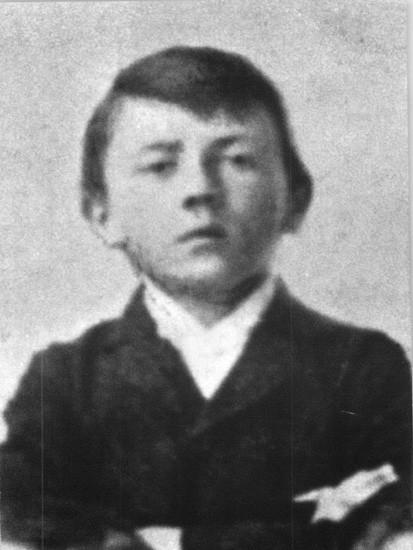
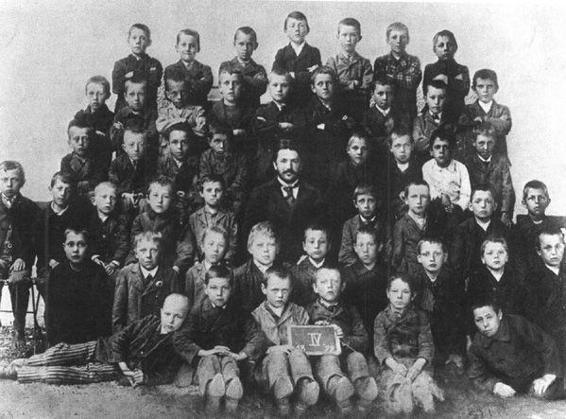
1. Adolf Hitler (top row, centre) in his Leonding school photo, 1899
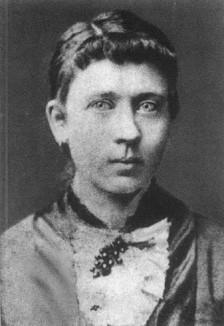
2. Klara Hitler, the mother of Adolf
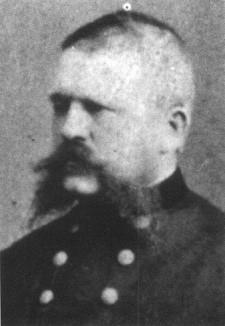
3. Alois Hitler, Adolf’s father
4. Karl Lueger, Bürgermeister of Vienna, admired by Hitler for his antisemitic agitation
5. August Kubizek, Hitler’s boyhood friend in Linz and Vienna
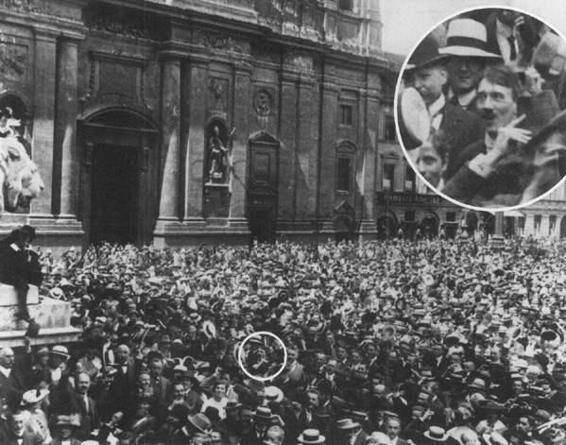
6. The crowd in Odeonsplatz, Munich, greeting the proclamation of war, 2 August 1914. Hitler circled.
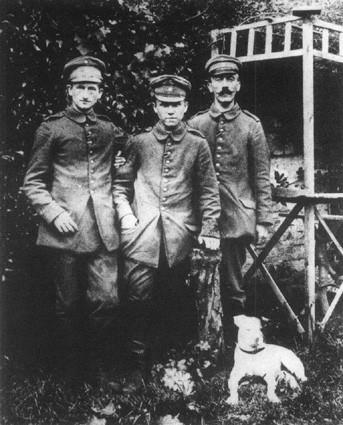
7. Hitler (right) with fellow dispatch messengers Ernst Schmidt and Anton Bachmann and his dog ‘Foxl’ at Fournes, April 1915
8. German soldiers in a trench on the Western Front during a lull in the fighting
9. Armed members of the KPD from the Neuhausen district of Munich during a ‘Red Army’ parade in the city, 22 April 1919
10. Counterrevolutionary Freikorps troops entering Munich, beginning of May 1919
11. Anton Drexler, founder in 1919 of the DAP (German Workers’ Party)
12. Ernst Röhm, the ‘machine-gun king’, whose access to weapons and contacts in the Bavarian army were important to Hitler in the early 1920s
13. Hitler’s DAP membership card, contradicting his claim to be the seventh member of the party
14. Hitler speaking on the Marsfeld in Munich at the first Party Rally of the , 28 January 1923
15. ‘Hitler speaks!’ NSDAP mass meeting, Cirkus Krone, Munich, 1923
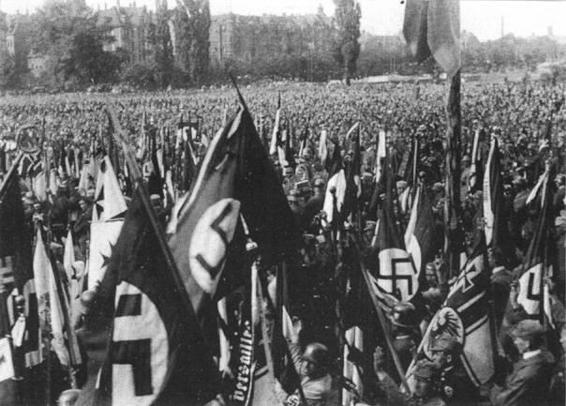
16. Paramilitary organizations during the church service at the ‘German Day’ in Nuremberg, 2 September 1923
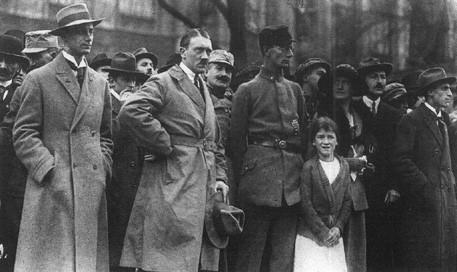
17. Alfred Rosenberg, Hitler, and Friedrich Weber (centre, behind Hitler, Christian Weber) during the march-past of the SA and other paramilitary groups to mark the laying of the war memorial foundation stone, Munich, 4 November 1923
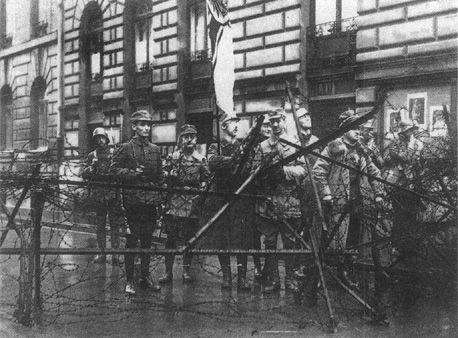
18. The putsch: armed SA men (centre, holding the old Reich flag, Heinrich Himmler, right, with fur collar, Ernst Röhm) manning a barricade outside the War Ministry in Ludwigstraße, Munich, 9 November 1923
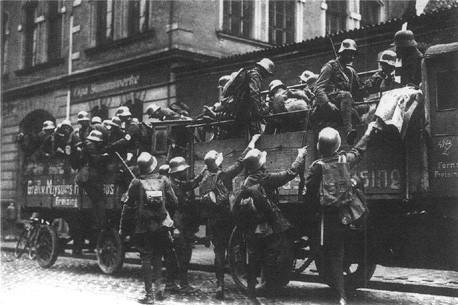
19. The putsch: armed putschists from the area around Munich, 9 November 1923
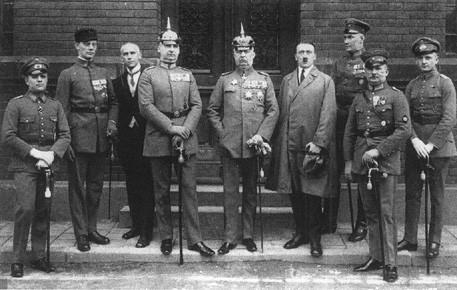
20. Defendants at the trial of the putschists: left to right, Heinz Pernet, Friedrich Weber, Wilhelm Frick, Hermann Kriebel, Erich Ludendorff, Adolf Hitler, Wilhelm Brückner, Ernst Röhm, Robert Wagner
21. Hitler posing for a photograph, hurriedly taken by Hoffman because of the cold, at the gate to the town of Landsberg am Lech, immediately after his release from imprisonment
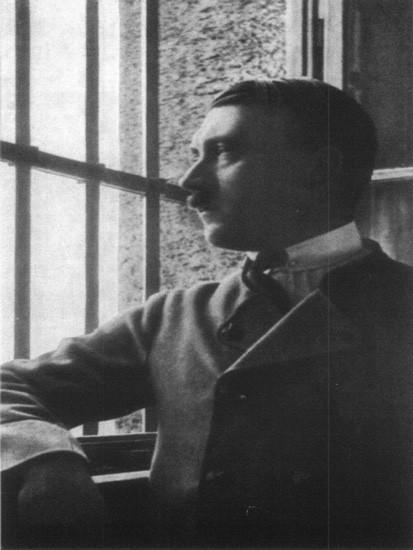
22. Hitler in Landsberg, postcard, 1924
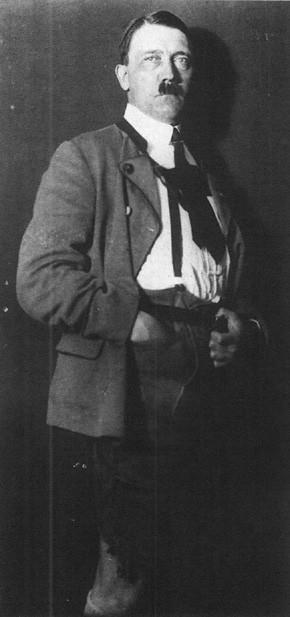
23. The image: Hitler in Bavarian costume (rejected), 1925/6
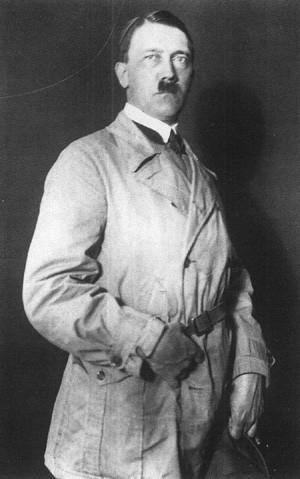
24. The image: Hitler in a raincoat (accepted), 1925/6
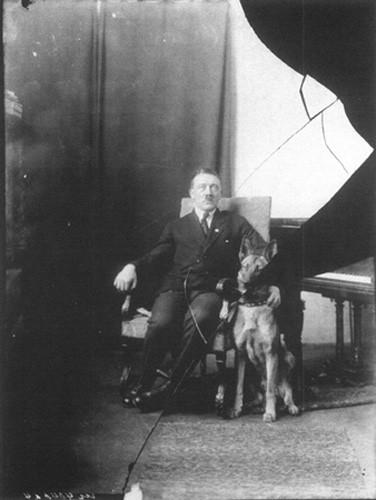
25. The image: Hitler with his alsatian, Prinz, 1925 (rejected, from a broken plate)
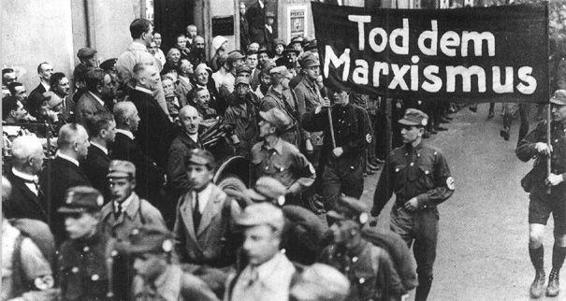
26. The Party Rally, Weimar, 3–4 July 1926: Hitler, standing in a car in light-coloured raincoat, taking the march-past of the SA, whose banner carries the slogan: ‘Death to Marxism’. Immediately to Hitler’s right is Wilhelm Frick and, beneath him, facing the camera, Julius Streicher
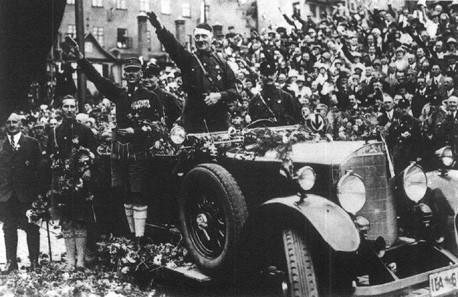
27. The Party Rally, Nuremberg, 21 August 1927: left to right, Julius Streicher, Georg Hallermann, Franz von Pfeffer, Rudolf Heß, Adolf Hitler, Ulrich Graf
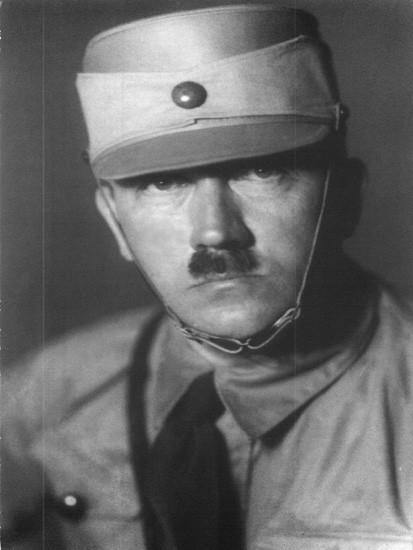
28. Hitler in SA uniform (rejected), 1928/9
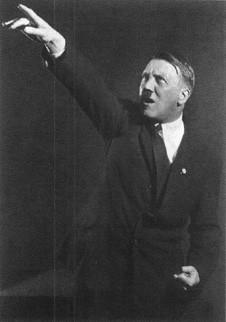
29. Hitler in rhetorical pose. Postcard from August 1927. The caption reads: ‘In the passing of thousands of years, heroism will never be spoken of without remembering the German army of the world war’
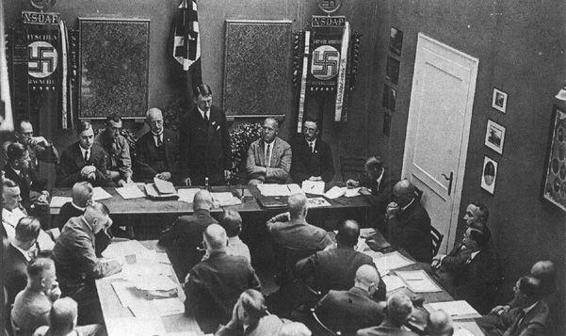
30. Hitler speaking to the NSDAP leadership, Munich, 30 August 1928. Left to right: Alfred Rosenberg, Walter Buch, Franz Xaver Schwarz, Hitler, Gregor Strasser, Heinrich Himmler. Sitting by the door, hands clasped, is Julius Streicher: to his left is Robert Ley
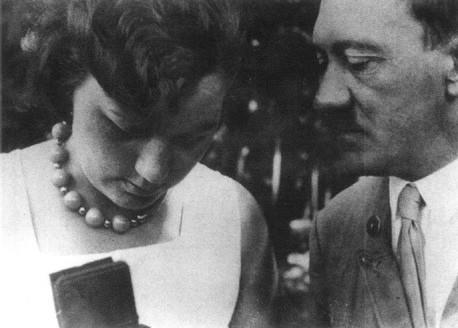
31. Geli Raubal and Hitler, c. 1930
32. Eva braun in Heinrich Hoffmann’s studio, early 1930s
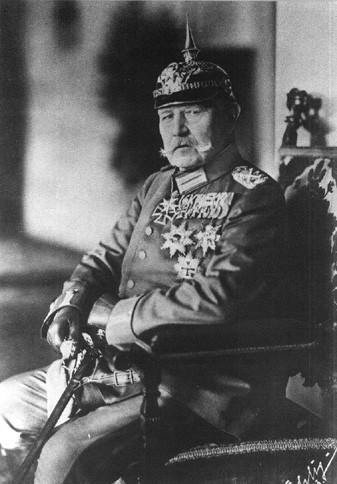
33. Reich President Paul von Hindenburg
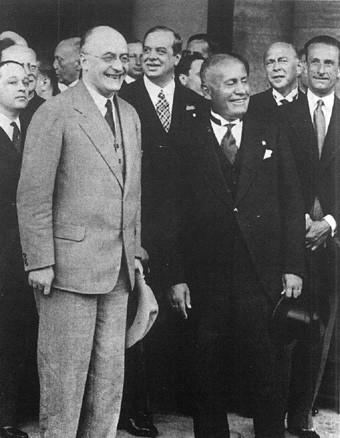
34. Reich Chancellor Heinrich Brüning (left) with Benito Mussolini, Rome, August 1931
35. Reich Chancellor Franz von Papen (front, right), with State Secretary Dr Otto Meissner, at the annual celebration of the Reich Constitution, 11 August 1932. Behind von Papen is Reich Minister of the Interior Wilhelm Freiherr von Gayl, who, that very day, put forward proposals to make Weimar’s liberal constitution distinctly more authoritarian
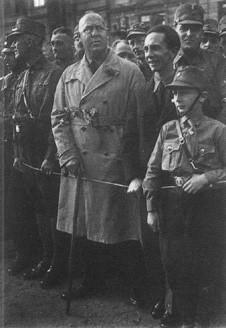
36. Gregor Strasser and Joseph Goebbels watching the SA parade past Hitler, Braunschweig, 18 October 1931
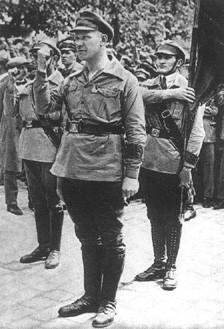
37. Ernst Thälmann, leader of the KPD, at a rally of the ‘Red Front’ during the growing crisis of Weimar democracy, c. 1930
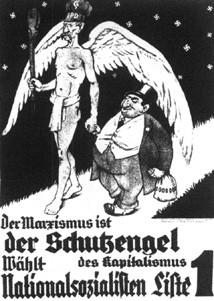
38. Nazi election poster, 1932, directed against the SPD and the Jews. The slongan reads: ‘Marxism is the Guardian Angel of Capitalism. Vote National Socialist, List 1’
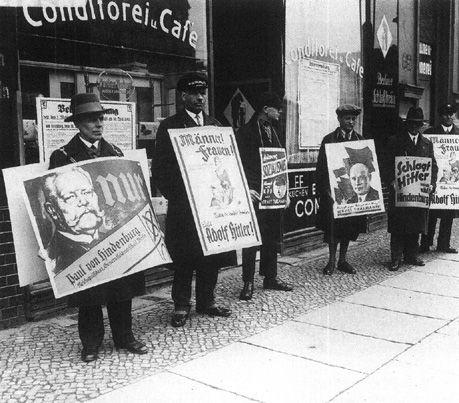
39. Candidate placards for the presidential election, Berlin, April 1932
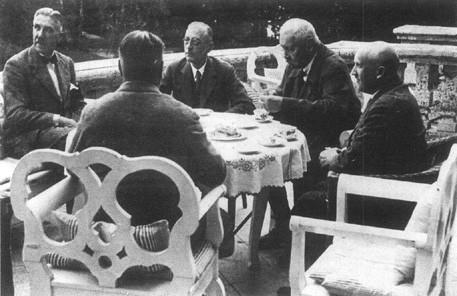
40. Discussion at Neudeck, the home of Reich President Paul von Hindenburg, 1932. Left to right: Reich Chancellor Franz von Papen, State Secretary Otto Meissner (back to camera), Reich Minister of the Interior Wilhelm von Gayl, Hindenburg, and Reichswehr Minister Kurt von Schleicher
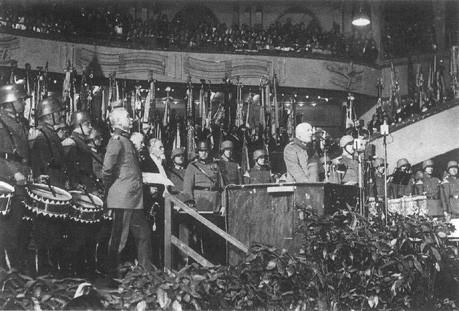
41. Reich Chancellor Kurt von Schleicher speaking in the Berlin Sportpalast, 15 January 1933
42. A photo taken of Hitler in the Kaiserhof Hotel, Berlin, in January 1933, just before his appointment as Chancellor, to test how he looked in evening dress
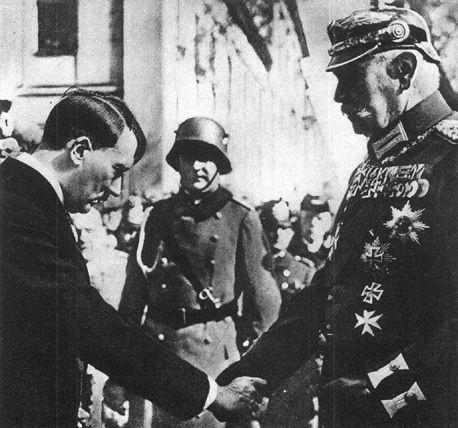
43. The ‘Day of Potsdam’, 21 March 1933: a deferential Hitler bows to Reich President von Hindenburg
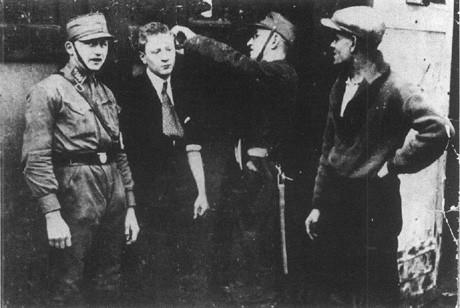
44. SA violence against Communists in Chemnitz, March 1933
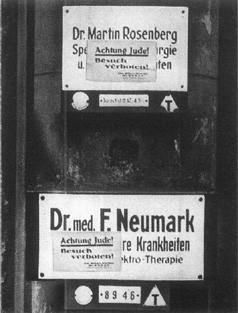
45. The boycott of Jewish doctors, April 1933. The stickers read: ‘Take note: Jew. Visiting Forbidden’
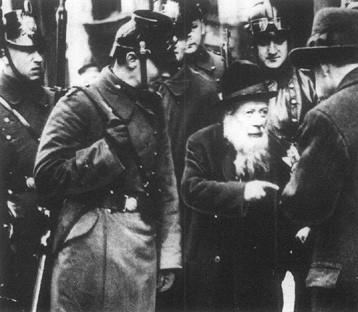
46. An elderly Jew being taken into custody by police in Berlin, 1934
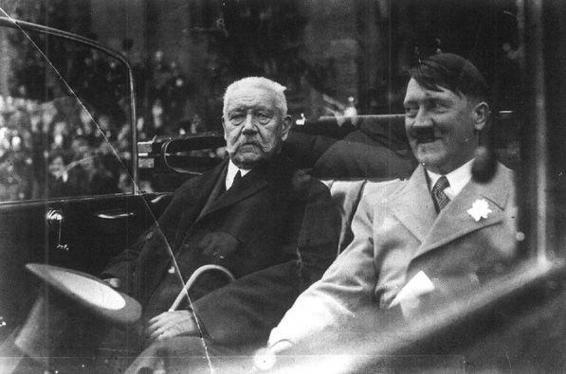
47. Hindenburg and Hitler on their way to the rally in Berlin’s Lustgarten on the ‘Day of National Labour’, 1 May 1933. The following day, the trades union movement was destroyed
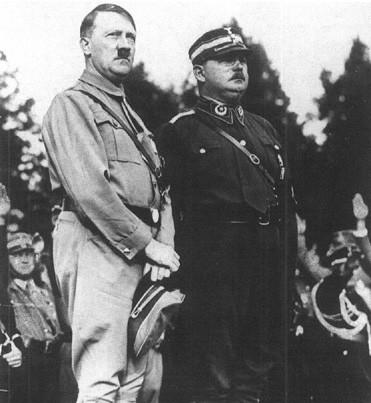
48. Hitler with Ernst Röhm at a parade of the SA in summer 1933, as problems with the SA began to emerge
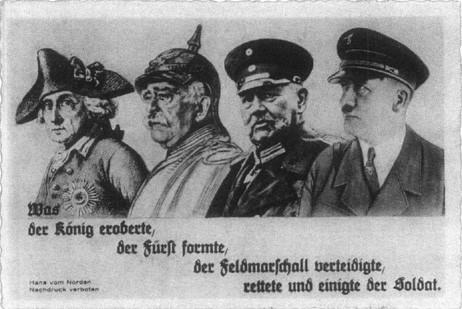
49. The Führer cult: a postcard, designed by Hans von Norden in 1933, showing Hitler in a direct line from Frederick the Great, Otto von Bismarck, and Paul von Hindenburg. The caption reads: ‘What the King conquered, the Prince shaped, the Field Marshal defended, the Soldier saved and united’
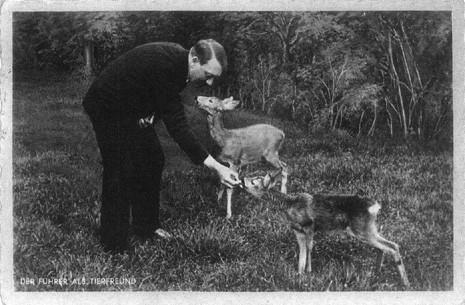
50. The Führer cult: ‘The Führer as animal-lover’, postcard, 1934
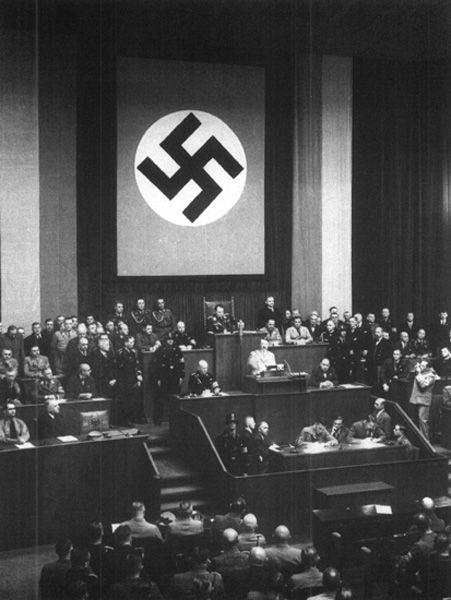
51. Hitler justifying the ‘Röhm purge’ to the Reichstag, 13 July 1934
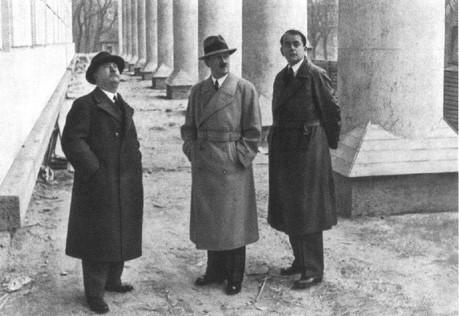
52. Hitler, Professor Leonhard Gall, and architect Albert Speer inspecting the half-built ‘House of German Art’ in Munich. Undated cigarette-card, c. 1935
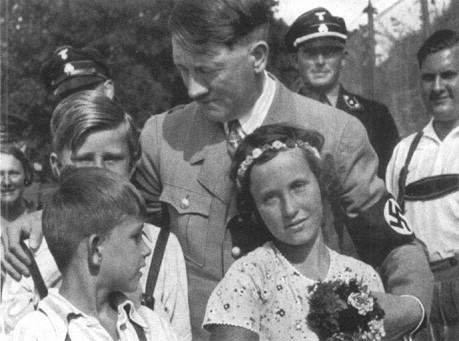
53. Hitler with young Bavarians. Behind him (right) in Bavarian costume, Hitler-Youth leader Baldur von Schirach. Undated photograph
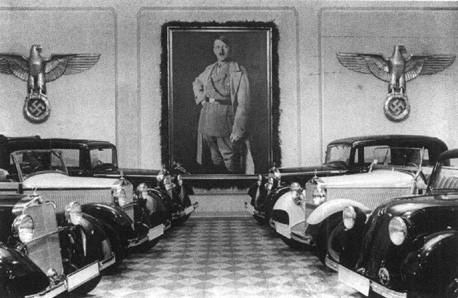
54· The Mercedes-Benz showroom at Lenbachplatz, Munich, April 1935
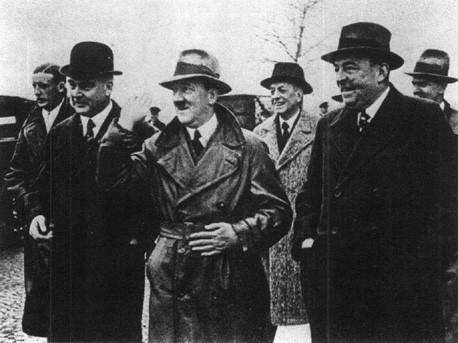
55. Hitler during a visit to the Ruhr in 1935, accompanied (left to right) by his Valet, Karl Krause, and the leading industrialists Albert Vögler, Fritz Thyssen, and Walter Borbet, all important executives of the United Steel Works
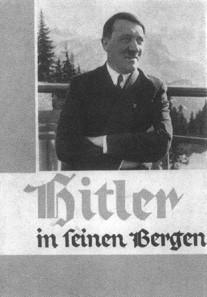
56. ‘Hitler in his Mountains’: cover of a Heinrich Hoffmann publication of 1935, featuring 88 photographs of the Führer in picturesque settings
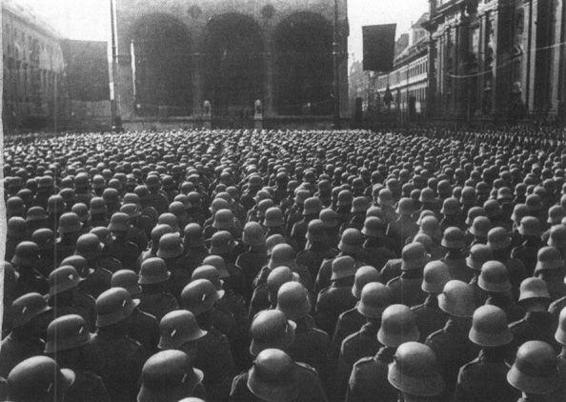
57. The swearing-in of new recruits at the Feldherrnhalle in Odeonsplatz, Munich, on the anniversary of the putsch, 7 November 1935
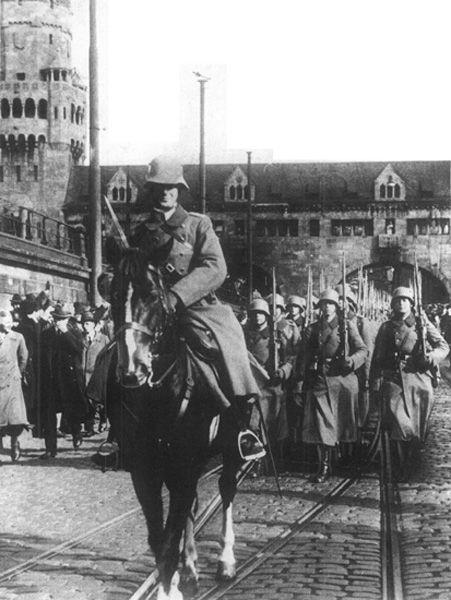
58. German troops entering the demilitarized Rhineland across the Hohenzollern Bridge in Cologne, 7 March 1936