
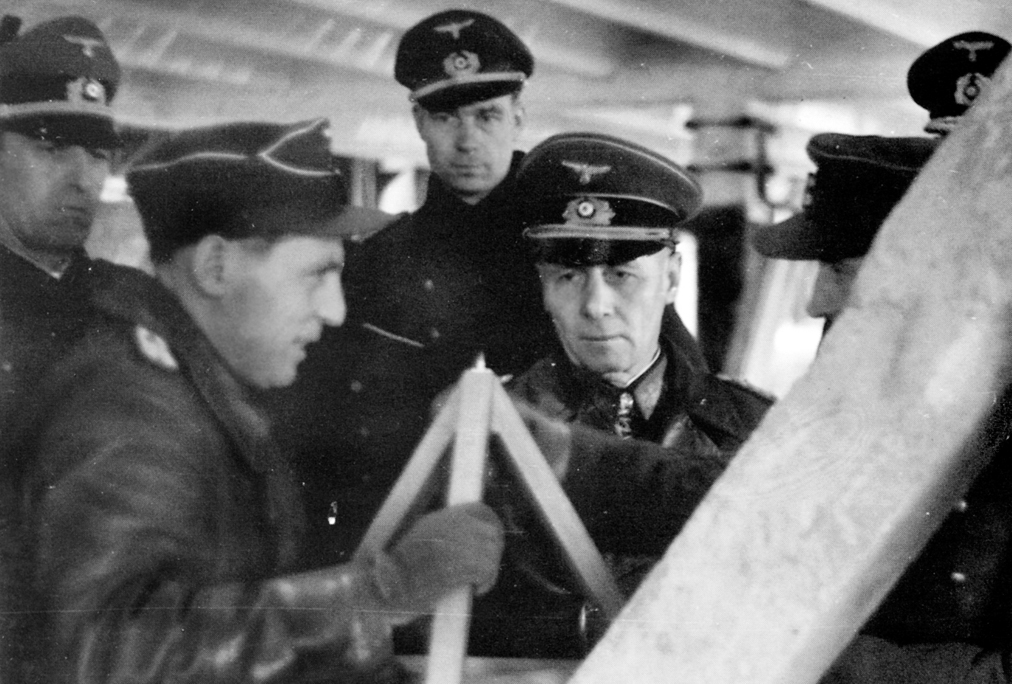
Feldmarschall Rommel is shown a new type of beach obstacle during his inspection of the Atlantic Wall defences.
THE ARCHAEOLOGISTS tell us that Iron Age man was constructing complex enclosure defences to protect his roundhouses and livestock long before history was recording the fact. Even in those days arable land was a valuable commodity and increasing competition for food and territory meant that tribal feuds and conflict became inevitable.
It was Chinese Emperor Qin Shih Huang in approximately 221BC, however, who was to take fence-building to a new level. Qin was responsible for laying the first foundations of what was to become the Great Wall of China. His intention was to safeguard his dynasty for descendants in future generations, principally from the hsiong nu or Huns. Roman Emperor Hadrian, of course, left a similar legacy on the border between Scotland and England in an attempt to prevent raiders from the north causing disruption to trade. In both cases, strong points and garrisons were positioned at strategic points, a pattern that was to change little in concept throughout the generations with areas around natural sea harbours and river estuaries particularly important to trading nations.
Hitler’s Atlantic Wall wasn’t, of course, really a wall as such but a string of impressive defensive bunkers, traps, obstacles and gun positions which stretched from Scandinavia in the north to Spain in the south. Their purpose, as the Second World War developed, became increasingly important as the shutters were put up on ‘Fortress Europe’ as the Allies began to flex their muscles in the air war. With Germany massing its troops on the Russian border, the Hitler-sponsored Organisation Todt undertook the monumental task of turning temporary gun positions into permanent fixtures on the Atlantic coast, while transportable armaments became largely static and an array of obstacless were deployed to combat possible Allied invasion plans.
The German Navy, or from the creation of the Third Reich, called the Kriegsmarine, had been responsible for defending the shoreline of Germany and the countries it controlled since the late 1800s but, in the winter of 1943 with the threat of an Allied invasion increasing by the day, Generalfeldmarschall Erwin Rommel, the famous Desert Fox, was appointed head of the new Army Group For Special Employment and, under the overall command of Generalfeldmarschall Gerd von Rundstedt, ordered to strengthen the defences where he thought appropriate. For Rommel this, his final appointment, was to prove a poisoned chalice – in more ways than one.
There are already several excellent books about the technical aspects of Hitler’s Atlantic Wall in Normandy, including D-Day Fortifications in Normandy by Steven J Zaloga (Osprey Publishing) but that is not what this book is solely about. I aim to tell a story, the story of how Organisation Todt used German construction workers and slave labour to construct the bunkers and fortifications of the Atlantic Wall. We explore the background and motivation of the men who controlled the weapons within, and read of the ingenuity and bravery of those tasked to destroy those guns on D-Day itself and in the months that followed.
There were many accounts of courage and heroism along the Atlantic Wall in the days and weeks following 6 June 1944, and I make no apologies about including many references and stories from D-Day itself, to which the fate of the Atlantic Wall is intrinsically linked. Time and space only allows me to mention but a few. However, in tracing the path taken by the men of the US First and British Second Armies, including the Canadian First and Third Armies and the British 79th Armoured Division as well as the US Rangers, I hope I have managed to give an insight into an important episode in European history.
Further, that others, perhaps another generation, will have their interest sufficiently arroused to travel across the Channel and see for themselves what remains of one of the most remarkable engineering projects undertaken in the Twentieth Century.
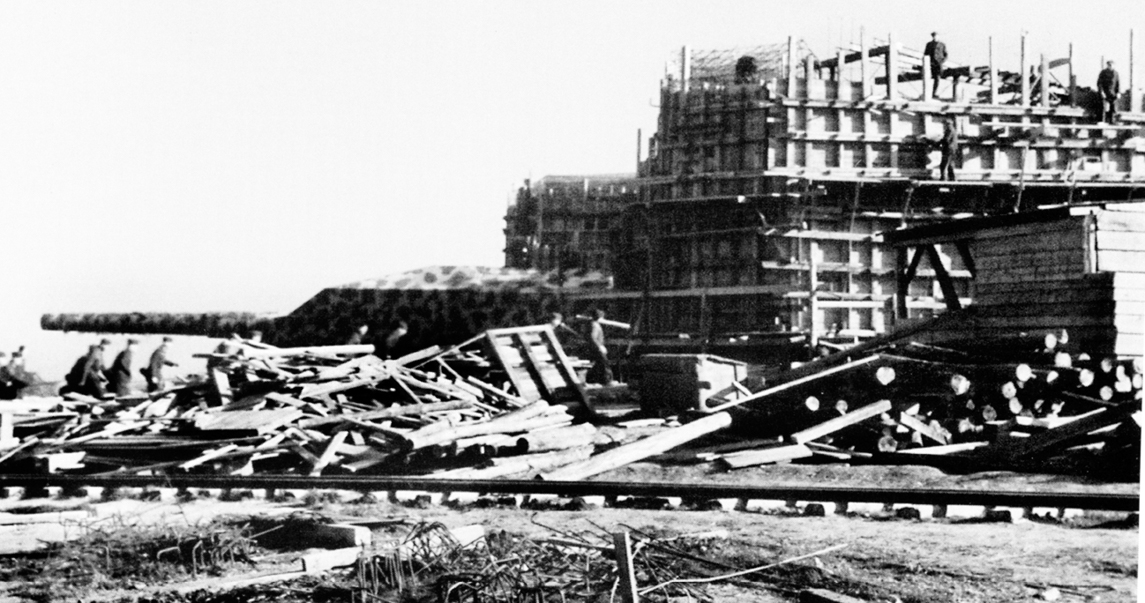
A concrete casemate under construction around a 406 mm Channel gun on Hitler’s Atlantic Wall.