
Chapter Ten
IT IS ALMOST CERTAIN that the Atlantic Wall was intended to mitigate German military weakness in the West and ostensibly deter an Allied invasion rather than form an impenetrable barrier. Ultimately, Hitler and his generals knew that once the Wall was breached, little stood in the way of an Allied advance to the German border. There might have been a chance of repulsing the Normandy invasion had the 1st Panzer Korps, based approximately 100 miles from Caen, and mobile heavy artillery been better situated or given permission to advance earlier. But a centralised and over-complex German communication structure and the fact that none of their senior commanders were in the vicinity lost the only chance the Nazi regime had to drive the Allies back into the sea and the window of opportunity was quickly closed.
In researching this book, I read somewhere that the Atlantic Wall ‘took two years to build and two hours to breach. And once breached, the rest of it largely became redundant’. That is grossly over-simplifying both the construction of the Wall in France and the reasoning behind it. Putting aside politics, Germany’s high command were not fools and, though under the control of what history accepts was a tyrant, they never intended that the Atlantic Wall would have the capability of repulsing the invasion on its own, merely that it bought time for Panzer reserves to move up from positions in the Seine valley and launch a co-ordinated counterattack. That plan may well have worked had Hitler, Rommel and von Runstedt not been trying to outmanoeuvre each other. After all the US forces were penned down for several hours on OMAHA Beach and it was only the failure of the German armour to respond quickly enough that eventually allowed the Americans to move inland. It also should not be forgotten that most of the troops on the Atlantic Wall were either second-rate soldiers or Ost Bataillone conscripted from Eastern Europe. The Russian Front had tied up most of Germany’s elite fighting force.
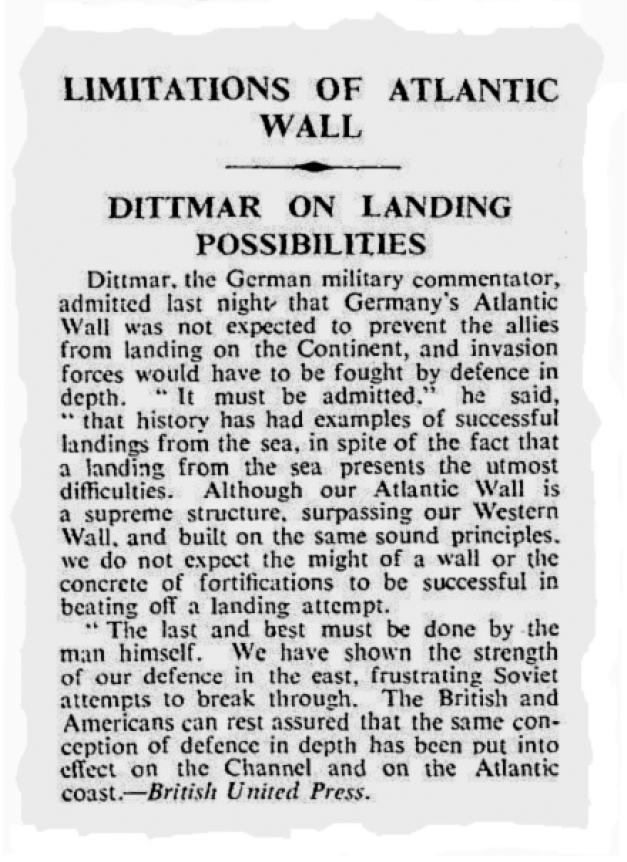
Could the Germans have created more Panzer divisions with the steel used to reinforce strongpoints and battery bunkers on the Atlantic Wall? Probably, but would not those tanks have been sent east, where the immediate need was greatest, or west on the off-chance an invasion fleet would land somewhere along a largely indefensible coastline? Without the Atlantic Wall, the Allied invasion probably would have achieved all of its D-Day objectives with ease. The advance across France and into Germany was delayed much longer than anyone had envisaged by the courage and tenacity of those Germans left behind to defend the fortified Channel ports. They knew there was no hope of escape once surrounded but it took a prolonged campaign to finally open the likes of Calais and Dunkerque to Allied shipping.
It could be argued, therefore, that Germany made the most of the resources it had at its disposal. Captured armaments were recycled as a matter of routine and slave labour and concrete was plentiful and cheap. Had German strategy complemented the fortifications and more responsive tactics been employed, there may well have been a different outcome, as Feldmarschal von Rundstedt reflected on his capture. He lamented:
Had I been able to move the armoured divisions which I had behind the coast, I am convinced that the invasion would not have succeeded.
The absence of the Luftwaffe to protect the skies and constant counter-productive interference from higher levels, certainly played major roles in the defeat of the German Army after the Normandy invasion, according to von Rundstedt. But the former German commander-in-chief on the Western Front also admitted that he and his senior officers and been outsmarted by the Allies and took several decisions that were to compound their plight.
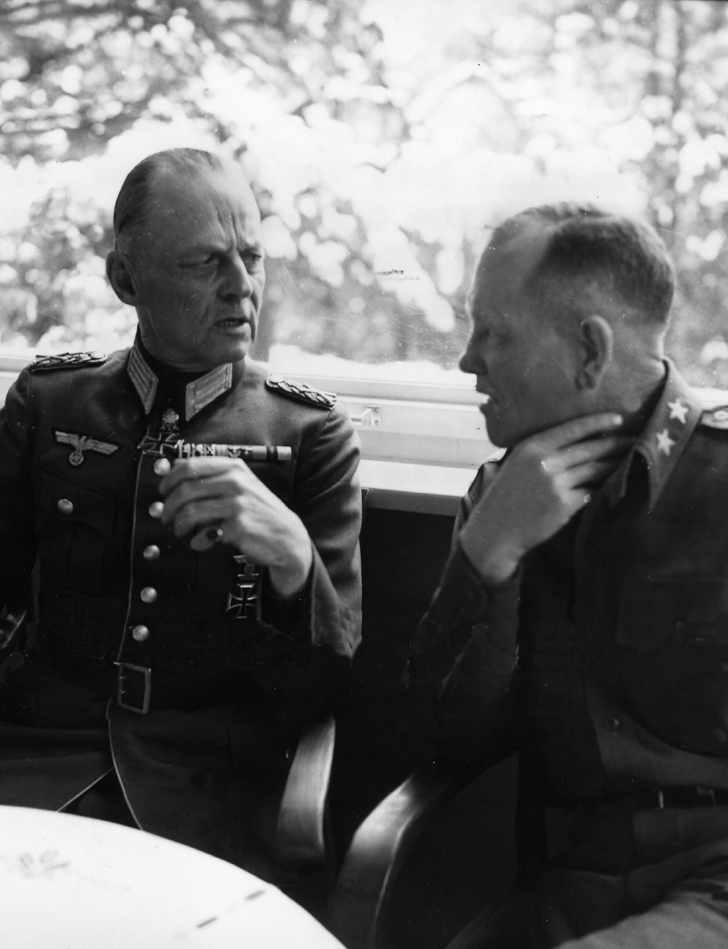
Von Rundstedt discusses what might have been if it had not been for… with his American captors.
Von Rundstedt had surmised that the landings on OMAHA and UTAH and subsequent push up into the Cotentin Peninsula were merely a feint to distract from landings on either the Belgian coast or in the Pas De Calais farther west. By the time he and his subordinates realised that the 6 June invasion wasn’t a false front, it was too late to save anything but the main reserve force of the German Army in France.
It was also alleged that interference from Berlin had wrecked earlier plans for the defence of France against invasion. Von Rundstedt knew there were not enough troops to cover the possible areas of invasion and also faced a constant battle to prevent those he had under his command being allocated to duties elsewhere. When he was finally given carte blanche, it was too late as the RAF and USAF had such overwhelming air superiority that they quickly reduced his reinforcements to tatters, cutting communications and destroying logistics and established defensive positions.
The position on the ground immediately prior to D-Day was a shambles, Von Rundstedt admitted. He and former Chief of Staff, General Blumentritt, highlighted several basic weaknesses in the German defences. There was an inadequate number of troops to cover stretches of exposed coastline with gaps in the Atlantic Wall of up to thirty miles in places. The Wall itself was ‘anything but a wall, just a bit of cheap bluff’ according to von Rundstedt, and there was no organised reserve under central command to counterattack where the invasion came.
Von Rundstedt, like many other high-ranking German generals, said he did not have access to his country’s most proficient troops. He complained bitterly that many of his best units had been sent on a ‘fool’s errand’ to Italy, and throughout his command and after, he maintained the notion that it was,
Madness to continue the war in Italy that way. That frightful ‘boot’ of a country should have been evacuated. Mussolini should have been left where he was and we should have held a decent front with a few divisions on the Alpine frontier. They should not have taken away the best divisions from me in the West in order to send them to Italy.
Of course, he knew that German High Command was running out of troops on all fronts. ‘Had I been able to move the armoured divisions which I had behind the coast, I am convinced that the invasion would not have succeeded.’ he told the Americans, ‘If I had been able to move the troops, then my air force would also have been in a position to attack hostile ships.’
Von Rundstedt revealed that his original plan would have been to ensure that the Allies would not have been able to sail their battleships close to shore so that they could engage the coastal batteries and forces would have sustained prohibitive losses during landing operations. To some extent, that happened at OMAHA but the British were able to come ashore with relative impunity on SWORD and the Canadians also made rapid inroads from JUNO. ‘That was all a question of air force, air force, and again air force,’ he commented.
Von Rundstedt wanted the landing beaches to resemble the disastrous Dieppe raid, only on a much larger scale, and remained adamant that the Allies would have had a much rougher ride had he been able to control his armoured divisions as he desired, ‘We would certainly have been better off if a good many things had been different as regards the distribution of forces.’ he reflected.
As for the Atlantic Wall itself, Von Rundstedt admitted it was a gamble that didn’t pay off, ‘The enemy probably knew more about it than we did ourselves,’ he confessed, proclaiming the only wall that mattered in the Second World War was the one that ran from the Scheldt in Antwerp to the Seine in Paris, ‘But further than that – one has only to look at it for one’s self in Normandy to see what rubbish it was.’
With the exception of the fortress port of Cherbourg the Atlantic Wall in northern France, according to Von Rundstedt, merely consisted of a few pillboxes in holes in the sand so far apart that ‘you needed field glasses to see the next one’. It was simply propaganda, he said, but admitted that the German people had believed it. He thought, however, that the Allies would have easily worked out its weaknesses because of their extensive air reconnaissance and the help of the local French Resistance.
Reflecting on the subject of German coastal batteries and artillery, the Kriegsmarine policy of mounting coastal guns as if they were on ships came in for particularly heavy criticism. It was undoubtedly a major design fault that the vast majority could fire only out to sea. Subsequently, they were of no use to land forces once encircled and the fact that most coastal batteries incorporated mainly captured guns meant it became increasingly difficult to keep them supplied with the correct ammunition.
Finally, von Rundstedt confessed that the Americans had totally caught him and his staff off guard by using the Cotentin Peninsula, and ultimately Cherbourg, as a giant beachhead. None of the German hierarchy could believe that the landings in Normandy were aimed primarily at securing a harbour. The route to the interior of France, after all, was three times as long from Cherbourg. Even as the Allies poured into the Cotentin Peminsula, most Germans still believed the major thrust would come through either Dunkerque or Antwerp and toward the Ruhr, which was why the troop concentrations were more compact in that sector and the fortifications more robustly constructed. The Cotentin, the German navy had assured field commanders, was only accessible at high tide and even then rocks and reefs below the water would wreak havoc on troop ships and landing craft. Of course, the Allies were to gain a further advantage by landing at low tide.
‘We probably didn’t know about the floating harbours.’ Von Rundstedt admitted in explaining that the Germans had not considered Normandy as a likely landing area. ‘I, at least, didn’t. Whether the Navy knew of them I don’t know.’
In June 1944, there were six or seven Panzer divisions in reserve but they were well spread out behind the front line in the west. Two were immediately available when the invasion started and two others were able to join the fray on the first day. Another one came from Belgium and a sixth was due to arrive from southern France. 2 SS Panzerdivision Das Reich arrived late, however, due to the action of the Resistance.
‘The defensive role played by the armoured divisions near Caen during July and August was a great mistake,’ Von Rundstedt confessed, ‘but it was done on the orders of higher authority. We wanted to relieve the armoured divisions by infantry, but it was impossible in the bulge in front of Caen where they were also under fire from ships’ guns. You can’t relieve any troops then.’
Von Rundstedt’s plan, which was rejected by Hitler, was to withdraw the armoured forces behind the River Orne to the east of Ouistreham, form up the reserve infantry and field artillery there, and then use the tanks as mobile units to attack the British and Canadian forces on the flanks. This option was backed up by the senior tank commander, General Geyr von Schweppenburg, but the armoured divisions were left where they were on the Führer’s personal orders.
In conclusion, two vital factors led to the breaching of the Atlantic Wall and subsequently the success of the D-Day landings.
Firstly, there was the smashing of the main lines of military communication and transport, particularly the railway junctions. Available reserves couldn’t be moved to the threatened areas and made the re-supply of armaments to batteries and strongpoints near impossible. The second factor was the attacks on road links and marching columns. This made it extremely difficult to move anything during daylight hours, and created bottlenecks of fuel and ammunition which could then be targeted by carpet bombing.
Senior Allied commanders were divided over the impact of this on German defences but Von Rundstedt said it had a profound effect on troops stationed on the Atlantic Wall in northern France. It also demoralized those reserves held in the rear. German planes by this time were outnumbered ten to one and any long-range reconnaissance had become ‘absolutely nonexistent’. He was also scathing over the impact of ‘Rommel’s asparagus’ which was planted with much fanfare as an effective defence against airborne invasion, but in many places was either covered by drifting sand or washed away by high tides.
So did the Atlantic Wall in Normandy and the Pas de Calais do what it was designed to do? On many levels, I believe the answer was in the affirmative. As a tool of propaganda, it reassured the German civil population that the Western Front was well protected. Likewise, it forced the Allies to take special measures to breach it. Concrete consumption on the Atlantic Wall actually declined in the months prior to D-Day as the RAF cut supply lines so one could argue it would have formed an even more imposing barrier had all the defences planned been carried through to completion and most of those with the authority to order reserves into action had not been absent or unwilling to act on D-Day.
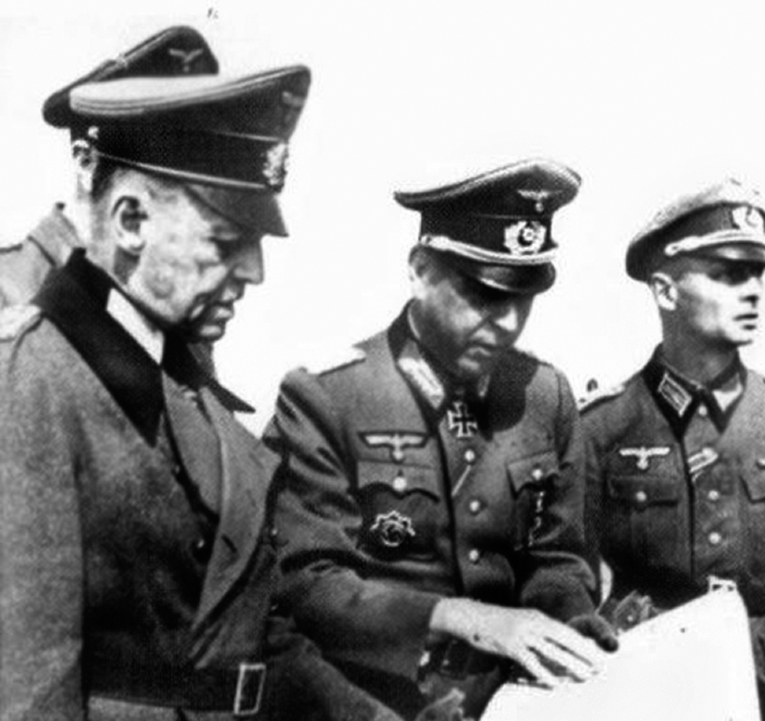
Field Marshal Gerd von Rundstedt, overseeing plans of the Atlantic Wall Construction.
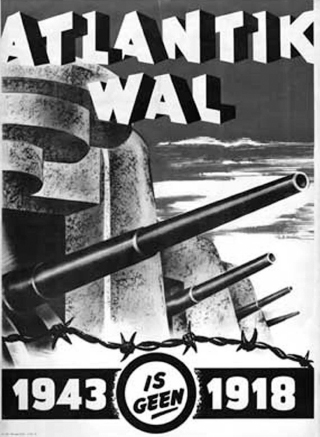
A Propaganda poster in Dutch and the coastal fortification is depicted as a continuous line. It declares that 1943 will not be like 1918 when the Second Reich was forced to sign an armistice.
But the fact remains that once most sites had been circumvented and the allies had crossed the Seine, the game was more or less up as far as the defenders were concerned and thousands of German troops were sacrificed in the Festunghäfe ports with no hope of rescue. There is probably some substance to the theory, therefore, that it wasn’t the Atlantic Wall that failed, but those German generals who planned around it.
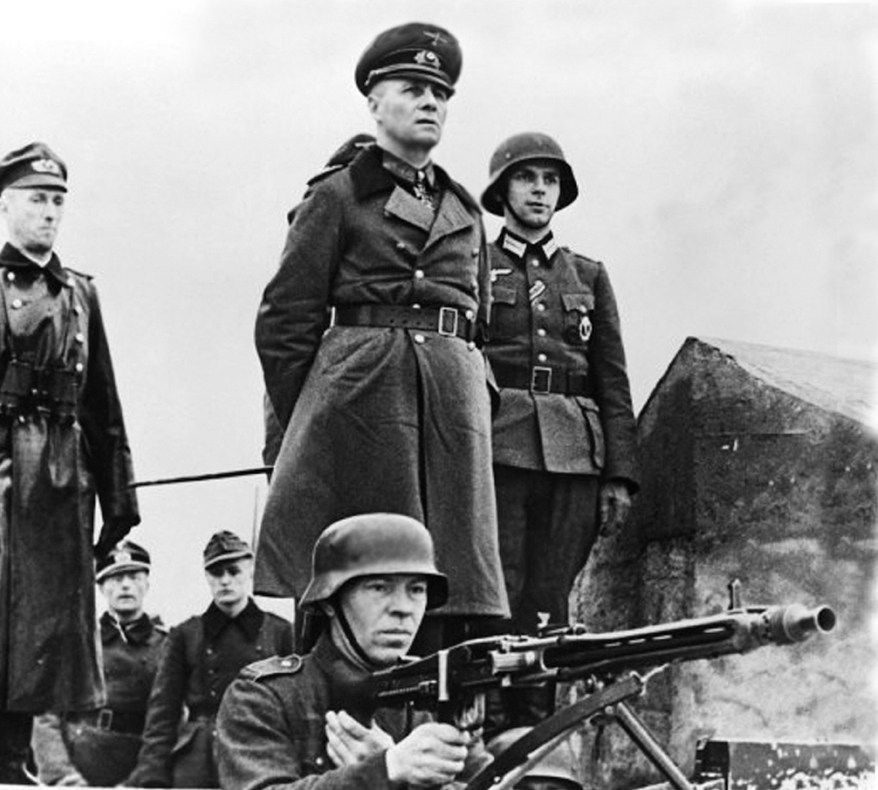
Rommel watches a firing excercise take take place on the Atlantic Wall.