In July 1944, the armed forces journal Offiziere des Führers (Officers of the Führer) published an essay by Walter Gross of the Racial Policy Office. It presented the usual argument that bloodlines contribute more to a person’s intrinsic characteristics and qualities of leadership than academics and material circumstances. With respect to the military, Gross added this: “On the Führer’s orders, the officer’s career became open to every German man without consideration of social origin and education. Some expressed misgivings. They saw this as the intrusion of a radical socialist principle, and a danger to the accomplishments and bearing of the officer corps. Dozens of times I've encountered objections to this National Socialist innovation; objections from those who point to the lofty, inherent value of a leadership class cultivated over generations of selecting the best from soldiers' and officers' families.”
Gross parried this protest with the observation that any traditional, exclusive system stifles the development of unexplored human resources within the nation: “Beyond such socially elevated families, there also rests within a people thousands upon thousands of individuals of comparable aptitude, submerged in the broad masses. They possess the same value to the community and are capable of accomplishing just as much in a particular field as the best of the old, cultivated families. . . .Wherever people with similar and equally precious qualities lie undiscovered, then it is possible and indeed necessary to find them, and place them in communal life. With the right training, they can achieve the utmost they're capable of. . . . The standard for determining whether the inherent prerequisites are present or are lacking, is one and the same for both groups; it lies exclusively in accomplishing the task at hand."188
When Hitler reinstated national defense before the war, the men occupying positions of command had entered service during the time of the old army. Many senior officers displayed little imagination or adaptability to warfare’s innovations such as armor, aviation, and elastic defense. Their shortcomings became especially apparent in the campaign against Soviet Russia. Some generals lacked the boldness, initiative, and raw nerve to outthink, outmaneuver, and outfight such an imposing military goliath and were dismissed. Replacing them were often men from ordinary backgrounds. Hitler himself stated in January 1944, “More than 60 percent of the new officer corps rose through the ranks, creating a bridge to the hundreds of thousands of workers, farmers and members of the lesser middle class."189
Though deprived of imperial privilege, the scions of Germany’s distinguished families retained their ancestral honors, and found the same path of opportunity open to them as to all of their countrymen. Most men of their younger generation dutifully entered frontline service during World War II, doing credit to their traditional standing. The inveterate conservatives and reactionaries among the aristocracy gravitated to the diplomatic corps and to the general staff, where they could inflict maximum damage to the German cause at minimal risk. Solitary and aloof, the resistance movement allied itself with the only group capable of destroying the social revolution that had transformed Germany: the enemy. To topple a form of government, the subversives accepted the enemy’s war aims, with all the consequences for their own country.
During a session with the Western Allies in Madrid on April 17, 1944, the conspirator Otto John asked that the demand for unconditional surrender be rescinded. The Anglo-American representatives replied that they intend to allow the Russians to be the first to invade Germany and enter Berlin. The Germans deserve to be punished, they maintained, and the job was better left to the Soviets.190 The Russians discharged the task as follows: In October 1944, the German 4th Army repulsed an offensive toward Königsberg in East Prussia by the Soviet 11th Guards Army. Recapturing Nemmersdorf, German soldiers discovered 72 murdered civilians, including the ravaged bodies of young women whom the Russians had nailed to barn doors.191
In Schillmeyszen in the Memel territory, the German artillery gunner Erich Czerkus was among the counterattacking troops re-entering the village, which was his home town. This is what he discovered after the withdrawal of the Soviet 93rd Rifle Corps: “I found my father in a barn, lying face-down with a bullet hole in his neck. In a stall lay dead a man and a woman with their hands tied behind their back, both bound together by a rope. In another farm we saw five children with their tongues nailed to a large table. Despite a desperate search I found no trace of my mother. While looking, we saw five girls bound together with rope. Their clothing was completely stripped away and their backs badly lacerated. It appeared that the girls had been dragged a long distance."192The Germans documented countless other atrocities.
The Soviets renewed the invasion of East Prussia in January 1945. They surrounded Königsberg. The German army conducted a relief operation beginning on February 19. Several German divisions, including the 5th Panzer, simultaneously attacked outward from the invested city. In the town of Metgethen, advancing troops recovered the bodies of 32 women whom the Russians had raped, murdered, and thrown into a shell crater. Master Sergeant Kurt Göring, a German tank commander participating in the attack, offered this testimony: “Then we reached Metgethen. We were appalled to see what had happened here. At the rail station was a refugee train standing on the tracks, with women and young girls. They had all been raped and murdered. We wrote on the side of the rail car, 'Avenge Metgethen.' The fighting went on without quarter."193
Another eyewitness participating in local German counterattacks was Sergeant Günther Adam, who recalled this: “We attacked and recaptured a town displaying the same crimes of these beasts. On a snow-covered, trampled-down village street was what remained of a young woman. It looked as though she was wearing a fur coat. She was lying on her back, her arms and legs outstretched. (The Soviets) had run her over with a tank and crushed her. This bloody, ground-up mass was frozen solid and the most horrible thing I ever saw during the war.... In a house, we found some men who had been beaten to death. In blood-soaked beds were ravaged women, who were still alive. Then worst of all, we found the head of a baby spiked to a bed-post.” 194

Red Army units overrunning German POW camps ruthlessly impressed the Russian inmates into first wave infantry battalions, or treated them as deserters. At the Alt-Drewitz camp, they fired on 30 American prisoners whom the German guards had failed to evacuate, killing some. This was the Soviet army, which Stauffenberg, Olbricht and their associates enabled to enter Germany.
The Western powers also waged war against German civilians, but from the air. In July 1943, the British Royal Air Force and the U.S. Army’s 8th Air Force conducted several nearly consecutive bombing missions against Hamburg. In the bombardment 30,482 residents perished by being blown apart, incinerated, asphyxiated, or buried by rubble. Among them were 5,586 children. Fires destroyed 24 hospitals, 277 schools, and 58 churches.195 An officer assisting in the evacuation of refugees described how some passenger cars carried grey-haired children, aged practically overnight from the terrors of the raid.196
Among the eyewitnesses was Gerd Bucerius of the resistance movement. In a Hamburg suburb, he watched the approach of the English bombers from his rooftop: “Finally, I shouted! Too long I have waited for the Allies to destroy the world-enemy Hitler. . . . What horror, what sorrow, I naturally thought back then. But also, you dead want it this way. And whom did I worry about during the attack? The pilots! They were valiant and did what I had hoped of them."197 After the war, the U.S. Army conducted a survey of German morale. Responding to the query about what caused the population the greatest suffering under Hitler, 91 percent of Germans who were polled cited Allied air raids. Just two percent completing the questionnaire marked “loss of freedom” or “Nazi crimes."198
“July 20 demonstrated that thoughts about high treason had no roots in the majority of the people,” Schwarz van Berk summarized. “What deprived the would-be usurpers of the last grain of sympathy was the clearly apparent intention of those involved not to risk their lives for what they claimed was an urgent necessity in the interests of their country, but to personally survive and satisfy their ambition for future positions of authority.” This SS officer also emphasized that the Gestapo was not the force that maintained cohesion and kept the Germans in line. This, he argued, was an illusion nurtured among those opposing the government. “The people and the troops fought bitterly and doggedly in the awareness that this struggle was literally a question of national and personal existence. Especially on the eastern front, there were as good as no deserters in the front lines. There were practically no saboteurs on the workbenches in the armaments factories at home. . . . The nation stood as never before in common cause, summoning all its moral strength to survive."199
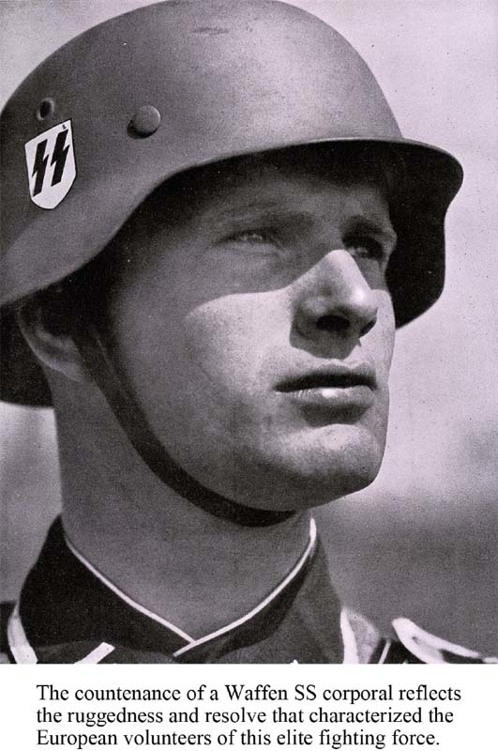
Of the 70 military officers implicated in the plot to overthrow or assassinate Hitler, 55 were aristocrats.200 This class-conscious clique resorted to sabotage, treason, and murder to achieve its ends. Also dissatisfied with elements of the Reich’s foreign and domestic policies were members of the Waffen SS. Youthful and idealistic, they fought both to preserve their continent from foreign invasion and for revolutionary change, not to restore anachronistic distinctions in title and rank of the former imperial age. The SS men promoted their social and political agenda through loyalty, service, and sacrifice. They gained influence through courage and commitment, working within the legal framework to reform rather than destroy the existing order. They were prepared to give up more than they expected to gain as individuals, for the benefit and growth of the European community.
A comparison of two persons, one an icon of the resistance and the other an ordinary German infantryman, illuminates the essence of the contrast: The son of a prominent psychiatrist, Pastor Dietrich Bonhoeffer covertly assisted the Abwehr in its intrigues against the German cause. His relatives traded profitably on the black market. Visiting Geneva in 1941, he told fellow clerics, “The Christian faith must be rescued, even if an entire nation must perish” (He apparently saw no contradiction in aiding the Soviets).... “I pray for the defeat of my fatherland."201 Nowhere near the fighting front, Bonhoeffer occasionally travelled and enjoyed a comfortable existence until April 1943, when the authorities jailed him for undermining the war effort.
In August 1940, the 17-year old Fritz Hahl volunteered for the Waffen SS. Assigned to the Wiking division, he saw his first action against the Red Army on July 1, 1941. During the balance of the war, Hahl was on the front line 861 days. He suffered seven wounds in combat. He wrote after the war, “Today I can no longer comprehend how as a young man from 17 to 22 years of age, I found the strength to keep my self-control again and again, to conquer my fears and then continue fighting, and despite the setbacks still believe in a good outcome. One argument alone determined my actions and those of my generation: Together with my troops, like all German soldiers, we wanted to protect our homeland with its women and children from the Soviets - and without regard for ourselves."202