
The Industrial Revolution paralleled Western civilization’s political transition during the 18th Century. James Watt’s development of the condensing steam engine in 1769 and Edmund Cartwright’s inventions of the power loom and wool combing machine a few years later introduced the age of weaving mills, coal mines and factories. The need for manpower to fill manufacturing jobs attracted rural folk (many of whom had lost their livelihood to mass production) to city-based industry. In the 1840s, expanding railroads facilitated their migration to the major population centers. This created a new class of people: labor.
Concentrated in squalid, overcrowded lodgings, members of Europe’s industrial work force had a comparatively low standard of living. Men, women and children toiled for excessively long work days in unhealthy and often unsafe conditions for meager wages. These circumstances, together with social isolation from the rest of the population, gradually led to the political radicalization of labor. In Germany, the president of the Prussian cabinet, Otto von Bismarck, promoted social reform to relieve the distress. He advocated legislation in 1863 to provide pensions for retired workers and to establish a protective association for Silesian weavers. The latter program Bismarck financed personally. The Prussian cabinet and parliament - liberal, clerical and conservative delegates alike -opposed reform. They considered the programs socialistic and contrary to the free play of forces.
Undaunted, Bismarck discussed labor issues in May 1863 with Ferdinand Lassalle, the founder of the Universal German Workers Union. They covered voting rights for labor, state-sponsored workers' associations and disability insurance. Lassalle eventually became frustrated with parliamentary opposition and remarked a year later, “revolution is the only remedy."44 His death in a duel was nevertheless a setback for constructive efforts to incorporate labor into the populace as a cohesive element. Social ostracism led to resentment among workers. In 1875, the periodical of the Social Democratic Workers Party, Volksstaat {The People’s State) declared, “Class hatred forms the basis for today’s society."45
Certain reforms Bismarck managed to legislate fell short of his goals and of labors' expectations. The inexorable radicalization of labor ultimately found expression in the doctrines of Karl Marx. Banned from Germany in 1848, Marx formulated his political-economic program in England. He based his conclusions, published in Das Kapital, mainly on the findings of government commissions surveying labor conditions in English factories. His ideas found a receptive audience among working Germans. Whereas early socialist reformers like Wilhelm Weitling had fought for labor’s acceptance into the German national community, Marx propagated class warfare. The exploited labor stratum, Marx preached, owed no allegiance to its nationality, but should seek solidarity with oppressed workers, the so-called proletariat, of other countries.
A fresh wave of nationalism swept Germany when World War I broke out in August 1914. Members of the middle class, common laborers and tradesmen fought side by side in the German army during the prolonged struggle. The comradeship at the front partially overcame class barriers and diminished individualist attitudes. Within Germany, the endless nature of the conflict, food shortages, and the government’s neglect of domestic morale led to war fatigue. When the Bolsheviks, a Marxist revolutionary movement, overthrew the Russian government and concluded a peace treaty with Germany and her allies in March 1918, this encouraged German Marxists. They organized public demonstrations by labor as well as strikes and finally a naval mutiny. This helped topple the emperor. A democratic government assumed power, and Germany concluded an armistice with her Western adversary, the Entente, in November 1918.
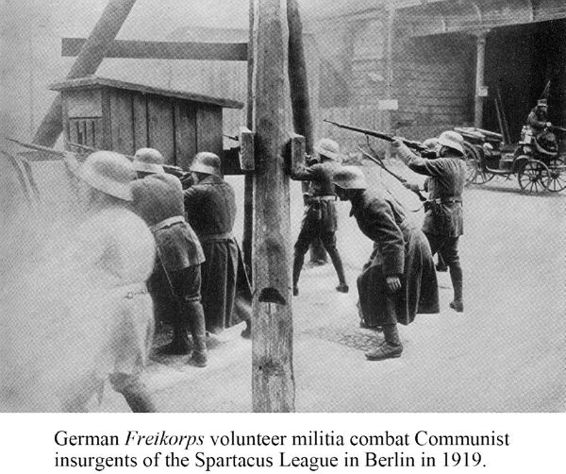
Supported by the Bolsheviks in Russia, German Marxists established Soviet republics within the Reich. The military commander of the Communist Party of Germany, Hans Kippenberger, stated, “Armed insurrection is the most decisive, severe, and highest form of class struggle which the proletariat must resort to... to overthrow the rule of the bourgeois."46 The month-old Spartacus League staged a Communist uprising in Berlin in January 1919. German military formations suppressed it, causing considerable loss of life. The army quickly crushed Soviet republics proclaimed in Brunswick and Baden. The Communist seizure of Munich in April led to another armed clash, resulting in 927 deaths. The German army and patriotic militia known as the Freikorps (Volunteer Corps) put down additional Soviet revolts throughout Germany over the next three years.
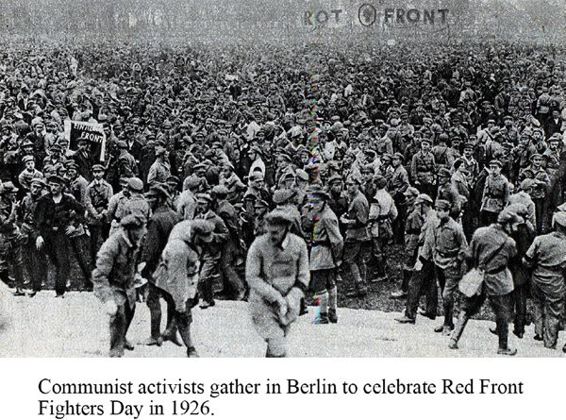
Despite the unifying influence of the World War, class distinctions resurfaced during the 1920s. The largely impoverished middle class maintained social aloofness from the industrial work force. Labor was consequently still susceptible to Communist propaganda about exploitation by capitalism. The Red Front attracted millions of followers during the politically tumultuous years of Germany’s Weimar Republic. The Communists sought power through elections after 1923.
To win labor for his cause, Hitler endeavored to make the destructive nature of Marxism apparent to German working men and women. National Socialism described it as a perverse by-product of the Industrial Revolution. It owed its success to the neglect of the working class by the imperial government in the 19th Century, liberalism’s creation of social barriers within Germany’s national community, and labor’s abrupt loss of roots. The former farmer or artisan, accustomed to creative, useful work with his hands and bound to the soil, was suddenly displaced and operating unfamiliar factory machinery in drab urban environs. A handbook published for German armaments workers summarized labor’s alienation as follows: “The person hatefully regards the machine he feels chained to. It is not his friend and helper. It only drives him in a pointless race for the avaricious interests of individual capitalist employers. It represents unemployment and starvation for many of his fellow workers. The machine distances the person more and more from nature."47
According to the 1938 book Der Bolschewismus (Bolshevism), “such social conditions facing the German worker were the product of liberalism. Like the Renaissance, it glorified the freedom of action and development of the individual, which means the same thing as unscrupulously advancing one’s personal interests."48 In his 1935 work Odal, Dr. Johannes von Leers added, “Liberalism’s preaching about the unconditional rights of the economically more powerful is so blinding, that de facto economic slavery is considered progress."49 Leers described the impressions of a typical German farm hand entering the industrial work force, in order to demonstrate the susceptibility to Marxist preaching: “Everywhere he encounters a merciless system of capitalist commerce. His only value is as the seller of himself as a 'labor commodity.'... From poorly compensated work to unemployment and then back to work again for low wages, despised by the educated class, watched suspiciously by the police, it’s no wonder he becomes indignant."50
Der Bolschewismus related a further source of resentment as labors' standard of living compared with that of people in affluent neighborhoods: “The man of the stock exchange and factory owners build villas in exceptional, well laid-out sections of the growing cities. The contrast to their own wretched quarters in overcrowded lodging houses, near the smoking chimneys of the factories, becomes ever more apparent to the masses of workers."51 In Odal, Leers wrote that only because German society turned a blind eye to the distress of the working people were the Communists able to recruit them: “The country’s propertied and educated strata, in contrast to the English upper class which was far more responsible about this, blocked any genuine, concrete social reform. It was their selfish belief in the laws of free trade, their heartlessness and callousness."52
Society’s failure to nurture and accept the working class as equal divided Germany, contributing to Marxist-organized strikes and mutinies that sabotaged the war effort in 1918. This circumstance supported Hitler’s contention that various groups within a nation, while maintaining their individual character and function, must work together as a mutually supportive entity for common goals, impartially regulated by the state. To disregard one group was to jeopardize all. Entering politics in 1920, Hitler had to combat the substantial Marxist trend among the workers. At this time, many social and economic strata in Germany formed parties championing their individual interests. This was especially dangerous in labor’s case, since it allied itself with Communism, an international revolutionary movement employing subversion, terror and armed insurrection to advance its objectives.
Hitler’s ponderously-named National Socialist German Labor Party (NSDAP) departed from political convention of the period by standing for all Germans. Though he privately disparaged intellectuals, the aristocracy and even the middle class, Hitler recruited from every walk of life. Above the interests of group or individual, he set those of Germany. This was the common denominator that welded his diverse membership into a formidable and aggressive political bloc. He stated in 1928 that National Socialism “is not a movement of a particular class or occupation, but in the truest sense a German people’s party. It will comprise every stratum of the nation, thereby incorporating all vocational groups. It wants to approach every German who wishes only to serve his people, live with his people, and belongs to them by blood."53
Germany’s Marxist parties, the Social Democrats and the Communists, did not campaign for labor’s acceptance into the German community but to overthrow the existing social order and supplant it with an international “dictatorship of the proletariat.” They did not solicit followers from among the educated classes. The NSDAP program described the Marxists as “united by feelings of hatred and envy, not by any constructive purpose, against the other half of the nation."54 Karl Ganzer wrote in Der Schulungsbrief, “Marx did not come from the labor movement but from the liberal sphere. ... He incorporated the concept of a perpetual struggle within society.... Earlier German labor leaders had wanted to solve the social problem through assimilation. With his class warfare ideas, Marx wanted to settle it by bringing chaos to the community."55
Ganzer wrote that Marx hoped to drive the working people “into a current that carries them further from the society they once wanted to be a part of."56 He also pointed out an important distinction between National Socialist and Marxist perceptions of labor. The NSDAP honored it. Hitler publicly stated that “No German should be ashamed of this name, but should be proud to be called a worker."57 Ganzer described the denigration of labor as “the worst crime of Marxist teachings. This class awareness Marx did not base on a sense of value but on a psychosis of worthlessness. Marx gave the sons of free farmers and tradesmen the derogatory name 'proletariat.' Just 40 years earlier, this expression had meant asocial riffraff. In this way, he draped the soul of an entire stratum in gloom."58
Hitler focused on recruiting working people, considering the nobility and the middle class profit-motivated, class conscious and lacking political usefulness. Members of the industrial work force still possessed the dynamic qualities he needed to take the movement to the streets: vitality, toughness, and willingness to fight. Publicly concentrating just on labor, however, would have contradicted the NSDAP program to represent all Germans. The party promoted the slogan, “workers of the mind and fist,” the last word referring to handworkers, not brawlers. In this sense, all working people, regardless of occupation, contribute to society. Hitler viewed “the concept of worker a greater honor than the concept of citizen."59
Speaking in Nuremburg in 1938, Hitler discussed the labor issue facing the NSDAP during its struggle for power prior to 1933: “Most of our followers consisted of sons of the broad masses; workers and farmers, small artisans and office workers. . . . Many of our middle class citizens already harboring reservations about the name, 'German labor party,' were utterly dismayed when they first saw the rough-hewn types forming the movement’s guard. . . . For the National Socialist party, 'worker' was from day one an honorary title for all those who, through honest labor, whether in the mental or purely manual sense, are active in the community. Because the party was a people’s party, it unavoidably had more manual than white collar workers in its ranks, just as there are in the population. . . . The Marxists hated the new movement as a competitor. They figured the easiest way to finish it off would be to tell the general public that the National Socialist concept of 'labor' as a conglomerate of all working people, contradicts the concept of the proletariat. This is of course true, since the proletarian parties excluded German white collar workers from their ranks as much as possible."60
The NSDAP’s stand as a people’s party during the early years did not alienate the middle class, which in fact formed the mainstay of its following. Labor usually provided 30 to 40 percent of the party’s members and voters.61 By supporting Hitler’s movement, men and women of the industrial work force found the acceptance in society - in this case the party’s microcosm of Germany’s national community - long denied them during the imperial era.