
A fundamental principle of liberalism and Marxism is the belief in universal equality of mankind. It challenged the bastion of absolutism, which had held that a superior privileged class was ordained to rule. It established a moral and legal foundation for individual freedom and parliament. The dictum of America’s Declaration of Independence, that “all men are created equal,” underscored a political demand for representative government. The French Revolution interpreted universal equality in a biological sense as well. It maintained that “all who bear the human countenance” possess comparable natural ability regardless of physical dissimilitude, gender or historic performance.
Scientists and historians disputed this view long before Hitler’s time. The 19th Century English naturalist, Charles Darwin, theorized natural selection and evolution based on the study of animals and fossils. He concluded that species develop unequally, and that nature strives for improvement by favoring reproduction of those exhibiting superior traits and eliminating the unfit. Francis Galton researched the human personality, deducing that intellectual prowess and morality are inherited from parents. He advocated marriages among talented people, believing superior offspring important to advance civilization.
The French aristocrats Arthur de Gobineau and Georges Vacher questioned universal equality from a historical perspective. Gobineau identified a correlation between the growth and vitality of cultures and the races that founded them. Both men argued that ancient civilizations like Persia and India gradually crumbled as the original white populations intermarried with captive or neighboring non-white tribes. Published in 1899, Houston Steward Chamberlain’s The Foundations of the 19th Century attributes all great cultures to the creativity of Germanic peoples. German language editions of Gobineau’s and Chamberlain’s writing appeared in Germany at the turn of the century.
Newly formed institutions there challenged the liberal doctrine of equality on scientific and historical grounds. Similar movements came to life in Scandinavia and in Italy, where Paolo Mantegazza and Giuseppe Sergi founded academies for anthropology and race studies. Eugenics, Galton’s term for the biological investigation of inheritable traits in human lineage, became racial hygiene in Germany. European universities excluded these studies from the curriculum. Racial hygiene nonetheless acquired some legitimacy early in 20th Century. Grounded in the theories of Darwin and Galton, its proponents offered cogent arguments, based on research and analysis, to establish it as a valid science.
In a 1925 study, Professor Hans Günther acknowledged that 19th Century education helped lower class individuals advance vocationally and socially. However, the more successful among them had fewer children and “this drained away more vitality than it fostered."88 According to Günther, this contradicted the main priority for a healthy society: “The progress of humanity ... is only possible through augmenting the higher-quality genetic traits, which means having a greater number of children among the superior and stopping propagation of the unfit."89
The study of race received public funding in Nationalist Socialist Germany. The NSDAP founded the Racial Policy Office in November 1933. Its director, Dr. Walter Gross, published articles on the subject in the monthly Der Schulungsbrief. This journal was an important medium for ideological propaganda, with a circulation of several million. In April 1934, Gross pointed out, “scientific literature in a democracy . . . understands a nation purely as a community unified by language and culture, disregarding blood ties."90 His interpretation of the rise and fall of nations reveals how closely National Socialist doctrine conformed to the principles of Gobineau, Chamberlain and Günther: “The old civilized states owe their existence to the Aryan man of Nordic blood who created them along with their cultures. When he encountered natives in a foreign land, he did not intermix but subjugated them. He placed those of his own kind over them as a ruling caste.
“Everything the ancient peoples produced of value and accomplished came from this stratum of Nordic conqueror. Their greatness lasted only so long as the Nordic blood that created it was strong and influential enough. As soon as the pure strain and sense of awareness of differences among races became lost, as soon as the foreign blood intermingled, so began the decay of the civilizations and states. . . . The influx of foreign blood undermines traditions, religion, good character and morality."91
The Racial Policy Office cited three biological factors which cause cultures to perish. The first was a decline in birthrate. This “weakens the national strength in the face of a somewhat stronger growing neighbor. It shifts the proportionate power of the two peoples so that the numerically weaker, despite potential inner superiority, will eventually be overwhelmed.” 92 A 1937 article in Der Schulungsbrief observed, “today, the birthrate among practically all nations of the white race is declining perilously swiftly."93
The second factor was a decrease in births among society’s more talented elements, versus a parallel increase in children from families exhibiting “mediocre or below average ability, character, or physical and mental endowment."94 One author blamed the policy in many democracies of “maintaining the weak and ignoring development of the strong” on the liberal perception that everything human is “unconditionally worth preserving."95 Der Schulungsbrief pointed out how regarding education in democratic states, the liberal administrator “groups the mentally deficient into small classes in special schools staffed by exceptionally proficient teachers. He then jams 50 to 60 talented and healthy youngsters together into classrooms that are too small due to budgetary constraints, and instructs them only in the basics."96
Largely influenced by mankind’s more benevolent religions, sympathy for the weak or helpless has become a natural human emotion. Gross countered this with scientific arguments: “Decisive for the historic fate of a people is whether over the centuries, bloodlines of the loftiest and most gifted elements increase in number and in so doing elevate the nation, or ... in their place those bloodlines augment that are genetically inferior and unfit. . . . The result will be that the outstanding talent will gradually disappear, while the less worthwhile will become dominant. Sooner or later that means the inevitable downfall of the civilization."97
The third factor leading to the fall of cultures addressed intermarriage with foreign races. This causes a drop in the birthrate among the people who founded the civilization and a corresponding rise in that of society’s less creative elements from cross-breeding: “The resulting group of intermixed types and bastards lacks what alone brings enduring vitality to the comparatively pure-blooded ethnic community: the harmony of body and soul, of spirit and character in every person."98 Dr. Theodor Artz listed the “ABC’s” of National Socialist policy: “Bringing forth sufficient numbers of offspring, stifling procreation of the inferior, and preventing the assimilation of racially foreign elements."99
What constitutes “racially foreign elements” was a matter of controversy within the NSDAP. Various ethnic groups comprise European civilization: Nordic, Gallic, Basque, Slavic, Baltic, Mediterranean and so forth. Pioneer racial hygienists maintained that intermarriage among diverse white clans produces a superior being. In 1924, the analyst Hildebrandt published an essay explaining, “The highest standard of living evolved where the Nordic race represented the leadership, but intermixed with others who adopted its culture.” Hans Günther wrote, “The French anatomist and race researcher de Quatresages observed in 1857 that the greatest mental and physical activity rests not among those of pure race, but among racially cross-bred populations."100
Günther argued that just as competition can motivate people, the merger of different bloodlines creates a conflict within the psyche of the individual or population itself, animating a hitherto latent zest for struggle: “Stress, confrontation, and the urge to prevail produce the greatest achievements of mind and spirit. There is more potential for tension and altercation in the racially intermixed person than is the case for a pure-blooded one....The pure-blooded man harbors too little restlessness. Germans, Englishmen, or non-Scandinavians in general are struck by the 'all too placid demeanor' of many purely Nordic Scandinavians."101
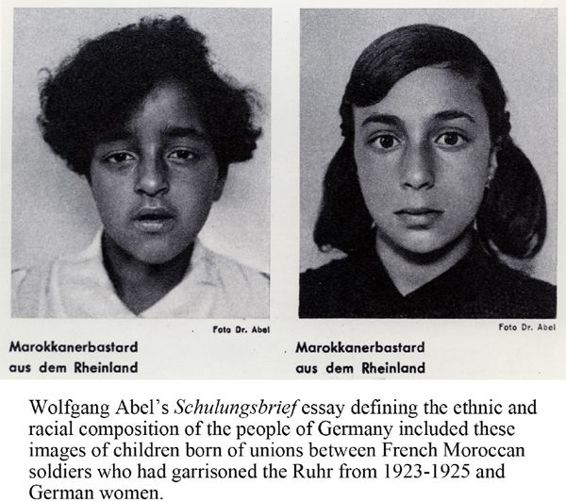
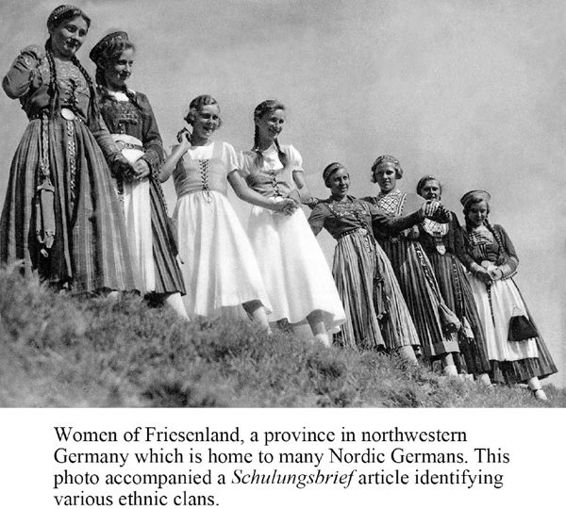
Under Gross, the Racial Policy Office walked a thin line between the more relaxed criteria envisioned by Günther and many of his contemporaries, and the “blond rapture” they cautioned against. In 1934, Gross' colleague, Wolfgang Abel, published generalizations of Germany’s ethnic tribes: the Nordic, Pfalzish, Eastern Baltic, Dinaric, Alpine, Western Nordic, and Western Mediterranean. He described physical characteristics, illustrated with camera portraits resembling mug shots, and collective personality traits of each. Abel offered for example, this profile of the Nordic type: “The least spontaneous, he surpasses all other races in steadfastness of purpose and cautious foresight. Thinking ahead, he subordinates his driving impulses to long-range goals. Self-composure is perhaps the most distinguishable trait of the Nordic race. In this lies a significant part of the ability to create civilizations. Races lacking this quality are incapable of following through and implementing long-term realizable objectives."102
Pfalz Germans were “more steadfast than pliant, more grounded than adaptable, more level-headed than daring, more freedom-loving than power seeking.” The Western Mediterranean German “takes life less seriously. Empty formula courtesies and insincere gestures play a major role, such as promising gifts and extending invitations he doesn't really expect people to accept. His inclination toward truthfulness and ethics is weaker than the Nordic person’s."103
Hitler disapproved of such comparisons. He especially opposed reference to physical contrasts of stature, coloring, or physiognomy among German ethnic groups. In 1930 he told an aid, “Discussions about the race problem will only divide the German people further, incite them against one another, atomize them, and in this way make them inconsequential with respect to foreign affairs.” He admonished senior officials of the party to avoid the subject of ethnic diversity in speeches and articles: “Everything that unifies and welds the classes together must be brought forth, what divides them, what re-animates old prejudices, must be avoided. . . .They are the surest way to destroy a community.” He remarked that people should be selected for leadership roles “not according to outward appearance, but by demonstrating inward ability."104 Goebbels, himself a diminutive man with a slight limp, recorded in his diary in October 1937, “Discussed race policy with Dr. Gross. I reproached him for our flawed standards for making selections. According to them, practically every officer today would be dismissed."105
Like the earlier race hygienist Günther, Hitler believed that the more capable and fit among the Germans should not set themselves above other groups to preserve or advance their particular bloodline. It was their duty to help elevate the German nation as an entity. As summarized by his chronicler Dr. Henry Picker, Hitler was “firmly resolved to transfer racially excellent military units, such as formations of the Waffen SS, to every region where the indigenous people are substandard. They will provide for the population by replenishing its bloodlines."106 (The Waffen SS was an elite branch of the German military requiring high physical standards for enrollment.)
Though believing in the inequality of mankind, Hitler opposed clique-forming or elitist attitudes among his countrymen’s more gifted persons or ethnic groups. He measured people not by what nature gave them, but by how they contributed their talents, be they lofty or modest, to advance the national community. This was a standard every German could aspire to, regardless of his or her station in society. Personal attitude and endeavor, not the circumstances of birth, determine the superior being.
In a speech as chancellor of Germany, Hitler described the evolution of his country into a social, national, and spiritual entity: “The German people came into being no differently than almost every truly creative civilized nation we know of in the world. A numerically small, talented race, capable of organizing and creating civilization, established itself over other peoples in the course of many centuries. It in part absorbed them, in part adapted to them. All members of our people have of course contributed their special talents to this union. It was, however, created by a nation-and-state forming elite alone. This race imposed its language, naturally not without borrowing from those it subjugated. And all shared a common fate for so long, that the life of the people directing the affairs of state became inseparably bound to the life of the gradually assimilating other members. All the while, conqueror and conquered had long become a community. This is our German people of today. . . . Our only wish is that all members contribute their best to the prosperity of our national life. As long as every element gives what it has to give, this element in so doing will help benefit all our lives."107