
Let thunder growl, you were louder than it.
Let the winds blow, you were swifter than they.
Let the water freeze, you were harder than ice.
Let the wolves ravage, you were fiercer than they.
You were a man, a warrior, a Viking,
and none was your master, until one day your day was done,
and you went into the darkness still laughing.
From the thirteenth century Icelandic Viking saga, The Burning of Njal
Vikings, Northmen, the Norse – the very names themselves conjure up romantic and bloody images of strident, horn-helmed warriors and dragon-prowed longboats, of adventure, glory and legendary discovery. For almost 500 years, from around AD 800, these raiders and sea pirates terrorised huge swathes of Europe and Asia. In their open boats they dominated the North and Baltic Seas, sailed down the Liffey, the Humber, the Seine, the Dnieper and the Volga, crossed the Atlantic to colonise Iceland and Greenland, and even reached the New World centuries before Christopher Columbus was born.
At first they would appear from nowhere to raid and pillage, and then just as quickly sail away home, then they began to come to conquer and to settle. Hundreds of thousands of Scandinavians left their beautiful but poor homelands to make new lives in Ireland, Britain, France, the Baltic lands and even the Ukraine. With a sword in one hand, and more often than not, a bag of trade goods in the other they turned the seas and rivers of Europe into highways for commerce as well as routes for raiding and savagery. They founded cities that are still with us today like Dublin and Limerick, as well as long-disappeared states such as Kiev Rus, the Duchy of Normandy and the Orkneys. Sailors, merchants and craftsmen, they were first and foremost warriors whose military prowess was recognised as far away as Constantinople, the fabled Great City of Viking storytelling, ‘Miklagard’. In that city they formed the Emperor’s bodyguard, his élite Varangians.
Then, like a powerful storm, they seemed to blow themselves out. Having changed the face of Europe they disappeared from it. Other nations and peoples came to the fore as the Scandinavians sank into the relative obscurity that enfolds them still. Where once they were central to Europe and its future, they became little more than its northern fringe, both geographically and politically. A brief resurgence of empire and power for royal Sweden came in the seventeenth century but was abruptly ended by Peter the Great in the bloody defeat at Poltava in 1709.
Christianised during their heyday of pillage and war, the Scandinavians then began to form into centralised kingdoms that became free and peaceful constitutional monarchies over the course of centuries, and all without the trauma of a revolution or civil war. Multi-party democracy has become the accepted norm, and the modern states of Denmark, Norway, Sweden and Finland were, and still are, prosperous and contented. Cultural traditions are strong and celebrated wholeheartedly, but the cult of the warrior (the dominant aspect of Viking life) has been firmly rejected; the national armies are small and poorly funded, and neutrality is the default position. When the horror of industrialised war enveloped Europe in 1914, the Scandinavians remained aloof and avoided the butchery of the trenches. Involvement in the Second World War was forced on them by invaders, but even then Sweden managed to remain neutral and free throughout.
As the populations of other European countries exploded with the advent of the Industrial Revolution and huge migrations swept across borders, the total number of Scandinavians stayed relatively low and the different populations remained ethnically homogenous. Even today, with pretty liberal asylum and immigration policies, the number of immigrants is remarkably low in comparison to elsewhere in Europe. On the eve of the Second World War the entire populations of Sweden (6.5 million), Denmark (4.5 million), Finland (4 million) and Norway (3.5 million) added up to less than a third of Great Britain’s, and minorities tended to be very small and made up of other Scandinavians – Finland’s biggest minority was ethnic Swedes.
Yet despite the passage of centuries the image of the Viking warrior has persisted, and was never more powerful than during the war that engulfed Europe from 1939 to 1945. It exerted a powerful pull on some members of the Nazi leadership, and found expression in the creation of six legions, battalions and divisions in the Nazis’ own Varangian guard, an organisation that remains deeply controversial even now, more than 60 years later – the Waffen-SS. The numbers involved were significant as well, with between 10 and 20,000 Norwegians, Danes, Swedes and Finns joining during the war; the entire pre-war Danish armed forces numbered just 6,600 men.
At first the only Scandinavians in the Waffen-SS were a handful who joined before the war, and even then most of them were either ethnic Germans born the wrong side of a re-drawn border or of mixed German/Scandinavian parentage. But that didn’t matter as the Waffen-SS was established as a German and not a multi-national force, intended to showcase the superiority of the so-called Aryan master race (das Herrenvolk). However, before a shot had been fired in anger their character was changing. Adolf Hitler may have caused the armed SS to be born, but the man who nurtured it, Heinrich Himmler, had a very different vision as to what the armed SS could and should be. Himmler foresaw legions of athletic, blond, blue-eyed giants standing guard over a German-dominated Europe stretching from the Atlantic right up to the Urals, and to achieve this he needed men, and lots of them. The Wehrmacht (the German armed forces comprising the army – Heer, navy – Kriegsmarine, and air force – Luftwaffe) jealously controlled the flow of German national recruits so Himmler had to look elsewhere. Suddenly the idea of recruiting tall, blond-haired, blue-eyed Scandinavians seemed a very good idea, and there were even rightwing pro-Nazi parties in the Nordic countries to act as ready-made recruiting pools. The only question was how to get hold of them; the answer was invasion.
The rise of the extreme Right in the 1930s was not a phenomenon restricted to Germany. All across Europe in the wake of Mussolini and Hitler a plethora of parties and movements had appeared. In Britain it was Mosley’s BUF, in France it was Doriot’s PPF and Déat’s RNP, in Belgium Degrelle’s Cristus Rex and De Clercq’s VNV, and in Holland Mussert’s NSB. In Norway it was Quisling’s NS, in Denmark Clausen’s DNSAP and in Sweden Lindholm’s SSS, among others. Nowhere, outside Germany and Italy, did these parties seriously challenge for political power, and levels of support varied from the PPF’s substantial quarter of a million members to the very low thousands for the Swedish parties. While elements of the French, Dutch and Flemish movements sometimes exhibited a semi-mainstream appeal, this was not the case in Scandinavia where they remained small, poorly-supported and prone to in-fighting. All this changed at midnight on 29 November 1939 with the following statement to his troops by General Kirill Afanasievich Meretskov of the Red Army:

The leader of the Danish neo-Nazis, Frits Clausen, strolls through crowds of saluting supporters.
Comrades, soldiers of the Red Army, officers, commissars and political workers! To fulfil the Soviet Government’s and our great Fatherland’s will I hereby order: the troops in Leningrad Military District are to march over the frontier, crush the Finnish forces, and once and for all secure the Soviet Union’s north-western borders and Lenin’s city, the crib of the revolution of the proletariat.
This communication heralded the invasion of one of Europe’s smallest countries by one of the world’s largest. The Soviet first wave alone comprised more than 250,000 men, it outnumbered the Finns two-to-one, and was accompanied by fleets of tanks and aircraft and masses of artillery. Against them the Finns had little more than a handful of First World War anti-tank guns and obsolete planes.
The rest of Scandinavia, and indeed the world, looked on horrified as a supremely confident Red Army swept forward into Finland expecting an easy victory over the tiny nation. The resulting fight was anything but, as the courageous Finns held their ground and inflicted devastating reverses on the ill-prepared Soviets; nowhere more so than in the utter annihilation of the Red Army’s 44th Division in the snow at Suomussalmi in late December. By the time hostilities ended on 13 March 1940 the Red Army had been forced to commit more than one million Soviet troops to the fighting and Stalin had been humiliated. As for the Swedes, Norwegians and Danes, they were both angry and fearful as they looked east and saw a brutal dictatorship seemingly willing to assault peaceful countries and bring death and destruction to their doorsteps. The Scandinavian Far-Right’s answer was to look south to Nazi Germany for salvation.
When the Germans came to Scandinavia though, it was not in a spirit of brotherly love, but in the back of armoured personnel carriers as they invaded and occupied Denmark and Norway in the spring of 1940. Sweden remained neutral and inviolate. Himmler naively believed that the invasions would be the signal for thousands of locals to flock to the banners of the Waffen-SS. So recruiting offices were opened in Oslo and Copenhagen in 1940 to fill a new SS division of ‘Germanics’ – the term given to peoples Himmler considered to be on a racial par with Germans – the aptly-named SS-Wiking. The new division was to have three regiments; the veteran national German Germania, and the new Dutch Westland and the Scandinavian Nordland. The Finns were allowed to form an all-Finnish battalion (although many of the senior positions would be filled by Germans) – officially sanctioned by their government – in the new division.

Bjørn Østring in the trenches around Leningrad wearing a typically non-issue jumper from back home. For the Scandinavians comfort was more important than strictly adhering to the Germans’ rigorous dress regulations. (Erik Wiborg)

Danish recruiting poster for the Waffen-SS. The Viking image in the background was intended to evoke a glorious, martial tradition in the minds of would-be volunteers.

Recruiting poster for the Norwegian SS-Ski Battalion Norge. The theme is very much one of defending hearth and home from the evils of communism.
However, even including the Finns, fewer than 3,000 Nordics came forward to join the Dutch and Flemish recruits, and the SS-Wiking had to rely on native and ethnic Germans to make up the numbers. Disappointed but not finished, the SS tried again in 1941 using the new war against the Soviet Union as its recruiting sergeant. They formed so-called ‘national legions’ in both Norway and Denmark, respectively the Den Norske Legion and Frikorps Danmark (the Legion Norwegen and Freikorps Danmark in German). Swedes were covertly encouraged to join as well and a slow trickle started to come in. The DNL and Frikorps never reached even regimental strength and were not given the best equipment or thorough training. Armed with little more than small-arms, the Norwegians were sent to man the siege lines facing Leningrad in the frozen north of Russia. There they spent a frustrating 18 months slogging it out with the Russians in almost First World War conditions as their strength dwindled and reinforcements dried up. The Danes fared even worse, being sent to reinforce the SS-Totenkopf Division in the horror of the Demyansk Pocket. They lost two commanders in a month and whole rafts of volunteers were swept away in the vicious fighting.
As the Scandinavian legions were training and preparing for the Front their countrymen in the Wiking were taking part in the largest military operation the world had ever seen – Operation Barbarossa, the invasion of the Soviet Union. The Wiking’s Scandinavians drove across eastern Poland and into the Soviet Union proper, joining Army Group South in its advance through the Ukraine. Through the summer and autumn the Wiking distinguished itself in the ‘battles of the frontier’ and the subsequent capture of the Ukraine. The winter saw it reach the Don River before retreating back to the Mius River as the horrendous weather and ferocious resistance stopped the headlong advance in its tracks – Barbarossa had failed. In spring 1942 the Wehrmacht went on the offensive again, and the Wiking was in the forefront of the renewed push east to simultaneously reach the Volga River and occupy the oil-producing Caucasus region. Within touching distance of the fabled city of Astrakhan, on the shores of the Caspian Sea, the Scandinavians were stopped again and forced to retrace their steps north. By this time casualties had wreaked havoc in their ranks and their numbers were pitifully low; the division had become German in all but name. The new year of 1943 found the Wiking and its remaining Scandinavians back in the Ukraine on the defensive against growing Soviet pressure.
Far to the north that warm spring, both Nordic national legions were depleted, disgruntled and exhausted. Withdrawn back to Germany they were disbanded and the legionnaires offered the chance to sign on again to join yet another new SS division – the SS-Nordland.

The Norwegian Wiking NCO, Rottenführer Tord Bergstrand, fighting in Russia during Operation Barbarossa, 1941.
The Nordland, as its name suggests, was conceived as the pinnacle of the Nordic war effort for the Waffen-SS. The regiment of the same name from the Wiking was nominated as the cadre for the new division with the majority, but not all, of Wiking’s Danes, Norwegians and Swedes transferred over. With this act the baton of the Scandinavian Waffen-SS was firmly passed from the veteran Wiking to the freshly-minted Nordland, and a new chapter begun for the Scandinavian Waffen-SS. That chapter would be written without the Finnish battalion, as its members were withdrawn home by their government and the unit replaced in the Wiking by an Estonian battalion. The Wiking old boys were joined in the Nordland by their countrymen from the national legions and a new tranche of volunteers. By this time the days of the Scandinavians being used mainly just to fill the ranks of the German-officered infantry companies were gone, and they occupied a lot of the technical posts as well as command appointments. The very best and latest equipment came along as well to complement their newly-recognised military competence, and the Nordland was designated as a powerful panzer-grenadier division (a mixed unit of infantry and tanks) with its own armour.
Forming and training in occupied Yugoslavia, the Nordland was intended as one of three élite divisions in the newly-created III Germanic SS-Panzer Corps under the command of the charismatic Felix Steiner. The other two were to be the Wiking (now a hugely-powerful panzer division) and a new Dutch division, the SS-Nederland. As it turned out the Wiking couldn’t be spared from the Russian Front, and indeed never fought alongside its intended stable mates, while the Dutch could only form a large brigade rather than a full division. Regardless, the Corps was considered battle-worthy and sent more than 1,000 miles north to the Oranienbaum Pocket near Leningrad. But after more than two years of siege it was the Red Army that held the advantage and not the besiegers. As 1944 dawned the Soviet juggernaut burst out of the Pocket and sent the Germans reeling back towards the Baltic states. The Scandinavians in the Nordland fought doggedly as they were forced backwards, joined in their desperate defence by Estonian and Latvian Waffen-SS divisions fighting to protect their homes. By spring the Nordland was dug in around the ancient Estonian city of Narva and the river that runs through it of the same name. Massive Soviet attacks developed into what became popularly known as the ‘Battle of the European SS’, some of the most brutal and intense fighting seen in the entire Russo-German war. The fighting was immensely costly with thousands of Danes, Norwegians, Swedes, Dutch, Estonians and Flemings dying alongside their German comrades; but the Red Army was held, giving the Wehrmacht a rare success that summer.
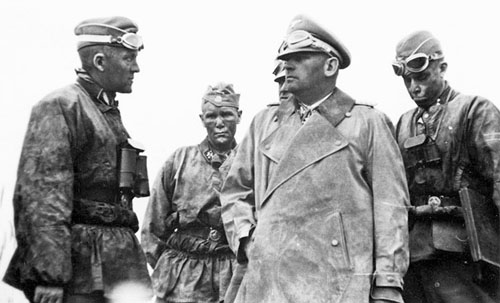
Felix Steiner (centre, with peaked cap) as commander of the Wiking Division in Russia in 1941. He would become the guiding figure in the foreign Waffen-SS and a much-celebrated figure among veterans after the war. (Comm. Felix Steiner)

The Nordland Regiment advance through Russia during Operation Barbarossa, summer 1941. (Erik Wiborg)

Russia 1941 – some of the Wiking’s Danes; Torkild Herman Nielsen is sitting on the bonnet in the middle, Ignatz ‘Ine’ Schwab is second from right sitting on the fender. Schwab volunteered along with his two brothers Hugo and Niels. Niels was killed in action with the 1st SS-Brigade in February 1942. Ignatz was awarded the Iron Cross at Cherkassy before himself being killed in action. (Jens Post)
The German Army in the East (the Ostheer) might have held in the north, but it was not so fortunate in the south, where almost a quarter of its total strength was wiped out by the Soviets’ gargantuan summer offensive, Operation Bagration. As the Red Army charged forward the Wiking was called north from the Ukraine to bolster the desperate defence. Despite the creation of the Nordland there were still a few hundred Nordics who had stayed in the old flagship Germanic division, and these men now found themselves rushed to join their Waffen-SS brethren from the Totenkopf in the shadows of Warsaw. On the Vistula the two SS panzer divisions again proved their worth, and in dramatic fashion managed to finally halt the Bagration offensive hundreds of miles from its start point.
At the same time the German’s Army Group North was forced to send some of its best divisions south to try and plug the huge gap in the line left by Bagration, and was then hit by its own Red whirlwind and almost crushed. Estonia was lost and the Nordland, along with the rest of the Army Group, was bottled up in the Latvian province of Courland. With their backs to the sea and a ‘no retreat’ order from the Führer in their pocket, the newly-christened Army Group Courland fought a series of six epic battles that would finally end on 8 May 1945 with the exhausted survivors filing into Soviet captivity. The Nordland was saved from that uncertain fate by a withdrawal order that took it by sea back to Germany for one last throw of the dice defending the eastern German provinces of Pomerania and East Prussia.
For the Wiking, 1945 saw it sent with most of the remaining premier Waffen-SS divisions to the south of the Eastern Front in Hungary. So as a last irony, as the Red Army geared up for a final push across Germany to capture Berlin and destroy Nazism, the last and best of the Führer’s ‘fire-brigades’ were deployed hundreds of miles away vainly trying to relieve the siege of Budapest and recapture the Hungarian oilfields. Wiking’s Scandinavians would fight in three more desperate attacks on the Magyar plains before being bundled back into Austria.
Back in northern Germany a hugely depleted Nordland, along with its European stable mate divisions – the Dutch SS-Nederland and Belgian SS-Langemarck and SS-Wallonien – took part in one last offensive as they tried to blunt the Soviet advance towards the Oder River. Unsurprisingly, the flow of eager recruits from Denmark, Norway and Sweden had dried up and the Nordland’s battalions were mere shadows of their former selves, the gaps filled with unemployed ground crew from the Luftwaffe and sailors from the Kriegsmarine. In a last hurrah, the besieged German town of Arnswalde was relieved, and the grateful garrison and local civilians flooded out to dubious safety in German-held territory. The Nordland was then forced to retreat yet again to defend the Oder River line at the river port of Altdamm opposite Berlin.
Like an old punch-drunk boxer the division reeled under blow after blow, but stubbornly refused to lie down. It was at the mercy of events. When it came the Soviet offensive across the mighty Oder splintered the division with hundreds of men surrounded, killed or forced to retreat north. Those that survived, including the command group, somehow regrouped and ended up in Berlin where they became the mainstay of the defence. Along with a French battlegroup (a kampfgruppe) from the SS-Charlemagne Division, a Latvian SS battalion, some Hitler Youth boys and the remnants of some Army formations, the Nordland fought on in the rubble of the Third Reich’s capital. Hitler’s suicide finally signalled a welcome end to the fighting in the city. Spurred on by dread of Soviet captivity many of the surviving Nordic volunteers joined their German comrades in attempting to break out west on the night of 1 May. Most of them, including their highly-decorated former divisional commander Joachim Ziegler, did not make it. A few did succeed and headed home. Those who did not die or escape joined the endless columns of prisoners being herded east to years of suffering in the Soviet Union’s slave labour camps, the infamous gulags.
For the Danes and Norwegians still in the Wiking, the end of hostilities offered the same dangerous option, to head west and surrender to the Anglo-Americans and escape the vengeful Red Army. The Wiking men fared better than their comrades in the Nordland, and most reached safety. Those that didn’t, joined their countrymen in Siberia.
As the volunteers were gradually released from POW camps, they headed home and were greeted less than warmly by their countrymen. Denmark and Norway in particular were convulsed with a need to cleanse themselves of the shadows of collaboration. Tens of thousands of people were investigated, tried and convicted of a variety of offences. Leading collaborators and political figures were executed and most of the volunteers went to prison. Even neutral Sweden punished some of its own ex-Wiking and Nordland men, few as they were. It was to be many years before all the former volunteers were free from jail or Soviet gulags. Still young, they sought to rebuild their lives, neither forgetting what they had done, nor dwelling on it either. Most worked hard, had careers, married and brought up families. Grandfathers and great-grandfathers now, their actions still provoke powerful reactions even today, with some celebrating them as heroes and the harbingers of a new ‘European identity and army’, while others utterly condemn them. The reality though is that while the vast majority of people, quite rightly, deplore the evil of Hitler and Nazism, they know nothing of the foreign volunteers who fought for that most controversial force, the Waffen-SS. If we are never to repeat the tragedy of the war and the Holocaust it is necessary to continually inform and educate people as to what really happened, and for people to make a judgement on the Scandinavian volunteers it is just as necessary to put the facts in front of them so they can make up their own minds. This book sets out those facts about the thousands of young Norwegians, Danes, Swedes and Finns who joined the Waffen-SS.