
19
‘There is no wrong men have not been ready to commit when they
thought it could serve religious purposes.’
Lord Acton, Selected Works of Lord Acton
By September 1937 Rome’s new strategy of rapprochement with the Ethiopian Church was definitely in place and was in the process of being implemented. In the major towns Italian commanders and governors were attending Church holidays such as Mesqel, Timqat and Easter, together with the Ethiopian clergy. They were even observing the holy days of saints such as Tekle Haymanot and Gebre Menfes Qiddus with great pomp—much, no doubt, to Graziani’s annoyance, who, still exiled in Asmara, was having to watch from the sidelines.1
However, even though Petretti had taken over the viceroy’s office at the Governo Generale, Graziani was still the de jure viceroy, and his friend Maletti was still willing to do his bidding in the remoter reaches of Northern Shewa, away from the prying eyes of Petretti.
Church Burning at Ankober
On Tuesday, 26 October 1937, a convoy of military trucks emerged from the Italian garrison at Tebassi, on the southern outskirts of Debre Birhan, and turned left to head north, passing through the town. Turning right a few kilometres beyond the city, they headed for the eastern perimeter of the Shewan plateau, for, as noted earlier, the rugged countryside at the edge of the plateau harboured resistance fighters. The numerous churches here (each parish typically served less than a hundred subsistence-farming households—one of the world’s highest church densities) would be targets for Graziani’s continued exemplary repression.
The area had already suffered from the depredations of the jihad of June–July, but burning any surviving churches and slaughtering the remaining priests would, Graziani presumably believed, destroy any lingering desire by the despised Orthodox inhabitants to support or shelter the resistance. Furthermore, pillaging would provide an added incentive for both the Italians and their askaris. The viceroy evidently thought there was a sufficient number of clergy left alive, and enough valuables remaining in the church treasuries, to make the campaign worthwhile.2
The convoy made its way along the stony tracks, past the site where just five months before, the deacons and pilgrims of Debre Libanos had been slaughtered. In the front of each vehicle were Italian officers armed with pistols and behind, under the canvas awnings, were around twenty Eritrean Muslim askari infantrymen, armed with rifles and sabres.
At Kundi, where the grassy plains began to fall away towards the escarpment, the road took a series of sharp turns and the trucks turned off to the north. Two kilometres later the convoy stopped at a site known locally as Kundi Fort (see Map 16), where a fort had been built by one of Shewa’s 19th-century rulers. This was the end of the road and the beginning of yet another campaign targeting the Ethiopian clergy.3
The askaris leapt down from the trucks and started scrambling down the rocky slopes towards their first target: the parish church of Mescha St John (see Map 16).4
With the help of collaborators familiar with the area, the Italian officers and their infantrymen descended along four kilometres of mule tracks and thick undergrowth, and burst into the clearing where the church of St John stood, surrounded by a circular stone wall. As the officers barked out orders, the askaris, who knew the routine, split up into groups. One group kicked open the wooden gate and ran to the church, while another fanned out to look for the clergy. A third group started splashing the outside of the church with benzine, while a fourth went in search of the treasury.
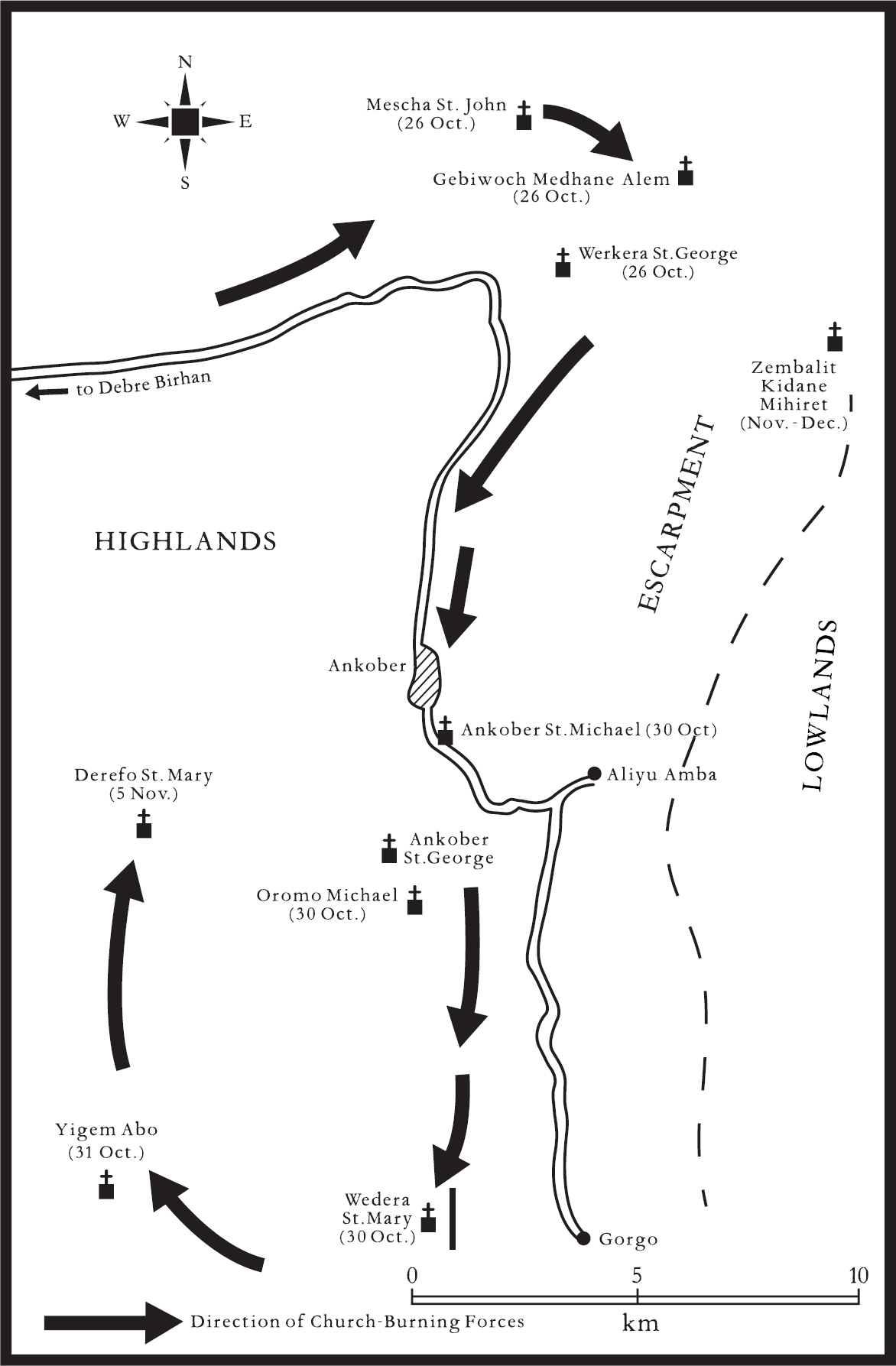
Map 16. Ankober district: church burning of October–November 1937 (© Ian Campbell)
The askaris at the church emerged with carpets, silver-topped prayer sticks used by elderly members of the congregation for leaning on during the long services, and the holy tabot they had seized from the inner sanctum. Other valuables were taken from the treasury: icons, parchment manuscripts, ecclesiastical umbrellas, a silver-cased ceremonial drum and an ecclesiastical crown.
The officers ordered the plunder to be carried back to the vehicles, and the church was set ablaze, the flames shooting high up through the roof with a roar. Taken by surprise, people from the surrounding area screamed and ran out of their cottages, as askaris appeared, dragging with them the unsuspecting clergymen they had rounded up. There was not a moment to lose. A group of askaris knelt down to form a firing squad, and an officer gave the orders to shoot. Five priests raised their hands in prayer and, as shots rang out, crumpled to the ground: Father Belachew, Father Amenshewa, Father Teshome Belachew, Father Weldeyes, and Father Dirafu Shewa. Two monks were also executed: Father Habte-Maryam and Father Tekle-Weld, along with a scholar, Debtera Gebre-Sillassé.5
While smoke blew across the village, the roar of the flames, and the shouts and cries of the villagers and families of the clergy, created a cacophony as the Italians ordered the askaris on to their next target: the church of Gebiwoch Medhané Alem (‘Saviour of the World’) (see Map 16). Leaving behind them a scene of devastation and carnage where only moments before peace and tranquillity had reigned, the Italians moved on, for there were many more churches to deal with before dark.
At the Saviour of the World, a few kilometres from Mescha St John, the scenario was the same. The church was burned, sacred manuscripts were looted from the treasury, and four clergymen were dragged from their homes and shot: Father Mogesé, Father Kelkilé, Father Tsenebet, and a scholar, Debtera Daniél Gizaw.6
We do not know how many more churches were burned and clergy killed, but we do know that before the day was over the raiders had reached the parish church of Werqera St George (see Map 16), quite close to where they had left their vehicles. There they burned the church and killed the three priests they found: Father Moges, Father Hayle-Mesqel (‘Power of the Cross’) and Father Subsibé, as well as Debtera Werqineh.7 By nightfall the soldiers were back in their trucks, heading southwards to resume their caravan of death.
By Saturday, 30 October, the military had burned and killed their way to the town of Ankober itself, some eighteen kilometres from Kundi Fort. The five churches of Ankober were actually all south of the town, and it is likely that as they were on or close to the main highway, their clergy had heard of the campaign, for when the soldiers reached the church of Ankober St Michael, there seem to have been no priests there to kill, and so the Italians had to make do with looting the treasury.8
After pillaging Ankober St Michael, the trucks turned off the main road, once again heading for churches where the clergy would not have been tipped off about the raid. Reaching the church of Oromo St Michael, they had a notable success, killing four priests and one monk: Father Desta Gebre-Iyesus, Father Aychiluhim Wibé, Father Taddesse Dilnasew, Father Hayle Welde-Maryam and Father Degife Gebre-Hiwet. In addition, they managed to loot the church of all its codices and other treasures.9
They staged another deadly attack at the church of Hehef St Michael near Ankober, where they put to death a further four priests and two scholars: Father Qirqos, Father Yegwala Ishet, Father Abbebe Ayu, Father Birhanu, Debtera Asrat, and Debtera Welde-Maryam.10
Astonishingly, the column still found time to attack yet another church before the end of the day: Wedera St Mary (see Map 16), where they were able to pillage all of the church properties, burn the church to the ground, and slaughter the two priests they encountered, Father Hayle and Father Wenderad Sema’at, as well as two Church scholars, Debtera Tsigé Neway and Debtera Kidane.11
By the next day, Sunday, 31 October, the raiding party had managed to move west across the Ayraka River—easily forded at that time of year—to reach the remote church of Yigem Abo (see Map 16). We have no details of the pillage, but we know that they killed the head of the church, a priest named Aleqa Gebre-Hanna, whom they cut down with a sword.12
There is no record of how many churches were devastated during the next few days, but by 5 November the marauding soldiers had reached the parish church of Derefo St Mary (see Map 16), where they looted the treasury and slaughtered all five priests: Father Welde-Tsadiq Mengistu, Father Tesfa Welde-Tsadiq, Father Gebre-Maryam, Father Tamré-Beyene, and Father Asrat.13
By the time the convoy reached the garrison at Tebassi, the trucks were weighed down with loot, for the eleven-day campaign had gathered a rich harvest. Many churches had been reduced to smouldering pyres. And thousands of Orthodox faithful of Ankober district were grieving for their loved ones. The military had fulfilled the Duce’s orders for ‘a reign of terror’, and the ‘schismatics and heretics’ had paid the ultimate price.
Destruction in Bulga
In late 1937 Bulga, south of Ankober district (see Map 15), was a focus of attention for the Italians. It had for some time been a centre of resistance, and had already been devastated by Graziani’s policy of exemplary repression. Describing a terrifying Italian raid on his grandmother’s house when he was a young boy, eyewitness Gétachew Beqele, who later rose to high office in Haile Selassie’s government, and accompanied the present author in his research in Bulga, recalled: ‘The Italians followed a scorched earth policy, burning everything in sight and killing anybody they found. The Italians behaved badly, which provoked the Ethiopians to retaliate. The sort of atrocities the Italians committed included cutting off of heads and displaying them. They would burn down houses with civilians inside.’14
But in September 1937 an incident in Bulga struck fear into the Italians. In the absence of Emperor Haile Selassie, who was in exile in England, several Patriot leaders, wanting to unite and strengthen the fragmented resistance armies, enthroned a substitute. They decided to crown a young man named Melake-Tsehay Iyyasu, great-grandson of Emperor Menelik. He was a son of Lij Iyyasu, whom Menelik had named as his heir apparent and who had been the de facto ruler of Ethiopia from 1910 to 1916, but had been outmanoeuvred by politicians supporting Ras Teferi (the future emperor Haile Selassie).
Melake-Tsehay was anointed by the head of the monastery of Abiyyé Gedam at the church of Wegfelé Michael in Bulga. Crowned on 2 September, he announced, ‘I have ascended to the throne of my father. People of Ethiopia, be united and fight your enemy!’ Drums were beaten, and the Ethiopian flag was raised.15
Fitawrari Welde-Tsadiq Zewdé, a key figure in bringing about this dramatic new development, was the uncle of Gétachew Beqele, who testified: ‘The news spread like wildfire and resistance leaders from every corner of the country flocked into Bulga. A government was organised and established and all the leaders who were gathered there were given traditional titles and appointed governors of the area from where they came.’16
This new development posed a serious threat to Graziani’s administration; unification of the various factions of the resistance was what he dreaded most of all. The precarious survival of the Italians within their besieged garrisons depended largely on their policy of divide and rule: dividing the resistance among themselves, and dividing the Patriots from both the local communities and the Orthodox Church. Now the entire fabric of Italian hegemony was at risk. When Graziani found out what had happened, his reaction was harsh and swift. Mobilising his Eritrean and Somali Muslim battalions to surround the heartland of Bulga in a desperate effort to root out the resistance and eliminate its potential supporters, he launched wave after wave of exemplary repression, in which a great number of churches were razed to the ground.17
Some 44 km due south of Ankober lies Berehet district in the wider administrative unit of Bulga. The district consists principally of rocky enclaves and densely treed river gorges, interspersed with tiny settlements each clustered around a church, far below the plateau. These gorges were first settled by Christian Amhara in the 10th century, whereas the plateau came to be settled later by Oromo, who arrived in the area in the 16th century.18 Thus many of the churches and monasteries dotted across the broken countryside of Bulga were of ancient foundation, and by the 1930s life for the conservative Christian communities in these valleys had in many respects changed little since medieval times. It was in Berehet district, in late November 1937, that the Italians organised yet another church-burning programme.
As in the case of Ankober district, we will never know the full extent of the carnage, the total death toll, and the number of churches burned and pillaged in Berehet. However, in some parishes the surviving residents were able to file their stories. One such case involved the church of Indode St Michael, situated in a deep valley just above a tributary of the Menso River that flows eastwards into the arid lowlands.
The latest campaign of exemplary repression was concentrated in this area because a few kilometres to the west of Indode St Michael, on the edge of the plateau, stood the great mountain of Megezez (see Map 13), and it was in the caves and crevices surrounding that mountain that Ras Abebe Aregay, the most renowned of Ethiopia’s resistance leaders, had one of his camps. Thus the settlements in striking distance of Megezez, which could be reached from the main Addis Ababa–Debre Birhan road by military vehicles, became targets. The viceroy was still convinced that terrorism and destruction striking at the heart of the Christian communities of Northern Shewa would dissuade them from supporting the resistance. In fact, as we have seen, the effect was the opposite. But Graziani’s hatred for the Ethiopian Church was visceral, and he would not be deflected.
There were many parish churches below the plateau and within a few kilometres of Megezez. Just how many of them were razed to the ground in the Bulga campaign of November 1937, and how many of their clergy died, is not recorded, but it is certain that most, if not all, of the churches were attacked and at least looted. One eyewitness, Memhir Demissé Abiyyé, who was himself with the Patriots in the area throughout the time of Melake-Tsehay, reported in 1988 that no less than 485 churches were destroyed.19
The attack on Indode St Michael was one of the few to be documented. Soldiers under Italian command reached the church on 24 November, looted it of its treasures, and killed the church’s five priests: Father Zelleqe, Father Hayle-Maryam, Father Fisseha, Father Mekonnin, and Father ZeSillassé.20 The nearby church of Werqele St Michael was also burned down, and all its manuscripts and other artefacts were stolen. However, the fate of the priests remains unknown.21
Three days later, another church in the vicinity of Megezez—the church of Werqa St Michael—was attacked, looted of all of its treasures, and burned to the ground.22 The fate of the clergy is unknown. The fact that the church appears never to have been reconstructed suggests that the entire community may have been annihilated.
Meanwhile, the onslaught in neighbouring Ankober district continued. As noted earlier, the records that survive cover only a fraction of the churches attacked. In some cases, documentation exists but is incomplete. For example, it is on record that on 8 November the church of Hagere St Mary was burned down while two of the priests were inside, and that, unable to escape, they were burned to death. However, their names are not recorded.23
By the Ethiopian month of Hidar (10 November to 9 December) the devastation had moved further east, with the burning of the church of Zembabit Kidane Mihret (‘The Covenant of Mercy’), in which the Italians massacred five priests and a monk: Father Tedla, Father Tekle-Giyorgis, Father Mamo Qetsela, Father Mukriya, Father Welde-Maryam, and Father Bantiyirgu.24
In summary, the church-burning campaigns in Northern Shewa and Bulga between June and December 1937 were so extensive that some entire villages were depopulated and disappeared for ever. Thousands of clergy and their parishioners were slaughtered, of whom only a few can be identified today by location and name. The majority lie in unmarked graves.
More Devastation in Wag
Meanwhile, by September 1937, desperate to contain the rapidly growing resistance in the north, the High Command aimed its forces at a Patriot leader who had led a surprise attack on the Italians at Korem (see Map 3): Dejazmach Haylu Kebede, son and heir of the hereditary ruler of the ancient Christian region of Wag, a royal bloodline dating back to the 13th century. Arming collaborating mercenaries from Wello, the Italians ravaged Wag in an onslaught in which several churches were burned, including Tiya Kidane-Mihret and Weleh St Mary.
Following one of the battles, in which 5,000 resistance fighters were reportedly massacred on Graziani’s orders to ‘show no mercy’, mutilation of prisoners by units under Italian command was widespread. In a horrific re-enactment of the Maletti–Mohammed Sultan jihad of Northern Shewa, Christian Wag was bathed in blood. One Italian officer described the savagery of his own troops as ‘horrendous’.
Dejazmach Haylu was captured, mutilated, decapitated, and his head displayed publicly by the Italians for several days, mounted on top of a long pole. The Italians even executed several Ethiopian military commanders who attempted to give the rest of his body a Christian burial.25
The Italian army went on to devastate the region. Despite, or perhaps because of, the fact that the people of Wag had long considered themselves protectors of Orthodox Christianity, the atrocities included the burning of numerous churches. In one district alone (Dehna wereda, the other district of Wag being Ziqwala26 wereda), the invaders razed no less than eleven churches to the ground: Biwel Arba’itu Insisa (‘The Four Beasts of the Apocalypse’), Tibanzba St Gabriel, Amdewerq Qirqos (St Quiricus), Debre Zeyit St Mary, Gur-Amba St George, Adeljan St Michael, Abam Abo, Abmata St Libanos, Misqa St Mary, Bachi St Mary, and Chir Arba’itu Insisa.27
Slaughter at Addis Alem
In 1900 Emperor Menelik had founded the town of Addis Alem (‘New World’) some forty kilometres west of Addis Ababa (see Map 7), with the intention of moving the capital there. The plan was eventually abandoned, but the throne room of the palace being built at Addis Alem for the emperor, which was decorated both inside and outside, was converted into the church of St Mary. A historically important and architecturally interesting building, today the church, together with an adjoining museum, is frequently visited by tourists.
However, Addis Alem was not always a happy place, for during the occupation it fell victim to the Italians. On 3 December 1937 the Italian administration accused the priests at the church of sheltering Patriots. They dispatched to the church a company of soldiers, who killed seven clergymen. They also imprisoned ten priests, who were reportedly then starved of food and water.28 As the new year dawned, the Italians had resumed their campaign in Bulga, where they were burning and looting the church of Akrimit St Michael, some twelve kilometres south-south-west of Indode St Michael.29
Unlike the attacks on well-known churches and monasteries such as Debre Libanos and Debre Bisrat and those on Mount Ziqwala, which were documented in reports to Rome, General Maletti’s church-burning campaigns, which continued in remote areas long after the change of policy, seem not to have been documented. For that reason, they have remained largely unknown outside the villages and hamlets concerned. However, the escalation in the resistance that the attacks generated inevitably came to Mussolini’s attention, confirming his view that the holy war had become counterproductive.