
BOOK V
37.
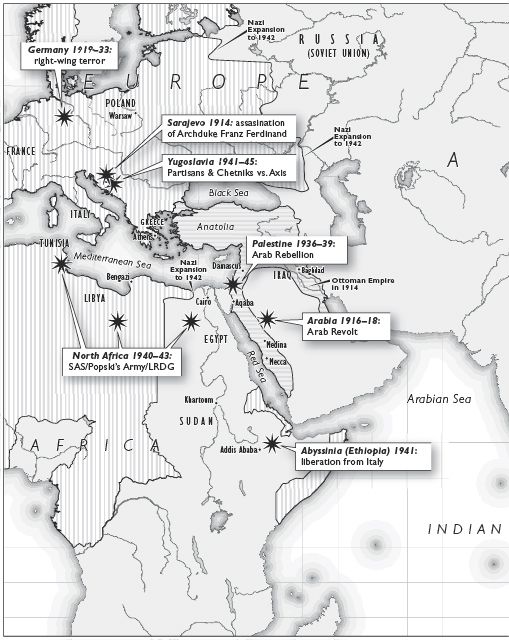
IT WAS THE most consequential wrong turn in history. Archduke Franz Ferdinand was on a brief visit to observe army maneuvers in the Austro-Hungarian province of Bosnia-Herzegovina. The heir to the Habsburg throne was supposed to spend only a few hours in Sarajevo on Sunday, June 28, 1914—just long enough to view some troops, meet some notables, open a museum, inspect a carpet factory. But from the start the day had not gone according to plan. The archduke and his wife, Sophie, had been sitting in the back of an open-top touring car on the drive into town from the train station when, just after 10 a.m., a Bosnian printer named Nedeljko Cabrinovic tossed a bomb at them. The nineteen-year-old “Nedjo” had been so excited he had forgotten to count to ten after priming his crude hand grenade. The bomb bounced harmlessly off the royal automobile and injured two officers in a trailing car along with some spectators.
Nedjo tried and failed to end his life with a cyanide capsule. He was taken to a police station, where he was interrogated, but he refused to reveal that five other would-be assassins were still stalking Franz Ferdinand. Out of an excess of courage or a deficit of common sense, the archduke proceeded with his next stop at the town hall, where he was greeted by local dignitaries and gave a short speech. Afterward he decided to stop by the hospital to visit one of the officers who had been injured in the earlier bombing. His staff thought it would be safer to take the broad Appel Quay rather than the original route, publicized in advance, through the narrow, winding streets of the city center. But because of a miscommunication the lead vehicle in the six-car motorcade turned down Franz Josef Street as originally planned, followed by the luxurious Graef und Stift convertible flying an imperial emblem and carrying Franz Ferdinand and Sophie. When he realized what had happened, the royal chauffeur stopped the car in order to turn around.
By a colossal stroke of ill fortune, the archduke’s car paused in the brilliant summer sunshine in front of Moritz Schiller’s Jewish delicatessen and general store. Standing in front was none other than Nedjo’s good friend Gavrilo Princip, another Bosnian radical armed with a bomb and a Browning pistol. The teenage terrorist, who was just shy of his twentieth birthday, must have been dumbfounded at the good fortune that had put his quarry only a few feet from him. He could hardly miss the archduke in his resplendent blue general’s uniform and green peacock-feather hat or his wife next to him in her white silk dress and wide-brimmed hat piled high with ostrich feathers. “Gavro” drew his revolver and fired twice. Both the archduke and the duchess were dead by lunchtime.
In many respects the death of Franz Ferdinand resembled that of Tsar Alexander II, another assassination carried out by a group of young Slavic fanatics. But the consequences were much more serious and long-lasting. For the Austrian government chose to blame the Serbian government for the attack.
In reality the links to Belgrade were tenuous at best. Nedjo and Gavro were members of Young Bosnia, a small group of radicals whose goal was to create Yugoslavia, a state that would unite the South Slavs: the Bosnians, Croats, Serbs, and other nationalities. They had been provided with arms (four revolvers, six bombs) and smuggled into Bosnia by Serbian officers who were close to Colonel Dragutin Dimitrijevic, a.k.a. Apis. He was not only chief of intelligence for the Serbian General Staff but also head of a secret society called Union or Death, popularly known as the Black Hand, which was intent on driving Austria out of Bosnia-Herzegovina to create a Greater Serbia. Apis later testified that he had never thought the conspirators would succeed and had even tried to recall them at the last moment. Certainly there was no evidence that anyone in a senior position in Serbia’s government had authorized the plot. But that did not stop Vienna from making intolerable demands on Belgrade. Germany backed its ally Austria, while Russia came to the aid of Serbia.
Thus one daring act of terrorism lit the fuse that ignited the deadliest war the world had yet seen. That the war probably would have broken out anyway over some other pretext does not diminish the enormity of this act or lessen its consequences.1
THE FIRST WORLD WAR raged from 1914 to 1918. It was followed by an unstable armistice and then the eruption of open conflict in China in 1931 and in Poland in 1939. Those two conflicts merged to produce the Second World War. That war, too, had its roots in terrorism: specifically the terrorist campaigns waged by German and Japanese militarists in the 1920s and 1930s to seize power from more moderate regimes.
The fragile Weimar Republic, born in 1919 out of Germany’s defeat, faced and survived an initial burst of left-wing and right-wing violence whose victims included Foreign Minister Walter Rathenau, assassinated by a rightist fanatic in 1922. The initial turmoil faded after Adolf Hitler’s Beer Hall Putsch was foiled in 1923. Thereafter the Nazis sought power through political organizing backed by the thuggish SA (Sturmabteilung, or “Storm Battalion”). Popularly known as the Brownshirts—a name that, like the Blackshirts (Mussolini’s paramilitaries), would have caused the liberal Giuseppe Garibaldi and his Redshirts to spin in their graves—the SA intimidated, beat, and killed political opponents and Jews. The Communists also engaged in street violence, employing a strong-arm squad called the Red Front Fighters’ League, but they were no match for the Brownshirts, who numbered half a million men by the time Hitler became chancellor on January 30, 1933.
Much of Hitler’s appeal was that he was the man who could restore “order”—which, of course, his own party had done as much as anyone to undermine. The arsonist was offering to turn fireman. The analogy is particularly apt given that Hitler was able to consolidate his rule thanks to the burning of the Reichstag on February 27, 1933, by Marinus van der Lubbe, a lone Dutch anarchist who had once been a Communist. Hitler used this isolated act of terrorism as an excuse to crack heads among the opposition and destroy the last vestiges of constitutionalism. From then on terrorism in Nazi Germany was to be a state monopoly.2
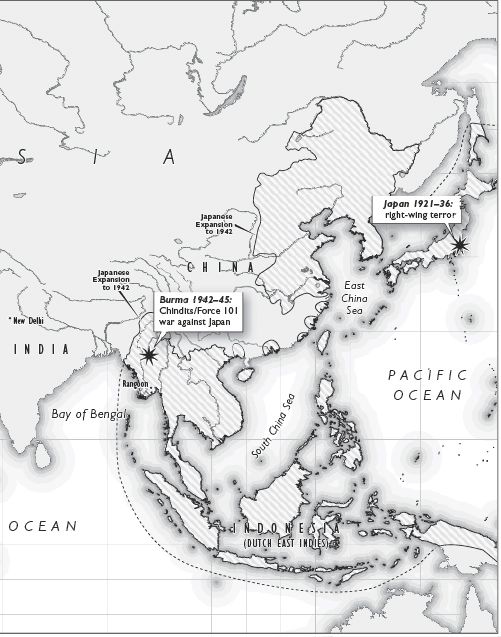
Japan’s experiment with parliamentary democracy, which began in earnest in the 1920s, was expiring at the same time. Its death was even more directly tied to a campaign of terrorism, this one waged by fanatical military officers and ultra-nationalist agitators organized in groups such as the Blood Brotherhood, whose slogan was “One Member, One Death.” Their victims included Prime Minister Kei Hara, killed in 1921, Prime Minister Hamagushi Osachi (1930), and, in 1932, a particularly busy year, Prime Minister Tsuyoshi Inukai, former finance minister Junnosuke Inoue, and the Mitsui corporation’s director-general, Baron Dan Takuma. The conspirators behind the 1932 attacks had also contemplated assassinating the comedian Charlie Chaplin during his visit to Japan because they thought this “would cause a war with America.”
Since 1924 Japan’s government had been run by whichever political party had won a majority in the parliament. After the 1932 “incidents,” as they were decorously known, military influence became predominant. But the radicals still were not satisfied: they intimidated and assassinated officers who were deemed too moderate, such as the elderly retired Admiral Makoto Saito, a former prime minister and lord privy seal. He was murdered along with the finance minister and the head of military education in 1936 during an aborted coup by junior army officers. The prime minster, Admiral Keisuke Okada, narrowly survived the 1936 revolt; he hid in a closet when his house was invaded by rebellious troops who murdered his brother-in-law by mistake. Getting the message, he resigned immediately afterward. None of his successors was any more successful in resisting the desires of the imperialist extremists.
Terrorism worked in Japan because the terrorists represented a significant and influential constituency, including a large portion of the armed forces. Even then terrorism was only partly responsible for bringing the militarists to power. Failed terrorist groups such as the anarchists, by contrast, had few supporters and those came from the fringes of society.3
THE POLITICAL TURMOIL in Germany and Japan was part of a broader struggle that rent the world apart in the first half of the twentieth century. In essence it was a battle between totalitarianism and liberalism, although totalitarians of left and right were often at each other’s throats. This clash of ideologies produced not only the two world wars but also lesser conflicts, including the civil wars in China, Mexico, Russia, and Spain. The whole 1914–45 period could be called “a second Thirty Years’ War”—a term coined by the German expatriate scholar Sigmund Neumann in 1946.4(From our present-day perspective we might see a Seventy-Five Years’ War lasting until the fall of the Berlin Wall in 1989.)
Most of the fighting during those years, even in civil wars, pitted conventional armed forces against one another and hence is of little concern from our perspective. But smaller-scale guerrilla warfare and terrorism did not disappear amid the clash of gargantuan fleets, armies, and air forces. Indeed this period produced some of the twentieth century’s most notable practitioners of low-intensity conflict and some of the most influential doctrines for its prosecution. We will focus in particular on the influence of T. E. Lawrence, Orde Wingate, and Josip Broz Tito. Their efforts were very much “sideshows” that affected the ultimate outcome of the big wars only at the margins. But these sideshows left a lasting legacy. They made “special operations forces” (i.e., guerrillas in the service of the state) a prominent part of all modern militaries. They showed the limitations of even the most draconian counterinsurgency policies in quelling uprisings that enjoyed outside support. And, even more significant, they made inevitable the independence of Europe’s Asian and African colonies by mobilizing and arming significant numbers of the “natives.” The conclusion of this modern Thirty Years’ War, which left the great powers of Europe wheezing and gasping, set the scene for decades’ more fighting in wars of decolonization that would send the popular reputation of guerrillas soaring to new heights.
Our examination of this turbulent epoch begins with a slight, sensitive archaeologist from Oxford who improbably enough became one of the most storied irregular warriors in history.