
BOOK VI
43.
GERMAN BOMBS AND rockets had ceased to fall on Liverpool and London, but for the people of Britain life did not improve markedly after the end of World War II. “People are suddenly realizing,” a New Yorker correspondent wrote soon after Japan’s surrender, “that in the enormous economic blitz that has just begun, their problems may be as serious as the blitz they so recently scraped through.” Some 750,000 houses had been destroyed or damaged, public debt was at record levels, the pound devalued, unemployment rising. Britain had to rely on a loan from the United States as a lifeline, even as the new Labour government was launching a dramatic expansion of costly government programs in health care, schooling, unemployment insurance, and old-age pensions.
Rationing remained in effect, covering everything from meat, eggs, and butter to clothes, soap, and gasoline. As one housewife noted, “Queues were everywhere, for wedge-heeled shoes, pork-pies, fish, bread & cakes, tomatoes—& emergency ration-cards at the food office.” Even in the House of Commons dining room, the only meat on offer was whale or seal steak. The situation deteriorated even more in the harsh winter of 1947–48. Coal, gas, and electricity were all in short supply. Everyone seemed to be shivering and complaining, as the college student Kingsley Amis put it, “CHRIST ITS [sic] BLEEDING COLD.”
The inclement weather heightened the sense of ruin and decay that Christopher Isherwood, the expatriate writer, found upon his return to London for the first time after the war. He noted that plaster was “peeling from even the most fashionable squares and crescents,” that “hardly a building was freshly painted,” and that “once stylish restaurants” had been “reduced to drabness and even squalor.” He wondered, “Were there to be no fruits of victory?”1
The situation was profoundly worse in France, which at the end of 1944 was just emerging from the trauma of occupation and the death of more than 600,000 of its citizens. More than 10,000 women who were accused of having consorted with German soldiers had their heads shaved; many were beaten, even forced to run the streets naked with swastikas painted on their bodies.
Malnutrition was a serious problem, with the average height of children falling “dramatically.” There was panic buying in bakeries, as customers who took too many baguettes were being attacked by those who had to do without. Even wine, the most Gallic of beverages, was hard to get. And that was not the only humiliating shortfall. In the new government proclaimed by Charles de Gaulle, notes a recent history, “writing paper was in such short supply that they had to use up the remaining batches of Vichy letterhead, striking out ‘État Français’ at the top and typing in ‘République Française’ underneath.”2
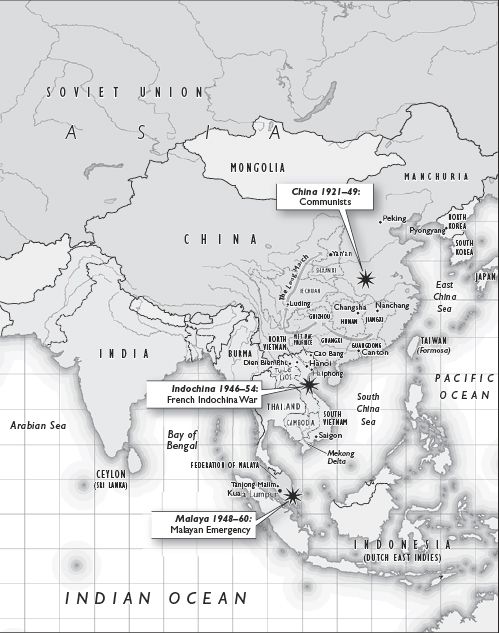
IT IS VITAL to underscore how weak the two biggest colonial powers were by 1945 in order to understand why decolonization swept the world in the next few years and why anti-Western guerrillas and terrorists appeared to be ascendant. This part of the book will examine Mao Zedong’s triumph in China, Ho Chi Minh’s victory in Indochina against the French, the FLN’s defeat of the French in Algeria, and (the lone success for the counterinsurgents) Britain’s suppression of a communist revolt in Malaya. But focusing on individual wars can easily give the sense that armed rebels defeated their old colonial masters. It would be more accurate to say that the empires were beaten from within. Nationalist uprisings contributed to the end of the imperial age, but seldom were they the decisive factor.
Even if Britain and France had been determined to hold on to all their overseas possessions after 1945, they would have been hard-pressed to do so. Both were essentially bankrupt. Neither country could comfortably fight a prolonged counterinsurgency. Especially not in the face of hostility from the rising superpowers that had usurped their place on the world stage. The Soviets, and later the Chinese, were always ready to provide arms, training, and financing to “national liberation” movements of a Marxist bent. The United States, for its part, despite its support for rebuilding Western Europe, had little sympathy with attempts to prolong European rule overseas. As the editors of Life magazine “bluntly” informed “the People of England” in 1942: “we are not fighting . . . to hold the British Empire together.”3 Indeed the United States pressed Britain to end its rule from India to Palestine. Later, as the Cold War heated up, Washington would modify its stance; it showed a willingness, for example, to bankroll the French war in Indochina. But in general the Americans viewed the continuation of colonial rule as a gift to communist subversives.
In 1948–49 the Truman administration threatened an end to Marshall Plan funding for the Netherlands if it did not end its efforts to put down a nationalist revolt in Indonesia.4 Seven years later, in a more high-profile confrontation, the Eisenhower administration threatened to let the pound collapse unless Britain, and its allies, France and Israel, ended their military operation to seize the Suez Canal and overthrow Egypt’s strongman, Gamal Abdel Nasser. Threatened with financial ruin, Britain and France had no choice but to give in, thus demonstrating the pathetic depth of their postwar weakness.
Even before then the British elite had already largely given up the imperial ghost. The theories of racial superiority that had once underpinned white rule over Asians and Africans had been discredited in different ways by the Nazis and Japanese. A British officer wrote in 1945 that, walking in Calcutta, he felt “rather like a Nazi officer must have felt walking along a Paris boulevard.”5
Nationalism had been percolating for decades in what became known as the Third World, thanks to the proliferation of European ideas. The desire for independence had been held in uneasy check by fear of the consequences, but the fall of Singapore in 1942, when 85,000 British troops surrendered to a Japanese force one-third their size, shattered once and for all any illusions about European invincibility.6 By war’s end, colonial elites were no longer willing to accept European rule—and in most cases Europeans were not willing to impose it at gunpoint.
In 1946 a British government publication declared, “British ‘Imperialism’ is dead.”7 To be sure, even Clement Atlee’s Labour government, which held power from 1945 to 1951, had no intention of dissolving the empire overnight. Initially Atlee hoped for a slow, stately process “to guide the colonial territories to responsible self-government within the Commonwealth.”8 But it soon became clear that procrastination would not be possible. Despite the opposition leader Winston Churchill’s impassioned warnings that “premature, hurried scuttle” carried “the taint and smear of shame,”9 independence was rushed for India, Palestine, and other colonies, leading to bloody civil wars. As one Labour minister acknowledged in 1948, “If you are in a place where you are not wanted, and where you have not got the force, or perhaps the will, to squash those who do not want you, the only thing to do is to come out.”10
Come out Britain did beginning in 1947 with the transfer of power in India, continuing in 1948 with Burma, Ceylon (Sri Lanka), and Palestine, resuming in 1956 with Sudan, followed the next year by the Gold Coast (Ghana) and Malaya. The rest of the African colonies were given their freedom a few years later. By 1967, the year that Prime Minister Harold Wilson announced the abandonment of commitments “East of Suez,” almost all of the empire was gone. Notwithstanding a few rearguard actions such as the Falkland Islands War in 1982, the age of imperialism was effectively over.
Most of the process was relatively peaceful. Jawaharlal Nehru and Mahatma Gandhi showed in India how civil disobedience, strikes, and protests—“a sort of non-violent warfare,” Orwell called it—could shame a liberal empire into withdrawal. (These were methods, Orwell noted, that “could not be applied in a country where opponents of the regime disappear in the middle of the night and are never heard of again.”) Their example of “shaking empires by sheer spiritual power”11 (Orwell again) was emulated by Kwame Nkrumah in Ghana, Julius Nyerere in Tanzania, Jomo Kenyatta in Kenya, and other independence leaders in Africa. All of them were helped by the United Nations’ newfound ability to marshal international opinion against imperialism.
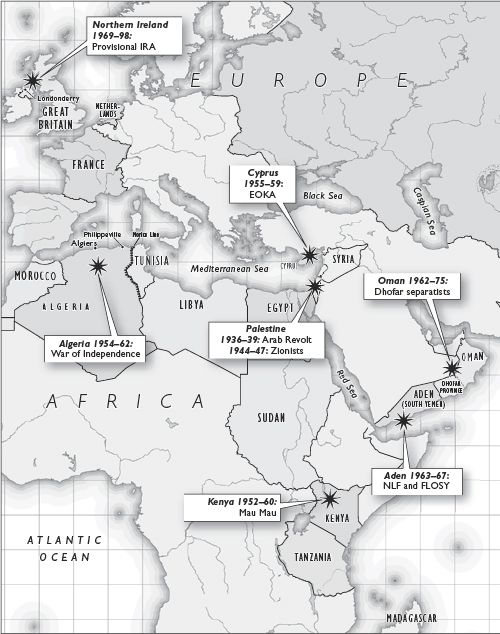
Where the British did face violent opposition, it did not take much to persuade them to leave. In 1947 the British cabinet decided to abandon Palestine after three years of attacks by Jewish terrorists, most belonging to the right-wing Irgun and Lehi (a.k.a. “the Stern Gang”), had killed 338 Britons—fewer than had died during one day of the retreat from Kabul in 1842. This was one of the more successful terrorist campaigns ever waged; Churchill called it a “hell-disaster.” But as important as bombs, such as the one that blew up the British headquarters in the King David Hotel in 1946 (an Irgun operation that killed 91 people), was the force of moral suasion exemplified by the Exodus affair. In 1947 the Royal Navy intercepted a ship called Exodus from Europe—1947 packed full of Jewish refugees trying to reach the Holy Land. In the process of taking over the vessel, Royal Marines killed and wounded a number of the passengers. The British then sailed the ship to Germany, where the passengers were off-loaded in “the land of their annihilation.” As the Israeli historian Benny Morris notes, this was a “major propaganda coup”: “Nothing could have done more to promote the Zionist cause.”12
Britain generally fought only to hold on to a few bases such as Cyprus and Aden deemed to be of strategic significance—or, as in Malaya and Kenya, to prevent a takeover by Communists or other extremists. When they did choose to fight, the British often did so skillfully and successfully; their counterinsurgency record is better than that of the French during the same period, and some of their campaigns, notably that in Malaya, are still studied by military strategists. But Britain was as successful as it was in large part because it was careful to pick its spots and not get mired in hopeless struggles to perpetuate unpopular rule in the dawning age of national self-determination. Belgium likewise gave up its only colony, Congo, without a fight in 1960.
The French remained more truculent, perhaps in reaction to their all-too-accommodating behavior before the war. They saw a need to hold on to their empire in order to resurrect lost glory and erase the humiliation of defeat. In 1945–46 they slaughtered thousands of Algerians and Vietnamese, and hundreds of Syrians, to reestablish their rule. In 1947–48 they killed at least 11,200 people to quash a revolt in Madagascar.13 But, like the British, the French were willing to grant independence to most of their African colonies with no bloodshed. (Even Madagascar became an independent member of the French Community, the Francophone version of the British Commonwealth, in 1960.) And, as we shall see, their will to prosecute the wars in Indochina and Algeria was severely limited.
So too with the Dutch, who abandoned Indonesia after an unpopular “police action” in 1947–48.
The Portuguese, under their fascist dictator Antonio Salazar, held out the longest. They did not abandon their Africa colonies, Guinea-Bissau, Angola, and Mozambique, until 1974–75 following a coup d’état in Lisbon. Significantly, the end of the Portuguese Empire, as with the Russian Empire nearly two decades later, was brought about on the home front—not on a distant battlefield.
NONE OF THIS is meant to trivialize the accomplishments of nationalist rebels; only to place them in the proper perspective. That sort of perspective was lacking in the immediate post–World War II era when the myth of guerrilla invincibility was born. By the mid-1970s, following the American defeat in Vietnam, it was easy for an informed observer to believe that it was virtually impossible for a conventional army to defeat an unconventional foe. Nothing could be further from the truth; as our survey should have already shown, the odds remain stacked against those who adopt guerrilla or terrorist tactics. For guerrillas to triumph they usually require outside assistance along with a major lack of acumen or will on the part of the government under siege. All of these factors were present in China, whose civil war would serve as a template for postwar insurgencies.
Its inclusion in a section entitled “The End of Empire” may seem strange since the Chinese Communists triumphed over a homegrown regime, not one imposed from abroad. But the revolutionary struggle in China had long been fueled by opposition to imperialism, first Western, then Japanese. Part of the Communists’ winning strategy was to paint their enemies as the “running dogs” and “lackeys” of the “imperialists” and to depict themselves as the true champions of Chinese independence. Moreover, Mao Zedong’s triumph would serve as inspiration for countless imitators across the Third World intent on overthrowing regimes ruled by Westerners or friendly to them. It is impossible to understand what came later—what happened in the 1950s and 1960s, the great age of communist and nationalist insurgency—without understanding how the “Reds” came to power in the world’s most populous nation in the 1940s.