
CHAPTER I
1. According to Pliny, Julia, the wife of Emperor Augustus, attributed her vitality and longevity-she died at eighty-seven at nearby Aquileia-to the Carso's wine.
CHAPTER 2
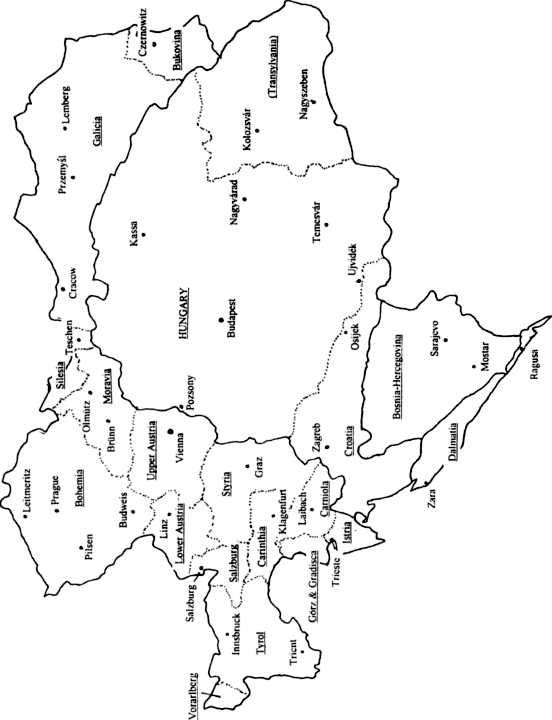
1. Hence the correct term for the Habsburg Empire after 1867 was Austria-Hungary; this work frequently refers to just "Austria" for brevity and convenience; the Austrian and Hungarian halves are referred to separately where required, and "Austria" is used to describe the empire as a whole.
2. Among the dead was twenty-three-year-old Herbert Conrad von Hotzendorf, a lieutenant of dragoons, the son of the chief of the General Staff.
3. One of them was the Seebataillon Triest, sailors from the naval base at Trieste sent to the Carso front to hold the line.
CHAPTER 3
1. Prime Minister Antonio Salandra later admitted that had Italy been aware of the impending Austro-German offensive, Rome might not have intervened at all.
2. From the Serbo-Croatian term for the Military Border, Vojna Krajina.
3. One of the most important tasks the 5th Army had to complete was the construction of new roads through the Julian Alps. There were few decent roads for supplying the troops, so construction of a major road to supply the upper Isonzo valley via the 5,000-foot-high Vrsic pass began in May. The work was done by 12,000 Russian prisoners of war.
4. "Forward Savoy!"-from the house of Savoy, Italy's ruling dynasty.
5. "Forward! With the knife!"
CHAPTER 4
1. Indeed, so pervasive was the despair about Italy's "moral delinquency" that even the philosopher Benedetto Croce believed that the army was fighting on the Isonzo not just to defeat the Habsburgs, but also for "nothing less than ... redeeming definitively the Italian people from a fifteen-centuries-old guilt."
2. Spanische Reiter, named after Vienna's famous Hofburg riding school, were high wooden supports for masses of concertina wire, intended to block the advancing Italian infantry.
3. Not exclusively Roman Catholics, however: many were Greek Catholics or Uniates, Eastern Christians in communion with Rome. Greek Catholics formed the second largest denomination in the Habsburg Empire and were well represented in the army, particularly in regiments from Galicia, eastern Hungary, and Transylvania.
4. "Long live Austria!"
5. The office of honorary regimental colonel, an ancient institution, was commonplace in European armies before the First World War; it was usually held by distinguished generals or foreign royalty. Vittorio Emanuele naturally resigned as the 28th's titular commander once Italy declared war on Austria, as he did with the three Imperial German Army regiments in which he held similar posts.
CHAPTER 5
1. This regiment, raised in 1696, was descended from the medieval Teutonic Knights, established in the end of the 12th century. Its honorary colonel, the Hoch- und Deutschmeister (High and German Master), was the head of the order. In 1915 the post was held by Archduke Eugen, commander in chief of the Italian front, who was destined to be the last Hoch- and Deutschmeister.
2. "Missing" includes the thousands of dead soldiers with no known grave or whose bodies were blown apart; hence even the official Italian death count likely exceeded 20,000.
3. This brigade, like its sister Cagliari Brigade from Sardinia, had an advantage over other Italian units: its soldiers' native dialect, difficult for mainland Italians to understand, was utterly incomprehensible to the Austrians; thus the Sardinians could communicate on field telephones and radios without using code.
CHAPTER 6
1. One such unfortunate staff officer was Colonel Giulio Douhet, the brilliant airpower theorist and later prophet of strategic bombardment, who wound up in jail for daring to raise awkward questions about Cadorna's fighting methods.
2. The Austrian Army's three dozen Jager (hunter) battalions, like Italy's Bersaglieri, were an elite force descended from nineteenth-century light infantry units.
3. This was a particularly biting comment because Cadorna's father, Count Raffaele, had captured Rome in 1870.
CHAPTER 7
1. Literally "the gray-green ones," from the color of the Italian field uniform.
2. Not that Mussolini was universally popular with his comrades in arms, many of whom blamed him for getting Italy into the war.
3. A total of 12,000 Russian prisoners were used by the Austrians to build the 5,300-foot-high Vrsic pass. The poorly clothed Russians suffered badly during the winter months, and hundreds succumbed to illness and the weather.
4. Relations between Paris and Rome were never ideal. The French Army, remembering Italy's need of French troops to defeat Austria in 1859, consistently rated Italian arms poorly, and Cadorna displayed no love for Joffre and his generals.
5. These were the three-division-strong Iron Corps and the elite 18th Division, whose mountain troops had so stoutly defended the Bainsizza plateau throughout 1915.
6. The Austrian command structure had been reshuffled during the winter: the XV Corps, defending the upper Isonzo from Tolmein to Rombon, now was under General Franz Rohr's newly raised 10th Army; however, because Boroevic was commander of all Austrian forces on the Isonzo, this three-division corps has been counted in the totals for the 5th Army.
7. Cynics have suggested that the British were at least honest enough to admit to Joffre that they would do nothing to help France until the summer. The Russians' March offensive at Lake Naroch was pursued with considerably more vigor than the Italian effort on the Isonzo. The Russian drive ended disastrously with the loss of over 100,000 soldiers while inflicting only one-fifth as many casualties on the Germans; it did little or nothing to relieve the French at Verdun.
8. The crisis did not change Cadorna that much, however; fearing the worst, Prime Minister Salandra again requested a Council of War to determine Italy's course of action. Cadorna brushed this suggestion off as rudely as he had dismissed Salandra's first request.
CHAPTER 8
1. Naturally not all Italians shared this view; in an inexplicable message sent by Vittorio Emanuele to fellow monarch and ally George V in March, the king stated that Germany was the real enemy (even though Italy had not declared war on Berlin), and that the Isonzo was only a secondary front! Cadorna, of course, thought differently.
2. In many places the Isonzo was fordable, except during the spring, when melting snows significantly deepened the river. Artillery and supply units, however, needed bridges.
CHAPTER 9
1. For this feat, First Lieutenant Wanke justly received the Knight's Cross of the Order of Maria Theresia.
2. The official Italian count was little more than 25,000, but independent estimates have ranged as high as 69,000. Certainly the latter figure is much closer to the truth.
3. Roosz was rewarded with the Knight's Cross of the Order of Maria Theresia. He had inflicted crippling losses on one of the finest Italian divisions; in just three days in the Fajti hrib area, its Tuscany Brigade lost 2,634 soldiers, most of them to the 61st Regiment's counterattack.
4. Archduke Joseph's VII Corps bore the lion's share of the casualties, as usual.
CHAPTER 10
1. In May 1917, the Italian Army boasted fifty-nine infantry divisions, twenty-one regiments of Bersaglieri, eighty-eight battalions of Alpini, and four cavalry divisions, supported by 8,200 machine guns, 3,000 field guns, 2,100 heavy guns, and 1,500 heavy mortars.
2. Three on the upper Isonzo, two on the Bainsizza, two behind Gorizia, seven on the Carso, and four in army reserve.
3. Fianune verdi, so called because of the green collar that adorned the mountain troops' uniform; the Bersaglieri, the army's other elite corps, wore red collar patches, and were known colloquially as "red flames" (flanune rosse).
4. Giovanni Randaccio died an agonizing death in a Monfalcone field hospital, D'Annunzio at his side. The warrior-poet managed to turn his friend's meaningless end into a gruesomely patriotic and romantic tale, which he recounted at Randaccio's funeral. The Duke of Aosta liked D'Annunzio's speech so much that he had it reprinted and distributed to the men of the 3rd Army, to assist the "moral preparation of the combatants."
5. Indeed, the Jewish regimental doctor was something of a cliche in the Austrian Army. Many distinguished Jewish physicians had done their service in the army, among them Lieutenant Dr. Sigmund Freud.
6. As befitted his act of heroism and daring, Captain Sonnewend received the Knight's Cross of the Order of Maria Theresia for his leadership on June 3, 1917.
7. On June 1 redesignated the 2nd Army.
CHAPTER 11
1. He believed-rightly-that the Vatican's sympathies lay more with the House of Habsburg than with the House of Savoy.
2. Antonio Gatti, Cadorna's adjutant, recalled frankly, "I never heard him speak about the men and about using them economically."
3. Gabriele D'Annunzio, observing the bodies of twenty-eight soldiers of the Catanzaro Brigade shot for cowardice, penned a gruesome poem, "The Dead Sing with Dirt in Their Mouths" ("Cantano i morti con la terra in hocca ").
4. Mauthausen, located on the Danube in Lower Austria, seventeen miles east of Linz, was the largest Austrian prisoner-of-war camp.
5. The zealously humanitarian and religious Karl also denied his generals the use of poison gas in battle without his permission, another gesture that helped to make the monarch decreasingly popular in military circles. He was better liked by civilians; to triestini the young emperor was Carlo Piria-"Charles Funnel"-so called for his well known love of wine.
6. The 63rd Infantry Regiment, with its depot at the medieval market town of Bistritz, recruited in the dark and wooded Carpathian valleys of northeastern Transylvania, where two decades earlier Bram Stoker had set his famous novel, Dracula.
7. Franek received the Knight's Cross of the Order of Maria Theresia for his heroism and leadership. Many years after the event, when asked about his daring on August 21, particularly his rescue of his trapped soldiers, Fritz Franek modestly retorted, "What else could I have done?"
8. The unlucky sergeant's mangled corpse was buried incomplete; the missing body part, a leg, was found four days later, when the smell of rotting flesh reached the gun positions. The severed limb was discovered resting in a ravine overlooking the battery, covered with blackflies.
9. The 1st Isonzo Army (the Carso and lower Isonzo regions, including the XXIII, VII, and XVI Corps) was assigned to Colonel-General Wenzel von Wurm; the 2nd Isonzo Army (the XXIV and XV Corps, from Mt. San Gabriele to Rombon) was under General Henriquez.
10. Two of its shattered divisions, the 21st Rifle and 106th Militia, had already been officially sent to the rear to regain their strength.
11. For this Corporal Kapetanovic received the Gold Medal for Bravery, the highest decoration bestowed on Austrian enlisted soldiers. He paid a terrible price, however; he was among the numerous Bosniaken struck by Italian shrapnel during the charge up Hill 830, and was permanently blinded in both eyes.
12. For this, Colonel Vladimir Laxa was awarded the Knight's Cross of the Order of Maria Theresia.
13. In terms of ethnic composition, in September 1917 Army Group Boroevic, comprising the 1st and 2nd Isonzo armies, was 60 percent Slav (Polish, Czech, Slovak, Ukrainian, and a large number of South Slavs), 16 percent Magyar, 13 percent German, and 1 I percent Romanian. Boroevic's army group, even more than the Habsburg Army as a whole, was a Slavic force.
CHAPTER 12
1. Three from Galicia, two from Transylvania, and two from France; Austria added two divisions of her own from the Russian front.
2. The rough Austrian equivalent of the Medal of Honor or Victoria Cross; the 7th Infantry Regiment was the army's second most decorated regiment, with thirty-six Goldenen to its credit.
3. In all, the lavishly equipped Sturmbataillon boasted eight heavy and a dozen light machine guns, a pair of 37mm light cannons, a dozen light mortars, and its own pioneer platoon with a half-dozen flamethrowers as well as demolitions-the fire power of an entire regiment in a single battalion; just as significant, the assault unit's tactics were innovative, indeed revolutionary, emphasizing flanking (not frontal) attacks, rapid exploitations of success, and keeping the momentum of the offensive.
4. Indeed, when early in the war Germany first raised mountain units of its own, it turned to Habsburg staff officers for advice on tactical, organizational, and logistical issues, a rare exception to the general rule of Austrian dependence on its ally's battlefield expertise.
5. Through the war, Austria's mountain troops were well equipped with special Alpine motor vehicles for the movement of troops, artillery, and supplies at high altitudes, many of them designed by the Daimler-Werke at Wiener Neustadt, whose chief engineer and general director was Ferdinand Porsche, later world-famous for his automotive pioneering.
6. One of which, Air Company 39D, was assigned directly to the 55th Division for the battle.
7. The feeling was mutual; Cadorna feared that Capello, a better politician than himself, was trying to depose him at the Comando Supremo.
8. The 144th Infantry Regiment, on the Isonzo on the eve of the Twelfth Battle, had recently received its forty-first colonel commanding since the war began.
9. "Long live Austria, the war is over!"
10. The future "Desert Fox" was initially a victim of his own bureaucracy. His hard-won Blue Max was first mistakenly presented to a brother officer, which made Rommel explode with rage.
11. The three elite regiments of Kaiserschutzen were the Austrian Landwehr's equivalent of the k.u.k. Armee's four regiments of Tiroler Kaiserjager.
12. Even the British artillery units on the Isonzo were ordered to retreat and abandon their guns and huge ammunition reserves; fortunately for the war effort, the British headquarters at Gradisca did manage to save its large stash of liquor and cigarettes from the advancing Austrians.
13. One of the few attackers killed during the capture of Udine was the German General von Berrer, commander of the LI Corps, who took his staff car into the city too quickly and was gunned down by retreating Carabinieri on horseback.
14. With this, the total of Italian men and equipment captured by Krauss's I Corps by October 31 reached 45,000 soldiers, 340 guns, and hundreds of machine guns.
15. The officer cadet and his "brown devils" celebrated their bloodless triumph with a three-day drunk in a nearby castle, where they appropriated an Italian general's abandoned stock of vintage wines.
CHAPTER 13
1. Some 300,000 less than the army had in mid-1917.
2. Among the Heimkehrer were many future Central European Communist notables, the best known of them Corporal Josip Broz of the 25th Honved Regiment, later famous by his nom de guerre, Tito. Future Hungarian Communist leaders Bela Kun, Imre Nagy, and Matyas Rakosi were likewise converted to the Marxist-Leninist faith in Russian captivity.
3. The military's official report on the Caporetto defeat, released in 1919, was highly critical of the army's generalship, Badoglio included (although, significantly, it did not blame politicians or defeatism on the home front); however, the thirteen pages that explicitly blamed Badoglio were tactfully excised.
4. "Who gets the honor? We do!"
5. One of their number was Captain Fiorello La Guardia, U.S. Army Air Service, who had resigned his New York congressional seat to join the struggle. La Guardia regularly addressed Italian troops about America's willingness to help its ally win the war and redeem Italia irredenta, and he was doubtless sincere: his mother was a Triestine Jewess.
6. Austrian resentment at the Dual Monarchy's dependence on Berlin ran deep, especially in military circles; Conrad, in fact, on numerous occasions referred to the Germans as "our secret enemies."
7. The typically blunt Field Marshal Boroevic informed officers of the 8th Cavalry Division as they arrived on the Piave from the Eastern front in the spring of 1918, "Gentlemen, you haven't been in Italy, you don't know what war is."
8. There had been bad omens, however. On June 11, the Austrian battleship Sent Istvbn was sunk by an Italian torpedo boat forty-five miles southeast of Pola during a routine Adriatic patrol. It was the worst Austrian naval loss of the war.
9. Diaz's field force counted fifty-six infantry divisions to defeat the Austrian offensive (including three British, two French, and one Czecho-Slovak), of which thirty-seven were at the front on June 15 and nineteen were held in reserve; the Italians also had 7,043 guns and 2,406 mortars of all calibers to resist the Austrian drive.
10. Or 142,550, counting the sick.
11. The Comando Supremo organized a whole division of arditi just before the battle (with six battalions of arditi and four of Bersaglieri, as well as mountain artillery and assault engineers), and it acquitted itself so well on the Piave that the army decided to raise a second immediately.
12. Segre was a Jew, as were fifty other Italian wartime generals. Italy's tiny Jewish community was decidedly overrepresented in the officer corps, and they performed well. One of them, Emmanuele Pugliese, was the most bemedaled general in the army, and all told not less than a thousand Jewish soldiers were decorated for valor during the Great War.
13. The Austrians were short of ammunition, but they occasionally responded, claiming unlucky Italian victims. One of them was Ernest Hemingway. Eager to see action, he demanded transfer from the tranquil Dolomites to the more fiery Piave front in late June, and soon found himself driving ambulances for the 3rd Army. His frontline career was brief, however, cut short by an Austrian mortar barrage on July 8 at Fossalta di Piave, a dozen miles from the Adriatic coast. Hemingway was struck by shrapnel and sent to the rear to recover, never to see the front again.
CHAPTER 14
1. The German-Bohemian wartime death rate was 34.5/1,000 inhabitants, compared to an Austrian average of 26.7, a German-Austrian rate of 29.1, and a CzechBohemian rate of 26.7. The highest rate in the whole empire was in the German belt of southern Moravia, which registered a loss of 44/1,000 residents; the second highest loss rate, not far behind, was found in Muslim districts of Bosnia-Hercegovina.
2. Arz, the chief of the General Staff, was similarly pessimistic about the prospects for a successful Austrian stand in Venetia; on October 5 he ordered General Victor Weber von Webenau to form an armistice commission in Trient, in preparation for the impending need to sue for peace.
3. Following Hungary's detailed constitutional understandings, Karl could not divide Hungary along ethnic lines, as he could the Austrian half of the empire.
4. Noting his ally's pervasive inability to coordinate artillery and infantry, Lord Cavan said, "I can tell you privately that they simply will not go in for the scientific side of accurate shooting."
5. In the dawn attack, the lead British battalion, the 11th Northumberland Fusiliers, lost every officer above subaltern, including the lieutenant colonel commanding, who was killed on the Piave's east bank.
6. "Austria is in your camp,/While we others are solitary ruins./Through foolishness and deceit/We have crumbled and decayed,/But her spirit lives still/In those you lead to battle ... /Those whom God created as Slav and Magyars/Do not quarrel spitefully over words,/They follow, even when the warrior's call is German,/For 'Forward!' calls to Hungarian and Czech alike."
7. Other units were not so fortunate. In one of the worst incidents, a November 10 argument between Graz police and returning Ukrainian and Czech troops led to a firefight in the train station, complete with machine guns, that left eight dead.
8. Even an unrepentantly nationalist German-Bohemian regimental history declared, perhaps reluctantly, "To be fair to the honor of our Czech officers and soldiers, it must be admitted that they remained loyal to their units at all times."
CHAPTER 15
1. Italy's new war minister, appointed in February 1919, was Enrico Caviglia, whose shock troops captured the Bainsizza in August 1917.
2. In a sad irony, Italy's population gain from annexing the Littoral and the South Tyrol almost exactly offset her enormous casualties in the Great War.
3. The 3rd Army also boasted 47,601 bravery medals: 274 gold, 18,467 silver, and 28,860 bronze.
4. D'Annunzio's last years were a pathetic reflection of his valorous war service, with gluttony and sexual excess replacing patriotism and daring exploits. The increasingly feeble bard died in March 1938, aged seventy-five, shortly before Italy's next great war.
5. He was soon followed by Colonel-General Wenzel von Wurm, last commander of the Isonzo Army, who died in Vienna less than a year later.
6. The republic was also burdened with many retired officers who opted for Austrian citizenship upon the empire's demise but remained diehard monarchists; one such was Guido Novak von Arienti, the hero of Plava, who until his death in Vienna in 1928 was active in conspiratorial circles planning a Habsburg restoration.
7. Emil Fey's role in the Dolfuss murder still remains ambiguous, although it is clear that his sin was one of omission, not commission.
8. Otto von Berndt was another.
9. Led by Matyas Rakosi and then Imre Nagy, both ex-Habsburg soldiers.
10. The last Knight of Maria Theresia for service on the Isonzo was Fritz Franek, who returned from Soviet captivity and died peacefully in Vienna in 1976. The very last Knight of Maria Theresia was Gottfried von Banfield, "the Eagle of Trieste," a former Habsburg Navy lieutenant and Austria's leading flying ace during the war; he received the Knight's Cross in August 1917 for his exploits while leading flying boat squadrons from Trieste Naval Air Station. He stayed in Trieste after 1918, becoming an Italian citizen, marrying into a wealthy shipping family, and establishing a reputation as a maritime salvage expert; he led the clearing of the Suez Canal in 1956 after Nasser's attempts to block the waterway. In time, Banfield became a cherished Triestine fixture (his son, Baron Raffaele de Banfield, won laurels as a noted composer and the director of the Trieste Opera), and when he died in September 1986, aged ninety-six, Trieste knew that an age had ended.
CHAPTER 16
1. A notable exception, as of this writing, is Luigi Berlot of Plave (Plava), born in 1908, who witnessed the opening battles for "Bloody" Hill 383 as a seven-year-old boy. His father was an Austrian soldier, so the young Luigi watched the fighting with great interest. He speaks Italian and Slovene, lives on the Isonzo's west hank, and is very happy to discuss his memories of the battle with anyone who inquires.
2. The summit of Krn is still crisscrossed with stone entrenchments, but its Italian war memorials were long ago destroyed by lightning strikes.
3. Perhaps the most poignant and haunting is an unofficial memorial left by the fanti themselves: an inscription carved into the limestone face of Hill 98, above Monfalcone-"La pace i'ogliamo [We want peace]-1917."
MAPS
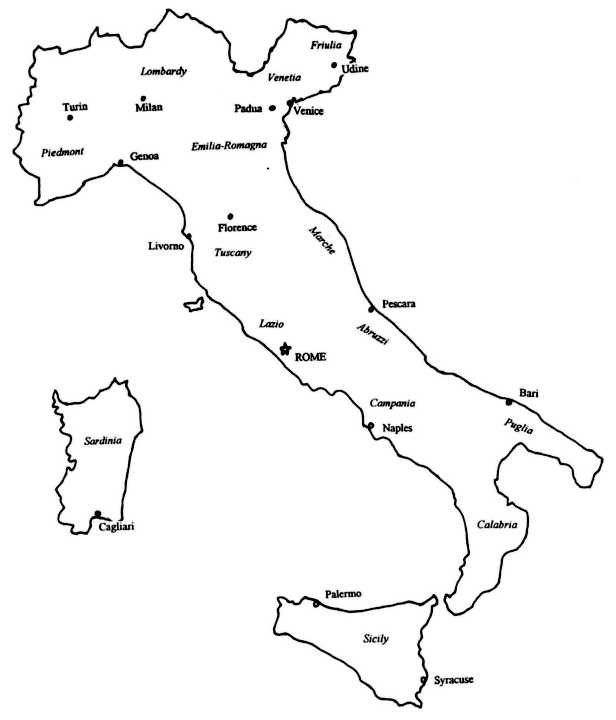
Map 2 Italy, 1914
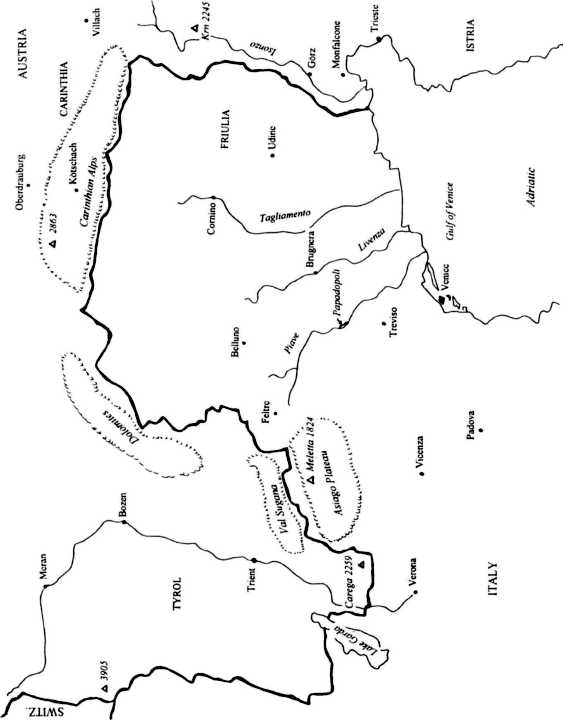
Map 3 The Austrian Littoral, 1914

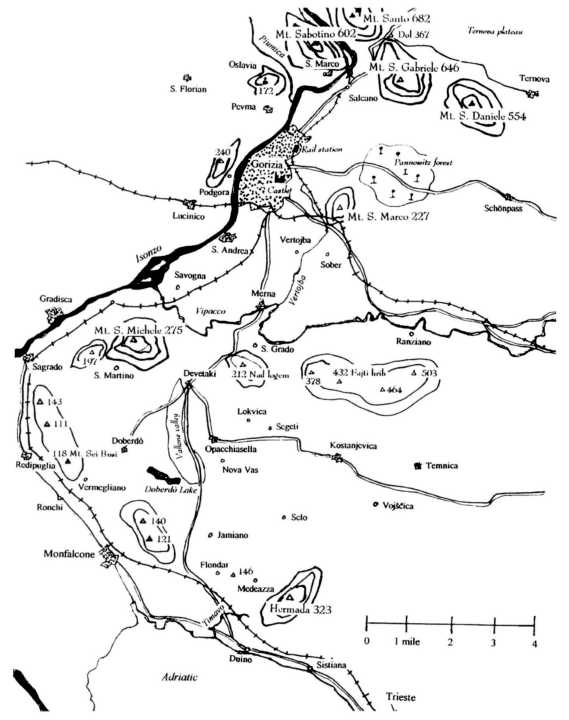
Map 5 The Gorizia-Carso Front
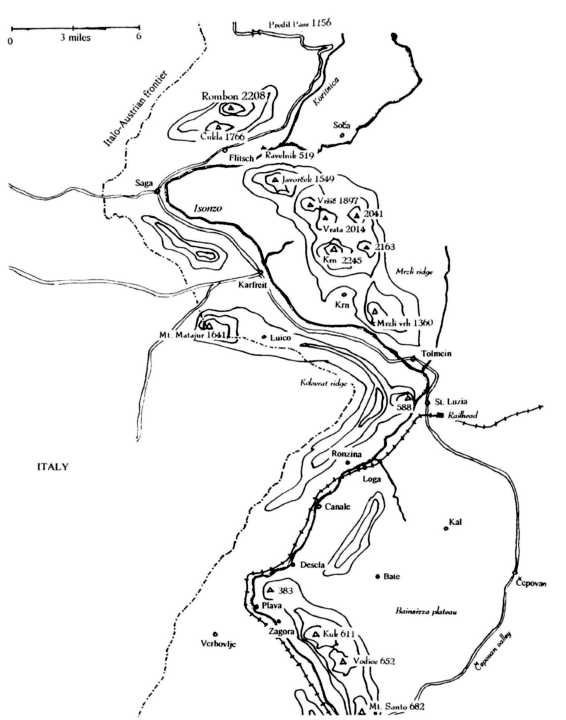
Map 6 The Central and Upper Isonzo
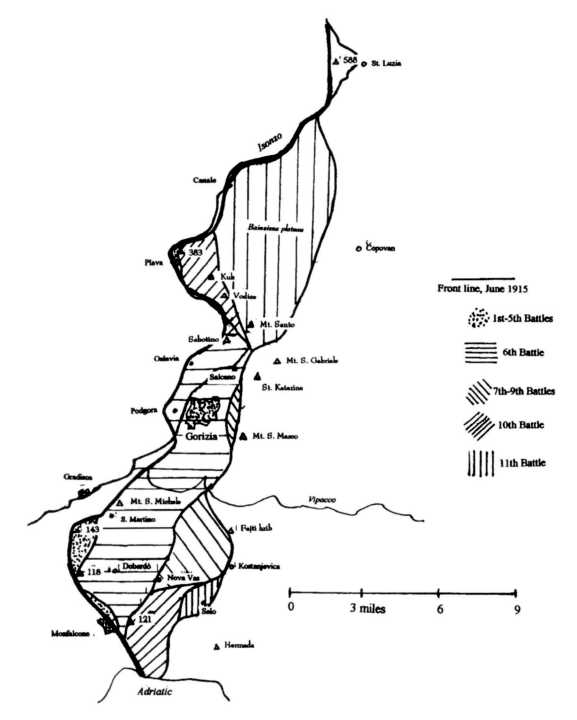
Map 7 Italian Territorial Gains, 1915-1917
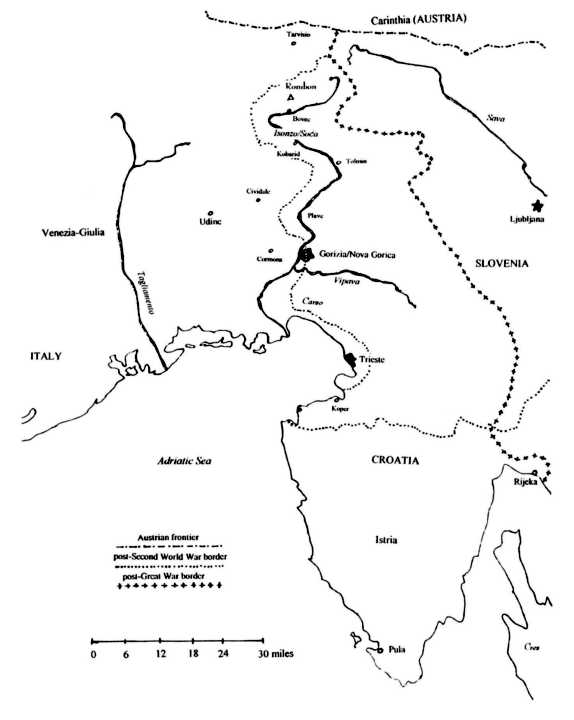
Map 8 The Isonzo since 1918
A NOTE ON NAMES AND
PRONUNCIATIONS
The names of many cities, towns, and rivers mentioned in this book have changed several times since 1918, so finding a standard method to choose the form used has been difficult; this has been particularly trying with the multilingual Habsburg Empire. In general, I have referred to places on the Isonzo battlefield as they were known at the time to the Austrian Empire and Army. This often produces an eclectic mix of German, Italian, and Slovene terms (i.e., Vipacco rather than Vipava; Karfreit, not Kobarid or Caporetto). The current Isonzo place-names are found below. For the Habsburg Empire, I have by and large relied upon post-1918 names, except where this would lead to needless confusion; hence, Ljubljana rather than Laibach, but Lemberg, not L'viv, L'vov or Lwow, for instance. I have used English equivalents where they exist (Vienna, Prague, Cracow). I have also not translated several perhaps untranslatable military terms where I felt appropriate, such as Bersaglieri, Arditi, Alpini, or Honved and Kaiserjager. Any mistakes I have made, or offense I have caused through apparent prejudice, are unintentional and mine alone.
This book therefore includes a diverse array of foreign names and terms. Although the pronounciation of Italian and German is well known in the Englishspeaking world, exact pronounciation of some names in other languages may be unfamiliar to readers. Therefore I have included this brief guide to assist the reader with pronouncing some names of places and persons encountered in this book.
ESSAY ON SOURCES
This book is based on extensive research in a variety of sources in several languages. Although there are many historical works, principally in Italian and German, which touch on the Isonzo fighting, comparatively few exist which deal solely with the war on the Isonzo. Certainly the Isonzo remains very underreported compared to other costly Great War campaigns such as Verdun, the Somme, or Passchendaele. Literature has likewise neglected the Isonzo; the Carso and Rombon have not found either their All Quiet on the Western Front or their Storm of Steel. Even Hemingway's vivid A Farewell to Antis, which includes graphic descriptions of the Gorizia and Plava fronts, is far from autobiographical.
Much of the information in the text, particularly concerning the Austrian Army, is taken from primary sources found at the Osterreichisches Staatsarchiv/Kriegsarchiv in Vienna. The impressive Viennese War Archive boasts a formidable collection of First World War documents. I have relied heavily on divisional records taken from the New Field Records section, as well as divisional and regimental accounts taken from the Battle Reports section. In addition, I have examined several special collections and the personnel files of many Austrian officers who served on the Isonzo. Austrian documents form the basis of my portrayal of the Habsburg Army.
Official histories of the war on the Isonzo reveal much interesting information, even allowing for their obvious prejudices. Vienna's weighty seven-volume account of the last Habsburg war, Osterreich-Unganis letzter Krieg, in many ways stands as a model of history-by-committee. To be sure, the authors of the Austrian work, former Habsburg General Staff officers, were careful to protect sacred reputations, especially that of Field Marshal Franz Conrad von Hotzendorf; no less, the Austrian volumes tend to blame ethnic disloyalty, rather than incompetent generalship, for battlefield defeats. That said, the Austrian official history is less biased than most works produced by ex-staff officers after the Great War; indeed, Basil Liddell Hart, no respecter of "official" viewpoints, considered the Austrian work to be "probably the best and most unbiased of the General Staff histories" to come out of World War One. Although Osterreich-Ungarns letzter Krieg should be approached with a degree of caution, it remains indispensable for anyone studying the war on the Isonzo.
The Italian official history, L'esercito italiano nella grande guerra, 19151918, is just as ponderous as its Austrian counterpart, but considerably less serviceable. Most of the government-issue accounts emanating from belligerent armies after 1918 concealed as much as they revealed, and the Italian work is a notable example in this respect. Written during the heyday of Fascism, it is careful to neither criticize nor to disparage Italy's failed efforts on the Isonzo. Nationalism and glory replace wisdom and honesty in most chapters. The result is an official history that, although useful at times, must be read with a high degree of skepticism. The British official account, Military Operations, Italy 1915-1919 (London, 1949), is better.
Many of the warnings about official histories apply just as strongly to memoirs. Although personal reminiscences are highly valuable to the historian, they must be read with great care. As a general rule, the level of mendacity increases as one progresses up the chain of command. Conrad's lengthy five-volume account of his years as Austria's top general, Aus newer Dienstzeit (Vienna, 1921-1925), is always intriguing, if not always true. Similarly, Luigi Cadorna's apologia for his war work, La guerra allafronte italiane (Milan, 1921), is selfserving to the point of dishonesty, precisely the kind of memoir one would expect from someone with an ego as all-consuming as Cadorna's. Luigi Capello's belabored explanation of his innocence in the disastrous Twelfth Battle of the Isonzo, Caporetto: Perche (Turin, 1967), ultimately conceals more than it reveals and fails entirely to convince.
Among senior generals' memoirs, Alfred Krauss's account of his I Corps's victory at Caporetto, Das Wunder von Karfreit (Munich, 1926), is perhaps the most interesting. It is detailed and informative, even if tempered by the author's German nationalist viewpoint. Regrettably Field Marshal Svetozar Boroevic left no memoir of his momentous years on the Isonzo. Unsurpassed for gaining an insider's view of Austria's army at war, on the Isonzo and elsewhere, is the often critical Unser osterreichisch-ungarischer Bundesgenosse inn Weltkrieg (Berlin, 1920), by August von Cramon, chief Prussian representative at the Austrian High Command.
Lower ranking soldiers also wrote accounts of their service on the Isonzo. Foremost among them is Il inio diario di guerra (Milan, 1922), penned by the ex-Bersaglieri sergeant Benito Mussolini. The war diary includes much bravado and myth-making, as befitted the future Duce, but the core remains intriguing. Mussolini frankly recalls many unpleasant hours on the Isonzo from the viewpoint of the fantaccino; for this reason alone it deserves attention. Another soldier's account, Caporetto: Note sulla ritirata di un fante della III armata (Gorizia, 1987) by Mario Puccini, a reprint of a 1918 memoir, includes unforgettable portrayals of the Italian Army's bizarre retreat across Friulia after the Twelfth Battle. Shortly before the Second World War, Erwin Rommel wrote his account of his famous conquest of Mt. Matajur; it appears in his Infanterie greift an (Potsdam, 1937). It offers a fascinating glimpse of the Great War through the eyes of a superefficient junior infantry officer.
Because the Isonzo front has been so unjustly neglected by historians, there are comparatively few biographies that illuminate the lives of the leading soldiers who fought there. David Fraser's Knight's Cross (London, 1993) is a very readable account of Erwin Rommel's long career; the Twelfth Battle of the Isonzo is treated in a relatively brief but thorough manner. Pietro Pieri and Giorgio Rochat profiled the life of one of Italy's senior soldiers in their Pietro Badoglio (Turin, 1974), which explains a great deal about both Badoglio and the Italian Army during the Great War. Gianni Rocca's Cadorna (Milan, 1985) is less interesting and revealing than its subject demands. There is only one, very brief biography of Boroevic, Ernest Bauer's Der Lowe voln Isonzo (Graz, 1985), an overwhelmingly sympathetic account of this controversial general. Bosco awaits his definitive biographer. Another regular on the Isonzo is protiled in Alfredo Bonadeo's recent D'Annunzio and the Great War (London, 1995). Bonadeo explains much about this fascinating warrior-poet, his motivations, and his militantly heroic exploits during the war with Austria.
Unit histories are another potential source for military historians, although one fraught with many potential complications. Inevitably the "regimental history" style, although sometimes offering a rich vein of otherwise lost knowledge, more often replaces balance with boasting. After al 1, no unit likes to admit a defeat. However, there are some serviceable unit histories available that deal with the terrible war on the Isonzo in admirable detail; the more recently written ones are usually better. Several of these are found in the bibliography. The chapters of this book draw upon a diverse mix of sources. Some of the best of them are mentioned below, for the benefit of future researchers.
THE ROAD TO WAR
Chapter 1
For a general overview of Italy on the eve of the Great War, including the irredentist question, see Christopher Seton-Watson's sympathetic Italyfrom Liberalism to Fascism, 1870-1925 (London, 1967); or, in a more general way, Dennis Mack Smith's Italy: A Modern History (Ann Arbor, MI, 1969). The sad state of Italy's armed forces going into the First World War is chronicled admirably in John Gooch's Army, State and Society in Italy, 1870-1915 (New York, 1989), which focuses on civil-military relations; the same author's "Italy Before 1915: The Quandary of the Vulnerable," in Knowing One's Enemies (Princeton, NJ, 1984), goes a long way to explaining the army's confusion during the first year of the Great War. Rome's slow slide to war in pursuit of sacro egoismo is recounted briefly in William Renzi's "Italy's Neutrality and Entrance into the Great War: A Reexamination," American Historical Review (June 1968). A view of Trieste before the war, especially its vibrant literary culture, is found in John Gatt-Rutter's Italo Svevo: A Double Life (Oxford, 1988).
Chapter 2
The best short explanation of the Habsburg Empire in its last decades is Alan Sked's The Decline and Fall of the Habsburg Empire, 1815-1918 (New York, 1989); for a longer version, with special attention to the nationalities question, see Robert Kann's excellent two-volume The Multinational Empire (New York, 1952). A revealing, more skeptical viewpoint is found in Oskar Jaszi's The Dissolution of the Habsburg Monarchy (Chicago, 1929); the comments by the author, a great Hungarian sociologist, on the Habsburg Army are highly interesting. Austrian military questions are detailed in Gunther Rothenberg's masterful Anny of Francis Joseph (West Lafayette, IN, 1976), unquestionably the definitive one-volume work on the subject. A broad overview of militarypolitical matters up to the war is Christoph Allmayer-Beck's "Die bewaffnete Macht in Staat and Gesellschaft," in Die Habsburgennonarchie: Bd. V. (Vienna, 1987). The unique multinational army is recalled vividly through its officer corps in Istvan Deak's Beyond Nationalism (New York, 1990). The best quick review of Austria's odd, ill-equipped army before its last war remains Norman Stone's provocative "Army and Society in the Habsburg Monarchy, 1900-1914" in Past and Present (April 1966). The empire's failed and costly war effort is recounted superbly in a book by an eminent Austrian historian, Manfried Rauchensteiner's Der Tod des Doppeladlers (Graz, 1994), the best single-volume account in any language. Budapest's troublesome political machinations during the Great War are reviewed in Jozsef Galantai's Hungary in the First World War (Budapest, 1989).
1915
Chapters 3-6
A few books recount the Isonzo fighting as a whole. Among more recent works, the best is Isonzo 1915-1917: Krieg ohne Wiederkehr (Bassano, 1993), by Walther Schaumann and Peter Schubert, even though its pictures are better than the rather formulaic text. Pietro Maravigna's Le undici offensive sull'Isonzo (Rome, 1929) is both biased and dated; the same can be said of Fritz Weber's colorful Menschenniauer am Isonzo (Leipzig, 1932), as well as his three short works, Isonzo 1915, 1916, and 1917, which tell the Austrian point of view. Much better is Antonio Sema's two-volume Li grande guerra sull fronte dell'Isonzo (Gorizia, 1997), which also has some good photos. The Slovene side of things is told rather dryly in Ivan Hmelak's Soska fronta (Ljubljana, 1968), the first Slovene popular history of the Isonzo battles, and better in Vladimir Gradnik's Krvavo Posocje (Koper, 1977), and especially in Vasja Klavora's extremely detailed Plavi kriz: Soska fronta: Bovec: 1915-1917 (Koper, 1993), which deals with the war on the upper Isonzo (and is available in German translation). The Magyar viewpoint can be found in an article by Marton Farkas about the Hungarian struggle on the Carso, "Doberdo: The Habsburg Army on the Italian Front, 1915-1916," in War and Society in East Central Europe, vol. 19 (New York, 1985); or, in Magyar, in Laszlo Szabo's Doberdo, Isonzo, Tirol (Budapest, 1980). A moving war memoir of a Hungarian soldier on the Carso, serving in Archduke Joseph's VII Corps during the terrible fight for the "stony sea" of Doberdo, is Joseph Gal's bitter In Death's Fortress (New York, 1991).
The bloody fighting at Plava in 1915 is recounted in Gustavo Reisoli's La conquista di Plava (Rome, 1932); although the author was the commander of the II Corps in the fighting for Hill 383, this patriotic book is nevertheless revealing about the determination of Austrian soldiers to defend the Isonzo line. Italian military shortcomings throughout the war are dealt with frankly in John Gooch's article, "Italy During the First World War" in Military Effectiveness; vol. 1, The First World War (Boston, 1988), a very good summary of Italy's martial weaknesses, especially in leadership. The complex and contested issue of nationalities in the Austrian Army, perhaps the greatest historical debate about Habsburg arms at war, is explained succinctly in Rudolf Kiszling's "Das Nationalitatenproblem in Habsburgs Wehrmacht 1848-1918," in Der Donauraum (1959). A longer and far more detailed evaluation of this vexing question is found in the Viennese Kriegsarchiv in Nachlass Robert Nowak, B/726, "Die Klammer des Reichs: Das Verhalten der elf Nationalitaten in der k.u.k. Wehrmacht 1914-1918," an exhaustive multivolume recounting of the nationalities question in the wartime Habsburg military.
1916
Chapters 7-9
The high point of the 1916 fighting on the Isonzo was the Sixth Battle, particularly the Italian capture of Gorizia. This great Italian victory is explained in an official account, La conquista di Gorizia (Rome, 1925) by Francesco Zingales. It contains excellent information about Italian dispositions, but ought to be approached carefully. More even-handed is Pietro Pieri and Giorgio Rochat's Pietro Badoglio (Turin, 1974), which explains its subject's meteoric rise and role in the planning of the triumphant Sixth Battle. Conrad's daring but ultimately failed South Tyrolean offensive of May-June 1916, one of the foremost what-ifs of the Great War, is explained in two main works: Kurt Peball's "Fuhrungsfragen der ost.-ung. Sudtiroloffensive im Jahre 1916," in Mitteilungen des osterreichischen Staatsarchives 31 (1978), and Gerhard Aril's Die osterreichisch-ungarische Sudtiroloffensive 1916 (Vienna, 1983).
1917
Chapters 10-12
The Tenth Battle of the Isonzo is elucidated from the Italian viewpoint in Rodolfo Pinchetti's biased but informative Isonzo 1917: Kuk-Bainsizza, Carso, Carzano (Milan, 1934). Cadorna's strategy and alternative Allied proposals are covered in 1917: Lubiana o Trieste? (Milan, 1986) by Giulio Primicerj. Mario Silvestri's Isonzo 1917(Milan, 1971) is a serviceable overview of Italian efforts during this pivotal year. The rise of the arditi and the assault troops' enduring military and political legacies are explained in Giorgio Rochat's solid Gli arditi della grande guerra (Milan, 1981). Enrico Caviglia, whose assault divisions broke the Austrian line on the upper Bainsizza at the beginning of the Eleventh Battle, produced La hattaglia della Bainsizza (Milan, 1930). This book, like all Italian accounts penned during the Fascist era, minimizes Italian casualty figures and presents an overly favorable view of Italian arms, but is interesting all the same.
The Twelfth Battle of the Isonzo and the epic Austrian victory that followed have received more attention than all other aspects of the Isonzo fighting combined. The main English-language account remains The Battle of Caporetto (Philadelphia, 1966) by the British military historian Cyril Falls; his work is flawed-like nearly everything written in English about Caporetto, it gives too much credit to the Germans-but worth reading. The Austrian achievement on the upper Isonzo in late October 1917 is chronicled carefully in Alfred Krauss's aforementioned memoir, Das Wunder von Karfreit. A noteworthy Italian investigation of the disaster is Mario Silvestri's Caporetto: Una battaglia e un enigma (Milan, 1984). Also revealing is La relazione Caraciocchi sulla battaglia di Caporetto (Salerno, 1982) by Piero Astengo, which chronicles and explains the collapse of the 2nd Army on the upper Isonzo in admirable detail. Erwin Rommel's daring exploits on Kolovrat ridge are recounted both in his lnfanterie greift an and in David Fraser's biography, Knight's Cross. An interesting English-language memoir that includes much about the Caporetto defeat is With British Guns in Italy (London, 1919) by Hugh Dalton, a Royal Artillery subaltern who witnessed the disaster unfolding.
1918
Chapters 13, 14
Austria's alarming material decline, rising domestic turbulence, and military disorder during the last year of the war are explained masterfully by Richard G. Plaschka in Cattaro-Prag: Revolte and Revolution (Graz, 1963), and, with Horst Haselsteiner and Arnold Suppan, in Innere Front (Vienna, 1974). The Piave offensive in June 1918 is detailed from the Austrian perspective in Peter Fiala's frank Die letzte Offensive Altosterreichs (Boppard am Rhein, 1967), and from the official Italian side in English translation in The Battle of the Piave (London, 1919). Emperor Karl's incompetent efforts at secret diplomacy in 1918, and their baleful consequences for his empire, are covered by the eminent historian Robert Kann in Die Sixtusaffare and die geheimen Friedensverhandlungen Osterreich-Ungarns ins ersten Weltkrieg (Munich, 1966). Mussolini's wartime activities are dealt with intelligently in a biography of Margherita Sarfatti, his longtime mistress, by Philip Cannistraro and Brian Sullivan: R Duce's Other Wonsan (New York, 1993). Hemingway's nebulous war record. the subject of much myth-making, mostly by "Papa" himself, is laid bare in Hemingway's First War: The Making of A Farewell to Arms (Princeton, NJ, 1976) by Michael S. Reynolds.
A revealing account of Austria's last battle can be found in Otto von Berndt's memoir, Letzter Kampf and Ende der 29. ID (Reichenberg, 1928); similarly, the last days on the Piave, seen by a lower ranking German-Bohemian soldier, are recounted in Karl Bergmann's Am Niemandslande (Reichenberg, 1930). The Allied perspective is explained well in E. C. Crosse's The Defeat of Austria as Seen by the 7th Division (London, 1919), which recounts the experiences of one of the British divisions that broke the Piave line at Papadopoli. Last, Italy's deceitful and deadly grab of Austrian prisoners at the war's end is elucidated in Emil Ratzenhofer's "Der Waffenstillstand von Villa Giusti and die Gefangnahme Hunderttausender," in Erganzungsheft 2 zum Werke OUIK (Vienna, 1932); or, in English, in R. Wayne Hanks, "Vae Victis! The Austro-Hungarian Armeeoberkommando and the Armistice of Villa Giusti," in Austrian History Yearbook 14 (1978).
EPILOGUE
Chapters 15, 16
Italian postwar diplomacy at Versailles, the question of Fiume and Dalmatia, and the complex origins of the notion of Italy's "mutilated victory" are ex plored thoroughly in H. James Burgwyn's The Legend of the "Mutilated Victory" (Westport, CT, 1989). The intricate details of border revision, Italian administration of the Littoral, and Germany's "Habsburg revenge" in 19431945 are explained lucidly in Dennison Rusinow's Italy's Austrian Heritage, 1919-1946 (London, 1969), an intriguing overview of an often overlooked subject. Information about the creation and development of Nova Gorica, up to the 1991 Slovene war for independence, can be found in the first chapter of Mark Thompson's solid A Paper House: The Ending of Yugoslavia (London, 1992).
Few guides to the Isonzo region mention the war in any detail. By far the best is Petra Svoljsak's Die Isonzofront (Ljubljana, 1994), which is thin but clearly written and well put together, and includes excellent photographs: a must for the tourist. There is one very interesting Italian guidebook, the haunting Sentieri di guerra: Le trincee sul Carso oggi (Trieste, 1991) by Lucio Fabi, which boasts first-rate photographs and maps of the Carso's limestone battlefields as they were more than eighty years ago and are today.