
During the early part of the war, the Luftwaffe had no need for its own military police branch, the few small field units of the Regiment General Göring would in any case not, under normal circumstances, have been entitled to a Feldgendarmerie-Trupp.
By 1942 however, Göring’s overwhelming ambitions had seen not only the expansion of his personal regiment to divisional status, but the creation of the first of the Luftwaffe field divisions. Eventually, 22 such divisions would be created.
Initially, the Feldgendarmerie sections of these Luftwaffe field units were considered as part of the divisional transport and supply (Nachschub) element. This situation remained until Luftwaffen Verordnungsblatt 43, Nr. 1115 of 3 June 43 decreed that the Feldgendarmerie was to be considered a separate branch in its own right.
Each major field unit of the Luftwaffe was allocated a Feldgendarmerie-Trupp and the Trupp was the standard Feldgendarmerie unit strength throughout the Luftwaffe. There were no Feldgendarmerie-Abteilungen within the Order of Battle of the Luftwaffe. The exception to the use of Truppsized units was a battalion comprising an HQ element and three companies of Feldgendarmerie which was located with Göring’s personal headquarter, the Feldgendarmerie-Bataillon Hauptquartier Oberbefehlshaber der Luftwaffe.
It should be noted that the Feldgendarmerie of the Luftwaffe existed solely to support its field units (with the exception of Göring’s headquarters battalion). The Luftwaffe did not maintain the widespread network of units fielded by the army through the various Wehrkreis on the home front, or with Orts- and Feldkommandantura. Any tasks required by these areas were carried out by Feldgendarmerie units of the Heer.
Uniforms and Insignia
Feldgendarmerie personnel within the Luftwaffe wore absolutely standard Luftwaffe uniforms and equipment, only the use of the following special insignia indicating their status as military policemen.
The principal form of dress which appears, from photographic evidence to have been worn by Luftwaffe Feldgendarmerie were the Fliegerbluse, tropical tunic in hot climates, camouflaged smock worn over the Fliegerbluse by Fallschirmjäger units and four pocket M43 style tunic worn by the Hermann Göring Division.
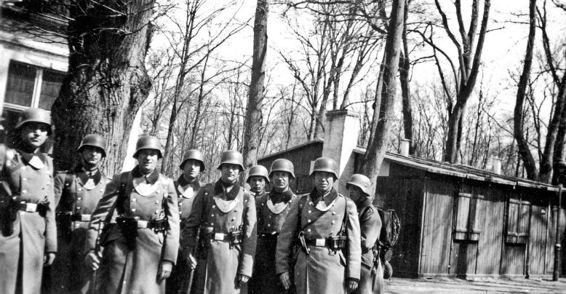
This shot is one of several unexplained images that emerged recently showing Police troops wearing a Luftwaffe gorget. It is however a standard bearers gorget not a Feldgendarmerie gorget, though it seems certain they are carrying out some sort of provost function.
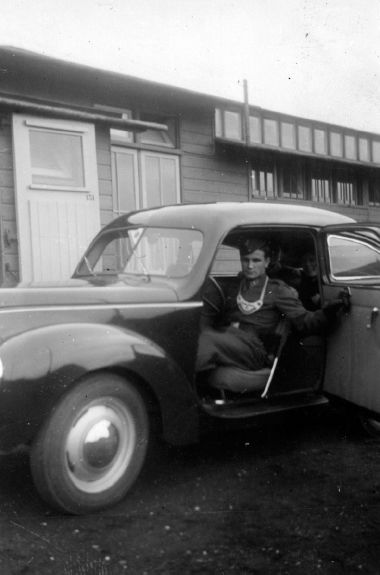
Luftwaffe NCO once again clearly wearing the army pattern gorget.
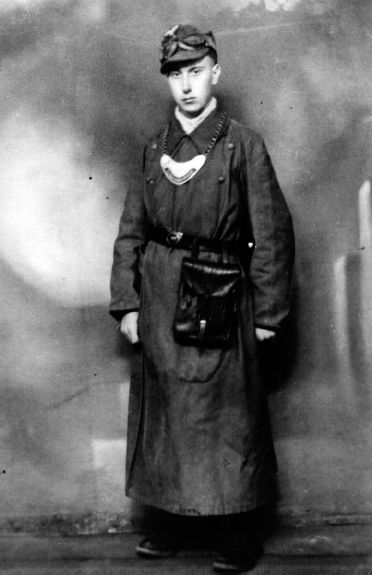
A Feldgendarm from the elite Hermann Göring Division. (Ludwig Dinger)
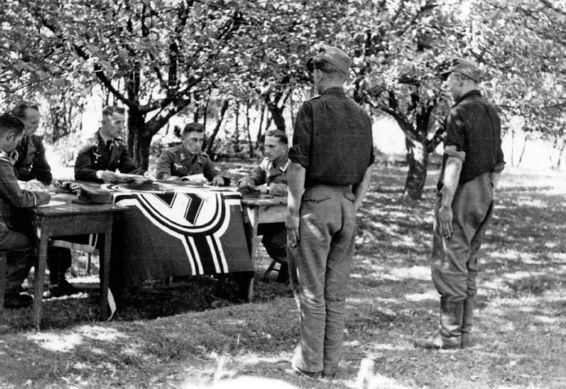
Two soldiers appear in front of a Luftwaffe Field Court Martial. (Herbert Kail)
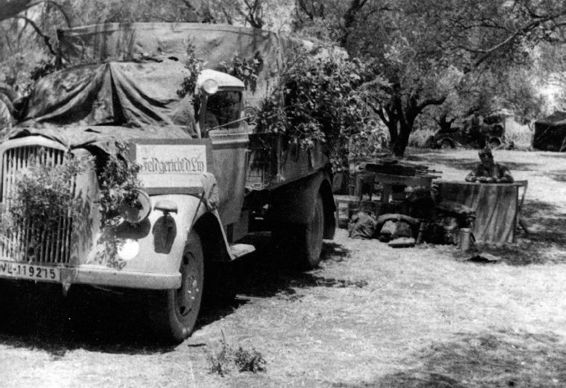
Note the sign on this Opel Blitz truck ‘Feldgericht der Lw’ (Luftwaffe Field Court Martial). (Herbert Kail)
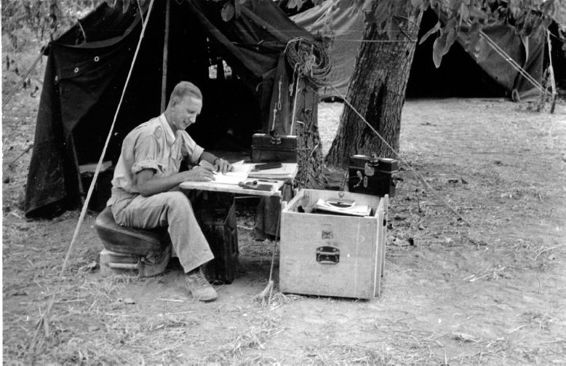
Even at the front, the military policeman was plagued with paperwork. Shown here is Unteroffizier Herbert Kail from Feldgendarmerietrupp ‘HG’. (Herbert Kail)
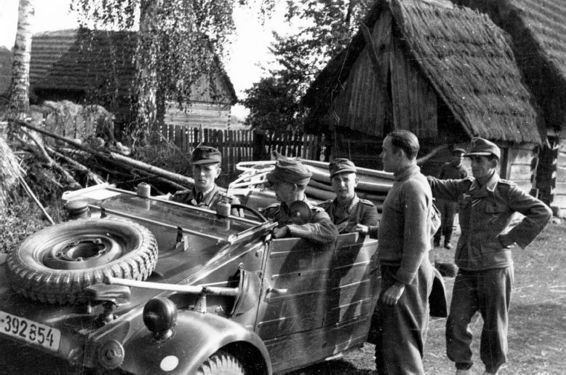
Feldgendarmerie from the Hermann Göring Division on the Eastern Front. (Herbert Kail)
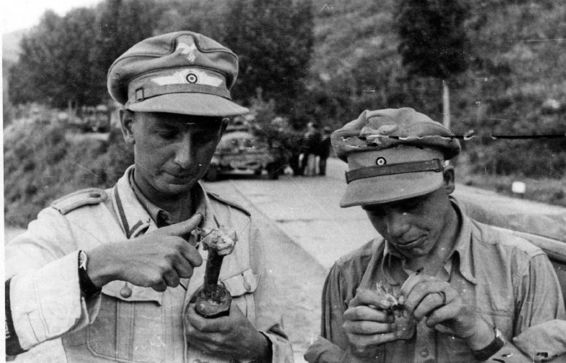
Luftwaffe Feldgendarmen on Sicily. (Herbert Kail)
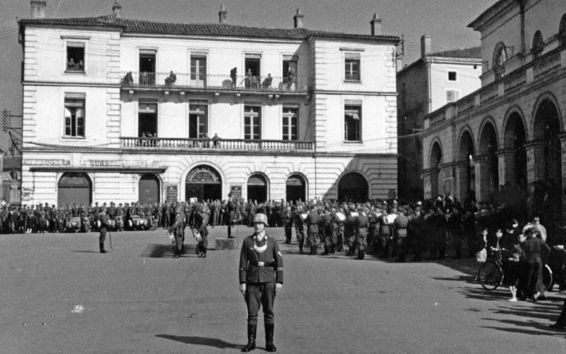
Hermann Göring Division Feldgendarm with the Divisional band in the background. Most of the members of the ‘Musikzug’ were absorbed into the Feldgendarmerietrupp. (Herbert Kail)
Shoulder straps
Initially, as stated above, until June 1943 the Feldgendarmerie were considered as part of the divisional transport and supply element as as such wore the pale blue Waffenfarbe of this branch as piping to the grey blue NCO and enlisted shoulder straps and as underlay to officer’s shoulder straps.
After June 1943, Luftwaffe military policemen would wear the same orange-red Waffenfarbe as members of the Heer and SS-Feldgendarmerie. The only exception to this was the Feldgendarmerie elements of the Fallschirmjäger divisions who are said to have worn the basic golden-yellow Waffenfarbe applicable to Fallschirmjäger personnel. There is however, some evidence that this may not have been the case and that Fallschirmjäger Feldgendarmerie may have worn the same Waffenfarbe colours as members of the field divisions and Hermann Göring Division.
Collar tabs
The standard collar tabs colour for the field divisions was the so-called ‘rifle green’ with white as the base colour for the Hermann Göring Division.
From inception until 1943, enlisted and NCO personnel of the field divisions wore Waffenfarbe piping in the branch colour around the edges of the collar tabs, matching that worn on the shoulder straps. This piping is believed to have been removed in April 1943 (at the same time as piping was ordered removed from tabs for the Hermann Göring Division) after which only the Waffenfarbe on the shoulder straps indicated the wearer’s branch.
Finally, in early 1944, collar tabs became virtually defunct and enlisted men and NCOs either wore no collar adornment, or pinned the small metal rank wings from the collar tabs directly to the tunic collar. This of course applies to field tunics. The four pocket Luftwaffe ‘Rock’ would have retained the use of collar tabs.
Thus the appearance of the Feldgendarm in a Luftwaffe field division would be along the following lines:
Enlisted Men/NCOs
|
1942–43: |
Green collar tabs with light blue piping. Light blue piping to shoulder straps. |
|
1943–44: |
Green collar tabs without piping. Orange piping to shoulder straps. |
|
1944–45: |
No collar tabs. Orange piping to shoulder straps. |
Officers
|
1942–43: |
Green collar tabs. Light blue underlay to shoulder straps. |
|
1943–44: |
Green collar tabs. Orange underlay to shoulder straps. |
|
1944–45: |
No collar tabs. Orange underlay to shoulder straps. |
The Hermann Göring division followed a similar timetable. Initially enlisted men’s/ NCOs collar tabs were worn with piping in Waffenfarbe colours, then had the piping removed and this was followed by cessation in the use of collar tabs on field uniforms. The appearance of a Feldgendarm in the Hermann Göring division would be along the following lines:
Enlisted Men/NCOs
|
1942–43: |
White collar tabs with light blue piping. Light blue piping to shoulder straps. |
|
1943–44: |
White collar tabs without piping. Orange piping to shoulder straps. |
|
1944–45: |
No Collar tabs. Orange piping to shoulder straps. |
Officers
|
1942–43: |
White collar tabs. Light blue underlay to shoulder straps. |
|
1943–44: |
White collar tabs. Orange underlay to shoulder straps. |
|
1944–45: |
No collar tabs. Orange underlay to shoulder straps. |
As previously mentioned, it has been reported that Feldgendarmen serving in Fallschirmjäger divisions wore the normal golden yellow Waffenfarbe of the Fallschirmjäger. However, photographic evidence shows Feldgendarmen wearing collar tabs that do not appear to be the light shade that yellow would appear as even in monotone photographs. The difficulty in establishing colours in a black and white image with any degree of certainty means that this question must, for now, remain somewhat of a mystery.
Cuffbands
Members of the Luftwaffe Feldgendarmerie wore the same standard machine woven rayon cuffband as their counterparts in the Heer as has been established in several original photographs. As with their Heer comrades, this would have ceased to be worn when the cuffband was ordered removed in 1944.
Arm Eagle
The use of the police style arm eagle by Feldgendarmen of the Luftwaffe seems to have been extremely rare. However, at least one wartime photo exists which shows the police arm eagle worn on the sleeve of the Fliegerbluse. Given the paucity of evidence of its wear it seems unlikely that a special version would have been made on Luftwaffe field blue cloth backing and the example seen on the photograph in question is most likely a standard army issue type on field grey.
Gorget
Once again we are faced with photographic evidence that the Luftwaffe made widespread use of the regular army pattern gorget. Certainly, as far as the Fallschirmjäger divisions are concerned, photographs show the army gorget in wear. The author is not aware of any photographs emerging which show the use of the special Luftwaffe pattern gorget by these units. What is clear however, is that the Luftwaffe pattern gorget was worn widely within the Hermann Göring Division and may also have been used by the Luftwaffe field divisions.
The Luftwaffe gorget is identical in design and construction to its Heer counterpart with the sole exception that the regular national emblem is replaced by a Luftwaffe style eagle and swastika. Original surviving examples of the Luftwaffe gorget are extremely rare, no doubt influenced by the fact that most of the units which used it fought predominantly on the Eastern Front.
Headgear
Visor caps for Luftwaffe officers from Leutnant to Oberst were piped in woven aluminium cord for all ranks regardless of branch so no special examples specific to the Feldgendarmerie existed.
Visor caps for enlisted men and NCOs did however carry crown and cap band piping in the appropriate Waffenfarbe colour. It appears that it was to say the least unusual to find NCOs within the field divisions wearing visor caps, the overseas cap or M43 field cap being the standard for of headdress. However, visor caps would be the normal form of dress with the four pocket tunic and as field division tunics in this pattern exist, it is likely that visor caps would have been worn with them. Theoretically at least, visor caps for those serving in the Feldgendarmerie of the field divisions would have been piped in light blue until the introduction of orange-red Waffenfarbe in June 1943. As the group photograph of Luftwaffe Feldgendarmen accompanying this text shows, visor caps were certainly worn by some Feldgendarmen though at this stage it is not possible to ascertain the colour of piping used on these caps, whether the rifle green of the field divisions, or the light blue or orange of the Feldgendarmerie branch. It is assumed that any visor caps worn by enlisted and NCO ranks of the Hermann Göring Division would have utilised that units unique white Waffenfarbe.
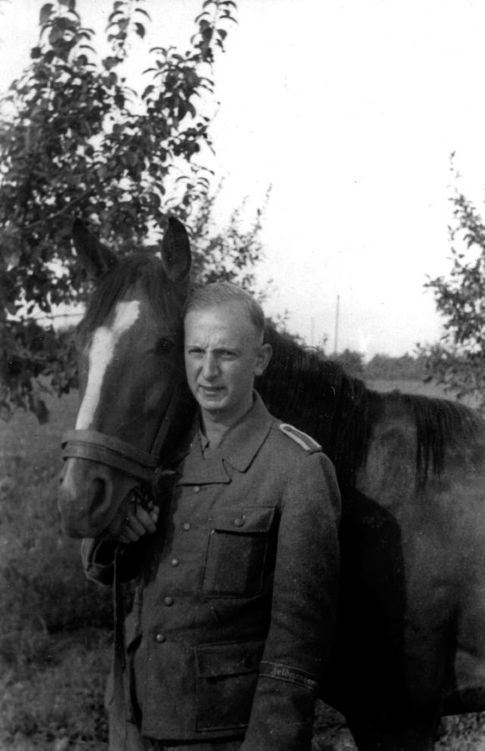
Unteroffizier Herbert Kail of the Hermann Göring Division can clearly be seen to be wearing the army pattern Feldgendarmerie cufftitle. (Herbert Kail)
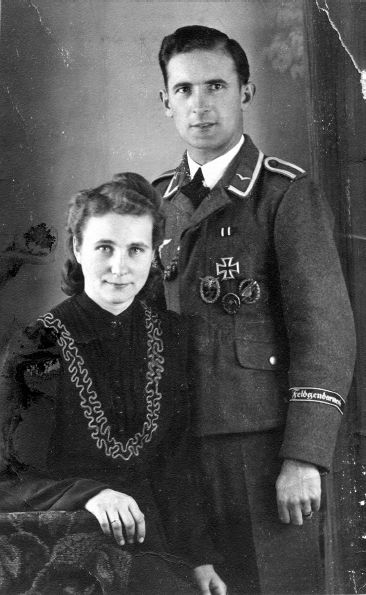
Fine study of Feldgendarmerie Unteroffizier Ewald Nickel with his wife. Note the Feldgendarmerie cufftitle, and the Luftwaffe Ground Combat Badge.
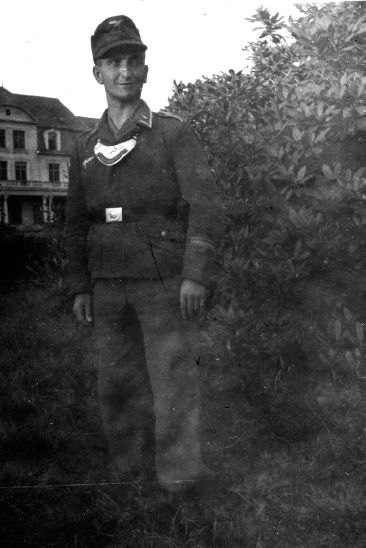
Unteroffizier from the Feldgendarmerie of a Luftwaffe Feld Division. Though difficult to discern, he also wears the Feldgendarmerie sleeve eagle, rarely seen on Luftwaffe uniforms.
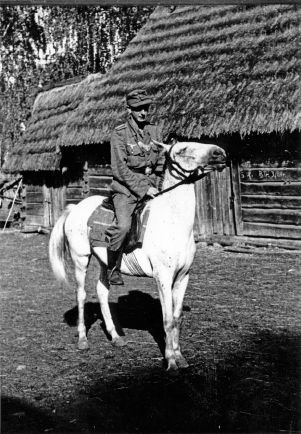
Horses were often used by Feldgendarmerie on the eastern front. This NCO is wearing the Luftwaffe pattern gorget. (Herbert Kail)
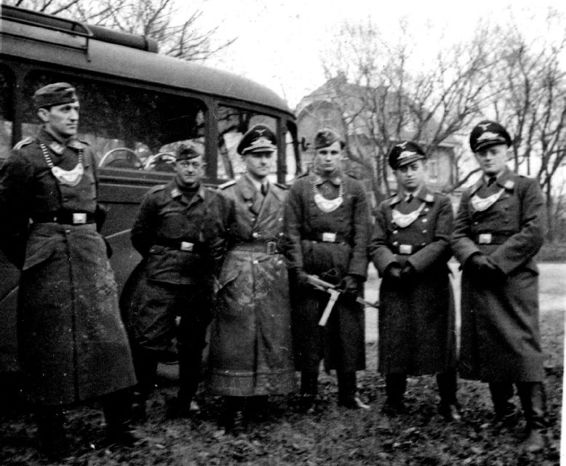
A group of Luftwaffe Feldgendarmen wearing the army pattern gorget. Note the MP40 carried by the junior NCO in the centre.
Luftwaffe Feldgendarmerie Units
Field Divisions
Initially, Luftwaffe Feldgendarmerie units were designated by name, e.g Feldgendarmerie-Trupp der 1 Luftwaffen Feld Division. This was subsequently changed some time around March 1943 so that all of the Luftwaffe field division units were allocated a four digit number in the 1100 range, thus the above became Feldgendarmerie-Trupp 1101. These units may (though by no means always) have the suffix ‘der Luftwaffe’ added, so the first field division military police troop may be variously encountered as:
Feldgendarmerie-Trupp der 1 Luftwaffen Feld Division.
Feldgendarmerie-Trupp der Luftwaffe 1101.
Feldgendarmerie-Trupp 1101.
For the sake of simplicity, only the numerical designation is used in the following list. The last digit or pair of digits therefore indicating the feld division number. i.e. 1116 = 16 Luftwaffen Feld Division.
|
Feldgendarmerie-Trupp 1101 |
1 Luftwaffen Feld Division |
|
Feldgendarmerie-Trupp 1102 |
2 Luftwaffen Feld Division |
|
Feldgendarmerie-Trupp 1103 |
3 Luftwaffen Feld Division |
|
Feldgendarmerie-Trupp 1104 |
4 Luftwaffen Feld Division |
|
Feldgendarmerie-Trupp 1105 |
5 Luftwaffen Feld Division |
|
Feldgendarmerie-Trupp 1106 |
6 Luftwaffen Feld Division |
|
Feldgendarmerie-Trupp 1107 |
7 Luftwaffen Feld Division |
|
Feldgendarmerie-Trupp 1108 |
8 Luftwaffen Feld Division |
|
Feldgendarmerie-Trupp 1109 |
9 Luftwaffen Feld Division |
|
Feldgendarmerie-Trupp 1110 |
10 Luftwaffen Feld Division |
|
Feldgendarmerie-Trupp 1111 |
11 Luftwaffen Feld Division |
|
Feldgendarmerie-Trupp 1112 |
12 Luftwaffen Feld Division |
|
Feldgendarmerie-Trupp 1113 |
13 Luftwaffen Feld Division |
|
Feldgendarmerie-Trupp 1114 |
14 Luftwaffen Feld Division |
|
Feldgendarmerie-Trupp 1115 |
15 Luftwaffen Feld Division |
|
Feldgendarmerie-Trupp 1116 |
16 Luftwaffen Feld Division |
|
Feldgendarmerie-Trupp 1117 |
17 Luftwaffen Feld Division |
|
Feldgendarmerie-Trupp 1118 |
18 Luftwaffen Feld Division |
|
Feldgendarmerie-Trupp 1119 |
19 Luftwaffen Feld Division |
|
Feldgendarmerie-Trupp 1120 |
20 Luftwaffen Feld Division |
|
Feldgendarmerie-Trupp 1121 |
21 Luftwaffen Feld Division |
|
Feldgendarmerie-Trupp 1122 |
22 Luftwaffen Feld Division |
Note:
The Luftwaffe field divisions were not a military success. So poor was their general level of achievement (though admittedly with some exceptions) that in November 1943, all those which had not already been destroyed were removed from Luftwaffe control and absorbed into the Heer. They retained their number but were then re-titled as, for example 16 Feld-Division (L)
For some reason, a study of the German field post system does not reveal a field post number allocated for Feldgendarmerie-Trupp 1107. Given the very short life of this unit before it was virtually destroyed on the Eastern Front, it is possible that it was never allocated its own number and may have been administered by and dealt with under the same number as the divisional Nachschub element.
Fallschirmjäger Feldgendarmerie Units
Unlike the Field Divisions, the Fallschirmjäger Feldgendarmerie units were usually numbered in the same three digit system as their Heer counterparts.
|
Feldgendarmerie-Trupp a (mot.) 646 |
1 Fallschirmjäger Div. |
|
Feldgendarmerie-Trupp a (mot.) 647 |
2 Fallschirmjäger Div. |
|
Feldgendarmerie-Trupp a (mot.) 648 |
3 Fallschirmjäger Div. |
|
Feldgendarmerie-Trupp a (mot.) 650 |
4 Fallschirmjäger Div. |
|
Feldgendarmerie-Trupp a (mot.) 654 |
5 Fallschirmjäger Div. |
|
Feldgendarmerie-Trupp 6 Fj. Div. |
6 Fallschirmjäger Div. |
Hermann Göring Division Feldgendarmerie Units
At approximately the same time that the Feldgendarmerie elements of the field units changed from a named to a numbered format, the Feldgendarmerie of the Hermann Göring Division did the same, becoming Feldgendarmerie-Trupp 1000.
|
Feldgend.-Trupp Panzer Div. Hermann Göring |
Mar 43 to Sep 43. |
|
Feldgend.-Trupp 1000 |
Sep 43 to Apr 44. |
|
Feldgend.-Trupp Fallschirm Panzer Div. Hermann Göring |
Nov 44 to May 45. |
|
Feldgend.-Trupp Fallschirm Panzer Div. Hermann Göring 2 |
Nov 44 to May 45. |
Corps Units
As with the Heer, the Luftwaffe fielded Feldgendarmerie units at corps level as part of the administrative machinery to support the control of the divisions for which the corps was responsible. In a similar manner to the field divisions, these began with named designations before changing to numbers.
|
Unit |
Period |
Parent |
|
Feldgend.-Trupp III Luftwaffen Feldkorps |
Jan 40 to Mar 43 |
III Luftwaffen Feldkorps |
|
Feldgend.-Trupp c (tmot.) 63 |
Sep 43 to Apr 44 |
III Luftwaffen Feldkorps |
|
Feldgend.-Trupp IV Luftwaffen Feldkorps |
Jan 40 to Mar 43 |
IV Luftwaffen Feldkorps |
|
Feldgend.-Trupp c (tmot.) 64 |
Sep 43 to Apr 44 |
IV Luftwaffen Feldkorps |
|
Feldgend.-Trupp V Luftwaffen Feldkorps |
Jan 40 to Sep 43 |
V Luftwaffen Feldkorps |
|
Feldgend.-Trupp XIII Luftwaffen Fliegerkorps |
Jan 40 to Mar 43 |
XIII Fliegerkorps |
|
Feldgend.-Trupp b (mot.) 675 |
From May 44 |
I Fallschirmkorps |
|
Feldgend.-Trupp b (mot.) 676 |
From Jan 44 |
II Fallschirmkorps |
As with the Heer, the Luftwaffe fielded Feldgendarmerie units at corps level as part of the administrative machinery to support the control of the divisions for which the corps was responsible. In a similar manner to the field divisions, these began with named designations before changing to numbers.
|
Unit |
Period |
Parent |
|
Feldgend.-Trupp III Luftwaffen Feldkorps |
Jan 40 to Mar 43 |
III Luftwaffen Feldkorps |
|
Feldgend.-Trupp c (tmot.) 63 |
Sep 43 to Apr 44 |
III Luftwaffen Feldkorps |
|
Feldgend.-Trupp IV Luftwaffen Feldkorps |
Jan 40 to Mar 43 |
IV Luftwaffen Feldkorps |
|
Feldgend.-Trupp c (tmot.) 64 |
Sep 43 to Apr 44 |
IV Luftwaffen Feldkorps |
|
Feldgend.-Trupp V Luftwaffen Feldkorps |
Jan 40 to Sep 43 |
V Luftwaffen Feldkorps |
|
Feldgend.-Trupp XIII Luftwaffen Fliegerkorps |
Jan 40 to Mar 43 |
XIII Fliegerkorps |
|
Feldgend.-Trupp b (mot.) 675 |
From May 44 |
I Fallschirmkorps |
|
Feldgend.-Trupp b (mot.) 676 |
From Jan 44 |
II Fallschirmkorps |
As with the Heer, the Luftwaffe fielded Feldgendarmerie units at corps level as part of the administrative machinery to support the control of the divisions for which the corps was responsible. In a similar manner to the field divisions, these began with named designations before changing to numbers.
|
Unit |
Period |
Parent |
|
Feldgend.-Trupp III Luftwaffen Feldkorps |
Jan 40 to Mar 43 |
III Luftwaffen Feldkorps |
|
Feldgend.-Trupp c (tmot.) 63 |
Sep 43 to Apr 44 |
III Luftwaffen Feldkorps |
|
Feldgend.-Trupp IV Luftwaffen Feldkorps |
Jan 40 to Mar 43 |
IV Luftwaffen Feldkorps |
|
Feldgend.-Trupp c (tmot.) 64 |
Sep 43 to Apr 44 |
IV Luftwaffen Feldkorps |
|
Feldgend.-Trupp V Luftwaffen Feldkorps |
Jan 40 to Sep 43 |
V Luftwaffen Feldkorps |
|
Feldgend.-Trupp XIII Luftwaffen Fliegerkorps |
Jan 40 to Mar 43 |
XIII Fliegerkorps |
|
Feldgend.-Trupp b (mot.) 675 |
From May 44 |
I Fallschirmkorps |
|
Feldgend.-Trupp b (mot.) 676 |
From Jan 44 |
II Fallschirmkorps |
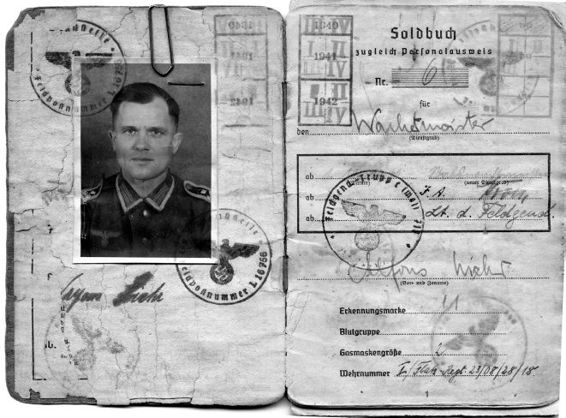
Soldbuch of Leutnant der Feldgendarmerie Alfons Liehr. The photo shows him as a Stabsfeldwebel before his commissioning. He previously served with the Feldgendarmerie of 11 Luftwaffen Feld Division before command of these Luftwaffe units was taken over by the Army, hence his photograph in army uniform.
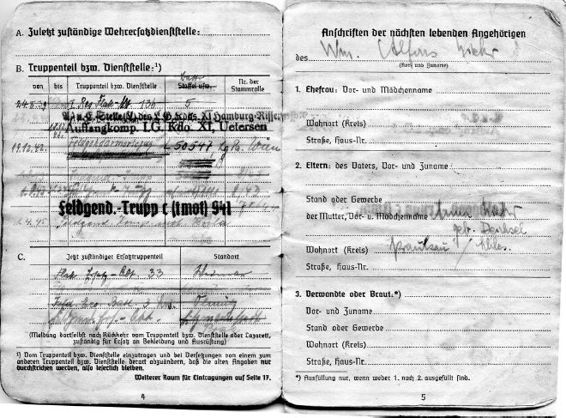
The Liehr Soldbuch with the marked entry showing Feldgendarmerietrupp a (mot) 1111, the Feldgendarmerie unit of 11 Luftwaffen Feld Division.
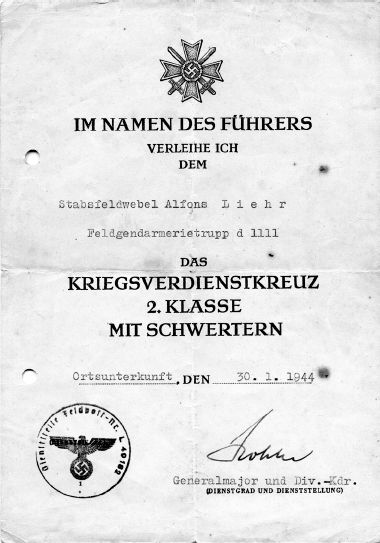
Award document for the War Merit Cross to Alfred Liehr of 11 Luftwaffen Feld Division.
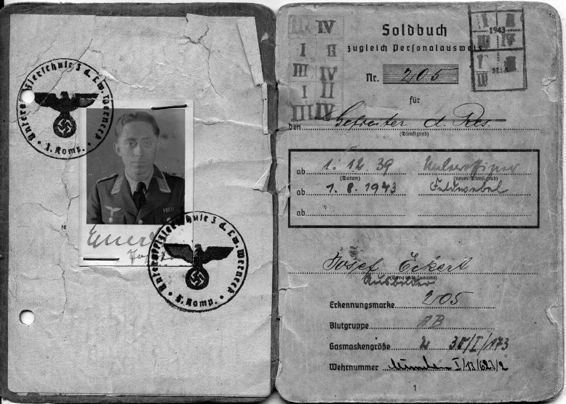
Soldbuch of Feldwebel Josef Eckert who served in the Luftwaffe Feldgendarmerie.
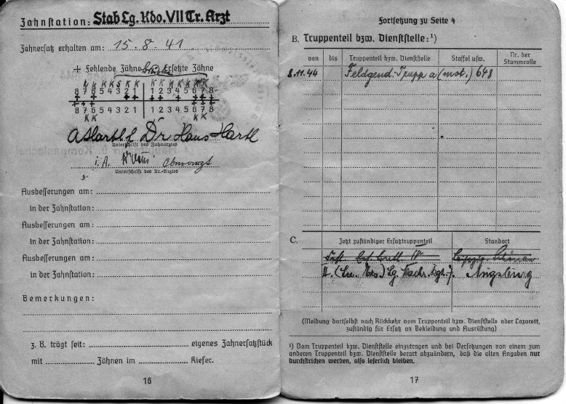
Entry in the Eckert Soldbuch showing his attachment to Feldgendarmerie Trupp a (mot) 648, the military police element of 3 Fallschirm Division.
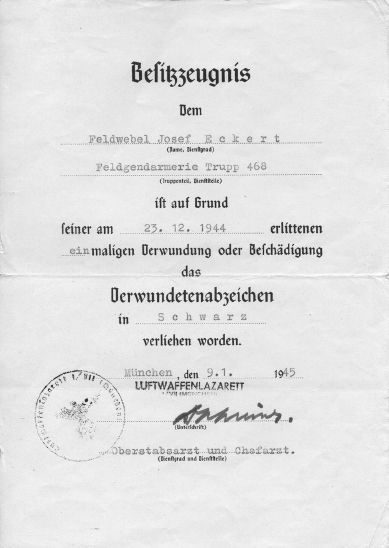
Award Document for Eckert’s Wound Badge, earned for wounds received during the Ardennes Offensive.
Headquarter Units
As previously mentioned only one large Feldgendarmerie unit was created for the Luftwaffe, and was attached to Görings personal headquarters.
Stab Feldgend.-Bataillon Hauptquartier Oberbefehlshaber der Luftwaffe.
1 Komp./ Feldgend.-Bataillon Hauptquartier Oberbefehlshaber der Luftwaffe.
2 Komp./ Feldgend.-Bataillon Hauptquartier Oberbefehlshaber der Luftwaffe.
3 Komp./ Feldgend.-Bataillon Hauptquartier Oberbefehlshaber der Luftwaffe.
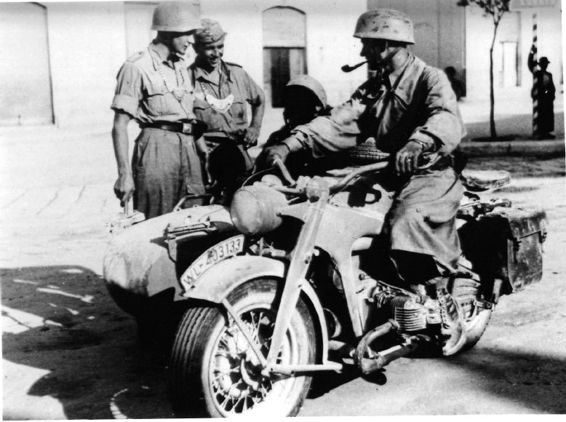
Fallschirmjäger Feldgendarmerie, instantly recognisable by the distinctive paratroop helmets being worn. (Josef Charita)