
AUTHORS’ NOTE
The vast majority of human beings who have been killed or harmed by extremists are innocent Muslims, largely people of goodwill.

MAY 2, 2011
ABBOTTABAD, PAKISTAN
0045 HOURS (12:45 A.M.)
The man with thirty minutes to live sleeps in his beige pajamas.
Meanwhile, two US Army UH-60 Black Hawk helicopters fly low over Pakistani airspace. The moon is a waning crescent. HAC—the helicopter aircraft commander—is up front in the left seat, his copilot to the right. “Chalk One,” as the lead bird is known, carries a dozen Navy SEALs on the hard metal floor in the cabin space behind the cockpit. Chalk Two ferries ten SEALs, a Pakistani American CIA translator, and a six-year-old Belgian Malinois dog named Cairo. Like the soldiers, Cairo wears Kevlar body armor and specially fitted night vision goggles.
The fuselage of each bird is painted black. Special metallurgy and heat-suppressing exhaust systems minimize the 60’s radar profile. Noise-reducing technology affixed to the tips of the rotors dampens sound. The pilots enhance their aircraft’s invisibility by using a flying technique known as “nap of the earth,” hugging landscape contours as low to the ground as possible. The fully laden machines travel at a deliberate seventy-five miles per hour.
Death is coming in the darkness.
Each member of this special team of SEAL (Sea, Air, Land) commandos remains almost motionless on the floor. The 60s are equipped with crew seats, but it is a matter of pride that SEALs are too tough for such luxury. Many are asleep despite this dangerous mission. Their uniform consists of Crye Precision desert digital camouflage combat pants with a matching pullover shirt designed to be worn under body armor. Pockets along each pant leg contain gear vital to the mission: leather gloves, medical kit, energy bars, extra ammunition.
In case the mission goes wrong, every SEAL carries a few hundred dollars in American currency to buy local assistance and find a way out of Pakistan.
The fighters are navy, but the pilots are army. This is by design. The 60 is flown by both branches of the service, but it is widely acknowledged that army pilots are best in “infil” and “exfil”—infiltration and exfiltration, the dangerous business of landing a helicopter in a battle zone and successfully departing when the mission is over.
Tonight, infil and exfil are life and death.
Both Black Hawks took off sixty minutes ago from a secure airfield in Jalalabad, Afghanistan. In support, two larger CH-47 Chinook helicopters flew out fifteen minutes later, loaded with spare fuel for the return journey. The two “Bathtubs,” as the Chinooks are nicknamed for their elongated shape, will land at a secret base in Afghanistan close to the Pakistani border, there to await further orders.
The SEALs are headed toward a private compound near the town of Abbottabad, just under two hundred miles away. Locals call it the Waziristan Palace for its enormous size.* Located on Kakul Road, in a middle-class section of Abbottabad known as Bilal Town, the acre-sized facility is surrounded by thick walls ranging in height from ten to eighteen feet tall. Solid steel gates cover each entrance. Several structures and a large open courtyard for raising animals and growing vegetables fill the space inside.
The plan is for Chalk One to hover low over the courtyard. SEALs on board will invade the compound by sliding down a system of thick ropes attached to a strong point inside the helicopter, known as the FRIES—fast rope insertion/extraction system. “Fast-roping” greatly resembles a fire pole descent—thus the leather gloves each man carries. Once on the ground, they will spread out and begin their search for tonight’s target.
Meanwhile, Chalk Two will land just outside the compound walls. Cairo the dog, his SEAL handler, Will Chesney, the CIA interpreter, and a small sniper team will disembark to provide perimeter security. They will seek out any approaching force or anyone trying to escape. One squad of SEALs will remain on board Chalk Two at this time, then be flown into the compound, where they will fast-rope onto the flat rooftop of the three-story main house.
Unloaded, both helicopters will then fly to a designated location to await the order to return and pick up the combatants. Total time on the ground will be no more than forty minutes.
There are several buildings to infiltrate, but the main house is of greatest interest. It is thought that “the Pacer,” as the tall figure whom satellite cameras so often photograph strolling the grounds is called, lives in this structure. The SEALs will enter the residence seeking this man. If he chooses to come along peacefully, he will be bound and escorted into a helicopter for a flight to captivity.
Should the homeowner prefer to fight, he will be shot dead. The weapon of choice for these SEALs varies by man, whether it be the Heckler & Koch HK416 assault rifle, FN Mark 48 machine gun, or the H&K MP7 machine pistol that fires an armor-piercing cartridge. In addition, each man wears a holstered pistol. And no SEAL is ever comfortable unless he is carrying a very long and very sharp fixed-blade knife.

This April 1998 file photo shows Osama bin Laden in Afghanistan.
The target on this warm, humid night is the notorious killer Osama bin Laden, the fifty-four-year-old terrorist mastermind of the 9/11 attacks on New York and Washington, DC. Formally named Osama bin Mohammed bin Awad bin Laden, he is six foot five, with a long black-and-gray beard. Saudi Arabian by birth, the terrorist was born the son of a billionaire who died in a plane crash when Osama was just ten.* Bin Laden is known to be frugal and soft-spoken but a strict father to the estimated twenty-six children he has fathered with his many wives.
The terrorist is the most wanted man in the world. People everywhere know his face; there is nowhere he can go without being recognized. Raised in a world of privilege, he is driven by a deep hatred for America. Bin Laden has turned his back on the peaceful tenets of the Muslim religion, preferring to live a life dedicated to killing US citizens. This has come at a cost: he spends his life on the run, taking extreme precautions to avoid being apprehended. But even from this remote hideaway, bin Laden controls a vast terror network. Extremists rally to his cause, and his message of hate does not fall on deaf ears in the world of the jihadi.
Most of all, bin Laden is a murderer. In addition to the almost three thousand innocent people killed on 9/11, he has used his considerable wealth to lead the terrorist organization al-Qaeda—“the Foundation”—in numerous deadly attacks around the world since 1998. In August 1996, bin Laden declared a holy war, a jihad, against America, operating from a hidden refuge in Afghanistan. For the past ten years, the most well-equipped intelligence agencies on the planet have hunted bin Laden, but he has been elusive. There have been numerous alleged sightings of the man, all of which have led nowhere.
Tonight will be different.
The CIA has confirmed that Osama bin Laden, his children, and his many wives have occupied the Abbottabad compound since 2005. Interrogation of al-Qaeda detainees at the US-run Guantánamo Bay prison in Cuba revealed the name of a bin Laden courier known as Abu Ahmed al-Kuwaiti, real name Ibrahim Saeed Ahmed. In 2007, officials learned that this messenger was living in Abbottabad under an alias; careful tracking of Ahmed’s movements led the CIA to believe he might be sheltering bin Laden. US intelligence officials sought to confirm this hunch by obtaining a blood sample from one of the many children whom satellite photos showed to be living in the compound. These same images revealed the first intriguing images of the Pacer.
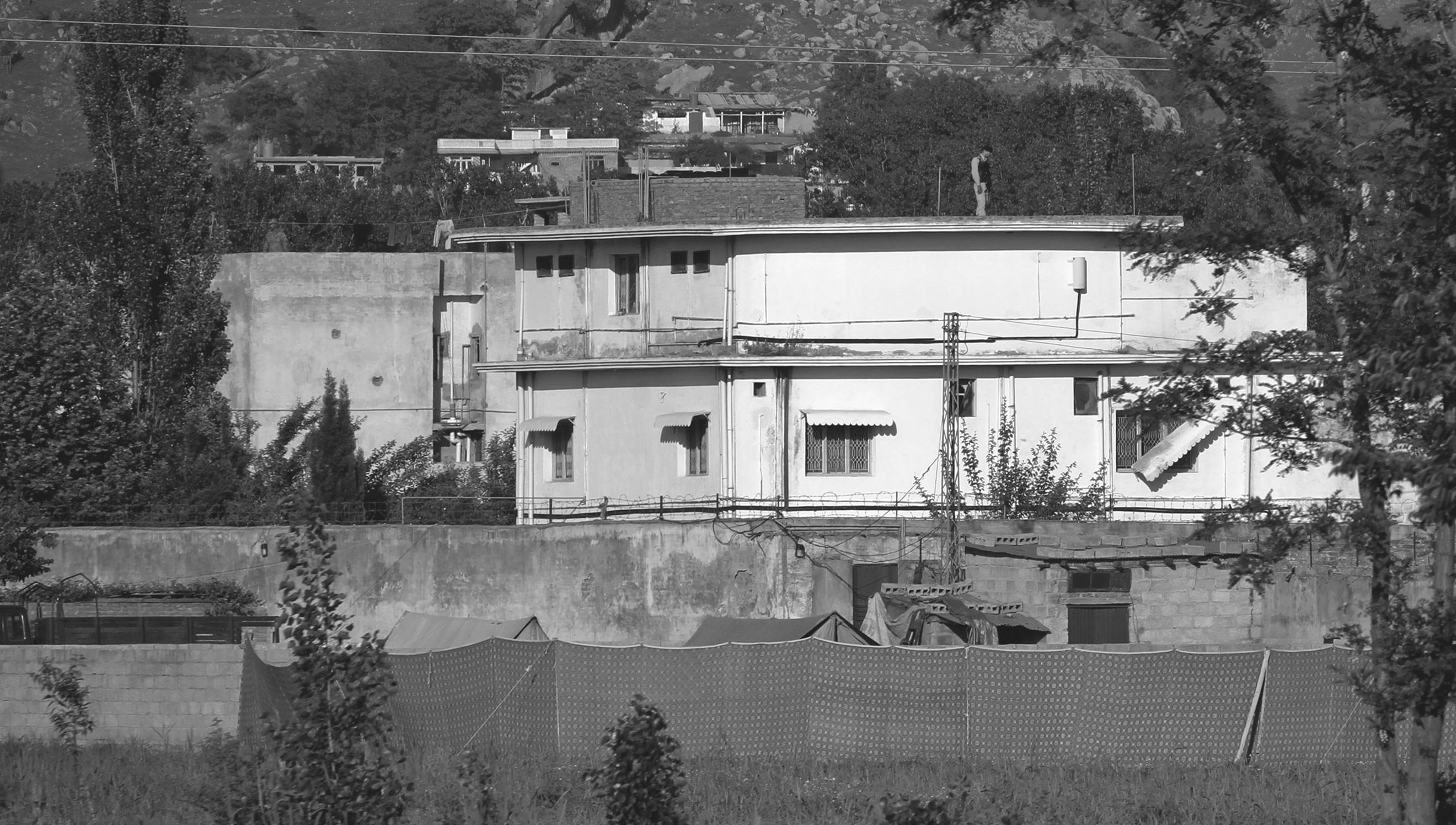
A Pakistan army soldier stands on top of the house where it is believed al-Qaeda leader Osama bin Laden lived in Abbottabad, Pakistan, on Monday, May 2, 2011.
Pakistani doctor Shakil Afridi, considered the top physician in the nearby Khyber tribal regions, was recruited by the CIA to set up a vaccine clinic in Abbottabad. He had previously worked on several US-funded vaccination programs in Pakistan and willingly agreed. Afridi was not told the name of the target. Unbeknownst to the doctor, any blood samples that could be acquired would be compared with DNA known to belong to bin Laden to confirm a match. The operation was successful.*
After the verification of bin Laden’s location, the American military and the CIA developed “Operation Neptune Spear.”† Several different tactics were discussed, including a stealth bomber dropping munitions on the compound or a drone-fired missile. But none of those actions would confirm the truth about whether Osama bin Laden was alive or dead. So the decision was made to send in SEAL teams to do the work.
But the strategy is a high-risk gamble. The SEALs have all volunteered to travel into Pakistan without permission from its government, knowing full well that a Pakistani military headquarters is just two miles from the compound. Should they be captured alive, each SEAL is guaranteed hours of the most heinous torture before being executed, most likely by beheading, in a dank jail cell. Thus, the TOT—time on target—must be as short as possible.
There are so many things that can go wrong. The twin-engine UH-60 carries 1,200 pounds of fuel in each of its two tanks. That’s enough gas for ninety minutes of flying. Add in another 1,200-pound auxiliary tank, heavy stealth technology, and the combined weight of the men, and these aircraft are at the very end of their technical flying ability. Simply put: they might not have enough gas to get home. And “getting home” in this case means flying back into Afghanistan over the rugged Hindu Kush, some of the most difficult terrain on earth.
But for pilots and SEALs alike, many years of training have been preparation for a scenario just like this: neutralizing a sworn enemy, one who has killed not just in America but all over the globe for two decades.
Osama bin Laden is the most important target in the world.
Three minutes until the drop. The pilots close in rapidly. The sound of their rotors will be audible to those in the compound when the helicopters are two minutes out. The residence has been heavily surveilled, but even after months of planning, questions remain. Nobody knows if the walls or rooftops are booby-trapped, whether an underground escape tunnel will allow the occupants to flee into the night, or how quickly the nearby Pakistani military will respond to the incursion. But already, there is good news: no activity has been sighted anywhere in the area, a sign that the American pilots have successfully flown beneath the radar.
Now they need to maintain that cloak of invisibility.
Darkness helps. Power outages are common in this Pakistani garrison town, and on this hot night, Abbottabad is bathed in total darkness. All light in both helicopters is suppressed. The SEALs make last-minute personal equipment checks. The assault is about to begin.
The code name of the target: Geronimo.
Osama bin Laden is asleep, his fourth wife, Amal, at his side. There are bars and curtains with yellow flowers on his windows. Barbed wire rings the compound. Before going to bed at 11:00 p.m., the undisputed leader of the al-Qaeda terrorist network ate dinner. Bin Laden prefers bread, dates, and honey; he rarely eats meat. The terrorist also does not use utensils, preferring to eat with his right hand, in the manner of the prophet Muhammad.
Bin Laden’s two-year-old son, Hussein, also sleeps in the room. No one pays attention to the power outage. These occurrences are so frequent they are no longer a cause for concern.
The terrorist, his wife, and his child prayed together before bed. Osama bin Laden sleeps just two to three hours a night. He is an anxious man, often lying awake in the darkness waiting for morning to come or taking sleeping pills when he cannot calm himself. But tonight is restful. So while her husband slumbers, it is Amal who hears the rotors of approaching helicopters.
“Mr. President,” an aide tells Barack Obama, “this is going to take a while. You might not want to sit here and watch the whole thing unfold.”
President Obama is in the basement of the White House’s West Wing, in the intelligence command post known as the Situation Room. The time is shortly before 4:00 p.m. A large television screen airs a live feed of the mission in Pakistan, transmitted from drones capable of circling as high as fifty thousand feet. The unmanned aircraft is invisible to the naked eye and is capable of remaining over the target for many hours at a time.

President Barack Obama and Vice President Joe Biden, along with members of the national security team, receive an update on the mission against Osama bin Laden in the Situation Room of the White House, May 1, 2011. Please note: a classified document seen in this photograph has been obscured.
Operation Neptune Spear combines the efforts of the civilian CIA and military Joint Special Operations Command (JSOC). So a similar viewing is taking place in a seventh-floor conference room at Central Intelligence Agency headquarters in Langley, Virginia, watched by agency director Leon Panetta, who has dedicated almost a year to this risky venture. Panetta is in direct contact with mission commander Admiral William McRaven at the SEALs’ departure base in Jalalabad.
But seeing the president depart causes others to follow him, into the office of a military adviser. The room is cramped, but that does not stop people from crowding into it, much to Obama’s dismay.
Barack Obama wears a white golf shirt and blue windbreaker bearing the presidential emblem. Though knowing full well the operation would proceed tonight, he intentionally played golf earlier, to avoid a departure from his normal Sunday routine. Being president means having your every movement and word scrutinized. Obama did not want to hint toward tonight’s operation in any way.
A long conference table covered with open laptops and various drinks fills the center of the small space. Vice President Joe Biden is openly nervous. He and Defense Secretary Robert Gates, who is also present, are ambivalent about the mission. Both men have been asking many questions about its viability, still remembering the 1980 American debacle in the Iranian desert, when eight US servicemen were killed and six aircraft destroyed after a botched effort to rescue American hostages. That incident damaged the presidency of Jimmy Carter beyond repair. There was also Somalia, in 1993, where a Black Hawk helicopter was shot down, resulting in the deaths of eighteen Americans. That incident still is vividly remembered by the public because of a bestselling book and a subsequent Hollywood movie.
Failure tonight would be a disaster far worse than Iran or Somalia. And President Obama would take much of the heat.
Wearing a brown blazer, Secretary of State Hillary Clinton enters the room and takes a seat next to Secretary Gates. Antony Blinken, destined one day to become future president Joe Biden’s secretary of state, stands in the doorway. There is very little talking. The air is thick with tension.*
Everything is going according to plan.
Until it doesn’t.
Chalk One hovers over the Waziristan Palace, SEALs poised to fast-rope out the open doors. Suddenly, the eighteen-foot-high stone compound walls and hot night air contribute to a dangerous condition known as “vortex ring state,” which prevents the helicopter rotors from producing lift. Simultaneously, the tail of the 60 bounces atop the compound wall. Lack of lift pitches the helicopter forward and down toward the ground. The tail wheel acts as a pivot point, forcing the Black Hawk to tilt sharply to the right.
The main rotors dig hard into the loose soil of a vegetable garden. Pilot and copilot strain against their seat belts, helmets and harnesses holding them fast to their cockpit seats. In the cabin behind them, the unbelted SEALs pitch forward, falling onto one another. They struggle to remain inside the helicopter. Slipping out the open doors into the spinning blades would be a horrific way to die.
Events unfold quickly. The pilots immediately shut down the Black Hawk’s two engines. SEALs, many slightly injured, scramble to exit, guns at the ready. The crash has been anything but silent, and the invaders prepare for incoming fire from the compound.
Outside, Chalk Two lands in a field, but takes off the instant the SEALs and Cairo jump out. The dog is immediately let off his leash to search for threats. He has been in combat before and knows the difference between a helpless infant and a lethal terrorist.
The original task of these operators was perimeter defense, but now they move to blow the walls and enter the compound, not knowing the fate of their comrades in the crashed helicopter.
The invading SEALs now see bin Laden’s safe house for the first time. They have practiced on a life-sized version at a secret location in North Carolina. But this is the real thing.
“We opened the doors, and I looked out,” SEAL operator Robert O’Neill will remember. Seeing the high walls and knowing what must be done to complete the mission successfully, O’Neill thought, “This is some serious Navy SEAL shit we’re going to do.”
Osama bin Laden is now awake. A loud, bright explosion shakes the house as he crouches on the bedroom floor; the sound of the crashing helicopter cuts through the night with a noise so loud that a witness will later call it a “noise of magnitude I have never heard before.” Baby Hussein cries. Amal tries to turn on a light, forgetting about the power outage.

“No,” bin Laden commands. Opening the bedroom door, he screams down the stairs to his son Khalid. “Come up!”*
“Americans are coming!” yells Khalid, running up the stairs in white pajamas, clutching a loaded AK-47 automatic rifle. The crying voices of the many children in the three-story structure echo up and down the stairwell.
Outside, a new explosion rings through the night as SEALs breach the perimeter wall on the north side of the compound. Two bodyguards, brothers Ibrahim Saeed Ahmed and Abrar Ahmed, have sworn loyalty to bin Laden and stand ready to fight. The men are Pakistanis who oversaw the construction of the compound but have long feared that a night like this might come. Several times, they suggested that bin Laden and his extended brood relocate.
After a time, the terrorist reluctantly agreed but asked for postponement of departure until September 2011—the tenth anniversary of the terror attack on America.
Now, five minutes into the SEAL landings, as explosions destroy the big metal doors guarding the compound entrances, Osama bin Laden regrets his decision.
“It appears that we have a helicopter down in the animal pen,” Admiral McRaven says from Afghanistan over the live video feed. “Backup helicopter on the way.”
In fact, McRaven ordered one Chinook to fly to the compound just moments ago.
At CIA headquarters in Virginia, Director Panetta watches the crash of Chalk One with rising fear. A multimillion-dollar helicopter crashes, and it’s Black Hawk down all over again.
Maybe.
At the White House, President Obama will recall feeling “an electric kind of fear. A disaster reel played in my head.”
The mood in the small conference room is grim. More than a dozen of America’s top leaders fill the space, anxiously watching the screen. Mr. Obama sits off to the side in a small chair, leaning forward, eyes riveted. Secretary Clinton presses one hand to her face, covering her mouth.
The video feed is a series of monochromatic images. Twenty-four SEALs are now on the ground, with most inside the compound. Explosions and gunshots can be heard clearly as the SEALs apply breaching charges to blast doorways, even as the trapped occupants open fire with AK-47s.
The SEAL weapons are suppressed, making very little noise when they fire. So all audible gunshots are from bin Laden’s security team, which now includes twenty-three-year-old Khalid. The team from Chalk One can be seen entering the main house. Others make their way to a small annex known by the code symbol C1 on the SEALs’ laminated maps of the compound, secured in their pants pockets.
Suddenly, as the team is about to enter the building, rounds from an AK-47 assault weapon rattle above their heads. Glass shatters, falling onto the crouched Americans. Returning fire, the SEALs shoot into the darkness. There is no response. The firing stops. A woman yells to them, then slowly steps into their sight line. She is holding a baby.
“He is dead,” the woman says to the fighters. The SEALs never take their fingers off the trigger, fearing she may be wearing a suicide vest. Slowly, the invaders follow the wife of Ibrahim Saeed Ahmed into a bedroom. There, her husband—the courier for bin Laden who unknowingly led the CIA to this location—lies in the doorway. The floor is thick with his blood, and the SEALs will later remember the room smelling of heating oil. The demise of Saeed Ahmed is not seen by those watching in Washington, Virginia, and Afghanistan; the drone video cannot show the inside of the buildings. So, for twenty long minutes, the feed from space remains silent.
Cautiously, the SEALs leave building C1 and cross the compound to the much larger complex mission planners have labeled A1—the main house. The night is far from silent. Children continue to cry. Women are shrieking. A three-man team enters a long hallway with two doors on each side. As the SEALs creep forward, one inhabitant of the residence cautiously leans his head out of the first door on the left. The SEAL walking point immediately fires a single shot.
Unsure if the target is hit, the team moves quickly into the room. Abrar Ahmed lies wounded on the floor, an AK-47 nearby. Suddenly, the bodyguard’s wife jumps forward in the darkness, trying to prevent the SEALs from getting to her husband. The Americans have been warned that women in the compound might be armed and that some might even be wearing explosives. The invaders take no chances, opening fire.
Abrar and his wife, Bushra, both die instantly.
It is known that four men occupy the compound. Two are now dead. That leaves Khalid bin Laden and his father, directly upstairs from where the SEALs now stand.
In his third-floor bedroom, Osama bin Laden prays. His family is gathered around. “They want me, not you,” the terrorist tells two of his wives who have run upstairs to be at his side. There is confusion as some refuse to leave and others have no idea where to go. Americans are in the courtyard, and some SEALs have entered the main house.
Carefully, six SEALs climb to the second floor using a narrow spiral staircase. The steps are tiled. Fighting here will be at close quarters. Every footfall or whining door hinge spells trouble.
The SEALs see the image of a man standing on the stairwell leading to the third floor. He is seeking to conceal himself and does not present much of a target. Believing the individual might be bin Laden’s son, the SEAL walking point softly calls out in Arabic: “Khalid, come here.”*
The younger bin Laden is confused. Cautiously, he peers out from his hiding spot. He is promptly shot in the chin, the bullet slicing through his brain before exiting out the back of his skull. Khalid bin Laden falls backward onto the stairs. The SEALs continue their advance, stepping around Khalid, whose white shirt is drenched in blood. His loaded AK-47 is propped against a wall, never fired.
At this point, three of the four males occupying the compound have been eliminated.
Only Geronimo remains.
Two rooms stand at the top of the stairs. A curtain conceals the entrance to one. A man with a long beard pokes his head out; he thinks he is invisible in the darkness. The SEALs immediately open fire. The man withdraws back into the bedroom, but his AK-47 pokes out around the doorjamb.
Two SEALs press their advantage, bounding up the stairs and throwing back the curtain. Two young girls stand in the room. One SEAL tackles them, fearing they are wearing bombs. Terrified, they cry out, having never been touched by a man not of their own family. “Sheikh,” one yells toward the man with the beard.
Now comes the stand-off. One SEAL remains, staring into the eyes of Osama bin Laden, who is standing at the foot of the bed. The terrorist’s beard is his most prominent feature. His hair is cut short. Amal stands in front of him. Bin Laden keeps his hands on her shoulders, using the mother of his young child, who now sits sobbing just a few feet away, as a human shield. Amal is bleeding from one leg, having taken one of the bullets fired up the stairwell.
Osama bin Laden has had years to prepare for this moment. There is a chance he is wearing a suicide vest, or perhaps concealing a gun or knife, using his wife’s torso to prevent the intruders from seeing these weapons. Bin Laden is a man who hates Americans and would have no compunction about blowing himself up to take more American lives in his final act.
The SEAL weighs all these realities.
So it is that Senior Chief Petty Officer Robert O’Neill raises his weapon high, to accommodate bin Laden’s height. The barrel is aimed at a spot just over Amal’s shoulder. The SEAL does not hesitate. The first bullet cuts a furrow through the top of bin Laden’s skull. The second shot is insurance. So is the third. The terrorist’s tongue hangs from his mouth as his body goes limp. His head is blown apart.
Other SEALs enter the room, having made their way up the stairs. One by one, they fire into the corpse, payback for those who died on 9/11.
The message is radioed back to Jalalabad and then relayed to Langley and the White House. The acronym for “enemy killed in action” rockets halfway around the world.
“We heard McRaven’s and Leon’s voices, almost simultaneously, utter the words we’d been waiting to hear,” President Obama will write.
“Geronimo, EKIA.”
There is no celebration. Not yet. Osama bin Laden’s corpse is placed in an olive drab body bag, and SEALs carry him to the waiting helicopter outside the compound walls. Inside, the buildings are ransacked for intelligence. Computer hard drives, laptops, thumb drives, documents, and cell phones are seized. This treasure trove of information is the most captured in a single recent raid. Vacuum-sealed piles of opium are discovered beneath bin Laden’s bed, the source of his income in the many years since his bank accounts were frozen.
Meanwhile, the explosions have attracted a crowd. Cairo is kept on his leash as the interpreter warns away curious citizens arriving to see the source of the noise. Dogs are considered devilish and filthy in Muslim culture, and the mere presence of a snarling Cairo is enough to deter the crowd.
A Chinook arrives to ferry out operators and captured intelligence. Bin Laden’s wives and children will be left behind.* The dead terrorist has two emergency phone numbers and five hundred euros sewn into the fabric of his underwear. Space inside the helicopter carrying Osama bin Laden is so cramped that one SEAL has no choice but to sit atop the body for the flight back to Jalalabad. Photos are taken of bin Laden’s face as the first step in authenticating the terrorist’s identity.
Inside the compound, the downed UH-60 is blown up to prevent its technology from falling into the hands of the Pakistanis. The bright light and noise of the detonation is so powerful that it can be heard and seen for miles around. A Pakistani military response is surely imminent.
Time to go. The mission is now almost over.
But there is one more danger to overcome. The two US helicopters have a ninety-minute flight back to Afghanistan. A single Pakistani fighter jet could shoot the helicopters from the sky. The SEALs are apprehensive—the journey is especially long.
At 5:41 p.m., Eastern time, cheers go up in Washington, DC. This is the moment when both SEAL teams cross safely into Afghanistan. Nine minutes later, they touch down safely at Jalalabad Air Base. US intelligence will later learn that Pakistani authorities had turned off their radar on this hot Sunday night, and that even if there had been advance warning, their fighter pilots were unwilling to fly in the dark.
“Let’s see him,” Admiral McRaven says as the body bag is removed from the UH-60.
The corpse is dropped onto the cement hangar floor. CIA analysts hastily begin conducting DNA tests to confirm the identity of the body. The sample matches those recently taken from family members. In order to calculate bin Laden’s height, one very tall SEAL is ordered to lie down on the floor next to the terrorist’s body.*
At 11:35 p.m. Eastern, President Barack Obama addresses the nation. In his hastily written speech, he informs the world that the long hunt for Osama bin Laden is over.
CIA director Panetta, who has driven to the White House to share the triumph with the president, leaves shortly after the speech. He is stunned to see crowds lining the sidewalk, cheering this moment of national victory: “USA, USA, USA,” they chant.
Panetta will call it one of the best moments of his life.
In Afghanistan, the Navy SEALs and their army pilots are reveling in the mission’s success, laughing and rehashing the action moment by moment just a few feet from the body of Osama bin Laden. The sense of relief is palpable, with thoughts of the many things that could have gone wrong after the crash of Chalk One in everyone’s heads.
This is also a sad moment for Will Chesney, Cairo’s handler, who must soon say good-bye to the veteran dog after three years working together. Cairo often sleeps in Chesney’s bed and has been his constant companion through that time.*
But the night is not over. Shortly after landing in Jalalabad, the SEALs, Cairo, their harvest of intelligence data, and the body of Osama bin Laden board a C-130 Hercules cargo plane for the flight to Afghanistan’s Bagram Air Base—150 miles away. There, they watch President Obama’s speech on a big-screen television, clean their weapons, store their gear, and grab a bite. The feeling of elation does not subside. The SEALs will soon continue to Washington, there to meet the president. Each will receive a Silver Star for bravery.†
As the SEALs depart for the United States, the body of Osama bin Laden is placed in the hold of a US Navy V-22 Osprey cargo plane and flown to the aircraft carrier USS Carl Vinson, in the northern Arabian Sea. The terrorist has been dead less than twelve hours. Rather than bury bin Laden on land, and have his grave become a shrine for terrorists everywhere, the team will dispatch the corpse at sea, where there is no chance his final resting place will ever be located.

In strict accordance with Islamic law, bin Laden is buried within twenty-four hours of his death. He is washed and shrouded in white cloth. There is no coffin. A US Navy sailor of the Muslim faith witnesses the cleaning and wrapping of the body.
And so it is that Osama bin Laden, wrapped tightly in the cloth, is placed inside a body bag with three hundred pounds of iron chains. The bag, resting on a flat board, is tipped over the side of the Vinson, sliding into the depths of the Arabian Sea. There are some eyewitnesses who suggest the body bag holding bin Laden might have been sliced open to allow creatures of the deep easier access to his remains. But that is unconfirmed.
What is confirmed is that the heinous mastermind of 9/11 has finally received justice.
But as one killer leaves the stage, many others are anxious to take his place.
There will be no shortage of terror killers in the years to come.