
OCTOBER 27, 2019
BARISHA, SYRIA
1:10 A.M.
ISIS fires first.
This is a mistake.
The Night Stalkers drop low for the final approach. Black fuselages. Sunday morning, rustler’s moon beaming pale light, headlights from a lone olive-green minivan on the two-lane road below. The Black Hawks and Chinooks have taken small-arms fire on their dash across Syria, but nothing like the precision volleys from automatic weapons now aimed their way from the terrain surrounding al-Baghdadi’s suspected compound. Bullets ping off each armored helicopter as muzzle flashes give away the location of ISIS shooters. The soldiers inside are annoyed but unhurt.
The Americans respond. Forward-firing machine guns mounted on each Black Hawk are fully integrated with the aircraft’s digital flight controls, automatically calculating range and ballistics. This all happens in less than a second. The Night Stalker pilots blast the ISIS defenders with .50-caliber Gatling guns and Hydra-70 rockets.
Targets neutralized.
It is estimated that a dozen or more ISIS fighters outside the compound are killed from the air. But the exact number remains classified.
Every effort is being made to avoid civilian casualties. The two pilots are in the unenviable position of making split-second life-or-death decisions. So it is with the minivan: al-Baghdadi was seen leaving the compound yesterday with his family in such a vehicle. But tonight, although the pilots cannot know this, the ISIS leader has chosen to stay home. Instead, the minivan’s three occupants are within four hundred meters of the targeted compound. The vehicle is blasted off the road in an instant.
Later, the men in the van will say they are not ISIS, just innocent civilians out for a late-Saturday-night joyride, drinking coffee and eating pumpkin seeds. Two of them, cousins, will eventually die of shrapnel wounds. A third man will live, but one of his hands is severed by a Hydra.
Both Black Hawks quickly descend outside the compound. The early morning sky is now alight from the flaming vehicle. A ten-man Delta Force team jumps to the ground, then spreads out—eight men in one group, just two in the other. The soldiers walk toward the dwelling with weapons already in firing mode. From Iraq, mission control speaks into their earpieces, reporting that drone footage shows no sign of guards.
The night is active. The air is full of six Chinook helicopters carrying reinforcements, a phalanx of drones, and a number of supersonic fighter jets keeping watch in the upper atmosphere.
Delta Force arrives at the wall, then attaches explosives to the side at a spot precisely four feet off the ground. Each man steps away and turns his back to shield himself from the blast. The surgical detonation explodes as planned. A loud boom and percussive shock wave ensue. Rubble flies into the compound. A second hole is quickly blasted in another section. The team does not wait for the smoke to clear, advancing forward quickly.
The Delta Force team are identically clad: black helmet, night vision goggles, body armor, M4 assault rifle, and a Glock 9mm pistol on the hip. Each soldier carries a knife of his own choosing. In addition, they are armed with fragmentation hand grenades as well as extra clips of ammunition.
The second Black Hawk lands, dropping off another team and Conan, a Belgian Malinois military dog named after the late-night television host. He is a four-year veteran with fifty missions to his credit. As with the bin Laden raid, the dog will be used to pursue any fleeing terrorist and to intimidate Muslims, who are generally afraid of dogs.
Now the Delta teams prepare to enter the buildings thought to house al-Baghdadi and his family.
The reckoning is here.
Approximately ten minutes after landing, a Delta Force soldier calls out in Arabic, requesting that al-Baghdadi surrender. Moments pass, but the team is not in a hurry. They know air and ground is totally controlled by US forces. What they don’t know is where the ISIS leader is located.
Suddenly, eleven children under the age of twelve and two women step into the courtyard. They are immediately searched for weapons, especially suicide vests, then led into a waiting helicopter—but not before they reveal that al-Baghdadi is not alone in the compound. There are other children, four more women, and at least four ISIS fighters.*
Once the thirteen children and women are off the premises, Delta Force soldiers move smoothly across the hard dirt between the houses. As drones watch overhead, the voice of their far-off mission commander confirms that no one has escaped from either building.
The final assault is ready.
Six thousand miles away, in the White House Situation Room, President Donald Trump watches the mission unfold in real time on large monitors. Also in the room are Vice President Mike Pence, National Security Adviser Robert O’Brien, Secretary of Defense Mark Esper, and General Mark Milley, chairman of the Joint Chiefs of Staff. A tangle of secure phone lines covers the large rectangular conference table.
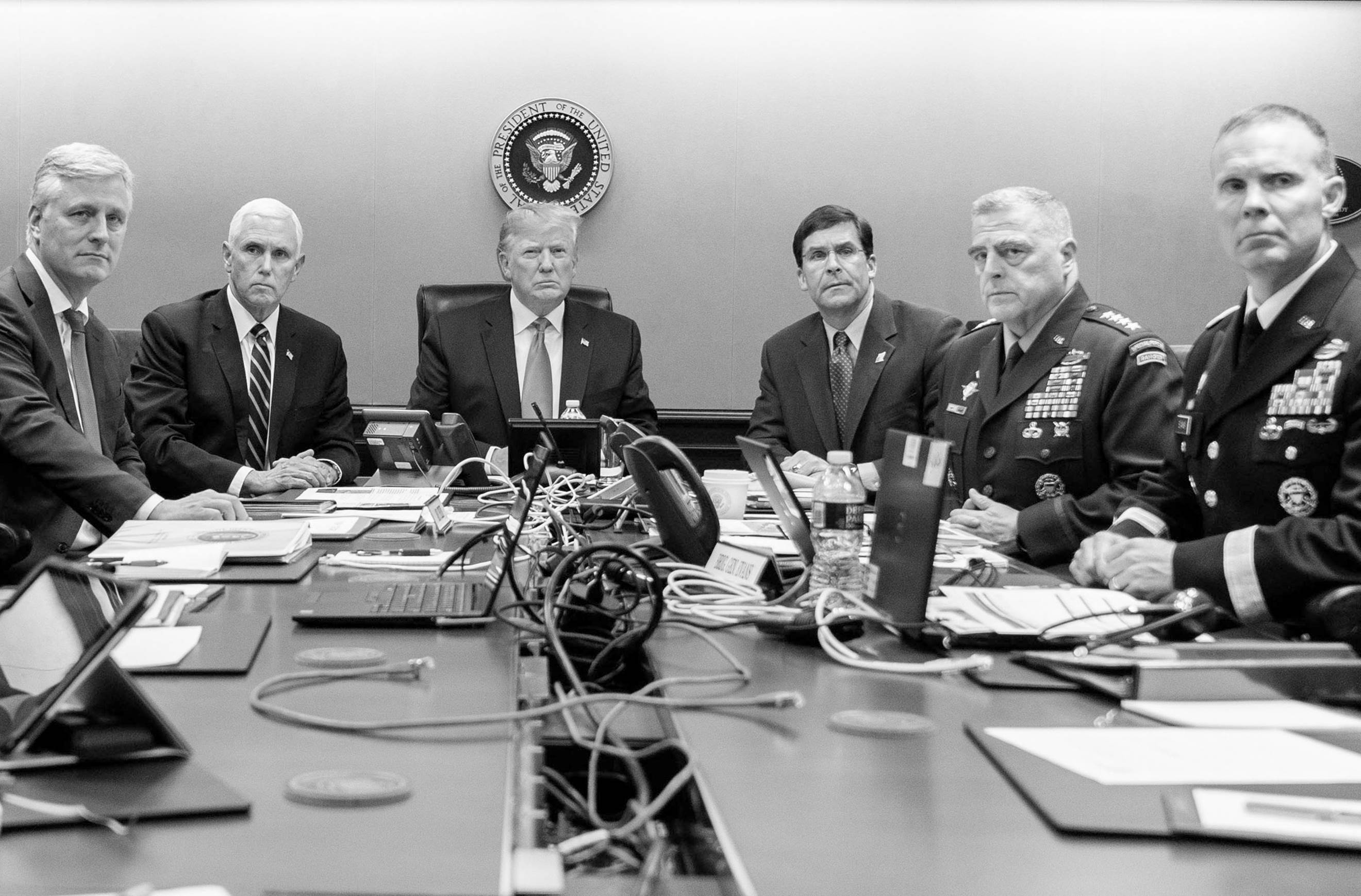
President Donald J. Trump is joined by Vice President Mike Pence; National Security Advisor Robert O’Brien, left; Secretary of Defense Mark Esper and Chairman of the Joint Chiefs of Staff US Army General Mark A. Milley; and Brig. Gen. Marcus Evans, Deputy Director for Special Operations on the Joint Staff, at right, in the Situation Room of the White House monitoring developments as US Special Operations Forces close in on notorious ISIS leader Abu Bakr al-Baghdadi’s compound in Syria with a mission to kill or capture the terrorist.
Earlier today, after authorizing the mission, the president played golf with Rob Manfred, the commissioner of baseball. Tonight is Game 4 of the World Series, and Mr. Trump took great pains not to deviate from his long-prepared schedule. Everything must look normal.
By 5:00 p.m. Washington time, just as the first helicopters are leaving for the al-Baghdadi compound, the president has changed into a dark-blue suit and light-blue tie to watch the raid. This is a signature moment in the war on terror. The Trump administration has taken a hard line on ISIS, but Abu Bakr al-Baghdadi has remained at large for the three years Mr. Trump has been in office, confounding all efforts to take him into custody. The mood in the Situation Room is tense, all present hoping that the terrorist does not find a way to escape one more time.
Meantime, things are moving fast inside the hideout.
Delta Force has swarmed both houses. The buildings are not large, and the informant has already disclosed the layout—right down to the location of the bathrooms and bedrooms.
The Arab himself is inside al-Baghdadi’s residence. Shouting and screaming in English and Arabic, he makes himself known to the soldiers. His photograph has been shown to Delta Force, who immediately confirm his identity. With the Arab’s guidance, US troops go from room to room in rapid fashion.
The women are captured first. Four were sleeping but were awakened by the explosions. Quickly, they rose and dressed themselves in long black robes and head coverings. Soldiers burst into their room and, in Arabic, order the women to put their hands in the air. This is to make it impossible for them to ignite suicide vests.
The women refuse.
And they are wearing suicide vests!
Among these women are two of al-Baghdadi’s wives.
A stand-off ensues. Delta Force prefers to arrest the women, not kill them.
Mission details remain classified, and what happens next still has not been revealed. But the authors of this book can confirm at least one of the women reaches down to trigger the explosives strapped to her body.
There is no hesitation. All four are shot in the head and die instantly. To shoot them in the torso would have detonated the vests.
In another part of the compound, two ISIS fighters, men, are also shot dead trying to detonate explosives. Delta Force is too quick for them, and the terrorists are eliminated.
The death toll is now six.
But where is Abu Bakr al-Baghdadi?
Conan the dog is brought forward to find him. Working with the Arab, the Americans discover the compound escape tunnels deep below the buildings. There, another ISIS terrorist surrenders. Now it’s just al-Baghdadi at large.
The ISIS leader is desperately trying to flee underground. Conan chases him down a tunnel. Delta Force suspects that the ISIS leader may be wearing a suicide vest, so the soldiers keep their distance. What they don’t know is that the cowardly al-Baghdadi has two small children with him. In the distance, voices of the frightened kids echo down the enclosure. And then comes a defiant taunt in Arabic, stating that the great Abu Bakr al-Baghdadi will never be taken alive. The man who is hiding behind his children is somehow portraying himself as special.
The tunnel is primitive, with many exposed electrical fixtures. As Conan goes farther into the shaft, barking to alert the soldiers of his progress, the dog brushes up against a live wire. Badly shocked and gravely wounded, Conan is rushed back to a helicopter for medical assistance.*
Al-Baghdadi continues to taunt the Americans, hoping to draw them into a death trap. But Delta Force is above all disciplined, and the warriors refuse to be lured. By this time, the Arab has pinpointed the tunnel’s exit for the American troops, and soldiers have blocked any escape. The tunnel is now a dead end. An American calls out to al-Baghdadi in Arabic, demanding he release the children.
At first, nothing happens.
Unbeknownst to Delta Force, the coward Abu Bakr al-Baghdadi has now pulled his two young children to his side. Neither is over the age of ten. The terrorist grips them tightly, feeling the fear in their young bodies. Al-Baghdadi finds the detonator switch attached to his suicide vest, then presses down hard with his right thumb.*
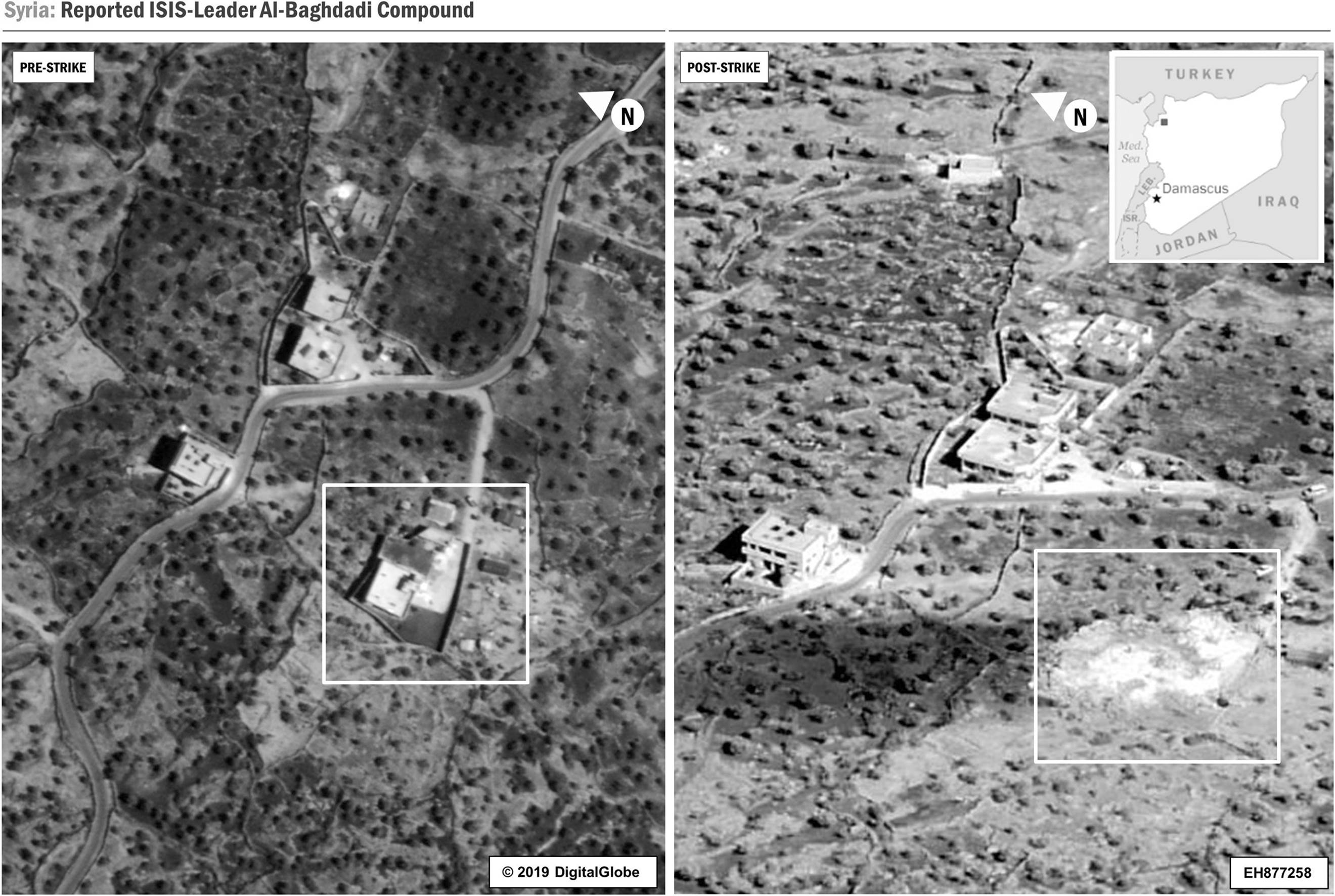
A side-by-side comparison of the compound before and after the raid that led to the death of Islamic State leader Abu Bakr al-Baghdadi, October 26, 2019. There was no collateral damage to adjacent structures.
The explosion kills the villain and his children instantly. The tunnel collapses, crushing the corpses. All three bodies are severed into pieces, arms, legs, and torsos poking from the rubble. Al-Baghdadi’s head remains intact, which will allow quick facial recognition of the body. But not until his identity is proven through DNA testing can Delta Force be completely sure they got their man.
The killer Abu Bakr al-Baghdadi goes out in a despicable way—murdering his own offspring. The names, ages, and genders of the children remain classified to this day.
Delta Force works quickly, lifting rocks and mortar in the narrow space to extricate the bodies in order to confirm the terrorist’s death.
Back in Washington, DC, the president and his advisers cannot see the real-time fate of al-Baghdadi; drones can only show open space. The Situation Room is very quiet. Mr. Trump believes the mission has been a success, and his speechwriters are already preparing remarks. But no one is celebrating. The faces of the president and his top officials are grim as they await the special code word confirming al-Baghdadi’s death.
The minutes tick past. No one leaves the room. On the video screens, images of dozens of US troops can be seen entering the two buildings to scavenge for intelligence: cell phones, laptops, flash drives, and whatever documents they come across. No bit of information is too trivial.
The Army Rangers and Delta Force are in no hurry to complete their task, taking as much time as they need to find every last bit of data on the scene. Each man wears a body camera, but images from inside the building are not transmitted on the live feed.*
Upon leaving, soldiers can be seen carrying not just the information cache but also body bags to the helicopters. Al-Baghdadi, his wives, and his children will be buried at sea within the next twenty-four hours—the bin Laden ritual repeated again.
Also at the compound are special medical technicians, who are in the process of verifying DNA from al-Baghdadi’s torn up body. The techs flew to the area with samples of the ISIS leader’s DNA in hand. The body is in pieces, each of which is carried from the tunnel for testing and burial. The jubilation over the ISIS leader’s death is tempered by the reality that this could have been a body double.
It takes fifteen minutes for scientific confirmation to come through. Finally, they have their proof: Abu Bakr al-Baghdadi is in hell.
It is 2:15 a.m. in Barisha—7:15 p.m. in Washington. The long-awaited code word is transmitted: “Jackpot.”
“Got him. One hundred percent confidence.”
One hour later, as the eight helicopters containing the soldiers depart the compound for the seventy-minute flight back to Iraq, the night is quiet—though only for a short time. In order that this area not become an ISIS shrine, it must no longer exist. F-15 Strike Eagle fighter jets and Reaper drones fire on the site, leveling everything. This is no simple rocket attack but rather a pulverizing combination of Hellfire and stand-off missiles, as well as laser-guided bombs.
Nothing is left of the evil hiding place.*
In Washington, DC, President Donald Trump once again turns to Twitter to communicate with the world. “Something very big has just happened,” he tweets at 9:23 p.m.
A press conference will be coming soon, he promises.
Intense and elated, Mr. Trump ignores the speech his writers are working on. He prefers to tell the story in his own words.
Which he will do. But on his own timetable.