
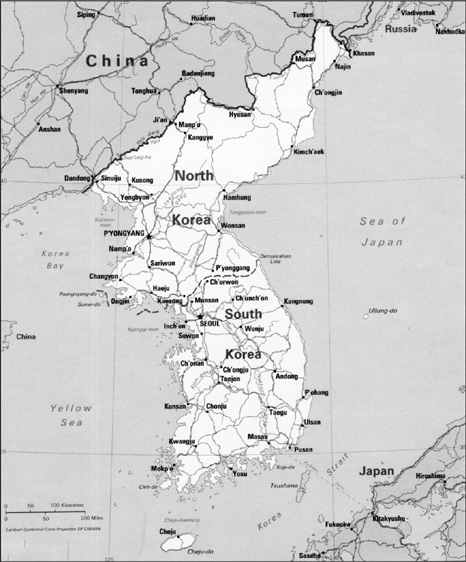
IT HAS TAKEN MANY YEARS FOR ME TO FINALLY DECIDE to put these experiences from the Korean War in a book. Although I began this project in the 1960s, my professional life took over, and limited my attention to it. In addition, I tend to keep the Korea of 1952-1953 to myself, perhaps because my life is so different since the war ended. Many of the people that I have come to know quite well over my professional career have no knowledge of this earlier life and will, in all likelihood, have some difficulty seeing the person that they have known as a professor or colleague as having experienced these events. All that aside, I decided that it is due time to share these wartime experiences. Events in Korea had a powerful impact, not only on me, but on countless others as well, and relatively little first hand accounts are available.
This book is a description of one infantryman’s experiences during the final year of that war and, obviously, not an objective history of the Korean War. The experiences recounted here are highly personal and subjective. If one of my buddies had written of these situations they might have taken a different emphasis or focus. On the other hand, my experiences may be representative of what a lot of other soldiers went through during the later months of the Korean War. The events we were caught up in during the war were accompanied by powerful fears and uncertainties that have left indelible marks on those of us who were there—some veterans have tried to forget these things; others have simply set them aside to go on with the rest of life.
For me, and likely other veterans, our wartime experiences remain quite vivid. Not a day has gone by since I left Korea that I have not replayed some of these scenes in my own consciousness—they are always ready for instant replay, and often do so even when I do not actively seek them out. These images are like those wagon trails that you can see while flying over western mountains—trails that were worn into the rock and clay by the early pioneers as they moved West in the middle of the 19th century or like the deep wheel grooves that were cut into the stone pavement of the ancient city Ephesus by countless Roman chariots as they made their way through them thousands of years ago.
For various reasons, the Korean War has become known as the “Forgotten War.” Many Americans know nothing of the battles and conditions described here, one of the primary reasons for writing this book. I feel compelled to keep alive the memories of some of the great guys with whom I served during the Korean War, especially those who died so young. Relatively few Korean War vets have written first person accounts. Others have interviewed some of us. Bill McWilliams’ excellent 2004 book, On Hallowed Ground, includes descriptions of the battles for Pork Chop Hill based on interviews from people who were there, like me. Anthony Sobieski included in his book a description of a two-man patrol that Bill Estes and I conducted to direct artillery fire against Chinese forces in the Yokkokechon Valley in his valuable 2005 account, Fire For Effect, about artillery in the Korean War.
I contributed a few brief articles about my experiences in published sources. A special issue of Stars and Stripes, commemorating the fiftieth anniversary of the beginning of the Korean War, described the eerie last night of the war on the front (Butcher, 2000). Two articles appeared in the Buffalo Bugle describing events in the Battle for Pork Chop Hill (Butcher, 2000) and an ambush patrol action (Butcher, 2001). Finally, some material included in this book appeared in an invited autobiographical article for the Journal of Personality Assessment (Butcher, 2003).
Affirmation of my strong positive feelings toward the South Korean people is another powerful motivator. Many Koreans—both civilians and fellow combatants—showed compassion and thoughtfulness in difficult times. Civilians gave me food when I needed it and they had little. One third of our company was Republic of Korea (ROK) soldiers sharing the horrors of the war on dark nights when we were so alone. Even though we did not share a common language, we supported one another and survived together. I appreciated their efforts at the time as I do now.
This book is a departure from my usual professional publications in psychology journals and books. Although there are themes in this book that are explored by clinical psychologists in academic writings—like the influence of severe stress on human memory or the long term consequences of terrifying events on adult development—they are presented here in a personal context, not intended as psychological observations. Furthermore, my experiences in the Army and Korea cannot be lumped together as all traumatic or stressful. There were many good times; perhaps more good times and close bonds with friends than there were horrific ones. Boredom during the quiet times along the front should also be mentioned.
I have a word of caution and apology for some of the language used in this book. It is my first publication that includes offensive language like “fuck” and racial epithets like “Japs,” “Gooks,” “Chinks,” and “Darkies.” I would be inaccurately portraying the words used during this era if I cleaned up the language. In the 1940-50s racial epithets were commonly used to describe the enemy, and served the purpose of dehumanizing them. I grew up reading newspapers and listening to the radio about “Japs” and “Krauts.” Derogatory terms for African-Americans were less commonly used where I grew up in West Virginia. But, as you will see in Chapter 2, I encountered them once joining the Army. My buddies and I never used such terms, but we heard them all too often in 1950s civilian America.
Well after the Korean War, and in “another life,” I have had the occasion to work extensively and collaboratively with many Chinese people. I traveled to China on three occasions for lecture tours and have developed close friendships with several colleagues there. I met a Chinese psychologist who had been in the army at the same time as me—but on the other side. Given the fact that I spent almost an entire year fighting the Chinese Peoples Army I had some initial difficulty managing the visits to China. They turned out to be, in our new spirit of cooperation and peace, wonderful experiences. I hope that my experiences and descriptions included in this book will be taken in the perspective of bygone times and will not be considered offensive by my Chinese colleagues.
Sixty years is a long time in the evolution of social and cultural values. My attitudes towards my time in Japan on R&R have changed dramatically, as you will see in Chapter 9. The events described in that chapter took place when I was nineteen years old and had barely made it through high school. I grew up with a mother whose education was cut short when she married at thirteen. I was not prepared to understand the underlying human rights issues regarding my activities during R&R. The military leadership of the time facilitated those activities. My changed perspective was aided through writings by several other scholars and human rights advocates, as well as many discussions with my wife about her work with refugee women in Asia (Williams, 1991; Williams & Berry, 1991).
All of the things described herein occurred as they remain in my memory, which was aided by notes I began shortly after the war ended. I also had the benefit of notes and dated keepsakes that I had sent home to my sister, Joan, during the war. In addition, I have had the benefit of some valuable memory jogs by several friends from the war or relatives of buddies long departed that I met later. These friends and their relatives encouraged me to document our shared experiences. It has been my pleasure to renew those acquaintances. I would like to thank Ray Daggett (Rhode Island), Don Schoen (Pennsylvania), and Frank “Vito” Field (Virginia) for providing information that was valuable in drafting this book. I would also like to thank the family of Robert Huggins (West Virginia) for talking with me about Bob (who was, at the time, in a nursing home).
I would like to express special appreciation to my West Virginia buddies, Carlos Coleman and the late Bill Estes. Each provided extensive and key information, including photographs, company rosters, and materials captured from the Chinese. I would also like to thank Regina Millsap, the wife of Ray Millsap (Illinois), for sharing information from Ray’s letters that were sent to her from Korea. I owe them a great deal for specific information that helped in dating some of the memories of those times long ago. I would like to thank Dale Moss’ niece, Kathy Moss, who contacted me by the Internet and sent me pictures that Dale had sent home to Missouri.
I sent copies of a draft of the book to my two brothers, Jerry and Richard (Dickie) Butcher, for comments on the information provided on our early days. Dickie assembled an early manuscript into a book—complete with a cover he designed—to my surprise and delight. His efforts and Jerry’s strong encouragement spurred me to finish the book.
My son, Janus (Jay) Dale Butcher (physician and colonel, Air Force Reserves), has also provided strong encouragement to publish this book. Jay was named for two of my closest friends who died on the front, Janus Krumins and Dale Moss. Not only that, both Jay and his son Benjamin Butcher (warrant officer and Army helicopter pilot) served together in Iraq, and his daughter Sarah Butcher was just commissioned a lieutenant in the Air Force Reserve. Both Janus Krumins and Dale Moss would be shocked that their namesake and his offspring outrank us all!
I am equally proud of the rest of my family and wish to acknowledge their love and support: daughters Sherry Butcher Wickstrom and Holly Krista Butcher; daughter-in-law Cindi Butcher; and grandchildren Bryce Thompson, Nicholas Younghans, and Neal Younghans. Holly, with her MA in Journalism, provided valuable editorial suggestions. Although my son Neal Butcher is no longer with us, his memory should also be acknowledged here.
Finally, this book would never have been completed without the extensive assistance of my wife, Carolyn L. Williams. She urged me on a number of occasions to write about my Korean War experiences and even signed me up for a workshop on writing memoirs! Without her encouragement over the years I would not have been able to complete the task. Not only is she a strong advocate for human rights, but also a very thorough researcher. She provided meticulous reviews of several versions of this memoir and our subsequent discussions greatly improved my work. I, of course, take full responsibility for any faults that remain.