
12
ACCORDING TO THE PLAY BOOK OF TACTICS and strategy for infantry units in Korea, outposts carried a great deal of responsibility in the overall plan of defense along the stabilized front. The mission of an infantry unit assigned to outpost duty—to serve as the forward unit in order to gain information about any approaching enemy units and to deceive them as to the position of the main force—is simple in conception but often difficult in operation. The out posted unit’s mission is also intended to disrupt the actions of the approaching enemy and to delay attackers that might be launching an offensive against the main body.
In some military situations the outpost is not expected to engage the enemy, only to warn of its presence. Many outposts in Korea during the latter part of the war, however, held a more strategic importance as a fighting force, not simply as observation posts. They were expected to put up an aggressive battle—often against great odds. Some of the bloodiest action of the latter part of the war took place on outposts like Pork Chop Hill and Yoke. These outposts, though small in terms of assigned unit strength (three or four squads), were heavily armed, self-contained fighting units. The old concept of circling the wagons in western movies, to hold off the attacking Indians who might come from any and all directions, aptly describes the mentality of the armed outpost. During the spring of 1953, our company was required to provide reinforced platoon size units to serve on Yoke, a remote outpost that lay well out into the valley. Usually the tour of duty on outpost was five to seven days. At night, Yoke was often visited by Chinese patrols and attacking forces. (See the photo of the marker on the slope of Outpost Yoke in April 1953 in Chapter 8).
The outpost usually contained eight or nine fighting positions placed in a circular position around the military crest of the hill. These emplacements were usually for protection from artillery and were often not the sleeping bunkers that would be near them, perhaps up the hill a few yards. These fighting emplacements were typically connected together by communication wire so that all of the men on the outpost knew what was happening anywhere on the hill. The armament on outposts consisted, as much as possible, of the automatic weapons variety—BARs, M-2 carbines, Thompson Sub Machine guns, light or .30 caliber machine guns, and even heavier .50 caliber machine guns.
Outposts were usually surrounded by a deep encirclement of barbed wire; in many cases there would be two or three separate barbed wire fences with triple strands of concertina wire strung between them. In order to provide friendly access to the hill, for example to bring in food, supplies, or particularly replacements, a series of gates would be provided through the sea of barbed wire.
Out in front, infantrymen would set up trip wires attached to warning flares or illumination grenades—hand thrown weapons that provided intense light instead of shrapnel fragments. (Although traditional high explosive hand grenades were also liberally employed as booby traps around the front of the outpost.) Enterprising GIs would also string booby traps at different locations around the hill. For example, one of my favorite defensive weapons was an ammunition can or a fifty-five-gallon drum filled with liquid napalm, a molasses-like substance that airplanes often dropped on entrenched hills and then ignited to burn deep into the tunnels. As a means of detonation, we would attach a white phosphorous or thermite hand grenade to the napalm can and string a wire from the loosened pin of the grenade, back to the bunker. If any enemy soldiers appeared in the front of our positions, the wire could be pulled exploding the grenade that ignited the napalm. Laid out in this way, the outpost could indeed be a formidable defensive position.
It was important to the security of the hill—as well to the platoon leader’s peace of mind—to have close communications with all of the fighting positions in the perimeter of defense. There was usually a communication between the firing positions on the outpost, unless of course incoming artillery cut the wires. The CP was the control center—all of the status communications from the fighting positions were transmitted to it. Telephone checks were frequent, periodic, or as the situation required. If anything out of the ordinary happened at any point on the perimeter, it was a threat to the entire operation and was immediately dealt with.
EVER PRESENT DANGER ON OUTPOST DUTY
Outposts were also exceptionally dangerous places in that the Chinese usually had accurate coordinates for their mortars and artillery and would fire harassing rounds periodically just to keep us on edge. Since the outposts were often smaller knolls near larger, higher Chinese-held hills, they also employed snipers to restrict our movement in the daytime.
Fehrenbach (1963) pointed out the danger of outpost duty in a war that was all but forgotten back home:
One final bitterness, of all these people, was that much of the bitter struggle of the last spring went unreported. There were months when as many as 104 enemy attacks—from company to division strength—smashed against the U. N. Outpost line, and days when as many as 131,800 rounds of communist artillery fell on it within a twenty-four hour period. Few of these events, buried deep in newspapers, caused a stir (p. 426).
One afternoon I was sitting on a step that had been carved into the trench, eating my mid-day rations (a can of the delicious entree called hamburger and gravy), and looking down the dugout at one of the new riflemen in the platoon who was filling sandbags to strengthen the roof on a machine gun emplacement. Suddenly, and without much audible warning, a sequence of mortar shells burst a few seconds apart along the trench line. One shell burst in the trench near the gun emplacement slightly beyond the rifleman, sending a shock wave and shrapnel down both directions in the line. I dived for the earth spilling the remaining juice from the rations beneath me as shards of shrapnel tore an ugly hole in the step on which I had been sitting but missing me by a couple of feet. The rifleman near me was not so fortunate; he was hit in both legs by shrapnel. He had to be evacuated from the outpost and carried back to the MLR where the helicopter could land.
CHEAP ENTERTAINMENT ON THE OUTPOST
The outpost near T-Bone was often the focus of Chinese entertainment—a frequent airing of propaganda through loud speakers on the hill. The Chinese placed these speakers in protected places so that they could keep the GIs on edge by broadcasting martial music interspersed with political commentary. Sometimes they even broadcast information about the units that were occupying the targeted outpost and were even known to mention the actual names of people in the units. Each succession of GIs going to the outpost tried to find where on the T-Bone the speakers were located in the hopes of firing rounds to eliminate them, but none succeeded. The recordings played on.
THE WILD, WILD WEST
Outpost duty was considered to be a riskier occupation than duty on the MLR, but it had its attractive side as well. One could usually ignore the spit-and-polish aspect of military life to some extent, although we were expected to shave every day regardless of circumstances. No one with any rank would show up at dangerous locations—like outposts such as Yoke, Eerie, or Arsenal—to check as to whether the men were actually complying with basic tasks. Outpost duty could be hazardous to your health—snipers, artillery rounds, and harassing attacks were par for the course. The job usually called for 100% alert. No one slept at night when Ole Joe prowled around the valley and nipped at our wire.
Seldom did the top brass visit us from Battalion or Regiment. Once during the winter when our platoon was serving a tour on Yoke, a colonel from regimental headquarters conducted a so-called inspection tour of our positions. We were told that we would need to shave and clean up. When we inquired as to where we could obtain the water for such fancy activities, we were told to “melt snow!”
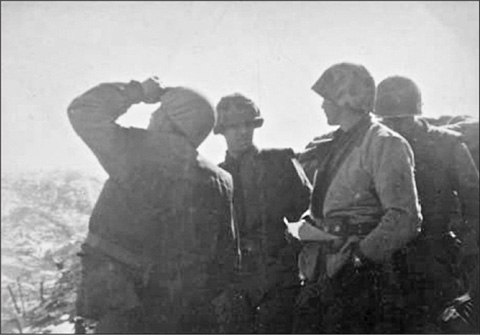
Outpost Yoke, February 1953. Left to right: Franklin Brown, Charles Otto, the author, unknown.
We were, fortunately, able to obtain an occasional hot meal on the outpost. The food was carried to the outpost (as was everything else) in a thermal container and served on a protected slope.
The colonel from regimental headquarters who visited the outpost for a few minutes, provided another bit of entertainment to the troops. The officer simply walked through the trench line for a brief spell looking at the enemy lines through a pair of binoculars, and then quickly returned to the main positions with the main company force. The outpost was quiet during the visit except at one time when a 76 mm round, simple not dangerous, dug up some rocks a distance away. A few weeks after the visit, the Army newspaper Stars and Stripes reported that the colonel received a Bronze Star for valor that day when he led troops on Yoke under enemy shelling. It was not uncommon for rear area brass to come up front (often at quieter times on the line) and wind up getting a decoration for valor.
PURIFICATION ON YOKE
The heavy weapons squad on Outpost Yoke had an interesting housekeeping strategy. Anytime they had a dud mortar round, that is a mortar shell that misfired, they would simply remove it from the mortar and dump it down one of the pipes that protruded from the earth making up the latrine system—an outhouse a few yards behind the bunker. Other guys in the 57 mm recoilless rifle squad dumped their defective shells down the hole as well. Other guys began to toss other types of unused or defective ammunition into the latrine such as bent machine gun cartridges that wouldn’t feed or hand grenades that had gotten rusty or bent out of shape.
One morning on Yoke, Bill Estes came out of his bunker and found two medics carrying a gasoline can toward the latrine on a mission to clean up and sterilize the outhouse by fire—a common practice under such conditions. After dumping a gallon of gasoline down the hole they decided to ignite the petrol by firing a pistol down the hole. Estes, seeing that an exciting event was about to take place, yelled, “I wouldn’t do that if I were you!”
One of the medics shouted back as they ignited the hole, “We have orders to purify this mess out here!”
Estes quickly headed for the bunker as he yelled advice to the medics to do likewise if they knew what was good for them. Within a few minutes, as the pit began to burn hotly (and, of course, reek more intensely) the .30 caliber ammunition began to pop off, followed by several large explosions of shells with the accumulated contents of the offensive pit.
As the medics wiped off the contents of the latrine from their clothes, Sgt. Estes thanked them warmly and enthusiastically for cleaning up the outhouse!
AN INCIDENT OF CIVILIAN “COOPERATION”
One night on Yoke, shortly after a KSC crew carried out rations and food, we began to receive intense shelling—more than the usual harassing fire—and we became alert to the possibility of an attack. One of our forward positions received a direct hit and two of the men inside were wounded. With an attack possible, we did not feel that we could spread our ranks thin by sending a full complement of stretcher-bearers back to the rear. Dugan (now operating as a medic in the platoon) and one of the ROK soldiers attempted to organize a stretcher bearing team to carry the wounded back using the KSC crew. The choggies were too scared of the incoming shells to help with the litter, they refused plaintively.
Dugan pointed his weapon at them yelling, “You commie bastards! We’re taking these guys back!” The KSC crew had a change of heart and picked up the stretchers and began the journey back.
I did not quarrel with Dugan’s handling of the situation, though it was a bit rough; everyone knew that he would likely have killed them had they not cooperated. One of the squad leaders on the outpost came to me afterward and was very critical of my not stopping Dugan’s enthusiastic expressiveness toward the KSC workers and I thought he was justified to some extent.
However, I thought that Dugan’s behavior, though extreme, was effective. Combat conditions, especially on outpost, tended to raise the level of emotions and a sense of exigency. I was inclined to agree with Dugan’s efforts, but perhaps it was wrong to force these civilians at gunpoint to carry wounded back to the rear with the possibility of drawing artillery fire at them. I realized that in vociferously supporting Dugan, I had perhaps lost some of my previous composure and objectivity under these tight circumstances.
The means to the end was certainly harsh. Maybe my own judgment in this situation was impaired but I acted as I thought circumstances required, that is, holding the defense of the hill intact at all cost while getting our wounded and the KSC crew off the hill.
AT WAR WITH THE ETHIOPIANS
One night, after a week on outpost duty, we were being relieved by a platoon from the Ethiopian battalion to return to the MLR. The Ethiopians were delayed in their arrival at the outpost so I went inside the CP and fell asleep on the top commo wire bunk to await their arrival. We had a lot of respect for the “Epps.” They had a reputation of being fearless and aggressive soldiers who had a great prowess in night stealth. This was certainly true in this situation because they arrived at our positions in the valley almost undetected by our sentinels until they reached the lowest strands of barbed wire strung around the hill.
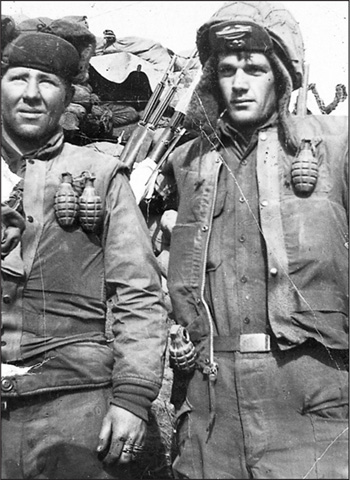
Dale Moss (left) and the author on Outpost Yoke, 1953.
No one had come into the bunker to wake me up because they were all getting their gear together to move back to the MLR. The first that I knew that the Ethiopians had arrived was when I, still groggy from the nap, detected some movement in the CP bunker near my bunk. I adjusted my eyes to see where the noise was coming from when I was startled by a grinning black face about a foot away from my head. In an automatic reaction, I went for my weapon only to have him grab my hand. Laughing aloud, he seemed to be enjoying the fact that he had gotten so close to me without awakening me.
****
When I went outside the bunker to check to see if all of our guys were saddled up and ready to go, I heard some loud voices down the trench and went to investigate. There was an apparent disagreement over the ownership of one of the weapons. We had orders to take with us all of our own weapons and equipment including the heavy machine gun our weapons squad had recently acquired. The Ethiopian lieutenant had other plans for our heavy machine gun and began to insist that it was a sector weapon and was supposed to stay on Yoke. Dale Moss, our machine gun team leader, was equally assertive about keeping the gun because he had grown quite attached to it.
Moss, becoming angered over the lieutenant’s insistence, settled the dispute by getting the drop on the officer. He quickly and adeptly drew his .45 caliber pistol from his holster and aimed it at the Ethiopian lieutenant’s head, cocked it, and said, “We’re taking our gun!” He instructed the ammo bearers to move it. That night the Ethiopians, who had a strong reputation for being fearless combat soldiers, discovered that the Americans could be a bit bad-assed too if pushed.
ON BECOMING A “SHORT TIMER”: THE INCREASE OF MY ROTATION BLUES
The rotation system, described earlier, disadvantaged both the unit and the individual soldier. The units were disadvantaged in that the most experienced men were sent home and the unit morale and effectiveness often suffered from such departures. This also meant that the day-to-day functioning of the unit was conducted by men with more limited experience. The military became somewhat disenchanted with this rotation system after the Korean War and made modifications by rotating units rather than personnel.
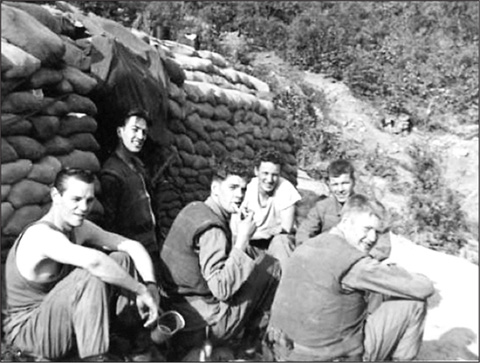
On a break, May 1953. Left to right: Thorn, Daggett, the author, Schoen, Field, and Otto.
Men were disadvantaged by the rotation system in several ways. Regardless of one’s stamina and capability of handling increasing stress, all people followed the same system. It is well known that some individuals fare better under stress than do others. However, in Korea, the tour of duty was of the “one size fits all” variety. Men at the front often acted strangely as they reached the magic thirty-six point milestone. Fear of death or injury tended to increase; the “short timers” often became preoccupied with “not taking any unnecessary chances”—and for good reason. We all knew of guys that had made it through some pretty tough times and who had finally attained the required points for rotation only to be maimed or killed. Grasshold, who died on Pork Chop, was a good example. He had more than thirty-six points when he was killed. By the time I reached the magic point, I was unlike the seemingly invincible young man who marched blindly and carelessly into action on Jane Russell. I was becoming overly cautious and jittery about surviving. I was anticipating the worst at every turn. It seemed as if every incoming artillery round had my name on it. Every Chinese infantryman on the opposing strongholds knew my location and was out to do me harm.
I was now a short timer—ready for rotation. I had become one of the point counters, having been in Korea for more than nine months, and I too became more reluctant to take excessive risks. I began to eat my C-rations in my bunker rather than run the risk of being erased by a shell on my way to the chow bunker. I had transformed into a different soldier, especially after I returned from R&R in Japan where I came to realize that there was life and fun out there. I became more preoccupied with getting back home.
THE INTERNATIONAL INCIDENT AND SYNGMAN RHEE
We were on outpost duty when we received the news about an extremely unsettling political action by the South Korean government: a situation that threw us into a flurry of anger and concern over our own safety.
On June 18, 1953, without warning, South Korean President Syngman Rhee released 35,000 North Korean prisoners from the prison camps. We were absolutely astounded by the fact that all of a sudden we would have a large body of enemy soldiers to our rear—a situation we considered a traitorous act by the leader. We were here on the front lines keeping the enemy from South Korea’s gate while their politicians made our lives difficult by turning a horde of the enemy loose at the rear. We became gravely concerned as to the security of our rear areas, and could visualize ourselves being attacked by guerilla forces from behind. After all, some of the men in our unit had been pulled off the line to chase infiltrators in our rear in the past.
Of course, we got no clarifying information from our own officers—most of whom were equally angered and puzzled over Rhee’s actions. We were not the only Americans who had these concerns. Apparently the general staff and the president were infuriated by Rhee’s brazen action. We were not told at the time that these POWs had opted not to return to the North.
Our anger at the politicians got expressed in an action that backfired and brought some “official” criticism of me at the time. One of the guys in the platoon happened to have a magazine picture of Syngman Rhee and set it up as a target on a bank near where we sometimes ate our lunch. Several of us let off steam by taking a few target practice shots at the picture after we heard the news of the prisoner release. A few days later, when we returned to the MLR, I was called on the carpet for creating an “international incident.” It seemed that one of the ROK soldiers in the unit had complained that we were not showing sufficient respect for his leader. The CO seemed a bit exasperated at having to deal with our misbehavior. I, as the ranking perpetrator, was required to make a public apology to the ROK soldiers, many of whom I was to learn, held the same sense of outrage as we did about the prisoner release.
I don’t think any of our generals or President Truman ever apologized for their angry expressions at Rhee. But then their anger was not expressed as openly as ours and, of course, we were at the bottom of the power hierarchy. Although this seemed like a crazy and traitorous situation to us at the time, many analysts have concluded that Rhee’s releasing the prisoners actually had a positive impact on hastening the end of the war. This interpretation is based on the fact that the greatest stumbling block in the peace negotiations at Panmunjom was the prisoners. Now that these people were no longer in captivity, it took away one of the points of disagreement holding up the talks.
SKOSHIE R&R: A FORCED REST AT CAMP CASEY
In the late spring my time came due to participate in what was referred to as “Skoshie R&R.” This was a planned leave to provide GIs who had been on the line a long time with a rest break to provide them a respite from the front and a brief period of relaxation at Division rear. I didn’t want to take another leave and I protested that I needed to be here on the front because we were so thin in rank and with so many new men up front. But, the new CO ordered me to take a break. He said that it was mandatory for GIs with my time in the trenches.
The Army plan and the CO’s implementation of it recognized that I was experiencing a bit of war weariness or operational ineffectiveness often referred to as “combat fatigue.” Many GIs with my time on the line began to show that they were becoming a bit frayed and a felling a bit depressed. The GI often did not agree, as in my case, and considered it unnecessary. But the officers in Battalion and the Company insisted, so I got a break. It is interesting as I look back at this time that they were clearly right in insisting but I felt so strongly as though I needed a rationale or justification for not staying at the front with my men.
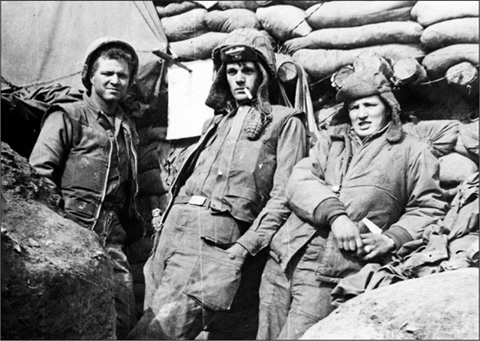
On Outpost Yoke. Left to right: Vito Field, the author, and Don Schoen.
The goal of the Skoshie R&R was designed to give the GI a chance to clean up, get a couple of nights sleep, watch a movie or two, drink some beer, and basically interrupt the cycle of operational fatigue, a very visible condition shown by jumpiness, irritability, fatigue, and depression. All the others before me who were sent back for a rest enjoyed it. Just to be able to sleep without worrying about Old Joe slipping into your trench and cutting your throat was a pretty big relief.
Late one evening on my second night in the rear, after a bit of drinking at the Regimental NCO club, three other NCOs from another battalion and I decided to go into Ouijongbu, a town close by, to look for some excitement. One of the guys managed to acquire a jeep, unofficially of course, from a guy who used to be in his squad.
We were off. We drove around town for a while but everything was locked up and dark. We did not find much going on. After midnight, and a fruitless search for excitement, we decided to try and find our way back to camp before the jeep was counted among the missing. As we rounded a corner of one street, we chanced to see some lights and some people moving about in one of the houses. With lights on at that time of the evening we, of course, assumed that it was a nightclub of some sort and we stopped the jeep to have a look around.
The Koreans inside, mostly older men and women, were sitting around a room drinking a fermented, milky rice drink. They invited us to come inside and we took a seat on the floor. They offered us some of the wine and some dried squid to eat—a snack for which Americans do not gain a ready fondness due to the fishy smell. None of them could speak English and we, of course, knew little Korean. They were certainly friendly enough, but we felt uneasy with the situation. After a while one of the sergeants came to the realization that we were sitting there in the midst of a wake.
Apparently the deceased woman, an ole “mamasan,” was to be buried the next morning. We felt a bit sheepish about our intrusion but we stayed there a while talking, or at least gesturing with the people, until we took our leave to return to camp, saying our friendly goodbyes. I have always wondered what the people at the funeral thought of four somewhat inebriated, heavily armed U.S. Army combat NCOs dropping in to pay our respects at the funeral of this old Korean woman.
INTO THE VALLEY OF DEATH
Our platoon was ordered to send an ambush patrol near Hassakol to interdict troop movements from the Chinese hill. The patrol leader was a capable lieutenant who was newly arrived in Korea and had no prior combat experience. Vito and I volunteered for the patrol, I might add with some reluctance because of my short time left on my tour of duty; however, there were few experienced men in the platoon at the time. In addition, it seemed like one more stroll through the valley wouldn’t be too bad. Our preparations for the patrol were routine, except for large numbers of questions and what seemed like excessive worry among several new men we had to take along.
As we left the security of the barbed wire fences surrounding our lines and began to make our way down the outbound path, I heard the familiar sound of an M-2 carbine fire in short bursts. Initially, I thought that one of the new men had accidentally discharged his weapon—giving away our positions. I yelled out, “Who fired that weapon?”
No sooner did I ask than our ranks were littered with five or six exploding Chinese hand grenades. Several men in our ranks began to yell for a medic. We were ambushed at a vulnerable point in the patrol—while we were in single file and before we could get into our diamond shaped patrol formation. The Chinese, who were apparently well aware of the fact that our patrols always had to leave from this section of the line, had set up their ambush on this familiar trail. The Chinese had allowed our point man to pass; he did not detect their presence at this early stage in the patrol. The fact that their initial attack came from the ground off to the right of the trail, actually a minefield, suggested that they had successfully cleared a path on earlier patrols prior to that evening so they would not explode our mines in setting up this particular ambush.
As the firefight proceeded, some of the more experienced men returned fire—firing at shadows and flashes. From a crouched position, I emptied the clip from my M-2 carbine at the bright flashes coming from my right. Then I fell to the ground next to Jerry Manning, one of the new men who was walking in front of me, to insert a new magazine clip into my weapon.
As I lay there, I felt something warm on my leg. “What the hell?” I said.
Manning replied, “I think I pissed my pants!” His voice was pained. (Manning had actually taken a shell fragment in his bladder that promptly emptied it, filling up the slight depression in the earth in which we had fallen.)
Soaking wet with urine, I stood up and fired in the direction from which the flashes had come. It soon became quiet along the path that the patrol had followed. The intruders left as quickly and as stealthily as they came.
The action aftermath of the patrol was horrible, with almost everyone wounded and in a state of shock. The action was sudden, brief, and very destructive. Before we knew what happened, we had one man killed, one missing, and several severely wounded.
Sergeant Estes, leading another company patrol, arrived shortly as the remnants of our patrol was making its crippled way back to the MLR. We had the wounded lined up along a road and were calling for stretcher bearers to get them down toward the bottom of the hill where they could get picked up by an APC for the trip to the rear.
ASSUMPTION OF DUTIES AS FIELD FIRST SERGEANT
The Battalion Executive Officer asked me if I would like to take on a new position in another company—the job of Field First Sergeant in K Company—to replace a sergeant that had rotated back to the States. Although it involved a transfer to another company, I agreed to do so even though I only had a few days or weeks until I would be eligible for rotation myself. Although I would miss a few of the old-timers in the company, I decided that there were some things about the new look of Fox Company that I would not miss. I made the move in early July and we moved back on the line facing our old foe near the T-Bone. Although I was still only nineteen years old, the new situation as field first sergeant made me feel like an old soldier.
The move was a good one for me. My duties involved serving as the assistant to the first sergeant and involved command of the company troops in the field, including such things as combat preparations, weapons inspections, troop movements, and so forth. The company officers appeared to be clearly stronger than the ones that I had just left in Fox Company and were friendly. I liked the group of guys in the new company and settled in to complete my Korean tour.
THE SECOND BATTLE OF PORK CHOP
On July 8th, we received word that Pork Chop Hill was under major attack again and that our company was to be one of the units to be deployed in a counterattack if the hill was lost. We were instructed to prepare for a jump-off later that evening. The NCOs were called in to the CO’s tent for a briefing just prior to the hour scheduled to load up the trucks for the ride up to the MLR behind Pork Chop. The CO indicated that the Battalion was being called in to put out the recent fires of the Chinese assault on Pork Chop and that evening our unit was moving up at 7:00 P.M.
After briefing the platoons, the CO told me that I was not going with the main unit, but that I was staying back with a contingent of men in the reserves in the event a counter attack was required. I was very surprised by the CO’s decision to leave me behind, and I had a great deal of mixed feelings about his decision. I suggested that I knew the hill and might be of some help in the engagement. He firmly pointed out that I did not have direct command responsibility for a platoon in the company and that an “extra” NCO might actually be confusing to the command structure. In addition, he pointed out, “You have already done enough with the Pork Chop; and you are ready to rotate.” With mixed feelings, I remained behind.
The Pork Chop again came to be a disastrous piece of real estate for our Battalion. Several companies were chewed-up in the seesaw battle that raged for two days. Many men in the company lost their lives on the hill that first night of the battle—including the company commander who had decided not to take me along—and most of the officers in the company. When the remnants of the company came off the hill the atmosphere was much the same as it had been back in April after the first Pork Chop.
After all of the troops were withdrawn from the Chop, I walked over to the Fox Company tents, which were pitched close by, a day after what was being referred to as the Second Battle of Pork Chop. I wanted to see if I could get word on what had happened to the unit during the foray and to see old friends Vito, Moss, and Estes.
Tragic news met me right away. Don Schoen, from my old squad, one of the few familiar faces around, told me that Moss had been killed. Dale and an ammo bearer, referred to only as “Doggie,” had gone down on the point on Pork Chop to set up a machine gun to bear upon attacking Chinese coming up the ridge. Neither Moss nor his ammo bearer ever returned from the mission.
I couldn’t believe that Moss was dead. This was an incredible revelation that I did not handle well at all. Sergeants are not supposed to cry but it was unavoidable. Moss the indestructible; Moss the happy dare devil; Moss the good friend was no more. This was the most unkind cut of the war. I felt numb from the shock and could not bear to hear more.
I cried all the way back to my own unit. The world had certainly lost one of the greatest humans ever to walk its face. This was not the only bad news from the Second Pork Chop. Vito had also been wounded and so had Bill Estes, who was the platoon sergeant for the mortar section. Bill took a bullet in his arm and was being evacuated to Japan. (Bill was among the many casualties evacuated to Japan after the Second Battle of Pork Chop, but his drama did not end when he left the hill. He told me some years after the war ended of a frightful experience he had during his evacuation. Estes and a number of other wounded men were loaded onto a C-47 hospital plane for the trip over to Japan. The plane was apparently overloaded and failed to clear the fence at the end of the runway. The plane crashed, spilling much of its already damaged cargo and killing the crew and several of the wounded. He reportedly was rather nervous getting on the second evacuation plane the next day to go to Japan).
It was a long and sorrowful walk back to my company.
FINAL DEMOLITION OF PORK CHOP
Hell’s little outpost, that godforsaken knoll of death, was once again held by the American forces with the loss of many lives only to be given up when the politicians decided that this piece of real estate was not worth keeping.
On July 10th Pork Chop Hill was evacuated and left to the enemy (who probably really did not want it either). General Trudeau decided that the hill was not worth spilling any more blood over and decided to secretly evacuate the positions on the hill after they were laden with tons of explosives. Throughout the trench works booby traps, napalm, and dynamite charges were strategically placed to be ignited on command from the safety of the MLR.
An easy deception was then perpetrated. The troops holding the hill were simply taken off in secret. Then the hill would be returned to Chinese hands if they wanted it. The deception was made easy because the reinforcement of the hill was now being carried out with armored personnel carriers. The Chinese could not actually determine if the APCs traveling up the hill were loaded with men going up or coming off the hill. Over a period of several hours the Pork Chop was evacuated
After two days of relative silence the Chinese became aware of the lack of movement on the hill and decided to move up in force to reclaim it. Once they were on the hill the charges were blown at the same time that an intensive artillery barrage was leveled against the hill, and on the enemy approaches leading up to it. The emplacements on Pork Chop were soon only piles of rubble. The Chinese could now have this patch of real estate to occupy but they paid very dearly for the clear deed to it.
We watched the hill blow from our positions on the MLR. This was an incredible sight to behold. The hill’s snake-like entrenchments were destroyed with an ear-bursting crescendo. Secondary explosions erupted and smoke billowed from the hill for several days after the detonation.
After all the lives that had been lost to gain and regain Pork Chop over the past several months, it was now removed from our list of real estate holdings above the 38th Parallel. Most of us concluded that it was “Good riddance!”
The ultimate irony is that this highly valued prize of the new type of “limited warfare” was now seen as a worthless relic—no longer did it hold the tactical value it had held for so many months during the later stages of peace talks. Such a conclusion was about four months late in coming.