
14
MORE THAN THIRTY-FIVE YEARS AFTER I LEFT Korea, my grandson, Nic Young-hans, asked, “Grandpa, the Korean War wasn’t really a war, was it?” Somehow, while studying American history in high school, Nic questioned whether our fighting in Korea was a real war. Korean War vets have heard statements like that ever since their return in the 1950s. For those of us on the front lines, it is a painful question, given what we experienced and the friends we lost. On an intellectual level, I can reason that President Truman’s decision to avoid going to Congress for a declaration of war resulted in this confusion about our actions. The Korean War was called a “police action” or “conflict” by the Truman administration for expedient political reasons (Hakim, 1995). Those labels, then and now, minimize the extent of the hard-fought battles and losses.
Ironically, Nic asked that question when he was about the same age I was when I volunteered to go to Korea. He was not that much younger than some of my close friends who died there. Among the thousands of young casualties, I lost many close friends. The battles on Pork Chop described in Chapters 10 and 12 included five close buddies among the many dead: Moss, Ziggy, Zimdahl, Grasshold, and Moosemaid. Sully died on Jane Russell (Chapter 4) and Krumins at Outpost Uncle (Chapter 11).
Nic’s question brought intense nostalgia. My first thought, “just ask Moss,” was left unsaid. Instead, I gave a very brief response, “Yes, it was a tragic war,” and settled back into my usual mode of keeping the war to myself. For reasons that remain unfathomable, I was not ready to go into the details found in this book—even in a conversation initiated by my grandson.
It took almost another twenty-five years before I could complete this accounting I started so long ago. Unfinished business can gnaw away at one’s inner peace. The impact and meaning of my experiences in Korea left me with a need for closure and a need to place those situations and circumstances in some perspective. Nic’s question, and similar ones from others over the years, kept popping up:
• How did I end up in Korea in the first place?
• How did the decision to call war a police action affect GIs like me?
• How did Korea impact my feelings back home?
• What did I learn on my return visits to Korea?
• Were the sacrifices made offset by the accomplishments?
Here, then, are my answers:
HOW DID I END UP IN KOREA IN THE FIRST PLACE?
In June 1950, when the North Korean Army invaded South Korea, I was about to start my last year of high school. As I explained in Chapter 1, I immediately was ready to serve my country in this new war, but my country did not think I was old enough. My understanding of the Korean conflict was pretty basic. The communist North Koreans, by crossing the 38th Parallel into the democratic Republic of Korea in the south, were the aggressors; and our country, along with the United Nations, were the defenders of the South Korean’s freedom.
While waiting to turn seventeen years old, my biggest fear was that the war would end before I was old enough to serve. Once the American and UN troops arrived in force overseas, they were able to overpower the North Korean forces, regaining South Korean territory that had been lost in the first weeks of fighting. I listened to the radio and read newspaper accounts of the triumphant UN forces. In the fall of my senior year, there was talk that the war would end by Christmas 1950. UN forces had driven so far into North Korea that they were at the Chinese border by October 1950. There was no reporting at the time about the responses of the Chinese Communist Forces (CCF), which were amassing along the Chinese-Korean border. The Chinese Army entered the war that fall and drove UN forces in mass back into South Korea.
The news from Korea during my last six months of high school was grim. We were retreating. In January, Seoul was once again under the control of communist forces. Fighting was intense. UN forces recaptured Seoul in mid-March. President Truman fired General MacArthur in April for failure to follow the policy of the U.S. In his speech about MacArthur’s firing that I heard on the radio, Truman declared:
In the simplest of terms, what we are doing in Korea is this: We are trying to prevent a third world war…I believe that we must try to limit the war in Korea for these vital reasons: to make sure that the precious lives of our fighting men are not wasted; to see that the security of our country and the free world is not jeopardized; and to prevent a third world war. (at http://teachingamericanhistory.org/library/index.asp?document=860).
As high school graduation approached, I was all the more convinced that I needed to volunteer. General MacArthur’s military failures and humiliating retreat incensed me. I was not among the voices urging an end to the Korean War. I agreed with President Truman’s policy of protecting South Korea from communist aggression. Our entry into the war, along with the other United Nations countries, provided a clear statement to the communist powers that the United States and the United Nations would not ignore violent take-overs of democratically elected governments.
World War II shaped me—there were good guys and there were bad guys (Chapter 1). And, it was my patriotic duty to serve on our side—either as a soldier or on the home front. I recall collecting scrap metal, planting victory gardens, and living through rationing as part of my home front service during WW II. My mother worked in a factory tied to the war effort until her death. I wanted a greater role in this new war effort. I was old enough to be a soldier. I was going to join another global effort to defeat the enemies of freedom. Those who remained on the home front during the Korean War would serve as well, like my family did in WWII. I did not, however, understand the impact of a “limited” war on the soldiers fighting it and how my expectations from childhood would not apply to this war.
HOW DID THE DECISION TO CALL WAR A POLICE ACTION AFFECT GIS LIKE ME?
The Korean War turned out to be vastly different than the war that preceded it by five years. At its start, President Truman called it a “police action” of the United Nations, not a war declared by Congress on behalf of the American people. Truman limited its goals to stopping the Communist aggression in Korea and avoiding a general war that would draw in mainland China and the Soviet Union on the other side. While we fought under the UN flag, the effort turned out to be not as global as Allied efforts during World War II.
The overwhelming burden of fighting fell primarily on the armed forces from two nations. More than 94% of the UN forces were American and Republic of Korea (ROK) military personnel. Hermes (1965) provided a breakdown of the nationalities of the forces serving in Korea that I include in Appendix B. During the first year of the war, Americans made up 45.6% of the ground forces, and by the last year of the war when I was there, we were down to 32%. The other UN troops hovered between 4-6% of the ground forces, with the ROK forces increasing dramatically each year. Commensurate with the overall level of commitment, the majority of the casualties were from the United States and South Korea.
Although the other nations made up such a small percentage of the forces, those of us on the ground in Korea appreciated their efforts. Several British Commonwealth nations (Australia, Canada, New Zealand, and United Kingdom) provided a substantial number of ground troops, averaging over 20,000 men for each year, to the war effort. Some of these units, particularly the Brits and Canadians, took heavy casualties and lost many men to captivity. Throughout the war Turkey provided a brigade of troops (roughly 5,500 men). This unit gained a worthy reputation for their fighting ability. We considered ourselves fortunate if the Turks were on our flank. (See Appendix B for a full description of the nations contributing troops to Korea.)
By the time I got to Korea, Truman had already firmly established, with the firing of MacArthur the previous year, our limited objectives. We were to defend the sovereignty of South Korea up to its border on the 38th Parallel. I did not pay much attention to the controversy and debates about limited war by the military brass and politicians. I did not realize I was in the middle of a major shift in American warfare: it was above my pay-grade. However, a number of generals and admirals were beginning to conclude that any future wars would likely be limited (Kaufman, 1986). General Ridgeway (1967) indicated that Korea taught us that all warfare from that time forth must be limited.
It certainly became obvious to anyone on the front lines that we were limited in the military actions we could take. Unfortunately, “limited” sometimes became synonymous with “limited resources,” The shortages that began to affect our war effort in Korea actually became the subject of Congressional investigations in the last two years of the war (Hinton, 1953; Stevens, 1953). GIs like me suffered as a result of deficiencies in both supplies and manpower. Basic supplies like ammunition and warm clothing sometimes were too scarce. I would have gladly traded—at least before the addiction kicked in—the endless supply of cigarettes (see Chapter 5) for items that would keep me alive and comfortable like overhead flares and warm socks.
The new limited warfare did not mean limited casualties. Not enough American military personnel were sent to Korea to replenish our units given the number of casualties we suffered. Instead, as troop strength dwindled, we were forced to integrate non-English speaking personnel into our units. None of us had skills in these other languages. Yet we had to communicate tactical orders to those who did not speak English.
At one point my platoon had to function with soldiers speaking three different languages: Spanish, Korean, and English. We got by as best we could with pidgin English and physical gestures, as I described in Chapter 4. However, American GIs and UN soldiers were often placed at risk by having to depend on others who could not communicate about dangers at hand. It is difficult enough to go into combat with full strength and with guys you know well. It is risky to do so with sometimes a quarter to a third of the guys in the unit not sharing a common language, as happened on the patrol described in Chapter 8.
In addition to the lack of a common language was the problem of differing training standards and operational effectiveness. On multiple occasions the company commanders would tell NCOs like me to retrain our replacement troops while we were on the front lines. We had to convey survival skills that we learned in basic training within a rifle shot away from the enemy. In too many instances, we had to fill vacancies in the American ranks with marginally trained replacements.
War-weary American civilians were not asked to make the sacrifices on the home front as they did during WWII. The prosperous 1950s were beginning, and I remember thinking that folks back home seem more interested in their new TV sets than what we were going through in Korea. Korea became a “Second Page War,” and later was known as the “Forgotten War” (see Blair, 1987; Melady, 1983). The obituary section of the papers told a different story—with pictures of deceased Soldiers and Marines often being the only conspicuous reminder of the tragic events that were being played out so many thousands of miles away.
The around-the-clock celebrations and nonstop jubilation at the end of WW II were much more muted at the end of the Korean War. Victory did not come about with the signing of a peace treaty by the “winners” and “losers.” Most of us quietly returned to civilian life without any fanfare. This was very different than what I witnessed just a few years before at the end of World War II. It contributed to feelings that the American people could easily ignore what we accomplished in Korea and its costs. The Korean War seemed to me to be much too easy to forget.
I feel empathy with today’s soldiers fighting in the limited wars in Iraq and Afghanistan. Why are young Americans sent into combat sixty years after the lessons from Korea without adequate supplies like body and vehicle armor? I am greatly saddened when I see the faces and ages of those killed during the previous week in obituaries on the few television networks that carry this news. I note a similar lack of attention on the part of the public and media about our country’s involvement in its current wars. Indeed, I recently saw a T-shirt online that said, “Afghanistan: The Forgotten War.”
I imagine these young people feel the same disconnect from the civilian population back home that I did on those lonely, cold, and dangerous nights in Korea. That disconnect for veterans continues even back home and can pop up unexpectedly many years later. It is isolating and demoralizing, and probably was a contributing factor for my long silence about my time in Korea.
HOW DID KOREA IMPACT MY FEELINGS BACK HOME?
Rudyard Kipling wrote a poem called “Tommy” to call attention to how British soldiers in the 1890s were treated by civilians. It highlights how soldiers feel ostracized in the civilian world, at the same time they are called upon to defend it. Many times since my return from Korea, verses memorized long ago in high school come to mind:
While it’s Tommy this, an’ Tommy that, an` Tommy, fall be’ind,”
But it’s “Please to walk in front, sir,” when there’s trouble in the wind
There’s trouble in the wind, my boys, there’s trouble in the wind,
O it’s “Please to walk in front, sir,” when there’s trouble in the wind.
For it’s Tommy this, an’ Tommy that, an` Chuck him out, the brute!
But it’s “Saviour of ‘is country” when the guns begin to shoot;
An’ it’s Tommy this, an’ Tommy that, an’ anything you please;
An ‘Tommy ain’t a bloomin’ fool - you bet that Tommy sees!
Kipling wrote “Tommy” to protest how British soldiers were treated in the 1890s. In anticipation of the end of World War II, Americans passed the Servicemen’s Readjustment Act, commonly known as the GI Bill. This represents a major turnaround in how a country provided for its returning soldiers. Kipling surely would have approved. But even today, Kipling’s “Tommy” is one of the most quoted and parodied of his poems. It still highlights the disconnect soldiers can feel with civilians (The Kipling Society, 2011):
Yes, it’s Tommy this, an’ Tommy that, an’ spend less on defence,
But who walks the streets of Basra when the air is getting tense?
When the air is getting tense, boys, from Kabul to Kosovo
Who’ll say goodbye to wife and kids, and shoulder pack and go?
Thanks to the G.I. Bill, I was able to build a new home in academia, after a few false starts. Although different in many ways, the rigors of my time in the military kept me determined and goal-oriented in college and graduate school. The Army and the GI Bill provided a way out of the coal mines of West Virginia to a professorship at the University of Minnesota.
I arrived at this large Midwest campus just as the tumultuous Vietnam War and the Anti-War Movement began to emerge. This was a confusing time, not only for me, but the country at large. Anti-war activists interrupted my classes at the university. I saw angry protests on campus and even tear gas being used against students and faculty protestors. I was confronted by students on a few occasions because I was a veteran, and therefore “pro-war.” These experiences were very different than the discussions with fellow students at Guilford College about their pacifist beliefs (Chapter 4). I felt a great deal of intolerance and animosity directed towards me because of my military service (“For it’s Tommy this, an’ Tommy that, an` Chuck him out, the brute!”). It was hard to reconcile this rancor with the sacrifices we made in Korea; it seemed unpatriotic.
Some returning Vietnam veterans thought differently about the war they fought, and founded the Vietnam Veterans Against the War (Hunt, 1999). This group may be the first American Anti-War organization founded by veterans while the war they were protesting was ongoing. Some Korean War and World War II veterans also participated in demonstrations against the Vietnam War. These veterans described their activism as “the highest form of patriotism” (Hunt, 1999).
The social conflict grew and the unthinkable happened in 1970. The Ohio National Guard shot and killed unarmed student protestors at Kent State University. The world seemed out of control. At the same time I was in the early stages of a demanding research career. The only way for me to deal with the turmoil was to concentrate on my work. I learned this skill in combat: to focus single-mindedly on the mission ahead, rather than on the chaos surrounding you. I became apolitical. Korea was pushed to the recesses of my mind.
WHAT DID I LEARN ON MY RETURN VISITS TO KOREA?
By the 1990s, my career was established and much of my research was on a psychological test that was used around the world. I supervised many international graduate students studying at the University of Minnesota, including Korean, Chinese, Japanese, and Thai. I conducted workshops and symposia in thirty-three other countries. I basically remained mum with my students and colleagues about my time in Korea—I was living a very different and rewarding life.
The war came flooding back with an invitation I received in 1992 to speak at a conference in Seoul, sponsored by the Korean Psychological Association. I didn’t hesitate to accept the invitation, but was surprised by some vivid flashbacks and a few nightmares about the war. Intrusive thoughts and feelings about the combat experiences and my lost friends were amplified during the months before the trip.
I was surprised by this reaction. I had already made trips to Hong Kong and China. My principal enemy during the war was the Chinese Army, not North Korean troops. I served side-by-side with South Koreans. Yet, going to China did not cause the same intensity of feelings as did returning to Korea. I even had an opportunity to discuss the war with a Chinese veteran from the Chinese Peoples Army. But, going back to Korea—I did not know what to expect. How would I react? What would the South Korean people be like?
Almost instantaneously on arrival, I re-experienced what I had known so well back in the ‘50s: I liked the South Koreans a lot. During dinners with colleagues in their homes, I was reminded of the very pleasant dinner I had on Koje-do (see Chapter 6). I re-experienced the same peace and warm feelings of family from long ago. Fortunately, my naïve palette, shaped by Army chow and cautions, had disappeared and I enjoyed the food shared with colleagues.
My most memorable experiences came when so many people expressed gratitude for what American GIs like me had done during the Korean War. I was treated like a victorious hero as soon as anyone learned I served in Korea after the North Korean invasion. My military experiences are hardly ever part of introductions at professional meetings. And, usually during breaks at these meetings, I’m asked questions about my lecture. This was not the case in Korea—I remember more expressions of appreciation for my service during the war, than I do content questions.
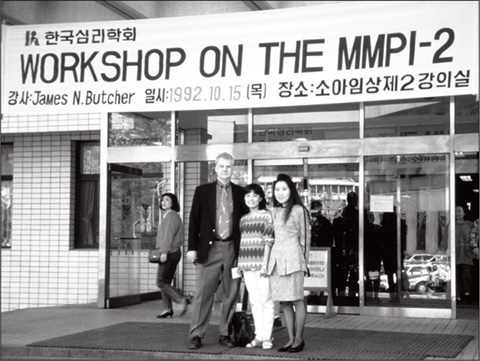
Author Jim Butcher posing with colleagues Kyunghee Han (center) and Jee Young Lim (right) at the Korean Psychological Association’s conference, Seoul, Korea, 1992. The banner reads: “We welcome Professor James N. Butcher, a great scholar of the MMPI-2.”
Other people I met on the streets were equally grateful. This happened even while shopping for souvenirs in the Myong-dong district of Seoul. As I was about to purchase a small trinket, a polite, elderly shopkeeper asked, “Have you been to Korea before?” I said, “Yes, in 1952 and 1953.” He began to smile and nod his head. At the same time a saleswoman in the store, overhearing the comment, came up to me and said, “Thank you! Thank you very much for saving our country!” They would not accept payment for the souvenir I selected. Not only that, but the shopkeeper hurried back to a storeroom, returning with a little package. “Thank you very, very much,” he said as he handed me the present. “We owe a great deal to Americans for what you did for our country. Please have this gift in appreciation.”
Despite my misgivings about the trip, I had hoped to return to the Demilitarized Zone to see some of the places where I fought. One of my Korean graduate students contacted the Korean Veterans Association in Seoul (KVA-Seoul) to see if a tour of the DMZ was possible. At that time, tours were not allowed. However, I was invited to their offices to meet the staff of this veteran’s group. My two students and I showed up at their office forty years to the day of the assault on Jane Russell Hill.
Retired Lt. Colonel Dong Koo Lee greeted us at the door. He treated me like an old friend. We talked about my unit and the places that I had served during the war. Colonel Lee explained that after the Korean War ended a group of the ROK veterans formed the Korean Veterans Association. They helped ROK veterans gain employment and provided advocacy for their needs. In 1975, on the 25th anniversary of the outbreak of the Korean War, they developed the KVA-Seoul Revisit Program as a way to express the gratitude of the Korean government for the veterans from all nations who served under the U.N. flag during June 25, 1950 to October 15, 1954.
In 1992, I had no expectations for what would follow this conversation with Colonel Lee at the KVA office. To my amazement, it was an award ceremony complete with an official proclamation:
It is a great honor and pleasure to express the everlasting gratitude of the Republic of Korea and our people for the service you and your countrymen have performed in restoring and preserving our freedom and independence.
We cherish in our hearts the memory of your boundless sacrifices in helping us re-establish our Free Nation.
In grateful recognition of your dedicated contributions, it is my privilege to proclaim you an “Ambassador for Peace” with every good wish of the people of the Republic of Korea. Let each of us reaffirm our mutual respect and friendship that they may endure for generations to come.
***
My wife Carolyn and I participated in the KVA-Seoul 50th Anniversary Revisit Program on July 24-27, 2003. We were there with 1,500 veterans from twenty-one different countries. During this visit, Carolyn and I were able to go to the DMZ. We attended the Armistice Signing Commemoration in the Joint Security Area. There were also numerous other ceremonies and tours, including a memorial service at the National Cemetery, a USO dinner where we met veterans from countries (particularly Belgium and Australia), and a World Peace Day Ceremony at the Korean War Memorial.
WERE THE SACRIFICES MADE OFFSET BY THE ACCOMPLISHMENTS?
The Korea I encountered on my return visits was vastly different than the one I left in the 1950s. Both North and South Korea were devastated by the war, but South Korea recovered to become a thriving democracy and North Korea remains under dictatorship and extreme economic hardships. It was heartwarming to see on my return visits how South Korea was able to rebuild and have such gratefulness for the American contributions to its freedom. It validated my beliefs:
• We won!
• The United Nations did not lose the war in Korea!
• The Korean War did not end in stalemate!
• We halted communist aggression!
• We dispelled the invading enemy!
• American soldier’s lives were not wasted in a lost war!
• We won!
In some ways my return visits to Korea were like the celebrations held for the returning World War II GIs that made such a mark on me in childhood, albeit forty to fifty years after the fact. It was most gratifying to meet so many people in South Korea who shared my views. They provided some closure, but not enough. I still needed to finish this book and its last chapter.
One of the questions weighing on my mind is whether the Korean War was worth the cost in human lives and suffering wrought during the three-year conflict. The United Nations suffered around 37, 895 deaths. Of these, the United States had 33,686 combat deaths and an additional 2,830 other deaths. The United States lost 8,144 missing in action. The Republic of Korea Army reported over 47,000 dead (Bruce, 1993; Highsmith & Landphair, 1995; Langley, 1979; MacDonald, 1986). Accounts of North Korean and Chinese deaths are not as precise. Estimates suggest that over a million and a half were killed and captured during the war. According to MacDonald (1986), North Korea may have lost 12% to 15% of its population to the war. He also estimates that 25,000 Chinese were killed in the last month of the war alone as a result of extensive and costly offensives against American and ROK forces.
When I read accounts that suggest the outcome of the Korean War was other than a clear-cut victory, I have a visceral, negative reaction. I lose objectivity—such accounts mean to me that the tens of thousand who died did so for nothing. I cannot consider the Korean War as a “lost war” or even a “tie.” If I did, I would be overwhelmed with bitterness. The United Nations forces won the major battles described in this book. The hills were taken, retaken, and eventually held under the rules of engagement that were imposed on us. Subsequent decisions by politicians and diplomats to give up territory we fought so hard to win, as what happened with Pork Chop Hill, are hard to accept given the massive losses in those battles. However, with the battles won, Truman’s goals of stopping the communist take-over of South Korea, and preventing World War III, were accomplished. I think in my mind that will always be a win.
In early drafts of this chapter, I found myself writing a defense of my long held beliefs, and admonishing historians, political scientists, or others who wrote to the contrary. I felt that anyone who did not categorically recognize our victory in the Korean War demeaned the men whose lives were lost. These men deserved a better accounting and I would provide it! My beliefs provided me with a way of surmounting all the frozen fingers and toes, all the shivering nights in trenches, all the anxious moments on countless patrols, all the terror felt as artillery shells pounded our ranks, and all those buddies lost. They served as a wall of defense, protecting me from painful memories.
My wall of defense still exists, as this chapter attests. Nevertheless, I am trying to accept that my viewpoints do not trump those of others just because I was there. My wife Carolyn helped me with the painstaking process of gaining some perspective. We talked about our 2003 visit to South Korea. The tributes were deeply moving to both of us. Like me, she saw the appreciation of so many South Korean people for the American contributions during the 1950s and later. Still, amidst all the celebrations, Carolyn recalls seeing small groups of South Korean protestors kept at a distance from us by police. I have no recollection of seeing them, another sign of a lack of objectivity that colors my observations about Korea.
Gradually I’m coming to the realization that my vantage point has been stuck in the trenches with the hellish experiences I had there. Through the process of writing this book, I am now able to consider some troubling repercussions of that war. Although South Korea grew into a thriving economic force over the last sixty years, the Korean peninsula remains divided. The Korean War did not end with the signing of a peace treaty, but a truce. Almost 30,000 U.S. military personnel remain in South Korea. The war could resume with devastating consequences for the two Koreas, the region, and the rest of the world.
Some South Koreans see the ongoing presence of American troops in their country as negative, and forget the accomplishments of the 1950s. Moreover, the U.S. military’s complicity in the coercion of “comfort women” over many years is a legacy that contributes to anti-American sentiments in the region. Continuing historical and political analyses of the Korean War and its aftermath are necessary. Some are likely to differ from my conclusions about the accomplishment made and be more critical of the war effort. I recognize that I need to be more willing to listen and learn from them.
I left Korea in better shape that many of my buddies. I was alive. My hearing loss from a shell explosion and the shrapnel wounds from the battles on Jane Russell and Pork Chop seem so superficial compared to the battle scars of others. The nine months in Korea shaped who I am. Not even out of my teenage years, I learned how to work with others as a leader, developed a deep appreciation for other cultures, and learned to keep focused on important goals. The GI bill allowed me to use those qualities to build a successful academic career. After all these years of thinking about writing this book, I’m finally done. I have overcome my silence about the war and its life-altering experiences. This book is about shared sacrifices and accomplishments, as well as personal reflections. Many questions about that distant war will endure beyond the lives of those of us who served in Korea.