
1
WAR IS THE PROVINCE OF THE YOUNG, FOR IT IS in the youth that nations find the necessary impetuousness and careless abandon to pursue their military goals. At perilous times in the history of most civilizations young men are pressed into military service though they might prefer otherwise. Former President Herbert Hoover, in a speech to the Republican National Convention in Chicago in 1944, observed, “Older men declare war. But it is youth who must fight and die. And it is youth who must inherit the tribulation, the sorrow, and the triumphs that are the aftermath of war.” In every era and culture some young men, perhaps buoyed by their youthful feelings of invulnerability, voluntarily reach out for such experiences. This book is a recounting of the events and circumstances of one who voluntarily and actively pursued a dream of hazardous military service.
Why would a young person willingly and knowingly volunteer for such things? Why would anyone actively seek to experience the horrors of war when other options might be available to them? The answers to this question are likely complex and probably reside in the early life experiences of such volunteers. Clauswitz, the noted 19th Century Prussian military strategist, considered war to be “continuation of policy” and thereby provided insight into the reasons nations seek warlike aims. But what of individuals? National policies are made by the elders—the politicians and diplomats—but it is youth who bear the brunt, make the personal sacrifices, and reap the personal tragedies of those policies. It is also quite likely that these circumstances underlying volunteerism, in part, results from the youth of society being shaped to think a particular way, by being formed by society to accept those motives as their own.
My life circumstances that lead me to join the Army and seek combat provide a context for what is described in the later chapters. The place where I was born and grew up, West Virginia during the 1930s, was harsh and depressing, at least from the perspective of coal mining families like mine. My father, being a coal miner, appeared to have relatively few options in life and possessed very little in the way of resources with which to deal with the harsh circumstances that the day-to-day living offered in those times during the Great Depression. With only a second grade education there was no such thing as upward mobility—only downward—down into the coal mines—an occupation that took his life at a very early age.
Life was very difficult as well as highly dangerous for the coal miner. The violent coal mining strikes of the 1930s “harshened” further the already bleak existence that coal mining families like ours experienced. Most miners were paid very low wages for their hazardous and backbreaking work and many with large families were forced to purchase the necessities of life from the stores owned by the coal mining company. Interestingly, coal miners were often not paid in American money but in mining company script; it was good only for purchase of goods in the company store. Needless to say that coal-mining families often became fully dependent upon the coal company, and as the amount of money they owed to the company mounted many families found themselves stuck in the mining towns. Tennessee Ernie Ford’s popular ballad of the ‘50s about the lives of coal miners rang true about our family owing their “soul to the company store” and was certainly true about most of the miners in those circumstances.
The coal mining strikes of the 1930s were vicious and unsettling events in the lives of these families. Some of my earliest childhood memories centered around the long picket lines of rough and rowdy miners with their pick axes and shovels walking and rousting about the picket lines. I also remember the meager food parcels that were doled out by the Miners Union once a month to tide the miners until the strike ended. Food baskets containing the necessary staples for living were provided by the miner’s strike fund and were meager indeed—with dried apricots, rice, some fat meat, flower, corn meal, and potatoes. When I was a small child my father, Glen Butcher, told me that I should never become a coal miner. He said to me one night, “This coal mining is a bad life!”
It was equally difficult for women. Georgia Neal Butcher, my mother, was only thirteen years old when she married my dad (he was seventeen.) My memory is that she left school after the 4th grade. The men in her family also worked in the coal mines, as well as in the lumber industry. My oldest surviving sister, Gloria Brannon, was born when my mom was sixteen years old. She had two other children before Gloria. A daughter, disabled at birth, died at two and a half years and another died within days of his birth. By age twenty-two, she had me, her fifth child, and two more followed me.
My mother’s days were consumed with laborious tasks: childcare, cooking, cleaning, and gardening. We had no running water in the house. Coal mining is a dirty occupation and the company did not provide showers for men at the end of their shifts. Every day my mother would drag a large tin tub into the living room, draw water from the well, heat it on the stove, and carry it to the living room for my father’s return from work. The stove was coal burning and required wood and coal to be carried into the house.
One Sunday afternoon, I had just turned eight, the daily routine of our town, Winifrede, West Virginia, was shaken by the announcement on the radio that America was at war—the Japanese had bombed Pearl Harbor. Almost everyone who was alive at the time remembers what they were doing when the heard the news flash. It was one of those vivid shared memories that accompany tragedies of that magnitude, like the Kennedy assassination or the terrorist attacks on 9/11. My brother Jerry and I were playing with our toy cars on the back porch. The rest of the family was listening to the radio. I remember hearing yelling about “the Japs” and being “bombed.” Everybody gathered near the company store and talked about what would happen next. My dad, like many of the other men, wanted to join the Army right away. However, when he tried to enlist, he was deferred because of his large family and his essential occupation—the country needed coal to operate its steel mills.
****
One day, not long after the Second World War began (January, 1942), as I was returning from school, the little town was again alerted by the mournful whistle of the mining company’s siren signaling—this time there was a serious problem at the coal mine. As I ran down the dusty road away from the school I encountered my Uncle Bub (Delbert Butcher, my father’s younger brother) who also worked in the mine. He told me to go home because there had been a terrible accident and that my father was badly hurt and was being taken to the hospital. Later, I learned that my dad had died as he lay in the hallway of Charleston General Hospital. For some reason that I was not told about he was not admitted into the hospital for treatment.
A few months later we left the mining town and moved to Charleston, the capital city of West Virginia, which was about thirty miles away, because my mother could get work in one of the growing number of war production plants in the area. This enabled her to supplement the less than adequate work compensation payments. We received a total of $36.00 per month for the family plus $18.00 per month for each minor child. There were five children at the time. My mother and the five of us moved into a three-room house on the Westside of Charleston and she began working in a glass plant that produced military materials. Consequently, due to the “around the clock” production schedules of the plant, she could work as much overtime as she could handle, enabling her to make a down payment on a small house.
The house we lived in wasn’t much of a structure; it was quite old and in a general state of disrepair. We always worried about it being somewhat of a fire trap, but this house was actually a cut above the homes in which we lived in the coal company towns where my dad had worked at Bergoo, Clifftop, or Winifrede. The little house had one bedroom, where my mother slept, and a living room where my two sisters slept. There was a small glassed-in sun porch on the side that served as a bedroom for the three boys. The room was at first unheated, and then we were able to get a small natural gas stove that provided some warmth in the winter. For a long time there was a broken pane of glass that allowed cold air to creep into the room.
I was in the second grade when we moved to Charleston. The living situation in the city was different—we actually had an indoor bathroom! I liked living in town better and I enjoyed the lower grade school (Littlepage) I attended near home. I liked the teachers and the school had several rooms, unlike the two-room school that I attended at Winifrede, where one room held grades one through three and the other held grades four through six. The war intruded into our lives when we learned an uncle, Jay Tilley, was killed at Cherbourg, France in 1944 leaving a widow and several children.
When I was in the 5th grade my mother became quite ill. We thought it was the flu, but it did not clear up. Her doctor began a treatment for pleurisy that involved putting a very tight binding around her chest. This caused a great deal of pain. After a few days of this misery she went to see the doctor to have the binding removed. Shortly after he removed the binding, while she was still in the doctor’s waiting room, she had a massive coronary and died. She was only thirty-two. My mom did not see the end of WW II and left behind four minor children: Dickie, age seven; Jerry, age nine; me, age eleven; and Joan, age fifteen.
The four of us lived in our house with our older sister Gloria, who was eighteen years old. Our grief was overwhelming and we lived in the almost constant fear that we would end up in an orphanage. Within a few months of our mother’s death, Gloria married a recently discharged Navy sailor, Russell Chandler. They lived with us for a few months, but our house proved to be too small and the arguments too loud, so they left. We were four children living alone. Although we were underage we were determined to continue our lives as we had been living. We did not want to be separated. My fifteen-year-old sister Joan was a very determined person and provided the glue to make this arrangement work. We prepared our own meals, got ourselves off to school, paid the bills (when we could), and tended to our own business.
The fact that we were without adult supervision did not mean that my sister, my two brothers, and I lived as feral children such as the Wild Boy of Avignon—not be any means. We tried to maintain a home life of sorts: we went to school, stayed at home most nights, maintained reasonable hours (every one of our friends had to go in at night so we didn’t have any one to play with), and cooked our own meals—and did everything we could to avoid being separated as a family. We were well aware that if we failed at these tasks or called attention to our unusual situation we might wind up living in an orphanage, which to us was unacceptable. We formed a very close unit; it was us against the rest of the world.
Growing up without parents or any adults in our home was filled with many uncertainties and voids. There were times when we felt isolated from society and alone. It would have been valuable to have some adult advice and perspective. It would have been comforting to have a parent’s touch in times of troubles or uncertainty, not to mention having help with creature comforts. There were many nights that we went to bed with empty stomachs and more nights in which we went to bed with an emptiness in our souls. Although children living alone can do a lot to support each other, there are many things that they cannot do.
In some respects, however, we fared pretty well. The closest thing to adult supervision that my brothers and I ever had was our older sister, Joan, who tried to provide guidance; but she asserted little in the way of control over our activities, especially as we grew older and she had her own worries to contend with. We had a guardian, my Uncle Mark, who was a bachelor and had his own life to lead. His duties as guardian were few and he was seldom bothered because we wanted to be left alone.
At first we needed Mark just to sign papers but when we learned to reproduce his signature, for example, to sign our report cards, we didn’t need to call on him at all. (I can still do a pretty good job of signing his name even after all of these years). Mark lived a few miles away and we rarely saw him, although he was handy a few times that we needed to thaw our pipes when they froze. In a pinch we could get a bit of advice from our maternal grandmother who lived a few miles away (with Mark). She was in poor health (diabetes) and could not provide much help except occasionally taking my baby brother Dickie in for a meal and a bit of temporary company.
The absence of adult role models was not something that we were particularly concerned about. We thought we were getting along just fine without them. An interested outsider, if there had been such a person, would likely have disputed this. Our deportment suffered somewhat from not having a proper model to follow. We didn’t always have clean clothes to wear or particularly good table manners, but we pretty much avoided major problems.
We did have some “adult” influence, however, because we went to every movie that we could. Movie characters were the people from whom we learned adult roles and adult behavior. There were times that we spent the entire day on Saturday and Sunday in the movies watching and re-watching whatever was playing; these were most often western movies with Gene Autry and Roy Rogers, and we especially liked the war movies that appeared to be plentiful at the time. I think the times we “imitated” movie characters, such as the Three Stooges, our behavior problems might have been more evident.
The movies were essentially free for us. Jerry and I would usually take an extra job of passing out fliers, show bills as they were called, in return for free passes. If we had one free pass my brothers and I could get everyone into the show quite easily. We soon got to know the people that took up tickets who might let us pass through the line. Or, if that did not work, then one of us would go into the theater on a pass and then, in a few minutes, open the fire exit to let the others, including friends, inside. We watched movies and ate popcorn and candy for lunch and supper. It never bothered us that sometimes when we left the theater we had splitting headaches. Movies were a great escape for us; and besides, we had nothing else to do with our time. I remember one time that we simply stayed all night in the theater after the last show played and hung out until the next morning when we went home.
Some Sundays, when we were short of money, we had a way of getting a little change. The three of us would go to Sunday school at a small church near home. At the end of the lesson the teacher would draw names from a hat and the winner would get a quarter. Since there was only one other boy in the class and we were three we had pretty good odds of winning the quarter. We would take our quarter and go to a local drug store where there was a pinball machine. Getting five nickels change we would use one nickel in the pinball game and spend the rest on treats. One nickel usually sufficed for the pinball because we were pretty adept (my brother Jerry being most facile) at putting our toes under the front legs of the pinball machine to slow down the ball so that we had better control over it. We were able to run up a lot of games. When we tired of playing the pinball machine we would sell the remaining games at a discount to anyone who was interested and we’d wind up with a few extra quarters to spend. We managed to have fun and earn a little extra cash in the process.
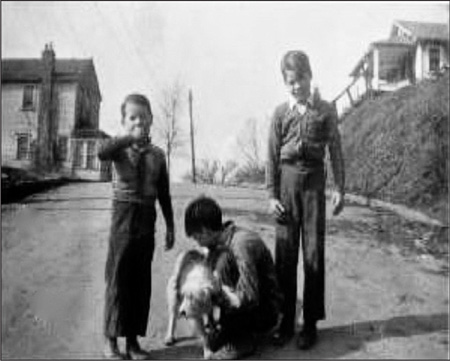
(Left to right): Dickie, Jim (the author), and Jerry playing with “Butchie” the dog in Charleston, West Virginia.
We also devised another way to have some extra coins to play the pinball games. One day we found a few broken records in a garbage can at a store. The records were made of a plastic-like substance (wax) that was quite shapeable. We broke the records into smaller pieces and sat on the pavement rubbing them to the size and shape of various coins. Not realizing, or at least not caring, that what we were doing was actually illegal counterfeiting, we found that these slugs worked well for a while. Our little project ended not too long afterwards, however, when the machine owners realized what they were getting and fixed the machines not to accept slugs. By then, however, we were on to other things.
The four of us stuck together quite closely in order to maintain a family. We really asked nothing of anyone and kept a pretty low profile. This living situation may be very difficult for anyone to comprehend from today’s perspective. How could the social system allow four minor children to live alone, essentially by their own wits, without adult guidance? Without some welfare assistance? Perhaps this situation could not happen today with the social welfare system that we have now; however, in West Virginia in the 1940s there was no such system. What about other family members? One relative or another indicated that they would take one of us (usually my brother Dickie because he was so cute!). But we declined their offers, choosing instead to try to make it on our own.
There were times when we had no food in the house—particularly towards the end of the month before the paltry compensation checks arrived at the first of the following month. This was the only money we had coming in on a regular basis after my mother’s death—the small, monthly miner compensation checks. So, it became necessary for me, and later my brother, to obtain paper routes to provide additional money for the family; usually we needed all the money we could earn delivering papers just to buy food. When I was eleven years old (in the winter of 1945) I went to talk with the station manager of the Charleston Gazette about the possibility of taking over a paper route that I had heard from one of the other boys was vacant. The manager seemed very sympathetic toward my home situation and my need to earn money but had some genuine concerns as to whether I was going to be big and strong enough to carry a heavy load of newspapers and whether or not I could learn the route so he gave me a test. He put a load of newspapers in a sack and told me to pick it up and carry it up the hill (Charleston is a very hilly city and it always seemed that we were going up rather than down hills!). Then he showed me the houses on several streets that subscribed to the Gazette. After a while we stopped and he backtracked with me to see if I could remember the correct houses. When we were through he told me that I had the job and could start tomorrow.
I worked at carrying papers for the remainder of my school years and for the last few years I was given the job (along with my friend Bob Baker) of assistant manager for the sub-station. We opened up early in the morning, counted out the papers necessary for each of the routes, and supervised the other boys. If they failed to show we needed to handle their routes. Bob and I split the salary for this job. This income was direly needed when we were growing up and although it was insufficient for some things we needed, at times it enabled us have food and some clothing (not the most fashionable) for school.
Most of the time my sister and I discouraged any assistance from other family members such as aunts and uncles. That is, we refused what we saw as “charity” and wouldn’t have anything to do with it. The Christmas of 1946 stands out as a good example of the closed and resistant attitude we developed toward receiving help from family. Two of my aunts visited our house a day or so before Christmas one year and brought with them some food for us. My brother Dickie, being too young to be defiantly proud, as Joan and I were developing to be, was quite excited, especially about the pies they brought. Joan and I refused to have anything to do with them and after they left we refused to eat the pies! As much as I try to figure why Joan and I took this stance with respect to gifts from the rest of the family I can only say that it likely had something to do with my sister’s refusal to accept anything because they did not initially offer to help us in our plight. It was a matter of defiant pride. I was really too young at the time to understand much about the source of Joan’s negative attitudes toward some of our aunts and uncles. I only knew that it was imperative for me to back up Joan to maintain the integrity of our foursome. I knew that I could not accept those pies—though even as I think of it today they sure looked delicious!
My brother Jerry and I wanted to make Christmas 1946 a good experience for Dickie, who still believed in Santa Claus at the time. We bought him a couple of presents although there wasn’t much money to go around, even for necessities. After we had the little tree up in the living room (my sister was now sleeping in our mom’s room and we had the front room as a family room) Dickie was very excited about Santa coming and wanted to stay up and wait for him. We did not think this would be a good idea so we talked him into watching Santa from a hole we drilled through our porch room door looking into the front room. On seeing this peephole Dickie wasn’t totally convinced about it because he realized that Jerry and I would not be able to see Santa. So, he insisted that we drill two more holes in the door; though it was a bit silly now as I look back, we did so just to keep up the ruse. Had we had an adult living in the home I am sure that we couldn’t have gotten by with such property defacement. These three holes in the door, each at a different height, stayed there until we all eventually moved from the house.
Jerry and I also realized that we had to have some kind of presents to open ourselves to continue the “Santa deception” so we purchased a cheap paper airplane model so that every one would have something to open on Christmas morning when Santa finally came. To this day, when my brother Jerry and I have our annual conversation over the holidays, we always inquire as to whether the other has his “Christmas holes” drilled yet.
****
Despite our life circumstances, or perhaps because of them, my brothers and I found some escape from our cares by retreating to the woods north of our house. We went there whenever we could and sometimes we would actually skip school to build our hideout in the woods. We learned a lot about taking care of ourselves and living on our own in nature—woods skills, stealth, and avoidance of unpleasant things in the outside world. On some occasions, when rumor had it that we were going to be placed in an orphanage (Witherow’s Home for Youth), we hid out in the woods until the threat blew over. No one could ever find us if we did not want to be found! The truth is that no social agency was ever involved or interested in our case. We basically sailed through our adolescent years without much pressure from the outside.
Early social and material deprivation can have a wide range of effects on children, usually negative. There were many times in our youth that we did not even have the basic necessities of life. How did these emotional and material deficits affect our development? In the case of our small family I think the answer would be that the lack of support and the lack of resources that we experienced as children was not entirely negative—at least insofar as generating a powerful motivation to succeed in life. We were very painfully aware, most of the time, the differences between the “haves and have-nots” in our society and we were determined that we would have a better life when we were older. We lived with the belief that we had to simply survive and bide our time. The future had to be better!
During these times we had a loyal and constant four-legged companion—a wonderful mongrel dog we called “Butchie.” She tagged along with us everywhere we went (even waited for us outside school at times). She unconditionally loved us even when we had no food to share with her; she loved us whenever the world seemed to have forgotten us. Butchie followed us everywhere and ate whatever we had to eat that day, and of course some things we wouldn’t. Sometimes the meals were pretty grim but she never complained. Her favorite treat to share was an RC (Royal Crown) Cola and Moon Pie, which we managed occasionally even when we were low on cash.
One of the darkest days of my life up to that point came when one of our neighbors, who we disliked forever after that, called the dogcatcher on Butchie when we were at school. This was a terrible blow to us because she meant so much to us. We did not, of course, have the money to retrieve her and we felt horrible that we could not help her because she had been so loyal to us. My brothers and I cried through the evening when we found out that the dog-catcher had “disposed” of her. This was a pretty bad thing to do to us and we did not have much to do with those neighbors after that.
****
It was difficult for us to know what to do when one of us was sick. Even a minor cold or the flu, without a parent to guide one through the miseries, could produce great anxiety and our imaginations might run wild as to what the illness meant. We had a group fear of illness, largely induced by the fact that we had been conditioned to expect the worse. Death was a common event in our family—both parents and an older brother and sister had died earlier. These were anxious times with only ourselves to turn to.
One day when I was about thirteen, my sister Joan became quite ill with stomach cramps and had to go to the hospital. She had to have her appendix removed. My brothers and I were quite upset over this situation because the health care system did not have a very good track record with our family so far.
Joan was in the hospital for several days and the other boys and I were on our own but we took pride in being able to handle the situation without help from others. In addition to carrying my paper route in the morning, I took on Joan’s usual task of preparing meals for my younger brothers. I took this responsibility very seriously and made sure that we all ate three square meals every day. I developed a plan for providing the meals that we needed yet also included saving some money at the same time. So, I cooked the same thing for lunch and dinner—macaroni and cheese—even though my brothers complained about the sameness of it all.
When my sister got out of the hospital she was concerned that we had not been taking proper care of ourselves. (She was excellent in home economics at school and actually won an award in high school for food preparation). I proudly told her that we had eaten well and that I saved some money from our reserve as well (I had spent less than $1.40 of our food money for the week). She was curious about how I had done that and was shocked that I had fed the family so well on so little. She asked what we had prepared for meals. When I told her that we had macaroni every day she almost laughed and cried herself back into the hospital. I didn’t realize what was so funny to her at the time, I only felt proud that I had gotten by with such a savings.
FOR THE RECORD: A SLIP IN JUDGMENT
Even without adults to provide guidance to our daily living we walked a pretty narrow path and usually avoided major problems; Joan’s influence on us was powerful and all she had to say was, “Don’t get into trouble,” and we knew to steer clear of mischief. For the most part we heeded her words and stayed away from the darker side of the street. We did not take up habits such as swearing or smoking cigarettes or drinking alcohol that seemed to be practiced by some others our age. We made a great deal of effort not to call attention to ourselves and tried to do what “the good kids” in the community did—we went to school, did what odd jobs we could. Our rule was “No problems, no orphanage!”
This rule got side tracked early one dark Sunday morning when I was fourteen. One morning, after we delivered ours papers, my brother Jerry, Gordon Bostick, and I were hanging out with nothing to do on the corner near where our routes intersected. Gordon had just discovered that a certain type of cap that fits over the air valves on tires had a particularly interesting function—if reversed, it actually let the air out of tires rather than inflate them. We were marveling over this finding when our problem started. Gordon thought that it would be good (and just) to let the air out of one of the tires on the car belonging to a man on his paper route who had cheated him out of money. We went along and helped out—revenge was certainly sweet at the time. It felt good to remedy the wrong in this way. We had a brief, momentary sense of doing something worthwhile.
Then I thought of someone on my route that had failed to pay their paper bill also so we remedied that great injustice as well. Then we got into the swing of the moment and thought of other people who might have caused us problems (like the ones that called the dog catcher) or that we thought were grouchy to kids in the neighborhood. We pretty well settled every score there was to settle at just about the time that the police car wheeled up and scooped us into custody. Charged as delinquents, we were pretty sure they were going to throw the book at us because we were caught in the act.
One of the most troublesome aspects of the situation was that questions were being raised by the judge about our ability to take care of ourselves. When our day in court came we did not know what to expect and we feared the worst—that we would be sent to Pat Witherow’s home for the wayward. But our guardian, Uncle Mark, came to the rescue and went to the juvenile court with us. We were uncertain at first as to whether Mark was going to make the court appearance. He did not take well to such duties and it did require that he take time away from this favorite activity—shooting pool at the Smokehouse Pool Hall on Washington Street. His appearance in court on our behalf gave the judge the clear impression that we did have adult supervision and that we had just made a slight deviation from our customarily good path in life. Mark assured the judge that we would be punished for our transgressions when he got us home. The judge gave us probation.
Mark told us to go home and wait for him. Jerry and I, thinking that we were going to be punished severely, of course headed for our woods hangout where we were sure no one would find us. We hid there for many hours in spite of being hungry and thirsty. After some time, Dickie brought us some bread and a bit of good news; we were told we could come home because Mark wasn’t going to punish us.
FAILURES IN THE SCHOOL SYSTEM
By agreement among ourselves (mostly to keep the authorities from getting interested in us) we usually went to school. The school that I attended in the 6th grade (Tiskelwah) was not a very pleasant or supportive place nor were the teachers at all understanding of our living circumstances. Admittedly, I probably was not a particularly well functioning student academically. I was also usually pretty tired, having to get up at 4:30 A.M. every day to deliver the papers. The unsupportive school environment can be characterized by a couple of circumstances that happened to us—one to me and one to my brother.
The most appalling lack of sensitivity that I experienced at this time was during what was called a Parent-Teacher’s Association or PTA “Drive” when I was in the 6th grade. The school and the teachers were interested in having 100% membership in the PTA chapter and began to pressure the children to register both parents by bringing in .50 cents dues for each parent. Because I did not have any parents at the time I thought I was exempt from the PTA so I did not bring any money in to register.
How wrong I was! Not only did they expect 100% registration but also the teacher actually put the names of the students on the blackboard of those who had not made their contribution. Every time I looked and saw my name on the list I got embarrassed. So, in order to remove my name from the infernal list I took some of my paper route money and went to the teacher and paid for one parent registration. She accepted the money and erased my name from the blackboard.
Years after we grew up and made our way in life my brother Jerry showed me one of his report cards from school that I think gives you the picture of how thoughtless and insensitive the school system was that we attended. Jerry—who managed to do pretty well in life having obtained a couple of Ph.D. degrees and a successful career as a minister—obviously had some talent that went unrecognized by any of his teachers. His grades in school were pretty abysmal though and his report card showed it. But what was most pathetic about his report card was a hostile note scribbled by one of his teachers that said: “Do not release this report card until this student’s shop fees have been paid!” These certainly were not the kind of experiences that promote personal growth and self-confidence.
I would say that there was somewhat of a black cloud over my school experiences during these middle years, but not every day in school was bad. I had a few good moments too. One day our school was engaging in a scrap metal and paper drive in order to help the war effort. We were very enthusiastic about this project and enjoyed doing this—not just to get out of school for a bit but because we felt as though we were doing something worthwhile by going out and picking up junk and old papers that could be used in the war production. One of the brightest moments of my early school days was when I took some of the papers that I had gathered up into the basement of the Tiskelwah School where the papers were collected and I started to read some of the pages of the old newspapers that were stored there.
I found one bundle of papers that had been published in 1887 and I started reading them. I found the topics fascinating and the old pictures intriguing. I found myself reading several of the papers and forgot about the time, returning quite late to the classroom. All through the scolding that I received I kept thinking of how more interesting those old papers were compared to this stupid school routine.
That was not my last trip to the storage basement. Soon afterward I went to school, but instead of going to the classroom, I decided to read newspapers instead—all the way through the lunch hour (I had brought a sandwich to eat) and into the afternoon. Unfortunately, before long all the papers were taken away and I had to return to the regular school program.
A second bright spot in my rather meager early days occurred when I found an intriguing object in a junk yard that I passed on the way home from school—it was an old Army airplane, just sitting there beckoning to be explored. This was shortly after the war ended and a lot of military hardware began to be dismantled and sold as scrap. I was fascinated with this old plane. I had heard a lot about these Army planes on the radio, now here was one right up close! A friend and I planned an adventure and discovered a way inside the fence and climbed up on the airplane wing (it was an T-6 Army Air Corps trainer) and into the cockpit. Even though it was incomplete and damaged, the left aileron was missing and the instrument panel had been mostly cannibalized, to us it was still a warplane! We went back a few more times before the honorable bird disappeared from the junk pile. We were never caught by the junkyard owner who had the reputation of being aggressive in keeping people away from his junk.
You may wonder where a youngster of twelve would acquire such strong interest in the military that I was beginning to develop, but I think the explanation is quite simple. I was taught these values. World War II was a time of total mobilization and many Americans were fully immersed in the war effort. Everything that happened seemed to relate to the war and to a devotion to the objectives of the military. Most families had loved ones in the service and proudly displayed the “stars” in their windows signifying how many men and women were serving in the military from the family. This was a critical period in my development, from ages eight through fourteen, and I think I “imprinted” on this national obsession and societal goal.
It was not simply that I was an impressionable youngster but rather that the whole social order was abuzz with the war effort: the radio, and of course, the newspapers that I delivered constantly presented stories about the war and updates on its. Many of the headlines that as a newsboy I yelled out on the streets of Charleston trying to sell papers related to the war. This included the one announcing VE Day and the end of the war in Europe (incidentally, VE Day, May 8, 1945, was one of the most profitable evenings that I had selling papers—people were paying a dollar or two for a single copy!).
During the war years, even some of our school lessons carried with them a heavy emphasis on the war. Geography lessons even included names of such exotic places such Tarawa, Guadalcanal, Anzio Beach, and many other places where our troops were fighting.
In simple terms I believe that I was taught by society to respect and value the military—through the schools and the media. I have discussed my impressions, if not obsessions, of these early wartime attitudes with other people my age and have found similar feelings—the social context at the time seemed to imbue interest in things military. How could we not value such things? They were of the utmost importance. Even President Roosevelt encouraged us daily to devote ourselves to the military effort!
What a person is or what they become is often set in motion in their early years. I was perhaps more extreme in my identification because I had no other effective adult role models to learn from. To me a military career was a direct route to being accepted or even important.
Throughout junior high and high school my academic interests and experiences ran lukewarm to cold. There was little incentive for us to do well much of the time; so the goal was to pass the classes and get promoted and not to call attention to ourselves.
A DISCOVERY THAT SOME MATH CAN BE USEFUL
Although school was generally pretty bleak for us, there was an occasional discovery that learning could be fun. There was one bright spot in high school—a teacher that made a difference in the way that I thought about something. In the ninth grade I performed pretty miserably with mostly “D’s” and a sprinkling of “C’s” until I encountered a particularly effective teacher, Mr. Thomas Hill, who happened to get my attention. Mr. Hill was a math teacher at Stonewall Jackson High School who also taught a course in aviation navigation. Being interested in flying at the time, I took his class and earned an “A.”
Mr. Hill told me that the stuff that I had learned about navigating an airplane was actually a branch of math called geometry and demonstrated that the procedures we had been using to plot an airplane’s course was simply plane geometry. He encouraged me to take that math class and told me that he thought that I could do well in it. The next semester I took the course in geometry from him and was surprised how much I enjoyed it; there must have been some spill over to other courses because I actually got all “A’s” that term.
Mr. Hill was also involved in the High School branch of the Civil Air Patrol Cadets and invited me to join. This was an outstanding experience in several respects. It was somewhat like the Army in that we wore uniforms and I also learned a lot about aviation. I actually had the opportunity to get a couple of flying lessons and spend some time flying an old Link trainer. Mr. Hill’s classes were certainly the highlight of my high school days. He also showed a personal interest in me and invited me on a few family outings; he had a son that was somewhat younger than I. The problem with the public schools at that time was there were not enough Mr. Hills to go around.
A FALSE START TOWARD A MILITARY CAREER
I couldn’t wait until the time that I could join the Army and be a part of things that were important. Then in 1950, a new war started in a place called Korea and American soldiers were being sent there to stop the aggression of the North Koreans toward the South Koreans. I was not quite seventeen, the minimum age for enlistment (I was actually several months short of it), but I identified with the underdog in the conflict and thought that it was important that Americans stand up for the South Koreans in their troubles. I also saw my opportunity at last to enter the military so I mentally increased my age a bit and went to the recruiting office in the Post Office Building on Capitol St. in Charleston to enlist in the service. I am afraid that my enthusiasm and exuberance must have been showing too much in that I had taken in with me a packed bag—I was ready to go! After a brief and somewhat unsatisfying discussion with the recruiter he informed me that I did not qualify because of my age and that I would have to wait until I was seventeen to volunteer when I could enlist with parental permission (which I knew that I could sign myself if I couldn’t get permission from my guardian.)
I was disappointed by that turn of events. So I waited. By the time I reached seventeen, my last year of high school had begun and I had gained a bit of perspective on life, thanks to Mr. Steadman, the Dean of Students at Stonewall Jackson High School, and Mr. Hill who had encouraged me to stick it out a bit longer, until May, when I would get my high school certificate. I compromised my burning ambition to go in the active duty military with an alternative option that I thought could tide me over until May. On my seventeenth birthday, I joined the 100th Division of the U. S. Army Reserves. I enjoyed playing the part of being a soldier for the six months that I had to wait to go on active duty. Graduation from high school finally happened on May 23, 1951 and my departure for the Army was scheduled for the next day. This time I waited until I had my ticket before I packed my bag. Finally, the day came and I was ready; I even bought a new shirt and pair of pants to wear on the trip to my new life.
AN EMERGING IDENTITY, COMPLIMENTS OF THE U. S. ARMY
I said goodbye to my sister and brothers, and my uncle drove me to the Charleston railway station. My train was scheduled to leave Charleston at 7:00 P.M. on May 24th. A couple of friends from Stonewall Jackson High “Class of ‘51” wanted to come down to the station to see me off but I felt it best that they did not, so I discouraged it. It was an uneventful sendoff; I waited on the station platform looking across the Kanawha River at the bright lights of the city until my train came. Especially visible were the lights from the Pastime Bar on Kanawha Boulevard blinking out its neon welcome to passers by. I was feeling very excited but not particularly sad about leaving; I was anxious to get my life under way.
The Baltimore & Ohio Railway conductor ushered me to what I considered to be very fine sleeping car accommodations that the Army had arranged for my overnight journey to Maryland for my indoctrination. Though quite small, scarcely larger than a railway seat, it was comfortable and, for one who had never been on a train, “top class.” As Charleston disappeared in the evening and the train began its long journey through the winding mountain trail on the way to Maryland, I anticipated what the next phase in my life held for me. I sat in my cabin on the train for a while savoring the novel experience of being on my own and taking a night train to what I considered such an important destination, the beginning of my military career. It felt good to be someone at last—finally to be part of something worthwhile and heading for the Army. Later that evening I walked around the train to get a bite to eat with the meal voucher that the recruiter had provided. I chanced to meet a couple of friendly guys who were about my age, both recent graduates from South Charleston High, and following the same venue that I had chosen. They even planned the eventual path of going into the airborne that I had set for myself. We hit it off right from the beginning. One of them, Gary Baker, and I followed the same course for a quite a while—being eventually assigned to the same Army indoctrination company (the Army does things alphabetically) and we wound up going to the same basic training program at Indiantown Gap, Pennsylvania, getting assigned to the same basic training company, and then eventually going on to Fort Benning, Georgia for Army parachute training in the same jump school company. Our parallel course changed after jump school, however, when we received different permanent duty assignments. This was the first of many brief transitory friendships that characterized military life. We enjoyed sharing each other’s company and some of our new experiences for a time.
When the train pulled into the station in Baltimore we embarked on our new adventure. Our first Army duty involved having to wait a long time to get picked up—a phenomena we would soon become accustomed to because the terms “Army” and “waiting” are almost synonymous. However, at that time we were very impatient. As we waited in the little station town for the Army transportation that would take us to the Ft. Meade replacement center we could hear loud music coming from a juke box across the road playing a very familiar refrain of the day that I will always associate with those times—Rosemary Clooney’s “Come On-A My House.”
Our little band of recruits was finally picked up by a somewhat worn Army truck and we were on our way. We soon passed by a large sign that read “Fort George G. Meade Army Training Processing Center”—we were finally there, a welcome sight. After we dismounted the truck with our small bundles of earthly belongings that represented the world that we had just departed, we were taken to a “holding” barracks for processing.
We were informed by a corporal on duty at the reception center that the recruit processing administration was closed for the long Memorial Day weekend so we were to be given a temporary duty assignment—kitchen duty, better known as kitchen police or just KP—for the weekend.
Thus began our first exposure to the Army. Gary and I were instructed to “fall in” (although we did not know what that meant yet) and we were marched by the corporal to our assignment—a giant, consolidated mess hall. We were still dressed in our civilian clothes because the Army had not yet provided us with military issued clothing. We assumed our new duties, initially with great vigor.
Like some fiendish punishment for an unforgivable crime we were assigned to clean the long accumulation of soot and grease from all of the stoves in the consolidated mess. Ours was indeed an incredible entry into Army life. Or, could this simply be the Army’s way of letting us know that we had passed from one life into another? We spent the entire weekend cleaning out coal and wood burning stoves and grease sumps. By the end of the two days we looked like bedraggled chimney sweeps—covered from head to toe with ashes and feeling muscle aches that only accompany the most grueling marathons.
Undaunted by this somewhat unpredictable aspect of our new home we eagerly awaited our next assignment. We wondered if we should feel fortunate to have been allowed this extra training experience so early in our Army career—perhaps we had already made great strides in becoming soldiers. In addition to learning a bit about how the Army works in our initial exposure in the consolidated mess hall, we also began to learn a little of the language of the Army—those strange sounding expressions that rang in our ears that long weekend: “Ye gawwdamned recruit sombitch!” “Yo’ur lower than snake sheeet!” and other such invectives that oozed through the somewhat chubby, balding mess sergeant’s southern drawl and could be loosely translated as “Fellas, I’m not very happy with your work!” These were terms that would haunt us for many nights during our indoctrination and basic training.
As our unhappy, brief but intense, bout with our first KP ended, the less than benevolent mess sergeant gave us one last bit of information about ourselves as we left to return to our company. He said, “You’ens are more useless than tits on a snake!”
Following my long stint at KP on my first weekend in the Army I was beginning to learn that there were two kinds of minds—the human mind and the Army mind. I realized at the time that I had a lot of work to make the transition to the Army mind—it was not going to be easy!
Gary and I were, however, determined not to allow this unfortunate indoctrination experience diminish our desires to make it. We had committed ourselves to be career solders and we could hardly wait for the next phase of character building given that we had now survived the first one. That Monday we received our whirlwind recruit processing with all the trimmings: another physical, several vaccinations, some lectures about comportment, and what to avoid in town if we were ever lucky enough ever to get a pass, and some new clothes (all brown or olive drab and none of them fitting much). I simply threw away the new civilian clothing that I had purchased for my entry into military life. Somewhat like my initially overly idealized view of the Army, they were in shambles.
We also received what was called “the flying twenty.” This was a $20.00 advance on our pay to allow the recruits to buy the stuff they wanted us to have but were not going to give us, such as shoe polish, Blitz cloth for cleaning brass, shaving gear, and so forth. We were next then herded onto a troop convoy westward toward Pennsylvania and our proper introduction into the Army—to basic training at Indiantown Gap, Pennsylvania.
Indiantown Gap, near Harrisburg, was nestled in the northern Allegheny Mountains—an old Army base that first saw service during the Civil War as a Union Army training base. The camp had also been used as a basic training facility during the First and was re-opened during the Second World War; it had proudly served as a National Guard base in between the wars. A large part of the military base had been closed down during the de-mobilization after World War II in 1946. The camp was reopened again in order to provide hilly terrain to condition troops for the mountainous conditions of Korea. The Blue Mountains of Pennsylvania certainly provided an appropriate match.
When the ragtag group of civilian solder wannabees arrived at Indiantown Gap we were loaded onto other smaller trucks to take us to our assigned company areas. We were assigned to Second Platoon of Company C of the 169th Field Artillery training command company. When we arrived at the company street and off-loaded from the trucks, we were instructed to form into ranks in front of the Company Headquarters. At last we had arrived! We were finally at home in the Army.
Our first official duty in basic training was to take the hammers and crowbars they provided us and remove the boards from the doors and windows to the barracks we were assigned. We entered the dirty barracks, still lined with the cobweb covered steel Army cots from another era. One of the NCOs then held a formation and explained that we were going to have a party to celebrate the beginning of our basic training, but his tone of voice and manner of speech had less than a festive air. We were about to learn what a “GI Party” meant.
The remainder of the day, night, and a portion of the following day were devoted to a general and thorough clean up of our new home. The pushy corporal counted out a certain number of men for each specific detail such as mop detail, broom detail, window washers, bathroom scrapers, painters, and so forth. Many of us were, for the first time, introduced to the infamous Army lye soap that was used for every cleaning purpose. Many hours later we began to feel as though we were making progress on the re-make of the barracks. At one point late in the evening we were marched to the supply center and issued our brown Army blankets and mattresses. In spite of the less than pleasant chores we found ourselves immersed in, some of us recruits, the younger ones, were enjoying the adventure somewhat as one might a summer camp; others in our group it seems were not so enthusiastic.