
Part Six

Before Germany could attack the Low Countries and then France, they first had to invade Denmark and Norway to prevent British and French troops occupying the countries. The Blitzkrieg attacks on Scandinavia were expected to be swift and decisive with the Danish and Norwegian air forces posing little threat. The campaign in Norway however lasted longer than expected and before Norway fell, 260 Luftwaffe aircraft were lost including 86 transport aircraft. The Stuka was a key element of the Blitzkrieg. The wartime caption for this propaganda photo stated, Heroes of the Norwegian campaign receive the Knights Cross. Four Knight’s Cross holders from a Stuka squadron, from left to right, Hauptmann Hozze, Leutnant Mobus, Leutnant Schafer and Feldwebel Grenzel. (IWM HU92194)

Oberst Oskar Dinort, Geschwaderkommodore of Sturzkampfgeschwader 2 ‘Immelmann’, from 15 October 1939 to 15 October 1941. Dinort, a record-breaking glider pilot became the first commander of StG 2. He received his Knight’s Cross (Ritterkreuz) on 20 June 1940 during the campaign in the West. Dinort became the twenty-first recipient but the first Stuka pilot to receive the Oak Leaves to the Knight’s Cross on 14 July 1941. At the war’s end he held the rank of Generalmajor. It was Dinort who suggested the modification to Stuka-carried bombs known as Dinortstabe(Dinort’s rods). 60cm metal rods were welded to the front of the bombs, with an 8cm metal disc on the end of the rod. On hitting the ground the rods caused the bomb to explode 30cm above ground causing much higher casualties among the enemy. (IWM HU24777)
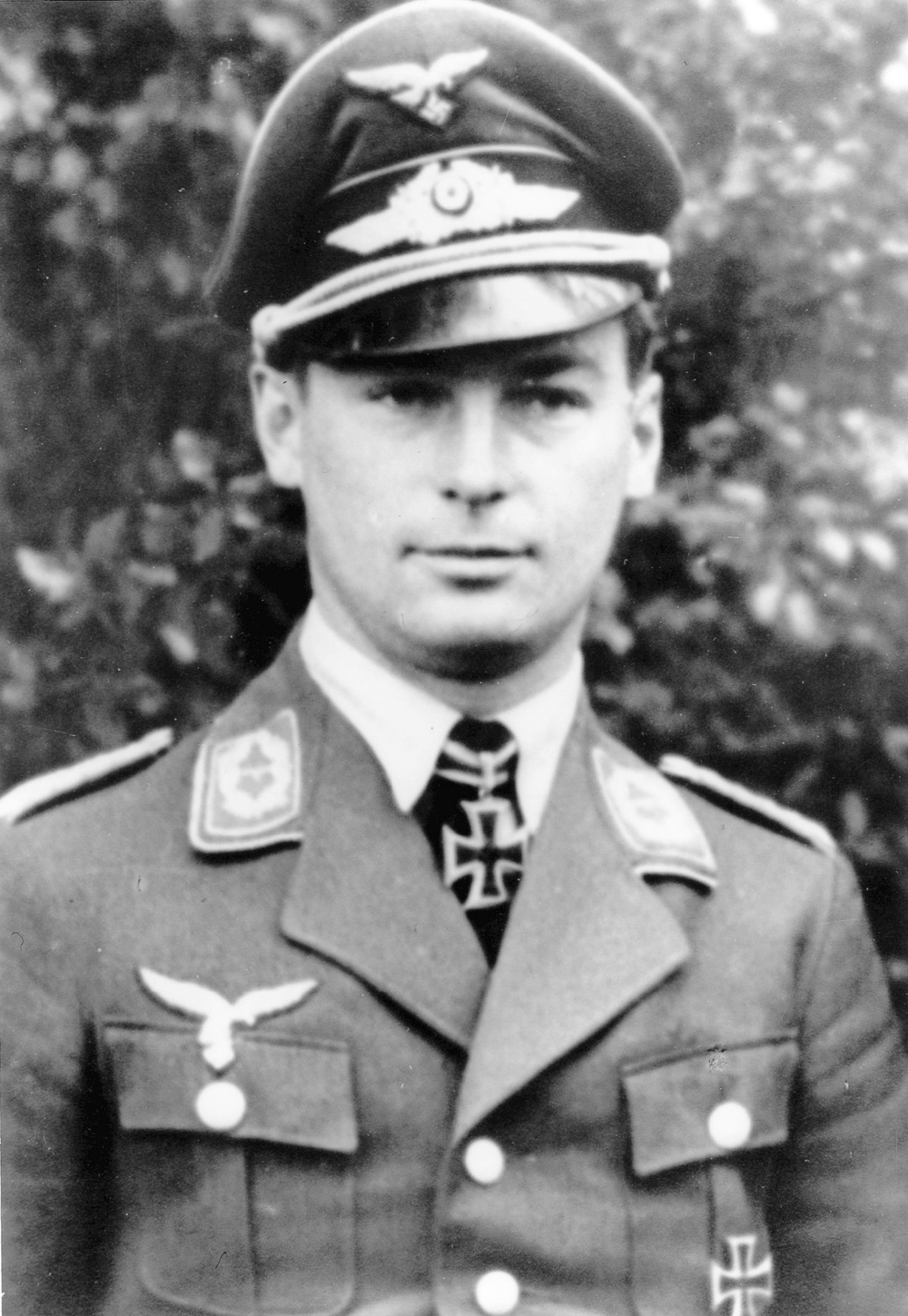
Born in July 1912, Hubertus Hitschold first flew in 1930. After the conclusion of his basic training, Hitschold was posted to the secret training base at Lipetsk in the USSR. He transferred to the Luftwaffe in 1935 and in 1937 began his long association with the Ju87 Stuka. When war broke out in September 1939 Hitschold was in action almost immediately with the Stukas in Poland. On 1 October 1939 he was made Gruppenkommandeur of I/StG1. For his actions during the Blitzkrieg against Belgium, Holland and France, Hitschold, already an Iron Cross holder, was awarded the Knight’s Cross on 21 July 1940. He is pictured here as a Major when he was a Gruppenkommandeur. By the end of the Second World War, Hitschold was a general. (IWM HU24778)
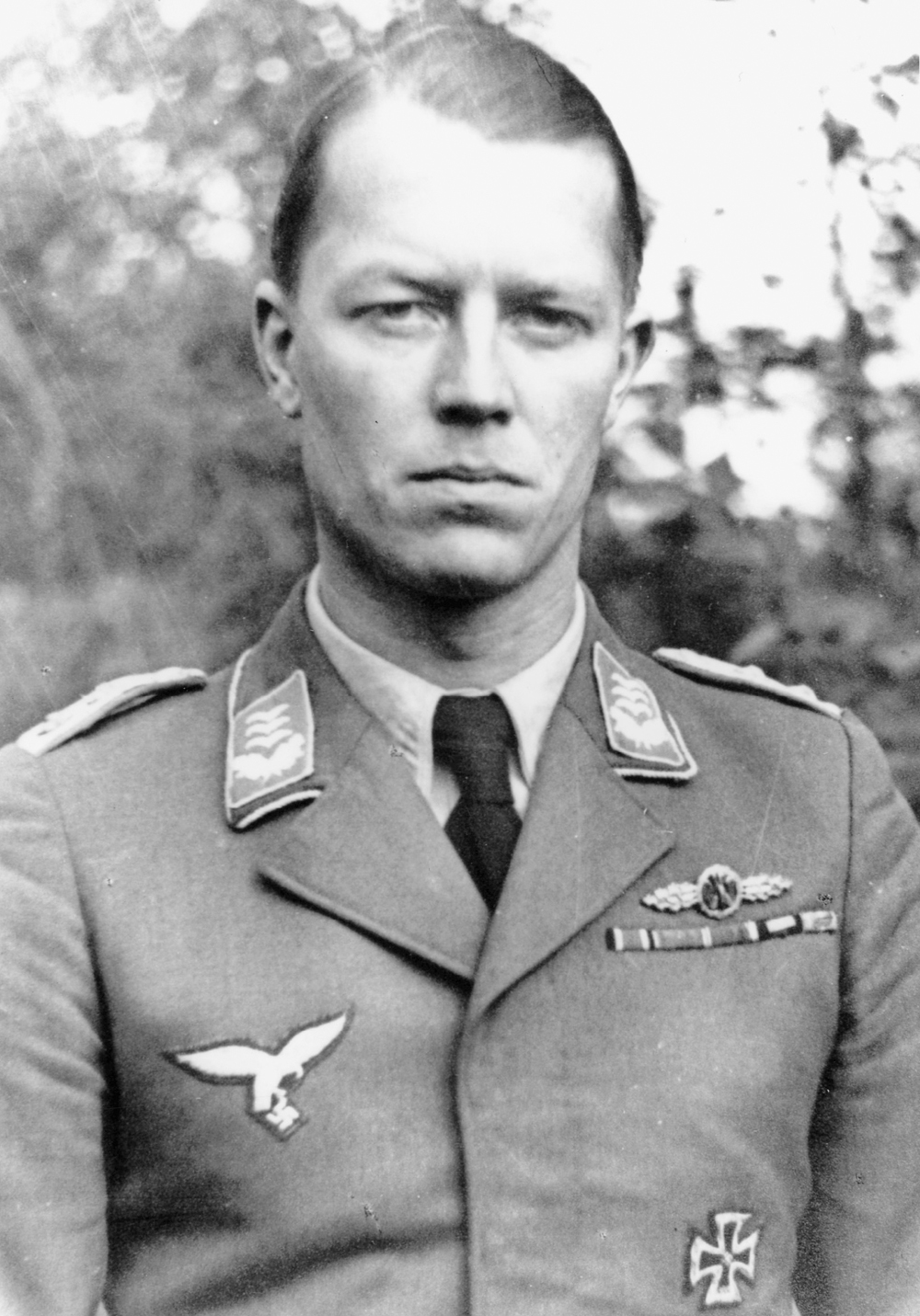
Hauptmann Ernst-Siegfried Steen, Gruppenkommandeur of III/ Stuka2. Steen was killed during the German actions near Stalingrad on 23 September 1941. At this stage in the campaign his unit was based at Tyrkowo and was equipped with the Ju87R. On 17 October he was posthumously awarded the Ritterkreuz or Knights Cross. Steen is seen wearing the Fliegerbluse, a plain, hip-length blue-grey jacket with fly-front and no visible buttons. Note the unusual variation of the Iron Cross 1st Class made of cloth and said to be more practical in the confines of a cramped cockpit. Steen also wears the Air-to-Ground Support operational flying clasp. (IWM HU24779)

Oberleutnant Karl Heinz Lutze (left) and Oberleutnant Werner Lode of Kampfgeschwader 77 at Freux auxiliary airfield in Belgium during the Blitzkrieg, 1940. On 27 September 1940 Lutze’s Ju88A-5 was sent to attack London. At 15:30 the aircraft was brought down by a combination of ground defences and RAF fighters and crashed at Vexour farm, Penshurst near Tonbridge. The aircraft, coded 3Z+DC, was first hit by anti-aircraft fire over London, damaging the starboard engine. Hurricanes of Nos 229 and 249 Squadrons then attacked the aircraft, finally bringing it down. Oberleutnant Lutze, Feldwebel Adler and Feldwebel Zeller were killed in the crash but Unteroffizier Brodbeck baled out and survived to be taken prisoner. Both men wear the one-piece summer lightweight flying suit. While fighter pilots wore two-piece protective clothing over their uniforms, bomber and reconnaissance crew conventionally used one-piece suits. Both men are wearing the highly practical officer-pattern flying cap (Fliegermutze), distinguished by its high quality cloth, the silver aluminium piping around the edge of the curtain, and the wire embroidered badges. (IWM HU22366)

Officers of 2/KG77 at Freux auxiliary airfield, Belgium. Imported Fiat CR.42 biplane fighters were delivered to Belgium, disassembled, in March 1940 still carrying Italian camouflage. When, on 10 May 1940, Nazi Germany launched its assault on the Low Countries, Belgium’s Aéronautique Militaire had received 25 CR.42s. Some of the Belgian defenders were woken at 01:15 in readiness for what was a not totally surprise attack and the gallant Belgian defenders were ordered closer to the German border. At 04:15, as the last fighters were leaving their runway to get nearer the enemy, the Luftwaffe Stukas appeared. With little experience of their new machines, the Belgian pilots did their best to stem the flow of the invaders who thought they were being attacked by Gladiator biplanes and not the Fiat fighters. Before Belgium fell, its air force destroyed or damaged a number of fighters, bombers and transports. (IWM HU22372)
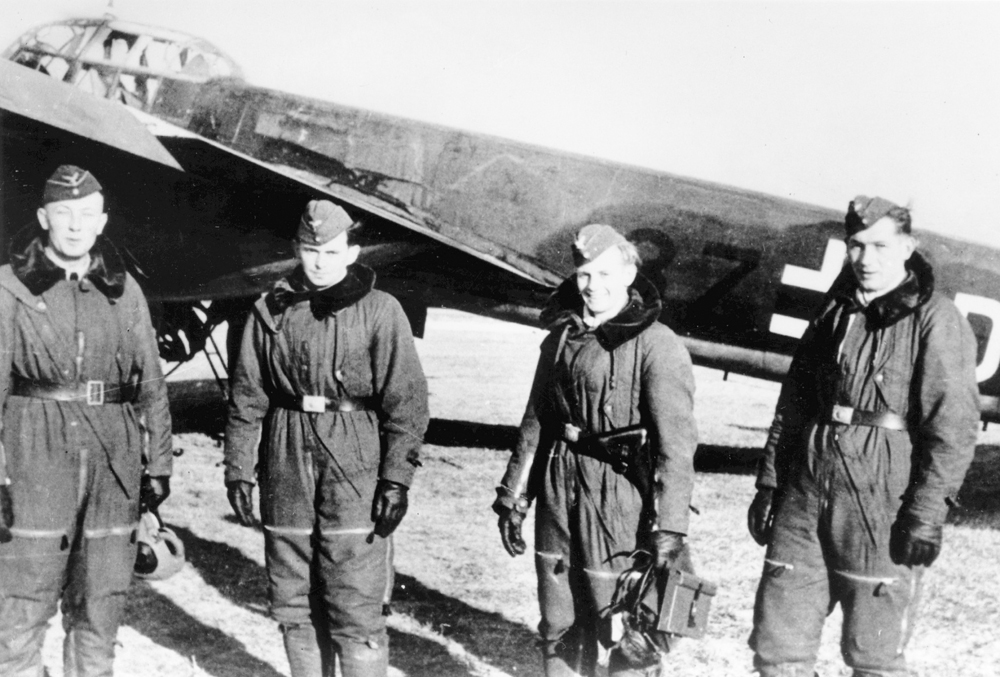
Junkers Ju88 3Z+DM of Kampfgeschwader 77 photographed at Reims, France, in the winter of 1940 41. Within a couple of months this aircraft was shot down near Littlehampton on the south coast of England on 13 March 1941. The crew at the time of the photo are named from left as: Oberleutnant Werner Lode (pilot), Billesfeld (navigator observer), Waraczyneke (radio operator) and Wallner (gunner). The Junkers Ju88, though versatile and the fastest of the principal Luftwaffe bombers was found to have poor defensive armament. Long-winged Ju88A-4s were built with elongated wings to carry heavy bomb loads of up to 3,000kg. The four Luftwaffe aircrew wear the velveteen-collared electrically heated one-piece flying suit (Winterfliegerkombi). (IWM HU23722)

Leutnant Karl Heinz Thurz at the controls of a Heinkel He111H-2, 1940. Thurz’s active duty ceased on 17 January 1941 when his aircraft, damaged by RAF Hurricanes, crashed on Fair Isle. Thurz had lifted his Heinkel from the runway at Oldenburg in Germany at 08:00 to carry out a weather reconnaissance mission to the Faroes. Three hours into the flight the German bomber was attacked by two RAF Hurricanes and suffered serious damage. Having decided to head for safety in Norway, Thurz had to revise his plans when an engine failed and the undercarriage dropped. The Heinkel’s second engine then failed and the pilot aimed for Fair Isle where he managed to crash land. Two of the five crew died in the crash and the survivors were taken to Lerwick Jail. Before being shipped to London for interrogation Thurz was introduced to the two RAF pilots who had shot him down. He was eventually shipped to Canada where he spent the rest of the war in a Prisoner of War camp. Much of Thurz’s aircraft still survives on Fair Isle. (IWM HU23746)


Leutnant Karl-Gottfried Nordmann, of JG 51 who, by the end of war, was credited with 78 victories. As Staffelkapitan of 3/JG77, Nordmann took part in the campaigns in the Netherlands, Belgium and France and, finally, from July 1940, in the Battle of Britain. In 1941 Nordmann was in action over the Eastern Front achieving numerous victories bringing his total to 31 and on 20 July 1941 he became Kommanduer of IV/JG 51. More aerial victories followed swiftly and on 16 September 1941 after downing his 59th foe he was awarded Oak Leaves to his Knights Cross. On 10 April 1942 Nordmann was made Geschwader Kommodore of JG51. In January 1943, by then credited with 78 enemy aircraft, Nordmann was involved in an aerial collision with another JG51 pilot and his injuries forced him to leave front line duties. Nordmann survived the war and emigrated to the US where he died in 1982. (IWM HU37975)

Messerschmitt Bf109E pilots gather during the conquest of Scandinavia, 1940. From left to right; Feldwebel Ernst Arnold, pilot with back to camera – unknown, Leutnant Erwin Axthelm, Feldwebel Heinz Beushausen. The latter was killed over the English Channel on July 20 1940 flying with 3/JG27, shot down by pilots of No 238 Squadron RAF. The German invasion of Norway and Denmark was planned to be so swift and so hard-hitting that only thirty Messerschmitt 109s of JG77 were deployed in case of unexpected enemy fighter activity that could not be dealt with by the twin engine Bf110s. The single seat fighters made their way to the front line from the airfields of Husum to Aalborg and Esbjerg in Denmark before crossing to Kristiansand-Kjevik in southern Norway. (IWM HU38414)

Johannes Naumann was a young pilot with III/JG26 at the beginning of the war and flew during all the Blitzkrieg campaigns of 1939 and 1940, including the Battle of Britain. In March 1944 he was promoted to Kommandeur of II/JG26 and joined JG7 in April 1945. Johannes Naumann flew 450 combat missions, achieved forty-five victories, all in the west, and was awarded the Knight’s Cross in 1944. (IWM HU38418)