
CHAPTER SEVEN
The Bridges Over the River Dives and Divette
Distance between stops by vehicle: 24.8 miles (39.91km)
Total walking distance at stops: 1.7 miles (2.74km)
Recommended time allowed for tour: 5-7 hours
A. DZ/LZ N (South)
This tour starts on the south and towards the eastern side of DZ/LZ N. Alternatively, if you have just completed the previous tour, return to the junction by the factory. Turn left on to the D233 and continue into Ranville. At the crossroads in Ranville with 13 Para Memorial on the wall to your right (see Battleground Europe Book Pegasus Bridge & Horsa Bridge Ch. 7, B13), turn right onto (D37):
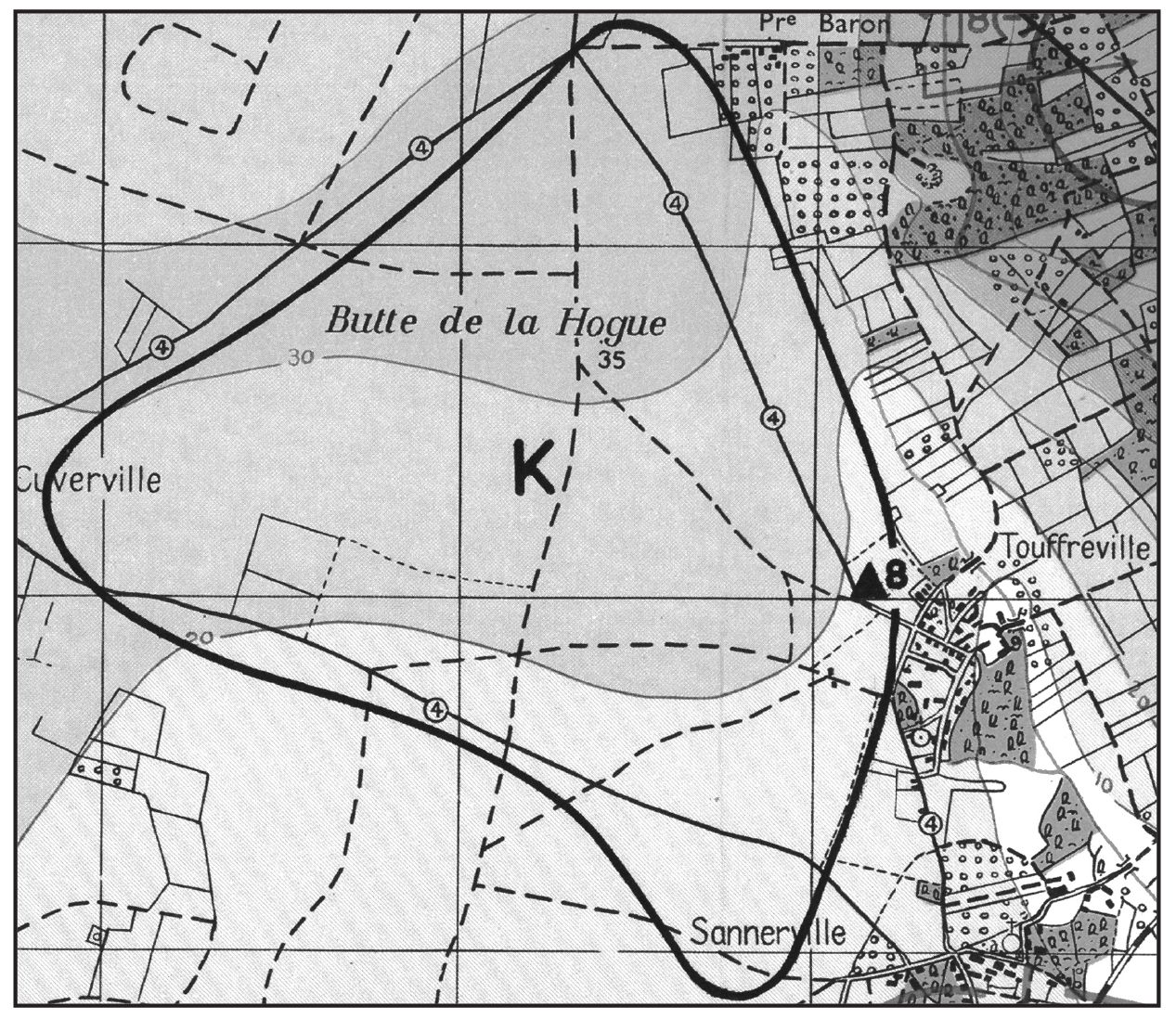
1) Rue des Airbornes. This road is dedicated to all the airborne troops and runs along the south side of DZ/LZ N. After 845 yards (773m) you come to a crossroads. It was at this crossroads Major C.A.’Tim’ Roseveare, CO of 3 Para Sqn RE, gathered his men after landing on the wrong DZ.
His record in the squadron’s war diary explains the chaos and confusion of the landing and why they had landed here instead of on DZ/LZ K some 1.5 miles (2.41km) to the south of here:
On landing I suspected we were in the wrong position as I could see no high ground to the east and Stirling aircraft were running in from all directions dropping paratroopers. Several gliders landed close by – they were not RE ones. My stick commander Lieutenant [Andrew] Lack and the SSM set about collecting the stick at the containers which were well concentrated and illuminated by the THOMAS devices which worked well. Paratroopers dropping around appeared to belong to every para battalion in the division. I contacted Captain [Ian] Tait of the 22 (Ind) Para Coy who said he had been dropped in the wrong place.
WAR DIARY, 3 PARA SQN RE
Major Roseveare was also able to meet up with Captain ‘Tim’ Juckes, CO of No. 2 Troop, and Lieutenants John S. R. Shave, George A. J. Wade, Alan N. D. Forster and David Breeze, who had also been dropped on the wrong DZ. In addition he had some sixty sappers and NCOs and some twenty plus ORs from 8 Para.
The group also had a recce boat, 400 to 500lbs (181 to 227kg) of plastic explosives, forty-five General Wade charges, demolition and cratering equipment, two radio communication sets and an adequate number of accessories. Although they only had six trolleys to carry the equipment, Major Roseveare deemed it enough to carry out some form of demolition on their three objectives; the bridges near Troarn and at Bures.
Major Roseveare organised his men and began moving off towards their objectives at 0230hrs. He, along with Captain Juckes and a few sappers, led the way. The route they took was approximately 2.5 miles (4.02km) and went due south, via Hérouvillette, then south-east via Escoville and towards a road junction, on the D37 road from Escoville to Troarn.
Sapper Charlie Willbourne was one of Major Roseveare’s 3 Para Sqn RE men to land at DZ N. Unfortunately though, he had dislocated his hip on landing. Another casualty, Sapper Thomas, had been shot in the foot on the way down from his aircraft. Both men were initially carried on one of the stores trolleys that were used to carry the heavy explosives. It was soon clear however, that the two casualties would impede the group’s progress and might jeopardise the operation to blow the bridges. It was decided that they would have to find their own way to 3 Para Bde HQ at le Mesnil, from where they could be transferred and treated at the nearest RAP or MDS for their injuries. As the rest of the group were initially heading in that direction they would leave arrows made of twigs to indicate the correct direction for the casualties to travel.
Using their upturned rifles as a crutch both men continued their painful journey, by daybreak they were suddenly joined by another straggler, this time from 8 Para, who had become detached from his stick. The paratrooper joined the two casualties, who welcomed having a fit companion along in the likely event of them coming into contact with any enemy.
Their journey continued, by now to the distant sound of the massive Allied naval bombardment that was heard coming from the direction of the beaches. The noise announced the start of the seaborne landings. Eventually the twig arrows ran out and the men soon became lost. While standing on a metalled road, deciding which direction to take, they suddenly had another problem to contend with; an armoured German patrol spotted and opened fire at the three paratroopers.

Sapper Thomas ran across the road to our right and dived over a low wall into the front garden of a house. And that was the last I saw of him! Me and the 8 Para man had committed ourselves to the track and as we moved I could see the brickwork of the 7ft [2.13m] high wall splintering as the bullets hit it. The Germans were now about 120 yards [110m] away when we found a five-barred gate by the hedge leading into a large field. How I climbed that gate I don’t know but I suppose blind panic helped. I tried to run alongside the hedge for cover when suddenly the machine gun on the Germans’ vehicle opened up and began sweeping the hedge... I could see the tracers whizzing through the hedge no more than a foot in front of me.
The 8 Para man was now way ahead of me and out of sight and I never saw him again – so much for infantry support! I dropped to the ground trying to make myself look part of the hedge and the two German soldiers had reached the five-barred gate. The machine gun had ceased firing and surprisingly they made no attempt to scale the gate and I could hear them talking… Amazingly they turned around and went back the way they had come.
SAPPER CHARLIE WILLBOURNE,
NO. 1 SECTION, NO. 1 TROOP, 3 PARA SQN RE
Alone, Sapper Willbourne moved slowly along the hedgerow. When four Frenchmen appeared he used his own limited French to explain he was a British soldier. Then, using his army issued French phrasebook, he showed them the translated sentence I am wounded, can you take me to a barn? Indicating that they would come back later the Frenchmen left the field.
Panzergrenadiere of 21 Panzer Division looking for British paratroopers among the hedgerows.
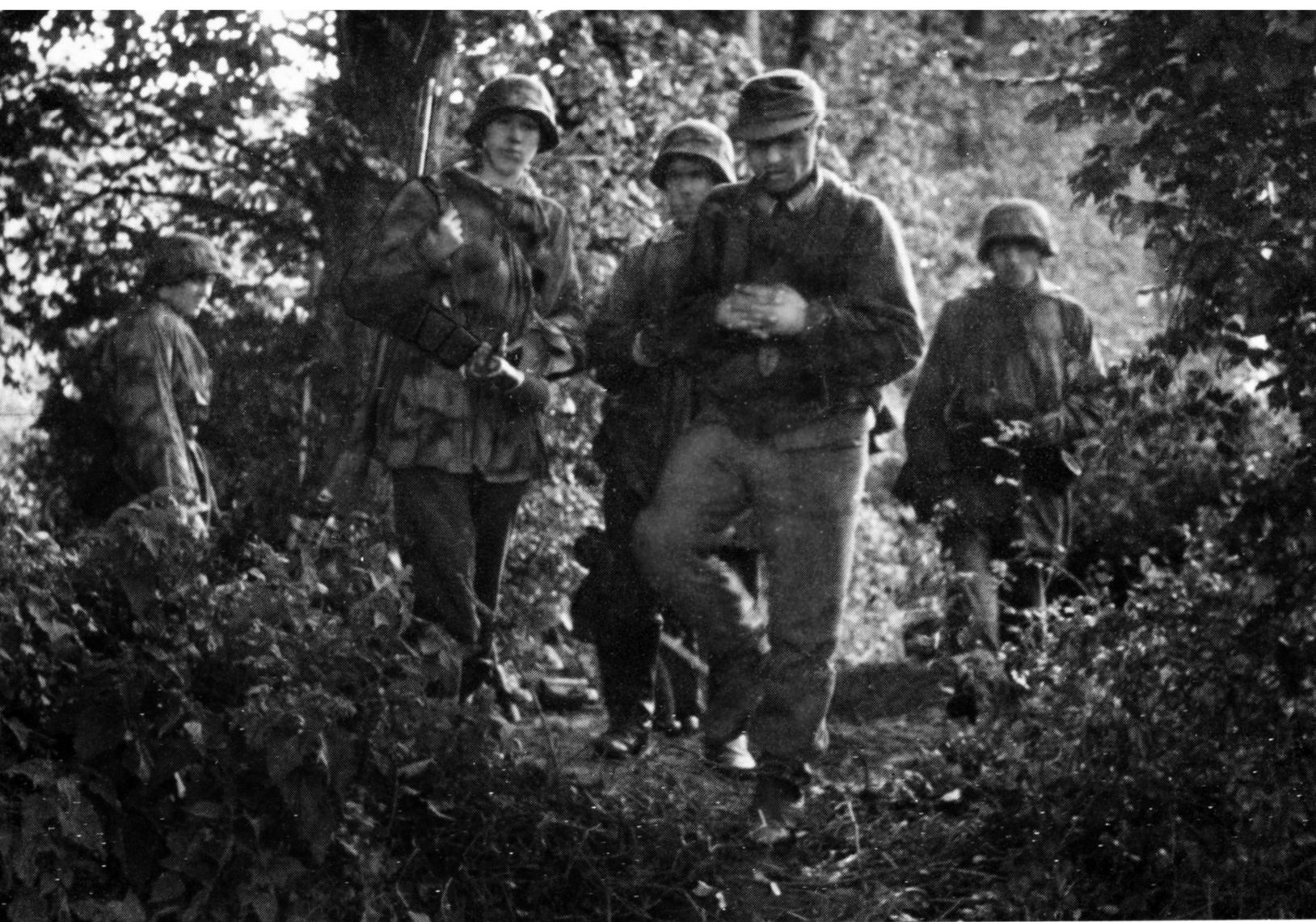
Unsure as to whether he could trust the men, Sapper Willbourne crawled to the opposite side of the field from where he had a better view of the immediate area and prepared himself a defensive position. In the shade of another hedge he began to clean out the mud from his rifle. Unable to move any further and with only his rifle and two primed No. 36 grenades as his defence, he could do nothing more than wait and see what would happen next.
After some time, he heard English voices nearby on the opposite side of the hedgerow. Shouting out 8 Para to get their attention, he thought it may be his companion returning with his comrades. To his astonishment, when the hedge parted it was the face of his own section commander Captain ‘Freddy Fox’ and some of his own troop returning from their demolition task. With the aid of a ‘liberated’ French bicycle, they helped Sapper Willbourne reach le Mesnil MDS by evening on D-Day where his dislocated hip was treated.
On 6 June 3 Para Sqn RE had seventeen officers and 123 other ranks parachuted into Normandy, a further fifteen troops landed in gliders and twenty-one came in by sea. By the end of June, 3 Para Sqn RE had sustained thirty-six casualties from the 176 that had started out on D-Day. By the end of the campaign in Normandy this had risen to ninety-four casualties.
B. Bois de Bavent
Continue straight on at the crossroads onto the Route de Cabourg, along the D224, (the D37 continues off to the right at the crossroads). This crossroads is the point at which Major Tim Roseveare and his men began their journey to the bridges at Bures and Traorn. The area approximately 150 yards (137m) away on your left and along this road for the next 635 yards (581m), continues to be the southern edge of DZ/LZ N. At the point where you reach a dirt track (that is heading due north-north-east) on your left, this track marks the approximate south-eastern edge of DZ/LZ N.
Continue along the road for just under 880 yards (805m) and at the junction with the D513 turn left, and continue for 880yds (805m) along and up the hill and past the white gates of le Mesnil Farm (224 Para Fd Amb MDS) until you reach le Mesnil crossroads. Turn right onto the D37b and after 900 yards (822m) there is a road on your right called:
1) Chemin du 8ème Para Britannique. Dedicated to 8 Para and in the area of la Grande Bruyère. To your left, on the opposite side of the road, this heavily wooded area is the Bois de Bavent. The area immediately south of this is the Bois de Bures which continues down and across due south-east towards Troarn.

Under the command of Lieutenant Colonel Alastair Pearson, 8 Para had the primary task of helping 3 Para Sqn RE, less No. 3 Troop, destroy the bridges at Bures and St Samson near Troarn. In addition, they also had the task of occupying and denying the Germans the use of the heavily wooded land between le Mesnil and Troarn, which was the south and eastern approach to the high ground.
The main body of 8 Para were expected to land at 0050hrs on DZ K, the northern most part of which is located some 1.25 miles (2.01km) south-west of where you are now. However, and again partially due to some pathfinders being dropped in the wrong place and setting up their beacons and lights on the wrong DZ, some of 8 Para, along with the Royal Engineers, ended up landing on DZ N. This was some 1.5 miles (2.41km) to the north of their designated DZ. Needless to say, this severely disrupted their organisation on landing.
Initially the recce party from 8 Para had been successful in landing on the correct DZ at 0020hrs. The slight opposition they met at the DZ was quickly dealt with and in doing so they managed to take one German prisoner. They later reported in the battalion’s war diary as having seen, when the main body arrived, aircraft flying in every direction, at different altitudes and all flying well above the dropping speed.
By 0120hrs, when Lieutenant Colonel Pearson arrived at the DZ, there were only thirty men present and one of the Royal Engineers Jeep and trailer. To add to the confusion the battalion’s RV signal, a red and green Verey light, had been seen over 2.5 miles (4.02km) away over DZ N, near Ranville.
As a result, by 0330hrs only 140 to 150 men from the 750 men, who set out with 8 Para, had assembled at their correct RV, near Touffréville. The majority had been scattered far and wide with only a few actually landing on their appointed DZ.
Subsequently, by the evening of 6 June after some more stragglers had arrived, 8 Para strength was still only seventeen officers and 300 other ranks. Nevertheless, the battalion had been able to take up all its positions and fulfil its primary objectives. In the following days, to convince the Germans that there was a greater force occupying this area, Lieutenant Colonel Pearson ensured that his men kept up constant patrolling into the surrounding villages during the night. He also set up defensive positions by the roads and tracks in the woods to intercept any German vehicles.
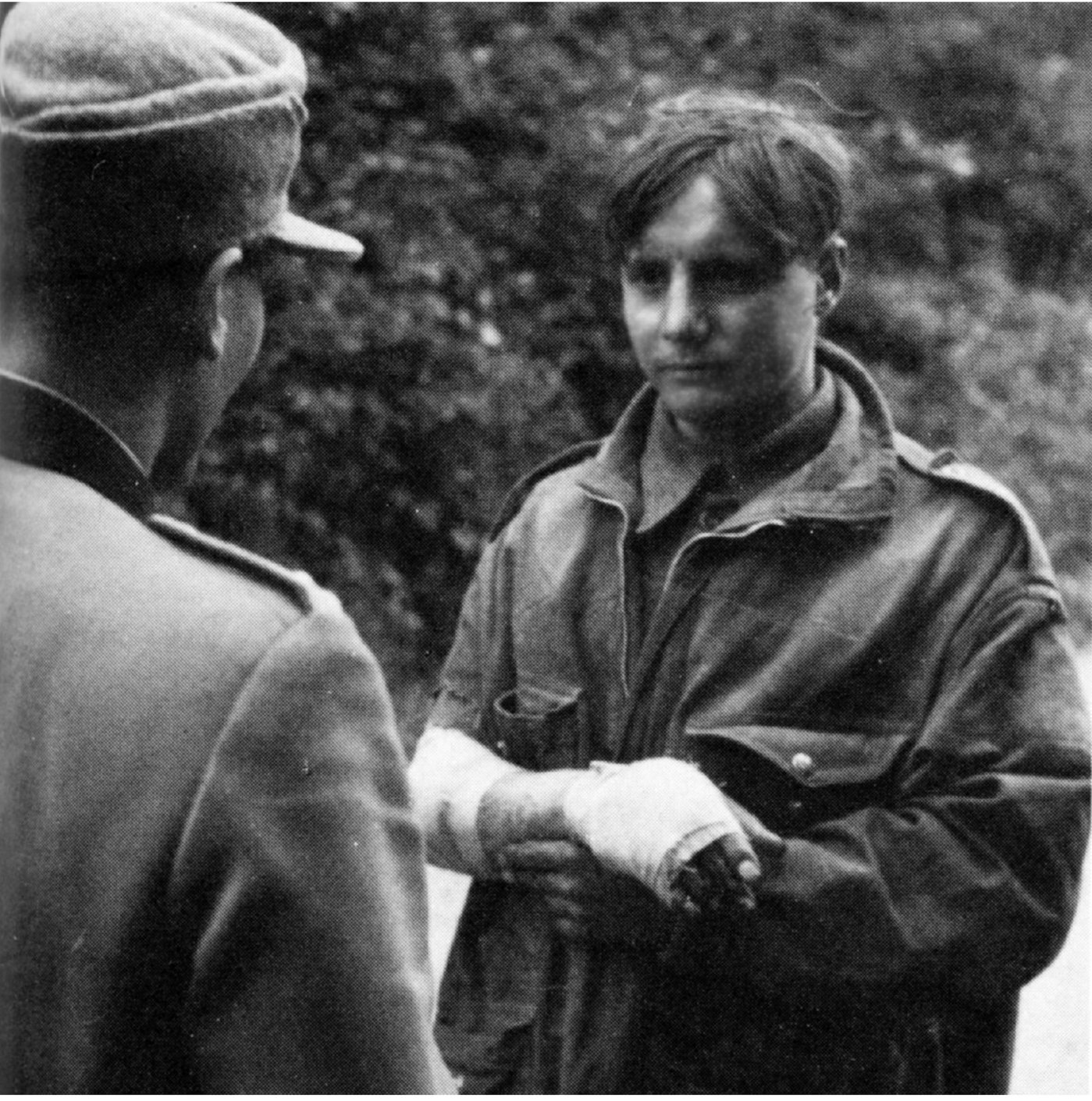
A wounded British paratrooper cared for by his captors.
The positions in these woods held by 8 Para were also constantly under attack from German patrols and mortar fire. In addition to the close-quarter fighting in the Bois de Bavent the general conditions endured by the men in this area proved to be most uncomfortable; since the heavily shaded ground was permanently wet the slit trenches were turned into quagmires of mud and water. To add to their discomfort, the whole area was also infested with mosquitoes and flies.
The men who occupied the ditches and hedgerows on either side of both this road (D37b), and the road (D37) leading into Troarn, were armed with anti-tank weapons and machine-guns. This enabled them to deny the Germans the use of this main thoroughfare from Troarn to le Mesnil. For the next eleven days they managed to resist all German attacks to reach and occupy the high ground. The cost was sixty-four men of 8 Para, who were killed in the period up to 17 June.
Continue to drive down the D37b for 1.1 miles (1.77km) until you reach the crossroads with the D37. This was:
2) 8 Para Firm Base. Major Roseveare, 3 Para Sqn RE, and his men who had landed on DZ N, reached this road junction by 0400 hrs after a one and a half hour march with their heavy equipment. It was later reported in the squadron’s war diary that many were limping as a result of DZ injuries but, in a feat of endurance, all had pulled their weight on the long uphill march. Fortunately, the group met no enemy resistance on their journey to the crossroads.
At around the same time a mortar platoon commander, Lieutenant R. Thompson, arrived along with another wounded officer. With him were some fifty personnel, mainly from A Coy, and twelve medium machine-guns and six mortar detachments. He had also been dropped over DZ N, at 0100hrs, and had been helped and guided to the road junction by a Frenchman he had met in Ranville.
Taking command of the party on their arrival, Major Roseveare ordered them to set up a Firm Base at the road junction. As the most senior 8 Para officer present, Lieutenant Thompson began setting up defensive positions around the crossroads and also organised a recce patrol to move along the road (D37) heading due south-east towards Troarn.
Major Roseveare had acquired a medical jeep and trailer at DZ N. The RASC driver, Lance Corporal Young, had his jeep and trailer loaded with medical supplies and had been ready to make his way toward le Mesnil (see Ch. 6, E6) until Major Roseveare commandeered the vehicle.
Upon reaching this road junction, Major Roseveare ordered all the medical equipment unloaded into a nearby timber yard and reloaded the jeep and trailer with the heavy General Wade explosive charges. These were needed for the largest of the six bridges which the engineers had to destroy on D-Day, the 110ft (33.53m), five span masonry arch bridge on the far side of Troarn near St Samson.
From this point Captain Tim Juckes went off with the majority of the sappers to destroy the two bridges, both 80ft (24.38m) steel lattice girder constructions at Bures (see Ch. 7, I). For this they had the use of all the plastic explosives that were loaded on the trolleys.
That left Major Roseveare, Lieutenant David Breese and seven NCOs and sappers, along with some thirty-nine General Wade charges, to complete the task of destroying the masonry bridge near St Samson. All but one climbed aboard the jeep. The remaining soldier, Sapper Sam Peachey, set up his Bren gun on top of the explosives in the heavily laden trailer. They then set off down the D37 towards Troarn to destroy the main bridge over the River Dives near St Samson. (see Ch. 7, H).
C. Manoir du Bois
Turn left at the crossroads onto the D37. some 350 yards (320m) on your left is a fenced driveway leading to the Manoir du Bois.
To the right of the driveway, approximately 30 yards (27m) away along the roadside, there is:
1) 8th Parachute Battalion Memorial. This marble headstone is dedicated to all those who fought and died with 8 Para, between 6 June and August 1944, during the Normandy Campaign. At the base of the headstone there is a small bronze:
2) Memorial Plaque to Sergeant Fred Collett. Dedicated to the memory of Sgt Collett, who was in HQ Coy, 8 Para, and who passed away in 2002. To the right of this memorial is:
3) Memorial Plaque to Brigadier Alastair Pearson CB DSO (&3 bars) OBE MC KstJ TD. This is to the memory of the former Commanding Officer of 8 Para who died in 1996. From his humble beginning as a Glasgow baker and son of a grain merchant, Pearson had soon established himself as a natural leader in the army. For his service in North Africa and Sicily he was awarded the DSO plus two bars and a MC, all for leadership and bravery while in action. The twenty-nine year old Scot would later receive a fourth bar to his DSO while serving in Normandy. His unquestionable ability and daring won him many admirers, one of whom is the present Colonel-in-Chief of The Parachute Regiment, His Royal Highness The Prince of Wales, who described Colonel Pearson as one of the great leaders of the Second World War.
Lieutenant Colonel Pearson never suffered fools gladly and had a total disregard for rank with his outspoken views. It was a characteristic that no doubt hindered his promotional prospects. But he was always able to resolve situations and deal with problems in his own unique way. In one instance, while he was personally leading a party over the River Dives to rescue some members of a crashed Dakota, one of his men jumped into his dinghy bayonet first; with the inevitable result. As the drenched soldier climbed out of the water Pearson sent him back into the river with a kick up the backside.
The soldier complained, as he pulled himself out of the river for the second time, and threatened to report the lieutenant colonel to the brigadier for his treatment which most certainly was not in King’s Regulations. Pearson was quick to reply in his broad Scots accent:
You can complain to General-bloody-Montgomery himself... For your stupidity, you can stay here until we come back, and guide us across the river again. And if a German patrol comes to find out what all this bloody row is about, then good luck!
The mission turned out to be a complete success, with the rescue of fourteen survivors from the crashed Dakota.
Turn your vehicle around in the driveway and return to the crossroads 350 yards (320m) back along the D37. Take the left turning and continue for 0.73 miles (1.17km) along the road. Just after the second left-hand bend there is, on the left-hand side of the road, a:
D. Memorial to Private Thomas W. Billington and Private Arthur Platt
Twenty-one year old Thomas Billington and twenty-four year old Arthur Platt of 8 Para Signal Platoon were taken prisoner, in the early hours of 6 June. However, instead of being treated as prisoners of war the two men were unceremoniously brought down this lane and shot through the back of the head.
The grim discovery was made by a local lady from Touffréville, Mme Yveline Langevin, as she walked down the lane later that morning. As a result of extensive work on 8 Para by Dr Tony Leake, a retired general practitioner, and William J. Lewis Platt, son of Private Platt, further information about this incident has come to light.
The troops occupying the area that evening were from Panzergrenadier-Regiment 125, 21 Panzer Division and were billeted in the nearby village of Touffréville. Several days later, around 10 June, the Germans moved the bodies in an attempt to cover up their crimes and any incriminating evidence. The body of Private Platt, and it is believed that of Private Billington as well, were moved and buried 1.83 miles (2.94km) south-west of here in the fields midway between Démouville and the small hamlet of Lirose west of Sannerville.
Private Platt was later found and his body reinterred in Ranville Commonwealth War Cemetery (IIA, N, 8). The body of Private Billington has never been discovered. Dr Leake believes this may possibly be a result of the heavy bombing and shelling of this area at the start of Operation GOODWOOD on 18 July. It is an event Dr Leake remembers well as he was then a private in 8 Para and he witnessed the bombardment from his position in the Bois des Monts.
It is believed that while this bombardment left Private Platt’s grave untouched, Private Billington’s grave may have been destroyed. As no body has been recovered. His name is now listed, along with another 1,807 men of the Commonwealth forces who have no known grave, on the Bayeux Memorial (Panel 18, Column 1). This memorial to the missing is situated opposite the entrance to Bayeaux Commonwealth War Cemetery.

Above left: Thomas W. Billington, murdered with Arthur Platt after capture.

Above: The only known surviving photograph of Arthur Platt (arrowed). General Montgomery speaks with Major J. B. Marshall. Lieutenant Colonel Alastair Pearson is to his right.
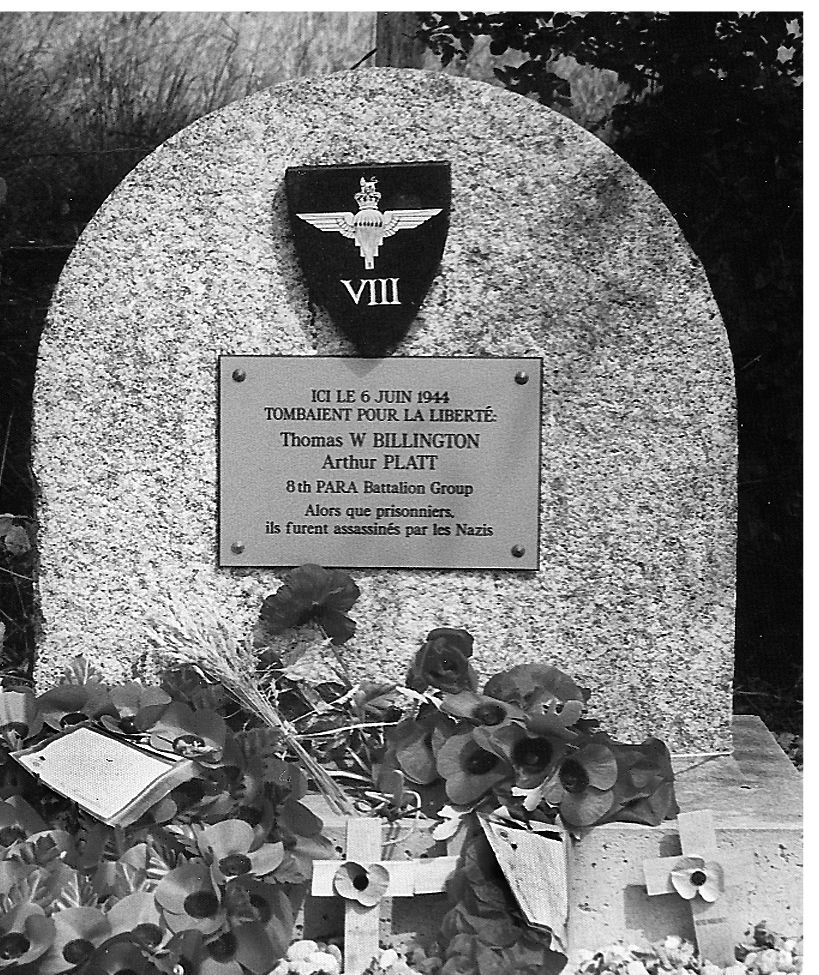
Memorial to Thomas W. Billington and Arthur Platt.
The people of Touffreville erected this roadside memorial, at the spot where the two men were murdered by the Nazis, on 6 June 1988. The perpetrators of the crime remain unknown and have therefore never been caught or brought to trial.
E. Touffréville
Continue along the road for 655 yards (599m) until you reach crossroads in the village of Touffréville. Turn right onto the road towards Escoville (D227) and stop on the dirt track 180 yards (164m) on your left-hand side. The corner of the field to your right, due north-east, is the site of:
1) 8 Para RV. The intended rendezvous for all 8 Para on D-Day. Turn around and drive back to the crossroads, in Touffréville, and turn right onto what is still the D227. This road is also known as:
2) Rue du 8ème Para Bn. Named in honour of 8 Para.
Continue along Rue du 8ème Para Bn and after 325 yards (297m) turn left down Rue de L’Eglise. Turn left after 100 yards (91m) into parking area opposite the church. This area is called:
3) Place Caporal E. D. O’Sullivan. Named in honour of twenty-two year old Lance Corporal Edward D. O’Sullivan, a pathfinder, who served with 22 (Ind) Para Coy. He landed on DZ K, with his commander Lieutenant Robert ‘Bob’ Midwood and most of the men from his stick.
Because of the heavy loads the pathfinders were carrying, their exit from the aircraft was slower than less heavily burdened paratroopers. Subsequently five of the stick, overshot the DZ and did not manage to report to the stick’s RV. Amongst the missing troops was Lance Sergeant Boardman who was carrying one of the stick’s two EUREKA sets.
As soon as the pathfinders landed, at 0020hrs, they came under enemy fire. Lance Corporal O’Sullivan was killed during the ensuing firefight. By 0035hrs Lieutenant Bob Midwood and his men had activated the remaining EUREKA set along with a holophane lamp. At 0130hrs the pathfinders gathered at 8 Para RV. They then began a thorough search of the DZ to try and locate the missing EUREKA. This was without success. After the EUREKA they had activated had fulfilled its purpose, and because of continuing enemy activity all around DZ K, Lieutenant Midwood destroyed and abandoned the set. At 0530 hrs they withdrew from the DZ and made their way to the company’s concentration area, over 3 miles (4.83km) away due north-west, at le Bas de Ranville. Across the road are some stone steps leading into:
4) Touffréville Churchyard. On the left-hand stone gatepost there is a green and white CWGC plaque. Just through the gates on the right-hand side there is the grave of a twenty year old French soldier Soldat Emile Hamel. On the far side of the church, in the churchyard, there is the grave of the twenty-two year old pathfinder, Lance Corporal Edward D. O’Sullivan.
F. Sannerville
Return to your vehicle and back along Rue de L’Eglise. Turn left onto Rue du 8ème Para Bn and continue for 700 yards (640m) until you reach the next junction in Sannerville. Turn left onto Rue de la Liberation (D266) and after only 40 yards (37m), turn left again onto Rue Pasteur. Continue along this road for 190 yards (174m) until you come to the next junction. Turn left and after 50 yards (46m) on your left-hand side, in Place de L’Eglise, and along the churchyard wall of Sannerville Church there is:
1) 3rd British Infantry Division Memorial. This memorial was erected by the people of Sannerville to perpetuate the memory of the British 3rd Infantry Division who gave their lives in Operation GOODWOOD between 18 and 21 July 1944 and the subsequent battles leading up to the liberation of Europe.
Between 6 June 1944 and the end of hostilities in Europe in May 1945, the 3rd Infantry Division sustained over 11,000 casualties. These included 2,585 killed in action, 8,039 wounded and 1,363 missing. This memorial was the idea of Alain Buzuel and made possible by the work of the Anciens Combattants et Bénévoles. It was unveiled on 7 June 2004. On the wall to the right of the memorial, there is:
2) Group Captain Charles Appleton CBE DSO DFC CDG. Memorial Plaque. Thirty-eight year old Group Captain Appleton was commanding officer of No. 124 Wing, No. 83 Group, 2nd TAF. This RAF unit comprised of 181, 182 and 247 Squadrons flying Typhoon 1B aircraft. The wing had been transferred to a temporary airstrip near Caen in June 1944.
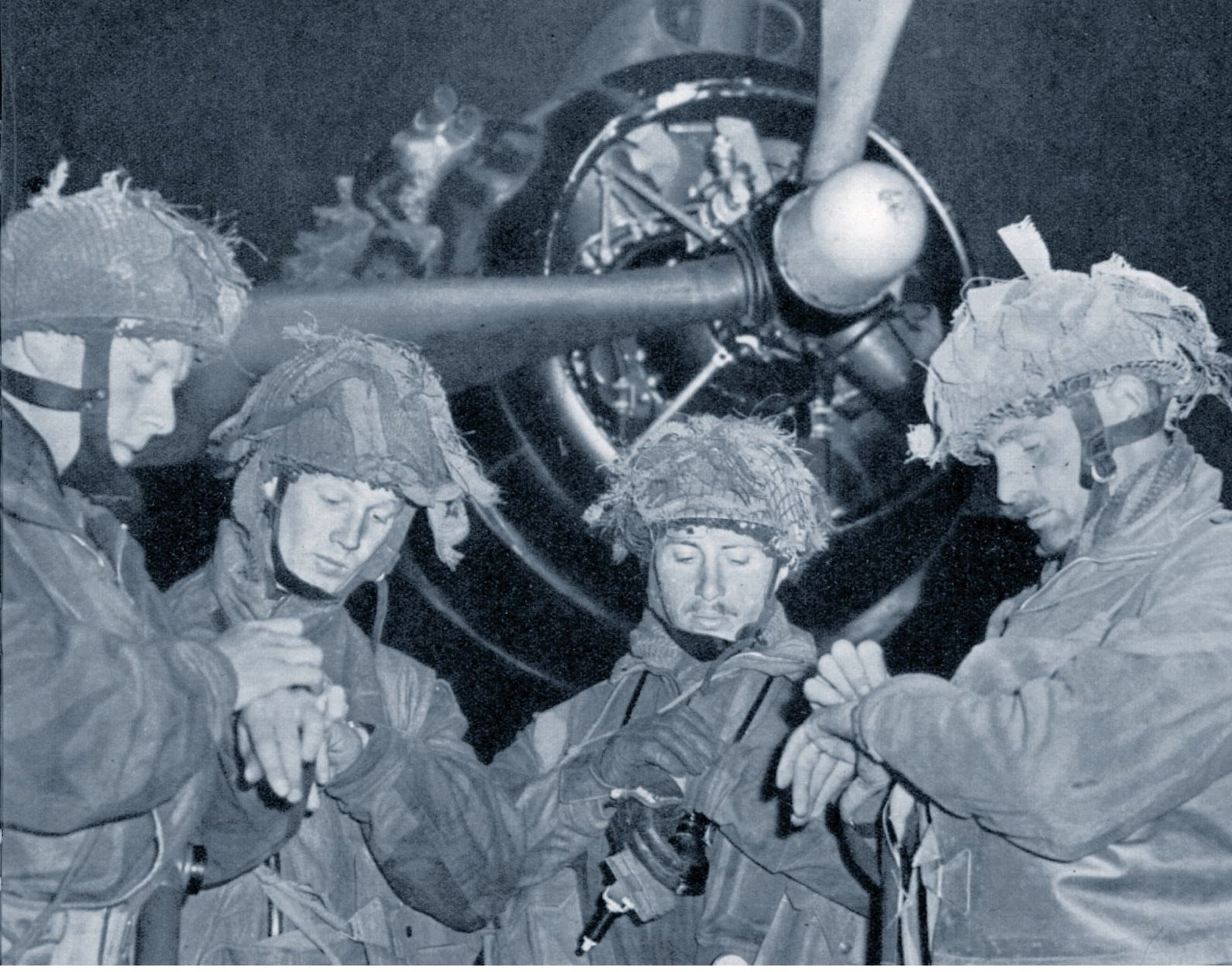
Left to right: Lieutenants Bobby de Lautour, Don Wells, John Vischer and ‘Bob’ Midwood, Pathfinders of 22 (Ind) Para Coy, synchronize watches prior to emplaning at RAF Harwell.
Group Captain Appleton had already lost a leg in action as a result of shrapnel wounds received in a German strafing attack while serving in Algiers, North Africa. When he was appointed CO of No. 124 Wing he was responsible for part of the offensive air to ground attack operations from D-Day onwards, providing valuable help to the Allied ground forces.
Despite his senior rank he regularly participated in operational sorties. On 12 August he was flying Typhoon MN928 G of 247 Sqn. While leading the flight his aircraft received a direct hit from German anti-aircraft fire and his aircraft plummeted to earth killing him instantly. He is now buried in Banneville-la-Campagne Commonwealth War Cemetery (IV, C, 14)
Between 6 August and 21 August No. 124 Wing lost a further eight pilots killed and four shot down and taken prisoner. From 6 June to the end of the Normandy Campaign in August 1944, 161 Typhoon pilots lost their lives. A memorial to all those pilots killed is in the village of Noyers-Bocage.
G. le Maizeret
Continue from Place de L’Eglise and along Rue du Muguet for 0.73 miles (1.17km) climbing the hill into the small hamlet of le Maizeret. On the right-hand side of the road, just after a left-hand bend in the road there is:
1) 41, 46, 47 & 48 Royal Marine Commando Memorial. This memorial is dedicated to the Royal Marine units of 4 SS Bde. Under the command of Brigadier B. W. ‘Jumbo’ Leicester, the brigade was actively patrolling this area between 7 and 17 August 1944 during which time they helped liberate Sannerville and Troarn.
There were five Royal Marine commando units that landed in Normandy on 6 June 1944. 45 RM Cdo was grouped with the three army commando units of 3 Cdo, 4 Cdo and 6 Cdo, to form 1 SS Bde. Meanwhile the remaining Royal Marine units formed 4 SS Bde.
On D-Day 41 RM Cdo landed on SWORD Beach at la Bréche d’Hermanville and fought their way west towards Lion-sur-Mer and Luc-sur-Mer. At the same time 48 RM Cdo landed on JUNO Beach at St-Aubin-sur-Mer and pressed on due east into Langrune-sur-Mer. Meanwhile, 47 RM Cdo landed on GOLD Beach and were tasked with heading farther west to take the coastal village of Port-en-Bessin. On 7 June 46 RM Cdo landed on JUNO Beach as 4 SS Bde reserve. They then helped form the link-up between 41 and 48 RM Cdo. On D-Day the Royal Marines lost over ninety men killed in action.
Later, in June, 4 SS Bde came under the command of 6th Airborne Division. The brigade helped reinforce the left flank of the Allied forces, while General Montgomery continued with his battle to take Caen. Although they formed part of the defences to hold the line along the high ground on the east side of the River Orne, the commandos, along with paratroopers, continued to launch probing and reconnaissance patrols deep into enemy territory.
After the capture of northern Caen in Operation CHARNWOOD on 8 July and the southern part of the city by the end of Operation GOODWOOD on 21 July, the Allied forces continued preparing for a breakout.
The Americans in the west of Normandy launched Operation COBRA on 25 July and began pushing the German forces east towards Falaise. Meanwhile, the British launched Operation BLUECOAT on 30 July on their right flank and on their boundary with the US 1st Army.
On 7 August Operation TOTALIZE began to the south of Caen with the Canadians and Poles pushing the Germans down towards Falaise and out on the south-east flank. As this battle progressed Major General Gale was told by the CO of I Corps, Lieutenant General J. T. Crocker, that the Germans were preparing to withdraw along the 6th Airborne Division front.
Major General Gale, reinforced with the Dutch Princess Irene Brigade, Belgian Piron Brigade and commandos from 4 SS Bde, prepared to launch an offensive across the flooded meadows and river of the Dives valley. This would not only protect the left flank of the Canadian and Polish forces but also, by keeping the pressure on the retreating Germans, it would enable the Canadians to accelerate their advance towards Falaise and aid the Canadian and Polish advance eastward. News finally arrived that the commandos would soon be launching an all-out offensive.
We’d been prodding at the Hun for a week or so, speeding the parting guest if you like, but, though one front after another seemed to be dropping back, our own particular and pet German unit – Fusilier Bataillon 346 – just didn’t want to budge. Then one morning I was called with my colonel to the usual O Group of commanding officers at headquarters of 4 SS Bde, and there we heard it. ‘Gentlemen,’ said Brigadier Leicester, ’the enemy on our front is starting to retire.’ That was for me my most inspiring moment.
LIEUTENANT D.F. MURRAY, 41 RM CDO
On 14 August, the Canadians launched Operation TRACTABLE reaching Falaise two days later. In the meantime Major General Gale had been preparing his own offensive for the 6th Airborne Division and on 17 August the aptly named Operation PADDLE began.
General Gale chose to make his main advance along a route that ran from Troarn towards Putot-en-Auge and Dozulé. From here he would continue the offensive over the River Touques at Pont l’Evêque, on through Beuzeville and the River Risle at Pont Audemer, which was less than 6 miles (9.66km) from the River Seine. Meanwhile, 6 Airldg Bde, the Dutch Princess Irene Brigade and Belgian Piron Brigade would clear the Germans from along the coast through Cabourg.
This offensive began with 6 Airldg Bde, Princess Irene Brigade and Piron Brigade attacking north and east of Sallenelles through Merville-Franceville-Plage, No. 1 SS Bde attacked north-east through Bavent and 1 Cdn Para pushing south-east from le Mesnil through the Bois de Bavent. To the east 3 Para Bde launched their offensive over the River Dives at Bures and 4 SS Bde went on from the area around this memorial to take Troarn.
H. Troarn (and St Samson)
Continue uphill through le Maizeret, for a further 750 yards (686m) until you reach a T junction. Turn right onto Rue du Bois (D37) and across the flyover the A13 (L’Autoroute de Normandie) into Troarn. After 800 yards (731m) you will reach a roundabout. Back in 1944 this was the site of the:
1) Troarn 1944 Railway Level Crossing. The fourth exit off the roundabout, to your left, is called Rue du Chanoine Longuet. This road follows the path of the old railway line that ran, in 1944, east of Troarn and onto Bures where it crossed over the River Dives some 1.88 miles (3.02km) to the north-east. This was a vital supply line for the Germans. The 80ft (24.38m) steel lattice girder railway bridge in Bures that supported the railway was one of the two primary objectives in the village of Bures for Captain Juckes of 3 Para Sqn RE to destroy (see Ch. 7, I).
The road along which you have just travelled, Rue du Bois (D37), is the same road that Major Roseveare travelled with eight men in the heavily laden Jeep and trailer, after he left 8 Para Firm Base at the D37 crossroads and junction with the D37b (see Ch. 7, B2). The roundabout, which was a level crossing back in 1944, was the place where Major Roseveare and his team ran into a German roadblock. His account in the squadron’s war diary explains what happened;
We had set off down the road at a moderate pace with everyone ready with a Bren and several Stens ready for any trouble. Just before the level crossing we ran slap into a barbed wire knife rest road block. One Bosche fired a shot and then went off. It took twenty minutes hard work with wire cutters before the jeep was freed. We then proceeded on, leaving behind it transpired later, Sapper Moon.
MAJOR TIM ROSEVEARE, CO, 3 PARA SQN RE

Proceeding with slightly more caution, Major Roseveare had sent two scouts ahead to the next crossroads as they untangled the jeep.
Continue along the Rue du Bois (D37) for 350 yards (320m) until you come to the next roundabout with a calvary to your right, Take the third exit off the roundabout, on your left, and onto the Rue de Rouen (D675). Find a suitable place to park. Immediately on your right, off the roundabout, is:
2) Troarn Communal Cemetery. On the wall to the left of the gateway entrance into the cemetery, is the now familiar green and white Commonwealth war graves plaque. Inside the walled cemetery, over to the far right along the west boundary wall, there are three commonwealth headstones of paratroopers from 8 Para all killed on the 6 June 1944. These are twenty-two year old Sergeant John Davies from HQ Coy, twenty-three year old Private Henry M. Carter from A Coy, and twenty-six year old Sergeant John A. Iliffe from A Coy. The circumstances surrounding their deaths are unknown.
Also in this cemetery are the graves of Mme Suzanne Lamy and her one year old son Philippe, both local civilians killed during the fighting around here.
Outside the entrance of the cemetery, to your left, is:
3) Troarn Eastern Crossroads. Although a roundabout has been put in today, back in 1944 this was where Major Roseveare’s two scouts were heading for after leaving the level crossing. As they approached the crossroads, from the direction from which you approached in your vehicle, a German soldier armed with a rifle cycled across the intersection. By now the jeep and trailer had been freed and was heading for the crossroads. It was quickly decided the German should be dealt with:
On being dragged from his bicycle he protested volubly and we made the mistake of silencing him with a Sten gun instead of a knife. The town was now getting roused so we lost no time and everyone jumped aboard while I tried to make the best speed possible. As the total load was about 3,000lbs [1360kg] we only made about 35mph [56kmh].
MAJOR TIM ROSEVEARE, CO, 3 PARA SQN RE
Return to your vehicle and continue along the Rue du Rouen (D675) into Troarn. This is the same route Major Roseveare took as he drove straight through the centre of the village. Some 420 yards (384m) from the roundabout the road starts to bend to the right. On the corner, to your right, there is a car park behind the building that has the Syndicat d’Initiative (Tourist Information Office) and Police Municipale (town Police station). Park here.
This area where you have parked is known as:
4) Place Paul Quellec named after one of the French heroes of the Resistance who were killed in 1944. Above on the right-hand side of the Police Municipale building there is a plaque dedicating the area to him. Also in front of the building there is a statue of a First World War soldier. Behind this on the wall there is:
The road in Troarn down which Major Roseveare sped in his jeep and trailer; on the left is Troarn Church.

5) Troarn War Memorial. This memorial lists twenty local men who were killed in the First World War, four local men who were killed in the Second World War and the six local civilians who lost their lives in the Second World War. To the right of the plaque there is a:
6) Memorial Plaque to 3 Para Sqn RE. The plaque reads, when translated: Erected by the people of Troarn in honour of the officers and men of 3 Para Sqn RE who, on information given by the Resistance, destroyed the bridges over the Dives to protect the left-flank of the landings at daybreak on 6 June 1944. Walk out of the car park and turn right. 40 yards (37m) along the Rue du Rouen (D675) there is another crossroads. Cross the road and on the corner of the building above you there is a street sign naming this road:
7) Voie Major J.C.A. Roseveare. You may wish to walk further along the Rue du Rouen (D675), to see the area along which Major Roseveare raced while under fire, before returning to your vehicle.
As the jeep rounded the corner in Troarn, the Germans, were alert having been roused by the sound of the Sten gunfire from the eastern crossroads. Spread-eagled with a Bren-gun, on top of the General Wade charges in the trailer, was Sapper Sam Peachey, he had taken up the position as rear gunner as the Jeep accelerated through the town. In the Jeep Major Roseveare was driving, Lieutenant Dave Breeze, Lance Sergeant Bill Irving, Corporal John Windeatt, Lance Corporal Bill Fellows and Sapper Tom Price were all on board, some returning fire with their Sten guns. Perched precariously on the tow bar between the jeep and trailer was Sergeant Joe Henderson
At the corner here the fun started. There seemed to be a Bosche in every doorway shooting like mad. However, the boys got to work with their Sten guns and Sapper Peachey did very good work as rear gunner with the Bren gun. What saved the day was the steep hill down the main street. As the speed rose rapidly and we careered from side to side of the road, as the heavy trailer was swinging violently, we were chased out of the town by a MG 34 which fired tracer just over our heads.
MAJOR TIM ROSEVEARE, CO, 3 PARA SQN RE

Major Roseveare continued down towards the bridge over the River Dives.
Return to your vehicle and turn right out of the car park onto the Rue du Rouen (D675). Continue for just over 0.75 miles (1.21km) through the town, past the church on your left, and downhill following the route Major Roseveare took towards St Samson. Park your vehicle on the dirt track on the right-hand side of the road just before the:
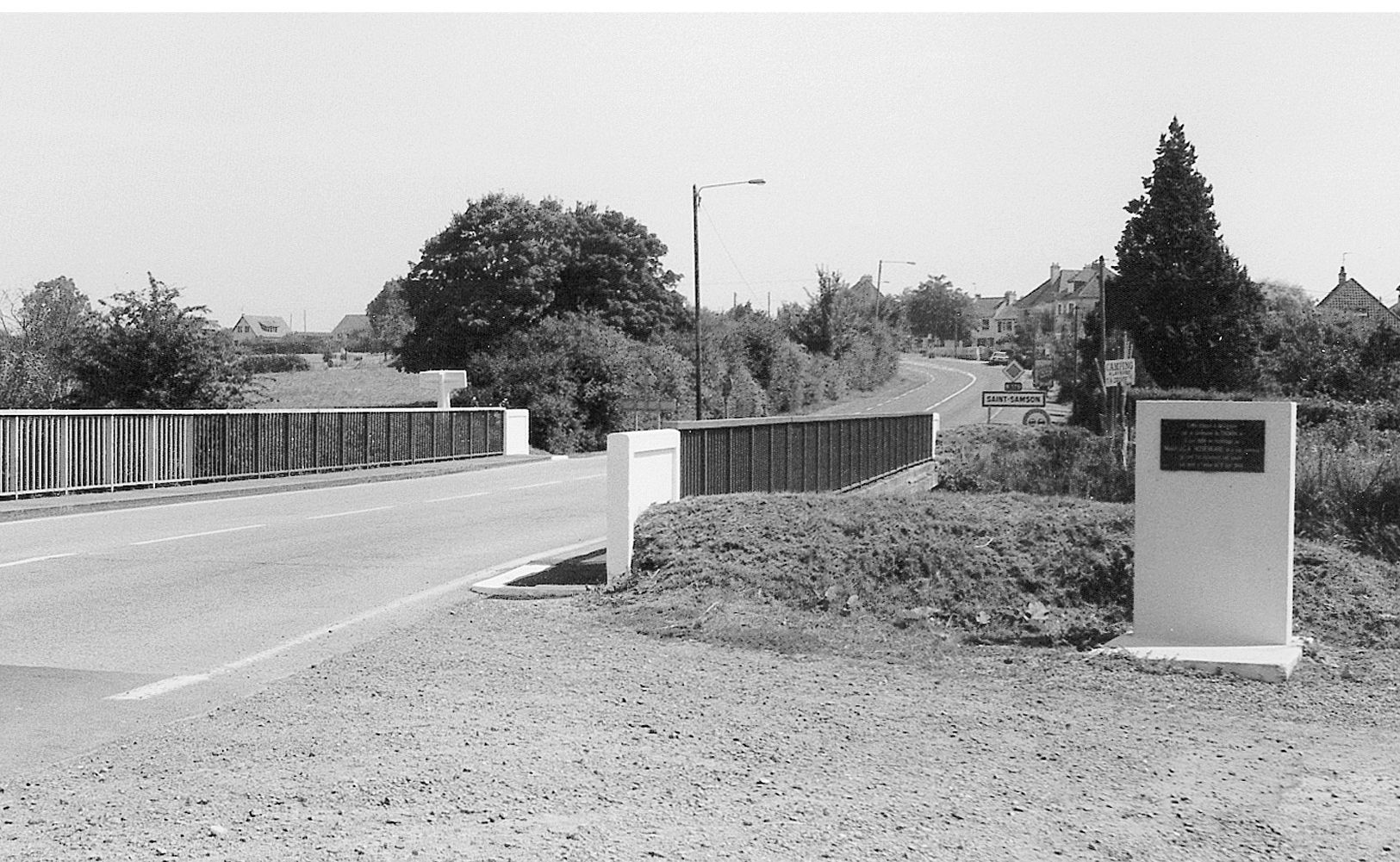
8) Site of Troarn’s 110ft (33.53m) Five Span Masonry Arch Road Bridge. Today this new bridge is built on the same site. When Major Roseveare and his men arrived at the bridge they found that there were no Germans guarding it. They also discovered that they had lost Sapper Peachey and his Bren gun. He had been thrown off the trailer as they came down the hill. Injured by his fall Sapper Peachey was taken prisoner.
Lieutenant Breese and Lance Sergeant Henderson ran back a short way along the road towards Troarn and set up an ambush in case the Germans followed. The rest of the men unloaded the trailer and set about laying the General Wade charges across the central span of the bridge. This completed, a detonation cord was fixed up and the charges detonated.
The centre span of the 110ft (33.53m) five span masonry arch bridge gave way under the explosion and a breach of 15-20ft (4.75-6.1m) was created. The demolition had taken about five minutes to complete. A second demolition party extended this gap to 35-40ft (10.67-12.19m) later in the day (see Ch. 7, I5). Next to the bridge on the south-west side there is a:
9) Memorial to Major J.C.A. Roseveare. This memorial was dedicated on 5 June 1986 by the people of Troarn and pays tribute to Major Roseveare and his men who successfully blew up the bridge in the early hours of 6 June 1944.
After the successful demolition of the bridge, Major Roseveare decided to avoid Troarn and instead headed due north, up a farm track beside the river, in the direction of Bures. When the track came to an end the jeep was dumped and the men set off on foot. Lieutenant Breese made a reconnaissance of Bures before the group approached, but he believed that the Germans were occupying the village.

The original five span, 110 ft (33.53m) masonry arch bridge at Troarn (near St Samson) that Major Roseveare demolished.
It was some time between 0500hrs and 0540hrs and Major Roseveare decided they should head due west towards the road junction and Firm Base held by 8 Para and from where they started their journey to the bridge near Troarn.
As they neared the road junction the sound of heavy machine-gun fire was heard coming from around the area, Major Roseveare decided to change plans and divert straight to brigade headquarters at le Mesnil.
Memorial to Major J.C.A. Roseveare beside the new bridge at Troarn (St Samson) over the River Dives.
He reached HQ at 1300hrs and only after he and his men had swum across several streams and found their way through the dense woods in the Bois de Bavent. Major Roseveare was later awarded the Distinguished Service Order for his actions in the field.
About thirty minutes before Major Roseveare arrived at battalion HQ, Colonel Pearson, not having received any news on the Troarn Bridge, decided to send another demolition party to destroy the bridge. They were under orders to destroy the bridge or, if they found the bridge had already been, destroyed, then they were to try and widen the breach.
I. Bures sur Dives
Drive for just over 0.66 miles (1.06km) back into Troarn on the Rue du Rouen (D675) and at the first crossroads turn right onto the Rue du 6 juin. Continue for 473 yards (432m) until you reach the junction with the Route des Marais (D95). This junction is where 3 Para Sqn RE set up a Firm Base for a second attack on the Troarn Bridge (see Ch. 7, I5) later on D-Day. Turn right, and continue along the Route des Marais (D95) for 0.75 miles (1.21km) until you reach the village of Bures. Take the first turning on your right. This is called:
1) Rue du Capitaine Juckes. This street was named in honour of Captain Thomas ‘Tim’ Roland Juckes who led the demolition party into Bures to destroy the two bridges.
Follow the road for some 350 yards (320m) until you reach, on your left:
2) Bures War Memorial. This memorial is dedicated to the local people who were killed in both the First World War and Second World War.
Turn right in front of the war memorial and follow the road, Rue du Port, for 480 yards (439m) until you reach a small bridge over the River Dives. This is the:
3) Site of Bures 80ft (24.38m) Steel Lattice Girder Farm Track Bridge. This brick farm track bridge, now called Pont du Capitaine Juckes (Captain Juckes Bridge) was built to replace the steel lattice girder bridge that was destroyed by Captain Juckes, CO of No. 2 Troop 3 Para Sqn RE. To the left of the bridge is a stone plinth with a bronze plaque that forms:
4) Capitaine Juckes Memorial. This memorial dedicates the bridge to the memory of 24 year old Captain Thomas ‘Tim’ R. Juckes. On 28 June 1944, Captain Juckes, was reporting to the HQ of 1 Cdn Para at the brickworks at le Mesnil, when a mortar bomb landed next to his jeep. He was knocked unconscious and received a severe chest wound. His driver immediately took him to the RAP from where he was then taken down to the MDS in Ranville.

He never recovered consciousness and died of his wounds soon after. The following day he was buried in the cemetery in Ranville (IIIA, H, 9). The last rites were performed by his friend, and 9 Para Chaplain, the Reverend Captain John Gwinnett. For his action in Normandy Captain Juckes received the MC. His troop was taken over by Lieutenant John S.R. Shave who would also receive an MC for his action in Normandy.
Some 450 yards (411m) downstream, due north-north-east, on the other side of the River Dives and along a dirt track that runs parallel to the river, there is the:
Farm bridge over the River Dives at Bures blown up by Captain Juckes.


Juckes Bridge, the new bridge that replaces the one blown by Captain Juckes.
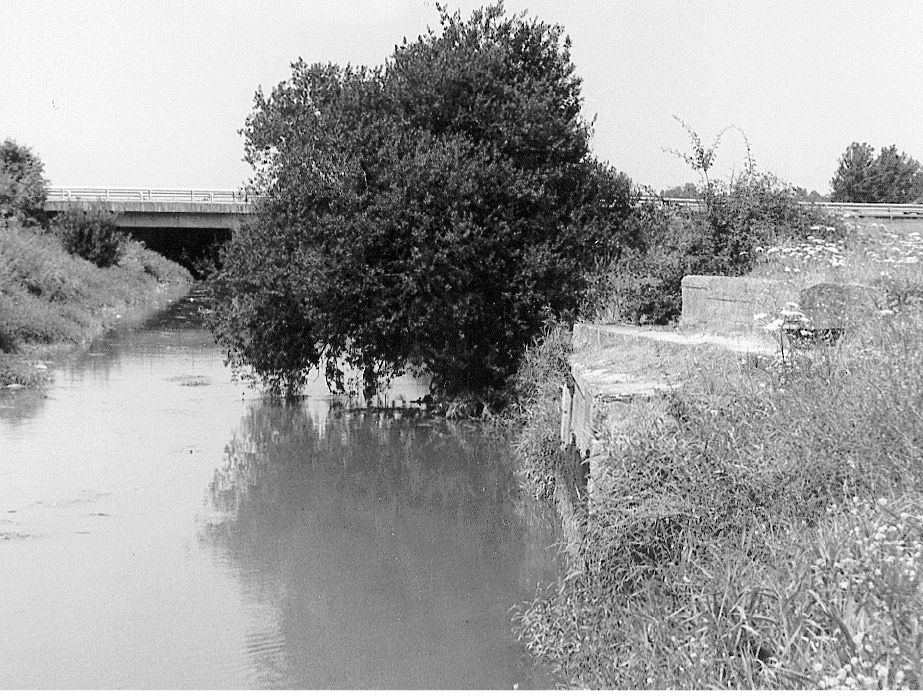
5) Site of Bures 80ft (24.38m) Steel Lattice Girder Railway Bridge. Although the 80ft (24.38m) steel lattice girder railway bridge and railway line no longer exist, part of the bridges concrete foundations are clearly evident today on the east bank of the river. This is all that remains of the second bridge Captain Juckes and No. 2 Troop 3 Para Sqn RE were tasked with destroying on D-Day.
The railway signalman’s house is still visible and located 35 yards (32m) from the west bank of the river. Some 100 yards (91m) farther downstream, beyond the remnants of the railway bridge, you can see the bridge carrying the Autoroute de Normandie (A13) over the River Dives.
In the early hours of 6 June, as Captain Juckes and his men approached the village of Bures, they heard the massive explosion caused by Major Roseveare’s detonation of the General Wade charges at the bridge near Troarn. When they reached Bures, at approximately 0545hrs, they were met by a Trowbridge party from 8 Para led by Captain Charles Shoppee. This group had also been dropped in the wrong place and landed some 1.5 miles (2.41km) to the north near Bricqueville. After landing, they made straight for the bridges at Bures to reconnoitre the area.
A recce patrol from 8 Para also arrived at Bures around this time. A runner was then sent to bring up a platoon to provide further protection for the Royal Engineers and also to bring the jeeps with RE stores. By 0630hrs Captain Juckes had arrived at the bridges, completing their 2 mile (3.22km) journey with their heavily loaded trolleys from 8 Para’s Firm Base at the crossroads.

RAF reconnaissance photograph showing the 80ft (24.38m) steel lattice girder railway bridge over the River Dives at Bures.
Stone support pillar, all that remains of the railway bridge at Bures. In the distance is a new bridge that is part of the Autoroute de Normandie (A 13).
The 80ft (24.38m) bridge was a steel lattice girder bridge and used primarily, like the concrete bridge that has replaced it today, as a farm track. Captain Juckes split his group, totalling about one and a half sections, into two parties. Lieutenant John Shave and one section of No. 2 Troop started arranging the demolition charges at this bridge, Captain Juckes, with Lieutenant Alan Forster and the remaining men of No. 2 Troop, went to deal with the railway bridge. This was located some 450 yards (411m), downstream. While this, too, was an 80ft (24.38m) steel lattice girder bridge, it was of heavier construction so that it could withstand the railway line.
In the meantime men of No. 1 Troop were on guard to provide local protection for the engineers while they went about their tasks. Lieutenant George Anthony ‘Tony’ Wade was sent back to help find Lieutenant Andrew Lack and his trolley party. They had fallen behind due to several of the sappers having sustained injuries at the DZ. On his journey he met some of No. 1 Troop in a jeep and trailer. They had landed on the correct DZ/LZ K, along with some of 8 Para. The CO of 8 Para, Lieutenant Colonel Alastair Pearson, had sent the men to Bures with the extra supplies after hearing that Captain Juckes was there.
Lieutenant Wade took the jeep and decided to proceed on to Troarn. However, some French locals alerted him to the fact that Troarn was occupied by the Germans and that he would not be able to get through. He decided to return to Bures with the Jeep and trailer and carried out a reconnaissance of the bridge near Troarn on foot which was just over 1 mile (1.61km) away. On his way to the bridge he came across the jeep and trailer that had been used by Major Roseveare and his men. He also found the bridge had been demolished across its central span. With no sign of any engineers he returned to Bures to report his findings.
Lieutenant Shave and his section had prepared the farm track bridge for demolition in just over thirty minutes. However, during their preparations Captain Juckes returned to report some complications had arisen and that detonation of the charges on the farm track bridge should wait until these had been resolved.
The first problem was that some 350 yards (320m) downstream, between the two bridges there was a crashed glider. This had landed and come to a halt on the embankment with part of the glider actually in the river. Inside there was one of the glider pilots, Sgt F Carpenter, with two broken legs. Also injured were gunners from 4 Airldg A Tk Bty that had been part of the three man crew travelling with the glider’s cargo of a jeep and 6pdr anti-tank gun. The remaining gun crew member and pilot, Capt J.M. Walker had tried to remove the jeep and trailer but without success. After ensuring the glider pilot and other casualties were as comfortable as possible, they left the scene and moved on towards their objective which had been LZ N.
The second problem was that the railway bridge was of an even heavier construction than had been anticipated. Captain Juckes decided that this bridge should be blown first and then, once that had been successful accomplished; they would withdraw over the farm track and then destroy the second bridge.
With the return of the jeep and trailer by Lieutenant Wade it was decided the jeep, now free of its cargo of explosives, could be used as a temporary ambulance to evacuate the glider pilot and gun crew. They were carefully extracted from the crashed glider and loaded onto the jeep and evacuated back to 8 Para, in the Bois de Bures, some 2 miles (3.22km) to the east, for further medical treatment.
With the farm track bridge ready for demolition, Lieutenant Shave and his men initially tried to salvage the anti-tank gun and jeep from the glider. But, despite working for over an hour trying to untangle the lashing chains, they were unable to free the cargo from the half-submerged glider. Instead, Lieutenant Shave and his men moved to help form part of the defences around the area while Captain Juckes and his team completed final preparations for the demolition of the railway bridge.
At just after 0900hrs Captain Juckes ordered everyone back over to the west side of the River Dives across the farm track bridge. Only Lieutenant Alan Forster remained on the east side ready to detonate the charges. Men were sent to evacuate the local inhabitants of the houses and farm buildings near the river and move them towards the centre of the village. Captain Juckes also allowed a local farmer to move some cattle from the fields back into the village.
Once the area was clear Lieutenant Forster detonated the explosives. A terrific explosion announced the demolition of the railway bridge. After inspecting the damage and ensuring the bridge was destroyed, Lieutenant Forster returned to the farm track bridge and withdrew to the west side of the River Dives.
Lieutenant Shave then detonated the charges on the farm track bridge. Also destroyed and sunk was a steel punt that was anchored in the river. By 0930hrs the engineers had successfully completed another of their objectives. In his book, ‘Go To It’ The Story of the 3rd Parachute Squadron RE, published after his promotion to Major, Lieutenant Shave recalls the timing; this was some four hours later than we had hoped, but in view of the unexpected events, we thought quite justifiable.
With his primary objective achieved, Captain Juckes decided his men needed some sustenance before they moved off. With sentries still posted, to guard the village, Captain Juckes ordered his men to sit down in the street, brew up some tea and have breakfast from their ration packs. For half an hour the men relaxed, smoked, ate and chatted between themselves almost as though they had just completed a training exercise back in the UK. Not everyone was so relaxed about the situation:
While we were smoking and talking, the villagers, who by now had lost their first shyness, were very anxious lest in our seeming folly we should allow the ‘Salles Boches’ to fall upon us and destroy us. [Captain] ‘Tim’ [Juckes], however, was fully aware of the risk and knew it was outweighed by the need for a short rest.
LIEUTENANT JOHN S.R. SHAVE, COMMANDER, NO. 6 SECTION
NO. 2 TROOP 3 PARA SQN RE
Once rested, the men of 3 Para Sqn RE moved off towards the Bois de Bures to search out 8 Para HQ. The troops from 8 Para remained in the village. Captain Juckes went on ahead in one of the jeeps and reported to the CO of 8 Para, Lieutenant Colonel Alastair Pearson, at 1000hrs.
Lieutenant Colonel Pearson organised a party and personally led them back to Bures in an attempt to salvage the jeep and anti-tank gun in the glider. This proved to be impossible and so they withdrew back to the Bois de Bures. By 1215hrs both Captain Juckes’ men and Lieutenant Colonel Pearson were back at battalion HQ.
The CO of 8 Para decided that an attempt should be made to widen the breach of the main road bridge at Troarn. The force, under the command of Captain Juckes, consisted of a demolition party with Lieutenant Tony Wade and six sappers from No. 1 Troop in a jeep and trailer. There was also a rearguard party led by Lieutenant Shave and No. 6 Section of No. 2 Troop, and a protection party formed by No. 9 Platoon of 8 Para commanded by Lieutenant William Brown. There was also a detachment of Royal Engineers, under the command of Sergeant Shrubsole, for added protection.
The party moved first east to Bures and then south down to Troarn, along the Route des Marais (D95) at the junction of the track leading south into Troarn (now called Rue du 6 Juin) a Firm Base was established for the demolition party and rearguard party.
Despite some warnings that were received from the local inhabitants and sniper fire from the Germans in the village, a decision was made to continue. The protection party from 8 Para pushed south into Troarn and reached the crossroads. Lieutenant Brown’s men then forced the Germans west through the village, while Sergeant Shrubsole’s detachment pushed east and down the hill towards the bridge. During the battle several German prisoners were taken and were later identified as being from 21 Panzer Division. Meanwhile, the rearguard party took up positions in the area, then an orchard, between the houses and the Firm Base.
Once the road was clear, the demolition party raced through Troarn in the jeep and trailer and down to the bridge. Charges were laid across the span next to the one already destroyed previously by Major Roseveare and his men. By 1500hrs, a second section was successfully demolished and one of the supporting piers almost completely destroyed. The gap in the bridge was now some 35-40ft (10.67-12.19m). The party also destroyed some boats and punts on the river but left the sluice as this did not allow any vehicle traffic. The demolition party then withdrew through Troarn via the route they had come and Captain Juckes force was back at 8 Para HQ by 1630hrs.
J. Robehomme
Drive back along Rue du Port and Rue du Capitaine Juckes and turn right onto Route des Marais (D95). Continue along for some 2.2 miles (3.54km) then turn right at the T junction onto the D224. Continue for 0.75 miles (1.21km) into Bricqueville. Follow the road through the village that bends round to the right and then after 100 yards (91m) it bends to the left. Continue for 700 yards (640m) and take the right-hand fork in the road (still the D224). Continue for 850 yards (777m) down this straight road until you reach the River Dives and the:
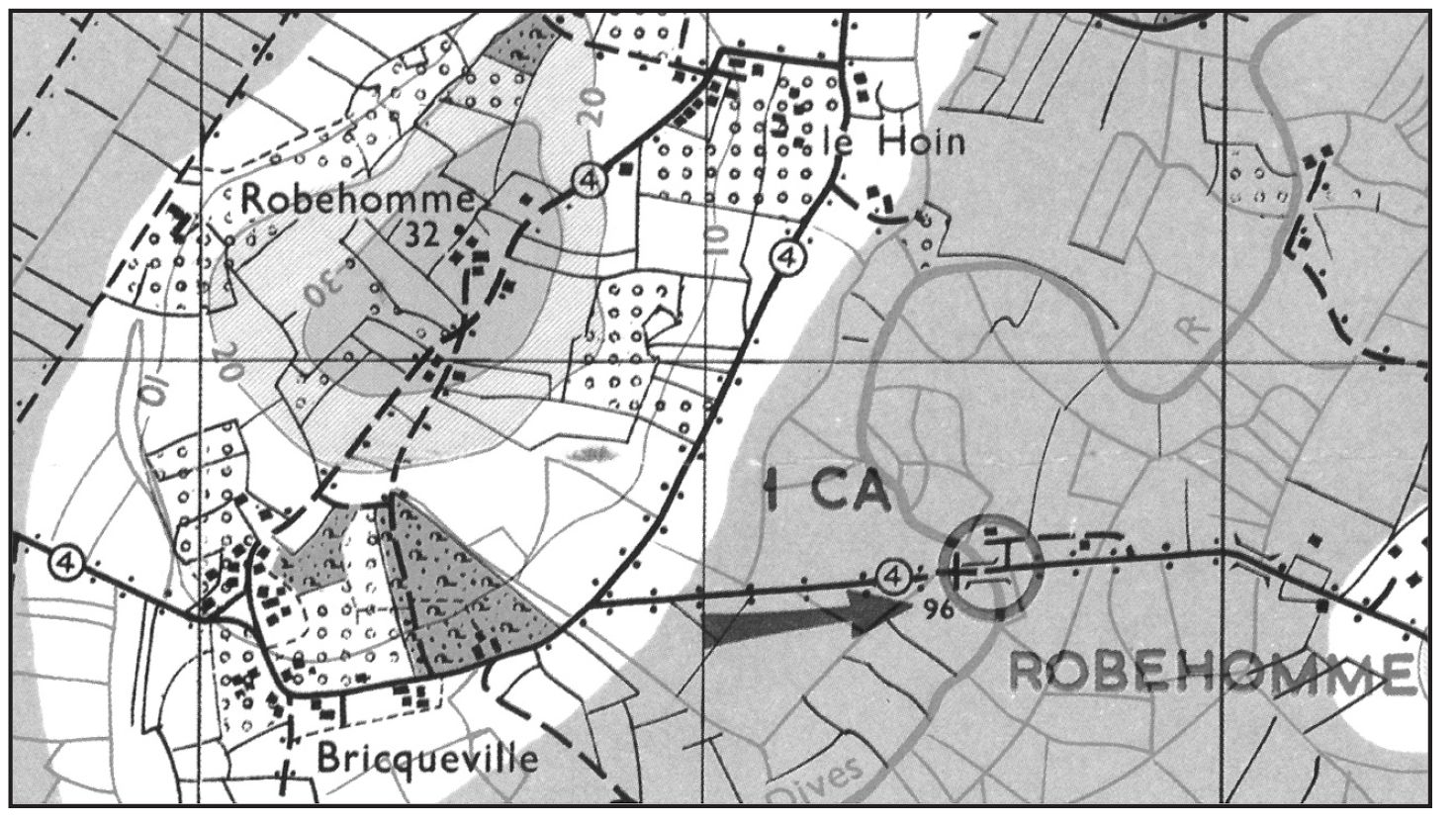
1) Site of Robehomme 80ft (24.38m) Steel Lattice Girder Bridge. Today a similar bridge has replaced the bridge destroyed by the engineers of No. 3 Troop 3 Para Sqn RE, under the command of Captain Geoff Smith and B Coy from 1 Cdn Para, in the early hours of D-Day. Although Robehomme is nearly 0.75 miles (1.21km) away it was the nearest main village to this bridge, hence the reason it is referred to as the Robehomme Bridge. On the brick wall on the south-west corner, before the bridge, there is:
2) Memorial Plaque to 3 Para Sqn RE and 1 Cdn Para. This memorial is dedicated to the men tasked with destroying this bridge over the River Dives, and Varaville Bridge just over 2 miles (3.22km) to the north over the River Divette. The troops were scheduled to land on DZ V located west of Varaville. The same DZ that 9 Para were designated. However, like 9 Para, men from 1 Cdn Para and 3 Para Sqn RE were spread over a much wider area. 3 Para Sqn RE later reported that the majority had been dropped 0.6 miles (0.97km) east of the DZ.
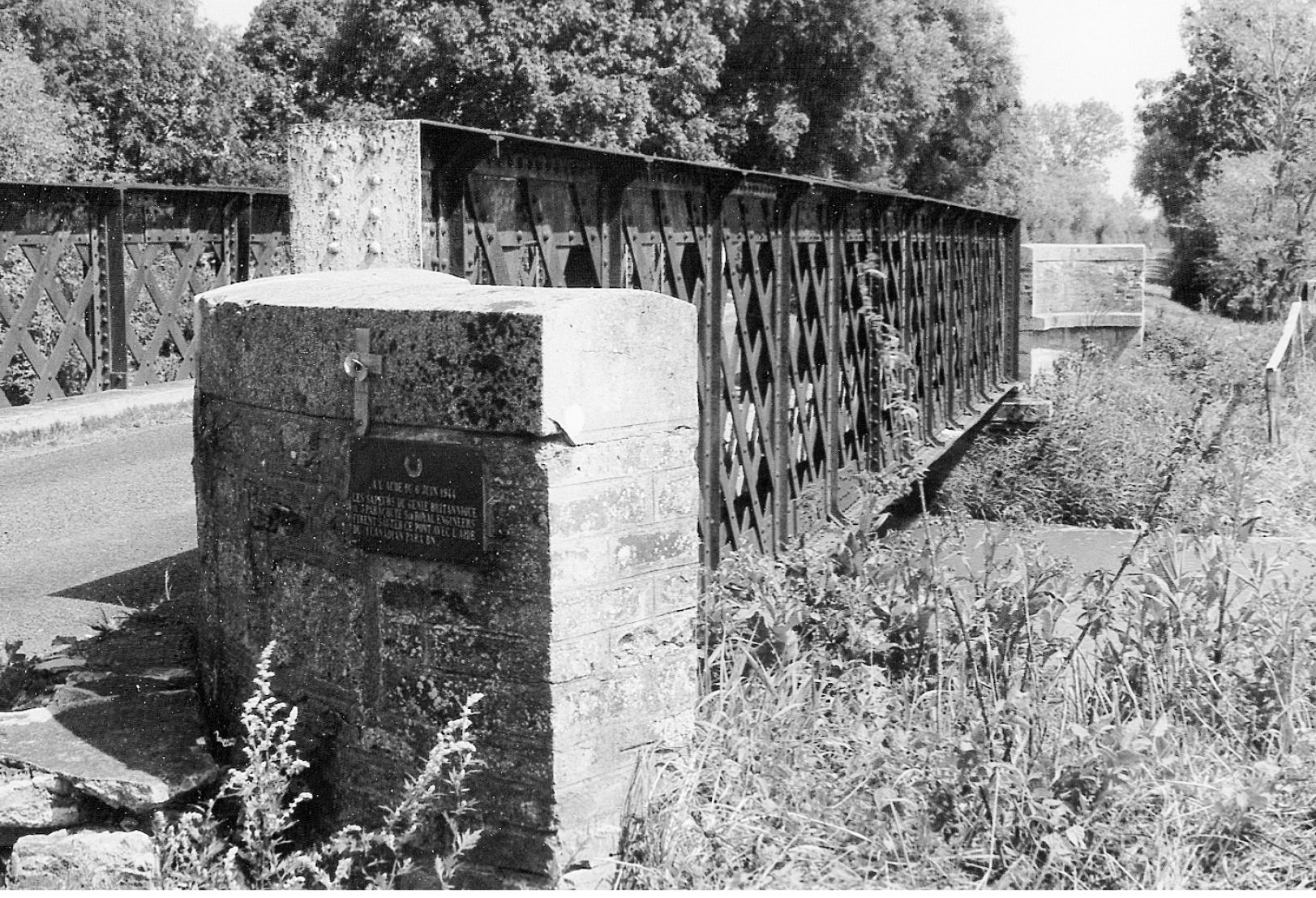
The 80ft (24.38m) steel lattice girder bridge that has replaced the one destroyed by 3 Para Sqn RE and 1 Cdn Para. On the south-west corner of the bridge is a memorial plaque.
In one instance, a pilot’s evasive action resulted in the paratroopers, from a small HQ party, being thrown to the floor of the aircraft, by the time they got to their feet and exited the aircraft the stick was spread from Varaville to Robehomme, a distance of over 1.8 miles (2.9km). Furthermore, because all the low-lying marshland around in this area had been flooded by the Germans, the majority of the men from 3 Para Sqn RE landed in water or on sodden ground.
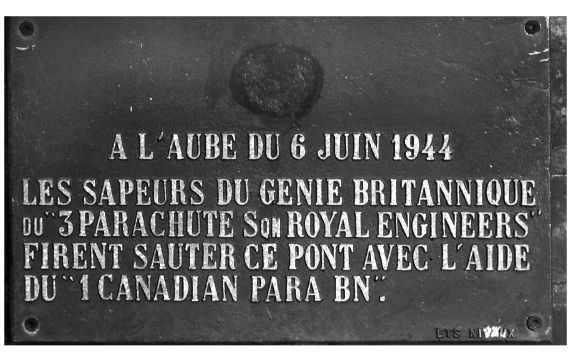
British intelligence had estimated that the depth of the flooded areas would be about 9 inches (22.86). In reality it proved to be about an average of 3ft (0.91m) in depth. There were also underwater hazards such as the drainage ditches to contend with. These could add an extra 6ft (1.83m) more to the depth. Many barbed wire entanglements had also been laid as part of Rommel’s defences against airborne operations. Any paratrooper who had the misfortune to land in the floods would almost certainly have jettisoned most of his equipment for fear of drowning. The floods also meant it was more difficult to locate the containers, carrying heavier equipment and explosives. However, the THOMAS illuminated locating devices they were fitted with, did offer some help as they had been designed to work underwater.
Lieutenant Jack Inman, No. 10 Section leader from No. 3 Troop 3 Para Sqn RE, was fortunate to find three containers carrying explosives and to make contact with twelve sappers. They then proceeded towards Varaville and the bridge over the River Divette.
After navigating the crossing of several ditches he and his men arrived at the Varaville Bridge and were met by Lieutenant Edward ‘Ted’ Baillie, No. 9 Section leader from No. 3 Troop 3 Para Sqn RE. He was, however, on his own having not been able to locate the rest of his men from his stick.
Lieutenant Inman left five sappers and 200lbs (90.72kg) of explosives with Lieutenant Baillie. He took the remaining seven sappers and using a single trolley, began heading off towards Robehomme. In the southern part of Varaville Lieutenant Inman contacted the CO of No. 3 Troop, Captain Geoff Smith. Also with him was Lieutenant Beverley ‘Bev’ Holloway, CO of No. 11 Section of No. 3 Troop and three sappers.
Captain Smith went onto the bridge at Varaville (see Ch. 7, M6) while Lieutenant Inman, Lieutenant Holloway and the remaining seven sappers continued towards Robehomme. On reaching Petiville they obtained information that Bavent was occupied by the Germans, so the party took to the flooded fields. After 0.6 miles (0.97km), the trolley full of explosives was proving difficult to manage, so each man took a load and carried the explosives on their backs.
At 0900 hrs the party of seven men reached Robehomme where they made contact with Sergeant Bill Poole of 3 Troop 3 Para Sqn RE. He had landed near the bridge and had successfully managed to destroy it with the help of a number of Canadian paratroopers. Major Clayton Fuller, CO of B Coy 1 Cdn Para, had been one of the first to reach the bridge, along with his 2ic, Captain Peter Griffin and another thirty men from the battalion. Joining them soon after was Lieutenant Norman Toseland and a group of another twenty-nine men from B Coy. They had been guided safely through the marshes and German minefields, to the bridge, by a local French woman.
Although Sergeant Poole didn’t have any of the engineers’ explosives, he improvised by using the 2lbs (0.91kg) of plastic explosives some of the paratroopers carried for their No. 82 Gammon Grenade. He managed to collect approximately 30lbs (13.61kg) of explosives and placed it precisely where it would have most effect.
Major Fuller left to find 1 Cdn Para HQ while Captain Griffin and his men waited to see if any other Royal Engineers would arrive with additional explosives. At 0630hrs none had arrived so Sergeant Poole detonated the explosives and successfully destroyed the bridge.
A guard was set up at the bridge and the rest of the paratroopers moved to the high ground in the village of Robehomme some 0.7 miles (1.13km) away.
Lieutenant Inman, having spoken with Sergeant Poole, decided that after his men had taken a short rest he would continue down to the bridge and try to further extend the damage. At 1100hrs his party were preparing to blow two craters in the road next to the bridge when German infantry moved up on the other side of the river in several lorries. Although pinned down by the German fire, they managed to detonate the explosives and withdrew to Robehomme under the cover of their Bren gunners.
At Robehomme the Royal Engineers and Canadians dug in and prepared their defences. The high ground in the village gave them a good view of the surrounding countryside and area up to the bridge they had just destroyed.
Drive back along the D224 for 850 yards (777m) until you reach the junction with the D95. Turn right onto Chemin de Bas (D95) and continue for 0.75 miles (1.21km) until you reach the road junction at le Hom:
3) Site of le Hom (aka le Hoin & le Hain) Objective.
By 7 June only one of the primary tasks for 3 Para Sqn RE had yet to be completed. This was the blowing of the culvert, a small bridge, at le Hom (referred to as le Hoin on the maps issued to the paratroopers and le Hain in the War Diaries).
This objective, however, was abandoned as the position could not be located due to the extensive flooding. Instead it was decided that two craters would be blown at this road junction as this would have the same effect on enemy movement. This lies some 850 yards (777m) north-east of the church at Robehomme. At 1600hrs on 7 June, Lance Sergeant Wren and seven sappers successfully made this junction unfit for traffic.
Continue along this road for a further 1.1 miles (1.77km), through la Londe and along Chemin de l’Anguille to the culvert, over the unnamed waterway. It is most likely that this is the culvert that the Royal Engineer paratroopers were tasked with destroying but were unable to locate because of the floods. This however cannot be confirmed as the map reference on the orders issued incorrectly placed the culvert some 150 yards (137m) to the north-east in a place where there is no roadway or culvert.
Return to the junction at le Hom and turn right onto Rue du Robehomme. Continue for 900 yards (823m) until you reach:
4) Robehomme Church. It was on this hill, just south of the church that Lieutenant F. Williams landed. He was the last man out of the aircraft with the small HQ party from 3 Para Sqn RE, that had been dropped in the stick that extended for over 1.8 miles (2.9km) between Robehomme and Varaville.
His experience, and the problems encountered as a result of his poor drop, was similar to many other paratroopers that night. After landing he managed to contact two sappers and initially proceeded, due north, towards the bridge over the River Divette in Varaville. However, because of the flooded marshland in the Dives valley, he had to first head east via Bavent. Finding this village held by the Germans, he decided to head south and then west, through the Bois de Bures and towards le Mesnil. Picking up stragglers from 8 Para, 13 Para and 1 Cdn Para along the way, He finally made it to 3 Para Bde HQ at 0900hrs, after a journey of over 4 miles (6.44km).
The task of holding the high feature of Robehomme had been assigned to B Coy 1 Cdn Para, along with a section from No. 3 Troop 3 Para Sqn RE. The church spire here in Robehomme was used as an OP by 1 Cdn Para, as it offered an excellent view of the surrounding countryside. Beside the road on a wall to the left of the church, there is:

Robehomme Church and Memorial plaques.
5) Robehomme Memorial
Plaque. This bronze plaque was dedicated in June 1997, to the inhabitants of Robehomme, by the veterans of 1 Cdn Para. The plaque also acknowledges the work of the Royal Engineers and was given to the village in gratitude to the citizens of the Bavent area for the risks they took to assist the battalion. To the right of the plaque there is a seat bench. On the backrest there is a:
6) 1 Cdn Para Memorial Plaque. This plaque dedicates this seat to all ranks of 1 Cdn Para who gave their lives for freedom while serving with 3 Para Bde.
There were no Germans in the village when elements of 1 Cdn Para first entered Robehomme, although there were several skirmishes throughout the day as the Germans attempted to infiltrate the village. The nearby school building, to the left of the church, was turned into a temporary dressing station by the medical orderlies.
By midday on D-Day the strength of troops at Robehomme was about 120 men all ranks and made up of both British engineers and British and Canadian paratroopers. The village was secured and guarded by using available cover or by digging slit trenches.
During the day an attempt was made by some men from 1 Cdn Para to recover a jeep and trailer from a nearby glider. This had crash-landed in 3ft (0.91m) of water just over 900 yards (823m) away to the south-south-west of Robehomme Church and just to the east of Bricqueville. However, initial attempts were frustrated by enemy fire.
A detachment of thirty-two men from 12 Para also made an attempt to move through the village of Bavent, but they were captured. The OP in the church spire allowed the Canadians to observe the Germans’ movement along the road (D27), some 2 miles (3.22km) to the north-east, between the bridge over the River Dives and the bridge over the Divette at Varaville. This went on for many hours with the Germans bringing infantry and artillery up towards Varaville. Unfortunately, with no radio equipment 1 Cdn Para were unable to relay details of enemy movement to 3 Para Bde HQ at le Mesnil. With the Germans holding Bavent, the troops here were almost completely isolated.
By 7 June Captain Griffin had organised the mixed groups of sappers and paratroopers into three platoons. At noon a reconnaissance party was also despatched to establish a safe route to battalion HQ at le Mesnil. The beleaguered troops at Robehomme did slowly grow in strength, as throughout the day stragglers continued to find their way to the village. This brought the total number up to over 150 all ranks.
An attack on Bavent was launched, but proved unsuccessful. In the meantime Lance Corporal Hill led another party, at 0100hrs, in another attempt to salvage the equipment from the nearby crashed glider. This attempt proved more successful and the group returned with much of the equipment from the glider seven hours later.
As Lance Sergeant Wren was blowing the road junction to the north-east at le Hom, the two remaining roads leading up to the village from the south-south-west were also being blocked. Situated approximately 600 yards (549m) from the church, road blocks were created using rows of Mk V anti-tank mines, thus denying the use of the road to any enemy vehicles.
At 2000hrs the reconnaissance party returned from le Mesnil, reporting the route clear of enemy. They also returned with orders to prepare for withdrawal to battalion and brigade HQ. Lieutenant I. Wilson, IO for 1 Cdn Para, came to guide the party back. Sappers were immediately sent out to lift the anti-tank mine road blocks. In addition, a German machine-gun post situated just over a mile away to the south-west of Robehomme, and south of Bavent, was dealt with at 2300hrs by one of the Canadian platoons.
At 2330hrs the paratroopers, now 162 men strong, began their withdrawal from Robehomme. They began by heading down the hill towards Bricqueville. To transport the wounded the local parish priest had given the paratroopers his car. In addition a local farmer also gave the troops his horse and cart. There were many occasions where the local inhabitants took risks to help the airborne troops. This generosity and kindness by the local people did not go unnoticed, even at the highest level:
Here is an incident, one of many, which I think indicates the courage of the French. A farmer who had been very badly wounded by a bomb splinter during the bombing by the British aircraft impressed everybody, not so much by his courage, which was remarkable, as by his attitude towards the bombing of his home; ’C’était terrible,’ he said. ‘Mais je sais bien que cétait necessaire. Il faut souffrir pour nous débarasser des Boches.’ There was no word of recrimination against the British; and when we had to evacuate the position, and leave him behind because he was too ill to be moved, they were all sad indeed.
MAJOR GENERAL RICHARD GALE, GOC, 6TH AIRBORNE DIVISION
When the paratroopers passed through Bricqueville they were challenged by German sentries. A firefight ensued during which seven Germans were killed and another was wounded. The wounded German was put on the cart along with the Canadian wounded and the group moved on.
Shortly afterwards, along the road from Bavent, the leading platoon ambushed a German staff car killing four of the officer occupants. The party continued through the Bois du Bavent until they reached 3 Para Bde HQ at le Mesnil at 0330hrs in the morning of 8 June.
Robehomme was again reoccupied by the Germans. It would remain in enemy hands until 17 August when it was liberated in the start of Operation PADDLE.
Continue along Rue du Robehomme, after 180 yards (165m) you reach a crossroads. Continue straight on along Rue de Sources and after 425 yards (389m) there, on your left-hand side, there is a small lane. It is this junction, and at the junction with the Chemin de la Vieille Cavée some 170 yards (155m) along this lane, that the engineers laid their anti-tank mines across the road to deny the Germans access to Robehomme via the road.
Continue for a further 375 yards (343m), following the road around to the left, until you reach the junction with the D224 in Bricqueville. Turn right and drive for 0.75 miles (1.21km) until you reach the T junction with the D95.
K. Bavent
Turn right at the junction onto the D95 and then, after 180 yards (165m) take the next left onto the Rue de Marais (D224). Drive for 770 yards (704m) and on your left you will see Bavent Church. Continue along the road, now Rue du Lavoir past the church and park on the right near the pond. This area is called:
1) Place Alexandre Lofi. The area is named in honour of Second Lieutenant (aka Enseigne de Vaisseau, naval equivalent of Sub Lieutenant, army equivalent of Second Lieutenant) Alexandre Lofi. He was a French officer that commanded the seventy-one men of No. 8 (French) Troop of 1 BFM Cdo. Between 9 June and 13 July, while Commandant Phillipe Kieffer was being treated for his wounds, Second Lieutenant Lofi was appointed commander of 1 BFM Cdo.
On 17 August during Operation PADDLE, 1 BFMC, attached to 4 Cdo of 1 SS Bde, helped liberate Bavent and Robehomme. To the right, just before the pond there is a:
2) Memorial to 1 SS Bde. This memorial is dedicated to 3 Cdo, 4 Cdo, 6 Cdo and 45 RM Cdo of 1 SS Bde. This memorial was dedicated in 1984, on the 40th Anniversary of the Normandy landings, to the memory of 1 SS Bde by the grateful population of Bavent and Robehomme.
By mid-August the commandos had been on the front line continuously for over two months. It had been initially believed that the commandos would be withdrawn to prepare for further special operations once the bridgehead had been established. However, such was the need for well trained soldiers that the commandos, like the airborne troops, remained at the front fighting alongside the regular infantry.
Return to your vehicle and drive back along Rue du Lavoir. Park your vehicle in the area Place de l’Eglise which is on your right just before:
3) Bavent Church and Churchyard. On the church wall there is the now familiar green and white Commonwealth War Grave sign. In the churchyard there is the grave of thirty-five year old Lieutenant David Haig-Thomas. His first regiment was the RASC, but he had joined the commandos and was attached to C Troop of 4 Cdo for the invasion of Normandy.
This was the only troop of 4 Cdo who wore the coveted airborne wings on their battledress. Lieutenant Haig-Thomas was assigned as liaison officer between the 6th Airborne Division and the commandos. He and his runner Private Ryder were the only two men of the troop to drop by parachute into Normandy. The remainder came in on landing craft on SWORD Beach.
Lieutenant Haig-Thomas was killed soon after landing, by a stick grenade, when ambushed by some Germans. He was a remarkable character having rowed three times for Cambridge University and also represented Great Britain in the 1932 Los Angeles Olympics. He was also a keen explorer, naturalist and wildlife photographer and had worked with the great British conservationist, artist and ornithologist, Peter Scott.
Retun to your vehicle and turn right onto Rue du Marais (D224) and then, after 50 yards (46m) take a left, opposite the church, down Rue du Champs. Some 320 yards (293m) on your left hand side is Bavent Cemetery. Inside there is a stone upon which there is a:
4) Memorial Marker for the Ashes of Brigadier Derek Mills-Roberts . The memorial marker, in a small area surrounded by a low small hedgerow, states that beneath this stone rest the ashes of Brigadier Derek Mills-Roberts CBE DSO and Bar MC Legion d’Honneur and Croix de Guerre with Palm.
Lieutenant Colonel Mills-Roberts was CO of 6 Cdo until 12 June. On this date he took over command of 1 SS Bde after Brigadier The Lord Lovat was wounded at Amfréville (see Ch. 6, B & C1). He was then also promoted to Brigadier. His commando memoirs were published in 1956 in a book called Clash By Night. He died, aged seventy-one years, on 1 October 1980.
L. Petiville
Continue to drive on Rue des Champs, along the single track for a further 450 yards (411m) until you reach the junction with Route de Troarn (D95) and then turn left and drive for 750 yards (685m) into Petiville. Alternatively, if the single track is not accessible, return, down the Rue des Champs, into Bavent, and turn left onto Rue du Marais (D224). Continue for 750 yards (686m) until you reach the T junction with the D95. Turn left and continue for 0.85 miles (1.37km) into Petiville.
At the T junction in Petiville turn right onto Rue de l’Eglise (D95), continue for 200 yards (183m) and pull into the parking area on your right. On the opposite side of the road, in front of Petiville Church, there is:
1) No. 3 Commando Memorial. This memorial is dedicated to the men of 3 Cdo, under the command of Lieutenant Colonel Peter Young DSO MC of 1 SS Bde, who liberated Petiville on 17 August 1944. This memorial was unveiled on 7 June 1994 on the 50th Anniversary of the Normandy landings.
M. Varaville
Return to your vehicle and continue along the Rue de L’Eglise (D95), past the church, and along Route de Varaville (D95) for just over 1.1 miles (1.77km) until you reach the junction with D513. On your right at this junction is a grey marble:
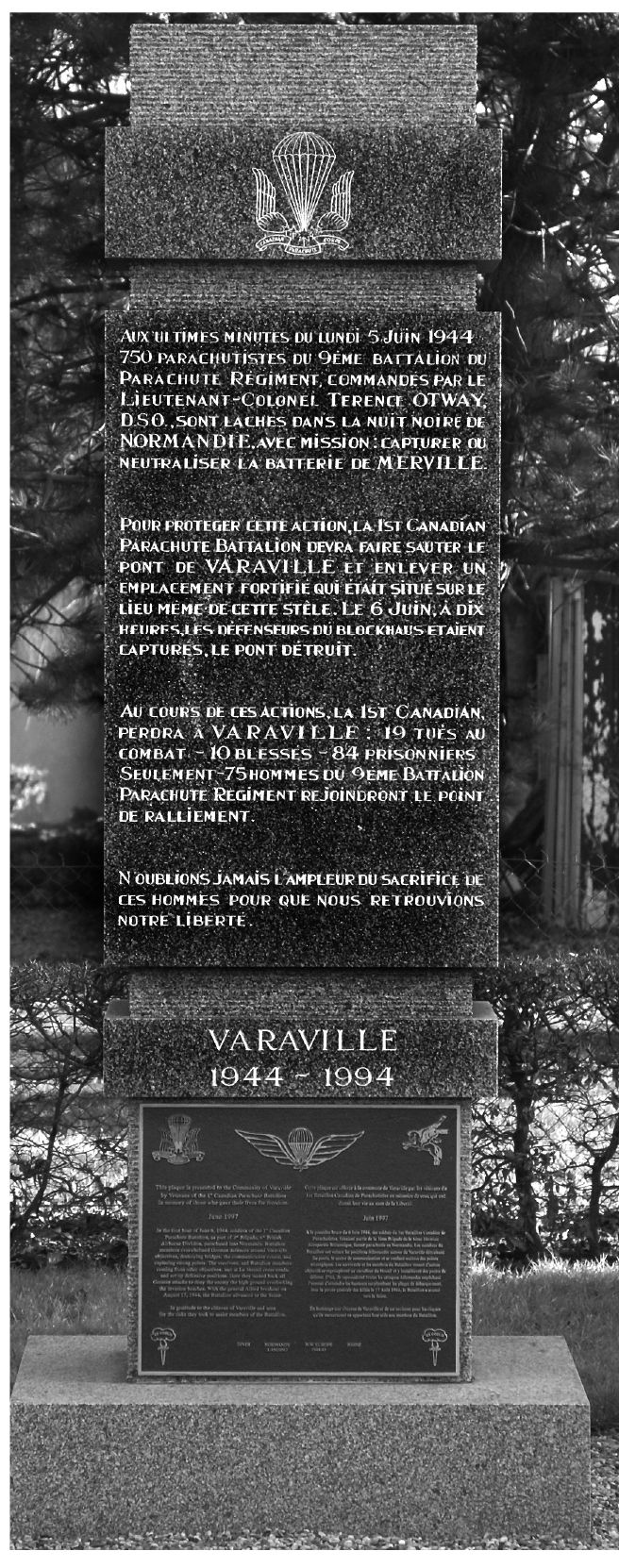
1) Memorial to 1 Cdn Para and 9 Para. This memorial was dedicated in June 1994, to the 750 men of 9 Para, under the command of Lieutenant Colonel Terence Otway DSO, who were to land near here with the task of neutralising the guns at the Merville Battery.
The memorial is also dedicated to 1 Cdn Para who were tasked with: protecting 9 Para as they advanced to the Merville Battery; helping destroy the bridge over the River Divette and attacking the German fortified strongpoint in Varaville.
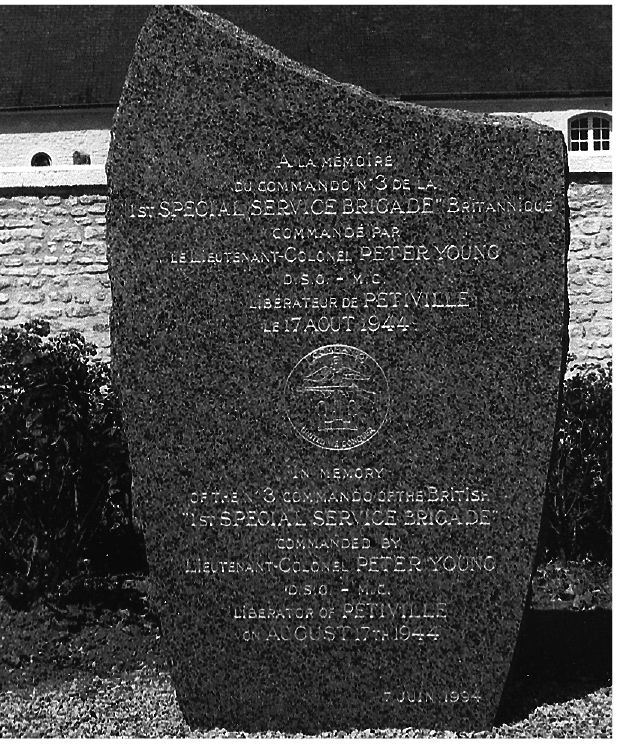
Petiville, 3 Cdo Memorial.
There is acknowledgement that this was all accomplished by 1000hrs (recorded as 1030hrs in the war diaries) on 6 June and that during the course of this action 1 Cdn Para lost nineteen men killed in action, ten wounded and eighty-four were taken prisoner. The inscription also mentions that 9 Para had only seventy-five men left after their attack (see Ch. 3 & 4) and that this sacrifice for the return of freedom should never be forgotten. On the base of the memorial there is a bronze:
2) Varaville Memorial Plaque. This plaque was dedicated in June 1997 to the community of Varaville by veterans of 1 Cdn Para. It was presented in gratitude of the risks the citizens of Varaville, and the surrounding area, took to assist members of the battalion during the Normandy Campaign.
Turn Right onto the D513 and after just 200 yards (183m) turn left onto the lane, heading south-west-west, that after 90 yards (82m) leads to:
3) Gatehouse for Château de Varaville. This gatehouse was the scene of some fierce fighting for the Canadians. C Coy 1 Cdn Para had been assigned the task of destroying a nearby German signal exchange, destroying the bridge over the River Divette at Varaville along with sappers of No. 3 Troop of 3 Para Sqn RE and neutralizing enemy positions in Varaville which would include the area in and around the Château de Varaville.
Only about thirty men from C Coy were actually dropped on DZ V, the rest were dispersed over a wider area. While some were within the general area of the DZ, others were dropped a considerable distance away. The 2ic of C Coy, Captain John Hanson, and his stick were dropped 10 miles (16.09km) from the DZ. Another stick landed on the west side of the River Orne and less than 1 mile (1.61 km) from the SWORD Beach.
C Coy had dropped before the main force of 1 Cdn Para along with the pathfinders from 22 (Ind) Para Coy, and a detachment from both 9 Para and 3 Para Bde HQ. This was done to allow C Coy time to secure the DZ. As a result of the dispersed drop C Coy was not able to meet at its RV. Instead the separate groups of paratroopers made their way towards Varaville and the château.
In the meantime, two sticks from 22 (Ind) Para Coy, commanded by Lieutenant Robert ‘Bobby’ E. V. de Latour, began setting up their navigational aids for the pilots carrying the main body of paratroopers from 9 Para and 1 Cdn Para. By 0040hrs at least one EUREKA was set up and a T set out on the ground using holophane lights and coding the letter V was also operational. The main drop commenced at 0050hrs, but would also be dispersed over a wide area.
Varaville Memorial Plaque.

Château de Varaville gatehouse.
Major Hugh MacLeod, CO of C Coy 1 Cdn Para, had landed near the north end of the DZ. Nearby his runner, Private Peter Bismutka, had also landed and the two men began to move towards their RV at the south-west side of the DZ. As they moved they were caught up in the bombing of the Merville Battery by the RAF. This had started at 0030hrs but some of the 100 Lancaster Bombers accidently dropped their 4,000lb (1814kg) bombs over or near the DZ.
Shaken, but fortunately sustaining no casualties from the unexpected bombing, Major MacLeod and his runner made it to the RV just after 0030hrs. Unfortunately, instead of the 100 or so men he had expected to meet at the RV only fifteen had made it. Among the group were Lieutenant Hugh Walker and Sergeant G. Davies. Instead of the heavily armed force of paratroopers equipped with machine-guns, mortars, explosives and anti-tank weapons, the group were equipped with only one PIAT, three sten guns, rifles and a pistol.
Nevertheless, Major MacLeod ordered Sergeant Davies to take his platoon up to the bridge over the River Divette in Varaville and set up defensive positions until the engineers arrived to blow the bridge. The rest of the men, under Major MacLeod, headed toward the gatehouse for the Château de Varaville. By securing the area around the château they would be protecting the DZ from any German attacks from Varaville.
The château was soon cleared and the men moved on to the gatehouse. This building overlooked a German strongpoint which was made up of an earth and concrete trench with machine-gun posts positioned at regular intervals. Positioned nearby was a pillbox with a 75mm (2.95in) anti-tank gun. Major MacLeod linked up with more men from C Coy as they approached the gatehouse. One group entered and searched the gatehouse finding it empty. However, it was clear from all the bunks that the Germans were using it as a barracks and had only recently vacated their beds to take up their action stations. The remaining men, under Lieutenant Walker, set up defences around the building and in a shallow ditch near the gatehouse.
Upon reaching the second floor of the gatehouse Major MacLeod looked out to observe the German defensive positions around their strongpoint. But his men had already been spotted by the Germans and within seconds an artillery round hit the building. Fortunately no one was injured. Major MacLeod called for Corporal Winslow Oikle to bring his PIAT up to the second floor. Lieutenant Walker and four other men also went up.
Cpl Oikle fired his PIAT at the concrete pillbox, but the round fell short. As he hastily reloaded the cumbersome weapon, the Germans retaliated with another round from the 75mm (2.95in) gun. A high-explosive round tore through the wall of the room in which the Canadians were taking cover. The PIAT ammunition exploded and twenty-one year old Lieutenant Walker, twenty year old Corporal Oikle, nineteen year old Private John Jowett and Private Leslie Neufeld were killed instantly. Major MacLeod and Private Bismutka were fatally wounded and Private Thompson lost part of his hand.
Memorial plaque to 1st Canadian Parachute Battalion at the Château de Varaville gatehouse.
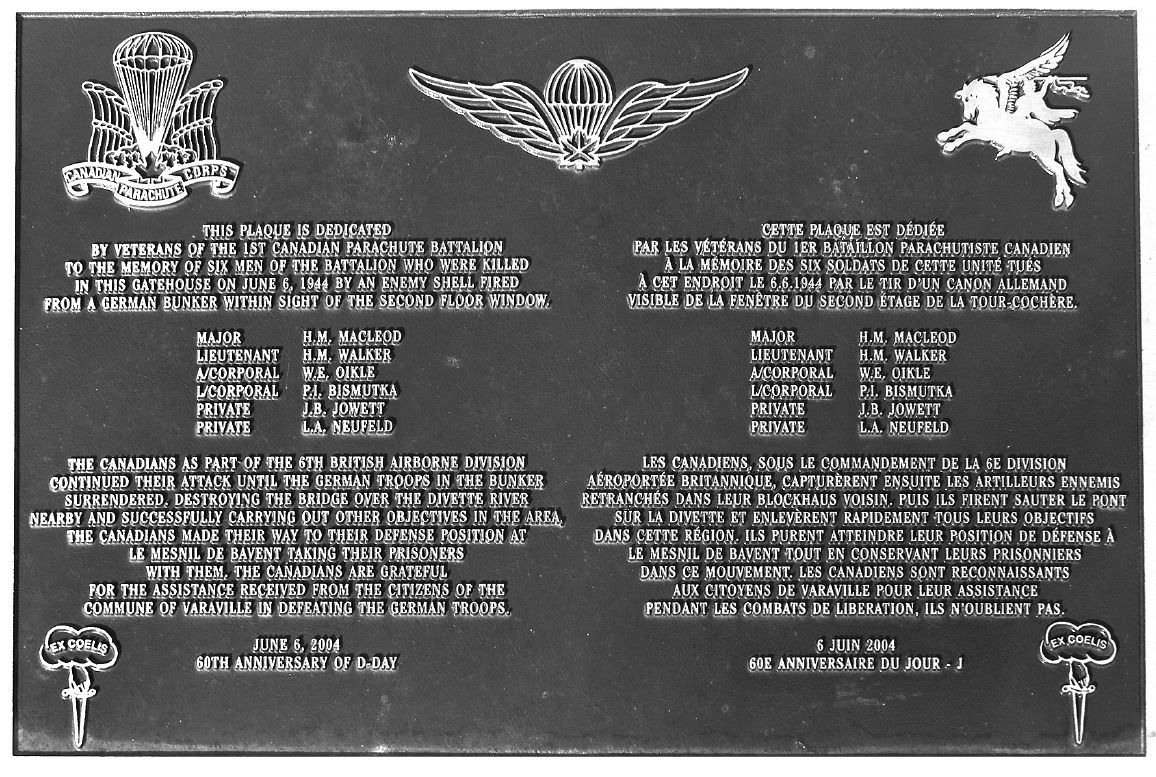
Private William S. Ducker, the medic, despite being under heavy fire, was able to evacuate the wounded with the help of Private Sylvester. Twenty-five year old Major MacLeod died within minutes, in the lap of Captain John Hanson who then assumed command of the group. Private Thompson and Private Bismutka were taken to the RAP that had been set up in the château. Private Bismutka died the following day. Twenty-two year old Private Ducker was awarded the MM for his action on D-Day. He was later wounded and died on 19 June 1944.
Major MacLeod and Lieutenant Walker now rest in Ranville CWGC Cemetery (VA, B, 1 and VA, B, 2). Private Bismutka rests in Bretteville-sur-Laize CWGC Cemetery (VII, B, 2) and Private Ducker rests in Hermanville CWGC Cemetery (1, W, 17). The bodies of Corporal Oikle and Privates’ Jowett and Neufeld were never recovered or later identified and have no known grave. Their names are inscribed on the CWGC Bayeux Memorial (Panel 27, Column 2).
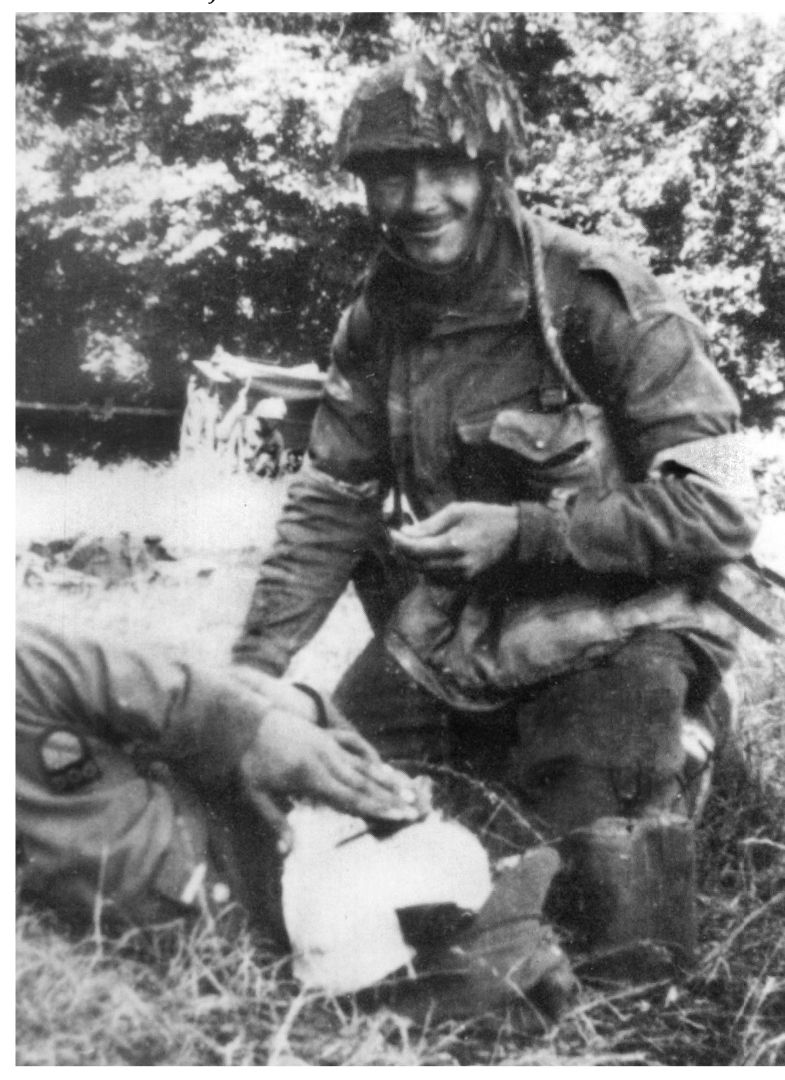
Private William Ducker tending a wounded German prisoner.
Further stragglers continued to arrive, bringing the total number of men at the gatehouse to over thirty. Although the group had lost the PIAT they had gained a machine-gun with the new arrivals. Later, Corporal Dan Hartigan also arrived with a 2inch (50.8mm) mortar.
Captain Hanson heard that Brigadier James Hill, CO 3 Para Bde, had arrived in Varaville after his miss-drop. He set off with his batman to meet the commander but was caught in a firefight. He was slightly wounded but his batman was killed. C Coy, with elements of brigade HQ and Royal Engineers, managed to take up defensive positions all around Varaville and also completely encircled the German strongpoint.

In the meantime Lieutenant McGowan and his platoon had landed some distance from the DZ, but on approaching Varaville they managed to ambush two German infantry sections that were attempting to enter the village. After suffering some casualties the German reinforcements surrendered. Lieutenant Samuel McGowan then moved his men to take up firing positions on the German strongpoint.
But the Canadians were not fighting the Germans alone. Their war diary records help from others:
During this time the local inhabitants were of great assistance, the women dressing wounds and the men offering assistance in any way. One Frenchman in particular distinguished himself. Upon being given a red beret and a rifle he killed three German snipers. This man subsequently guided the Brigade Commander and his party towards le Mesnil. Although I believe he was a casualty of the bombing attack that caught the party enroute to le Mesnil (see Ch. 4, AFTERMATH).
WAR DIARY, 1 CDN PARA, 6TH AIRBORNE DIVISION
Heavy sniping and mortar fire from the surrounding woods near Varaville continued to harass the Canadians as they continued their siege around the German strongpoint. At one point an enemy patrol, from outside the strongpoint, managed to re-enter the château, now a Canadian RAP, and captured all the wounded and medical staff. Despite a counter-attack by the Canadians the Germans managed to escape taking their prisoners with them.
At around 0830hrs a German, under a white flag, came out from the strongpoint to request evacuation of their wounded. Captain Hanson provided the Germans with a cart and soon some six or seven wounded, some walking, others in the cart, appeared on the lane between the château and the gatehouse. To everyone’s surprise, a German machine-gunner opened fire on his own men riddling the cart with bullets.
The siege continued amid sporadic mortaring, machine-gun and rifle fire. An hour or so later, Corporal Hartigan used a drainage ditch to crawl up, with his mortar, to within direct firing range of the German gun position. Using the trunk of a tree to stabilise the base of the mortar he held it near horizontal and fired off, in quick succession, four rounds into the emplacement. This he followed with several smoke bombs. Expecting a rapid response from the Germans, he quickly crawled back to the relative safety of a deeper ditch.
But the Germans had been worn down and sometime around 1030hrs a white flag appeared and forty-two German prisoners were taken. In addition four Canadians who had been captured by the Germans, having parachuted within the perimeter of the strongpoint, were released.
At 1500hrs leading elements of 6 Cdo arrived at Varaville. At 1730hrs C Coy 1 Cdn Para withdrew from Varaville and moved to their battalion HQ at le Mesnil. Some 15 yards (14m) in front, and to the left, of the gatehouse entrance there is:
4) 1 Cdn Para Memorial Plaque. This bronze plaque is dedicated to the six men of 1 Cdn Para, mentioned in this chapter, who were killed in this gatehouse by the enemy shell fired from a German bunker that was within sight of the second floor window.
This plaque was unveiled on 6 June 2004, on the 60th anniversary of D-Day. The memorial also pays tribute to the citizens from Varaville for the assistance 1 Cdn Para received in defeating the German troops.
Return to your vehicle and along the lane to the junction with the D513. Continue straight across the junction and along Avenue de la Libération (D27). Some 200 yards (183m) on your left there is:
5) Varaville Churchyard. It was in the grounds of the church that C Coy 1 Cdn Para set up their Company HQ. During the early hours of the morning they were able to stop at least one group of Germans from advancing through the village.
Continue for a further approximately 300 yards (274m) and you will cross over a small bridge over the River Divette. Find a safe place to park and return to the bridge. This is:
6) Site of Varaville’s Small Masonry Single Span Bridge. This bridge has replaced the bridge destroyed by the engineers of No. 3 Troop, 3 Para Sqn RE, under the command of section leader Lieutenant Edward ‘Ted’ Baillie of No. 3 Troop and C Coy from 1 Cdn Para in the early hours of D-Day. On the west side of the bridge, just below the sign for the river, La Divette, there is a marble stone upon which is mounted a red:

The River Divette Bridge in Varaville.
7) Memorial Plaque to 3 Para Sqn RE and 1 Cdn Para. This memorial is dedicated to the engineers and Canadians for successfully destroying the bridge here over the River Divette.
The first engineer to arrive at the bridge had been section leader Lieutenant Ted Baillie. Soon after another section leader, Lieutenant Inman, from No. 3 Troop arrived. He was also accompanied by some other engineers and a supply of explosives. He left five sappers and 200lbs (183kg) of explosives before he continued, with his remaining men, on to Robehomme.
Captain Geoff Smith had made it to the bridge as did a sergeant and his platoon from 1 Cdn Para. While the Canadian paratroopers provided a defence for the engineers, No. 3 Troop successfully blew a 15ft (4.57m) gap in the bridge.
The area around the demolished bridges could not be held and covered due to the shortage of troops. Eventually the Germans were able to cross the River Dives and River Divette, after they had made some repairs or constructed temporary bridges.
Nevertheless, the primary objectives for the Royal Engineers from 3 Para Sqn and the paratroopers from 1 Cdn Para, were all completed. There is no question that these operations were successful in delaying the Germans from reinforcing and building up their forces in the area of operations of the 6th Airborne Division. Most importantly, during the crucial first twenty-four hours while the Allies established their bridgehead.

Memorial plaque to 3 Para Sqn and 1 Cdn Para by the bridge over the River Divette in Varaville.
This concludes the tour of the bridges in the Dives valley that were to be destroyed by 3 Para Sqn RE. However, you may wish to use Varaville as the starting point for two extra stops that are listed in the next and final chapter.