
CHAPTER 25
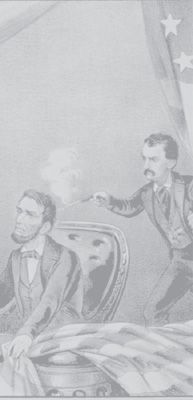
A Currier and Ives lithograph of the assassination of Abraham Lincoln.
“An eclipse,” declared a Boston minister on Easter Sunday 1865, “seems to have come upon the brilliancy of the flag .... The sun is less bright than before .... It is manly to weep today.” The words spoke for untold hundreds of thousands of mourners throughout the North, suddenly plunged into profound shock by the assassination of Abraham Lincoln on Good Friday. The attack, and the vigil at the President’s deathbed, tracked by the press in special bulletins and editions, doused the joyful public mood that had inspired wild celebrations in the week since Lee’s surrender at Appomattox. “The bonfires of exultation which the night before lighted up the streets of many of our cities, as if in anticipation of the terrible event,” another preacher observed, “left their ashes and blackened embers ... in readiness for the general sorrow.” As one contemporary remembered: “Business stopped; hearts throbbed almost audibly; knots of men congregated on the streets; telegraph offices were thronged by anxious faces; and all were incredulous that such a stupendous, nefarious transaction had occurred in America.”
But occur it did, and while Lincoln’s murder was lamented as the gravest tragedy in the nation’s history, it also became the century’s biggest news story. The Times did not shrink from its journalistic responsibility during the crisis, whether events occurred in Washington, along the assassin’s escape route, or outside its own headquarters in New York. The paper responded with an outburst of energetic, detailed reporting, wild but understandable speculation, and mournful editorials, never flagging in energy or attention to detail.
Nearly — but not quite — ignored in the wake of the immense tragedy were concurrent events that in fact did signal the closing chapters of the Civil War. On April 26, Confederate General Joseph E. Johnston surrendered his army at the Bennett House near Durham, North Carolina. Though for all intents and purposes Johnston’s surrender ended the active fighting, it received far less attention in the press (and a far less venerated place in Civil War mythology) than Appomattox. Its relatively minor place in history was probably guaranteed when the two opposing generals required not one, but three meetings to iron out surrender terms, after the War Department rejected Sherman’s original agreement because it embraced too many political issues outside his jurisdiction.
No story, however important, could possibly eclipse that of the President’s sudden death, at the peak of his popularity and success, or the nation’s unprecedented response. Not long before he ventured to Ford’s Theatre that Good Friday evening, Lincoln had met with General James Van Alen, who offered what turned out to be a prophetic warning about his safety. The President promised to “guard his life,” Van Alen remembered, and “not expose it to assassination as he had by going to Richmond” a few days before. In a written note — one of the last he ever wrote — Lincoln assured the general: “I intend to adopt the advice of my friends and use due precaution.”
But he did not. That afternoon, he took a long carriage ride with his wife. “He was almost boyish, in his mirth,” Mary Lincoln remembered. “I never saw him so surpassingly cheerful.” They spoke of their shared hope for a happier future, visited an ironclad warship and crew recently returned to the Washington Navy Yard, then returned to the White House to dress for the theater. The Lincolns arrived after the play had begun, acknowledged the cheers of the audience, and bowed to an impromptu rendition of “Hail to the Chief” by the orchestra. Then they took their seats in a special, patriotically decorated box directly above stage left, and held hands to watch an English comedy called Our American Cousin. Shortly after 10 p.m., John Wilkes Booth, an actor and Confederate sympathizer — a onetime Confederate agent of sorts, too — crept into the box and shot Lincoln point-blank in the back of the head. The President never regained consciousness, and died the following morning at 7:22 a.m.
Only three days before he attacked the President, Booth had joined a crowd on the White House lawn to hear Lincoln deliver what quickly became known as his final address — but, more to the point, was his first major speech since the end of the war, and the first on Reconstruction. As the racist Booth listened, the President suggested enfranchising African-Americans — if only the “very intelligent,” and “those who serve our cause as soldiers.” No American president had ever before spoken publicly of black voting rights, and hearing those words, Booth turned to a companion in a fury. “That means nigger citizenship,” he growled. “Now, by God, I will put him through. That will be the last speech he will ever make.” It was.
A celebrity in his own right, Booth was recognized by the theatergoers the night he killed Lincoln at Ford’s, and though the ensuing manhunt was one of the largest ever undertaken to capture a criminal, the assassin eluded capture for days, transfixing the reading public. Newspapers overflowed with conjecture about whether Booth had been inspired or directed by the Confederate government, perhaps by Jefferson Davis himself.
As for Davis, his end was as inglorious as Lincoln’s was sublime. Pursued by federal troops after escaping Richmond with his wife, the Confederacy’s first and only President was captured after attempting to flee captors while wearing Mrs. Davis’s raglan-sleeved raincoat. For years, Varina Davis insisted she had thrown the garment on her husband only to assure he would be warm if he escaped. But the Northern press and cartoonists had a field day reporting that the starchy Southern gentleman had tried to flee wearing women’s clothes — later exaggerated to include a petticoat! Four years earlier, The Times had published (and embellished) the report that Abraham Lincoln had begun his presidency by sneaking into his capital in disguise. Now it noted that his Confederate counterpart had ended his presidency by fleeing his capital in disguise. As Davis became a comic figure, the once-controversial Lincoln was transfigured into a revered one.
As Mary Lincoln was led from her husband’s deathbed to a carriage waiting to take her back to the White House, she glanced at Ford’s Theatre across the street and wailed: “That dreadful house! That dreadful house!” But the horror at the theatre had elevated its famous victim to martyrdom. Lincoln had become one of 620,000 casualties to die in the fight to preserve the national house. Back in 1858, he had invoked a biblical passage to warn: “A house divided against itself cannot stand.” History had proven him right. Now, though “drenched ... in blood and tears,” as The Times put it, the house was again reunited.
AWFUL EVENT
PRESIDENT LINCOLN SHOT BY AN ASSASSIN.
THE DEED DONE AT FORD’S THEATRE LAST NIGHT.
THE ACT OF A DESPERATE REBEL.
APRIL 15
[OFFICIAL.] WAR DEPARTMENT, WASHINGTON, APRIL 15 — 1:30 A.M.
Maj.-Gen. Dix:
The assassin then leaped upon the stage, brandishing a large dagger or knife, and made his escape in the rear of the theatre.
The pistol ball entered the back of the President’s head and penetrated nearly through the head. The wound is mortal. The President has been insensible ever since it was inflicted, and is now dying.
About the same hour an assassin, whether the same or not, entered Mr. SEWARD’s apartments, and under the pretence of having a prescription, was shown to the Secretary’s sick chamber. The assassin immediately rushed to the bed, and inflicted two or three stabs on the throat and two on the face. It is hoped the wounds may not be mortal. My apprehension is that they will prove fatal.
The nurse alarmed Mr. FREDERICK SEWARD,2 who was in an adjoining room, and hastened to the door of his father’s room, when he met the assassin, who inflicted upon him one or more dangerous wounds. The recovery of FREDERICK SEWARD is doubtful.
It is not probable that the President will live throughout the night.
Gen. GRANT and wife were advertised to be at the theatre this evening, but he started to Burlington at 6 o’clock this evening.
At a Cabinet meeting at which Gen. GRANT was present, the subject of the state of the country and the prospect of a speedy peace was discussed. The President was very cheerful and hopeful, and spoke very kindly of Gen. LEE and others of the Confederacy, and of the establishment of government in Virginia.
All the members of the Cabinet except Mr. SEWARD, are now in attendance upon the President.
I have seen Mr. SEWARD, but he and FREDERICK were both unconscious.
EDWlN M. STANTON,
SECRETARY OF WAR.
This evening at about 9:30 P.M., at Ford’s Theatre, the President, while sitting in his private box with Mrs. LINCOLN, Mrs. HARRIS, and Major RATHBURN,1 was shot by as assassin, who suddenly entered the box and approached behind the President.
1. The Lincolns’ theater guests that fateful night were Clara Harris and her stepbrother and fiancé, Major Henry Rathbone. They were later married.
2. Seward’s son had also served as his assistant secretary of state.
THE CONDITION OF THE PRESIDENT.
APRIL 15
WASHINGTON, APRIL 15 — 2:12 A.M.
The President is still alive; but he is growing weaker. The ball is lodged in his brain, three inches from where it entered the skull. He remains insensible, and his condition is utterly hopeless.
The Vice-President has been to see him; but all company, except the members of the Cabinet and of the family, is rigidly excluded.
Large crowds still continue in the street, as near to the house as the line of guards allows.
THE SUCCESSION.
MR. JOHNSON INAUGURATED AS PRESIDENT.
APRIL 16
WASHINGTON, SATURDAY, APRIL 15 — 12 A.M.
ANDREW JOHNSON was sworn into office as President of the United States by Chief-Justice CHASE, to-day, at eleven o’clock.
Secretary MCCULLOUGH and Attorney-General SPEED1, and others were present.
He remarked:
“The duties are mine. I will perform them, trusting in God.”
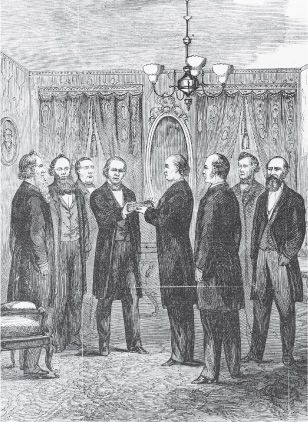
The swearing-in of new President Andrew Johnson.
1. Hugh McCullough (1808–1895) had been Lincoln’s third secretary of the treasury; James Speed (1812–1887) his second attorney general. Both continued in the Johnson administration.
OUR GREAT LOSS.
DEATH OF PRESIDENT LINCOLN.
THE SONGS OF VICTORY DROWNED IN SORROW.
APRIL 16
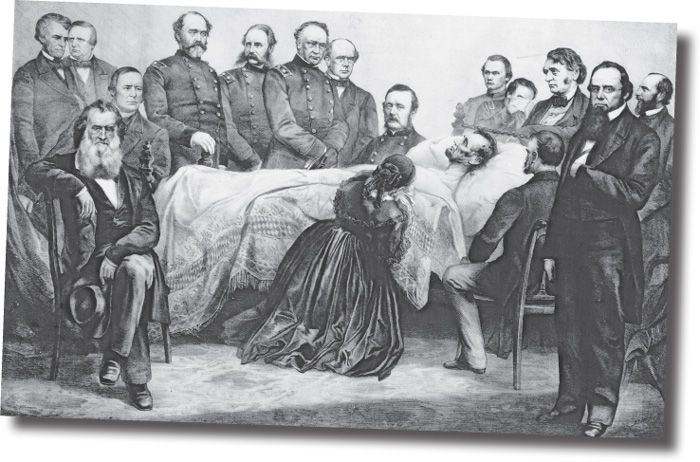
The deathbed of Abraham Lincoln, engraved by C.A. Asp, 1865.
WAR DEPARTMENT, WASHINGTON, APRIL 15
— 4:10 A.M.
To Major Gen. Dix:
The President continues insensible and is sinking.
Secretary SEWARD remains without change.
FREDERICK SEWARD’S Skull is fractured in two places, besides a severe cut upon the head.
The attendant is still alive, but hopeless. Maj. SEWARD’s wound is not dangerous.
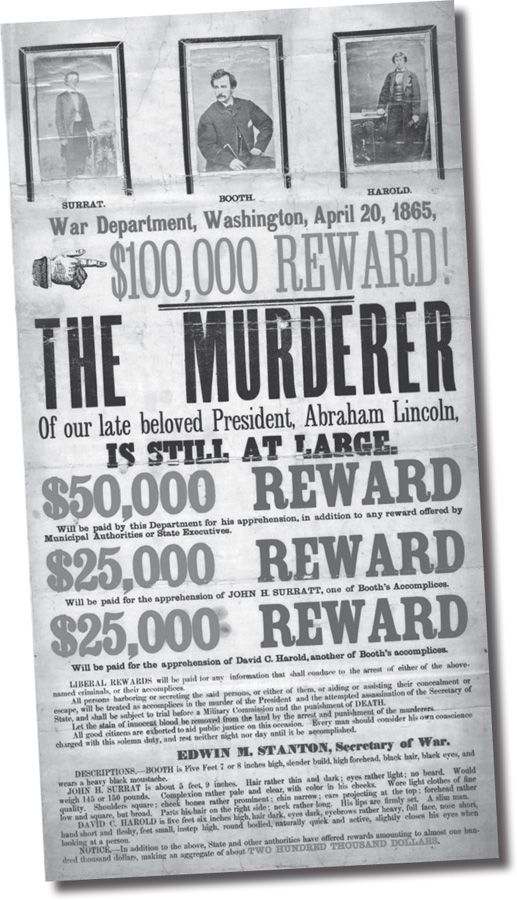
It is now ascertained with reasonable certainty that two assassins were engaged in the horrible crime, WILKES BOOTH being the one that shot the President, and the other companion of his whose name is not a known, but whose description is so clear that he can hardly escape. It appears from a letter found in BOOTH’s trunk that the murder was planned before the 4th of March, but fell through then because the accomplice backed out until “Richmond could be heard from.” BOOTH and his accomplice were at the livery stable at six o’clock last evening, and left there with their horses about ten o’clock, or shortly before that hour.
It would seem that they had for several days been seeking their chance, but for some unknown reason it was not carried into effect until last night.
One of them has evidently made his way to Baltimore — the other has not yet been traced.
EDWIN M. STANTON,
SECRETARY OF WAR.
WAR DEPARTMENT, WASHINGTON, APRIL 15
Major-Gen. Dix:
ABRAHAM LINCOLN died this morning at twenty-two minutes after seven o’clock.
EDWIN M. STANTON,
SECRETARY OF WAR.
THE ASSASSINS.
CIRCUMSTANCES TENDING TO INCULPATE G. H. [SIC] BOOTH.
APRIL 16,
WASHINGTON, SATURDAY, APRIL 15
There is no confirmation of the report that the murderer of the President has been arrested.
Among the circumstances tending to fix a participation in the crime on BOOTH, were letters found in his trunk, one of which, apparently from a lady, supplicated him to desist from the perilous undertaking in which he was about to embark, as the time was inauspicious, the mine not yet being ready to be sprung.
The Extra Intelligencer says: “From the evidence obtained it is rendered highly probable that the man who stabbed Mr. SEWARD and his sons, is JOHN SURRATT, of Prince George County, Maryland. The horse he rode was hired at NAYLOR’s stable, on Fourteenth-street. SURRATT is a young man, with light hair and goatee. His father is said to have been postmaster of Prince George County.”
About 11 o’clock last night two men crossed the Anacostia Bridge, one of whom gave his name as BOOTH, and the other as SMITH. The latter is believed to be JOHN SURRATT.
Last night a riderless horse was found, which has been identified by the proprietor of one of the stables previously mentioned as having been hired from his establishment. Accounts are conflicting as to whether BOOTH crossed the bridge on horseback or on foot; but as it is believed that be rode across it, it is presumed that he had exchanged his horse.
From information in the possession of the authorities it is evident that the scope of the plot was intended to be much more comprehensive.
The Vice-President and other prominent members of the Administration were particularly inquired for by suspected parties, and their precise localities accurately obtained; but providentially, in their cases, the scheme miscarried.
A boat was at once sent down the Potomac to notify the gunboats on the river of the awful crime, in order that all possible means should be taken for the arrest of the perpetrators.
The most ample precautions have been taken, and it is not believed the culprits will long succeed in evading the overtaking arm of justice....
At the Cabinet meeting yesterday, which lasted over two hours, the future policy of the government toward Virginia was discussed, and the best feeling prevailed. It is stated that it was, determined to adopt a very liberal policy, as was recommended by the President. It is said that this meeting was the most harmonious held for over two years, the President exhibiting throughout that magnanimity and kindness of heart which has ever characterized his treatment of the rebellious States, and which has been so illy requited on their part.
One of the members of the Cabinet remarked to a friend he met at the door, that “The government was to-day stronger than it had been for three years past.”
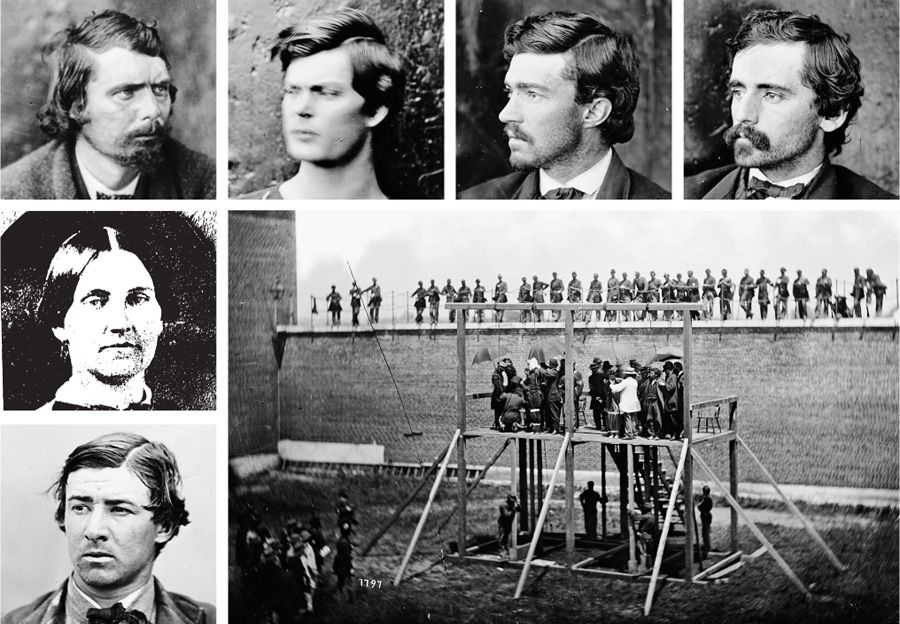
Some of the Lincoln assassination coconspirators and their execution. Top row from left: George A. Atzerodt, Lewis Powell, Samuel Arnold, and Michael O’Laughlen. Middle: Mary Surratt. Bottom: David E. Herold. Large photograph: After a speedy military trial, Atzerodt, Herold, Powell, and Surratt, were executed by hanging on July 7, 1865.
THE NEW PRESIDENT.
THE POLITICAL HISTORY AND ANTECEDENTS OF ANDREW JOHNSON.
APRIL 17
ANDREW JOHNSON has been in continuous public life for thirty years. He entered the General Assembly of Tennessee as a member of the House of Representatives the first Monday in October, 1835, from the County of Greene, in East Tennessee. He was reelected to the succeeding biennial Assembly in 1837, and again in 1839. In 1841 he was transferred to the State Senate by the Counties of Washington, Greene and Sullivan. In 1843 to a seat in Congress from the First Representative District, comprising the same counties and the new County of Johnson. He served the same district, by four successive reelections, until the new apportionment under the census of 1850, in all ten years, when, in 1853, he was made Governor of Tennessee, and was subsequently reelected in 1855. At the end of his second term, in 1857, he was made United States Senator, his term expiring on the 4th of March, 1863, since when, and until his recent election as Vice-President of the United States, he was Military Governor of Tennessee....
Above all, Mr. JOHNSON is a true, as well as a brave man; faithful four years ago among the faithless of his old rivals of the Whig party, and his old colleagues of the Democratic party of Tennessee; true to the Union, when it cost something to be true; to the government in its life struggle against rebellion and insurrection; to free labor and its disenthralment from the incubus of slavery, and to that unswerving line of duty and devotion to hard study, progressive statesmanship and ripening experience which have carried him from the humblest to the top-most round of human ambition.
THE MURDER OF PRESIDENT LINCOLN.
APRIL 16
The heart of this nation was stirred yesterday as it has never been stirred before. The news of the assassination of ABRAHAM LINCOLN carried with it a sensation of horror and of agony which no other event in our history has ever excited. In this city the demonstrations of grief and consternation were without a parallel. Business was suspended. Crowds of people thronged the streets — great gatherings sprung up spontaneously everywhere seeking to give expression, by speeches, resolutions, &c., &c., to the universal sense of dismay and indignation which pervaded the public mind.
Perhaps the paramount element in this public feeling was evoked by personal regard for ABRAHAM LINCOLN. That a man so gentle, so kind, so free from every particle of malice or unkindness, every act of whose life has been so marked by benevolence and goodwill, should become the victim of a cold-blooded assassination, shocked the public heart beyond expression. That the very moment, too, when he was closing the rebellion which had drenched our land in blood and tears — by acts of magnanimity so signal as even to excite the reluctant distrust and apprehensions of his own friends — should be chosen for his murder, adds a new element of horror to the dreadful tragedy.
But a powerful element of the general feeling which the news aroused was a profound concern for the public welfare. The whole nation had come to lean on ABRAHAM LINCOLN in this dread crisis of its fate with a degree of confidence never accorded to any President since GEORGE WASHINGTON. His love of his country ardent and all-pervading, — swaying every act and prompting every word, — his unsuspected uprightness and personal integrity, — his plain, simple common sense, conspicuous in everything he did or said, commending itself irresistibly to the judgment and approval of the great body of the people, had won for him a solid and immovable hold upon the regard and confidence even of his political opponents. The whole people mourn his death with profound and sincere appreciation of his character and his worth.
ANDREW JOHNSON, of Tennessee, is now the President of the United States. We have no doubts and no misgivings in regard to the manner in which he will discharge the duties which devolve so suddenly upon him. This country has no more patriotic citizen than he — no one among all her public men who will bring to her service a higher sense of his responsibilities, a sounder judgment in regard to her interests, or a firmer purpose in the maintenance of her honor and the promotion of her welfare. He has suffered, in his person, his property and his family relations, terribly from the wicked rebellion which has desolated the land; but he is not the man to allow a sense of personal wrong to sway his judgment or control his action in a great national emergency. Traitors and rebels have nothing to expect at his hands, but strict justice, tempered with such mercy only as the welfare of the nation may require.
In this hour of mourning and of gloom, while the shadow of an awful and unparalleled calamity hangs over the land, it is well to remember that the stability of our government and the welfare of our country do not depend upon the life of any individual, and that the great current of affairs is not to be changed or checked by the loss of any man however high or however honored. In nations where all power is vested in single hands, and assassin’s knife may overthrow governments and wrap a continent in the flames of war. But here the PEOPLE rule, and events inevitably follow the course which they prescribe. ABRAHAM LINCOLN has been their agent and instrument for the four years past; ANDREW JOHNSON is to be their agent for the four years that are now to come. If the people have faith, courage and wisdom, the result will be the same.
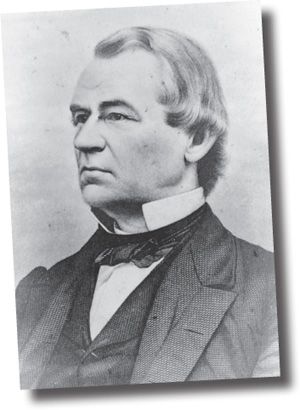
President Andrew Johnson.
NEWS FROM WASHINGTON.
THE INVESTIGATION OF THE MURDER.
APRIL 17
The city and military authorities have been quietly pursuing investigations since yesterday morning, and persons conversant to some extent with the results thereof, are very confident that the murder of Mr. LINCOLN and the attempted murder of Mr. SEWARD, are only part of a carefully planned conspiracy that intended the murder also of other members of the Cabinet, and the destruction of some of the public buildings, and perhaps certain sections of the city.1 Nothing has yet been brought to light calculated to fix the identity of the assassin of Mr. SEWARD,2 though various parties have been arrested and examined, and two or three are held for further examination.
RUMORS OF BOOTH’S ARREST.
Rumor has arrested BOOTH a dozen times already, and many persons will retire tonight in the confident belief that he is confined ion a gunboat t the Navy-yard, but so far as can be learned from the authorities he has not been arrested, but very little is known of the route he took in escaping. The aggregate reward now offered here for the arrest of these men is thirty thousand dollars.
MRS. LINCOLN
Mrs. LINCOLN is yet much depressed, though less so than yesterday. She remains at the White House....
THE BODY OF MR. LINCOLN.
The body of Mr. LINCOLN, dressed in the plain black suit he wore on inauguration day, is lying in the northwest corner of the second floor of the White House, The head lies amidst white flowers, and the features wear the calm peaceful expression of deep sleep. The corpse will be laid in state in the east room on Tuesday, and the funeral will be held on Wednesday....
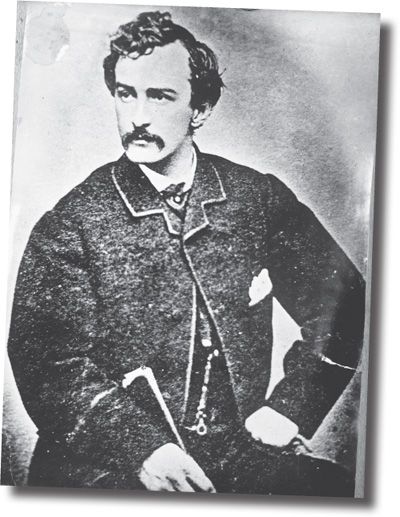
John Wilkes Booth.
1. In fact, Booth intended for coconspirator George Atzerodt to murder Vice President Andrew Johnston, but Atzerodt lost his nerve.
2. Seward was viciously knifed by Lewis Powell, alias Paine, a hulking former Confederate soldier. He was later captured and hanged.
THE LAST ADDRESS OF THE PRESIDENT TO THE COUNTRY.
APRIL 17
Probably all men in all quarters of the world, who read President LINCOLN’S last Inaugural Address, were impressed by the evident tone of solemnity in it, and the want of any expression of personal exultation. There he stood, after four years of such trial, and exposed to such hate and obloquy as no other great leader in modern history has experienced, successful, reelected, his policy approved by the people and by the greater test of events, the terrible rebellion evidently coming to its end, and he himself now certain of his grand position in the eyes of history — and yet not a word escaped him of triumph, or personal glory, or even of much hopefulness. We all expected more confidence — words promising the close of the war and speaking of the end of our difficulties. Many hoped for some definite line of policy to be laid out in this address. But instead, we heard a voice as if from some prophet, looking with solemn gaze down over the centuries, seeing that both sides in the great contest had their errors and sins, that no speedy victory could be looked for, and yet that the great Judge of the world would certainly give success to right and justice. The feeling for the bondmen and the sense of the great wrong done to them, with its inevitable punishment, seemed to rest with such solemn earnestness on his soul, that to the surprise of all and the derision of the flippant, an official speech became clothed in the language of the Bible. The English and French critics all observed this peculiar religious tone of the Inaugural, and nearly all sensible persons felt it not unsuited to the grandeur and momentous character of the events accompanying it. Many pronounced it a Cromwellian speech; but it had one peculiarity, which CROMWELL’s speeches never possessed — a tone of perfect kindness and good-will to all, whether enemies or political opponents.
“With charity to all and malice for none,” President LINCOLN made his last speech to the world. Men will reperuse that solemn address with ever increasing interest and emotion, as if the shadow of his own tragic fate and the near and unseen dangers to the country, rested unconsciously on its words. It will seem natural that no expression of exultation or personal triumph escaped the great leader of this revolution, but that his mind was filled with the impressive religious lessons of the times. It will be thought characteristic of his sense of justice and his sincere humanity, that his last public address to the country was most of all occupied by the wrongs done to the helpless race, whose friend and emancipator he had been. And it will seem but a part of his wonderful spirit of goodwill to all, that not a syllable of bitterness toward the enemies of his country, to the traitors at home, or his personal revilers, passed his lips.
THE NATION’S BEREAVEMENT.
APRIL 17
Death, as the Northmen imaged him, is no dart-brandishing skeleton, but a gigantic shape, that in wraps mortals within the massive folds of its dark garment. Long has it been since those dread robes closed upon a mightier victim than President LINCOLN. It is like the earth’s opening and swallowing up a city. The public loss is so great, the chasm made in our national councils so tremendous, that the mind, not knowing how to adjust itself to such a change, shrinks back appalled. It comes home to every bosom with the force of a personal affliction. There is not a loyal family in the land that does not mourn. It is as when there “was a great cry in Egypt, for there was not a house where there was not one dead.”
No public man has ever died in America invested with such responsibilities, and the mark of so much attention, as ABRAHAM LINCOLN. The unprecedented manner of his death has shocked inexpressibly; but it is not that which most harrows with anguish. It is the loss of the man himself — the privation of him when he seemed peculiarly necessary to the country, and when the heart of the people was bound to him more than ever. Had he been taken by a natural death, the public grief would have been just as profound, though unaccompanied with the other emotions which his assassination has excited. All true men feel that they have lost a man of wondrous fitness for the task he had to execute. Few Americans have lived who had such a faculty of discovering the real relations of things, and shaping his thoughts and actions strictly upon them without external bias. In his own independent, and perhaps we may say very peculiar way, he invariably got at the needed truths of the time. Without anything like brilliancy of genius, without any great breadth of information or literary accomplishment, he still had that perfect balance of thoroughly sound faculties which gives an almost infallible judgment. This, combined with great calmness of temper, great firmness of purpose, supreme moral principle, and intense patriotism, made up just that character which fitted him, as the same qualities fitted WASHINGTON, for a wise and safe conduct of public affairs in a season of great peril.
Political opponents have sometimes denied that Mr. LINCOLN was a great man. But if he had not great faculties and great qualities, how happens it that he has met the greatest emergencies that ever befell a nation in a manner that so gained for him the confidence of the people? No man ever had greater responsibilities, and yet never were responsibilities discharged with greater acceptance. All disparagement sinks powerless before this one fact, that the more ABRAHAM LINCOLN was tried, the more he was trusted. Nobody can be so foolish as to impute this to the arts and delusions which sometimes give success to the intriguer and demagogue of the hour. It would be the worst insult to the American people to suppose them capable of being so cajoled when the very life of their country was at stake. Nor was it in the nature of Mr. LINCOLN to act a part. He was the least pretentious of men. He never sought to win confidence by any high professions. He never even protested his determination to do his duty. Nor, after he had done his duty, did he go about seeking glory for his exploits, or asking thanks by his presence for the great benefits he had conferred. Sampson-like, he could rend a lion and tell neither father nor mother of it. He was a true hero of the silent sort, who spoke mostly by his actions, and whose action-speech was altogether of the highest kind, and best of its kind. He was not an adventurer, aiming at great things for himself and courting the chances of fortune; nor was he a great artist in any sense, undergoing passions and reflecting them; but he was a great power, fulfilling his way independently of art and passion, and simple, as all great powers are. No thought of self — no concern for his own repute — none of the prudish sensitiveness for his own good name, which is the form selfishness often assumes in able and honorable men, ever seemed to enter his mind. To him it was but the ordinary course of life to do that which has made him illustrious. He had a habit of greatness. An intense, all-comprehensive patriotism, was a constant stimulus of all his public exertions. It grew into the very constitution of his soul, and operated, like a natural function, continuously, spontaneously and almost as it were unconsciously. It pervaded and vivified all that he said, and formed the prime incentive of all that he did. If he had ambition, it was to serve his country, and in that sphere where he might do it most effectually. In no way did he ever fail his country in the time of need. He was independent, self-poised, steadfast. You always knew where to find him; you could calculate him like a planet. A public trust was to him a sacred thing. Sublimer moral courage, more resolute devotion to duty, cannot be found in the history of man than he has displayed for the salvation of the American Union. It was the sublime performance of sublime duties that made him so trusted, and which has given him a fame as solid as justice, and as genuine as truth....
No public power, no public care, no public applause could spoil him; he remained ever the same plain man of the people. It was this which peculiarly endeared him to the people, and makes the sorrow for him so tender as a personal feeling, apart from the sense of a national calamity. It is not simply because “he hath been so clear in his great office,” but because “he hath borne his faculties so meek.”
“That his virtues Will plead like angels, trumpet-tongued, against The deep damnation of his taking off.”1
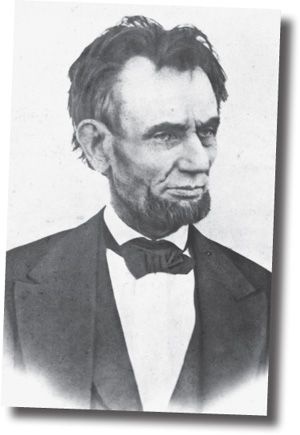
The last photograph of President Abraham Lincoln. It was taken on the balcony of the White House by photographer Henry F. Warren on March 6, 1865.
1. A quote from Macbeth, Lincoln’s favorite Shakespearian tragedy, invoked often in the days of mourning for the late President.
THE PROCESSION.
EIGHT GRAND DIVISIONS. THE SPECTATORS.
APRIL 26
Even during all the night before yesterday, preliminaries for the great funeral procession had been going forward at many points in the city. Before dawn, the stir increased. Almost as soon as it was light, the vast mass of our great metropolitan population began to move perceptibly toward the sadly magnificent ceremony of the day. At first, solitary soldiers, uniformed and armed, or single civilians, in decent black, were gathering to a thousand rendezvous of regiment, society, club or association, as to centres of crystallization sprinkled over the extensive city map. And while uniform and civic costume varied in their respective many ways, two universal marks, distinguishable, indeed, in almost every citizen, whether to be participant or spectator of the sombre pageant — the crape badge on the arm, and the countenance serious and often sad — silently witnessed that the vast city arose in oneness of heart to offer a last testimony of grief and love at the death of the liberator, the patriot, the honest man and the wise ruler....
As the time of starting approached, a tremendous crowd of spectators lined the whole of the appointed route, standing often in a dense human hedge twelve or fifteen feet deep along the curb-stones.
Another almost equally numerous body occupied the steps, gratings and inner border of the walk; while all windows were filled with men, women and children — occupancy being often sold for money, and advertised by handbills posted up outside, thousands and thousands of these lookers-on were too young to know their right hands from their left — and were doubtless brought in order that, in old age, they might say they saw the funeral procession of ABRAHAM LINCOLN. Eaves, roofs, trees, posts, were edged or tint or fructified with men or women. Along the middle of each sidewalk crept in either direction a sluggish, narrow stream of passengers, like the slow snow-broth of a half-frozen stream creeping between wide edgings of fixed ice. And between two such triple living borders, the watchful and peremptory policemen — their active efforts seconded by the desire of all to comply with the regulations of the day — easily secured an empty roadway, perfectly clear from curbstone to curbstone.
Down the whole long line of the great thoroughfare, clear to the Park, the regiments are standing at ease, facing eastward. One after another, in quick succession, they now break into column of sections, and now a bird’s eye view would show the whole distance from Union Park to the City Hall, one long track of stoney gray, bordered with the heavy black masses along each sidewalk, and from end to end, transversely striated with the sections, deliberately gliding northward in common time, the swords and bayonets sparkling and glinting in the perfect sunlight. But to us on the earth, this impressive effect is invisible except in imagination; we count the soldiers and the guns; we can scarcely perfectly apprehend at one glance the twenty sections of one full regiment As we look, however, section after section, regiment after regiment, brigade after brigade, marches steadily by. They may be called our household troops. They are our own city regiments, and though most of their members have the pale face that tells of recent indoor life, yet many of them have once, at least, been embrowned by the Southern sun in actual service. In close lines, marching true and even, they pass and pass, until seemingly a whole army has gone by already, and still the long vista of the street is blue with the troops coming up from the South, nor can any sign of the funeral car yet be seen....
The car itself rolls slowly and gloomily before us. Its sixteen gray horses are shrouded in black, and led each by a colored groom. Immediately about it march the faithful squad of soldiers of the Veteran Reserves who have accompanied the remains from Washington. The car itself consists of a broad platform fourteen feet by eight, on which is a stage or dais where the coffin lies. Over this is a rich canopy upon four columns, having planted at the foot of each column three national flags festooned and craped. Above the four corners of the canopy are four great shadowing and waving masses of sable plumes, and at the top is a smell model of a circular temple, unwalled, open, empty. Thus — so would teach this little emblem — was the nation, the home of freedom, bereft of its representative man. Or, perhaps — thus empty of its former tenant, is the body of the dead, the temple of life, within, the car is lined with white satin, and above the coffin hangs a large eagle, his wings out-spread as if he hovered there, and carrying in his talons a wreath of laurel....
The immense number of organizations, political, benevolent, municipal and others, renders it impossible to give details in full and connectedly, of its parts. It was, moreover, a very interesting observation, that of all the high dignitaries national, State and city, only a very small number could possibly have been distinguished from their companions, except by a knowledge of their persons. Governors, Judges, officials of every grade and kind, walked quietly by, in the same ranks of twenty each, with private citizens, and the utter absence of signs of rank was even an inconvenience to the inquisitive beholder....
The numerical strength and watchful nationality of the Irish among us was once more shown by the fact that one whole division, the Fifth, consisted entirely of Irish associations — and a large division it was. Among them marched, as in the inauguration procession, a number of companies of boys, in green blouses, and hand in hand. The little fellows looked well and marched finely.
The athletic German turners, in their plain linen coats, looked strong, ready and sensible.
A long array of mechanics’ protective and provident associations constituted the latter part of the civilians’ procession, a very few among them here and there, disgracefully enough, showing the influence of liquor.
The Brooklyn delegation constituted the Eighth Division, and after it, bringing up the rear, with a strong double rank of policemen before and behind, came a body of about two hundred colored men. Part of them were freedmen recently from slavery, and these bore a banner with two inscriptions: “ABRAHAM LINCOLN our Emancipator,” and “To Millions of Freemen he Liberty gave.” This was the only portion of the procession which was received with any demonstrations of applause. For them, a just and kindly enthusiasm overrode the strict proprieties of the occasion, and handkerchiefs waved and voices cheered all along as they marched....
The deep sobriety of this ceremony gave it a profound and weighty character, far more impressive than the festal pomp of most pageants. And the walling notes of the dirges played by the bands greatly increased this effect. The streets were in remarkably good condition. The air and sky were perfect; the arrangements for the occasion very good indeed; and in grandeur of form, as well as in ethical and political meaning, the great funeral pageant given by the City of New-York to the remains of President LINCOLN was entirely successful.
It is 1 o’clock, and with prompt good faith the great procession gets forward. The right of the first or military division resting on Fourteenth-street, it was of course at that point that the actual movement began....
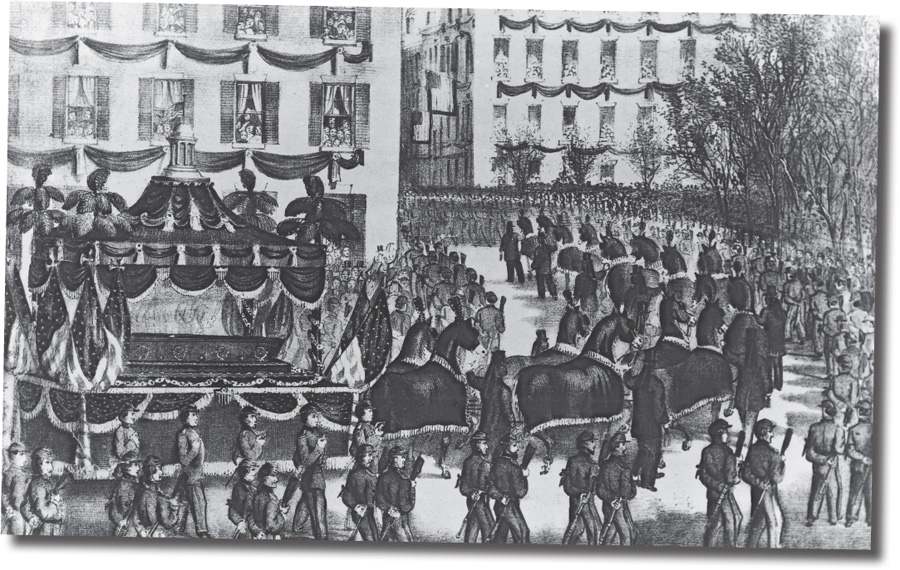
Abraham Lincoln’s funeral procession passing Union Square in New York City, a lithograph by Currier and Ives.
THE LAST TRIBUTE OF THE METROPOLIS TO THE DEAD PRESIDENT.
APRIL 26
The partial loss of decorum which attended the overcrowding of the spectators at night in the first day’s observances, was amply atoned for in the marked order and seemliness of the unparalleled funeral demonstration yesterday. As a mere pageant, the vast out-pouring of the people, the superb military display, the solemn grandeur and variety thrown into the procession by the numberless national, friendly, trade and other civic societies; the grand accompaniment of music; and, above all, the subdued demeanor of the countless multitude of onlookers, made the day memorable beyond the experience of the living generation. The first thought with those who found the occasion one favorable to quiet contemplation, must have taken form in a reflection upon the continuity of those feelings of anguish, sorrow and poignant regret (among the vast body of the people,) which had their first sudden impulsive outburst twelve days ago. Twelve days of human sorrowing — even when the affliction, or bereavement comes closely home to the household affections, represent a longer period than many would at first be ready to admit. Twelve days, voluntarily devoted to the expression of a grief which arises from a public loss, measured by comparison with all our past experience, or even with all our historical acquaintance, seem to expand almost into an age. And when these days of relaxation from secular thought and occupation are measured by the value of time in a vast industrial community, we stand almost amazed at the self-sacrifice of the people....
The tribute, then, unparalleled as it has been in its character and costliness, becomes, in this light, not the heedless offerings of prodigality, but primarily a prompt, spontaneous and deliberate sacrifice by the industrious, the frugal, the pecuniarily responsible body of the people. Viewed as such, it forms not only the grandest oblation ever made on the altar of departed worth, as embodied in Statesman, President or Monarch, but it raises the character of the whole nation far above the imputation of sordidness, of persistent and unchangeable devotion to Mammon, so falsely urged against it by outside commentators, whose pleasure and privilege is uniform destruction. And we may also say that, in the presence of the ready self-sacrifice which out present bereavement has illustrated, the theory that republics are ungrateful may at least bear revision.
THE MOURNING CROWDS.
AT THE CITY HALL.
APRIL 26
Yesterday will be a day long to be remembered as one marked by the most tremendous crowds ever seen in this city, celebrated as it is for its crowds and gatherings. To say that New-York was full of people would convey a very faint idea of the actual state of our streets during the whole of yesterday. New-York is always full of people, too much so for the comfort of the actual inhabitants, but yesterday the city simply overflowed with humanity. There was not room for all the visitors who wished to see the funeral cortege doing honor to our beloved and martyred President. The streets along the route of the procession were filled in most cases with a compact mass of human beings, who were unable to see anything for themselves, nor could they give way for a still more unfortunate class, those who wanted to gain a foothold. In the streets, on the housetops and in the windows the people swarmed and struggled. Everywhere and anywhere the eager citizens endeavored to gain some position that would afford a sight of the ceremonies of the day.
The weather was warm and fine, the event was an interesting and important one, and all Manhattan was about to participate in the ceremonies of the day. Every condition in life and every age and class of society went forth. Here you could see the velvets and rustling silks of the rich, and there the humbler garments of the honest poor; now a fair and haughty damsel moved past, leaning upon the arm of one who sported the latest hat and fashion, whose bonnet is a study, and whose gloves are a surprise in their way. Again, you see the hard-handed laborer, attending the partner of his humble joys, and who shall say which has the greatest interest in the proceedings. Young boys, who will live to tell of this great day to their children when this century has passed away. Old men, who have seen the wars of 1812 and of 1861-5, and now come out into the genial sunshine to see our second WASHINGTON carried to his tomb, their aged and tear-dimmed eyes have beheld the country twice convulsed by war, and are now preparing to go to that bright abode to which our heroic LINCOLN has gone before.
Notwithstanding that the body of the President was kept on view all night, the morning’s sun of yesterday saw large crowns still standing in patient waiting for a chance to see the face of the Great Emancipator. The lines were better kept than on Monday, but there were more of them, and they usually lead nowhere in particular, and anywhere in general. Down Centre-street the actual line of visitors were stationed, and in the hot sun they stood for hours together, boiling and sweating and suffering. Moving slowly and painfully this large line of jammed humanity remained in patient endeavor to reach the coveted space inside the Hall, where lay in State the remains of the President.
In Broadway several lines of people could be seen, extending for whole blocks in various directions, the heads of each devoted column converging to one common centre — the dense crowd near the entrance of the Park. These ill-fated people were doomed to certain disappointment, and in no case did these impromptu lines come to any realization of their fallacious hopes.
To endeavor to reach the TIMES Office from up Broadway, by any of the accustomed thoroughfares, was to attempt impossibility. For blocks round the City Hall the people surged and crammed themselves into the most compact of all masses. Hoping against hope this immense crowd kept its position during the entire morning. Viewed from the windows of the TIMES office the scene was one of peculiar interest. The clear space in front of the hall hedged by a large force of police and military, outside of which the tumultuous and surging crowd heaved with a mighty motion. Within all was quiet and orderly, outside all was confusion and noise. The Twenty-sixth Precinct Police picked up in the City Hall Park several ladies’ veils, furs and shawls, at which Station-house they will remain for identification.
Going up town the spectator found it almost beyond the power of man to progress by the sidewalk. In the middle of the street one could get along slowly. When the military made their appearance and formed in line, the crowd, from a moving body, became a rigid and fixed object. Passage was then perfectly impossible, and it required an immense amount of labor on the part of the police to keep any more people from wedging themselves into the street. In the windows of the buildings along the street could be observed a great number of spectators — the cornices and other projections on the buildings were studded with little knots of people. Ladies ventured on the most dangerous ground, and boys hung on to the awning-posts, and clambered up telegraph and flag poles. In a number of instances windows were advertised to let, and seats were obtainable all along the route. Impromptu stands were frequently erected in front of stores and places of public resort. The most fabulous prices were asked and obtained for priveliges of this kind, forty dollars for a single window being often given by those desirous of seeing the procession from a favorable and comfortable stand-point. At each cross street huge vans and numerous carts stood loaded down with a swarming crowd of women and children, thus making a complete barrier against any progress down those streets. Down each of these streets more crowds could be seen, constant to catch a glimpse even of the most salient points in the procession. From the windows of the houses in these streets for several blocks eager heads and straining eyes gazed feverishly toward Broadway, waiting for the cortege to move. On the house-tops peered down upon the crowd below adventurous spirits who had gained their dizzy and dangerous heights for a better, though not very secure view of the spectacle spread out at their feet. Everywhere the eye ranged black and serried masses of men, women and children appalled the vision, and astonished the spectator.
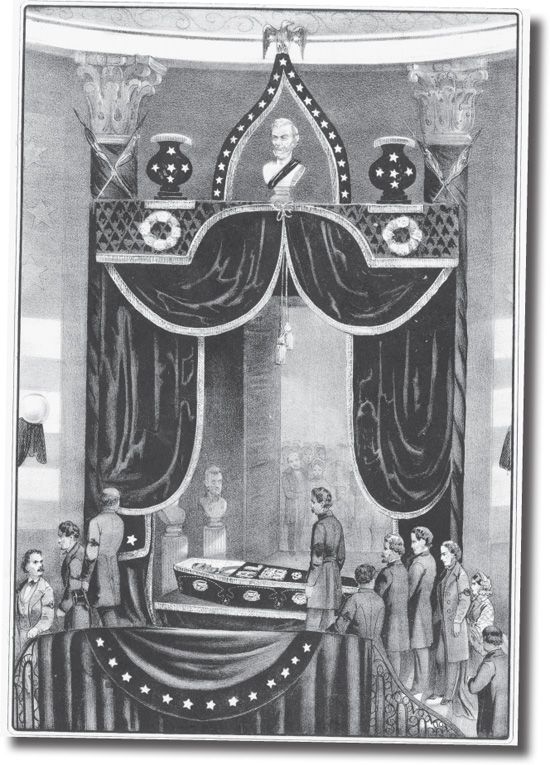
A Currier and Ives print depicting Abraham Lincoln’s coffin, lying in state at the City Hall in New York City, April 24-25,1865.
THE OBSEQUIES.
DEPARTURE OF THE FUNERAL TRAIN.
APRIL 26
The coffin in which was deposited the dead body of our deceased President was kept open from 12 o’clock Monday noon, until 12 o’clock Tuesday noon. From the earliest moment to the latest, every facility compatible with the narrow arrangements of the committees, was afforded the public for viewing the remains. The Guard of Honor, divided into twelve watches, did duty until the lid was fastened on the casket, relieving each other every two hours....
During these hours the pressure very sensibly diminished — the successful people had gone home disappointed, and the unsuccessful had gone provoked. Their places, in the main vacant, were filled partially by new comers, men who had slept all night, risen early, taken breakfast, and were prepared with vigor for the race set before them. These were gradually reinforced by crowds from the adjoining cities and the country round about. The Fulton and other ferries, more particularly the former, had been patronized to an incredible extent all day, but their receipts at night doubtless exceeded those of any other occasion. The boats were loaded to the very edge. Gentlemen with ladies, thinking the early morning hours the best, had gone over at 1 or 2 o’clock, only to find the streets blockaded and the passage to the Hall impossibility. Disliking to give it up so, they would hang about the place for an hour or two and then retrace their steps, meeting on their homeward route as many more, who preferred the experience of the moment to the wisdom of its predecessors....
At a little after 12 1/2 o’clock a stir was made at the west end of the Park, and there, drawn by sixteen magnificent gray horses, led each by a colored groom, came.
It was drawn slowly down the line to the east gate, then turned back and nearly up to the centre of the esplanade, leaving a line of march of, perhaps, forty feet from the precise centre, to the car. The reader will picture it thus; imagine a box twelve or fifteen feet long, by six feet wide, on wheels; the box covered with black broadcloth, which falls to the ground, entirely concealing the wheels; on this, silver lace and fringe are elaborately and effectively displayed, embroidered in the shape of shields and stars, and fringing delicately yet richly the entire crape; above this box is reared a pavilion, American flags decorating each pillar, and it in turn covered with cloth ornamented like the other, and surmounted by a temple of liberty with a guided dome, from which floats the national colors; heavy mourning plumes from every available point, and the elegance and costliness of the arrangement are only equaled by the entire beauty and symmetry of its shape and its perfect adaptation to the service for which it was intended....
On the sturdy shoulders of the Veteran Reserves the casket was tenderly taken from the dusty catafalque, borne down the winding stairs end brought to the City Hall steps. Here a hall of a few minutes occurred, when the procession moved forward to the car, the troops presented arms, the drums rolled, the colors drooped, and the thirty thousand men in front bared every one his head. It was a memorable scene.
BOOTH KILLED.
APRIL 28
WASHINGTON, APRIL 27 — 9:20 A.M.
Maj.-Gen. John A. Dix, New-York:
J. WILKES BOOTH and HARROLD1 were chased from the swamp in St, Mary’s County, Maryland, to Garrett’s farm, near Port Royal, on the Rappahannock, by Col. BAKER’S force.
The barn in which they took refuge was fired.
BOOTH, in making his escape, was shot through the head2 and killed, lingering about three hours, and HARROLD was captured. BOOTH’s body and HARROLD are now here.
EDIWN M. STANTON,
SECRETARY OF WAR.
1. Booth coconspirator Davy Herold.
2. In fact, he was shot through the top of his spine.
ACCURATE ACCOUNT OF THE PURSUIT AND CAPTURE OF BOOTH.
APRIL 28
SPECIAL DISPATCH TO THE NEW-YORK TIMES.
WASHINGTON, THURSDAY, APRIL 27
Without recurring to the circumstances that brought together and put to work a large body of detectives in pursuit of the assassin BOOTH and his accessories in crime, I propose to state briefly and consecutively the incidents in the pursuit from the time the detachment started from this city until their arrival here this morning with the corpse of BOOTH and the body of HARROLD The following facts I obtained from Col. BAKER1 and the other persons engaged with him.
From the time the Secretary of War telegraphed Col. L.C. BAKER at New-York, twelve days ago, to come here immediately and take charge of the matter of ferreting out the facts, and arresting the criminals in the assassination, up to last Sunday, but little progress was made in the right direction. All the lower counties of Maryland were scoured by a large force consisting of 1,600 cavalry and 500 detectives and citizens. On Sunday last Col. BAKER learned of a little boy in Maryland some facts which satisfied him that BOOTH and HARROLD had crossed the river about 11 o’clock A.M. and had gone into Virginia. A telegraph operator with a small body of soldiers was sent down the river to tap the wires at a given place and make certain inquiries. This party returned on Monday morning last, bringing with them a negro man whom they picked up at Swan Point, who, on being closely interrogated, disclosed that he had seen parties cross in a boat, and the description of these parties assured Col. BAKER that BOOTH and HARROLD were the men. No examination or search had yet been made by official authority in Virginia. Demand was made upon Gen. HANCOCK for a detachment of cavalry, and twenty-eight of the Sixteenth New-York were immediately sent to Col. BAKER, under command of Lieut. DOHERTY, one of this detachment being BOSTON CORBETT. The whole party were put in charge of Lieut. L.B. BAKER and Lieut.-Col. E.J. CONGOR. They were instructed to go immediately to Port Royal; that BOOTH had crossed the river, and had had about time to reach that point; that he could not ride on horseback, and must therefore have traveled slowly.
At twenty-five minutes past four o’clock on Monday afternoon, this force left the Sixth-street wharf in the steamer Ida. They were directed that when they arrived at the landing place — Belle Plain — they should shove or swim their horses to the shore, if they could not make a landing, for they must have the horses on land. That night the party went down the river four miles, but heard nothing satisfactory. They finally, at daylight, brought up below Port Royal some miles. They returned, finding no trace of the criminals till they got to Fort Royal Ferry. Lieut. BAKER rode up, found the ferryman, and made inquiries. The ferryman stoutly denied having seen any such persons as those described. Lieut. BAKER throttled him and threatened him, yet he denied any knowledge of the persons sought. By the side of the ferryman a negro was sitting. Lieut. BAKER presented a likeness of BOOTH and HARROLD. The negro upon looking at these exclaimed. “Why, Massa, them’s the gentlemen we brought cross the river yesterday.” The ferryman then admitted that he had brought BOOTH and HARROLD over the river in his boat. The cavalry was started off and went fourteen miles beyond Garrett’s place. There they met a negro who said he saw two men sitting on Garrett’s porch that afternoon. The description of one accorded with that of BOOTH. Lieut. BAKER and his party returned to GARRETT’s house. GARRETT denied that the two men had been there. BAKER threatened to shoot him if he did not tell the truth. GARRETT’s son thereupon came out of the house and said the two men were in the barn. The barn was at once surrounded. This was about 2 A.M. BAKER went up and rapped at the door. BOOTH asked “Who are you, friends or foes? Are you Confederates? I have got five men in here, and we can protect ourselves.” Col. BAKER replied, “I have fifty men out here; you are surrounded, and you may as well come out and surrender.” BOOTH answered, “I shall never give up; I’ll not be taken alive.” The instructions were that every means possible must be taken to arrest BOOTH alive, and BAKER, CONGER and DOHERTY held a consultation a few feet from the barn. In the meantime BOOTH was cursing HARROLD for his cowardice, charging him with a desire to meanly surrender, etc.
Col. BAKER and his party returned and held a parley with BOOTH, thus consuming about an hour and a quarter. Another consultation of officers was held, and it was determined that, in view of the probability of an attack from a tolerably large force of rebel cavalry, which they had learned were in the neighborhood, the barn should be fired, and BOOTH thus forced to come out.
CONGER gathered a lot of brush, and placed it against and under the barn, and pulled some hay out of the cracks, in the mean time holding a lighted candle in his hand. BOOTH could now see through the openings of the barn all their movements. The lighted candle was applied to the hay and brush, and directly the flames caught the hay inside the barn. BOOTH rushed towards the burning hay and tried to put out the fire. Failing in this, he ran back to the middle of the floor, gathered up his arms and stood still pondering for a moment. Whilst BOOTH was standing in this position Sergt. BOSTON CORBETT ran up to the barn door and fired. Col. BAKER, not perceiving where the shot came from, exclaimed “he has shot himself,” and rushed into the barn and found BOOTH yet standing with a carbine in hand. BAKER clasped BOOTH around the arms and breast; the balance of the party had also, in the mean time, got inside. CORBETT then exclaimed “I shot him.” BOOTH fell upon the floor apparently paralized. Water was sent for and the wound bathed. It was now just 3:15 o’clock. The ball had apparently passed through the neck and the spine. In a few moments BOOTH revived. He made an effort to lift his hands up before his eyes. In this he was assisted, and upon seeing them he exclaimed somewhat incoherently. “Useless! — useless! — blood! blood!! and swooned away. He revived from time to time, and expressed himself entirely satisfied with what he had done. He expired at 7:10 yesterday morning.
The body was placed in a cart and conveyed to the steamer Ide, and brought upon that vessel to the navy-yard, where the boat arrived at 5:20 o’clock this morning.
While the barn was burning, HARROLD rushed out and was grappled by Lieut. BAKER, thrown to the ground and secured.
CORBETT says he fired with the intention of wounding BOOTH in the shoulder, and did not intend to kill him.
BOOTH had in his possession a diary, in which he had noted events of each day since the assassination of Mr. LINCOLN. This diary is in possession of the War Department. He had also a Spencer carbine, a seven-shooter, a revolver, a pocket pistol and a knife. The latter is supposed to be the one with which he stabbed Mayor RATH-BURNE. His clothing was of dark blue, not Confederate gray, as has been stated.
[Sergeant Boston] CORBETT, who shot BOOTH, was born in England, and is about 33 years old. He came to this country some years since, and resided for several years in Troy, N.Y. He resided for a time in Boston, where he became a member of a Methodist Church, and took in baptism the name of “Boston.” He is a man of small stature, slight form, mild countenance and quiet deportment.2
Surgeon-Gen. BARNES says the ball did not enter the brain. The body, when he examined it this afternoon, was not in a rapid state of decomposition, but was considerably bruised by jolting about in the cart. It is placed in charge of Col. BAKER, in the attire in which he died, with instructions not to allow any one to approach it, nor to take from it any part of apparel, or thing for exhibition hereafter; in brief, it is necessary for the satisfaction of the people that two points shall be positively ascertained; first, that the person killed in GARRAT’s barn, and whose body was brought to this city, was J. WILKES BOOTH; secondly, that the said J. WILKES BOOTH was positively killed. The first point was to-day confirmed by overwhelming testimony, such as no jury would hesitate to accept. The substantial one of the second point is shown in the report of Surgeon-General BARNES, which will be officially announced.
BOOTH’s leg was not broken by falling from his horse, but the bone was injured by the fall upon the stage at the theatre.
Besides the articles heretofore mentioned, BOOTH had on his person a draft for sixty pounds drawn by the Ontario Bank of Canada on a London banker. The draft was dated in October last.
1. Colonel Lafayette C. Baker (1826–1868) organized the pursuit of John Wilkes Booth.
2. Corbett was later lionized as a hero.
BOOTH’S BODY IN WASHINGTON.
APRIL 28
WASHINGTON, THURSDAY, APRIL 27
The greatest curiosity is manifested here to view the body of the murderer, BOOTH, which yet remains on the gunboat, in the stream off the Navy Yard. Thousands of persons visited the yard, today, in the hope of getting a glimpse at the murderer’s remains, but none not connected with the yard were allowed to enter.
The wildest excitement has existed here all day and the greatest regrets are expressed that BOOTH, was not taken alive. The news of BOOTH’s death reached the ears of his mistress while she was in a street car, which caused her to weep aloud, and drawing a photograph likeness of BOOTH from her pocket, kissed it fondly several times.
HARROLD, thus far, has evaded every effort to be drawn into a conversation by those who have necessarily come in contact with him since his capture; but outward appearances indicate that he begins to realize the position in which he is placed. There is no hope for his escape from the awful doom that certainly awaits him. His relatives and friends in this city are in the greatest distress over the disgrace that he has brought upon themselves.
JOHNSTON’S SURRENDER.
APRIL 29
The dilemma in reference to the rebel army of Gen. JOHNSTON is satisfactorily solved. The Lieutenant-General has sent official information to the War Department from North Carolina that JOHNSTON has surrendered the forces of his command on the basis agreed upon, on the 9th instant, for the surrender of the army of Gen. LEE. We need not say that this will be perfectly satisfactory to the country, as it assuredly is to the government.
The rebel forces embraced in this surrender include all that are in arms between the Southern border of Virginia and the Chattahoochee River. The Chattahoochee forms for a great distance the Western boundary of the State of Georgia; so that the territory covered, or rather uncovered, by this great surrender, embraces the States of North Carolina, South Carolina, Georgia and Florida, or a distance of over five hundred miles from east to west. The reason, we suppose, that it did not extend an indefinite distance further, is that the Chattahoochee is the western boundary of Gen. JOHNSTON’s command. This shows that, unlike the Sherman negotiation of April 18, the present is strictly a military surrender, and that neither JEFF. DAVIS, BRECKINRIDGE, nor any of the civil rebel leaders had anything to do with it. The negotiation of the 18th, of which DAVIS was the dictator, covered the entire Confederate territory and secured his own safety.
The region between the Chattahoochee and the Mississippi includes the States of Alabama and Mississippi. Every important position in both these States is in our hands, and the only rebel troops in them are the few thousand fugitives who escaped from Mobile recently on its surrender, and who have probably been chased into chaos before this time by the cavalry of Gen. WILSON.
Thus, it can now be said that peace reigns over the entire South — if we except the single State of Texas. The great armies of the rebels are now all broken up, and every man of them is sworn to keep the peace. All the rebel arms, artillery, and munitions of war are in our keeping. Under these circumstances, there will be little difficulty in maintaining order and the national authority all over the South.
Secretary STANTON’s important order, issued on the 13th inst., providing for the reduction of the army, the curtailment of expenses, and the opening up of trade and commerce, can now very soon take actual effect.
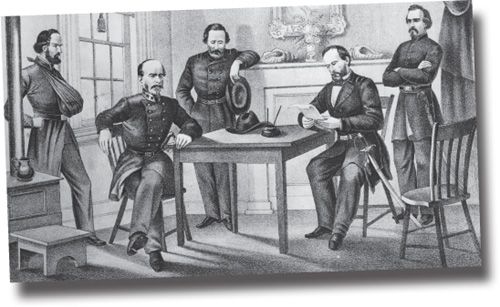
A Currier and Ives depiction of Confederate General Joseph Johnston, seated left, surrendering to General William Sherman, seated right.
RETURN OF GENERAL GRANT TO WASHINGTON.
APRIL 30
SPECIAL DISPATCH TO THE NEW-YORK TIMES.
WASHINGTON, SATURDAY, APRIL 29
Gen. GRANT arrived here, to-day, direct from SHERMAN’s headquarters. From one who was present when Gen. GRANT arrived there, we learn that the latter immediately on his arrival, sent a message to JOHNSTON that the Sherman-Johnston agreement had been disapproved, and that hostilities would recommence within forty-eight hours from the time the messenger passed within the rebel picket line. On the same day SHERMAN made a demand upon JOHNSTON to surrender. JOHNSTON requested a further armistice, and an interview, which was appointed for noon of the 26th. Gen. SHERMAN was at the appointed rendezvous at the time named, and JOHNSTON arrived in about an hour after, he having been detained by some accident. After a short conference, it was agreed that JOHNSTON should surrender on terms substantially the same as those agreed upon by Gen. LEE, when he surrendered to Gen. GRANT. From the best information at that time obtainable, Gen. JOHNSTON’s command embraced nearly thirty thousand troops.
A GRAND REVIEW OF OUR ARMIES — PROPOSITION FOR A CROWNING HONOR BY THE NATION TO OUR TRIUMPHANT SOLDIERS
MAY 4
We cannot help hoping that before SHERMAN’S and MEADE’S armies are broken up, arrangements will be made for a great military display, at which the larger portion at least of both may be present, and at which an opportunity would be afforded to the public to express in some striking and worthy manner the general sense of our obligations to these great and famous corps.
This war has been singularly wanting in “pomp and pride and circumstance.” Most of the great military movements — the battles, sieges and marches, have taken place in a sparsely settled, forest-covered, and semi-barbarous country. The service has been one of unusual hardship too, and it has never, or only rarely been lighted up, by those seasons of repose in great cities, or thickly settled or fertile districts, which makes holiday work of much of the campaigning in European countries. Our men have only known war in its hardest, sternest and most repulsive aspect. They have toiled through swamps, and forests, and pine barrens, forded rivers, trudged thousands of miles over muddy roads, fought day after day, and filled every lonely thicket with their dead, without other actual lookers on than contrabands or poor whites; and when they have marched through a city, it has been between closed blinds, and under the scowling looks of the remnant of the population....
JEFF. DAVIS THE ASSASSIN — REWARD FOR HIS CAPTURE.
MAY 4
President JOHNSON, as will be seen, has issued a proclamation announcing that, as appears from evidence in the Bureau of Military Justice, the atrocious murder of the late President, and the attempted assassination of the Secretary of State, were incited, concerted and procured by and between Jefferson Davis, late of Richmond, Jacob Thompson, Clement C. Clay, Beverly Tucker, Geo. N. Sanders, W.C. Cleary and other rebels and traitors harbored in Canada; therefore, to the end that justice may be done, the following rewards are offered and promised for the arrest of said persons, or either of them, within the limits of the United States, so that they can be brought to trial, to wit: For the arrest of Jefferson Davis, one hundred thousand dollars; for the arrest of Clay, Thompson, Sanders and Tucker, twenty-five thousand dollars each; and for the arrest of Cleary, ten thousand dollars. The Provost-Marshal-General of the United States is directed to cause a description of said persons to be published, with the notice of the above rewards.
Thus ignominiously passes out of history, and thus passes into history, the rebel President, who for the last four years has been patronized and encouraged by half the Kings of Europe, and nearly the whole of its aristocracy. His last act was worthy of himself and of his whole career.
JEFFERSON DAVIS is still on our soil, and at last accounts was in full flight and closely pursued through the Carolinas and Georgia. He is probably the only one of the conspirators mentioned who is in the South, though the Canadian organ of the rebels lately said JACOB THOMPSON was in Virginia, and that CLEARY also might be there; while we know that SANDERS was close to our Northern lines a few days ago. The precise whereabouts of the others is not positively known.
THE ARREST OF JEFF. DAVIS.
MAY 15
The arrest of DAVIS, while it gratifies the sentiment of justice in every loyal heart, imposes new duties and responsibilities upon the government. He has been guilty of the highest crime known to the laws of any nation, one which involves the accumulated guilt of many murders, and upon which the laws of every nation impose the most awful penalties which it is possible for human laws to pronounce. It is true, he has not been alone in his crime. He has but shared the treason of thousands of others, and made himself the representative and the executor of their treasonable designs. But he stands before the world as the foremost figure in this great rebellion. He has wielded all its power and put in execution all its decrees. It was the weight of his example, far more than all other influences, which banded the rebel States so long together in their determined hostility against the Government of the United States. It has been his voice, his will, his ability, his determination, to overthrow that government, which has rallied to the rebel standard the whole strength of the Southern States, and plunged this whole country into the dreadful carnage of the last four years.
DAVIS will unquestionably be tried for treason, and that trial must be in the civil courts and in the presence of the public. He is charged with complicity in the assassination of President LINCOLN, and may, if the government so decide, be tried by court-martial for that offence. It is probable, however, that he will be tried for the greater crime first; and of his conviction there can be no doubt. There is no possible definition of the crime of treason which can relieve him from its guilt. He has “levied war” — openly, ostentatiously, avowedly — “against the United States.” The whole world has been cognizant of his treason, and more than half a million of the bravest and noblest of the land, sleep in their graves as the consequence of his crime. If that crime should not be punished, what crime should? In the strong, direct phrase of President JOHNSON, if treason such as his may go unwhipt of justice, why should laws longer remain on the statute book to punish the murderer or the robber?
We shall have vehement appeals from foreign nations on behalf of DAVIS. His anticipated punishment is denounced already as barbarous and blood-thirsty. Foreign journalists affect to be profoundly impressed by the courage and persistency which he has evinced, and deplore the “madness” which may prompt our government to overlook these qualities and regard him only as a traitor and a rebel. Fortunately, we are under no necessity of paying any heed to their remonstrances, and their course hitherto has rendered it impossible to attach any moral weight to their advice. They have given their support to the rebellion, not because they admired the courage of its leaders or approved the principles on which it rested, but because it threatened to divide and destroy the power of this republic. It is natural, now that the rebellion has failed, that they should try to screen the leaders who have sacrificed everything on their behalf.
Our latest advices show that the behaviour of DAVIS at the moment of his arrest was well calculated to strip him of whatever romance anybody may have been inclined to surround him with. A great leader, — the hero of a grand and noble revolution, would scarcely try to evade the consequences of defeat by disguising himself in his wife’s dress, nor would he claim immunity because he had surrounded himself with the women and children of his family. DAVIS proves to have been a very paltry character after all.
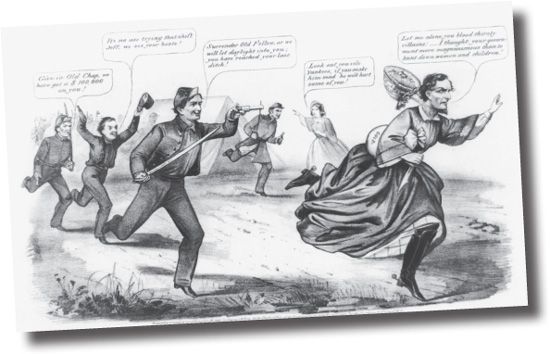
A cartoon lampooning Confederate President Jefferson Davis’s alleged attempt to escape Union troops in Georgia by wearing women’s clothes.
THE BURIAL.
PRESIDENT LINCOLN AGAIN AT HIS WESTERN HOME.
THE MORTAL, FOUR YEARS ABSENT, RETURNS IMMORTAL.
MAY 5
SPRINGFIELD, ILL., THURSDAY, MAY 4
Never before was there so large a military and civic display in Springfield. There were immense crowds of people in the immediate vicinity of the Capitol to see the procession as it passed, and the people for several miles occupied the sidewalks....
Thousands of persons were assembled at the cemetery before the arrival of the procession, occupying the succession of green hills. The scene was one of solemnly intense interest. The landscape was beautiful in the light of an unclouded sun.
The religious exercises were commenced by the singing of a dirge. Then followed the reading of appropriate portions of the Scriptures and a prayer. After a hymn by the choir, Rev. Mr. HUBBARD read the last inaugural of President LINCOLN. Next a dirge was sung by the choir, when Bishop [Matthew] SIMPSON delivered the funeral oration. It was in the highest degree eloquent, and the patriotic portions of it was applauded. Then followed another hymn, when benediction was pronounced by Rev. Dr. [Phineas] GURLEY. The procession then returned to the city.
We have followed the remains of President LINCOLN from Washington, the scene of his assassination, to Springfield, his former home, and now to be his final resting-place. He had been absent from this city ever since he left it in February, 1861, for the national Capital, to be inaugurated as President of the United States. We have seen him lying in state in the executive mansion, where the obsequies were attended by numerous mourners, some of them clothed with the highest public honors and responsibilities which our republican institutions can bestow, and by the diplomatic representatives of foreign governments. We have followed the remains from Washington through Baltimore, Harrisburgh, Philadelphia, New-York, Albany, Buffalo, Cleveland, Columbus, Indianapolis and Chicago to Springfield, a distance in circuit of 1,500 or 1,800 miles. On the route millions of people have appeared to manifest by every means of which they are capable, their deep sense of the public loss, and their appreciation of the many virtues which adorned the life of ABRAHAM LINCOLN. All classes, without distinction of politics or creeds, spontaneously united in the posthumous honors. All hearts seemed to beat as one at the bereavement, and, now funeral processions are ended, our mournful duty of escorting the mortal remains of ABRAHAM LINCOLN hither is performed. We have seen them deposited in the tomb. The bereaved friends, with subdued and grief-stricken hearts, have taken their adieu and turn their faces homeward, ever to remember the affecting and impressive scenes which they have witnessed. The injunction, so often repeated on the way, “Bear him gently to his rest,” has been obeyed, and the great heart of the nation throbs heavily at the portals of the tomb.
REVIEW OF THE ARMIES.
PROPITIOUS WEATHER AND A SPLENDID SPECTACLE.
NEARLY A HUNDRED THOUSAND VETERANS IN THE LINES.
MAY 24
SPECIAL DISPATCH TO THE NEW-YORK TIMES.
WASHINGTON, TUESDAY, MAY 23
The Army of the Potomac has passed in review. The first day’s pageant is over, and to the correspondent falls the duty of depicting a scene almost devoid of incident, save in its grand aspiration. Every circumstance has combined to make it a complete success. The weather has been magnificent; the air, delightfully tempered by the rains of the past week, is cool and fragrant, and dust is for the time subdued.
Washington has been filled as it never was filled before; the hotel-keepers assert that the pressure upon their resources never was so great, and thousands of people have been nightly turned away to seek a place of rest where best they might. The train which left New-York on Monday evening consisted of twenty-one overcrowded cars, and only reached Washington at ten o’clock this morning, an hour after the grand column had begun to move. Still are the crowds pouring in, particularly from the West, with the friends and admirers of SHERMAN’s great armies, which pass in review to-morrow.
Though the city is so crowded, it is yet gay and jovial with the good feeling that prevails, for the occasion is one of such grand import and true rejoicing, that small vexations sink out of sight. With many it is the greatest epoch of their lives; with the soldier it is the last act in the drama; with the nation it is the triumphant exhibition of the resources and valor which have saved it from disruption and placed it first upon earth.
So the scene of to-day (and that of tomorrow) will never be forgotten, and he who is privileged to be a witness will mark it as a white day in the calendar, from which to gather hope and courage for the future.
As you are already informed, the troops participating in this most interesting pageant that has ever been known in the history of the country, left their camps yesterday and marched to positions convenient to the city. The Ninth Corps, which was encamped near Alexandria, left their camp at an early hour yesterday morning, and marched through Alexandria, along the turnpike, thence to Long Bridge, across the bridge, and through Maryland-avenue to a field about one and a half miles east of the Capitol, where they encamped for the night....
The President arrives in his carriage. Directly after, however, almost at the same moment, Gen. GRANT and Staff walk briskly from their headquarters and assume their designated positions. Gen. MEADE and Staff having passed, they now return dismounted, and soon the sharply-defined head of the Commander of the Army of the Potomac adds another to the group of distinguished persons, on whom the eyes, the opera-glasses, and even the photographers’ lenses are resting. And now begins the review proper, the renowned Cavalry Corps, first mobilized by HOOKER, first successfully fought by PLEASONTON, and which has gained such great renown under SHERIDAN, and now led by MERRITT, begins to pass by in platoons of sixteen horsemen each, with sabres drawn. The drum corps opposite the reviewing-officer peals out a salute, and the march commences.
Just here is the most exciting little incident of the day. CUSTER leads his famous division around the corner of Fifteenth-street when some fair hand throws out a beautiful wreath; the General catches it upon his arm, but the movement so frightens the magnificent stallion which the General rides, that he becomes unmanagable and dashes up the avenue at a frightful speed; but CUSTER is too good a horseman to be so easily unseated; minus hat and sabre, holding on to the wreath with one hand, he brings his steed down with the other, and curbing him severely, brings him back to his good behavior and in his place at the head of the division, and horse and rider, with superb spirit, have afforded the spectators the finest equestrian exhibition of the day....
The whole army, numbering in the aggregate over eighty thousand men, thus passed a given point in just five hours and a half, marching by company front of twenty miles. This is a very remarkable feat.
During the entire march along Pennsylvania-avenue no unpleasant incident occurred to mar the general harmony. The street was kept entirely clear of pedestrians not belonging to the army, and by this careful management no opportunity for accident or disorderly proceedings occurred. All the liquor establishments were closed by order yesterday, and will remain so until Thursday morning.
The day has been memorable and enjoyable beyond expectation or precedent.
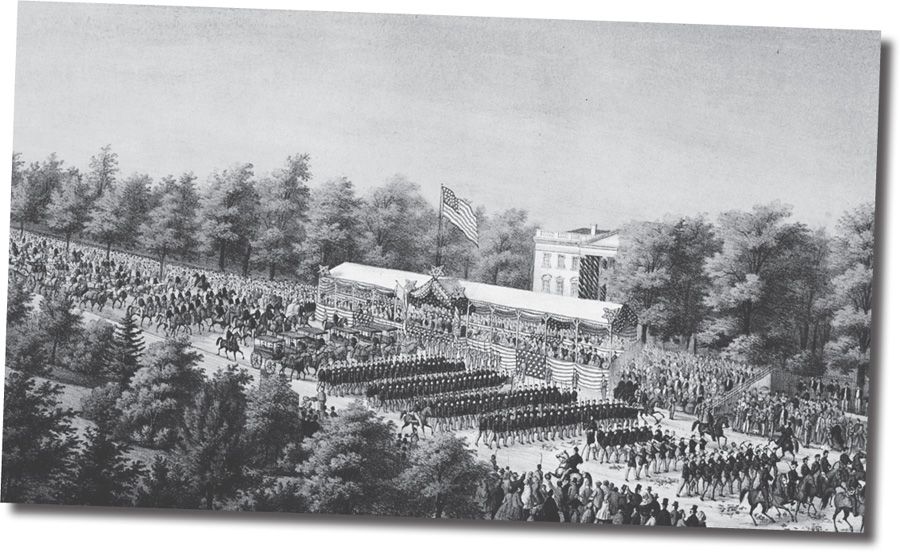
Grand review of the Army of the Potomac in Washington, D.C.
REVIEW OF THE ARMIES. THE SECOND AND LAST DAY OF THE GREAT PAGEANT.
WHOLE-SOULED WELCOME TO THE GLORIOUS VETERANS OF THE WEST.
MAY 25
SPECIAL DISPATCHES TO THE NEW-YORK TIMES.
WASHINGTON, WEDNESDAY, MAY 24 — 8 P.M.
The great display is over. SHERMAN’s two armies — the most superb material over molded into soldiers — has passed in review through the streets of the capital, of which they have heard so much, and toward the safety of which they have done so much, and yet had never seen.
The men who marched from the Ohio to the Tennessee under BUELL, only to march back again; who first penetrated down into Alabama under the daring and nervous MITCHELL; who fought at Perrysville under MCCOOK, and checked the advancing tide of the rebellion to again send it reeling southward, at Stone River, under the chivalrous ROSECKANS; who toiled over the rugged passes of the Cumberland Mountains and seized the great natural fortress of Chattanooga; who held the left with a tenacity that saved them from defeat at Chickamauga, under the ever-victorious THOMAS; who stormed Lookout Mountain, and fought above the clouds with HOOKER; who cut their way from Chattanooga to Atlanta, and from Atlanta to the sea; who swept the Carolinas as with a besom of destruction, and who gave the finishing blow to the great rebellion, in following the lead of SHERMAN, and HOWARD, and SLOCUM — these were the men who received to-day the enthusiastic plaudits of a hundred thousand spectators.
The interest of to-day has exceeded that of yesterday. The Army of the Potomac is our old acquaintance, but the Armies of Georgia and Tennessee few people here had ever seen. The most eager interest was therefore exhibited to view the Veterans of the West, whose marches can only be counted by thousands of miles.
The weather was even more propitious than yesterday, the temperature being several degrees cooler, and the streets comparatively free from dust. The army of spectators was, therefore, greater, especially in the vicinity of the stands, to which tickets were issued adlibitum....