CHAPTER ONE
‘Had the pious teetotalling Monty wobbled into SHAEF with
a hangover, I could not have been more astonished than I was by
the daring adventure he proposed!’
General Omar Bradley.
It is not within the scope of this book to give a detailed analysis of the controversial background to Operation MARKET GARDEN. What follows, is a distillation of the political and military factors that shaped the plan in sufficient detail for the operation to be clearly set within the context of the North West European Campaign as a whole.
After D Day, the Allies initially made slow progress in terms of captured terrain, with the rate of progress, measured against Supreme Headquarters Allied Expeditionary Force (SHAEF) planners’ expectations not being met. However, by mid-August, after some hard fighting, the Germans collapsed into defeat. The Normandy campaign was won and the German defeat, when it came, was as complete as was Montgomery’s victory over his many critics. The remnants of the German Seventh Army, who had escaped destruction in the Falaise Pocket, streamed eastwards. The Germans made successive attempts to halt the Allies on the Seine (reached fifteen days ahead of Montgomery’s target) and, subsequently, on the River Somme and any other topographic feature of tactical significance. However, the Allied armoured divisions’ momentum was such that each obstacle was ‘bounced’ and the advance continued, at rates of up to fifty miles per day. The lack of opposition and the Allies’ reception as liberators, led to a feeling that the war was almost at an end. The contrast between the hard slogging of the Normandy battles and the swift advances, served only to sharpen in the minds of both commanders and front-line soldiers, the prospect of an early end to the war. The reader should judge the MARKET GARDEN plans against the contemporary, and seemingly reasonable, expectations of victory in Europe before the end of 1944.
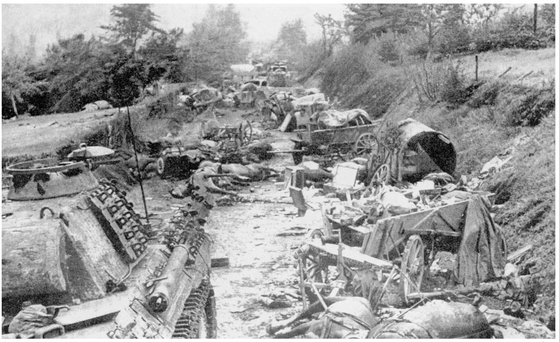
The sure sign of German defeat in Normandy – a road crammed with destroyed men and equipment.
Alliance Politics
General Dwight D Eisenhower took over conduct of the campaign from the newly promoted Field Marshal Montgomery on 1st September 1944. The extent of the Allied victory and the speed of the advance eastwards eclipsed SHAEF’s ability to plan and led to Eisenhower not having a detailed military strategy to follow when he took full command. Eisenhower has been criticised for not being a decisive commander but, after Normandy, there was no shortage of plans being put forward by his generals. At one stage, it seemed as if he was agreeing to support all of them. However, Eisenhower’s problems in selecting a strategy following the German collapse, became even more difficult, as national pride and his generals’ personal ambitions became pre-eminent. In short, British and American plans were no longer subordinated to the common goal of defeating a powerful enemy. With such notoriously difficult characters as Patton and Montgomery to deal with, along with their respective press corps, Eisenhower’s command was never going to be easy. In what at the time was the most frankly reported campaign of the Twentieth Century, the Supreme Commander was working primarily at a political level. Whatever the arguments in favour of Montgomery’s narrow front advance into Germany, it would never have been politically acceptable to US public opinion to have Patton’s Third Army halted, with the victor’s laurels going to Montgomery. It is clear that Eisenhower found considerable favour with the arguments for the northern route to Berlin but political realities forced him to adopt the ‘attack everywhere’ philosophy that underpinned the US broad front strategy of the day.
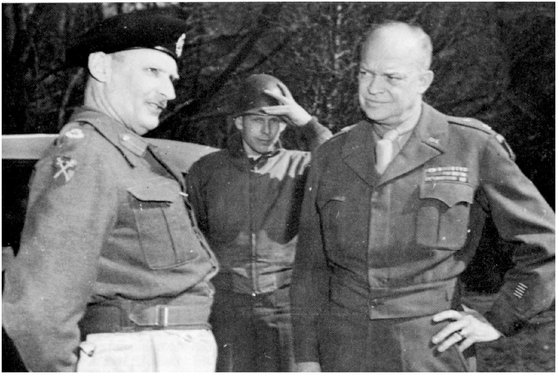
Montgomery was a notoriously difficult subordinate. This photograph of Montgomery and Eisenhower together illustrates, through body language and expressions, the problem between the two commanders.
Other than his generals’ prestige and national pride, Eisenhower had other pressing political factors to consider as he came to his decisions on Sunday 7 September 1944. Firstly, there was the fact that after five years of war, Britain was at the end of her resources and, ideally, the war in Europe needed to be over by Christmas 1944. Secondly, V2 ballistic missiles, launched from north-west Holland, were falling on London. The need to clear the enemy from the area of the launch sites and thus take the missiles out of range, was one of Churchill’s key requirements. Thirdly, another purely European factor was that the Prime Minister did not want a Soviet presence in the heart of Europe and, therefore, gaining as much territory and being the first to Berlin was important. Fourthly, the Ruhr industrial area, despite the Strategic Bomber Offensive was still the power house of Germany and in 1944 tank production actually rose to a record 19,002 vehicles. It was estimated that capturing the Ruhr Triangle would end the war within three months. All these factors had to be considered and balanced as the Supreme Commander made his decisions.
The fact that the Supreme Commander pleased none of his ‘difficult’ subordinate commanders, is illustrated by Patton’s comment that Eisenhower was ‘the best general the British have’. This indicates that he was at least even-handed. Another prophetic quote from Patton in 1944 summed up Eisenhower’s role in the European campaign; ‘he’d make a better president that a general’.
Logistics
Logistics lay at the route of Eisenhower’s political and military problems: in early September, he could not sustain all or even a half of his forces in offensive operations at any one time. The rapid advance eastward led to his armies, still without a major port, being largely supplied through the artificial Mulberry harbour and across the Normandy beaches. Two hundred and fifty miles forward of their supply bases, commanders were prepared to lobby hard, in competition for all the supplies that they could get. Typically, they would paint an over-optimistic picture of the prospects on their front in order to secure additional resources: General Patton is widely acknowledged as the master of this technique. However, the further the front advanced eastwards, the fewer troops were able to pursue the Germans. Infantry divisions were ‘grounded’ and their trucks stripped from them to transport combat supplies needed to keep the armoured divisions mobile. Fewer troops at the front meant a reduction in combat power and at, the same time, they were having to cover wider frontages. Consequently, there was an increasing likelihood of an ad hocGerman defence assembling sufficient force to halt the advancing Allies. To make the situation worse, it should also be borne in mind, that Allied soldiers were, understandably, increasingly unlikely to risk their lives in what they perceived to be the final weeks of the war.
The shoulder patch worn by staff of HQ 1st Allied Airborne Army.
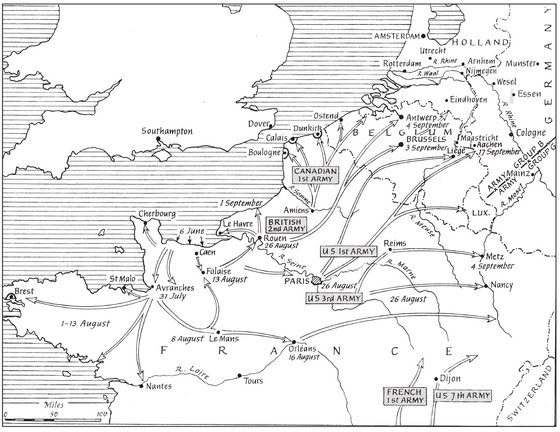
The general situation in North West Europe by September 1944.
First Allied Airborne Army
Airborne forces had been embraced by the US Army prior to the war and, following their successful use by the Germans in 1940, the British formed their first airborne units in 1940. By 1944 airborne forces were sufficiently strong to warrant grouping into their own Army, with a headquarters to look after their interests and advance their cause. Considerable resources, as strategic bomber commanders saw it, had been diverted into transport aircraft to support the new arm. The First Allied Airborne Army was also Eisenhower’s only strategic reserve, contrary to the impression that the Germans still held as a result of the OVERLORD deception operation; FORTITUDE. In addition, the US Chief of Staff, General Marshall, was pressurising Eisenhower to find a use for this expensive asset, as the airborne divisions were ‘coins burning holes in SHAEF’s pocket’. Attempts had been made to utilise 1st (British) Airborne Division but the speed of the ground advance had, frustratingly, eclipsed all plans for its use. However, as the armies in France and now Belgium began to lose momentum an opportunity for their use presented its-self. Eisenhower could easily support Montgomery’s plan to enhance an earlier divisional plan (Operation COMET) to a corps level airborne operation, as Bradley was far from keen on airborne forces. He and other main US commanders would have preferred to have the air transports used in the logistic effort to support his armies. The allocation of an airborne corps to Twenty First Army Group was a way of satisfying the demands of both Montgomery and the Pentagon. However, would there be sufficient combat supplies available to support full execution of the plan? In short no. Alliance politics prevailed over pure military interest.
Intelligence
Not only were the impressions of soldiers at the front shaped by lack of opposition and the speed of advance but even normally reserved staff officers were optimistic that the war’s end was near. As early as mid August, SHAEF’s Intelligence Summary declared:
‘Two and a half months of bitter fighting, culminating for the Germans in a blood-bath big enough even for their extravagant tastes, have brought the end of the war in Europe within sight, almost within reach.’
All indicators were that the German collapse was total. Tens of thousands of German soldiers were, in many cases, isolated or almost cut-off, in the fortified ports of France and the Low Countries. In addition, in early September 1944, the Volksarmies that were later to confront the Allies in the Ardennes and, during early 1945, on the Rhine, did not yet exist.
During early stages of planning for Operation COMET, some remarkably accurate intelligence that painted a less rosy picture, was received on 7 September 1944:
‘... it is reported that one of the broken panzer divisions has been sent back to the area north of Arnhem to rest and refit; this might produce some 50 tanks.’
This was the Resistance passing on details of the arrival of the leading elements of the shattered II SS Panzer Corps (9th and 10th SS Panzer Divisions) from France to refit north of the Rhine. The report continues:
‘To-day’s photographs together with ground reports from Dutch sources, indicate that the main direction of German movement is NW to SE; not only has 347 Div come down, but many of the SS training units which were near AMSTERDAM are now quartered in the excellent barracks at NIJMEGEN. There seems little doubt that our operational area will contain a fair quota of Germans, and the previous estimate of one division may prove to be not far from the mark; moreover it would not be surprising to find the high ground south of NIJMEGEN, Pt 83 the highest point in Holland - protected as it is by the MAAS - WAAL Canal to the west, the MAAS to the south, and the WAAL to the north, and guarding a vulnerable outpost of the Fatherland’s frontier has been made into a hedgehog defensive position ...’
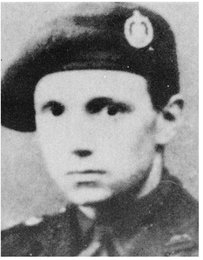
Major Brian Urquhart, Dorset Regiment, warned of the presence of panzers around Arnhem and was promptly sent on leave.
This is an early recognition of the dominating nature of the Groesbeek Heights. In MARKET GARDEN this area had to be seized and held by 82nd Airborne Division, if ground troops were to reach Arnhem. In the optimism of the time, the presence of a shattered panzer division and numerous ad hoc units did not seem to count as a significant planning factor, although some junior commanders had reservations about their missions. As recounted by Geoffrey Powell:
‘At one battalion briefing, a company commander, on hearing the task allocated to a colleague, had leaned over to him and whispered “That should provide you with either a Victoria Cross or a wooden one”.’
This tendency to ignore the enemy is highlighted by, Polish airborne commander, General Sosabowski’s outburst ‘But the Germans, General, the Germans’. Ignoring the enemy became even more marked as planning for MARKET GARDEN got under way. A little more than a week later, the intelligence planning documentation for the larger, corps scale, operation failed to mention most of the enemy positions and movements outlined above and ignored the significance of much more material. Accusations of ignoring intelligence, as it stood in the way of the conceived plan (cognitive dissonance), have been levelled against Montgomery and 1st Airborne Division in particular. Colonel Michael Hickey provides one explanation:
‘Monty was very competitive. He wanted, as a battalion commander, his battalion to win all the trophies available in the Egyptian Command in the 1930s, and they probably did He competed against other generals, particularly in north-west Europe with General Patton, with whom his relationship was a pretty unstable one. They couldn’t make each other out as men, because they were so radically different from each other: Patton the dashing, swashbuckling Southern cavalryman in the American army, Monty the ascetic, non-smoking, non swearing, non-drinking Cromwellian. And the competition grew to a head as the Allies broke out of the Normandy pocket and made their bid to go for the German border in the high summer and early autumn of 1944.’
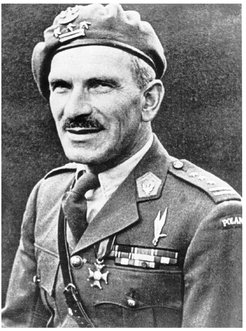
Polish General Sosabowski was uninpressed by the Airborne Plan.
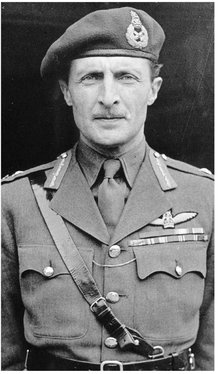
Lieutenant General ‘Boy’ Browning.
The MARKET GARDEN Plan – Outline
Montgomery left his meeting with Eisenhower at Brussels on 7 September, with the resources of the Allied Airborne Army at his disposal and correctly or incorrectly believing that he had been promised ‘absolute priority’ for logistics. His MARKET GARDEN plan, which he personally detailed down as far as divisional tasks, was delivered to General Miles Dempsey, Commander Second British Army on 10 September. It was a bold plan. Lieutenant General ‘Boy’ Browning was to command a corps of three airborne divisions, made up of 1st British Airborne Division, and 82nd and 101st US Airborne Divisions. Montgomery explained that the Airborne Corps, in Operation MARKET, was to seize important points (mainly rivers and canals) across Holland on an axis from the bridgehead on the Escaut Canal through Eindhoven, Nijmegen and Arnhem. Across this ‘Carpet’ of airborne troops, in the GARDEN part of the operation, an armoured spearhead would drive north to the Zuyder Zee, some one hundred miles into enemy territory. From here, having outflanked the West Wall and cut-off hundreds of thousands of Germans in western Holland, the armoured forces would envelop the Ruhr and prepare to strike towards Berlin. Not only was General Bradley surprised at Montgomery’s boldness but he also said ‘Monty’s plan was one of the most imaginative of the war.’
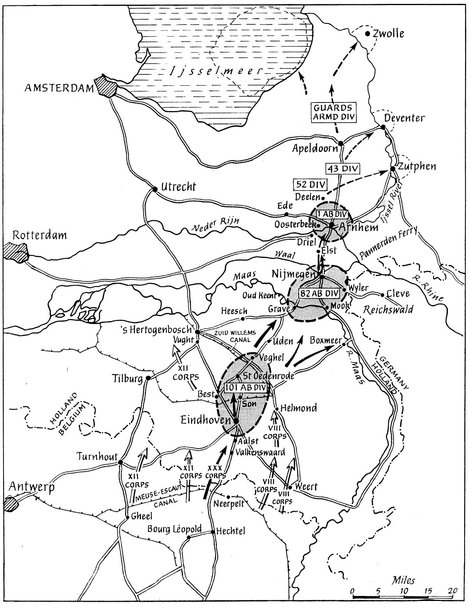
Operation Market Garden: The Plan.
It certainly was a bold plan but the whole concept was predicated on the fact that the German defences were a thin crust and that a properly concentrated and well-supported ground force could pierce it and reach the airborne divisions. Montgomery, as we shall see, successfully broke through the German defences on the Escaut Canal but what had not been envisaged was the escape of 82,000 soldiers of the German Fifteenth Army across the mouth of the Scheldt. Nor had it been anticipated that the shattered divisions from France, the North Sea coast and the ‘ageing gentlemen of Germany’s last reserves’, would be able to form an effective defence.
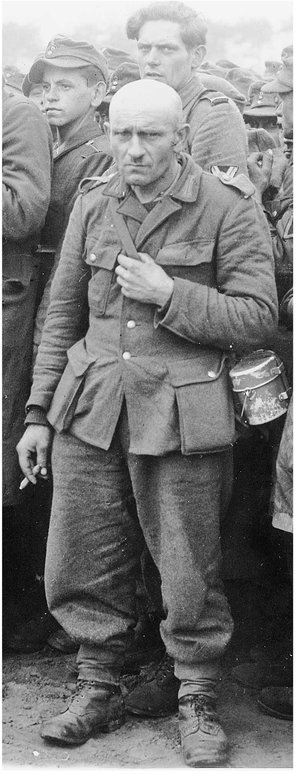
German prisoners taken at Nijmegen demonstrate the extreme age-range of the troops being put into the field after the defeat in Normandy.
General Lewis Brereton, commanding the Allied Airborne Army, had to bring two elements together in his plan. Firstly, there were the ground troops, represented by the headquarters of the Airborne Corps under Lieutenant General Browning and, secondly his fellow British and American airmen. The plan he developed gave primacy to the airforces’ considerations, which did much to contribute to MARKET GARDEN’s overall failure. The first decision was a daylight drop. With inexperienced aircrews and a moonless period, a repeat of the badly dispersed drops that opened D Day three months earlier was to be avoided. In addition, Brereton’s aircraft were capable of flying less than half of the Airborne Corps in one lift. A lack of ground crew compounded the problem and led to Major General Williams’ USAAF IX Troop Carrier Command (TCC), recommending to Brereton that there should be only one lift per day. Thus, the airborne divisions were not going to arrive in a single ‘clap of thunder’ but over a period of three days. Worse still, in most cases, only half of the first lift would be available to seize objectives on the first day, as vital units had to defend Drop Zones (DZs) and Landing Zones (LZs) for subsequent lifts. Finally, as with Normandy, the airmen warned of heavy aircraft losses to flak. With the end of the war in sight, there was a general wish to avoid unnecessary casualties and senior air officers wishes prevailed. Consequently, DZs were to be sited away from flak positions and, therefore, well away from the ground troops’ objectives. Crucially, Major General Urquhart had his request for a glider coup de main at the Arnhem Bridge turned down. However, even General Gavin (82nd Airborne), arguably MARKET GARDEN’s most experienced Allied airborne commander, also eventually lost out to IX TCC’s insistence that a coup de main on the Nijmegen Bridge was too dangerous. The landing serials at the northern end of the Nijmegen Road Bridge were eventually written out of the early drafts of IX TCC’s plan on 16 September 1944. Only a parachute coup de main against the lightly defended Grave Bridge was allowed to go ahead. The over cautious approach of the air force commanders concerning the first lift, based on an understandable desire to avoid casualties, led to a far greater sacrifice by the aircrews over subsequent days.
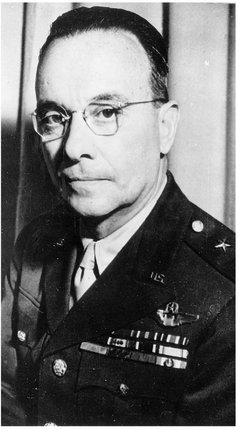
General Lewis Brereton, commander 1st Allied Airborne Army.
Troop Carrier Command badge incorperating a parachute and a glider.
General Browning had severe reservations about MARKET GARDEN, as illustrated by his famous off the cuff remark to Montgomery ‘I think we may be going a bridge too far’ but he was overruled. Having previously offered his resignation over what he saw a Brereton’s disregard for ground elements of an earlier operation, he was in no position to influence the plan by repeating his threat. In addition, Major General Urquhart, although he was commanding the most exposed division, lacked airborne experience and, consequently, credibility to convince the airmen to change their plans.
In advance of the air armada, the Allied airforces were to fly 1,395 bomber and 1,240 fighter or fighter bomber sorties over southern Holland and the areas where the Airborne Corps were to drop. As a result of these attacks, the transports, paratroops and gliders were able to carry out the first phase of the operation with minimal losses. The P-51 Mustangs and P-47 Thunderbolts protecting the slow moving columns of transport aircraft had little to do. On the ground in the Groesbeek/ Nijmegen area, known troop concentrations in barracks and anti-aircraft positions were repeatedly attacked spoiling the gentle rear-area Sunday routine.
82nd Airborne Division’s Mission and Plan
Faced with a far from ideal airborne plan, the 82nd Airborne Division’s new commander faced a difficult problem. Brigadier General James M Gavin or ‘Slim Jim’ as he was known to his troopers, was a tall, lean and tough ex-ranker who had led 505th Parachute Infantry Regiment (PIR) in action in the Mediterranean. In the UK for OVERLORD planning, he joined Eisenhower as his airborne advisor and during the Normandy battles acted as the 82nd’s Assistant Divisional commander. On the Division’s return to UK, at the age of thirty-seven, Gavin took over command of the 82nd Airborne and in doing so, became the US Army’s youngest divisional commander of World War Two. General Gavin has described his mission in the Nijmegen area and some of the difficulties he envisaged that his division would have to deal with:
‘The mission assigned to the 82nd Airborne Division was to seize the long bridge over the Mass River at Grave, to seize and hold the high ground in the vicinity of Groesbeek, to seize at least one of the four bridges over the Maas-Waal Canal, and finally to seize the big bridge at the city of Nijmegen. ... For my part, I was concerned about the very widespread dispersal that would take place in the initial landing. Inevitably, there would be huge gaps in the perimeter that I was to seize and defend, and some very difficult decisions had to be made concerning where the landings were to take place. We had learned from the very beginning in Sicily, that it is better to land near an objective and take heavy losses rather than have to fight on the ground to get it. On the other hand, we had so many objectives over such an extensive area - approximately twenty-five miles - that a complete loss of control of the division might take place the very moment the landings occurred if judgement was not exercised in allocating troops to particular objectives.’
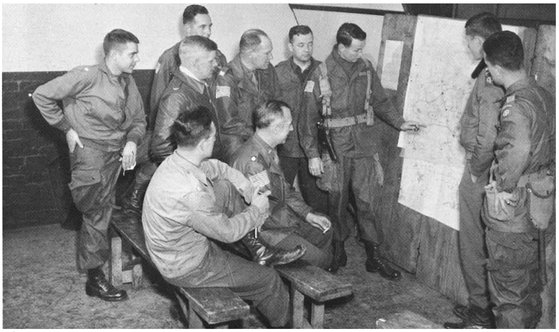
General Gavin briefing his staff and commanders.
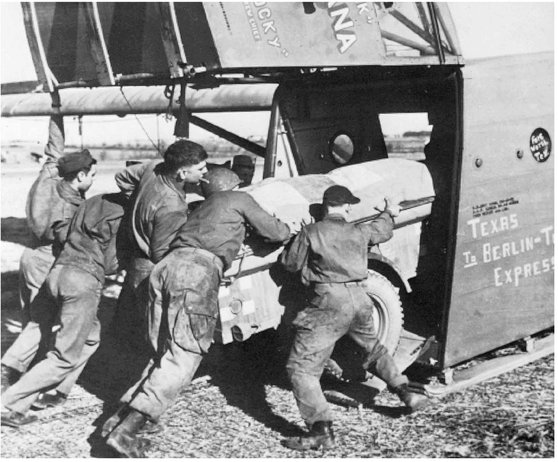
American paratroopers load a trailer onto a Waco glider.
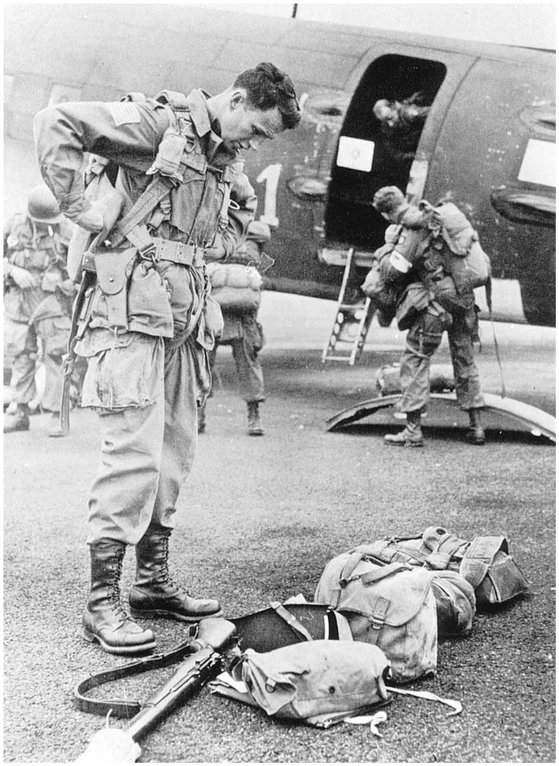
General James Gavin prepares for the drop.
In contrast to XXX Corps and 101st Airborne Division who had to fight through the enemy’s forward positions in the newly formed German 1st Fallschirmjäger Army’s Forward Combat Zone, the 82nd was to drop in the enemy’s Rear Combat Zone. Here the 82nd should only encounter lines of communication troops and broken formations but this rosy prospect was to underestimate the German’s capacity to find troops with which to mount an effective response. The MARKET GARDEN plan placed the 82nd’s DZs in close proximity to the boundaries of the Netherlands Military District and Weherkreis VI (a military district in Germany) where several training schools and numerous rear echelon units were to be found. The latter were often made up of previously wounded, young or old soldiers or otherwise ‘low quality’ troops. An example would be units consisting entirely of soldiers who were hard of hearing or suffering from stomach problems. In addition, the 82nd were aware of and had recognised the importance of the presence of armoured divisions reportedly refitting in the Reichswald. In the event, these enemy tanks proved to be the remnants of II SS Panzer Corps who 1st Airborne Division encountered to the north-east of Arnhem; having been correctly assessed at twenty percent of its establishment. The Germans’ genius in fighting with reportedly ‘ineffective’ or ad hoc formations was to test the widely dispersed American paratroopers in the days to come.
General Gavin’s airlift on Sunday 17 September 1944 was only sufficient to drop his three parachute infantry regiments, a single battalion of artillery and deliver by glider, a limited portion of his divisional troops. They were to secure the various bridges, the DZs / LZs and to capture one or both of the Nijmegen road and rail bridges. The denial of gliders to seize the Nijmegen Road Bridge must have been a cruel blow and a severe limiting factor. Meanwhile, 504 PIR was to drop on to DZs Easy and Oscar, located in the triangle between the River Maas and the Maas/Waal Canal. They were to seize bridges across these waterways, in order to enable the British Guards Armoured Division, leading XXX Corps, to reach Nijmegen and Arnhem. 505 Parachute Infantry Regiment (PIR) was to drop on DZ November, just south of Groesbeek from where they were to take the Mass Railway Bridge at Molenhoek and secure the south-west portion of the Groesbeek Heights and its LZs. In addition, 2/505 PIR was to assist 504 PIR by attacking the Maas / Waal Canal bridges from the east, thus complying with the Division’s experience that a simultaneous attack from both ends of a bridge would succeed. Subsequently, 2/505 would become the divisional reserve. Dropping on DZ Tango, 508 PIR were to secure the high ground between Groesbeek and Nijmegen, overlooking the border with Germany, below and to the east. They were also to send a battalion to the Nijmegen bridges.

XXX Corps ‘Rampant Boar’.
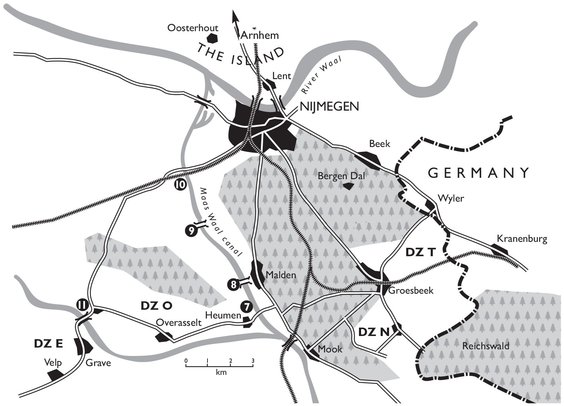
Nijmegen, Grave and Groesbeek area.
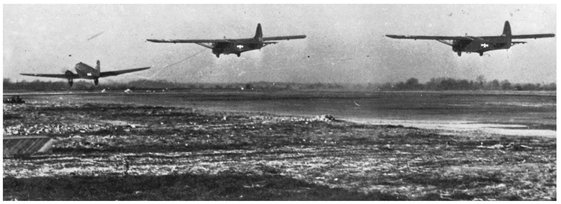
The idea of transporting troops into battle by glider was developed alongside military parachuting, as a means of delivering heavy support equipment and stores, as well as non-para-trained infantry, into battle. They were used in small numbers in 1940 during the German capture of Fort Eban Emael and in far greater numbers on D-Day. For MARKET GARDEN, nine hundred CG-4 A Waco gliders were allocated to the 82nd Airborne Division alone. They transported an infantry regiment, three of the Division’s four artillery battalions, engineers, medical personnel and other essential equipment, as well as the ubiquitous Jeeps that enabled commanders to move around the divisional area. Most of these gliders were to form a part of the second lift, as the C-47 Skytrains or Dakotas, as the British referred to them, were needed for the parachute drop on Sunday 17 September. So great was the demand on the pool of American glider pilots, that rather than the usual two pilots per Waco, only one was available to fly the cumbersome aircraft. However, unlike the British Glider Pilot Regiment, the American glider pilots were not trained as ground troops but, in this case, as the 82nd was to be cut-off for several days, the US glider pilots worked hard assembling stores. Eventually, when pressure in 505 PIR’s sector became dangerous, they held a section of line. Eventually they were returned down Hell’s Highway to Brussels, in the process becoming involved in 101st Airborne Division’s battles.
During the days leading up to 6 June 1944, General Eisenhower had a very difficult decision to make. Could he launch the D-Day invasion with the weather predicted by Group Captain Stagg or would he have to postpone the vital operation. General Louis Brereton had a similar decision to make based on similar meteorological advice, in mid September: a period of far less stable weather than three months earlier in June. 21st Army Group’s post operational report for 16 September 1944 recalls:
‘1630 hrs. Lt-Gen BRERETON decided to proceed with Op MARKET. Period 17-20 Sep suitable for airborne ops with fair weather apart from morning fog. Light winds’.
However, what proved to be variable weather conditions over Central and Southeast England and Holland were to have a significant impact on the coming battle, which from its conception had a very slim margin for error.