
CHAPTER ONE
During the early summer of 1944 the Western Allies gathered their strength for the great enterprise which was to liberate occupied Europe and end in the conquest of Nazi Germany. In the armed camps of southern England, where the invasion forces gathered, men’s eyes and thoughts turned southward to France. Three great questions were in all minds: where would it happen, and when, and, above all, what would it be like over there?
Across the Channel the German propaganda magazine Signal featured pictures of strong, confident troops gazing resolutely seaward from their emplacements on the Atlantic Wall. Hitler boasted with his usual confidence that Fortress Europe was impregnable.
On the face of it the German strength was formidable. Field Marshal von Rundstedt, as Commander-in-Chief West, was responsible for the defence of France, Belgium and Holland, and had more than half a million men under his command for the task. These troops were organised into two Army Groups, with 38 infantry divisions guarding the coastline and a further 10 held in reserve. A Panzer Group of 10 armoured and mechanised division were also stationed in France. The defences along the Channel coast were a monument to German efficiency and hard work. The beaches were cluttered with ingenious death-traps. Obstacles of varying shape and size, many carrying explosive charges and designed to impede the movement of landing craft, vehicles and men, covered the shores like barnacles, from Antwerp to the Cherbourg peninsula. These obstacles were covered at approximately 1,000-metre intervals by mutually supporting strongpoints formed from concrete emplacements, surrounded by barbed wire and mines. Each contained artillery pieces, anti-tank and machine guns and a garrison of between 50 and 200 men. The strongpoints were linked by anti-tank ditches. All roads leading off the beaches were blocked and the low-lying areas were flooded. Interspersed with the strongpoints were 20 huge coastal batteries between Cherbourg and Le Havre. Each battery, with its huge concrete casemates, was a fortress in its own right. The Saint Marcouf Battery, for example, contained three 210 mm guns with a range of 27 km, six anti-aircraft guns, one 150 mm and four 20 mm guns, two mortars, numerous flame-throwers and machine guns and a garrison of three officers, seven non-commissioned officers and 287 men. In support further inland were medium and field artillery regiments, and the reserve divisions. The villages behind the beaches were fortified with blockhouses, the roads were mined and the fields covered with long poles to prevent gliders from landing.
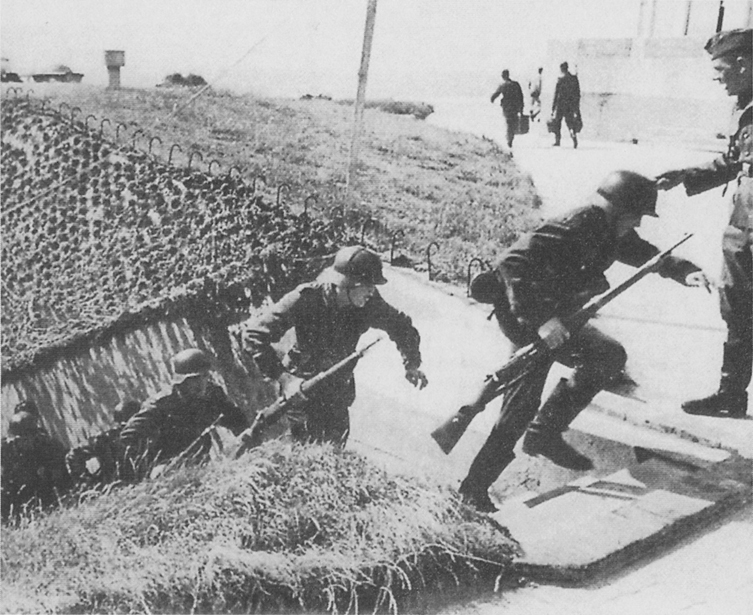
Atlantic Wall defenders - an NCO puts his men through their paces.
Impressive though the static positions were, there were flaws in the German defence. The troops themselves were not of top quality. By this stage of the war Russia and Italy were draining German manpower and the divisions in the West contained large numbers of semi-invalids, recruits and pressed foreigners. The Luftwaffe, too, was low in strength and quality. The Third Air Fleet, based in France, numbered only 160 aircraft. Finally, the German High Command was riven with controversy over how the impending battle should be fought. Field Marshal Rommel, in command of Army Group B in the northern part of von Rundstedt’s command, firmly believed that the Allies should be defeated on the beaches before their vanguard could gain a stronghold on the Continent. A strange turn of tactics for the man who had been a master of mobile warfare in the desert, but Rommel had felt the devastating effect of air superiority at the receiving end and knew that mobile reserves would be severely hampered on a battlefield over which the Allied aircraft flew virtually unmolested. So Rommel asked for the Panzer divisions to be allocated to the Atlantic Wall. Von Rundstedt disagreed. Influenced by his experience in outflanking the Maginot line with the help of Luftwaffe supremacy in 1940 and not fully accepting the complete reversal of circumstances which now applied, von Rundstedt pressed for the classic military solution of not committing the reserves until the direction of the enemy thrust was confirmed. The result, at Hitler’s direction, was a compromise. On D-Day Rommel had one Panzer division in his reserve (the 21st), while three more were held under orders, not even of von Rundstedt, but of Hitler himself.
An important factor in the German arguments over how best to group their forces was the question of where the Allies would land. Security was strict and the only information reaching the Germans was that which the Allies wanted them to have. There were two possible areas for the invasion force to land. The Pas de Calais, opposite the Kentish coast, offered the obvious advantages of a short sea crossing and a short flying time from home airfields for covering fighter aircraft. Normandy was further away but had various factors in its favour. One of the most important of them was that if the Allies were to succeed it would be vital for them to have the use of port facilities for supply and troop build-up early in the battle. The unsuccessful raid on Dieppe in 1942 had shown how heavily defended were all the French ports. A solution was found in the creation of Mulberry Harbours which would be towed across the Channel and sunk off the French coast to form harbours as large as that of Dover. The beaches at the Pas de Calais were unsuitable for such a scheme, but the long, shelving sands of Normandy, protected from the worst of the Atlantic weather by the Cherbourg peninsula, were ideal. The decision was for Normandy. The need now was to persuade the Germans that the Pas de Calais had been selected.
The art of deception is, of course, that of persuading your opponent that you will undertake Course A, when in fact you plan to follow Course B. The best chance of achieving this is to find out what he wants to believe, convince him he is correct, and then do actually something quite different. This is the story of the D-Day Deception Plan - Operation Fortitude.
Fortitude North involved ‘creating’, largely through simulated radio traffic, a fictitious Army in Scotland, which might in theory pose a threat to Norway. The success of Fortitude North is shown by the fact that it was not until 16 June that the Germans removed any troops from Norway - too late to affect the battle in northern France.
From Ultra intercept it was clear that the Germans expected the invasion to come at the Pas de Calais. Fortitude South was designed to confirm this impression in German minds. To achieve this a fictitious 1st US Army Group (FUSAG) was ‘invented’, commanded by the flamboyant US General George Patton, who was frequently photographed ‘inspecting troops in south-east England’. Tanks, vehicles, camps and store parks, not quite well enough camouflaged to avoid detection, were in fact inflatable dummies, as were the landing-craft which mushroomed along the banks of the Thames and Medway. And the radio traffic necessary to support the daily life of FUSAG, as it trained and prepared to invade the Pas de Calais area of northern France, was easily heard by the Germans eagerly listening across the Channel, confirming them in their views.
By late 1942 the British had arrested every spy that the Germans had tried to infiltrate into Britain. Many had been ‘turned’ and were now working for the Allies, feeding false information, about formations such as FUSAG, to their former masters.
Nor could the Deception Plan end with D-Day itself. The longer the Germans could be persuaded, after D-Day, that there was still a real threat elsewhere than Normandy, the slower they might be to move forces to confront the Normandy invasion. So successful was this plan that on 10 July, five weeks after D-Day and only two weeks before the break-out from the beach-head, a signal from Rommel to von Rundstedt stated:
‘The enemy has at present 35 divisions in the landing area. In Great Britain another 60 divisions are standing-by, 50 of which may at any moment be transferred to the continent. We shall have to reckon with large scale landings of 1 US Army Group in the north for strategic co-operation with the Montgomery Army Group in a thrust on Paris.’
Some of these divisions did exist, but were destined for Normandy. Others did not. FUSAG, and the threat it posed to the Pas de Calais never actually existed.
The date and time of the landing was, to a large extent, determined by Rommel himself. The Army planners wished to land in darkness or at dawn when the greatest tactical surprise could be achieved, but the Navy pressed for a daylight assault, allowing for greater control of shipping and of the naval and air bombardment. In the event, beach reconnaissance showed that Rommel’s obstacles were submerged at high water and that it would be necessary to carry out demolition work on them at low tide and in daylight. It was finally agreed that the landings would take place, after a moonlit night, about 10 minutes after sunrise and two to three hours after low tide. Such a precise requirement could only be met on about three days in every lunar month. This, combined with other factors, dictated that D-Day should take place in the first week of June 1944.
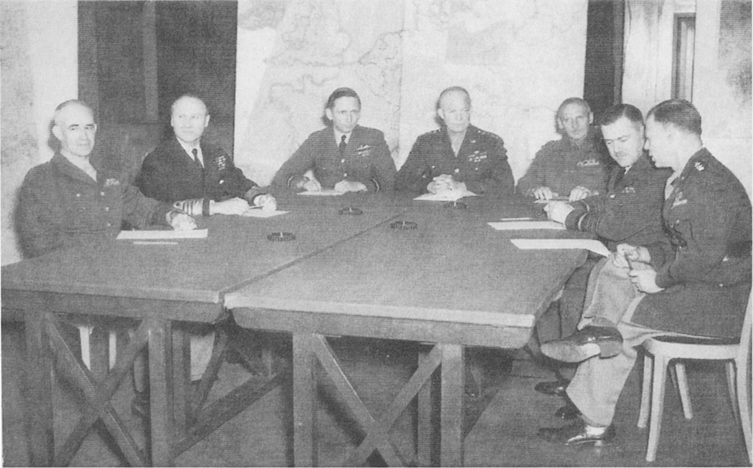
The Allied Command Team. From the left: General Bradley (First US Army); Admiral Ramsay (C-in-C Naval Forces); Air Chief Marshal Tedder (Deputy Supreme Commander); General Eisenhower (Supreme Commander); General Montgomery (C-in-C Land Forces); Air Chief Marshal Leigh-Mallory (C-in-C Air Forces); General Bedell Smith (Eisenhower’s Chief of Staff).
The idea of the invasion had been in Churchill’s mind since the dark days of 1940 when survival, rather than conquest, had been the uppermost consideration in most Englishmen’s minds. ‘Nous reviendrons’, he had told the French, ‘We shall be back’. A Planning team, COSSAC (Chief of Staff to the Supreme Allied Commander-designate), was established in May 1943 under the British Lieutenant General Morgan, tasked with conducting research and planning for D-Day. Three months later COSSAC submitted its initial plan - an invasion by three divisions between Ouistreham and Grandchamp, on the Normandy coast, supported by an airborne division on Caen.
In December 1943 General Eisenhower was appointed Supreme Commander, with Air Chief Marshal Tedder as his deputy and General Montgomery commanding the landing forces, 21st Army Group. Montgomery considered the invasion area to be too narrow and the force too small. In consequence the plan was expanded to a five division assault, with three airborne divisions deployed on the flanks. General Bradley’s 1st US Army would land at Utah and Omaha Beaches in the west, with 4 Infantry Division at Utah at the foot of the Cotentin Peninsula, and 1 Infantry Division, backed by 29 Infantry Division at Omaha. Utah would be the launch-pad for subsequent operations to cut the Cotentin Peninsula, isolate and then capture Cherbourg, thereby hopefully providing a workable port. To ensure success, 82 and 101 Airborne Divisions would be dropped inland from Utah, in the area of Sainte Mère-Eglise, to protect the flanks of the Utah force and secure crossings over the flooded Merderet valley which would be needed during a speedy break-out from the beach area. General Dempsey’s 2nd British Army would land at Gold, Juno and Sword Beaches in the east, with 50 Infantry Division at Gold, 3 Canadian Infantry Division at Juno and 3 Infantry Division at Sword. At the extreme eastern end 6 Airborne Division would secure a small bridgehead east of the River Orne, between Caen and the sea. The landing area would spread along fifty miles of the Normandy coast, with a boundary between the two armies in the area of Port-en-Bessin.

Amphibian Wing of the Royal Army Service Corps preparing for the invasion, seen here in sand dunes somewhere in England. Just a small part of the vast Allied force training to use new-fangled specialists vehicles - in this case, the DUKW.
Throughout May 1944 the south of England became one huge military cantonment containing 39 divisions (20 American, 14 British, 3 Canadian, 1 French and 1 Polish). These were supported by 5,049 fighter aircraft, 3,467 heavy bombers, 2,343 other combat aircraft, 2,316 transport aircraft and 2,591 gliders. More than 6,000 warships, merchant vessels and landing craft were assembled to transport the force. There were also specialist tanks carrying flails for minefield clearance, mats for covering sandy beaches, bridges for crossing gaps, amphibious tanks with propellers, 70 old merchant ships and 4 warships to sink as breakwaters, 2 artificial harbours, and a cross-channel pipe-line for supplying petrol (PLUTO) until the tankers could berth. 66,000 tons of bombs were dropped on Normandy during the three months preceding D-Day, creating what Churchill called ‘a railway desert’ around the Germans. This preparatory work was to be strengthened by a further 14,000 tons dropped on radar installations on the eve of D-Day and by a massive air and sea bombardment prior to and during the landings.
As the great day drew near General Montgomery visited his troops in southern England, briefing large gatherings on the forthcoming operation. With soldierly brevity he summed it all up in a few simple words:
‘We have a long sea journey, and at the end of it all we will have to land on an enemy coast in the face of determined opposition. The violence, speed and power of our initial assault must carry everything before it.’
The dawn was about to break.
