
1.
IT was a raw, biting wind that swept down from the Hindu Kush in the first weeks of 2002, and the militiamen guarding the Ariana Hotel in downtown Kabul stamped their feet and blew on their hands to fight off the chill.
Behind them the hotel sat squat, yellow, and ugly. The Ariana was owned by the Afghan government, which in reality meant whichever guerrilla army happened to be in charge of Kabul at the time. It also meant the hotel had played several cameo roles in the decade of civil war that had wracked Afghanistan since the pro-Soviet government fell to the mujahideen in 1992. When the Taliban army of fundamentalist Muslim students routed the weak central government in 1996, their first order of business had been to drag Najibullah, the last pro-Soviet Afghan dictator, from the United Nations compound in which he and his brother had sheltered since their government fell in 1992. After torturing them, the Taliban death squad murdered the brothers and then hung their bodies from a makeshift scaffold in the traffic circle in front of the Ariana. Thereafter, the Taliban used the hotel as an R & R spot for troops rotating back from the front line in the war against the Northern Alliance forces of Ahmad Shah Massoud, and as a way station for Pakistani volunteers en route to the front. By way of payback, a Northern Alliance jet dropped a bomb on the hotel in 1997.
Now the tables had turned again. Al Qaida, the Islamist terrorist organization that had found a welcoming home in Afghanistan under the Taliban, had hijacked four planes in the United States and flown two of them into the World Trade Center and one into the Pentagon, killing thousands and stirring the world’s only superpower to action. The Americans had come to Afghanistan, embraced the Northern Alliance, and driven the Taliban from power. And so it was that the guards lounging by the large concrete steps that led up to the Ariana’s main entrance were tough-looking Northern Alliance fighters, hard men down from the Panjshir Valley whose fingers never wandered far from the triggers of their Kalashnikov assault rifles. Some of these men had been fighting—against the Soviets, Najibullah’s regime, other mujahideen militias, and the Taliban—for more than twenty years, and it showed on their dark, worn faces and dirty, calloused hands.
But the balance of power had not shifted completely in the Northern Alliance’s favor. Not yet. The big dog on the block was the United States, and so while the Panjshiri guards shivered outside in their motley camouflage uniforms provided by the Central Intelligence Agency, inside the Ariana’s bullet-scarred walls the Americans held court. The CIA had rented the entire hotel, retained the staff, and set up its Kabul station there. It made sense for the spooks to use the Ariana. It was centrally located, just a couple of blocks from the Presidential Palace, and the safe house being used by the Special Forces, but it was protected from the busy street by a ten-foot wall. The only other defenses the Americans had added were a string of concertina wire atop the wall and a sandbagged guard post on the flat roof, manned twenty-four hours a day by a couple of Northern Alliance fighters.
Easy living it wasn’t. The plumbing was atrocious, even by Afghan standards, and the hotel was in a general state of disrepair. But it was warm, and the dining room still offered simple but delicious dishes of beans and rice and other staples of Afghan cuisine.
On this frigid mid-January afternoon a handful of men were gathered in one of the hotel’s upstairs rooms for a meeting. The CIA personnel conducted most of their meetings in this room during those first turbulent months after the fall of Kabul, but on this occasion only one agency officer was present—a thin, bearded man with long sandy hair called John, who was the deputy chief of station. The rest of the men were soldiers, special operators from the units that had been at the forefront of the war in Afghanistan. Like John, they were dressed in civilian clothes and wore their hair longer than most American soldiers are allowed. All sported the beards that were ubiquitous among American special operators and intelligence operatives in Afghanistan. Most were armed with M4 carbines or 9mm Beretta pistols.
It was a dark-walled room made even darker by the curtains drawn to prevent any snipers from drawing a bead on those inside. Dust motes swam in a single shaft of intense sunlight that exploited a small gap between the curtains. A lamp resting on an end table cast shadows on a floor covered by an Afghan rug, and the men sat on a tatty, overstuffed sofa and similarly worn but comfortable chairs.
As the Americans sipped green tea from a service that a member of the hotel staff had set on a glass-topped coffee table, the mood was businesslike. The Taliban had been defeated, the Northern Alliance had swept into Kabul, and the whole country was—in theory—under the control of the Americans and the Afghan warlords with whom they had allied themselves. But the men in the room were not celebrating. The Taliban were gone and Al Qaida’s guerrillas were on the run, but there was still much to do. Six weeks earlier the Americans thought they had Al Qaida’s leaders holed up at Tora Bora in the White Mountains that straddle the border with Pakistan. Reluctant to put too many American troops on the ground, U.S. commanders had relied on their Afghan allies backed up by Special Forces to snare Osama bin Laden and his henchmen. But this time the Americans’ faith in their militia allies was misplaced, and a failure to block escape routes into Pakistan from Tora Bora meant bin Laden and hundreds of Al Qaida’s most hardened fighters had slipped the net.
So long as those guerrillas remained at large, the Americans knew they could not rest. And so as usual in these brainstorming sessions, which John convened daily in his excuse for a sitting room, the talk this afternoon was where to focus next.
As the meeting was breaking up, John looked across the table and spoke directly to one of the special operators—an Army officer dressed in a thick, long-sleeved shirt with an Afghan scarf around his neck. Clipped into the waistband of his cargo pants was a black leather holster in which nestled a semiautomatic Glock pistol with a twenty-round extended clip. Over six feet tall with dark hair and a goatee that framed an open and honest face, the officer was forty years old, yet still had the lean, hard physique of the track and field champion he had been in his youth. He exuded the self-confident air of a man used to not just living but succeeding on his wits. His name was Pete Blaber and he was a lieutenant colonel in 1st Special Forces Operational Detachment—Delta, better known to the public as “Delta Force.”
The agency was getting a lot of reports that Al Qaida forces were regrouping in a mountainous region south of Gardez in eastern Afghanistan’s rugged Paktia province, John said. “What’s it called?” Blaber asked. The CIA officer told him. Blaber, who had been in Afghanistan for a month and thought he knew the lay of the land, had never heard of the place. “How do you spell it?” he said, eyes narrowing with curiosity as he grabbed a mechanical pencil to jot the name down in his day planner.
As Blaber scribbled, the CIA officer spoke each letter in turn: “S-H-A-H-IK-H-O-T.”
2.
THE spooks and operators at the Ariana weren’t the only Americans in central Asia to have taken a sudden interest in the Shahikot Valley. Two weeks earlier, and 350 miles (about 563 kilometers) to the northwest, at a remote air base in Uzbekistan, two Army officers had been poring over maps of eastern Afghanistan. Major Paul Wille and Captain Francesca Ziemba were on the staff of the 10th Mountain Division, and they were working on an urgent tasking from the division commander, Major General Franklin “Buster” Hagenbeck.
A native Floridian and West Point graduate, Hagenbeck had taken command of the division in August, having previously seen combat in Grenada with the 82nd Airborne Division in 1983.
By late December 2001, Hagenbeck was a frustrated man. He’d left 10th Mountain’s home post of Fort Drum in upstate New York a month earlier in the expectation that he would soon be commanding troops in combat in Afghanistan. Although it had been America’s commandos who had carried the fight to the enemy so far, Hagenbeck was sure the conventional Army’s battalions, brigades, and divisions would be essential in defeating the Taliban. He was by no means alone in believing that victory in Afghanistan would likely require conventional forces sooner rather than later. When the first CIA operatives and Special Forces soldiers had flown into Afghanistan in September to link up with the Northern Alliance, U.S. commanders were not planning for victory by Christmas. Their ambitions were far more modest: to use the Northern Alliance, emboldened by the precise lethality of America’s air power and the tactical savvy of her special operators, to carve out a foothold in northern Afghanistan before the onset of the dreaded Afghan winter. The aim was to seize at least one airfield in the north into which conventional troops could be flown, if necessary, in time to launch a spring offensive.
When, against all expectations, one province after another fell quickly to the Northern Alliance, the Americans instead began planning to introduce conventional forces in a battle for Kabul, in case the Alliance’s attack stalled at the gates of the Afghan capital. The plan was to airdrop a brigade of the 82nd Airborne Division to seize Kabul’s airport, through which would flow the conventional units charged with taking control of the city. But the Taliban’s hasty retreat from the capital on November 13 obviated the need for such an assault. (This was fortunate. With no permission to stage the airborne assault from bases in neighboring countries, it would have taken every tanker aircraft in the Air Force’s fleet to refuel the C-17 and C-141 transports flying the paratroopers from Pope Air Force Base, North Carolina, to the dark skies over Kabul. This would have left no tankers for the bombers that would be expected to conduct preassault strikes on Kabul’s defenses.) Similar plans for a conventional assault on the southern city of Kandahar, the Taliban’s spiritual home, also went by the wayside when the regime failed to make the last ditch defense of the city expected by U.S. commanders.
So instead of pitting their wits against the Taliban and Al Qaida, the end of 2001 found Hagenbeck and his staff sitting on the sidelines, itching to get into the action. Hagenbeck’s mission was to be the forward headquarters in the Afghanistan theater for Lieutenant General Paul Mikolashek, who commanded all of America’s conventional ground forces in a swathe of the globe that encompassed twenty-five countries stretching from Sudan to Kazakhstan. That was the territory for which U.S. Central Command (CENTCOM)—one of the Pentagon’s five regional commands—was responsible, and Mikolashek’s boss was CENTCOM commander General Tommy Franks. In peacetime Mikolashek’s command was known as the Army component of Central Command, or ARCENT. But during the war in Afghanistan, as other ground forces—U.S. Marines, as well as U.S. and allied special ops units—were placed under Mikolashek, Franks gave it the tongue-twisting title of Coalition Forces Land Component Command, or CFLCC (pronounced “sea-flick”).
ARCENT’s headquarters at Fort McPherson in Atlanta, Georgia, was too far away from Afghanistan for Mikolashek’s taste, so he moved it to the high-tech facilities at Camp Doha in Kuwait. But he wanted a headquarters element even closer, so the Army gave him the 10thMountain division HQ, which is how Hagenbeck found himself at the windblown base at Kharsi-Khanabad, Uzbekistan. He and his headquarters arrived at K2, as it quickly became known, on December 1.
By the time Hagenbeck’s troops had pitched their tents in K2, the Taliban had abandoned Kabul and retreated to their power base in the southern city of Kandahar, where their resistance evaporated by December 9. Meanwhile, bin Laden and hundreds of his fighters had fled to their Tora Bora stronghold. When Franks declined to commit conventional troops to stop those fighters from escaping into Pakistan, another opportunity to get into the fight seemed to have slipped through Hagenbeck’s fingers. But he wasn’t about to give up. Although an even-tempered officer of patrician countenance, the division commander was, by his own admission, “chomping at the bit to do something.” He knew there were still enemy forces in Afghanistan. That much was clear from the daily video-teleconferences (VTCs) through which CENTCOM ran the war from its headquarters at MacDill Air Force Base in Tampa, Florida. These video-teleconferences, in which the senior figures from each headquarters sat in front of a TV camera–monitor combination that automatically broadcast the picture of whoever was talking to the other headquarters watching, were a feature of daily life for the colonels and generals planning and fighting the war. In these discussions CENTCOM officials referred to remaining concentrations of Al Qaida fighters in Afghanistan as “puddles of resistance.”
Hagenbeck gathered his staff in late December and told them to collect all the intelligence they could about the situation in Afghanistan and to draw up rough plans—concepts of operations, in Army lingo—for missions in which the Mountain headquarters could be used to command and control conventional and special operations forces. Hagenbeck’s aim was to demonstrate his headquarters’ value to Mikolashek, in the hope of persuading the three-star general to give Mountain a combat operation to head up.
Wille and Ziemba got to work. A brawny, likable and plainspoken man, Wille was the division’s chief of plans. His job was to coordinate the efforts of all the other planners in the division staff and subordinate units. Ziemba, a slender brunette who as a West Point cadet had somehow acquired the incongruous nickname “Ox,” was the plans officer in the division’s intelligence section. “Okay, where’s some enemy activity?” Wille asked the intel officer. “Right here,” she said, indicating a digital map display on her laptop, her finger pointing right at the Shahikot. “There’s some enemy activity in this valley.” The Shahikot area had been a mujahideen stronghold during the Soviet-Afghan war, she added. To Wille that seemed as good a place as any for which to plan an operation. He and Ziemba applied themselves to the task assiduously. Their “office” was the plans tent, the only unheated tent in the entire command post. In the chill of the Uzbek winter, they often typed with their gloves on. Operating on two hours of sleep a night, supplemented by copious amounts of coffee, the two officers scrutinized maps, analyzed intelligence reports, and put together a rough plan.
Their job was made all the harder by the fact that no one at the Mountain headquarters, including Hagenbeck himself, had access to the most current intelligence about events in Afghanistan. This was a function of the compartmentalized approach to intelligence gathering in the war, in which, for reasons of operational security and bureaucratic turf protection, intelligence gathered by one U.S. agency or command was often not shared with other senior U.S. officials or military commanders in the region. CENTCOM even held back intelligence from Mikolashek’s headquarters. Nevertheless, by the end of December, Wille and Ziemba produced a well-developed concept paper that showed how the Mountain HQ could use conventional and unconventional forces to crush Al Qaida guerrillas in the Shahikot. Wille presented it to Hagenbeck, who liked what he saw. The concept was forwarded to Mikolashek and his CFLCC planners in the first week of January.
Hagenbeck heard nothing back from Mikolashek. His frustration gave way to resignation. On January 25 he boarded a plane and flew to Kuwait, there to brief Mikolashek on another plan his staff had drawn up: the one for their imminent return to Fort Drum.
3.
WITHIN forty-eight hours of his return to K2 after briefing Mikolashek on his plan to take his headquarters back to the States, Hagenbeck was finally read in on some of the compartmentalized intelligence hitherto denied him. The man sharing the intel was Colonel John Mulholland, a bear of a man who commanded 5th Special Forces Group. Mulholland had every right to be pleased with the course of his war so far. Under his command a task force of just 316 Special Forces soldiers had entered Afghanistan, organized, trained, and, in some cases, equipped the Northern Alliance and the anti-Taliban Pushtun militias, toppled the Taliban government in Kabul and routed its fielded forces. The entire campaign, from the first A-team flying into Afghanistan on October 19 to the collapse of the Taliban’s home base in Kandahar on December 6, had lasted only forty-nine days. Notwithstanding the critical contributions made by the CIA, air power, and other special operations forces, the defeat of the Taliban was Special Forces’ finest hour.
Special Forces have been part of the Army since 1952. For much of that time they have been treated like a bastard child. The “big Army” never really felt comfortable with the independence bred and trained into SF soldiers. Unlike the conventional Army, which often maneuvered in 600-soldier battalions, Special Forces’ cutting edge was provided by twelve-man operational detachments alpha, more commonly known as ODAs or A-teams. By 2001 Special Forces focused on “unconventional warfare”—teaching insurgents how to wage war against enemies of the United States. Afghanistan seemed to validate their approach. But that didn’t stop CENTCOM from ensnaring Special Forces in a confusing and often conflicting chain of command that was to affect with nearly disastrous results the rest of the war in Afghanistan.
The commander of all of CENTCOM’s “white” (i.e., those whose existence is not classified) special operations forces was a former head of SEAL Team 6, the Navy’s rough equivalent of the Army’s Delta Force. That officer, Rear Admiral Albert Calland, split the special ops command in Afghanistan. In the north, where the Northern Alliance’s presence offered great opportunities for unconventional warfare, he created Task Force Dagger, with Mulholland’s 5th Group at its core. To special ops planners, the south offered more potential for a force designed to conduct special reconnaissance and direct action; in other words, a force that specialized first in finding the enemy, then killing him. The force Calland established to do that—Joint Special Operations Task Force (South)—was led by another SEAL, Commodore Robert Harward, and comprised largely special ops units from allied countries, rounded out by some SEALs and Special Forces. It was called Task Force K-Bar.
Many, especially those in the Army, worried about Navy operators being thrust into extended land operations. But in the north the plan worked better than anyone had dared hope.
WITH Mikolashek’s support, Task Force Dagger put unconventional warfare (UW) doctrine to work on a massive scale in Afghanistan, allying with the warlords who would become American surrogates or, in the language of UW, “G-chiefs” (the G stands for guerrilla). According to Lieutenant Colonel Mark Rosengard, Dagger’s operations officer, the key to understanding and implementing that doctrine was to reduce it to its bare essentials. For a UW operation to work, a potential G-chief must be able to answer “yes” to three simple questions, he said.
“The first one is ‘Do we have a common goal today, recognizing tomorrow may be different?’ The second question is ‘Do you have a secure backyard?’” Rosengard said. Without a sanctuary in which Special Forces could meet with and organize indigenous troops, “we’ll only run away from the enemy all the time and never get anywhere.”
The third question is even more basic: “Are you willing to kill somebody?”
“With those three things, I can do business,” Rosengard said. “It’s no more complicated than that. Bragg [Fort Bragg, North Carolina, where Special Forces doctrine is written and taught] will make that a mile long and teach people a course for eight weeks.”
In the Northern Alliance, Task Force Dagger found an organization whose leaders could answer with a resounding “yes” to each of the three questions. Despite the assassination of its charismatic leader, Ahmad Shah Massoud, only two days before the September 11 attacks, the alliance remained a force in being, with its own “secure backyard” in northeastern Afghanistan. Once the A-teams got their feet on the ground and put their heads together with their chosen G-chiefs, the combination of American know-how and air power with Northern Alliance muscle proved unstoppable when opposed by the Taliban’s ragtag army.
The Taliban’s collapse heralded an extraordinary success for Task Force Dagger, but it also posed new and difficult challenges. The Northern Alliance had proven worthy allies in the fight to topple the Taliban. But once that victory had been achieved, the alliance’s leaders were more interested in consolidating power for themselves in Kabul, or in fighting among themselves, than they were in crushing the Al Qaida forces that, along with the remnants of the Taliban army, had fled to the mountains that lined the border with Pakistan. This was to be expected. The Northern Alliance was dominated and led by fighters from the two largest ethnic groups in northern Afghanistan, the Tajiks and the Uzbeks. The Taliban, on the other hand, was a movement that emerged from the Pushtun tribes concentrated along both sides of the border with Pakistan. The Pushtuns had traditionally controlled Afghanistan’s central government, and what the Northern Alliance leaders were really interested in was ejecting their hated Pushtun rivals from power, and then enjoying the fruits of victory. They had little incentive to risk their lives chasing Al Qaida’s highly motivated foreign fighters through the mountains.
At this point American interests diverged from those of the Northern Alliance. U.S. commanders had little interest in rounding up the Taliban’s foot soldiers, most of whom had returned to their farms and villages or fled to Pakistan. But the Americans had every intention of killing or capturing the hundreds—perhaps thousands—of Al Qaida fighters now on the run in eastern Afghanistan, as well as Taliban leader Mullah Mohammed Omar and his immediate subordinates. Task Force Dagger was given permission to extend its unconventional warfare campaign into the Pushtun lands of southern and eastern Afghanistan. However, having allied themselves with the Northern Alliance, dominated by the Pushtuns’ historical enemies, the Americans had—perhaps unavoidably—set themselves a difficult task when it came to winning Pushtuns over to their cause. To make matters worse for the Americans, Al Qaida had also been a stronger presence in the eastern provinces than elsewhere in the country, buying friends and influence with cash.
The TF Dagger leaders realized allies would not be as easy to find in eastern Afghanistan as they had been in the north. Working out of bases in Pakistan, Dagger teams cobbled together a few Pushtun tribal militias and tagged them the “Eastern Alliance,” as a counterweight to the Northern Alliance. For a time this approach seemed to be working. It was Dagger, with help from the CIA and other special ops units, which brought Pushtun leader Hamid Karzai into Afghanistan from obscurity and exile in Pakistan, then fought with him until the Taliban were vanquished and he could assume power as the United States’ handpicked head of state in Kabul. Other A-teams found Pushtun chiefs willing—for a price—to help them pursue Al Qaida in the mountains of northeast Afghanistan. But the Americans’ luck ran out at a place called Tora Bora.
4.
NESTLED in the White Mountains on the north edge of a finger of Pakistan that jutted fifty miles into eastern Afghanistan, Tora Bora was one of several complexes along that part of the border that had served as bases for the mujahideen during their war against the Soviets and had since been taken over by the Taliban or Al Qaida. The bases were in the Pushtun heartland, just across the border from Pakistan. This meant they could be easily resupplied by Pakistan’s Inter-Services Intelligence Directorate, which in the past had supplied both men and materiel to the mujahideen and the Taliban. Most of these bases shared the same features: natural and man-made caves, bunkers, antiaircraft defenses, logistics depots, and convenient escape routes back into Pakistan.
In late November intelligence reports indicated that a significant Al Qaida force was coalescing at Tora Bora. There were strong suggestions that bin Laden was also there, although firm intelligence on the movements of bin Laden and other Al Qaida leaders was hard to come by. Bin Laden had lived among the Pushtuns for all but six of the last nineteen years. Many families in the region had benefited from his generosity. Like bin Laden, the Pushtun tribesmen were fiercely Islamic, but the Pushtuns also lived by a strict honor code that set great store by the sheltering of guests from their enemies. Few were willing to cooperate with the Americans. Fewer still could be fully trusted. Even with a $5 million reward on his head, bin Laden was safer among the Pushtuns than he was almost anywhere else on earth.
Without good intelligence, the Americans faced a daunting challenge in assaulting Al Qaida’s mountain fastness in Tora Bora. They went with the modus operandi that had worked for them up to now: unconventional warfare. Dagger’s success around Kandahar with Karzai and his fellow Pushtun leader, Gul Agha Sherzai, had given the task force’s leaders confidence that they could take the momentum they had gained with the Northern Alliance and transfer it to the Pushtun heartland. They found a few local militia leaders they thought they could work with in the Tora Bora area and, with CIA officers handing out wads of greenbacks, set about using them to hunt bin Laden down.
But the truth was it didn’t matter much whether or not the Dagger leaders or the generals at CFLCC headquarters in Kuwait thought unconventional warfare alone would be enough to destroy the Al Qaida forces at Tora Bora. They had no other option. From the very start of the war, CENTCOM had been extraordinarily reluctant to introduce conventional forces into Afghanistan. This approach reflected what Franks was being told by Defense Secretary Donald Rumsfeld. “The message was strong from the national level down: ‘We are not going to repeat the mistakes of the Soviets. We are not going to go in with large conventional forces,’” recalled Major General Warren Edwards, who was Mikolashek’s deputy commanding general for operations at CFLCC. “This was so embedded in our decision-making process, in our psyche.”
“We don’t want to make the same mistakes as the Russians, we don’t want to look like an invading force” became a mantra, an article of faith for U.S. officials from senior figures in the Bush administration to field grade officers in Afghanistan. This represented a very simplistic view of the Soviets’ defeat in Afghanistan, which owed as much to their attempt to impose an alien, morally bankrupt political system on the Afghan population using scorched-earth tactics as it did to the raw number of troops they put into the country. It also ignored the possibility of a middle ground somewhere between the 120,000 troops that the Soviets had in Afghanistan at the height of their war in the 1980s and the few hundred special operators that the United States had in Afghanistan. Even had the United States put two light divisions—say the 101st Airborne and 10th Mountain divisions—into Afghanistan, the numbers would not have exceeded 30,000, only a quarter of what the Soviets deployed.
Inside the Pentagon the three figures at the head of the Army—Secretary of the Army Tom White, Chief of Staff General Eric “Ric” Shinseki, and Vice Chief of Staff General Jack Keane—argued for a larger role for their service. Afghanistan was a large, landlocked country, after all. It had no air force to speak of, and no navy. But when Shinseki, who represented the Army when the Joint Chiefs of Staff met to discuss strategy, pushed for a greater deployment of regular Army units to Afghanistan, he was repeatedly rebuffed by the defense secretary and the loyal coterie of political appointees who surrounded him in the Pentagon. “Ric was always for more conventional force than the guys down the hallway, and Rumsfeld in particular,” White said. It didn’t help the Army leaders’ cause that Shinseki’s relations with Rumsfeld had been strained since the early days of the defense secretary’s tenure. Rumsfeld arrived at the Pentagon in January 2001 determined to restructure the military so that it could more efficiently and effectively meet the challenges of the twenty-first century. In an ironic twist he called this process “transformation,” hijacking a term Shinseki had been using since October 1999 to describe his plans to modernize the Army. Rumsfeld spoke of transforming the entire military, but he had the Army foremost in his sights. The Army’s senior generals, he believed, were too wedded to their Cold War-era heavy armored and mechanized divisions and lacked the imagination necessary to break with the ways of the past in order to create the more flexible formations and doctrine Rumsfeld believed were the keys to success on future battlefields. In the months prior to September 11, the media had been full of stories suggesting that Rumsfeld was looking to do away with two of the Army’s ten active duty divisions and use the savings to fund the development of precision munitions, which he and his advisers viewed as the route to success in future conflicts. Although Rumsfeld’s rhetoric about transformation in many ways echoed Shinseki’s, the personality clash between the brash, arrogant defense secretary and the low-key chief of staff did much to create an atmosphere of mutual distrust between the office of the secretary of defense and the Army leadership. In this light, it is hardly surprising that Rumsfeld resisted the Army leaders’ suggestions to deploy more conventional forces to Afghanistan. As the combination of Special Forces and airpower helped sweep the Taliban from power, it appeared the Afghanistan campaign was validating Rumsfeld’s vision of twenty-first-century warfare.
The Pentagon’s—and, by extension, CENTCOM’s—obsession with minimizing the presence of U.S. conventional troops in Afghanistan translated into an arbitrary cap on the number of U.S. personnel that Franks would allow on Afghan soil at any one time.
THUS the attack on Al Qaida’s positions at Tora Bora that began November 30 followed the same pattern as previous operations: an assault by Afghan fighters, advised by Dagger A-teams, Delta Force operators, and CIA operatives, and supported by a massive aerial bombardment. For the first time the formula failed. The CIA and Dagger had recruited a local Pushtun militia led by a warlord named Hazrat Ali for the assault. But Ali and his troops did not share the Northern Alliance’s enmity for the Taliban’s foreign allies and prosecuted their attacks halfheartedly. Even had they been more highly motivated, the challenges of assaulting such inaccessible, heavily defended positions would almost certainly have proved beyond the capabilities of the hastily organized force.
“That was the most formidable terrain that we fought in,” said Rosengard, Dagger’s operations officer. Valleys were no more than snow-filled defiles whose sheer rock walls soared skyward to become jagged peaks up to 15,000 feet high. “Given the availability of that cover and concealment [to the enemy], with the Afghans, and particularly with the Pushtun Afghans—the General Hazrat Ali guys—we did not have the fire and maneuver available to us to get in there and root guys out,” Rosengard said. “We just didn’t have the skill to overcome the combination of that enemy and that terrain.”
The Dagger leaders assumed a portion of the Al Qaida force would fight to the death, but only to protect their comrades, including bin Laden and other senior leaders, as they tried to escape. This is exactly what happened. The Tora Bora base backed on to the porous Pakistan border, across which lay the Pushtun tribal areas of the Northwest Frontier Province, whose inhabitants were sympathetic to the Taliban and largely beyond the control of the central government in Islamabad. With no U.S. conventional forces to block their escape, hundreds of Al Qaida fighters slipped into Pakistan.
It seems incredible in retrospect, but this turn of events had not been foreseen at CENTCOM or CFLCC. “There was some knowledge that this might be the last great stand, that bin Laden might be there, the senior leadership might be there,” said Edwards, Mikolashek’s deputy. “But the mindset was, we’re gonna push forward, we’re gonna strike ’em with air, we’re gonna kill ’em all up here in the valley. Not, they’re gonna flee outta there.” A few days into the fighting the Americans intercepted a radio communication out of Tora Bora from bin Laden himself. But even then, with the prospect of their highest-value target escaping with the core of his remaining force, U.S. commanders remained oblivious to the strategic disaster unfolding. “When Tora Bora started to bog down, I’m not sure anybody understood how many were escaping,” Edwards said.
The American generals might not have realized how many foes were escaping, but after several days of inconclusive fighting around Tora Bora, they became frustrated with the operation’s slow pace. “The whole issue between CENTCOM and CFLCC and Dagger during Tora Bora was keeping up the momentum,” Edwards said. The Afghan allies would make an attempt at an attack, then go home and drink tea. “It wasn’t moving fast enough for the CinC [commander-in-chief, i.e., Franks].”
American surveillance planes spotted scores of intense heat sources—interpreted as campfires—in the snowy heights. There were no settlements at that altitude. The perception at CFLCC was that these fires were keeping enemy fighters warm as they made their way to Pakistan. The generals in Kuwait recommended bombing the positions as soon as possible. But Franks and his staff did not see it like that. “They might be shepherds” was Central Command’s attitude, according to two officers who sat in on video-teleconferences in which the matter was discussed. At CFLCC that theory didn’t wash. The idea that scores of shepherds were tending their flocks in drifting snow at 10,000 feet in the middle of winter was implausible. But the higher headquarters prevailed and refused to target the hot spots because no one could prove that they were enemy campfires. Whoever set the fires—Al Qaida fighters or a midwinter gathering of shepherds—survived to make a safe passage over the border.
At least two Dagger A-teams were sent across the border to help Pakistani troops whom the Americans wanted to block Al Qaida’s path. This was a vain hope. The Pakistani military was reluctant to stray into the Pushtun tribal areas that straddled the border, and the effort foundered. The Pakistanis intercepted about 300 Al Qaida troops, but roughly 1,000 escaped. Among those who got away, almost certainly, was Osama bin Laden. Franks would later say that he remained unconvinced that bin Laden was at Tora Bora. Deputy Defense Secretary Paul Wolfowitz told Congress in June 2002 that Franks had believed that conducting the Tora Bora operation with U.S. conventional forces would have required “a massive, highly visible buildup” of troops that would have tipped off the Al Qaida forces, allowing them to flee. But among American officials familiar with the battle, Franks was in the minority. The prevailing opinion was that, despite the scores of enemy fighters killed by American bombs, Tora Bora represented a failure, a defeat for the Americans, and CENTCOM was to blame for not using conventional forces.
For the first time the unconventional warfare approach had come up short. The point was lost on neither TF Dagger nor the higher-ups in CFLCC and CENTCOM. “Certainly [Tora Bora] has got to be quantified as a failure for not having drug out of there who everybody believed was there,” Rosengard said. “[That failure] drove home to much greater clarity the fact that we did indeed lack the fire and maneuver to do all things for all people in Afghanistan.” But to CFLCC’s planners, Tora Bora also underlined the consequences of CENTCOM’s bias against committing the conventional forces required to destroy the remaining Al Qaida elements in Afghanistan. “There was a constant—in our mind—disconnect between mission and assets allowed to be available to do the mission,” Edwards said. That disconnect would reassert itself ten weeks later in the Shahikot.
5.
IN the cold, muddy tent city at K2, the Tora Bora failure prompted long conversations among the senior Dagger officers as the unconventional warfare maestros reconsidered their approach to what remained of the war in Afghanistan. As the officers talked long into the dark Uzbek nights, one thick Boston accent rose loudly above the whine of C-17 engines and the roar of MC-130 Combat Talon turboprops from the nearby runways. The voice belonged to Lieutenant Colonel Mark Rosengard.
Until October, Rosengard had been deputy commander of 10th Special Forces Group, which is headquartered at Fort Carson, Colorado, but specializes in operations in Europe. Then he received a call from Special Forces Command at Fort Bragg telling him to pack his bags—he was headed to K2 to serve as Dagger’s new operations officer. (A Special Forces group’s operations officer was usually a major, but when transformed into a joint special operations task force, the group was entitled to a lieutenant colonel in that position.) Even if he’d been a bland operator who preferred to stay in the background, Rosengard’s job as the officer in charge of coordinating Dagger’s current missions while planning future operations would have made him one of the most important of the fifty-plus augmentees who arrived at K2 to beef up Mulholland’s staff. But Rosengard wasn’t that type, and the inspiring force of his personality rendered his impact on the task force, and the coming operation, all the greater.
Possessed of an exuberant self-confidence, the forty-four-year-old Rosengard had been seasoned by years spent operating in Bosnia, Kosovo, and northern Iraq. That experience, combined with his extraordinary energy and drive, meant he commanded instant respect among his subordinates in the “3 shop,” as an Army unit’s plans and operations directorate is known. Rosengard was “a fireball” who motivated his men to work eighteen-hour days, seven days a week, said Captain Tim Fletcher, who, as commander of 5th Group’s Headquarters and Headquarters Company, observed Rosengard at close quarters for several months.
Rosengard’s ability to work long hours with no apparent diminishment in his judgment or equilibrium astonished his subordinates. Fueled by a constant intake of caffeine and nicotine, Rosengard would literally work until he dropped. “He wouldn’t sleep unless he basically just shut down,” said Fletcher. After being evacuated—against his will—to a U.S. military hospital in Incirlik, Turkey, suffering from chest pains that turned out to be nothing more serious than acid reflux, Rosengard quit his pack-a-day-of-Marlboro-Lights habit on January 1, impressing colleagues with his ability to do so without becoming short-tempered. But that was his only lifestyle concession. He only relaxed when reading letters from his wife and two children. Then he would slip into a comalike sleep. On those occasions his staff would let him doze through small crises or moments of decision, because he needed the rest, even though they knew their failure to rouse him would bring a rocket when he finally awoke.
Rosengard was a man who found it easy to get along with others, and for whom subordinates would gladly work themselves into the ground. This was an invaluable trait for an officer who arrived as an unknown quantity in the pressurized atmosphere of Dagger’s headquarters. “He’s a phenomenal man that I’d work for again in a heartbeat,” Fletcher said. Rosengard quickly formed a good working relationship with Major Perry Clark, 5th Group’s operations officer who now worked for him. Clark knew the personalities in the headquarters and the operators on the teams. Rosengard brought experience.
But there was also a flamboyant side to Rosengard, a former college hockey goalie whose black mustache was as thick as his vowels were broad. He gave briefings at high volume, accentuating his remarks by using a red laser aiming device attached to his 9mm Beretta pistol. His over-the-top, all-action style unsettled some soldiers, who had to suppress laughter when confronted with this vociferous, pistol-waving officer. But Rosengard never used his outspokenness to demean. If he was angry with someone, he let them know privately. “If you ever got pulled aside, and talked to nice and quietly, you knew you were in a world of hurt, because that’s when he was serious,” Fletcher said.
American bombs were still falling on Tora Bora when Rosengard and his staff met December 8 to consider where next to focus Dagger’s energies. There were probably still some Taliban elements in the desert provinces south and west of the city of Kandahar city, but U.S. commanders considered these an insignificant threat. “We knew where we had a problem, where the sanctuary was, where there were people that would support [the enemy] we were going to get,” Rosengard said. That sanctuary was Paktia’s mountainous border with Pakistan. “The place where we had the littlest influence that had the most significance was Paktia province….We knew there was order of battle [there]that we had not yet encountered and had not accounted for in any way,” he said. Dagger’s planners concluded that “tactically, Paktia was the biggest deal left on the plate.”
But as they were figuring out where they should next take the fight to their enemy, U.S. commanders were also rethinking their “all UW, all the time” approach. The war had changed course. They were now facing a different enemy than they had encountered—and conquered—using unconventional warfare. For the past two months Dagger’s Special Forces operators and CIA operatives had used the Northern Alliance to roll back an enemy that consisted largely of the Taliban’s peasant infantry. But by now the Taliban had been evicted from all major towns. Most Taliban fighters not killed or captured had returned to their farms and villages or crossed into Pakistan. Al Qaida, however, was another matter. Its fighters had no hometowns or villages in Afghanistan to which to return. The option of simply surrendering or switching sides, as many Taliban-affiliated militias had done when it was clear which way the war was headed, did not exist for Al Qaida. They were outsiders, foreigners from Uzbekistan and Chechnya, as well as Saudi Arabia and other Arab states. They could expect no quarter from the Northern Alliance and little from the Americans. Nor could they return to the homes they had left. Most were on the run from the authorities in their native countries, who preferred to export Islamic extremism rather than let it fester at home.
What’s more, Al Qaida troops’ religious fervor made them highly motivated soldiers. During the war with the Northern Alliance, the Taliban’s 55th Brigade—composed entirely of Al Qaida fighters—was one of the Taliban order of battle’s most effective formations. Al Qaida fighters were also, almost by definition, vehemently anti-American. With their most senior leaders still at large, they would not consider themselves defeated. Some had made it into Pakistan from Tora Bora or elsewhere. There they might find refuge in the tribal areas. A few leaders, perhaps, could hide in plain sight in the sprawling metropolises of Rawalpindi, Lahore, or Karachi. But most Al Qaida fighters would remain close to their bases along the border. Many had traveled thousands of miles to learn the skills of jihad in Al Qaida’s Afghan training camps. Now the infidels had come to Afghanistan. The prospects for jihad could not be better. With no way home and the chance for victory or martyrdom before them, they could be expected to fight.
The disappointing performance of Hazrat Ali’s forces at Tora Bora, where the Americans’ nominal allies accepted bribes to allow Al Qaida safe passage, combined with the knowledge that they now faced a more skilled and determined enemy, forced Dagger’s senior officers to reassess the wisdom of relying on local militias. Unconventional warfare was yielding diminishing returns. Perhaps it was time for a new approach.
BY mid-December a new place name was appearing in reports being sent back to K2 about Al Qaida activity in eastern Afghanistan: Shahikot. When used by the Special Forces’ indigenous allies, it referred to an area south of Gardez, rather than to any particular valley. The focus on Paktia, where the Shahikot was, sent the Dagger folks searching for copies of two books Mulholland had arranged to have shipped to them before they left 5th Group’s home post of Fort Campbell, Kentucky: The Bear Went Over the Mountain and The Other Side of the Mountain. Translated and edited by Lester Grau, a retired U.S. Army officer who worked at the Army’s Foreign Military Studies Office at Fort Leavenworth, Kansas, The Bear Went Over the Mountain was a collection of tactical vignettes from the Soviet war in Afghanistan, written by Soviet officers. The Other Side of the Mountain, written by Grau with Ali Ahmad Jalali, a former mujahed, followed a similar format, only with a different set of vignettes seen this time from the perspective of mujahideen commanders. Both books featured detailed analyses of combat operations in eastern Afghanistan in general and Paktia in particular. When read together, they provided Dagger personnel valuable insight into how their enemies might operate in Paktia, and which tactics would work best against them.
While most Dagger staff boned up on eastern Afghanistan’s recent military history and brainstormed on what to do next, one officer adopted a more scientific approach. Captain Brian Sweeney was attached to the Dagger staff from the Land Information Warfare Activity, an Army organization that specialized in tracking patterns of enemy activity in order to discern enemy networks and command and control nodes. Beginning in December, on his own initiative, Sweeney patiently correlated the information that Dagger and CIA teams were sending back from eastern Afghanistan with technical information on the location and movement of Al Qaida forces provided by spy planes and satellites. Sitting in Dagger’s secure, compartmented intelligence facility, or SCIF—a long tent, surrounded by razor wire, guarded by 10th Mountain troops and permeated by the smell of burnt coffee—Sweeney worked to paint a picture of Al Qaida’s network of safe houses, transportation nodes and escape routes out of Afghanistan, which he called “ratlines.” He identified three separate ratlines.
Although working as an information operations specialist, Sweeney, described by a colleague as a tall, dark-haired, “James Bond-looking guy,” was also a Special Forces officer. This was a key attribute. As an SF officer, Sweeney “brought a Special Forces background and mindset to the analysis process that the technicians had not previously thought about,” Rosengard said. Dagger’s intelligence cell was dominated by Air Force personnel who had been brought in to aid 5th Group’s transformation to a joint special ops task force, but even the SF soldiers from 5th Group’s intel shop failed to put the pieces together as well as Sweeney. “It was brilliant,” Rosengard said.
As the Shahikot assumed a higher profile in Dagger’s planning, the special ops staffers began feeding intelligence tidbits to their Mountain counterparts and K2 neighbors, allowing Wille and Ziemba to draw up their own plans for how to deal with the Al Qaida force said to be assembling south of Gardez. But despite the growing frequency of references to the region in intel reports, Dagger did not make the Shahikot its primary focus until mid-January. When it did, it was partly on the basis of information received from an A-team code-named Texas 14.
6.
THE convoy of mud-splattered pickup trucks that wound its way through the muddy, crowded streets of Gardez on January 4, 2002, was manned by a motley crew of Americans and Afghans, and led by an American who looked like an Afghan.
The Americans were the SF soldiers of Texas 14, the call sign for ODA 594, an A-team from 5th Group’s 3rd Battalion, along with a couple of CIA operatives. The Afghans included the beginnings of a private Pushtun army that Texas 14 and the agency were starting to assemble. And the American who looked like an Afghan was Texas 14’s leader, Captain Glenn Thomas, an officer of Japanese descent whose black beard and longish black hair meant he could pass as a local for as long as he could go without speaking.
Thomas and his men were tired, but still hungry for action. While other A-teams had distinguished themselves in actions around Kandahar, Kabul, and Mazar-i-Sharif, Texas 14 had spent most of the last two months in Afghanistan but had yet to find itself at the center of a major operation.
In mid-December the team relocated to Logar province—south of Kabul, but north of Paktia—to work with a couple of small militia factions. Afghanistan’s ethnic boundaries merge in Logar, and few of the forces with which Texas 14 was working were Pushtuns. But on January 2 a group of thirty Pushtun fighters from Logar arrived on the team’s doorstep. Already vetted by the CIA, they were clearly of a higher caliber than the other Afghans Texas 14 was training. The A-team was particularly taken by the anti-Taliban firebrand who led this new group. The man’s name was Zia Lodin, and, unbeknownst to him, Americans he had never met would soon assign him a key role in the biggest battle of their war in Afghanistan.
A scion of the Lodin tribe, whose patriarch had nominated him to lead the American-paid force, Zia was estimated to be in his thirties or early forties. At least six feet tall, he had dark brown hair, a short dark beard, and puffy cheeks. He did not have a fighter’s background. But to the men of Texas 14 and their bosses at K2, Zia had enormous potential. They immediately entrusted his men with their personal protection. Within a few days of being introduced to Zia, Thomas decided the charismatic Zia met all three rules of UW. Zia’s fierce animosity toward the Taliban and Al Qaida impressed Texas 14, as did his personal courage and other qualities the SF soldiers and CIA operatives associated with strong leadership. But the Dagger men were also drawn to Zia because he seemed to represent an enlightened sort of Afghan strongman, a rare commodity among their G-chiefs. “He was not interested in just doing what other people told him to do,” recalled Rosengard, Dagger’s operations officer. “He was a young man with his own vision, which didn’t include hanging women because they looked at him strangely one day, and it certainly didn’t include not sending his kids to school, and his vision probably didn’t include a society that allowed exportation of terrorism. He was a pretty idealistic young man. He was a young man of moxy.”
When Mulholland ordered Thomas to push south into Paktia toward Gardez, Texas 14 decided to form their collective of little militia factions (now emboldened by CIA cash) into one warrior band, which they would use as armed reconnaissance during the move to Gardez. By the time Texas 14’s small convoy reached Gardez, their faith in Zia was solid. “Everything that he had said he would do, he did,” Rosengard said. “He was willing to go with us and take us places, and everything he told us turned out to be true.” With the help of the CIA’s open bags of cash, Texas 14 had found their G-chief.
THE town into which Texas 14’s little convoy was making its way had a feel of past grandeur gone to seed. A couple of the downtown streets were almost European-style boulevards, bisected by median strips and flanked by buildings whose paint had long since worn off. The town’s veneer of affluence had peeled away, but its population was booming and its barely paved roads were choked with people. In 1979, when the Soviets invaded Afghanistan, Gardez had a population of fewer than 10,000. By 2002 it had swelled tenfold. The increase could be mostly attributed to an influx of people who had fled to Pakistan as refugees during the Soviet war and returned—many with new families—in the 1990s. Like many of those refugees, when Texas 14 rolled into Gardez, their first order of business was to find themselves a home. The technical term for what the SF soldiers and their CIA counterparts were seeking was a “safe house.” But when the CIA found and rented the perfect place on the town’s eastern outskirts, that phrase did not do it justice. Typical of the compounds inhabited by families of means in Afghanistan, it was more of a fortress than a house. Protected on all sides by tapered mud-brick walls about 100 meters long, twenty-five feet high, six feet thick at the bottom, and about four feet thick at the top, the square, Alamo-like compound had an enormous dirt courtyard entered via a steel gate that, when opened, was wide enough to accommodate the Americans’ pickup trucks.
The Americans moved into the compound. Their Afghan allies camped outside. To eliminate the threat of a drive-by shooting from the main road that ran east to west in front of the compound, Texas 14’s Afghans established check-points over a mile from the safe house in each direction. Normal traffic was blocked and had to take a long detour—a clear indication that, in terms of the local population, at least, the Americans were now operating in uncharted territory.
Once settled into their new home, the safe house residents set about doing their respective jobs. For the CIA, that meant putting out feelers to try to develop sources of human intelligence in Gardez, talking with locals in order to get harder information about the whereabouts of Al Qaida forces. The SF soldiers got down to the business of instructing their Afghan force, which included Hazaras and Tajiks from central and northern Afghanistan who were distinctly unwelcome in the Pushtun heartland, but who Texas 14 felt they needed to protect the safe house and provide added muscle during forays into the countryside. Training their polyglot Afghan force in basic infantry tactics was no small task for, oddly enough, given the mission the Americans would ask them to perform a few weeks later, one field in which Zia and his small band of peasant warriors—only half the size of a U.S. infantry company when he joined forces with Texas 14—had almost no experience was combat.
7.
THE bulky, powerful C-17 Globemaster III taxied slowly along the Bagram runway before coming to a standstill. As the giant turbofan engines wound down with a high-pitched whine, the crew lowered the back ramp, revealing the Afghan night sky inch by gray-black inch. It was the first week of January, and bitterly cold air flooded the transport’s cabin. Rising from his nylon seat, Pete Blaber shouldered his ruck and braced himself against the midnight chill before striding down the back ramp and climbing into a waiting SUV. Sitting behind the wheel in civilian clothes was a paunchy reserve officer named Scott. In civilian life Scott was a cop, but here in Bagram he was the deputy commander of a top-secret intelligence outfit. It was only a two-minute drive to the broken-down building where Scott was taking Blaber to spend the night, but that was all the time the Delta officer needed to take in the bleak, moonlit landscape. Perhaps Scott’s civilian background was not as incongruous as it might first appear, because this place looked like it needed a new sheriff.
Located thirty miles north of Kabul on a high, broad plain at the southern edge of the Hindu Kush, the base was built in the late 1950s as part of a Soviet aid package for Afghanistan’s left-leaning government. The Soviets were not acting out of generosity. They knew they might find it useful to have a few good air bases in Afghanistan someday. Sure enough, the first wave of the Soviet force that invaded Afghanistan in December 1979 flew into Bagram. The base served as the hub of Soviet air operations during the 1980s and was frequently attacked by guerrillas. Peaks as high as 15,000 feet dominated the approaches to the airfield on three sides, and the huge Soviet transport planes would land and take off in tight corkscrew patterns to avoid flying over the mountains and becoming targets for mujahideen armed with shoulder-held antiaircraft missiles. After the Soviets left, the base was on the frontlines of the various Afghan civil wars. Like the Ariana hotel, it bore the scars.
The first American troops into Bagram belonged to ODA 555 (the “Triple Nickel”), who arrived with the Northern Alliance on October 21. The Special Forces soldiers found the base in terrible condition. Bullets had pockmarked the low-quality concrete every building was made of. Here and there a larger hole had been punched through a wall by a tank main gun round, or the corner of a roof ripped off by a rocket-propelled grenade. There was no electricity or running water. All that remained of the Afghan air force was a jumbled pile of broken and rusting MiGs beside the runway.
A few of the Americans at the base were conventional soldiers conducting support operations. But the vast majority looked a little different from the denizens of most American military camps. Few complete uniforms were in evidence. These troops wore jeans, T-shirts, and photojournalist vests, plus fleece jackets to shield themselves from the harsh Afghan winter. Their hair hung lank around their ears. All had thick, bushy beards. But appearances can be deceiving, and in this case were intended to be so. These scruffy men were among the most skilled warriors and covert operatives in the world. America had sent the best it had to Afghanistan in the wake of September 11. Now many of them had set up shop in Bagram’s dilapidated hangars and barracks.
They belonged to a variety of organizations, some of which were well known to the American public. But others had names that rarely if ever appeared in print. By late January they had been assigned a series of exotic code names: Bowie, Dagger, and K-Bar. In fact, many troops at Bagram in January belonged to a top-secret unit that had already changed its name since deploying to Afghanistan. It started the war as Task Force Sword, but by January had been renamed Task Force 11.
Task Force 11 had only one goal: to kill or capture so-called “high-value targets” (HVTs), the phrase the U.S. military used to describe senior Al Qaida and Taliban leaders.
Task Force Sword had included 2,200 to 2,500 personnel, making it one of the biggest agglomerations of “black” special operators ever assembled. (“Black” special operations forces, such as Delta and SEAL Team 6, also known as “special mission units,” are those whose existence the Pentagon refuses to formally acknowledge.) Inside Sword were several component task forces, but from October until early January its principal muscle had been provided by a 100-strong squadron of Delta Force operators and support troops, code-named Task Force Green. These were the men at the very core of Task Force Sword, the direct action force trained to kick in doors, overwhelm a numerically superior force, and kill or capture America’s most dangerous enemies.
Established in 1977 at Fort Bragg as the United States’ premier counterterrorist unit, Delta had grown from a few dozen soldiers to a force of almost 1,000. Only about 250 were “operators,” super-fit commandos who executed direct action missions. They were divided into three squadrons—A, B, and C—of about seventy-five to eighty-five soldiers each. Within each squadron were three troops (not three soldiers, but three company-equivalent formations). Two were assault troops specializing in direct action. After completing Delta’s six-month operator training course, newcomers were assigned to an assault troop. A few handpicked veterans would graduate to the squadron’s reconnaissance and surveillance, or “recce,” troop. Smaller than the other troops, the recce troop’s missions included penetrating enemy lines unseen, watching enemy positions, and sniping. (The use of the British abbreviation recce, rather than the more American recon, reflected Delta’s roots as an organization modeled along the lines of the British Special Air Service, or SAS, by its founder, Colonel Charlie Beckwith, who had served with the SAS as an exchange officer.) For reasons of operational security and practicality, Delta, now known also by its cover name of Combat Applications Group, was a very self-contained organization. The rest of the unit consisted of superbly trained and equipped mechanics, communications specialists, intelligence analysts, and other support troops, plus a headquarters staff. In addition, Delta had an aviation squadron based elsewhere on the East Coast, which also flew missions for the CIA.
The first Delta squadron to deploy as TF Green for the war in Afghanistan was B Squadron. It came home in December. A Squadron took its place, but only for a few weeks. By January 1 A Squadron had been replaced by another commando element. But these operators were from SEAL Team 6 and went by the name Task Force Blue.
Formed in 1980, SEAL Team 6 recruited its personnel from the rest of the Navy’s SEAL teams. The unit’s job was to conduct the same sort of antiterrorist direct action missions in which Delta specialized, but in a maritime environment. In other words, if terrorists threatened a cruise ship or an oil rig, Team 6 would likely get the call to take care of the situation. But the unit got off to a rocky start.
Richard Marcinko, the unit’s charismatic and hard-drinking founder and first commanding officer, was a legendary SEAL. But his flamboyant—some would say cowboylike—personality proved divisive within the team and the wider SEAL community. He changed command in 1983, but the damage to the team’s reputation did not pass so easily. Marcinko’s abrasive personality and the freewheeling, devil-may-care attitude he imprinted on the new organization ensured that for the rest of the decade many Delta soldiers viewed their Navy counterparts with suspicion verging on scorn. In 1990, Marcinko was sentenced to twenty-one months in jail after being convicted of several charges in connection with a scheme to use his former Team 6 colleagues to bilk the U.S. Treasury of over $100,000. His conviction further tarnished the reputation of the organization he had built from the ground up.
It took a few years, but after Marcinko’s departure, Team 6 slowly gained a measure of professionalism and respect. It also expanded, but, lacking Delta’s extensive support structure, it never grew to more than about a third of the size of its Army counterpart. Like Delta, the team acquired a cover name—Naval Special Warfare Development Group, or DevGru—and matured so that by the early 1990s even some Army special operators felt its professionalism matched Delta’s. But as Team 6 became more proficient, the scorn Delta felt toward it evolved into antagonism as the Navy operators began to encroach on Delta’s turf, taking on land-based direct action missions that had been Delta’s exclusive preserve. Some of the bitterness—which was mutual—could be attributed to the fierce rivalry that had always existed between the respective special operations communities of the Army and Navy, from which both units recruited most of their men. One Navy officer who worked closely with both Army and Navy special ops forces described their relationship as “at best analogous to a sibling rivalry, and at worst, to a marriage coming apart.”
Joint Special Operations Command (JSOC), the higher headquarters for both units, instituted a joint training regimen in the early 1990s that required both organizations to train with each other every three months. After a few years of this routine, the leaders in each organization had grown up beside each other. A mutual respect ensued. By the mid-1990s the friction had become a healthy rivalry rather than outright animosity. Strong friendships developed between operators in each organization.
Nevertheless, JSOC commander Major General Dell Dailey’s insertion of TF Blue into Afghanistan irked Army special operators, and Delta men in particular, who worried that their Navy counterparts’ limited land warfare training did not adequately prepare them for the extraordinarily demanding missions presented by operations in Afghanistan. They noted, disapprovingly, that while Delta would never seek to conduct a direct action mission at sea, Team 6 had no inhibitions about taking on missions that required a deep understanding of land warfare. “A lot of the SEALs are just boat guys, and you can’t shake and bake an infantry guy,” an Army operator in Afghanistan said. In the eyes of the Delta operators, much of the blame lay with Joint Special Operations Command, which seemed determined to treat Delta and Team 6 as interchangeable, despite their vastly different areas of expertise. The decision to withdraw Delta’s A Squadron early and put Team 6’s squadrons into the TF 11 rotation before all three Delta squadrons had seen action seemed nonsensical to Army types. The operators in Delta’s C squadron “were borderline suicidal that they weren’t in the fight yet,” according to an Army special ops source.
But Dailey, an Army special operations helicopter pilot who had also served in the Rangers, had little sympathy for the Delta operators. His decision to use the SEALs reflected his view that the “war on terror” had to be viewed in the same context as the Cold War: a long, drawn-out marathon, not a short sprint to victory. He expected the new war to last forty years and was determined to ensure JSOC could prosecute the fight with intensity over the long haul. Therefore he decided to give Delta a rest. Committing the unit to Afghanistan indefinitely, he believed, would burn Delta out within nine months. He knew Delta was superior to Team 6 in land operations, but he thought each unit easily surpassed the standard required for success.
Dailey applied the same thought process to the leadership of TF 11. In October Sword’s joint operations center moved from JSOC headquarters at Pope Air Force Base in North Carolina to Masirah Island, off the coast of Oman in the Indian Ocean. Dailey went along as Sword’s commander. But in a move that roughly coincided with the change from Sword to 11, he put his entire operation in Masirah and Afghanistan, including his position as the task force commander, on a ninety-day rotation cycle. So in January he and his principal staff returned to Pope. His replacement was his deputy, Air Force Brigadier General Gregory Trebon. Curiously, although Task Force 11’s raison d’être was reconnaissance and direct action against high-value targets, Trebon had no background in those fields. A vastly experienced pilot who had logged over 7,000 flight hours in fifty-five different military and civilian airframes, Trebon was also a free-fall–qualified parachutist. He had spent most of his career in special operations and enjoyed a reputation for being a solid professional. But Trebon’s special ops assignments had been spent in aircraft units or coordinating the special operations air component on larger Air Force or joint staffs. His specialty was piloting C-141 transports specially configured for landing on dirt airstrips or dropping Rangers on low-level parachute missions. An expert at integrating Air Force special ops into commando operations, he had had no opportunity to learn the tactics, techniques, and procedures involved in hunting down and killing enemies on the ground.
Some JSOC personnel thought Dailey should have placed Delta’s commander, Colonel Jim Schwitters, or Captain Joe Kernan, the Team 6 commander, in charge of TF 11, depending on whether it was the turn of TF Green or TF Blue to take the lead in the task force. Dailey knew Trebon lacked boots-on-the-ground experience, but he believed he had an obligation to develop his deputy by giving Trebon responsibility. Dailey also knew that Tommy Franks preferred to work through generals whenever possible, and that Trebon was the protégé of Air Force General Charlie Holland, who as commander of U.S. Special Operations Command was Dailey’s boss.
In contrast with Trebon, there was one general in Bagram who knew all about how to chase down and kill “bad guys,” as the U.S. military liked to refer to its enemies. That was Brigadier General Gary Harrell. A barrel-chested man with a viselike handshake his aides felt compelled to warn visitors about, Harrell was a legendary special operator. He had spent all but eighteen months between December 1985 and July 2000 in a variety of jobs in Delta and JSOC, rising to command Delta between 1998 and 2000. Harrell was no stranger to manhunts. As Delta’s C Squadron commander, he had tracked drug kingpin Pablo Escobar in Colombia and warlord Mohammed Farah Aidid in Somalia. Later, in the 1990s, he helped locate and capture war criminals in the Balkans.
Despite his background, Harrell was not in charge of any “door-kickers” in Afghanistan. Since July 2000 he had headed CENTCOM’s Joint Security Directorate, which oversaw the protection of U.S. forces across CENTCOM’s slice of the globe. But in November 2001 Franks ordered him to Afghanistan to command an intelligence “fusion cell” that would take all the intelligence being produced by U.S. assets in—or over—Afghanistan and fuse it together to be “stovepiped” back to Franks. The CENTCOM commander placed a lot of faith in Harrell, whom he referred to as his “quarterback,” and sent him to Afghanistan to bring more focus to the intel collection process. The burly one-star showed up in Bagram on November 25. Staffed with personnel from the military, the CIA, and other agencies, his fusion cell’s task was to sift through the reams of information the United States was gathering on the movements of high-value targets and decide what constituted “actionable” intelligence. The cell started off small, but after Harrell arrived it expanded to a force of fifty or sixty people. Like TF 11, Harrell’s new organization, which he named Task Force Bowie, worked directly for Franks, with no requirement to report to Mikolashek. Unlike TF 11, however, Bowie was located in Bagram, which was fast becoming the dominant military headquarters in Afghanistan. Harrell was also in charge of Bagram’s detention facility, a large multistory gray building where Taliban and Al Qaida prisoners were held and interrogated by U.S. intelligence personnel. In the opinion of special operators in Afghanistan, Harrell’s location gave him a substantial advantage over anyone back in Masirah.
Those on the ground in Bagram realized Harrell was more than an intelligence conduit. He was Franks’s personal representative at Bagram. “He [Franks] wanted his guy on the ground to make sure that things were going the right way,” said an officer who worked close to Harrell. Harrell not only brought a general’s star to bear, but also an intimidating weight of experience that few, if any, at Bagram, could match.
Nested inside Bowie, but reporting to TF 11, was a small organization that would soon have a major impact on the war. Called Advance Force Operations, or AFO, its mission was to conduct high-risk reconnaissance missions deep into enemy territory. AFO was not a standing organization back in the States, but rather a concept coordinated by a JSOC headquarters cell that could draw personnel from any special operations unit to meet a particular mission’s requirements. Troops attached to AFO were equally at home conducting deep tactical reconnaissance on a conventional battlefield or infiltrating a foreign capital wearing suits and carrying false passports in order to rent vehicles and office space in preparation for a direct action mission. AFO could also conduct terminal guidance (spotting targets for aircraft to strike), sniper missions, and direct action, if necessary. “The intent is to tailor the force for the situation, so it’s never quite the same, but it’s always small, it’s always cross-functional, and it’s always the best of the best working in it,” said an officer familiar with AFO.
Although AFO was small, relative to a typical Delta squadron, its mission—challenging even when compared to the Herculean tasks often required of Delta—was reflected in the seniority of its personnel. The AFO commander was usually a senior lieutenant colonel who had already commanded a Delta squadron, and almost all the NCOs were master sergeants or sergeants major—seasoned operators who could each draw on fifteen to twenty-five years of experience. “The ability to do that stuff required a degree of self-control and just being cool that almost went beyond what you would expect of anybody in the squadrons,” said an officer who worked on the JSOC staff in the 1990s.
The man JSOC chose to run AFO in Afghanistan was Pete Blaber.
Prior to taking charge of AFO early January, Blaber had been Delta’s operations officer, having already commanded B Squadron. As the operations officer, he had deployed to Masirah and then Afghanistan with TF Green before returning to the States in December. Now he was back to run what was arguably the most challenging mission in TF 11, the on-the-ground reconnaissance efforts in the search for the most senior enemy leaders. To cover Afghanistan’s 647,500 square kilometers Blaber had a tiny force of about forty-five operators, intel analysts, and commo guys. The bulk of these troops were divided into six teams—half in southern Afghanistan, led by a major, and half in northeastern Afghanistan, also commanded by a major. The small headquarters element Blaber would head up was based at Bagram with TF Bowie.
But all was not well in Bagram. The several hundred special ops troops gathering in khaki tents and ramshackle buildings at the base were some of the planet’s finest warriors, backed by a world-class intelligence capability. In briefings and planning sessions they exuded a calm, professional aura so polished it positively shone. But beneath the surface, tensions were pulling at the unity of the operation at Bagram. Some operators felt that the force gathering there was neither organized nor led in the most effective, logical manner; that it was not, in military-speak, “optimized for mission success.” Many were concerned at Trebon’s appointment as TF 11 commander and JSOC commander Dailey’s decision to replace Delta’s experienced land warriors with Team 6’s “boat guys.” To Army special ops types at Bagram, these steps smacked, at the very least, of a misplaced commitment to the U.S. military principle of “jointness”—the notion that combat effectiveness is always enhanced by the closest possible integration of the four military services. “The Green position was ‘We should do this, give it to us. We don’t need anybody replacing us, we’ll just do this ourselves,’” recalled a JSOC officer.
Dailey was a divisive figure in the special operations community. A former head of the 160th Special Operations Aviation Regiment, his appointment as JSOC commander made him the latest in a string of Army and Air Force pilots to be given senior positions in U.S. Special Operations Command and JSOC. This trend upset many of JSOC’s ground warriors, who viewed their direct action missions as JSOC’s raison d’être and couldn’t see why aviators were placed in charge of such operations. “Guys who come from aviation units know how to manage money, but they don’t know how to tactically employ their ground elements,” said a Delta NCO. Among these men, Dailey had a reputation for parochialism and risk aversion. An officer who worked for him said Dailey nurtured “a long-held gripe” against ground special ops units. Other operators agreed that Dailey’s experiences in the 160th, whose pilots are often referred to as “taxi drivers” or “bus drivers” by the operators they ferry into combat, had left him with a big chip on his shoulder. In after-action reviews of training exercises and combat missions, 160th officers often were sharply criticized by their Delta, Ranger, and Special Forces peers if the helicopter portion of an operation was less than perfect. It was easy to see how such experiences might have left Dailey bearing a grudge that came to the fore when he took command of JSOC, they said. “Now the guy who was head of the fleet of taxi cabs is running the show,” noted a special operations source in Bagram. Dailey also believed, according to an Army officer, that a general, simply by virtue of his rank, was automatically qualified to command and control ground operations, even if he had no real ground experience.
But other officers, particularly those who knew Dailey through service in the 160th, had a far more positive view of the general. “He always seemed to me to be a fair-minded, pretty smart tactical leader,” said a field grade officer who had worked for Dailey in the 160th. “He was very popular as commander of the 160th—very charismatic.” These officers were skeptical of the view that Dailey was biased against ground-pounders. As a junior officer he had served in the Rangers, they said, noting that near his Master Aviator Badge he still wore the Expert Infantryman Badge, an award given only to infantrymen who pass an exacting series of field tests.
In theory, Dailey was not in Trebon’s chain of command, which ran straight to Franks, who had operational control of TF 11. But in reality, as the deputy JSOC commander, Trebon frequently answered to Dailey, who from his North Carolina headquarters continued to exert control over how his forces were used in Afghanistan.
Dailey’s performance during video-teleconferences with TF 11’s staff did little to alter his reputation as a micromanager—some JSOC staffers referred to him as “the 6,000-mile screwdriver”—and a black special ops elitist averse to having JSOC forces work with white special ops forces, let alone the conventional troops now deploying into Afghanistan. Given these circumstances, it was almost inevitable that tensions would arise between Trebon, the Air Force officer in charge of a manhunt, and Harrell, whose résumé seemed to make him more qualified to do Trebon’s job than Trebon himself.
Edwards, the deputy CFLCC commander watching events unfold from Kuwait, could see Harrell pushing the envelope of the authority Franks had given him. The CENTCOM commander placed great trust in Harrell, Edwards noted, “but he gave Gary no operational responsibilities when he put him over there.” Harrell strained against these restrictions. “Gary’s a good officer,” Edwards said. “And good, intelligent, aggressive officers tend to fill vacuums.” In this case, the vacuum was the lack of strong, experienced leadership being applied by Trebon, and both Harrell and Dailey were trying to fill it. “There was clearly friction between what Gary Harrell was doing or thought he was doing, and what Dell Dailey was doing or thought he was doing,” Edwards said. “Now, I say that very cautiously, because probably never in the United States’ history was there as much cooperation as was shown there, but that didn’t eliminate all of the tensions over who was actually going to control black SOF [special operations forces] in country, and exactly what Gary and his little Task Force Bowie was to do as an intelligence fusion operation, and who had operational control.”
Some in TF 11 were also unhappy with Dailey’s and Trebon’s concept for how the task force was to operate, which was to keep the direct action force—first Green, and then Blue—based intact at Bagram, waiting for intelligence from Bowie to pinpoint a high-value target, at which point the door-kickers would launch on a raid to kill or capture the target. The hours required to fly from Bagram to the eastern provinces where bin Laden and the other senior enemy figures were probably hiding made some think it would have been better to divide the direct action force into smaller elements and push them out to safe houses in those provinces. “It became an unwieldy process,” an operator said. “Most of the guys knew it wasn’t the best way of operating…. You cannot fly in a helicopter in real time to a target from Bagram and have a high likelihood of killing or capturing someone. You have to be deployed forward.”
But in Masirah, Trebon and his staff were juggling competing missions. CENTCOM had ordered them to have commandos on standby at Bagram twenty-four hours a day for what were called “time-sensitive targeting” missions. This assignment came after it took four days to get U.S. troops to a snowbound site in the mountains where the Americans had conducted an airstrike on a man they hoped might be one of the “big three”—bin Laden, his deputy, Ayman al-Zawahiri, and Mullah Omar. After that fiasco CENTCOM ordered TF 11 to handle such missions. “So they added that to our rucksack, which meant all the guys had to sit strip alert, basically,” a TF 11 officer said. In addition, Dailey knew that if he pushed TF Blue out from Bagram to safe houses in the hinterland, he’d need to deploy more Rangers to guard them, and he was desperately trying to control the size of his force in Afghanistan. (Rangers provided a supporting direct action element, named Task Force Red, to act in concert with Green or Blue.) To some, TF Blue was complicit in this arrangement. Eager for action, but lacking a thorough grounding in reconnaissance, the SEALs were reluctant to go searching for high-value targets. “They weren’t proactive,” a special ops source said. “They wanted the HVT to come to them with a fucking ribbon on him.”
Not surprisingly, the Rangers were perhaps the most frustrated troops at the base. Their commander, Lieutenant Colonel Tony Thomas, was one of the most seasoned special ops officers in Afghanistan. One of the few soldiers of any rank with two combat jumps to his credit, he had parachuted into Grenada as a Ranger platoon leader in 1983 and into Panama in 1989 as a Ranger company commander. He spent most of the 1990s in Delta, participating in major operations in the Balkans and rising to command B Squadron. Now he was back in another combat zone, but this time forced to work under officers with far less experience of such circumstances. “He was as good of a guy as we had,” said a special operator with extensive Afghanistan experience.
TF Red had been sharply reduced at the end of the year. The original TF Red, consisting of the 3rd Ranger Battalion, was replaced by Thomas’s task force, which included only a reinforced company (a rifle company plus mortars, snipers, and scouts), and a large battalion headquarters from Thomas’s 1st Ranger Battalion. Like all Rangers, Thomas’s troops specialized in direct action and prided themselves on their ability to conduct detailed mission planning. TF Red had a large staff trained in planning dangerous missions in a way that left as little as possible to chance. The size of Thomas’s staff allowed him to put his operations center at Kandahar while keeping his operations officer and a rump staff at Bagram. TF Blue’s SEALs, by contrast, were not renowned for their planning skills, and often asked the Rangers for help in planning missions in Afghanistan. Thomas and his men found it incredible that they were acting as glorified gate guards for a unit that didn’t have the wherewithal to plan its own missions. The 1st Battalion commander stewed in frustration as he watched the SEALs “fooling around,” a special ops source said. “He had to bite his tongue to keep from just fucking killing somebody.”
“Red knew they should have been the lead unit working missions, but they were standing guard and task organized under the [SEALs],” commented another observer at Bagram. “What a waste.”
This was the situation that confronted Blaber when he walked off the C-17 that first week in January. Blaber was by now an old hand at parachuting (sometimes literally) into a situation and having to take it all in at a glance. A former enlisted man and Ranger who gained his commission via the Army’s Officer Candidate School, he had joined Delta in 1991 and was a combat veteran who had seen action all over the globe, including Panama, Somalia, and the Balkans. It didn’t take him long to get the lay of the land in Bagram.
Blaber had long believed in “the power of combinations,” putting together cross-functional teams from black and white SOF, conventional forces, and the CIA in order to maximize the potential of each. At this stage in the war the other key players on the ground in Afghanistan were Dagger and the CIA. It was they who were out in the hinterlands, conducting UW with Afghan militias and keeping an ear to the ground for useful information about the location of Al Qaida troops and HVTs. Blaber’s first act after arriving was to ensure that his AFO teams were joined at the hip in what were called “pilot teams” with the Dagger and CIA personnel operating out of the safe houses in Gardez, Khowst, and other provincial towns. But for these teams to be truly effective, they needed greater on-site communications bandwidth and intelligence analysis capability. So Blaber flattened his organization, taking almost all his intel analysts and commo guys out of Bagram and pushing them down to empower the pilot teams in the safe houses. That joined the information users (the operators) with the information gatekeepers (the intel analysts), allowing data to flow from one to the other smoothly and efficiently, without being contaminated by layers of staff in between. Blaber decided that Bagram held no appeal for him. He joined his northern AFO command element in the CIA “station annex” in the Ariana, taking a commo guy and an intel analyst. In the Ariana he was plugged into the heart of the CIA’s operation in Afghanistan and was just two blocks from Dagger’s Kabul safe house. Both Dagger and the Agency had more to offer Blaber in the way of useful intelligence than had anyone at Bagram.
He left two analysts at Bagram, plus an air operations officer and a major called Jimmy, who was his deputy commander. Another former Ranger, Jimmy was in his late thirties, six feet tall, and weighed about 180 pounds. He had the lean, athletic physique typical of Delta operators. He wore his black hair long, slicked back, with a full black beard. Dark brown eyes and perfect white teeth only added to his movie-star good looks. A 10th Mountain officer said Jimmy resembled Al Pacino in the lead role of the movie Serpico. Indeed, in some quarters Jimmy had the reputation for being “a Hollywood-type Delta guy.” But others who knew him well said that was unfair, and that those who made that criticism were just jealous of Jimmy’s professionalism. “If you’re going to go into a combat operation, he’s one of the guys you want on your team,” said an operator who served with Jimmy. Blaber and Jimmy went back a long way. They had first met when Jimmy was a Ranger lieutenant and Blaber was a major in Delta. They had worked closely together when Jimmy was the operations officer in Delta’s A Squadron, and Blaber held the same job for the entire unit. This was the first time they had served together on a combat op, but Blaber had complete trust in Jimmy. He knew he would need a liaison officer and go-to guy in Bagram upon whom he could depend. He had no hesitation in making Jimmy that guy.
In the space of a few days Blaber had dramatically reshaped his organization to take full advantage of its capabilities, as well as those of Dagger and the CIA. Now the pieces were in place. The AFO troops were ready to take on whatever challenges lay in store. They would not have long to wait.
8.
FOR a week after moving to Kabul in the first few days of the year, Blaber met daily at the Ariana with John, the CIA’s deputy station chief, and TF Dagger’s Lieutenant Colonel Chris Haas, the highly respected commander of 5th Special Forces Group’s 1stBattalion. Then, on January 16, John mentioned for the first time that intelligence indicated the presence of a significant enemy force in the Shahikot area.
The meeting marked a turning point in the war. Since mid-December, the station chief—a tall, quiet, intelligent, and very self-assured CIA officer named Rich—had been telling the military that U.S. forces needed to focus their search for Al Qaida on the Gardez-Khowst area. Rich was a man whose counsel the military leaders had learned to heed. A case officer in Algeria during the Islamist rebellion of the early 1990s, he had been appointed chief of the CIA’s “bin Laden unit” in 1999. In that job he had visited the strip of Afghanistan held by Ahmad Shah Massoud. He probably knew more about the country than any other U.S. offical in Afghanistan in early 2002. When Edwards, the deputy CFLCC commander, visited that month, Rich told him he expected “the last battle” of the war to be fought in the Gardez-Khowst region. Now, a few weeks later, the CIA had sharpened its focus from “Gardez-Khowst” to “Shahikot.” From the moment that John first uttered the word in the meeting at the Ariana, the CIA and AFO made building the intelligence picture of the Shahikot region their highest priority.
In Rich and John the CIA had two of the smartest Americans in Afghanistan. All the military folks who dealt with either of the Agency’s top two in Kabul came away impressed. “In no conversation that I’ve ever had with [Rich] has he turned out to be wrong,” Edwards said. “He had a much better feel for Afghanistan than most of the people I talked to. Most of the people thought they knew a lot more than they really did.”
AFTER receiving intelligence tips that Al Qaida and Taliban forces were moving into the town of Zermat, eighteen kilometers southwest of Gardez, Texas 14 drove into Zermat on January 16 with about 300 Afghans. The Afghan forces included 170 troops under two commanders named Kabir and Ziabdullah who had accompanied Texas 14 from Logar, Zia’s thirty men as the Americans’ personal security detail, and 100 men provided by the Gardez shura, which was essentially a town council made up of the tribal elders. The Americans included Thomas’s men and several CIA operatives. But when they reached Zermat, it was clear any enemy force had been forewarned and made itself scarce. Instead the U.S. troops were greeted by curious crowds. At the Islamic school, or madrassa, which they thought was an enemy base, they instead found the town elders waiting for them with a lunch laid out. If anything this experience made the Americans even more suspicious about Zermat and its environs. The next day they headed down the same road again, and Zia’s men spotted a Russian-made Kamaz truck a couple of kilometers away heading east toward the Shahikot (which no one had told Texas 14 was an area of interest, despite the attention the valley was receiving at higher headquarters). Zia’s men gave chase but couldn’t catch the vehicle. However, en route they captured another Kamaz truck and a taxi. A search of the truck turned up a bag full of bomb-making documents, plus food and clothing that Zia’s men said were definitely Arabian.
The incident drew Glenn Thomas’s attention to the Shahikot. He took immediate action. The next day another convoy departed the safe house, bound for the Shahikot. Most of the force consisted of 100 Afghan militiamen, including thirty from Zia plus a large Gardez shura contingent. The U.S. element included Texas 14, several CIA men, a signals intelligence team, and a couple of Team 6 SEALs attached to the AFO element now resident in the Gardez safe house. The Americans’ intent was to drive down the Zermat road, turn off toward the Shahikot, and split their force as they approached the huge humpback mountain that marked the valley’s western edge. One half of the force would set up a blocking position just south of the mountain while the rest of the force would enter the valley from the north.
As they moved toward the valley, the signals intelligence team picked up several transmissions in Arabic from Zermat describing the convoy and trying to figure out where it was going. Then the plan fell apart. The Gardez shura troops drove off and made a beeline for the valley, leaving the Americans in their dust. When Thomas’s men caught up with them at the valley’s southern entrance (not the northern one the shura troops were supposed to head toward), they told the Americans some of their vehicles had already entered the valley and one of their men had been captured. Then the “captured” man suddenly reappeared, still with his weapon. The U.S. troops grew suspicious. Thomas sent some Gardez shura fighters into the nearest village to find out what was going on. They were gone for hours. Before they returned, the Americans saw a woman in a burkha leave one of the villages and climb into the mountains. Then a small boy in tears passed them leading a camel loaded with household goods out of the valley. When asked why he was crying he replied that the men in his village had told him to leave because there was going to be a big fight. Zia’s men, who the Americans trusted more than any other Afghans, were visibly nervous and repeatedly told Thomas that they should leave before the sun set. Meanwhile a white van could be seen driving back and forth between the villages in the middle of the valley and the mountainous ridgeline that formed the Shahikot’s eastern wall.
The shura troops came back with two locals who said no Al Qaida fighters were in their village. They invited the Americans for tea. Thomas and the others were not convinced. All their senses told them they were in a perilous situation. With the sun setting they decided to head back to Gardez before dark. As they drove back to the Zermat road, they couldn’t help but notice that the Gardez shura troops who had earlier claimed total ignorance of the Shahikot knew the route well enough to lead the convoy out in blacked-out conditions. Back at the safe house two of Zia’s senior lieutenants told Thomas that while in the Shahikot they had seen “Chechens” setting up DShK (pronounced “dishka”) 12.7mm heavy machine guns and other weapons on the high ground overlooking the route the Americans would have to take into Babulkhel. The “Chechens” shouted down to Zia’s fighters to “do their Muslim duty” by leading the Americans into what was clearly a trap. Zia’s men had no intention of betraying their American allies but were reluctant to tell Thomas of the episode while still in the valley. They thought that if the shura troops heard they might turn on the Americans.
Yet again Zia’s fighters had proven their worth. It wasn’t long before the Americans eased Kabir’s men out of the picture and placed Zia in overall charge of the little Afghan army they were assembling in Gardez.
9.
BY January 20 reports from Gardez, combined with Sweeney’s analysis, had persuaded Mulholland to make the Shahikot Dagger’s top priority. While Sweeney sat in the SCIF tracing ratlines south and east of Gardez, other planners worked to piece together other parts of the puzzle in Dagger’s Joint Operations Center (JOC).
Dagger’s JOC, like TF 11’s, consisted of a series of interconnected, white-walled, temperature-controlled nylon tents that hummed with nonstop staff activity interspersed with the scratchy insistence of radio chatter. The plethora of laptops made it resemble a high-tech stenographer’s pool. Racks of communications gear lined the walls, and the tables were strewn with maps and notebooks, as well as the coffee machines ubiquitous to all military operations centers. In a tent corner sat a couple of boxes filled with snacks from MREs—Meals, Ready to Eat, the U.S. military’s calorie-filled ration packs—that hungry staffers grazed on day and night.
Two of Rosengard’s key planners were SF warrant officers who had served on teams that had just returned to K2 from north of Gardez. One warrant was analyzing the Shahikot area to determine where Al Qaida might have training or logistics bases and how enemy fighters might travel between them. The other leaned over a planning table in a different tent, using his knowledge of key personalities in that part of Paktia to draw up a “people network” not only of likely Taliban or Al Qaida leaders or supporters, but also those figures who might become U.S. allies.
By now Mulholland, the Dagger commander, had decided the intelligence justified a major operation aimed at the Shahikot. Planning proceeded, but was still very compartmentalized. Much of the nuts-and-bolts work was confined to the tent Rosengard’s planning cell shared with CIA officers attached to Dagger. In addition to Mulholland, Air Force Colonel Frank Kisner (Mulholland’s deputy who also commanded the AC-130 gunships and MC-130s at K2), Rosengard, Sweeney, and the two warrants, only a few staffers with a “need to know” were aware something big was in the works.
AS Dagger’s planners and analysts pored over intel reports, maps, and satellite photos, they became increasingly familiar with the Shahikot, which had previously been to them just a vague area south of Gardez.
There were in fact two Shahikot valleys—an Upper Shahikot Valley and a Lower Shahikot Valley. The two valleys ran parallel on a line south southwest to north northeast, separated by a mountainous ridgeline over 9,000 feet high. The Upper Shahikot Valley, which lay to the east, was aptly named. It had a higher elevation, and the valley floor appeared on maps as a thin ribbon of land no more than a couple of hundred meters wide, hemmed in by craggy mountain peaks. No one appeared to live there. But the Lower Shahikot Valley—soon known as the Shahikot—was a different proposition. Depending on where you measured, the valley was about five miles (eight kilometers) long by two-and-a-half miles (four kilometers) wide. An arrowhead-shaped ridgeline jutted into the valley’s southern end, creating southwestern and southeastern entrances. This ridgeline became known as “the Finger.” The valley was bordered on the east by the ridgeline dividing it from the Upper Shahikot. At its southern end this ridgeline peaked at a mountain called Takur Ghar, which at 10,469 feet dominated the valley. An equally imposing terrain feature marked the valley’s western edge: a humpback ridgeline almost 9,000 feet high, over four miles long and almost a mile wide. This ridge was called Tergul Ghar (Ghar means “mountain” in Pushto), but its distinctive shape caused American planners to dub it “The Whale,” after a similar rocky mass at the Army’s National Training Center in California’s Mojave Desert.
Unlike its inhospitable eastern neighbor, the Lower Shahikot’s floor was reasonably suited to human habitation. It was flat enough to support subsistence farming, and several creeks ran through it. As a result, there were four villages in the valley, each with no more than a couple of hundred inhabitants. The farthest south was Marzak, located between Takur Ghar and the Finger. The tiny hamlet of Zerki Kale was just to the north of the Finger’s tip, about 1,000 meters southwest of Babulkhel. Serkhankhel, the largest village, sat squarely in the middle of the valley. The Shahikot’s main entrance lay to the southwest, between the southern end of the Whale and the western side of the Finger. Beyond lay Zermat, about nine miles to the west northwest, and Gardez, eighteen miles to the north. But there were other exits from the Shahikot, for those who wished to seek them: heading south, past Marzak, a determined traveler could climb through saddles and passes, or head east through the steep-sided gorge along the southern base of Takur Ghar. There were also several high passes through the eastern ridge into the Upper Shahikot, as well as an obvious route to the northwest around the Whale’s northern end. The most logical avenues of ingress and egress were those to the west around the Whale, but it was those that pointed south and east for which anyone headed to Pakistan in a hurry would likely opt.
After studying the intelligence, Rosengard’s planning cell concluded that the Shahikot held three types of people: Afghan civilians who had no stomach for a fight and would try to escape west out of the valley as soon as the shooting started; enemy leaders (no one knew how senior, but everyone at K2 and Bagram was hoping a genuine HVT was hiding in the Shahikot) who would also try to slip away, either by hiding among noncombatants or by heading toward Pakistan; and last, hard-core fighters, who might have no option but to stick around and cover their leaders’ escape before also trying to make their getaway. No firm estimate on the number of enemy fighters existed, but overhead imagery showed considerable traffic along a route running due east out of Serkhankhel through a pass in the eastern ridge. This trail—no more than a goat path—was assumed to be how the most senior enemy figures in the valley would choose to exit the Shahikot in case of attack. Rosengard decided the key to the operation lay in forcing the enemy to try to escape along that route. He called this “convincing the enemy to do what he already wants to do.”
Despite the evidence from Tora Bora that relying on Afghan allies was a high-risk strategy in the Pushtun provinces, Rosengard initially explored the possibility of an operation in the Shahikot geared entirely around friendly Afghan fighters—in the blizzard of acronyms that characterized the war in Afghanistan, these were known as Afghan military forces, or AMF—with the usual complement of Special Forces advisers. To Rosengard and other Dagger leaders, there were two overriding reasons why the AMF still represented the force of choice. First, reports from Gardez suggested that any Al Qaida forces in the Shahikot were intermingled with up to 1,000 Afghan civilians. These included the village residents as well as people brought in from nearby towns to work as the guerrillas’ “indentured servants.” When attacking the Shahikot, Dagger officers thought, it would be essential to have troops who could quickly distinguish between local civilians on the one hand and the Arabs, Uzbeks, and other foreigners the Americans wanted to kill on the other. Rosengard et al. didn’t trust any Americans—not even their own Special Forces—to be able to make that distinction. The alternative, in the Dagger officers’ minds, was to risk a slaughter of civilians, with a negative strategic impact that would outweigh any benefits gained. Rosengard worried aloud about sending a U.S. conventional force into the Shahikot, seizing the objective, and then civilian survivors of the assault telling CNN: “These Americans came in and killed my sister and my brother and all these Afghans.”
The second reason the Dagger leaders thought it vital to use AMF for the attack was a desire to give the Afghans a feeling of “ownership” over the victory the Americans presumed would ensue. This harkened back to the U.S. desire to not appear as an occupying or invading force. “In the end we want the Afghans to feel ownership of having liberated their country, and having participated as a partner in [eradicating] the sanctuary” that Al Qaida had created for themselves, Rosengard said. Asked whether, in a country so fragmented along ethnic lines, the average Afghan grasped that concept, Rosengard thought for a moment before replying that Zia, at least, understood it.
10.
AT his Kuwait headquarters Mikolashek’s strategic thinking paralleled that of Mulholland and Rosengard. The general had been following intel reports since late December about Al Qaida regrouping in the Shahikot. Every day he would walk the 300 meters between the warehouse that was home to his headquarters and the CFLCC intelligence center, which was housed in a brick building inside another warehouse. There he would spend an hour or more picking the brains of analysts who were poring over raw intelligence from Afghanistan. A new human intelligence report would surface every couple of days indicating enemy activity in and around the valley. Marzak was the first village to crop up, followed a few days later by Serkhankhel. Mikolashek’s interest was piqued. This is bigger than a bread box, he thought.
As evidence mounted that Al Qaida forces were coalescing in the Shahikot, the generals running the war in Afghanistan considered their next move. To Mikolashek, eastern Afghanistan was the last part of the country allied forces did not control. Estimates of enemy strength in the Shahikot area varied wildly. For a long time the intel folks’ best guess was that fewer than 100 Al Qaida fighters were in and around the valley. That figure grew steadily, with estimates ranging from a couple of hundred to several thousand. Mikolashek and other U.S. leaders concluded that their next step in the war must be to bring a significant force to bear to crush the enemy in the Shahikot.
Based on intelligence he was receiving, Mikolashek assessed the enemy fighters gathering in the Shahikot to be members of the Islamic Movement of Uzbekistan (IMU). The IMU was a radical Islamist group that had spent the last decade fighting Uzbekistan’s authoritarian government from bases in neighboring Tajikistan. By September 11, the IMU had become the central Asian franchise of Al Qaida. Its fighters had gathered in strength in Afghanistan to defend bin Laden in his fight against the Americans. The IMU fighters in the Shahikot had been driven out of the Kunduz area in northern Afghanistan, and then had escaped again from Tora Bora, Mikolashek figured. Reluctant to enter Pakistan because their different ethnicity would make them stick out there, the Uzbeks were probably biding their time in the Shahikot before either attempting a return to Tajikistan, or launching a fresh assault on U.S. forces and the provisional government in Kabul, Mikolashek thought. He was determined to prevent them taking either course of action.
HAVING decided to act against Al Qaida in the Shahikot, senior U.S. commanders then had to decide when and how to attack, and with what forces. Despite the Tora Bora debacle, Franks and Mikolashek opted to stick with the formula that had brought them success against the Taliban: unconventional warfare plus airpower. “We followed our guiding principles,” Mikolashek said. “This [would] be an unconventional operation, and the main effort [would] be AMF forces.” The fact that intelligence indicated that the enemy in the Shahikot were not the Taliban’s farmers-cum-fighters, but hardened Al Qaida and IMU guerrillas, did nothing to change the generals’ minds.
If it was to be an unconventional operation, Mikolashek had to choose one of the two joint special ops task forces under his control—Dagger (Mulholland’s unconventional warfare task force) or K-Bar (Harward’s direct action and special reconnaissance task force)—to pull the attack together. It was not a difficult decision. Mulholland’s Special Forces teams had demonstrated time and again an ability to mold Afghan militias into effective combat units. The acknowledged masters of unconventional warfare in Afghanistan, they were already working on the challenge presented by the Shahikot. The disparate special ops units in K-Bar had not developed the same ties with Afghan forces that Dagger had. As special reconnaissance and direct action specialists, that was not their job. To Mikolashek, there was only one option: let Mulholland take this one and run with it.
Mulholland was already running with it, but he was also running into problems in the Pushtun heartland as he tried to replicate his successes with the Northern Alliance. Despite its name, the “Eastern Alliance” organized by Dagger teams in other Pushtun provinces was not a coherent organization, just a collection of unconnected militias, none of which hailed from the Gardez-Shahikot area. There was no “Eastern Alliance” available for the Shahikot mission. Dagger had been active in Paktia only since December, but even before it became clear the Shahikot would demand his attention, Mulholland had wanted a force in the province capable of conducting operations. There was no local anti-Taliban force in being, and recruiting and training one would take time. With higher commanders impatient for action, Mulholland decided to use the one force he had available: Texas 14’s Afghan fighters under Zia Lodin.
In Gardez, Glenn Thomas and his A-team was working hard to transform Zia’s troops into an effective combat force, but by early February it was clear they had a long way to go before they would be ready to take on Al Qaida. That wasn’t good news for Mikolashek. He wanted to attack the Shahikot as soon as possible and waited anxiously for Texas 14 to complete their preparations with Zia. “Trying to find, recruit, train, equip, and supply these guys took a lot longer than we would have wanted it to,” Mikolashek said. “If we would have had by early February a force in being, we probably would have gone in there [to the Shahikot] about that time.” But there was a “force in being” available to Mikolashek. By mid-January the 101st Airborne Division’s 3rdBrigade had deployed to Kandahar to replace the Marines. Although the brigade had only one of its three infantry battalions in Kandahar, it had another guarding the airfield in Jacobabad, Pakistan, while 10th Mountain’s 1-87 Infantry was at K2. Thus U.S. commanders had three battalions of highly trained light infantry available to them in theater, had they wanted to use them instead of Zia’s forces as the main effort in the attack. But CENTCOM’s obsession with minimizing the role of U.S. conventional troops meant this option was never seriously considered.
However, CENTCOM, CFLCC, and Dagger had learned one important lesson from their embarrassment at Tora Bora: the need to block any escape route to Pakistan. The terrain around the Shahikot was more conducive than at Tora Bora to establishing blocking positions along the ratlines that ran toward Pakistan. The Americans were determined not to let their enemies escape again. “What we didn’t want…was the effect of not having a backstop,” Mikolashek said. “One of the things that we learned from Tora Bora was the need to have blocking positions.”
But who would man such positions? The answer seems obvious in hindsight: U.S. infantry. But to the generals, that wasn’t clear at the time. If the CIA and Mulholland’s A-teams could have recruited enough militiamen, Mikolashek probably would have “defaulted” to the Afghans-plus-Special Forces formula yet again. But even though Dagger was recruiting a company-sized Pushtun force in the Gardez area to bolster Zia’s tiny militia, there still weren’t enough AMF to conduct the classic hammer-and-anvil operation the Dagger staff envisioned for the Shahikot. Meanwhile, officers up and down the chain of command continued to analyze the intelligence picture as it was pieced together like a jigsaw. With estimates of the enemy force mounting and no other troops to establish the desired blocking positions, Mulholland decided the operation in the Shahikot presented a good opportunity to use U.S. conventional forces in large-scale combat for the first time in Afghanistan. Mikolashek’s staff had come to the same conclusion independently. CENTCOM finally came on board in late January. At one of the innumerable video-teleconferences through which Franks and Mikolashek ran the war, CENTCOM issued orders to focus intelligence, surveillance and reconnaissance assets on, and expedite operations in, the Khowst-Gardez area with a view to eliminating pockets of Al Qaida resistance. CENTCOM further directed that a combination of Afghan, SF, and conventional forces be used to conduct these operations. “That was the first time that CENTCOM acknowledged that we could use and should use conventional forces for offensive operations,” Edwards said.
As January shivered into February in Afghanistan, generals and colonels at MacDill, Camp Doha and K2 began to pepper their discussions on how to approach the challenges in Paktia with a new, oddly Japanese-sounding word: Rakkasan.
11.
IT was a cold, crisp night in Kandahar and the phone on the desk in Frank Wiercinski’s cramped office in the airport’s dusty terminal building was ringing insistently. The brigade commander answered. On the line was a TF Dagger officer in Bagram. His message was brief and to the point. Wiercinski’s presence was required at a meeting to be held in Bagram in a couple of days to discuss an upcoming operation. The tall, solidly built infantry colonel replaced the receiver and glanced vacantly around the sparsely decorated room. A stand by his desk held an American flag and the 187th Infantry regimental colors. On the wall hung a rug presented to him by a local Afghan commander and the 101st Airborne Division flag, which showed the head of a bald eagle, its orange beak open as if in mid-scream, against a black background. There were no maps. Wiercinski received too many visitors here who weren’t cleared to view them. All the maps were on the walls of his tactical operations center just forty feet away. An upcoming operation? he thought. Now, this is interesting.
WIERCINSKI’S life had been a blur since he had answered another phone call in entirely different circumstances almost five months previously. He had been stepping out of the shower at home after doing physical training with his troops on the morning of September 11. When he picked up the phone, he heard the urgent voice of Bruce Meyers, a family friend. “Have you seen the TV yet?” Meyers asked. “No.” “Turn it on.” Wiercinski’s TV screen flashed to life moments before the second plane hit the World Trade Center. “No way,” the still-dripping colonel muttered under his breath as he watched the orange ball of flame burst from the skyscraper. As news filtered through of a plane hitting the Pentagon and of another that had crashed in mysterious circumstances in Pennsylvania, it quickly dawned on Wiercinski that someone had attacked his country. The United States was at war. Wiercinski hurriedly pulled his uniform on—he lived only six minutes from Fort Campbell’s main gate, and always came home to shower after PT—before jumping in his red Mazda pickup truck and racing back on post.
As he pulled into the brigade commander’s parking slot behind the 101st Airborne Division’s 3rd Brigade headquarters, his staff was already buzzing with nervous energy. Returning salutes en route to his office, the colonel found himself looking into many familiar pairs of eyes. He had been in command for over a year, living, eating, and breathing the brigade’s business. Brigade command was an extraordinarily stressful stint of an officer’s career. Preparing several thousand men and women for the savagery of ground combat could not be otherwise. But Wiercinski had solid subordinates upon whom he could count for support. He didn’t get to select his three battalion commanders—the Army assigned its most promising lieutenant colonels to those positions—but he had handpicked each of his majors, placing trustworthy officers upon whom he knew he could rely into the crucial brigade and battalion staff jobs. He had also inherited a first-class brigade command sergeant major in Iuniasolua Savusa, an imposing slab of Samoan muscle whose professionalism set a tremendous example for the brigade’s enlisted soldiers.
There was an extra edge to the hustle and bustle in the brigade headquarters, even accounting for the extraordinary scenes being replayed on every television in the building. The brigade was preparing to go on “black cycle,” meaning that for the next six to eight weeks, it would be the first of the division’s three infantry brigades to deploy somewhere should the Pentagon order the 101st to war.
Wiercinski felt a surge of excitement. What a job he had. It was his dream posting. The Army had 320 infantry colonels and only twenty-five infantry brigades, so most colonels never even got to command a brigade. But Wiercinski wasn’t commanding just any brigade. He had one of the most famous brigades in the Army: the 3rd Brigade of the 101st Airborne Division (Air Assault)—the Rakkasans.
THE 101st Airborne Division began life in 1942 as a glider and parachute unit. In the general order that gave birth to the 101st, Major General William C. Lee, the division’s first commander, told his troops that although the 101st had no history, it had “a rendezvous with destiny.” The phrase became the title of the division song, but also imbued the 101st with a sense of uniqueness. “Let me call your attention to the fact that our badge is the great American eagle,” Lee said. “This is a fitting emblem for a division that will crush its enemies by falling upon them like a thunderbolt from the skies.”
Known as “The Screaming Eagles,” the 101st’s soldiers set about creating a history for themselves. The division jumped into Normandy on June 6, 1944, and saw action across Europe, famously repelling a German siege at Bastogne during the Battle of the Bulge. The 101ststood down at the end of World War II, and was not reactivated as a combat division until 1956. Twelve years later, when deployed to Vietnam, the 101st morphed from an airborne (i.e., parachute) division to an airmobile (i.e., helicopter-transported) division. In 1974 the Army changed the division’s “airmobile” designation to the more combat-oriented “air assault,” and thus it had remained—not only the Army’s sole air assault division, but unique among the world’s militaries.
Used correctly, the 101st Airborne Division (Air Assault) was one of the most powerful divisions in the world. Its 72 AH-64 Apache attack helicopters and three battalions of 105mm howitzers could subject an enemy to withering firepower. But it was the 101st’s massive complement of helicopters—two brigades’ worth, or 234 aircraft, compared with the single aviation brigade of fewer than half that number in every other division—that made it unique. In addition to three Apache battalions, the division had three battalions of UH-60 Black Hawk transport helicopters, plus a CH-47 Chinook battalion for heavy lifting. This was all in addition to three superbly trained and equipped light infantry brigades. The combination of helicopters and light infantry created the air assault, capitalizing on the shock effect of helicopters appearing over the enemy’s heads and depositing hundreds of troops in a matter of moments. The division could lift an entire infantry brigade into battle at once.
But the helicopters that gave the 101st its unique mobility were also its greatest vulnerability. The spread of sophisticated air defense weapons among America’s enemies posed an increasing threat to helicopters. Even man-portable missiles like the widely available SA-7 spelled danger for the division’s aircraft. And as the Somalis had shown in Mogadishu in 1993, a rocket-propelled grenade—among the most ubiquitous of Third World weapons—could down a Black Hawk. There was an inherent tension between these stark facts and air assault doctrine, which still clung to Lee’s sixty-year-old vision of avenging eagles swooping from the sky to crush their enemies.
It was a quirk of the Army’s arcane system for naming its fighting formations that divisions and brigades rarely shared the same history as their component battalions. Such was the case with the 101st. Wiercinski’s brigade was composed of the 1st, 2nd, and 3rdBattalions of the 187th Infantry Regiment. Those battalions had only formed the 3rd Brigade of the 101st since 1987, but their glittering history stretched back to World War II, when the 187th Infantry Regiment saw a lot of action in the Pacific theater as part of the 11th Airborne Division. Reorganized as the 187th Regimental Combat Team, it performed magnificently in the Korean War, conducting two dramatic parachute assaults. By then it had gained its unusual nickname while on occupation duty in Japan, where the natives dubbed the unit Rakkasan, which translates loosely as “falling umbrella.”
The legacy of valor Wiercinski inherited as the Rakkasans’ commander gave him an advantage over commanders of less-storied units in fostering esprit de corps. Rakkasan veterans of earlier wars enjoyed almost unfettered access to the brigade in garrison, visiting frequently to share war stories and wisdom with their successors. “They’re always at functions, and the soldiers always hear of their tales, and of the Rakkasan legacy, whether it be World War II, or Korea with the two combat jumps, or Vietnam—Hamburger Hill,” Wiercinski said. “And then of course, Desert Storm, with the great deep air assault into the Euphrates River Valley. That all plays into combat power. It just does something to soldiers to feel a part of such a tight-knit organization…. You hear boys talk about it all the time, you know, ‘We’re keeping up the Rakkasan legacy, we’ve got to uphold the standards of the Rakkasans and the 101st, the Screaming Eagles.’ All of that was such a great combat multiplier for us. We knew where we came from, we knew who we were, and we knew what we stood for.”
The 101st’s commander, Major General Dick Cody, a cigar-chomping, tobacco-chewing Apache pilot who had led the first helicopter attack of the 1991 Gulf War, resolved to ensure that if the Pentagon called on his soldiers to participate in the war that was starting to unfold, they would not be found wanting. He put every available infantry company through a series of rigorous combat drills. Most of his 2nd Brigade was deployed in Kosovo—one of those peacekeeping missions that continued to eat away at the Army’s combat power long after most Americans had forgotten about them—and would not return until November, but the other two brigades knuckled down. No company was considered “qualified” unless it had successfully conducted a live-fire exercise at night. The training ran through October, November, and December in miserably cold and wet conditions, but the pace was unrelenting.
In early November Wiercinski lost a third of his infantry force when 1-187 was sent to guard the air base at Jacobabad, Pakistan, where U.S. aircraft were staging for missions over Afghanistan. The battalion was lucky to have gone through the exercises at Campbell, because training opportunities were very limited in Pakistan. Political constraints prevented them from even firing their weapons on the ranges at Jacobabad.
AS the Rakkasans braved sleet and rain to hone their skills at Campbell, the CENTCOM and CFLCC generals were discussing who should replace the Marines at Kandahal. CENTCOM initially planned to bring in another Marine task force. But Mikolashek was determined that this time the Army take the lead. “It was important to have the Army replace the Marines because we were making the transition into what the Army does, which is sustained land operations,” Mikolashek said.
In early December the call came down from the Army Staff, via Forces Command in Fort McPherson, Georgia: Get the Rakkasans ready. (Cody had kept the Rakkasans on “black cycle” after September 11.) But for Keane, Mikolashek, and other Army leaders, the success in persuading Franks and others to deploy the brigade quickly became a case of “Be careful what you wish for.”
WHEN a brigade was sent to war, particularly when it is deployed without its parent division, it usually went as a brigade combat team, or BCT. The brigade combat team consisted of the brigade itself—essentially the brigade’s three “maneuver” battalions (i.e., infantry or armor, depending on the brigade type) and the brigade headquarters—plus the division “slices” that habitually accompanied the brigade. These slices were division-level units that did not fall under the brigade in garrison, but which were deemed essential for the brigade commander to fight according to Army doctrine and were always pushed down to him by the division commander during training and combat. In the 101st these slices typically included a battalion each of artillery, Apaches and Black Hawks, plus a Chinook company, an air defense battery, a military police platoon, engineer, signals, and military intelligence elements. The brigade commander and his staff, the commanders and staffs of the infantry battalions, as well as those of the “slice” units all trained together and expected to fight together. With all its components a 101st brigade combat team numbered around 5,000 soldiers—a formidable organization. But Franks didn’t want a complete 101st BCT in Afghanistan, just a few of its parts. Now the “force cap” on the number of troops CENTCOM would allow on Afghan soil began to bite. Instead of asking for the 3rd Brigade Combat Team, CENTCOM gave Cody and Wiercinski a list of the pieces of the BCT they were to deploy. Missing was any mention of artillery or attack helicopters—the two most powerful weapons systems in Wiercinski’s arsenal. The troop cap for the BCT was set at about 2,200, a number to which Mikolashek had reluctantly agreed in the belief that it was his only hope of persuading CENTCOM and the Joint Staff in the Pentagon to agree to the deployment. The cap meant Wiercinski could only take one infantry battalion into Afghanistan.
This news sat well with neither Cody nor Wiercinski, whose soldiers’ lives were at stake. The Rakkasan commander had taken most of his brigade combat team to the Joint Readiness Training Center (JRTC) in Louisiana, and then had put it through another intensive train-up at Campbell. He was intimately familiar with the strengths and weaknesses of the commanders, staff officers, and troops. The trust and bonding essential to the cohesion of a combat organization had taken place. Now Wiercinski was being asked to break that organization apart for a real war. It was the only war the United States was fighting, and his was the only brigade the Army was deploying to take part in that fight, yet he was being ordered to leave over half his force at home. This made no sense to Wiercinski, Cody, or the colonels and generals higher up the Army chain of command. “The brigade commander [and] the division commander back at the 101st clearly wanted to provide more troops,” Keane said. “At the Army Staff we were asking the same questions, because it makes sense to send the whole organization.” Wiercinski appealed. “I said how about the rest of the brigade combat team, particularly the artillery and the rest of the aviation—can we take that?” he recalled. His division commander backed him to the hilt, recommending that the entire BCT deploy. An Apache pilot, Cody was incensed that CENTCOM’s wish list didn’t include a single attack helicopter. He sent a request through Mikolashek to CENTCOM to deploy at least some Apaches. It was denied. “Dick Cody went crazy, and we agreed with him,” said Edwards, another helicopter pilot. “We all agreed we had to have attack helicopters—the Marines had attack helicopters there with them. There was no question over whether we should have them or not.” The debate was still raging when the Rakkasans deployed in January. Wiercinski left Campbell without his Apaches.
Franks also made it clear that no requests for artillery would be entertained. Again, this ran counter to the wishes of just about every general between Wiercinski and CENTCOM. “Did Wiercinski ask for artillery in his package? Yes. Did Cody advocate sending artillery in? Yes,” Edwards said. Another advocate for including artillery in the Rakkasan BCT was Major General Hank Stratman, an artillery officer and Mikolashek’s deputy commanding general for support. “Hank very nobly said several times, ‘Edwards, we need to get artillery in,’” Edwards said. “My answer was ‘Yes, Hank, in a perfect world, we certainly do. But I can’t get there.’”
The decision to deploy Wiercinski’s brigade combat team—Task Force Rakkasan—to a combat zone with no artillery had major implications. Since the nineteenth century the Army had committed its infantry to battle as part of a combined arms team, capitalizing on the complementary capability of direct and indirect fire, maneuver, and, when it appeared in the twentieth century, airpower, to present an enemy with an overwhelming range of lethal threats simultaneously, giving him, as soldiers liked to say, multiple ways to die. The Army rarely if ever sought to maneuver large numbers of light infantry against an enemy beyond the reach of friendly artillery. But American commanders had already bent or broken so many rules in Afghanistan without suffering a reverse that leaving the Rakkasans’ most reliable source of firepower behind didn’t seem misguided. Dagger’s unconventional war had relied upon fixedwing airpower for fire support. That approach worked to spectacular effect when air-delivered precision munitions could be guided on to targets by Special Forces soldiers wielding laser designators. (The Taliban’s military ineptitude didn’t hurt, either.) CFLCC and CENTCOM generals thought bombers could fill in for TF Rakkasan’s missing artillery. But artillery had unique qualities. Unlike aircraft, it could remain on the battlefield for more than an hour or two, and neither its availability nor its performance was affected by the weather. It might not—except in the cases of very expensive, specialized rounds—have enjoyed the precision of the Air Force’s smart bombs, but an artillery battery could keep an enemy’s head down merely by dropping lots of shells in his vicinity, even if they didn’t blow his head off. Of course, another advantage for CENTCOM of relying on airpower was that the planes dropping the bombs were all flying from air bases outside Afghanistan, thus keeping Franks’s force cap for Afghanistan low. The generals were sending mixed messages to Wiercinski. On one hand, Mikolashek was telling the brigade commander that one of his missions was to be prepared to conduct “full-spectrum operations,” everything from peacekeeping operations through combined arms warfare; on the other, CENTCOM was forbidding Wiercinski access to what has historically been the biggest killer on the battlefield: artillery. It is hard to avoid the conclusion that Franks’s and Mikolashek’s orders to Wiercinski paid lip service to the need to be prepared for “full-spectrum operations,” but did not equip him for such, and that the reason was that senior U.S. commanders thought the war was all but won, and that combined arms battles were not in the cards.
When TF Rakkasan deployed to Kandahar in early January, it included Wiercinski’s headquarters, an infantry battalion, a signals package to enable the brigade to maintain communications in that far-flung, desolate part of the world, beefed-up engineer and military intelligence elements, ten Chinooks with their crews and maintenance troops, eight Black Hawks (including three designed for medical evacuations), and some support soldiers. Wiercinski was also given a military police battalion to run the prison camp being built at Kandahar to house Taliban and Al Qaida prisoners. The force package “was an effort to get the right amount of force for the type of missions we had envisioned,” Mikolashek said. “Our philosophy was that this was an unconventional war that we were going to introduce conventional forces into, and they were going to behave more like unconventional forces than conventional ones, because that had been successful up to that point in time…. We saw afairly depleted, defeated enemy, with some pockets that were out there.” This view emanated from the highest levels of the Defense Department. “Rumsfeld’s view was the war was basically over,” Army Secretary White said. “There was this kind of mindset that this was going to be a low-intensity conflict against an enemy that was running away.” (Rumsfeld fired White in April 2003 after they had disagreed over the Crusader howitzer program, which Rumsfeld terminated.)
Senior U.S. officers also excused the decision to strip the Rakkasans of so much combat power on logistics grounds. Both Kandahar and Bagram airfields had been mined during the Afghan civil war, they noted, and the mines had to be cleared to create space for incoming units. Space at Kandahar was at a premium in the early weeks of 2002, before all the mines were cleared. In addition, the more combat soldiers there were in Kandahar, the more support soldiers would be needed to feed them, run their shower and laundry services, and handle their mail. Faced with potholed and cratered runways in Kandahar and Bagram and a strategic air bridge creaking under the weight of supporting even the relatively small deployment to Afghanistan, CENTCOM and Joint Staff officers were keen to keep the numbers as low as possible.
They were doing so under extraordinarily close supervision by Rumsfeld, who took it upon himself to ensure that not a single soldier was deployed to Afghanistan unless the defense secretary considered that soldier’s presence there absolutely necessary. “Rumsfeld came to the table with a view that commanders are sloppy about their use of manpower,” White said. The defense secretary decided to personally vet each request for forces. To officers hanging on his decisions, this meant an agonizing wait every time a request went forward. “I’ve watched lots of deployments in my life, [and] I have never seen the pain of deployments like there was for Afghanistan,” Edwards said. It usually took two weeks, and sometimes three, for Rumsfeld to approve a request. The defense secretary’s “micromanagement” resulted in what White called a process of “nickel-and-diming” each request for troops. Task Force Rakkasan and Frank Wiercinski fell victim to this process.
According to a senior officer in the Pentagon, Franks was not acting under orders from Rumsfeld or anyone else when he set the force cap. But the CENTCOM commander decided to minimize the number of troops in Afghanistan knowing his boss, the defense secretary, was scrutinizing each and every request for forces. The urge to keep the Rakkasan numbers down was shared by “the services,” including, presumably, some in the Army leadership, who were reluctant to pony up more forces for a war that seemed to be winding down, the senior officer said. This reluctance to a the concern in the Pentagon over the size of the Rakkasan headquarters, and CENTCOM’s obsession—based partly on the tone emanating from Rumsfeld’s office—with keeping the numbers down, all were factors in the decision to drastically limit TF Rakkasan’s combat power. “With Rakkasan there’s a little shame probably on both sides,” said the senior officer. “All of the people had fingerprints on this.” But another Pentagon official, who participated in VTCs with Rumsfeld and Franks, said the defense secretary put extreme pressure on Franks to minimize the number of conventional troops in Afghanistan. “The responsibility goes all the way up the chain,” he said.
White was more willing than others to cut Franks a break. “Tommy did the best he could with a very hardheaded guy who walks into the room thinking he’s right before the discussion’s even started,” White said. In the Army secretary’s view, even if Franks had argued strongly for the deployment of a larger conventional force, he would have gotten nowhere with Rumsfeld.
Since the Army’s training revolution of the early 1980s, one of the service’s rules of thumb had been “train as you fight.” Whatever the rationale behind the decision, by forcing Wiercinski to deploy with less than half his brigade combat team, CENTCOM was ripping that page from the rule book and tearing it into tiny little pieces.
OVER the course of the first three weeks of 2002, Task Force Rakkasan’s soldiers kissed their loved ones goodbye and climbed aboard chartered airliners that flew them to Germany, where they boarded military transports for the flight to Kandahar. Behind they left a country whose wounds were still raw. The chartered flights passed over New York, and at least one pilot, after telling air traffic control that he was flying troops en route to Afghanistan, received permission to divert from his assigned flight path in order to give his passengers a chance to gaze down at the floodlit Ground Zero, where the World Trade Center had stood. It was a somber moment, reinforcing for each of the soldiers why this deployment differed from those to Somalia, Haiti, Bosnia, Kosovo, or the Sinai. They were being sent to Afghanistan as neither peacekeepers nor nation-builders, but as defenders of their country.
SITUATED several miles outside the city of Kandahar on the edge of a desert, the airfield that was to be the Rakkasans’ home for the next six weeks was bitterly cold. The troops from Fort Campbell arrived to find that special operators had taken all of the prime real estate—the string of garages and compounds on the grounds of the airfield, which had served as both a military air base and civilian airport—and the Marines had taken most of what was left. But the Marines were on their way out, and the soldiers’ khaki GP (for General Purpose) Medium tents, which could sleep about a dozen troops in reasonable comfort, soon replaced the Marines’ tiny pup tents. The Rakkasans quickly assumed the perimeter security mission. The infantrymen filled hundreds of sandbags as they built bunkers and guard posts along the edge of the airfield to replace the rudimentary “hasty fighting positions” left by the Marines. A couple of Rakkasan platoons escaped the drudgery of Kandahar when they flew north to perform security for the pilot team safe house in Khowst. Others went to Zawar Khili, about twenty miles southwest of Khowst, to conduct sensitive site exploitation missions (combing through the debris left after enemy hideouts were hit from the air). But the vast majority of the Rakkasans remained at Kandahar. They repelled a few minor probing attacks of the airfield by unknown assailants but otherwise settled into a life of dreary routine. The exceptions to this rule were Wiercinski and his staff. Not only were they coordinating the steady buildup of their task force, they were also handling a new mission from Mikolashek, who had designated the Rakkasans as the quick reaction force for Task Forces K-Bar and 64 (the Australian Special Air Service). This meant the staff had to draw up a plan to reinforce or rescue the commandos every time one of the special ops forces launched on a mission, which was several times a night. The pace got so hectic in early February that the Rakkasan staff wrote seventeen plans in seventy-two hours. “The battalion and brigade staffs were literally pulling their hair out,” recalled Lieutenant Colonel Jim Larsen, Wiercinski’s executive officer. “We were dealing with a mission we’d never trained on, with people we’d never trained with, facing an ambiguous threat in a completely unknown environment. It was chaotic. We were all walking around in a state of sleep deprivation for the first month.”
But because the Rakkasans never had to execute any of these missions, they remained transparent to Wiercinski’s increasingly frustrated junior officers and enlisted troops. Every night the infantrymen watched K-Bar’s SEALs and Special Forces operators fly off on secret missions. For the Rakkasans, eager for action after months of hard training and with a proud legacy to uphold, shivering in the sand at Kandahar watching tumbleweeds blow on the other side of the perimeter fence was less than they had bargained for.
AS the Rakkasans adjusted to their new environment, Cody, Edwards, and others continued their efforts to beef up the task force. Wiercinski asked again for his artillery, as well as more Chinooks and Black Hawks. The generals finally persuaded Franks to allow a single company of Apaches—eight attack helicopters, only a third of a battalion—to join TF Rakkasan in Kandahar. They also got permission to deploy another three Chinooks, although a crash quickly reduced the total number in the task force to twelve. But as far as U.S. troops were concerned, that was it for TF Rakkasan. Cody never received a straight answer about who had prevented his brigade commander from taking more combat power with him into a war zone. But at CFLCC the answer was clear. Tommy Franks “had at the back of his mind, just like Rumsfeld did, that the Army was too big, too slow, too unresponsive, and wanted too many things,” Edwards said. (The reader may question why Franks, an Army general after all, and an artillery officer into the bargain, would take so many decisions that appeared to denigrate the value of the Army and of artillery. In this context, it is worth noting that Army leaders thought that Franks believed he owed his appointment as head of CENTCOM to the Marines, and to Marine General Anthony Zinni, his predecessor at CENTCOM, in particular. If the choice had been up to the Army’s leadership, Jack Keane probably would have become CENTCOM commander. “It did give Franks some disgruntlement with the Army way of doing business,” a general said.)
Wiercinski’s force was also boosted by the arrival in late January and early February of a 900-strong battle group formed around the 3rd Battalion of Princess Patricia’s Canadian Light Infantry. The Canadian formation was placed under Wiercinski’s command and included three infantry companies and some reconnaissance elements. Wiercinski planned for the Canadians to take over the security mission at Kandahar, freeing the 101st troops for missions further afield. When he took the call from Bagram, Wiercinski knew Task Force Rakkasan didn’t represent anything close to its usual killing power. Nevertheless, the colonel thought he had enough forces on the ground to conduct “full-spectrum” operations. After a month manning guard posts and conducting uneventful patrols, the Rakkasans were ready for some action. As he put the phone down, his heart started to beat a little faster. He wondered what challenges lay ahead. Sounds like the pace is picking up, he thought as excitement coursed through him. It’s time to go to work.
12.
THE addition of Wiercinski’s force drove Mikolashek to reexamine the forthcoming operation’s command and control structure. What had started out as a plan for a fairly limited mission by Dagger and Zia’s troops under Mulholland’s command had more than doubled in size. Moreover, Mulholland and Wiercinski held the same rank—colonel—and would need someone above them to make decisions in the case of disagreement. Mikolashek realized he needed to install a tactical headquarters in Bagram to integrate the special operators and conventional forces. Mulholland had already come to the same conclusion. In early February he sat in one of Bagram’s decrepit buildings discussing the evolving plans for the Shahikot with Haas and Blaber, who was still based out of the Ariana, but making frequent trips to Gardez, Khowst, and Bagram. All three officers were dressed in civilian clothes and their conversation was similarly informal. The chat turned to who should be placed in charge of the upcoming operation. “You should,” Blaber told Mulholland, who was wearing his signature black-and-white Arab kaffiyeh headdress as a scarf. “How am I going to get the assets?” replied Mulholland, referring to the larger headquarters he believed was required to command and control such a complex operation. “Sir, you don’t need the assets,” Blaber said.
Blaber thought Mulholland, the Dagger boss, should command the operation because he alone of the various colonels and generals in Bagram had followed the operation from its inception, he had the most experience of operations in Afghanistan and his troops along with Zia Lodin were to be the main effort. Some special ops officers were wary of allowing command and control to pass out of their hands. Up to now, Afghanistan had been their battlefield. The introduction of an infantry brigade and a higher headquarters from the conventional Army would distinctly alter the war’s character. To Blaber, the most critical part of the battle would be finding and isolating the enemy in the Shahikot. He knew the team of CIA operatives, Special Forces soldiers, and AFO operators at Gardez could accomplish that. Once battle was joined, tight coordination between allied forces would be vital. Since Mulholland’s Dagger staff had worked with all of them and understood who was doing what and why, Mulholland was the ideal choice to command the operation, Blaber said.
Blaber welcomed an expanded role for conventional forces. But other special ops troops feared the arrival of the “Big Army” would stifle initiative and impose a rigidity from which the campaign had heretofore been refreshingly free. Mulholland understood these concerns. But as he watched the concept of operations for the Shahikot developing, the Dagger commander couldn’t help but conclude that it was growing too big for his headquarters to handle on its own. He had already been sharing intel on the Shahikot with Hagenbeck, the Mountain commander. Now he took the conversations a step further. If Franks wanted to attack the valley, Mulholland told Hagenbeck, then the size of the enemy and the way they appeared to be arrayed argued for a higher-level headquarters on the ground. “Would you be willing for me to ask General Franks for you to command and control this?” Mulholland asked the two-star. Hagenbeck’s answer was as immediate as it was predictable: “Absolutely.”
Having secured Hagenbeck’s approval, Mulholland took his suggestion up the chain of command. It met with a positive response from CENTCOM and CFLCC. Mikolashek gave Hagenbeck an overview of the operation being planned, but without all the details, because Hagenbeck didn’t have the clearances necessary to be read in on the compartmented intel. This was not as frustrating as it might have been for Hagenbeck. He had been in the Army for thirty years and was used to not being read in on every detail of an upcoming operation immediately. What was frustrating for him and his troops was the two months spent cooling their heels at K2 while a couple of hundred miles to the south, their country was at war. “We were really chomping at the bit to do something,” Hagenbeck said. “We thought we’d gotten there at the tail end of the war in Afghanistan, and we weren’t gonna see much action. So when we heard that there was some Al Qaida there, we wanted to be a part of the fight. When [Mulholland] extended that offer, we jumped at the chance.” But Mikolashek said nothing at first to indicate any intent to send Hagenbeck’s headquarters south. The Mountain staff continued planning their return to Fort Drum. Within a few days, those plans were shelved. In a video-teleconference around February 5 Mikolashek gave Hagenbeck as direct a hint as he could that his mission was about to change: “Start thinking about how to spell ‘Bagram.’”
JIM Larsen, in Bagram to establish a Rakkasan quick reaction force, strode briskly along the 300 meters of muddy road that separated the Rakkasan tents by the runway from Dagger’s advanced operating base in the middle of the base’s cantonment area. The AOB building looked from the outside as if it might once have been a movie theater for the Soviet troops garrisoned at the base. But the large kitchen and sleeping quarters in the rear of the building suggested it had actually been a mess hall. Now it was occupied by 5th Special Forces Group’s B Company, who had patched up the roof with some plywood to make the run-down building habitable. The work area was at the front of the building. This was the room where briefings were held, and it was full of people when Larsen climbed the steps leading up to the front door and disappeared inside.
The Rakkasan officer walked into a scene he found hard to fathom. About twenty Dagger personnel and at least one TF Bowie representative were discussing the Shahikot Valley. Most of the Dagger troops appeared to be NCOs, but it was hard for Larsen to tell, because none of the long-haired, bearded men wore a uniform, and all called each other by their first names. But Larsen didn’t find this unusual. He’d gotten used to the sight of heavily armed commandos in ball caps and jeans. What surprised him was that Major Perry Clark, Rosengard’s deputy, was leading this scruffy group—none of whom resembled an infantryman’s version of a soldier, let alone an officer—through a textbook version of the Army’s military decision-making process. This was the meticulous—some would say needlessly detailed—process by which Army doctrine says units should plan operations. It is the sort of thing that Ranger and other light infantry staffs pride themselves on, but not something that Larsen expected from Special Forces troops. Having taught tactics for two years at the Army’s Command and General Staff College, Larsen knew good staff work when he saw it. He was seeing it now.
The reason for the meeting was clear. Mikolashek had ordered Dagger to draw up a plan for the Shahikot that relied on Special Forces and Afghans as the main effort. Clark was leading his staff through a “receipt of mission,” in which they analyzed the task in hand, the intelligence on the enemy, the troops, the terrain, and the time available in order to arrive at an operational concept that had a good chance of success. Once the discussion moved beyond what was known or assumed about the enemy to the topic of what troops might be available, eyes turned to Larsen: What could TF Rakkasan contribute? Almost two full infantry battalions, he replied, so long as Wiercinski was allowed to pull most of 1-187 out of Jacobabad. Larsen didn’t pick the two battalion figure just because that was all TF Rakkasan could spare. It also seemed to be the minimum needed to execute the role envisioned for the 101st troops: sealing the passes on the valley’s eastern side. Larsen reckoned it would take about a company (90 to 100 men) to close each pass completely. “When you started doing the math, it quickly became a two-battalion operation,” he said. That seemed to satisfy Clark and his colleagues. The Dagger guys hadn’t specified how they wanted the infantry forces to get to their blocking positions, but to Larsen there was only one answer—air assault, the 101st’s raison d’être. “This mission had the 101st written all over it,” he said later. He was confident that the “psychological impact” of helicopters full of troops descending suddenly out of the sky would unhinge the enemy fighters. The meeting moved on, but Larsen’s mind was already racing. Two battalions! That meant a brigade-level air assault, something that had only happened once since Vietnam. But would two battalions be enough? The intelligence on the number of enemy in the valley was vague. We’ll need a reserve, Larsen thought. During a break, he dashed across the road to a tall gray building that housed the forward command post of 10th Mountain’s 1-87 Infantry. Although most of that battalion was still at K2, in late November the battalion commander, Lieutenant Colonel Paul LaCamera, had moved his C Company and a small command element to Bagram, where his troops assumed the same perimeter security and other force protection missions they had been conducting in Uzbekistan.
Larsen and LaCamera had served in the 2nd Ranger Battalion together in the late 1980s, and Larsen wondered if his buddy wanted to get in on the action being briefed across the street. As luck would have it, LaCamera was visiting K2. His operations officer raised him on the phone. Believing two Rakkasan battalions ought to be able to handle the couple of hundred enemy fighters thought to be in the Shahikot, Larsen was hoping LaCamera might spare a platoon that the Rakkasans could use as a reserve. But LaCamera told Larsen that he could probably commit a company to the fight. (By the next day LaCamera was talking about making his whole battalion available.) Larsen retraced his steps and sat through the remainder of the briefings. At the end of the evening Clark invited him to another meeting. This one was to be held the next day in the Dagger safe house in Kabul, and Larsen was welcome to hitch a ride with the Dagger contingent driving down the next morning. But there was a catch: He would have to wear civilian clothes, so as not to attract attention en route to the capital (as if a couple of vehicles full of well-armed American-looking young men in mufti would pass unnoticed by the locals).
Larsen didn’t have any civilian clothes in his rucksack. But the Ranger old-boy network came through yet again for him. An ex-Ranger assigned to TF Bowie loaned Larsen a set of civilian clothes for the journey. Combined with an Afghan hat and scarf somehow procured for him by another Rakkasan staff officer, the civvies did the trick. No one would mistake Larsen for an Afghan tribesman any time soon, but at least the Dagger guys would let him ride in their pickup trucks.
The next morning the two-vehicle convoy assembled by the AOB. In addition to Larsen, the non-Dagger passengers included three CFLCC staff officers who had flown in specifically to attend the Kabul briefing: Lieutenant Colonel Andy Nocks, from the deep operations cell; Lieutenant Colonel Craig Bishop, who coordinated special ops activities in the CFLCC operations cell; and Commander Jim Merkloff, a military intelligence officer. Larsen climbed into the back seat of a maroon Toyota pickup. As a Ranger company executive officer, he had jumped into Rio Hato airfield during the Panama invasion, and another Ranger job had taken him to Haiti in 1994, but this was a different level of adventure altogether. The soldiers crammed into the cabs of the two trucks had their weapons—M4s and 9mm pistols for each of the Dagger troops—locked and loaded. There were to be no refreshment or bathroom breaks. The full water bottles in the trucks were for drinking, the empty ones for pissing in. The trip lasted about two hours. Gazing out of the window as he rode, Larsen was awestruck by the Shomali Plain’s lunar landscape, the rusting hulks of T-55 tanks and ZSU antiaircraft guns by the side of the road, the unexploded ordnance lying on the curb like traffic cones that a passing vehicle had casually knocked aside, and the cemeteries full of fighters who had fallen in battle, with black, green, and red Afghan flags fluttering in the winter wind above many of the graves. The Shomali Plain marked the northern approach to Kabul. The green flatlands had served as a battlefield during each of the last twenty-three years, and it showed.
The Toyotas pulled up outside the safe house at midday. Larsen, who had spent the last few weeks shivering in dusty tents in Kandahar eating MREs, walked into the safe house and discovered how the other half lived. Task Force Dagger and the CIA had been the architects of the triumph over the Taliban, and for those Special Forces soldiers lucky enough to be based in Kabul, the palatial safe house, which had served as a Taliban guesthouse, represented the first fruits of victory. “It was a beautiful mansion, four stories, each floor probably had 900 or 1,000 square feet. Just an amazing place, and they lived in that with a cook,” said an envious visitor. “They were living good.” Larsen was equally impressed. “The best thing about this place was the food,” he said. “They had real food, not like Kandahar or Bagram. I mean real food—meat, rice, bread, and snacks with recognizable names on the wrappers.”
Larsen’s sense of arriving at some Shangri-la was only slightly disturbed by the odor of mildew that greeted his nostrils as he descended the stairs into the dank basement where the meeting was to be held. Several days earlier Dagger and Bowie had announced they would be holding a meeting to allow Dagger to present their concept for an operation to crush the enemy forces in the area south of Gardez known as Shahikot, and to figure out how best to fuse the various sources of intelligence. Representatives from K-Bar, the CIA, Task Force 11, CFLCC, the Coalition and Joint Civil-Military Operations Task Force, and Task Force Rakkasan had been invited. Now about forty-five people were crowding into the basement. A sense of expectation hung in the air. These men had known nothing but victory in Afghanistan, and now the opportunity to take a huge step toward completing the destruction of Al Qaida appeared to present itself. Larsen didn’t recognize most of the attendees, and their civilian clothes made it hard to even hazard a guess which organizations they worked for. But he spotted a few familiar faces, including those of Pete Blaber and a major named Mark O. who ran the AFO operation in northern Afghanistan out of the Ariana. Larsen knew both from their time in the Ranger Regiment and was glad to renew acquaintances. “It was great to see their faces again, even with the beards,” he said. “They were real warriors—true to the core.” Among the others there were Gary Harrell, regarded by Larsen as “a legend,” Commander Ed Winters—a SEAL who was the TF 11 operations officer—and Chris Haas, who served as the moderator.
Rich, the CIA chief of station, began by updating the group on the latest intelligence. His spies were reporting about 200-250 enemy fighters in the Shahikot, the only remaining Al Qaida concentration in Afghanistan. He urged action. History showed that Al Qaida and its allies did not like to fight in the winter, preferring to husband their forces for spring offensives. His conclusion was blunt: We must take the battle to the enemy by attacking this winter, forcing the enemy to fight in conditions to which he is unaccustomed, when the passes are less accessible. The experienced agent pressed for action by February 15, just a week away.
The senior AFO intelligence analyst, Sergeant First Class Glenn P., laid out everything that was known about the Shahikot. Human, signals, and imagery intelligence pointed to a concentration of between 200 and 1,000 Al Qaida, IMU, and Taliban fighters in the Shahikot, Glenn told his audience. There were also indicators that a high-value target was in or around the valley. Brian Sweeney, who had flown down from K2, presented a detailed analysis of how and why the enemy was gathering south of Gardez. He didn’t have all the answers, but he used deductive reasoning to fill in the gaps as he outlined his “ratline” theory. “That was one of the best briefs I’ve ever heard,” Blaber told him when he had finished.
The talks by Sweeney and Glenn P. complemented each other. Their analysis was founded on the assumption that the Al Qaida forces at Tora Bora had escaped via two routes: one straight into Pakistan and another southwest to the Gardez-Khowst region. Those who had taken the southwest route were now ensconced south of Gardez in some of Afghanistan’s most defensible terrain. They had been joined by IMU fighters who had fled south through Logar and Paktia as the Taliban regime disintegrated. The Shahikot’s proximity to Pakistan made it an even more attractive refuge to Al Qaida and their allies. Analysts present from other agencies, including the CIA and the Defense Intelligence Agency, agreed.
Perry Clark then outlined Dagger’s concept for attacking the Shahikot. It was the same concept Larsen had seen the Dagger troops refining the night before, involving an attack from the west by Zia’s troops and their Special Forces advisers, with the Rakkasans sealing the escape routes to the south and east. However, Clark and Glenn Thomas, the Texas 14 team leader who was also in the room, poured cold water on Rich’s hopes of attacking within the next week. Zia’s force would not be ready for another ten to fifteen days, they said. The Dagger proposal was only a concept. No one beyond Dagger had approved it, and no other forces had been officially committed. Harrell became frustrated with the lack of commitment he perceived from some in the room. Task Force 11, represented by Winters, was particularly reluctant. Winters said his organization would consider participating in the operation, but wanted no role in the planning, for fear it would distract them from the hunt for high-value targets. Dagger and Bowie wanted to know who stood with them as they worked to turn this from a concept in a dingy basement in Kabul to violent, bloody reality at 9,000 feet in the Shahikot. “Okay, who’s in?” Harrell asked loudly, as if he was rounding up a Wild West posse, not setting the stage for the biggest battle U.S. troops had fought in a generation. Blaber was first to respond. “We’re in!” he said loudly and without hesitation. Sensing Blaber’s confidence, “the rest of us followed suit,” Larsen recalled.
Larsen’s enthusiasm actually unnerved some special operators in the meeting. They became concerned when the Rakkasan executive officer stood up and told them: “The key to success here is the air assault. Throughout history the air assault has struck fear into the enemy’s hearts.” Larsen later said he was trying to repeat something he remembered from Trevor Dupuy’s book Understanding Defeat: that most defeats in battle resulted when one side became unhinged by the prospect of an enemy maneuvering on its flanks or in its rear. But to the others his words might just as easily have been spoken by the ghost of Major General Lee using Larsen as a medium. Sixty years after he articulated it, Lee’s vision of the 101st falling on its enemies “like a thunderbolt from the skies” still held the division’s officers in its thrall. Larsen made no apologies for being an air assault true believer, but others in the room, particularly the special ops men, were not convinced that the air assault held the “key to success” in the Shahikot. After Larsen’s outburst, “We kind of looked at each other and got worried,” one attendee remembered. “‘Uh-oh. What did we get ourselves into?’”
13.
IN the late morning of February 10, Wiercinski climbed aboard a Black Hawk at Kandahar and made the four-hour flight to Bagram with Major Michael Gibler, his operations officer, and Major Dennis Yates, his fire support officer.
When the helicopter landed at Bagram in midafternoon, Larsen and Lieutenant Colonel Ron Corkran, the 1-187 commander, were waiting. They took Wiercinski into the tent that housed their tiny headquarters. As Wiercinski tore open an MRE’s brown plastic packaging, the officers huddled around Larsen’s laptop. Over the cacophony of radio chatter inside the tent and helicopter engines just a few yards outside on the runway, Larsen ran through a slide briefing that enlightened the brigade commander on why he had been summoned to Bagram (security concerns had prevented Larsen telling his commander over the phone). “It’s an operation in a place called the Shahikot Valley,” Larsen said. “They’re going to use us as blocking forces initially, in an air assault operation, I would assume. I don’t have the full details about where we would be going [in the valley]—obviously that would be something we have to figure out. It’s going to be a combination of Afghan forces, Task Force Dagger, Task Force Rakkasan, and even, potentially, some other elements.” Wiercinski was excited. Finally we’re going to get to do a real full-up mission here, he thought. But his enthusiasm was tempered by skepticism that there was a large enemy force in the valley. “So many of the targets that we and K-Bar had been in were cold,” Larsen explained later.
That evening the Rakkasan officers walked over to the AOB to hear Dagger’s ideas on how to tackle the large enemy presence they had apparently detected south of Gardez. Wiercinski sat down on a folding chair and glanced around. There were about thirty-five men in the room, including Mulholland, Rosengard, Haas and sundry other Dagger officers, as well as Bishop and Nocks from CFLCC, Blaber and Rich, the CIA Kabul chief of station. Out of the corner of his eye Wiercinski spied LaCamera, whom he knew from the Ranger Regiment and who had returned from K2. The meeting followed the normal pattern for an operational brief, with each principal Dagger staff officer speaking in turn. The task force’s intelligence officer, Air Force Major Barry Leister, summarized the intelligence that had led Dagger to focus on the valley. Sweeney presented his “ratline” analysis. Then the irrepressibly flamboyant Mark Rosengard, also newly arrived from K2, took center stage. Dressed as he was in full Tajik garb, including a flat wool “pakhul” hat, with his thick black hair and mustache, many in the crowd assumed Rosengard was an Afghan until he opened his mouth and his broad Boston vowels rang out. Using the laser on his pistol to point to maps and overhead photos pinned to easels behind him, the Dagger operations officer laid out his concept of operation in detail. Wiercinski, Gibler, and Yates were hearing for the first time what the others in the room already knew: that intelligence sources had identified as many as 200 to 250 Al Qaida guerrillas in the Shahikot, but the fighters were thought to be living with and among their own women and children, as well as other civilians who were locals with no Al Qaida connection. This drove Rosengard’s concept, in which Zia’s men would identify the enemy fighters among the valley’s civilian population, before either killing them or forcing them toward the passes blocked by the Rakkasans. (Rosengard referred to the notion of bringing a force to bear that would scatter the enemy fighters towards the valley exits as “splashing the puddle.”)
Listening to Rosengard and looking at the maps, which were already overlaid with acetate sheets marked with colored arrows and lines drawn with alcohol pens, Wiercinski realized that Rosengard’s team had already invested considerable time and effort in the planning. After Rosengard finished, Mulholland discussed what he hoped to achieve. By the end of the meeting the Rakkasan officers were eagerly anticipating the operation. “This is what we had been training for for years,” Larsen said.
With the meeting about to end, Chris Haas and Rich pulled Blaber aside and recommended he give a quick briefing on the Shahikot, emphasizing the need for surprise and the downsides of using Chinooks. When Rosengard asked if there was anything else they needed to discuss, Blaber strode forward. He updated the audience on everything his teams had discovered about the people in the area, including the enemy, and said if anyone had any requests for information to let him know and AFO would do its best to answer them. He then discussed the terrain and environment, and warned the others that using helicopters did not obviate the need for smart tactics. “There are only two air approaches into the valley, and we should assume both will be covered by heavy weapons,” he said. “Remember, every enemy on the planet expects the U.S. military to attack using helos, this enemy will be no different. The time it will take you to brake, flare, hover, and land will make you highly vulnerable to his antiaircraft weapons.”
The briefing over, Mulholland and Wiercinski talked over the operation together. The two had never served together before being posted to Fort Campbell, but they and their wives had gotten to know each other at social functions, and Wiercinski knew of Mulholland’s strong reputation in the special ops community. “I felt very, very comfortable with John Mulholland,” Wiercinski said. To the Rakkasan commander, the tone of his conversation with Mulholland was one of mutual trust and support.
The Rakkasan officers strolled back to their tent. Larsen detected a lack of enthusiasm on the part of his boss about the role that LaCamera’s battalion would play in the operation. The Rakkasan commander—often known by his radio call sign “Rak 6”—had only two of his infantry battalions, 1-187 and 2-187, in theater. CENTCOM’s force caps meant 3-187 still languished at Fort Campbell. It seemed increasingly likely that LaCamera’s battalion would fill the gap left by 3-187’s absence. “Rak 6 wasn’t really keen on the idea because we still had 3-187 back at Campbell and he really, really wanted to get them in the fight,” Larsen said. “It was wearing on him emotionally not to have the entire brigade combat team together. Though Paul LaCamera and his command sergeant major, Frank Grippe, were highly respected within the Ranger community of which Colonel Wiercinski and I were longtime members, and we were convinced that 1-87 would perform well in combat, Rak 6 would have felt like a million bucks if he could get the Rakkasans’ third battalion to Afghanistan.”
Wiercinski, Gibler, and Yates returned to Kandahar the next morning. They now knew the mission. Their job over the next several days was to develop a plan for the Rakkasans that they could present to the other commands involved in the operation. Once back at Kandahar, the Rakkasan planning cell conducted a standard Army mission analysis, which required the staff to examine the mission, the enemy, the troops available, the terrain, and the time period in which the mission must be accomplished. Wiercinski told his planners to give the Apaches a forward arming and refueling point close to the Shahikot, to maximize the use of close air support from fixed-wing aircraft, and to ensure that a large reserve force was retained to conduct follow-on operations. “We thought that by striking hard in the Shahikot Valley, other enemy elements around there would start moving, and we wanted to be able to pounce on them quickly,” Larsen said. Wiercinski told them to assign highest priority to ensuring the safest possible helicopter landing zones for the initial insertion of the infantry force. Without good LZs, an air assault mission would be an invitation to disaster.
MEANWHILE, Bishop and Nocks remained at Bagram as Mikolashek’s representatives as the plan for the Shahikot developed. One evening a couple of days after the big meeting in the Kabul safe house, the two officers were sitting in the Bowie headquarters, talking about whether the operation in the Shahikot deserved a name of its own, and if so, what that name should be. They knew giving the operation its own name might be courting controversy. So far the guidance they had received was that “there was only one name for any and all operations—Operation Enduring Freedom,” which was the name the U.S. government had given to the entire war against Al Qaida and the Taliban since September 11. But the operation in the Shahikot was shaping up to be the largest set-piece battle of the war. It seemed like it deserved a monicker of its own, so they decided to stick a name on the latest version of the plan and see if it stuck through the next round of briefings. The name Nocks had been using was Operation Shwack, a comic-book–style reference to the idea of suddenly bringing an overwhelming force down on the enemy. Amused, Larsen pointed out that if this operation came off, it would be on front pages all over the world, so it would probably need a “sexier” name than “Shwack.” Nocks and Bishop went back to the drawing board.
Other elements were being added to the plan. In addition to the battle of envelopment conceived by Rosengard, in which Zia’s force would attack from the west while the Rakkasans sealed the escape routes in the east, there was talk of using other G-chiefs and A-teams to create a wider perimeter around the Shahikot, in order to capture or kill any enemy fighters who slipped the noose being drawn by the Rakkasans and Zia’s troops. Task Force K-Bar teams would be inserted to watch the passes that led toward Pakistan. The concentric circles of pressure around the enemy in the Shahikot reminded Nocks and Bishop of a snake crushing its prey in its coils. Each would later—politely—claim credit for the suggestion that followed, but what is beyond reasonable doubt is that by the end of the conversation they had decided on a name they thought fit the operation perfectly: Anaconda.
14.
THINGS were getting crowded—and sometimes a bit tense—at the Gardez safe house. Thomas and his Texas 14 team were scheduled to return home, but with the Shahikot operation just weeks away, they were told to stay put. Meanwhile, their replacements, ODA 372, a team from 3rdSpecial Forces Group led by Captain Matthew McHale, had arrived. With two A-teams and burgeoning CIA and AFO recon contingents, there was little space left in the house itself, so Thomas put the new team up in a tent in the yard. Initially neither A-team was comfortable with the new arrangement. Special Forces teams prefer—indeed are trained—to operate on their own, not with other teams. “It’s like moving in with your brother,” McHale said.
CONDITIONS were primitive. “It was wintertime, and it saps you. It snowed and rained almost every day,” said an inhabitant. “The place was mud.” At each of the compound’s four corners was a guard tower that contained a room reached by ladders from the ground. The AFO operators used these as sleeping areas. There were two spacious rooms in the front wall, divided by the gate into the compound. The Dagger and AFO men worked in one of these rooms, the CIA in the other. Spread over a wall of the Dagger/AFO operations center were maps and overhead imagery of the Shahikot, including a 1:100,000 map of the area from the valley all the way back to Gardez and another map of the Shahikot on which all the past signals intelligence “hits” had been marked. The upstairs was divided into bedrooms. There was no plumbing. “We were shitting in one hole,” said a resident. Food and water were air-dropped regularly by MC-130s. The Americans fixed sheets of clear plastic across the window spaces in the mud walls. At night they used candles. They had a generator, but the need to conserve fuel meant it was used only to power the radios. (Candles also had the advantage of not silhouetting the men through the windows.)
DESPITE the spartan living arrangements, the Dagger soldiers felt they were making good progress in their primary mission: organizing and training the Afghan troops. Texas 14 had laid the groundwork with Zia. The team hadn’t seen any combat with Zia, but they had forged tight bonds with him and his men. The G-chief was physically brave and, an operator said, “smart in a crafty kind of political way.” Zia’s second-in-command was his cousin, a fighter in his thirties named Rasul. Almost six feet tall, of slender build and dressed in a brown leather jacket he never took off, Rasul was a reserved man with an almost effeminate demeanor. But the U.S. soldiers soon realized he was also “super smart” and that they would do well to mark his words.
With Texas 14 having bonded so well with Zia’s troops, it might have been difficult for McHale’s team to make an impression with the Afghans. But an incident shortly before they arrived in Gardez led to a solution. The background to the episode was a power struggle between Pacha Khan Zadran, a local strongman, and the Gardez shura. The two sides fought a battle in which the safe house was caught in the crossfire. After Texas 14 sent some of Zia’s troops to warn each side to stop, the Gardez shura decided to contribute some better troops to work with the Americans. So a new company of Pushtun fighters under a commander named Hoskheyar joined up with Texas 14 a few days prior to McHale’s arrival. The U.S. officers settled on a logical division of labor: Thomas’s team would continue working with Zia and Rasul, while McHale’s team focused on organizing and training Hoskheyar’s force.
Zia was now the equivalent of a battalion commander with two companies—Rasul’s and Hoskheyar’s—underneath him. (A third company was also organized under Ziabdullah, the Pushtun from Logar who had accompanied Texas 14 to Gardez. But the Americans considered Ziabdullah and his men less reliable than the others, and minimized their involvement in the assault on the Shahikot.) The A-teams organized each company into platoons and squads along U.S. lines, then held a ceremony to award the squad and platoon leaders and company commanders their rank. The rank insignia were no more than little silver-colored buttons that the Americans had bought locally.
Practices such as this were at the heart of the unconventional warfare approach Special Forces soldiers used to win over local militia forces. “You think it’s a trivial thing, but they wore that on every single outfit,” said a Dagger soldier. “If they took their coat off, they would take the pin off and put it back on their next outer garment. It means a lot to them. They were proud about their ranks. Just a little button on a safety pin. That gave them their status in that structure.”
Of course, while silver buttons and mutual respect went a long way toward winning the Afghan fighters’ hearts and minds, the cash the CIA doled out also helped. Although Special Forces were considered the United States’ foremost unconventional warfare specialists, they were prohibited by law from actually passing out money or “lethal aid”—weapons and ammunition—to the forces they organized and trained. Only the CIA had that right. In Gardez, that meant that every few days a Soviet-built Mi-17 helicopter—one of a small fleet flown by a combination of U.S. military pilots and contracted foreigners—would land on the road beside the safe house and the CIA team’s “money guy”—his entire job seemed to be to fetch and distribute cash—would run out of the compound and jump aboard. He would return with several holdalls full of U.S. currency, which he gave to Zia and the other Afghan commanders.
Like most men raised in the Afghan countryside, Zia’s fighters took naturally to guerrilla warfare and were comfortable with firearms. Veterans of the war with the Soviets were sprinkled throughout the force. But they lacked the discipline and understanding necessary to combine mortar and machine gun fire with infantry maneuver. They would need these skills in the upcoming operation, and the Dagger troops had only a few short weeks to teach them. Hoskheyar’s men appeared to be particularly raw recruits. The A-team members had to walk a fine line, avoiding the appearance of being too bossy and ordering Zia and his men about as if the Afghans knew nothing on the one hand, but not patronizing them on the other. In short, it required the U.S. soldiers to treat the Afghans with respect. A Dagger soldier said it helped to view the Zia’s troops as the Afghan equivalent of the Minutemen of the American Revolution. “They’re fighting for their country, and you’re gonna organize them, treat them like soldiers, give them respect, to the point where, in the tents at night, when you start talking about how to fight, we do as much listening as we do talking,” he said. “We don’t tell them, ‘You’re gonna fight exactly this way,’ it’s ‘Let’s draw pictures in the dirt,’ and ‘How would you do this?’”
Despite the emphasis on developing mutual trust, however, the Dagger troops didn’t breathe a word to the Afghans of the plan to attack the Al Qaida positions in the Shahikot. But the Afghans could tell something was up. The Americans weren’t giving them brand-new weapons and clothing for the hell of it. The Special Forces operators told their Afghan partners that this was all in preparation for some training “up north.” But whenever the conversation between the Dagger troops and the Afghans turned to Al Qaida, the Afghans would reply simply, “Shahikot.”
THE CIA presence in Gardez grew to about fifteen or twenty personnel by the end of February, of whom maybe seven or eight were “shooters,” with analysts and technicians making up the remainder. They were led by a six-foot-tall, fit, affable man with blondish hair and a thick beard. He was in his mid-forties and was one of the Special Activities Division’s most experienced operatives. Unlike many other operatives in the division, he did not have a military special ops background, as far as the soldiers in Gardez knew, but he was a veteran of numerous covert operations, including those in Somalia and the Balkans, and had frequently worked with Delta. “He was brought in because they knew that they needed their best ground leader,” said another safe house resident. Appropriately for someone with an outsize reputation for visionary combat leadership, this covert warrior went by not one but two noms de guerre: To some, he was “The Wolf,” but most knew him only as “Spider.”
Spider led a handpicked team whose level of expertise reflected the high priority that Rich, the Kabul chief of station, placed on the Shahikot. “They went with their first team,” Haas said. “They pulled in their heavy hitters, their most experienced, trusted, successful paramilitary guys.”
15.
WHILE the Special Forces soldiers put the Afghans through basic combat drills in the dirt outside the safe house, the CIA and AFO men were heavily engaged in what the military calls “IPB”—intelligence preparation of the battlefield, the business of building as accurate a picture as possible of the enemy’s locations, force size, order of battle, intentions, and likely courses of action if attacked.
Blaber’s decision to push his intel analysts and commo guys down to the safe house paid off in spades. Working closely with their CIA counterparts, and led by Glenn P. (described by a source as “the best of the best” of Delta’s intel analysts), they collected all the available intelligence on activity in the mountains south of Gardez. Attempts to mine the U.S. intelligence community’s databases came up dry. Before deploying to Afghanistan, Blaber had asked for any U.S. government information on Afghanistan based on debriefs of CIA operatives who had spent time with the mujahideen in the 1980s, but the search turned up little useful intelligence. And after ordering a lot of satellite imagery of the Shahikot, the Americans in Gardez were disappointed but not surprised to find that it revealed nothing. Any Al Qaida forces there were too lightly equipped and too adept at camouflage to stand out. This wasn’t like looking for a Soviet—or even an Iraqi—tank brigade. The agency operatives and AFO troops realized they would have to rely primarily on human sources (HUMINT) and intercepted signals (SIGINT) to gain an understanding of what was going on in the valley.
The CIA controlled HUMINT collection in and around Gardez, a process that ranged from quizzing locals who approached the safe house looking to trade information for cash to hiring more traditional spies among the Gardez population. In general, the Americans treated the information gained from “walk-ups” as the least reliable. Because the locals thought the Americans wouldn’t pay for vague tips, their reports often contained details they could not substantiate. But sometimes these reports seemed to pan out. On one occasion a local walk-in reported Arabs with vehicles in the Shahikot. Thomas sent a couple of Zia’s men together with the walk-in toward the Shahikot in a vehicle to check out the story. Upon their return they told the Americans they had run into men manning machine-gun positions who blocked their path with a “semiplausible” tale about wanting to protect their herd’s pasture.
In mid-February the CIA recruited a local doctor to drive toward the Shahikot and see what happened. The doctor, about forty to fifty years old, coaxed his beat-up sedan along the track that led east from the main Gardez to Zermat road, only to encounter Al Qaida roadblocks and surface-laid mines. He made it as far as the final turn around the southern end of the Whale before Al Qaida fighters dragged him from his car, beat him up, and stole his medical supplies before letting him go. His report gave the Americans at the safe house another vital piece of the puzzle they were assembling about the route the doctor had taken and what lay beyond it.
For signals intelligence, the team in Gardez could call on a six-man cell from the National Security Agency (NSA), the vast and secretive body that monitors the world’s telephone and e-mail conversations. Led by Major Fred Egerer, a stocky Marine intelligence officer, the cell was the medium through which commanders in Bagram gained access to the U.S. government’s vast panoply of signals intelligence technologies. Whenever a commander—particularly Harrell—was interested in enemy activity in a particular location, he would buttonhole Egerer and ask him, “What do you have on this?” Egerer would then check if any U.S. assets—satellites, airborne listening posts, or the U.S. military’s ground-based voice intercept teams—were listening to transmissions from that part of Afghanistan. If nothing was focused on that patch of terrain, Egerer had authority to direct any element of the United States’ signals intelligence apparatus to orient on the target area.
In Afghanistan, the communications systems used by America’s enemies as well as by the general public ranged “from crappy walkie-talkies to the most advanced communications systems out there,” a TF 11 source said. Ironically, the introduction of U.S. forces into Afghanistan so cluttered the ether that the NSA found it harder to collect signals intelligence once the Americans had arrived. Even when a signal was detected, that didn’t equate to instant intelligence. “There’s a false sense out there that if someone turns on their cell phone, we’ve got their name, just like that,” said a special operator, clicking his fingers. “It takes hours for that stuff to be analyzed, and one of the things we worked on over there was getting the quickest ‘flash to bang.’”
When U.S. forces began paying attention to the Shahikot, efforts to intercept enemy transmissions from the valley produced few results. This was partly due to good communications security practices on Al Qaida’s part. “They used a lot of codes,” said Lieutenant Colonel Jasey Briley, Hagenbeck’s senior intelligence officer. “They would use code words like wedding. Normally that meant a meeting or something.” But the dearth of SIGINT also resulted from the fact that there just weren’t many radios, satellite phones, and other transmitters in the Shahikot at the turn of the year. Human intelligence thus played the key role in focusing U.S. attention on the Shahikot. But in January or early February, Blaber gave Egerer the Shahikot’s coordinates and told him: “Crunch on this.” This directive, along with the communications technology the enemy was bringing into the Shahikot as their forces built up, resulted in a stream of valuable intelligence. By the second week of February, the NSA was picking up enemy transmissions from the valley, as well as discussions between other individuals in Afghanistan and elsewhere about the forces gathering in the Shahikot.
This information was fed immediately to the pilot team in Gardez, who marked the spot where the SIGINT hit had been detected on the map of the Shahikot in their operations center. A few feet away, Glenn P. sat trawling classified intelligence databases for any mention of the Shahikot. “The intel databases now are just like the Internet,” said a special operator. “You type in the name and out spit 400 technology reports, after action reports, anything that mentions the name, including overhead imagery [and] SIGINT hits that include the word Shahikot.” Meanwhile, Spider worked to gain access to every CIA report that might shed light on what Al Qaida was up to in the valley.
As they gathered information, the Dagger and AFO troops in the safe house took time to digest it. Blaber wanted his men immersed in the history and topography of the area. If they had to conduct missions in the valley, he wanted them to know and understand the terrain as well as any Al Qaida guerrilla. In the evenings drinking coffee, tea, and cocoa and seated on wooden crates and MRE boxes around the small potbellied stoves they had brought with them, the operators read everything they could get their hands on that dealt with warfare in Afghanistan in general, and the Shahikot in particular. Before deploying from Bragg, the AFO guys had assembled a database of every known engagement of the Soviet war in Afghanistan. The safe house residents now pored over this, as well as both of Les Grau’s books on the conflict. They learned that the mujahideen always sought to take and hold the high ground, and hid their artillery in creek beds. By knowing where the mujahideen had fought and how they had positioned themselves in the past, the operators hoped to figure out where the Taliban and Al Qaida would be most likely to set up ambushes now.
Around this time an old friendship bore fruit for Blaber. He had asked an intelligence analyst who had worked with Delta previously to look out for documents that could prove useful to AFO in Afghanistan. Back in the States, the analyst kept his eyes and ears open and came across a fascinating document that he forwarded to Blaber. It was the product of an interrogation of Ali Mohamed, an Egyptian-born Al Qaida operative arrested by U.S. authorities in September 1998, for his role in the bombings of the American embassies in Kenya and Tanzania on August 7 of that year. But his association with Al Qaida stretched back to the late 1980s.
Ali Abdelsoud Mohamed was born in Alexandria, Egypt, in 1952, and entered the Egyptian military, rising to become a special forces major. Along the way he became enchanted with radical Islam, secretly joining the Islamic Jihad organization that assassinated President Anwar Sadat in 1981. After his religious extremism led to his being forced out of the armed forces in 1984, Mohamed obtained a U.S. visa and traveled to the United States. Settling in California, he became a U.S. citizen after marrying an American woman he had met on the flight over. Bizarrely, Mohamed then joined the U.S. Army and became a supply sergeant at the John F. Kennedy Special Warfare Center and School at Fort Bragg, where he also lectured on Middle Eastern culture. Since his arrest, there had been published speculation that Mohamed was more than just a supply sergeant and was acting as a liaison between the CIA and the Afghan mujahideen.
Mohamed left the Army in 1989 and became even more deeply embedded in radical Islam. In the early 1990s he accompanied Ayman al-Zawahiri, the leader of Egyptian Islamic Jihad who would later become bin Laden’s second-in-command, on a fund-raising trip—ostensibly for the Kuwaiti Red Crescent—to California. He also helped bin Laden set up shop in Sudan and Afghanistan. One of his duties was to train bin Laden’s bodyguards. Mohamed also became a sometime informant to the Federal Bureau of Investigation, in 1993 giving American authorities their first insider’s account of Al Qaida that has been publicized. Then he moved to east Africa to join the Al Qaida cell that would eventually bomb the embassies.
After the August 1998 bombings, Mohamed was one of five Al Qaida members arrested on charges related to the incidents. The U.S. government kept his arrest secret for eight months while it tried to negotiate a deal with him. Those efforts seemed to have foundered in May 1999 when he was publicly indicted. However, Mohamed’s commitment to Al Qaida’s cause apparently wavered when he was confronted with the prospect of spending the rest of his life behind bars. He cut a deal and pled guilty to five counts of conspiracy to kill American nationals and U.S. government employees on account of their official duties, to murder and kidnap, and to destroy U.S. property. The details of Mohamed’s plea agreement were kept secret. But he divulged enough in his plea to suggest he had a very close understanding of Al Qaida’s organizational structure, training, and operations in Afghanistan and elsewhere. No doubt some of the United States’ best interrogators went to work to find out how much more he knew. The fruits of their labors now found their way into laptops in the Gardez safe house.
Mohamed told his interrogators that for hunting Al Qaida in Afghanistan, the best sources of human intelligence would be shopkeepers, shepherds, taxi drivers, and money changers. Shopkeepers, because the Arabs needed special spices for their food; shepherds, because the Arabs had to buy goats for their milk and lambs to eat; taxi drivers, because the Arabs didn’t have their own cars and always hired Afghans to take them from town to town; and money changers, because the Arabs usually arrived with Pakistani rupees that they need to exchange for Afghanis. Mohamed also told the Americans that if he were searching for bin Laden, he would focus on the towns in and around Paktia—Khowst, Gardez, Jalalabad, Shkin, and Zermat—as well as in the mountains south of Gardez, in a valley called Shahikot. To the folks in the safe house, this was invaluable intelligence, even though they had heard nothing to suggest bin Laden himself was in the Shahikot.
Another document that found its way to the safe house was a debriefing of a Soviet officer who had fought the mujahideen around Gardez. This report mentioned Shahikot by name (although, curiously, the Soviet officer thought it was a village only seven kilometers south of Gardez), as well as several other villages in the area. The safe house residents paid special attention to what the officer said about how the mujahideen had used the terrain to their advantage, particularly in the Zhawar Ghar mountain range just east of the Shahikot. “Mujahideen retreating from Shahikot passed through the Zhawar Ghar mountain range, which was fairly easy to traverse, using a complex network of dry river and creek beds,” the report stated. The description might have been taken straight from Sweeney’s briefing. Clearly, the Arabs, Uzbeks, and Afghans fighting in Paktia had forgotten none of the lessons from their predecessors in the 1980s.
DURING this period Blaber was shuttling between Gardez, Khowst, and Kabul, where he met regularly with Rich and John. The more he and Spider read and heard, the more convinced they were that a sizable enemy force was coalescing in the Shahikot, and the more eager they became to mount more ambitious reconnaissance and intelligence gathering operations in that direction. It was increasingly clear to those in Gardez that getting full situational awareness of the Shahikot would require putting “eyes on the target,” or at least getting much closer to the valley than any of the U.S. elements—CIA, AFO, or Dagger—had managed since Texas 14’s aborted venture January 18. (Inexplicably, Blaber was unaware of Texas 14’s foray into the Shahikot. Thomas later expressed surprise at this, and said he thought Blaber knew all about it.) The challenge the men in the safe house wrestled with was how to get close to the Shahikot without compromising the larger operation. Any heli-borne insertion of reconnaissance teams ran a high risk of being seen by the valley’s defenders. Even if the teams escaped, their very presence would tip the enemy off that something bigger was coming, with the likely result that many of them would disperse. Blaber was unwilling to countenance this risk. He announced there would be no helicopter infiltrations (“infils,” in reconnaissance lingo) of AFO teams anywhere near the valley. If the AFO recce specialists were going to get close to the Shahikot, they would have to do it the hard way: walking through the mountains with everything they needed on their back, and without being seen.
Blaber began to talk to the others in Gardez about conducting a trial run by putting teams into the mountains to perform a “risk analysis.” He wanted to see how far they could travel per night, how deep the snow was, and whether it was feasible to infiltrate the Shahikot unseen. In AFO this sort of trial run is called an environmental recon. But before he could begin to plan such a mission, Blaber had to overcome significant resistance from his chain of command related to two specific issues.
The first of these was what a special operator termed “the weird stigma” that senior U.S. commanders, including Blaber’s bosses in Joint Special Operations Command, attached to winter operations in Afghanistan. February was still midwinter in Afghanistan, with deep snow clogging the mountain passes and temperatures well below freezing. Senior U.S. officers had read about campaigns in Afghanistan coming to a grinding halt during the Soviet war in the 1980s and the civil war in the 1990s, and were skeptical about the prospects of any operation in the mountains launched before spring. Most thought the mountains were impassable in summer, and wouldn’t even consider attempting to traverse them in the winter.
The previous summer, while still in command of Delta’s B Squadron, Blaber had taken thirty operators on an excursion to Montana’s Bob Marshall Wilderness area. Inhabited by large numbers of gray wolves and grizzly bears, the “Bob” consisted of about 1.5 million acres of wilderness, with mountain ranges that rose over 9,300 feet. Blaber wanted to figure out “the art of the possible” in case Delta ever had to operate in such terrain. Split into teams of five, the operators walked cross-country over five mountain ranges to a pickup point almost 100 miles from where they’d set out five days earlier. They lived off what they carried in their rucksacks and what they caught in the streams. It was tough. The thin air at such altitudes magnified the effects of even the slightest exertion, leaving the extraordinarily fit men gasping for breath after the shortest movements. But they learned valuable lessons: They could walk over at least one mountain—and sometimes two—every day. With the right conditioning, a reasonable load, and by taking advantage of natural sources of water, the operators realized that a mountain was no longer the insurmountable obstacle it had appeared on a map, or when viewed from a distance. It was just another terrain feature.
At the time many in Delta had mocked the B Troop excursion. “What a boondoggle!” they had said. “That’s a waste of time. You should be shooting.” But eight months later Blaber’s Montana adventure seemed prescient. Of course, Afghanistan in midwinter is colder than Montana in the summer, but the operators figured that one reason the Afghans, and, to a lesser extent, the Soviets, did so little winter fighting in the mountains was because they were ill equipped for it. For instance, Afghan fighters typically wore sandals or light shoes, even in winter—not the best choice of footwear for operating in the snow. By comparison, the special operators thought, U.S. troops were the best trained and best equipped in the world, and should be able to overcome whatever challenges they might face in the mountains. As one said, “That’s why they give us $5,000 worth of winter clothing and boots—to actually use them.”
Blaber also told the others in Gardez that his lifelong passion for backpacking and climbing had taught him that movement in the mountains would be easier in the winter than during the warmer months. In winter, streams that can impede progress are frozen over and at high altitudes the snow develops a thick crust that actually makes for a more level surface across which to walk than the undulating terrain underneath. The chances of a reconnaissance mission in the mountains running into an enemy patrol in midwinter were low, Blaber told them. Neither the Taliban nor their Al Qaida guests were nearly as well equipped as AFO to survive in the mountains. Unlike previous guerrillas the U.S. military had fought, these adversaries were not adept at living off the land. Even poor Afghans subsisted on flour, goat milk, and lamb, not wild animals and grubs. This was doubly true in the case of the Arabs and Uzbeks congregating around the Shahikot, who relied on a logistics umbilical cord to Gardez and Zermat to keep them supplied. “They’re not hunting wild boar and digging up roots to survive” was Blaber’s message to his troops. “It’s not like fighting the Viet Cong.”
As he argued the case for aggressive reconnaissance missions in the mountains south of Gardez, Blaber realized he needed more troops. In his opinion, three teams of four or five men were required to conduct those missions. But when he made the request in a Febrary 12 video-teleconference that linked him, sitting in the TF Blue headquarters at Bagram, with Trebon and his senior staff in Masirah and Dailey, who still appeared to be trying to micromanage the TF 11/AFO operations in Afghanistan from North Carolina, the JSOC commander again expressed skepticism about AFO’s approach.
In fairness to Dailey, he was skeptical that any of the “big three” high value targets were in the Shahikot. Nevertheless, with the support of Kernan, the TF Blue commander in Bagram and Colonel Frank Kearney, JSOC’s operations officer at Pope, Blaber got most of what he asked for. But Dailey’s acrimonious reaction was indicative of how little trust the higher headquarters of both Spider and Blaber had in their assessments that a large enemy force was gathering in the Shahikot. It also reflected the strained relationship the introspective and inflexible Dailey had with the more open and engaging Blaber. “Their personalities are oil and water—they don’t mix,” said a JSOC officer who knew both men. “There’s not a lot of love there.” (A senior Army officer disagreed, claiming that Dailey considered Blaber “creative” and “innovative.”)
Dailey thought Blaber and his AFO troops in Gardez were exceeding their authority with their ambitious plans for the Shahikot and their close coordination with the CIA and, when they arrived, the conventional forces. The JSOC commander found this frustrating. According to a JSOC officer, Dailey’s frustration was compounded by his lack of confidence in either Trebon or Commander Ed Winters, the SEAL officer serving as TF 11’s operations officer in Masirah. “You’ve got the CG [commanding general] not really comfortable with Ed, not really comfortable with General Trebon, and the perception is that Pete Blaber is running the show and running amok,” the JSOC officer said. “I think that he [Dailey] was upset that they [AFO] were not following his instruction, which was to stay focused on the target and not do whatever the CIA wanted them to do,” the officer said. “Pete was out doing things that General Dailey had pretty clearly told General Trebon and the teams not to do, which was to be strategic reconnaissance for the conventional guys.” From the perspective of those in Gardez, AFO’s actions clearly supported the mission to find the HVTs. They had followed a trail of facts and deductive logic that led to the Shahikot Valley as a likely location of a large body of enemy fighters. Wherever there were a lot of Al Qaida troops, there was a good chance they would be protecting at least one senior enemy leader, Blaber thought. This was particularly true when the enemy gathered in an almost inaccessible mountain re-doubt close to the Pakistani border. Blaber put his thoughts in a daily report titled “AFO Commander’s Comments” that went to the TF 11 headquarters and from there to CENTCOM and JSOC. But these reports failed to resonate with Dailey.
Either way, the perspective of those in Gardez was that neither Blaber’s reports nor similar ones written by CIA officers in Afghanistan were being taken seriously at CIA headquarters in Langley, Virginia, in the Pentagon or, particularly, on Masirah Island and at JSOC headquarters at Pope Air Force Base. “There were a lot of skeptics [at Pope and Langley] saying, ‘Why would they be concentrated? You’re not going to find a pocket,’” said a Gardez source.
But from the point of view of those in Gardez, it was better to be ignored than to be micromanaged. They realized that only the safe house’s sheer isolation prevented the generals in Masirah and Pope from interfering with the AFO element in Gardez. As it was, officers at TF 11’s desert island headquarters mocked the independent role that Blaber had carved out by calling him “Peter the Great” and “Colonel Kurtz,” a reference to the U.S. officer in the Vietnam War movie Apocalypse Now who cut all ties with his chain of command and went native. But to Chris Haas, the Dagger lieutenant colonel, the AFO commander’s approach reflected his “bold and audacious” personality. “His concept was, we’re gonna find that actionable intelligence, we’re not gonna wait for actionable intelligence to come to us,” Haas said.
Part of the reason for the skepticism at higher levels was the Shahikot’s proximity to Gardez and Zermat. The valley seemed too far from Pakistan and too close to the towns, which on some maps resembled sprawling cities. (In fact, both towns were very concentrated, with just scattered compounds on their outskirts.) But to those in the safe house, the enemy’s decision to base himself in the Shahikot was “simple genius.” The valley was close to an urban area, giving the guerrillas access to food and other supplies, and was within a day’s travel of Pakistan. But, crucially, the Shahikot represented all but inaccessible terrain. A force that held the high ground around the valley enjoyed commanding views of all likely approaches. “Once you got up there and you saw this, you realize what a perfect spot this is for a base camp,” said an American in Gardez.
16.
THE dark gray shape of the Combat Talon descended steeply, a 100-foot-long piece of the night sky falling suddenly to earth, each of its four turboprop engines churning out the power of 4,910 horses as the plane’s undercarriage landed with a short squeal of rubber on the blacked-out Bagram runway. The aircraft taxied to a halt, and an officer with an unusually long—for an infantryman—shock of brown hair that flopped across his forehead rose to his feet. In the luminescent green cabin “slime lights” it was just possible to make out two khaki stars on the desert camouflage fabric covering his helmet. The plane’s ramp swung down, and the officer took his first deep breath of Afghan air. Finally he was here. The months of frustration in K2 melted away. Looking across the tarmac to the headquarters of the various task forces, he could see a few chinks of light escaping through window frames and tent flaps. Inside tumbledown buildings and GP Medium tents, bleary-eyed staff officers and NCOs on the night shift were typing on laptops, staring at map boards, and punching numbers into calculators, honing plans for Operation Anaconda (Nocks and Bishop’s name for the operation had stuck). And the moment the general’s feet touched the ground, he became the senior officer. Not just in Bagram, but in all of Afghanistan. It was 4 a.m. on February 17, and “Buster” Hagenbeck had got his war.
After finally securing Franks’s approval, Mikolashek had notified Hagenbeck February 11 that the Mountain headquarters would be moving to Bagram to assume command of all U.S. conventional ground forces in Afghanistan, plus Task Forces Dagger and K-Bar. The only American military outfit in Afghanistan to remain outside Hagenbeck’s command was Task Force 11, over which Franks retained direct command and control. Mikolashek directed Hagenbeck to change the name of his headquarters from CFLCC (Forward) to Coalition Task Force Afghanistan, once he had established himself at Bagram. Mikolashek made it clear to Hagenbeck that although his task force’s lifespan was open-ended, its first order of business—and the catalyst for its deployment to Afghanistan—was to oversee the planning and execution of Operation Anaconda. However, he delayed issuing the order that granted Hagenbeck formal command authority over the other elements. (Mikolashek later said this delay was not deliberate.) While the rest of his staff began breaking down the headquarters at K2 in preparation for the move to Bagram, Hagenbeck sent several key members of his staff ahead in order to quickly gain some kind of control over the planning process that was already progressing apace. Among the first to arrive, in the early hours of February 13, were Lieutenant Colonels David Gray and Chris Bentley. Gray, a lean, youthful fair-haired officer, was the division’s director of operations. Bentley, Hagenbeck’s deputy fire support coordinator, was the man responsible for ensuring the command had all the “fires”—artillery and close air support—it needed to support its operations. Following hard on their heels later that day were Wille and Ziemba, the two officers whose brainstorming had first alerted the division’s higher-ups to the potential for an operation in the Shahikot. Over the next several days the rest of Hagenbeck’s headquarters loaded onto C-130 and C-17 aircraft and moved to Bagram. The 10th Mountain Division was going to war again.
THE 10th Mountain Division had existed in its present form only since 1985. Despite the division’s name, its troops no longer laid claim to special expertise in mountain warfare. The division traced its heritage back to World War II, when it was a mountain warfare unit that distinguished itself in Italy in 1945. Disbanded that November, the division was reactivated in 1948 as a training organization called 10th Infantry Division. Inactivated again in 1958, the 10th did not reappear on the active rolls until the mid-1980s. The Iranian revolution and the Soviet invasion of Afghanistan in 1979 prompted the Army to design a “light infantry” division that could deploy quickly to crisis spots. One of four divisions activated or converted to the new design was the 10th, officially designated 10th Mountain Division (Light Infantry).
The 10th survived the cuts at the end of the Cold War and had the dubious privilege of being the most deployed Army division in the 1990s, serving in Somalia, Haiti, and the Balkans. (The deployments exerted a disproportionate strain on the 10th because, alone among the Army’s remaining ten divisions, it had only two maneuver brigades, instead of the standard three.) In November 2001, when duty again came calling to Fort Drum, the division was already stretched thin by peacekeeping commitments long forgotten by most Americans. The 10th had about half its division headquarters plus a brigade combat team in Kosovo, a battalion task force in Bosnia, another battalion task force in the Sinai, and, of course, 1-87 already in Uzbekistan. But Hagenbeck and most of his principal staff remained available for deployment, and it was to them, rather than a more intact division like the 101st, that the Army turned to establish the CFLCC (Forward) headquarters at K2. This decision guaranteed that if the headquarters dispatched to Uzbekistan ever moved to Afghanistan to command combat operations, it would have few troops of its own in the fight.
WHEN Mikolashek, the CFLCC commander, decided to put a forward headquarters in K2, he did so fully aware that the headquarters the Army gave him might move to Afghanistan and oversee combat operations. For that reason he insisted the headquarters should be commanded by a general. He did not specifically request a division headquarters, but when the Army’s decision-makers examined the request, they realized that a division command post most closely matched Mikolashek’s requirements.
Once Forces Command decided a division headquarters was needed, the choice of division became a process of elimination. Forces Command oversaw only the Army’s six divisions in the continental United States, not the four overseas. Of these six the three heavy (i.e., mechanized or armored) divisions were not considered suitable for Afghanistan’s terrain, and anyway, the Army wanted to hold them in reserve in case of a war against North Korea or Iraq. That left the three light divisions in XVIII Airborne Corps: 82nd Airborne, 101st Airborne (Air Assault), and 10th Mountain (Light Infantry). The 82nd was disregarded because of its mission to maintain a brigade as a national reserve, ready to deploy on very short notice. That left a straight choice between the 101st and 10th Mountain. The 101st’s combination of helicopter-provided mobility and light infantry strength should have made it the obvious choice for Afghanistan. Unlike 10th Mountain, whose troops were scattered around the world, the 101st was at home (except for the brigade returning from Kosovo and the battalion in Pakistan) and being put through an intensive training regimen by its commander, Major General Dick Cody, a former commander of Delta’s aviation squadron who knew most of the special ops commanders in Afghanistan. The Army could have deployed Cody’s headquarters to K2, knowing that if the headquarters later moved to Afghanistan to command combat operations, there would be three infantry brigades at Fort Campbell just waiting to be called forward to go to war with their division commander. But it was not clear to those making the decisions in the United States that the headquarters they picked to go to K2 would ever command a combat operation in Afghanistan. And they knew that once committed to Afghanistan, the 101st, a unique division, would not be available in case trouble flared elsewhere. “The 101st is on every war plan there is,” said Major General Julian Burns, Forces Command’s deputy chief of staff for operations.
The generals and colonels at CENTCOM and CFLCC were fully aware of the 101st’s unique capabilities. In the weeks after September 11, they had worked on a plan called “Desert Viper” to put the 101st in a country close enough to Afghanistan that it could be used in the war that America was only just beginning to wage there. “We were hoping to get the 101st in theater,” Mikolashek said. His planners considered positioning the division at airfields in either Turkmenistan or Uzbekistan, but ruled both out as “politically unfeasible,” he said. A third option was basing the division in a remote desert airfield in Oman. This appealed because Oman was close enough to allow for flights into Afghanistan without having to negotiate overflight rights with any country other than Pakistan, but also provided easy access to other likely Al Qaida hiding places, like Yemen and the Horn of Africa. “We didn’t know where Al Qaida was,” Mikolashek said. “We thought we might have to go in and do an Afghanistan-like operation in Somalia.”
Another plan, for which the 101st was considered “the force of choice,” according to a senior officer, was for a limited war with Iraq. The response of the Pentagon’s civilian leadership to September 11 had been to agitate for an immediate attack against Iraq, despite the lack of evidence linking Iraq to the terrorist attacks and the fact that a war in Afghanistan would strain the military’s airlift capability all by itself. President George W. Bush rebuffed those initial urgings from Defense Secretary Rumsfeld and his deputy, Paul Wolfowitz. But in October the Pentagon asked CFLCC to draw up a plan to seize the southern oil fields in Iraq. Mikolashek’s planners put together a plan involving two brigades of 1st Cavalry Division—an armored division at Fort Hood, Texas, that already had a brigade in Kuwait—and at least one brigade of the 101st. Mikolashek said the operation might have been launched as “a fairly early preemptive” attack if the United States received any intelligence indicating that Iraqi dictator Saddam Hussein was considering an attack on Kuwait or Saudi Arabia.
Burns was unaware of the plan to seize the oilfields, which was never executed, but others in the decision-making chain at CFLCC, Central Command, Joint Forces Command, the Joint Staff, and the Department of the Army surely were. Every senior officer knew his civilian bosses might order a war in Iraq sooner rather than later. “In the minds at the Defense Department and in the CinC’s [i.e., Franks’s] staff, that was a real possibility,” recalled Warren Edwards, Mikolashek’s deputy commanding general for operations. “There was clearly a thought process that was being worked at the highest levels that said, ‘We may want to do something else, somewhere, and a piece of that will probably be the 101st.’” One senior special operations officer who served in Afghanistan said Central Command was distracted from the war in Afghanistan by the need to plan for a “general war” in Iraq, which was originally scheduled for much earlier than March 2003, when it actually occurred. “It was supposed to go in October [2002],” he said. “That was the plan, that’s what everybody was working for…. That’s what CENTCOM was focused on. They believed that it was done in Afghanistan and that the 10th came in to do this civil goodwill, start to rebuild things.”
At the recommendation of XVIII Airborne Corps commander Lieutenant General Dan McNeill, the Army passed on the 101st and instead selected Hagenbeck’s headquarters—the most undermanned, stretched, and stressed division headquarters in the Army—to deploy to K2 in preparation for a move into Afghanistan. Asked if Forces Command was told that the 101st should be kept on the shelf for Iraq, Burns replied: “That was certainly implied in the message that we got to deploy the 10th Mountain.” Burns and General John Hendrix, head of Forces Command, were frustrated that a division as obviously suited to Afghanistan as the 101st was being left on the shelf. “That was our frustration, but we were told continue to train,” Burns said.
Again it bears pointing out that senior U.S. commanders had completely misread the situation in Afghanistan. They were already patting themselves on the back for a job well done and looking ahead to the next war, despite the fact that the Al Qaida leadership remained at large in Afghanistan and in command of hundreds, probably thousands, of well-trained, highly motivated fighters. The United States faced a stark choice: to deploy conventional forces into eastern Afghanistan and destroy those enemies or to allow them to escape and foment violence against America and her allies for years to come. But neither the opportunity—nor the risk of not seizing it—appeared uppermost in the minds of senior leaders who already had one eye on Baghdad. Shortly after the Mountain headquarters deployed to K2, Burns again asked Joint Forces Command and CFLCC, “What is the mission set for them?” “The answer I got back,” he said, “was that they were going to return in early February because this war was over.”
AS they would a few weeks later with the Rakkasans, CENTCOM’s restrictions bit deeply into the force 10th Mountain was preparing to deploy. Franks’s planners sent a message that all that was needed was a force smaller than a division tactical command post (a forward headquarters of about sixty-five to seventy people usually commanded by a brigadier general). By the time this message reached Fort Drum, it had been translated into an informal directive to deploy only fifty to sixty troops. The 10th Mountain staff knew such a skeletal headquarters would never be able to maintain round-the-clock operations, and they managed to negotiate a limit of about 160 troops. Roughly a third of these were augmentees from XVIII Airborne Corps and Forces Command, replacing division staffers deployed in the Balkans. The new troops—many of whom were assigned to Mountain’s intelligence section—were good, professional soldiers. But for Hagenbeck, being forced to deploy with almost a third of his headquarters filled with unfamiliar faces was hardly an auspicious start.
ON February 14 Hagenbeck’s staff assumed control of planning for Operation Anaconda. That was not a signal to give up for the Dagger and Rakkasan planners, whose work was already far advanced, but it was now the Mountain staff’s job to oversee their planning and to add the oomph their larger headquarters could provide. The Mountain officers took to their new mission with gusto. A couple of weeks previously, they had been anticipating their return to snow-covered upstate New York. Now they were in charge of what promised to be “the culminating point” of the war. Their headquarters finally was getting a chance to prove its worth. They were determined not to waste the opportunity.
The draft plan for Anaconda had fixed D-Day—the day the attack would commence—for February 25. But first the Mountain staffers faced the challenge of forging a spirit of teamwork and understanding among organizations and units who rarely, if ever, had worked together before. They weren’t helped by the fact that CFLCC waited a week after they got to Bagram to make Hagenbeck’s command of the operation official. This frustrated the Mountain staff, who, in the meantime, could only ask, not order, representatives from other task forces to come to meetings or assume particular missions. At first some of the other units ignored their Mountain counterparts’ requests. Nor did it help that TF Dagger’s men considered themselves the experts on how to make war in Afghanistan, yet now had to take directions from conventional officers who hadn’t spent a week in country. But day by day the cooperation increased as the SEALs and Special Forces soldiers of K-Bar and Dagger mingled with Rakkasan and Mountain light infantrymen, AFO’s Delta operators, and CIA covert operatives. The Australian Special Air Service commandos—perhaps the hardest-looking men in Bagram—added an even more exotic, weatherbeaten aspect to the mix. As soon as the Mountain staffers established their tactical operations center (TOC)—the bustling, high-tech nerve center from which Hagenbeck would run Anaconda—by hooking together about eight modular olive drab tents, liaison officers from the other organizations began drifting in. The TOC soon resembled “the bar scene from Star Wars,” said Major Lou Bello, an artilleryman on the Mountain staff. “[There were] guys with ballcaps and beards, and guys with turbans running in and out,” he said. “It was a high-adventure place.”
High adventure or not, invisible walls had to be broken down and cultural barriers breached before an atmosphere of cooperation and mutual trust could prevail. CENTCOM’s insistence on making Dagger’s little Afghan force the main effort and its refusal to countenance the deployment of the rest of the Rakkasans’ combat power meant that from the start the command structure for Anaconda was jury-rigged from top to bottom. For a battle that would involve perhaps 2,000 allied troops—less than a brigade’s worth—in combat, CENTCOM had cobbled together a force that drew elements from eight countries, two U.S. Army divisions, two Special Forces groups, a hodgepodge of aviation units, and a variety of clandestine organizations. Despite the enormous military skill and experience nested in most of these units, the operation’s main effort was to be a few hundred Afghans drawn from different clans and provinces who had barely a month of semiformal military training under their belt. Their Special Forces spine was provided by two A-teams from different SF groups, led (eventually) by Chris Haas, commander of a battalion that included neither of the A-teams. Much of the special reconnaissance mission was the purview of TF K-Bar, a mishmash of units from half a dozen countries under the command of a Navy SEAL whose maritime background had better prepared him for reconnoitering enemy-held beaches than for keeping watch over mountain passes. The air assault/blocking force mission was the responsibility of TF Rakkasan’s three infantry battalions, one of which was from not just a different brigade than the others, but another division entirely, and each of which was missing one of its three rifle companies. Within TF Rakkasan, units had been pulled from companies and battalions and cross-attached to others to such an extent that from the rank of lieutenant colonel down to lieutenant officers were working alongside and under commanders they had never trained with and in some cases barely knew. Even the Rakkasans’ helicopter outfit, Task Force Talon, was a jumble of units from different commands: an Apache company from 3rd Battalion, 101st Aviation Regiment; five Black Hawks from 4th Battalion, 101st Aviation; two Chinook platoons from 7th Battalion, 101st Aviation; and another Chinook platoon from Bravo Company, 159th Aviation Regiment, an XVIII Airborne Corps unit that had spent most of the war in Jacobabad. Perhaps the most tightly bonded, least rearranged unit in Anaconda was Task Force 64, the Australian SAS force whose mission would be to guard the Shahikot’s southern approaches. But, of course, the Australians were all but an unknown quantity to the Americans.
The job of lashing this Rube Goldberg organization into a cohesive fighting force fell to Hagenbeck and his downsized staff (almost a third of which consisted of complete newcomers to the 10th Mountain headquarters). This was asking an awful lot of a staff for whom Anaconda would be virtually the first experience of war in Afghanistan. U.S. Army units were supposed to all follow the same doctrine, and the service’s training and personnel systems were designed to allow the Army to take a soldier of any rank from one unit and drop him into another of the same type with minimal fuss. That, at least, was the theory. But the setup forced upon Hagenbeck and the troops under his command would put that theory to the most extreme of tests, with soldiers’ lives on the line. The Mountain staff came up with a word for the organizing principle behind the force they were being asked to control: “ad-hocracy.”
AS the new arrivals from K2 took the helm, their first order of business was to gain the confidence of the special operations forces. Given the mutual antipathy that had traditionally characterized the relationship between “the big Army” and the special operations community, this was no small task. “There were a lot of holy cows who had to be taken quietly out the back and sorted out before this could become a success,” said Major Jonathan Lockwood, a British exchange officer posted to the 10th Mountain staff at Fort Drum who now found himself going to war with the U.S. Army. It was a credit to Hagenbeck and the other leaders at Bagram that the slaughter of holy cows was allowed to take place at all, he added. The common doctrinal grounding shared by the 101st and 10th Mountain troops was a huge asset in enabling LaCamera’s 1-87 Infantry to blend with Wiercinski’s Rakkasans in a matter of days, while the exchange of liaison officers and NCOs between conventional and special ops units helped bridge the divide between those two communities. Despite the best efforts of all involved, however, Hagenbeck and his team failed to create a seamless organization out of so many disparate parts. That was too much to ask in such a short space of time. To the extent the different elements were able to work together at all, most of the credit must go to a serendipitous alignment in key leadership positions of individuals who already knew each other.
The most obvious prior connection, and one of the most advantageous, was between Hagenbeck and Wiercinski. As a brigadier general, Hagenbeck had served as the 101st’s assistant division commander for operations—a position with decision-making responsibility—when Wiercinski had been the division’s director of operations, or G-3, in which position he would ensure that the general’s decisions were carried out. Now they were together again. Knowing how his boss thought gave Wiercinski a comfort level he would not otherwise have enjoyed working for a division commander other than his own. “Having had a great relationship with General Hagenbeck when he was the ADC(O) of the 101st and I was the G-3 made it incredibly easier, because he understood air assault tactics and how we do things in the 101st,” the Rakkasan commander said. “So I didn’t have to do a lot of explaining. When I was giving my backbrief, he knew exactly what I was talking about, and I knew he did.”
But it was the Ranger Regiment that provided the largest set of shared experiences that connected the leaders gathering at Bagram. The regiment falls under U.S. Special Operations Command but is really an elite airborne infantry force that links the light infantry and special ops communities. Unlike Delta or Special Forces, into which troops tend to disappear for the rest of their careers, soldiers often rotate between the Ranger Regiment and the Army’s light infantry divisions. So it was that many Mountain and Rakkasan officers and senior NCOs had served together in the Rangers. This was a massive slice of good fortune. The 75th Ranger Regiment is a tight community of warriors whose ethos is summed up in the Ranger Creed. There are 241 words in the Ranger Creed, and every Ranger is required to learn them all by heart. But the Creed’s essence is encapsulated in six of them: “Never shall I fail my comrades.”
If the Ranger Regiment Association had opened a Bagram chapter, Wiercinski, Larsen, LaCamera, Grippe, and Nielsen would all have been members. Of these, only Nielsen had not fought with the Rangers in Panama. Other Ranger alumni included Blaber, Jimmy, and Rosengard, as well as Lieutenant Colonel Chip Preysler, who commanded 2-187 Infantry. Blaber and Grippe had served together in 1997 as the operations officer and B Company first sergeant of 2nd Ranger Battalion. When Grippe left the battalion, he bid farewell to Blaber with the prophetic words, “I’ll see you on a distant battlefield.”
Walking out of one of the many briefings held at Bagram in the prelude to Anaconda, another soldier whispered to Wiercinski, “Holy smokes! Look at everybody’s right shoulder!” In the U.S. Army, soldiers wear their unit patch on their left shoulder. The space on their right shoulder is reserved for the insignia of a unit in which they have served in a combat zone. As Wiercinski glanced around, on right shoulder after right shoulder he saw the small black scroll-shaped patches of the Ranger battalions. It told him these were men who lived the values of the Ranger Creed, men who would not let him down.
For Wiercinski, still smarting from the refusal of generals far above his level to allow his third battalion to join him in Afghanistan, there was some solace to be gained from knowing that its place would be taken by a unit led by LaCamera, who had been the operations officer of the Ranger Regiment’s 1st Battalion when Wiercinski had been the regiment’s deputy commander. “I knew him very well—superb reputation, great soldier,” Wiercinski said. “I know we all train to the same standards, but that would have been a little bit different, had I not known Paul LaCamera and served with Paul LaCamera before, and understood exactly how he trained and the kind of leader that he was.”
Then Hagenbeck made an inspired decision. A division commander is normally supported by a pair of one-star generals who serve as his assistant division commanders, one for operations and the other for support (i.e., logistics). But neither of Hagenbeck’s assistant division commanders was in Afghanistan. One was in Kosovo, where about half the division was stationed. The other had fully expected to deploy to K2 with Hagenbeck. But Forces Command ordered Hagenbeck to leave a general behind at Fort Drum, even though there were few troops left to command there, because the four-star headquarters felt more comfortable with a general available to handle any tasks assigned to the post as part of Operation Noble Eagle, the mission to secure key facilities in the United States after September 11. So Hagenbeck had to deploy to a war zone without either of his right-hand men. Once he got to Bagram, the Mountain commander realized he could use some general officer help, both to organize the various components of his new command into a cohesive whole and then to help him run the battle. There weren’t many generals in Afghanistan to choose from, but the two Hagenbeck had in mind were perfect for the job. One was Gary Harrell. The other was Brigadier General Mike Jones, a six-foot-four Special Forces officer who was in Kabul as the military’s liaison to the CIA. Both brought impeccable credentials as warriors with contacts throughout the special ops and intelligence communities. When asked by Hagenbeck, the two readily agreed to serve as his deputy commanding generals. Hagenbeck then got Franks to approve their assignments in that capacity. Harrell began working with Hagenbeck around February 22. Jones came on board several days later. Now Hagenbeck had two seasoned special ops generals—officers well known to many of the other leaders in Bagram—at his side. These weren’t just experienced special ops officers, they were generals willing to use their rank to break bureaucratic logjams at CENTCOM and other higher headquarters. In the days and weeks ahead they would prove invaluable.
Harrell and Jones were also useful intermediaries between Hagenbeck and the two elements of U.S. force in Afghanistan over which he exercised no control: Task Force 11 and the CIA. That the CIA was beyond the control of the military commander in country was to be expected. But CENTCOM’s decision to retain control of TF 11 in Tampa caused concern in Bagram, even though that too was par for the course in large military operations. Because of the covert nature of their specialized missions, the sensitive intelligence on which those missions were often based and the equally highly classified methods used to conduct them, black special ops units were rarely placed under conventional two or three-star commanders. But this didn’t mean such circumstances met with the approval of the generals cut out of the command chain. Hagenbeck and his staff were preparing to fight the largest set-piece battle the U.S. military had waged since the 1991 war with Iraq, and yet American units over whom they exerted no control would be running around on the same battlefield. This was a clear violation of the military principle of unity of command—the idea that a single commander should control all forces involved in an operation. U.S. officials like to say that in circumstances in which unity of command is impossible, “unity of effort” is the goal. But this doctrinal sleight of hand only papers over the cracks left when two generals at the same base each command forces operating over the same patch of ground, yet neither is answerable to the other, or to another commander in the theater of operations. In the Mountain TOC, the situation made officers uneasy. “There’s definitely some concern any time you’ve got two forces working in the same location, and there’s so little known about what one of them is doing,” Wille said.
To reduce the risk of friendly fire and to share situational awareness, Task Force Blue permitted a single liaison officer from Mountain to hang out in their TOC, located at the other end of the airfield from Hagenbeck’s headquarters. But there was only one other exception to TF 11’s “never the twain shall meet” policy regarding conventional forces: Pete Blaber’s AFO. In keeping with his belief in “the power of combinations,” Blaber had begun to work closely with the conventional troops soon after the basement meeting in Kabul. Although friction persisted between Blaber and some JSOC leaders, Blaber persuaded the TF 11 staff to support Anaconda and his participation in it. “Pete’s arguments, and why we ended up going into Shahikot, is if you go to the places they have fought before, where the caches were, where they had a historical pattern, that’s where the leaders will be, and that’s what some of the signals [intelligence] supported,” said a TF 11 staffer. “We were watching and supporting their operation because we believed that would flush the pheasants.”
(Despite the lack of hard evidence that any of the “big three” HVTs were in the Shahikot, the very presence of a large number of enemy fighters in one place, combined with a spike in Arabic cell phone traffic and a concentration of SUVs, suggested that one or more of them might be wintering there, protected by a large cadre of guards. This added to the widespread view among U.S. officers that Anaconda would prove to be the decisive operation in the Afghanistan. “It’s safe to say that the intel community thought that there were some significant leaders potentially in the Shahikot Valley,” Harrell said.)
Blaber installed Jimmy and his small command and control element in the Mountain TOC as soon as it was established in Bagram. The AFO officers decided there was no point in gaining knowledge only to keep it from the commanders whose troops would be at the tip of the spear, so Blaber fed Hagenbeck intel from Gardez and Jimmy ensured the AFO teams’ locations were marked on Mountain’s maps of the Shahikot and the surrounding area. Jimmy, who by now had about half a dozen operators working for him in Bagram, also attended every important rock drill and briefing that Mountain held. In the Mountain TOC Jimmy ran his operation from a table just five feet away from the table at which the three generals sat. Sitting on the AFO desk were enough radios, satellite phones, and secure laptops to keep a small electronics store in business. But the gadgetry and the proximity had a purpose. If Jimmy learned something important, he could immediately pass it on to the generals without even raising his voice.
THE first Mountain staffers to arrive in Bagram—Bentley, Gray, Wille, Ziemba, and Captain Shawn Prickett, an air operations officer—threw themselves into their work. February 14, the day after their arrival, marked the start of a two-day planning conference held by Rosengard in Dagger’s AOB building. Mulholland and Rosengard gave the newcomers another detailed overview of the intelligence regarding the Shahikot, and how they proposed to attack the valley. The Mountain planners liked what they heard, and applied themselves to the painstaking staff work required to give such a complex military operation any chance of success. The work Wille and Ziemba had done sketching out a concept of operations for the Shahikot now paid dividends, drastically shortening the time the Mountain planners needed to get smart on the operation. By the time Hagenbeck arrived February 17, his advance party had a detailed concept of operation ready to brief to him. The nascent plan still clung to Rosengard’s vision of attacking the valley from the west with Zia’s troops and the two A-teams (a force now collectively known as Task Force Hammer) while air-assaulting TF Rakkasan—including LaCamera’s battalion—to occupy blocking positions astride the escape routes out of the valley. Many i’s remained to be dotted and t’s to be crossed, but the basic elements were there. With D-Day set for February 25, the planners needed the commanding generals at every level to sign off on the work that had been done so far. Those crucial briefings occurred February 17.
Hagenbeck was briefed first, by Gray and Smith, and gave his thumbs-up. Then Mikolashek flew in from Kuwait. His approval was vital for Anaconda to proceed, and represented the highest hurdle so far for the work into which Rosengard, Wille, and the other planners had been pouring themselves. All the assorted task force commanders—Hagenbeck, Harrell, Mulholland, Wiercinski, Harward, and even Trebon—gathered to hear Gray and Rosengard brief the CFLCC commander. Rich, the CIA chief of station, also came up to Bagram for the occasion. Gray outlined the conventional forces’ role in each phase of the plan to Mikolashek, Rosengard described what Dagger would contribute. Mikolashek raised two issues. He was concerned that the operation was scheduled to begin on the last day of Eid ul Adha, the three-day Feast of Sacrifice that commemorates Abraham’s willingness to sacrifice his son Ishmael to Allah. During the holiday Moslems around the world sacrifice a lamb or other animal and distribute the meat to relatives or the needy. Mikolashek told Hagenbeck and the others that they should not ignore the holiday: Either they should take advantage of it and attack during the festivities to catch the enemy by surprise—he cited Washington’s Christmas 1776 crossing of the Delaware and attack on Trenton to illustrate what he meant—or they should delay the attack until the holiday had passed. Worried that some of their Afghan allies wouldn’t show up for the fight unless the date changed, the Americans decided there and then to move D-Day from February 25 to February 28.
Mikolashek was also concerned that too many conventional forces were being committed to the fight, according to officers who heard him speak. Larsen, the Rakkasan executive officer, who was present at the briefing, said Mikolashek reflected CENTCOM’s view that “the more targets we present to the enemy, the more he will kill.” This was a curious approach to take to an operation in which the objective was to trap and kill the enemy. Wiercinski countered that “he didn’t think we had enough force, because the enemy situation was too vague, and there were a lot of escape routes,” Larsen said. There was, of course, no chance of CENTCOM providing more forces for the operation. Just getting eight Apaches into the country had taken a momentous bureaucratic struggle. But Wiercinski’s argument at least persuaded Mikolashek not to tamper with the force already set aside for Anaconda. (Mikolashek took strong exception to this account. “I don’t remember saying anything about ‘too many conventional forces,’” he said.)
Finally, the leaders in Bagram held a video-teleconference with Franks and his principal staff in Tampa. The CENTCOM commander liked Rosengard’s concept of forcing the enemy in the valley to flee toward Pakistan, which the Dagger operations officer referred to as “convincing the enemy to do what he already wants to do.” Franks approved the concept of operations, but told Hagenbeck to give his task force a new name. “Don’t call yourself ‘Afghanistan,’” he said. “Call it anything else, but that has geopolitical implications.” With CENTCOM apparently still gripped by the fear of appearing like an army of occupation, Hagenbeck renamed his organization Coalition and Joint Task Force (CJTF) Mountain.
Having gotten a green light, the planners redoubled their efforts. What Mikolashek and Franks had approved was a concept of operations—the broad brush outline of who would do what in Anaconda. There was still much work to be done to determine the hows, wheres, and whens of the operation. As C-130s and C-17s landed night after night on the airstrip and scores of tents went up to shelter the army gathering at Bagram, Gray, Wille, Rosengard, and Larsen toiled long caffeine-and nicotine-fueled hours refining the plan. There were plenty of devils left in the details.
17.
PETE Blaber had a rapt audience.
It was February 14. The B Squadron recce guys had arrived earlier that day, only forty-eight hours after Blaber had requested them in the tense video-teleconference with Dailey. (They had actually been warned several days earlier by others in Delta that Blaber wanted them in Afghanistan, forcing them to cut short a training exercise in Europe to return to Bragg less than a week before their arrival in Gardez.)
Blaber gathered the new men—the operators he planned to send on the reconnaissance missions—and explained why they had been called forward. The meeting, held in the big work room, was also attended by the Special Forces and CIA folks. Their mission was to reconnoiter the approaches to and—eventually—the interior of the Shahikot Valley, Blaber said. He repeated his guiding principles for operating in the enemy’s backyard. First was the need to understand the enemy. Blaber told the new arrivals they should read everything about the Shahikot, talk to Zia’s troops about the enemy, and ask themselves, “If I were the enemy, how would I defend this area?” Locking eyes with each man in turn, he told them, not for the last time, that the key to success was to follow Patton’s three principles of war: “Audacity, audacity, and audacity.”
Blaber had handpicked these men because he knew they were some of the very few in the U.S. military—in anyone’s military—who could attempt the missions he had in mind with any hope of success.
The next day the reconnaissance effort began in earnest. The new guys got up to speed quickly, reading all the same books and intel papers the other guys had read, and familiarizing themselves with the surrounding area using maps and overhead photos. Helped by Glenn P., the AFO intel analyst, they looked for avenues of approach into and escape from the Shahikot, potential enemy lines of communication, evidence of enemy activity, and, crucially, places in and around the valley where they might be able to establish observation posts. It was busy, as they war-gamed numerous options for infiltrating teams into the valley.
The AFO operators were imbued with their commander’s audacious spirit, but neither they—nor he—were blind to the dangers of operating in that environment. They were particularly concerned about the threat of mines, which had been strewn about the Afghan countryside liberally over the previous twenty-five years. These haphazardly marked minefields had cost many civilians their legs or worse. The maps and other intelligence documents identifying the area’s minefields left a lot to be desired. The AFO troops turned for help to Hoskheyar’s fighters, who, as locals in the pay of the Americans, were the best sources of intel on the mine threat. Prompted by the AFO operators, the Dagger troops at the safe house asked their Afghan allies a series of seemingly innocuous questions designed to elicit information about minefield locations without letting on that a big operation in the Shahikot was in the offing. The militiamen knew there were Al Qaida troops in and around the Shahikot, and the Americans were clearly building up the force in the safe house and paying, training, and equipping the Afghans for something, so whether the local fighters failed to put two and two together is open to question. However, they did give the U.S. troops valuable information about “thousands” of mines that lay along routes the AFO patrols might otherwise have taken.
Blaber envisioned an initial recon mission divided into two phases. The first would be a “vehicle recce,” driving along and off the roads southwest and southeast of Gardez in order to determine the feasibility of moving deeper into the mountains on foot. Providing such penetration seemed possible, the second phase would be the true environmental recon, with two teams approaching, but not entering, the Shahikot Valley—one from the north, one from the south—and establishing observation posts, before returning to Gardez to prepare for a mission into the valley just prior to D-Day.
The troops who would take the lead were the recce experts newly arrived from Bragg. The B Squadron operators were divided into two teams: India and Juliet. A Delta recce team usually consisted of four men, divided into two sniper-spotter duos, with the spotter being the senior man of each pair, but these teams had only five operators between them.
Juliet was the larger of the two. Its three men were led by Master Sergeant Kris K., a family man with golden blond hair and a boyish face from West Virginia. Kris was in his thirties and about five feet ten with a very athletic build. His work was characterized by precision and attention to detail. Second in command was Master Sergeant Bill R., an easygoing skydiver and technology wiz who could work miracles with computers. The team was rounded out by Sergeant First Class Dave H., the youngest of the five new arrivals who was also incredibly fit and another technology buff.
India had only two operators, less than the bare minimum for a mission with such a thin margin for error. But the two men could not have been better suited for the task at hand. The thirty-six-year-old team leader was Master Sergeant Kevin W. Short and tautly muscled, he grew up in the backwoods of western Kentucky, learning how to handle a hunting rifle by his eighth birthday. In addition to his hunting prowess, Kevin possessed a natural talent for running far and fast. He had been a competitive triathlete, and after he left his colleagues for dust in his first five-mile run during Delta’s operator training course, he was nicknamed “Speedy.” Every operator is assigned a nickname when he joins Delta. The names usually refer to a physical characteristic or personality trait, and are not always flattering or even completely accurate. But Speedy’s was entirely appropriate. Speedy did everything—eating, driving, running—as if his life depended on being the first one to finish. His penchant for speed had actually forced him into the Army. When he was seventeen, police arrived on the scene during an illegal motorcycle race between Speedy and a friend. His buddy was arrested on the spot, but Speedy outran the law on his bike, only for the police to show up at his home soon after. The judge strongly suggested Speedy join the Army, and dropped all charges when Speedy did so. That was nineteen years ago. Western Kentucky’s loss had been the Army’s gain. Speedy had gone straight from high school into Special Forces as an “SF baby.” He joined Delta in 1991. After doing his time in an assault troop, his hunting ability made him a natural for a spot in one of the reconnaissance and surveillance troops.
Speedy’s thirty-eight-year-old second in command was another master sergeant, Bob H., a stocky six-footer from Austin, Texas, who functioned as a “pack mule” on patrols, carrying other operators’ gear if they were having trouble keeping up. Bighearted and reliable, Bob’s reputation was of a guy who just wouldn’t quit. “If you’re in a bad situation, there’s nobody you’d rather have beside you,’ cause he’s gonna be there,” said another Delta NCO. Speedy and Bob were close friends and made a terrific recce team. Both were extraordinarily fit and avid outdoorsmen—expert trackers and game hunters. “If you needed two men to track a chipmunk in a 100,000-acre forest and kill it with one bullet, these are the two,” said Blaber later. “Although two operators was less than I would have said were needed for these missions, these two were living proof of why you never say ‘never’ with regards to rules or guiding principles governing tactics. Having Speedy and Bob on a team together was like having Daniel Boone and Simon Kenton together in the frontier days—as hunters and athletes, they had no peer, anywhere.”
Juliet had the northern reconnaissance. Their goal was reach a position from which the tri-cities area and the Ewadzkhal Valley, five kilometers to the Shahikot’s east and the site of reported enemy activity, could be observed. The concept they developed was to drive southeast down the road that ran in front of the safe house and penetrate the Sate Kandow pass that led through the mountains to Khowst. The Americans knew all about the Sate Kandow from their homework. Throughout the 1980s mujahideen forces under Jalalluddin Haqqani held the pass, effectively blocking the main road from Gardez to Khowst. The Soviets only broke through once, in 1987, behind an artillery and air bombardment so powerful that the chemical residue from the explosives poisoned the mountain streams. Twenty-five years later the pass retained its reputation as a forbidding, treacherous gateway to eastern Paktia and Khowst. No U.S. or other allied troops had yet broached the Sate Kandow. According to the Afghans at the safe house, hundreds of old antitank mines lined the pass, so once between its sheer cliffs, the operators would leave the road and drive south via a trail to find a suitable site to drop off the recce team. In phase two of the mission Juliet team would either walk or ride on all-terrain vehicles (ATVs) to positions several kilometers northeast of the Shahikot.
The southern recce was India Team’s responsibility. The first phase would be to drive to Zermat, which appeared to be a logistics hub for the enemy in the Shahikot. No Americans had driven down the Zermat road since January 20, after the CIA and Dagger higher headquarters had told their men in Gardez to limit operations in that area. Reopening the road would open the back door to the Shahikot, Blaber told his men. The second phase would involve a second vehicle recce, dropping India Team off at a point from which they could continue toward their observation posts on foot. An alternate plan involved a helicopter insertion south of Pecawul Ghar, Celam Kac and Jakangir Kot, the site of a suspected Al Qaida exfiltration network and headquarters. Intel analysts assessed this area as the main avenue of escape from the valley. From their LZ, the team would then hike to their observation posts. (Blaber did not want either of his teams to actually enter the Shahikot. That would have carried too high a risk of compromise, not only for the teams, but for the entire operation.)
The first phase of the northern recce was ready to go within a couple of days, but there were problems with the southern approach. The CIA was running local agents into Zermat and didn’t want Americans driving in that direction and arousing local suspicions. Bad weather south of the Shahikot also argued for a delay. So while India Team refined their plan, the rest of the AFO contingent focused their energies on Juliet’s mission. Glenn P., AFO’s intel wizard, gave Juliet a briefing paper on the situation in the area they were about to enter. Their route was controlled by militiamen loyal to local warlord Pacha Khan Zadran. Although loosely allied with him the Americans had identified Pacha Khan as a troublemaker and begun to marginalize him. Pacha Khan’s men had a checkpoint and billets along the Gardez-Khowst highway before it reached the Sate Kandow, and an observation post in the hills overlooking the road. There had been no report of enemy movement around the Sate Kandow since the end of December, when about 500 Al Qaida troops were supposedly in the area, as well as Taliban forces. The only reported enemy activity in the area was west and south of where Juliet hoped to emplace their observation posts. Those reports—of up to 100 Al Qaida fighters and sixteen tanks in the town of Menjawar to the west, and of “many Al Qaida” to the south in the Shahikot—were, of course, why the mission was being undertaken in the first place. The briefing included another unsettling detail: “According to mine maps, the infiltration road area is cleared of mines, meaning the area was mined in the past. Accuracy of the clearing is not known.”
The reconnaissance mission began at 11 a.m. February 17. A Predator unmanned aerial vehicle (UAV) appeared in the cloudy skies above the safe house and began following the route toward the Sate Kandow. The Predator beamed back live television pictures to Bagram where Jimmy watched closely, relaying what he saw to the operations center in the safe house. (There were two types of Predator flying over Afghanistan: an unarmed version controlled by the Air Force and a CIA-controlled version armed with a Hellfire missile.) AFO had arranged for the Predator to fly the entire route before the patrol left Gardez, so the team would be forewarned of any obstacles or potential threats. The Predator returned within an hour, having spotted nothing untoward. It took up position overhead as Juliet’s two Toyota Tacoma crew-cab trucks pulled out of the compound onto the main road, hung a right, and headed for the mountains.
The Toyotas trundled through Pacha Khan’s checkpoints without incident. The tiny convoy drove into the small town of Dara and turned south along a dirt trail that led into the heart of the dark mountains. The operators kept their eyes peeled for danger, bouncing in their seats as the bone-jarring ride took them past the snowline at 8,000 feet, higher and higher into the mountains. But there was no sign of Al Qaida, or any other human activity. The trail became a creek bed covered with deep snow. The truck engines labored as the drivers negotiated the increasingly rough and rocky terrain. The operators wanted to get far enough south to identify spots for future observation posts, but the route became impassable before that was possible. Juliet turned around and retraced their route back to Gardez. The Predator, which observed nothing alarming, monitored their progress until they reached the safe house.

That first recce taught Juliet several lessons. Most important, the rough terrain meant the northern routes toward the Shahikot were not viable avenues of approach or escape. The AFO troops found it harder than expected to negotiate the rocky mountain trails. In addition, communication and coordination with the numerous intelligence, surveillance, and reconnaissance aircraft that supported the mission needed more planning. On the plus side, the team’s satellite radios with batwing antennae that could be attached to the roof or the bed of the truck worked well. For the first time the troops could talk securely over satellite from inside a moving vehicle. Overall, the operators were more than satisfied with the mission’s planning and execution.
The next day the Americans got a big break when one of the CIA’s sources gave up fresh information on Al Qaida positions in the Shahikot area. Once again the way Spider and his men treated the information validated the pilot team concept. Instead of the usual CIA practice—even in war zones where U.S. troops were fighting—of sending a report up the Agency’s chain for editing and dissemination, which would have forced the AFO and Dagger troops working just yards away from their Agency colleagues to wait days before receiving the benefits of their wisdom, the CIA operatives gave the soldiers the raw report of their interview with the source immediately. As a result, the AFO men were able to order overhead imagery to confirm or deny the source’s report, and share the pictures with Spider’s men.
Meanwhile the operators continued planning further recon missions. They were still running into problems over the CIA’s reluctance to sanction a road recce to Zermat, which in turn was delaying India’s environmental recce of the Shahikot’s mountainous southern approach. AFO considered several options, one of which was to land India by helicopter around the Zawar Ghar Mountains that ran southwest to northeast about twelve kilometers south of the Shahikot. In the meantime, Speedy and Bob decided to see if it was possible to ride ATVs down the Zermat road, leaving the road and outflanking each village to avoid being seen. They went about five kilometers before veering off ahead of the first village, only to discover that the ground was far too muddy. The transmission on Speedy’s ATV broke and Bob had to tow it back to Gardez. So much for that idea.
Events were moving faster for Juliet. Blaber wanted them to penetrate deeper into the Sate Kandow than on the first mission, and to enter the Ewadzkhal Valley, which ran west from the Sate Kandow toward the Shahikot. To prepare for the mission, the team was introduced to Pacha Khan’s son, who was an old friend of Rasul and who led a group of Pacha Khan’s fighters manning a checkpoint on the Gardez-Khowst road between the safe house and the Sate Kandow. Pacha Khan’s son declared himself more than willing to escort the team into the pass, which intelligence reports indicated was controlled by his father. The team members doubted the reports’ accuracy, but nevertheless realized the value of a local guide who commanded some loyalty in the immediate area.
Juliet’s reconnaissance patrol departed the safe house at 10 a.m. February 19. A Predator again led the way, but this time a manned spy aircraft—a Navy EP-3 Aries II with a twenty-four-person crew whose job was to intercept and analyze a wide range of signals, as well as to provide detailed moving footage of the ground from high altitude—was also on station overhead. AFO requested that the two aircraft check the entire route for potential ambush sites and gauge reactions in nearby towns to Juliet’s probing.
This time Juliet took a more robust force into the Sate Kandow. Crammed into six pickups were all three Juliet members, plus Master Sergeant Bob H. from India, an Air Force combat controller called Jay, whose job was to call in air strikes if the team came under attack, two more AFO men from Gardez, and a dozen Afghan fighters. Also along for the ride was a signals intelligence soldier called Jason, who worked for one of the U.S. military’s most secret organizations. The unit was code-named Gray Fox, but it had also gone by a smattering of other bland code names, including the Intelligence Support Activity, the Army of Virginia (sometimes amended to the Army of Northern Virginia), and the U.S. Army Office of Military Support.
Gray Fox was a strange animal. Formed in 1981, it specialized in gathering human and signals intelligence for the Pentagon under the most challenging of circumstances, often working with Delta’s aviation squadron to get behind enemy lines. It had about 200-250 operators, divided into squadrons. Many, but by no means all, of the operators were drawn from Special Forces, because of SF soldiers’ reputation for self-sufficiency and independence. During the war in Afghanistan, Gray Fox worked directly for CENTCOM, which attached Gray Fox personnel to AFO from the start of the conflict. Four of the six AFO teams in Afghanistan included a Gray Fox operator, which was how Jason now found himself sitting in a Toyota pickup truck with his secret equipment, concentrating intently as he scanned frequencies for any suspicious broadcasts from the mountains. Jason was a linguist, but his ability to track the frequencies of Al Qaida broadcasts was arguably more critical than his ability to translate them. Once he identified a frequency on which the enemy was broadcasting, it could be passed up the military intelligence chain of command so that spy planes and satellites with more sophisticated listening equipment could monitor it twenty-four hours a day, or help him triangulate the source of the broadcast. When a Gray Fox element joined a black special ops task force, it was known as Task Force Orange.
ONCE again the drive to the pass went smoothly. This time, instead of turning off at Dara, the convoy continued. Juliet’s group became the first Americans to penetrate the feared Sate Kandow. The road was a series of hairpin bends once it entered the pass, the shoulders of which towered 1,200 feet overhead. It was perfect ambush country, but the villagers who waved from the side of the road appeared friendly. Once inside the Sate Kandow, the convoy linked up with another group of Pacha Khan Zadran’s fighters, who guided the Americans to two places of particular interest.
The first was a small valley running north-northeast from the midpoint of the Sate Kandow. Pacha Khan’s men said an enemy force of about 700 men had passed through this valley about four weeks previously, bound for the Shahikot through the Ewadzkhal Valley. Between ten and twenty “Taliban” had remained until about ten days ago, they added. That a significant force had come through was clear. The valley was covered in footprints and littered with syringes, empty tuna cans, and coupons issued by al-Wafa (a Saudi “humanitarian” agency long suspected of financing Islamist terrorists).
The convoy continued for five kilometers to the small town of Obastay, which lay about a kilometer to the southwest of the highway down a smaller road. Local militiamen told the Americans that “bad guys” had a base and an observation post near there, close to Al Kowt, where the Americans knew of some underground Al Qaida facilities. Pacha Khan’s men were clearly worried about what their new American allies were getting them into, and refused to go down the side road that led to the observation post. With the Predator low on fuel because the patrol had taken longer than expected, the operators were preparing to return to Gardez when word came that they might already have overstayed their welcome in the Sate Kandow. The Predator had picked up suspicious activity at the western end of the Ewadzkhal Valley, about thirteen kilometers west of Obastay. About twenty men had arrived in seven vehicles, dismounted, and set up a checkpoint about 700 meters from the reported location of another suspected underground facility. The AFO operators questioned Pacha Khan’s men about the report. The militiamen said the activity had nothing to do with them, and whoever it was could not be friendly.
That conclusion was reinforced by an intercept Jason made at 10:47 a.m., the best assessment of which was that someone in the Sate Kandow was warning fighters in the Shahikot of the AFO convoy, hence the blocking force’s appearance in the Ewadzkhal Valley. (Intriguingly, the intercepted broadcast was transmitted on the same frequency bin Laden had reportedly used in Tora Bora, leading the AFO troops to believe there was a good chance a senior Al Qaida leader was near the Shahikot.) With their access to UAVs, spy planes, and satellites, the AFO troops had a high-tech edge over their foes in the reconnaissance arena, but these events proved they did not enjoy a monopoly in the spying game. They, too, were being watched.
The AFO operators judged the patrol a success. The news of the 700 enemy fighters headed for the Shahikot buttressed earlier intelligence reports and illustrated that the “bad guys” were using the Ewadzkhal Valley as a route to and from the Shahikot. The Americans now also knew that the Al Qaida forces had a reasonably effective security network screening their operations in the Shahikot.
ON February 20, Blaber finally moved to launch his recce missions to the south and west of the Shahikot. With Anaconda’s D-Day set for February 28 and bad weather approaching, the window of opportunity for India’s environmental recon was closing. Blaber’s only option was to infiltrate the team by helicopter. But to avoid compromising the mission, the team would have to insert far to the south of the Shahikot. AFO’s plan was to insert India (Speedy and Bob plus Hans, a SEAL Team 6 operator from the Northern AFO element) south of Zawar Ghar. The trio would scale Zawar Ghar, then hike north to establish an observation post from which they could monitor several areas of reported enemy activity, including the villages in the Shahikot, and to assess the potential of the area south of the Shahikot for future AFO missions. The day was spent in a frenzy of planning and coordination as AFO lined up several intelligence, surveillance, and reconnaissance (ISR) aircraft as well as Navy F-14s and F-18s and at least one AC-130 Spectre gunship to provide on-call close air support if necessary. (The AC-130 was armed with a stabilized 105mm howitzer, as well as 40mm and 25mm cannon, and could deliver devastatingly accurate fire from thousands of feet above the ground.) The team took off in a 160th Chinook shortly after nightfall and, in order to avoid arousing suspicion, followed the route used by all helicopters to resupply the Khowst safe house. But again the men of India Team were to be frustrated. An impenetrable layer of cloud covered both their primary and alternate landing zones. At 7:31 p.m. the clouds parted for a long moment, allowing the EP-3E shadowing the mission to scan the countryside and report nothing unusual. But that was all the luck India was to have that evening. The mission was canceled. The team flew back to Gardez.
However, the night was not to be wasted. Juliet Team decided to take advantage of the ISR aircraft assembled in the sky for India’s mission and instead embark on their environmental recce. Joining Juliet’s three Delta operators in two Toyota pickups were Jason, the Gray Fox SIGINT NCO, and Jay, the Air Force combat controller. Driving and riding shotgun were four other Delta operators: Sergeant Major Al Y., a laid-back Alabaman and the senior NCO in B Squadron’s recce troop, who had traveled from Bragg with India and Juliet; Captain John B., the northern AFO setup’s impressive commander; and Nelson, a SEAL Team 6 NCO. Nelson and Hans made up Northern AFO Team Two. The plan was for Juliet’s five men to jump off at a predetermined drop-off point in the mountains and trek to their observation post on foot. They picked a spot on Serawray, a mountain five miles southwest of the safe house that overlooked the Gardez to Zermat road. Once ensconced there, Juliet’s mission was to keep an eye on several “named areas of interest” (as the military refers to spots on the map that require particular attention), monitor the Zermat road and other trails, creek beds, and draws north of the Shahikot for patterns of enemy movement, and collect “technical information,” or signals intelligence—all while surviving the elements and staying out of sight of the hundreds of enemy fighters thought to be in the area.
The small convoy pulled out of the compound and headed southeast toward the Sate Kandow. Driving with night-vision goggles instead of headlights, the operators coaxed the pickups off road and into the mountains. When they reached the drop-off point, Juliet’s five men jumped out and said their goodbyes. As the trucks turned around, the handful of Americans slung their rucks over their backs and began climbing south up the mountain, their M4 carbines in their hands. They started at 7,733 feet, just below the snowline, and climbed steadily upward. The weather worsened by the hour. A blizzard engulfed them as they labored through the thick snow and thin air. Now their endurance—and their gear—would be put to the test.
The tough terrain, deep snow, and blinding storm eventually forced them away from their planned route. They descended to 8,300 feet to look for another path, but the steep slopes and awful weather persuaded them that the smartest course of action was to rest until daylight. While at least one man kept watch, the others huddled on the mountainside and tried to sleep. It wasn’t easy. They had packed with survival, not comfort, in mind.
By daybreak almost twelve inches of snow had fallen. But the weather had cleared enough that they could plan another route to their desired observation post. They began their ascent. As they crept forward, Juliet saw no enemy guards. They concluded that the enemy’s positions were oriented on the roads that led toward the Shahikot. The Arabs and Uzbeks apparently did not anticipate anyone—least of all the soft, decadent Americans—would hike in along the snowbound ridgelines. “They really didn’t expect us to be walking anywhere,” said an operator. “They all expected the helo, which is what the whole world expects America to come in on.” Moving steadily, Juliet team reached its goal before sundown. The spot they picked faced southwest at 8,700 feet, just below Serawray’s peak. From this vantage point, looking through their high-powered scopes, Juliet could see people on the streets of Jannekhel, a town six kilometers to the southwest on the Gardez to Zermat road. Turning south, they could see the western slopes of snow-covered ridgelines flattening out into a valley of terraced fields and mud-brick houses about eight miles (14 kilometers) away. They were finally gazing upon the Shahikot.
SHAHIKOT means “Place of the Kings” in Pushto, and the valley had a long history as a place of refuge, if not for kings, then certainly for warlords. It had been a stronghold for Pushtun guerrilla commander Jalalluddin Haqqani during the 1980s. A glance at the map made it easy to see why. The Shahikot’s terrain strongly favored the defender. It was riddled with natural and man-made caves. Criss-crossing the valley floor were dry creek beds that doubled as trails into the mountains. The key terrain—that which, when held by either side, will provide a decisive advantage—was in the ridgelines: the Whale, the eastern ridge, and the Finger. From the Whale, the enemy enjoyed a commanding view of the approach from Gardez, and could see any vehicle approaching from several miles away. “You don’t really have to do too much to get yourself seen,” said a Dagger NCO. “It’s a difficult area to get into without being observed…. You’re only going to get so close before you either one, get seen, or two, start getting engaged. And once you’ve been observed and engaged, then the cat’s out of the bag.”
JULIET spotted little of note, observing only three vehicles, all traveling along the Gardez to Zermat road. They spent their second night in the mountains. They were at the limits of even their endurance, shivering on the edge of hypothermia. Their superior fitness and cold weather equipment saved them.
The next morning the team retraced their steps to where they had begun their trek into the mountains. The same operators who had driven them out the previous evening picked them up. When they had returned to the safe house and warmed up, they gave their report. The 1:100,000 maps they had been using were not good enough for navigation and planning, due to the fifty-meter contour level. This observation made the Juliet members the first—but by no means the last—U.S. soldiers to complain that their maps of the Shahikot did not match reality. Better resolution was offered by Soviet 1:50,000 maps that AFO had, as well as the FalconView computerized mapping program. Jason, the Gray Fox NCO, said he had been able to communicate well with the Air Force RC-135 Rivet Joint aircraft that was supporting Juliet’s mission. (The Rivet Joint is an extensively modified C-135 whose crew of thirty-two can detect, identify, and geolocate almost any electronic or communications broadcasts across the electromagnetic spectrum, and then forward that information in real time to intelligence consumers, be they national-level decision-makers in Washington or NCOs shivering on the side of an Afghan mountain.) The team also discovered to their dismay that batteries died very quickly in the mountains. This was a serious problem. The green, brick-sized BA5590 batteries powered their radios and laptop computers—their lifeline to Gardez and beyond. Under normal conditions two batteries would run a PRC-117 satellite radio nonstop for forty-eight hours, but the cold cut this time in half. This meant that when the teams returned to the Shahikot before D-Day, they would have to strike a balance between increasing their overall loads and sacrificing food and cold-weather gear in order to carry more batteries.
WHILE Juliet shivered on Serawray on February 21, India Team prepared for its long-delayed mission to reconnoiter the southern approaches to the Shahikot. The area around the valley was increasingly popping up in human, signals, and imagery intelligence reports, but at only five places did two of the intelligence disciplines indicate enemy activity. These were: a pair of DShK heavy machine gun positions on the Whale, where man-made structures had shown up in overhead imagery; the Ewadzkhal cave area, where human intelligence and the Predator had identified enemy activity; a spot in the middle of the Upper Shahikot Valley where signals and imagery indicated activity; and at Jahangir Kot, six kilometers south of the Shahikot, where human intelligence and signals intelligence came together. There were only two locations where all three intelligence disciplines coalesced. The first was a cave along the Sorbuchi Khwar, a stream that ran south from the Shahikot to the east of the Finger. An overhead system had photographed a vehicle with personnel standing nearby on a road beside the stream. The CIA’s agents reported a cave near there with many Al Qaida and Taliban forces. Intercepted transmissions also suggested this was an enemy hideout. The second location was an Al Qaida headquarters that spies said was just south of Celam Kac, a hamlet about five kilometers south of the Shahikot. The AFO troops got their hands on overhead photos that indicated three buildings at the location of the supposed headquarters. Signals intercepts supported this conclusion. All this information was fed to India Team to help focus their reconnaissance.

But time was running out. Anaconda was scheduled to kick off in less than a week. If India’s mission was to be a “go,” it had to be tonight. The plan was still to infiltrate the team by helicopter onto the southern slopes of the Zawar Ghar range about a dozen kilometers south of the Shahikot. The team was to move immediately to an observation post where they would spend the day watching a spot where the Arme Khwar stream that ran east to west met a trail leading south from the tiny village of Celam Kac. The AFO commandos thought that trail was the most likely escape route for Al Qaida forces in the Shahikot. From there the team was to move north to other observation posts from which they would be able to spy on the two locations where human, imagery and signals intelligence all came together to indicate an Al Qaida presence. The team’s northernmost observation post would be on the Pecawul Ghar ridgeline, just four kilometers south of the Shahikot itself. The operators had chosen their route after intensive study of maps and overhead photos. But they weren’t looking for the most navigable path. On the contrary, they chose their route precisely for its treacherous terrain and high elevation. It would be where the enemy least expected to find Americans.
That afternoon a new weather forecast predicted snow and high winds for the next three nights. This raised the stakes. If any team member fell victim to enemy attack, hypothermia, altitude sickness, or even a simple climbing accident, there would be no chance of a medevac helicopter or a quick reaction force coming to their aid. The operators would be on their own with just their weapons and their wits to protect them. For many commanders, whether ornot to send the team on such a perilous mission would have been a tough call. But it was a no-brainer to Blaber. He had full faith and confidence in his troops’ ability. Speedy and Bob had spent their lives stalking game in some of the most isolated parts of the United States. In Blaber’s view they were uniquely qualified for the mission. He was taking a calculated risk, but the potential payoff in information was worth it. The mission was a go.
Four men would brave the mountains. The original India Team members—Speedy and Bob—were again joined by Hans the SEAL. Added to the mix was a quiet, black-haired NCO of medium build called Dan, a Gray Fox linguist in his mid-twenties whose job would be to intercept and monitor communications using a small piece of equipment that resembled a police radio scanner. In the darkness a pair of the 160th’s MH-47E Chinooks landed outside the safe house. The four operators climbed aboard and the helicopters flew south into the night. But again, the preferred landing zone on the south side of Zawar Ghar was obscured by clouds. This time the operators decided to take a chance. They had the helicopters fly about ten kilometers west along the southern slopes of Zawar Ghar to a break in the mountains. There, the two Chinooks banked right and then right again, heading north and then east along the mountain range’s northern face until they reached an alternate landing zone in Zawar Ghar’s northern foothills. The four passengers jumped out at the bottom of a small mountain Speedy judged to be “Hill 2835” (so named because that was its height in meters), on top of which he planned to establish their first observation post. But as they clambered toward this initial destination, they realized, as Juliet had several days before, that the maps did not do the terrain justice. It was far more uneven and tougher to traverse than the team had anticipated. Again and again they had to descend into steep ravines and then attempt the backbreaking climb back out the other side. When they reached the peak, Speedy saw another small mountain about a kilometer to the northeast. It could only be Hill 2835. They had just spent hours climbing the wrong mountain. Speedy broke the bad news to his colleagues and they set off again, slipping and sliding in single file over a seemingly endless series of ridges and humps.
Delta’s extensive mountain training in Montana and elsewhere had taught the AFO troops what equipment was needed to endure such a harsh environment. They would be walking for miles on end at high altitude, so their clothing and sleeping gear had to be warm enough to keep them alive and ready to fight, but not so bulky or heavy that it slowed them down. They wore black thermal underwear for warmth under desert camouflage Gore-Tex jackets and pants that kept them dry in the snow. Waterproof gloves protected their hands. Each team member wore his favorite brand of cold-weather combat boots. On their heads the operators wore Pro-Tek foam-lined plastic sports helmets that they modified by cutting off the earpieces and adding chinstraps and mounts for their night-vision goggles. The helmets offered no ballistic protection but weighed less than a pound and allowed the operators to avoid wearing the awkward face mounts for night-vision goggles. They also wore Peltor earmuff-style radio headphones, which blocked out loud noises like close-in gunfire while enhancing distant sounds like footsteps. The operators also carried Afghan scarves and blankets, so that if seen from afar as they picked their way along the ridgelines, they wouldn’t stand out immediately as Americans. None of them wore body armor. Too heavy and bulky for their mission, it also prevented snipers from lying fully prone. In an effort to save weight, the operators carried just one cold-weather sleeping bag between them, to be used only in emergencies. “If a guy went hypothermic, we could at least stuff him in a bag and warm him back up,” an operator said. Otherwise, they slept in “Norwegian sleeping bags” they had bought on a mission in Bosnia. These were little thicker than military poncho liners and could be rolled into tiny packages and stuffed in rucks. When bedding down, an operator would slip the Norwegian sleeping bag into a “bivvy sack,” a Gore-Tex shell that kept the sleeping bag—and the soldier inside it—dry. Before moving out, the operators packed the sleeping gear, food, water, and communications equipment into civilian long-range mountaineering and hunting rucks designed to distribute weight evenly. The commandos spraypainted these in khaki and tan camouflage patterns, except for a couple that came with a preprinted camouflage design for civilian hunters.
Bob the “pack mule” broke the trail. As they ascended the real Hill 2835, this meant creating a path through thigh-deep snow that sucked energy from them at every step. The conditions were brutal. The effort required to hump eighty-pound rucksacks uphill through thick snow at high altitude forced the team to pause every half-dozen steps. It was a cloudless night. The temperature hovered around 20 degrees Fahrenheit, but the cold didn’t bother the operators as long as they were moving. “You’d be sweating while you were climbing, and as soon as you sat down to rest, in about three or four minutes you’d be cold because the wind was blowing and you’d start to chill instantly,” an operator recalled. “As soon as we started getting cold, we’d get up and start moving again.” The slope became so steep that the operators were crawling up on their hands and knees. Dan, the linguist whose day-to-day job gave him the least preparation for such exertions and who might reasonably have been expected to complain or quit, just kept putting one foot in front of the other. Hans, the SEAL Team 6 operator, was a different story, especially as he realized how far Speedy expected the team to hike over the next several days. “This is bullshit,” he complained. “We’re never going to make it.” It was a refrain he would keep up for the rest of the mission, but Speedy ignored him. The team leader was determined to gain the high ground, even if their calves, thighs, and lungs had to pay a terrible price to reach it. If the enemy spotted them, Speedy wanted to be on a ridgeline or a mountaintop, not down in a valley. He was sure that even though they were only four men armed with rifles, once on the high ground they could hold off any attack until close air support jets arrived.
The team reached the summit thoroughly spent and with daylight less than an hour away. From their perch they had a clear view down the northeast slope of Hill 2835 to the confluence of the Arme Khwar and the trail from Celam Kac about 1500 meters to the northeast, where signals intelligence had indicated some activity. The operators spent the rest of February 22 holed up behind some rocks watching the spot, taking turns to try to sleep. Using a small Panasonic laptop, Speedy wrote a report and sent it back to Gardez as a document over the satellite radio. The team saw nothing moving. When darkness fell, they pulled their rucksacks over their shoulders and set out again, heading for the slopes of Pecawul Ghar, the peak of which rose six kilometers to the northeast. They left Hill 2835 via a draw on its eastern side. Compared to the climb up, it was easy movement despite the sharp incline, because the waist-deep snow prevented them from falling when they lost their balance. Once at the bottom of the mountain the snow only came up to their knees, and they reached the Arme Khwar stream within two hours of setting off. It was a bright, moonlit night. While Dan and Hans rested, Speedy and Bob spent an hour reconnoitering farther upstream to the east. They saw nothing out of the ordinary, and, after locating a spot that could be used for an emergency helicopter landing zone, they rejoined the others. The team began climbing the southern slopes of Pecawul Ghar, which lay just across the creek from Hill 2835. Here the sun had melted the snow, but this actually made the ground more difficult and dangerous to cross. The loose shale underneath frequently gave way as the operators’ feet searched for purchase on the steepest slopes. At one point their path was blocked by a sheer-sided 100-meter-deep ravine they knew they could not traverse, so they had to double back and around. The thin atmosphere again slowed the team’s movement, and they had to stop to catch their breath every minute or two. They would start to climb again as soon as the wind chilled the sweat on their bodies to the point where they were shivering uncontrollably. This usually took no more than two minutes. Few words were spoken. They were too busy gasping for air. Only the sounds of their boots slipping on the rocks and their labored breathing broke the silence of the Afghan night. When they finally stopped before dawn, they had climbed to about 3,000 meters. They settled in for the day on the eastern side of Pecawul Ghar’s long southern ridgeline. They had only traveled about three kilometers as the crow flies, but to their aching muscles and burning lungs it might have been thirty.
ON February 22 Blaber finally lost patience with the risk-averse attitude he perceived on the part of the CIA, TF Dagger, and other higher headquarters regarding the dangers of the Zermat road. He ordered an armed recce to proceed the next day. The CIA and Dagger personnel in the safe house tried to dissuade him. Their sense, reinforced by the “safety first” message broadcast by almost all higher headquarters, was that the roads were too dangerous to drive down. Blaber was incredulous. “Hey look, guys, I use deductive reasoning to make my decisions,” he told them. “We’ve already driven the Sate Kandow Pass. I drove here from Kabul. I’ve driven almost every road in and around Kandahar. How can you tell me that the one road that sits right outside this fort, with [our] 300 Afghans, we can’t drive down? I’m driving down it tomorrow.”
Despite Blaber’s confidence, Glenn Thomas, Texas 14’s team leader, and his team sergeant continued their efforts to dissuade the AFO guys from driving down the road right up to when the vehicles pulled away, according to two accounts. (Thomas disputed this. “That absolutely did not happen,” he said.)
The six-vehicle convoy consisted of Juliet’s three Delta NCOs, the Northern AFO command element (Captain John B., Sergeant Major Al Y., and Master Sergeant Isaac H.), Nelson from Northern AFO Team 2, Jason from Gray Fox, Jay from the Air Force, and a group of Afghans led by Rasul, Zia’s second in command. Texas 14 remained behind, ready to respond in case the convoy got into trouble. The trucks pulled out of the compound at 10:30 a.m. This time they turned left into the town of Gardez, then headed south. The snow lay thick along the roadsides, and the hair was standing up on the back of the operators’ necks as they drove through what was, for them, uncharted terrain.
But once again Blaber’s instincts proved correct. The convoy did not come under fire once as it drove south. The troops even threw candy at the wide-eyed children who ran to the side of the road to stare and wave at these strange-looking men. The recce was by no means uneventful, however. As the Americans passed a typical mud fort near Janekkhel, they came upon four men guarding a checkpoint. At the sight of the convoy the quartet took off running. In an act of loyalty that impressed the AFO troops, several of Rasul’s men sprinted after them, while another, armed with a PK machine gun, took up position on a nearby knoll. Rasul’s troops caught up with and captured the four checkpoint guards after a lung-busting 500-meter dash. The detainees were left at the side of the road with seven AMF fighters and a truck while the rest of the convoy drove on toward Zermat. Once there, the trucks turned around and headed back. After picking up Rasul’s men and the detainees, they saw a pickup truck barreling toward them along the road from Zermat. The AFO men and their Afghan allies took up defensive positions, but the truck stopped and it quickly became apparent that its four occupants had come to negotiate, not to fight. A man stepped out of the vehicle and approached the AFO troops. He explained he was the commander of the four detainees and demanded their release. The AFO troops denied his request, but, thinking quickly, told him he was free to follow them back to Gardez and there discuss the matter further. He agreed and fell in trail behind the convoy. Once back at the safe house, the AFO troops got out of their vehicles, surrounded the truck, and detained the four men in addition to the four captives they had already taken. A search of the vehicle turned up a PK machine gun, several AKs, other small arms, and ammunition.
The Americans soon realized they had trapped a fairly big fish. The prisoners’ leader was Mohammed Naim, the Zermat “police chief” and reportedly the main supplier of food and other necessities to Al Qaida forces in the Shahikot. He was quickly dispatched to Bagram for further questioning. The interrogations of the captured men revealed that Zermat was a vital source of logistical and moral support for the forces gathering in the Shahikot. This support emanated from the town’s Islamic school, or madrassa. “The madrassa was obviously the mechanism through which the local population was coerced, required, indentured, whatever, to provide resources and support to this pile o’ bad guys that occupied the Lower Shahikot Valley,” Rosengard said, with what he acknowledged was 20/20 hindsight. “[Local] people were asked by the people that worked for the madrassa, ‘Hey, it’s your turn now, dude, you’ve gotta provide a goat and some cheese and some milk, and if you have some clothing…but you’re gonna provide resources.’”
In a briefing to the Mountain TOC after the battle, Blaber said reopening the road was perhaps the most “mission critical” task AFO accomplished to facilitate the recon missions. For India Team it would turn out to be a lifesaver.
AS night fell on February 23, India continued north. They were now moving through treacherous terrain, sometimes having no choice but to walk along the crest of Pecawul Ghar, which in places was only two meters wide with a sheer drop on either side. With the wind gusting to forty miles per hour, it was no place for an attack of vertigo. The temperature was below freezing. Speedy coaxed his men beyond what they had thought were the limits of their endurance. Despite Hans’s complaints, Speedy had no intention of canceling the mission just because it was tough going. As long as he had batteries and food, he was determined to continue. Quitting just wasn’t in Speedy’s vocabulary. He had broken both feet in Ranger School and still gritted his teeth and carried on to graduate. (It was a costly display of determination—foot problems plagued him for the rest of his Army career.) Here the risks were manageable, especially with the air cover the team enjoyed. There was always at least one aircraft scouting the route ahead reporting any potential dangers. During the daytime Predators and EP-3Es filled this role. At night the drone of an AC-130 could often be heard overhead. (Worried the aircraft noise would draw attention to the area, Speedy sometimes sent the planes off station once they had checked his route.)
India Team stopped before dawn on February 24 about 1500 meters southwest of the peak of Pecawul Ghar, and a similar distance directly west of Celam Kac, which appeared uninhabited. Down the slope to their right they could see the three structures south of Celam Kac where all three intelligence disciplines had indicated suspicious activity. Upon closer examination, it was clear that what had appeared in the imagery as possible buildings were actually ruins or fighting positions made of stones. There was no sign of recent human activity. Indeed, the operators had seen no one but themselves since bidding farewell to their buddies who had driven them down from Gardez. With the winter sun warming their chilled bones, it was hard to imagine there were hundreds of enemy fighters hidden nearby. Maybe we’re in a dry hole, they thought. Maybe there ain’t nobody out here. Maybe we’re on a wild-goose chase.
Speedy’s only concern was battery power. To stretch out the life of his last few batteries he shut down the radio when he wasn’t using it. But he didn’t like doing this, because it took a couple of minutes to power back up. If an enemy force spotted the team and suddenly attacked, those 120 seconds could spell the difference between close air support jets arriving in the nick of time or never even getting the call for help. On February 24 Speedy called Blaber and told him the team needed to be resupplied or pulled out within the next twenty-four to forty-eight hours.
That night they struck out for the peak of Pecawul Ghar. The balmy weather in which they had luxuriated a few hours previously disappeared. Just as the forecast had predicted, a ferocious blizzard blew up out of nowhere, reducing visibility to a few feet and driving snow into the operators’ faces as they struggled to keep their balance. Each man concentrated on keeping sight of the figure in front of him, who shimmered like a greenish-white ghost in the night-vision goggles each member wore. The only advantage conferred by such godawful weather was that it reduced the chances of running into an enemy patrol to almost zero. Struggling to keep their footing, the operators finally reached the 10,578-foot peak and immediately sought shelter from the elements. The wind was from the east, but Pecawul Ghar’s western side was a sheer cliff. There was no escape from the icy gale. The team’s only option was to move a short distance back down the eastern slope to some rocks sticking straight up out of the mountainside. Squeezing into crevices, they used bungee cords to string their ponchos across the gaps between the rocks to protect them from the snow and wind driving sideways into the mountain. They hunkered down and waited for morning. The miserable conditions made real sleep out of the question. Their lightweight sleeping gear meant they were lucky to drift off for a few minutes before their own shivering woke them. By the time dawn cast its cold gray light across the jagged landscape, fourteen inches of new snow lay thick around the operators.
The location would have made an ideal observation post, but for the weather. A cloud layer blanketed everything below, completely obscuring the spots the team had come to observe. They were only three kilometers south of the Shahikot, and had proven that it was possible to infiltrate on foot from the south without being detected. But their batteries and their own physical energy were being sapped by the cold weather and frozen ground covered with deep snow. When they relayed all this back to Gardez, Blaber followed Speedy’s recommendation and decided to exfiltrate the team.
(Additional factors contributed to Blaber’s decision. Along with his intel analyst Glenn P. and Texas 14 leader Glenn Thomas, the AFO commander had driven to Kabul and attended a midday meeting February 24 with Rich, the CIA chief of station, and Lieutenant Colonel Chris Haas of TF Dagger. The meeting’s purpose was to discuss the roles to be played by Dagger, the CIA, and AFO in Operation Anaconda. With D-Day set for February 28, Blaber needed to get his men back to Gardez from the side of the mountain quickly if he were to reinsert them for the recce mission inside the Shahikot prior to the Rakkasan air assault.)
After being told that one of the Mi-17s controlled by the CIA would pick them up at the emergency LZ that Speedy and Bob had located northeast of Hill 2835, the four members of India wearily climbed down Pecawul Ghar and began the five-kilometer trek south. This time they took a different, much easier route. Having seen no sign of the enemy or anyone else, Speedy felt confident enough to pick up a trail in the valley south of Celam Kac and follow it until it intersected with the Arme Khwar. Once on the trail, the four got their first indication that maybe this wasn’t a wild-goose chase after all. The path was well worn, but how recently and by whom there was no way to know.
Again the weather interfered with their plans. Earlier in the day the solid bank of clouds above them had begun to break apart, but as the team closed on the LZ, the weather worsened again. A call to Gardez confirmed that the Mi-17 flight had been canceled. But because AFO had opened the Zermat road, there was another option: to drive south and pick up India. While AFO headquarters scrambled to put together an alternate plan for extracting India, Speedy marched his men west along the Arme Khwar stream, the direction they would have to take to meet a ground exfiltration force. When they passed the foot of Hill 2835, they found the first ominous sign that they were not alone in the area: two or three pairs of footprints in snow that had fallen since India had walked over the same ground on their way north a couple of days previously. Fighting positions that were little more than low stone walls lined both sides of the Arme Khwar. Having followed Blaber’s orders to read up on the area’s military history, Speedy realized these positions dated back to the 1980s. As with the trails north past Celam Kac, weather conditions at that time of year made the Arme Khwar route unsuitable for motor vehicles, but it was more than adequate for horses and donkeys, to judge from the hoofmarks and dung along the trails. The creek cut through the mountains, and rock walls rose almost sheer on each side of the streambed. Gazing up, the operators saw caves in the rock face, some clearly man-made with narrow trails leading up to them.
Physically exhausted and moving cautiously through the rough, potentially enemy-controlled terrain, the team had taken longer than Speedy had anticipated to make it back this far. Dawn had broken some hours ago, exposing the four to anyone staring down from one of the caves. Speedy began to second-guess his decision to trade speed for security by taking the low ground. For the first time on the mission, the India Team leader felt vulnerable. He opted to move the patrol up one of the trails and explore some of the caves overlooking the creek. Still unsure the exfil was going to happen that day, he decided to wait in a cave for word from Gardez. Most of the caves were small—barely large enough for one or two men. But the opening to one measured twenty feet by fifteen feet, and inside the floor was tiered. The operators found trash and firewood in the caves and along the trails, but it all looked several weeks old. Nevertheless, this evidence validated the ratline theory put forward by TF Dagger’s Brian Sweeney. A sizable force had come through here this winter.
The team found a suitable cave and settled in. Looking around their temporary quarters, the operators contemplated how many other warriors had taken refuge in there over the preceding centuries. After a few hours in the most comfortable surroundings they had enjoyed for five days, the operators called Gardez, to be told a ground convoy would pick them up. But there was no precise pickup point established. Instead, Speedy told Gardez he would move west and try to find a good spot. As India resumed their march, four Toyota pickups pulled out of the safe house gate and headed south.
After seeing no humans during the entire patrol, India then spotted suspicious activity in the tiny village of Ghbargi, about 1.5 kilometers south of Gordadkhwohi, which was about seventeen kilometers southeast of Zermat. The village was inhabited. Outside a three-story building a knot of men wore dark clothing that seemed out of place among the other pedestrians’ pale shalwar kameez suits. The team noted the building’s grid reference, then moved to a deserted location just north of Gordadkhwohi that Speedy decided was the best place around for a dozen Americans to link up without being noticed. So it proved. John B.’s convoy made the rendezvous with no problems. After the briefest of greetings India climbed into the Toyotas. The trucks sped back to Gardez, where Speedy, Bob H., Hans, and Dan spent the afternoon thawing out and being debriefed by Glenn P., the AFO intel analyst.
Every member of India Team had reason to feel proud of what they had just accomplished. They had crept through a snowbound, frozen hell to penetrate deep into enemy-held territory unseen, proving the southern routes were a viable avenue of approach for future reconnaissance missions timed to precede the launch of Anaconda. Further, though Speedy remained unconvinced of a large Al Qaida presence in the area, they had found evidence suggesting the enemy was using the trails and wadis to the south of the Shahikot as routes into Pakistan, and they had been able to check several sites pinpointed by intelligence. Most important, together with Juliet Team they had proven Blaber’s theory that the awful Afghan winter weather in the mountains actually gave superbly equipped athlete-warriors like those in Delta a clear advantage over their enemies. This was to prove a mixed blessing for India Team. While they had been scrambling through the snow and ice at 10,000 feet, events in Bagram and Kabul had been moving forward apace. The generals had set an H-Hour of dawn on February 28, less than two days away. India’s prize for the near-perfect execution of their mission was to be handed a tougher one. There was no time to rest on their laurels. Out came the maps and the imagery. It was time to start planning.
18.
AS men and materiel flowed into Bagram, inside Dagger’s AOB building where most collaborative planning took place, officers from all task forces were hashing out the final details of the Anaconda plan, often in tense debates tinged with acrimony and mutual suspicion.
The basic thrust of the plan that developed changed little from the concept that Hagenbeck, Mikolashek and Franks had approved February 17: TF Hammer—Glenn Thomas’s and Matthew McHale’s A-teams, plus Zia’s 300–400 militiamen—would approach the Shahikot from the west, while TF Rakkasan sealed the trails and passes running east and south out of the valley; TF K-Bar’s motley crew of SEALs, Special Forces, and allied special ops units would form an outer ring of security, together with some other Afghan militia forces; TF 64’s Australian SAS troopers would keep watch to the south of the valley; and TF 11’s door-kickers would remain at Bagram, ready to launch if one of the “big three” high-value targets was spotted.
What this plan was designed to accomplish was encapsulated in CJTF Mountain’s mission statement for Anaconda:
CJTF Mountain attacks to destroy (capture or kill) Al Qaida vicinity Objective Remington (Shir-Khan-Kheyl), and to identify or disrupt Al Qaida insurgency support mechanisms and exfiltration routes into Pakistan. On order conduct follow-on operations to clear selected objectives and interdict Al Qaida movements in Area of Operations Lincoln.
The plan envisaged defeating the enemy in the Shahikot within three days, allowing Hagenbeck to make a decision the morning of the fourth day: whether to launch further attacks on fleeing Al Qaida forces and other enemy troops between the Shahikot and the Pakistan border (an area referred to as AO Lincoln), or, if no other targets presented themselves, to conduct civil affairs operations to help the civilian population around the Shahikot. Wille and Ziemba each told their bosses that they anticipated a two-week operation in and around the Shahikot, but they were rebuffed. “We were told, ‘No, this is gonna be a three-day operation,’” Wille said.
Central to the plan were intelligence assumptions of enemy strength in and around the Shahikot, and of what the enemy’s intentions were. There was broad consensus that there were 150-250 enemy fighters in the valley. The view of Jasey Briley, Hagenbeck’s senior intelligence officer, based on intelligence from sources interacting with the enemy fighters and on Al Qaida’s recruiting activity at local mosques, was that the guerrillas were waiting out the winter in their mountain fastness before launching a spring offensive to retake Gardez and Zermat with the support of local Taliban figures. Two tribal leaders had reported similar Al Qaida plans to the American contingent at Gardez.
Locals usually described the fighters in the valley as “Arabs and Chechens,” but it is likely that many Uzbeks were referred to as “Chechens” because they shared the Russian language. The Americans believed these fighters would be vastly outnumbered in the Shahikot by the valley’s civilian population, estimated at 800, as well as some of the fighters’ own families. This assumption that they would be forced to distinguish between local civilians and hardened fighters was a driving factor in the Americans’ planning. They geared everything to avoid the nightmare of a battlefield strewn with civilian corpses. The Mountain planners shared Rosengard’s view that using Zia’s force as the main effort would minimize the chances of needless civilian deaths. The Rakkasans focused much of their energy on how to discern enemy fighters among the civilian crowds expected to approach their blocking positions. (No civilians were to be allowed to leave the valley during the operation, however.)
As to the enemy fighters, the intelligence assessment was that they were concentrated on the valley floor around Serkhankhel. The Mountain intelligence staff expected the enemy to have observation posts just to the west of the valley “for early warning,” and similar positions and air defense systems on the Whale and the eastern ridge. But much of this was little more than educated guesswork. For two months the United States had focused spy satellites, spy planes, and plain old spies on the Shahikot, but was finding it impossible to sketch out the enemy positions with any clarity. “We had just about every available intel asset focused on a ten-kilometer by ten-kilometer box around the objective, but we still had a lot of gaps that we had to fill, and we did that with templates and common sense based on what we had seen before, especially at Tora Bora,” Ziemba said. (By templates, she meant a process by which intelligence analysts, in the absence of hard information, suggest the possible locations of enemy positions based on previous experience.)
The planners at Bagram were equally in the dark about the weapons enemy forces might use. Their biggest concern was anything that might shoot down a helicopter. Wiercinski, the Rakkasan commander, made it clear that his priority was to get his troops on the ground safely. He was confident in their ability to handle anything that came their way once on the valley floor, but the prospect of Chinooks tumbling out of the sky in flames filled him and the other officers with dread. Such an outcome would give Al Qaida a tremendous propaganda victory, and, in a war that had cost precious few American lives so far, would be viewed in the United States as nothing short of a disaster. Although there had been little use of shoulder-held air defense missiles in the war, and no U.S. aircraft had been shot down, the Mountain planners obsessed over the possibility of the enemy using man-portable missiles such as the Soviet-made SA-7, the American Stinger or the British Blowpipe against the Allied helicopters and fixed-wing aircraft involved in Anaconda. Their fear was based on the mujahideen’s success using U.S.-supplied Stingers against Soviet aircraft. But in the case of the Stinger, this threat had almost certainly evaporated. Although the mujahideen had received thousands of Stingers in the 1980s, the missiles needed careful maintenance, and the chances of any still being useful fifteen years later were low.
Of greater threat were the DShK heavy machine guns Al Qaida was assumed to have placed around the valley. These simple yet lethal weapons could bring down a helicopter up to a kilometer away. Produced by the Soviet Union and China, thousands found their way into Afghanistan during the 1980s, where they constituted the mujahideen’s standard air defense weapon until the Stinger’s 1986 introduction. Overhead photos revealed a couple of possible DShKs on the Whale. These became the focus of much discussion in planning meetings, but otherwise there was little hard intel about the numbers or locations of these weapons. “We had no clarity on the enemy air defenses in that area,” Hagenbeck acknowledged.
The Rakkasans and Zia’s militiamen would be going into combat unprotected by tanks or other armor, but little attention was paid at Bagram to any indirect fire assets such as artillery or mortars that the enemy might use to devastating effect against light infantry caught in the open. Ziemba would later say she and the other intel officers had “expected some mortars” in the Shahikot and also identified an artillery piece of unknown type there. But neither the mortars nor the howitzer were emphasized at the Mountain or Rakkasan rehearsals in the final days of February. Ziemba and her colleagues were also concerned about the threat of mines, rocket-propelled grenades (RPGs), and booby traps, as well as a BRDM reconnaissance vehicle reported to be in the area. But the commanders’ focus remained on the air defense threats.
Worries over antiaircraft weaponry aside, the bottom line was that at Bagram, as at CFLCC, CENTCOM, and, apparently, the Pentagon, the thinking was was that victory was assured before the battle had even begun. “The belief was that the enemy resistance had all but collapsed,” Hagenbeck, the Mountain commander, said. The assessment of “virtually all” intelligence agencies “was that they weren’t going to stand and fight,” he added. “That once Zia’s forces confronted the enemy inside Shahikot, that there would be a standoff for somewhere between twelve and twenty-four hours, in which any HVTs would try to negotiate their way out or escape by night. And then when the sun came up the second day, the fight would be on or they would surrender. But the important people that might have been in the valley would have tried to escape. Therefore it was important for us to get our infantry troops into the blocking positions…and to have the main effort [be] Afghans on Afghans and Afghans against the Al Qaida early on. In all of the fights leading up to this point, there had not been…fierce resistance.”
(Rosengard, on the other hand, said later that in Dagger’s view, the enemy leaders would try to escape—hence his plan to leave the eastern trail open—but the rank and file would fight hard to cover their leaders’ withdrawal, albeit with nothing heavier than machine guns and RPGs. Ziemba’s prediction, she said, was similar: once U.S. and allied Afghan forces appeared in the Shahikot, the enemy’s priority would be to get their senior leaders out. Their next objective would be for as many fighters as possible to slip the noose tightening around their positions while some stayed to inflict U.S. casualties and, if possible, take an American prisoner. Finally, the enemy would try to get their remaining fighters out, in order to regroup elsewhere when conditions permitted. The enemy’s center of gravity was its senior and mid-level leadership, the Mountain intel staff concluded. “It seemed that their loss would unhinge the defense,” Ziemba said.)
Like other officers in Bagram, Hagenbeck noted that he and his staff had war-gamed several scenarios to ensure that if events didn’t go quite according to plan, they had enough combat power in reserve to handle the unexpected. “We worst-cased it, but the reality was that the intel said there was 150 to 250 bad guys in the valley and we had more than enough troops and firepower—read air assets—to take care of that size of a force,” he said. Asked what he felt in his gut prior to the operation, Hagenbeck replied: “I had no reason to doubt the intel.”
To help with the fight on the ground, Blaber asked Trebon, the TF 11 commander, to permit TF Red’s Rangers to be used as additional blocking forces in the Shahikot. If there was a large enemy force in the Shahikot and it decided to fight, Blaber knew even a couple of platoons of Tony Thomas’s superbly trained and equipped Rangers could be invaluable. But Trebon refused to release the Rangers from their gate-guard and quick reaction force duties at Kandahar and Bagram unless Blaber could prove there was a high-value target in the Shahikot. Of course, there was no such proof. The Rangers remained in their guard shacks and TOCs, planning for missions that never came off. Then Blaber turned to Kernan, the commander of SEAL Team 6 and TF Blue, and suggested the Navy officer commit his entire squadron to help man the Shahikot passes. But Kernan also preferred to keep his force intact at Bagram, waiting for one of the “big three” to be located. (In such an event the entire operation was supposed to freeze while the Rakkasans cordoned off the patch of terrain the high-value target was in and TF 11’s operators launched from Bagram, over an hour’s flight from the Shahikot, to snatch him.)
Undeterred, the AFO commander asked Kernan to instead release just his twelve-man recce troop to Blaber’s command. Blaber was thinking ahead to the recce missions he wanted to run into the Shahikot. He only had India and Juliet available. They were good teams, but they wouldn’t give him all the coverage of the valley he desired. SEAL Team 6’s recce troops had a good reputation. Blaber held them in high enough regard to figure he could send them into the valley with the two Delta teams. Blaber had worked extensively with several of the recce SEALs in previous operations. He not only had full confidence in them, but from conversations with them knew they were itching for the sort of mission he had in mind. Kernan compromised and gave Blaber one of his two teams. The five-man team’s call sign was Mako 31. It was led by a lanky, gregarious senior NCO called Mike, but better known to all as “Goody.”
NO sooner had the Rakkasan, Mountain, and Dagger planners gathered in mid-February to begin putting flesh on the bones of the operational concept for Anaconda than they found themselves deeply divided over a key issue: when and where the Rakkasans should conduct the air assault. Rosengard’s original concept envisaged most of the Rakkasan force landing under cover of darkness in the Upper Shahikot, then walking west to stealthily occupy the blocking positions in the passes. Only the troops who were to occupy the southernmost blocking positions needed to land in the Lower Shahikot, near Marzak, he thought. He and Paul Wille, the lead Mountain planner, thought it imperative to leave open the most heavily used trail that ran out of Serkhankhel through the eastern ridgeline. Rosengard’s vision was of Zia approaching to block the western avenue of escape and a Rakkasan element landing in the gap between the Finger and the eastern ridge, preventing any exit to the south. The enemy fighters in the villages would then, he thought, make a run for it via the trail that appeared open, only to be confronted and trapped by the Rakkasans who had landed in the Upper Shahikot and, unseen, marched west to block the pass out of the valley. Rosengard and Wille thought it might even be possible to land the helicopters far enough away that the guerrillas wouldn’t hear them and the Rakkasans could reach the blocking positions before the Al Qaida fighters realized they had landed. (Wiercinski, the air assault expert, ridiculed this notion: “Everybody’s gonna hear those helicopters coming in.”) In all this, Rosengard and Mulholland were supported by the Mountain planners as well as by Blaber and Spider. All preferred a night air assault into the Upper Shahikot.
From the moment they became involved, however, Wiercinski, Larsen, and the other senior Rakkasans were fiercely resistant to this concept. They wanted the entire air assault to go into the Lower Shahikot in daylight. The Rakkasans put forward several arguments to support their position. By landing an element in the Lower Shahikot and the rest of the air assault force in the Upper Shahikot, Wiercinski would be separating his forces by a mountain range, making mutual support impossible if either or both of the elements came under fire in the battle’s opening minutes. In addition, unlike the Lower Shahikot, where overhead imagery revealed numerous potential landing zones, the Upper Shahikot was entirely snow-covered, making it impossible to determine whether there were any suitable LZs, the Rakkasans said. Dagger and Mountain staffers strongly disagreed, pointing out what they thought were several good LZs. “We determined that the snow was not that deep and we could use them,” Wille said.
But, the Rakkasans argued, even if it were physically possible to land a Chinook in the Upper Shahikot, doing so would dramatically cut into the number of soldiers in the air assault. If the air assault went into the Lower Shahikot, they said, each Chinook could be filled to the max with about forty-two infantrymen. But as the altitude got higher and the air got thinner, the amount each helicopter could lift got lower. Larsen said that the proposed LZs in the Upper Shahikot were at 11,000 feet, which would only allow the Rakkasans to half fill the Chinooks. Given the tiny number of Chinooks CENTCOM had given for the operation—Hagenbeck described the number of Chinooks as “the long pole in the tent” of the Anaconda plan—landing in the Upper Shahikot would therefore impose great constraints on how many Rakkasans could get into position at the start of the battle, according to Wiercinski and Larsen.
Wiercinski also expressed doubts about trying to land helicopters in the Upper Shahikot, particularly at night. The Rakkasans had already experienced a very close call trying to land a Chinook at night in difficult terrain. A Task Force Talon Chinook had suffered a “hard landing” on the night of January 28 while inserting a small infantry force into Khowst to protect the safe house there. No soldiers were killed, but sixteen were injured and the helicopter destroyed. Wiercinski had no desire to repeat the experience. His nightmare was losing a helicopter during the air assault, and he was willing to go to the mat to minimize that risk.
The Rakkasans thought they were putting forward reasoned arguments based on the professional opinions of Lieutenant Colonel Jim Marye, the TF Talon commander, and his senior pilots. “All the helicopter guys were saying, ‘No way in hell can we get back up in there,’” Larsen said. But to everyone else, it appeared as though each time they knocked down one Rakkasan argument, Wiercinski or his staff would raise another. Among the Mountain, Dagger, and AFO field grade officers, there was deep suspicion of the Rakkasans’ motives. Everyone thought the Rakkasans—the Johnny-come-latelies to the planning process—were trying to elbow the others aside with the goal of redrafting the plan so that the Rakkasans, not Zia’s force, would end up assaulting Objective Remington. The Rakkasans were using the safety argument in order to become the main effort, the Dagger and Mountain officers thought. “The real reason is Colonel Wiercinski wanted to get as close as he could to Serkhankhel, to the point that they would start taking fire from taking fire from Serkhankhel and once they were taking fire they could use it as an excuse to take down the objective themselves, rather than letting Task Force Dagger with Zia’s forces take care of Serkhankhel,” said a Mountain officer who closely monitored the planning debate. Wiercinski flatly denied any such thought crossed his mind. “Never,” he said. “We always knew our mission was as the support for this thing…. We weren’t going in to attack or seize anything.”
The conversations between Wiercinski and the Mountain and Dagger officers were “not very” strained, according to the Rakkasan commander. Other participants begged to differ. There was no shouting, but a lot of raw feelings were on display, they said. “There was a lot of emotion about who gets to take down the objective,” said Wille. “[Lieutenant] Colonel Rosengard, Colonel Mulholland, and Colonel Wiercinski were very emotional on the issue.” Rosengard was worried that by landing along the eastern ridge’s western slopes, the Rakkasans would jeopardize his goal of “making the enemy do what he already wanted to do”—flee the valley via the trail deliberately left open. “We wanted him to think that’s open,” Rosengard said. Putting the first air assault in close to or astride that avenue of escape could “fuck up” the plan that sought to convince the enemy to enter the trap, Rosengard told Wiercinski.
Rosengard and several other Dagger personnel were convinced that the Rakkasans failed to grasp the plan’s subtleties and were interested only in executing a magnificent air assault into the valley, killing everyone they could see and claiming victory. “I part company with the Rakkasans on the fact that they lost the vision of what we were trying to accomplish,” Rosengard said. “To them it was an airmobile assault into this valley.” To Rosengard, the Rakkasans seemed obsessed with air assaulting almost on top of the suspected enemy positions on the valley floor. “They were seeking—and I heard these words come out of their mouth—’ the psychological impact of the appearance of helicopters on the battlefield,’” he said. “I respect them for the warriors that they are…but in my exposure to them their instantaneous reaction to this is ‘We just need to do the air assault and get in there and kill ’em all.’”
The A-teams in Gardez who would accompany Zia into the valley were equally concerned. The Special Forces captains and NCOs thought the Rakkasans wanted to land far too close to Serkhankhel. Above all, the SF soldiers feared a friendly-fire incident between the Rakkasans and Zia’s troops. “We had a good clear idea of where the 101st was gonna go, [and] that was a stupid, stupid, stupid thing, because they’re landing right on an objective that I’m treating as a hot objective,” said a Dagger officer in Gardez.
The constant references by Larsen and Wiercinski to “the psychological impact of helicopters on the battlefield” only reinforced the special operators’ view that the Rakkasans were more concerned with their place in history than with fulfilling the supporting role assigned them in the original plan. “The 101st decided that this was a helicopter legacy mission,” said a special ops officer who participated in the meetings. “They allowed that to overwhelm their own common sense.” But Wiercinski said all he wanted was to ensure the plan minimized the risk attached to the few moments when his force was at its most vulnerable—when the Chinooks entered the valley from the south and flew north to deposit their troops near the villages. “You only get one shot at surprise and I wanted to get that first lift down, situated in a position where they could overwatch those three towns almost immediately.” he said. “Our job was to block people coming out of these towns.” Rosengard and Mulholland on one side and Larsen and Wiercinski on the other were talking past each other. Their TOCs were only fifty meters apart, but in their understanding of each other’s approach to warfare they were separated by a yawning cultural chasm.
For instance, Wiercinski’s assertion that assaulting Objective Remington was the farthest thing from his mind is borne out by the series of internal Rakkasan briefings, rehearsals, and rock drills in the days leading up to Anaconda, in which no one mentioned that course of action. The Rakkasans focused on establishing their blocking positions as quickly as possible. Despite Rosengard’s fears of a Rakkasan “kill ’em all” attitude, in talks with his subordinates Wiercinski stressed the importance of fire discipline and safeguarding civilian lives. But the Dagger, Mountain, and AFO officers did not attend these briefings. They had only their perceptions formed in the planning sessions to go on. On the other hand, Rosengard’s idea of leaving the main trail free of a visible American presence—a key element in his version of the plan—made little sense to Wiercinski. “My thinking was, we’re going in here to set up blocking positions,” the Rakkasan commander said. “That’s why you have us. Why is it you want people to escape?”
MATTERS came to a head at a February 20 war game. Rosengard made a comment that another field grade officer took as a threat to take Dagger out of the operation. “I know that happened,” the officer said. “I was there.” Rosengard emphatically denied making any such threat. “None of us were about to walk away from our responsibilities—immaterial of the command and control relationships that necessarily existed, and despite the resultant friction points,” he said. But the fact that another officer could—even mistakenly—perceive the Dagger operations officer to be threatening to withdraw his forces shows how fractious the meetings had become. Sergeant First Class Frank Antenori, a Third SF Group NCO whose A-team was assigned to TF K-Bar, recalled sitting in Dagger’s AOB building one evening when Mulholland returned from a planning meeting enraged that his advice wasn’t being taken. “He said no general in the history of the United States, if you have the advantage of taking the high ground, would start off on the low ground, and try to take the hill, but these guys were doing it,” Antenori said. “He was fuming mad.”
It appeared to special ops folk at Bagram that Mulholland was being sidelined. It made no sense to them. The gruff, beefy colonel had extensive special operations experience. In addition to his time in Special Forces units, he had commanded a squadron in the unit now known as Gray Fox and served as a Delta staff officer. And of course, he commanded the task force whose troops had been a major reason for the United States’ victory in Afghanistan, which made the trouble he had getting his point across to the Rakkasans all the more puzzling to others. “This was a guy who basically took this country with twelve A-Teams…and they wouldn’t listen to him,” Antenori said.
(Not all Mountain officers at Bagram remembered the acrimonious discussions that made an impression on their colleagues. “I thought the relationships and the personalities that came together for that operation came together remarkably well,” said Bentley, the senior fire support officer in Bagram. “There was never a time when I was there that there was any animosity or misgivings as to who was doing what. I was never present in any kind of sessions where there were issues and advice not being taken.” Lieutenant Colonel Mike Lundy, the deputy operations director in Hagenbeck’s headquarters, agreed. “There was very good cooperation,” he said. “It was as close to one team as you could get.”)
WITH Wiercinski and Larsen at loggerheads with their Dagger, Mountain, and AFO counterparts, it was left to Hagenbeck to make the final decision on the night of February 22. He sided with Wiercinski. The Rakkasans would airassault into the Lower Shahikot, in daylight. Hagenbeck said he made the call based on the Rakkasans’ assessment that flying in to the Upper Shahikot would be too difficult. “The discussions on the LZs had to do with the combat experience or lack thereof of the pilots, and the risk assessment that was made, and the risk management,” Hagenbeck said. Jimmy from AFO went back to Hagenbeck to counsel against the daytime air assault. “Jim, we just don’t have the experience here yet, that’s why we’ve got to do this,” Hagenbeck said. “Roger that, sir, got it,” replied Jimmy. “We’ll do everything we can to protect that.” (Despite this, in one of their last meetings with Hagenbeck before D-Day, Blaber and Spider made a final, unsuccessful attempt to dissuade him from having TF Rakkasan air-assault into the Lower Shahikot.)
That the Mountain commander made his decision only after carefully considering all sides of the argument helped mollify those whose recommendations were not taken. “He deserves an incredible amount of credit,” Blaber said. “I’ve got a lot of respect for his leadership and management techniques. He follows the number one rule of a solid combat commander—always listen to the guy on the ground. It doesn’t mean you have to do exactly what he says, but always listen to him, and you’ll have a much better chance of making optimal decisions for your men.” Nevertheless, Hagenbeck’s decision did not sit well with everyone. One Mountain officer felt the Rakkasans had cynically played the “safety” card to advance their own interests at the expense of the larger plan, knowing how difficult it is for a commander to order a subordinate to do something that the subordinate says is “unsafe.” In the modern Army, the officer said, “as soon as we mention ‘safety,’ then it’s all over with.”
Wiercinski prevailed on another point. He disagreed with Mulholland and Rosengard that the trail east out of Serkhankhel was the most likely avenue of escape for any senior enemy figures. The Rakkasan commander thought a wadi-trail combination that led from the Whale’s northeast corner across the top of the valley through a gorge in the eastern ridgeline was the route that U.S. forces should leave open, before using the second wave of the air assault to cut off any enemy leaders making their exit along it. The final version of the plan reflected this. The first lift of Chip Preysler’s 2-187 Infantry was given the mission to block the trail out of Serkhankhel that the Dagger leaders wanted left open. The northern path was to remain untouched until later on D-Day, when the second wave of air-assault troops would arrive to “close the back door.”
WHILE the Dagger and Mountain officers worried about the Rakkasans’ perceived desire to become the main effort, the Mountain staffers joined their conventional Army brethren in the 101st in concern over whether Dagger could deliver on their promise to get Zia into the fight at the prescribed hour, which was now dawn on D-Day. The force of 300–400 Afghan militiamen accompanied by a couple of dozen SF troops was supposed to travel in convoy down the Zermat road, then veer onto a dirt track that ran east toward the Whale before turning south and then east again into the valley around the southern end of the Whale, a turn that became known as “The Fishhook.” Zia’s fighters and the A-teams—Task Force Hammer—were the main effort in the biggest battle U.S. troops had fought in over a decade. The conventional officers wondered if they were up to the task. “The big concern from the [Rakkasan] battalion and brigade commanders was that the Afghan forces would not do their job,” said Wille.
Rosengard and Mulholland tried to put the conventional officers’ minds at rest. They “flat guaranteed” that Zia would arrive at the chosen hour on the battlefield, according to Wille. “Rosengard said on a couple of occasions, ‘Don’t worry about Zia, we’ve got the Zia piece licked,’” recalled Major Lou Bello, a Mountain fires planner. Despite these assurances, Hagenbeck and Wiercinski had a fall-back option if Zia’s forces failed to show up: air-assaulting the TF Rakkasan reserve, Lieutenant Colonel Ron Corkran’s 1-187 Infantry Battalion, into the Fishhook.
This plan reflected an apparent contradiction: Zia’s force was the main effort, but its presence on the battlefield—let alone its successful execution of its mission—was not deemed essential to the success of Anaconda. “We were going to go into the Shahikot Valley, with or without Zia,” said Bentley, Hagenbeck’s senior fire support officer. “We always knew that we weren’t going to get full resolute cooperation from the Afghans,” Bello said. “We had several discussions on this because we knew the Afghans were fickle, we knew that they may or may not cooperate. We knew that they at some point would decide, ‘Hey we’ve got to go back to the farm now and tend goats,’ so that was always factored in. The plan wasn’t hinging on the success of that Dagger piece with Zia…. There was always that concern in the planning process that Zia and the boys might not be fully cooperative.”
The conventional officers voiced their doubts about Zia in terms that left their Dagger counterparts shaking their heads in the belief that the Mountain and Rakkasan officers did not understand the “human terrain” in which they they were about to fight. “There were some open comments and discussions [about whether Zia could be relied upon], which increased the friction,” Wille said. “The 5th Group [i.e., TF Dagger] guys were kind of insulted by…the regular Army guys saying, ‘These Afghan units are not gonna do shit for us.’…It was a sensitive issue. I specifically heard several of the staff from Colonel Wiercinski’s brigade discuss it. It was brought up when everybody was in the same room and frequently brought up separately. The 5th Group guys knew their concern and said, ‘We will be there.’”
THE inclusion of Harward’s Task Force K-Bar in the plan as the outermost ring of security for the operation injected more tension into the planning process. “TF K-Bar were a real pain in the butt to deal with as far as getting them to locations on the other side of the Shahikot Valley where we wanted reconnaissance done,” Gray said. It took “three or four days of wrangling” before Harward agreed to put his units in the observation posts the Mountain staff had chosen for them, said another Mountain staffer. “It was like working out a divorce contract for each one of those positions,” he added. “If CJTF Mountain tried to tell those organizations [i.e., K-Bar and Dagger] what to do, and they didn’t want to do, then it became a big food fight—a polite food fight—in terms of getting them to do it.”
That they had to negotiate with units that were supposed to be working for their commander was intensely frustrating for the Mountain staff. “I could never count on units actually doing what they were tasked to do in the operations order,” Wille said. “I never knew for sure. The joke was that we were running a blue-light special, and commanders could sign up for a mission if they wanted to, but they didn’t have to.” Their difficulties were compounded by the fact that CFLCC’s order formalizing Mountain’s authority over the other task forces did not take official effect until February 20. Prior to that date, Hagenbeck’s staff held a series of important synchronization meetings to ensure that everyone knew what was supposed to be happening on the battlefield at each stage of the plan, in order to minimize the risk of friendly fire. With no authority to compel other task forces to send representatives, the Mountain staff found the right people rarely showed up. “We never had everybody in the same room at one time,” Wille said. “Even when we did have representatives there, they weren’t always decision makers. They didn’t always have the authority to speak for their commander.” Only after February 20 did “the more competent people” start attending the meetings, he said.
The rancorous debates that blighted the final fortnight of planning would never have happened had most of the forces involved in Anaconda been part of the 10th Mountain Division (or if Major General Dick Cody’s 101st Airborne headquarters been deployed instead of Hagenbeck’s, along with one or two complete brigade combat teams of its own). Lieutenant colonels and colonels from the same division, who worked day in and day out for the same commander (who in turn exercised great power over their careers), would not have dared engage in such disruptive and divisive arguments while planning a major operation. But Central Command’s enthusiasm for assembling the Anaconda force in piecemeal fashion from a grab bag of units was now paying predictable dividends. In theory, Hagenbeck and his senior staff officers should have quickly settled the arguments that arose. But that was easier said than done when the Rakkasan and Dagger officers had been in Afghanistan longer than anyone from 10th Mountain. Mikolashek had sent Hagenbeck to take firm command of all these task forces and lash them together. The Mountain commander did his best in difficult circumstances. “I met with the commanders of all of these disparate units at least once and many times twice a day about an hour or so at a time in my office,” he said. “The whole purpose was to build this team…to war-game and make a determination on how each of us thought, so that we would at least have a sense of how people would react under given situations.”
But until Harrell and Jones came aboard, no Mountain staffer outranked Wiercinski or Mulholland. This encouraged the colonels and their subordinates to continue their debates longer than necessary. David Gray, Hagenbeck’s director of operations, said he and his colleagues had twelve days to bring together “a coalition of coalitions of coalitions.” They were very sensitive to any perception on the part of Rakkasan or, particularly, Dagger that Mountain was now in charge, even though Mountain was in charge. “We didn’t want to come across as 10th Mountain taking over,” said Wille, a statement as extraordinary as it was undoubtedly accurate.
Through all the distractions, Wille worked tirelessly on a plan that would somehow take all these disparate parts—from Norwegian special operators to barely trained Afghan tribesmen to 10th Mountain infantrymen and 101st Airborne Apache pilots—and glue them together into a war machine that would not break apart the moment it came into contact with the enemy lurking in the Shahikot. His wife Karen e-mailed him a photo of their sons Pete, Jake, and Matt, ages eight, six, and two respectively. To motivate himself and remind others of their responsibilities, he printed the photo and pinned it on the plans bay door, together with a message he had added: “If these were your sons going down to the Shahikot Valley, would the plan be good enough?”
19.
AMIDST all the squabbling over the Rakkasans’ landing zones and K-Bar’s observation posts, one historically significant detail about the operation being planned went unnoticed: For the first time since the November 1942 invasion of Papua New Guinea, the U.S. Army was sending a brigade-size infantry formation into battle against prepared enemy positions with no supporting artillery.
The Mountain and Rakkasan planners wanted artillery, but they had been told repeatedly by CFLCC and CENTCOM that they weren’t allowed any. “We were told we were not going to get any more than what we had already,” Wille said. “That was it, period. We could not have any more forces, and we really had to work to pull the forces we did from Jacobabad, K2, and Kandahar.” Bello sat through a lot of video-teleconferences involving flag officers in Bagram, Kuwait, and CENTCOM’s Florida headquarters. Whenever the subject of artillery came up, the senior leaders “tap-danced” around it. “I never heard a general officer say, ‘Okay, here’s why we’re not bringing artillery,’” Bello said. “Nobody ever said, ‘Because Don Rumsfeld said we can’t have artillery,’ or ‘General Franks said we can’t have artillery.’…It was a sensitive decision.”
Bello was unaware that Franks had told Mikolashek to forget any thoughts of deploying artillery. But after repeatedly running into negative or evasive answers when he asked his chain of command in Bagram and CFLCC headquarters in Kuwait about the possibility of bringing over artillery, Bello concluded that artillery had fallen victim to the pervasive fear at MacDill and the Pentagon that if the United States deployed anything heavier than a few mortars to fight the war in Afghanistan, the locals would view the Americans as no better than the Soviets. “If you study the Soviet Afghan experience, you come away with learning that the Soviets indiscriminately used artillery, leveled cities and towns, and that was not the impression that we wanted to give,” he said.
Hagenbeck knew his staff was asking their CFLCC counterparts about artillery, but felt he had no grounds to take the matter up at the general officer level. His planners had war-gamed several scenarios that predicated an enemy in the Shahikot with more strength than intelligence reports indicated. On each occasion CJTF Mountain had enough combat power to achieve victory. The two-star thought his mortars could handle any requirement for ground-based indirect fire. “In my view I didn’t have any feasible or reasonable argument to go back up the chain to General Franks and say, ‘I need more of this or more of that,’” Hagenbeck said. The result was that Mountain was “operating with reduced assets,” Bello said. But in Bentley’s view, their task was to figure out how to maximize what had been given to them. “The force package [for Anaconda] will be debated for years,” he said. “Our job was to employ the assets that we had.”
When it came to fire support, those assets were not insignificant. But most were airborne. If anything packing a bigger wallop than mortars was required to subdue the enemy, it would have to come from the sky. Few in Bagram had any concerns over this state of affairs. Airpower had worked wonders in the war up to this point, and there would be a wide variety of aircraft on hand to support the troops in the valley, ranging from Apache attack helicopters to F-15E Strike Eagle and F-16 Fighting Falcon fighter-bombers and B-52 heavy bombers. At night they would be able to call on AC-130 gunships whose sensors and rapid-firing cannons could track a man or a vehicle relentlessly from 15,000 feet in the sky. But close air support was not the equivalent of flying artillery. There were several key differences between the capabilities of the aircraft that would be over the Rakkasans’ heads in the Shahikot and those of the artillery batteries they had been forced to leave behind. The standard bomb used by the Air Force and Navy jets in Afghanistan—the Joint Direct Attack Munition, better known as the JDAM—was much more precise than a howitzer round. Each JDAM had a Global Positioning System-updated inertial navigation system allowing a crewmember to program it to hit a particular grid reference point. But this precision was only useful if an enemy’s exact location was known. At anywhere from $27,000 to $37,000 each, using JDAMs to blanket a hillside with fire to keep enemy fighters’ heads down—what the military called “suppression”—was prohibitively expensive. Once on the battlefield, artillery could keep firing under almost any conditions unless it ran out of ammunition or was physically overrun by the enemy. Airpower could not always be relied upon. Bad weather often mitigated against the use of helicopters and jet aircraft, and the Air Force kept the slow-flying AC-130s out of harm’s way during daylight hours and even brightly moonlit nights. Aircraft also had to fly away from the battle area to be refueled. Unlike artillery, which always belonged to the ground commander, Wiercinski and Hagenbeck would not “own” the fixed-wing aircraft providing their close air support. Those pilots answered to their own Air Force or Navy chain of command. If the commanders on the ground needed their help, they had to request it. They could not order it.
Bringing air power to bear was a more complex process of coordination than using artillery (itself a skill many battalion and brigade commanders in the Army found tough to master). If an infantry battalion commander spotted a target he wanted artillery to take out, he told his fire support officer, who ensured there were no aircraft due to fly through the space the artillery shells would pass through, made sure no friendly troops were in the area, and then called the artillery unit, gave them the target’s coordinates of the target, and told them to fire the mission. The rounds should hit home within three to five minutes. In the case of close air support the battalion commander’s air liaison officer (an Air Force officer attached to the unit) had to locate an aircraft capable of hitting the target, wait for the air component chain of command to approve the mission, then orient the pilot on to the target using visual reference points like mountains, bridges, or roadways. At lower echelons Air Force enlisted personnel called enlisted tactical air controllers (ETACs) did this. All the ETACs and air liaison officers in a division worked for an Air Force lieutenant colonel who commanded the air support operations squadron collocated at the division’s home base. This officer headed up the air cell in the division headquarters and bore primary responsibility for coordinating all close air support missions through Air Force channels.
However, there was a significant gap between doctrinal theory and on-the-ground reality when it came to CJTF Mountain. In early November, while 10th Mountain was still at Fort Drum, the Air Force sent Lieutenant Colonel Louis Bochain, the division’s air liaison officer, to K2 to command Task Force Dagger’s fires cell. This left Hagenbeck without his air liaison officer when the Mountain headquarters deployed to K2. Not that it would have mattered if Bochain had still been at Drum, because Central Command denied Hagenbeck’s request to bring his air cell to K2. At least, that was how 10th Mountain told the story. But Bochain said there seemed to be more to it. He noted that LaCamera’s battalion deployed to K2 with an air defense company—hardly a top priority in a war against an enemy with no air force—and that it should have been possible to meet CENTCOM’s force cap requirements by swapping air defenders at K2 for his eight-or nine-person air planning cell cooling their heels at Drum. From early December when Hagenbeck’s headquarters arrived at K2 Bochain tried “daily” to get his team over to join the Mountain staff. But each time he asked, Mountain staffers told him “the force cap guys” wouldn’t allow it. Bochain wasn’t convinced the Mountain staff understood the handicap they would face if they were ordered to fight in Afghanistan without their air planners. “This frustrating bureaucratic bullshit was going on and we’re just trying to convince everybody that you’ve gotta get these guys over here,” Bochain recalled. It never happened. Thus when Hagenbeck moved to Bagram to command and control the U.S. military’s biggest set piece battle in a dozen years, he went without his air cell. If Bochain had still been with Dagger, he could at least have helped his buddies in Mountain out. But several days before serious planning for Anaconda started, he returned to the United States to be with his seriously ill father. This deprived the staffs at Bagram of the officer with the most experience coordinating close air support in Afghanistan as they prepared to fight the biggest battle of the war.
But this wasn’t clear to Bochain when he left. It appeared to him, as to so many others, that the war was winding down and he wouldn’t be missed. “We hadn’t dropped a bomb in quite a while in support of our ODA teams, a few weeks anyway, and it was sporadic before that,” he said. “After Kabul fell there was very, very little kinetic activity going on.” Bochain and the other Dagger staffers were already writing after-action reports and filling out “the standard paperwork that follows up an operation,” he said.
In the absence of an air cell, the Mountain and Dagger fires cells put together the broad concept for fire support during the first week of planning at Bagram, assisted by Andy Nocks from CFLCC’s deep operations cell. But once Mikolashek and Franks blessed the concept of operations February 17, Bentley knew they would need an air cell. He called CFLCC headquarters in Kuwait. On the other end of the line was Air Force Major Pete Donnelly, a man of average height and weight with thinning sandy blond hair framing a boyish face. Donnelly was working in the 18th Air Support Operations Group’s Air Combat Center, an Air Force organization that functioned as a link between CFLCC and its Air Force equivalent, the Coalition Forces Air Component Command (CFACC, prounounced “see-fack”) at Saudi Arabia’s Prince Sultan Air Base. But in peacetime he worked under Bochain at Fort Drum and was on good terms with Bentley and Bello. Bentley explained why he was calling. He briefly outlined Anaconda, mentioning the operation’s name, and asked if the Air Combat Center could send anyone to stand up an air cell in Bagram. Donnelly passed the request to his boss, Colonel Mike Longoria, and volunteered to lead the mission himself. Longoria agreed, and late February 19 Donnelly and a six-person Air Force team arrived in Bagram to set up an air cell.
It was apparent to Donnelly that the Army officers planning the operation did not anticipate a major fight that would stress the capabilities of the allied air component. “It was designed as a boots-on-the-ground operation, vice an intense air operation with ground support,” he said. “It definitely wasn’t a top priority [of the planners] to talk to the air planners and discuss what we’re going to need.” Coordination with the Air Force appeared to be done “almost as an afterthought.” Even though Bentley had called Kuwait eleven days before D-Day to request Air Force assistance, Donnelly viewed the Mountain staff’s attitude as one of “Oh by the way, we might need some air support.”
But to Mountain staffers, Donnelly’s team seemed too small and ill prepared to handle its responsibilities. A Mountain officer said Donnelly, who had spent two weeks at Bochain’s elbow at K2 learning how Dagger’s close air support was arranged, was “a squared-away guy,” but added that the same could not be said for the rest of his cell. “Those guys didn’t really know what was going on,” the officer said. “It was clear to me from talking to the guys…that the crew that was sent to man that C2 [command and control] cell was not very well trained. They didn’t really understand what was going on with the operation.”
The Mountain staff read Donnelly and his team in on the plan and explained how they proposed to use airpower. The only air strikes they wanted prior to TF Hammer’s arrival in the Fishhook and the Rakkasans’ air assault were against about a dozen targets—mostly DShK machine guns—that threatened the Rakkasans’ landing zones and Zia’s approach from the west. These targets were to be hit while the first wave of air assault troops was in the air between Bagram and the Shahikot. Donnelly proposed a much longer and broader air campaign. He knew the villages on the valley floor were off limits because of the presumed presence of hundreds of civilians. But as D-Day approached and snippets of new intelligence suggested an enemy presence on the high ground above the LZs, Donnelly proposed two days of saturation bombing of the mountaintops and ridgelines that bordered the Shahikot. The Mountain staff rejected this on the grounds that such a bombardment would remove any element of surprise from the operation. “It was a risk they were willing to take,” said an officer close to the debate.
BUT even as Donnelly pushed unsuccessfully for a massive bombing campaign, others in Bagram sensed reluctance on the part of senior CFACC and CENTCOM generals to permit any but the most limited air strikes. “Anaconda was the third war of three wars in Afghanistan in less than six months,” Bentley said. “The first war was special operators supporting Northern Alliance forces fighting the Taliban and whatever Al Qaida forces there were in there. The second part of the war was sensitive site exploitation, where the Northern Alliance forces sort of stopped. There wasn’t a direct ground-on-ground fight going on anymore.” Anaconda marked the first introduction of large-scale American ground forces into combat. But the rules of engagement and targeting processes had not kept pace with events. They were still geared to pinpoint strikes against fixed targets, not killing large numbers of enemy fighters in close contact with U.S. and allied troops. This meant any targets struck prior to the air assault had to be confirmed by at least two of the three intelligence disciplines: human, signals, or imagery. But it was one thing to know—or strongly suspect—that a mountainside was riddled with caves and camouflaged fighting positions big enough for one or two fighters and maybe a machine gun. It was another to positively identify such positions, even with all the spy planes and satellites the United States brought to bear over the Shahikot. “It would have been great if we were looking at a Soviet motorized rifle regiment or some other large target set, but we were looking at a DShK on a hillside, in the middle of Afghanistan in the middle of the night,” Bello said. “Very, very elusive targets…It really is like trying to find a needle in a haystack.”
When the war in Afghanistan began, Lieutenant General Chuck Wald was the CFACC commander, the senior Air Force officer in southwest Asia. Wald flew F-15E Strike Eagles, which have a ground attack role, and he understood the complex business of close air support. But in November, in the middle of the war, the Air Force called Wald back to take a Pentagon job and replaced him with Lieutenant General T. Michael “Buzz” Moseley. “That was mistake one,” said an Air Force officer who served under both men. “You’re changing your key commander during a very complex, never-before-done operation in Afghanistan. And General Wald had done a spectacular job.” Moseley was an F-15C air superiority fighter pilot with little experience in close air support. In this he had much in common with many of his staff, said an Air Force officer who flew missions in Anaconda. “The key staff members didn’t support close air support,” the officer said. Louis Bochain, the officer in charge of arranging close air support for Dagger’s A-teams, disagreed. “I didn’t get that read from General Moseley,” Bochain said. “I had all the authority that I needed to execute the missions that they gave me.”
The Air Force’s policy of rotating almost all its personnel in the Central Command theater every ninety days meant that neither the staff in Moseley’s Combined Air Operations Center (CAOC, pronounced “kay-ock”) at Prince Sultan Air Base whose job was to coordinate air support for Anaconda nor the pilots who would be flying the missions had been around during the peak of the war against the Taliban. A personality conflict between Mikolashek and Moseley that filtered down to their staffs did not help. “The CFLCC and the CFACC were having trouble communicating because Moseley and Mikolashek did not have a strong working relationship,” an Air Force officer said.
That Anaconda was coming and would require close air support was no secret to Air Force officials in Saudia Arabia and Kuwait. When Hagenbeck published his operations order for Anaconda February 20, it was sent to Moseley’s headquarters. In addition, said an Air Force officer, “there were e-mails from Mikolashek to Moseley that didn’t generate enough interest.” But according to this officer the real blame for the problems that would hobble the ability of pilots circling the Shahikot to provide effective close air support during the opening days of Anaconda lay with CENTCOM, and in particular with Air Force Lieutenant General Gene Renuart, Franks’ director of operations. “Renuart is asleep at the wheel,” the Air Force officer said. “When big Army gets involved, you’ve gotta get close air support working, and working now, period. General Renuart’s staff didn’t see that this was going to be a close air support fight.” While the staffs exchanged information, none of it trickled down to the pilots. “Those guys are having rock drills at Bagram,” said the Air Force officer. “We, the guys who are going to fly the missions in support of it, aren’t part of it. What the fuck? Over.”
Word of the impending operation did not filter up to Brigadier General John Corley, the CAOC director, until February 23. CAOC officials felt blind-sided and later complained that it was hard to get any specifics from their counterparts at Bagram about what was expected from the air component.
Donnelly acknowledged that his team did “very little” communicating with their Air Force chain of command in the run-up to D-Day. They held two video-teleconferences with Longoria in which they described the plan and their “issues” with it, and they got the CAOC to increase the number of planes in the sky over Afghanistan for a five-day period beginning forty-eight hours prior to D-Day. Donnelly asked for increased air coverage to start two days out for two reasons: in case Hagenbeck changed his mind and agreed to Donnelly’s recommendation to conduct forty-eight hours of bombing prior to the air assault, and to have aircraft ready to come to the aid of Blaber’s AFO teams in case they were compromised. The air coverage was scheduled to wind down three days after D-Day “because it was supposed to be a seventy-two-hour operation,” Donnelly said.
Hagenbeck, Mikolashek, Franks, and Moseley held another video-teleconference February 26. Monitoring the VTC, Wille had his mind put at rest by Moseley. “I was always concerned because we don’t have control over the Air Force guys until that three-star general in the VTC said that all air that they that they had in the AOR [area of responsibility] was prepared to support Anaconda to whatever degree we needed,” Wille said. “Fire support was a big concern of mine. But when I hear a three-star Air Force general say, ‘You’ve got the world,’ then I think things are squared away.”
Things were not squared away, but Wille was by no means alone in his optimism, which permeated Bagram and the higher echelons of command. Anaconda would be overseen by an ad hoc command and control setup and fought by units weakened by Central Command’s force cap executing a plan that was a product of negotiation and compromise, but confidence was not in short supply in Bagram. “Originally people thought there was anywhere from 150 to 250 Al Qaida sitting right in Serkhankhel, right in the valley,” Wille said. “It didn’t look like it was gonna be that big of a deal.”
20.
THERE was still no evidence any of the “big three” high-value targets were hiding in the Shahikot. But in Gardez and Bagram there was a lot of speculation about who was leading the enemy force hunkered in the valley.
There were reports Jalalluddin Haqqani was still pulling some of the strings in his old stomping grounds around the Shahikot. As a Pushtun warlord who had long been close to the foreign Islamists in Afghanistan, it was to be expected that he was at the very least helping support the force in the Shahikot with logistics, intelligence, and perhaps an outer ring of security. But as analysts worked feverishly to build the intelligence picture, one name was popping up repeatedly in the chatter: Tohir Yuldeshev.
A skilled organizer and passionate orator, Tohir Abdouhalilovitch Yuldeshev was a radical Islamist from Uzbekistan’s Fergana Valley who had spent the 1990s traveling to Pakistan, Saudi Arabia, the Caucasus, and elsewhere forging bonds with pan-Islamic jihadi groups. Between 1995 and 1998 he was based in Peshawar, the dusty city in Pakistan’s Northwest Frontier Province, where he was supported by Pakistan’s Interservices Intelligence agency, the driving force behind the Taliban. In 1998 he and Juma Namangani, a fellow Islamic militant from his hometown, formed the Islamic Movement of Uzbekistan, dedicated to the violent overthrow of Uzbek President Islam Karimov’s authoritarian government and its replacement by an Islamic state. Given refuge in Afghanistan by the Taliban, the IMU grew to a multiethnic force of at least 3,000 guerrillas from as far afield as Chechnya to the west and China to the east. It waged jihad across the Central Asian republics and fought for the Taliban against Massoud in Afghanistan. Yuldeshev was the political brains of the IMU. Namangani, a clever and charismatic guerrilla leader, provided its military muscle. When U.S. forces enlisted the Northern Alliance to drive the Taliban from power after September 11, the IMU staunchly defended their hosts. After a U.S. bomb reportedly killed Namangani near Kunduz in November 2001, Yuldeshev was thought to have assumed total control of the organization. As the Taliban was swept aside, IMU forces who survived the punishing bombardments in the north fled to the old mujahideen hideouts of eastern Afghanistan.
By late February a rough consensus had formed that Yuldeshev was the senior enemy figure in the Shahikot. “We had a fairly good idea that Yuldeshev was in there,” said a TF 11 officer. “He was probably in there about a month or two before.” The officer’s analysis was based partly on his “gut feeling” and partly on intercepts of Yuldeshev’s aides “chattering.” However, U.S. SIGINT personnel never heard Yuldeshev himself. He and the other enemy leaders practiced very good communications security. “Those guys are really good,” the officer said. “The senior Al Qaida guys are phenomenal. That’s why it’s so hard [to find them]. They’re just smart in that way.”
21.
OBSESSING over opsec was not the exclusive preserve of Al Qaida and the IMU. The Americans went to great lengths to conceal their plan to attack the Shahikot, which relied on achieving at least tactical surprise. If the enemy leaders knew hours or days ahead of Anaconda when and where they would be attacked, they would be unlikely to stick around. So U.S. forces took extreme measures to keep a lid on information. They decided to permit half a dozen journalists embedded with the Rakkasans in Kandahar to cover the operation. But the journalists they tapped were told only that a mission was in the offing, to have a rucksack packed ready to leave within an hour’s notice, and to not breathe a word to anyone. They were forbidden to bring laptops or satellite phones when they boarded the C-17 that flew them to Bagram February 25, for fear one of them would discuss the mission in an e-mail or phone conversation with his editors, and that that information would find its way back to the Shahikot.
U.S. forces took other steps to shroud their future actions, but it is hard to believe their enemies in the Shahikot had no idea an attack was coming. Zia and his men were not told of the mission until the day before, but the fact that dozens of Americans were living in a compound in Gardez training and equipping an Afghan force would hardly have gone unnoticed or unreported. The enemy must also have been aware of the Predator drone flying over their positions in and around the Shahikot, which Ziemba acknowledged “sounded like a flying lawn mower.”
The Rakkasans seemed more intent on achieving total surprise than the other elements grouped under Hagenbeck. This was to be expected. The Rakkasan air assault relied on surprise. If the enemy were waiting with DShKs and, perhaps, surface-to-air missiles pointed skyward when the first Chinooks flew into the valley, the chances of disaster were high. Dagger officers warned the Rakkasans such surprise might be difficult to achieve. The officers in Gardez thought that the moment that the TF Hammer convoy left the safe house, cell phones would be ringing in the Shahikot. “We believed that as soon as Zia got trucks lined up in Gardez…that that was going to be the call to arms for whoever was in that valley,” Rosengard said. “We did tell them [i.e., the Rakkasans], ‘Have no doubt in your mind, that when Zia moves out of Gardez south, that the boys in this valley are going to know something’s coming.’” Nonetheless, U.S. officials remained upbeat about their chances of gaining a measure of surprise. “While we figured the enemy would be able to figure out in general the day of the attack by the AMF, they probably would not be able to [determine] when or where we would insert U.S. conventional forces,” Ziemba said.
THE Rakkasan company-grade officers and NCOs kept their soldiers busy. Preparations focused on how to survive and prosper in the mountain environment, and how to set up blocking positions and distinguish “bad guys” from the civilians they expected to rush the positions in an effort to escape any fighting.
Anaconda would be the highest-altitude battle ever fought by U.S. troops. Bagram was at about 5,000 feet, which gave troops a few days to acclimate before going into the valley, the floor of which was at 8,000 feet. Some medical officers gave out altitude-sickness pills, others figured the risks of side-effects weren’t worth the benefit. Sergeants major put their minds to figuring out what gear soldiers should wear and carry so that they could withstand the cold but not be too weighed down.
In battalion TOCs and around sand tables, battalion and brigade staffs refined their plans, making sure each officer and NCO understood his role in the operation. Outside, sergeants ran their troops through drills that focused on how to identify and apprehend enemy fighters. Space was at a premium, so if the drill required some soldiers to pretend to be Al Qaida leaders fleeing in an SUV, a John Deere Gator (akin to a lawn tractor) was used instead. Special Forces NCOs gave classes on how to subdue, search, disarm and flex-cuff enemy fighters. The special operators warned that Al Qaida troops might try to conceal hand grenades in order to blow themselves and U.S. soldiers up. These battle drills were the only collective training the TF Rakkasan companies could perform. There were no ranges at Bagram for them. They had done no maneuver or live-fire training since leaving Fort Campbell almost two months previously.
Platoons practiced getting on and off Chinooks. (Most infantrymen are used to riding in helicopters, but the use of Chinooks was unusual. Black Hawks are the Army’s air assault helicopter of choice, but the Chinooks got the nod for Anaconda because their twin sets of rotors gave them more power in the thin mountain air.) In an exercise that was part rehearsal, part deception operation, the entire first lift of helicopters planned for D-Day took off with its assigned complement of soldier-passengers. But instead of flying south toward the Shahikot, the helicopters flew north before returning to Bagram.
22.
EVERY few days in the second half of February, an Mi-17 would settle on the Bagram tarmac and out would step Blaber and his CIA counterpart, Spider. After a short SUV ride from the flight line the bearded warriors would sweep into the hangar that held the overflow workstations that didn’t fit in the Mountain TOC. Followed by the gaze of curious staff officers, the CIA operative and the Delta Force lieutenant colonel would stride into a closed-door meeting to brief Hagenbeck on their latest discoveries.
By now Blaber was working as much for Hagenbeck—albeit unofficially—as he was for Trebon and TF 11. The AFO commander had taken it upon himself to begin reporting to the two-star general, who, unlike Trebon and Dailey, took Blaber’s reports seriously and hungered for more information from the Shahikot. Hagenbeck otherwise had little contact with TF 11, whose commander preferred to keep his distance. Without Blaber and Spider coordinating their operations with Mountain, Hagenbeck would have had no direct access to the intel being developed at Gardez. Such coordination was doubly important because Blaber was planning to send his teams into the Shahikot ahead of Hagenbeck’s troops. With Hagenbeck enjoying no authority over AFO or any other TF 11 operators who might be running around in his Shahikot “battle-space,” a close relationship between the Mountain commander and staff on one hand and Blaber and Jimmy on the other not only made sense, it was essential. Knowing that if the AFO teams made it into the Shahikot they would run into the Rakkasans, Jimmy, who usually wore black jeans, a bright blue polar fleece top, and jungle boots, even put on a fashion show for the Rakkasan leaders, dressing up in garb that the AFO troops would be wearing, so the Rakkasans would not mistake them for the enemy.
But when word of the close interaction between AFO and Mountain reached JSOC headquarters, it infuriated Dailey. The JSOC commander became so angry with what he considered Blaber’s freelancing that he considered bringing the AFO commander home. This was in keeping with Dailey’s reputation for disdaining interaction with or use of conventional forces. “In almost every case Dell Dailey was probably resistant to using any kind of conventional force,” said Warren Edwards, the CFLCC deputy commanding general for operations, who participated in numerous video-teleconferences with Dailey.
But in Dailey’s view, Anaconda could only divert TF 11’s attention away from the mission to track down bin Laden, Zawahiri, and Mullah Omar. He had heard nothing to convince him any of the “big three” were in or around the Shahikot, and when Trebon told him that he had committed TF 11—principally AFO—to help out Hagenbeck, Dailey was not pleased. “Hey, Greg, we are in manhunt mode, and this is a conventional fight here,” Dailey said to his deputy. “How did we get hornswaddled into this?” Trebon replied that AFO was only supposed to be “on the periphery” of the fight, not in the middle of it. This cut no ice with Dailey. “This is gonna blow up in our face, but if you’ve made the commitment, then we need to honor the commitment,” he said. However, the perception remained that Dailey’s attitude to AFO’s role in Anaconda was one of grudging acquiescence at best, outright opposition at worst.
With Dailey trying to undercut Blaber’s efforts, Gary Harrell’s support was crucial in smoothing the AFO commander’s path into Hagenbeck’s office. When Harrell, the former head of Delta Force, urged Hagenbeck to take advantage of AFO’s capabilities, his black special ops credentials gave his advice added weight. “He was a good sounding board, a good reality check, and I think he emboldened Hagenbeck as far as ‘Damn right you should be using those guys [i.e., AFO], and damn right you should be a little more audacious,’” said an officer who watched the two generals interact in the Mountain TOC. Over the course of several weeks, Blaber and Hagenbeck developed a strong mutual respect, yet another example of a personal bond that helped paper over the cracks in the command-and-control setup.
BY late February the Gardez safe house was bursting at the seams with over 100 heavily armed commandos. This included the two A-teams; the AFO headquarters personnel plus India, Juliet, and Mako 31, and upward of 20 CIA personnel. But there were three new elements taking up residency in the little fort: a small Australian SAS command-and-control element from TF 64; a squad of 101st Airborne engineers, who were to clear mines or other obstacles from TF Hammer’s approach to the Shahikot; and the fourteen-man tactical command post of Chris Haas’s 1stBattalion, 5th Special Forces Group. Haas’s February 25 arrival resulted in another confusing command-and-control situation. Haas saw his job as threefold: to provide a headquarters that could relieve the A-teams of responsibility for communicating with Mountain and Dagger in the run-up to and execution of the battle; to exercise command over the A-teams, eliminating the awkwardness of having one captain command another; and to show Zia Lodin that the Americans cared enough about the operation to put a lieutenant colonel in charge. But neither A-team in Gardez belonged to Haas’s battalion, and they were confused about his role. Blaber, however, liked Haas’s attitude and was glad to have a kindred spirit show up on his doorstep. “He was all over, cutting through the bureaucracy and working missions based on what the best solution was for America, rather than a particular unit or staff,” Blaber said. The AFO commander’s respect for Haas gave the SF officer instant legitimacy in Spider’s eyes, bringing all three together as a team whose members happened to work for different organizations.
It was now time for Blaber to implement his plan to send three teams into the Shahikot itself. He gathered his men and told them it was going to happen. If they managed to infiltrate the valley unobserved, they had three tasks: to confirm or deny the presence of any senior enemy leaders; to check that the Rakkasan landing zones were usable and prevent enemy forces from concentrating near them when the air assault went in; and to call in air strikes on targets of opportunity. These were veteran Delta, SEAL Team 6, and Gray Fox operators, but what Blaber was proposing set their pulses racing: to sneak overland into a valley occupied by hundreds of enemy fighters without being seen. It would be the mission of their lives if it came off. “We were a reconnaissance unit and that’s what we’d trained all our careers for,” said an operator. They were due to depart the next night, February 27, but the members of India, Juliet, and Mako 31 were still skeptical that they would get a green light for such an audacious mission. “We thought this wasn’t gonna happen’ cause it was too risky. You’re not gonna send four guys into 700,” said one team member. But it was slowly dawning on the AFO operators that they were working for an unusual commander, one willing to take calculated risks to achieve tactical, operational, and strategic gains, and more than willing to buck the system to make it happen. “Blaber is the first commander I’ve worked for willing to take the risk,” said an AFO operator. “He’s not risk averse. He leaves the tactical decisions to the guy on the ground, especially the enlisted guys. His officers he’s pretty hard on.” Of course, Blaber knew Delta was one of the few organizations in the Army in which the enlisted soldiers usually had far more experience than most officers. A captain in Delta might have eight years in the Army. Most NCOs in his troop would have double that. Indeed, some operators would tell you that all but the best troop commanders in Delta were “figure-heads.” It was the sergeants major who ran the troops.
The operators also respected the fact that by conducting a mission Dailey so clearly disapproved of, Blaber was laying his career on the line. “Blaber was leaning farther forward” than the TF 11 and JSOC headquarters realized, according to one operator, who said Blaber had not been his favorite officer back at Fort Bragg, but had won him over at Gardez. “He was taking career-political risks to get guys on the ground,” he said. “That’s why I changed my mind about him.” Blaber gave each team a final mission brief. After walking the India Team members through the mission as he saw it, the AFO commander joined Speedy outside in the frosty, moonlit night. “Sir, now I know you don’t really care whether I live or die,” the team leader joked in his Kentucky drawl after hearing what Blaber expected of him and his men. “Speedy, your dying is none of my concern,” Blaber replied with dry humor, but added shortly afterward, “Speedy, it’s not that I don’t care, it’s just that I know how good you are, so I don’t have to worry about you dying. You’re uniquely qualified to execute this mission. It’s your destiny.”
THE two A-teams were less sanguine about their roles in the upcoming mission, and their concerns increased as they watched the plan evolve through the second half of February. Thomas and McHale, the A-team leaders, were particularly worried that the plan called for their ragtag force to conduct a tightly synchronized advance, crossing phase lines on the map at precise times. “That clearly showed us that nobody was giving a darn about how difficult it was going to be to get our guys down there,” said McHale. They had not expected this when they had been told they were the main effort. The SF officers thought the sequence and timing of the preparatory strikes and the air assaults should be triggered by TF Hammer’s movement, not the other way round. “Because if you’re the main effort, everybody supports you,” McHale said. With such an inexperienced force, it was hard for the A-team leaders to guarantee that Zia’s fighters would be exactly where the plan required them to be, when it required them to be there. They had bonded with their militia brethren as well as could be expected, but were not blind to their weaknesses. Zia’s men were hit-and-run fighters, but the plan called for them to behave like American light infantry, using tactics they had just learned and weapons they had only owned for a few days. This reflected a split between the Dagger leaders at Bagram, who promised their Rakkasan and Mountain counterparts that Zia’s force would stick to the tight schedule, and the A-team leaders in Gardez. To McHale and Thomas, the planners in Bagram seemed to have lost touch with reality. The A-team leaders suggested that instead of landing along the eastern ridge, at least one Rakkasan company land behind their task force as it swung east into the Fishhook, to provide extra firepower in case they had to close with an enemy force in the villages. The suggestion got nowhere at Bagram.
Haas, McHale, and Thomas knew instinctively that just moving a few hundred Afghans and a few dozen Americans in the dead of night along rutted, washed-out dirt roads was going to present a significant challenge. The Americans would travel in a combination of Toyota pickups and a few armored Mercedes SUVs donated by Norway. But moving the 300–400 Afghan fighters was a challenge of a different scale. “We labored intensively trying to figure out how we were going to move all these dudes,” Haas said. The Americans’ preferred solution was to buy more pickup trucks. But the CIA couldn’t find fifty pickups for sale on such short notice anywhere. In the end the CIA bought a couple of dozen “jinga” trucks—the gaudily decorated, seemingly top-heavy trucks that are ubiquitous in Afghanistan, Pakistan and India. But who would drive them? Hoskheyar had been a truck driver, and some of the other Afghans claimed experience in driving trucks. “So we thought okay, let’s just have our own [Afghan] guys drive these trucks,” McHale said. “Well, in their culture they hate to say no when they can’t do things. So we ended up with some guys who weren’t really truck drivers.”
Haas shared his team leaders’ concerns about moving hundreds of men into battle down poor roads in nontactical vehicles. “There were spots where we knew we were going to have problems,” Haas said. “We said it’s a risk, but it’s the only way to get Zia’s guys into the battle.” If the SF officers felt a sense of foreboding, they weren’t the only ones. Not long before D-Day an intelligence report reached the safe house that someone in Zermat, the local Al Qaida logistics hub, had placed an order for 165 coffins.
23.
THERE was an eerie feel to Bagram on those nights in late February. Tendrils of fog snaked around the tents and even on overcast nights the sky retained a ghostly pallor. A Rakkasan soldier making a nocturnal trek from the Mountain headquarters hangar back to tent city would have noticed the base was a little chillier than Kandahar and a lot wetter. Pools of water lay everywhere, surrounded by mud rutted with the tracks of Humvees and SUVs that plied the main routes around the base. Half-closing his eyes and gazing between the strands of barbed wire that surrounded the special operations compounds, the soldier could have imagined himself somewhere on the Western Front during World War I.
ON February 25, Wiercinski met with his commanders in a large tent erected inside the hangar that housed Hagenbeck’s headquarters. On the floor was an eight-foot by nine-foot scale model of the Shahikot, surrounded by a map overlaid with operational graphics, and two large aerial photos that each measured about thirty inches by thirty inches. The officers gathered around, serious and attentive, but not noticeably nervous.
“You’re making history here,” Wiercinski told them. “You need to be proud of yourselves, you need to be proud of your soldiers.” Leaders would have a critical role to play on the Anaconda battlefield, he told them. “Do not slacken up…. Our soldiers will do what we tell them. They always have.” Then he reiterated his priorities: “The most important thing is surprise and opsec and getting 100 percent of the force on the ground.”
The next morning Hagenbeck and Wiercinski briefed the handful of journalists who had flown up from Kandahar. Hagenbeck described the plan. Task Force Hammer would approach the Shahikot from the west, halting at daybreak at the Fishhook, just as the Rakkasans’ first air assault wave landed along the eastern ridgeline. The plan counted on surprise to get the air assault on the ground safely, but it also hinged on the enemy fighters realizing that the Rakkasans had landed. The idea, Hagenbeck explained, was for the enemy leaders to know that Zia blocked the valley’s western exits and the Rakkasans blocked the trails to the south and east. Hagenbeck anticipated a stand-off would then occur, as the enemy leaders pondered their options. The enemy had 150 to 200 fighters in Serkhankhel, the Mountain commander said. But even though “Zia really wants to get these guys,” Hagenbeck said there was no intention for Zia to attack the villages on D-Day, still set for February 28. The enemy would probably try to slip their leaders out using the northeastern trail that the plan deliberately left open and inviting. To preclude that option, at dusk part of the Rakkasans’ second air assault would set down in the northern end of the valley “to close the door,” with the remainder landing in the south to reinforce LaCamera’s 1-87 Infantry. This time, Hagenbeck said, the air assault in the north would probably be unseen by the enemy. “We think the action on D-Day will be completely minimal,” he added.
On March 1, if the enemy forces had neither surrendered nor tried to escape, Zia would attack Serkhankhel. “He’s willing to go house to house” to root out Al Qaida fighters, Hagenbeck said. He acknowledged that he had never met Zia, but appeared unconcerned that he was commanding a major combat operation in which the man at least nominally in charge of the main effort was an unknown to him. That John Mulholland, the Dagger commander, had faith in Zia was enough of a guarantee for Hagenbeck. “Our Special Forces guys are very, very confident,” Hagenbeck said.
The Mountain headquarters at Bagram would function as Anaconda’s command-and-control hub, but Wiercinski said he intended to fly with his forward command post into the valley behind the Chinooks, landing lower down the same Finger upon which Mako 31 planned to put their observation post in order to get a firsthand feel for how the battle was going. He planned to just stay for an hour or so and then return to Bagram. It would nearly cost him his life.
If the enemy chose to fight, Wiercinski predicted it would be in the villages—” That’s where they have cover and concealment.” In a statement that might have surprised Rosengard, who still believed the Rakkasans suffered from a “kill ’em all” mentality, the Rakkasan commander stressed his commitment to the rules of engagement, which only allowed his troops to fire at personnel they had “positively identified” as enemy fighters. “I don’t want to kill women and children in this place,” Wiercinski said. “I don’t want to kill an innocent Afghan. Nobody does.” The Rakkasan commander also noted that, contrary to the fears of the Hammer A-teams, his blocking positions would be located over a kilometer from the villages, so the Rakkasans would not be able to influence any small arms fight in the towns.
LATER on February 26 Wiercinski held a “confirmation brief” in which his subordinate commanders walked him through how they intended to execute their part of the operation. The meeting was held in “The Hunting Lodge,” a GP Medium tent belonging to Ron Corkran’s scout platoon that had a satellite photo of the Shahikot taped to the tent wall and a to-scale relief model of the valley, made out of dirt. Over forty soldiers clustered around the sandtable, going over the operation one more time. Their comments reflected a focus on distinguishing between civilians and enemy fighters, and their belief that firepower would not be a priority. Chip Preysler, the fresh-faced 2-187 Infantry commander, described how his companies intended to configure their blocking positions: Anybody approaching from the villages would first encounter a fence made from engineering tape with a sign in Pushto saying go away; if they ignored this warning, they would encounter a second sign indicating they were entering a minefield (even though the U.S. troops had no intention of actually laying a minefield); only if they ignored both warnings and continued to advance would the U.S. troops consider shooting at them. (Preysler was more concerned with the prospect of a vehicle approaching at high speed than with pedestrians, who would be easier to deal with.) Wiercinski approved of the false minefield, which fitted with his concept of applying an “escalation of violence” against people approaching the blocking positions.
In keeping with the overriding belief that any combat would be dominated by small arms and automatic weapons, Preysler said he would not bring any mortars in on the first air assault wave—or lift—and would take just one 60mm mortar team in on the second lift. As with LaCamera’s battalion, only three Chinooks had been apportioned to carry his first lift—just enough to haul most of his C Company plus a twelve-man battalion command post. Preysler asked for another Chinook so he could bring in all of his C Company. But there were no more helicopters to be had. Wiercinski instead suggested that Preysler create space on the second lift by leaving his mortars behind, as LaCamera’s battalion was bringing a 120mm mortar capable ranging of the entire valley.
Then Preysler voiced a concern heard frequently in the run-up to Anaconda: that Al Qaida leaders would try to escape disguised as women clad in burkas, the uniquely Afghan garments that covered women from head to toe, with just a gauzy latticed slit to see through. “Do you want us to actually take the burkas off?” he asked. No, Wiercinski replied. Special operators had told him the best way to handle the situation without offending Muslim sensitivities was to look at a person’s feet to see if they resembled a man’s or a woman’s.
The discussion turned to the potential for friendly casualties. “When there’s a casualty, nothing else matters at that time,” Wiercinski told his audience. “Get the casualty to a location where we can bring him out without causing more casualties.” If a Chinook was shot down, the brigade commander said, the other helicopters in the lift should land beside it to perform combat search and rescue, with the Apaches “laying down a wall of steel” between the troops and the enemy. “We go back to the old Ranger creed of never leaving a fallen comrade, hooah!” Wiercinski said.
After Dennis Yates, the Rakkasan fire support officer, briefed the group on procedures for calling in close air support, Wiercinski gave a prophetic final piece of advice. “Fight the enemy, don’t fight the plan,” he told his men as a series of explosions caused by soldiers blowing up captured materiel echoed in the background. “The second the first shot goes downrange, things are gonna change with the plan.”
SHORTLY thereafter, Wiercinski convened the Rakkasan “maneuver rehearsal,” also held in the Hunting Lodge, in which each commander repeated how he intended to conduct his mission. The Rakkasan commander again cautioned his audience that “a plan goes about as far as the first shot being fired,” and he reminded them that Zia was the operation’s main effort and TF Rakkasan the supporting effort. “For me, the decisive point of the fight is getting the force on the ground,” he said. Once the troops landed, “the first five minutes of the fight is going to tell the story,” he added presciently. Then he returned to the theme of taking care not to target civilians. “There’s about 800 to 1,000 people in this town,” he said, pointing to Serkhankhel on the terrain map on the floor. “About 10 percent of them are bad people and about 90 percent of them are good folks.”
NEXT the senior Rakkasan officers joined the other task force commanders and the Mountain staff in the big tent in the hangar to brief Hagenbeck. About fifty-five personnel, ranging from clean-shaven, uniformed infantry officers to TF 11 representatives in jeans, beards, and ballcaps, crowded in. The more senior officers sat on folding chairs, generals and colonels in the front row. Others stood around the side. The atmosphere was tense, the mood serious. Nobody was expecting a bloodbath, but most attendees had enough experience to realize no combat operation could be taken lightly, even one in which the enemy was not expected to stand and fight. The commanders and planners were putting over a thousand soldiers’ lives on the line, and that heavy responsibility focused their minds. There was little side chatter. Everyone paid close attention to the briefers.
Captain Eric Haupt, the Rakkasan intelligence officer, gave a short rundown on what he expected to find in the valley. Intelligence on the enemy was scant. “We’re looking at approximately 200 to 250 Al Qaida and Taliban fighters,” he said. But he had little solid information on how they were positioned and armed. From overhead imagery they had only been able to identify one DShK position, he said, adding that there must be more. After repeating the intel gurus’ mantra that enemy leaders would probably try to flee, he warned that care must be taken with enemy captives, who were not above hiding hypodermic needles on their bodies. “What we’ve seen in the past is these guys will put grenades on their testicles,” he said.
Gary Harrell added a warning that, in light of events a few days later, prompted surprisingly little discussion: An intelligence source U.S. forces had “picked up” in Khowst had said the enemy fighters in the Shahikot were not in the villages, but were living up in the ridgelines and coming down to the villages to get supplies. Hagenbeck listened intently. This was the first he’d heard of this intelligence report. Harrell said the intel folks thought the source was reliable. Given that the plan was predicated on the enemy being in the villages, it is noteworthy that when the general responsible for collating all the intelligence coming into Bagram indicated that that premise might be false, nobody suggested changing the plan. David Gray, the Mountain director of operations, later said that it was unreasonable to expect wholesale changes based on “single source” intelligence. But Paul Wille, his chief planner, acknowledged that writing the plan had been such a painful process of compromise and negotiation that nobody could face the prospect of tearing it up—or even significantly modifying it—at the eleventh hour simply because the enemy might not be where they were supposed to be. (However, Wille also said that the Rakkasans’ refusal to land in the Upper Shahikot meant there was little that could have been done to change the plan anyway.)
As for engaging targets in the villages, Hagenbeck told the officers any target they wanted to strike with an Apache would be considered “a sensitive target,” and Tommy Franks’s approval was needed before attacking it. This illustrated a drawback of the digital age for tactical commanders: the requirement—absurd on its face—for an infantry battalion or brigade commander to relay a message from a battlefield in eastern Afghanistan to a four-star general in Florida requesting permission for an attack helicopter to take out a single target during a firefight. The requirement was a function of Central Command’s desire to control as much of the fight in Afghanistan as it could from the United States, but it would not have been possible without a dazzling array of technologies that had given some generals the illusory perception that they could control a battle from thousands of miles away. In any case, Wiercinski seemed to dismiss the possibility of using the Apaches in such a situation, saying he wouldn’t need them “in an infantry-on-infantry fight.”
Once the crowd had drifted out of the tent, a smaller group strolled in. Most were TF Dagger members and were there for the TF Hammer rehearsal—a rock drill in which the officers at the spearhead of Hammer could run through their moves using the terrain board on the floor. Rosengard presided and the attendees included Jimmy from AFO, CIA operatives, and at least one 3rd Special Forces Group officer not based at Gardez. “I brought guys to that rock drill that no one else needed to know about,” Rosengard said.
But segregating the special ops rehearsal from the Dagger-Mountain briefing to Hagenbeck meant the officers leading Anaconda’s main effort were walking through their battle plan unseen and unheard by the Rakkasan and Mountain leaders. The opposite also held true. Neither Glenn Thomas nor Matthew McHale—the two A-team leaders charged with taking Zia’s force into the valley—had even been to Bagram before, let alone attended any Rakkasan or Mountain-level briefings or rehearsals. They had no idea what the conventional troops expected of them. Had just one officer from the operation’s “main effort” attended the walk-through of the operation with Hagenbeck, all participants would have been on the same page when it came to how events were expected to play out in the operation. The A-team leaders had not heard the latest version of the plan, but Rosengard’s first words were not encouraging. “He starts out with a disclaimer, saying, ‘You cannot argue over what the 101st is doing. This is done. This is the way it’s gonna be. This is how you’re gonna execute,’” McHale recalled, a memory seconded by Haas. (Rosengard said he remembered his opening remarks being along the lines of “The good-idea window is closed…. The course of action has already been determined.”) Then Rosengard laid out the plan, with the Rakkasans landing along the eastern side of the valley. This doesn’t make any sense, McHale thought. He and Thomas bit their tongues as Rosengard went around the tent calling on other officers to say their piece. Finally he asked the two team leaders for their thoughts. “Well, sir, I think what’s gonna happen is, the 101st will land, and they’re gonna take fire from the villages, and of course, they’ll return fire, so they’re gonna get in a firefight,” McHale said. “And if that happens about the same time we’re coming around through the south side [of the Whale], you’re gonna have two American forces on either side of the objective attacking toward each other in close proximity, which hasn’t been a good idea since, like, the Revolutionary War. Also, the 101st will be in contact, getting shot at, and they don’t know what my guys look like. So I think we’ll have an extreme chance of fratricide. And so it’s gonna get all fucked up, sir. And that’s what’s gonna happen.”
Haas was of like mind. “That’s an infantry [force] that pride themselves on being meat-eaters, and they weren’t going to sit in the blocking positions,” he explained. “The minute they took fire, their training told them ‘fire and maneuver, engage, close with, find, fix, finish the enemy.’”
Unbeknownst to McHale and Thomas, Rosengard had been arguing the same points unsuccessfully over the past two weeks. But there was no turning back from what had been agreed with the Rakkasans. “That’s where they’re going, so you’ve got to deal with it,” he told the team leaders. Then a Texas 14 soldier asked whether TF Hammer was still considered the main effort. Rosengard said yes. “It was very clear that we were the main effort,” said McHale. The young Special Forces officers left the meeting under the impression that as the main effort, they would enjoy “priority of fires”—first call on the close air support aircraft—until they had cleared the villages.
McHale and Thomas had some time to kill before their helicopter left for Gardez. As they chatted in a dark passageway that led from the main hangar bay to a side door, Rosengard walked up. “You guys the team leaders from down there?” he asked in his broad Boston accent. “Yes, sir,” they replied. His next comment shocked them. “The best thing that can happen is [for you] to get around the south of that mountain [the Whale] and make contact with the enemy. Because if you’re in contact, the 101st won’t land in front of you.” It took a moment for the implication of what Rosengard was saying to sink in. McHale recalled their confusion: “I remember Glenn and I looking at each other and saying out of frustration, ‘You’re telling us that this thing has to get screwed up for us to succeed…. I mean, that doesn’t seem right.’ And the colonel cocked his head and raised his eyebrows. Certainly, that’s just what he was trying tell us.” The captains suddenly understood they weren’t the only ones with profound doubts about the plan. “It was clear to me at that point that it wasn’t our chain of command that thought this was a great idea,” McHale said.
BETWEEN all the rock drills, the task force commanders, and senior staffers in Bagram had to find time to attend three daily video-teleconferences that linked them with Mikolashek’s CFLCC headquarters in Kuwait, Moseley’s CAOC in Saudi Arabia, and Franks’s Central Command headquarters in Tampa. Video-teleconferences were Franks’s preferred tool for managing operations in central Asia from Florida, but they imposed a strain on staffs, especially because of the eight-and-a-half-hour time difference between Bagram and Tampa.
Some officers appreciated the opportunity for almost face-to-face contact with the senior leaders in Kuwait and Florida. On the evening of February 26, Wiercinski came away from a VTC with Franks with renewed self-confidence. “I got one of the greatest feelings when I talked to General Franks,” the Rakkasan commander said. “It was one of the best things any general officer had ever said to me. Because I didn’t know what he thought we could do. When he said, ‘You all will know what to do on the ground. I have full faith and confidence. You will know when not to squeeze the trigger, you will know when to squeeze the trigger.’…It just gave me a sense that he trusted us and I had—we all had—his full faith and confidence. That did a lot for me personally as a commander, because to hear it from your big, big boss is important.”
But others in Bagram and Kuwait saw CENTCOM’s command-by-VTC approach as symptomatic of Franks’s tendency toward micromanagement. Within twenty-four hours of the VTC in which Franks had imbued Wiercinski with confidence, Central Command ordered the Mountain staff to forward to Tampa a PowerPoint slide showing the proposed D-Day locations of TF Rakkasan troops in the Shahikot down to the platoon level. This extraordinary order—four-star generals and their headquarters are usually concerned with moving corps, not platoons, around a battlefield—sent a shiver through officers who feared CENTCOM’s habitual reluctance to commit conventional troops to the fight was rearing its head yet again. “That created a lot of concern among us because at the last moment [we thought] they were going to start taking away forces that we had already gone through rehearsals with,” said a Mountain staff officer. The attitude of those at CENTCOM who demanded the slide seemed to be: “Why do you need that many forces? Why can’t you do it [with fewer]?”
Edwards, the CFLCC deputy commanding general for operations, said such behavior was par for the course from CENTCOM, but CFLCC tried to “filter” similar demands to avoid overloading the staffs in Afghanistan with petty requirements. However, not all the the requests for information originated at CENTCOM, he said. “Some of this was driven by the insatiable need for detail in Washington because the SecDef was having a daily press briefing,” Edwards said. “There are many things acceptable in Washington, but what’s the one absolutely unacceptable answer in Washington, D.C.? ‘I don’t know.’
“When the SecDef started having a [press] briefing every day, it meant that for hours of the day you could not talk to the CENTCOM staff. It didn’t matter what was going on. For hours of the day you were unable to get to a senior person to make a decision at CENTCOM because they were tied up prepping themselves for the SecDef’s briefing. The SecDef called CENTCOM every morning. They had a morning telephone call and I believe they had an afternoon telephone call. And for a couple of hours before that telephone call you could not talk to the CinC, you could not talk to the deputy CinC, you could not talk to the J-3 [director of operations], you probably could not talk to the J-2 [director of intelligence], and therefore you couldn’t get a decision. Numbers became so important that if the SecDef went to a briefing, and we had reported that we had captured fourteen Al Qaida, and it really turned out to be twelve or sixteen, then it would be easier to let two go or go back and capture two more than to go back and try to change the OSD [Office of the Secretary of Defense] number.”
But many officers were too consumed with the frantic preparations for battle to ponder these issues. To them, the collaborative planning process between task forces, the standing-room-only backbriefs, and the video-teleconferences with higher headquarters were evidence that everything was proceeding as it should. This was particularly so after Mountain held its own VTC February 26 to discuss the fires plan. The VTC connected Gray, Briley, Yates, Bentley, and Donnelly at Bagram, CFLCC and CAOC representatives, and the commander of the aircraft carrier John Stennis’s air wing. “We discussed the pre-assault fires and the follow-on CAS [close air support] plan,” Gray said. “Some minor issues arose and were dealt with, but we left that meeting feeling like everyone was on the same sheet of music.”
This was an illusion. Everyone was not on the same sheet of music. That evening, when Hagenbeck briefed Franks, Mikolashek, and Moseley via VTC, Moseley said he had only recently been made aware of the operation and had some issues with it. The staffs tried to iron out these differences, but events on D-Day would reveal significant command-and-control problems between Moseley’s Air Force operation in Saudi Arabia and the Mountain staff at Bagram. Even more incomprehensibly, the rehearsals hid—or perhaps, because the Hammer A-team leaders did not attend the Rakkasan-Dagger run-throughs caused—at least three major communication breakdowns between Mountain’s component task forces, two of which would have serious repercussions.
The first misunderstanding involved what TF Hammer—Zia’s 300-400 tribesmen plus the two A-teams—was to do at dawn on D-Day as it reached the Fishhook. The conventional Mountain and Rakkasan officers thought the plan called for Hammer to halt at the entrance as the Rakkasans air-assaulted into the eastern side of the valley. The Rakkasans expected Hammer to hold at the Fishhook throughout the day and night in the open, while the enemy leaders in Serkhankhel pondered their options before surrendering or making a break for the open trail to the northeast. Only if the enemy was still hunkered down in the village on day two was Hammer to attack Serkhankhel.
That was not how the Hammer A-teams understood the plan. In their minds there would be no pause; they would round the Fishhook and drive into the villages. Only if they met heavy, sustained opposition would they pull back, in order to let close air support aircraft soften up the target. (However, Haas thought his force would only get as far as Babulkhel on D-Day, occupying that village and some of the Finger overlooking Marzak before halting. Attacking Serkhankhel on D-Day, he said, would have been “a village too far.” It is possible the Mountain and Rakkasan officers misinterpreted this version of the plan as a pause at the Fishhook.)
The second major breakdown in communication between Gardez and Bagram concerned the airstrikes planned against suspected enemy positions on the Whale as Hammer was approaching from the west. The Special Forces troops thought Mountain’s February 20 operations order specified that the Whale would be pummeled by fifty-five minutes of airstrikes. Mulholland, the Dagger commander, reiterated that to Haas, who was to command Hammer, telling him as early as mid-February that “the Air Force is gonna commit more assets to this fight than they committed to Mazar-i-Sharif and the Kabul campaign, they are on board and this is the main effort for the Air Force, and we’re gonna have fifty-plus minutes, they’re gonna be racked and stacked for you.” This view persisted among Hammer personnel even after the February 26 special ops rehearsal at Bagram. “We were working off the assumption that we would get the fifty-plus minutes of air support,” said Haas, who regarded that level of air support as essential if he were to push his convoy through the constricted terrain of the Fishhook under fire. The SF officers in turn told Zia and his men not to worry about Al Qaida forces on the Whale. Any DShK positions up there would be subjected to a fearsome barrage before the convoy of Toyota pickups and jinga trucks got within range, they told Zia. The awesome capabilities of U.S. airpower had achieved mythical status among Afghans, and the promise—delivered by Haas to Zia—calmed their fears. “Zia had seen what happened in Kabul, he saw what happened in Tora Bora, and that was the kind of air campaign that he expected for his fight, especially as I had been in both campaigns and explained to him how those things were run, and that’s one of the reasons why I was there: to make sure that he had that kind of fire support,” Haas said.
But the officers in Bagram who would have been responsible for planning and arranging for that sort of bombardment—Wille, Bello, and Bentley—said no plan to bomb the Whale for fifty-five minutes ever existed and were unaware their Special Forces brethren at Gardez were laboring under such a serious misconception. “I can tell you what was not going to happen along the Whale, and that was carpet bombing,” Bentley said. “We didn’t have enough assets in theater to plaster the Whale. It’s a huge terrain feature. And…we did not identify an abundant amount of targets on the Whale.” The fires planners at Bagram identified only five targets to be struck ahead of H-Hour in support of Hammer’s movement from Gardez. Two of those were west of the Whale. Only three were on the Whale itself. The plan’s final version called for thirteen targets around the valley to be bombed prior to H-Hour—the time the first Rakkasan helicopters were supposed to touch down in the valley. These bombs were to be dropped over a forty-minute period, ending five minutes before the first helicopters entered the valley. Bentley later speculated that at some stage in the planning process this series of “prep fires” was supposed to take fifty-five minutes, and that somehow the SF officers at Gardez misconstrued this figure and thought all fifty-five minutes would be devoted to a barrage of the Whale. Haas agreed with this assessment. “That’s absolutely what happened,” he said later. Rosengard, the lead TF Dagger planner, was also unaware that the troops in Gardez were expecting a fifty-five-minute plastering of the main terrain feature in their path. He suggested that perhaps they were confused by “fifty-five minutes of available B-52 [bomber] coverage.” But whatever the source of the confusion, “I’ve gotta take the blame for that,” he said.
The final misunderstanding between the Special Forces troops who would lead the charge toward the Shahikot and the conventional officers on the Mountain staff concerned the seriousness with which Hammer’s role as Operation Anaconda’s “main effort” was viewed. In Gardez, McHale, Thomas, and Haas took this literally, and expected Mountain to treat them as such. In particular, they expected to enjoy priority of fires. Even Wiercinski repeatedly reminded his subordinates that the Rakkasans were the supporting effort in Anaconda. But some senior Mountain officers were only paying lip service to the notion that Zia and his SF advisers were the main effort. “Zia was the main effort for information operations perspectives,” Bentley said. Bentley was implying that Zia’s designation as the main effort had more to do with the propaganda value of having an Afghan lead the way into the valley than it did with any military necessity, and that Mountain’s senior leaders would behave accordingly. The problem with this approach was that no one informed the Special Forces officers charged with coordinating Zia’s assault on the Shahikot that they were only being referred to as “the main effort” for “information operations” purposes.
WHILE scores of officers and NCOs at Bagram filed in and out of briefing after briefing, VTC after VTC, Spider and his CIA team in Gardez reported startling news to the others in the safe house February 26. One of the CIA’s local sources—a Taliban “squad leader” who claimed to command thirteen fighters—divulged a treasure trove of information that would have significantly changed the outlook of those huddled around the sand tables in Bagram, had they been made aware of it. It might have at least persuaded them that Gary Harrell’s comments had the weight of authenticity.
The Taliban fighter told the CIA that 580 to 700 Al Qaida fighters were in the Shahikot area—triple the numbers those in Bagram were expecting to face—and they were not living in the villages, but higher in the mountains. The source based this estimate on his observation of thirty-five local residents who prepared food for the Al Qaida fighters. The guerrillas would descend into the villages, collect the food, and climb back into the mountains. The Al Qaida–Taliban force was divided into three tiers, the source reported. The Taliban were at the bottom of the hierarchy. Armed only with AK-type weapons, they provided an outer ring of security for the Al Qaida force in the Shahikot. Mostly, this meant manning a series of mobile checkpoints. Approaches not covered by checkpoints were seeded with mines that could be turned on and off. He said he was one of sixteen Taliban squad leaders to whom this task had been assigned, each of whom commanded between twelve and fifteen fighters. Most of the Taliban fighters had families nearby and had been “forced” into providing security for Al Qaida, the source said.
Occupying the enemy hierarchy’s middle tier were fighters the source described as “Chechens,” equipped with small arms and DShKs. At the top of the pecking order were Arabs, armed with mortars, sniper rifles, and two “Stingers.” The mortars had preplanned fire plans—they were already set up to fire at certain targets in and around the valley. The mention of “Stingers” caught the Americans’ attention, as there was still a concern among U.S. forces that their aircraft would fall victim to the very weapons they had provided the mujahideen in the 1980s. The source assured the Americans that he knew the difference between Stingers and similar weapons systems. Even more disturbingly, the Taliban fighter said the Al Qaida force was arrayed in small groups in fortified positions around the valley and prepared to resist to the bitter end. “They are described as being dug in and not going anywhere,” an account of the source’s report stated. The Arab fighters would not allow the Taliban to talk to them, the source said, but nevertheless he said he knew that the Al Qaida forces were aware of the Americans’ presence in Gardez.
None of this information made it to Hagenbeck, to Wille, his chief planner, or to the Rakkasans. David Gray and Jasey Briley, Hagenbeck’s operations director and senior military intelligence officer respectively, each said he might have heard the gist of the agency report, but not the fine details. But at the time each was reluctant to place much fath in “single source” intelligence. Gray remembered a report that said “there are more in there than we think…and more in the high ground than down in the villages,” but he was never told the source of the intelligence. “At my level there’s no way of knowing who these characters are,” he said. Gray assumed it was coming from Pacha Khan Zadran, the local warlord with a reputation for dishonesty. No one in the CIA, Task Force Bowie, or the Mountain headquarters bothered to brief Eric Haupt, the Rakkasans’ senior intelligence officer, on what the Taliban squad leader had said. “I wish to hell I had had that report,” he said later in bitter frustration. The failure to share such crucial intelligence among the different task forces was another symptom of the patched-together operation at Bagram, where some officers seemed so busy congratulating themselves that they were able to work together at all that they neglected to consider what might be falling between the cracks that separated the different components of the allied effort. “I just didn’t get anything from Mountain,” Haupt said. Briley, whose job it was to pass such intelligence down to Haupt, acknowledged that the system did not work as smoothly as it might. How such a detailed CIA report could have escaped wider dissemination—especially to the commanders whose troops would soon be in combat—may never be fully established. But with D-Day fast approaching, the Anaconda plan appeared to have built up so much momentum that intelligence that ran counter to the premises on which the plan was based was all but ignored.
24.
ON the morning of February 27, a forecast of bad weather for the next day forced Hagenbeck to postpone Anaconda forty-eight hours. H-Hour was now set for 6:30 a.m. on March 2. Few would openly admit it, but there was a lot of relief in TF Rakkasan, which had been sprinting flat out to be ready in time for February 28. Now they could draw breath, refine their plans, and make other final adjustments. Wiercinski used the time to conduct a full-up flyaway rehearsal for his task force. On February 28 all soldiers slated for the first lift into the valley climbed onto six Chinooks in exactly the order prescribed for Anaconda, but instead of flying south toward the Shahikot, the helicopters flew north before turning around and returning Bagram. The rehearsal not only allowed the Rakkasan aviators to fly a full load of soldiers into the mountains and see how the helicopters responded, but because the troops were carrying exactly what they intended taking into combat, it gave senior NCOs a chance to assess the “soldier load” for the mission—the amount of gear each soldier was bearing. The rehearsal proved the troops were overburdened for high-altitude infantry combat. “We had guys who were huffing and puffing just getting off the aircraft, dragging these humongous packs,” Wiercinski said. Horrified, the three battalion sergeants major overhauled their soldiers’ packing list before D-Day.
Of all the non-American forces involved in Anaconda, it was the Australians who inspired the most confidence among the U.S. officers. Paul Wille found the Aussies’ commander, Colonel Rowan Tink, “a pain in the butt sometimes,” but overall considered Task Force 64 “very cooperative and extremely effective,” more so than the rest of the American-led Task Force K-Bar. “K-Bar was a joke, compared to TF 64,” Wille said. “They were a bigger pain in the butt to work with, and they were nowhere near as effective as 64 was. I loved to work with those guys.” Ed Burke, Mountain’s deputy director of logistics, had a similar impression of the tanned, grizzled Australian warriors. “They rarely needed anything,” he said. “They were pros.”
The Australian SAS was designed along the same lines as the British SAS and Delta Force, with three line squadrons, each of which had three troops. Task Force 64 was built around 1 Squadron and included three troops—A, B, and C—plus headquarters and support elements for a total of about 100-150 soldiers. When the Aussies first got to Afghanistan in early December they fell under the operational control of Marine Task Force 58. When the Marines left in January, tactical control of the Australians shifted to TF K-Bar, which left the Australians less than perfectly happy. The Aussies regarded themselves as the equivalent of Delta or the British SAS and felt K-Bar’s missions were neither challenging nor prestigious enough for a unit of their capabilities. They were not alone in this perception. U.S. special operators observed that K-Bar seemed to exist as much for public relations reasons—the need to find missions for allied special ops units—as it did because of any military necessity.
By mid-February the Australians were on the verge of going home. Then they got word of Anaconda and asked to participate. The Australian operations officer said to Craig Bishop, the special ops coordinator in Mikolashek’s CFLCC headquarters, “Craig, if there’s any way you can get us involved in what’s going on, we want to be involved.” Bishop supported their request and suggested to Mulholland that TF 64 be used to plug a gap in coverage southwest of the Shahikot. The Aussies could be used to watch for “squirters,” as the Americans referred to enemy personnel who might escape the dragnet thrown by Hammer and Rakkasan, and as a quick reaction force, Bishop said. He suggested this because the Australians enjoyed an advantage over K-Bar’s other non-American special ops units: They had their own vehicles—four-and six-wheeled sand-colored Long Range Patrol Vehicles that looked like Land Rovers on steroids and were all but indestructible. “One of the reasons why we didn’t employ the other nations’ special operations forces to a greater extent is that nobody but the Australians brought their own transportation,” Bishop said.
AT the Gardez safe house February 27 was a day of last-minute preparations for the AFO recce missions: weapons cleaning, radio checks, and preparing and loading the trucks that would take the teams to the drop-off point. Jay, the Air Force special ops combat controller, gave a class on how to “rack and stack” aircraft for close air support operations. This was particularly important for India Team, which was not taking a combat controller into the valley this time.
After further analysis of maps and imagery, the three teams had settled on locations for their observation posts and the routes they would take to reach them. Juliet would travel around the northern tip of the valley to occupy a spot high in the eastern ridgeline from which they could overwatch Serkhankhel and the northern half of the valley. They would not be walking. After examining the northern approaches to the Shahikot on the environmental recce mission to Serawray Mountain, Kris K., the team leader, had hit upon the idea of using ATVs to penetrate the valley and climb up the eastern ridge. Juliet Team would be riding to battle.
India and Mako 31, on the other hand, would approach the Shahikot on foot from the south. India had picked an observation post in high ground south of the Fishhook, from which they could observe the southern end of the Whale and TF Hammer’s route toward the valley. The SEALs of Mako 31 intended to occupy a position on the Finger that poked into the southern end of the valley. Together, these three positions would allow Blaber’s teams to observe the entire valley, except for some dead ground between the mountains on the eastern ridgeline.
Goody and his SEALs hadn’t had time to conduct an environmental recon, so they were naturally a bit wary about the task ahead. “At first Goody was very apprehensive about taking this mission,” said a source in the safe house. “His guys didn’t have the benefit of either Montana or those environmental recons, so Blaber had to make sure they knew how confident he was in them…. He just told them, ‘I wouldn’t send you in if I didn’t think you could do it, and I think you can do this.’” As the teams prepared to depart the safe house, Blaber held a last face-to-face, heart-to-heart talk with the Mako 31 team leader, whom he regarded as “a true warrior and a great guy.”
“Goody, the success or failure of your mission will predicate the success or failure of the entire operation,” the AFO commander told the SEAL NCO. “You have to make it to that OP [observation post] before H-Hour.” Neither man could have known how true Blaber’s words were to prove, but Goody was determined not to let his new boss down. “Sir, I’ll make it to my OP come hell or high water,” Goody replied. “If we’re hurting on time, I’ll drop our rucks. If we’re still having problems, I’ll keep dropping gear until five naked guys with guns are standing on the OP at H-Hour.” Where do we get such men? Blaber thought as Goody walked away.
JUST after 7 p.m., two Toyota pickups pulled out of the safe house and turned left. The trucks were mounted with MAG-58 7.62mm and Squad Automatic Weapon machine guns. On board were the eight operators of India and Mako 31, plus the four members of “the infil team”—Captain John B., Master Sergeant Isaac H., Sergeant Major Al Y., and Hans—plus about fifteen of Zia’s fighters in the backs of the trucks. Behind them on four ATVs rode Juliet’s five commandos—Kris K., Bill R., and Dave H. from Delta, each on his own ATV, with Jason from Gray Fox sharing a ride with Jay, the combat controller.
Some of the ATVs were Delta’s and had been provided by Task Force 11 and some were loaned to Juliet by ODA 372. The Delta ATVs had been extensively—and expensively—modified with reinforced axles and suspensions, plus special mufflers that silenced their exhausts. “They’re really quiet,” said a Delta source. “I mean, impressively quiet. And then they’re spec’d out. They have the proper torque and engine horsepower capacity to carry the load that they’re supposed to carry—a heavy load—fast, and to go up steep hillsides…. Our mobility gurus go out, bring in vendors, tell them exactly what we want…[the vendors] love doing that shit.” The ATVs loaned by McHale’s A-team didn’t have all the high-tech modifications, but they did have one neat piece of gadgetry in common with the Delta models: With the flick of a switch the rider could kill the white headlight and turn on an infrared beam invisible to the naked eye, but not to the operators wearing their night-vision goggles.
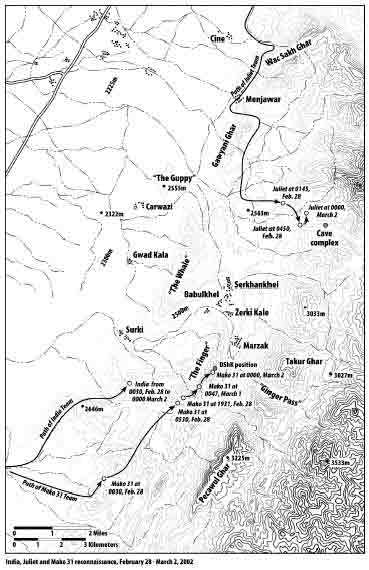
With the pickups also being driven with their lights off, the small convoy rolled quietly south out of Gardez, a family of shadows heading into the unknown. Juliet’s four ATVs split from the convoy before reaching the checkpoint manned by Gardez shura fighters, leaving the road and heading east to proceed with their infiltration. The time was 7:45 p.m. The four ATVs moved as pairs, with Bill R. in the lead, and Dave H. second. Jason and Jay rode third, with team leader Kris K. bringing up the rear. The team bounced across the rough terrain, the operators’ gaze alternating between the ground in front of them and the hills and mountains around them, searching for anything that might threaten the mission, be it a hidden rock or an Al Qaida sniper. They moved through the deserted hamlet of Kwas and then around the village of Cine. They had hoped to cross the Wac Sakh Ghar Mountain to the east, but the passes that had looked inviting on the imagery were impassable. Ahead lay the small town of Menjawar, in which intel reports said 100 enemy fighters were billeted. The team had no option but to ride through the enemy-held town. It was half past midnight when the four ATVs zigzagged silently through Menjawar’s deserted streets, which were just a few yards wide and lined with mud walls. The solid cloud cover gave the operators a distinct advantage as they crept under their enemy’s nose in the dead of the cold, dark night. They were all but invisible to the naked eye, but their infrared headlights and night-vision goggles gave them perfect vision. They saw nothing to alarm them. The special ops mechanics had done their jobs well: The ATVs were so quiet that nothing stirred in Menjawar, save the dogs that could be heard barking from behind the walls.
Once through the town, the team breathed a collective sigh of relief and motored on, jouncing toward the Shahikot. They finally found a way east through the Gawyani Ghar ridgeline. The operators navigated using Falcon-View maps loaded into laptops that they carried in pouches on the ATVs’ gas tanks, where the operators could easily access them. The laptops were fitted with GPS receivers, so the team members were able to trace their own movements on the digital map in real time. They were tracked by a Joint STARS surveillance aircraft designed to spot moving vehicles. The crew on the Joint STARS, one of several spy planes supporting the recce missions, reported to the team that they could see additional movement in the area. The Juliet operators were in an area where an enemy bunker with a DShK had been reported. They rode south with their senses on high alert, but the only things moving were a few dogs. As they neared the Shahikot, Bill raised his hand quickly to signal “Stop!” He had made a heartstopping discovery—around them the rocks were painted with red Xs—the symbol for mines. Despite the care with which they had chosen their route, they had ridden into a minefield. If just one ATV hit a mine, it would mean mission failure. The explosion would alert enemy fighters for miles around to their presence and would almost certainly kill or maim the unfortunate rider of the ATV that triggered it. Kris evaluated his options. Sixty meters to the south a sloping rock face rose steeply from the ground, paralleling their route and offering a potential avenue of escape. The operators pointed their vehicles toward the outcropping and then rode for several hundred meters along the exposed rock with their ATVs tilted at a gravity-defying 45-degree angle until they were safely out of the minefield.
As Juliet Team approached the Shahikot’s eastern wall, the terrain began to rise. Giant rock shelves jutted menacingly over the plain. Bill scrutinized the dim silhouettes ahead of him with a practiced eye and again calmly raised his arm to halt the team. Kris drove up to ask him what he’d seen. Bill pointed upward. There, 4,000 feet above them, was an enemy fighter standing beside a DShK smoking a cigarette. Then Bill indicated another DShK position 200 meters away from the first. Of course, they were too far away to be seen by the enemy gunners. Kris lased the two positions and recorded their locations. Then the team drove directly under the machine-gun posts, moving more slowly to ensure they wouldn’t be heard. A few minutes later they came to the draw they had selected as their route toward their observation post. Pointing their vehicles up a dry creek bed, they began their ascent into the mountains. They climbed slowly through increasingly deep snow. Suddenly Bill felt his ATV beginning to tip upright into the “wheelie” position. He flung himself off just before the vehicle rolled backward end over end down the slope. There was remarkably little damage done. The team members had packed to minimize the risk to any sensitive equipment if the vehicles rolled over. When they clambered down the slope, they realized they had been successful.
Poring over the maps and photos at Gardez, Juliet had picked two possible locations for their observation posts in the Shahikot. Their plan was to reach the first by daybreak, spend all day there, and then move to the second after dark. They made good time, but found the first location unsuitable. Kris decided to press on to the second observation post. This was the most dangerous stage of the infil. At any moment an enemy fighter could spy them as the ATVs crawled forward through the snow, the operators scanning their surroundings for the smallest hint of an Al Qaida presence. It took the team three hours to cover the last 1,000 meters, but they made it. This spot was much better and afforded good views of the Whale, Serkhankhel, and the valley’s northern end. The operators hid the ATVs behind a ten-foot embankment and camouflaged them with netting. They put up a tent right behind the ATVs, then walked about 100 meters up to the observation post. This way they could have three guys in the OP and two sleeping in the tent. Once they reached the OP, they took off their helmets to get a sense of what an operator called the “sights, sounds, and smells” of their surroundings. This was a key part of the recce concept. “Whenever you get in a new place, you want to stop, take off your helmets, and get used to the environment,” an operator said later. At 4:47 a.m. Kris called back to Gardez and reported that the team was beginning operations. It had taken them nine hours to drive about twelve kilometers, but Juliet Team had made it in.
AFTER watching Juliet’s ATVs disappear into the darkness, the two pickups continued south for about 15 kilometers then left the road and headed east for about 4,500 meters before stopping at 10:15 p.m. This was the drop-off point for the remaining teams. As soon as the trucks came to a halt, the AMF fighters jumped out and ran to the nearest high ground, throwing a secure perimeter around the Americans in a matter of seconds. The small force was deep in territory that, if not enemy-held, could certainly be considered enemy-controlled. There was no time for long goodbyes. The teams had far to walk to reach their observation posts before dawn. The eight operators of India Team and Mako 31 jumped down from the cabs, shouldered their packs, and marched into the night.
John B. kept his team sitting at the drop-off point for about thirty minutes after the recce teams departed, ready to come to their aid if they ran into trouble immediately. Then he called the Afghan pickets down from the high ground, mounted up, and headed back toward Gardez. This was the riskiest part of the operation for the infil team. Any enemy elements they might have surprised on the way in would by now have been alerted to their presence and waiting in ambush for their return. The infiltration team’s job—to drop off and pick up the recce teams—was not glamorous, but John B., who usually led such missions, earned the recce operators’ respect for the way he applied himself to the task. “He’s the best troop commander I’ve every worked for,” said an operator. “He displayed a lot of physical and moral courage.” John would need to call on his reserves of courage and coolness under pressure on the nerve-jangling drive back. First, the operators spotted two or three vehicles behaving suspiciously near a small town west of their route. The infil team stopped and observed the vehicles, which eventually left the area. Continuing north, the two Toyotas were shot at by militiamen manning the Gardez shura checkpoint. Equipped with night-vision goggles, perfectly zeroed M4 rifles, and years of shoothouse training, the four operators in the vehicles—three from Delta and one from SEAL Team 6—were infinitely superior marksmen to the tribesmen at the checkpoint and in all likelihood could have killed every one of the militiamen without even calling on the AMF fighters in the back of the trucks. But John decided the checkpoint guards probably fired more from sheer fright at the sight of the two pickups emerging from the darkness than from any ill will they bore those in the vehicles. Eager to avoid what one account of the episode described as “unneeded killing,” he told his troops to hold their fire and outflank the checkpoint. They did so and arrived at the safe house without further incident.
THE men of India Team and Mako 31 walked east together at a steady pace, following the Zawar Khwar creek. After three kilometers India Team turned north up a smaller creek bed. For this mission Speedy had cut his team down to the bare minimum of three men: himself and Bob from Delta plus Dan, the Gray Fox operator who had proved himself on the environmental recce. Neither Speedy nor Kris, the Juliet Team leader, had been keen on taking Hans or Nelson on this most vital of missions. The pair’s negative attitude counted against them when it came time for the team leaders to pick the warriors they would take into the mountains. “Hans and Nelson were naysayers the whole time,” a Delta operator said.
The weather—clear in Gardez—turned foul as they pushed into the mountains. The operators fought their way through rain, sleet, and intermittent snow flurries. It wasn’t comfortable, but the weather wrapped the trio in its shrouds, shielding them from the prying eyes of any lookouts in the mountains. Nevertheless, the three walked with their weapons at the ready. Speedy and Dan each carried an M4, but Bob had armed himself with his prized SR25 Stoner sniper rifle, which is modeled on the M16, but is designed for extraordinary accuracy and fires a 7.62mm round instead of the 5.56mm bullet fired by the M16 and M4. India faced a seven-kilometer hike to their observation post, but compared to the grueling trek they had endured during the environmental recce, this was an easy movement with just a few short climbs up rocky stream banks interrupting an otherwise gentle ascent, albeit in freezing temperatures carrying over 80 pounds of gear per man. But none of the three was relaxing, physically or mentally. As they trudged uphill, the smell of smoke drifted into their nostrils. Someone had lit a fire nearby. Dogs were barking off to their right in the distance. On a normal patrol the operators might have been tempted to investigate, but tonight making it to the observation post by daylight was all that counted.
After more than six hours of movement, they knew they were getting close. Because the site they had picked for their observation post was only two kilometers from the southern tip of the Whale, they were even more careful than usual about staying hidden, though it was still dark. Dropping their rucks, they crawled the final 200 meters to the position, which was behind some large rocks. Once they had clambered down, they realized they had chosen well: from their aerie they could observe the Fishhook, the southern end of the Whale, Hammer’s route into the Shahikot, and the southwestern corner of the valley.
At 5:22 a.m. Speedy called back to Gardez with a simple message: India Team was in.
MAKO 31’s operators were less experienced in this terrain than the two Delta teams, but they had been handed the toughest movement. The five-man team included three SEALs and an Air Force combat controller called Andy, but also, incongruously, a Navy explosive ordnance disposal expert. Once India Team had split to the north, Goody and his men faced a daunting eleven-kilometer walk over jagged 8,000-foot ridgelines to reach their observation post. Because the goal was to arrive in the valley unseen by the enemy, Goody’s men did not take the most direct or obvious route to the Finger. Instead, they took a roundabout approach, heading south for at least 1,000 meters before turning north again. Knee-deep snow, rocky terrain, and driving rain, snow, and sleet that slashed their faces made it heavy going. With Blaber’s exhortations fresh in his memory, Goody drove his men forward just as Speedy had done a few days earlier under similar conditions. “He did a great job, too,” Blaber said of Goody. “They had a really tough movement.” But despite their best efforts, as the night wore on, it became clear Mako 31 would not make it to their observation post before daylight. Exhausted, they stopped about a thousand meters southwest of their desired position. Their present location was just west of a 9,400-foot ridgeline that stretched north to become the Finger and blocked Mako 31’s view of Marzak and the landing zones designated for Paul LaCamera’s 1-87 Infantry. However, they enjoyed good sight lines down to the Fishhook and across to the Whale. At 5 a.m. the team called the AFO operations center at Gardez to report their location and their intention of staying put until the next night, when they would move forward to occupy the observation post.
As the gray dawn broke over the Shahikot Valley, Blaber and his men had reason to feel proud of what they had accomplished. Two of the three teams were already in position, with the third just a thousand meters away. They had moved from the safe house—whose location was undoubtedly known to all Taliban and Al Qaida leaders in the area—overland through harsh weather and harsher terrain into the heart of the enemy without being seen. Through a combination of meticulous preparation, tactical boldness, personal courage, and a professionalism honed by years of rigorous training, AFO had given the generals in Bagram an extraordinary advantage. There were now thirteen pairs of American eyes watching the Shahikot. How the generals used this gift would go a long way toward determining the course of the operation.
25.
THE satellite radio in the AFO operations center in Gardez crackled to life at 9:20 a.m. on February 28. On the line was Speedy, the first of the three team leaders to report in. He had had an interesting start to his morning. The site India had picked for their observation post could accommodate one person, but was too exposed for the entire team to spend days on end there. The hillside dropped away just behind (i.e., to the south of ) the observation post, so the operators moved their rucks and communications gear about twenty-five meters back to a small nook out of sight of the Fishhook and the Whale. Then Bob crept back down behind the rocks, while Speedy crawled to a ledge about 200 meters to the east. With the team separated, the early morning silence was broken by the unexpected—and definitely unwanted—tinkling of small bells.
Speedy froze then turned his head away from the valley to look behind him where the noise seemed to be coming from. Below him a couple of hundred meters to the north he saw an old Afghan man, unarmed and alone except for the small herd of goats he was tending. Speedy shrank back. The man hadn’t seen him yet. Grabbing his small handheld MBITR (pronounced “embitter” or “M-biter”) radio, he whispered the news to the others, then squeezed himself further into the crack between two rocks where he had been hiding and lay still. He was well hidden, not only by the rocks but also by the camouflage outfit he was wearing. Designed for hunters and snipers (Speedy and Bob were both), the gear was little more than netting overlaid with artificial leaves, hence its trade name: Leafywear. The two had chosen suits of grayish brown, the same color as the rocks in that part of Afghanistan, topped with soft tan “boonie” hats. Speedy and Bob were virtually impossible to spot as they crouched between the rocks. They hadn’t worn the gear on the way in, but whenever either of them moved forward from where they’d stashed their rucks, they put on the Leafywear, which was less bulky than the traditional “gillie suits” worn by snipers. To Speedy, wearing Leafywear was second nature. He wore the same sort of outfit hunting wild turkeys in his native Kentucky.
The other two operators were hidden by rocks, and Speedy was confident he hadn’t been seen, but he was still very concerned. The goatherds in these parts had probably been grazing their livestock on the same land for years, and would notice if something seemed out of place, he figured. His mind raced through his options if the goatherd stumbled upon him. He couldn’t think of many. There was no way he would shoot an unarmed civilian, and if they took the man prisoner, his family would probably come looking for him within twenty-four hours. Speedy’s only course of action would be to let the man go and immediately call back to Gardez with the news his team had been compromised. That would probably mean immediate extraction or an order to sneak back out of the valley. It could jeopardize the entire operation. Very fortunately, the wizened Afghan led his goats away. Speedy breathed again and turned his attention back to the valley.
OVER the next several hours the AFO teams gathered the first empirical evidence of a large-scale enemy presence in the Shahikot. Using Schmidt-Cassegrain spotting scopes, each team methodically scanned as much of the landscape as its members could see from their perch. (The scopes allowed an operator to follow a man and know he was carrying a Kalashnikov rifle from six or seven kilometers away.) The clouds lifted for the first part of the morning, giving India a clear view of the Fishhook, the village of Surki just outside the valley entrance, and the route planned for Hammer’s approach along Whale’s western base. There were no signs of mines, and Surki and the Fishhook appeared deserted, save for a white Jeep CJ5 circa 1980 a few hundred meters northwest of the village.
Juliet, meanwhile, spotted movement on the Whale—the first confirmed activity on the huge humpback mountain or in the valley. Kris moved his team a short distance to a position that afforded better views of the valley and the Whale.
Mako 31 had yet to make it to their designated observation post, but they managed to sneak into a position from which they could observe a good road that led south from Marzak and then turned east into a valley. The road was lined with white rocks, a local sign that indicated it was clear of mines. The movement on the Whale that Juliet had seen was the only activity any of the teams spotted during the morning. But their ears told them Blaber’s hunch had been right. Dan and Jason, the Gray Fox operators with India and Juliet respectively, set up their monitoring equipment. Soon each was picking up cell phone or radio traffic from the immediate area. And at 12:10 p.m., Mako 31 heard gunfire coming from the direction of Marzak. It didn’t sound like somebody hunting. It sounded more like marsksmanship training.
Then, from their new observation post in a narrow valley about 3,500 meters northeast of Serkhankhel, the Juliet operators watched an unnerving episode unfold before them. To their east they spotted five men walking in single file toward them from the direction of a cave complex the operators knew about from examining the overhead imagery. Bin Laden had supposedly stayed at the cave in December. Three of the five were armed with AKs. The other two had RPGs. Their facial features were those of local Afghans. All wore turbans and earth-tone clothing. To the Juliet operators’ great concern, they appeared to be following the tracks left in the snow by the ATVs. There were a lot of tracks muddled in the snow, but if the enemy fighters found the ATVs, Juliet would be in big trouble. Kris used his MBITR radio to warn Bill and Dave, who were sleeping in the tent. They took up defensive positions, but the embankment at first prevented them seeing the enemy troops.
Step by step the turbaned warriors inched toward the hidden ATVs. Juliet Team watched and waited as the quintet stood and scratched their turbans, talking among each other and looking at the strange tracks in the snow with bemused expressions. Infrared dots danced around their torsos as the operators took aim and curled their index fingers around their triggers. Kris whispered to his men to hold their fire until the last possible moment, while he juggled the possibilities in his mind. The five fighters might be the lead element of a larger force, and if Juliet shot them the operators would be on the run, on foot. Killing them would also compromise the mission. But if Juliet didn’t kill them, they might raise the alarm and return with more enemy fighters. Or they might be confused and just let the tire tracks pass unexplained. But the AK-toting militiamen were getting closer and closer to the ATVs. Kris was on the verge of giving the order to open fire when they paused, talked to one another for a few moments, and then turned around and walked away. One man turned back toward the ATVs. “It was bothering him, the tire tracks,” an operator said later. “But he’s looking at tire tracks at 10,000 feet on the east side of the valley, with the north being impassable due to terrain and minefields, and the south—you’ve still got the long axis of the valley [to traverse], so how could there be these tire tracks up here, and who could’ve ridden the thing that made it up here? He was probably wondering, what sort of spaceship was able to get up here?” Again, Kris got ready to fire at the confused fighter. Then, “at what would have been his last moment,” as a military report of the incident put it, the inquisitive Taliban fighter appeared to reconsider before turning around and rejoining the group.
In a turn of amazing good fortune, a blizzard suddenly appeared out of nowhere. Gale-force winds whipped snow into the small knot of guerrillas. As if of one mind, the Afghan fighters apparently decided that in this case discretion was the better part of valor and continued west toward the shelter of the village. Thinking the five enemy troops might be back with reinforcements, the operators broke down the tent and hauled the gear up to the observation post. They set a trip wire with a grenade by the ATVs to give them early warning. The snow fell for the next two hours, smothering the area. After it stopped, Kris looked around and realized this would be their final observation post. He had planned on possibly pushing further south to establish the team on Takur Ghar. But if the team were to move now, the snow would provide what an operator called “a cookie-crumb trail” for the enemy to follow. Of equal import, they now had superb overwatch of the valley and the Whale, and the blanket of snow would give them an accurate indicator of any enemy movement in the area.
(Juliet sent a data message reporting their close call back to Gardez via satellite. Blaber read it and immediately forwarded it to Hagenbeck, Harrell, and TF 11’s Masirah headquarters. Displaying his renowned flair for the dramatic, he introduced Kris’s report with three words—” We’re in business”—a line taken from the moment in the movie Saving Private Ryan when U.S. troops pinned down on Omaha Beach use a Bangalore torpedo to make a breakthrough.)
After their brush with catastrophe, Juliet turned their attention back to the Whale. The weather abated long enough for them to spy four “possibly armed” individuals on the east side of the mountain. A few hours later they spotted three enemy positions on the Whale. One was an observation post occupied by a single guerrilla at the top of the ridgeline facing west. Two other fighters sheltered nearby in a rock shack with a cloth cover. Fifty meters below them were concealed fighting positions. Shortly thereafter Juliet identified another observation post and four fighters moving between a pair of bunkers on the eastern side of the Whale. Kris and his men were starting to realize the Whale was honeycombed with fighting positions. Looking south, they could see a portion of Marzak a little over five kilometers away and reckoned that at least five or six buildings in the town were active.
The weather worsened as the day wore on. The cloud ceiling descending to 7,000 feet and visibility was restricted to 400 meters. Speedy repositioned India a little lower down their hillside to get under the cloud cover. He and his men were momentarily alarmed to hear gunfire from the direction of Juliet, but quickly concluded it was the same sort of marksmanship training Mako 31 had reported earlier. The Gray Fox signals interceptors became the main effort. They reported every intercept they made quickly back to Gardez. From there the information was sent to Bagram, where Fred Egerer used it to task the NSA’s spy planes and satellites for further collection.
Later that afternoon Mako 31 also spotted enemy positions on the Whale. Once darkness fell, Goody and his troops struck out for their OP. A thick blanket of fog covered their movement, but the going was even tougher than the previous night’s efforts. With snow and sleet stinging their faces, the five men picked their way carefully along the steep, jagged ridgeline, only too aware that the slightest misplaced step could send them tumbling hundreds of feet into the dark crevasses below. It took them six hours to cover about 1,000 meters. They halted at about 2 a.m. on the morning of March 1 in a depression about 250 meters southwest of the Finger’s highest point. This would be their mission support site where they would stash their rucks and rest. The next morning they would push out and establish the observation post a little farther along and on the eastern side of the crest. That night the AFO operations center passed a message to the teams in the valley: H-Hour was set for 6:30 a.m. March 2, less than thirty-six hours away.
BY the evening of February 28 word was seeping into the Mountain and Rakkasan final rehearsals that the enemy might not be concentrated on the valley floor after all. At 8.30 p.m. the senior officers and NCOs from Chip Preysler’s 2-187 Infantry gathered in a dark GP Medium tent where Captain Denis Holtery, the battalion’s intelligence officer, told them the focus was turning to the mountains that surrounded the valley. “The change is we’re not so much worried about taking rounds from the town,” Preysler then explained to his men. The threat to the platoons conducting the air assault was more likely to come from the mountains on the Shahikot’s eastern side. “We may have an uphill fight,” in which case the plan was to send the Apaches against the enemy positions in the mountains, he said. There was also new thinking on when the air assault’s second lift would be committed, Preysler told them. Originally scheduled to touch down in the valley at dusk on D-Day, the plan now was for the second lift of infantry to arrive within three hours of the first lift, he said. (The reason was that the planners now considered it impossible to seal all the blocking positions without those additional forces.) However, despite the reports reaching Bagram of an enemy presence in the ridgelines around the valley, no effort was made to change the plan to accommodate these new facts.
The focus for most Rakkasans that day had not been on new intelligence from the Shahikot, but on the flyaway rehearsal Wiercinski used to tailor his load plans for the aircraft. The extra forty-eight hours they had gained courtesy of Hagenbeck’s weather call also gave the battalion commanders and command sergeants major more time to focus their soldiers’ minds on the mission. Their messages reflected the curious dichotomy that existed at the higher levels of command. On one hand, the plan and the forces used to execute it were a function of the expectation that the enemy would not put up a big fight. Hence the focus at the small unit level on how to screen crowds of civilians for the presence of guerrillas trying to escape. On the other hand, in the world of the infantry officer or NCO, it was considered almost criminal to allow your soldiers to go into a “real-world” mission without mentally steeling them for combat. Nowhere was this more apparent than in the meeting Preysler held with his subordinates that evening. Mark Nielsen, Preysler’s wiry sergeant major who commanded enormous respect among the battalion’s enlisted men, personified this hardheaded, combat-oriented mentality. His eyes sweeping the tent, he told the company first sergeants to scrub their lists of soldiers heading into the Shahikot and leave behind those they thought couldn’t cut it physically or mentally. “I don’t want any pussies going on this mission,” Nielsen said, glowering like a bulldog in the weak electric light. “There’s no pop-up targets this time, boys; there’s fucking real flesh and blood out there. Let’s get ’em on the ground, meet the enemy, and destroy him.”
Major Rick Busko, Preysler’s operations officer, reminded the infantrymen that the eyes of President Bush and everyone else in their chain of command would be on them in the Shahikot. “At the National Command Authority-level…this is the only game in town,” he said, adding that company commanders and first sergeants needed to tell their soldiers “now is the time to perform.” The message was getting through to the soldiers. As he stood in line outside the chow tent waiting for dinner, Sergeant David Dedo of 2-187’s Charlie Company reflected on the mission to come. “Osama bin Laden made a comment that U.S. soldiers are ‘paper tigers,’” he said. “Well, now he’s got a chance to find out.” But, he added, displaying the hard-boiled realism of an infantry NCO, “I don’t think this is going to be the new-age Normandy the 101st is looking for.”
The Rakkasans also used the extra time to give some last-minute instruction on how to fight and survive in the frozen conditions they expected to find in the Shahikot. Standing on the hood of a Humvee on the edge of tent city, Staff Sergeant John Hodges, a squad leader in 2-187 Infantry’s A Troop, gave a cold-weather operations class to a walk-up crowd. Hodges had been stationed in Alaska for three years and had gone through cold-weather training at the Army’s Northern Warfare Training Center at Camp Greely. He ran through the basics that might never have occurred to soldiers unused to operating in sub-freezing temperatures. “In the cold it’s going to take two to three times as long to do anything,” he said. A simple task like loading a magazine could take ten to fifteen minutes in extreme conditions. It was vital to keep eating and drinking water, particularly at high altitude, Hodges said. Then he explained the three types of cold weather injuries—chilblains, hypothermia, and frostbite—and how to avoid them. Finally Hodges gazed around the crowd and asked whether there was anyone who had never seen snow before. Two soldiers raised their hands. “If you’ve never seen snow, don’t worry about it,” Hodges told them. “Here’s your chance, and the Army’s picking up the tab.”
26.
SHORTLY after dawn on an overcast March 1, Goody sent two Mako 31 snipers up the Finger to scout the location the team had selected for their observation post. The two SEALs inched forward for 500 meters along the rocky ridgeline until they could put eyes on the exact spot Goody and Blaber had agreed on. As they poked their heads above the rocks to get a good look, they got the shock of their lives. Someone had beaten them to it. There, in the lee of a large, jagged outcrop, on the very patch of ground on which they intended to establish their observation post, sat a gray-green tent big enough to sleep several people. As the commandos digested this unexpected turn of events, their eyes fastened on an even more unsettling sight. About fifteen meters up the rock-strewn slope, they discerned the outline of a tripod-mounted DShK wrapped tightly in blue plastic. The discovery was momentous. The position dominated the southern end of the valley—that, after all, was why the AFO operators wanted to occupy it—and overlooked the 700-meter gap through which TF Rakkasan’s helicopters were to fly between the Finger and the eastern ridge. With an antiaircraft range of 1,000 meters, the DShK was ideally located to shoot down the infantry-packed Chinooks due to fly into the valley in less than twenty-four hours. It would be Frank Wiercinski’s worst nightmare come to horrifying life.
The loss of even one Chinook full of Rakkasans would be a disaster from which Operation Anaconda might not recover. Troops would have to be dispatched from their previously assigned missions to secure the downed helicopter, all while enemy fire poured down on them from the mountainsides. Any reserves flown in would have to brave the same gauntlet of fire that had precipitated their arrival in the first place. But the DShK was positioned to deal an even more devastating blow to the operation. Wiercinski planned to bring his forward command post, containing himself, Savusa, Marye, Corkran and Air Force Captain Paul “Dino” Murray, the Rakkasans’ air liaison officer, into the valley on two Black Hawks and land just a few hundred meters farther north along and a little farther down the Finger from the DShK. At such close range it would be hard for the Al Qaida gunner to miss. As he emptied his weapon into the two American helicopters, even he would not have dreamed that the Black Hawks cartwheeling to the ground were carrying to their deaths not only the commander of the entire air assault force but also the commanders of his aviation task force and his only reserve, as well as his senior NCO and the officer responsible for coordinating close air support for the troops who survived the initial air assault. In the opening minutes of Anaconda a single heavy machine gunner would have dealt the operation a shattering blow.
“The success or failure of your mission will predicate the success or failure of the entire operation,” Blaber had told Goody. The AFO commander learned how truthfully he had spoken at 10:02 a.m., when India Team relayed a message from Mako 31 to the safe house stating the bare facts of their discovery: an unmanned DShK and a tent sitting on the observation post. The news validated Blaber’s bold decision to risk an infiltration of the Shahikot before D-Day. Without the audacity displayed by the AFO commander and his three recce teams, the staffs at Bagram would have remained ignorant of the DShK’s existence until the moment Task Force Rakkasan flew into a buzz saw of high-caliber bullets. This was a lesson for anyone who thought the U.S. military’s billions of dollars’ worth of spy satellites and surveillance aircraft obviated the need for ground reconnaissance. Despite the boasts at Bagram that “every national asset” was being focused on the valley, none of the satellites or spy planes—not even the Mi-17 helicopter the CIA had flown over the Shahikot the previous day with an operative filming the valley floor—had revealed either the tent or the weapon that could have spelled defeat for the Americans in the battle’s opening moments. Lou Bello, the Mountain fires planner, compared searching for a single DShK on a mountainside from the air to “looking for a needle in a haystack.” In the giant haystack that was the Shahikot Valley, Mako 31 had found a needle and it was pointing straight at the heart of Operation Anaconda.
The SEAL snipers used a Nikon Coolpix digital camera equipped with an eight-power telephoto lens to snap a few photos of the DShK and the tent. They marked the position’s coordinates with a Global Positioning System receiver then slipped away as low clouds and a sudden snowstorm appeared to cover their withdrawal. Once the weather cleared, they returned for a second look and were rewarded with an extended sighting of two fighters manning the position. One was a short, dark-haired, and bearded man with Mongol features—possibly an Uighur Chinese. The other, clearly in charge of the DShK, was a tall, clean-shaven Caucasian with reddish-brown hair—most likely one of Yuldeshev’s Uzbeks. They were well equipped for the elements. A blue five-gallon gas can just outside and a pipe protruding from the roof indicated that their tent was heated. The shorter fighter wore a pale tunic, a sleeveless jacket, and what appeared to be a wool hat. The taller man wore a thick red Gore-Tex jacket, a Polartec fleece jacket tied around his waist, Russian-style camouflage pants, and Adidas sneakers. Each fighter appeared fit and healthy. The Uzbek-looking guerrilla would shadow-box in his spare time. Strolling between machine gun and tent with his hands in his pockets, he would not have looked out of place on any main street in Western Europe or North America.
The SEALs clicked off a few more photos and crept back to the mission support site, about 200 meters northwest of the DShK. From there, Goody sent several photos and a report back to Blaber using a Toshiba Libretto mini-laptop hooked via a USB port to the satellite radio. To emphasize the importance of the material, Goody labeled the photos and the report “eyes only,” his way of saying they were for Blaber only. The SEALs had alone seen two enemy fighters, but they reckoned as many as five might be occupying the position. Mako 31’s leader also had an urgent question for Blaber, prompted by the machine gunner’s European features: “Are there Brits up here?” He wanted to make sure he wasn’t about to get in a firefight with the SAS. “It was so fantastical seeing this guy with no beard and red hair and Gore-Tex [and] BDU pants, they had a hard time believing that’s what the enemy was,” recalled an operator. “And the guy did look like he could have been British. He could have been American, too. But they figured they knew where all the American special ops guys were.” Blaber assured Goody there were no Brits in the area, then he forwarded the photos to Jimmy in Bagram, who in turn sent them to Hagenbeck and to Masirah. Blaber followed up with a call to Hagenbeck. The AFO commander underlined his view that the fighters seen by Mako 31 and Juliet were proof the enemy was in the mountains. But despite the enemy presence, Blaber told the Mountain commander that with the three AFO teams occupying dominant terrain, “we are in a position to control the valley.” “Good job,” Hagenbeck replied.
Using point-to-point digital messages similar to e-mail sent via satellite, Blaber and Goody discussed what to do about the DShK position. It clearly had to be eliminated before H-Hour. Goody asked Blaber what he thought Goody should do. Blaber typed a response that turned the question around, asking Goody what he thought he should do. “I think we ought to wait until H minus two [hours],” Goody wrote. “At H minus two I start moving; I engage at H minus one, and then follow up with AC-130. I understand that you have to make the decision on this and I’ll support any decision you make.” Blaber sent him a two-word reply: “Good hunting.”
Goody was relieved. Not used to being given such latitude, he was worried someone higher up the TF 11 chain of command would veto any suggestion that Mako 31 take out the DShK team on their own. (His fears were not entirely misplaced. After quoting from Saving Private Ryan in the wake of Juliet’s close encounter with the cave-dwellers, Blaber chose Apocalypse Now as his inspiration for another message up the chain of command, in which he said that he planned to tell Goody, “Terminate with extreme prejudice.” The message caused some angst at Masirah. E-mails pinged back and forth saying AFO shouldn’t jump to conclusions and Mako 31 didn’t have enough men to engage the tent and DShK position. At least one TF 11 staffer complained that such direct action missions were not in AFO’s bailiwick.)
While Goody and his men focused on the DShK position, India and Juliet continued their observation of the valley. As the day lengthened, they reported more evidence of a significant enemy presence. India Team, a couple of hundred meters south-southwest of the Fishhook, monitored three SUVs driving around Babulkhel, the village closest to the valley’s western entrance and into which the road that passed through the Fishook ran. The vehicles would stop at the village’s westernmost house—a two-story adobe structure with a walled-in compound—before proceeding further. When three horsemen with AKs approached the village, six armed men came out and greeted them about 100 meters from the village. India concluded the house was an enemy checkpoint.
Speedy and Bob also spotted an antenna mast protruding from a compound in Serkhankhel, and another walled compound with what appeared to be a guard at the gate and ten to fifteen people milling inside. In an ominous sign, at noon they observed a family below them hurrying out of the valley on foot with their belongings loaded on a camel. Other than a sighting about half an hour earlier of two women in Babulkhel, the family represented the only report of civilians in the valley by any AFO team before H-Hour.
The low clouds prevented Juliet, whose observation post was higher than India’s, from seeing much of anything during the morning. But once the weather lifted, Kris and the other operators in the northeast observed plenty of suspicious activity in Serkhankhel. They saw six men meeting at a mud-walled compound in the village. Two pickup trucks were parked beside the fortlike building, and when a Predator drone flew overhead, the six scattered. Once the Predator had passed, an armed man came out and circled the compound as if on patrol, before going back inside. Later that afternoon Juliet reported seeing more vehicles and armed men in Serkhankhel, as well as six men with rucksacks walking south into Serkhankhel from a position about a kilometer southwest of Juliet’s observation post. Meanwhile, Jason, the Gray Fox operator, intercepted a call indicating the enemy would be holding “a group meeting” the next day.
By afternoon’s end the operators realized Blaber had been right. There was a large enemy force in the valley. How large they didn’t know, but India and Juliet had each observed dozens of fighters moving in and around the Shahikot. Their observations also told them that the enemy occupied the high ground around the valley on the Whale, the Finger, and the eastern ridge. These facts were included in the reports they sent back to Gardez that were immediately forwarded to Bagram. Mako 31’s reports and photographs of the DShK position were particularly telling: the Uzbek machine gunner was no amateur; he took meticulous care of his weapon, wrapping it in plastic to shield it from the elements; he had arranged his 12.7mm rounds around the weapon ergonomically, for easy access; and he had built a small brick platform that he could rest the barrel on, with other bricks beside it that could be added or removed depending on the desired elevation. He also had less professional habits that the AFO operators pointed out: He and his colleagues walked around without their personal weapons, sometimes with their hands in their pockets. It was as if they felt completely secure on their mountain perch.
The AFO reports supported the recent intelligence from Gardez and Khowst that had received such limited attention and distribution in Bagram: The Al Qaida force in the Shahikot was almost certainly larger than the Americans were anticipating, and the enemy was well-armed, well-trained and ready to fight. But again, there was little alarm in Bagram. Officers there had been encouraged by the Mi-17 flight over the valley, which revealed no significant enemy troop concentrations or weapons and helped refine the selection of the landing zones in the low ground. (That Mi-17 flight was itself controversial: AFO, who had no advance notice of it, and Dagger officers disapproved, believing it was bound to tip off the enemy; but Wiercinski and Larsen were grateful for the opportunity to view film of their objective taken so close to D-Day.) Not until late that night did Hagenbeck started to comprehend the significance of AFO’s discoveries (beyond the obvious importance of the DShK position). “I had no reason to doubt the intel until about six to eight hours before we launched,” he said. “I got a call back from a special operator [Blaber] who said they believed there were up to 400 in the valley,” Hagenbeck said. By then there was little time to adjust.
The reports from the AFO teams in the Shahikot were also notable for what they did not include: any mention of civilians, beyond the two women seen by India and the family fleeing the valley with its possessions piled on top of a camel. The operators noticed the difference between the Shahikot villages and those they had observed during the environmental recces, in which women and children had been clearly visible. “This place was nothing but a bunch of men, and they weren’t going about daily life,” said an operator who was watching the valley floor. But the fact that the AFO teams had seen virtually no civilians—something completely at odds with Wiercinski’s expectation of a valley in which 200 enemy mingled with 800 civilians—never reached the Rakkasans, whose plan was geared around the civilians.
Why not? Much like Sir Arthur Conan Doyle’s Sherlock Holmes story of a “dog that didn’t bark,” the absence of any mention of civilians from the AFO reports was a negative clue no one in Bagram picked up on because they weren’t looking for it. The Mountain and, particularly, Rakkasan officers were intently focused on the air assault and scoured the AFO reports for any information suggesting a threat to the landing zones. “The sit temp [situation template] we got asked to confirm or deny was weapons systems, enemy concentrations,” said a special operator. “No one ever said to us, ‘Hey, are there civilians out there?’” Not having been asked to report on the presence of civilians, the AFO teams made no mention of the fact that they weren’t seeing any. “We’re trained to report what we see, not what we don’t see,” said an operator who was in the Shahikot.
One officer in Bagram who was reading the reports from the valley with growing concern was Jimmy, Blaber’s deputy and AFO’s liaison to Hagenbeck. The DShK on the Finger, the fighting positions on the Whale, the intel reports that said most of the enemy was in the mountains, not in the villages—none of this sounded good. On March 1 Jimmy went back a final time to Colonel Joe Smith, Hagenbeck’s chief of staff. “Sir, do not land those helicopters [there],” Jimmy said. “The current plan is not going to work out for you.” “I know, Jim,” Smith replied. “But it’s too late to do anything about it.’”
AT 12:30 p.m. Wiercinski met with the pilots and staff officers from TF Talon, his helicopter task force. The briefing was held in Bagram’s pitifully small chow tent. Over sixty soldiers stood shoulder to shoulder, most of them pilots wearing tan one-piece flight suits. Even though it was midday, the tent was dark and the electric lights made it seem more like a nighttime gathering. This meeting was crucial for Wiercinski. The aviators’ role was central to the operation. The Chinook crews had the vital job of ferrying the Rakkasan infantry into enemy-held territory and the Apache pilots would provide the only heavy firepower under Wiercinski’s direct control. The Rakkasan commander wanted to look them in the eye and tell them he believed in them.
As usual, Wiercinski’s intelligence officer, Eric Haupt, briefed first. He told the crowd, which was swollen with representatives from the other task forces, that as recently as January there had been an estimated 700 to 800 enemy fighters in and around Serkhankhel, but they had mostly departed. All that remained, he said, were 150 to 200 “remnants” of that force. Seventy-two hours had passed since the report from Gardez casting grave doubt on that assertion, and fewer than eighteen hours remained before the first Chinooks were due to land in the Shahikot.
A few minutes later Wiercinski spoke, his comments alternating between efforts to bolster the aviators’ confidence and more cautionary wisdom. He said he had told the infantry commanders they were going into battle with the best crews and the best helicopters in the world. “Not every helicopter and not every crew could do this,” he said. “You’ve got the equipment, you’ve got the people, this is going to be a great mission.” But then he gave his first indication that the AFO reports were worrying him. “I’m mostly concerned with any threat to the aircraft from the east ridgeline,” he said. Turning to the pilots who were to fly the half-dozen Apaches into the valley a couple of minutes ahead of the Chinooks, he told them to “service” any targets they saw on that ridgeline “immediately.” Chief Warrant Officer 2 John Quinlan of Bravo/159 could sense the Rakkasan commander’s tension as the weight of responsibility bore down on him. “Colonel Wiercinski—excellent commander,” Quinlan said. “But even on his face you could see a dire amount of concern.”
Wiercinski let other officers brief, then resumed where he had left off. Again he locked eyes with the dozen pilots charged with flying the hornetlike Apaches into combat the following dawn. Normally his brigade would be able to call on a full battalion of twenty-four Apaches and thunderous barrages from a battalion of howitzers to pummel the enemy into submission. Tomorrow, these twelve men in their six helicopters would be all he had. He needed them to know he was counting on them. “Apaches, protect the force,” Wiercinski said. “Protect them. Give them everything you’ve got.”
To underline the importance of good fire discipline, he cited tales of America’s Wild West in which the cowboy who shot six times quickly never hit anything, but the cool customer who took careful aim before pulling the trigger always hit the target. He also wanted it understood that he would be in control of fires. “It will be on my word that we unleash hell,” he said, a quote from the movie Gladiator that showed he yielded nothing to Blaber in his ability to draw on Hollywood for melodramatic inspiration.
Then his speech wandered down a rhetorical path that, to the ears of the 101st troops in the tent, did not sound out of place. But had some AFO and Dagger officers been there, Wiercinski’s words probably would have confirmed their fears that he was letting the potential legacy of Task Force Rakkasan and his place in air assault history overrule his best tactical judgment. “When they wrote the book on air assault, this is what they were talking about,” Wiercinski said. “You will make history. You’ve got to be very proud of yourselves, and very proud of your unit. No other unit in the world could do this…. Go out there and give them hell, guys.”
The soldiers streamed out into the cold afternoon, but Wiercinski had only been warming up. Next on his agenda was an eve-of-battle speech to his entire 1,700-soldier task force. It was quite an occasion. Each battalion lined up in formation on an empty patch of ground in tent city, colors fluttering in the breeze. A public address system was rigged up for Wiercinski and Savusa, his command sergeant major, to address the troops from the hood of a Humvee. Savusa clambered up. “You guys are fixing to go in and do exactly what you get paid for,” he reminded the soldiers, before continuing the historical legacy theme where Wiercinski had left off in the chow tent. “Be proud of yourselves because you’re part of history right now,” the sergeant major said. Alluding to the composite nature of TF Rakkasan, which included LaCamera’s battalion from 10thMountain standing proudly before him, he drove home a message of unity: “We’re going in all of us together.” Then he added a touch of humor. After the operation, he told them, “You can go back home and tell all the lies you wanna tell. And if I see you in a bar anywhere telling stories, I will back you up.” To cheers he yielded the Humvee to Wiercinski, who delivered his speech in a clear, confident voice that held every soldier’s attention.
“It’s Friday night and every soldier here’s been invited to the party!” the brigade commander said by way of introduction. Then he turned serious. Every American generation had been called on to give something for their country, he told the serried ranks. Their generation was no different. “Every man, every woman has certain defining moments in their life,” he said. “Today is one of those defining moments.” They would be going into battle to avenge the firefighters, police, and other emergency workers who had gone into the burning Twin Towers of the World Trade Center to save others, he added.
“A lot of you are thinking, ‘I’ve never been in combat, I don’t know how I’ll do,’” the colonel continued. Experience had nothing to do with it, he said. “I guarantee you there are a lot of people out there that drive cars every day that are shitty drivers…. You will be good in combat for a lot of reasons. The first one is because of who you are. You volunteered. You’ve got it in here,” he said, pounding his chest. “That’s what makes you good in combat.” Great training and equipment would also help, he added. “And you’ll be good in combat because of comrades…. You will do it for each other…. We have two missions tonight. One is to defeat an enemy. The second one is a goal: to bring everybody home. Never leave a fallen comrade.”
“There are two kinds of people out there tonight,” he said, again touching on the subject of the civilians he expected to find in the Shahikot. “There are innocents who don’t want any part of this fight, and there are those out there who want nothing better than to kill an American or kill a coalition partner.” This time Wiercinski’s message was that he didn’t want any hesitation when the time for killing those in the latter category arrived. “Do not be afraid to squeeze that trigger,” he told the young soldiers. “You will know when, you will know why.”
“We few, we happy few, we band of brothers,” he continued, channeling Henry V via Shakespeare and Stephen Ambrose, before closing with references to the 10th Mountain and 101st Airborne mottos. “I wouldn’t want to be anywhere else, anywhere else in the world today, than right here with you. Today is your ‘Climb to Glory,’ today’s another chapter in Rakkasan history, today’s our ‘Rendezvous with Destiny.’ You should all be proud of yourselves. God bless each and every one of us. I’ll see you when we come back. Remember our motto: ‘Let Valor not Fail.’ Rakkasans!”
Wiercinski departed the makeshift stage to cheers. The chaplain led the troops in prayer and the Mountain and 101st troops sang loud, if somewhat off-key, renditions of each division’s song before the units walked back to their tents. The infantry companies on the first lift would be getting up in the middle of the night. Most soldiers hit the chow tent one last time, made sure their rucks were packed and ready, and then racked out. Who knew when the next opportunity for sleep would present itself?
LATE that afternoon Hagenbeck took part in a video-teleconference with Central Command and CFLCC. Hagenbeck explained that the AFO teams now had eyes on previously unknown enemy positions. He requested additional preassault air strikes the next morning to destroy them. “General Hagenbeck said, ‘Hey, bomb these frickin’ things,’” recalled Mikolashek, who was also in the VTC. This request provoked what Mikolashek described as “a little consternation” on the part of the CENTCOM participants in general, and Renuart, the Air Force general who was Franks’s director of operations, in particular. “Hey, you guys said you wanted this many targets bombed, and now it’s all of a sudden this many. What are you doing?” was how Mikolashek characterized Renuart’s response. Another officer who witnessed Renuart’s outburst was more graphic. “The J-3 [Renuart] went crazy on the VTC, bitching and moaning and yelling, ‘We can’t do that, we can’t adjust,’” he said. “He showed himself big time.”
In the end Renuart and Central Command said they would try to arrange the additional air strikes. But Renuart’s initial reaction suggested that Central Command was not postured to quickly adapt to changing battlefield circumstances. “CENTCOM, in their defense, had not been exposed to this kind of close combat heretofore,” Mikolashek said. It promised to be a steep learning curve for all concerned.
AS the infantry slumbered, a single pair of Vietnam-style jungle boots squelched through the mire of tent city. Jimmy was dog tired after a twenty-hour day monitoring the radios and keeping the senior members of the Mountain staff updated on the latest revelations from the AFO teams in the Shahikot. But before he crashed he had a personal commitment to fulfill. Jimmy was a “prior service” officer, meaning he had entered the Army as an enlisted man. As a young specialist in 1st Ranger Battalion’s B Company he had come to know and respect a staff sergeant in A Company, even though the hard-as-nails NCO would drop him for push-ups for parking his motorcycle in A Company’s parking area. By strange coincidence, after Jimmy obtained a commission via a Reserve Officer Training Corps scholarship at the University of Pennsylvania and was given a platoon in 2nd Ranger Battalion at Fort Lewis, Washington, his mentor, now a sergeant first class, was assigned as his platoon sergeant. At first the NCO couldn’t believe his bad luck—taking orders from a kid you used to drop for push-ups is a hard adjustment for a grizzled non-com to make. “But he turned out to be one of the best platoon leaders I’ve ever had,” the NCO said many years later. Jimmy had learned a lot about soldiering from his platoon sergeant. Now, after twenty-eight hard years in the Army, that NCO was preparing to lead men in combat for the first time and Jimmy wanted to help out in any way he could. That’s why he found himself splashing through the mud peering at one tent after another at 2 a.m. on March 2. He found the right tent and pulled the flap back. The light was on inside and he easily picked out the leathery face of his old platoon sergeant, now Command Sergeant Major Mark Nielsen. Jimmy bent over Nielsen’s cot and shook him gently awake. The sergeant major was alert in a nanosecond, looking up at Jimmy inquisitively. The Delta officer whispered a short, potent message: “The LZs are clear. Watch the high ground.” Then he was gone.