
CHAPTER 9
IN CHAPTER 4, WE LEFT 1 Black Watch of 154 Brigade, mid-morning on 23 March, having been forced back from Speldrop by a vigorous German counter-attack and had only just managed to retain a foothold in Klein Esserden. As far as XXX Corps was concerned Speldrop and Bienen were key to breaking out of the bridgehead that was hemmed in by the Alter Rhine. Colonel Stacey the Canadian official historian explained the significance of the village:
To expand northward therefore the villages of Speldrop and Bienen must be taken. Speldrop itself lies at the heel of the great horseshoe of which the Alter Rhein is the western side. Bienen at the northern end is the toe of the horseshoe and the waters of the Millinger Meer form the eastern side. A breakout could only be accomplished by securing Bienen, but Bienen could not be taken so long as the Germans held Speldrop.

The Germans had fully appreciated the tactical value of these villages and were determined to hold them knowing that the British needed to take them to expand the bridgehead. A second attempt was made by 1 Black Watch, now supported by tanks of the Staffordshire Yeomanry and two of the Battalion’s Wasp flame-throwers. They were quickly in possession of Klein Esserden and then turned against Speldrop, ‘but could not get across the open ground without loss, and their attack failed’.
See air photo on page 226


The Royal Artillery Rocket Battery preparing to fire across the Rhine during Operation PLUNDER.
Speldrop
The Black Watch’s third attack on 24 March against Speldrop went in at 1630 hours, with the infantry advancing behind a creeping barrage of smoke and HE. The regimental historian records that ‘At first it fared well and even got a footing; but eventually it was expelled, leaving another platoon isolated and stranded’. Under cover of a smoke screen, the battered Jocks of the Black Watch withdrew, leaving their wounded sheltering in the cellars. One of the stranded platoons in Speldrop was successfully contacted by radio and told to take what cover they could from their own division’s artillery fire.
In the late afternoon, the leading Canadian battalion, the Highland Light Infantry of Canada, commanded by Lieutenant Colonel Strickland, was ordered to take Speldrop, instead of Bienen, which had been nominated as their original task. Their war diary recorded:
The attack by HLI of C was to be well supported; six field and two medium regiments, as well as two heavy batteries (7.2s) were available to back up our attempt to gain the village of Speldrop. At 1600 hours, behind a series of linear artillery concentrations and with the left flank screened by smoke to give protection against the German fire from the north, B Coy HLI of C went in from the west.
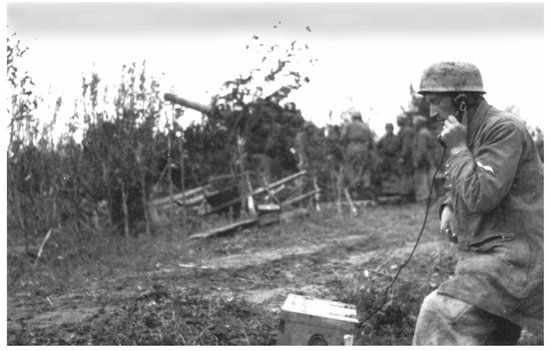
A Fallschirmjäger gun position officer receives fire orders to stop the Canadian advance.
With the artillery keeping the enemy’s heads down, a single company of Canadians advanced across 1200 yards of flat, ‘horribly open fields’, which despite the smoke screen were swept by the enemy’s machine guns, artillery and mortar fire. A member of the battalion recalled, ‘Hugging the shelter of our own barrage, the leading company reached the outskirts of the built-up portion of the town but immediately ran into stiff resistance’. The CO believed that by sending B Company on its own he would be reducing casualties from both friendly and enemy fire. If an eighty-strong company could break into the village and establish a firm base, the remainder of the battalion could follow in stages with covering fire. This approach worked well at Speldrop but Sergeant Reidel led a bayonet charge against enemy positioned in an orchard and then led his men on through the outskirts of the village. The rest of the company followed Sergeant Reidel, who surprised Major King by promptly handing over the three troublesome 75 mm anti-tank guns and their crews as prisoners.
Having reached the edge of the village Major King realised that he needed the HLI of C’s six-pounder anti-tank guns, as the enemy had moved a platoon of assault guns into Speldrop in support of the Fallschirmjäger. In addition, he requested the Wasp flame-throwers, which had been brought across the river aboard LVTs, to help him burn the enemy out of buildings. The Wasps however, had a strictly limited supply of flame fuel and would only be able to deal with a few buildings before withdrawing to refuel. B Company used this close support to help storm the German position and secure a lodgement amongst the buildings on the northern edge of the village.
With B Company having broken into Speldrop, A Company was then brought across the open ground to join the fight against the determined Fallschirmjäger, who were defending the fortified houses. The Wasp flame-throwers negated the Fallschirmjäger’s defensive advantage to a degree. A member of the Battalion recalled that ‘even the resolution of these well trained toughs melted before the horrid jets of flame which the Wasps sprayed among them, and the backbone of their resistance was broken’. Meanwhile, C Company succeeded in clearing the southern part of the town extricating the trapped platoons of 1 Black Watch, while the fourth rifle company sent patrols north of the town and captured several Fallschirmjäger machine-gun crews who were, curiously enough, asleep at their guns. Colonel Stacey noted that ‘It was evident that the past twenty-four hours of almost continual attack and bombardment had rendered the German infantry completely exhausted’.

The Wasp flame-thrower, a converted carrier, is filled with flame fuel.

The HLI of C’s war diary reads:
The battle continued well into the morning of the 25th. Houses had to be cleared at the point of the bayonet and single Germans made suicidal attempts to break up our attacks ... It was necessary to push right through the town and drive the enemy out into the fields where they could be dealt with.
One of the factors in downgrading German performance in Speldrop was the presence of the isolated Black Watch Platoons. Sergeant Johnson commanded one of the platoons and received a DCM for his part in the battle. The Fallschirmjäger had repeatedly fought their way into the platoon’s house before being ejected. When relieved, the Jocks counted thirty-five dead Germans around the house.
Bienen 24 – 25 March 1945
While the HLI of C was mopping up the last resistance in and around Speldrop, 7 Argylls were ordered to pass through 1 BW in Klein Esserden and to capture Bienen. The Battalion attacked Bienen in the fading light, but as at Speldrop numerous, well-prepared and still determined Germans, supported by panzers and assault guns opposed the Scots. It was obvious that 15th Panzergrenadiers had taken over responsibility for holding the vital ground of Bienen.
The soldiers of B Company, who were acutely aware that they were facing self-propelled guns, delivered the Argyll’s first attack from the southwest and reported that ‘enemy spandau posts were chattering away all along the Bund’. Their historian describes the attack:
A platoon under Lieutenant Maxwell tried to rush a farm and were never seen again. It was discovered later that the farm was held by at least fifty Boche. B company commander, Major Morton, along with all the platoon officers was wounded, and the company sergeant major was killed. After a grim battle, B Company had eventually to be withdrawn to A Company’s position at Rosau.
Argyll Farm.
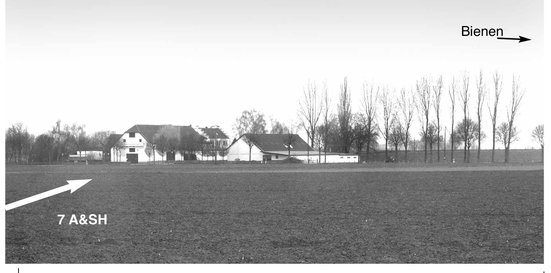

Fallschirmjäger MG 42 team firing from cover.
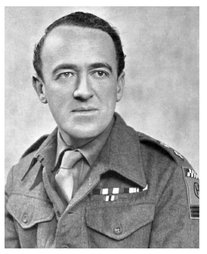
Lieutenant Colonel Mac-Kinnon, CO 7th Argylls.
At 2000 hours, in full darkness, the Argylls tried again, this time with D Company advancing across the open ground to Bienen, illuminated by German mortar flares that spiralled down from above. D Company had ‘a very sticky time’, and most of the Spandauposts had to be taken at the point of the bayonet. By about midnight 24/25 March, the farm at the southwest corner of Bienen had been taken, along with sixty prisoners, mostly from the 15th Panzergrenadier Division. Lieutenant Colonel MacKinnon’s plan was now to pass A Company through D Company. They were to attack to the southern half of Bienen and if successful, B Company was then to go through D Company and clear the northern half of Bienen.
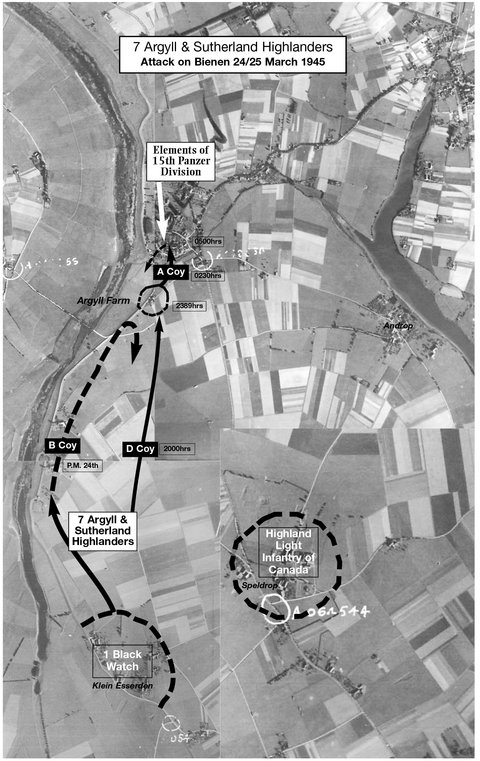
7 Argyll & Sutherland Highlanders Attack on Bienen 24/25 March 1945
Meanwhile, Bienen was subjected to heavy artillery fire and at 0230 hours, A Company advanced from Rosau, supported by a troop of DD tanks from the Staffordshire Yeomanry, who engaged suspected targets on the edge of the village in an effort to suppress the enemy fire.
After passing through D Company, A Company immediately ran into very heavy opposition from Spandaus and self-propelled guns mostly sited along the southern edge of Bienen. The tank troop commander was killed, and Lieutenant Laurie, one of our platoon commanders, was wounded. Everything possible was tried to get into Bienen, but without success. Finally, A Company tried an outflanking movement to the right with one platoon. They had, however, only gone a short distance when they again ran into withering machine-gun fire.
In the early hours of 25 March, Brigadier Oliver had concluded that it was not possible to capture Bienen with just ‘one or two companies’ and the attack was broken off leaving the Argylls with a toe hold in Bienen at the west corner of the village. After some discussion and hot planning by the divisional staff, it was decided that one of the Canadian battalions would renew the attack in daylight. Before the Canadians could arrive, the Panzergrenadiers launched a quick counter-attack to drive the Argylls out of their positions on the edge of the village around 0500 hours. Major Ian Cameron wrote, ‘Heavy defensive fire was brought down continuously and the counter-attack was broken up’.

Brigadier Oliver.
By dawn, 7 A & SHs’ two attacks and the German counter-attack had resulted in heavy losses and they had been beaten back to the farm buildings several hundred yards from the southwest corner of the village. In addition to casualties during operations earlier in the day, the exhausted Argylls had lost seven officers and ninety-six other ranks.
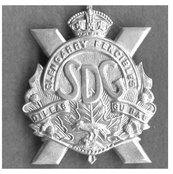
The force needed to capture Bienen was already on its way, in the form of 9 Canadian Infantry Brigade, whose other battalions were now on the east bank of the Rhine. The Stormont Dundas & Glengary Highlanders (SD&GH) had crossed first in Buffaloes the previous afternoon and had concentrated near the river south-east of Speldrop and the North Nova Scotia Highlanders (North Novas) followed at 1700 hours using the storm boat ferry service, and concentrated in the area recently vacated by HLI of C.
With these extra battalions available, General Horrocks redeployed his forces. This saw the SD&GH relieve 7 BW in the area of Reeserward, between the main river and the Alter Rhine. This move together with those described below meant that Brigadier Rockingham’s 9 Canadian Brigade had taken over the Highland Division’s left flank. The Reeserward position was very exposed but the Canadians:
... taking advantage of whatever cover the moonlit night offered, moved in. Once in place, they found themselves occupying the unique position of the extreme left of the whole Allied force which had crossed the Rhine.
The relief completed, 7 BW moved to a concentration area northwest of Ratshof, leaving the SD&GH to plan an attack on Grietherbusch which was to be delivered at dawn on 25 March.
With the failure of 7 A&SH to capture Bienen and because of the mauling they had received, a fresh battalion, the North Novas, were ordered forward through Speldrop to renew the attack at 0900 hours. Following behind the North Novas, 1 BW was to relieve the centre HLI of C in Speldrop. This Canadian battalion reorganised and became the Brigade reserve with immediate effect. The final move was bringing the North Shore Regiment over to join 9 Canadian Brigade in order to give depth to the bridgehead and be available to exploit opportunities.

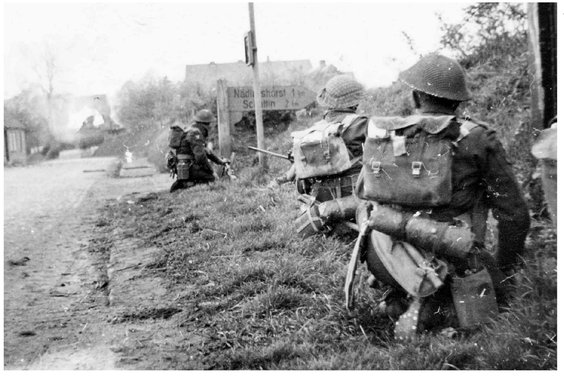
Infantry deployed in an open assault formation await the signal to advance across some open ground.
The day started well for the Canadians with the SD&GH attacking Grietherbusch with great dash. By 1200 hours 25 March, the enemy, ‘despite suicidal stands along the road from Grafenhof to the farm at Tillhaus, had been subdued’, and the SD&GH were probing forward in search of further resistance. In the centre of the divisional area, however, the Canadians were to face a far sterner test.
Bienen – Operation ASTER
In his notes on operations on 25 March, the Canadian official historian noted:
This was the Novas first battle on the east bank of the Rhine, and as if to show the significance of this action, the war diary of this veteran unit contains the heading ′The day of the battle 25 Mar 45’; as though everything else which had befallen since 6 June 44 was as nothing compared to this costly day.

A 25-pounder of 43 Wessex Division firing in support of 9 Canadian Brigade.
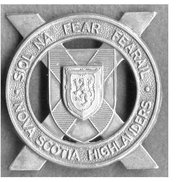
At 0530 hours on 25 March, in an observation post overlooking the open ground between Speldrop and the vital village of Bienen Colonel Forbes gave his orders to the Company Commanders. He started by outlining their part in XXX Corps’ Plan. The task of North Novas was to pass through 7 A&SH, capture the village and thus open the way for a northward expansion of the bridgehead, which would free the ferries and forward assembly areas from shell and mortar fire and open the roads for the breakout into the heart of Germany.
The plan for the battalion attack was divided into two phases, with H Hour at 0900 hours. The first problem was to get the attacking troops across three hundred yards of open country and to help with this support by heavy artillery fire, including plenty of smoke fired by both field guns and the battalion’s 3-inch mortars. According to the Battalion’s War Diary:
In the first phase A Company would seize the right hand portion of the village and B the left, thus securing the start line for C and D Companies in the next phase, in which the east and west portions of the rest of the village would be taken. In the first phase a troop of tanks, (B Squadron 4/7 Dragoon Guards), which had been ferried across the Rhine the previous evening, were to support A Company.

Left:
A Canadian Wasp in action.
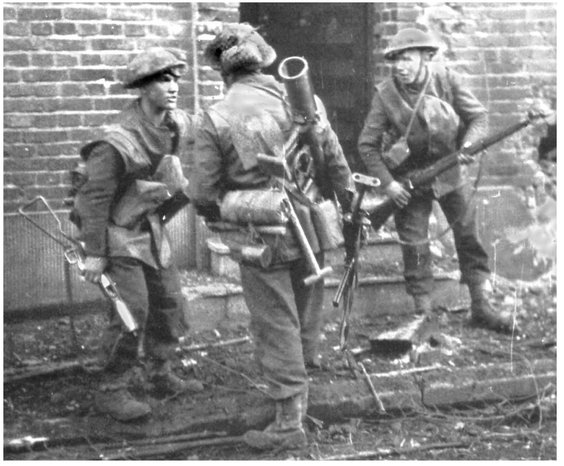
Tension is etched in the faces of these infantrymen in an urban setting.
A report on the battle in a Nova Scotia newspaper described the ground that their local men had to cross before they could start the fight to clear Bienen.
A succession of farms provided very limited amount of cover up the line of the dyke approaching the village from the south. There was no cover whatsoever further to the right or to the left of the Dyke. The next farm [Argyll Farm] was about four hundred yards ahead of the village and the ground beyond was raked by machine-gun fire. The whole area, including the last two farms was under fairly continuous artillery fire and sporadic bursts of machine-gun fire from the right flank. All approaches for vehicles were covered by anti-tank guns.
The operation did not start well. Major Learment led A Company up to its start line in single file along the side of the dyke to ‘Argyll Farm’ but at 0825 hours, thirty-five minutes before H Hour, A Company and the accompanying tanks reported that they were pinned down on their way to the start line by machine guns, snipers and some mortaring. Shortly afterwards, B Company reported that it was experiencing great difficulties in reaching their start line near the farm, still held by the Argylls. Both companies were suffering casualties but ‘At 0845 hours, however, the smoke from the supporting fire plan began, and using it for temporary protection, the troops managed to make headway and succeeded in forming up for the attack’.
Supporting infantry take cover as the Sherman they were following ‘brews up’ after taking a direct hit.
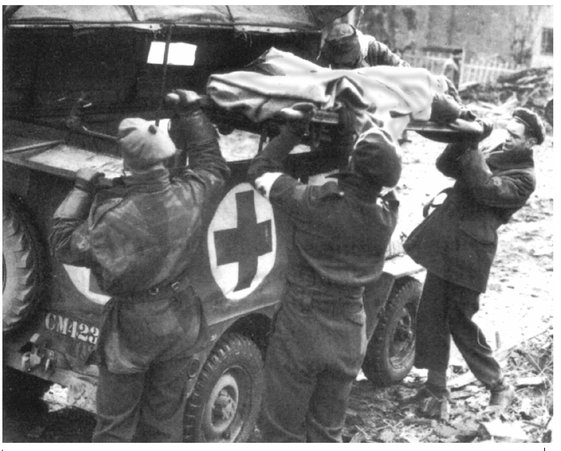
The RMO’s Jeep and later ambulance Jeeps were the only vehicles across the Rhine until ferries were established.

Field Marshal Montgomery, Generals Horrocks and Thomas discuss the battle.
Having formed up under these adverse conditions and set off, the two companies immediately came under fire from previously unidentified positions and within minutes Colonel Forbes was hearing over the radio that his men were again pinned down, that some of the platoons were out of contact and that casualties were mounting. A and B Companies fell back to the cover of Argyll farm. The Novas’ war diary reads:
... the Battalion had quite definitely lost the initiative and contact between platoons was next to impossible because of the murderous fire and heavy mortaring’.
The next diary entry recorded that:
The Commanding Officer contacted Major Learment, A Company Commander, at 0920 hours and asked him to tee up a new attack immediately with the tanks and artillery supported in by his Forward Observation Officer, and make a concerted effort to reach the first row of houses. However, by 1000 hours, nothing had been tied in because so many of the platoons were out of contact and it was impossible to get any sort of message to them.
The companies eventually attacked again but ‘even though attempts were made to reorganise and press on loss of contact and casualties among officers and NCOs made control a serious problem’. At 1145 hours on 25 March, Brigadier Rockingham came forward to make an appreciation and was forced to concede that he would have to use fresh troops to break into Bienen. He directed Colonel Forbes that he was to ‘start from scratch and do the attack over again using the two remaining companies’. Armour and artillery fire support was clearly needed in quantity so as to overcome the Fallschirmjäger and Panzergrenadiers in the vital Bienen position. The battalion’s war diary recorded:
The artillery fire plan was again set up, which consisted of a series of concentrations and stonks on the rear of the town and targets covering the approaches from the rear. Each company had a section of sappers and a forward observation officer while MMGs were laid on targets. The 3-inch mortars were to use smoke and HE to shield the right flank of C Company from observation and fire from Androp. The Typhoons were put in on Millingen. The Artillery plan started at H-10 ...
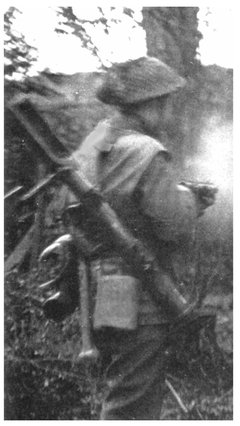
An infantryman fires a burst from his Sten before entering a house in the final phase of the clearance.
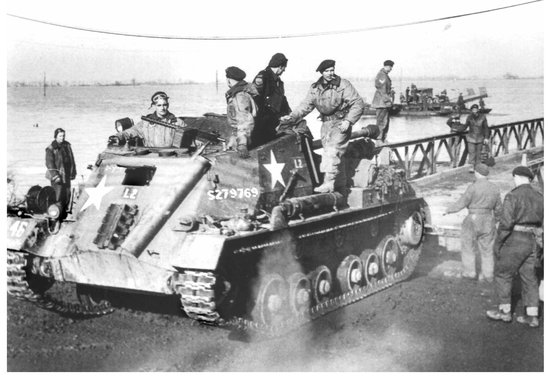
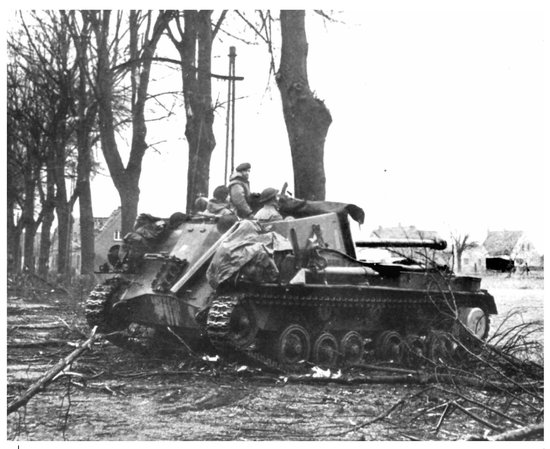
17-pounder self-propelled Archers were ferried across the Rhine and were available to give support to the attacking infantry. They were to take on the German assault guns with a rare qualitative advantage.

While the Canadians were in action soldiers of 5 Dorset led 43 Wessex Division across the Rhine into the bridgehead.
Colonel Forbes also called for additional armoured support and received an additional troop of four Shermans from B Squadron 4/7 Dragoon Guards, who were grouped with C Company, ‘while D had the troop of DD tanks, C Company took in a section of Wasps’. The plan was that C and D Companies were to advance as far as they could into the town and then the remnants of A and B Companies would pass through and clear to the far edge of the objective.
The Forming Up Point and Start Line were again at the farm buildings and at 1430 hours, with the artillery fire plan being repeated, C and D Companies advanced to capture what was still the Phase One objective. Under cover of the exploding shells, D Company, on the left, made good progress towards the village using the dyke and the road as their axes of advance. However, just as they reached the edge of the village their company commander, Major Dickson, was wounded and his men had only managed to take the first houses before they were brought to a halt badly disorganised. Nonetheless, they had succeeded in taking almost a hundred prisoners.
Even though they had a more exposed route to Bienen, C Company too reached the village but:
... had a large number of men killed getting across. In spite of this, they persisted and gained a foothold, which they were able to expand sufficiently to prevent direct fire from coming on the open ground they had crossed.
Within 15 minutes of H Hour, C Company were reporting that they had reached the first houses and the fringe of the town but had suffered thirty-three casualties in their advance across the five hundred yards of open ground.
The additional tanks and artillery support had done their job in neutralising and forcing the panzers and assault guns, which had been reported in Bienen, out of the village. With the Canadians pressing home their attack, they would have certainly fallen prey to the Canadian infantry amidst the buildings and rubble, had they remained. With the enemy armoured threat neutralised, ‘The tanks were on the fringe of the town and bringing heavy fire on the centre in support of the infantry’.
Now that neither the enemy infantry nor panzers could cover the approaches to the village with small arms fire, at 1530 hours, A and B Companies were able to close up to Bienen, leaving the stretcher-bearers to the grisly task of clearing the open fields of the dead and the wounded. OC C Company wrote in his post operational report:
The work of stretcher-bearers and jeep-drivers during the attack was particularly commendable. In spite of the fact that two stretcher-bearers were killed by MG fire while attending to wounded in the open field the remainder carried on with their job under fire and all wounded were evacuated quickly.

Fallschirmjäger prisoners head into captivity after their last-ditch fight to hold Bienen.
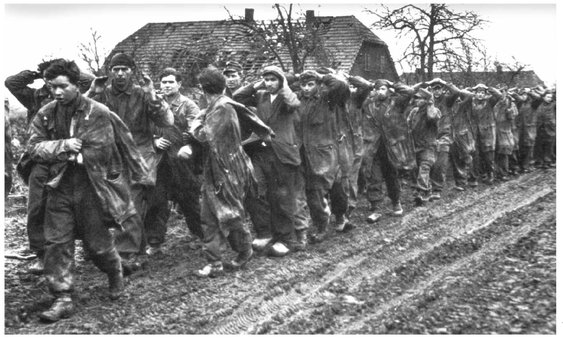
At 1600 hours, 9 Canadian Infantry Brigade came under the command of Major General Ivor Thomas’s 43rd Wessex Division, who was to be responsible for the left flank allowing the Highland Division to concentrate on the centre and right. General Thomas promptly demanded that the Canadian renew the attack.
With the Novas having now gathered sufficient combat power in the village, including Wasps, at 1700 hours another attack started with the limited objective of completing the clearance of what had been originally been their Phase One objective. C Company was ordered to push forward and clear the remainder of their quarter of the village, which they reported as complete at approximately 1745 hours and were ordered to continue to press on through the village before reorganising and digging-in.
A and B Companies then took over the advance and methodically set about the task of clearing each and every building in the main part of the village. It took the remainder of the day, yielding a mixed bag of Fallschirmjäger and Panzergrenadier prisoners. An account by OC B Company gives a flavour of the fighting:
We picked up three tanks and started into the town along the left road. The tanks, our big brothers, covered our right flank by ′brewing up’ each house in turn, while we moved up the left. A couple of the boys were hit by snipers firing from the big house, so we got a tank to ′brew it up.’ 10 Platoon got into the place and started to clear it. This made Jerry very unhappy, and he started firing through the floors. We finally, with the help of 12 Platoon and the moral support of the tanks, got forty prisoners and a couple of officers out of the place.
At about 1815 hours, C Company reported that enemy armour in the unwelcome form of assault guns, supported by infantry, were advancing from the north and knocked out two of the Shermans. The Company was forced to withdraw. Fortunately, a counter-attack had been anticipated and a troop of 3rd Canadian Anti-Tank Regiment Archers were already on their way forward from the heavy ferry sites to help 9 Canadian Brigade hold their gains. The German attack was prevented from getting beyond C Company’s position when one of the new Archer SP gun versions of the obsolescent Valentine Tank, mounting a 17-pounder gun, knocked out one of the enemy assault guns.
It had been clear to Brigadier Rockingham for some hours that another battalion was going to be needed and he was under mounting pressure to complete the capture of Bienen. Consequently, the HLI of Canada, were warned that they were to pass through the North Nova Scotias at 2300 hours and ‘finish the job’. At 1950 hours, Colonel Forbes ordered the Novas to secure a start line in Bienen for their fellow Canadian highlanders. The Canadian official historian recorded that ‘Even this limited task entailed clearing the extensive buildings of a creamery and exploiting to the far end of Bienen’, which principally fell to A Company.
For the Novas, the fighting at Bienen on 25 March had been ‘a long, hard, bitter fight against excellent troops who were determined to fight to the end’. In this ‘day of battle’ to kick open the exit from the confined bridgehead, they lost forty-two killed and seventy-nine other ranks wounded.
During the course of the afternoon Brigadier Rockingham was visited by the Corps Commander, General Horrocks, who always liked to visit as far forward as possible. He was briefed that the remainder of 43rd Wessex Division, who 9 Canadian Brigade was still under the command of, was about to cross as a part of the XXX Corps plan to expand the front by feeding three divisions into the bridgehead. By keeping the frontages narrow sufficient combat power could be applied on the enemy to ensure progress was maintained.
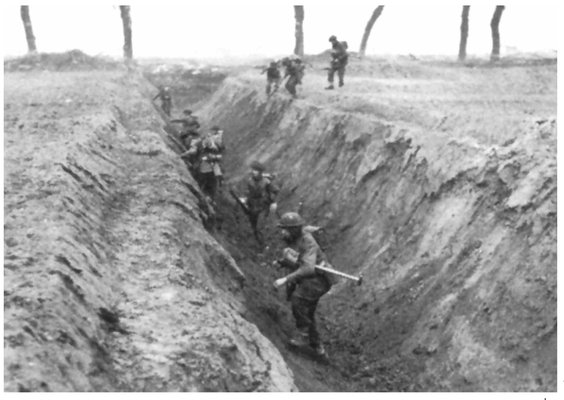
The Fall of Bienen
The Highland Light Infantry of Canada were to complete the clearance of Bienen supported by the final troop of B Squadron 4/7th Dragoon Guards in order to provide a firm base for the attack of 130 Brigade (43rd Division) to the northeast. Their war diary recorded:
26 Mar 45. Progress was very slow as the enemy fought like madmen. Isolated houses had to be cleared and proved most difficult. The enemy artillery and mortars poured shells into our troops continually. Again, single paratroopers made suicidal charges at our advancing troops. They were consistently chopped down but often not before they had inflicted casualties on our own sections.
By first light, the town had been cleared except for isolated groups of snipers who refused to quit. These were mopped up as D Company pushed through the town to a point at the A/Tk ditch approximately MR 054575. With consolidation completed, the North Shore Regiment under command of 9 Canadian Infantry Brigade passed through us towards Millingen. Lieutenant Colonel J Rowley OC of the North Shore Regiment was killed in this push by enemy Arty fire.
In their war diary, the HLI of C recorded some of the lessons the battalion had learned in clearing the village: ‘When open ground has to be crossed to attack isolated houses we must make use of our supporting arms including an artillery barrage, to block off the flanks as well as hitting the objective.’
Let an entry from a Canadian war diary, referring to Bienen, have the last word on Operation PLUNDER, the Rhine Crossing.
It was a long hard bitter fight against excellent troops who were determined to fight to the end. It cracked open the bottleneck that had restricted the bridgehead and from then on, the expansion was much easier and more rapid. The road to Northern Germany and Holland was established.