
BIBLIOGRAPHY
PRIMARY SOURCES
Historische Reichskommission (ed.), Die auswärtige Politik Preussens 1858–1871 (Munich, 1932–45), 9 vols. Vol. 7 (March to August 1866) was never published. Nor were the three volumes covering the period after 1866.
Heinrich Ritter von Srbik (ed.), Quellen zur deutschen Politik Österreichs 1859–1866 (Oldenburg, 1934–8), 5 vols.
Hermann von Petersdorff et alia (eds), Fürst Otto von Bismarck: Die gesammelten Werke (Berlin, 1923–35), 15 vols.
Ministère des Affaires Etrangères, Les origines diplomatiques de la guerre de 1870/1, Recueil des documents officiels (Paris, 1910–32), 29 vols.
Emile Ollivier, L’Empire libéral: études, récits, souvenirs (Paris, 1895–1916) 16 vols.
Hermann Oncken (ed.), Die Rheinpolitik Kaiser Napoleon IIIs von 1863 bis 1870 und der Ursprung des Krieges von 1870–71 (Berlin, 1926), 3 vols. Oncken claims that the key to Napoleon’s policy was an obsessive desire to gain part of the Rhineland.
Harald Jørgensen (ed.), Statsraadets forhandlinger 1848–1912 Copenhagen, 1954–72), includes ministerial conferences as well as Statsraadet meetings. Vols 8 and 9 cover the period December 1859 to July 1864. This official publication replaces Aage Friis’s edited extracts in Statsraadets forhandlinger om Danmarks Udenrigspolitik 1863–1879 (Copenhagen, 1936).
SECONDARY SOURCES
The following works were found useful in the preparation of the text.
GENERAL TEXTS
Heinrich Lutz, Zwischen Habsburg und Preussen:Deutschland 1815–1866 (Berlin, 1985), puts the Austrian case; T. Nipperdey, Deutsche Geschichte 1806–1866: Bürgerwelt und starker Staat (Munich, 1987), a mine of information on social and economic conditions; James J. Sheehan, German History 1776–1866 (Oxford, 1989), an excellent survey.
MONOGRAPHS
Much has been written about Bismarck. The modern biographies include: Ernst Engelberg, Bismarck: Urpreusse und Reichsgründer (Berlin, 1985), by a GDR historian; Lothar Gall, Bismarck: Der weisse Revolutionär (Propyläen, 1980); A. Hillgruber, Bismarcks Aussenpolitik (Freiburg, 1972), a perceptive analysis; George Kent, Bismarck and his times (South Illinois University Press, 1978); W.N. Medlicott, Bismarck and Modern Germany (London, 1965); W. Mommsen, Bismarck: Ein politisches Lebensbild (Munich, 1959); Otto Pflanze, Bismarck and the Development of Germany: The Period of Unification 1815–1871 (Princeton, 1963); F. Stern, Gold and Iron: Bismarck, Bleichröder and the Building of the German Empire (London, 1977), for his financial dealings; A.J.P. Taylor, Bismarck: The Man and the Statesman (London, 1955), readable as always: On the international background: W.E. Mosse, The European Great Powers and the German Question 1848–1871 (Cambridge, 1958), primarily British and Russian policy; A.J.P. Taylor, The Struggle for Mastery in Europe 1848–1918 (Oxford, 1954).
Important symposia on unification and its problems: H. Bartel/E. Engelberg, Die grosspreussisch-militärische Reichsgründung 1871: Voraussetzungen und Folgen (Berlin, 1971), 2 vols. for a GDR perspective; Josef Becker/Andreas Hillgruber, Die deutsche Frage im 19 und 20 Jahrhundert (Munich, 1983); Helmut Boehme, Probleme der Reichsgründungszeit 1848–1879 (Cologne, 1968); T. Schieder and E. Deuerlein, Reichsgründung 1870–71: Tatsachen, Kontroversen und Interpretationen (Stuttgart, 1970).
Work on the origins of nationalism is a growth industry. Important studies include: P. Alter, Nationalismus (Frankfurt a/M, 1985); John Breuilly, Nationalism and the State (Manchester, 1982), a brilliant analysis of the legitimization function of nationalism; Otto Busch and James J. Sheehan (ed.), Die Rolle der Nation in der deutschen Geschichte und Gegenwart (Berlin, 1978); O. Dann, ‘Nationalismus und sozialer Wandel in Deutschland 1806–1850’, in O. Dann, Nationalismus und sozialer Wandel (Hamburg, 1978); Karl W. Deutsch, Nationalism and Social Communication: An inquiry into the Foundation of Nationality (Cambridge, Mass., 1966), a basic study; Dieter Düding, Organizierter gesellschaftlicher Nationlismus in Deutschland (1808–1847) (Munich, 1984), the first thoroughly researched study of mass organisations; Michael Hughes, Nationalism and Society in Germany 1800–1945 (London, 1988), a perceptive commentary; Hagen Schulze, Der Weg zum Nationalstaat: Die deutsche Nationalbewegung vom 18 Jahrhundert bis zur Reichsgründung (Munich, 1985), the latest German account; James J. Sheehan, ‘What is German History? Reflections on the role of the nation in German history and historiography’, JMH (53), 1981, thought-provoking; H.A. Winkler (ed.), Nationalismus (Königstreu/Ts, 1968), contains important essays.
On liberalism: Eugene N. Anderson, The Social and Political Conflict in Prussia 1858–1864 (Lincoln, Neb., 1954), exaggerates the degree of popular support for liberalism; M. Gugel, Industrieller Aufstieg und bürgerliche Herrschaft: sozio-ökonomische Interessen und politische Ziele des liberalen Bürgertums in Preussen zur Zeit des Verfassungskonflikts 1875–1867 (Cologne, 1975), goes to the other extreme and underestimates the liberal desire for change; an early work on the National Society is Le Mang, Der deutsche Nationalverein (Berlin, 1909); an important article by Lenore O’Boyle, ‘The German Nationalverein’, J. Cent. E. Affairs (16), 1956/7, is critical of Anderson; James J. Sheehan, German Liberalism in the nineteenth century (London, 1982), is a standard work; H.A. Winkler, Preussischer Liberalismus und deutscher Nationalstaat 1861–1866 (Tübingen, 1964), believes resistance to liberalism was greater in Germany because of the power of local dynasties.
On conservatism: Arno J. Mayer, The Persistence of the Old Regime: Europe to the Great War (New York, 1981), emphasizes the dominant role of aristocracy down to 1914; J. Weiss, Conservatism in Europe 1800–1945 (London, 1977).
On public opinion and the press there are only: Kurt Koszyk, Deutsche Presse im 19 Jahrhundert: Geschichte der deutschen Presse Teil II (Berlin, 1966); and Eberhard Naujoks, Bismarcks auswärtige Pressepolitik und die Reichsgründung (Wiesbaden, 1968).
On the Schleswig-Holstein Question for the pre-1848 period, see W. Carr, Schleswig-Holstein 1815–1848: A study in National Conflict (Manchester, 1963); Manfred Jensen-Klingenberg, Schleswig-Holstein in der deutschen und nordeuropäischen Geschichte: Gesammelte Aufsätze von Alexander Scharff (Stuttgart, 1969), contains perceptive essays by a former professor at Kiel University; P. von Linston, ‘Bismarck Europog Slesvig-Holsten 1862–1866’, HT 78 (1978), is important; on Schleswig Lorenz Rerup, Slesvig og Holsten efter 1830 (Copenhagen, 1982), is an excellent survey; Keith A.P. Sandiford, Great Britain and the Schleswig-Holstein Question 1848–1866: A Study in diplomacy, politics and public opinion (Toronto and Buffalo, 1975); Lawrence Steefel, The Schleswig-Holstein Question (Cambridge, Mass., 1932); Johannes H. Voigt, ‘Englands Aussenpolitik während des deutsch–dänischen Konflikts 1862–1864’, ZGSHG 90 (1965).
For the Danish perspective: Troels Fink, Deutschland als Problem Dänemarks: Die geschichtlichen Voraussetzungen der dänischen Aussenpolitik (Flensburg, 1968); Erik Møller, Helstatens Fald, 2 parts (Copenhagen, 1958), is a detailed study, but cf. review ZGSHG 85/86 (1961), pp. 351–9; N. Neergaard, Under Junigrundloven: En Fremstilling af det danske Folks politiske Historie fra 1848 til 1866, 2 vols (Copenhagen, 1892–1916), another detailed study still of great value; Johannes Nielsen, 1864: Da Europa sik af lave (Odense, 1987), describes the 1864 War; Vagn Skovgaard Petersen, Tiden 1814–1864, vol. 5 of Danmarks Historie (Copenhagen 1977–85) and Roar Skovmand, Folkestyrets Fødsel 1830–1870 (Copenhagen, 1964), vol. 11 of Danmarks Historie by John Danstrup and Hal Koch are the latest general histories.
On the conflict between Austria and Prussia: C.W. Clark, Francis Joseph and Bismarck before 1866: The diplomacy of Austria before the war of 1866 (Cambridge Harvard, 1934); H. Friedjung, Der Kampf um die Vorherrschaft in Deutschland 1859 bis 1866, 2 vols (Stuttgart and Berlin, 1912), is a classic account hostile to Prussia but also highly critical of Austrian leaders; the revisionist case in Heinrich Lutz und Helmut Rumpler, Österreich und die deutsche Frage in 19 und 20 Jahrhundert: Probleme der politisch-staatlichen und sozial-kulturellen Differenzierung im deutschen Mitteleuropa (Vienna, 1982); on the Habsburg monarchy C.A. Macartney, The Habsburg Empire 1790–1918 (London, 1968).
On the economic rivalry between Austria and Prussia: Helmut Boehme, Deutschlands Weg zur Grossmacht: Studien zum Verhältnis von Wirtschaft und Staat während der Reichsgründungszeit 1848–1881 (Cologne and Berlin, 1966), a pioneer work though less original than the author claims; Hans-Werther Hahn, Geschichte des Deutschen Zollvereins (Göttingen, 1984), is the latest account of the Customs Union superseding W.O. Henderson, The Zollverein (London, 1939). A veritable treasure trove of material on economic and social development in Theodore S. Hamerow, The Social Foundations of German Unification 1858–1871, vol. 1, Ideas and Institutions (Princeton, 1969); vol. 2, Struggles and Accomplishments (Princeton, 1972); a comparison of the Prussian and Austrian economies in H. Kernbauer/E. März, ‘Das Wirtschaftswachstum in Deutschland und Österreich von der Mitte des 19 Jahrhunderts bis zum ersten Weltkrieg’, in W.H. Schröder und R. Spree, Historische Konjunkturforschung (Stuttgart, 1980), pp. 47–59; material on Austrian development in Herbert Matis, Österreichs Wirtschaft 1848–1913: Konjunkturelle Dynamik und gesellschaftlicher Wandel im Zeitalter Francis Joseph I (Berlin, 1972); W. Zorn, ‘Wirtschafts und Sozialgeschichtliche Zusammenhänge der deutschen Reichsgründungszeit 1850–1879’, HZ 197 (1963), pp. 318–42.
On the military side of the war of 1866: G. Craig, The Battle of Königgrätz: Prussia’s victory over Austria 1866 (Princeton, 1964).
On German Catholicism, a subject rather neglected by historians: George G. Windell, The Catholics and German Unity 1866–1871 (University of Minnesota Press, 1954); and J. Sperber, Popular Catholicism in nineteenth-century Germany (Princeton, 1984).
On Franco-German relations: Rudolf Buchner, Die deutsch-französische Tragödie 1848–1864 (Würzburg, 1965); Alan Mitchell, Bismarck and the French Nation 1848–1870 (New York, 1971); Raymond Poidevin, Jacques Bariéty, Frankreich und Deutschland. Die Geschichte ihrer Beziehungen 1815–1975 (Munich, 1982).
On France: Mary Barker, Distaff Diplomacy: Empress Eugénie (London, 1957); J.P.T. Bury, Napoleon III and the Second Empire (London 1964); T. Zeldin, The political system of Napoleon III (Oxford, 1958);idem Emile Ollivier and the Liberal Empire of Napoleon III (Oxford, 1963).
On public opinion in France: A. Armengaud, L’opinion publique en France et la crise nationale allemande en 1866 (Paris, 1962); E.M. Carroll, ‘French Public Opinion in the war with Prussia’, AHR 31, 1929 pp. 679–700; Lynn M. Case, French Opinion in war and diplomacy during the Second Empire (Philadelphia, 1954); Irene Collins, The government and the newspaper press in France 1814–1881 (London, 1959); Elisabeth Fehrenbach, ‘Preussen-Deutschland als Faktor der französischen Aussenpolitik in der Reichsgründungszeit’, HZ Beiheft 6 (Munich, 1980).
On the Hohenzollern candidacy: Josef Becker, ‘Zum Problem der Bismarckischen Politik in der spanischen Thronfrage 1870’, HZ 212, 1971, puts the blame for war on Bismarck; idem, ‘Der Krieg mit Frankreich als Problem der kleindeutschen Einigungspolitik Bismarcks 1866–1872’, in M. Stürmer, Das kaiserliche Deutschland: Politik und Gesellschaft 1870–1918 (Düsseldorf, 1970); Georges Bonnin, Bismarck and the Hohenzollern candidature for the Spanish throne (London, 1957), contains an important selection of documents from the Sigmaringen archives; Jochen Dittrich, Bismarck Frankreich und die spanische Thronkandidatur der Hohenzollern (Munich, 1962), contains an appendix of documents from the Sigmaringen archives in the original German; Eberhard Kolb, Der Kriegsausbruch 1870. Politische Entscheidungsprozesse und Verantwortlichkeiten in der Julikrise 1870 (Göttingen, 1870), puts the blame back on the French: cf. trenchant criticism in William S. Halperin, ‘The Origins of the Franco-Prussian war revisited: Bismarck and the Hohenzollern candidature for the Spanish throne’, JMH 45 (1973); a series of essays on the international context of the war in Eberhard Kolb, Europa vor dem Krieg von 1870: Mächte Konstellation-Konfliktsfelde-Kriegsausbruch (Munich, 1987); William S. Langer, ‘Red rag and Gallic bull: the French decision for war 1870’, in Otto Brunner/Dietrich Gerhard (ed.), Europa and Übersee. Festschrift für Egmont Zechlin (Hamburg, 1964), unravels some confused chronology; R.H. Lord, The Origins of the War of 1870: New documents from the German archives (Cambridge, 1924); Lawrence D. Steefel, Bismarck, the Hohenzollern candidacy and the Origins of the German War of 1870 (Cambridge, Mass., 1962).
For the military events: Michael Howard, The Franco-Prussian War: The German Invasion of France 1870–1871 (London, 1961).
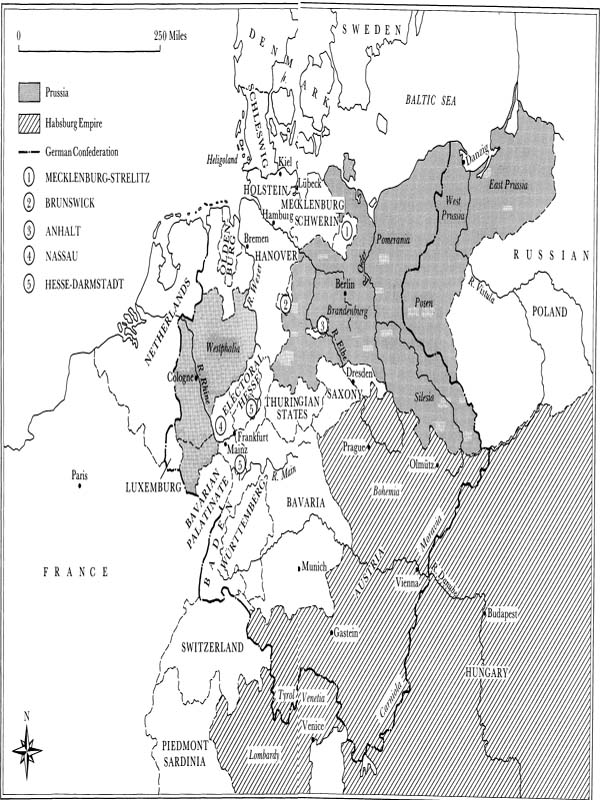
1. The German Confederation in 1815
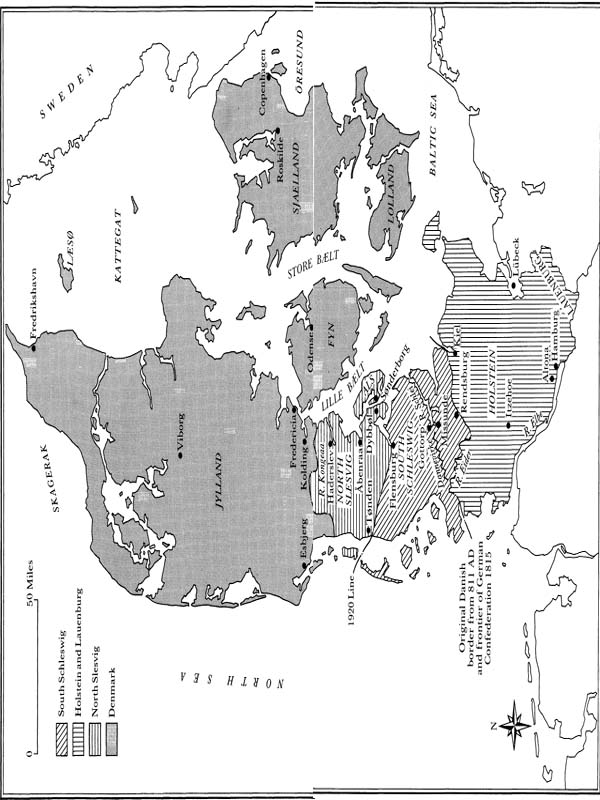
2. The War of 1864: Denmark and the Elbe Duchies
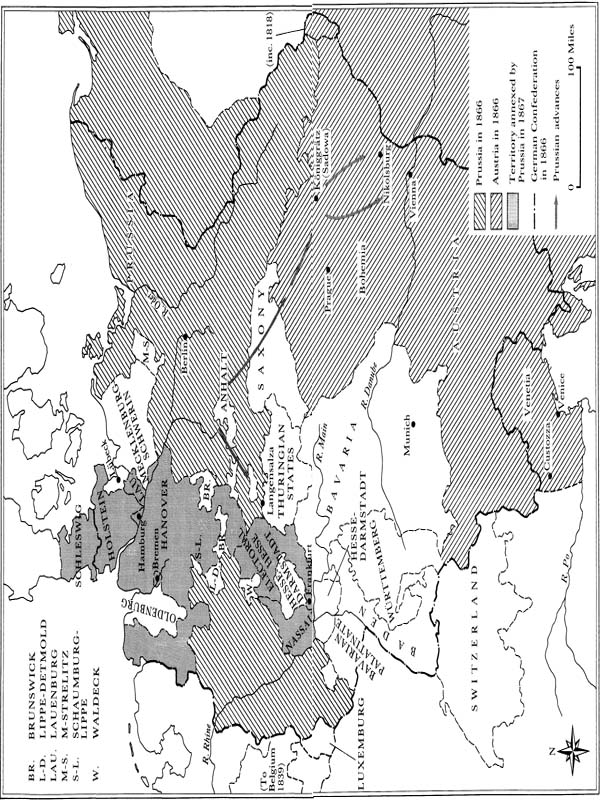
3. The War of 1866
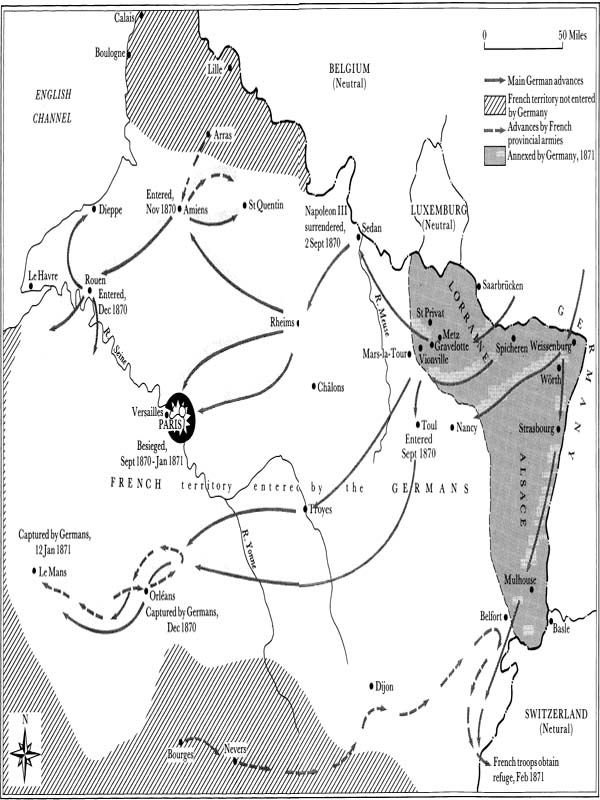
4. The Franco-Prussian War, 1870–71 after Martin Gilbert, Recent History Atlas (Weidenfeld & Nicolson)