
CHAPTER 3
Mujahideen shelling attacks on garrisons, outposts, airfields and cities were a daily event. The Mujahideen usually used mortars, rockets and recoilless rifles in these attacks. Sometimes they used mountain guns and howitzers. The objective was to harrass their foes and destroy war material. Mujahideen gunners learned to construct multiple firing sites and to fire and then quickly displace before DRA or Soviet artillery or aviation could respond effectively. When possible, Mujahideen would keep water near their firing sites to dampen the ground behind the rocket or recoilless rifle. This would help curb the amount of tell-tale dust raised by the backblast of the ordnance. The Soviets and DRA tried to curb these attacks with counterbattery fires, rapid reaction forces and ambushes. Due to their routine nature, the Mujahideen did not usually discuss these unless the interviewer probed. The Mujahideen considered these as usually rather dull events that did not bear retelling. The following attacks, however, were hardly dull events.
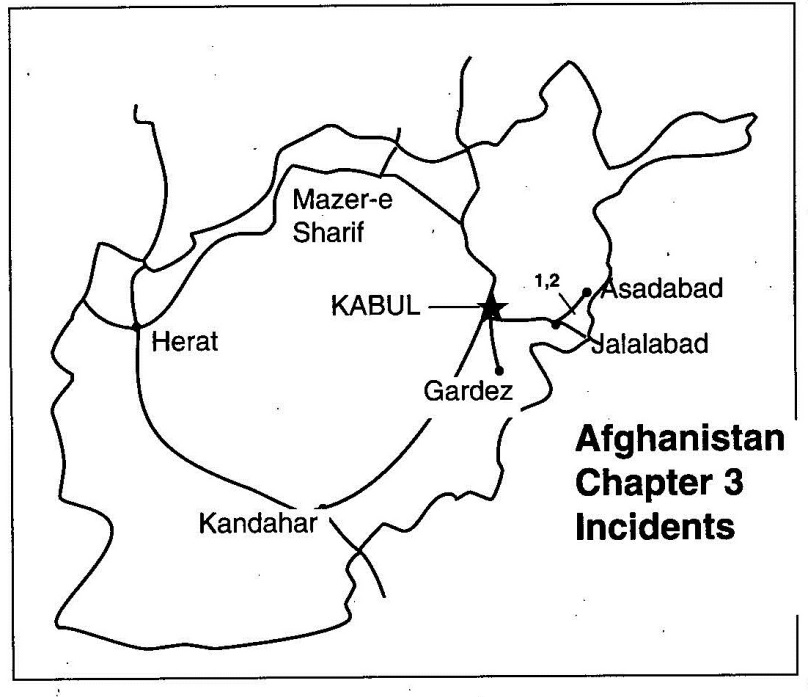
VIGNETTE 1 — A SHELLING ATTACK TURNS BAD by Mawlawi Shukur Yasini{48}
In the spring of 1981, the Soviets and DRA were very active in our area. As a result, we dismantled our permanent bases and changed them to mobile bases scattered throughout the area. I intended to launch a major show of force against the Soviets using my mobile bases. I had two mortars—a 60mm and an 82mm. The problem with the 60mm mortar is that it only has a range of 1,400 meters, so the gunner has to get close to the target to use it. I also had two DShK machine guns, and five RPG-7s. I kept these heavy weapons at my base at Gerdab. My men had small arms which they kept with them.
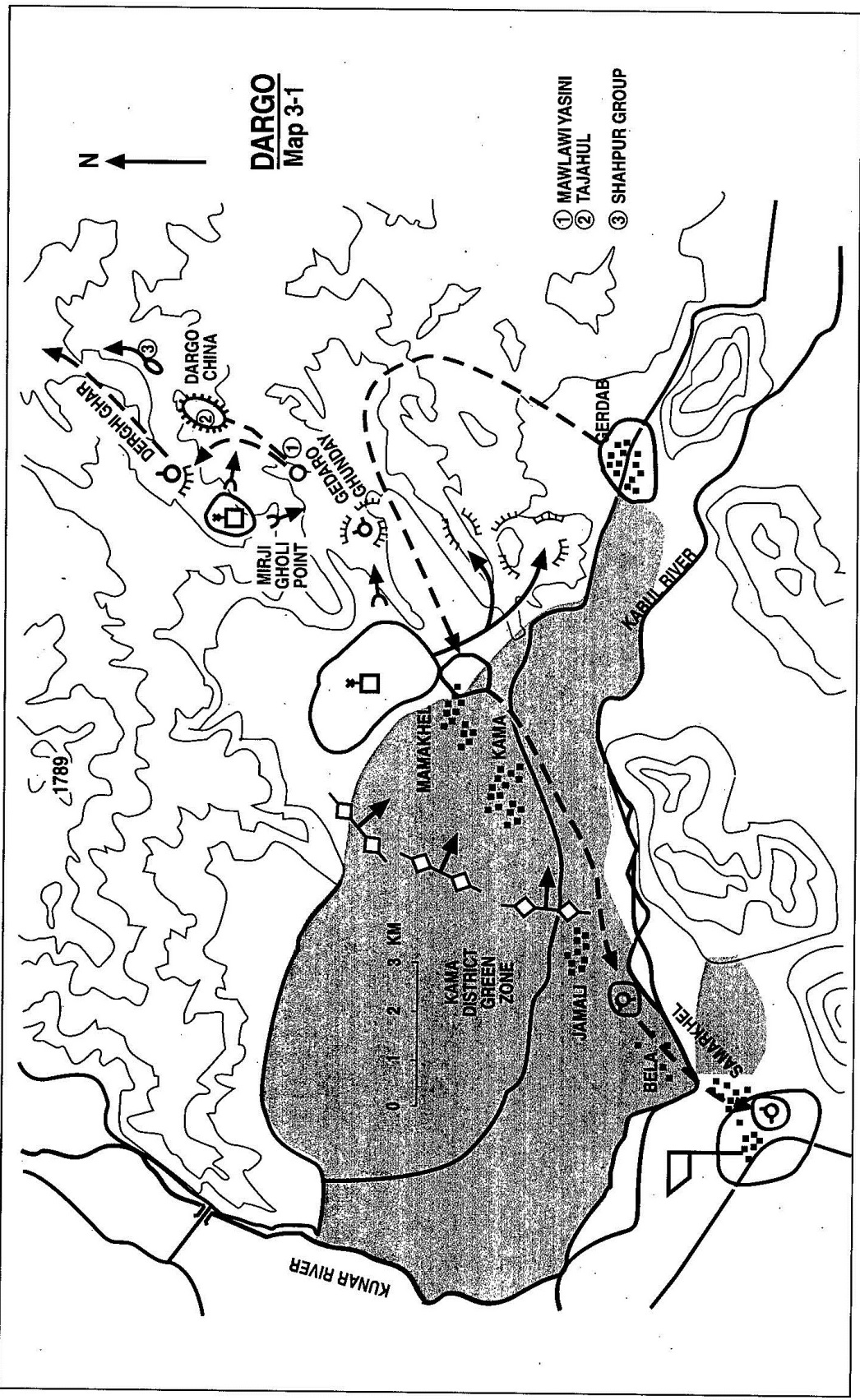
On 17 April 1981, I launched a shelling attack against the Soviet 66th Separate Motorized Rifle Brigade in Samarkhel. I only took 42 men with me since we were not very well equipped and we were not ready for a major encounter with superior forces. Further, Kama District is right across the river from the 66th Brigade garrison and they kept the area under constant surveillance. I did not want to move a large group of men through the area and alert them. To avoid observation, we went north from Gerdab into the mountains and then west across the mountains and into Mamakhel Village in the Kama area (Map 3-1 Dargo). We stayed for three nights in Mamakhel and spent the days in the mountains at Dargo China spring—some three kilometers away. From Mamakhel, we went to
Kama Village where some people were still living—although many people had already emigrated to Pakistan.
At Kama, I put my nephew Shahpur in charge and told him to take my two mortars and 38 men and to go shell the 66th’s camp.{49} I kept four men with me. The shelling group left Kama at dusk. They positioned the 82mm mortar on the north side of the river at the house of Khan-e Mulla at Jamali Village—since it had the range. Then they crossed the river at Bela and approached the camp through the village of Samarkhel. They occupied positions close to the entrance of the enemy camp. They had the guerrilla mortar (60mm) and the RPGs with them. They opened fire with the RPGs and the 60mm mortar from close range at 2200 hours. The 82mm mortar joined in long-range fires onto the sleeping camp. The shelling attack created chaos. The shelling group fired at intervals over a two-hour period and then broke contact and withdrew. I was in Kama throughout the attack. My men had orders to join me in the mountains at the Dargo China spring the next day. I went to the rendezvous point. I arrived at dawn and they were already there. Two of my men were missing, since they had forgotten the 60mm mortar and a video camera and had gone back to retrieve them.{50}
While I was in Kama, informers told me that the enemy would launch a search and destroy mission in Kama District in five days. I decided that they would now come sooner since we had shelled them.
I decided that we had to leave the area. At sunrise, I instructed my men to go deeper into the mountains. I was tired and had a cold, so
I decided to go back home to Gerdab. However, as I set out, I saw two helicopters lifting off from the airport and flying low over Kama District. I hit the ground and hid. I was alone except for Haji Shahbaz. Other helicopters followed the first two. At first I thought that the helicopters were enroute to Kunar Province, but then they started landing troops from two helicopters at Mirji Gholi point on Derghi Ghar mountain—about a kilometer away. They also landed troops north of Mamakhel on the plain and on Gedaro Ghunday hill. My men saw the helicopters landing and realized that they would be seen if they continued to climb into the mountains. So they turned around in the wide canyon and started back toward me. I was in a ditch between Mirji Gholi and Dargo China and was hidden by the early morning shadow from the mountain. As I raised my head, I could make out some 25 Soviet soldiers along with several people wearing tsadar moving to the southeast from the high ground of Mirji Gholi toward Gedaro Ghunday. I could also see Soviets setting up mortars on top of Gedaro Ghunday. I crawled about 50 meters in the ditch. The Soviets were facing the sun and I was in the shadow, so they couldn’t see me. As I crawled, I got rid of heavy things that I had in my pockets—such as pliers and wads of money. I headed north toward the mountain ridge. At that point, Zafar and Noor, carrying the missing 60mm mortar and video camera, walked into the Soviet group setting up at Gedaro Ghunday. They were immediately captured. Noor was my cousin.
I climbed Derghi Ghar Mountain to try and see what was happening. I saw that my men had split. Thirteen were now back in Dargo China. These 13 men were commanded by Tajahul and the rest, commanded by Shahpur, were going back into the mountains. I saw that part of the Soviets were heading toward my 13 men. The Soviets began firing flares at the group of 13 to mark their position. Helicopter gunships then attacked my men with machine gun fire. Other Soviets headed down from Derghi Ghar toward them. After the air attack, the Soviets began attacking my 13-man group. I was midway between the attacking Soviets and my men—about 500 meters away. I looked in my binoculars and saw that another group of Soviets were down in the valley picking up the pliers, first aid packets and money I had discarded. The group examining my things looked different than the others and I thought that they were officers. I decided that when the helicopters made their next strafing run, I would use the noise of their gunfire to hide my fire. When the helicopters made their next gun run, I fired on the group in the valley and hit one. I then took cover, raised my head, fired and got another one. This drew the Soviets attention and they opened up on me. Artillery started to fall all around. I ran from this position to another position about 100 meters away. I had a “20-shooter” [Czechoslovak M26 light machine gun] and some of my men had “20-shooters.” As I ran to change positions, I heard firing from “20-shooters” in my group. They were involved in a heavy fire fight.
I then heard noise from the north and I thought that the Soviets were coming from that direction as well. But then I saw Shapur and one of my other men. They were coming for me. Shapur reported that tanks were moving through Kama and had sealed the exits. The enemy were arresting people throughout Kama. We decided to leave to the north. Earlier, Shapur had sent a messenger to my group of 13 telling them to move north. However, they were pinned down by heavy artillery fire and direct fire. They could not break contact and fought to the last man. As we left the area, one of my Mujahideen fired an RPG at a helicopter. The helicopter caught fire and flew off and fell to the ground near Kama—where it exploded. I don’t know whether the RPG hit the helicopter or whether other ground fire got it.
We moved to the village of Ghara Mamakhel, some four hours into the mountains, where I met two more of my men. By morning, 12 of my people arrived there. I learned the fate of my group of 13. The Soviets remained in Kama for two days. Then we returned to retrieve the bodies of my men. I found the bodies of my 13 men in a group, plus those of Zafar and Noor and five more of my men. The Soviets had booby-trapped some of the bodies and had sprinkled chemicals on other bodies which caused them to disintegrate. We couldn’t evacuate these bodies. So we built graves over them. Their bodies are still there under stones. I do not know what the Soviet casualties were, but I do know that I shot two, we downed a helicopter and the Soviets lost three armored vehicles to our mines during this action.
Throughout the war, I faced the Soviets like this during seven sweeps. I moved the families of the martyrs to refugee camps in Peshawar, Pakistan, since we couldn’t support them in the Kama area. I later learned that the Soviets were looking for me personally. They arrested someone who looked like me (the narrator has a prominent nose) while he was harvesting clover. At that time, my beard was shorter. They took him to Jalalabad and paraded him around—“We’ve caught the son of a b----” they said. Someone finally recognized him, and said that he wasn’t me and so he was released. Around that same time, the DRA governor of Kama District was in the Merzakhel Village. The Soviets arrested him and put him into forced labor since they didn’t recognize him. They had him carrying water to their soldiers on the high ground. The Soviets were very careless of Afghan lives. They killed several villagers indiscriminately. They also killed one of my men who was unarmed. I am glad we drove the Soviets out, but the subsequent actions of the Mujahideen tarnish their record of victory. I have written many poems of protest against their current activities.
COMMENTARY: The Mujahideen were able to fire on the garrison over a two-hour period since they periodically shifted firing positions to avoid return fire. The Soviets did not push out any night patrols to find the firing positions but only replied with artillery fire. The artillery fire did no good. Apparently, the garrison commander had not surveyed potential and actual Mujahideen firing positions to counter them.
The Mujahideen rendezvous point was located in one of three escape routes into the mountains from Kama District. Further, it is adjacent to a likely blocking position which the Soviets used during their periodic block and sweep operations. The Mujahideen were caught downhill from the Soviet blocking force and could not escape. As usual, the Mujahideen were severely hampered by the lack of portable, short-range radios which would have allowed them to coordinate their actions.
VIGNETTE 2 — A NEW YEARS PRESENT FOR THE SOVIETS by Mawlawi Shukur Yasini{51}
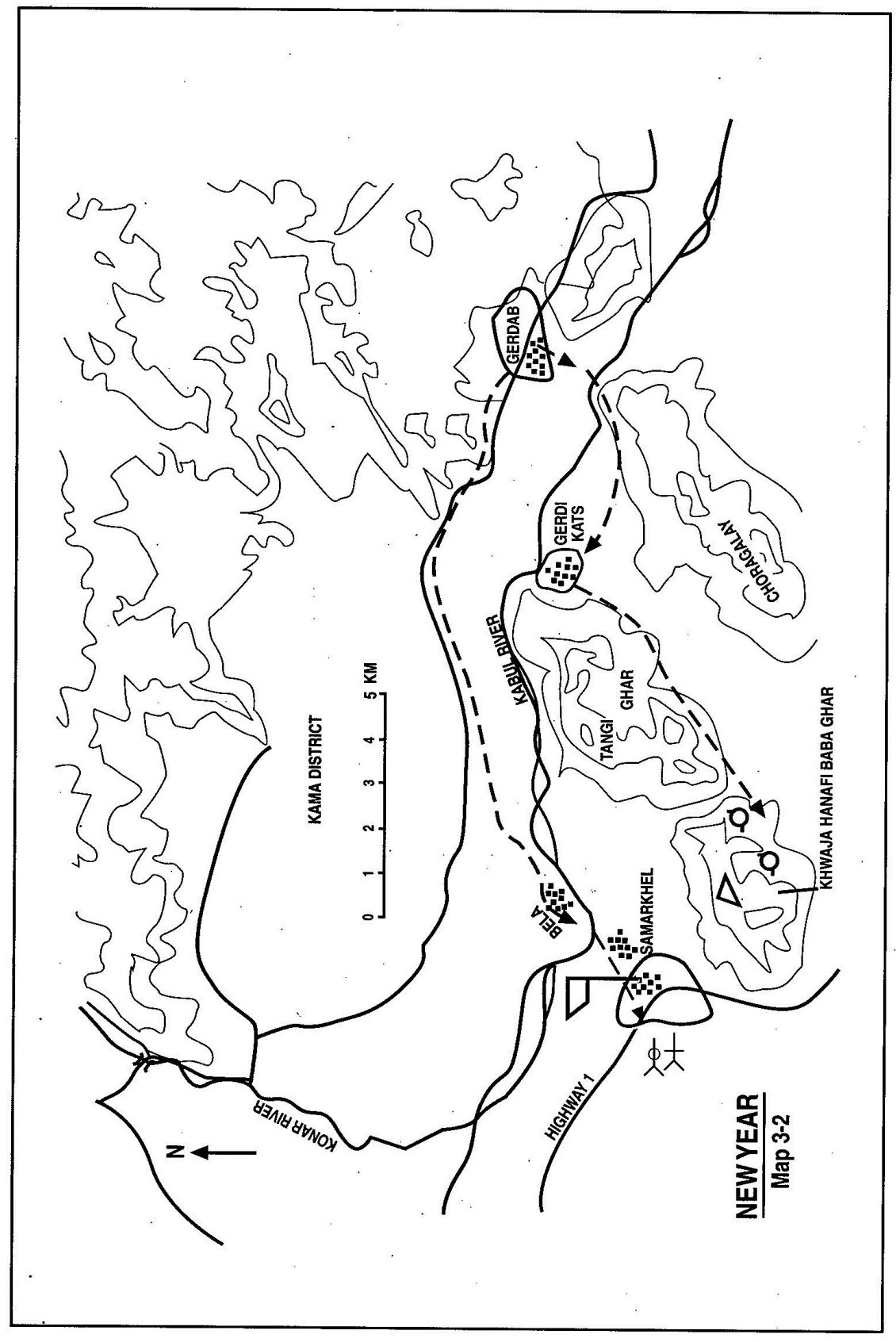
The Soviets invaded Afghanistan on 27 December 1979. I decided that we should give them a combination anniversary and New Year’s present on 29 December 1983. The present would be a shelling attack on the 66th Separate. Motorized Rifle Brigade at Samarkhel. I assembled 150 Mujahideen with two 82mm mortars, two RPG-7s, one recoilless rifle, and five or six antitank mines. We had 250 mortar rounds for the attack. I placed my nephew Shapur in command. He formed four groups: a mortar group commanded by Awozubellah; a mortar group commanded by my son Abdul Basir; an observation post/fire adjustment group commanded by Shapur; and a light group. We started moving the ammunition and supplies on donkeys and mules two days before the attack. We had to move all of it across the Kabul River and stockpile it in the village of Gerdi Kats. From there we had to move it. to Khwaja Hanafi Baba Ghar Mountain overlooking Samarkhel (Map 3-2 New Year).
We moved all the ammunition and supplies to the mountain area undetected during the two days. We set up the mortars behind the mountain and set up the observation post on top.. The light group had the recoilless rifle, RPGs and antitank mines. They crossed the river at Bela at night and went through Samarkhel to the west. Local Mujahideen met them, guided them to the objective and helped them plant the mines. They planted the mines in the road near the main gate of the compound near a mosque. Our plan was to start with a quick strike by the light group and then follow on with the mortar attack. The 66th Brigade was garrisoned in barracks and tents, so we hoped that our mortar fire would be effective against them. It was a rainy night with lots of lightning. The light group launched the attack at 2200 by firing the recoilless rifle and RPGs at the main gate of the enemy. compound. The enemy reacted with tanks and APCs which came roaring out of the gate. Two of them were destroyed or damaged by the antitank mines. The light group withdrew. At the same time, the mortars went into action. They sent all 250 rounds of hot steel into the enemy compound as our New Year’s present to the 66th Brigade. The 66th Brigade responded with BM-21s, artillery and mortars. Round after round of enemy fire slammed into the mountains, while the Mujahideen mortars continued to fire from the valley between the mountains. With the Soviet fire, the Mujahideen mortars and the lightning, the night was practically turned into day. It was a spectacular fireworks display.
I had stayed at Gerdab and had a cow killed and cooked. I planned to welcome my returning heroes with a feast. They were supposed to return at dawn and so all the arrangements for the feast were ready as the eastern sky lightened. But, my men did not return at dawn. They were pinned down by the heavy Soviet return fire. At daybreak, Soviet helicopters and aircraft began flying over the area and firing everywhere. I despaired that anyone would survive. I promised Allah that I would donate a large sum of money to charity if even half of my men would return. At 0800, my body guard, Juma Khan, and. I left Gerdab and climbed the mountain overlooking Gerdab. I was using my binoculars, I saw a shepherd running toward me. Everything was now calm. The aircraft had returned to the airfield and the artillery had quit firing. I climbed down to meet the shepherd. He brought me the good news that my Mujahideen had survived and had returned to Gerdab. None of my Mujahideen were even hurt! We had a very good feast.
Due to the heavy Soviet shelling, many other Mujahideen left their areas. Our contacts in the Soviet camp later reported that helicopters evacuated wounded and dead from Samarkhel to Jalalabad airport. The helicopters made 12 trips. Our contacts told me that there were at least 200 killed and wounded. This attack increased Soviet activity and Soviet helicopters were out flying every day looking for Mujahideen.
COMMENTARY: A lot of Mujahideen mortar firing was observed fire from the forward slopes of a mountain with the gunner making firing adjustments. The mortar crews in this attack would not have survived the Soviet return fire if they had tried firing from the forward slopes. Their reverse slope firing positions in the valley made it difficult for Soviet artillery to reach the firing positions. The use of forward observers to adjust fire is a mark of sophistication among Mujahideen forces. However, the Soviet mortar battery commanders should have surveyed these likely firing sites and had them plotted long before the Mujahideen attack. Apparently, they did not. This is a step that fire support commanders should take whenever their forces stop. This was a permanent garrison, so such planning should have been done years before. The figure of 200 dead and wounded seems high, but it was a well-planned and executed attack.
DRA and Soviet intelligence efforts in the Kama area seem inadequate. Commanders, like the narrator, operated from the same area throughout the war and moved freely through populated areas, yet the DRA seemed unable to react in time. The Soviets and DRA knew who the narrator was, what he looked like and where he was from, but they were never able to kill or capture him.
CHAPTER COMMENTARY
The Mujahideen fired from fixed, surveyed sites and from mobile firing bases. The mobile fire base deployed in two phases. During the day, the firing survey party would move into the area, determine weapons positions, map locations, headings, intended positions for the aiming stakes and firing data. At night, the firing party would arrive in á jeep, meet with the survey party, set up their weapons, conduct a quick firing raid and depart.
The Mujahideen also employed unmanned firing bases. Unmanned firing bases were used against targets which were devoid of cover and concealment. The Mujahideen would survey these points in daylight and set up rockets on makeshift or disposable launchers. They would connect these rockets to time-delay firing devices. The Mujahideen would be well away from the area when the Soviet or DRA forces would launch a search for them.
Shelling attacks had mixed results. When launched against military airfields and garrisons, they occasionally destroyed military targets of value. Further, they prevented the DRA or Soviet forces from sleeping and depressed morale. When launched against cities, they frequently killed innocent civilians. This cost the Mujahideen potential supporters. As some civilians expressed it, “the government oppress us during the day and the Mujahideen oppress us at night.”