
CHAPTER 6
The war was a contest by both sides to control the other’s logistics. The Soviets used aerial bombing, scatterable mines, crop burnings and assaults on rural villages to drive the rural population into exile or into the cities. Their objective was to deprive the guerrilla of his source of food, shelter and rest.
The Soviet lines of communication (LOC) was a double-lane highway network which wound through the Hindu Kush Mountains—some of the most inhospitable terrain on earth. Mujahideen constantly cut the road and ambushed convoys carrying material from the Soviet Union. The Soviet presence depended on its ability to keep the roads open. Much of the Soviet combat in Afghanistan was a fight for control of the road network. Soviet security of the Eastern LOC required 26 battalions manning 199 outposts, patrolling the LOCs or escorting convoys. The more-open Western LOC required three battalions. More than three-fourths of Soviet combat forces were routinely involved in security missions. DRA forces were also tied down in LOC and area security.
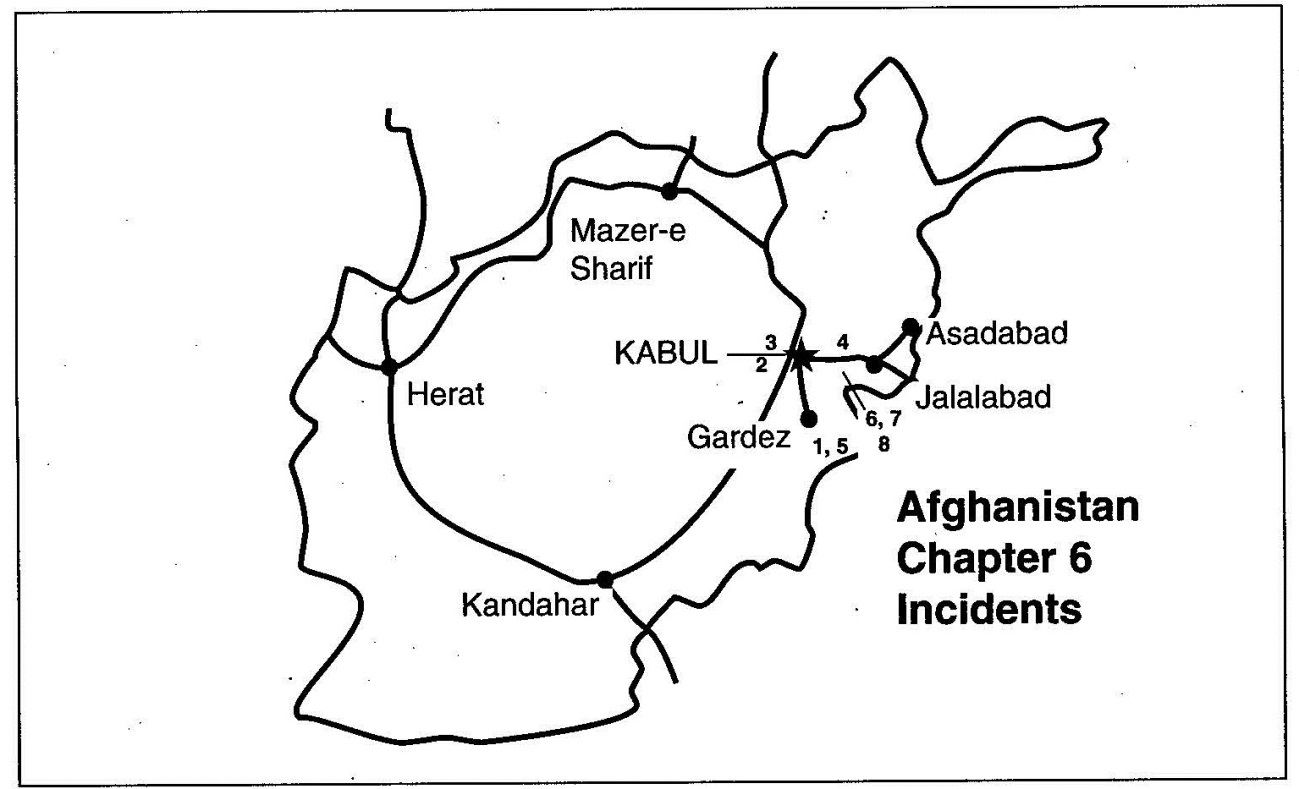
The resistance destroyed over 11,000 Soviet trucks. DRA truck losses were reportedly higher. The Mujahideen ability to interdict the LOC was a constant concern to the Soviets and prevented them from maintaining a larger occupation force in Afghanistan.
VIGNETTE 1 — CARVING UP REGIMENTS ON THE APPROACH TO WAZI by Haji Badshah Khan{65}
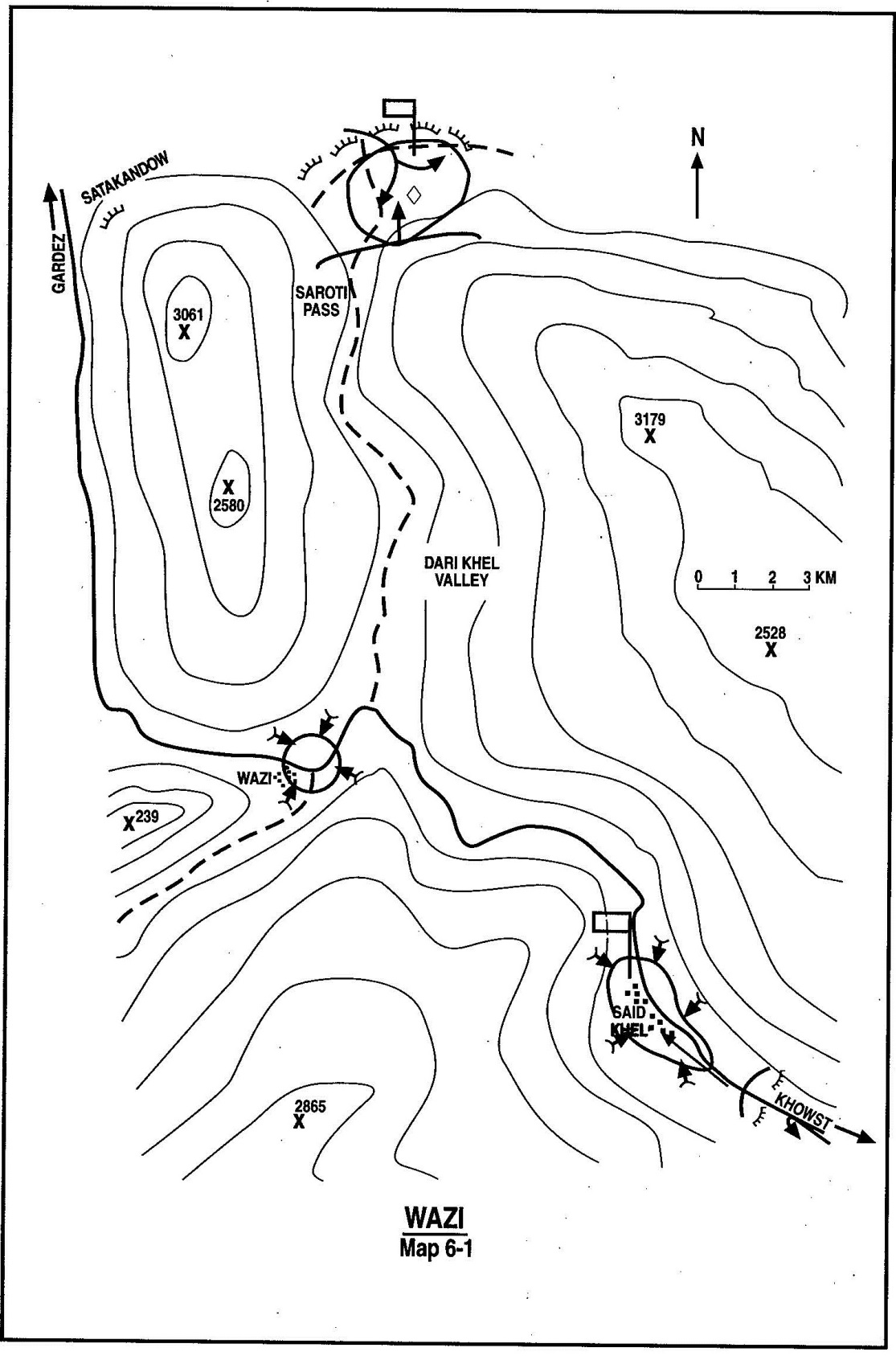
In April 1980, I set out to capture the Wazi District Headquarters which sits astride the main road between Gardez and Khowst. I had some 400 Mujahideen who came from the Dari Khel Valley. The Saroti pass is at the northern end of the Dari Khel Valley and offers access from Gardez to Khowst. The Satakandow pass on the main Gardez-Khowst highway was already controlled by the Mujahideen, so the Dari Khel approach was the only possible route for the DRA. In those days, we did not have base camps, but lived in our villages and used whatever weapons were at hand. We had rifles plus some locally manufactured machine guns from Pakistan. I made my plan of attack. During the night, we moved to Wazi which is close to the Dari Khel Valley (Map 6-1 Wazi). I divided my men in groups and we surrounded the district headquarters on all four sides. I ordered my subordinate group commanders to wait for my signal to attack. In the morning, I intercepted radio communications between the Wazi garrison and their headquarters. The commander was asking for help and stated that he was surrounded by Mujahideen. Shortly after that, two helicopters came, circled the area and returned. The commander of the garrison was Mohammad Hashem. He was from the Jaji tribe and we knew each other. He sent a mediator to me who announced that the garrison was ready to surrender. I told him to disarm his men first and then we would negotiate. He did and then he surrendered the garrison. We captured a lot of weapons. The spoils of this action encouraged other Mujahideen to besiege other posts for their weapons.
The DRA reacted to the fall of Wazi by sending two columns to reestablish government control. The government forces moved on two axes, one from Khowst and the other from Gardez. The column from Khowst reached Said Khel and formed an assembly area there. The column from Gardez approached the Saroti pass. I began to mobilize people against the government forces. I sent harbakai (tribal police or regulators who kept law and order in their areas) to rally the tribes and the tribes responded since they knew that the DRA would loot the villages if they let them into the area. I assigned two harbakai groups to reinforce the Mujahideen blocking DRA forces at Said Khel. I took the rest of the Mujahideen to the Saroti pass. I arrived at Saroti in the late afternoon and surveyed the area. I determined how many Mujahideen I would need and where I would position the forces. I did not have enough Mujahideen, so I assembled some of the local barbers (Pushtun barbers usually also play drums) to play their drums to gather a lashkar.{66} I did this to raise the whole area and to demoralize the enemy. The drummers did a great job. Warriors came from many tribes to Saroti and soon I had a large army. Originally, I had planned to defend the pass, but when I viewed the size of my army, I decided to attack. I promised them the weapons we captured and we attacked the column and captured weapons, trucks and tanks. When we had dealt with the Saroti force, I left a blocking force to deal with any further columns and then took the lashkar to Said Khel.
We cut the road to Khowst behind the DRA regiment which was still assembled at Said Khel. Then we surrounded the regiment. It remained trapped for 20 days. The DRA sent another column out of Khowst to relieve this force, but they could not break through the Mujahideen blockade. After some fighting, the entire force at Said Khel surrendered. There were 1,300 personnel in the column and we captured 1,200. The enemy lost another 100 either KIA or WIA. We captured all the weapons of this regiment including 50-60 trucks and armored vehicles. After the surrender, the DRA air force bombed their own column and destroyed the rest of the vehicles in it, or we would have had even more booty. A few vehicles managed to escape from us. The father of DRA Minister of the Interior Gulabzoi was wounded in the fighting and managed to escape in one of the APCs. His name was Gulab Shah and he was a member of the Zadran tribe, so perhaps some tribesmen helped his escape.
COMMENTARY: Early in the war, the Mujahideen resistance was mostly centered on the tribes. Only later, when the United States, Egypt, Saudi Arabia and other countries began supplying the Mujahideen through the various religious-based factions, did the Mujahideen’s primary focus and loyalty shift to the factions. The method of raising the force and fighting the DRA columns described here is little different from what the British forces experienced fighting these same tribes on the northwest-frontier. Once the lashkar assembled, the warriors would chant and sing along with the drums. This occurred here as well.
VIGNETTE 2 — BLOCKING THE PAGHMAN HIGHWAY by Commander Haji Aaquelshah Sahak{67}
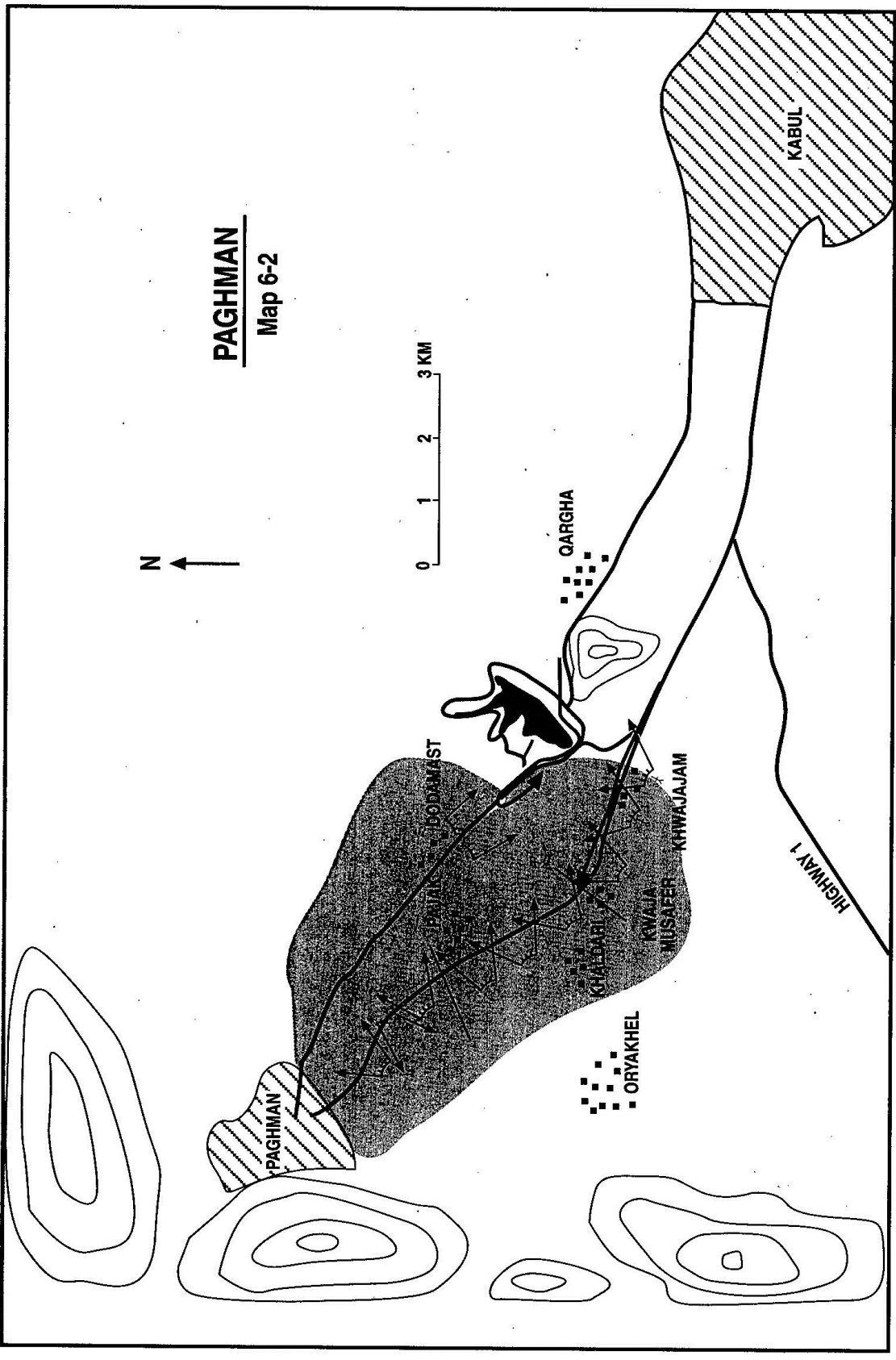
I have been in many actions, but one stands out that I won’t ever forget, because it was a very trying situation. On 4 or 5 June 1983 we were in Paghman, a district capital (garrisoned by DRA forces),{68} which is some 25 kilometers west of Kabul. We received information one evening that a major Soviet/DRA column Would attempt to resupply and reinforce Paghman’s garrison and government enclave. There are two parallel highways from Kabul to Paghman. (Map 6-2 Paghman) The late Commander Habibullah, the late Commander Wahed and others planned to block the convoy. They had some 250 to 300 Mujahideen armed with two mortars, one recoilless rifle, 12 RPG-7s, and some Kalashnikov and Enfield rifles. They assigned sectors of responsibility to different groups. Each group would block the highway with ambushes in its sector. Habibullah (HIK), Commander Aman (IUA) and I (NIFA) were given the sector from Khwajajam to Khwaja Musafer. Khwaja jam is about a kilometer from the Cheltan road fork. We occupied positions primarily on the south side of the road. Commanders Ajabgul, Wahed, Abduljan and Kochi had the sector from Khwaja Musafer to Pajak. They occupied ambush positions mostly on the southern side of the road. From Pajak to Paghman, Mujahideen occupied ambush positions on both sides of the road.
We occupied our ambush positions at night. The next morning, the column left Kabul. As the leading armored vehicle reached Kwaja Musafer, we opened fire. The ambush turned into a battle as we destroyed 11 armored vehicles and two helicopters. Enemy aircraft and helicopters continually tried to drive us from our positions, but we held and the fighting continued for three days.{69} Even during the fighting, the women from the villages would bring bread and milk forward to our positions. The whole area was actively supporting us. The inhabitants of Paghman, Oryakhel and Khaldari were feeding us. Mujahideen came from outside the area to reinforce us. Modir Zaher of Khaldari took nine wounded Mujahideen into his home. His wife cared for them, nursed them and applied dressings on them. The Soviets tried to bypass our ambush by moving on the northern route to Paghman through Qaragha. Mujahideen stopped this column at Dodamast northwest of Qaragha. The enemy then tried to bypass the Kwaja Musafer ambush by skirting around it, but the bypassing force soon fell into further Mujahideen ambushes. The center of fighting was Kwaja Musafer and we stopped and held the enemy there. After three days of fighting, the enemy broke contact and withdrew to Kabul. In my sector, we lost 13 KIA and many wounded. I personally know of 20 wounded, but there were many more. The enemy lost 14 armored vehicles and trucks in my sector. I know that over 40 DRA soldiers were captured or defected. We captured hundreds of small arms during this battle.
COMMENTARY: This is an example of good Mujahideen field cooperation—not always a feature of the war. The Mujahideen cooperated and their overall formation strengthened as the battle continued since Mujahideen came from all around the area to join in the fight. The British noted that a good fight had almost a magnetic effect on the warrior-tribesmen of Afghanistan and the Soviets learned that this trait had not disappeared over time. The Soviets and DRA broke contact after three days although their lines of communication were intact and the enemy was fixed in known positions. Firepower could not break the Mujahideen and the Soviets and DRA would not commit the necessary infantry to close with the Mujahideen.
The road to Paghman runs through a heavily-populated green zone and the Mujahideen were able to select and fortify good ambush positions along the route. In this summer fighting, the trees and crops provided good concealment for the Mujahideen.
VIGNETTE 3 — ROAD BLOCK AT ESTALEF by Commander Sofi Lai Gul{70}
In October 1983, one of my men was injured during a fight with other Mujahideen from the local area. I took a group of 20 of my Mujahideen from my base in Farza and went five kilometers north to Estalef. We were going to meet with local elders in Estalef to settle the dispute with other local commanders. Estalef is a popular summer resort some 40 kilometers north of Kabul.
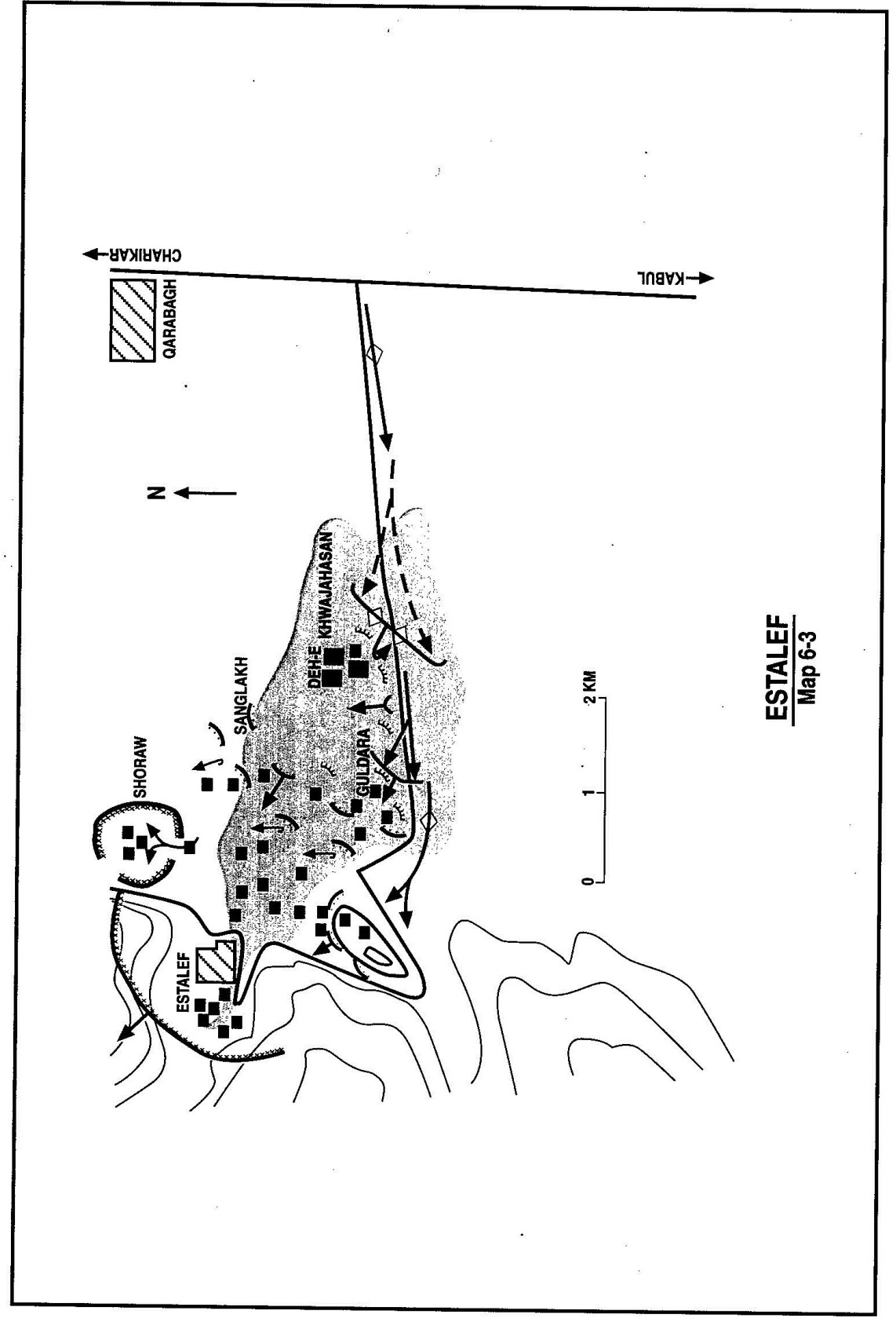
Informers told the DRA and Soviets about our gathering and the enemy decided to attack us. The Soviet forces came from nearby Bagram and the DRA forces came from Kabul. At night, Mujahideen patrols at the Estalef junction of the Kabul-Charikar highway reported that Soviet and DRA columns have moved from Kabul and Bagram and were heading toward Estalef. The Mujahideen alerted their men at dawn. My 20 men joined a force of nearly 100 commanded by a local commander who was the son of a leading Estalefi chieftain (Wakil Mohammad Amin Khan). We took up positions in the orchards at Deh-e Khwajahasan and Qabr-e Malik (Map 6-3 Estalef). We planned to block the Estalef road and deny the enemy access to the town which dominated the fertile valley.
The Mujahideen commanders divided their men into small teams of four-five men and deployed them in the orchards along the road in order to ambush the enemy column over a wide stretch. We instructed our men to let the head of the enemy column reach Qabr-e Malik and then everyone should open fire. As the leading vehicles reached Qabr-e Malik, the attack signal was given and relayed through portable megaphones. We hit the lead armored vehicle and a jeep. The battle raged along the length of the column from Qabr-e Malik to Deh-e Khwajahasan. The Soviet infantry dismounted and attacked the Mujahideen positions and heavy fighting ensued. We were scattered throughout the orchards and had plenty of room to maneuver, so it was hard for the Soviet infantry to pin us down. However, we were short of supplies, particularly ammunition. Further, the Soviets/DRA had much more combat power than we did and they were using helicopter gunships and other aircraft against us. Since we were scattered over a wide area in small groups, Mujahideen command and control over the battle was difficult and sporadic. Coordination of the actions of the many resistance groups became very difficult.
The battle in the orchards continued until 1400 hours. As they ran out of ammunition, the various Mujahideen groups withdrew in different directions and moved their wounded to safe areas. The Soviets consolidated their advance through the green zone, securing the high ground commanding the approaches to Estalef. I pulled my men out to Shoraw, about three kilometers northeast of Estalef. The Soviet/DRA column moved to Estalef and launched an intensive search of homes. The soldiers looted homes, destroyed property and set fire to the houses of suspected Mujahideen. Many people lost their livelihoods due to their actions. The Soviets stayed three days in Estalef and then returned to their bases. Mujahideen casualties in my group were two KIA and 18 WIA. Most of the casualties were from Soviet air strikes.
COMMENTARY: The large Mujahideen concentration in Estalef, close to Soviet/DRA forces, was an extremely imprudent move. If the Mujahideen patrol had not provided early warning, the Mujahideen losses at Estalef might have been much higher. The Mujahideen deserve high marks for their quick reaction and rapid deployment along the road to Estalef. They utilized their familiarity with their home area to quickly select effective fighting positions and they used local terrain and vegetation to conceal themselves from Soviet ground and air power. However, the Mujahideen suffered from lack of effective command and control which prevented the timely coordination of counterattacks and countermeasures. Better command and control might have enabled the Mujahideen to hold the high ground dominating the Estalef approach and to prevent the Soviet entry. But the well-armed and supported Soviet force was able to push its way through. The Mujahideen were reluctant to become decisively engaged in a protracted battle with a much-stronger, better-supplied opponent. They felt that they had to survive to face this opponent over and over again. The Mujahideen lack of a structured, viable supply system hampered their tactical capabilities significantly.
The Soviets and DRA deserve high marks for carrying enough forces for dismounted combat and for using them aggressively. The combination of overwhelming firepower and ground maneuver unhinged the Mujahideen defense and the decisive action taken by the Soviet infantry forced the poorly-supplied Mujahideen to break contact—leaving the dominant terrain and subsequent access to Estalef open. However, the Soviet/DRA forces merely pushed at a more-nimble foe and failed to try to outflank or encircle the Mujahideen force. This kept them from bringing the Mujahideen to decisive combat and allowed the Mujahideen to withdraw without heavy losses.
VIGNETTE 4 — DEFENSE OF A RIVER LINE AND ROAD BLOCK AT SAYAD by Commander Haji Abdul Qader{71}
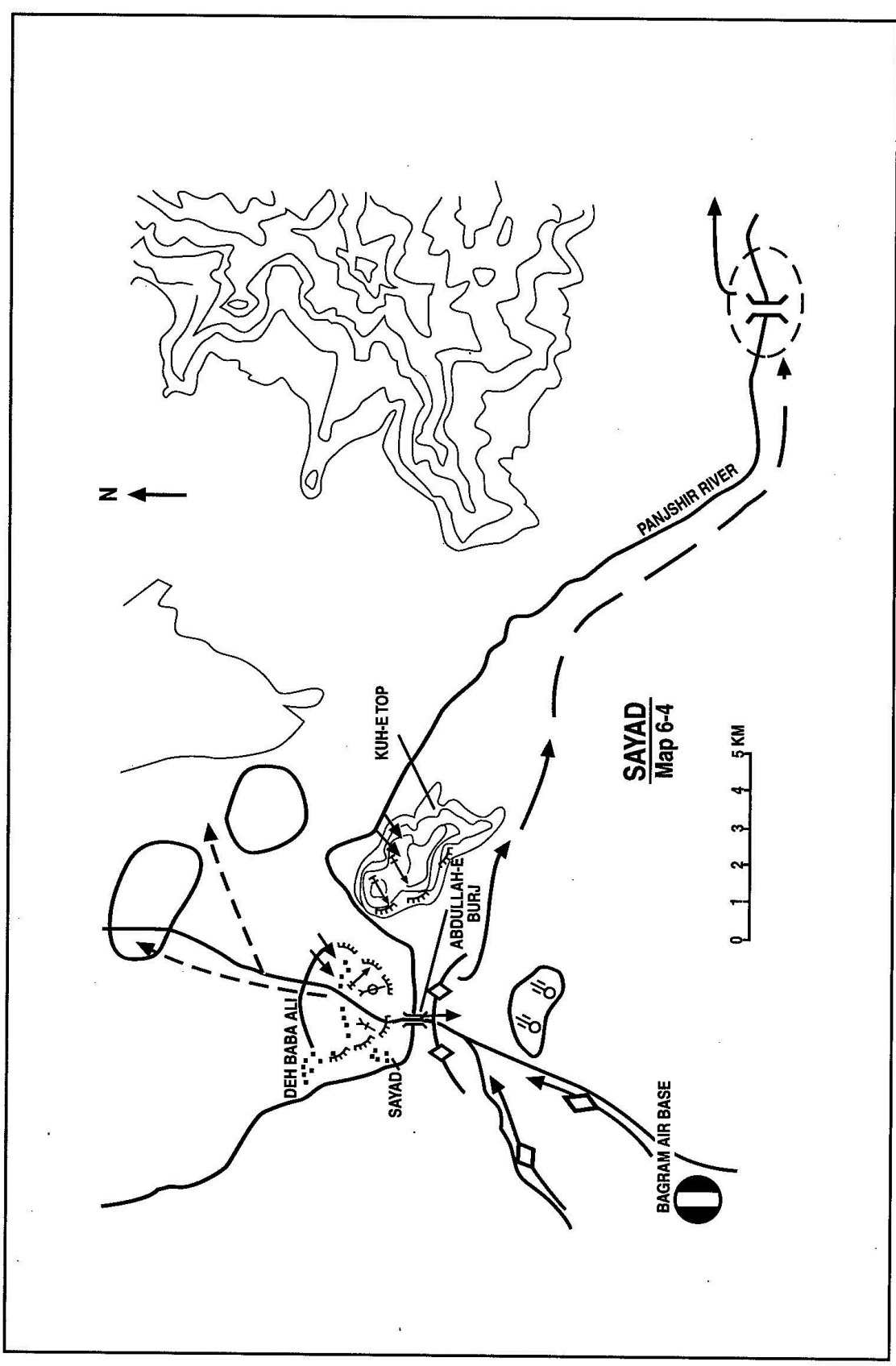
In late summer and early fall of 1983, the Mujahideen in Nejrao and Tagao Districts of Kapisa Province increased their attacks on government facilities. These districts are located on the east side of the Panjshir River and link Sarobi on the Kabul-Jalalabad highway with key locations in the provinces of Parwan, Kapisa and Laghman. These districts also provided access to several Mujahideen mountain base camps. The only permanent bridge across the Panjshir River (at Abdullah-e Burj) is located in this area and provides direct access to Bagram. We expected Soviet/DRA forces at Bagram to launch a strike through the area. Their purpose would be to protect Sarobi and the main road connecting Sarobi with the Kapisa Province Capital of Mahmoud-e Raqi and Gulbahar located further north at the mouth of the Panjsher Valley.
We decided to block this expected advance with my forces and the forces of Commander Shahin (based around Mahmoud-e Raqi). We prepared defensive positions on the north bank of the Panjshir River around the bridge at Abdullah-e Burj (Map 6-4 Sayad). We built blocking positions in a deep ditch which passes through upper Sayad village and covers the road as it approaches the bridge. We prepared positions on the high ground south of the river which dominates the approach and both banks of the river. We put in land mines and built shelters with overhead cover to protect our Mujahideen from air and artillery fire. We moved supplies forward to a forward supply base in Deh Babi village immediately northwest of Sayad village. We built covered trenches from the base to the forward positions. The trenches were big enough to allow us to resupply by pack horses, mules and foot porters.
Commander Shahin had approximately 600 men and I had approximately 250. There was not enough space to deploy them all, so one-third of the force occupied fighting positions while the rest were in reserve or given support tasks. Some Mujahideen held flank positions to contain the enemy. Since all of the Mujahideen were locally based, we were able to deploy the blocking force in total secrecy. This helped surprise the enemy and hit him at a time and place where he was not fully ready to react effectively.
Early on the morning of 31 October 1983, Soviet and DRA forces moved out of their Bagram base along two parallel routes and approached the Abdullah-e Burj bridge. I estimate the strength at several regiments backed by strong artillery support and ample logistics. Tanks and APCs led the column. As the head of the column reached the lower Sayad village on the southern bank, the tail of the column had not cleared their Bagram base some ten kilometers to the southwest. As the enemy tanks and APCs passed through lower Sayad village toward the river, we opened fire and took the enemy by surprise. It took the enemy some time to react and find our positions. We intensified our fire as more vehicles of the enemy column came into anti-tank weapons range. We hit several of their vehicles and they started to burn. Instead of trying to secure the bridge by infantry, the enemy continued to push his tanks and APC’s toward the bridge. One tank and two APCs made it to the bridge, but we knocked them out at the bridge site.
The enemy stopped and began pounding suspected Mujahideen positions with artillery fire and air attacks. He also began indiscriminately bombing the area, including the surrounding villages. However, our blocking force was well entrenched and protected against the enemy fire. Most of our Mujahideen moved into the covered shelters for the duration of the enemy fire preparation. As soon as the enemy began to shift his fire so that he could launch an attack, our Mujahideen would reoccupy their fighting positions and engage enemy infantry and tanks with mortars, machine guns, 82mm recoilless rifles and RPG-7s. The news of our defense against the Soviet/DRA forces soon spread throughout the area and reached as far as Kabul, Charikar and Panjsher. Mujahideen from these areas began to move to the fight. This had a demoralizing impact on the enemy as these Mujahideen began probing attacks against his flanks and rear.
In early afternoon, the enemy reinforced his efforts with some DRA troops and launched another attack to clear the roadblock. We drove back the attack and inflicted heavy casualties on the enemy. In the late afternoon, the enemy again conducted heavy artillery and air strikes on our positions. Artillery, jets and helicopter gunships took their turns against us and then a Soviet unit attacked us. We defeated this attack as well. During the night, the enemy tried to attack across the bridge three times. Each time he was unsuccessful. The river could not be forded by vehicles and he did not try using infantry in assault boats to cross at another point to outflank us. Probably the number of Mujahideen who had come to the fight on both sides of the river discouraged the enemy from risking an infantry assault crossing at night.
On the morning of 1 November, the enemy resumed heavy artillery fire and air attacks. At the same time, we detected enemy activity toward the south. Around 1000 hours, the enemy facing the bridge began to break contact. Most of their troops headed south across the plain on the southern bank of the Panjsher river. We later found out that the enemy built an engineer bridge across the river near Shokhi, some 20 kilometers downstream and crossed there to move against Nejrao and Tagao Districts. Seeing the enemy withdraw, we left our positions and collected what the enemy had left behind. The next day, we pushed their disabled tanks and APCs off the bridge into the river.
COMMENTARY: The Soviet/DRA force did not lead with reconnaissance, nor did it use forward detachments to seize potential chokepoints before it moved. The Soviet/DRA force was evidently surprised by the strong resistance they met. Had they detected the Mujahideen road block in advance, they could have dealt with it more effectively than trying to force a crossing through repeated frontal attacks.
The Soviet/DRA force had several options besides frontal attacks. First, they could have moved DRA forces from Jabul-e Seraj and Gulbahar in the north to attack the Mujahideen positions from the flank and rear since these forces were already garrisoned across the river. Second, they could have conducted an infantry assault crossing at an unopposed site and then attacked the Mujahideen position from the flank. Third, if speed was essential, the planners could have selected the option it was later forced to choose after sustaining losses and losing much time at the Abdullah-e Burj bridge.
Once delayed by a strong Mujahideen resistance, the Soviet/DRA columns acted very slowly to try to seize the initiative. Tanks were ineffective in forcing the bridge. The Soviet/DRA force needed to use well-trained infantry to seize the dominant Kuh-e Top Mountain quickly. This mountain was on their side of the river and would facilitate forcing the bridge. By allowing the column to stall in a Mujahideen area, the Soviet/DRA force became vulnerable to flank and rear attacks by local Mujahideen. Quick, decisive action is key to the survival of a stalled, surrounded force.
Mujahideen secrecy while planning and implementing the road block was commendable. The local commanders coordinated their actions and the force fought staunchly. Their well-prepared defensive positions allowed them to survive artillery fire and air bombardment. The Mujahideen had the advantage of fighting on home turf with local support.
Had the Mujahideen developed a more effective system of operational cooperation and coordination, the enemy column might not have succeeded in reaching Nejrao and Tagao. Lack of a viable operational command and control system prevented the Mujahideen at Abdullah-e Burj, Shokhi, Nejrao and Tagao from acting together. A more elaborate operational coordination could have mobilized the Mujahideen forces at Shokhi to prevent the Soviet/DRA troops from crossing the river to Kapisa Province.
VIGNETTE 5 — THE DEFENSE AGAINST THE SOVIET OPERATION “MAGISTRAL” by General Gulzarak Zadran, Lieutenant Omar, Mawlawi Nezamuddin Haqani, and Mawlawi Abdul-Rahman{72}
“We were a very desperate people without much equipment or armaments, but we had the power of our faith, love for our homeland, love of freedom and reliance on the Almighty. We were fighting against very heavy odds.” — General Gulzarak Zadran
Sources in the DRA warned us that a combined Soviet/DRA force would launch an offensive to open the road between Gardez and Khowst. We Mujahideen closed the road in March 1979 and the government had supplied their garrison at Khowst by air ever since. The DRA had tried to open the road on many occasions and had two entire regiments annihilated in the process. The road had become a thing of myth—the Mujahideen-held road that no power could open. We watched the enemy mass his forces and supplies in Gardez in November 1987. This was clearly going to be a major 40th Army operation involving forces from several Soviet motorized rifle divisions, the Soviet airborne division, DRA units, Spetsnaz, massed artillery, surface-to-surface missiles, and Soviet air power. At the time, General Zadran analyzed the impending operation to determine its operational significance. He determined two possible goals for the operation: this unprecedented massing of such a major force either meant that the Soviets wanted to escalate the war by threatening Pakistan directly from Paktia; or the Soviets wanted to shatter the myth that the Mujahideen along the Gardez-Khowst highway are invincible by opening the unopenable road. If the Soviet goal was to escalate and to threaten Pakistan, then the Soviets needed to bring more forces to Paktia Province after they opened the road to Khowst. General Zadran thought that this was too dangerous a gamble for the Soviets to take, considering the probable international and regional implications. Instead, General Zadran concluded that the Soviets meant to show their military might to the world by doing the impossible, so that they could then end the Soviet occupation of Afghanistan and withdraw with a solid victory to their credit. In order to accomplish the impossible, the Soviets needed to force the main road from Gardez with at least a division and, having achieved the breakthrough, move toward Khowst to link-up with the DRA 25th Infantry Division which would try to open a corridor to the west. General Zadran’s final analysis was that the Soviets needed to flex their muscles by opening the road that had been closed for all those years.
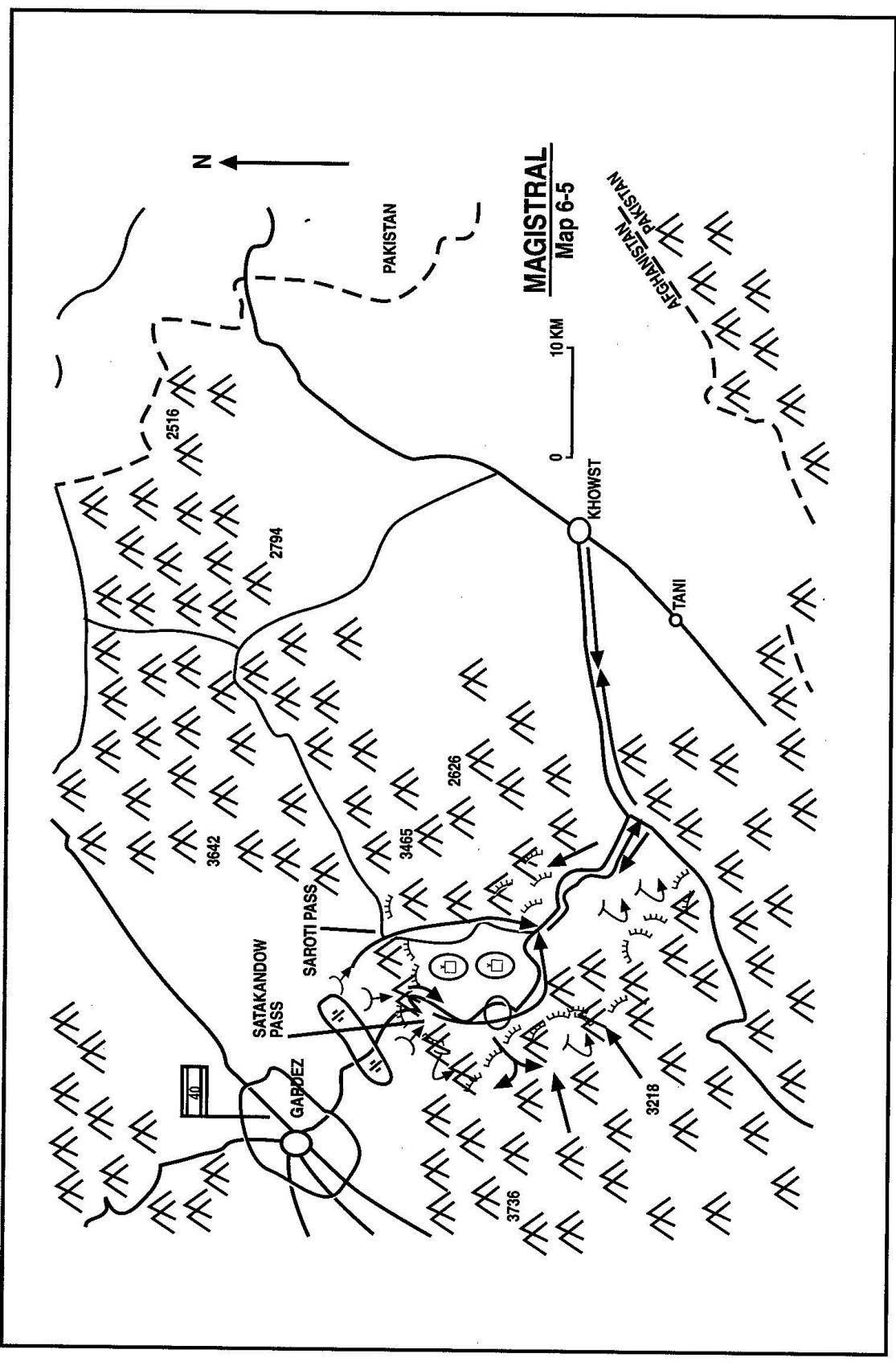
We started to prepare for the Soviet offensive against the Satakandow pass. The shoulders of the pass loom some 400 meters over the road and, once in the pass, the road follows a slow, twisted route packed with hairpin curves. It is an excellent place to defend. We reinforced the minefields along the road. We laid three mine belts on a three kilometer front at the opening of the pass with 300400 meters between mine belts. We reinforced our positions on the high ground overlooking the road and pass. We had a total of ten BM-12s in the area. We crowned the pass with ZGU-1 air defense machine guns. These are both good positional weapons but are very difficult to displace rapidly when the situation requires. We also had DShK machine guns, 75mm and 82mm recoilless rifles and plenty of RPG-7s. Haji Nawab Khan commanded the Satakandow pass approach. Two kilometers to the west of the Satakandow pass is the Khadai pass—a secondary pass with a dirt trail going through it. We reinforced the defenses here as well. Ismail commanded the Khadai pass approach (Map 6-5 Magistral).
Most of the Mujahideen in this area were local men who were defending their own villages. Unlike other parts of Afghanistan, the people still lived here and had not been driven out to the refugee camps in Pakistan. The majority of the people in the area belonged to the Zadran tribe, but other tribes and different factions were also involved. The decision to prepare and the decision to fight was not made by the factions, but by the tribal council. This was to be fight for homes and neighborhoods. Our local major commanders were Mawlawi Nezamuddin Haqani, Mula Ibrahim, Mula Abdurrahman, Captain Khan Zamak, Izat Khan, Ghaday, Dool Khan, Ghanamkay, Sadat, Hakem, Jung, Dr. Khiali, Badshah and Alef.
We focused our efforts on the main road where it runs through the Satakandow pass. There is another road some seven kilometers to the east which goes through the Saroti pass and joins the main highway at Lakatega{73}—some 25 kilometers to the south of the Satakandow pass. This is a poor road which passes through the Dari Khel tribe.{74} We did not expect that the Soviets would want to move vehicles along this road, so we did not mine it. However, we did reinforce the local Mujahideen in this area. Each tribe sent harbakai to help and we sent about 300 harbakai as reinforcements to the Saroti pass in the Dari Khel area. Commander Badshah commanded the Saroti approach.
The Soviets established forward bases at Dara and Zawa. They deployed their artillery in Division Artillery Groups (DAGs) near Dara and deployed their Army Artillery Group further back south of Gardez. They moved a maneuver force to Zawa. Suddenly, they launched an attack from Zawa toward Saroti. We were completely taken by surprise. In four to five days of fighting, the Soviets pushed us back on the Saroti approach. Commander Badshah was killed in this fighting. Qader Shah took over command and fought a stubborn withdrawal back through the Saroti pass (Map 6-6 Phase 1).
Once the Soviets captured the Saroti pass, they launched air assault landings on the high ground located between the main road and the road through the Saroti pass. They now held key terrain controlling both axes with air assault troops and small caliber artillery.{75} From these peaks, they could hit our positions and support their advance through the Satakandow pass on the main road. At the same time, they could support their continued advance along the Saroti approach. Their sudden seizure of the high ground between their two axes gave them a tremendous advantage. The Soviets began bombing the Mujahideen headquarters at Sarani. Command and control suffered greatly from the shelling.
The Soviets on the high ground began directing artillery and rocket fire on the villages in both valleys leading from Satakandow and Saroti. The Zadrans in the villages had not emigrated and the Soviets wanted to displace them. They were successful. Many Mujahideen, concerned about the danger to their families, left the fighting to evacuate their families to Pakistan. This exodus opened the way for the further advance of the Soviet troops. They were now ready for the main attack on the Satakandow axis.
The Soviets opened their operation against the Satakandow pass{76} with heavy air strikes and artillery fire while they moved their maneuver forces to Dara. Then, once their positions were set, they flew an airplane over the pass at high altitude, dropping paratroopers. Reconnaissance aircraft, flying at much higher altitudes, trailed the aircraft that was dropping the paratroopers. We engaged the paratroopers with all our air defense machine guns and whatever other air defense weapons we had. As the paratroopers drifted closer, we realized that we had been duped. The “paratroopers” were dummies and the reconnaissance aircraft had photographed our response and pinpointed our positions.
The Soviets now began firing on our positions in earnest. Heavy artillery strikes followed air strikes, which were followed by more artillery strikes. We were pinned down in our positions by the strikes which continued for hours. Our positions were generally artillery-proof but not bomb-proof and, thanks to their reconnaissance, they were hitting our positions exactly. They then launched their ground attack, but we readily defeated it. The next day, 1 December 1987, they resumed their heavy shelling and bombing.
The overwhelming force of their artillery and airpower took the initiative from us. There were no Soviet forces garrisoned in Paktia and we were used to fighting the DRA. The DRA had no artillery larger than 130mm. Now we were getting pounded by heavy artillery including BM21 and BM-27 MRL. In Dara, the Soviets had three, powerful, long-range heavy artillery pieces with four tires each. We saw one of these firing. The firing recoil gases alone flipped a jeep over.{77} Aircraft were dropping cluster bombs on us. We could not survive in these positions, so we left our positions and moved to higher mountains in the west called Ghumbor Khwaley and Fakhry. The Soviets advanced on our positions behind us and, after five days, they seized the Satakandow pass.
We had cut and destroyed sections of the road in the Satakandow pass. As the Soviets tried to repair the road, we started firing on them with our heavy weapons from the high ground. But the Soviet firepower was strong and the Soviets pushed us higher into the mountains. As their converging forces cut our rear, we fell back. They captured Gulzarak Zadran’s base at Shwak. The Mujahideen took what equipment they could, but some had to be abandoned to the enemy. The Mujahideen withdrew to the southwest mountains and the Soviets/DRA advanced and established a base camp where they stayed for two days. Then they resumed their advance to Sarani. They destroyed the Mujahideen base camp at Sarani—our first indication that the Soviets/DRA planned to abandon the route instead of trying to maintain a long-term presence there.
The Mujahideen plight was serious and we were suddenly faced with a new problem—the absence of drinking water. The intensity of Soviet shelling was so great, that the chemical residue from the explosions had contaminated the streams. Some of us thought that the Soviets had poisoned the water since one glass of water would choke you up and make you very ill. We had to use snow for drinking water, but the snow was also affected by the chemicals. Our supplies were cut off and food was scarce, but our major problem was thirst. People were suffering from dehydration, but they could not use the local water. We had not made arrangements to haul water into the area since local water had always been adequate for our needs. The roads were blocked so trucks could not enter the area. We had some mules that we could use in some of the area, but we carried in most of our supplies by Mujahideen porters.
The Soviets continued their move south. They preceded their movement by air assault landings to seize high ground on both sides of the road. Their columns would then advance under the protection of these picketing forces. As the Soviets moved forward, they left security OPs behind to secure their lines of communication. The Soviets reached Lakatega and the columns from Satakandow and Saroti linked up. After that, it was smoother for them. The Soviets/DRA left a security detachment at Lakatega and advanced on Khowst. At the same time, a DRA detachment from the 25th Infantry division moved. west out of Khowst to link up with the approaching column. After the force secured the road to Khowst, they began moving supply columns along the road to resupply the beleaguered city.
The tide was beginning to turn. The local Mujahideen, who had taken their families to Pakistan, returned. Mawlawi Jalaluddin Haqani and other commanders (Matiullah, Mula Abdul Ghafur, Gulzarak Zadran, Amanullah, Mula Seddiq, Tawakal, Abdur-rah-man, Wakil Wazir Mohammad, Pari, Padshah Khan and Sadat) arrived and moved into the mountains west of the highway. Colonel Imam of the Pakistani ISI arrived and tried to coordinate the Mujahideen action. Haji Amanullah Khan and other commanders arrived. Mujahideen from other areas in Afghanistan arrived. Mujahideen and Taliban arrived from Pakistan. They were all eager for a fight. The Mujahideen selected 12 commanders and assigned enemy outposts between Wazi and Satakandow for them to attack. The Soviets had moved into the side valleys, but the 12 commanders forced the Soviets out of the side valleys and confined them to the vicinity of the road. Then they began attacking the road. Jalaluddin Haqani, was at Fakhry. Once again, Jalaluddin Haqani was wounded during battle—this time with shrapnel in his thigh. Although Haqani was wounded, he stayed on for a week. Then he was evacuated on mule back over mountain paths to Miram Shah.
The Soviets/DRA could only keep the road open for 12 days. Then they withdrew. When the Soviet air assault abandoned the heights, they took their weapons, but left all the ammunition behind. The Mujahideen recaptured the road and neither the DRA nor the Soviets could reopen it.
Despite the intensity of battle, Mujahideen casualties were light. There were perhaps some 100 Mujahideen KIA. The villagers suffered greatly and the villages were heavily damaged or destroyed.
Some 80% of the villages in the area were damaged. Soviet/DRA losses are unknown. The Mujahideen shot down one helicopter and three jets. As the Soviets withdrew, we captured two intact Soviet tanks and four trucks. Some 600 DRA soldiers defected or were captured. Most of them defected with their weapons.
COMMENTARY: Gulzarak Zadran’s evaluation of the Soviets is not flattering. “I should mention here that the Russian Army is a worthless military institution and that no professional soldier will give them a high mark in discipline or the will to fight. They are useless. I should also note that the Russians relied throughout the action on maximum use of artillery and one Mujahideen would draw the fire of a battery or more for several minutes. The high peaks which they occupied by heliborne troops helped them a lot. Even there, they surrounded themselves with all sorts of mines. And these ‘bears’ would be sitting around lighted campfires to keep themselves warm in the winter, so the peaks were on fire all night. The Soviet Air Force was not very effective because they flew very high, probably out of fear of our Stingers.”
Despite General Zadran’s comments, the Soviet planning and execution of this operation was well done. It matches the initial Soviet invasion in tactical surprise, the use of multiple axis, operational tempo and innovation. The fire support and logistics portion of the plan were first rate and the use of dummy paratroopers was a masterstroke. The use of air-assault forces was well-planned and executed. The Soviets needed a “save-face” operation before withdrawal and Magistral was that.
VIGNETTE 6 — OPERATION GHASHEY (ARROW IN PUSHTO) by General Abdul Rahim Wardak{78}
From 23 October to 7 November 1988, a force of some 2,000 Mujahideen from the National Islamic Front of Afghanistan (NIFA) shut down the Kabul-Jalalabad highway along a 70-kilometer stretch between Sarobi and Laghman. I commanded them.
This action was part of a four-party (NIFA, HIK, HIH and JIA) combined operation aimed at closing the eastern supply route to the Afghan capital for a period of two months (October-November). Each party was responsible for deploying its units to keep the highway blocked for 15 days. The operation was planned in the wake of Soviet forces withdrawal from the Nangrahar Province. The Mujahideen intent was to prevent the government from reinforcing the Jalalabad garrison while the Mujahideen prepared to advance on Jalalabad from Torkham.
Elements of the DRA 8th and 18th border guard brigades, the DRA 60th Infantry Division, tank subunits from the 15th Tank Brigade, a Sarandoy battalion and local militia manned the enemy’s six bases and nearly 20 outposts along this stretch of road. The DRA hoped to protect the highway against Mujahideen attacks and keep the supply route to Jalalabad open (Map 6-7a Arrow 1). Each base was manned by at least a platoon reinforced by one or two tanks or APCs, 122mm D30 howitzers plus heavy machine guns and 82mm mortars. The outposts consisted of five to ten men reinforced with machine guns, AGS-17 and mortars.{79}
I assembled my force from Mujahideen groups based across several districts in Nangrahar and Kabul Provinces. Some of these groups were based more than 200 kilometers apart. Other groups and a contingent of 70 former Afghan Army officers, who were used to work with combat task forces, came from the NIFA central reserve based in Pakistan.
I organized my force into five strike groups (task forces Bravo, Charlie, Falcon, Gulf and Hurricane), two containment (holding) groups (task forces Alpha and Delta), one reserve (task force Echo) and one rocket launcher group (Saqar Rocket launcher). The force composition follows:
A. NIFA’s Kabul Province Eastern Sector Forces under the overall command of Dr. Shahrukh Gran
1) Task Force Alpha
AO: Marora and Salamkhel Tangay
Number of Mujahideen: 350.
Unit commanders: Sadiq Patang, Haji Sangeen, Mir Wali, Khawani, Mirajan, Wrekhmin, Haji Habib, and Mo’alem Karim.
2) Task Force Bravo
AO: Debili
Number of Mujahideen: 393
Unit commanders: Janat Gul, Haji Mir, Gulbat, Sakhi Usmankhel, Ghulam Rasoul
3) Task Force Charlie
AO: Kamkay Dargo
Number of Mujahideen: 276
Unit commanders: Mohammad Alam, Zaher Khan, Sahak, Sakhi Janikhel, Majnoon
4) Task Force Delta
AO: Ghata Dargo
Number of Mujahideen: 411
Unit commanders: Noor Hasan, Sayed Rahman, Captain Zalmay, Afridi, Gulab, Noor Rahman, Ruhullah.
5) Task Force Echo
AO: Dargo
Number of Mujahideen: 343
Unit commanders: Hasan Khan Kairokhel, Sartor, Asel Khan, Captain Hashmat, Khalil, Ehsan
6) Task Force SSM (Sugar)
AO: Chakari targeting Kabul Airport
Number of Mujahideen: 100
Unit commanders: Captain Sediqullah, Zaher Kahn, Shinwari, Hanan, Ghulam Haider, Umar, Hasan Khan, Momin Khan
B. NIFA Forces From Nangrahar Province, Southwestern Sector:
1) Task Force Falcon
AO: Tor Ghar opposite the Kaftarkhana base
Number of Mujahideen: 250
Unit commanders: Lt. Wali, Shari’ati, Mohammad Anwar
2) Task Force Gulf
AO: Tor Ghar opposite the Spina Thana base
Number of Mujahideen: 350
Unit commanders: Haji Zaman Ghamsharik, Zabit Zaher
Task Force Hurricane
3) AO: Tor Ghar opposite Khairokhel base
Number of Mujahideen: 130
Unit commanders: Asef Khan, Qazi Samiullah
While all these groups were assembling to the south of the Kabul River, I ordered a group of about 50 Mujahideen under command of Lieutenant Ali Ahmad and Ghuncha Gul to move from their bases in the north (Ozbin area) and take positions at the northern ridge along the Kabul-Jalalabad highway overlooking the Debili bridge. They were to observe enemy activity and support the operation by fire. This group occupied the designated position but was unable to participate effectively and withdrew after a few days.
While the number of Mujahideen in each group ranged between 100 and 350, I could use only one third of them for combat since the rest were required for logistics and security tasks and occasionally relieving combatants at the front lines.
My force was armed with individual automatic rifles (AK-47), light machine guns (RPK), heavy machine guns (PK), light anti-tank grenade launchers (RPG-7), Milan anti-tank missile launchers, 82mm recoilless rifles, 75mm recoilless rifles, 82mm mortars, 107mm Multiple Barrel (twelve barrel) rocket launchers (BM12), Saqar Rocket Launchers, and Stinger shoulder-fired air defense missiles.
I instructed my five strike groups to attack and seize enemy bases/outposts, establish road blocks and lay ambushes against the enemy columns.
The western containment (holding) group—Task Force Alpha—was positioned in Marora and Salamkhel Tangay area. I ordered them to block enemy columns attempting to enter its AO or attempting to outflank my forces along the old Sarobi-Jalalabad road. This road passes through Jegdalay, one of my main Mujahideen supply bases. I gave Task Force Alpha an “on order” mission to disrupt any enemy concentration in Sarobi by fire. I gave the eastern containment (holding) group—Task Force Delta—a similar mission on the eastern flank of the operation area, i.e. eastern mouth of the Abreshmin Gorge. I gave Task Force Delta an “on order” mission to be prepared to serve as a strike group. I had the Reserve group (Task Force Echo) concentrate in the Dargo area. They were prepared to act against enemy heliborne insertions; to relieve task forces Alpha, Bravo, Charlie, Delta; and to launch a counter-attack if needed.
I had the rocket launcher detachment operate independently. Their mission was to occupy firing positions in the Chakari area (about 80 kilometers away) and hit the Kabul airport to divert attention from the rest of the operation.
Conduct of the Operation
During the late part of September and first three weeks of October 1988, I directed the preparation, resupply and movement of participating Mujahideen forces as they moved to the area of operation and deployed for action. I moved a total of 400 tons of various supplies from Pakistan to the area of operation by mules and other pack animals. Supplies included mines, small arms ammunition, rockets, mortar rounds and anti-tank ammunition.
One major challenge facing me was to covertly move the various Mujahideen groups from widely dispersed locations to the deployment area, avoiding enemy observation and air attack. Further, moving ammunition, supplies and men from Pakistan through the three provinces of Paktia, Logar and Kabul required detailed planning and careful execution.
Mujahideen were all unpaid volunteers who joined the jihad to fight. One leadership challenge was to convince guerrillas to perform the vital, if unglamourous, missions of rear area security and LOC security instead of participating in actual combat. This was always hard since these volunteers wanted to fight.
Another leadership challenge was commanding and controlling a volunteer multi-regional force and integrating them into a single command. In fact, as later transpired, the right flank strike groups (task forces Falcon and Hurricane) left their positions and withdrew unannounced to their permanent bases when their permanent bases came under enemy threat. Further, as our operation continued over a week many Mujahideen became restless and gradually left the battle area unannounced. Mujahideen had developed the habit of what Ali Jalali terms “short hit and long run tactics.”
There were several reasons for this. First, the Mujahideen felt that they were fighting a war of “a thousand battles” and no single battle was a decisive one. Therefore, the Mujahideen felt that combat should be limited in terms of time and space in order to increase the Mujahideen’s survivability.
Another reason was the absence of an efficient logistic system to provide meals, medical support and other required services. The fighters were issued all available supplies prior to the battle. There was seldom resupply available afterwards. This forced the Mujahideen to carry heavy loads and forage for food. Local food resources were scarce since the Soviets had destroyed the local economy and driven out the population in the rural areas. Consequently, Mujahideen field rations had to be carried from Pakistan and were poor and monotonous (usually bread with tea or boiled rice and dhal (a split chick pea dish).
Mujahideen fought best on their home territory. This area of operation was not the “home turf’ for most of my forces. They were not fighting on their home territory but away from their villages where they were better provided for and had a better chance for rest. Given the traditional attachment of the Afghan resistance to its home territory, many Mujahideen did not feel the same enthusiasm they showed in fighting their own villages.
Finally, the long treks in the mountains sometimes lasted for weeks and contributed to fatigue before the battle began. Mujahideen commanders were hard pressed to keep their extremely hungry and tired fighters together for an extended period of time.
Although my operations plan encompassed a wide front from Sarobi to Surkhakan Bridge (70 kilometers), the main action took place on a four-kilometer stretch between Debili and Dargo bases (Map 6-7b Arrow 2). Combat at other points was either in support of this action (task forces Alpha, Delta and Echo), or were separate actions (such as attacks on Khairokhel Post, Spina Thana Base and Kaftarkhana Base).
The operation began with rocket attacks on the Kabul military airport on October 19. The rocket launcher detachment targeted the airfield and kept it under intermittent fire until a few days after the beginning of the road block when the rocket detachment moved to Jagdalay to fire on an enemy concentration in the Nghlu-Sarobi area.
My operations plan had four phases:
1. Attack to destroy and seize enemy bases and outposts:
2: Block the road by destroying bridges, laying mines and shelling enemy columns attempting to reopen the highway.
3: When the enemy manages to reopen the highway, conduct a large-scale ambush to inflict heavy losses.
4: Break contact and withdraw.
Phase One
The strike groups initiated their attack along the extended front at 1000 hours, October 23. Rocket launchers, mortars, recoilless rifles and heavy machine guns provided supporting fire from the southern high ground overlooking the highway. Since the area was heavily mined by the enemy, my Mujahideen could not descend on the road from all points. Instead, they moved down a limited number of mountain arroyos. These arroyos were safe since minefields could not be maintained in them due to the periodic flash floods which swept through them. These arroyos were mostly in the Debili and Dargo area.
Once my Mujahideen passed through the mined area, they fanned out and attacked the enemy using the paved road as the main approach. Their movement was covered by fire from the high ground dominating the gorge. The assault groups stormed the targeted enemy outposts and bases. After fierce fighting, several posts were overrun and others isolated from their bases and neighboring posts by 1600 hours.
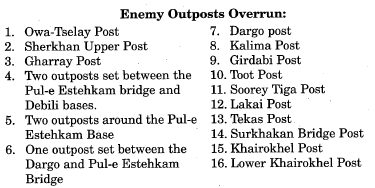
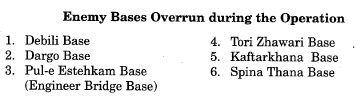
During subsequent attacks through October 25, my force seized 14 outposts and four bases. The occupants were killed, fled or captured. We seized about 100 prisoners, 11 tanks or APCs and 21 other vehicles. We damaged the hydroelectric installations at Sarobi and Nghlu which supply electricity to Kabul and Jalalabad. Our losses were 10 killed and 21 wounded.
Phase Two
As my strike groups secured the highway, they destroyed three highway bridges—Khairokhel bridge, Istehkam (Dargo) bridge and Debili bridge; mined the road; set up road blocks and established firing positions on the southern high ground overlooking the highway, the roadblocks and the destroyed bridges. Four other outposts and the remaining bases, except the Mash ála base, fell to us by October 31.
The DRA’s reaction was slow and incremental. The DRA now lacked sufficient observation and security posts on the high ground flanking the highway. The DRA failed to recapture any of his outposts except the Owa-Tsalay post. The Owa-Tsalay post was located on the highest peak overlooking Sarobi and provided observation of Mujahideen groupings and artillery positions. The Owa-Tsalay outpost changed hands several times, but we finally held it. The DRA held the Mash’ala Base throughout the operation.
Our attack gained control of this stretch of the highway. DRA reaction was very slow and ineffective. DRA forces in Sarobi fired lots of artillery against my attacking force while their aircraft bombed suspected Mujahideen positions on the rocky ridges south and southwest of the gorge. DRA and Soviet helicopter gunships were not very effective since they did not dare fly low through the gorge or fly close to our positions. The DRA made no attempt to outflank NIFA positions from Sarobi or from the eastern mouth of the gorge at Mash’ala base. They also made no attempt to use heliborne troops to cut our supply and withdrawal routes.
From October 25 through the end of the operation, the enemy concentrated its efforts on building up forces at the two entrances of the gorge and continuously tried to demolish our roadblocks and regain control of the gorge section of highway. The DRA launched frontal attacks using infantry supported by tanks moving from the Mash’ala base in the east and from Sarobi in the west. The DRA reinforced the beleaguered Mash’ala base with elements of the 11th DRA Division which had been operating in Alingar District of Laghman Province.
The DRA build-up from Laghman and Jalalabad was possible because Mujahideen groups from Nangrahar Province (task forces Hurricane, Gulf and Falcon) withdrew a week after overrunning their assigned objectives. The DRA had moved reinforcements and launched attacks in Nanagahar Province and the Mujahideen from that area left to defend their homes. Consequently the DRA was able to push more troops into the gorge from the east in an attempt to break through the main obstacles (between Dargo and Debili). From 25 through 31 October, the DRA launched several unsuccessful attempts to open the road and suffered losses in men and vehicles.
As the task forces Falcon, Gulf and Hurricane withdrew from their sectors, two mechanized columns of -DRA moved into the area from two directions. Elements of 8th DRA Division, reinforced with Soviet elements, moved east from Kabul to Sarobi and tried to open the highway. Another column moved west from Jalalabad trying to overrun Mujahideen blocking positions between Dargo and Debili. The pressure of the two-pronged attack on the widely scattered Mujahideen groups and the lack of supplies forced me to narrow my front and concentrate in the four-kilometer stretch between Dargo and Debili between the two highway bridges which his Mujahideen had destroyed earlier.
From 1 to 6 November, the enemy moved bridge-building vehicles supported by tanks and motorized infantry to lay bridges across the Kabul river at Debili and Dargo. We Mujahideen repeatedly disrupted and defeated these attempts by firing from the high ground south of the narrow gorge. We also took DRA columns under crossfire from well-prepared positions. During these attempts, the DRA lost several tanks, APCs and bridging equipment sets.
Phase Three
The third phase of the operation was the conduct a large-scale ambush before withdrawal. I ordered all Mujahideen task forces to observe complete radio silence and cease firing effective 2000 hours on 6 November. I further directed some Mujahideen to physically withdraw as part of the deception. The next morning, the entire front was quiet. The DRA moved freely along the highway and replaced the necessary bridges. At 1530 hours, the DRA started moving large mechanized columns across the Debili bridge toward Dargo, entering our “kill zone.” A large number of vehicles entered the kill zone as traffic surged into the gorge from both directions. The two-way lanes were full of vehicles and a traffic bottleneck ensued. The head of the column coming from the east reached the repaired bridge at Debili and the head of the column coming from the west reached the newly restored bridge at Dargo. The four-kilometer stretch between the two restored bridges was jammed with traffic when I gave the signal to open fire. My Mujahideen opened fire along the entire front, taking the DRA by surprise. Mujahideen firing began at 1600 hours and continued until 1900 hours in the evening. We inflicted heavy losses on the trapped columns. The DRA columns retreated into Sarobi.
Phase Four
My Mujahideen withdrew without DRA interference. They broke .contact during the night following the ambush and returned to their bases.
DRA/Soviet Losses
Total losses during the entire operation include:
—Forty-two tanks and APCs, six BMPs, nine artillery pieces, one BM-13 MRL, one bulldozer, two cranes, 65 soft-skin vehicles, two jet aircraft and one helicopter gunship destroyed or damaged. Most vehicle losses were inflicted during the Phase 3 ambush.
—Over 500 soldiers killed or wounded and 212 soldiers and 11 officers captured.
—Four pistols, 261 assault rifles, two flare guns, three light machine guns, four medium (PK) machine guns, three heavy 7.62 machine guns, three 12.7 DShK machine guns, seven ZGU-1 14.5mm heavy machine guns, two AGS-17 automatic grenade launchers, thirteen RPG-7 antitank grenade launchers, seven medium 82mm mortars,, and nineteen tactical radio sets captured.
Mujahideen Losses
18 killed and 53 wounded.
COMMENTARY: OPERATION ARROW was one of the few thoroughly-planned and fairly well-coordinated large-scale operations conducted by the Mujahideen. The command and staff and the Mujahideen combatants showed a high level of combat capability and resoluteness during the action. It was a complex, daring undertaking which achieved an ambitious goal. Considering the number of combatants, the time spent for preparation (two-three months according to General Wardak), the complexity of the planning, the amount of supplies needed to be moved to the battle area—mostly all the way from Pakistan across three provinces (Paktia, Logar, Nangrahar)—and the results achieved, it appears that OPERATION ARROW was an expensive and not very cost-effective venture.
OPERATION ARROW was driven more by political than military considerations. The Soviet Union was withdrawing from Afghanistan and, by this time, over half of the Soviet forces had already left. People expected the DRA to rapidly crumble once the Soviets were gone. The various political factions of the Mujahideen were jockeying for position in the post-communist government of Afghanistan. In order to maintain the interest and financial support of their Arab and Western backers, the Mujahideen had to demonstrate their ability to work together militarily—a cooperation that had been lacking (except, to some extent, in the fighting around Kandahar) throughout the war. This need for a show of military/political cooperation was. one of the key factors in planning and conducting such a large-scale operation in this guerrilla war. OPERATION ARROW was a success and boosted Mujahideen prestige and particularly promoted the lagging image of the National Islamic Front of Afghanistan (NIFA), which enjoyed the greatest military success during the operation.
Militarily, the resources could have been better used by substituting a series of smaller actions (conducted successively by groups of about 50-70 Mujahideen at a time) at different points along the highway. These actions would each last for a few days over an extended period of time. Such an option, although not very spectacular, would effectively block the highway for a longer period of time than during OPERATION ARROW. The DRA losses would not have been spectacular each time but should have ended with higher over-all losses. While NIFA could afford to launch an “Arrow”-sized operation once a year, it could conduct several similar actions of smaller size with the same or less cost in men, material, time and other resources.
The political requirement to employ the forces of four Mujahideen factions to close the Kabul-Jalalabad highway for two weeks each was an expensive option. It required four separate deployments of forces, four separate plans of operation, three relief operations as one faction took over the task from another and four withdrawals. This inevitably entailed tactical and logistic duplications, unnecessary transportation costs, and the tactical complications involved with relieving one group by another over a wide front. Dividing the area into four sectors, each the responsibility of one faction for a period of eight weeks, would have achieved the same goal with fewer complications, lower costs, better logistic support, and more focused action. However, the lack of a unified political and military leadership and factional differences among the Mujahideen prevented this option.
The combined command and staff of the Mujahideen force showed a high level of professionalism and operational vision in both planning and execution. The movement of a large force from widely dispersed bases to the area of operation and providing for its logistic support using very limited local resources is an extremely challenging task. The leadership of the force accomplished this with admirable effectiveness. The impact of the operation went far beyond the tactical and operational level, contributing to strategic and political destabilization of the Soviet-backed government in Kabul. The operation panicked the DRA government which committed unnecessarily-large forces into the area and accepted heavy casualties.
But the Mujahideen also paid a political price for the operation. The highway closure caused losses to civilian merchants who, at this time of the year, export pomegranates from Tagao and grapes from Kabul to Pakistan. The fresh fruit and vegetable trade is one of the major sources of income in Afghanistan. During the first week of November, representatives of fruit dealers appealed to the Mujahideen to open the highway, but to no avail. In a guerrilla war, support of the local population is too valuable to be risked by actions that hurt local economy.
Tactically, the DRA committed several errors. Inadequate DRA reconnaissance allowed the Mujahideen to deploy a several-thousand man force within a short distance of DRA positions without detection or interruption. Most of the Mujahideen movement took place at night and employed natural cover and concealment in the mountainous terrain. However, a more active DRA reconnaissance would have disclose the Mujahideen secret deployment and allowed countermeasures to interrupt the Mujahideen preparations for the operation. DRA failure to establish and man observation posts on the higher mountains also let the Mujahideen move into the area and prepare attack positions undetected.
The enemy forces in Sarobi were in a favorable tactical position to launch ‘a flanking attack against the main base of the Mujahideen toward Hisarak. Such a move, supported by air and artillery support, should have foiled the Mujahideen operation and cut off their withdrawal. Such a move, supplemented by heliborne landings behind the Mujahideen lines, could have created chaos and forced the Mujahideen to abort the operation. The DRA reaction, however was reactive and unimaginative. The road-bound DRA forces paid heavily for this leadership failure.
Falling into the final Mujahideen ambush was the worst and the most costly DRA mistake. After the Mujahideen guns fell silent, the DRA did not bother to ensure that the silence really meant that the Mujahideen had withdrawn and was not a “calm before the storm.” The DRA then allowed too much traffic to move down the unsecured highway. The DRA traffic jam occurred right in the Mujahideen kill zone.
The two following vignettes describe battles within OPERATION ARROW on the eastern approaches to the gorge.
VIGNETTE 6A — THE BATTLE FOR THE KHAIROKHEL POST by Asef Khan{80}
I brought my 130 Mujahideen from our permanent base in Surkhrud District, southwest of Jalalabad to join OPERATION ARROW. My group was designated Task Force Hurricane. My group deployed at night into its attack position located in the folds of the Tor Ghar Mountain. My attack position was about 3 kilometers directly south of my objective-the Khairokhel post (Map 6-8 Arrow 3).
Khairokhel post was located immediately west of the Khairokhel village. It was manned by a platoon-sized unit supported by two tanks and one APC. They also had mortars and machine guns including DShKs. There was another post connected with the Khairokhel defenses between the village and the Surkhakan Bridge Post to the east. The enemy would detach small teams during the day to patrol the main highway between Khairokhel and the Surkhakan bridge. The patrols would return to their base at night.
Task Force Gulf, commanded by Haji Zaman Ghamsharik, was deployed on the left flank of my group. Its mission was to attack the adjacent enemy base at Spina Thana. Further to the west, Task Force Falcon, commanded by Shari’ati and Lt. Wali, was to attack the Kaftarkhana Base. The right flank of my task force Hurricane was exposed and covered only by mountainous terrain.
I formed my task force into three groups: an assault group, a support group and a service detachment. There were 50 Mujahideen armed with assault rifles and 15 RPG-7 anti-tank grenade launchers in the assault group. The support group manned the heavy weapons including one BM-1, one 75mm gun, and three 82mm recoilless rifles.
At 2200 hours on the night of 22 October 1988, I took a few men down to the Khairokhel village on reconnaissance. I had dinner with the local elders and asked them to talk to the government post commander and convince him to abandon his positions rather than face attack. Following the meal, I completed my reconnaissance and returned to the attack position in the hills overlooking the village. It was so close to the enemy that an American female journalist who was accompanying my group said “If I were the government militia, you would not be able to survive a single night sitting so close to the government post within range of heavy weapons.”
The operational commander, General Rahim Wardak, radioed my adjacent commander, Haji Zaman, and told him that the attack time on the posts would be at 0800 hours, 23 October. When I returned from my reconnaissance, Haji Zaman relayed this information to me. I moved my raiding party into some ruins located one kilometer south of the Kabul-Jalalabad highway in preparation for the next.. mornings attack. I also set up an ambush near the highway to kill the patrol that left the Khairokhel post and moved toward the Surkhakan bridge every morning. My aim was to keep the area clear for my raid on the Khairokhel Post.
At 0700, a group of about 15 soldiers left the government post and started moving in the direction of Surkhakan bridge to set up security checkpoints. My Mujahideen let them clear the village and, as soon as they reached an open stretch of the road, opened fire from well-concealed positions near the road. My ambush killed six enemy soldiers and wounded a few others.
This action drew a heavy barrage from the enemy bases on either side of Khairokhel. Artillery and tanks were firing from the Spina Thana in the west and from Surkhakan Bridge Post on the east. At this point I radioed a coded message to Haji Zaman saying “get the dogs off my back.” He immediately responded with heavy fire against the enemy base at Spina Thana. Haji Zamari’s group was ready since it was 0800 hours, the time to start the attack.
Mujahideen fire on Spina Thana took the pressure off my Khairokhel sector. For several hours, Task Force Gulf exchanged fire with the Spina Thana base. Then, some direct hits on fuel drums set the fort ablaze. Task Force Gulf then attacked the enemy base.
As Task Force Gulf launched its attack against Spina Thana, I launched the main part of Task Force Hurricane against the enemy positions around the Khairokhel Post. I kept a security detachment east of the village to block enemy forces trying to enter the engagement area. The coordinated attacks of Task Forces Gulf and Hurricane overran the adjacent Spina Thana base and Khairokhel Post at about 1430 hours. My Mujahideen destroyed the tanks and APCs at the Khairokhel Post and, while part of my group established a perimeter defense around the captured post, the other part moved captured weapons and equipment to my mountain hideout. This continued all day.
During the attack, the enemy was moving communist officials of the Alingar District government to Jalalabad in a military convoy (at this time, due to the ongoing Soviet withdrawal, the communist regime was withdrawing its military and administrative units from those remote areas which could not be easily maintained or defended). This convoy deployed in the Mehtar-e Lam Baba hills north of the Kabul river and began to employ long-range artillery and rocket fire across a wide front stretching from Khairokhel to Kaftarkhana. Their artillery and BM-21 multiple rocket launchers were firing at a range of over 10 kilometers, so their fire was not very accurate or effective. However, later in the day, part of the column moved along the main road toward the battle area and tried to cross the Surkhakan bridgé. The enemy base at Kaftarkhana was still alive. However it was under attack by Shari’ati’s group and could not spare its fire against the Mujahideen in adjacent areas.
In order to contain the movement of the enemy column, I moved my assault group with all available RPG-7s to positions facing the Surkhakan bridge. I also destroyed the highway bridge at Khairokhel village with demolition charges that we had brought for this purpose all the way from our home base. The enemy tanks and APCs in his column came under flanking fire from my RPGs. The enemy could not hit my RPG gunners since they were protected by a steep turn in the road. The enemy could not flank my position since the off-road areas were heavily mined and the blown bridge prevented a frontal assault. This significantly boosted my Mujahideen’s morale and gave them a sense of improved security. For some reason, enemy air activity was weak despite the fact that the area was open and the fight was going on in broad daylight.
At dusk the enemy column pushed its infantry out front to clear the way for the vehicles, but it did not make any headway. Later, as we moved our spoils and POWs to their mountain positions in the south, I withdrew my security elements from the highway since the enemy was moving yet another motorized column into the area from Jalalabad. By the next day, Task Forces Falcon, Gulf and Hurricane had withdrawn their forces from along the highway. The enemy columns coming from Jalalabad and Laghman moved slowly down the road all the way to Mash’ala Base and reinforced it. The Mujahideen never overran this base and it played a pivotal role in maintaining enemy’s presence.
Following this, I limited our action to firing our heavy weapons at enemy targets on the highway. Shortly thereafter, I withdrew my Mujahideen from the operation since DRA forces had moved into my district and were threatening our homes.
COMMENTARY: The confident commander’s meal with the village elders certainly helped his reconnaissance, but clearly tipped off the defending DRA commander that the Mujahideen attack might come soon. On the other hand, the Mujahideen had been in the area for some time. Further, the guerrilla commander apparently assumed that all the local inhabitants were favorably disposed to the Mujahideen. His brash behavior succeeded this time, but could have compromised operational security. Apparently, the DRA commander took no action to increase his defenses and may not have even informed his superior.
Apparently, the Mujahideen lacked enough working radios so that each Task Force Commander could have one. General Wardak could not rapidly influence the course of the battle since communications were scarce. Further, General Wardak lacked radio communications with his eastern flank. This seems a serious problem in case the DRA decided to roll up his operation from that flank.
Once the Mujahideen withdrew to the hills, their long-range fires had little apparent effect. Their early departure, however, did create additional problems for General Wardak.
VIGNETTE 6B — THE BATTLE FOR SPINA THANA BASE based on interviews with. Haji Zaman Ghamsharik{81}
I commanded the 200-man Task Force Gulf (See Map 6-8 Arrow 3). As part of OPERATION ARROW, I launched my attack on the government base at Spina Thana in coordination with attacks on the Khairokhel Post to the east and Kaftarkhana Base to the west. Spina Thana was one of the main military bases providing security for columns moving along the Kabul-Jalalabad highway. It also patrolled against guerrilla incursions across the Kabul River into Laghman Province. A reinforced company supported by tanks, BMPs, APCs, heavy machine gun and guns garrisoned the base. They protected the base with mines and other obstacles. The entire area surrounding the base, except the paved highway running through the base was heavily mined.
Spina Thana would be a tough nut to crack. I could assign up to 150 Mujahideen to the assault group, but using such a large force for the attack carried some risks. I could incur heavy casualties since the group could not effectively deploy due to the mines. I considered a night attack, but this was equally difficult because of the mines, particularly since the enemy habitually mined the exits and entrances to the base at night. I decided on a day-light attack. I intended to move part of my force as close to the base as possible under heavy covering fire. I decided to put my attacking force on the highway outside the mined area and move on the highway in the attack. This was the only route guaranteed free of mines.
I constituted a Task Force support group which manned our BM-12 and BM-1 MRL, 82mm recoilless rifles, ZGU-1 and DShK heavy machine guns and mortars. I positioned it in the terrain folds of Tor Ghar dominating the enemy base on the low ground between the main highway and Kabul river.
I had to begin my planned fires earlier than intended when Task Force Hurricane came under heavy fire from the Spina Thana Base. The enemy responded resolutely to my fires. The fire exchange went on unabated until my Mujahideen gunners set part of the base on fire with some direct hits. This was the turning point in the battle. As panic spread throughout the defenders, I led a 60-man assault group through a ravine to the west of the base. We got on the highway and attacked east. I instructed my men to stay on the pavement. Two of my Mujahideen who strayed had their legs blown off by mines. We moved quickly to the base entrance. The defenders had little time to mount an organized defense, particularly since some of the defenders had fled from their positions in panic and were rushing to the river to escape the fire. We met little resistance in storming the base. We captured scores of defenders including the base commander, Rahmatullah Spelanay. We destroyed the tanks and APCs and whatever else could not be moved. We continued the attack to the east to help Task Force Hurricane which was locked in battle with the defenders of the Khairokhel Post. As we Mujahideen advanced from two directions, most of the Khairokhel defenders fled toward the river. We captured the rest. The actions for the rest of the day unfolded as detailed in the preceding vignette.
COMMENTARY: One estimate claims that the Soviets left over 13 million landmines behind in Afghanistan. The Soviets and DRA surrounded their outposts and bases with minefields. A major Mujahideen problem in capturing a position was getting through the minefield. Mujahideen minefield clearing methods included:
—probing the ground cautiously in a slow advance;
—driving a flock of sheep through the minefield;
—heaving boulders ahead of an advance to provide stepping stones for the advance;
—firing recoiless rifles into the minefield and creating a path via the recoiless rifle craters;
—limited use of some mine clearing systems provided by western and Arab backers.
CHAPTER COMMENTARY
Control of the highway net was essential to the Soviet/DRA effort, but in some regions, the Mujahideen were able to block the highway for weeks, months and even years. The best blocks were maintained by local Mujahideen who were able to look after their personal interests and yet maintain an effective blockade. The least effective road blocks were those done by mobile guerrillas who lacked the supplies and commitment required to keep the road closed.