

WILLIAM HOWARD RUSSELL, ON ASSIGNMENT for the Times of London to cover the American War Between the States, was up late drinking on the riverboat Southern Republic as it cruised with the current on its way down from Montgomery to Mobile. The evening was warm and felt a little lazy that May of 1861. People were talking a lot about fighting as the War of Secession gathered momentum, but, at that point, few were dying. Russell’s barroom companions—rich planters and parvenu businessmen—declaimed for hours, whiskey in hand, about Yankees and slaves and the Southern struggle for independence from the North until the air grew heavy with the burning tar of bad cigars, and electric with armchair bravery. “We will never be conquered,” one would say. “There is nothing on earth that could make us go back into the Union,” another proclaimed. “We will burn every bale of cotton, fire every house, and lay waste every field and homestead before we will yield to the Yankees!”
Captain Timothy Meaher, the boat’s owner, was drinking with the rest of them, and he focused his cunning gray eyes on Russell. Meaher figured the foreign journalist might not understand the way folks did things here in America, so close to the old frontier. White men had claimed this land, and white men had brought it civilization, and men like Meaher had made their fortunes here doing whatever needed doing to get ahead. Not so long ago, said the captain, there were a lot of Indians along the river. But the settlers had trapped them on a bluff high above and starved them into surrendering. They were so desperate that, when the white men told them they could leave on boats, the Indians believed them. And once they were on the river, the white men, well, they just shot the hell out of them, Meaher said. Slaughtered hundreds!
Russell was not much impressed. He knew Meaher’s type. The captain’s blood was Irish, and Russell, who was Irish too, figured it was County Kerry blood. He could tell from Meaher’s square jaw and full lips. The captain was rawboned and rough and looked as if he could handle himself in a brawl. He liked to tell tales, and tall ones, and he could be intimidating even when he was having a laugh—maybe especially when he was having a laugh.
The other guests harrumphed their approval and raised their glasses to Meaher’s story about pioneer bravado, but Russell knew that the coming fight with the Union Army would be like nothing these men had seen or imagined before. Over the previous decade Russell had made his reputation as a correspondent witnessing the carnage in the Crimea, where the British and the French had fought the Russians. His dispatch about the charge of the Light Brigade had captured the imagination of the world; his descriptions of the grotesque suffering of the sick and wounded soldiers had horrified it. Russell had covered the uprising in India that almost cost Britain the heart of its empire, and he had seen and reported the savagery on all sides. He had slept many times—too many times—on battlefields where “the air stinks of blood.”
What Russell thought about this war in America in May 1861 was that it would be long and savage in the way that only modern warfare could be. Killing would take place on an industrial scale. The South had seceded. The North had declared it would fight to preserve the Union. Tens of thousands of troops were being called up, and histrionic headlines shouted about battles won and lost. But there had been, as yet, nothing more than skirmishes. Even the shelling of Fort Sumter, which had officially started the shooting war a few weeks before, had ended with the surrender of the Federal garrison before anyone was killed. Such “battles” were making for a lot of bourbon-fueled bravado, but they wouldn’t decide the conflict.
Russell went out on deck. Beyond the dim glow of the cigars and the crackling flames of pinewood in iron baskets that lit the boat’s way down the river, the banks were steep and forested and unwelcoming. Broken branches and other flotsam crowded the muddy water. Torches lit the wharves where the boat would wheel around to take on logs for fuel and a few bales of cotton. At harvest time, later in the year, the decks would be stacked with that white gold. But now only a few wretched slaves watched from the flickering shadows as the boat hands scrambled ashore for the wood that fed the boiler’s maw. Sparks flew from the smokestacks. Fireflies, which the Alabamans called “lightning bugs,” floated across a landscape otherwise as dark beneath the new moon as the shores of the Styx.
Russell’s main worry as he made his way to his cabin that night was that he might be burned alive. The Southern Republic was an ostentatious thing, like a four-story hotel perched on a pontoon. The salon alone was a hundred feet long, thirty feet wide, and brightly painted, with staterooms around it like boxes in an opera house beneath a skylight of tinted glass. The boat also boasted offices, card rooms, and barrooms, and atop it all stood the calliope, its organ pipes fed by the engine’s steam, its keyboard in the hands of an exiled French musician who alternated between “Dixie” and “La Marseillaise” whenever the Southern Republic approached a landing. But for all its pretensions of grandeur, theSouthern Republic’s structure felt somehow perilous, improvised, and flimsy. The frame was made of resinous pine so raw that the turpentine oozed through the paint. The boat was a pile of kindling that, at the touch of a match, could sputter and flare into an inferno from which there would be no escape.
The wooden beams in Russell’s cabin creaked and groaned, while below him the engine throbbed, shaking the whole ship whenever the paddle wheels strained against the current. Russell slept barely at all, and the next morning, as he looked into his shaving mirror, he saw the heavy-jowled face of a forty-one-year-old man who had talked and smoked and drunk way too much the night before and then had slept through breakfast.
Once up on deck, Russell found Captain Meaher in the company of a wealthy planter, and the conversation turned, as it so often did, to slaves. Russell was curious about the different classes of Negroes he saw on the boat. The stewards and maids looked well dressed and well mannered, but some of the hands had a wilder air about them. Could they be from Africa?
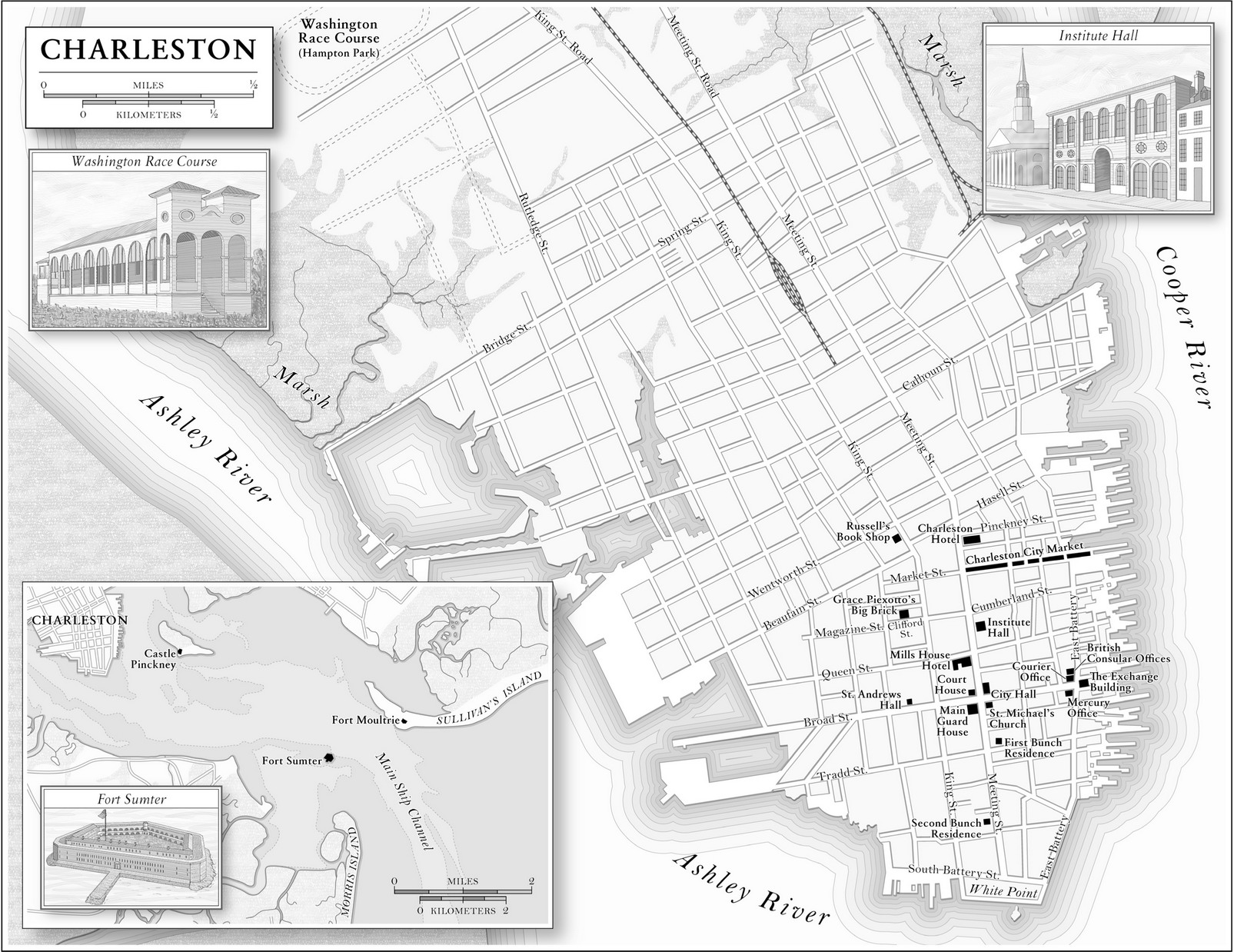
Russell knew that, for his British readers and their leaders, this could be—or should be—a critical question. Her Majesty’s government could not tolerate the slave trade across the Atlantic. And Russell, as it happened, had just spent several days with Her Majesty’s Consul Robert Bunch in Charleston, South Carolina. Lively and indiscreet, indefatigable and thoroughly British, or so he seemed, Bunch had very well-defined views and copious intelligence on the slave-trade question. In fact, it was something of an obsession for him. The consul had been following the horrific commerce for years, and told stories in grim detail about slaves smuggled under the American flag to Cuba and about the Southern firebrands who’d started bringing Negroes by the hundreds to the coasts of the United States. Some of these were people Bunch knew personally and despised, and he had shared much of what he knew with the man from the Times. So, yes, Russell was more than a little curious about some of the young slaves he’d seen on the Southern Republic.
The planter said he would let Russell in on a little story about Captain Meaher, and Meaher, who was right there, didn’t seem to mind listening. Trafficking in slaves from Africa was, as everybody knew, a hanging offense according to Federal law, and it had been so for almost forty years. But times were changing, and as America pushed west—as the South pushed west—opening up new land, there was a hell of a lot of money to be made with slaves farming sugar and cotton. So a group of investors had commissioned a brig to sail from Alabama to the Congo to bring back good, strong human stock. The investors had agreed to pay a certain amount for the vessel and for each head of human cargo if the ship made it and, obviously, a lesser amount if she were seized by the Federal government or lost at sea. Eventually the brig reappeared off the coast of Mobile, and, whether by design or luck, no authorities were waiting to intercept her.
Now, as the planter on the Southern Republic continued telling Russell the tale, he made it seem that Captain Meaher had been a shrewd and lucky bystander to the event. At the time he was captain of a riverboat called the Czar, which docked alongside the slave brig that evening at dusk. The next morning the sailing vessel was gone, no one knew where, but the human cargo remained, and in the weeks and months that followed, the captain was suddenly rich in fine slaves—enough to let him buy a lot of land and to build the Southern Republic. The original investors lost their money, but what recourse did they have? None of them wanted to risk getting hanged for slaving, even if nobody could remember that happening to anyone they’d ever heard of. “Captain Meaher, as an act of grace, gave us a few old niggers but kept the rest for himself,” said the planter.
Meaher listened to the tale with a triumphant grin. The truth was well known in those parts: Meaher himself had commissioned the slaving expedition across the Atlantic from start to finish. He’d found the investors among his friends, and he’d had the brig constructed to carry human cargo. It was his to-hell-with-Washington, we’ll-do-what-we-damn-well-please project, and he simply wanted to have a little fun with Russell—maybe send a message to those damn British abolitionists.
“Well, now, you think those niggers I have aboard came from Africa? I’ll show you.” Meaher’s eye settled on a boy who looked to be about twelve years old. He was fat and nearly naked, his skin a deep black, his cheeks marked with parallel scars, his chest tattooed, and his white teeth filed to points. Everything about him said he was born and raised and given ritual scars in Africa.
“What’s your name?” the captain asked him.
“Bully,” said the boy.
“Where were you born?”
“Born in South Carolina, sir.”
“There, you see?” said the captain, sure that everyone around him understood the joke. “I’ve got a lot of these black South Carolina niggers aboard.”
“How did he get those marks on his face?” Russell asked.
“Oh, them? Well, it’s a way them nigger women has of marking their children to know them.”
“And on his chest?”
“Well, really, I do believe them’s marks against the smallpox.”
“Why are his teeth filed?”
“Ah, there now! You’d never have guessed it: Bully done that himself, for the greater ease of biting victuals.”
The Southerners exchanged knowing smiles. The captain and his planter friends finally admitted that they were obliged to bring a few Africans in now and then to make up for those slaves who escaped north to British Canada and to freedom. They understood that the Brits opposed slavery, but they still needed Southern cotton, and they thought London ought to appreciate what was required to keep producing it.
So there it was. These Southerners openly made a joke of their inhumanity and, as they saw it, of Great Britain’s long-standing commitment to eradicate the transatlantic slave trade. Russell wondered how the men could be so naïve. Had they ignored fifty years of history? Did they think the Crown could be treated like some venal shopkeeper, willing to accommodate any crime in order to turn a profit? This was just the sort of thing Consul Bunch had predicted Russell might find. The journalist recorded the conversation in his dispatch with very little embellishment. He would let the smug slavers on the Southern Republic hang themselves.