
GERMAN HOLLOW-CHARGE AMMUNITION FOR 75-MM TANK GUN
From Tactical and Technical Trends, No. 19, February 25th, 1943
A sketch showing the details of the hollow-charge round for the German 7.5-cm KwK (75-mm tank gun) accompanies this report. The German nomenclature for this ammunition is 7.5-cm Pz. Gr. Patr. 38 KwK.
The round is of the fixed type. The cartridge case and the weight and type of propellant are similar to those for the other types of 75-mm antitank gun ammunition. The shell is fitted with a threaded hemispherical cap into which is screwed a small nose percussion fuze. From the nose fuze, a central tube runs down to a booster which is situated in the base of the shell. This booster consists of a detonator set in penthrite wax, the whole being contained in a perforated container. The bursting charge consists of three blocks of Hexagen (Trimethylene Trinitramine) the front one of which is concave, as shown in the sketch. The blocks are contained in waxed paper and are cemented into the shell.
The operation of the Aufschlag Zunder or percussion fuze (A.Z. 38-type fuze) is simple. The striker is held off the detonator assembly by six centrifugal segments which are surrounded by an expanding spring ring. After the shell has left the gun, centrifugal force causes the clock spring and the safety blocks to open, thus freeing the striker. Upon impact, the striker is driven onto the detonator. The detonation passes down the central tube to initiate the booster. This in turn initiates the bursting charge.
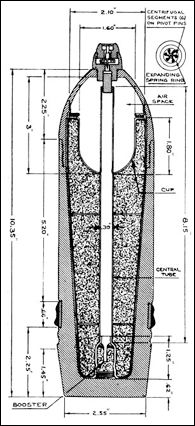
The shell is painted white and has black markings. The weight of the shell is 4.5 kilograms, and that of the bursting charge 450 grams.
Comments: This is another instance of the use of hollow-charge ammunition to increase the armor-shattering effect of a gun of comparatively low muzzle velocity. No data is available at this time concerning the performance of this type of projectile against armor at various ranges.

The Panzer IV was originally intended to be used only on a limited scale, so initially Krupp was its sole manufacturer. Prior to the Polish campaign, only 262 Panzer IVs were produced: 35 Ausf. A; 42 Ausf. B; 140 Ausf. C; and 45 Ausf. D. After the invasion of Poland, and with the decision to adopt the tank as the mainstay of Germany's armored divisions, production was extended to the Nibelungenwerke factory (managed by Steyr-Daimler-Puch) in the Austrian city of St. Valentin. Production increased as the Ausf. E was introduced, with 223 tanks delivered to the German army. By 1941, 462 Panzer IV Ausf. Fs had been assembled, and the up-gunned Ausf. F2 was entering production. The yearly production total had more than quadrupled since the start of the war.
As the later Panzer IV models emerged, a third factory, Vomag (located in the city of Plauen), began assembly. In 1941 an average of 39 tanks per month were built, and this rose to 83 in 1942, 252 in 1943, and 300 in 1944. However, in December 1943, Krupp's factory was diverted to manufacture the Sturmgeschütz IV, and in the spring of 1944 the Vomag factory began production of the Jagdpanzer IV, leaving the Nibelungenwerke as the only plant still assembling the Panzer IV. With the slow collapse of German industry under pressure from Allied air and ground offensives — in October 1944 the Nibelungenwerke factory was severely damaged during a bombing raid — by March and April 1945 production had fallen to pre-1942 levels, with only around 55 tanks per month coming off the assembly lines.
The Export of the Pz IV
The Panzer IV was the most exported German tank of the Second World War. In 1942 Germany delivered 11 tanks to Romania and 32 to Hungary, many of which were lost on the Eastern Front between the final months of 1942 and the beginning of 1943. Romania received approximately 120 Panzer IV tanks of different models throughout the entire war. To arm Bulgaria, Germany supplied 46 or 91 Panzer IVs, and offered Italy 12 tanks to form the nucleus of a new armored division. These were used to train Italian crews while Italian dictator Benito Mussolini was deposed, but were retaken by Germany during its occupation of Italy in mid-1943. The Spanish government petitioned for 100 Panzer IVs in March 1943, but only 20 were ever delivered, by December. Finland bought 30, but received only 15 Panzer IVs in 1944, and the same year a second batch of 62 or 72 were sent to Hungary (although 20 of these were diverted to replace German losses). In total some 297 Panzer IVs of all models were delivered to Germany's allies.
Combat history
The Panzer IV was the only German tank to remain in both production and combat throughout World War II, and measured over the entire war it comprised 30% of the Wehrmacht's total tank strength. Although in service by early 1939, in time for the occupation of Czechoslovakia, at the start of the war the majority of German armor was made up of obsolete Panzer Is and Panzer IIs.The Panzer I in particular had already proved inferior to Soviet tanks, such as the T-26, during the Spanish Civil War.
Western Front and North Africa (1939–1942)
When Germany invaded Poland on 1 September 1939, its armored corps was composed of 1,445 Panzer Is, 1,223 Panzer IIs, 98 Panzer IIIs and 211 Panzer IVs; the more modern vehicles amounted to less than 10% of Germany's armored strength. The 1st Panzer Division had a roughly equal balance of types, with 17 Panzer Is, 18 Panzer IIs, 28 Panzer IIIs, and 14 Panzer IVs per battalion. The remaining panzer divisions were heavy with obsolete models, equipped as they were with 34 Panzer Is, 33 Panzer IIs, 5 Panzer IIIs, and 6 Panzer IVs per battalion. Although the Polish army possessed less than 200 tanks capable of penetrating the German light tanks, Polish anti-tank guns proved more of a threat, reinforcing German faith in the value of the close-support Panzer IV.
Despite increasing production of the medium Panzer IIIs and IVs prior to the German invasion of France on 10 May 1940, the majority of German tanks were still light types. According to Heinz Guderian, the Wehrmacht invaded France with 523 Panzer Is, 955 Panzer IIs, 349 Panzer IIIs, 278 Panzer IVs, 106 Panzer 35(t)s and 228 Panzer 38(t)s. Through the use of tactical radios and superior tactics, the Germans were able to outmaneuver and defeat French and British armor. However, Panzer IVs armed with the KwK 37 L/24 75-millimetre (2.95 in) tank gun found it difficult to engage French tanks such as Somua S35 and Char B1. The Somua S35 had a maximum armor thickness of 55 mm (2.17 in), while the KwK 37 L/24 could only penetrate 43 mm (1.69 in) at a range of 700 m (2,296.59 ft). Likewise, the British Matilda Mk II was heavily armored, with at least 70 mm (2.76 in) of steel on the front and turret, and a minimum of 65 mm on the sides.
Although the Panzer IV was deployed to North Africa with the German Afrika Korps, until the longer gun variant began production, the tank was outperformed by the Panzer III with respect to armor penetration. Both the Panzer III and IV had difficulty in penetrating the British Matilda II's thick armor, while the Matilda's 40-mm QF 2 pounder gun could knock out either German tank; its major disadvantage was its low speed. By August 1942, Rommel had only received 27 Panzer IV Ausf. F2s, armed with the L/43 gun, which he deployed to spearhead his armored offensives. The longer gun could penetrate all American and British tanks in theater at ranges of up to 1,500 m (4,900 ft). Although more of these tanks arrived in North Africa between August and October 1942, their numbers were insignificant compared to the amount of matériel shipped to British forces.
The Panzer IV also took part in the invasion of Yugoslavia and the invasion of Greece in early 1941.
Eastern Front (1941–1945)

A PzKpfw IV Ausf. H of the 12th Panzer Division operating on the Eastern Front in the USSR, 1944.
With the launching of Operation Barbarossa on 22 June 1941, the unanticipated appearance of the KV-1 and T-34 tanks prompted an upgrade of the Panzer IV's 75 mm (2.95 in) gun to a longer, high-velocity 75 mm (2.95 in) gun suitable for antitank use. This meant that it could now penetrate the T-34 at ranges of up to 1,200 m (3,900 ft) at any angle. The 75 mm (2.95 in) KwK 40 L/43 gun on the Panzer IV could penetrate a T-34 at a variety of impact angles beyond 1,000 m (3,300 ft) range and up to 1,600 m (5,200 ft). Shipment of the first model to mount the new gun, the Ausf. F2, began in spring 1942, and by the summer offensive there were around 135 Panzer IVs with the L/43 tank gun available. At the time, these were the only German tanks that could defeat the Soviet T-34 or KV-1. They played a crucial role in the events that unfolded between June 1942 and March 1943, and the Panzer IV became the mainstay of the German panzer divisions. Although in service by late September 1942, the Tiger I was not yet numerous enough to make an impact and suffered from serious teething problems, while the Panther was not delivered to German units in the Soviet Union until May 1943. The extent of German reliance on the Panzer IV during this period is reflected by their losses; 502 were destroyed on the Eastern Front in 1942.
The Panzer IV continued to play an important role during operations in 1943, including at the Battle of Kursk. Newer types such as the Panther were still experiencing crippling reliability problems that restricted their combat efficiency, so much of the effort fell to the 841 Panzer IVs that took part in the battle. Throughout 1943, the German army lost 2,352 Panzer IVs on the Eastern Front; some divisions were reduced to 12–18 tanks by the end of the year. In 1944, a further 2,643 Panzer IVs were destroyed, and such losses were becoming increasingly difficult to replace. By the last year of the war, the Panzer IV was outclassed by the upgraded T-34-85, which had an 85 mm (3.35 in) gun, and other late-model Soviet tanks such as the 122 mm (4.80 in)-armed IS-2 heavy tank. Nevertheless, due to a shortage of replacement Panther tanks, the Panzer IV continued to form the core of Germany's armored divisions, including elite units such as the II SS Panzer Corps, through 1944.
In January 1945, 287 Panzer IVs were lost on the Eastern Front. It is estimated that combat against Soviet forces accounted for 6,153 Panzer IVs, or about 75% of all Panzer IV losses during the war.
Western Front (1944–1945)

British officers inspect a German Pzkw-IV knocked out in France in June 1944 by the Durham Light Infantry.
Panzer IVs comprised around half of the available German tank strength on the Western Front prior to the Allied invasion of Normandy on June 6, 1944. Most of the 11 panzer divisions that saw action in Normandy initially contained an armored regiment of one battalion of Panzer IVs and another of Panthers, for a total of around 160 tanks, although Waffen-SS panzer divisions were generally larger and better-equipped than their Heer counterparts. Regular upgrades to the Panzer IV had helped to maintain its reputation as a formidable opponent. Despite overwhelming Allied air superiority, the Norman bocage countryside in the US sector heavily favored defense, and German tanks and anti-tank guns inflicted horrendous casualties on Allied armor during the Normandy campaign. On the offensive, however, the Panzer IVs, Panthers and other armored vehicles proved equally vulnerable in the bocage, and counter-attacks rapidly stalled in the face of infantry-held anti-tank weapons, tank destroyers and anti-tank guns, as well as the ubiquitous fighter bomber aircraft. That the terrain was highly unsuitable for tanks was illustrated by the constant damage suffered to the side-skirts of the Ausf. H's; essential for defence against shaped charge anti-tank weapons such as the British PIAT, all German armored units were "exasperated" by the way these were torn off during movement through the dense orchards and hedgerows.

Pzkw-IV in Belgrade Military Museum, Serbia.
The Allies had also been developing lethality improvement programs of their own; the widely-used American-designed M4 Sherman medium tank, while mechanically reliable, suffered from thin armor and an inadequate gun. Against earlier-model Panzer IVs, it could hold its own, but with its 75 mm M3 gun, struggled against the late-model Panzer IV (and was unable to penetrate the frontal armor of Panther and Tiger tanks at virtually any range). The late-model Panzer IV's 80 mm (3.15 in) frontal hull armor could easily withstand hits from the 75 mm (2.95 in) weapon on the Sherman at normal combat ranges, though the turret remained vulnerable.
The British up-gunned the Sherman with their highly effective QF 17 pounder anti-tank gun, resulting in the Firefly; although this was the only Allied tank capable of dealing with all current German tanks at normal combat ranges, few (about 300) were available in time for the Normandy invasion. The other British tank with the 17 pdr gun could not participate in the landings and had to wait for port facilities. It was not until July 1944 that American Shermans, fitted with the 76-mm (3-inch) M1 tank gun, began to achieve a parity in firepower with the Panzer IV.
However, despite the general superiority of its armored vehicles, by August 29, 1944, as the last surviving German troops of Fifth Panzer Army and Seventh Army began retreating towards Germany, the twin cataclysms of the Falaise Pocket and the Seine crossing had cost the Wehrmacht dearly. Of the 2,300 tanks and assault guns it had committed to Normandy (including around 750 Panzer IVs), over 2,200 had been lost. Field Marshal Walter Model reported to Hitler that his panzer divisions had remaining, on average, five or six tanks each.
During the winter of 1944–45, the Panzer IV was one of the most widely used tanks in the Ardennes offensive, where further heavy losses—as often due to fuel shortages as to enemy action—impaired major German armored operations in the West thereafter. The Panzer IVs that took part were survivors of the battles in France between June and September 1944, with around 260 additional Panzer IV Ausf. Js issued as reinforcements.
Other users
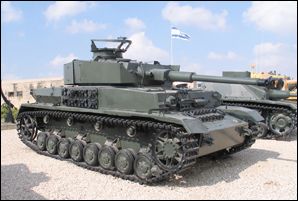
A Syrian Panzer IV Ausf. G, captured during the Six-Day War, on display in the Yad La-Shiryon Museum, Israel.
In the 1960s Syria received a number of Panzer IVs from the French, replacing the turret's machine gun with a Soviet-made 12.7-millimetre (0.50 in) machine gun. These were used to shell Israeli settlements below the Golan Heights, and were fired upon during the 1965 "Water War" by Israeli Centurion tanks. Syria received 17 more Panzer IVs from Spain, which saw combat during the Six-Day War in 1967.
The Finns bought 15 new Panzer IV Ausf J in 1944, for 5,000,000 Finnish markkas each (about twice the production price). The tanks arrived too late to see action against the Soviets, but were instead used against the Germans in the Lapland War. After the war, they served as training tanks, and one portrayed a Soviet KV-1 tank in the movie The Unknown Soldier in 1955.
After 1945, Bulgaria incorporated its surviving Panzer IVs in defensive bunkers as gunpoints on the border with Turkey, along with T-34 turrets. This defensive line known as the "Krali Marko Line", remained in use until the fall of communism in 1989.
Most of the tanks Romania had received were lost in 1944 and 1945 in combat. These tanks, designated T4 in the army inventory, were used by the 2nd Armoured Regiment. On 9 May 1945 only two Panzer IV were left. Romania received another 50 Panzer IV tanks from the Red Army after the end of the war. These tanks were of different models and were in very poor shape. Many of them were missing parts and the side skirts. The T4 tanks remained in service until 1950, when the Army decided to use only Soviet equipment. By 1954, all German tanks were scrapped.
Variants

A Jagdpanzer IV/48 tank destroyer, based on the Panzer IV chassis, mounting the 75 mm PaK L/48 anti-tank gun.
In keeping with the wartime German design philosophy of mounting an existing anti-tank gun on a convenient chassis to give mobility, several tank destroyers and infantry support guns were built around the Panzer IV hull. Both the Jagdpanzer IV, initially armed with the 75-millimetre (2.95 in) L/48 tank gun, and the Krupp-manufactured Sturmgeschütz IV, which was the casemate of the Sturmgeschütz III mounted on the body of the Panzer IV, proved highly effective in defense. Cheaper and faster to construct than tanks, but with the disadvantage of a very limited gun traverse, around 1,980 Jagdpanzer IV's and 1,140 Sturmgeschütz IVs were produced. The Jagdpanzer IV eventually received the same 75 millimeter L/70 gun that was mounted on the Panther.
Another variant of the Panzer IV was the Panzerbefehlswagen IV (Pz.Bef.Wg. IV) command tank. This conversion entailed the installation of additional radio sets, mounting racks, transformers, junction boxes, wiring, antennas and an auxiliary electrical generator. To make room for the new equipment, ammunition stowage was reduced from 87 to 72 rounds. The vehicle could coordinate with nearby armor, infantry or even aircraft. Seventeen Panzerbefehlswagen were converted from Ausf. J chassis, while another 88 were based on refurbished chassis.

A Sturmpanzer IV Brummbär infantry-support gun (Casemate MG variant (flexible mount)).
The Panzerbeobachtungswagen IV (Pz.Beob.Wg. IV) was an artillery observation vehicle built on the Panzer IV chassis. This, too, received new radio equipment and an electrical generator, installed in the left rear corner of the fighting compartment. Panzerbeobachtungswagens worked in cooperation with Wespe and Hummel self-propelled artillery batteries.
Also based on the Panzer IV chassis was the Sturmpanzer IV Brummbär 150-millimetre (5.91 in) infantry-support self-propelled gun. These vehicles were primarily issued to four Sturmpanzer units (Numbers 216, 217, 218 and 219) and used during the battle of Kursk and in Italy in 1943. Two separate versions of the Sturmpanzer IV existed, one without a machine gun in the mantlet and one with a machine gun mounted on the mantlet of the casemate. Furthermore, a 105-millimetre (4.13 in) artillery gun was mounted in an experimental turret on a Panzer IV chassis. This variant was called the Heuschrecke, or Grasshopper. Another 105 mm artillery/anti-tank prototype was the 10.5 cm K (gp.Sfl.) nicknamed Dicker Max.

The Wirbelwind armored anti-aircraft vehicle.
Four different self-propelled anti-aircraft vehicles were built on the Panzer IV hull. The Flakpanzer IV Möbelwagen was armed with a 37-millimetre (1.46 in) anti-aircraft cannon; 240 were built between 1944 and 1945. In late 1944 a new Flakpanzer, the Wirbelwind, was designed, with enough armor to protect the gun's crew and a rotating turret, armed with the 20mm quadmount Flakvierling anti-aircraft cannon system; at least 100 were manufactured. Sixty-five similar vehicles were built, named the Ostwind, but with a single 37-millimetre (1.46 in) anti-aircraft cannon instead. This vehicle was designed to replace the Wirbelwind. The final model was the Flakpanzer IV Kugelblitz, of which only five were built. This vehicle featured a covered turret armed with twin 30-millimetre (1.18 in) anti-aircraft cannons.
Although not a direct modification of the Panzer IV, some of its components, in conjunction with parts from the Panzer III, were utilized to make one of the most widely-used self-propelled artillery chassis of the war—the Geschützwagen III/IV. This chassis was the basis of the Hummel artillery piece, of which 666 were built, and also the 88 millimetres (3.46 in) gun armed Nashorn tank destroyer, with 473 manufactured. To resupply self-propelled howitzers in the field, 150 ammunition carriers were manufactured on the Geschützwagen III/IV chassis.