
Chapter 5
Boris Vasil’evich Nazarov
I was born in Moscow in 1923 in the neighbourhood of Patriarshie Prudy [Patriarch’s Ponds – a long-time cultural and aristocratic centre of the city]. My father worked in a factory, while my Mama was a full-time mother and housewife. In 1940 I completed my tenth year of schooling and enrolled in the V.V. Kuibyshev Institute of Engineering and Construction.
In the summer of 1941, the entire second-year class of the Institute volunteered for the Moscow militia. They assembled us at the military enlistment centre on Butyrskaia Street, created a roster, and transported us to a summer military encampment in the Moscow suburbs. There we were issued a combat blouse, a side cap and a belt – our own boots and trousers made up the rest of the uniform. In this camp we practised close-order drills, and they demonstrated to us how to use a bayonet in hand-to-hand combat. There was one rifle with a bayonet, and in turn each of us stuck it into a dummy. They told us how we ought to fire, but over the entire time of our training, we never once had any target practice.
At the end of summer we were sent as a march company to the front as replacements for a rifle regiment. In the Smolensk region we spent the night at the Semenovsky State Farm. There, we had a meal and they issued us our rifles and cartridges. One ‘old man’, having glanced into my rifle barrel, concluded that I’d never hit a German from it. Speaking honestly, I didn’t attach any particular significance to these words. I was still thinking that the war would end soon and I was in hurry to see what it was all about.
On the next day, regular officers appeared and split our company into platoons. I wound up in one of them together with two other students. In fact, in the future we all stayed together. Soon we marched to the front in a column and we joined some unit. Where we were or what unit we joined – I don’t know. The position we were occupying was not at all a good one. There was a forest out in front of us. We should have been positioned on its opposite, western side, but we were dug-in on its eastern side.
On the second or third day there, several German planes flew past overhead. Soon, a dust cloud appeared above the road that ran not far from our position. Someone said it was German reconnaissance. When their vehicles moved within range, we fired some shots and they drove away. I didn’t see any of our commanders again.
Soon, Germans deployed mortars beyond the woods and they began to pound our trenches. First they concentrated fire on our left flank, and then on our right flank. Once everyone had shifted into the centre of our position to avoid the fire, they began raining down shells there. I was wounded in the arm by a mortar fragment and received a slight concussion. The blood was spurting but I had nothing with which to stop it – I had no tourniquet or bandage. My buddies picked me up and evacuated me from the battlefield. They carried me to some village, scrounged a piece of cord, applied a tourniquet, and then we set out again. We reached a road. It was jammed with vehicles and people. Where they were going wasn’t clear.
With difficulty, my buddies stopped a vehicle and placed me aboard it, and it delivered me to a hospital. I was bedridden there until autumn – I received meals and good care, so I don’t have anything else to say about it. My arm healed, but it took quite some time before it was fully functional. Since I was an ambulatory patient, I had to help the medical personnel take care of the more seriously wounded.
I was discharged from the hospital at the end of December 1941 and sent to a military registration and enlistment office. I tried to secure work in a factory in order to receive an exemption from active duty – the romance of war had passed and I no longer wanted to fight at all. However, my effort to avoid returning to the front failed. In February 1942 I was drafted into the RKKA [Workers’ and Peasants’ Red Army] and sent to the Rostov Artillery School, which trained platoon commanders for the anti-tank artillery units.
On the outskirts of Niazepetrovsk, to where the school had been evacuated, we rebuilt the factory housing that dated back to Peter the Great, adapting them to serve as army barracks. Over the summer we succeeded in furnishing them, equipping them with three-storey bunk beds and stoves for heating. However, we didn’t have time to build a kitchen, a latrine or most importantly, a Russian sauna, so in the winter of 1942–1943 we badly suffered from the cold. Moreover, we were wearing shabby summer uniforms: riding breeches, a combat blouse, a uniform jacket, puttees and ankle boots. Only our caps were winter-wear. It was cold and we became lice-ridden. The 5-kilometre march every evening into the woods, from which each cadet was supposed to bring back a log for heating the barracks and instructors’ residences, was particularly exhausting.
By January the cadets had begun to bloat from hunger, and one day every battery refused to leave the barracks, demanding to be sent immediately to the front. The officers attempted to force us out, but we resisted. The commander of the Urals District came to the school together with Colonel Lampel’, about whom it was said that during the Spanish Civil War he had commanded the defence of Madrid. They persuaded us to fall into formation out on the drill ground. Colonel Lampel’ grabbed a handful of snow and handed it to the man on the right of the line, asking for it to be passed down the line from cadet to cadet, but the snow quickly melted away. That was the way, he said, that the cadets’ rations were reaching our tables. He finished his speech with the words, ‘I’ll set things right!’
In fact, by spring we warmed up, drills became more regular, and they began to feed us better. Colonel Lampel’ personally checked the amount of food going into the pots as the cooks prepared the meals. The school began to wake up each morning to the sounds of a bugle, which roused all the cadets at promptly 0600. The day began with physical exercises. We would rush out of the barracks in bare feet and underpants, do some chin-ups, and then wash up with icy water. Having dressed, we’d form up on the drill ground for roll call, after which we would march in formation to the mess hall for breakfast, where bread, porridge and tea – well, not tea, but tinted water – awaited us. In the mess hall each cadet had an assigned spot. One cadet would stand with his back to the table while another cadet would cut off a slice of bread and fill a bowl with porridge, after which he would ask the one with his back to the table, ‘Whose?’ That cadet would then in turn call out the name or nickname of a seated cadet, to whom this portion would then be passed. After everyone had their slice of bread and bowl of porridge, an order would follow and everyone would start eating. The meal would have to be finished in a set time. This process repeated itself at lunch and dinner.
After breakfast was the first task – 2 hours of close-order drills. Then we would have 2 hours in the classroom, where we studied the regulations, topical political matters, and many other things, closely following the syllabus. At the bugle signal ‘Grab a spoon, grab a container,’ we’d march to lunch singing. After lunch came field tactics. The instructor would be in his fur coat, while we’d be freezing in our uniform coats. Afterward, having returned to the warm classrooms, everyone without exception would doze off. The most interesting were the classes conducted by Colonel Lampel’. He would familiarize us with German tanks, their vulnerable locations and their combat tactics. I remembered his definition of ‘blitzkrieg’ as the combined operation of three types of troops: aviation, tanks and mechanized infantry. He said that it remained to knock-out the German tanks and the blitzkrieg would collapse. One must give him his due; he actually shared his combat experience, which subsequently came in handy for me personally; I cannot say the same about our study of the manual, which was of no use.
In addition to basic training and specialized artillery training, we were taught how to drive a vehicle and ride a horse. We were responsible for the school’s security, worked in detachments and served the instructors. In general, we were busy up to our necks with studies, tasks, training and duties.
I remember one night in May 1943, when the school was raised in response to an alarm. From our formation, they called out cadets who were born in 1922 and 1923. We were issued dry rations for three days, which we consumed while we were marching to the railroad station, and we travelled to the Chebarkul’skie camps. Literally within several days after our arrival, they again loaded us into heated freight cars, which were hooked up to a train carrying tanks that was headed toward the front. We travelled for a long time; somewhere in Perm we received a good meal while our freight cars were hooked up to a different train, on the platform cars of which stood canvas-covered SU-152 self-propelled guns. Here we were divided into crews.
I was made a gun loader, and all the dirty work was dumped onto me and the radio operator, although our self-propelled gun wasn’t equipped with a radio. What was the pecking order in the crew? The driver-mechanic was a god; the commander – another god; the gunner – a respected fellow; and the radio operator and I were the labourers. We had to refuel the vehicle with diesel, haul the shells, go for the meals, stand on sentry, and so forth and so on. We were always filthy and covered with oil. I don’t remember the last names of these guys; I recall that the driver-mechanic’s name was Grisha, the commander of the self-propelled gun was Ivanych, the gunner – Sasha (incidentally, he was a cadet just like me), and we simply called the radio operator radist [the Russian word for radio operator].
The platoon commander came by to see us one time. He told us that our armoured vehicles were secret, that when these self-propelled guns were brought to the Kremlin, Supreme Commander-in-Chief Stalin, having looked them over, said that this was the weapon with which we would win the war. The political worker, whom we called ‘the Pope’, came around occasionally, read us the newspaper and led some sort of discussion.
Once, we discovered two elderly women underneath the canvas covering our self-propelled gun. We made no effort to make them leave, and as a sign of gratitude they fed us some lard, of which they had two bags full. They successfully reached their destination, while we received a little something extra to our rations, and it seemed to us that we’d gained some more strength.
Our commander Ivanych had a gloomy personality and he never seemed to react to anything. Grisha ran the show. He even showed the radio operator and me how to open the breech, how to load the gun, etc. Since I alone couldn’t lift the 48-kilogram shell, two men had to load the gun.
After unloading, at night, we set out for the front lines. We drove all night and the following day. Despite the fact that the hatches were open, the heat inside the vehicle was unbelievable. Ivanych barred us from sticking our heads out of them, so we were sitting inside stripped almost naked. By evening we reached our jumping-off position and began to dig a revetment. Here at last the entire crew was working. Out in front of us we could hear the rumble of artillery fire. Occasionally, aircraft flew over us. That night there was a glow on the horizon in front of us.
When it became light, the sound of firing increased and in the distance, columns of black smoke rose into the sky – tanks were burning. From the hatch I could see a field, which began immediately beyond a shallow ravine that fronted our revetment. Beyond the field was a little village; a bit further on, some sort of tall buildings. The commander ordered us to move out the self-propelled gun and advance toward a knoll.
Suddenly Ivanych is shouting: ‘Load!’ We loaded the gun. The self-propelled gun rocked when the gunner fired. Again, ‘Load!’ Another shot, with scarcely time to open your mouth. With all the fumes, there was no way to breathe. The gunner began crying: ‘A hit! A hit!’ The vehicle commander stuck his head out: ‘We hit it!’ The rest of us started to move to take a look. He kicked us back down: ‘Load, fuck it!’
At that moment a German shell penetrated the armour right where the driver-mechanic was sitting. Grisha was killed and rags in the fighting compartment started to burn. Ivanych shouted, ‘We’re burning! Bail out, fellows! . . . We’ll explode any time!’
We dropped the shell that we were preparing to load and clambered out of a hatch. At first the radio operator and I dashed toward the ravine, but a Tiger was climbing out of it. We started running toward some bushes. The Tiger opened fire on our tanks, which were moving to our left. Our tanks returned fire. Everything was burning around us, ammunition was exploding, and men were leaping out of burning tanks like torches. It was sheer hell.
Bullets were whistling and armour-piercing rounds swept past us with a howl. From some unknown direction, an aircraft appeared and started to bomb – friendly or enemy, I didn’t know. I was trying to run, but my legs were wobbly and the ground was shaking. I fell down several times. I looked back – it wasn’t a battle, but a scene from hell! Both sides were in the process of exterminating each other. How I got out, I don’t know, but I remained alive and I wasn’t even wounded. When I reached the rear, I fell in with a field kitchen for anti-aircraft gunners. The battalion commander promised to add me to the roster, but soon I was summoned to regiment headquarters. A captain said, ‘Listen, dear fellow, a letter of inquiry has arrived regarding you. Get moving to the Officers’ Reserve.’
No matter how much I tried to convince them that I actually was Boris Nazarov, not an officer, and I had no reason to go there, they didn’t begin to listen to me. NKO Order No. 0528 was in effect and it was being carried out without exception. I reached the Officers’ Reserve with the letter I’d been given, making my way on foot or catching a ride on passing vehicles. The Officers’ Reserve was located in a large village, where there was a sugar factory, and where we ate molasses to our heart’s content. We had full freedom there, but this dream didn’t last long – a major arrived and handed me a certificate verifying my promotion to junior lieutenant. I and another five men received new uniforms and shoulder tabs, and soon an instruction followed to report to army headquarters as well, and from there I made my own way to the 163rd (subsequently the ‘Warsaw’) Guards Red Banner Orders of Nevsky and Kutuzov Destroyer Anti-tank Artillery Regiment.
I reached the 163rd Guards Destroyer Anti-tank Artillery Regiment just after it had been withdrawn with the remnants of its gun platoons, having lost many guns and crews in a battle with German tanks in the area of the cities of Vinnitsa and Kazakin. From regiment headquarters I was immediately directed to report to the forward commander of a gun platoon, the individual gun commanders of which were Senior Sergeant Popov and Sergeant Major Liubimov. At the moment I arrived at this platoon’s position, they had scrounged one divisional gun and a few shells, which had been abandoned by the infantry, plus one German light machine gun.
Thus equipped, they had set up an ambush on a road, down which German units were supposed to retreat. A short time later a column of trucks showed up which was being led by a tank. After Liubimov immobilized it and we shot up the column with the machine gun, the Germans turned back. They blew up their damaged tank and withdrew to a different back road, which bypassed our position. We pulled out of our position, gathered the soldiers who’d been wounded in the previous fighting from their hiding places, and brought them back to regiment headquarters, which was located in a village.
After these battles, the regiment’s remaining personnel were withdrawn to Zhitomir for reforming. A new commander was sent to us to take charge of the battery. Soldiers with experience from the battles of Stalingrad and Kursk began to arrive from hospitals, as well as young, totally green soldiers from conscription centres.
Training began for upcoming battles. Sergeant Major Liubimov told us a lot about the 163rd Anti-tank Artillery Regiment, in which he had been serving almost since the war’s start. Back then the Regiment had been equipped with horses and 45-mm anti-tank guns. In one of the battles, the 163rd Anti-tank Regiment had been completely destroyed. Its headquarters surrendered, but Liubimov came out of the encirclement with the regimental banner and the journal of combat operations.
I learned a lot from him. One day after we’d been withdrawn for refitting, he asked me, ‘Lieutenant, where have you fought?’ I answered him.
‘Well, then you don’t know a damn thing. Go, dig yourself a hole and take a seat in it; I’ll teach you.’
I dug a hole and sat down in it. He disappeared for a moment, and then a burst of submachine-gun fire struck around the hole where I was sitting.
He shouted, ‘Where am I? Stick your head up, I won’t fire.’
‘And how should I know?’ I replied.
‘Listen again.’
That’s how you teach someone who doesn’t yet know how to determine the source of incoming fire! Such knowledge is necessary, since very often the surviving battery members found themselves in the German rear and had to make their way out of encirclement. That’s how he trained me, and I had learned a lot by the time he was killed later in the war.
Soon we received ZIS-3 guns straight from the factory, and then American Studebaker trucks arrived. The gun crews were brought back up to full strength. A crew consisted of five men: the gun commander, a gun layer, a loader, and two ammunition bearers. All the crew members were mutually interchangeable. The strength of this crew was barely sufficient to hoist the gun trails and set them on the hitch of the Studebaker, and only then under the condition that the heaviest of the crew members dangled from the gun’s muzzle brake as a counterweight.
I also received a personal weapon. But whereas all the command staff had TT pistols, I received a Nagant revolver, which had become so rusty that the cylinder wouldn’t revolve, and no matter how hard I squeezed the trigger, the gun wouldn’t fire. However, soon I procured a German Walther P-38 and life became easier. The gun crews received PPSh submachine guns. We did have to resort to them once, but it is hard for me to talk about it. Near Kovel, one day we crawled out into no-man’s-land for some potatoes and bumped into a German combat outpost. The German foolishly tossed a grenade at us. Had he been smart, he would have kept down and not revealed himself. But apparently he wanted to fight, and wanted to kill us, but his grenade landed short. When he rose up to take a look, I gave him a burst. We crawled over to his position – he was lying there all bloody. I was totally shaken. I was all out of sorts . . . It was unpleasant . . .
Eventually I obtained an orderly, who would bring me meals from the kitchen and carry out various responsibilities. Lieutenant Colonel S.P. Arkhipov, who soon became a colonel, assumed command of the regiment. Only recently from documents did I learn that he was a Hero of the Soviet Union. He didn’t wear his Star at the front and we didn’t know that he was a Hero.
After the regiment was brought up to its authorized number of batteries, under its own power it joined the offensive in the direction of the city of Kovel’. On the road we were fired upon by submachine gunners from ambush positions. We quickly leaped out of the trucks, the sergeant major determined where the firing was coming from, and with several rounds we silenced it. In this place, several placards were hanging in the villages: ‘Death to the Gestapo and the NKVD’.
On the road we were hardly fed, and we could only get milk from the local population; they hid everything else. But such was the atmosphere of mutual suspicions that even when accepting milk, we forced the owners to drink it first – we feared poisoning. In one farmhouse, the owner of which together with his family had left with the Germans, we found two pigs in the barn. I shot one of them. While we travelled, we ate fresh pork; even the regiment commander sent one of his staff officers, who asked for a rear leg, but we gave him only half of one.
As gun platoon commander, my task was to select a position correctly and to deploy the guns properly. After all, our shells could only penetrate the armour of tanks at close range, and this meant the tank had a chance to overrun the gun. So a position had to be selected that would enable us to camouflage the guns easily, but would also make it difficult for the tanks to overrun the guns. I loved to deploy a gun between two large trees, which the tankers knew beforehand that their vehicle couldn’t knock down. In addition, I considered it my duty to fire the first shot and to destroy the first tank. If we succeeded in knocking out one or two tanks, then the rest would start to bypass our positions. Of course, they would spot us and begin to fire at us. Well, as soon as the first projectile passed over us, we would dive into holes, and wait to see if a shot hit the gun. However, they were now no longer advancing, fearing they’d lose another tank, and they’d begin to go around us. This gave us time to bandage the wounded and bury the dead. We lost men in every fight.
We created our firing positions in the following manner. We would dig our gun emplacements to a depth of around 50 centimetres and with a diameter of 5 metres. We threw the excavated dirt up around the perimeter in order to create a parapet. We would dig timber or small logs into the ground, butting them up against the gun’s trail spades. If we didn’t do this, the gun would roll backwards with the recoil, even if the trail spades were dug into the ground. We would then dig a magazine for the shells about 20 metres away from the gun and a trench leading to it from the emplacement. To the left and right of the gun, we dug foxholes. We set up a captured machine gun in the left foxhole, while a sentry and an observer sat in the right one. Usually they unloaded us into a firing position in the evening, and over the night we had time to dig and camouflage the position. Everyone worked, regardless of rank and insignia.
We took part in our first battle near Kovel’. The Germans were trying to free a grouping that we’d encircled in the area of the city, and we were deployed on an axis vulnerable to tanks. We moved into our firing position in the evening. My platoon was covering a road. In the place where we were positioned, the road made a sharp, 90° turn. Approximately 300 metres away from the road, there were two large trees on the edge of a patch of spindly woods. I set up the No. 1 gun of my platoon, with which I was located, between these two trees. The battery commander ordered that the No. 2 gun be deployed about 500 metres beyond the turn in the road. That night, a Guards mortar unit of Andriusha rocket launchers moved into that same place. On the other side of the road we could see shattered stone buildings, and a little bit behind them loomed a structure that looked like a factory workshop, from which periodically flares streaked into the sky and a machine gun fired. Behind our backs there was a ditch and a railroad embankment. The railroad had been demolished, and the rails and ties were standing practically vertically, looking like some sort of fence.
In the morning, after an enemy air attack, German tanks on our right started moving down the road in our direction, while from the front, from the direction of the factory, infantry went on the attack, taking cover behind buildings as they advanced. From long range, one of the tanks began to fire from the road in the direction of the rocket launchers and hit one of them, which exploded. As we found out later, one of the rockets, blown off its guide rail, struck the No. 2 gun of my platoon, destroying the gun and killing the entire crew. When the tanks drew even with our position, we set two of them ablaze, but a third tank opened fire at us. We had wounded. We leaped into our holes, where we sat until the firing stopped. The tanks didn’t come at us, but turned off the road into a field and moved on past us.
We spent the rest of the day sitting in our position. The fighting shifted to our left, and the road became empty. That evening, the fellows carried our wounded to the rear, and I remained in the position to cover their passage over the railroad embankment. The guys returned that night with a Studebaker from a different battery. Under artillery fire, with great difficulty we hooked up the gun. I had just grabbed a hold on the truck, preparing to hoist myself into it, when I took a splinter in the stomach from a nearby exploding shell. They quickly loaded me aboard the truck and took me to the medical-sanitation battalion.
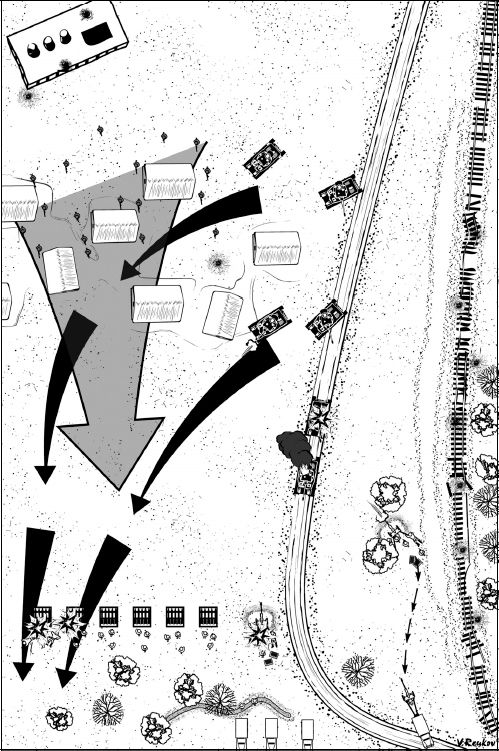
The battle of Boris Nazarov’s platoon against tanks near Kovel’.
A doctor came into the room, took a look at my wound, and told the nurses, ‘Carry him to the morgue.’ I was trying to speak, but my mouth was foaming and I couldn’t say anything though the pain was severe. After his words, I blacked out. I woke up in the morgue, when they had started to carry out the dead for burial.
One elderly nurse said, ‘Take a look, this one’s eyes are moving!’
The other replied, ‘What do you mean, moving?! Roll him!’
However, they carried me into the operating room; a doctor came in, examined me, and said, ‘Of all things, he hasn’t kicked the bucket!’ He operated on me.
I took rather a long time to recover, but before I was fully healed they sent me back to the regiment. I arrived all bandaged, and I had to go regularly to get my dressings changed. The regiment commander felt sorry for me, and when brigade headquarters sent a request for a combat officer to serve in the 47th Army’s headquarters as a signals officer, he sent me.
In the evenings, the headquarters would organize dances, but I didn’t attend them. Why? I’ll tell you. On the first day when I arrived at the headquarters, I found a mirror, took off my threadbare combat blouse, my trousers, my puttees and ankle boots, washed them and bathed myself, of course without soap. Then I laid all this out to dry. Once everything had dried, I re-dressed and I felt like a million bucks! I went to the headquarters, and as I neared it I could hear music playing. Some soldier was walking nearby. I asked him, ‘What’s going on there?’
‘They have dances there.’
I walked up, took a look, and saw that officers were dancing, and they were all such dandies. Their uniforms were spiffy, and their polished leather boots gleamed. Real prima donnas! I took another look and spotted a nice-looking female signaller. Alone. I thought, ‘Well, that one’s by herself; I’ll take a seat next to her.’ So I plopped down next to her, and then said, ‘Well, you even have dances here. How fine!’ I added something else and then suggested we get acquainted. She sat quietly, not saying a word. Well, then I shifted a little closer to her, put my arm around her, and said, ‘Come on, let’s get acquainted!’ She gently took my hand, laid it back on my knee, and said, ‘Listen, I have to stay on the line for commanders with multiple stars, while you’ve got just one little star and are groping me.’ That was all! I never went back there again, except for one time when I went to see an American film, but that was it.
It must be said that I didn’t feel any hatred or deep-seated envy for these well-groomed staff officers. I had an acute desire to be in their place – to sleep in a warm bed with clean sheets, and not in a lice-ridden, filthy trench; to be fed regularly and well; to be dressed so grandly. There’d also be a little less death all around. So when a month later an order arrived to return to the regiment and reassume my post as a gun-platoon commander, I felt bitter and upset. I’d become so tired of all the fighting, the filth, the blood and deaths! What kind of life is that?!
Bad news was waiting for me when I returned to the regiment. I learned that in one of the recent battles, Sergeant Major Liubimov had been killed.
In 1944 the situation in and around Warsaw was complicated. We were shifted to the area of the town of Legionowo. In one of the battles on a hill near Legionowo, I lost the gunner Mit’ka Dolinsky and the loader Tsai . . . Mit’ka was a Muscovite like me. We’d become friends. How he loved to fire the gun! He was quite the fellow. He was sitting in his hole. A rocket shell came out of nowhere and landed directly in his foxhole. When I glanced in that direction after the smoke and dust had cleared, I was struck numb by the sight of this bloody mass; somehow his ‘For Courage’ medal glittered on top of it. That was it – Mit’ka Dolinsky was gone. So I buried him in this hole.
One day they summoned me to regiment headquarters, and the commander reassigned me to a platoon of SU-76 self-propelled guns of a then forming Polish artillery regiment. When I reached it I found three other Red Army men: driver-mechanics whose assignment was to deliver several self-propelled guns to the regiment. Within a certain amount of time, they dressed us in Polish military caps and greatcoats made from British wool.
I recall that once I entered a Polish village. I was walking down the street, and suddenly a window opened, a Polish woman leaned out and said, ‘Mighty Polish soldier! Come in, come in, sir!’ I went inside. She was chattering something and offered me a seat, but I was feeling uncomfortable – my boots were tracking mud into her house, and under my greatcoat I was still wearing our Red Army combat blouse. Just then she spotted someone else walking past her window – a lieutenant. Again she leaned out and said, ‘Mighty Polish soldier, Lieutenant, sir!’ So a real Pole entered the house. He was speaking refined Polish exclusively. She also offered him a seat. They both turned to me and said something – I couldn’t catch a word of it. I thought that I needed to scram, so I quietly slipped out into the corridor. I look, and there’s his cap hanging there. It was a beauty, with an eagle and a lacquered visor. I left my own cap for him and took his. I also swapped greatcoats. I stepped outside and went on my way, making sure not to pass the window. When I arrived back at my unit, the fellows gasped, ‘Oh, Lieutenant, sir!’ Of course, what I did was wrong . . . In general, our relations with the Poles were only so-so.
Once I decided to go for a ride in one of the self-propelled guns. We entered a little city, which was still partially held by Germans. As we were moving down the street, out in front of us a German tank began to cross an intersection. From short range we set it ablaze. We stopped in front of some house. Grishka, the driver-mechanic, said, ‘I’ll go in and check out the cellar. I’ll look for some juice.’ The locals canned juice, and for us it was a novelty.
‘Well, go and look,’ I said.
‘Let’s go together, you can cover me.’
So we climbed down from the self-propelled gun and entered the house. I sensed that someone was in it. We went down into the cellar and didn’t find any juice, but realized someone alive was down there. We thought it was Germans. Grishka shouted, ‘Halt!’ – and from behind a wall stepped a Polish or German woman – damned if we knew – and two small kids. She took a seat behind a table in front of a basement window and looked at us with fright: ‘Kaput, kaput!’
I took a seat opposite her and said, ‘Now the war is ending; I’ll go home to Moscow and I’ll get married.’ She kept looking at me and looking out the window, where this German tank was smoking. Grishka asked her why she was looking out the window, and added that we were the ones who had just knocked it out.
The woman replied:
It’s only because an Oberleutnant was just sitting here in your spot, and he also said that the war was ending, he was going back to Berlin, and he’d get married . .. Now there you are, from Moscow, sitting where he was, and you’re talking about the same thing. I’m curious; is he alive or was he killed?
Grishka said, ‘That can be checked.’
The woman went out with Grishka and they examined the tank, but there was nobody there, dead or living – the crew had run off. They came back pleased. We continued to sit for a bit longer, and then we headed back to our unit. The gunner with the crew of this self-propelled gun was a guy whose last name was Guiman. Soon after we returned, there was a call from headquarters: ‘Guiman’s father has arrived for him. He’s a big-shot doctor and he’s come to get his son.’
At the time, we were sitting together with him and eating porridge from a mess tin. I told him, ‘Listen, your father’s come for you. Report to headquarters.’
‘I’m not going,’ he replied, ‘I’m afraid.’
‘What are you afraid of? I’ll give you an escort.’
‘I’m afraid. I’ll never reach headquarters.’
Indeed, he didn’t go.
Night fell. In the middle of the night, a soldier shook me awake: ‘Lieutenant, Guiman has been killed.’ He had been sitting next to the self-propelled gun. A shell came in and exploded directly at his feet, taking his head off. Why hadn’t he left for headquarters in the evening? Perhaps he would have reached it . . .
I remember when we were shifted to a new axis; you look at the guys and all their faces were grey. They didn’t look normal somehow. I recall another case. When I came out of one battle, I dropped by a house. Mirrors were hanging on the walls. I went in, and in a mirror I saw an unfamiliar man and reached for my Walther. He did the same . . . only then did I recognize myself in the reflection, and I was just about to fire. Can you imagine that a man can be reduced to such a state?
The rear-echelon soldiers were involved in the looting and rapes. I never saw such behaviour among my guys. Those at the front, as a rule, didn’t mistreat the local population, and the civilians in turn related to us not badly. What if suddenly it happens that you’re wounded and surrounded? Who other than the local civilians will hide you? That’s what compelled all of us, who were at the front, not to engage in looting or violence against the civilian population. Of course, we searched for hidden provisions, dug them up and, of course, devoured whatever we found. There’s no way you can get by without this.
Things didn’t go well with the formation of the new Polish regiment; replacements didn’t arrive and there weren’t enough self-propelled guns. So having gotten a bit of rest in the rear, I returned to my gun platoon.
In the winter, we were holding defensive positions, having settled into the homes and cellars abandoned by the local residents. I remember a cold, east wind was always blowing, and it snowed quite a bit. Silence had fallen over the front lines, with only rare shellfire from the enemy’s side. My gun platoon received replacements: gun commander Zakharov, gunner Ermolenko, gunner Varlashkin, and gun commanders Kholetsky and Masiuk.
Two of the guns were replaced, one of which due to deterioration of the gun barrel, the other because of a direct shell hit. Over the entire time of my service in the three gun platoons, more than a dozen guns had to be written off, but not one of them was overrun by a tank or abandoned.
After the New Year 1945, the regiment formed into a column, past which the new command wearing camouflage smocks drove in review: the regiment commander, Lieutenant Colonel Bondarenko; the commissar Tsariuk; and the chief of staff Kholodenko. Soon thereafter, we launched a new offensive.
We forced a crossing of the Vistula River over the ice. We stopped in a village, which lay in ruins, on the road into Warsaw. That night I went into Warsaw in a Studebaker, because prior to this I had received a letter from home, requesting I go in search of a daughter of a close friend of my father. Her last known address in Warsaw was Building 2 on Marshalovsky Street. Warsaw was empty and burning. I found the building, but there was no one there.
As part of a tank column, the regiment moved along a road that paralleled the Vistula River in the direction of Bydgoszcz. There were a lot of prisoners. As we were approaching Bydgoszcz, the column came under fire from machine guns and submachine guns from a roadside settlement. A gun commander, Sergeant Major Kholetsky, deployed his gun and opened fire on the cellars of the nearest buildings, but he was soon killed. After the battle we buried him at the foot of a turret of the fortress. Under the cover of tanks that had hastened up, the column entered the city. The Germans offered no resistance.
The regiment continued on toward the city of Stettin. Along the road together with us moved refugees and civilians of various nationalities, who had been working for the Germans. Having deployed in Stettin, the regiment fired from covered positions at the bridge, over which German troops were retreating from Prussia. There were a lot of families of German refugees and unarmed German soldiers who had lost their units surrounding our batteries. Our relationship with them was peaceful; they even offered us food and told us that Hitler was finished, that he hadn’t been seen in Berlin since January, and that he was making no addresses over the radio. They were very afraid that they were going to be sent to Siberia, having heard what Goebbels was saying over the radio. After liquidating this pocket of resistance, we crossed the Oder River over a pontoon bridge.
We had our last combat with German tanks in Pomerania, near Deutsch Krone (present-day Wacz, Poland). We were to take a position beyond the Khlebovo Estate. My gun platoon was bringing up the rear of the regiment’s column. Just a little more than a kilometre short of the estate the column was met by infantrymen, who were waving their arms and shouting, ‘Where are you rolling?! Germans are there!’ The batteries moving in front had time to turn off the road to the right and hide in some woods, but German tanks opened fire at our battery. The trucks of the 1st Platoon, trying to drive off the road to the right, became stuck in a roadside ditch. I climbed out of the cab of my truck and gave a sign to the No. 2 gun to turn to the left off the road and take position behind a storage bunker holding potatoes. Katiusha rocket launchers were already occupying a position there and were preparing to open fire on the estate.
Meanwhile I drove on a little bit and came upon an exit to the right off the main road. Under fire, we unhitched a gun, rolled it into some woods, and having taken a position among the trees, dropped off a few cases of shells. In front of us we could see a trench, with one end terminating at the road, the other end anchored on a large pond. Gunner Senior Sergeant Varlashkin, having noticed that the trench was full of Germans, opened fire on it, and taking casualties they began to run. Varlashkin and I began to pivot the gun in the direction of approaching German tanks, and at this moment a projectile tore off his leg below the knee. With Nikolai’s stump gushing blood, I hoisted him onto my back and attempted to carry him away from the gun, but at this point some guys hurried up, took him from me, and carried him off in the direction of the Studebaker. Having returned to the gun, I watched as a German shell struck one of the Katiusha rocket launchers, and a chain of explosions resulted that destroyed them; my No. 2 gun and its crew perished there. At this time, German tanks and self-propelled guns advanced through a passage between the road and the pond and went on the attack against the positions of our infantry. Having allowed them to approach to 200–300 metres, I hit two of the armour vehicles in the flank and set them ablaze, while the remaining vehicles turned back.
After the destruction of the German panzer grouping in Pomerania, our regiment was sent on a march toward Berlin. The German Wehrmacht was disintegrating in front of our eyes. It was a repeat of 1941, but in the opposite direction. There were so many resigned German troops that we no longer took them prisoner, and they were marching in columns in some unknown direction. On this march our gun platoon lost gun commander Masiuk. One night he was standing watch at the building that housed the battery commander. A column was filing past him, and one of them approached Masiuk to have a smoke. Realizing that he was a German officer, Masiuk took him prisoner and led him into the building. While the battery commander was questioning the Oberleutnant, Masiuk shot himself with the Parabellum pistol that he had taken from the German officer.
During the preparations for the final offensive against Berlin, the question of converting the regiment into a heavy self-propelled artillery regiment was finally resolved. We hurried to obtain four JSU-152 ‘heifers’, as we called them, and I became the commander of one of them. We were attached to storm groups, which consisted of infantry and combat engineers. When the fighting for Berlin began, we as part of the assault group moved down the streets, primarily using our machine guns to fire at open windows on the upper floors and at the cellars of buildings. On our axis of advance, the resistance was light and scattered.
On 1 May 1945, we were advancing toward the city centre along one of the streets. Suddenly something rocked our assault gun. I crawled out of the hatch in order to see what had happened. One of the tracks had been broken by the explosion of a shell or a mine. At this moment a shell exploded not far away, and a fragment struck me in the knee, smashing the knee cap and tearing the ligaments. I fell. Some guys picked me up and carried me into a cellar, where they bandaged my leg. The guys crafted a splint from two sticks, which they wrapped with a strand of wire, and attempted to teach me how to walk with this contrivance. However, I was unable to do so.
I continued to lie in this cellar until the evening of 2 May. The guys kept running out and bringing back cigars and French brandy. Then they returned with an entire drum of something. They were saying, ‘We’ve brought you some ice cream!’ They gave me a spoon, and when I took a spoonful and sampled it, the frozen mixture turned out to be lime sorbet. They themselves hadn’t tasted it, but they dug into it with gusto – a feast of a frozen treat!
Soon I was taken to a hospital in Potsdam. German doctors operated on me and inserted a prosthetic knee ligament. After recovering I was discharged from the ranks of the RKKA in 1946 according to Article 1A. I could only walk with the support of a cane.
I went back to my institute. There they told me, ‘We have no records showing that you ever studied here. We were evacuated and we lost everything.’
‘Excuse me, but what can I do?’ I asked.
I had to take the entrance exams again. I must say that to my surprise, even though four years had gone by, I passed the exams. I graduated from the V.V. Kuibyshev Institute of Engineering and Construction, and then worked to design and build things in the electronic industry, before switching to the aviation industry, where I worked at many of the defence industry’s enterprises across the entire Soviet Union.
What was the attitude toward invalids of the war? It was a hard period. People without arms and without legs lived by begging around the subway and rail stations. Pensions were tiny. Families rejected cripples. The war invalids had to hear reproaches like ‘Why have you come back? You were supposed to have been killed there, but you’ve returned.’ There was so much hatred; where it all came from, I don’t understand.
Initially after the war, films were made only about the generals and their hard-to-swallow exploits during the war. Indeed, back then there wasn’t even a drop of truth in the films. There was one about anti-tank gunners entitled, Goriachii sneg [Burning snow]. Well, judge for yourselves how it would be possible to set up guns in compact rows, like in the film? Tanks would have taken them from the flanks and crushed them. They wouldn’t have been able to turn and fire through each other! The general walks around, passing out Orders – nonsense! Our regiment commander never even made an appearance. Even the battery commander sought to stay with the vehicles at least 300 metres behind our positions.
I no longer dream of the war. At first, after I had just returned home, I would have nightmares about it. Everything would seemingly be fine, and I would fall asleep. I’m dreaming about a field of grass – and suddenly there’s an explosion! I would wake up in a cold sweat, unable to breathe, there’s no air – everything would be unhinged. For three years I was tormented like this, but then it passed. Once it had all passed, it was forgotten, and I didn’t recall any of it. It is only now, in my old age, that I can say something about it.
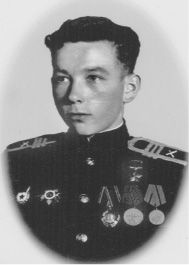
Vitaly Ulianov.
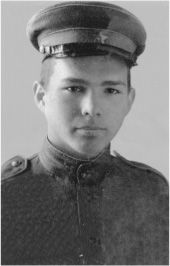
Nikolai Markov.
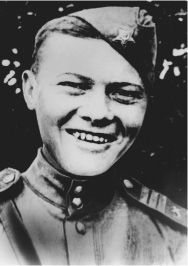
Mikhail Borisov, 1943.
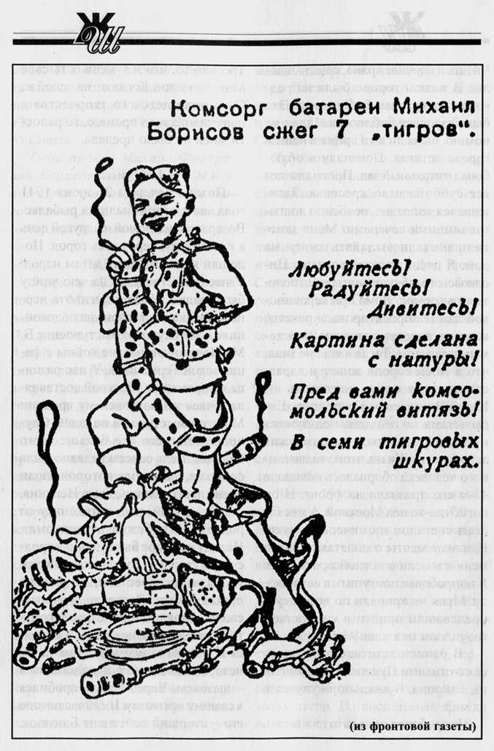
A friendly cartoon of Mikhail Borisov portrayed as the hero of the epic saga by Shota Rustaveli, Man in a Tiger’s Skin.
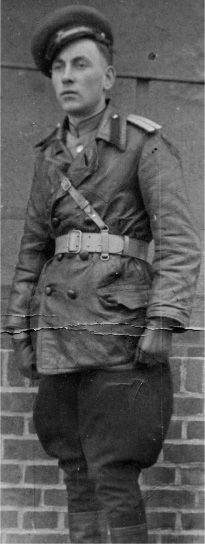
Boris Nazarov.
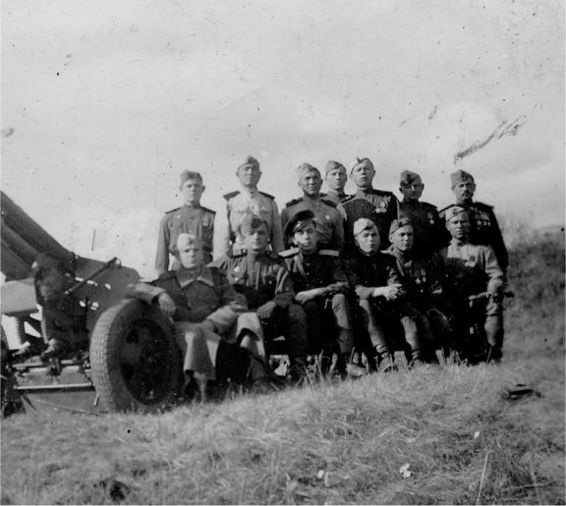
Soldiers of Boris Nazarov’s platoon. Nazarov is sitting on the cheek of the gun carriage in a service cap.
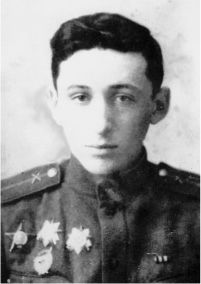
Moisei Dorman, 1945.
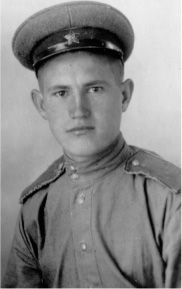
Vladimir Zimakov, 1945.
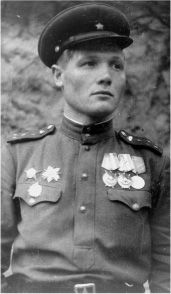
Nikolai Shishkin, 1945.
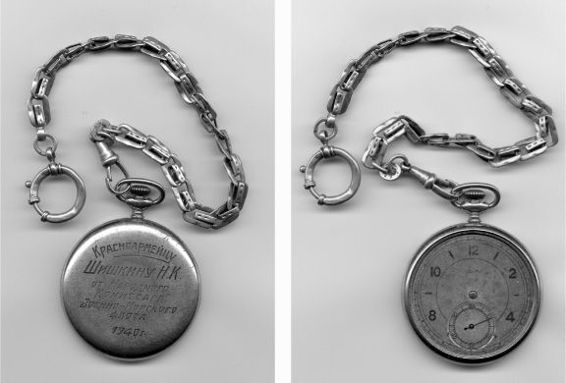
The front and back of a watch awarded to Red Army soldier Konstantinovich Shishkin.
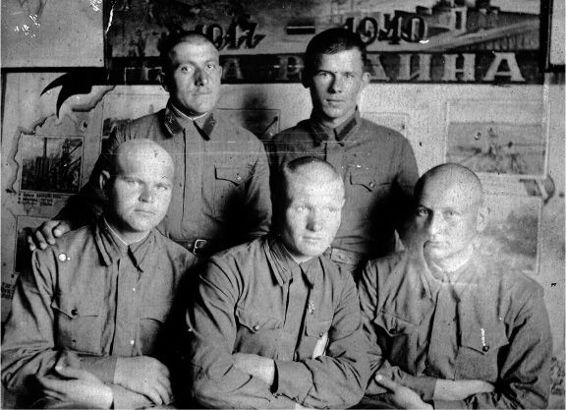
From left to right, sitting: unknown, Nikolai Shishkin, Potapov; standing: Avraam, Podrezov, Khanko, October 1940.
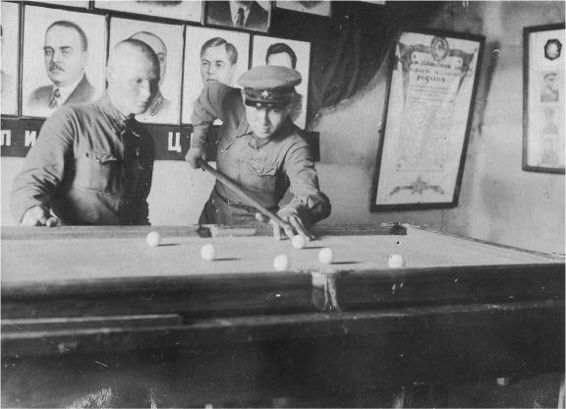
In the so-called ‘Lenin room’, Nikolai Shishkin is on the left, Khanko, 1940.
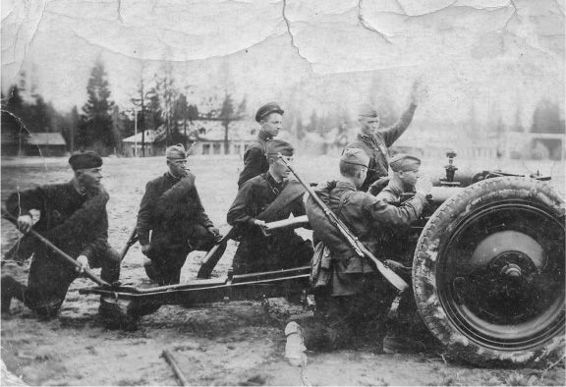
Shishkin’s 76-mm regimental gun crew on exercises. Standing from the left: battery political officer Nikolai Shishkin and an unknown man; sitting from the left: Klivtsov, Kiselev, Mesin, Guschin, Burda.
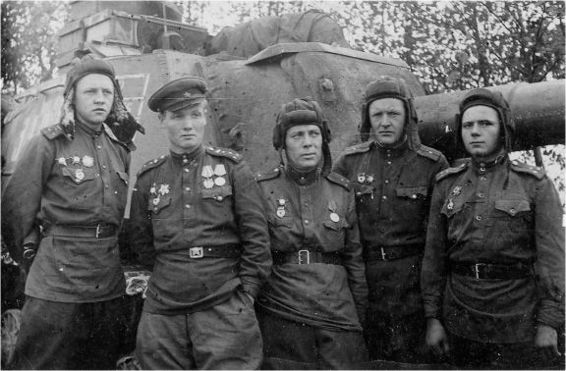
From the left: commanders of SPG batteries Zverev and Nikolai Shishkin, commanders of Shishkin’s battery SPGs Ustinov, Murav’ev, Krasheninnikov.
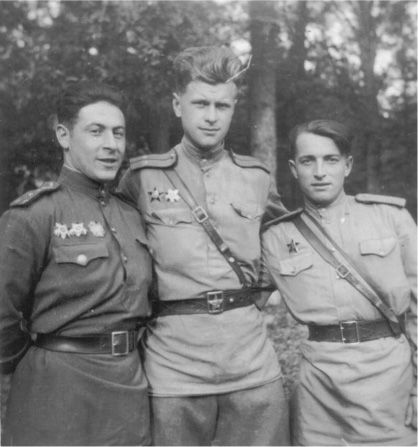
From the left: Mikhail Chernomordik, regimental Komsomol leader Stepnevsky, chief of staff Popov.
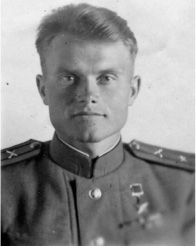
Aleksei Voloshin.
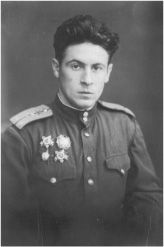
Mikhail Chernomordik.
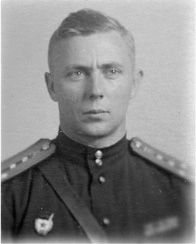
Aleksandr Rogachev.
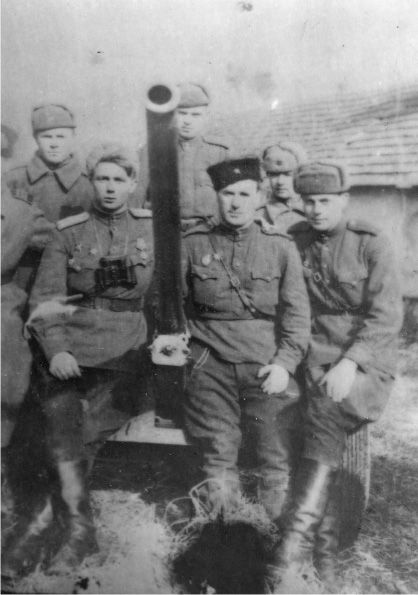
Battery commander Aleksandr Rogachev (with binoculars) and his soldiers.
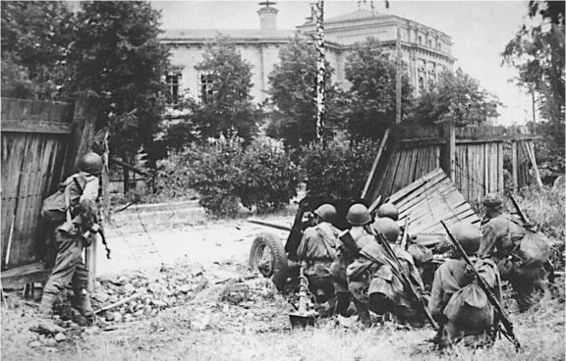
A 45-mm gun crew during the fight in the city. The commander on the left is searching for targets while trying not to expose himself to enemy observers. All soldiers carry knapsacks. The photograph is likely to have been taken in a real combat situation.
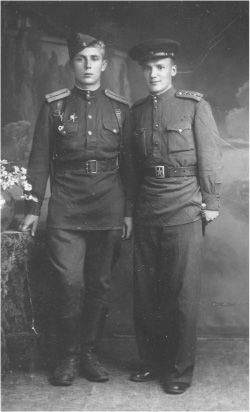
Aleksandr Rogachev (left) and Ivan Panteleev, 18 September 1944.
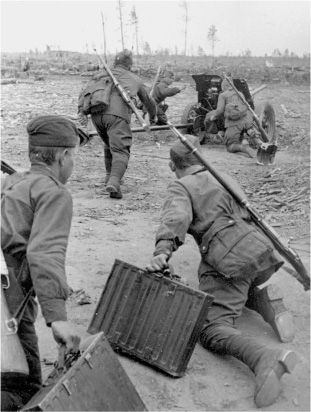
A 45-mm gun crew practising a position change.
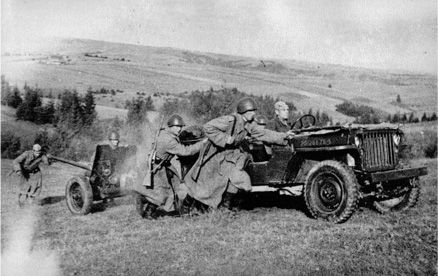
From 1943 Willys jeeps started to tow 45-mm guns instead of horses, but sometimes they needed help.
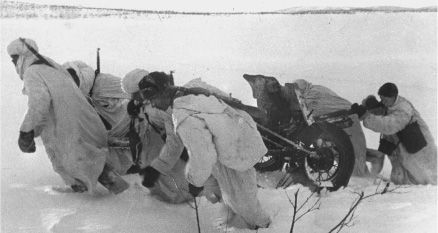
A 45-mm gun crew moving the gun. The gun commander (with binoculars) hangs onto the barrel to balance the weight of the gun carriage.
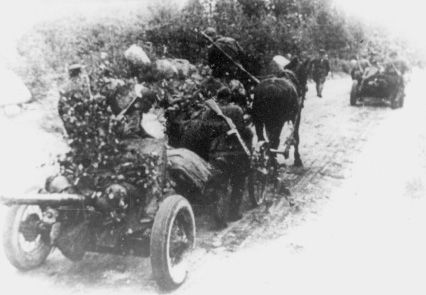
Horses towing an anti-tank gun.
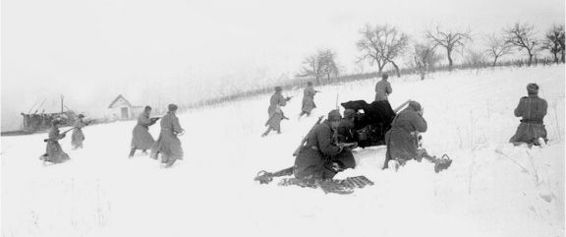
Fighting in winter. The gun crew consists of just four men.
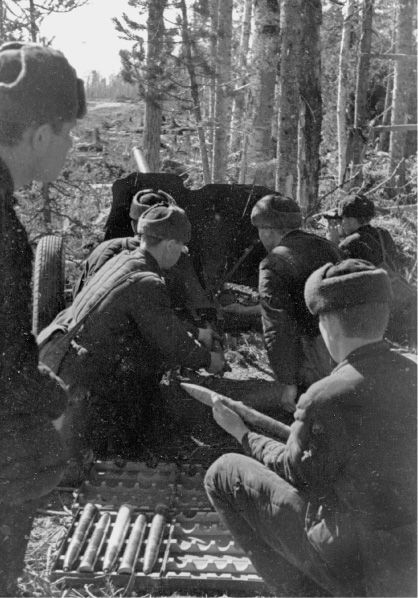
A 45-mm gun in action.
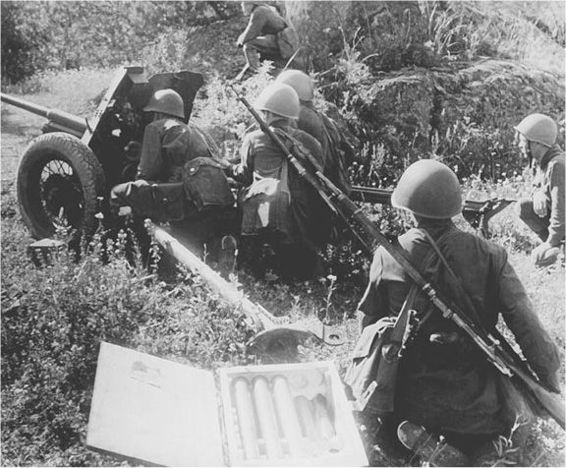
Another 45-mm gun in action.
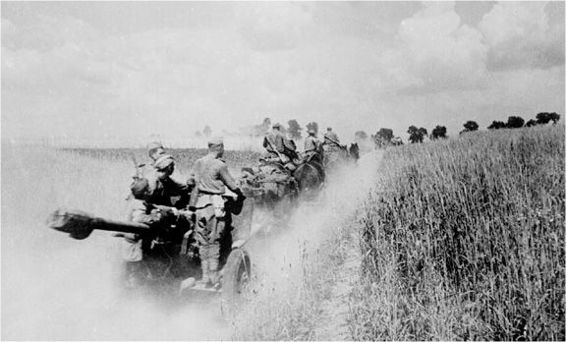
A horse-drawn battery of ZIS-3 guns on the march.
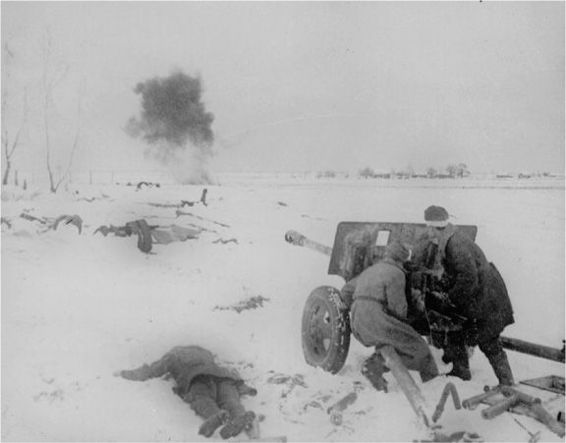
A ZIS-3 crew reduced to two men during a battle.
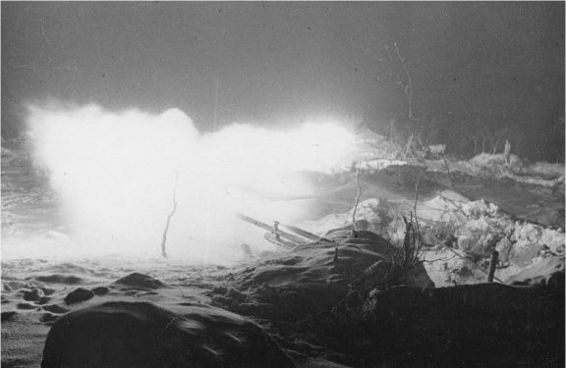
A ZIS-3 firing from a covered position.
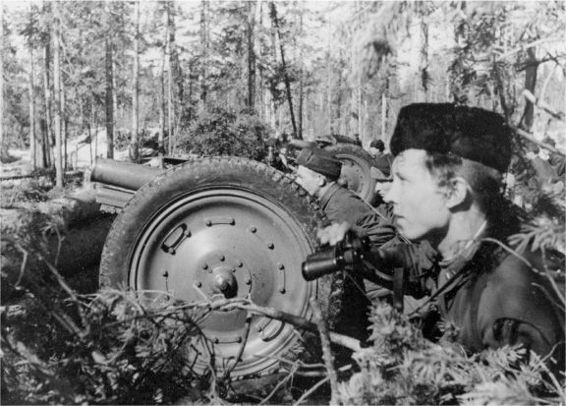
A platoon of 76-mm regimental guns prepare to fire from covered positions.
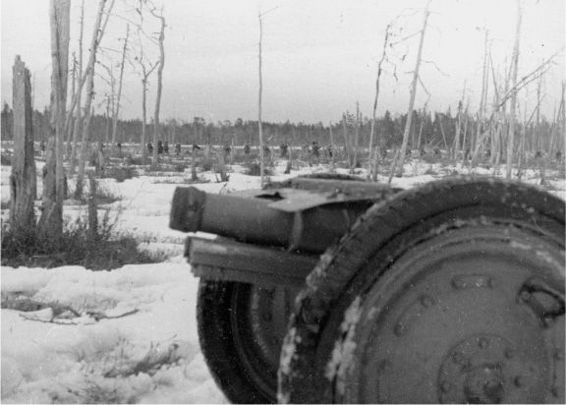
Regimental 76-mm gun, 1927 Model.
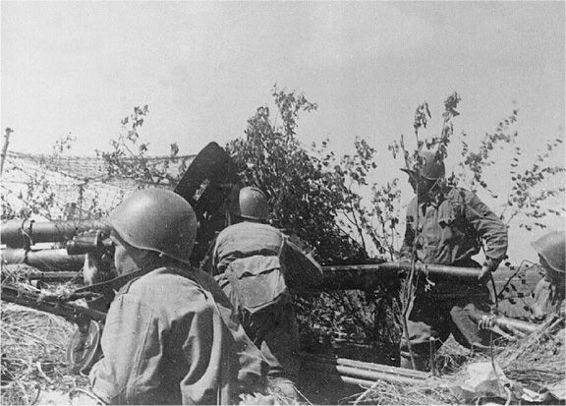
A ZIS-3 firing over open sights.
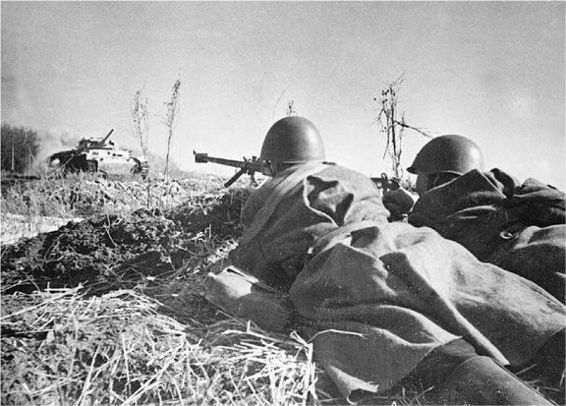
A PTRD crew practise firing on a German Pz-III tank.
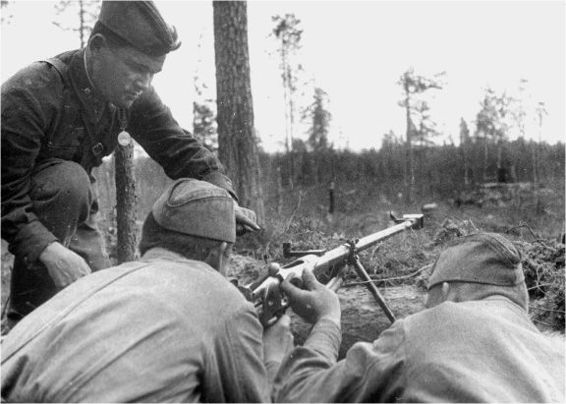
A PTRD crew during training.
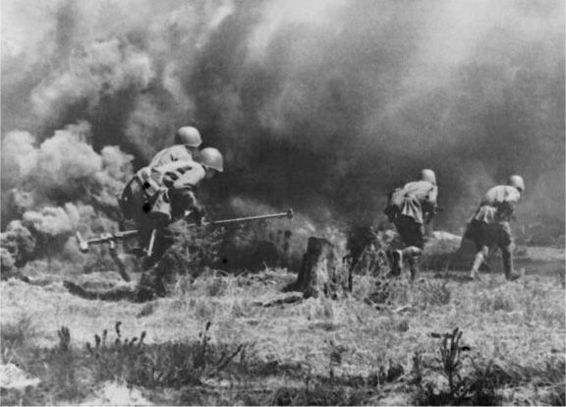
A PTRD crew changing position.
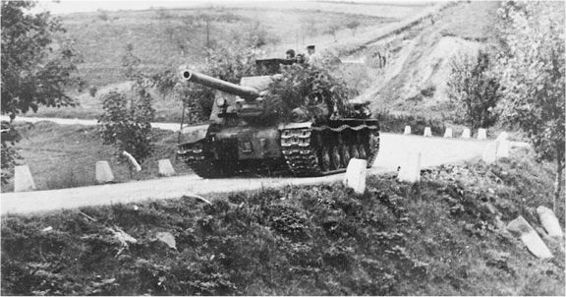
An SPG ISU-152 on the march.
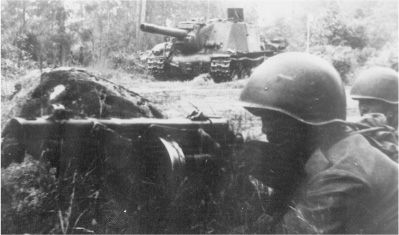
An SPG ISU-152 supporting an infantry advance.
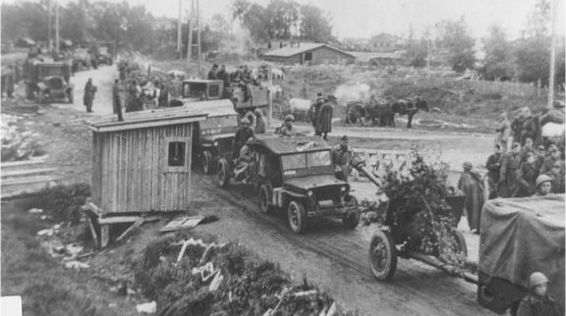
On the road: a Dodge truck with a 76-mm ZIS-3 and a Willys jeep with a 245-mm gun.
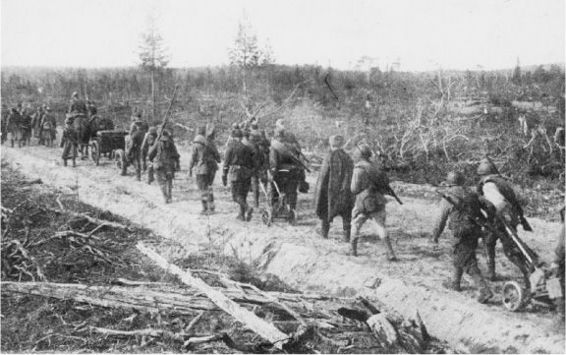
Infantry on the march, with a 45-mm gun at the front of the column.
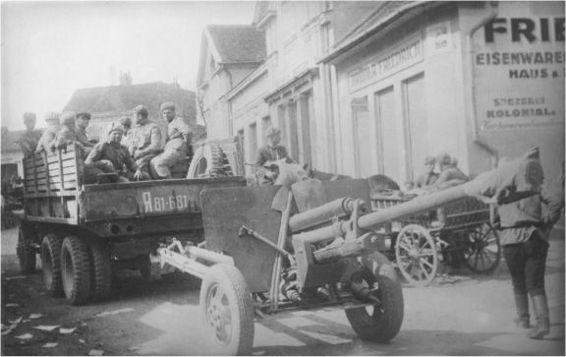
Somewhere in Germany: a Studebaker hauling a 76-mm ZIS-3 gun.