
Chapter 8
Nikolai Konstantinovich Shishkin
In 1939, I graduated from tenth grade with honours in the Kazakh city of Petropavlovsk and applied to three institutes of higher education: Moscow’s Aviation Construction and Architectural Institutes and the Sverdlovsk Polytechnic Institute. I was accepted by all three institutes – honour graduates were admitted without entrance exams and I decided to enroll in the Metallurgical Department of the Sverdlovsk Polytechnic Institute. Two months after the start of my studies, simultaneously with the outbreak of the war with Finland, a voluntary call-up of students to military service was announced. One could refuse to join the Red Army, but we were all patriots and almost my entire class decided to sign-up in defence of the Motherland. Guys from other nearby higher education institutes also responded to the call to service.
We thought we would immediately be sent to the West, but we wound up in the city of Achinsk in Siberia’s Krasnoiarsk District. At the beginning of November, there was already snow on the ground there. We arrived at a transit point, where we cleaned ourselves and donned our uniforms, which altered our appearances so much that at first we didn’t recognize each other.
We were called into formation on a drill ground and formed two ranks, down which ‘shoppers’ walked, choosing soldiers for their particular units. I and a handful of other soldiers wound up in the regimental artillery. That’s how I became the gunner of a 76-mm Model 1927 gun. With this gun I went through the entire Winter War with Finland and the beginning of the Great Patriotic War. My platoon commander was Lieutenant Orel, and my gun commander was Sergei Semin, who achieved the Hero of the Soviet Union Star for heroism in action on the Karelian Isthmus. The Finns had broken through to our regiment headquarters, and although our gun was disabled – the counter-recoil mechanism wasn’t working – we deployed it and opened fire on them, returning the barrel of the gun to its firing position with our hands. It was because of this that we saved the regimental headquarters, and Semin was awarded the title Hero of the Soviet Union and promoted to captain and battalion commander; he was killed in 1943.
As part of the 90th Rifle Division’s 613th Rifle Regiment, I arrived on the Vyborg [Viipuri] axis. The combat was very hard. In the month of December 1939, the snow was up to our belts. True, we Siberians had been well trained and were well equipped. We were dressed in short sheepskin coats, winter fur caps with earflaps, and fur mittens that came up to our elbows. I can’t say that the –40° C. weather was trifling, but we didn’t sense it so acutely. We could lie prone (and did lie prone) in the snow for several days. Back in Siberia we had become inured to this and also accustomed to running through the snow. Our platoon leader, thanks to him, had trained us well. We’d haul a gun into position. He’d give the command, ‘Ranging mark 1, right 20, a machine gun, two shells. Fire!’ Then he’d shout, ‘To cover!’ This meant we had to run through thigh-deep snow for about 200 metres. You’d run and then drop into the snow. Barely having caught our breaths, the command would already come, ‘Man the gun!’ You’d struggle back over those same 200 metres back to the gun at a run. That’s how he in fact saved us from the frost and trained us. On the Karelian Isthmus, oh how this helped us! We could quickly open fire, and then make a run to take cover from counter-battery fire or a mortar barrage.
Over the entire Winter War, we perhaps fired several times from defilade positions, since we spent nearly all our time manhandling the guns forward behind the advancing infantry, always firing over open sights. We’d take a ridge line, advance 100 to 200 metres, and then make no headway for about a week. We’d then make another 100 to 200 metre advance and again come to a grinding halt. That’s how we broke through the Mannerheim Line. Even though I do believe the regiment command was competent, nevertheless, the regiment was replenished with troops more than once before we reached Vyborg.
The regiment’s last battle was for possession of Vyborg itself. During the assault on the city, our regiment lagged behind in the advance. The neighbouring regiments managed to break through, but the Finns had our infantry pinned down in front of some barbed wire by flanking machine-gun fire. Yet just 300–400 metres remained to the city’s outskirts! The regiment commander assembled everyone who was still reporting for duty, took half of the battery’s personnel, and led them all to the barbed wire. There, he himself got the men up and moving forward. Although we lost a lot of men, we broke through to Vyborg’s outskirts. On the night of 11 March 1940, when it became known that a peace treaty was to be signed the next day in Moscow, all the artillery fired in the direction of the Finns. We were in a forested area, with little clearings, so the guns stood in rows with just 3 metres between each gun, and all night long we pounded the Finns without any concern for conserving our shells.
In the summer of 1940 we were shifted to the Hanko Peninsula as part of the 8th Separate Rifle Brigade, which had been formed on the basis of our division. The regiment took up defensive positions along the Petrovsk corridor, over which, according to legend, Peter the Great dragged his galleys from one part of the harbour to the other during the war with Sweden. By June 1941, we had thoroughly entrenched our positions.
Prior to 17 June, there were only 6 wooden shells per gun that we used to rehearse the loading procedure, but on this day an order arrived to man the defences, and in place of the imitation shells, we were given 200 rounds of live ammunition. The earth and timber emplacement for our gun still hadn’t been finished: two side walls had been embedded, and the wall that protected the gun from the front had been thrown up, so that only the barrel of the gun protruded over it. We had covered the emplacement with metal beams, covered them with rocks and logs, and then shovelled dirt over this entire structure. A large mound resulted, and although we had camouflaged it, our emplacement clearly stood out against the backdrop of the terrain. A ditch had been dug in front of us, along the bottom of which three strands of barbed wire had been laid under tension. In front of the ditch, two machine-gun pillboxes had been constructed with overlapping fields of flanking fire. Everything had been mined. Our regiment engineer was Lieutenant Repnia – a master of his craft and a big extemporizer as well. He placed not only mines, but also built remote-controlled demolition bombs and stone mortars. The latter consisted of a conical hole dug out of the ground, in which first gun powder and then a sack of rocks were placed. We were told that something was going to happen and were given an order to not allow the enemy to penetrate our line. We could fire only in response to an enemy attack, but also had the strictest instruction not to fire first, in order not to trigger a war.
On 22 June we heard over the radio that the war had begun. On this same day, two of our fighters shot down a German Ju-88 reconnaissance plane over Hanko, but it was quiet on the ground. We didn’t know the situation. We were told, ‘If it starts, fire and drive them back.’ On 25 June the Finns for the first time opened artillery fire on us, but they didn’t go on the attack. But at 0300 (remember, at this latitude it was bright as day!) on 1 July, a preparatory artillery barrage began, which continued for 2 hours. The entire forest was burning! They also pummelled our gun emplacement. The crash of the shells and the subsequent explosions were terrifying! The rocks were shattering and fragments were flying in every direction. We were sitting in a bunker for the crew, but the gun was standing on a platform, protected by a concrete parapet. Our guys were firing in reply. After the preparatory barrage ended, the Finns went on the attack in dense lines. In front of my gun and a bit to the left and right of it were the pillboxes, which could direct flanking fire on the attackers, while our gun, as it were, was covering them, situated at a certain distance behind them and at the apex of a nominal triangle. It must be said that in front of the machine-gun pillboxes, a listening post had been thrown out closer to the border. On this day, Sergeant Sokur and Private Andrienko were manning it. Everyone thought that they’d been killed – both our artillery and the enemy’s artillery were falling around it, and moreover the waves of attacking Finns were passing over them. However, after the battle they returned, prodding several captured Finns in front of them. For this action Sergeant Petia Sokur received the title Hero of the Soviet Union, while Private Andrienko was awarded the Order of Lenin.
As soon as the Finns moved out, we started firing at them. We were working on our knees, in order to keep behind the gun shield. The Finns began to climb toward the emplacements. We were firing canister at point-blank range, more than anything because we didn’t have time to select a shell. The adjuster Sasha Klevtsov, a powerfully built Georgian longshoreman, was chucking the gun back and forth to the left and the right; it happened more than once that we fired while he was still holding it. We were now firing without aiming it, only because there was no way to miss. They shoved another round into the gun. I fired – but there was no report! We opened the breech and the casing tumbled out, but the projectile remained in the gun barrel. The attacking Finns were approaching and there were bursts of machine-gun fire. That’s when Sasha Klevtsov performed an amazing feat. He grabbed the bore cleaner with the attached brush, whereas according to regulations, in case of a jammed shell, you were supposed to force it out carefully with a specialized gun swab, which avoids the detonator as you drive out the shell, whereas the bore cleaner has a blunt end that strikes the detonator directly. But where is the other one? Sasha jumped up under fire and drove out the jammed shell with the bore cleaner; thank God, it didn’t explode! Sasha survived and after the battle he was decorated with the Order of the Red Star. In general, such exploits always ended with medals. I, the battery commander and the gun layer were recommended for the Order of the Red Banner. The battery commander received it, but we didn’t.
Likely, our recommendation got lost somewhere on its way up the chain of command. You see, only an army commander could sign a recommendation for a higher Order, while the guys who were put up for the Order of the Red Star and the ‘For Courage’ medals received them, because just the regiment and division commander could sign off on those award lists. So those men got their decorations within just a couple of weeks. Later, after we arrived in Leningrad, we checked, but I had no award, so they gave me a ‘For Courage’ medal.
Returning to our story, the fighting went on for 2 hours and the Finns repeated the attack twice. They even managed to close to within 20 metres of my gun, but we stood firm, having killed in the order of 200 soldiers and officers. At the end of the fight I only had six shells left; the ammunition bearer Ozerov had been wounded, the gun had been knocked out of alignment, and we were bleeding from the nose and ears. These metal beams, with which we had covered our earth and timber emplacement, rang so loudly that we were completely deafened. Later it became clear that we had received the enemy’s main attack. After this battle the entire crew was replaced, while we were sent to the hospital, where we spent approximately a week recovering. Our eardrums had ruptured; we’d say something, but couldn’t hear each other. We rested in the hospital for a week before returning to the front lines.
We found our gun emplacement had been smashed, all the camouflaging had been blown away, and the stones had been broken up and scattered around. We changed positions, creating a new earthen and timber emplacement in the direction of a village, and concealing it within a large shed. Generally speaking, we frequently had to change our position, practically after every battle.
That’s where we held out for 164 days. The Finns dropped leaflets over us, which stated, ‘You are heroes, but your situation is hopeless. Surrender!’ They dropped so many that the ground became snowy white with them. But we also scattered our own propaganda leaflets over their lines. I recall that one of them had a depiction of Mannerheim on it, licking Hitler’s shaggy ass. We laughed uproariously over the image! Music was played for us: ‘Sten’ka Razin’, ‘Katiusha’ and other songs, but we also didn’t forget to fight.
On 1 December, an order was given at midday to cease fire. Our regiment was the last to withdraw. At midnight we were instructed to abandon our guns, throw away the latching mechanism, and withdraw on foot. They rolled away only my gun as the heroic cannon that had started the war. They say it is now on display in a museum in St Petersburg. We boarded ships, and ours led the convoy of the last ships that were abandoning Hanko. With our arrival in Leningrad, the 136th Rifle Division (subsequently the 63rd Guards Rifle Division) was formed on the basis of our brigade. Colonel Simoniak assumed command of the division. He was a competent commander with a tremendous amount of experience and practice, who knew how to prepare the troops and to promote sensible officers.
The fighting on the Leningrad front was hard. People were dying not only in battles, but also from hunger. We were defending the banks of the Neva River near the village of the Novosaratovka colony.1 I recall the owner of the house in which we spent our nights. During a lull in the fighting, he went outside, walked 50 metres, and there he dropped dead from hunger; in his pocket he still had a small piece of bread that he was conserving and hadn’t eaten. The people were emaciated. You’d walk to the mess, they’d ladle you out a half a mess tin of so-called pea soup – a yellowish broth with a single pea swimming in it – and you’d add a little snow to it before eating it. Yet after this, you’d still have to haul your gun through the snow. In the summer you’d lie around the gun and pluck blades of grass, until you came across one with a tender, whitish section. You’d eat that and then pluck another one. Over the course of the day, you’d eat your fill. They’d distribute pieces of bread. You’d cut your portion into little cubes and slowly chew these pieces. If you got a full slice to eat, you’d feel kind of stuffed. Never mind . . . we still manhandled our guns into firing positions and fought.
On 2 September 1942, our 136th Rifle Division broke the blockade in the vicinity of the village Ivanovskoe near Ust’-Tosno, in the so-called ‘Valley of Death’. We had moved into our jumping-off positions; the infantry had dug approach trenches to within about 100 metres of the German barbed wire. There remained 100–150 metres to the enemy’s trenches. We also rolled our gun right up to the infantry. Sappers cleared lanes through the minefields. The offensive was to begin at 0800 after a 2-hour preparatory artillery barrage, at a time when the fog still hadn’t lifted. I don’t know why, but the artillery barrage began 90 minutes late. By this time the fog was already dissipating and the Germans, noticing our infantry that had been massed for the attack, opened up a hurricane of fire. The trenches became abattoirs covered with blood and human flesh. It was a horror! We sat there for 2 hours while they poured fire into our trenches. When the bungled artillery preparation came to an end, the infantry moved out, but the losses in its ranks were already enormous. As a result, a breakthrough didn’t result, and we became bogged down in positional fighting, advancing just 200–300 metres per day.
The terrain was boggy and sandy. We moved about on our bellies. Rifles wouldn’t fire – they became jammed by the sand and mud. There was a heavily damaged, enormous grey concrete building in the valley, from which a railroad embankment extended. The infantry would assail the Germans with grenades – they’d fall back from it and we would take it. We’d run out of grenades, and then they’d throw us back. This embankment changed hands repeatedly. The casualties were staggering . . . but the regiment kept attacking. On one sector we made a penetration of 1 to 1.5 kilometres. We were rolling our gun forward directly behind the infantry’s battle lines. Just then a Ju-87 dived on us, and the bomb exploded almost right next to the gun’s left wheel. I remained alive, three of us were wounded, of which only one was still mobile, and the rest, including Sasha Klevtsov, were killed.
At this time, a group of Germans moved up from the right, intending to strike the company I was supporting in the flank. A company! Today we normally talk about larger formations: armies, divisions, regiments and battalions. But we had only 100 men left in the battalion, instead of the normal 500, and just 20 in the company. The Germans, likely, were also attacking with only a company, but it also had no more than thirty to fifty men. My gun was behind our infantry. What could I do? The gun had a smashed dial sight and wheel, but it could still fire. From somewhere we found the strength. I pivoted the gun by the trail, and we slaughtered the counterattacking Germans, firing all my remaining shells, likely not more than ten, at them. We didn’t kill all of them, of course, but the main thing was that we broke up their attack. Simoniak later said, ‘That’s Shishkin for you! Again he was successful. He repelled the attack!’
I spent the next couple of days in bed, recovering my strength. I felt shivery. Then I received a new gun, and with it we pressed on. It was later also disabled during a bombing.
For this fighting, for the first time I was put up for the title Hero of the Soviet Union, but the battles were unsuccessful. Our losses were enormous and after the operation ended, the Front commander assembled all the sergeants who had distinguished themselves in it and told them, ‘With my authority I can give you all the rank of junior lieutenant, or I can give you documents for three to four months of training in a specialist school back in the ‘‘Big Land’’ [in the expanses of Russia in the rear area].’ Some guys chose to remain, but I and a few others accepted our tickets out of the front line. Probably I had lost a bit of my nerve, but I had fought honourably over the preceding year and I was simply tired, and I wanted a break from the war, the hunger and the cold.
We were sent to Saratov to the 2nd Artillery School, where we studied and trained for the next three to four months, losing one of those months to cutting firewood and digging trenches. But what could they teach us? We all had combat experience, and we knew the ins and outs of the artillery better than some of the school’s lieutenants. Thus in April 1943 we hastily acquired the rank of lieutenant and were sent to Cheliabinsk, in order to pick up SU-152 self-propelled guns.
At this time, the 30th Urals Volunteer Tank Corps was forming up; its 244th Tank Brigade, commanded by Fomichev, was in Cheliabinsk. In the oblast, a motorized rifle brigade was also being formed on a volunteer basis. There were 100 applications for each place. First, there was the awareness that it was shameful to sit in the rear, when others were pouring out their blood; secondly, conditions were hard in the rear. At the front you’d be fed, but here there was nothing to eat.
One, let us say, overzealous officer was placed in command of our 1545th Heavy Self-propelled Regiment. He, for example, could dress down any officer with a healthy dose of swear words in front of the assembled rank and file. Yet this was the crudest violation of the Regulations! What was it like for the soldiers to hear their commander be disrespected in such a manner?! My fellow lieutenants would say, ‘When we reach the front, he’ll get his.’
Before its departure to the front, the regiment was located at the Self-propelled Artillery Centre. This regiment commander on the day we were to embark on the trains drove off somewhere. The regiment received the order to load onto trains, but the chief of staff reported to the Centre that it had no regiment commander, that he had gone off somewhere unknown. Literally within an hour, a bulky man showed up on the platform of the Mamontovka Station, which as we later found out was the new regiment commander Tikhon Efremovich Kartashov. He approached, didn’t question anyone about anything, and only watched: who, how and what was being done. That’s how he took command of the regiment. Another one would have started giving instructions. There were those like that – they were constantly directing how a tank should be loaded, but for this there are lieutenants and sergeant majors. I’ll tell you a bit later about our first battle, but when we came out of it, we learned that the neighbouring tank regiment, which by a whim of fate was being commanded by our former regiment commander, had lost almost all its armour. Later we were talking with guys from that regiment, and they told us, ‘Well, how was it like to fight under our idiot? He only knows one thing, ‘‘Forward!’’’ But Kartashov told us, ‘If you’re grabbing a bull by its horns, I’ll be the first to latch on! Here’s some scrub brush, here’s some ravines, here’s a haystack; use the terrain, the factor of surprise and concealment.’ It is with such commanders that we in fact won the war.
Both the higher command and the troops thought highly of our commander, because the regiment was always prepared for both combat and for marches. The first orders after a combat were, ‘Inspect your weapon, calibrate the sights, load the vehicles with ammunition and fuel, and test the traverse.’ Only then were we allowed to grab something to eat and to get a bit of sleep. Thus we had a lot of damaged tanks, but our losses were not large. Of course, regarding the light losses in our regiment, they can also be explained by the fact that we were used in a supporting role. We only helped the main combat units – the tank and rifle units to which we’d been assigned – to carry out their assignments, and we didn’t have our own independent missions.
Our first battle took place at the Nugr’ River, beyond which on a steep bank sat the village of Bol’shaia Chern’, which the Germans had converted into a strongpoint. From there, 88-mm anti-tank guns were firing at our tanks and infantry that were attacking across a large field of rye. Amid the rye, one couldn’t identify where the fire was coming from. Tanks were burning. My gunner Bychkov was superb. In this battle he left two enemy tanks in flames. At some moment we took a hit. There were sparks, smoke and the smell of redhot metal in the fighting compartment. The driver-mechanic Nikonov quickly drove the vehicle into a depression. I crawled out of the hatch and began to look around. With difficulty I spotted an anti-tank gun on the edge of the field in a patch of bushes. We moved out of its field of fire, and it redirected its fire against the tanks. I decided to turn and aim the gun at a landmark in line with the German anti-tank gun, and to drive out of the depression toward it for a shot. If our first shot didn’t hit, we’d be toast. Barely had we emerged from the depression, when the anti-tank gun began to pivot in our direction. Bychkov shouted, ‘Shot!’ and simultaneously the sound of the gun firing rang out. I barely had time to shout, ‘Nikonov! Reverse!’, but this proved to be unnecessary – Bychkov had hit the target.
The tanks were crossing a shallow stream, outflanking Bol’shaia Chern’ from the left. We covered their manoeuvre with fire. Suddenly three or four Panthers emerged on the flank of the attacking tanks and opened fire. I will say here that if an enemy tank appeared at a range of 1.5 kilometres, then it was possible to distinguish its type only through binoculars, and at that only a motionless vehicle from a halt, and even then not always. Well, given the battlefield situation and through the dust and smoke, we didn’t scrutinize them. Anyway, we fired at them from a range of 1,000 metres and left them burning – or at least three of their burned out hulks were still there when we passed by them a little later as the advance resumed. I looked over at them and my hair stood on end – they were our T-34s. We would all be sent in front of a tribunal! Only having passed them and looking back, when I spotted crosses on the turrets, was I able to calm down. The tanks were German. I was correct – they had been firing at our tanks, but if they had in fact been our tanks, I would have hardly been able to make a case for myself .. .
In these battles I happened to encounter the army commander. We had reached the area of Shemiakino. From the gardens on the outskirts of this settlement, the Germans greeted us with fire, knocking out several tanks. We had suppressed one gun and had caught the next target in our sight. I shouted, ‘Aladin, load!’ At this moment there was a blow – the radio flew from its place and the gun’s breech suddenly dropped – a projectile had punched through a trunnion. I shouted, ‘Nikonov, reverse!’ and a second round struck but failed to penetrate the armour. The self-propelled gun rolled back about 20 metres and stopped behind a mound. The gun barrel was hanging loosely, the spent German projectile was in the breech assembly, and just then there was a rapping sound on the armour. I opened the hatch and looked, and found the commander of the 4th Tank Army General Badanov standing there with a pistol in his hand: ‘Where are you headed, son? Are we staying on course?’
I replied, ‘I have a shell in the breech assembly and the gun is hanging loose.’
‘Ah, OK,’ said the General, ‘but let’s go, get moving to a repair station.’
Iut he might have given me a cuff, if I had been retreating to the rear undamaged. In a nearby forest, a repair team replaced my main gun with one taken from a different self-propelled gun, and soon we were already catching up with the regiment.
A couple of weeks later, in one of the battles the battery commander was wounded and I took command upon myself. After all, I had combat experience from two wars, while many of the self-propelled gun commanders were newcomers to the front. Things went well for me, and subsequently during a re-forming period, I was confirmed in this post.
In the Battle of Kursk, our 30th Urals Volunteer Tank Corps received the honourific title of a Guards unit, while I was awarded the Order of the Red Star. I never drank in the war with Finland or to this point in the Great Patriotic War, but this time I couldn’t resist. In the regiment there was a tradition to drop an Order into a full glass of vodka; the recipients would have to drink it down to the bottom before he could attach his own Order to his combat blouse. I recall the regiment commander seating everyone around a table, before he got an Order and placing it in the glass. Everyone took a swig as it was passed around the table, but I moved it aside without partaking. The regiment commander looked and said, ‘I’m giving him an Order, but he isn’t drinking! The hell . . . Get with it!’ I had to take a swig. I set down the glass and quickly reached for a snack. The commander exclaimed merrily, ‘And he said he doesn’t drink! He downs glasses!’ One can say that this was my Vodka-Order baptism.
Incidentally, there we also liberated the regiment commander’s home village. Only scorched chimneys remained of the village, but Kartashov’s parents were alive, hiding in a nearby wooded area. Around this time we were withdrawn from combat for refitting. So we spent it cutting logs for several new cabins and building stoves. To put it briefly, we put this village back on its feet. When we departed, we left behind everything necessary for the villagers.
In addition to medals and Orders, a crew received a cash award for destroying tanks – 2,000 rubles for each one. Usually over an operation the battery as a rule added more than one tank to its score, normally three to five, and sometimes even more. In my crew there was no permanent scheme for distributing the money. Sometimes we split it equally, sometimes we gave a little extra to the gunner or, if we knew, for instance, that the grandparents were still in Aladin’s house, we’d give him a little more to send back home. Sometimes the money was shared even with those batteries that hadn’t taken direct part in the fighting. For example, sometimes some bonus money was given to the mechanic or to someone else – they also contributed to our common cause. The officer’s ration – biscuits, spam and sweets – was always shared with the entire crew and never eaten somewhere on the sly. We all worked together, which is why the crew and the submachine gunners attached to our vehicle regarded us, the commanders, very warmly.
There was the following incident in the Kursk bulge. For several days we stood down, bringing ourselves back into order. Several former prisoners arrived at this time in the platoon of submachine gunners. On the next day one of them reported to me that one of these guys had stolen a loaf of bread. Although we were not starving, our sustenance was limited, and how could we pillage and plunder our own people? I told him, ‘Dig a hole deep enough so that only his head sticks out.’ I ordered the thief to be placed in this hole and for a sentry to be posted, thereby creating a unique sort of brig. Everyone walking by could see him sitting there – it was deeply shameful for him. Within several hours, he was begging, ‘Battery commander, free me from this shame. I’ll redeem myself with my blood!’ I replied, ‘Fine. But, just look, you’ve made a promise.’
Several days later the regiment again entered combat. We were driving through a village, seated atop the self-propelled gun. Suddenly he gave me such a blow that I flew off the turret head over heels and struck the engine compartment with a thud. I jumped up and went after him, ‘What the hell?!’ But he was wounded – he had spotted a German submachine gunner who was crouched on the roof of a barn, and he had managed to knock me off just before the German fired. For saving the life of an officer, a soldier could be recommended for the Order of the Red Star, which I indeed did.
From the end of 1943 until early 1944, the regiment went through rest and refitting in the vicinity of the city of Karachev. We received new self-propelled guns, repaired the old ones, and engaged in daily training, particularly for the new personnel. I, as a former gunner, paid particular attention to training our crews in gunnery, and without false modesty I will say that my battery fired with the most accuracy.
In January–February 1944, our regiment was transferred from the 4th Tank Army to the 5th Guards Tank Army, which in the spring was redeployed to the Ukraine. There was very hard fighting around Targu-Frumos. In May 1944, I was wounded near this city. We were standing in one of the positions, ready to attack. The Germans were pounding us relentlessly with artillery fire, and then several dozen German aircraft appeared overhead just as I had popped my head out of the commander’s hatch to take a look around. Just then an artillery shell or bomb exploded near the vehicle. I dropped back inside the fighting compartment and felt like I had banged a rib against the edge of the hatch. I felt a bit sick. I passed my hand over the spot that had taken the blow and looked – it was all bloody. A fragment had struck me in the back. I said aloud, ‘Guys, I’ve been wounded.’ They quickly patched me up and the regiment’s assistant commander of the administrative unit took me to a hospital. There was no X-ray machine, and the fragment was deeply embedded. Where to find X-ray apparatus? They decided not to operate and merely stuck a gauze compress into the wound. It would become saturated with blood, and then they would pull it out. That’s how I went around for the next two weeks until the wound had scarred over. Later after the war, when they took an X-ray, I found out that the fragment had almost reached the heart. It is still sitting there today.
There was another memorable incident that took place near Targu-Frumos. I had summoned all the self-propelled gun commanders to my vehicle, in order to give them their orders. They took them and started to run off back to their vehicles, but one of them, Iura Krashennikov, delayed a bit. At this time a group of Ju-87s appeared and began to bomb us. The infantrymen who had been assigned to me scattered and dropped prone. Whenever a bomb was falling, I would watch to see where it would land, and then I would run and kick the prone men, so that they would move to the opposite side of the self-propelled gun, instead of lying there like logs. They would get sprayed with fragments, while I always managed to take shelter behind the vehicle. This time we were running from the bomb, and then we saw that it appeared as if it was going to drop right into the open hatch of the self-propelled gun commanded by Iura. Shocked by the realisation that he’d been saved by a miracle by lingering next to my vehicle, he immediately went grey and began to stammer. I even had to send him to a hospital for treatment.
What am I driving at? If a man is watchful and sees where to turn, where to jump, and where to fire – then he’ll have success and he’ll survive. Well, luck also means a lot. I, in all likelihood, had been born lucky.
In June we redeployed to Belorussia. Our regiment was assigned to the 3rd Guards ‘Kotel’nikovo’ Tank Corps under the command of General I.A. Vovchenko. My battery practically always served with Grigorii Pokhodzeev’s 19th Guards Tank Brigade – the best brigade in the corps. These were skillful commanders, from which I learned a lot. Brigade commander Colonel Pokhodzeev was an eagle. He was a hard-driving, taciturn man. You’d report to him at a conference in order to receive your orders before a battle, and he would ask, ‘So, artilleryman, do you know your mission?
‘I know.’
‘Do you understand what you need to do?’
‘Understood.’
‘Dismissed.’
That just reminded me of one combat action. Three tanks of the brigade’s spearhead, which had emerged from a forest and were climbing a low ridge, were destroyed by a Tiger, which was standing out in the open on the opposite side of the clearing. It was impossible to bypass this clearing, so the brigade commander ordered: ‘You’re a beast-killer, right? So go destroy this tank.’2
My self-propelled gun moved forward, reached the bottom of the slope and began slowly to climb it. I was standing in the hatch, exposed to my waist. At a certain moment I spotted the German tank, which was positioned with its aft end up against the trunk of an enormous tree. The Tiger fired. The vortex of air created by the shell as it whizzed over my head almost tore me out of the hatch. While I was pondering what I should do, it fired another round or two, but since only a fragment of the superstructure was visible above the crest of the ridge, it failed to hit us, even though the trajectory of the shells fired by the Tiger was flat. What to do? If we advanced over the crest, we’d surely be killed.
So here I decided to make use of the possibilities of our 152-mm howitzers, which fired shells in an arched trajectory. I noticed a bush on the slope. Looking through the barrel of the howitzer, I had the driver manoeuvre the self-propelled gun to a position where this bush was lined up with the crown of the tree, under which the German tank was sitting. I took a seat behind the gunner, from where I could see this bush in the optical sight, and I lowered the gun barrel to a point where I knew the shell would have to strike the enemy tank. There were millions of calculations, but it has taken me longer to narrate this than it required doing all this. We fired. I stood at full height in the hatch, and I could see the Tiger’s turret lying next to it – we’d hit it right below the turret! Later in the brigade newspaper it was written, ‘Shishkin shoots like the Good Soldier Svejk – on the sly.’
In June 1944 the corps went on the offensive with the task of reaching the Berezina River in the Borisov area, and then to move on Minsk. We didn’t advance along the Minsk highway, but stuck mainly to the woods. We in our columns would cover 15–20 kilometres before bumping into a rear guard detachment; we’d deploy, drive it away, and then resume our forward movement. In the vicinity of the settlement of Bobr, the corps collided in a meeting engagement with a German division. We managed to smash the division, but I was wounded in the stomach by a shell that exploded directly in front of me as I was dashing between self-propelled guns. I fell. Next to me was a foxhole, in which as I later learned the corps’ commissar, who had been the commissar of my brigade back at Hanko, was sitting. They bandaged me and then took me to a field hospital in a staff vehicle.
The hospital consisted of a dozen small soldier’s tents, in each of which stood an operating table. There were a lot of wounded. They laid me on some straw. I laid there and was silent, and because I was silent, they didn’t place me on an operating table. So I laid there for a day; no one even took me to processing! It is a good thing that the regiment commander arrived and demanded that someone examine me. They laid me on a table, gave me an injection, removed the fragment, sewed me up, bandaged me, and literally within a week I was back with the regiment. We took Minsk, but then again I was hospitalized, because my wound hadn’t healed.
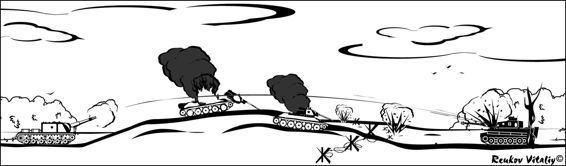
Battle of Nikolai Shishkin’s ISU-152 with Tiger tank.
I returned to the regiment only after Vilnius had already been captured. Savage fighting was going on in Lithuania. There we were shifted from one axis to another, from Siauliai to Tukkum. The front lines were changing with kaleidoscopic rapidity. We were attempting to cut off the German Courland grouping. We were told that the commander of the unit that first entered the city of Tukkum would receive the title Hero of the Soviet Union. A lot of people were killed, but no one managed to become a Hero. We forced a crossing of the Dzelda River. A gently sloping rise with a length of 200–300 metres extended from the mouth of the river. The Germans had taken up a defensive position in a patch of woods about 300 metres behind this rise. My battery and the tank battalion of Hero of the Soviet Union Captain Penezhko, being in the vanguard of the brigade’s main forces, managed to cross the river on the heels of the withdrawing Germans. The tanks attempted to make a further advance, but while they were climbing out of the river valley onto level ground (during which time it was impossible to fire because the gun was pointing skywards and nothing could be seen), they were being shot up at almost point-blank range. Having lost three or four tanks, we rolled back. We requested artillery support, but it was still in the process of deploying. The tank commanders climbed out of their tanks, and each of them selected a target. We repeated the attack, knocked out several German tanks, but we lost two more tanks and fell back again. We spent all day spinning our wheels in place like this. It began to grow dark. On the opposite bank the brigade’s main forces were concentrated, the headquarters came up, and with it the regiment commander. My vehicle was parked next to Penezhko’s tank. I heard him say, ‘The brigade commander has ordered that within 20–30 minutes, after the artillery gives us some fire, we all in concert climb that rise and attack.’
The artillery fired a barrage. We went on the attack, lost one vehicle and again fell back. By now it was dark. The order had to be carried out. We started our engines, clattered up to the crest of the rise, but stopped before fully revealing our superstructures. We could see Penezhko’s tanks; they weren’t going anywhere. We requested another artillery barrage, and the artillery again blanketed the German positions. The commander is shouting at me over the radio, ‘Penezhko is reporting that he is attacking and has reached the road. And you? Why are you silent? What are you doing?’
‘I’m in my jumping-off positions.’
‘Get going, advance! Penezhko is attacking.’
‘Penezhko’s tanks aren’t moving; they’re simply gunning their engines and firing into the sky.’
Penezhko was being clever – just running his engines and firing, while he was reporting, ‘I’m attacking; I came out onto the road and met strong enemy fire. I had to fall back and re-occupy my jumping-off positions. We will repeat the attack right away.’
The regiment commander cursed me up and down before saying: ‘Well, OK; do whatever the tankers are doing.’
The next morning the brigade’s tanks crossed the river. All the artillery came up. They fired a powerful preparatory barrage, and we broke through the German defence, losing just two or three tanks.
There was a lot of fighting after this breakthrough, but I particularly recall one battle near Memel. At the time, I was now fighting with the 18th Guards Tank Brigade. The brigade was concentrated in some woods, and I had deployed my self-propelled guns on the edge of it among some bushes. A field stretched out in front of us, and beyond it I could see Hill 29.4, which was overgrown with bushes. The brigade at that time had not more than twenty tanks – in essence, a tank battalion. The brigade commander summoned the battalion commanders and issued an order to attack the hill. While the attack was being prepared, we managed to spot several German tanks in a patch of woods to the left of the hill. At my command the self-propelled guns moved into firing positions and destroyed the detected targets – one or two shots and a tank would be destroyed. My gunner Bychkov hit one tank at a range of 1,000 metres with his first shot; I had trained the others to shoot not badly, so over the 24 hours before the tanks attacked this hill, my battery had destroyed approximately ten tanks, and this meant 20,000 rubles!
Well, and what about the tankers? They popped out into the open field, and the Germans began to lay into them. One burst into flames, then another . .. and a third. They came back. No one was eager to burn to death within a flaming tank. A certain amount of time passed, and then again the brigade commander called a meeting: ‘Repeat the attack.’ Again they went forward, again they took losses, and again they came rolling back. A third time: ‘The Motherland must today fire a salute in our honour! We must take Memel. Our neighbours have already broken into Memel, while we’re spinning our wheels! A green flare – launch the attack!’ The brigade commander loved this business . . .
The guys were saying, ‘Again we’re going to be lit up. First we must work over the Germans with artillery. But he’s recklessly driving us to attack.’
We attacked a third time. Some tankers were unbolting the bottom hatch and the crew would tumble out, while the tank kept rolling forward until it was consumed in flames. Over the three attacks, a company of tanks was knocked out. When this commander tried to hound the brigade into a fourth attack, one battalion commander grabbed his pistol and said, ‘If you send us once more into the attack, I’ll shoot you. It’s all the same to me – burn to death now or be sent to a penal company later.’
At this time my battery was ordered to conduct a lateral march along the front and assemble on a different axis. I gathered the men and told them to leave their positions covertly and to assemble behind a copse of trees in our rear before moving further. When we had assembled on the road and were waiting for an order, a German fighter flew past low over the column. The pilot shook his fist at us and flew away. I think that he had radioed that the heavy self-propelled guns had pulled out of the area. Suddenly instead of a signal to move out, an order arrived to return to our previous positions and to restore the situation there. That was the entire order. Today they write large orders that run for two to five pages. But back then, it was nine words: ‘Return to your previous positions and restore the situation.’ Looking back toward the copse of trees that we had just left, I saw some major running and shouting, ‘Stop, stop!’ I stopped. The major said excitedly:
The brigade has been used up, the Germans are attacking there. When you left, anti-aircraft gunners took over your positions, they were overwhelmed and Tigers are on the move there.
I looked and saw one tank emerging from the woods, followed by another. One’s main gun was smashed; the other’s mud guards were battered. In total five or six tanks came out. I gave the order, ‘Load the guns. To our former positions! At the attacking enemy tanks – Fire!’ We loaded the guns, returned to our previous firing positions, and saw five Tigers at a range of 400 metres that were heading directly toward us. Well, what of it?! With our first volley of shots, four of the Tigers were destroyed. We muffed the shot at the fifth Tiger, on the extreme right, and missed. It stopped, and then pulled back behind a house. I had Ustinov’s crew on the right flank. I ordered him to move out, keeping concealed by the bushes along the ditch, and to finish off the Tiger. That’s just what he did.
I returned to the edge of the woods and reported to the regiment commander that the situation had been restored. Just then the brigade commander walked up: ‘Oh! See, with you we hold the defence.’ For this action I was recommended for the Order of Suvorov 3rd Degree, but I didn’t receive it. The recommendation got lost or they simply didn’t award it to me – after all, Memel hadn’t been taken and a half of a brigade had been destroyed. One can always find a reason. Yes, if all the deserved Orders had been received, there would have been nowhere to hang them all!
In October or November 1944, an order was given to entrain at Vainod Station. There are some places that you remember for a long time . .. It was 20 kilometres to the station, but the mud was such that the road wasn’t a road, but a swamp. You take a step, and your boot gets stuck and your foot comes out of it. Your foot popped out of even tightly laced boots! It was forbidden to climb up onto the railroad embankment – for this you might even have received a bullet! Only cars were allowed onto the corduroy road that had been laid down. We had to move along a hastily improvised road through the woods. It took more than 24 hours for the regiment to move 20 kilometres! The self-propelled guns sank into the mud up to their underbellies, to a point where they were unable to move. Each had a log to assist with this which was attached to the front of the track. Slowly you’d progress across the bog the length of the hull. Then the log would disengage and you’d have to repeat the process. A tow cable would snap, or the log would wrench free, or a track link would break.
Well, nevertheless we entrained, which took us to Warsaw. We began to attack toward Mlawa in the direction of the city of Elbing. We deployed into combat formation at night. Nothing was visible. There were seemingly random gunfire, flares and the flashes of shots and explosions. To put it briefly, we took Mlawa. Our 19th Tank Brigade was moving in the forward detachment. We moved on toward Preussisch-Holland (modern-day Paslek). I was advancing on the highway with the task to reach the northern and northeastern outskirts of Preussisch-Holland, while the tanks were swinging around to the left. We rolled past Marau Station. It was a little way off the highway we were taking. I thought, ‘I wasn’t told to take the station, but I should check out what’s over there.’ I walked up to it and saw trains parked there and a big crowd of people. I stopped the column and ordered them to swing their guns around toward the station. As an interpreter, I took a boy who’d been taken by force to Germany, who one day had drifted into our camp somewhere along the way. He spoke German fluently. We walked up to the station. There was a crowd of German civilians standing there, and German soldiers en route to some place – it was a troop train. I attempted to clarify who was in charge. I ordered the soldiers to surrender. At this moment, there was a burst of automatic weapons fire from out of this crowd. The boy crumpled and fell, while I ducked around a corner of a building. I gave the signal to open fire, and we fired a couple of shells at the train. I don’t know who it hit. The principle was: if you fire at me, I’ll fire back. I returned and again ordered that the German troops surrender or they’d all be killed. At this time, the crowd led the Germans who had fired at us to our vehicles. I turned them over to the submachine gunners, who tied them up, and then left behind several men to wait for the arrival of our main forces. We patched up the boy as best we could and sent him to a hospital. We had no medics. Meanwhile, a throng of civilians encircled the self-propelled guns, shouting and pointing at the prisoners, ‘Don’t shoot us, don’t shoot . . . They’re the fascists!’ I said, ‘Guys, let’s get away from this crowd as soon as possible.’
From this station we moved off toward Preussisch-Holland. The road travelled along an embankment, on both sides of which were 5-metre-wide shoulders. It was jammed with refugees and enormous wagons that were just like in the movies about the Wild West. They were all moving toward Preussisch-Holland, filling both lanes of the road. A little to the right of us, there was another road that angled toward this city. I looked over at it and saw that some German unit – artillery, self-propelled guns and trucks – was moving along it. If they managed to reach the city before we did and fortified themselves, there was nothing I could do with them. I issued an order: ‘Keep to the left side. Close the hatches. Forward!’ We had to crush these wagons. Whoever didn’t turn off the road fell under our tracks. Nevertheless I managed to win the race to the outskirts of the city, where I turned my SU-152s around, allowed the German column to approach to within 500–600 metres, and then we opened fire. The column dispersed, and at this time the brigade arrived. That’s how we took the city. I believe that I seized it. It wasn’t just the tankers who took objectives!
The next day I received orders to move on to Elbing. En route we took other little towns. The adversary was primarily occupying the villages and towns. You’d move up close to a town, pick out the largest building, fire a round at the bottom floor, and it would collapse; if there was no obvious structure, you’d fire a couple of shells into the gardens in the sector of attack. After all, if you moved in without firing, you yourself might be knocked out. We, of course, were conserving our ammunition.
We arrived at Elbing somewhere between 20 and 25 January. We took the city at night. Music was playing in the restaurants and there were pedestrians out and about. Our regiment was given the order to take the villages of Baumgart (Ogrodniki), Trunz (Milejewo) and Gross Stoboy (Kamiennik Wielki) in order to block the road to Elbing to the German units retreating from Konigsberg. My battery was positioned in Gross Stoboy, Captain Zverev’s battery was in Baumgart, and one more battery was in Trunz. We also towed two abandoned Sherman tanks up to our position – apparently they’d been unable to climb the ice-covered road leading up a slope and had been abandoned. Later their machine guns would really help me out.
The Germans attempting to break out of encirclement at Konigsberg initially attacked to the right of the highway, where they ran into Zverev’s battery and recoiled. They decided to try again along the highway. They had no other options – it was impossible to break out across the muddy fields. Somewhere on the morning of 29 or 30 January, they came at me. In the course of the day, we destroyed those tanks that tried to escape along the road. The next day they made another attempt to break out. Once again we repulsed them. We fired at attacking infantry, but my shells were running out. Each SU-152 had only ten to twelve rounds left. The German infantry reached our positions, but thank God, they had no grenades or anti-tank mines. We had to defend our positions with submachine-gun fire and grenades. Somehow, we managed to drive them back.
We even took prisoners – we rounded them up and placed them in a barn. They were standing and trembling – they thought we were going to shoot them now. However, we didn’t have the desire to shoot them . ..
At some moment, from my vehicle I saw several German tanks that had turned off the road into a ravine, trying to turn our left flank. My radio wasn’t working, and I decided to go in person to deliver orders to my self-propelled guns on the left flank to shift further to the left in order to block the exit from the ravine. I leaped out of my vehicle, next to which was standing our motor mechanic Sergeant Major Aleksei Semin. Actually, he was the brother of my machine’s driver-mechanic, Technician-Lieutenant Nikolai Konstantinovich Semin. We walked away from the SU-152 about 20 metres. My vehicle fired. The round flew short or overshot its target. I thought it would now fire a second time. Instead of a shot, the vehicle exploded. Aleksei appealed to me, ‘Battery commander, keep silent! Don’t report anything to my home. My mother would die from grief.’ Recently his pilot brother had been killed, and now another brother had burned to death in front of his eyes . . .
What had happened? The loader had evidently been careless and bumped the detonator of the shell he was loading against the breech. However, that isn’t even the real cause. If the detonating fuse had been functioning properly, then it wouldn’t have ignited. It turned out that in one lot of fuses, the inertial safety device had already been triggered and was no longer effective.
For this battle I was again nominated for the title Hero of the Soviet Union. For three days we held the highway leading into Elbing from Konigsberg. But instead I received a ‘Red Banner’. Why? A short time later the Germans broke through to the encircled forces in Konigsberg 30 kilometres to the right of our position. The army commander seemingly said, ‘What kind of heroes are you?’ But what did that failure have to do with me? I’d been assigned a 3-kilometre sector, and I had held it for three days, allowing no German to pass. The recommendation was made a month later, after the Germans had broken the encirclement. If it had been put in right away, they probably would have given it to me.
After this battle I was appointed as the regiment’s deputy chief of staff to replace Shipov, who’d been killed. A month later, I was promoted to regiment deputy commander.
The nickname for the JSU-152 self-propelled guns was ‘Beast killer’. We didn’t call them ‘Heifers’. The JSU-152 had a separate load of ammunition. The shell weighed 48 kilograms and the casing weighed 16–20 kilograms – more brass and less cardboard. For the loader, this demanded unbelievably hard work. We sought to pick guys of a corresponding build – no taller than 160 centimetres, so they wouldn’t bump their heads on the roof of the fighting compartment, but with arms and legs like a weightlifter.
I always had five men. A gunner, a loader, a radio man, the commander, and the driver-mechanic. I’ll say it was a true brotherhood. The crew was one family. Of course, a lot depended on the commander and on the character of the crew members, but in the majority of cases, the absolute majority, the crew acted as one. It never happened that one or two would be doing something, while the others sat around watching and smoking. Everyone worked together. Let’s say the vehicle was gassed up, but ammunition had to be loaded. Everyone would go to fetch and load the ammunition. Or, let us say, the vehicle still had to be fuelled. Then one would ready the hose, while another would open the drums. Work was allocated in a way so that it would be carried out with maximum speed.
Of course, there was a superior-subordinate relationship. I would give the orders, which was my job, but I would never tell the gun commander, ‘Comrade Sergeant, I’m giving an order!’ I never once even uttered the words, ‘I order . . .’ Instead I requested. Or I wouldn’t be saying, ‘Well then, button up!’ or something else, if combat was imminent. That’s hogwash!
In the self-propelled gun there are two officers – the commander and the driver-mechanic. These were the two primary members of the crew. Of course, there was a hierarchy. But also, we passed through battles together; we’d sit together, eat together out of the same pot, and share the 100 grams of vodka [a normal combat ration in the Red Army to boost morale]. If there was free time, the soldiers and sergeants had their own yarns to spin, while the officers had their own tasks, their own professional matters to which to tend, and their own circle of responsibilities. However, as soon as a common task appeared, this hierarchy immediately vanished. The vehicle commander could always take over the driver-mechanic’s role.
We had heavy casualties – how could it have been otherwise?! Over six months, almost all of the self-propelled gun commanders had to be replaced.
It is hard to distinguish between the SU-152 and the JSU-152. Even today I won’t tell you that there was a difference in anything but their designation. The main gun was 152-mm, the shell weighed 48 kilograms, but I could care less about whether it had seven rollers or only six, or carried twenty or twenty-two shells inside it. The vehicles were green. They did have code symbols on them that belonged to the regiment. The letter ‘K’ or painted squares. In winter our vehicles were never repainted white.
Unfortunately, the JSU-152 had no machine guns. Although they later mounted a DShK machine gun on it, my battery never received any of these. This circumstance forced us to procure a captured machine gun on the sly, and we almost always had one with a supply of ammunition for it. It was usually lying in a case carried on the armour outside the fighting compartment. In general, in addition to the machine gun we always had four or five cases of shells there as well. Behind the fighting compartment on the outside of the vehicle there was a fuel drum. The vehicle moved toward the battlefield always with this camel’s hump mounted on top of it. In our jumping-off positions, we would transfer the fuel from the external drum to the internal tanks and toss the empty tanks aside. Sometimes we discarded the auxiliary tanks, but we never got rid of the shells – they were always atop the vehicle. The vehicle always carried one and a half standard ammunition loads. Twenty shells were plainly too little. During a pause in the fighting, we might take the next shell not from the internal store, but from the external cases.
For those times the radio communications were good. The radio sets kept pace with the times. Sometimes, we even bandied words with the Germans. Although it was precisely the loss of radio communications, as I’ve already mentioned, that saved my life.
We used armour-piercing shells against tanks – they were more reliable. The T-3 or T-4 – they broke up when striking armour, but the slug would punch through heavy tanks. If in doing so it detonated the on-board ammunition, it would rip off the turret. The distribution of the bunker-busting, armour-piercing and high-explosive shells in the ammunition load differed. Whatever they had at the dump, they’d distribute it in that proportion. It was fine to fire a solid shot at tanks, but if you had to collapse a building, here you couldn’t get by without a high-explosive shell.
Self-propelled guns suffered malfunctions, just as with any mechanism. The running gear would break down or the track idlers would fly off. The motor might conk out. If you maintained and serviced it well, it would run just fine. The crew took care of minor repairs themselves. Sometimes we required the assistance of a field repair shop for jobs we couldn’t handle ourselves, but we never had to turn in our vehicles for major repairs.
The entire crew took part in maintenance and repairs, including the commander, without exception. There were some commanders that didn’t want to get their hands dirty. Here we’re talking about officers who had uniforms with white linings and high-necked tunics made of imported fabric . .. Such officers didn’t last long. Who needs a guy like that? Such guys were replaced or learned to change their ways.
I had to escape a burning vehicle a couple of times. Once out of sheer stupidity – oil-soaked rags ignited inside. We had to bail out. The guys quickly covered the flames with canvas and smothered the fire. But one time, it was in combat. A shell penetrated the armour and the gunpowder caught fire. But it burns slowly and it was a simple matter to bail out. However, it happened repeatedly that a shell penetrated without igniting a fire. It happened in Lithuania once that a large-calibre shell struck the self-propelled gun, when we were inside. There was a shower of sparks, like from a welder. I still don’t know what it was, but it gave the impression that a conflagration had started. True, this passed very quickly.
Primarily the self-propelled guns were used to support the tanks. We usually moved a bit behind them. We never had independent assignments, but helped the main combat units – tank and rifle units – carry out their tasks. Since our regiment served in a tank army, it was broken up and each battery was assigned to a tank brigade.
In each column there was always a variety of vehicles, which are driven by drivers with the most diverse levels of training and abilities. God willing, the brigade column moved at a speed of 20 kilometres per hour. On the whole, we were no hindrance or burden for the T-34s.
It was important for me to know how many enemy I had in front of me, or whether they had tanks and artillery, but as to which formation they belonged, that wasn’t important to me. Let those who work out the operational plans think about this.
I can’t speak for everyone, but among my guys there was no rancour against the Germans when we entered German territory. There was a well-defined hatred toward their soldiers. But toward the civilian population? I wouldn’t say that somewhere something came out in us with respect to them. I didn’t witness this. We were in combat, and we had no time to engage in mistreatment of the civilians, and we almost never saw them. Coming out of combat, we had no contact with the population. We’ll say that in the very first East Prussian town of Neidenburg that we entered, the guys did scatter to check all the homes, but the population had already departed or was in hiding. But no one searched for them in order to take revenge against them, even though some of the men had lost family members.
I can pass judgement on the old ladies and mothers. After the war, German prisoners were constructing a road next to my home, and they would often ask my mother: ‘Mother, can you share some bread or water?’ Then Mum would bring out both bread and water. We’re a charitable and kind people.
We didn’t take trophies back to our vehicle or to place on the baggage train. If you got killed, they’d say about you: ‘He was a packrat.’ In the area of Marau Station, a motorcycle with a sidecar drove up to meet me. It stopped, a German hopped off the motorcycle and he handed me a pouch. Evidently, he thought that our column was German. We took him prisoner, and in the motorcycle sidecar we found chocolate and some bottles. We, of course, analyzed them. Later, near Elbing, we knocked out several vehicles. We searched them and found chocolate and whisky, which we also took. So our trophies were all like this – anything we came across while on the move. We took Marienburg, and I said to the soldiers, ‘Take off, go and see what you can find.’ One brought back a long case, like for a rifle; inside it, tinted crystal stemware was nestled against velvet. I asked him, ‘Why did you come back with this?’
‘It’s for you.’
‘I don’t have anywhere to put my pistol, and you bring back stemware. Take it away.’
I don’t know what he did with them, but the beauty of those crystal glasses have stayed in my memory.
I don’t know how many tanks I knocked out in total. How to count them? I myself didn’t fire the gun. I gave the orders. But my self-propelled gun knocked out probably two or three dozen tanks, and well, the battery, of course, even more.
Notes
1. This colony was founded in 1763 by ethnic Germans from the Volga region, who had come to the St Petersburg suburbs. There they also built St Catherine’s Church with the help of a large donation from Catherine the Great. Today, the church and its grounds are a Lutheran theological seminary.
2. Designed as an assault gun, the SU-152 with its massive gun was capable of knocking out the heavily armoured German Tiger and Panther tanks, so it often acted as a heavy tank destroyer and received the nickname ‘Beast-Killer’.