
During 1942 the German response to the superior numbers of allied tanks lay in the development of more new tanks and up-gunning existing models. The Tiger and Panther were on their way, but in the meantime the Panzer IV was now the mainstay of the German Tank Divisions and it was still found to be capable of further development.
Only a few modifications were required to upgrade the tank to accept the highly effective long-barrelled L/43 gun, although the gun itself had to be fitted with a muzzle brake in order to prevent the gun recoil from taking off the breechblock. (The muzzle brake on a gun is fitted on the barrelled end to allow gases to vent from behind the shell before it leaves the muzzle, thus reducing the recoil force). Many of the early Panzer IVs were actually fitted with the new long L/43 gun in the field.
The last variants of the Panzer IV to appear in Africa were fitted with a more powerful gun, the L/48, which fired a shell at even higher velocity.
The Panzer IIIs in the desert theatre were also modified. The increased use of the Panzer IV in the anti-tank role left a need for infantry support tanks. The British called these upgraded tanks the ‘Specials’. As the Panzer IV was being fitted with the long-barrelled 75mm the Panzer III was now fitted with the short-barrelled infantry support gun which had originally equipped the Panzer IV. In effect the two tanks had swapped roles in mid-campaign.
After the fall of Tripoli on 23rd January 1943 the Afrika Korps fell back before the advancing British Eighth Army. The Germans left in their wake mines, booby traps and demolitions. These caused problems for the British troops unable to deploy off the main axis route due to salt marshes and soft sand.
The Germans next stand was at the Tadjera hills, which sat on the approach to the Mareth Line. A brilliant move by 22nd Army Tank Brigade put the British in a position to bring effective fire upon the Germans. This resulted in the German forces abandoning the Tadjera position, allowing British observation of the Mareth Line.
The Mareth Line lay 80 miles inside the frontier of Tunisia between the sea and the Matmata hills. The Mareth Line has been over-rated as a defensive line. The original defences were a line of antiquated blockhouses built by the French, of little use in modern warfare, except as shelter from artillery fire. The French had also believed that either a salt marsh or steep wadis would stop attackers, and that it could not be outflanked.
Rommel’s inspection of the area led him to believe that well-trained soldiers could surmount these difficulties. The British advance proved him correct.
Rommel had wished to concentrate on the Akarit line, which could not be outflanked, but his superiors thought otherwise. On 15th February 1943 the rearguard of the 15th Panzer Division took up these positions in the Mareth Line. The long retreat from El Alamein was over.
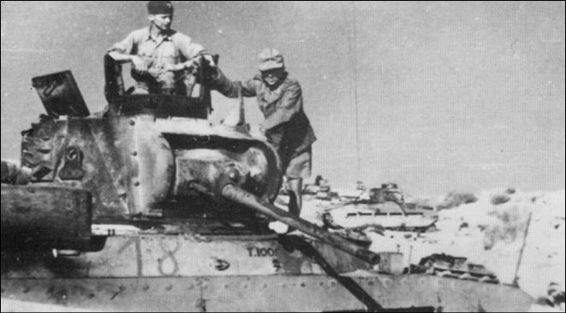
Inspecting one of a group of knocked-out British Matildas. These machines were taken and used by the Afrika Korps in surprisingly large numbers.
This was Rommel’s command position from which he commanded his last action in the desert war; the writing was on the wall for the Afrika Korps.
Rommel, now a disillusioned and physically sick man, was ordered to leave his beloved Africa Korps on 9th March 1943. He flew back to Europe, deep in despair about the approach of the inevitable end. Hitler this time refused to allow him to return to Africa where his men, now under the command of General von Armin, soldiered on. The axis forces retreated all the way into Tunisia and to Enfidaville, some twenty-five miles south of the Cape Bon peninsula and between the mountains and the sea. Here the 90th Light Division dug in around the hills while the 21st Panzer Division prepared to meet a head on thrust from the massed allied forces.
During the first days of May an incredibly ferocious artillery and air bombardment ripped into the German positions. At the heart of the defence of Tunis the 15th Panzer made a desperate last attempt to combat the overwhelming allied forces.
The guns fired until there was no more ammunition. The tanks, when their petrol was gone, carried on firing from where they stopped until they, too, ran out of ammunition. The official report of Army Group Africa preserved to this day, records simply: ‘The bulk of 15th Panzer Division must be deemed to have been destroyed’.
In early May, slowly, reluctantly, the white flags of surrender began to appear from the men whom Hitler had ordered to fight to the last. The allies marched triumphantly into Tunis. Rommel’s Afrika Korps had existed for two years and three months. Out-gunned, out-supplied, out-numbered, but rarely out-manoeuvred, the Afrika Korps marched proudly into the pages of German military.