
22
Mademoiselle from Armentières, Parley-voo?
Mademoiselle from Armentières, Parley-voo?
Mademoiselle from Armentières,
She hasn’t been kissed in forty years,
Hinky, dinky, parley-voo.
HARRY CARLTON AND JOE TUNBRIDGE, popular song of the Great War
A researcher is a pack rat, a private eye, a grave robber, a ghoul. I’ve collected all my life, both to acquire material for books and for the pleasure of accumulation. Two garages overflowing with books, magazines, posters, documents, and letters give proof of a persistent fascination with the hunt. My appetite whetted by Neil’s material, I put my nose to the ground and began the search in earnest.
To scavengers, the street markets of junk known as brocantes are the truffle groves of information. Any weekend, we can be found rummaging through cartons of papers, boxes of postcards, heaps of magazines, sifting through the sand of society for flecks of informational gold.
Over twenty years of haunting brocantes and junk markets on three continents, I’d seen thousands of items relating to World War I: everything from medals and pieces of uniform to postcards and flower vases made from cannon shells. Some I’d even bought—in particular copies of magazines such as La Baïonnette and L’Illustration. Such magazines would be a good place to start my research, but to have some sense of how the war progressed, I needed more than isolated copies. Only long runs told the story in any detail, and these, I assumed, would be rare.
The first inkling that I was wrong came the following week. At the weekly street market at Porte de Vanves, I found a few wartime copies of L’Illustration.
“I don’t suppose you have any more?” I asked the seller.
“Sure.” He led me to his van parked behind the stand and opened the back doors. It was filled with cartons—including one that contained, as far as I could judge, a complete run of wartime issues of L’Illustration.
“How much?”
“Each?”
“For the lot.”
“The lot?”
“I’ll give you fifty euros,” I said.
“Okay!”
He was hardly able to believe his luck. Back numbers of L’Illustration, like Reader’s Digest or National Geographic in the United States, are almost unsellable. He was more than willing to carry them to the car, even at the risk, to judge from his bowed legs and red face, of a double hernia.
After that, it was a kind of gold rush. Maybe it was just because I was actively looking, but forty-four copies of La Baïonnette appeared on a market stall five minutes’ walk from my home. Marie-Dominique located a run of Le Miroir from 1914 to 1916. In the seaside village where we have our summer home, she also spotted a pile of La Vie Parisienne and persuaded the dealer to reserve them until I arrived.
Seeing my delight, the dealer said, “It’s material about la guerre de ’14 you’re looking for?”
“Well, yes. In general.”
He glanced around to see we weren’t overheard.
“Are you interested in unusual stuff?”
“How unusual?”
He went digging in the back of his store and returned with two plain envelopes.
One contained six photographs. Three were postcards. In the first, a woman lies in bed, dreaming of her soldier lover, who appears in a balloon above her head. In the second, the man himself arrives outside her window, complete with tin hat, rifle, and greatcoat. In the third picture, he’s discarded his kit and she’s pulled back the bedding to welcome him in. Since such postcards generally came in groups of eight, I could imagine what happened next.
The other images were original photographic prints.
Two showed a young man carrying a rifle, with fixed bayonet, and wearing a military backpack. He looked embarrassed—understandably, since, unless you counted a wispy mustache and a willing expression, he wore nothing else.
The last photo was the strangest of all. Where the others had been, to some extent at least, professional, this one was homegrown. I could imagine the amateur photographer sloshing the print through developer and fixer in his home darkroom and grinning in satisfaction at how well it had turned out.
It showed the rear view of a nude woman, bent over, presenting her backside to the photographer. He’d drawn on her buttocks a likeness of Kaiser Wilhelm and, to complete the tableau vivant, balanced a pickelhaube on her hips.
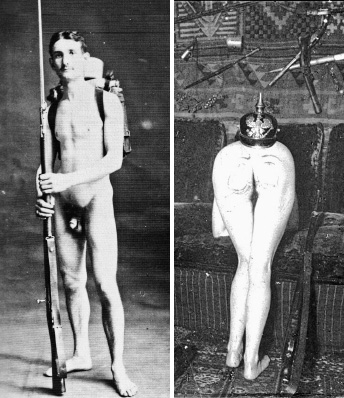
Trying to assume a scholarly expression, I said, “Interesting. Do you know when they date from?”
He pursed his lips. “About 1910, give or take.”
He was guessing. But if these photographs did date from before the war, it added a scrap of evidence to Peter’s theory that France was preoccupied with things military long before mobilization.
“This came from the same place,” he said, interrupting my thoughts. From the second envelope, he extracted a small folded square of cream-colored fabric.
“Do you know what it is?”
I did, as it happened.
Before vulcanized rubber made condoms cheap, men put their trust in kid leather, a pig’s bladder, or a square of finely woven fabric—cotton or, even better, silk. Silk squares were produced for this purpose. They even inspired a joke. “He’s a fine boy,” a man says, admiring a friend’s new baby. “He should be,” replies the father sourly. “He was strained through a silk handkerchief.”
“Yes. I’ve seen them,” I said.
Not to be trumped, the stall holder said, “Not like this one.”
He held it up to display its startling feature. It was photographically printed with pornographic scenes of monks and nuns in impious rapture and unecclesiastic dishabille.
Even the toughest poilu, from a lingering piety, might have shunned such an item, but a foreign soldier—someone like Archie—could well have bought it while on leave, and carried it, somewhat shamefacedly, in a wallet; confirmation for pals back home, if he ever got there, that France lived up to its reputation. Weren’t condoms in their folded paper packets called “French letters” and oral sex known as “Frenching”? Sex was just one more thing, like baking bread or making cheese, at which the French excelled.
The dealer looked at me expectantly.
“I don’t know . . .”
“If you take everything,” he said, “I can make it . . .” He named an obscenely inflated price.
The postcards and photographs had no historical value. As for the handkerchief, who knew when it dated from or whence it came? Any serious historian would dismiss such material. But was it any different than the brass matchboxes, the vases hammered from shell casings? “Trench art” could encompass anything that reminded soldiers of the real world just over the horizon—fragments to cling to amidst the dirt and terror of war.
I reached for my wallet.